THE TOP 6 COMPANIES WITH THE BEST CSR REPUTATION

By: Moksha Grover

Image credit: Relocation Africa Group

WHAT IS CORPORATE SOCIAL RESPONSIBILITY (CSR)?

Its been six years of the advent of the Companies Act, of 2013 that obligated companies to contribute over a specific size and profitability, a portion of their profits or benefits towards societal development, discourses about corporate social responsibility, or CSR, is all over the place. There have been workshops, seminars, meetings, newspaper articles, and award distribution ceremonies galore on the matter.  Today, CSR has become an important aspect for all companies in contributing towards both, society as well as increasing the brand value reputation of the companies. As corporate social responsibility (CSR) is not compulsory, many companies might not prioritize it or engage in it. However, there are many companies ranging from middle-class companies to highly valued companies who have contributed a lot to CSR and continue to contribute, knowing its importance. The top 6 companies with the best CSR reputation are:

INFOSYS LIMITED

Image credit: Alamy

Infosys Limited is ranked as the top company in India, contributing the most towards CSR. Being an early adopter of corporate social responsibility (CSR) initiatives, its contributions to the environment and society have been key factors in the holistic growth of its business.

The company spent nearly Rs. 360 crores on various CSR schemes in the financial year 2019-20[1]. It has contributed to many covid relief works and among its main CSR initiatives in the financial year, 2019-20 were a 100-bed quarantine set up in Bengaluru in partnership with Narayana Health City, and another one which had 182 beds for COVID-19 patients for Bowring and Lady Curzon Medical College & Research Institute[2]. This company has also established the Infosys foundation— a nonprofit nodal body aimed at contributing toward community and society development and betterment and also fulfilling its CSR commitments. Infosys Foundation has worked with many non-government organizations for implementing its projects. Highlights of the Foundation’s interventions in the past include the introduction of Aarohan Social Innovation Awards, restoration of water bodies in Karnataka, enabling the pursuit of access and excellence in sports through the GoSports Foundation, and disaster relief efforts in Tamil Nadu, Karnataka, and Kerala[3].
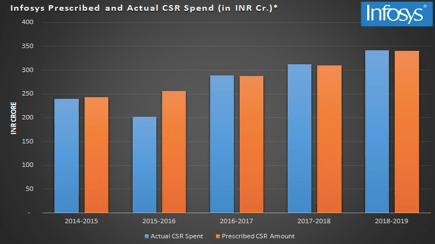
Image credit: The CSR journal

The above graph shows CSR spending of Infosys Ltd. in the last 5 years[4]

ROLEX WATCH CO. LTD.

Image credit: prezi.com

Rolex has been on the top 10 list of the most reputable companies in the world for four consecutive years. Rolex’s success is attributed to the authenticity and longevity of its charity work. By investing in and committing to long-term social enterprise projects, Rolex has an impressive record of over forty years of philanthropic work[5]. The Rolex Awards for Enterprise which were established to commemorate the 50th anniversary of the Oyster Chronometer is a great example of CSR activity carried out by the company. All the individuals who demonstrate leadership and entrepreneurialism in the areas of technology, applied sciences, and the environment are presented with these awards. Since the inception of the Awards, 33,000 people from over 190 countries have applied, and 140 laureates have been selected[6]. These laureates have worked on projects benefitting millions of people in 60 countries across the globe[7]. Several initiatives under the Rolex Perpetual Planet have been taken up for upgrading our environment. These include watching over the Earth’s blue heart, Heroes of the Oceans, and Paula Kahumbu: defending rights for elephants.

MAHINDRA AND MAHINDRA LTD.

Image credit: Avinash Chandra

Mahindra and Mahindra ltd. is known for its contributions to climate change and sustainable business practices. The company spent INR 93.50 crores on CSR initiatives during the financial year 2018-19[8]. The biggest CSR project for educating girls in India known as Nanhi Kali was conducted by Mr. Mahindra. This project provides free education to girls, who belong to low-income backgrounds and also empowers their families. The group works closely with non-profits like Naandi Foundation, which feeds over 1.3 million government school children every[9]. This project also encourages environment-friendly farming practices by working with many small farmers. Mahindra and Mahindra Ltd. has also won the award for India’s best CSR project in the Environment and Sustainability category for its green initiative of project Hariyali, which aims at planting 1 million trees on India’s green cover every year. In the financial year 2019-20, Mahindra & Mahindra planted 1.32 million trees, taking the total tally to 17.93 million trees[10]. Of these, 10.78 million trees have been planted in the Araku Valley, which besides greening the environment, also provides livelihood support to tribal farmers growing coffee in the region[11]. The company’s other CSR projects include Mahindra Pride schools: a unique 90-day livelihood training program for youths from socially and financially disadvantaged communities, Integrated Watershed Management Programme, saving a life with safer roads, employee social options, and covid-19 releif[12].
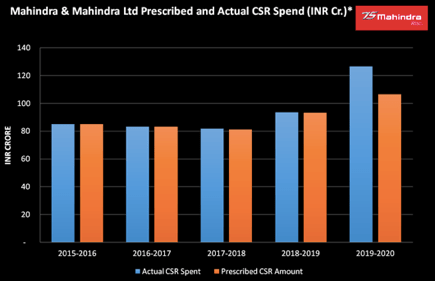
Image credit: The CSR Journal

The above graph shows the CSR Spends of Mahindra and Mahindra Limited for the last five years.

WALT DISNEY COMPANY

Image credit: Money Inc

Considering the Walt Disney company CSR report, it can be said that it is well organized, and consistent, and is in connection with the global reporting initiative (GRI) too.  The company has contributed a lot towards renewable energy, workforce investment, community engagement, charitable giving, and diversity and inclusion. In the financial year of 2019-20, Disney brought online a massive 270-acre, 50+-megawatt solar facility onsite in Orlando, in collaboration with the Reedy Creek Improvement District and Origis Energy USA[13]. The facility generates enough power from the sun to operate two of the four theme parks at Walt Disney World annually[14]. This, along with other initiatives, helped to reduce the net emissions by 47% in FY19 from 2012 levels[15].

Disney has also donated a lot towards workforce investment, supporting the long-term career goals of its employees through education.

The company is investing $150 million over the first five years to cover 100% of employee tuition, books, and education fees[16].

Disney also gave $338.2 million in cash and in-kind donations to non-profit organizations that bring comfort, inspiration, and opportunity to kids, families, and communities around the world[17].
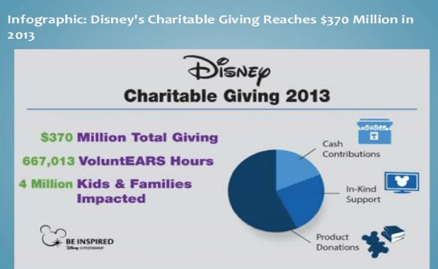
Image credit: Slideshare

COCA- COLA COMPANY

Image credit: India Frontline

Coca-Cola aims to create a sustainable and better future. For this, they follow various activities like Focusing on a World Without Waste, Maximising water conservation, reducing carbon footprint, etc.

In addition to this, all the countries where coca-cola has its market, have increased employment and helped to raise the standard of living which has, in turn, helped to strengthen the national economy.

The company has also launched its project known as the last mile, which aims to expand access to HIV and malaria medicines across Africa. The Coca-Cola Foundation recently awarded a $2 million grant to Project Last Mile—$1 million for South Africa and $1 million for additional countries across the continent—as part of the foundation’s $20 million “Stop the Spread” fund[18]. An additional $500,000 grant from The Coca-Cola Foundation has supported COVAX, a program co-led by the World Health Organization (WHO) to ensure equitable global access to COVID-19 vaccine tests and treatments in the world’s poorest countries[19].

The company also aims at making all its packaging 100% recyclable and also reduce its carbon emissions 25% by 2030 from a 2015 base year[20]
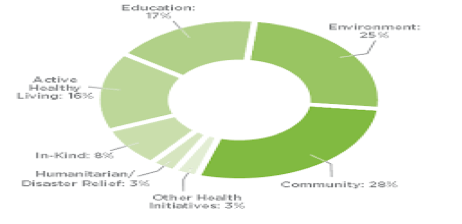
Image credit: research-methodology.net

TATA CHEMICALS LTD.

Image credit: csrbox.org

The CSR model of Tata chemicals limited is very unique. Although the prescribed CSR for 2019-2020 was 21.39 Crores, the company went on to spend 37.81 crores on community development projects[21]. Tata Chemicals spends INR 12 crores on CSR annually, and wildlife conservation accounts for 30% of the budget of the TCSRD[22]. The company has also established the Tata Chemicals society for rural development. The company’s CSR agenda also focuses on empowerment, inclusion—especially of women and socially backward communities, volunteering, technology, innovation, etc. At Okhai, the company provides sustainable livelihood to 900 rural women artisans by applying their traditional handicraft-making skills to create marketable products[23].

Blossom: Promotion and development of native handicrafts •Enhance: Overall enhancing the quality of life, Aspire: Education and vocational skill development, Conserve: Investment in Bio-diversity, natural resource, and climate change management leading to increase in environmental sustainability, Nurture: Health care, sanitary solutions, and safe drinking water are some of the other projects taken up by Tata chemicals ltd[24].
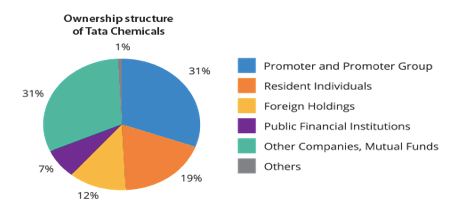
Image credit: Tata Chemicals

[1]  Kasmin Fernandes and Hency Thacker, ‘Top 100 companies in India for CSR in 2020’, The CSR Journal (November 3,2020) < https://thecsrjournal.in/top-indian-companies-for-csr-in-2020/> accessed 18th October,2021

[2] Ibid.

[3] Ibid.

[4]  Hency Thacker, ‘The Ultimate Report on CSR of Infosys Limited’, The CSR Journal (May 18,2021) < https://thecsrjournal.in/infosys-csr-report-india-2020/> accessed 18th October,2021.

[5]  GivingForce Team, ‘Rolex: CSR Business Model Analysis’, GivingForce (July 18, 2018) <https://www.givingforce.com/rolex-csr-business-model-analysis/ > accessed 18th October,2021

[6] Felix Scholz, ‘LIST: 5 times Rolex helped to make the world a better place (for more than just your wrist)’, Time Tide (September 26,2016) < https://timeandtidewatches.com/list-5-ways-rolex-helped-change-the-world/> accessed 18th October,2021.

[7] Ibid.

[8] Kasmin Fernandes and Hency Thacker (n 1)

[9] Ibid.

[10]  Hency Thacker, ‘The Complete CSR Report of Mahindra and Mahindra Limited’, The CSR Journal (January 27, 2021)< https://thecsrjournal.in/mahindra-csr-corporate-social-responsibility-activities-report/ > accessed 18th October,2021.

[11] Ibid.

[12] Ibid.

[13] ‘Disney Publishes its 2019 Corporate Responsibility Report’, The Walt Disney Company (March 12,2020)< https://thewaltdisneycompany.com/disney-publishes-its-2019-corporate-responsibility-report/ > accessed 18th October,2021.

[14] Ibid.

[15] Ibid.

[16] Ibid.

[17] Ibid.

[18] ‘Iteration, for Good: How Project Last Mile is Supporting Covid-19 vaccine distribution in Africa and Beyond’, The CocaCola Company (September 20,2021)< https://www.coca-colacompany.com/news/project-last-mile-covid-19-vaccine-distribution > accessed 18th October,2021.

[19] Ibid.

[20] ‘Sustainable Business’, The CocaCola Company <https://www.coca-colacompany.com/sustainable-business > accessed 18th October 2021

[21] Kasmin Fernandes and Hency Thacker (n 1)

[22] Ibid.

[23] Alka Talwar, ‘Championing CSR’, Tata (March,2018) < https://www.tata.com/newsroom/alka-talwar-championingcsrtatagroup#:~:text=Tata%20Chemicals%20works%20closely%20with,technology%20and%20innovation%2C%20and%20volunteering.> accessed 18th October,2021

[24] Amit Khurana, ‘India’s Top 10 Companies for CSR Initiatives in 2018’, Cross Barriers (November 8,2018)< https://crossbarriers.org/indias-top-companies-for-csr-initiatives-in-2018/ > accessed 18th October,2021.
BRIHADESWARARAR TEMPLE

The big temple, Thanjavur, Unesco classified monument. | Flickr
BRIHADEESWARAR TEMPLE

INTRODUCTION

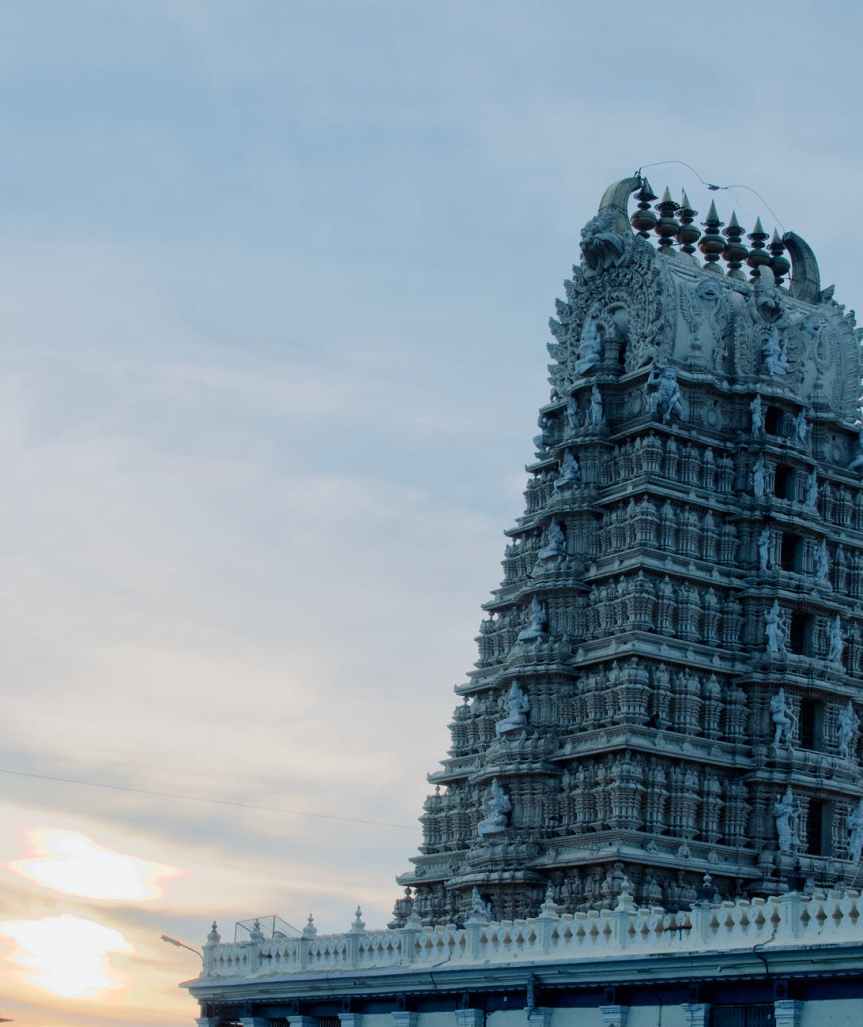
Built by Raja Raja Chola I in 1010 AD,  is an ancient temple at Thanjavur in Tamil Nadu. The deity of the temple is Lord Shiva—in his dancing pose—who is called the Nataraj. The temple is also known as Rajeswara Temple, Rajarajeswaram and Periya Kovil. The temple was built, like a fortress on the shores of a river, by the king to grace the Chola Empire. This thousand-year-old temple is now part of the UNESCO World Heritage Site adding to its exceptional historical and cultural value.

FEATURES

The Big Temple of Tanjavore is a stunning monument that speaks oodles about the  architectural mastery of the Chola era.  This 212 ft (64.8 meter) towering Shiva temple is home to  one of the largest Shiva Lingas of the country.  A majestic Nandhi (bull), measuring a gigantic 19.4 ‘ x 8.23’ x 12’ (5.94 x 2.51 x 3.66 in meters) stands guard over the temple.  This is the second largest  Nandhi in India and is carved out of a single stone.  Everything about this temple is big, majestic.  No wonder it is referred  as The Big Temple.

King Raja Raja Cholan had the main temple built completely with granite.  It is hard to imagine how, in  that age, more than 130,000 tones of granite was brought to the temple site, especially given that  there is no granite quarry within a hundred kilometers of the temple site.  Another stunning  architectural feat is the Vimana / Shikhara – the spire atop the temple.  The beautiful lotus shaped stone of  the Big Temple weighs a stunning 80 tons.  We can but marvel at the engineering mastermind who  managed to hoist an 80 ton carved rock up a 212 feet tower back in the 11th century.

The chief architect of the temple was Kunjara Mallan Raja Raja Perunthachan.  The layout of the  temple is based on the principles of Vastu Shastra, the ancient Hindus science of architecture and  construction and Agamas, the ancient scripts that define principles behind temple construction.  The  central temple site is surrounded by a rectangular boundary 885 ‘ x 450 ‘ (270 m by 140 m).  The  temple boundary holds many sub shrines besides the main temple and the Nandi. 

The niches on three sides of the temple hold images of Shiva, Vishnu and Durga.  The southern wall  has sculptures of Ganesha, Vishnu with his consorts Sridevi and Bhudevi, Lakshmi, a pair of  Dvarapalas, Vishnu anugraha murti, Bhikshatana, Virabhadra, Dakshinamurti, Kalanta and Nataraja.   On the west side there are images of Harihara, Ardhanarishvara, a pair of dvarapalas and two  Chandrasekharas, one with and the other without halo.  On the north, in the lower series, the  depiction of Adhanarisvara, Gangadhara, a pair of dvarapalas, Virabhadra (with a sword and a shield),  Alingana Chandrasekhara, Siva holding a Sula (spear), a pair of dvarapalas, Sarasvati,  Mahishasuramardini and Bhairava.  The north series shows a number of Tripurantakas repeated in  each niche.  In the small circular space of the top niches are present the carvings of Ganesha,  Vrishabavahana, Bhikshatana, Narasimha and Varaha.

Besides these, each wall of the temple and the surrounding architecture are filled to the brim with  carvings and paintings depicting the rich history of art, culture, mythology and science of the era.

“IF HAD A TIME MACHINE ,I WOULD GO BACK 1000 YEARS FOR CHOLA PERIOD TO SEE HOW THEY BUILT A BRIHADEESWARAR TEMPLE(BIG TEMPLE)

SOLAR ECLIPSE

A solar eclipse occurs when a moon is directly between earth and sun. which fully or partially blocks sunlight.During this earth,moon and sun are in a alignment. Such alignment coincides with a new moon indicating the Moon is closest to the ecliptic plane.

TYPES OF SOLAR ECLIPSE:-

* Total eclipse

* Annular eclipse

* Hybrid eclipse

* Partial eclipse.

TOTAL ECLIPSE:-

A total eclipse occurs when the dark side of the Moon completely observe the bright light of the Sun.During total eclipse totality occurs at only in a narrow track on the surface of Earth. This narrow track is called the path of totality.

ANNULAR ECLIPSE:-

An annular eclipse occurs when the sun and moon are exactly in line with earth but one side of the moon is smaller than that of sun.so that region looks very bright.

HYBRID ECLIPSE:-

It is very rare type of eclipse shifts between the total eclipse and the annular eclipse.sometimes it appears as a total eclipse on other side it appears as annular eclipse.A hybrid eclipse occurs when the magnitude of an eclipse changes during the event from less to greater than one.

PARTIAL ECLIPSE:-

A partial eclipse occurs when the Sun and Moon are not exactly in alignment with the Earth. One partial side of the moon observe the bright light of the sun.The phenomenon is called partial eclipse.It seen most part of the earth.

HISTORICAL SOLAR ECLIPSE:-

The first appearance of a solar eclipse can be found in the Rig Veda, the oldest document from India dated to between 1700 and 1400 BC.

The longest solar eclipse in history is 6 minutes 53 seconds on July 11,1991.

IMPACT OF SOLAR ECLIPSE:-

When in total solar eclipse moon is between earth and the sun. It creates unusual weather conditions.It cause drop in temperature and lack of light.It have impact on weather, animals and plants.

Effect in plants

IMPACT ON HUMAN:-

Eye injury: Viewing the eclipse with naked eyes can damage your retina and even lead to blindness.

Digestive issue: The eclipse is believed to disturb the digestive system. For the reason, eating or drinking during the eclipse is to be avoided.

SAFETY MEASURES:-

Projecting the Sun through a box projector, or we can see using binoculars or telescope, or simply 2 pieces of card is a safe and easy way to view a solar eclipse.

Ghaziabad Development Authority finds over 320 illegal colonies.

GHAZIABAD: Over 320 illegal colonies in the district were identified by the Ghaziabad Development Authority (GDA). The GDA plans to make the list public soon on GDS’s portal so that buyers exercise caution while investing in such colonies.

According to officials, Unauthorised colonies have put an additional burden on the city’s resources. In the non-appearance of effective mechanisms, the development authority has failed to monitor the safety quality resulting in building collapse incidents. GDA has long tried to take in in illegal colonies and stopped the registries of such colonies a few years ago.

GDA official said that “Unauthorised colonies in the district are a bane, and they are increasing every year. The problem about these colonies is due to a lack of awareness, buyers invest in these properties and mediators, and land sharks have a big role to play in it. There is an increased pressure to provide civic amenities like water and electric supply once these colonies come up.

“These 321 unauthorised colonies identified in the district include Pandav Nagar, Nandini Enclave, Brij Nagri, Durga Enclave. So, we have decided that these 321 unauthorised colonies will be made public, and the list will shortly be uploaded to the portal. This will prevent people from investing in these colonies,” the official also added.

The problem was also addressed earlier by GDA by requesting the stamp and registry department to verify the land records and documents before executing land registries. The official also said that “But that did not materialise as there is a clause in the registration manual according to which registering officers will not take into account the validity of documents brought to them before executing registries”.

The official also added that registries in unauthorised colonies should keep taking place as in the past, the development authority had written to the state government, requesting it to make the GDA’s previous approval mandatory.

Bio-diversity and climate change (Nature’s cries for assistance)

Bio diversity is the biological variability of life on earth. It is the variation of animal, plants, fungi and microorganisms like bacteria. Biodiversity is a variation in the genetic, species, and ecosystem level. Terrestrial biodiversity is usually greater near to the equator. Biodiversity is not equally distributed on earth. There are only 10% of tropical evergreen forests on earth but they contain about 90% of world species. Marine Biodiversity is greater is usually higher along the coast in western pacific where the sea temperature is highest. Biodiversity generally tends to cluster in hotspots and has been increasing through time. Biodiversity supports everything in nature that we need to survive: food, clean water, medicine, and shelter.

But as people put expanding weight on the planet, utilizing and devouring more assets than ever some time recently, we hazard disquieting the adjust of biological systems and losing biodiversity. Quick natural changes regularly cause mass terminations. More than 99.9 percent of all species that ever lived on Soil, producing to over five billion species, are evaluated to be terminated. In 2006, numerous species were formally classified as uncommon or imperiled or undermined; in addition, researchers have assessed that millions more species are at chance which have not been formally recognized. Approximately 40 percent of the 40,177 species surveyed utilizing the IUCN Ruddy List criteria are presently recorded as undermined with extinction—a add up to of 16,119.

The factors affecting the biodiversity are Residential & commercial development, Farming activities, Energy production & mining, Transportation & service corridors and human activities. Pollution is an another major cause of loss of biodiversity causing habitat destruction. Territory devastation has played a key part in terminations, particularly in connection to tropical woodland pulverization. Components contributing to living space misfortune incorporate: overconsumption, overpopulation, arrive utilize alter, deforestation, contamination (discuss contamination, water contamination, soil defilement) and worldwide warming or climate alter.

Climate change is the long-term alteration of temperature and normal climate designs in short. Climate alter might allude to a specific area or the planet as a entire. Climate alter may cause climate designs to be less unsurprising. These unforeseen climate designs can make it troublesome to preserve and develop crops in districts that depend on cultivating since anticipated temperature and rainfall levels can now not be depended on. Climate alter has too been associated with other harming climate occasions such as more visit and more seriously tropical storms, surges, deluges, and winter storms.

Effects of climate change are Hotter temperatures Nearly all land areas are seeing more hot days and heat waves; 2020 was one of the hottest years on record. Higher temperatures increase heat-related illnesses and can make it more difficult to work and move around. Wildfires start more easily and spread more rapidly when conditions are hotter. More extreme storms Changes in temperature cause changes in precipitation. This comes about in more extreme and visit storms. They cause flooding and avalanches, pulverizing homes and communities, and costing billions of dollars. Many more effects like Droughts, Rise in the level of oceans, shortage of food and more health problems.

Securing biodiversity could be a exceptionally complex errand since most of human’s activities have a negative impact on biological systems by overexploiting them. For occurrence, human exercises create contamination that influences living species. Deforestation crushes the living space of numerous animals, reptiles, and plants. Limiting deforestation Reducing the artificialization of natural environments and preserve natural areas as much as possible Reduce air pollution (by limiting our use of transport and our energy consumption, by switching to renewable energies) Fighting global warming by creating regulations for activities that contribute to the greenhouse effect. Making changes in the way industrial agriculture works and using more agroecology methods.

SPIRITUAL-SELF

Prayer is unimaginable power. It is that enriching experience that provides abundant willpower and courage to deal with our daily problems. Man is not made up of body and mind alone but an integral part is embedded in us, which is the principal part called the “spirit”.

Why do we pray, fast, and meditate? All these practices enable us to control our growth of the spirit and direct our life to be worthy ones. As physical growth is essential for the various needs of our body, spiritual growth and control are important for knowledge and coping with physical problems.

In the Gita 6:24 it is written: “The man who longing, abandoning all desires, he attains peace.”

Globalization and Rural Areas

Globalization is not a foreign concept to many – the term might be as we proceed to the interior. Its effects have been too much and many, touching every spectrum of life to be easily ignored. It can never be not given the time of the day when it has so successfully managed to touch every aspect of life. Its effect as we al know has been positive and negative, just like the two sides of a coin. Often cited to be double-edged sword, it has managed to flourish life for some while disrupt it for some. Bringing and making everything come out to be in open, liberalized, interlinked, interdependent, it has created chaos for beings who couldn’t grasp the complexities of apparently simple notion.

Rural areas with its close-knitted community, spatially located has too not been spared, not any of us expected. Rural development and sustenance have always been necessary for the sprouting and survival of urban areas. How would have urban areas survived if it not were for surplus of agriculture among many other reasons?! However, when we think of a backward area, rural areas would come to our mind if not immediately. It could not act keep up with the pace of development or it might have been neglected in some ways or others.

When Liberalization, Privatization and Globalization reforms were taken up in India, it did allow the country to let its fortunes grow but the negative impact cannot be ignored. The article takes up the case of rural areas and how it has been impacted on the negative side. It does not take up the analysis of data given the time crunch but throws a light on the subject. One of the many effects has been the draining of human resources – sort of every industrial model predicted. With industries coming up attracting the labor for the same. Abundance of labor with just minimum wage served as a profitable interest for the industrialist. However, it led to the rural areas filled with old age people capable of doing only minimum work. With technology coming up requiring more skilled laborers, unemployment is only rising. The lack of proper skills has also compelled the concentration of laborers in the field (disguise unemployment). A viscous cycle has been created, somehow and poverty could never actually leave. Although, development has taken place, reforms have been made in terms of basic needs, imparting training and education, a lot still need to be done. There has been a difference, a very bold line created because of the cultural difference. Though the interlinkages and interdependence has led the spread of ideas, it has also created some sort of animosity among the community towards urban dwellers. One of the reasons can be the exploitation – low wages, some unfair action taken up by the middleman, less profitable trades and the obvious, the viscous cycle of debts, they are unable to escape.

Steps have been taken on the part of government to bring in the development in rural areas. Focus should also be thrown in preserving the culture of the same, creation of jobs in the same heritage, promotion of cottage industries, more push to the handicrafts, encouraging the participation of communities in decision making among many.

Image Credit: Google