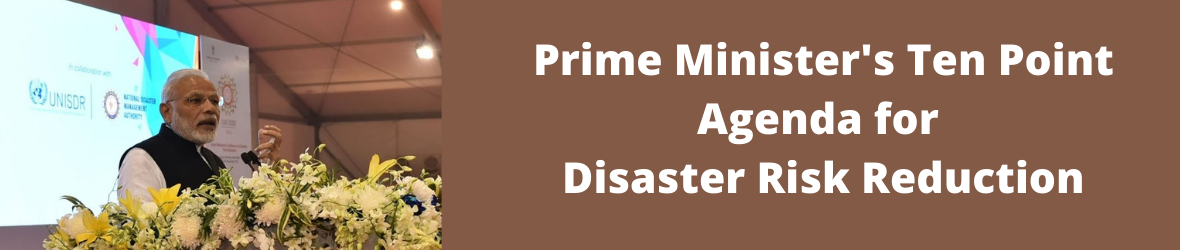
Prime Minister’s Ten Point Agenda on Disaster Risk Reduction

 PM 10 point


Sl No. Agenda Point
1 All development sectors must imbibe the principles of disaster risk management

Explanation
Development and Disasters are two sides of a coin. While a planned development can reduce the risks of disasters, the absence of proper planning can aggravate them. It is, therefore, essential to imbibe disaster risk reduction approach in all development schemes. Development should focus on reducing disaster risks and not create them.▲
2 Risk coverage must include all, starting from poor households to SMEs to multi-national corporations to nation states

Explanation

Disasters result in loss of lives and damages to properties and assets. Those who survive face the challenges of their rehabilitation. This applies to all from poor households to SMEs to multi-nationals.
It is necessary to think big and innovatively to widen the risk insurance cover. Some bold steps have been taken to ensure financial inclusion and risk insurance for the poorest.
Government has some schemes having risk coverage in consideration which include Jan Dhan Yojana, Suraksha Bima Yojana, Fasal Bima Yojana (crop insurance) etc. 
There is a need for:

  • Development of disaster insurance mechanisms for home-owners in disaster prone area
  • Development of parametric insurance for weather and climate related disasters
  • Develop insurance products to cover major infrastructure projects▲
Women’s leadership and greater involvement should be central to disaster risk management

Explanation
It is necessary to encourage greater involvement and leadership of women in disaster risk management to support special needs of women affected by disasters. Women are generally seen as vulnerable to disasters. But women can play an important role in disaster risk reduction at the household, society, community and beyond. We need large number of women volunteers, engineers, masons and building artisans to participate in post-disaster reconstruction and promote women self-help groups which can assist in livelihood recovery. There is a need to include women in NDRF and SDRF, and to train elected women representatives at the local level under development.▲
4 Invest in risk mapping globally to improve global understanding of Nature and disaster risks

Explanation
Disasters know no boundary. Many natural hazards impact across countries, so there is a need for better understanding of such risks at global level. With a shared understanding of the nature and severity of disaster risks globally, their impacts can be mitigated with better planning and preparedness. This requires undertaking multi-hazard risk assessments and developing maps for all major hazards in a standardized format to facilitate disaster risk reduction.▲
5 Leverage technology to enhance the efficiency of disaster risk management efforts

Explanation
Efforts must be made to leverage technology to enhance the efficiency of our disaster risk management efforts. This requires use of technology in resource planning, e.g., India Disaster Resources Network (IDRN), creation of e-platform to map expertise and resources on highly specialized aspects of disaster response and to increase the efficacy of early warning systems for all major hazards through the application of technology.▲
6 Develop a network of universities to work on disaster-related issues

Explanation
It will be helpful to develop a network of universities and academic institutions to work on disaster-related aspects. As part of this network, different universities could specialize in multi-disciplinary research on disaster issues most relevant to them.▲
7 Utilise the opportunities provided by social media and mobile technologies for disaster risk reduction

Explanation
Utilize the opportunities provided by social media and mobile technologies to develop a social media strategy for Disaster Risk Management in the country. Social media is transforming disaster response. It is helping response agencies in quickly organizing themselves and enabling citizens to connect more easily with authorities.▲
8 Build on local capacity and initiative to enhance disaster risk reduction

Explanation
Disaster management must build on local capabilities and initiatives. The task of disaster risk management, particularly in rapidly growing economies, is so huge that formal institutions of the state can at best be instrumental in creating the enabling conditions. Specific actions have to be designed and implemented locally. Such efforts reduce risk and create opportunities for local development and sustainable livelihoods. Localization of disaster risk reduction will also ensure that good use is made of the traditional best practices and indigenous knowledge.▲
9 Make use of every opportunity to learn from disasters and, to achieve that, there must be studies on the lessons after every disaster

Explanation
Ensure that the opportunity to learn from a disaster is not wasted. After every disaster there is a need to undertake research studies to understand the best practices and learn lessons to improve the policy and disaster governance.▲
10 Bring about greater cohesion in international response to disasters

Explanation
Disasters’ impacts are huge and so are the needs to be prepared for and respond strategically. Across the globe, countries face disasters similar in nature and sometimes across the countries. It requires coordinated and unified response by affected countries. Pre-disaster planning and preparedness can result in effective and timely response, hence it is important to bring about greater cohesion in international response to disasters. International forums and protocols should be used in addressing disaster risks for effective and coordinated response.▲

India announces it’s first two cases of newly emerged Omicron Virus

Possibly, the worst covid variant named Omicron has been discovered in South Africa and has already spread to many other countries namely United Kingdom, Netherlands, Italy, Australia, Hong Kong and many others including India.The highly contagious virus Omicron was reported to WHO by South Africa on november 24 and has been designated as “Variant of Concern”. India reported it’s very first two cases of the virus on thursday itself in Karnataka. The Health ministry said that the patients are 66 and 46 years and no severe symptoms have been identified so far. Karnataka Chief Minister Basavraj Bommai said on thursday that the state will issue new covid guidelines and have been testing international travellers coming from at-risk countries after two people were detected with being affected with the virus. As part of new guidelines, the centre has made it mandatory to have a negative RT-PCR report for travellers coming from other countries. After India confirmed two omicron cases of the coronavirus in Karnataka on Thursday, there is some good news waiting in the wings. Government data shows that the Narendra Modi-led central government’s door-to-door vaccination drive, ‘Har Ghar Dastak’, has been able to boost Covid-19 vaccinations. With more and more people getting jabbed in the country, it might help in boosting people’s morale as the whole nation gears up to fight against the newly founded strain “Omicron”.

C.V.RAMAM

Sir Chandrasekhara Venkata Raman FRS was an Indian physicist known for his work in the field of light scattering. Using a spectrograph that he developed, he and his student K. S. Krishnan discovered that when light traverses a transparent material, the deflected light changes its wavelength and frequency.He was born in 7th November 1888 in Thiruvanaikoil, Tiruchirappalli His parents was R. Chandrasekhar Iyer, Parvathi Ammal.He did his education in st Aloysius Anglo Indian High school, presidency College.

C.V.Raman Theory proposed a theory that when light that shines through a material is scattered and its wavelength changes from that of the original incident light because of its interactions with the molecules in the material.This is also called as Raman effect.C.V. Raman is also known as Chandrashekhara Venkata Raman. He was a man of brilliant mind who has done his matriculation at the age of 11 and 12th class at the age of 13. Let us solve an interesting quiz on Dr. C.V. Raman which throws light on his life and inventions done by him.07-Nov-2019

He received many awards,

* 1928-Matteucci medal.

* 1930-Hughes medal.

* 1930-Nobel prize in physics.

* 1941-Franklin medal.

* 1954-Bhart ratna.

* 1957-Lenin peace prize.

Things to do at least once in your life.


This is an image about life.

Living every day, doing our daily chores, when we pause and think. We are often surprised at how fast time passes by as we might have already lived through 20, 30, or 40 years of our lifetime. Although a considerable amount of our lives have passed, when we look back, there are several things that are left unsaid. Several things that are left undone. So many dreams that are left unscathed. 

Maybe now is the time to do some of those things, to add more meaning and experiences to our lives. 

Here are some of the things that you should do at least once in your life.

1.Own a pet:

This an image of Own a pet.


There is nothing like being smothered by the unconditional love of an animal. Owning a pet can especially help improve your mood while having a particularly bad day. You can also practice being caring and compassionate as owning pets will require you to do so very often. What you can have as a pet is up to you. A transformation witnessed in you, in terms of loving and caring is guaranteed!

2. Live alone:

This is an image of Live alone.


To some it may sound daunting, to some it may sound exciting. Nevertheless it’s an experience one should have in their lives. Sometimes it also becomes the need of the hour to spend time alone at your place. Living alone brings in with it the sense of responsibility, adulthood and freedom unlike anything else. You can choose whatever you want to do without seeking permission from anyone. Unless you have a landlord. 

3. Buy something expensive:

This is an image for Buy something expensive.

How long would you keep criticising every newly launched I-Phone while intrinsically desiring to buy the same? Or anything expensive for that matter. Just go ahead and make that expensive purchase at least once in your life. Here’s a follow-up story that can encourage you to pursue the finer things in life. 

Ratan Tata, an Indian industrialist and the former chairman of Tata and sons, spoke about a friend who had the misfortune of losing his pens very often. He ended up buying and using cheap pens as a result of his worrying habit. Ratan Tata gave him the suggestion of buying the most expensive pen that he could afford and see what happens. 

His friend went on to buy a 22 carat gold cross pen. 6 months later when Ratan Tata met his friend again, he asked him about his habit of losing pens. His friend replied saying he is very cautious about his expensive pen and has managed to keep it with him till now. 

It was the value of the pen that made the difference and there was nothing wrong intrinsically with his friend. If this story doesn’t convince you to buy something expensive, nothing else can. 

4. Fall in love:

This is an image of fall in love.


It might not be possible to plan and pursue such feelings in life. But when you do fall in love with someone you have met, embrace this beautiful feeling. What to do after you fall in love is something beyond my league. But the cliched feeling of butterflies in the stomach while you are near them, or imagining spending a lifetime with them when you are away from them. Is a moment worth living and experiencing. 

5. Help a stranger:

This is an image of Help a stranger

There are a lot of people around us who are yearning for our help with something. Donate when an opportunity presents itselves. Reach out to the lone person in the group. Avoid bargaining over petty expenses with the vegetable or fruit vendors. Lend your seat on public transport to someone who has been standing for a while. Buy food for someone. There are plenty of ways we can help as every individual has so much to offer to society. 

Although the list ends here, let your spirit keep looking for more things to do at least once in your life. 

City as an Organism

 An organism is anything that has life i.e. Living . Every city has some characteristics that can be compared to that of a living organism some places of a city act as organs of an organism some bodies (legislature, judiciary, etc.) Function like organs of an organism. 

The system of life is growing in size and in complexity, and so do the infrastructures sustaining it. In 2008 the point was reached where more than 50% of the world population lives in cities. That percentage is growing. By 2030, over 60% of the world’s population – nearly five billion people – will be living in urban area. Initially the two life-essential resources for cities were water and food. As cities grew and as technology evolved, the supply of these resources became dependent on energy for processing, for pumps and for transportation. In the process, cities and their resources evolved into a system of life energized by the individuals that populate cities, and fuel its dynamics. 

A city protects a cluster of houses. A house protects a cluster of humans and a human protects a cluster of organs. All the way down to the bacteria, cooperative clusters are formed that give the participants a more secure way to live. A house is a body. It supports the body but it also contains all the bodily functions. If we provide the house with these bodily functions the house becomes more sustainable. It is possible to regenerate the waste that the humans produce into energy just as the liver is doing in our body.

Body parts

City parts

Heart

City centre (CBD)

Blood vessels

Roads

Brain

Legislature

Spinal chord

Secretariat

Nerves

People

Mouth

Media  Includes newspapers, news channels

Ears

Judiciary

Nose, lungs

Green spaces  parks, gardens

Kidneys

Drainage system

Hands

Services and facilities

For example, Secunderabad is a city located in the state of Telangana to the north of Hyderabad. This city is compared to as a living organism Heart:– Secunderabad – always busy, connected to all parts of the city. Blood vessels: Roads- means to connect the heart to every other part of the city. Skin:- Jawaharlal Nehru Outer ring road- all around the city; outer covering. Alimentary canal:- P V Narsimharao Expressway- longest expressway of India. Nervous System: Administration Brain: Legislature- law making. Spinal chord :- Secretariat- body which makes sure that laws are implemented. Nerves:- People- who elect representatives to enable reach of their problems to the legislature. Eyes. Birla Mandir One of the most prominent highest points of Hyderabad. View of the entire city from the top of the temple. 

Mouth:- Media includes newspapers, news channels and their team- journalists; reporters; cameramen; creative team Local channels that promote tourism of the city and highlight culture of Hyderabad; radio channels. Ears:- Judiciary; mainly lawyers Listen to problems of the people Receptors: High court for the state of Andhra Pradesh and the state of Telangana. Respiratory system:- Nose, lungs, Green spaces parks, gardens. Lakes: Hussain Sagar Tank bund, Necklace road. Two cricket stadiums and many football grounds. Skeleton:- Metro rail Connects parts of the city. Bones join during the course of time- Metro was built in parts and joined later to form a continuous phase. Legs:- Modes of transportation predominant: APSRTC (now TSRTC) buses. Hands:- Services and facilities. Electricity and water supply educational institutions hospitals functions of GHMC. Shoulders;- Hi tech city carry weights of the economy of the city. Hyderabad as an IT hub – IT sector- major contributor to the economy of Hyderabad. Kidneys ;– Drainage system, collection of drainage, disposal or purification of the drains. Hair:- Tourismtourist attractions, add beauty to the city, Major attractions: Charminar, Golconda fort and Ramoji film City, Snow world, Hussain Sagar- Buddha statue and adjoining parks, Nehru zoo, etc.