Promoting Investor Education and Financial literacy among youth through Gyan Darshan channel

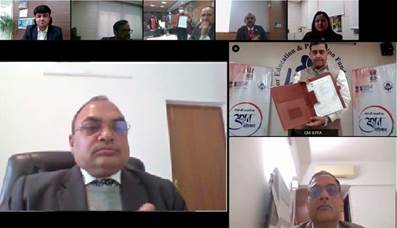
 The Investor Education and Protection Fund Authority (IEPFA) under the aegis of Ministry of Corporate Affairs has signed a Memorandum of Understanding (MoU) with Indira Gandhi National Open University (IGNOU) through a virtual event here today. The objective for signing the MoU is to achieve the mandate of Investor Education, Awareness and Protection by utilizing the tele-lecturing facility of Gyan Darshan Channel.

This association with IGNOU/Gyan Darshan channel will help in propagating the message of Investor Education and Awareness among a large group of present and prospective stakeholders. The panel of resource persons for the lecture series would include experts from professional institutions such as ICAI, ICSI & Senior officials from IEPFA, Ministry of Corporate Affairs and other regulators. The proposed lecture series of 75 episodes will be live tele-lecturing series on 24×7 Gyan Darshan TV channel and is a part of the ongoing celebration of the yearlong activity commemorating the 75th anniversary of India’s Independence under “Azadi ka Amrit Mahotsav”.

26 Episodes of the tele-lecturing series were earlier rolled out in the year 2021 which were appreciated by all stakeholders. The repository of the tele-lectures is available on IEPFA’s official YouTube channel.


      Description: A picture containing text, indoor, wall, personDescription automatically generated


Shri Rajesh Verma, Secretary, Ministry of Corporate Affairs (MCA) and ex-officio Chairperson of IEPFA in his keynote address said, “All of us are here with the common goal of educating people. The entire nation is celebrating 75 years of Azadi ka Amrit Mahotsav to celebrate the spirit of a self-reliant, progressive nation, India has become. This day is also celebrated as National Youth Day to commemorate the birth Anniversary of Swami Vivekananda, the youth ICON and influencer of global stature. With all these noble events falling together, today’s event has become even more apt and relevant. Both IEPFA & IGNOU have the common objective of imparting education and making people aware about subjects affecting their lives. IEPFA intends to create awareness among all the stakeholder groups and specially the youth”.

Prof. Nageshwar Rao, Vice Chancellor, IGNOU, in his remark stated that IGNOU and IEPFA with this initiative shall reach out to youth and other stakeholders at large which would be productive in fulfilling the vision and mission of both the organizations.

Sh Manoj Pandey, CEO IEPFA Authority, Prof. Satyakam, Pro-VC Vice Chancellor, IGNOU, Sh Nihar Jambusaria, President ICAI, Sh Nagendra D. Rao, President ICSI and other Senior officials from IEPFA, IGNOU and Ministry of Corporate Affairs also graced the occasion.

Investor Education and Protection Fund Authority (IEPFA) has been established under Section 125 of the Companies Act 2013 for administration of the IEPF fund as per section 125 (3) of Companies Act 2013. The main objective of the authority includes to promote Investor Education, Awareness & Protection, refund unclaimed shares, dividends and other amounts transferred to it under sections 124 and 125 of the Companies Act 2013 to the rightful claimants. IEPFA works under the administrative control of Ministry of Corporate Affairs.


****

Initiatives of Government in ensuring Safety in Online Education

 Central Board of Secondary Education (CBSE) has launched a ‘Cyber Security Handbook’ to ensure safe and healthy digital habits among students. This module covers topics in cyber safety, such as cyber bullying, including social exclusion, intimidation, defamation, and emotional harassment, online sexual abuse, cyber radicalisation, online attack and frauds, and online enticement. The ‘Cyber Security Handbook’ can be accessed at this link:http://cbseacademic.nic.in/web_material/Manuals/Cyber_Safety_Manual.pdf

Indian Computer Emergency Response Team (CERT-In) under Ministry of Electronics & Information Technology has prepared guidelines to handle the security concerns about various video conferencing apps, which can be found at this link:

https://www.cert-in.org.in/s2cMainServlet?pageid=PUBWEL01

The National Commission for Protection of Child Rights (NCPCR) has also issued advisory to all secretaries at school education department of all states to ensure safety of students in online classes.

PRAGYATA guidelines for school heads and teachers describe the need assessment, planning and steps to implement digital education while ensuring cyber safety and privacy measures. The guidelines can be accessed at:

https://www.education.gov.in/sites/upload_files/mhrd/files/pragyata-guidelines_0.pdf

National Webinar on ‘Indian Knowledge System, Languages, Art & Culture’

 As part of the celebration of one year of transformative reforms under National Education Policy, 2020, Government of India is organising a series of theme-based webinars on different aspects of National Education Policy, 2020. Indian Knowledge System, Language, Arts & Culture being one of the innovative thrust area of NEP, Indian Knowledge System at AICTE under Ministry of Education organised a National Webinar on Transforming Education in the Light of Indian Knowledge System, Language, Arts & Culture today.  Union Minister of Education and Skill Development and Employment Shri Dharmendra Pradhan was the Chief Guest on the occasion. Member of Parliament Shri Tejasvi Surya; Secretary, Higher Education Shri Amit Khare Senior officials from Ministry of Education and AICTE were also present.

Speaking on the occasion Shri Dharmendra Pradhan discussed the relevance of traditional knowledge systems & ancient wisdom in contemporary times and their role in the making of an Aatmanirbhar Bharat. He stated that there is a need to synergise knowledge with art, culture, language with a spirit of Bharatiyata.

The Minister said that no society can thrive without connecting to its roots. Our past is filled with examples of architectural grandeur, engineering marvel and artistic excellence, he further added. He called for conservation, promotion and dissemination of this cultural wealth of India should be the top priority of the country because it is crucial for the country’s identity. 

Shri Pradhan highlighted that the National Education Policy has laid down a roadmap for 21st century India and lays emphasis on our traditional knowledge systems. By taking Indian knowledge traditions forward, we can sow seeds for starting a new era. We must recreate our traditional knowledge with contemporary, contextual relevance to connect with the youth, he added. Shri Pradhan stated that solutions to many of contemporary challenges lie in our traditional knowledge systems

Shri Amit Khare, Secretary, Higher Education in his address shed light on the formulation and fundamentals of National Education Policy, 2020. Shri Khare said that NEP is the medium to fulfil the aspirations of New India and it will play an important role in realising the Prime Minister’s vision of attaining self-relaince. 

Shri Tejasvi Surya expressed his views on the need of new NEP 2020 with respect to Traditional Indian Knowledge in 21st century. He said that Science, Culture, Civilization, Art, various ancient learnings, History etc. are an important part of our glorious tradition and our young generation should we be aware and respect these traditions. He stressed upon value-based education to learners.

Shri Surya also highlighted different aspects of traditional Indian wisdom with respect to NEP 2020 which is being reintroduced in Indian Education. He added that through this NEP 2020, a strong effort is being made to strengthen the departments and institutions of various languages ​​across the country.

The theme wise sessions were conducted followed by the Inaugural Session where the first session of the Webinar was on the theme “Indian Knowledge System” and was addressed by Dr.Shailendra Raj Mehta,President and Director, MICA, Ahmedabad; Dr. A. S. Nene,Board Member, Civil Engg. Dept., Jagatguru Shri Devnath Institute of Vedic Science and Research, Nagpur;Prof. M. D Srinivas,Chairman, Centre for Policy Studies, Chennai.

The second session of the Webinar was on the theme “Languages” and was addressed byShri. Chamu Krishna Shastri, Secretary, Sanskrit Promotion Foundation; Prof. Santosh Kumar Shukla, Dean, School of Sanskrit and Indic Studies, JNU, New Delhi;Dr.Sudha Seshayyan,Vice- Chancellor, The Tamil Nadu Dr. M.G.R Medical University, Chennai.

The third session of the Webinar was on the theme “Arts & Culture” and was addressed by Dr.Sonal Mansingh, Member of Parliament, Rajya SabhaIndian classical dancer and Guru Bharatanatyam and Odissi dancing style; Dr. Anil Joshi, Environmentalist, Green Activist, and the Founder of Himalayan Environmental Studies and Conservation Organization, Dehradun; Dr.Shashibala,Dean, Centre of Indology, Bhartiya Vidya Bhavan, New Delhi.

The Valedictory session was conducted by the concluding remarks of Prof. Anil D. Sahasrabudhe, Chairman, AICTE. He motivated with the thought that the upcoming NEP 2020 by the Ministry of Education is the golden opportunity to awaken the self-respect and self-reliance for all the students.

Educational Infrastructure in North-Eastern States

 University Grants Commission (UGC) is implementing schemes, awards, fellowships, chairs and programmes under which financial assistance is provided to institutions of higher education as well as faculty members working  in North Eastern States to undertake quality research covering areas of knowledge across disciplines. Some of the initiatives taken for improving quality of higher education are (i) Choice Based Credit System (CBCS); (ii) Universities with Potential for Excellence; (iii) Centre with Potential for Excellence in particular area; (iv) Consortium for Academic Research and Ethics(CARE) (v) Basic Science Research (vi) Scheme for Trans-disciplinary Research for India’s Developing Economy (STRIDE) (vii) Deen Dayal Upadhyaya (DDU) Kaushal Kendras (viii) Scholarship Scheme (ISHAN UDAY) for North-Eastern Region; (ix) New Methodology of Grading by NAAC (x) UGC (Minimum Standards and Procedure for award of M.Phil/Ph.D Degree) Regulations, 2016; (xi) UGC (Credit Framework for Online Learning Courses through SWAYAM) Regulation, 2016. 

All India Council of Technical Education (AICTE) has taken several steps over the years for framing appropriate policies on technical education needed to design and implement various schemes for educational advancement and achieving the objective of creating favorable environment to ensure speedy socio-economic development in North East States. This includes equipping all necessary infrastructure upgradation of colleges, special coaching, educational concessions, better teaching learning material and infrastructure for North East region students. Some of the Schemes are (i) Research Promotion Scheme for North East Region; (ii) Short Term Training Programme for NER; (iii) Faculty Development Programme for NER; (iv) Scheme of Funds for Regeneration of Traditional Industries (SFURTI); (v) Post Graduate Scholarship Scheme; (vi) Doctoral Fellowship; (vii) Pragati Scholarship Scheme; (viii) Saksham Scholarship Scheme; (ix) Campus Accommodation & Facilities Enhancing Social Experience; (x) Grant for Augmenting Infrastructure in NER; (xi) Scheme for Promoting Interests, Creativity and Ethics among Students; (xii) Grant for Organizing Conference; (xiii) Establishment of Idea Development, Evaluation & Application Laboratory in Institutions; and (xiv) E-Shodh Sindhu (Subscription to e-Journals). 

A Virtual Reality

InformationQ.com on Twitter: "Gadgets – cheek out the latest electronics  gadgets information and it's reviews. And latest news on electronics gadgets.  #Gadgets #Electronics #GadgetsInfo #LatestElectronics  https://t.co/4qVjU9uO5U" / Twitter

As Neil DeGrasse Tyson rightfully says, “Dreams about the future are always filled with gadgets.” We human beings have constantly been growing and developing rapidly for generations now. One of the most things that we are constantly moving ahead with us is technology. The number of tabs, mobiles, phones, laptops that roll out in a few months is so many in our daily live themselves. Electronic gadgets once were a just medium however, now it is a necessity for every single human being. By this, I think the readers have some kind of idea about my topic for today’s article. It is about how electronic gadgets have become a part of our daily lives and even more during the pandemic.

Human life and electronic gadgets

Remember the time when having a phone used to be a privilege. We knew all the phone numbers through our strong memory. The only time that we used to get phones in our hands was when our parents were not using them and we could play all the games on them. Electronic gadgets then were a means of getting the work done or for communication. From standing in one place and using the landline to being able to move around with a mobile phone we have come a long way. Electronic gadgets have come a long way with human civilization. However, by coming along with us they have also managed to seep into our lives so much that now mobile phones, laptops have become more than just their purpose. They have not just become a part of our world but they are also our world now.

I was casually scrolling through social media when I came across this post showing a mom during the earlier times pulling us inside the home while the childe still was playing and a parallel image of the present where the mom is pushing out of the house to go and play outside. This might sound very typical and cliché but it is the reality. The virtual world has immensely taken over our real world. The games that we once used to play on the road is something that now children play on video game. Electronic gadgets have not just brought bad things but also an immense amount of good things. People do not have to spend a lot of time searching for information rather; it is now readily available at our fingertips. A cinematic experience is now available in the comfort of our own houses because of the various electronic gadgets that have come about to make our lives more comfortable and luxurious. We do not have to remember every single phone number these days. Just a small click and all the numbers are right with us anywhere, anytime, and any place.

With the invention of electronic gadgets, it slowly became a means of provision, entertainment, etc by the establishment of apps. Today, the virtual world of apps and online businesses has an immense amount of impact on our real-world not just physically but also mentally, emotionally, financially, and economically. Due to apps and electronic gadgets people can be a part of every sector such as clothing, footwear, food, appliances, language, culture, world, etc. Electronic gadgets and apps have made our lives easier, simpler, and more accessible. It is maybe due to this that these days electronic gadgets have become inevitably an important and major part of our lives.

The reason electronic gadgets whether it be television, radio, mobile phones, laptops, washing machines, etc are known as a necessary evil these days is because it has made it possible to increase human efficiency and productivity but at the same time is harmful to not just human beings, but also to nature and other living species of plants and animals. The improvement of technology, gadgets, etc has brought about so many solutions and yet so many problems that needs tackling and handling for the future generation to survive in the coming generations.

Electronic gadgets and the virtual world has been responsible for bringing human civilization together and are also responsible for bringing about division, hierarchy in human civilization. Electronic gadgets and the virtual world plays an important role in bringing about good in society but also play the same amount role in bringing about the bad things as well. It has connected us and disconnected us at the same time.

Therefore, it is very important to realize that human beings need to have the same amount of responsibility, carefulness, etc that they have in the real world to be present in the virtual world as well.

Let me ask all the readers out there, ‘What would happen if this necessary evil as we call it became our only means of dependency and daily living?’ Well, the answer is simple. Whatever is happening right now due to the pandemic would happen if we think about it. The dependency and the increase in the virtual world becoming our real world is because of the pandemic that we are still a part of even today. The pandemic has made it impossible to live without electronic gadgets these days.

Let us understand more about this.

How Cloud Technology Helps Connect People and Reduces Isolation

The Real virtual world during the pandemic.

Remember the times when our parents constantly were annoyed about the amount of time children spend on their phones and laptops? During the pandemic, it even got worse. Children’s screen time amount drastically increased during the pandemic. They spent time attending classes online and even spent the rest of the time on electronic gadgets because it was not safe during the pandemic to go outside. Their daily real world was constantly revolving in the virtual world and this brought about an immense amount of stress and uneasiness among children. The real world becoming the virtual world was not just for students, children but also for adults who were working regardless of which sector they were working in.

The real and the virtual world becoming one was a big problem especially for the lower economic class. Electronic gadgets do not come cheap and during the pandemic education, business and everything else became online which made it even more difficult for these people to survive and keep up with other people. Students from small towns and villages found it very difficult to survive in the real virtual world because they did not have access, products, or connection that would help them move forward with other kids.

The consumers during the real virtual world had a drastic increase, which brought about inefficient production. I have only mentioned the education sector but there are many more sectors that are very affected due to the virtual and the real world coming together as one.

The real and the virtual world becoming one are a boon and a pain at the same time. This was because it kept us safe and protected but at the same time brought about more amount of problems during the same time. Virtual reality has not had a conclusion yet. We are still fighting the pandemic and trying to bring about recovery from the losses and struggles that we have been facing for almost two years now. The only thing is that we are now more adaptable to the virtual and real-world coming together through experience.

To conclude with a hopeful note that, it is time we human beings act more responsibly, carefully, wisely so that we can overcome the pandemic time and through the lessons, we have learned during this time bring about some positive change and awareness and make our world a better place for everyone.

References

  1. Google searches for images and quotes