Synergy between education and skills for making a future-ready workforce

 Addressing the CII’s virtual special plenary session on ‘Job Creation & Entrepreneurship – Way Ahead for Livelihood Generation’, Union Education and Skill Development Minister Shri Dharmendra Pradhan said that under the leadership of Prime Minister Shri Narendra Modi, the economy is growing at a rapid pace and the future of India is looking very promising. He added that building skill capacity is a key to enhance productivity and drive the economy ahead. 

Shri Pradhan highlighted that continuous efforts are being made to equip our youth with the 21st Century Skills. He said that as envisioned in the National Education Policy (NEP) -2020, the Government is working to create greater synergy between education and skills for making a future-ready workforce. NEP will contribute in creating a robust education ecosystem and eventually facilitating economic growth, he added.

The Minister informed that Educational institutions and skill development centers have been affected during the pandemic but Government ensured continuity of education by developing digital content at a large scale. He further informed that in the near future every village will be connected with high-speed Internet and these mass-scale digitization efforts are creating new education, skilling, and entrepreneurial ecosystems. 

Shri Pradhan stressed that teachers play an important role in building society and technology is reshaping society. With the greater advent of technology and changing society, our teachers need to be re-skilled and up-skilled, he added. 

Shri Pradhan urged that as we celebrate “Azaadi ka Amrut Mahotsav”, we must work together to make our youth future-ready who will lead India towards the goal of an Aatmanirbhar Bharat. He stated that with this goal, India is going to witness rapid economic growth and will become the engine of global growth. The Minister called upon the industry to contribute to this mission.

Shri Ajay Shriram, Chairman and Senior MD, DCM Shriram Ltd, Shri Chandrajit Banerjee, Director General, CII , Dr. Gayathri Vasudevan , Pratham Education Foundation and other industry experts attended the session.

*****

Booklet on one-year achievements of NEP Implementation

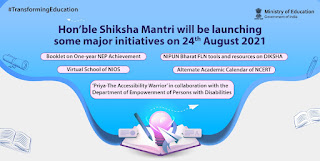
 In order to commemorate one year of the implementation of NEP 2020, the Department of School Education and Literacy, Ministry of Education has prepared a booklet on one-year achievements of the NEP Implementation. The booklet will be launched virtually by Union Minister of Education, Shri Dharmendra Pradhan on 24th August, 2021


In addition to the booklet, some major NEP 2020 initiatives will also be launched by the Education Minister. These include: NIPUN Bharat FLN tools and resources on DIKSHA, which is a separate vertical for FLN resources developed under DIKSHA to assist and mentor States/UTs and teachers for implementing NIPUN Bharat; Virtual School of NIOSfor providing advanced digital learning platforms through Virtual Live Classrooms and Virtual Labs; Alternate Academic Calendar 2021-22 of NCERT containing week-wise plan of interesting and challenging activities, with reference to learning outcomes, themes and chapters taken from syllabus or textbook. 

Union Education Minister along with Minister for Social Justice and Empowerment, Dr Virender Kumar will also launch, ‘Priya’- Accessibility booklet developed by NCERT in collaboration with Department of Empowerment of Persons with Disability for ingraining the concept and significance of accessibility in children right from their formative years itself as a move towards inclusive education.

As the National Education Policy 2020 envisions a substantial transformation in the entire education system at all stages, the Department of School Education and Literacy took the implementation of the NEP 2020 on a mission mode and has prepared a flexible, interactive, indicative and inclusive NEP implementation plan called SARTHAQ.  The Department has accomplished 62 major milestones in this one year, which will transform the school education sector. These include: NIPUN Bharat Mission on Foundational Literacy and Numeracy, aligning of the Samagra Shiksha scheme with the NEP 2020, Vidya Pravesh- a three months School Preparation Module, Blue print of National Digital Education Architecture (NDEAR), capacity building of Secondary teachers under NISHTHA, Assessment reforms, Digital content on on DIKSHA, etc

The programme will be attended by senior officials of the Department and Heads of Autonomous Institutions and senior officers from the School Education Department from all States and UTs, and will be followed by a workshop with the states and UTs, SCERTs on the way forward for NIPUN Bharat Mission.

*****


Innovation-driven virtual schools to achieve greater inclusion in school education

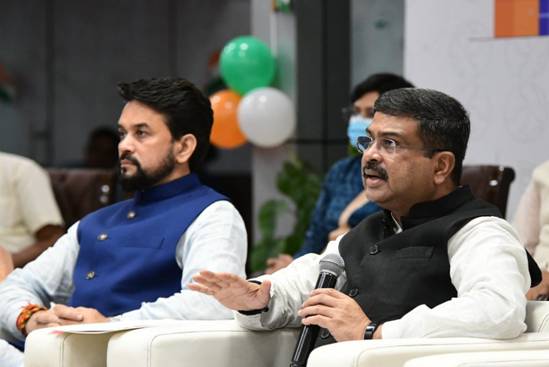
 Union Education and Skill Development Minister, Shri Dharmendra Pradhan and Union Minister for Social Justice and Empowerment Shri Virendra Kumar today jointly launched the booklet on One-year New Education Policy (NEP) – 2020 Achievement along with some major initiatives of the New Education Policy- 2020 such as NIPUN Bharat FLN tools and resources on DIKSHA; Virtual School of NIOS; Alternate Academic Calendar of NCERT; and Release of ‘Priya’- accessibility booklet developed by the NCERT and Department of Empowerment of Persons with Disabilities. Minister of State for Education Smt Annapurna Devi and Secretary, School Education Smt Anita Karwal were also present on the occasion.

Addressing the participants, the Minister said that NEP is a guiding philosophy to transform the hopes and aspirations of millions of the youth to reality and making India self – reliant. He said that the formulation of NEP is also a live example of co-operative federalism to achieve a common goal of making India a global hub of knowledge. When we look back at the progress of NEP, we get more confident about the future of our students, he added.

Shri Pradhan stated that Education is not merely a competition to acquire degrees, but is a transformative tool to leverage knowledge for character building and eventually nation building. The Minister stressed that the Government is working to facilitate upgradation of infrastructure in schools, such as ensuring that Internet reaches the village schools across the country.

Shri Pradhan said that the book “Priya -The Accessibility Warrior”, released today will sensitize the students on accessibility related issues for Divyangs. Special emphasis has been laid to make the booklet simple, interesting and interactive to create awareness on accessibility in children right from their formative years, he added.

The Minister while launching the Virtual School of NIOS said that this school is a new model of learning and is an example how leveraging technology and innovation can facilitate greater inclusion in education. The school is first-of-its-kind initiative in the country which will provide advanced digital learning platforms through Virtual Live Classrooms and Virtual Labs., he added. Shri Pradhan also said that the Alternate Academic Calendar of NCERT has been developed to facilitate teachers and parents to assess the progress in the learning of children. The Alternate Academic Calendar contains week-wise plan of interesting and challenging activities, with reference to learning outcomes, themes and chapters taken from syllabus or textbook.

Speaking on the occasion Shri Virendra Kumar said that the accessibility opens doorways to opportunity and growth, thus, reinstating the importance of creating an accessible environment for everyone. He further said that awareness and a sensitized community are the essential fuels driving any revolutionary change. Government’s commitment to promote accessibility led to the development of the E-Comic cum Activity Book, titled – ‘Priya- The Accessibility Warrior’.

Shri Kumar urged both the Departments of School Education & Literacy and Department of Higher Education to take up the task of creating accessible educational infrastructure and content on a mission mode, consistently progressing towards Inclusive Education which is a vital component of the new National Education Policy. On the occasion of the 75th year of Independence of India, let us all work with our Children to become ‘Accessibility Warriors’ and make inclusive education a reality to build a brighter future for all our citizens, he added.

Another important initiative launched was “Priya -The Accessibility Warrior”, which is the outcome of collaborative efforts of Department of Empowerment of Persons with Disabilities (Divyangjan), Ministry of Social Justice and Empowerment and Department of School Education and Literacy. It provides glimpses into the world of a girl named Priya who met an accident and could not walk, due to plastered leg. The story depicts how Priya managed to participate in all activities at school, and in the process learnt the importance of the accessibility. She, therefore takes the pledge of being an accessibility warrior. The comic book is also available with Indian Sign Language (ISL) explanatory videos.

NEP 2020 envisages education as a continuum without any segmentation and focuses on making education more experiential, holistic, integrated, character-building, inquiry-driven, discovery-oriented, learner-centred, discussion-based, flexible, and above all, more joyful. With this perspective, the Department of School Education and Literacy has taken up a multitude of initiatives at all levels of school education and has achieved 62 major milestones which will eventually transform the school education sector.

Other major achievements include: the launch of NIPUN Bharat Mission with a vision to ensure every child achieves the desired learning competencies in reading, writing and numeracy by the end of Grade 3, by 2026-27; aligning of the existing scheme of Samagra Shiksha with Sustainable Development Goal for Education (SDG-4) and the NEP 2020 to ensure inclusive and equitable, quality, and holistic school education; Vidya Pravesh- a three months School Preparation Module for Grade I children; Blue print of National Digital Education Architecture (NDEAR) conceived to energise and catalyse the education ecosystem, capacity building of Secondary teachers under NISHTHA with a focus on improvement in quality of teachers and learning outcomes of students, Assessment reforms to make learning more joyful and experiential, DIKSHA as an teaching-learning repository of engaging e-content, etc.

NIPUN Bharat FLN tools and resources has been made available under a separate vertical for FLN resources developed under DIKSHA to assist and mentor States/UTs and teachers for implementing NIPUN Bharat guidelines. This vertical has infographics and videos on learning outcomes and assessment tools for teachers to facilitate them.

The programme was attended by senior officials and heads of autonomous institutions of the department, senior officers from the School Education department of all States and UTs and experts.

Click the link below to see the booklet on One-year New Education Policy (NEP): https://www.education.gov.in/sites/upload_files/mhrd/files/upload_document/nep_achievement.pdf

Click the link to see the booklet “Priya -The Accessibility Warrior”: https://ncert.nic.in/ComicFlipBookEnglish/mobile/

Click below to see the details of Virtual Open School: http://virtual.nios.ac.in/

*****

61st Foundation day of National Council of Educational Research and Training (NCERT)

 Union Minister for Education, Shri Dharmendra Pradhan will be addressing 61st Foundation Day of National Council of Educational Research and Training (NCERT)  tomorrow via video conferencing.. MoS (Education), Shri Subhas Sarkar and MoS (Education), Dr. Raj Kumar Ranjan Singh along with Sh. Santosh Kumar Sarangi, Addl. Secretary, DoSEL, Prof. Sridhar Srivastava, Director, NCERT and senior official of the Education Ministry and NCERT will also be present on the occasion.

As a premier national organisation the Council is committed towards promoting excellence, equity, inclusiveness and quality, in the arena of school education.  The significant activities of the Council, spanning six decades of its existence, covers research, development of curriculum, textual and training materials (both face-to-face and online), and supplementary readers, aim to meet the needs of teacher educators, teachers and students. The organisation has significantly contributed in all deliberations and consultations of the National Education Policy (NEP) 2020, organised at all levels including the grassroots. Significant initiatives were taken up in eliciting bench mark information on student’s achievements in all States and Union territories that was collected with the help of the National Achievement Survey (NAS),. Contributions were made in developing Learning Outcomes (LO’s) and in preparing e-contents in all subject areas covering all stages of school education, for concept clarification and better understanding of subjects. Another milestone of achievement included the preparation of ECCE Curriculum and guidelines. NCERT is presently working towards development of National Curriculum Framework for school education, early childhood care and education, adult education and teacher education. It is helping the States to develop their own State Curriculum Frameworks. During the pandemic time, NCERT developed Alternative Academic Calendar for students of all classes and subjects so that their learning is not affected when the schools are closed.

*****

HAMMURABI – THE BABYLONIAN RULER OF MESOPOTAMIA

‘A youth full of fire and genius, a very whirlwind in battle, who crushes all rebels, cuts his enemies into pieces, marches over inaccessible mountains, and neve loses an engagement’ – Inscriptional evidence, William James Durant

WHO IS HAMMURABI ?

Hammurabi (Khammurabi/Ammurapi) was the 6th king of the Amorite first dynasty of Babylon, reigning from 1792 – 1750 BCE. He conquered all of Mesopotamia, from Babylon by 1750 BCE. The Sources that give us information about his life and achievements are inscriptions, letters and administrative records. He is famously known for his ‘Law code’.

HAMMURABI’S ACHIEVEMENTS

  • He centralized and streamlined the administration and heightened the fortifications
  • He issued a proclamation – cancelling all debts
  • He improvised Irrigation of fields and maintenance of infrastructure of the cities under his control.
  • A popular title – ‘BANI MATIM’ (builder of the land) was given to him, as he issued building projects like granaries, palaces, canals and a bridge across the Euphrates River that allowed city to expand on both banks
  • He built temples to the gods, as well as, renovated the sanctuaries of gods, especially Marduk (Babylon’s patron deity)

POLITICAL AND CULTURAL BACKGROUND OF HAMMURABI

  • Hammurabi – Hammu (family in Amorite) and Rapi (great in Akkadian) came from the Amorites, who were nomadic people coming from the coastal region of Eber Nari to Mesopotamia around c. 2 – 3rd millennium BCE. They were ruling the Babylonian region by 1984 BCE.
  • Hammurabi is credited with expanding the city of Babylon to unite all of Southern Mesopotamia.

HAMMURABI’S ‘CODE OF LAW’ (C. 1772 B.C.)

Hammurabi’s stele (Image credit: KJZ/Flickr. Copyright 2021)
  • Jacques de Morgan, found the stele on 1902. He was a French mining engineer, who led the archaeological expedition to excavate the Elamite capital of Susa, located at a distance of 250 miles from Hammurabi’s kingdom.
  • The black diorite block, nearly 8 feet high, was broken into three pieces, probably by the Elamites who brought it to Susa as spoils of war in mid 12th century B.C.
  • It is the longest inscription of early Mesopotamian History, containing almost 51 columns of text, housed in the Louvre museum of Paris.
  • Code of Law covers the following aspects: False accusations, Sorcery, kidnapping, burglary and robbery, duties and privileges of officer’s and constable, Land Laws, Debts deposit, Family and Marriage, and the economic matters like penalties for crimes and slaves.

HOW DOES THE CODE OF LAW STAND OUT?

  • It is one of the earliest examples of the doctrine – ‘lex talionis’/laws of retribution i.e. an eye for an eye
  • It provides the provision of ‘one crime, one punishment’
  • Even though the code does not include harsh punishments like removing the tongue, hands, breasts, eye or ear of the guilty, it sets an example for the principle of accused person being considered innocent until proven guilty.
  • The code shows a shift from communal to individual ownership, family or clan revenge to individual responsibility and marriage laws safeguards the legal status of a woman, despite the society being patriarchal.

PARALLELS TO THE CODE IN CONTEMPORARY SOCIETIES

  • There are similarities between the English law back then and the code – in terms of the provision sales before witnesses being legal
  • There are similarities between the American law and the code – in terms of the provision penalties for aiding the escape of slaves
  • There are similarities between the Hindu law and the code – with the provision of paying the owner of the land the value of the crop that should have grown and infidelity of wife.
  • There are similarities between the European law and the code – with the provision of gradation of fines and damages for injuries to members of different social classes and divorce.
  • Similarities with other societies include, Berbers in the case of ill – treatment of wife and a Japanese fiction matching the provisions for children of a concubine and wife.

CONCLUSION

As Gwendolyn Leick said, Hammurabi was an ‘outstanding diplomat’ and ‘negotiator’, who waited for the right moment to fulfill his aims, with the right amount of resources and ruthlessness. He managed to create a civilized society, uniting the multi – ethnic, multi – lingual empire through his laws, so this is a classic example of ‘learning from the past’, not only in terms of the Mesopotamian region, but also for the political leaders all over the world.

REFERENCES

‘Laws of Hammurabi’ – George E. Vincent (American Journal of Sociology, 1904)

‘Review: The Code of Hammurabi’ – J. Dyneley Prince (American Journal of Theology,1904)

https://www.ancient.eu/hammurabi/

https://www.history.com/news/hammurabi-babylon-mesopotamia-city-state

https://www.history.com/topics/ancient-history/hammurabi

https://www.supremecourt.gov/about/northandsouthwalls.pdf

Marxist Literary criticism

Marxism was introduced by Karl Marx. Most Marxist critics who were writing in what could chronologically be specified as the early period of Marxist literary criticism, subscribed to what has come to be called “vulgar Marxism.”

In this thinking of the structure of societies, literary texts are one register of the superstructure, which is determined by the economic base of any given society. Therefore, literary texts are a reflection of the economic base rather than “the social institutions from which they originate” for all social institutions, or more precisely human–social relationships, are in the final analysis determined by the economic base.

According to Marxists, even literature itself is a social institution and has a specific ideological function, based on the background and ideology of the author. The English literary critic and cultural theorist Terry Eagleton defines Marxist criticism this way: “Marxist criticism is not merely a ‘sociology of literature’, concerned with how novels get published and whether they mention the working class. Its aim is to explain the literary work more fully; and this means a sensitive attention to its forms, styles and, meanings. But it also means grasping those forms, styles and meanings as the product of a particular history.”

Karl Marx‘s studies have provided a basis for much in socialist theory and research. Marxism aims to revolutionize the concept of work through creating a classless society built on control and ownership of the means of production. In such a society, the means of production (the base in the architectural metaphor Marx uses to analyze and describe the structure of any given society in written human history) are possessed in common by all people rather than being owned by an elite ruling class. Marx believed that economic determinismdialectical materialism and class struggle were the three principles that explained his theories. (Though Marx does attribute a teleological function to the economic, he is no determinist. As he and Friedrich Engels write in The Communist Manifesto, the class struggle in its capitalist phase could well end “in the common ruin of the contending classes,” and as Terry Eagleton argues in Why Marx Was Right, “Capitalism can be used to build socialism, but there is no sense in which the whole historical process is secretly laboring towards this goal.”) The bourgeoisie (dominant class who control and own the means of production) and proletariat (subordinate class: the ones who do not own and control the means of production) were the only two classes who engaged in hostile interaction to achieve class consciousness. (In Marx’s thought, it is only the proletariat, the working class, that must achieve class consciousness. The bourgeoisie is already quite well aware of its position and power in the capitalist paradigm. As individuals, workers know that they are being exploited in order to produce surplus value, the value produced by the worker that is appropriated by the capitalists; however, the working class must realize that they are being exploited not only as individuals but as a class. It is upon this realization that the working class reaches class consciousness). Marx believed that all past history is a struggle between hostile and competing economic classes in the state of change. Marx and Engels collaborated to produce a range of publications based on capitalism, class struggles, and socialist movements.

These theories and ideologies can be found within three published works:

The first publication Communist Manifesto (1848) argues that ‘the history of all hitherto existing societies is the history of class struggle’.[4] As class struggle is the engine room of history, to understand the course of history, one must analyse the class relations that typify different historical epochs, the antagonisms, and forms of class struggle embodied in such class relations. This involves the development of class consciousness and follows the revolutionary movements that challenge the dominant classes. It extends to rating the success of these revolutions in developing new modes of production and forms of social organization.

In contrast to the ManifestoPreface to the Contribution to the Critique of Political Economy (1859) and Capital (1867) focus on the unfolding logic of a system, rather than class struggle. These provide an alternative account of historical development and emphasize the self-destructive contradictions and law of motion of specific modes of production.Preface argues that society’s economic organization consists of a distinctive pattern of forces and relations of productions. From this foundation arises a complex political and ideological superstructure, where economic development impacts societal progress.

Capital was more concerned with the genesis and dynamic of capitalism. As Mclellan (1971) states, “it refers to class struggle mainly in the context of the struggle between capital and labor, within capitalism, rather than over its suppression.” Capital was less concerned with forecasting how capitalism would be overthrown, than considering how it had developed and how it functioned. The key to understanding this logic was the ‘commodity form of social relations – a form that was most fully developed only in capitalism.

Psychoanalytic Literary Criticism

Psychoanalytic literary criticism is literary criticism or literary theory which, in method, concept, or form, is influenced by the tradition of psychoanalysis begun by Sigmund Freud.

Psychoanalytic reading has been practiced since the early development of psychoanalysis itself, and has developed into a heterogeneous interpretive tradition. As Celine Surprenant writes, ‘Psychoanalytic literary criticism does not constitute a unified field. However, all variants endorse, at least to a certain degree, the idea that literature … is fundamentally entwined with the psyche’.

Psychoanalytic criticism views the artists, including authors, as neurotic. However, an artist escape many of the outward manifestations and end results of neurosis by finding in the act of creating his or her art a pathway back to saneness and wholeness.

The object of psychoanalytic literary criticism, at its very simplest, can be the psychoanalysis of the author or of a particularly interesting character in a given work. The criticism is similar to psychoanalysis itself, closely following the analytic interpretive process discussed in Freud’s The Interpretation of Dreams and other works. Critics may view the fictional characters as psychological case studies, attempting to identify such Freudian concepts as the Oedipus complexFreudian slipsId, ego and superego, and so on, and demonstrate how they influence the thoughts and behaviors of fictional characters.

However, more complex variations of psychoanalytic criticism are possible. The concepts of psychoanalysis can be deployed with reference to the narrative or poetic structure itself, without requiring access to the authorial psyche (an interpretation motivated by French psychoanalyst Jacques Lacan‘s remark that “the unconscious is structured like a language”[citation needed]). Or the founding texts of psychoanalysis may themselves be treated as literature, and re-read for the light cast by their formal qualities on their theoretical content (Freud’s texts frequently resemble detective stories, or the archaeological narratives of which he was so fond).

Like all forms of literary criticism, psychoanalytic criticism can yield useful clues to the sometime baffling symbols, actions, and settings in a literary work; however, like all forms of literary criticism, it has its limits. For one thing, some critics rely on psychocriticism as a “one size fits all” approach, when other literary scholars argue that no one approach can adequately illuminate or interpret a complex work of art.

As Guerin, et al. put it in A Handbook of Critical Approaches to Literature, The danger is that the serious student may become theory-ridden, forgetting that Freud’s is not the only approach to literary criticism. To see a great work of fiction or a great poem primarily as a psychological case study is often to miss its wider significance and perhaps even the essential aesthetic experience it should provide.

Freud wrote several important essays on literature, which he used to explore the psyche of authors and characters, to explain narrative mysteries, and to develop new concepts in psychoanalysis (for instance, Delusion and Dream in Jensen’s Gradiva and his influential readings of the Oedipus myth and Shakespeare‘s Hamlet in The Interpretation of Dreams). The criticism has been made, however, that in his and his early followers’ studies ‘what calls for elucidation are not the artistic and literary works themselves, but rather the psychopathology and biography of the artist, writer, or fictional characters’.[3] Thus ‘many psychoanalysts among Freud’s earliest adherents did not resist the temptation to psychoanalyze poets and painters (sometimes to Freud’s chagrin’). Later analysts would conclude that ‘clearly one cannot psychoanalyse a writer from his text; one can only appropriate him’.

Early psychoanalytic literary criticism would often treat the text as if it were a kind of dream. This means that the text represses its real (or latent) content behind obvious (manifest) content. The process of changing from latent to manifest content is known as the dream work and involves operations of concentration and displacement. The critic analyzes the language and symbolism of a text to reverse the process of the dream work and arrive at the underlying latent thoughts. The danger is that ‘such criticism tends to be reductive, explaining away the ambiguities of works of literature by reference to established psychoanalytic doctrine; and very little of this work retains much influence today’.

Formalism

Formalism, also called Russian Formalism, Russian Russky Formalism, innovative 20th-century Russian school of literary criticism. It began in two groups: OPOYAZ, an acronym for Russian words meaning Society for the Study of Poetic Language, founded in 1916 at St. Petersburg (later Leningrad) and led by Viktor Shklovsky; and the Moscow Linguistic Circle, founded in 1915. Other members of the groups included Osip Brik, Boris Eikhenbaum, Yury Tynianov, and Boris Tomashevsky.

Although the Formalists based their assumptions partly on the linguistic theory of Ferdinand de Saussure and partly on Symbolist notions concerning the autonomy of the text and the discontinuity between literary and other uses of language, the Formalists sought to make their critical discourse more objective and scientific than that of Symbolist criticism. Allied at one point to the Russian Futurists and opposed to sociological criticism, the Formalists placed an “emphasis on the medium” by analyzing the way in which literature, especially poetry, was able to alter artistically or “make strange” common language so that the everyday world could be “defamliarized.” They stressed the importance of form and technique over content and looked for the specificity of literature as an autonomous verbal art.

They studied the various functions of “literariness” as ways to separate poetry and fictional narrative from other forms of discourse. Although always anathema to the Marxist critics, Formalism was important in the Soviet Union until 1929, when it was condemned for its lack of political perspective. Later, largely through the work of the structuralist linguist Roman Jakobson, it became influential in the West, notably in Anglo-American New Criticism, which is sometimes called Formalism.

Victor Erlich’s Russian Formalism (1955) is a history; Théorie de la littérature (1965) is a translation by Tzvetan Todorov of important Russian texts. Anthologies in English include L.T. Lemon and M.J. Reis, eds., Russian Formalist Criticism (1965), L. Matejka and K. Pomorska, eds., Readings in Russian Poetics (1971), and Stephen Bann and John Bowlt, eds., Russian Formalism (1973).

The focus in formalism is only on the text and the contents within the text such as grammar, syntax, signs, literary tropes, etc. Formalism also brings attention to structural tendencies within a text or across texts such as genre and categories. Formalism is based on an analysis of a text rather than a discussion on issues more distant to the text.

So Formalism is based on the technical purity of a text. Formalism is divided into two branches Russian Formalism and New Criticism. Formalism also argued that a text is an autonomous entity liberated from the intention of the author.

A text according to Formalism is a thing on its own without the need of external agents. As the name suggests, Formalism is a scientific, technical mode of understanding texts which expects a greater degree of mental intelligence instead of emotional intelligence from the readers.  

Russian Formalism was a school of literary criticism in Russia from 1910 to 1930. Some prominent scholars of Russian Formalism were Viktor Shklovsky, Yuri Tynianov, Vladimir Propp, Boris Eichenbaum, Roman Jakobson, Boris Tomashevsky and Grigory Gukovsky. Russian Formalism brought the idea of scientific analysis of poetry. Russian Formalism alludes to the work of the Society for the Study of Poetic Language (OPOYAZ), 1916 in St. Petersburg by Boris Eichenbaum, Viktor Shklovsky and Yury Tynyanov.

SHAKESPEAREAN COMEDY

A Shakespearean comedy has a happy ending, usually involving marriages between the unmarried characters, and a tone and style that is more light-hearted than Shakespeare’s other plays. Shakespeare started to write comedies by the year 1600. Shakespeare wrote more comedies than any other kind of play. Shakespeare comedies (or rather the plays of Shakespeare that are usually categorised as comedies) are generally identifiable as plays full of fun, irony and dazzling wordplay. They also abound in disguises and mistaken identities, with very convoluted plots that are difficult to follow with very contrived endings. But Shakespeare’s plays are not in the rigorous sense either pure tragedies or pure comedies. 

Shakespeare’s comedies represented a significant departure from the classical comedy that had dominated the stage before he arrived in London. Whereas classical comedies were fairly straightforward, Shakespearean comedies introduced several elements that made for more complicated plots. Classical comedies typically opened with an already established pair of lovers, and they told of how these lovers had to overcome some obstacle or another to confirm the legitimacy of their union. Shakespeare, however, did not write comedies with already established lovers, and instead emphasized the plot on the process of wooing itself.

Some of the chief characteristics of Shakespearean comedy:

Love and Marriage as motif:

Love and marriage are the main themes in Shakespeare’s comedies. The preoccupation of the noble characters is love. Sometimes love leads to intrigue but is happily resolved at the end. The course of true love never runs smooth and thus conflict arises. But sighers and lovers live side by side. Love is mingled with sighs and even sorrow in some cases, but finally it converges into laughter. Love is treated as a divine passion and life is a pilgrimage towards its realisation.

Love and Marriage in Twelfth Nigth

Supernatural:

Shakespeare uses the supernatural in some of his comedies like ‘A Midsummer Night’s Dream’. However, the supernatural acts as a foil to human actions and errors.

The supernatural element in A Midsummer Night’s Dream

Women Characters:


Shakespeare’s comedies are dominated by women characters. As Gordon says “his comedies are a riot of feminine supremacy, a feminine revel”. Shakespeare’s men love and remain idle; his women characters use their brain, wit, and grace to enlarge the progress of love. Such are Rosalind, Viola, Portia, and Beatrice. They are guided by a certain clear-headedness and frankness in facing facts.

Clown:

Clowns and fools are a part of Shakespeare’s comedies. They provide fun and laughter. they are the satiric commentators on life and correctors of the excesses of the urbane characters. Falstaff, Malvolio, and Jaques provide laughter of a high order whereas characters like Dogberry, Verges, Bottom, and Touchstone provide a good deal of farcical mirth by their vanity, stupidly and complacency.

Realism and Fantasy:

In Shakespeare’s comedy, there is a fine blending of observation and imagination, fact and fiction, realism and fantasy. The story and the plot move between the real and the illusory. The forest of Arden assumes a realistic existence due to Shakespeare’s imagination and fancy. In his comedies, the base is real but the superstructure deal.

Laughter:

Shakespeare’s philosophy of laughter is tolerance. His comedies bring together different points of view and contrasts. The end is the realization of perfect order through laughter. Dowden says “Shakespeare made laughter wise and taught seriousness how to be winning and gracious”.

Music:

Shakespeare uses music in most of his comedies. As Orsino says, music is the food of love. It enhances the romantic atmosphere of the play and relieves the tension. There is music in As You Like It, Twelfth Night, A Midsummer Night”s Dream, and The Merchant of Venice.

Disguise:

In most comedies, Shakespeare has used disguise. This takes the action to several funny situations and complications as in As You Like It, Twelfth Night, and The Merchant of Venice. Disguise brings to focus the incongruities and irrationalities of life’s endeavors.

Voila disguise as Cesario in Twelfth Nigth

MoE, AICTE and DPIIT organises ‘National Innovation Week’ from 10th – 16th January, 2022

 To commemorate 75th years of progressive India ‘Azadi Ka Amrit Mahotsav’, Ministry of Education (MoE), AICTE and Ministry of Commerce& Industry (DPIIT) are jointly organising ‘National Innovation Week’ from 10th – 16th Jan 2022. The innovation week is also the iconic week of Ministry of Education. This Innovation week will highlight various initiatives undertaken by these agencies to spread awareness to promote innovation and entrepreneurship in India. Renowned personalities gracing the occasion with there presence are Shri Sridhar Vembu, Founder, ZOHO Corporation, Dr. K. Radhakrishnan, Ex-Chairman, ISRO, Shri Ankit Agarwal, Founder & CEO, Phool, Smt. Arundhati Bhattacharya, Chairperson & CEO, Salesforce, Smt. Sri devi Pankajam, MD, Commonwealth Bank of Australia, Shri C V Raman, Chief Technology Officer, Maruti and many more

A 2 days long e- Symposium on ‘Building Innovation Ecosystem in Educational Institutions’ will be held on 11th and 12th January 2022 by the Ministry of Education. E-Symposium will be inaugurated by Shri Rajkumar Ranjan Singh Minister of State for Education on 11th Jan 2022 at 10.30 AM. Program will be held virtually and it will see huge participation from academic institutions, schools, industry, Start-up and investor community. 

From 10th January onwards, 75 innovative technologies selected from various programs such as National Innovation Contest, Smart India Hackathon, YUKTI2.0 and Toycathon conducted by the Ministry of Education will participate in e-exhibition and demonstrate their innovations. Alongside exhibition, there are full day activities scheduled for 11th and 12th Jan comprising of multiple key note sessions and panel discussions on emerging areas related to innovation and entrepreneurship in HEIs and schools.

Prof Anil D Sahasrabudhe, Chairman, All India Council for Technical Education (AICTE) said the Innovation week will inspire young innovators to solve the problems faced by society through constructive ideas and address upcoming challenges. Proposed symposium highlights key aspects for building innovation system like investment, mentoring etc. and we believe that this symposium will further encourage our educational institutes to focus on building innovation eco-system within their campuses. As India is witnessing an exponential growth in terms of number of Start-ups, concerted efforts to create holistic innovation culture will pave the way for making Atmanirbhar Bharat and a 5 trillion-dollar economy as envisioned by Prime Minister Shri Narendra Modi, he added.

Dr. Abhay Jere, Chief Innovation Officer, Innovation Cell, Ministry of Education said that the Innovation Week is an opportunity for all innovators to showcase their work and inspire the young minds to take their entrepreneurial journey more seriously so that India can emerge as a global Innovation and Start-ups hub. As Innovation Cell, we are under taking multiple Innovation, Entrepreneurship related initiative and through this symposium we would like to encourage our educational institutions to work closely with us so that a sustainable ecosystem is establish within the campus, he added.

Eminent industry leaders, emerging unicorn founder, investors and policy practitioners will join as key note speakers and panellists to share their views and perspective on different aspects of innovation and start-up. Special panel sessions consisting of panellists from early stage start-up founders, and student innovators will be held to motivate school kids and young minds to pursue innovation and entrepreneurship as career choice.

The program is aiming to sensitize and orient the stakeholders as part of innovation and Start-up ecosystem in academic institutions. 

*****


A knowledgeable individual is the building block of a just society

 Union Education and Skill Development Minister Shri Dharmendra Pradhan today virtally addressed the 82nd Indian Public Schools’ Conference (IPSC) Principals’ Conclave  organised by Doon School today.

Speaking on the occasion, Shri Pradhan said that National Education Policy (2020) focusses on equitable and inclusive education with special emphasis given on Socially and Economically Disadvantaged Groups. An inclusive classroom benefits everyone from myriad experiences and viewpoints, and understand  the various challenges facing this country, he added. The Minister urged all the schools attending the conclave to reflect how inclusive our leading schools are and what more can be done towards ensuring that every child in the country gets the best education.

The Minister stated that a knowledgeable individual is the building block of a good society, a just society, and a progressive society. The will to learn, apply and pass that knowledge forward has pushed humanity as far as it has, from discovering fire, to farming, to soaring past the skies and floating amongst the stars. He stressed that tt is the duty of every single one of us to do what is best for our children to give them the fundamental right to education, to guide them to their full potential, and thereby make our country and this world a better, more inclusive place. 

The Minister was happy to know that IPSC which started in 1939 with a few residential schools now has a strength of 81 schools including Sainik Schools and Military Schools. The annual meet of the Headmasters, Headmistresses of more than 80 leading schools of India holds significant weight in terms of the power to influence the generation of tomorrow. 

Shri Pradhan expressed his confidence that the Conclave has been productive where everyone has learnt something new, something to reflect on, something to innovate and implement in their respective schools so that they are able to produce curious, learned, and well-informed leaders for the society and the nation.

The  IPSC (Indian Public Schools’ Conference), since its inception in 1939, has guided public schools in India in forming traditions that also build character and personality of students engendering a well-rounded education.

Mrs. Nishi Misra, Chairperson of the IPSC, Dr. Jagpreet Singh, Headmaster Doon School were also present on the occasion.


Sports-integrated learnings for students to adopt fitness as a lifelong attitude

 Key Highlight:

  • The nation-wide quiz will give a chance to compete on a national platform and an opportunity to win a total cash prize of more than Rs 3 crores for their schools
  • This Fit India Quiz is part of the central government’s ‘Azadi Ka Amrit Mahotsav’ initiative to celebrate 75 years of India’s Independence
  • Tokyo Olympics medalists Neeraj Chopra and P V Sindhu virtually joined the event

Union Minister of Education Shri Dharmendra Pradhan and Union Minister of Youth Affairs and Sports Shri Anurag Singh Thakur and launched the Fit India Quiz, which is the first-ever quiz on fitness and sports, in New Delhi today. Minister of State of Youth Affairs and Sports, Shri Nisith Pramanik also graced the launch event.  Tokyo Olympics medalists Neeraj Chopra and P V Sindhu virtually joined the event. A few school students also took part in an impromptu Quiz to launch the said initiative.

The nation-wide quiz is aimed at creating awareness about fitness and sports among school-going children, while giving them a chance to compete on a national platform and an opportunity to win a total cash prize of more than Rs  3 crores for their schools. This Fit India Quiz is part of the central government’s ‘Azadi Ka Amrit Mahotsav’ initiative to celebrate 75 years of India’s Independence and is designed to not just bring students from all states on to one platform, but also to involve them in a competition of mental skill and physical fitness.

Speaking on the occasion Shri Dharmendra Pradhan said that there is a strong interconnection between fitness and education. New Education Policy (NEP)-2020 gives special attention to sports-integrated learning for students to adopt fitness as a lifelong attitude as envisaged in the Fit India Movement. Shri Pradhan stated that COVID-19 pandemic has disrupted normal routines and the relevance of Fit India Movement has increased manifold. He said that Fit India Quiz will provide a national platform to students to showcase their knowledge about fitness & sports, create awareness about India’s rich sporting history, including indigenous sports, our sports heroes and how traditional Indian lifestyle activities hold the key to a Fit Life for all.

Speaking about the Fit India Quiz, Shri Thakur said, “Mental fitness is equally important to physical fitness. The Fit India Quiz will inculcate mental alertness at a very early age and the quiz is a perfect way to simultaneously enhance sports knowledge. India has a vast sporting history, along with our success at the Olympics; we’ll add momentum to the goal of building a sports culture in the country with the school students as its champions. A sense of competitiveness also build team character and team spirit. Prime Minister Narendra Modi has emphasised on holistic education and the importance of sports in our lives. His interaction with children has also built a stress free environment for students to learn and grow; the Fit India Quiz is aimed in this direction.” 

During his address MOS for YAS Shri Nisith Pramanik said that people of every age group have participated in the Fit India Mission and appealed to all schools to participate in Fit India quiz and make New India a Fit India.

Neeraj Chopra said that he is feeling very happy  that now we are thinking and doing so much about sports. It will  definitely motivate all students. P V Sindhu said that Fit India quiz is going to give a platform to students and she appealed to every student to participate in this quiz.

To participate in the quiz, the schools have will have to register on the link provided on the Fit India website between 1st September to 30th September 2021 and nominate their students who will take part in the preliminary round of the Quiz at the end of October.

The winners of the Preliminary Round will then take part in the State Round in the month of December and the winners of the state round will then go on to participate at the National level in January – February 2022. The Final round of the Quiz will be aired on Star Sports.

*******

Shikshak Parv 2021 to commence from 5th September

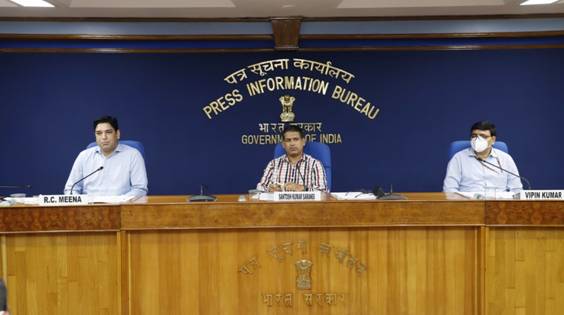
 Shri Santosh Kumar Sarangi, Additional Secretary, School Education, Shri R.C.Meena, Joint Secretary and Shri Vipin Kumar, Joint Secretary held a press conference on the upcoming National Award to Teachers and Shikshak Parv here today.

Shri Sarangi informed that in recognition of valuable contributions of our teachers and to take New Education Policy (NEP) 2020 a step forward, like the previous year this year too, the Department of School Education & Literacy has decided to celebrate Shikshak Parv-2021. Shikshak Parv 2021 will commence from 5th September, 2021 till 17th September through virtual mode, he said.

On vaccination drive to vaccinate more than 2 crore teachers, Shri Sarangi said that the vaccination progress in the states is being monitored by the Department of School Education and Literacy. This will also contribute to decisions pertaining to school reopening.

Shri Meena informed that President Shri Ram Nath Kovind will confer the awards to 44 Awardees through virtual mode on 5th September, 2021. A documentary film on each of the 44 Awardee Teachers will also be shown. He further informed that the National Awards to Teachers were first instituted in 1958 to recognize excellence and commitment of teachers in shaping the minds as well as future of the youth. The award was to accord public recognition to meritorious teachers working in elementary and secondary schools, he added.   

Shri Vipin Kumar informed that Prime Minister Shri Narendra Modi will be addressing the teachers, students, parents and stakeholders associated with education on 7th September, 2021 at 11 AM.  He also informed that Prime Minister will be launching five initiatives of the Department, that is, Indian Sign Language dictionary of 10,000 words, Talking Books (audio books for visually impaired), School Quality Assessment and Accreditation Framework (SQAAF) of CBSE, NISTHA teachers’ training programme for NIPUN Bharat, and Vidyanjali Portal (for facilitating education volunteers/donors/CSR contributors for school development). The conclave will be attended by Shri Dharmendra Pradhan, Union Minister for Education; Smt. Annpurna Devi, Minister of State for Education; Dr.Subhas Sarkar, Minister of State for Education and Dr.Rajkumar Ranjan Singh, Minister of State for Education along with senior officials of the Ministry.

Shri Vipin Kumar said that the inaugural conclave will be followed by webinars, discussions, presentations etc. upto 17th September, 2021 in which the educational practitioners from various schools of the country have been invited to share their experience, learnings and the roadmap ahead. It is noteworthy that teachers and practitioners from even remote schools will be speaking on issues relating quality and innovation in schools. The SCERT and DIETs in respective states will also be deliberating further on each of the webinars and suggesting the roadmap which will be consolidated by State SCERT. These will be shared with NCERT and provide inputs for curricular framework and teacher training modules, he said.

He highlighted that the theme of Webinars has been further segregated into nine sub-themes in the subsequent webinars such as Technology in Education: NDEAR, Foundational Literacy and Numeracy: A Pre-requisite to Learning and ECCE, Nurturing Inclusive Classrooms etc.  to highlight the best practices and initiatives which can be adopted by schools of India.

*****

R&D fair to create an enabling environment for cutting-edge research across the areas envisaged in NEP

 Union Education Minister Shri Dharmendra Pradhan chaired a virtual meeting with the Steering Committee constituted for organizing of the R&D fair of all Indian Institute of Technology (IIT).Minister of State for Education Shri Subhas Sarkar and Minister of State for Education, Shri Ranjan Kumar Singh; Shri Amit Khare, Secretary, Higher Education along with senior officials of the Ministry attended the meeting.

While addressing the participants, the Minister said that R&D Fair of all 23 IITs is scheduled to be held in second half of November, 2021 in commemoration of the 75thyear of Indian independence under the aegis of the Azaadi ka Amirt Mahotsav initiative. He further said the the fair will lead to better understanding and create awareness among Indian industry on the capabilities and the high technology readiness levels in the IITs.  

Shri Pradhan stated that this R&D fair will create an enabling environment for cutting-edge research across the areas envisaged in NEP. The collaborative initiative by 23 IITs with Indian industries on developing innovations for the Indian and global markets would facilitate ease of living and augment the investment by alumni and industries in futuristic research in emerging technologies.

The Minister suggested prioritizing the focus areas for thematic sessions on energy systems, communication tools, waste management, integration of traditional knowledge in structural and architecture, spatial research etc.

Ten themes have been identified in focused areas and 72 projects brought out by 23 IITs on these themes will be shortlisted by the Committee. After due scrutiny, these projects will be presented before the audience in the 2-day mega event. The audience for the event shall include partners from Indian Industry and global institutions, Faculties of various CFTIs, Scientists from DRDO, ISRO, CSIR and ICAR, Students and Youths and Research Scholars.

Dr Pawan Goenka, Chairman,  BoG IIT Madras; Dr BVR Mohan Reddy, Chairman,  IIT Hyderabad; Dr. K. Radhakrishan, Chairman, Standing Committee for IIT Council; Prof Virendra Kumar, Director, IIT KGP; Prof Bhaskar Ramamurthy, Director, IIT Madras; Prof Abhay Karandikar, Director, IIT, Kanpur; Prof Ramgopal Rao, Director, IIT Delhi; Prof T V Sitharam, Director, IIT Guwahati; Prof B.S.Murty, Director, IIT Hyderabad and Prof Subhasis Chowdhary, Director, IIT Bombay were present in the meeting. 

*****

Universities should promote learning in Indian languages & popularise the cultural heritage of India

 Union Education and Skill Development Minister Shri Dharmendra Pradhan today held a meeting with Vice Chancellors of Central Universities through video conferencing. Minister of State for Education Shri Subhash Sarkar, Secretary, Higher Education, ShriAmitKhare, Chairman UGC, Prof D P Singh and senior officials of the Ministry and UGC attended the meeting.

Addressing the participants, Shri Pradhan said that our universities are cradles of creativity, innovation and opportunities. The New Education Policy- 2020 will play a crucial role in placing India at the top of the emerging new world order and, as custodians of India’s destiny, our universities should fulfil their responsibilities outlined in the NEP.He stressed on making education a lot more vibrant & holistic and establishing India as a knowledge superpower through NEP.

The Minister said that our higher education institutions are key catalysts for promoting socio-economic development and for realising aspirations and national goals. The Minister appealed that universities should popularise and promote learning in Indian languages & cultural heritage of India.

Shri Pradhan encouraged Central Universities to work on mission-mode to fill-up the 6,000 vacant posts by October, 2021. He urged them to create a framework for alumni endowment.

Shri Pradhan expressed his happiness to learn about the best practices of Central Universities and on several matters of importance, including filling up of general and reserved vacancies, education during Covid19, online learning and status of NEP implementation.

The Minister exhorted the Universities to come with the strategies for making India fully literate, as well as to contribute helping the country to meet its Nutrition Challenge during ‘Poshan Month’ as a mark of AzadiKaAmrutMahotsav.

The VCs were also requested to encourage Sports in their Universities, thereby promoting a sporting culture in the country. The VCs were encouraged to make their students Job Creators by promoting innovation and research in their campuses.

The Minister thanked the VCs for their insights and valuable suggestions. He urged that as thought leaders, our central universities should assume pioneering roles in building capacities, initiating frameworks for implementation of Academic Bank of Credit, Multiple Entry & Exit, virtual universities and several other facets of the NEP from this academic year itself.

*****