"Management solutions emerge when we hear and listen to all the views with honest intentions"

 The Minister for Commerce & Industry, Textiles, Consumer Affairs and Food & Public Distribution Shri Piyush Goyal today exhorted the youth to “dream big and aim high.” Addressing a group of university students affiliated to Vadodara based ‘Chhatra Sansad’ who are on the ‘Intern Nation Leadership Tour 2022’, a ten-day Good Governance tour, Shri Goyal said youth are the agents of positive change.

Citing their role in the Independence Movement and the Fight Against Emergency, Shri Goyal said, “Mass movements are created on the back of the youth of the times.” 

“Students bring energy that brings great changes. We need to give up on ‘Chalta hai’ (Let It Go) attitude to ‘Kuchh karna hai’ (Let’s do It). The Josh and excitement that youth bring to the table is vital to achieve great results. Please dream big…Don’t think in terms of small aims,” said Shri Goyal, in his address during the video conference. “Koshish karne walon ki kabhi haar nahin hoti,” he quipped.

“When we aspired for $400 billion exports, people would laugh away at us  But now here we are at $300 bn in the first nine months (of the current Financial Year.),” said Shri Goyal, adding, “Even in the pandemic we dreamt big about exports and  making India vibrant with bound less business opportunities.”

Shri Goyal said the Prime Minister Shri Narendra Modi is an inspirational leader for the nation’s youth, who has brought about sweeping changes in India’s history such as ‘Swachh Bharat’ and ‘Atma Nirbhar Bharat’ by involving all the people with his motto of “Sabka Prayas.”


Shri Goyal said we are having the world’s biggest Food Security programme, – NFSA, and food grains are being given to almost 80cr people to ensure no one goes hungry.

Shri Goyal said the civil society should not only work on improving social conditions but also work towards improving political processes as well which encourages honesty in Governance. 

“Integrity, transparency and honesty is the need of the hour which the civil society is now beginning to see from initiatives of Government.  Civil society should always be proactive and bring dignity to vulnerable sections of society. We must decide about the positive outcomes and go all out with full force about it,” he said.

Responding to a question by one of the participants about how he manages to arrive at good management solutions, Shri Goyal said it’s important to hear and listen to all the views with honest intentions without getting biased and prejudiced about anything. “Solutions emerge when such an approach is implemented,” he said. The Minister gave the example of implementation of the jewellery hallmarking which was stuck for many years for the lack of deeper insights.

Shri Goyal said the Indian Youth has made a great impact on the global scale. International organizations now look up to India and Indian youth to make changes and bring growth.

“We are celebrating 75 years of Freedom, Azadi ka Amrit Mahotsav, and it’s time the nation achieve the global status it rightly deserves,” said Shri Goyal. 

Pointing out that India has started leaving its mark on the global stage including the Olympics and Paralympics, Shri Goyal said, “Today no international organisation or event is possible to be conceived without India.”

***

A Right Not A Privilege

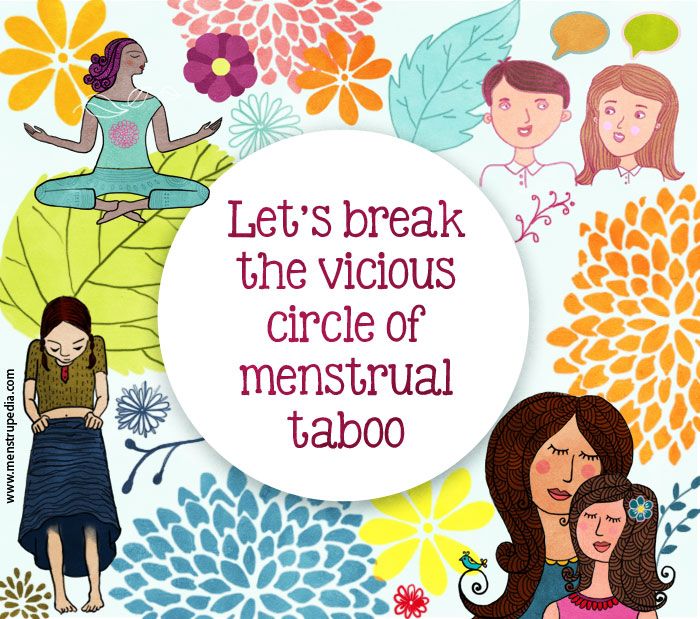
Menstrupedia Blog | Let's Break the Vicious Circle of Menstrual Taboo -  Menstrupedia Blog

Judy Grahn once beautifully said and I quote “Menstrual blood is the only source of blood that is not traumatically induced. Yet, in modern society, this is the most hidden blood, the one so rarely spoken of and almost never seen, except privately by women”. By this, everyone knows what this article is going to be about today. As women are slowly growing stronger and learning to stand up for themselves, it is time, not just women but also men start talking about menstruation, periods, and the entire process that girls, women go through every month for several years. It is high time topics like menstruation are brought out openly rather than hiding among women.

Understanding menstruation and the taboo behind it

Menstruation is the process where girls and women lose blood for a period of five to seven days, every month. This process is the menstrual cycle. The blood is usually old blood cells that detach themselves from the uterine walls. This is a process that every girl and woman goes through around the world no matter which religion, race, ethnicity, countries women belong to. Sounds pretty normal right? Then everyone just is wondering what the taboo is all about. People need to understand that menstruation, menstrual cycle, period cramps, etc are not something that has emerged very recently. These have been there from the time humankind has been existing.

The idea of menstrual blood being impure and something bad for society comes from a place of women idealization, gender discrimination, the gendered identity that has come into creation by the one and only patriarchy. Menstruation has become a medium to suppress women and limit their creativity, intelligence, feelings, emotions, and everything else that makes women as important as men or more in society. Let me ask people reading this. First, to all women and girls, how many of you have covered your pad in a newspaper and or taken your sanitary napkin like a secret bomb to the washroom? In addition, the second question to all men and boys who have seen this and found it weird until you know why women or girls have been doing this? This is how the inclusion of patriarchy happens in society and the idea of impurity and purity seeps into everyone’s lives. The very idea of how girls in co-ed schools and college are only in the class while the teachers are talking periods and the boys are in another class during that period shows how the societal taboo behind them. This is the very reason boys have no education about menstruation and how it works.

Until today, the awareness of menstruation is so less, that a lot of action and awareness is in great need to make things better for women and girls in every district, village, and country. Over the years, the taboo has come down about the menstrual cycle at least in the metropolitan areas of different countries. There was a time when women were in deprivation of communication with other people during their menstruation, and there were places separately for women and girls during their menstruation that was usually away from the house. So many more things were happening that no are longer happening in the developed parts of the country. Nevertheless, there are still so many places that these things take place. These are small villages, districts that have no connection with the mainland. That being said, many castes and religions have a cultural tradition of celebrating the commence of menstruation with great joy and pomp and bringing down the menstruation taboo that has such a strong grasp on the minds of the community.

Yes, things are much better in the metropolitan areas but let me ask you this how many times do we hear jokes or statements made about women “PMSing” when they are genuinely angry or irritated about something at work or home. Linking something as natural as menstruation to religion, caste, and gender is still present in every part of the world whether it is a village or a metropolitan area. People believe that period cramps are nothing because every woman goes through the menstrual cycle. What people do not understand is that though every woman suffers from period cramps the intensity level is very different. If you believe that women who have low tolerance levels have high-intensity pain, then you are wrong. Several studies have proven that period cramp pain is equivalent to the pain of several bones breaking together. Therefore, it is time we think twice before making comments or statements about menstruation.

It's Time We Make Feminine Products Free

Menstruation products and their prices

Though the world is moving forward and developing rapidly, women are still paying a huge amount for menstruation products that are in use for a natural process of losing blood every month. It might seem very surprising that women all over the world have to keep aside a lot of money just for menstrual products such as sanitary napkins, tampons, etc. Basic things like these have become a privilege. Products that are necessary during the cycle are not available for the lower section of the economy because the price of these products is so high. How fair is it that some sections of girls and women get menstruation products and some women and girls cannot? Menstrual hygiene is such an important thing in every single female’s life. If menstrual hygiene is not cared for then it can lead to many physical problems as well. It is time that governments all over the world look into this problem and make things more accessible to women and girls whether they belong to the higher economy or the lower economic class. Scotland and New Zealand are some of the best examples of other countries. These countries have made sanitary napkins free for everybody. These countries have shown that menstruation products should not be a privilege rather products everybody has a right to.

The argument that has been made is that these countries have a lesser population, therefore; it is easier for the government to bring about these laws. To this argument, the only answer can be that, even if you cannot make sanitary products free for everybody, things can at least be done to make them free for people who cannot afford menstruation products. The thing that needs to be kept in mind as well is that the quality of these products should be equally good as the products that are being paid for. The rights of women and girls should not be made into a monetary business from which only the rich benefit. In recent years, awareness, protests, and petitions have been increasing to bring about some change and remove patriarchy from the root so that women can get what they deserve. These actions should not stop until we as people have some change in the community and the world.

I would like to conclude that women do not expect to be treated as supernatural beings or goddesses rather what we do expect is to be treated as human beings who deserve respect, trust, proper treatment, and everything else like any other person living on this planet. Finally, it is time that the people of the world realize that periods are not gross, weird, or inappropriate to talk about.

References

  1. Google searches for quotes and images.

100% door to door collection of segregated waste from each household/ premise to be done under (SBM-U) 2.0

 The salient features of Swachh Bharat Mission (SBM-U) 2.0, launched on 01st October, 2021, are:

(i). all households and premises segregate their waste into “wet waste” (from kitchen and gardens) and “dry waste” (including paper, glass, plastic, and domestic hazardous waste and sanitary waste wrapped separately);

(ii). 100% door to door collection of segregated waste from each household/ premise;

(iii). 100% scientific management of all fractions of waste, including safe disposal in scientific landfills;

(iv). all legacy dumpsites remediated;

(v).all used water including faecal sludge, is safely contained, transported, processed and disposed so that no untreated faecal sludge and used water pollutes the ground or water bodies, in cities with less than one lakh population;

(vi). phased reduction in use of single use plastic.

The salient features of AMRUT 2.0, launched on 01st October, 2021, are:

(i). Universal coverage of water supply from 500 cities to about 4,800 statutory towns.

(ii). Focus on making the cities ‘self-reliant’ and ‘water secure’.

(iii). Universal coverage of sewerage and septage management in 500 AMRUT cities.

(iv). Target to provide 2.68 Crore tap connections and 2.64 Crore sewer connections.

(v). Focus on financial sustainability of Urban Local Bodies (ULBs) through enhanced credit worthiness and market borrowing.

(vi). ‘Pey Jal Survekshan’ will be undertaken in cities to promote healthy competition among them and function as monitoring tool and Mission accelerator.

(vii). Technology sub-Mission under AMRUT 2.0 will help in identifying proven and potential global technologies in water sector.

(viii). Entrepreneurship/ start-ups involved in low-cost indigenous equipments and processes will be encouraged.


SBM-U 2.0 and AMRUT 2.0 have been launched on 01stOctober, 2021. The financial outlay of SBM–U 2.0 and AMRUT 2.0 is at Annexure-I.


Out of 4372 Urban Local Bodies (ULBs),4371 have been certifiedOpen Defecation Free (ODF),except for one ULBof Purulia in West Bengal.


Under AMRUT Mission, launched on 25thJune, 2015 in 500 cities, the objective was to improve the sewerage coverage and septage management and providing safe drinking water universally, in all ULBs with population of one lakh or more (as per Census 2011), all Capital cities, all Heritage City Development and Augmentation Yojana (HRIDAY) cities, identified cities on the stem of the main rivers, hill states, islands and tourist destinations.Now under AMRUT 2.0 all 500 cities will get universal coverage through sewerage/ septage.

Sewerage, septage management and recycle/ reuse of treated used water in cities with population less than one lakh, which are not covered under AMRUT, will be covered under SBM-U 2.0.

Sanitation being a State subject, it is the State Government which formulates its Action Plan for implementation of SBM-U in the State. Under SBM-U, Ministry of Housing & Urban Affairs (MoHUA) has released the Central Share (CS) assistance for implementation of the Action Plan submitted by the Government of Assam, which includes construction of Individual House Hold Latrine (IHHL), Community/ Public Toilet (CT/PT), Solid Waste Management (SWM), Capacity Building (CB) of the ULBsand also for carrying out Information Education Communication (IEC) and Public Awareness (PA) campaign.  The details of the status of financial and physical progress of SBM-U in Assam are at Annexure-II.

For making cities garbage free, underSBM-U a protocol has been launched for Star Rating of Garbage Free Cities (GFCs) in January, 2018, in order to institutionalize a mechanism for cities to achieve Garbage Free status, and to motivate cities to achieve higher degrees of cleanliness.

In the National Capital Region (NCR) of Delhi, New Delhi Municipal Council (NDMC) has been rated as 3 star ULB in 2019 and 5-star in 2021 in Garbage Free City (GFC) assessment. In the past,Delhi Cantonment achieved 1 star GFC rating in 2020.

Under AMRUT, steps taken to provide water supply to every household includes, taking-up of 1,345 water supply projects worth ₹ 42,206 Crore, of which 1,326 projects worth ₹ 41,847 Crore have been grounded. Out of the target of providing 139 lakh water tap connections to achieve universal coverage, so far 114 lakh new water tap connections have been provided.

In NCR of Delhi, so far ten water supply projects worth ₹ 292 Crore have been taken up in the four ULBs, namelyNew Delhi Municipal Council (NDMC), East Delhi Municipal Corporation (EDMC), North Delhi Municipal Corporation (North DMC) and South Delhi Municipal

Corporation (SDMC).  Of these nine projects of ₹ 262 Crores have been grounded.

Operational Guidelines of SBM-U 2.0 and AMRUT 2.0 have been shared with the States/ Union Territories through the web portals given below:

SBM-U2.0:https://sbmurban.org/

AMRUT 2.0:https://mohua.gov.in/upload/uploadfiles/files/AMRUT-Operational-Guidelines.pdf

Annexure-I


Financial outlay of SBM-U 2.0

Estimated cost of implementation                    : ₹1,41,600 crore.

Government of India share                              : ₹36,465 crores.


Balance cost to be contributed by


(a).  Individuals as beneficiary contribution,

(b). States and UTs/ ULBs

(c). Private Sector under PPP.


(Wherever private sector funding is not available, State/ UT will need to provide the necessary funds)


Remaining cost : To be generated through various other sources of funds, including Corporate Social Responsibility (CSR) funds from public/ private sector, external assistance etc.

Financial outlay of AMRUT 2.0

The total indicative outlay for AMRUT 2.0 is ₹ 2,77,000 crore including central share of ₹ 76,760 crore for five years from FY 2021-22 to FY 2025-26.

The central budgetary allocation for various Mission components will be as under:

S.

No.

Mission component

Central

Allocation ( ₹ Cr)

1.

Projects

66,750

2.

Incentive for Reforms (8% of project CA allocation)

5,340

3..

Administrative & Other Expenses (A&OE) for States/ UTs (3.25% of project CA allocation)

2,169

4.

Administrative & Other Expenses (A&OE) for MoHUA (1.75% of project CA allocation)

1,168

5.

Technology Sub-Mission (1% of project CA allocation)

667

6.

IEC Activities (1% of project CA allocation)

667


The ongoing AMRUT projects will be funded with central assistance up to 31 March 2023.

No funds will be released for any AMRUT project incomplete by that date and it will become the responsibility of the State/ UT to complete them from their own resources.           

Annexure-II


Swachh Bharat Mission


  1. Financial progress: Out of total Mission allocation of ₹244.30 Crores for Assam, an amount of ₹207.49 Crores (84.93%) has been drawn by the Government of Assam till date.


  1. Physical Progress:


(i). Toilet construction :

Type of Toilets

Target

Completed

Percentage Progress

Individual House Hold Latrines (IHHL)

75,720 Units

74,416 Units

(98.50%)

Community / Public Toilets (CT/PT)

3,554 seats

3,350 seats

(92%)


(ii). Open Defecation Free (ODF) status :

ODF certification type

Target

No. of certified ULBs

ODF

All 96 ULBs in the State ODF

96

ODF+

27

ODF++

0


(iii). Solid Waste Management :

Activity

Target

Achievement (in%)

100% Door-to-door collection

In all 943 wards

In 845 wards (89.60%)

100% Segregation at source

In all 943 wards

In 410 wards (43.47%)

Scientific processing of waste

100% of 1,021 TPD of waste generated daily

653 TPD (64%) of waste processed

MetroLite and MetroNeo projects to ease the Mobility Problems in smaller cities

 The standard specifications of Light Urban Rail Transit System named “MetroLite” and rubber-tyred electric coach powered by overhead traction system running on a road slab with an exclusive right of way named “MetroNeo”, suitable for smaller cities or areas of cities with less projection of ridership were issued in July, 2019 and November, 2020 respectively. MetroLite and MetroNeo are the low cost mobility solutions with reduced system requirements and same experience, ease of travel in terms of comfort, convenience, affordability, safety, punctuality, reliability and environment- friendliness as that of conventional metro rail system. The low capital cost of these new transit modes than that of high capacity metro rail is due to light civil structure, lesser axle load, smaller stations, low power rated electrical equipment, low operation and maintenance cost etc. These systems can also be used as feeder system to conventional metro rail.

Urban transport, which is an integral part of urban development, is a state subject. Hence, respective State Government/ Union Territories(UTs) is responsible for initiating and developing urban transport infrastructure including rail based mass transit modes viz. Metro Rail/MetroLite/MetroNeo/Regional Rapid Transit System(RRTS) etc.   As per Metro Rail Policy-2017, the Central Government considers financial assistance for such projects in cities or urban agglomerates, based on feasibility of the proposal and availability of resources, as and when posed by the concerned State Government/ Union Territories (UTs). The details of MetroLite and MetroNeo proposals received from various State Governments/Union Territories (UTs) for central financial assistance, State and City-wise, are as under:

Sr No

State/UT

City

Name of Project

1

Delhi

Delhi

Rithala-Narela MetroLite Corridor in the remaining 03 corridors of Delhi Metro Phase-IV

2

Maharashtra

Nashik

Nashik MetroNeo

3

Jammu and Kashmir

Jammu

Jammu MetroLite

4

Srinagar

Srinagar MetroLite

5

Uttar Pradesh

Gorakhpur

Gorakhpur MetroLite

Swachh Technology Challenge launched to Create an Innovations’ Ecosystem in Waste Management

 Swachh Bharat Mission-Urban 2.0 (SBM-U 2.0), under the aegis of the Ministry of Housing and Urban Affairs (MoHUA), today launched the Swachh Technology Challenge. The Challenge seeks to harness the entrepreneurial potential of the waste management sector in India and promote an enabling environment for enterprise developmentunder Swachh Bharat Mission-Urban 2.0. In line with Hon’ble Prime Minister’s clarion call for an “Atmanirbhar Bharat”, there is a need for identifying indigenous, cost effective technologies that are easy to replicate and scale-up, andcan be put to use by ULBs to implement various components of SBM-U 2.0 on the ground.


Over the years, SBM-U has been encouraging innovations and best practices particularly through Swachh Survekshan, the annual cleanliness survey conducted by MoHUA. This trend has been rising over the years with over 4,000 innovations and best practices having been identified since 2018. Swachh Technology Challenge,scheduled to run from 6th December 2021 to 15th January 2021, will particularly seek solutions in  four thematic categories, viz.(i) social inclusion, (ii) zero dump (solid waste management), (iii)plastic waste management and (iv)transparency through digital enablement. The details and modalities of the Challenge were elaborated in a presentation by Roopa Mishra, Joint Secretary and National Mission Director, Swachh Bharat Mission-Urban, MoHUA. Designed as a sub-component of the ‘Citizen Engagement’ component under Swachh Survekshan 2022, the Challenge endeavours to invite solutions not just from start-ups but also individual entrepreneurs, educational institutions, local businesses, research and development organisations,NGOs, and other citizen groups to help city administration efficiently manage Mission operations.The active participation of cities in the Challenge will have a direct bearing on their performance in the ‘Citizen Engagement’ component of Swachh Survekshan 2022 and thus their overall ranking in the survey. The top three solutions in each of the four thematic categories from across the country will be felicitated at the Swachh Survekshan award ceremony hosted by MoHUA. As an additional incentive, top three state level solutions will be rewarded with a cash prize by respective State governments.

To further incentivize the start-up ecosystem, MoHUA will also launch a Swachhata Start-Up Challenge as an extension to the Swachh Technology Challenge in January 2022. Winning solutions from start-ups under Swachh Technology Challenge will be eligible to participate in the Swachhata Start-Up Challenge to be run in collaboration with AgenceFrançaise de Développement (AFD). Winning entries under the Challenge will be rewarded with seed funding of ₹25 lakhs per project along with one year of dedicated incubation support from French Tech, the French government’s initiative to promote start-ups.  


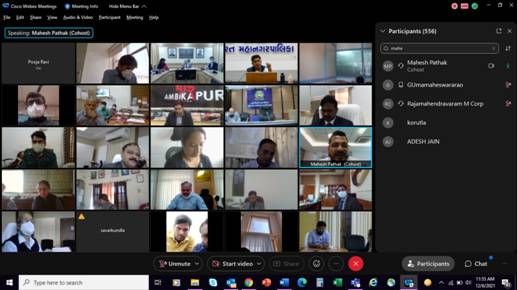
Speaking at the launch occasion, Shri Durga Shanker Mishra, Secretary, MoHUA said, “Technology has played a key role in the transformation of the urban landscape of India. Technology has the potential to bring about affordable, scalable and replicable innovations that can not only bring the Mission closer to citizens but also help us achieve our collective goal of Garbage Free Cities in a time-bound and efficient manner. Today, with the launch of the Swachh Technology Challenge, I appeal to all States and cities to participate wholeheartedly in the Challenge by engaging proactively with stakeholders across the spectrum to drive sanitation and waste management outcomes under SBM-U 2.0”. Also present on the occasion was Mr. Augustin Delisle, Deputy Director, AFD. The event was attended virtually by senior government representatives including Principal Secretaries, Mission Directors and Municipal Commissioners from States and cities.

Swachh Bharat Mission-Urban 2.0, launched on 1stOctober, 2021, aims to achieve the vision of ‘Garbage Free Cities’ over the next five years through remediation of legacy dumpsites, construction and demolition waste and plastic waste management. Additionally, sustainable sanitation through faecal sludge and used water management will be a key focus under SBM-U 2.0. Technology has played a critical role in achieving the outcomes under SBM-U’s journey in the last seven years with several key initiatives such as Swachhata App, SBM Toilets on Google Maps, etc. Recently, the integrated SBM-Urban MIS portal Swachhatam and the state-of-art GIS platform were launched under SBM-U 2.0which will not only take the Mission closer to citizens but will also enable smart data driven decision making, transparency and robustness in Mission implementation. The Swachh Technology Challenge is another step towards ensuring smart governance in SBM-U 2.0 by incentivizing the innovations’ ecosystem to help realize the Prime Minister’s vision of ‘Garbage Free Cities’.

AMRUT 2.0 envisages to make cities ‘water secure’ through circular economy of water

 The Government has launched Atal Mission for Rejuvenation and Urban Transformation 2.0 (AMRUT 2.0) scheme on 01 October, 2021 for the period of 05 years i.e. from the financial year 2021-22 to the financial year 2025-26. AMRUT 2.0 is designed to provide universal coverage of water supply to all households through functional taps in all statutory towns and coverage of sewerage/septage management in 500 AMRUT cities. Making the cities ‘water secure’ and thereby enhancing ease of living of citizens is major objective of the Mission. AMRUT 2.0 will promote circular economy of water through development of city water balance plan for each city focusing on recycle/reuse of treated sewage, rejuvenation of water bodies and water conservation. It will help cities to identify scope for projects focusing on universal coverage of functional water tap connections, water source conservation, rejuvenation of water bodies and wells, recycle/reuse of treated used water, and rainwater harvesting. Based on the projects identified in City Water Balance Plans, Mission envisages to make cities ‘water secure’ through circular economy of water.

Mission also has a reform agenda on ease of living of citizens through reduction of non-revenue water, recycle of treated used water, rejuvenation of water bodies, augmenting double entry accounting system, urban planning, strengthening urban finance etc.

Other components of AMRUT 2.0 are:

    1. Pey Jal Survekshan to ascertain equitable distribution of water, reuse of wastewater, mapping of water bodies and promote healthy competition among the cities /towns.
    1. Technology Sub-Mission for water to leverage latest global technologies in the field of water.
    1. Information, Education and Communication (IEC) campaign to spread awareness among masses about conservation of water.

The total indicative outlay for AMRUT 2.0 is ₹2,99,000 crore including Central share of ₹76,760 crore for five years. This outlay includes funding of ₹22,000 crore (₹10,000 crore as Central Assistance) for ongoing projects of AMRUT till March 2023.

70 percent Municipal Solid Waste (MSW) processing achieved under Swachh Bharat Mission – Urban

 Swachh Bharat Mission-Urban (SBM-U) was launched on 2nd October 2014 with the objective of making all Urban Local Bodies (ULBs) in the country Open Defecation Free (ODF), scientific management of all Municipal Solid Waste (MSW) generated therein and change in behaviour.  Under SBM-U, out of 4,372 ULBs across the country, 4,371 have been certified ODF, exceptfor one ULB of Purulia in West Bengal. Processing of MSW has increased from 18 per cent in 2014 to 70 per cent in 2021. Through a Jan Andolan approach, there is perceptible change in behaviour towards swachhata in urban areas.

Swachh Bharat Mission (SBM-U) 2.0 has been launched on 1st October, 2021 with a vision of achieving 100 per cent ‘Garbage Free’, status for all cities. The following specific objectives are targeted to be achieved under SBM-U 2.0.

(i). Ensuring cleanliness and hygiene in public places to make all cities clean and garbage free, with 100% scientific processing of MSW.

(ii). Reducing air pollution arising out of SWM activities, through effective management of C&D waste, and mechanical sweeping.

(iii). Phased reduction in use of single-use plastic.

(iv). Remediation of all legacy dumpsites.

The present status of progress of Solid waste Management (SWM) in various States, including Andhra Pradesh and Telangana, is at Annexure-I.

AMRUT:

Under the first phase of Mission AMRUT, launched on 25th June, 2015 in 500 cities, the objective was to improve the sewerage coverage and septage management and providing safe drinking water universally, in all ULBs with population of one lakh or more (as per Census 2011), all Capital cities, all Heritage City Development and Augmentation Yojana (HRIDAY) cities, identified cities on the stem of the main rivers, hill states, islands and tourist destinations.

Under first phase of Mission AMRUT, steps were taken to provide water supply to every household includes, taking-up of 1,345 water supply projects worth ₹ 42,206 Crore, of which 1,326  projects worth₹ 41,847 Crore have been grounded. Against the target of providing 139 lakh water tap connections to achieve universal coverage, so far 114 lakh new water tap connections have been provided.

The second phase, i.e., AMRUT 2.0 has been launched on 1st October, 2021 with the following salient features:

(i). Universal coverage of water supply from 500 cities to about 4,800 statutory towns.

(ii). Focus on making the cities ‘self-reliant’ and ‘water secure’.

(iii). Universal coverage of sewerage and septage management in 500 AMRUT cities.

(iv). Target to provide 2.68 crore drinking water tap connections and 2.64 crore sewer connections.

(v). Focus on financial sustainability of Urban Local Bodies (ULBs) through enhanced credit worthiness and market borrowing.

(vi). ‘Pey Jal Survekshan’ will be undertaken in cities to promote healthy competition among them and function as monitoring tool and Mission accelerator.

(vii). Technology sub-Mission under AMRUT 2.0 will help in identifying proven and potential global technologies in water sector.

(viii). Entrepreneurship/ start-ups involved in low-cost indigenous equipments and processes will be encouraged.

Model Tenancy Act to promote rental housing

 Union Cabinet approved Model Tenancy Act (MTA) on 2nd June, 2021 and the same was circulated to all States / Union Territories (UTs) on 7th June, 2021 for adoption for future tenancies by way of either enacting a fresh legislation or amending existing rental laws suitably.

Model Tenancy Act aims to promote rental housing by balancing and protecting the rights and interests of both the tenants and landlords by regulating renting of premises in an efficient and transparent manner. It will also help in overhauling the legal framework with respect to rental markets across the country by providing speedier dispute resolution mechanism framework and is expected to give a fillip to private participation in rental housing.

All States and UTs were consulted while finalising Model Tenancy Act. Views / comments / suggestions of States and UTs on draft Act were duly analysed and suitably incorporated in the final draft.MTA is applicable in both urban and rural areas of the States and UTs.

Land and Colonization are State subjects. Tenancies in States/ Union Territories are governed by their respective rental laws. States and UTs have been advised to adopt MTA by way of eitherenacting a fresh legislation or amending their existing rental laws suitably on lines of MTA in their respective jurisdictions.

"Main Bhi Digital 3.0" campaign aimed at digital onboarding of Street Vendors

 Digital onboarding and training of Street Vendors (SVs) is an integral part of PM Street Vendor’s AtmaNirbharNidhi (PM SVANidhi) Scheme.Lending Institutions (LIs) have been instructed to issue a durable QR Code & UPI ID at the time of disbursement and train the beneficiaries in conduct of digital transactions.

In order to give further impetus to the digital onboarding and training of beneficiaries, Ministry of Housing & Urban Affairs (MoHUA) and Ministry of Electronics & Information Technology (MeitY) jointly launched ‘Main Bhi Digital 3.0’from September 9 to November 30, 2021, to complement the efforts of LIs in adoption of digital transactions by the PM SVANidhi beneficiaries.

“Main Bhi Digital 3.0” campaign is aimed at digital onboarding of Street Vendors (SVs)who have already been provided loans under PM SVANidhi Scheme.

An Integrated IT Platform has been developed for implementation of this Scheme. The application process is fully online. SVs can apply for loan directly through PM SVANidhiPortal. The application can also be submitted at Municipal Offices and Common Service Centres (CSCs). In addition, the SVs can approach municipal functionaries or representatives of Lending Institutions to apply through PM SVANidhi mobile App.

PM SVANidhi Scheme is available to all street vendors across the country, including those from Dahod tribal area, who are engaged in vending in urban areas on or before March 24, 2020. InDahod Municipality of Gujarat, out of 868 beneficiaries of the scheme, 337 are from Scheduled Tribes Category.

"Main Bhi Digital 3.0" campaign aimed at digital onboarding of Street Vendors

 Digital onboarding and training of Street Vendors (SVs) is an integral part of PM Street Vendor’s AtmaNirbharNidhi (PM SVANidhi) Scheme.Lending Institutions (LIs) have been instructed to issue a durable QR Code & UPI ID at the time of disbursement and train the beneficiaries in conduct of digital transactions.

In order to give further impetus to the digital onboarding and training of beneficiaries, Ministry of Housing & Urban Affairs (MoHUA) and Ministry of Electronics & Information Technology (MeitY) jointly launched ‘Main Bhi Digital 3.0’from September 9 to November 30, 2021, to complement the efforts of LIs in adoption of digital transactions by the PM SVANidhi beneficiaries.

“Main Bhi Digital 3.0” campaign is aimed at digital onboarding of Street Vendors (SVs)who have already been provided loans under PM SVANidhi Scheme.

An Integrated IT Platform has been developed for implementation of this Scheme. The application process is fully online. SVs can apply for loan directly through PM SVANidhiPortal. The application can also be submitted at Municipal Offices and Common Service Centres (CSCs). In addition, the SVs can approach municipal functionaries or representatives of Lending Institutions to apply through PM SVANidhi mobile App.

PM SVANidhi Scheme is available to all street vendors across the country, including those from Dahod tribal area, who are engaged in vending in urban areas on or before March 24, 2020. InDahod Municipality of Gujarat, out of 868 beneficiaries of the scheme, 337 are from Scheduled Tribes Category.

Regional Rapid Transit System corridors to connect various important towns of NCR

 National Capital Region Planning Board (NCRPB) prepared a ‘Functional Plan on Transport for National Capital Region(NCR)-2032’ which recommended eight Regional Rapid Transit System (RRTS) corridors to connect various important towns of NCR with high speed rail based commuter transit system viz. (i) Delhi-Gurgaon-Rewari-Alwar (ii) Delhi-Ghaziabad-Meerut (iii) Delhi-Sonipat-Panipat (iv) Delhi-Faridabad-Ballabhgarh-Palwal (v) Delhi-Bahadurgarh-Rohtak (vi) Delhi-Shahdara-Baraut (vii) Ghaziabad-Khurja and (viii) Ghaziabad-Hapur. Out of these, the Task Force constituted by the then Planning Commission prioritized three corridors namely, (i) Delhi-Ghaziabad-Meerut (ii) Delhi-Gurugram-Rewari-Alwar and (iii) Delhi-Panipat. From the above, Delhi-Ghaziabad-Meerut RRTS corridor has been approved and the construction work is underway.

The Detailed Project Report (DPR) after the Feasibility Study has been received from National Capital Region Transport Corporation (NCRTC) for Delhi-Gurugram-SNB Urban Complex RRTS Corridor in December, 2018 and for SNB Urban Complex to Sotanala RRTS Corridor in June, 2020; which are part of Delhi-Gurugram-Rewari-Alwar RRTS Project.The DPR of Delhi-Panipat corridor has been received from NCRTC in June 2020. Approval of Government of National Capital Territory of Delhi (GNCTD) with financial commitment on DPRs of Delhi-Gurugram-SNB RRTS corridor and Delhi-Panipat RRTS corridor has not been received.

The RRTS projects are cost intensive projects which require extensive inter-ministerial consultations and their approval depends on feasibility of projects and availability of resources. The allocation/release of funds and construction activity of project is undertaken once the project is approved.

Swachh Bharat Mission (Urban) 2.0 and AMRUT 2.0 to make the cities garbage free and water secure in 2021-2026

 The major focus of Swachh Bharat Mission (Urban) 2.0 [SBM (U) 2.0] and AMRUT 2.0 launched on 1st October, 2021 is to make the cities garbage free and water secure during the mission period of five years (2021-2026).

The highlights of SBM (U) 2.0 are as under:

  1. all households and premises segregate their waste into “wet waste” (from kitchen and gardens) and “dry waste” (including paper, glass, plastic, and domestic hazardous waste and sanitary waste wrapped separately);
  2. 100% door to door collection of segregated waste from each household/ premise;
  3. 100% scientific management of all fractions of waste, including safe disposal in scientific landfills;
  4. all legacy dumpsites remediated;
  5. all used water including faecal sludge, is safely contained, transported, processed and disposed so that no untreated faecal sludge and used water pollutes the ground or water bodies, in cities with less than one lakh population;
  6. phased reduction in use of single use plastic.

The highlights of AMRUT 2.0 are as under:

  1. Universal coverage of water supply from 500 cities to about 4,800 statutory towns.
  2. Focus on making the cities ‘self-reliant’ and ‘water secure’.
  3. Universal coverage of sewerage and septage management in 500 AMRUT cities.\
  4. Target to provide 2.68 crore drinking water tap connections and 2.64 crore sewer connections.
  5. Focus on financial sustainability of Urban Local Bodies (ULBs) through enhanced credit worthiness and market borrowing.
  6. ‘Pey Jal Survekshan’ will be undertaken in cities to promote healthy competition among them and function as monitoring tool and Mission accelerator.
  7. Technology sub-Mission under AMRUT 2.0 will help in identifying proven and potential global technologies in water sector.
  8. Entrepreneurship/ start-ups involved in low-cost indigenous equipments and processes will be encouraged.

All the cities of Uttar Pradesh including Firozabad arecovered under SBM (U) 2.0 and are eligible to avail all components as per operational guidelines.


Out of 4,372 ULBs, 4,371 ULBs including Firozabad of the country except one in West Bengal (city of Purulia) have been declared Open Defecation Free (ODF) under SBM (U).SBM (U) 2.0 & AMRUT 2.0 cover all the cities in the country and their aim is to make them garbage free and water secure during the Mission Period 2021-2026.


Technical Conference cum Exhibition on 24×7 Water Supply Systems

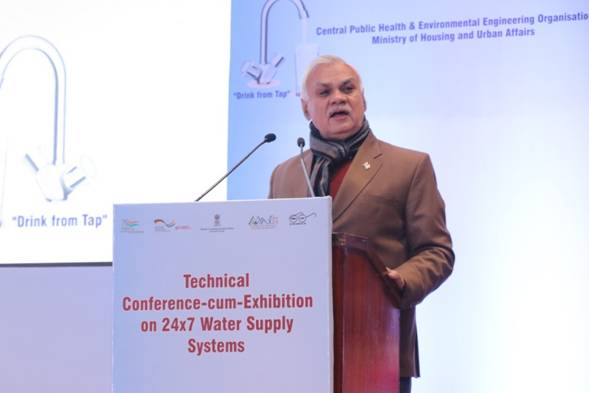
 In order to disseminate knowledge on the planning, design, implementation,Operation and Maintenance of 24x7water supply systems, a “Technical Conference cum Exhibition on 24×7 Water Supply Systems”was organized by held today in New Delhi. The event was organized by the Central Public Health and Environmental Engineering Organisation (CPHEEO), Ministry of Housing and Urban affairs. ThePrime Minister, Shri Narendra Modi launched on October 1st, 2021 AMRUT 2.0,with a vision to make all cities water secure and provide universal coverage of water supply services in all the urban areas of the country.Cities are mandated to undertake reforms such as water conservation, reducing non-revenue water to below 20%, recycle of treated used water to meet at least 20% of total city water demand & 40% for industrial water demand, PPP projects, community involvement etc.

The Inaugural session was chaired by Shri Durga Shanker Mishra, Secretary, MoHUA. While addressing the session, he emphasized the need for integrated water resource management with water conservation through recycling of used water, control of NRW and rejuvenation of water bodies and also to take up 24×7 water supply projects at least in one ward/DMA in 500 AMRUT cities under AMRUT 2.0.

Shri Mishra said that 24×7 water supply projects will ensure prevention of water contamination, control of NRW, equitable water supply and bring efficiency in terms of financial sustainability by attracting PPP funding and institutional financing.

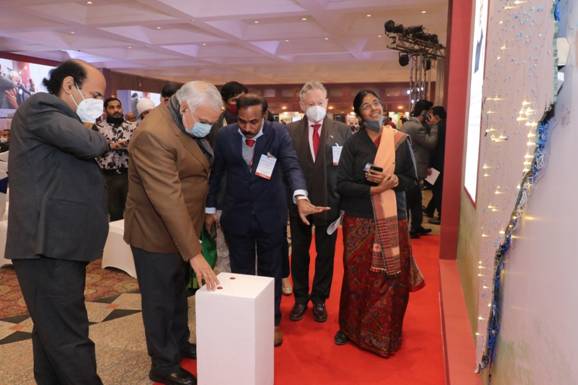
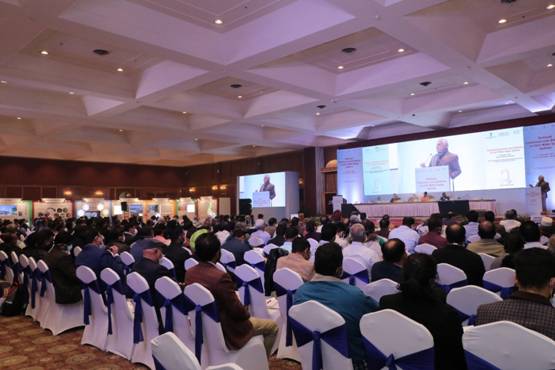
 The cities that are implementing 24×7 water supply projects showcased their best practices and technological solutions such as water meters, valves, GIS mapping, hydraulic modelling, Operational Zones (OZ), District metered Areas (DMA’s),SCADA, SMART water management solutions for monitoring & sustainability etc. in the exhibition. About 600 participants participated in the conference.


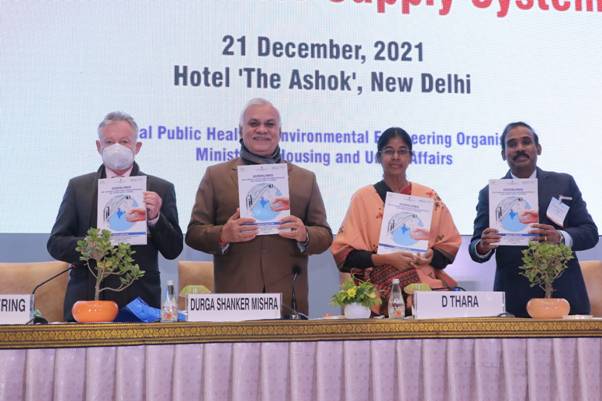
The Guidelines for Planning, Design and Implementation of 24×7 Water Supply Systems were released in the Conference. The present status of the Manual on Water Supply & Treatment which is under revision incorporating the latest technological developments was briefed. Thedraft National Urban Water Supply and Management Policy 2020-30 wasalso presented in the conference.A case-study of 24×7 Water Supply in Puri city, “Drink from Tap Mission” and case studies ofPune and Coimbatore 24×7 water supply projects and other draft Advisories were presented for better understanding among the Engineering community.

Detailed discussions & deliberations among experts, engineers, technology providers and other relevant stakeholders on 24×7 water supply systemsfor better understanding of the meritsand to bridge the existing knowledge gap were held in the conference.


The conference was attended by Technical Heads, Chief Engineers, City Engineers& senior engineers dealing with water supply in all the 500 AMRUT cities, PHEDs/Corporations/Boards/Jal Nigams, Experts, PPP partners, manufacturing firms, consultants.

*****

Meeting of the Consultative Committee of Ministry of Housing and Urban Affairs held

 The meeting of the Consultative Committee of Ministry of Housing and Urban Affairs was held today in the Parliament House Annexe, New Delhi.  The Agenda item of the meeting was “Smart Cities Mission”. Minister of Housing and Urban Affairs, Shri HardeepPuri chaired the meeting.

Briefing about the Smart Cities Mission, Shri Puri said that the main objective of the Mission, launched on 25th June, 2021, is to promote cities that provide core infrastructure, clean and sustainable environment and give a decent quality of life to their citizens through the application of ‘Smart Solutions”.  The Mission aims to drive economic growth and improve the quality of life through comprehensive work on social, economic, physical and institutional pillars of the city.  100 cities have been selected to be developed as smart cities through a two-stage National competition.

Smart Cities Mission is a centrally sponsoredscheme under which the Central Government will provide financial support to the extent of 48000 crores over 5 years i.e. on anaverage 100 crores per city per year and an equal amount of matching basis is to be provided by the State/ULB.  Emphasis has been given on the participation of private sector through public private partnerships.  Aggregating at national level, these proposals contained more than 5000 projects worth over 2,00,000 crores.  Mission has a two-pronged strategy consisting of Pan-city and Area-Based development project. Implementation at the city level is being done by Special Purpose Vehicle(SPV) created for the purpose.  There is no template or universally accepted definition of the Smart City.  Therefore conceptualization of Smart City depends on the level of development,willingness to change and reform resources and aspirations of the city  residents. 

The overall progress of the Mission as on 12 November, 2021 shows great momentum in execution.  Over 6452 projects worth 184,998 crores have been tendered.  Of this, work orders have been issued for close to 5809 projects worth 156571 crores of which 3131 projects worth around 53,175

crore have been completed. Since the launch of the Mission, a total of . 27,234 crores have been released by the Government of India to 100 cities under the Mission. The progress of the Mission inthese cities is done on a regular basis by State level High Powered Steering Committee.

The Mission has launched several initiatives that will not only ensure integrated development across variousaspects of urban development but also help lay long-term foundationfor good quality urbanization in the country.  Some of the initiatives are:

  1. Ease of the Living Index
  2. Municipal Performance Index
  3. City GDP Framework
  4. Climate Smart Cities Assessment Framework
  5. Data Maturity  Assessment Framework
  6. ICCC Maturity Assessment Framework
  7. Data City Strategy
  8. India Urban Observatory
  9. India Urban Data Exchange
  10. Smart Cities Open Data Initiative
  11. National Urban Innovation Stack
  12. National Urban Digital Mission
  13. ICT standards
  14. India Cycles4Change (IC4C) Challenge
  15. Streets4people Challenge
  16. Nurturing Neighbourhoods Challenge
  17. Transport 4 all (T4All) Challenge
  18. EatSmart Cities  Challenge
  19. City Investments to Innovate, Integrate and Sustain (CITIIS) Challenge
  20. Climate Centre for Cities
  21. Climate Smart Cities Alliance
  22. India Smart Cities Fellowship Program
  23. The urban Learning Internship Program

The Minister also informed that smart cities have played important role in managing the crises during Covid-19. With Integrated Command and Control Centres being usedas Covid-19 War Room, they have helped in the area of information, communication, management and preparedness.

Hon’ble MPs made many valuable suggestions during the meeting.


*******

Compendium on Indigenous Innovative Building Materials and Construction Technologies

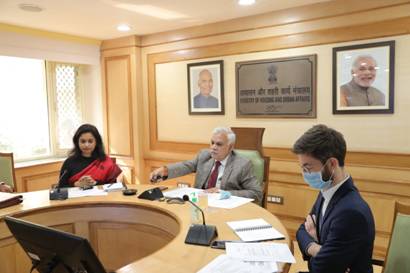
 Secretary, Ministry of Housing and Urban Affairs (MoHUA), Shri Durga Shanker Mishra chaired the 57th meeting of Central Sanctioning and Monitoring Committee (CSMC) under Pradhan Mantri Awas Yojana (Urban) held on 23rd December 2021 in New Delhi. Project proposals for 1.07 lakh houses were approved for construction from Andhra Pradesh, Madhya Pradesh, Maharashtra, Puducherry and Uttarakhand under various verticals of PMAY(U). Secretary, MoHUA, also reviewed the progress of implementation of PMAY(U) in other States.  

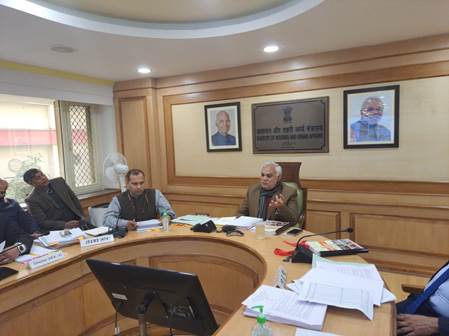
Presiding over the meeting, Secretary, MoHUA, discussed the issues pertaining to grounding and construction of houses in the States/UTs. He directed the State/UT officials to expedite construction of houses in their respective areas. He said that grounding should be the first responsibility of the States/UTs, followed by focus on 100% completion of grounded houses. States/UTs should also declare saturation of demand city by city.

A group of people sitting at a tableDescription automatically generated with low confidence


Secretary, MoHUA also urged the LHP States to promote LHP technologies for their further replication in Indian context. He also directed the State officials to encourage students, professionals and other stakeholders to enrol as Technograhis so that more people could learn the use of these technologies. He requested all States/UTs to visit the LHP sites and study about it. Engineers, urban planners should be trained through the Technograhi module.

Total number of sanctioned houses under the Mission is now 1.14 crore; of which around 91 lakh have been grounded for construction and more than 53 lakh have been completed and delivered to the beneficiaries. The total investment under the Mission is ₹ 7.52 lakh crore, with Central Assistance of ₹ 1.85 lakh crore. So far, Central Assistance amounting to ₹ 1.14 lakh crore has already been released.

At the CSMC meeting, approval for construction of Demonstration Housing Projects (DHPs) at Dimapur in Nagaland and Kot Bhalwal in Jammu was also accorded. Both the projects will be built using new/alternate technologies under Technology Sub-Mission component of PMAY(U). DHPs are model housing projects that showcase field level application of the technology and are also used as a platform to impart on-site orientation, training to practitioners and students in the housing sector. So far, six DHPs have been completed and four are being constructed in different parts of the country.

The upcoming DHP in Dimapur will be used as working women’s hostel while the one in Kot Bhawal will serve as a sports hostel on rental basis with other infrastructure facilities and provisions.

The CSMC also approved a proposal for incubation support under ASHA-India for low cost Bamboo Housing Project submitted by IIT Kharagpur.

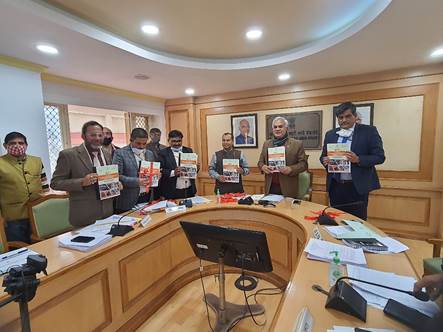
On this occasion, a Compendium on Indigenous Innovative Building Materials and Construction Technologies was also released by Secretary, MoHUA. It provides details about 84 technologies showcased during Indian Housing Technology Mela (IHTM) in Lucknow from 5th to 7th October 2021.  It will serve as useful resource for dissemination of technologies for field level application, replication across the country. The compendium will help policymakers, public/private construction agencies, other stakeholders to select and adopt materials, technologies in future housing projects.

A picture containing ceiling, indoor, wallDescription automatically generated


While releasing the Compendium, Secretary, MoHUA, asked the States/UTs to share it widely with construction agencies, engineers, architects for utilising these technologies for construction for the benefit of the housing sector.

Secretary, MoHUA, also reviewed the progress of Light House Projects (LHPs) in Chennai (Tamil Nadu), Indore (Madhya Pradesh), Rajkot (Gujarat), Ranchi (Jharkhand), Agartala (Tripura) and Lucknow (Uttar Pradesh). He directed the officials to complete the construction work within the stipulated time period.