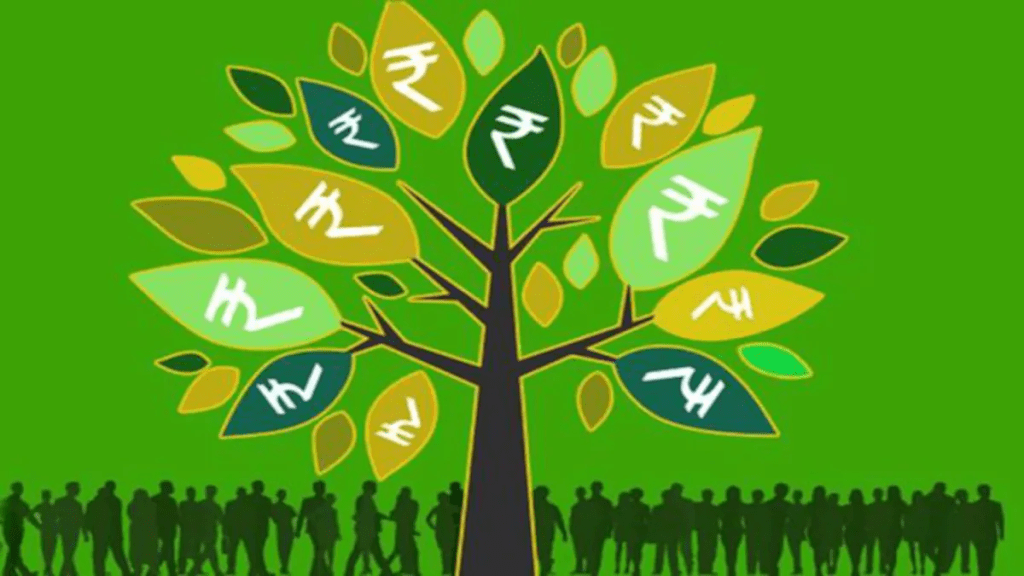
Financial inclusion may be defined as the process of ensuring access to financial services and timely and adequate credit where needed by vulnerable groups such as weaker sections and lower income groups at an affordable cost. Financial inclusion, broadly defined, refers to universal access to a wide range of financial services at reasonable cost. These not only include banking products, but also other financial services such as insurance and equity products.
INDICATORS OF FINANCIAL INCLUSION
As per the general laid down standards following are the key indicators of financial inclusion:
· Formal banking system
This refers to the existence and usage of banking services which are regulated by formal mechanism.
· Formal credit
The usage of formal or recognized credit providers indicates the presence of an inclusive financial system.
· Insurance
Apart from formal lending and depositing the citizens will also have access to proper insurance providers in a well inclusive financial system.
· Savings options
An inclusive financial system should provide attractive options to deposit the saved funds irrespective of the customer background.
· Modern banking
Each and every user should have access to modern banking services like electronic banking, mobile banking, internet banking, etc.
FACTORS AFFECTING FINANCIAL INCLUSION
Access to financial services have been recognized as an important aspect of development and more emphasis is given to extending financial services to low-income households. The lack of financial services limits the range of financial services and 7 credits for households. There are multiple factors which have affected the access to financial services, like
· Place of living
The area of operation of banks are limited to some specific geographical areas which leaves a significant portion of the rural population unbanked.
· Absence of legal identity and gender biasness
Due to lack of financial independence and unemployment there exists a bias on the basis of gender in having access to formal financial services.
· Limited knowledge of financial services
Illiteracy and lack of proper knowledge about banking system has led to reluctance towards formal banking practices among deprived classes.
· Level of income and bank charges
The charges and fines levied by banks make them less attractive for some classes of society.
· Rigid terms and conditions
Since formal banking system is subject to strict rules and regulations, many finds it difficult.
NEED FOR FINANCIAL INCLUSION
Financial inclusion broadens the resource base of the financial system by developing a culture of savings among large segment of rural population and plays its own role in the process of economic development. Further by bringing low -income groups within the perimeter of formal banking sector, financial inclusion protects their financial wealth and other resources. Financial inclusion also mitigates the exploitation of vulnerable sections by the usurious money lenders by facilitating easy access to formal credit.
India is a nation with a major chunk of the population living under vulnerable conditions. So, it is the duty each and every privileged section to lift the conditions of the underprivileged. Financial inclusion will pave a path of uplifting the society and empowering the people.
Financial inclusion may be defined as the process of ensuring access to financial services and timely and adequate credit where needed by vulnerable groups such as weaker sections and lower income groups at an affordable cost. Financial inclusion, broadly defined, refers to universal access to a wide range of financial services at reasonable cost. These not only include banking products, but also other financial services such as insurance and equity products.
INDICATORS OF FINANCIAL INCLUSION
As per the general laid down standards following are the key indicators of financial inclusion:
· Formal banking system
This refers to the existence and usage of banking services which are regulated by formal mechanism.
· Formal credit
The usage of formal or recognized credit providers indicates the presence of an inclusive financial system.
· Insurance
Apart from formal lending and depositing the citizens will also have access to proper insurance providers in a well inclusive financial system.
· Savings options
An inclusive financial system should provide attractive options to deposit the saved funds irrespective of the customer background.
· Modern banking
Each and every user should have access to modern banking services like electronic banking, mobile banking, internet banking, etc.
FACTORS AFFECTING FINANCIAL INCLUSION
Access to financial services have been recognized as an important aspect of development and more emphasis is given to extending financial services to low-income households. The lack of financial services limits the range of financial services and 7 credits for households. There are multiple factors which have affected the access to financial services, like
· Place of living
The area of operation of banks are limited to some specific geographical areas which leaves a significant portion of the rural population unbanked.
· Absence of legal identity and gender biasness
Due to lack of financial independence and unemployment there exists a bias on the basis of gender in having access to formal financial services.
· Limited knowledge of financial services
Illiteracy and lack of proper knowledge about banking system has led to reluctance towards formal banking practices among deprived classes.
· Level of income and bank charges
The charges and fines levied by banks make them less attractive for some classes of society.
· Rigid terms and conditions
Since formal banking system is subject to strict rules and regulations, many finds it difficult.
NEED FOR FINANCIAL INCLUSION
Financial inclusion broadens the resource base of the financial system by developing a culture of savings among large segment of rural population and plays its own role in the process of economic development. Further by bringing low -income groups within the perimeter of formal banking sector, financial inclusion protects their financial wealth and other resources. Financial inclusion also mitigates the exploitation of vulnerable sections by the usurious money lenders by facilitating easy access to formal credit.
India is a nation with a major chunk of the population living under vulnerable conditions. So, it is the duty each and every privileged section to lift the conditions of the underprivileged. Financial inclusion will pave a path of uplifting the society and empowering the people.
Urbanization refers to moving rural population in urban areas. With the gradual growth of the economy, the process of urbanization depends on the shift of surplus population from rural to urban areas along with the growth of some industrialized urban centres.
People from isolated village started to move towards urbanized centres in search of job, established industries and other activities constantly offer job opportunities to those people migrating to cities.
Urbanization in india
In India, an increasing trends towards urbanization has been recorded from the very beginning of this era. The census data on the rural – urban mixture reveal a continuous rise in the rate of urbanization in india.
Causes of Rapid Urbanization in India
Expansion in government services as a result of the second World War.
Migration of people during the partition of India and Industrial Revolution.
Eleventh Five year Plan that aimed at urbanization for the economic development of India.
Growth of Private sector after 1990.
Infrastructure facilities in the urban areas.
Land fragmentation, village being erased due to roads and highway construction, dam construction and other activities.
Agriculture is the primary source of livelihood, but now it is not profitable due to several reasons such as drought low productivity. These situations are forcibly the people of rural areas to migrate towards cities.
Growth of employment in cities is attracting people from rural areas as well as smaller cities to large towns. According to Mckinsey India’s urban population will grow from 340 million in 2008 to 590 million in 2030.
Therefore, it is being driven by economic compulsions where people move out for economic advancement to areas offering better job opportunities.
Urban Local Government
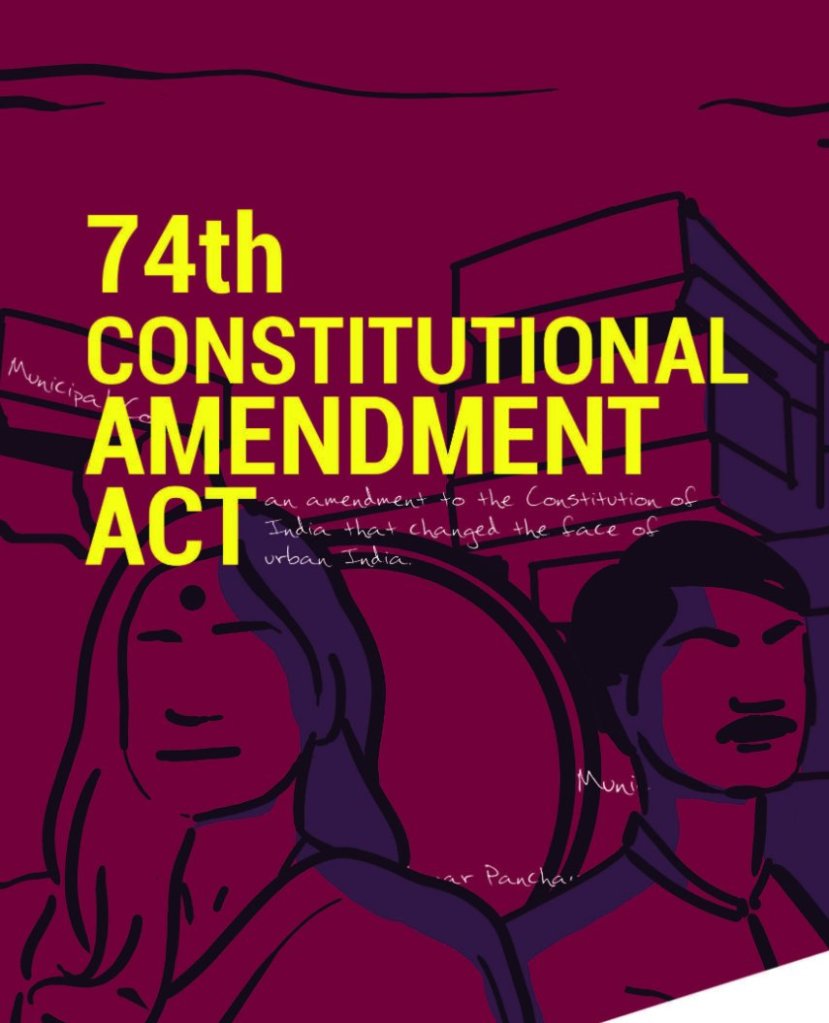
The concept of local self Government is based on the assumption that there are certain basic human needs having direct bearing on the lives of the individual and the community as a whole. The Governance of an urban areas by the local people through their elected representative is called urban Governance. Urban local government in India was constitutionalised through the 74th constitutional Amendment Act of 1992. The Ministry at Central level dealt with urban local government such as Ministry of Urban development, Ministry of Defense in the case of cantonment Boards, Ministry of Home Affair in the case of Union Territories.
The Institution of Urban local Government originated and developed in modern India during the period of British rule. 1667 Municipal Corporation Madras, 1726, Municipal Corporation Bombay, Calcutta. 1870 Lord Mayo resolution on financial decentralization. 1882 Lord Rippon resolution, which is held as the Magna Carta of local Self Government. Rippon is remembered as father of local Self Government. 1919 Dyarchical scheme introduced in provinces.1924 Cantonments Act was passed and 1935 Provincial autonomy introduced.
73rd Amendment Act of 1992
The act has added part IX – A to the Constitution of India. It is entitled as the municipalities and consists of provision from Article 243P to 243G. This act added 12th schedule to the Constitution. Indian long history of Urban Municipal Governance was characterised by some structural infirmities & affected it’s performance. Municipal bodies we’re delegate limited powers with restricted autonomy.
The 74th act gave constitutional status to the municipalities which has brought under the preview of judicial part of the Constitution. The act aim at revitalizing and strong thing the urban Government so that they function effectively as units of self Government.
The members of municipality are directly elected by people of the area. The territorial constituency of municipality is known as wards. The state legislature determine the manner of election of chairperson and representation of knowledgeable person and member of parliament to municipality.
The salient features of the 74th Amendment Act are: 1) Reservation of seats for SC/ST and women 2) Term of Municipalities 3) Ward Committee 4) Disqualification 5) Metropolitan Planning committee
Municipal Corporation
Municipal Corporation are created for the administration’ of big cities like Delhi, Mumbai, Kolkata. They are established in the states by the acts of the concerned state legislature and in Union Territories by the acts of parliament of India. A municipal corporation has three authorities like – The council, standing committee and the commissioner. The corporation council consists of councillors directly elected by the people.
Corporation council is head by a mayor assisted by a deputy mayor. He is elected for a 1 year renewable term. The standing committee are created to facilitate the working of the corporation, which is large deals with taxation and finance.
Supply of pure water, construction and maintenance of Public streets, cleaning places, Public streets, sewers, Naming streets and numbering houses, lighting and watering of Public streets. Regulation of offensive, dangerous or obnoxious trades, Maintenance or support of Public hospitals, establishment of primary school are the following functions of Municipal Corporation.
Municipal Council
It is an Institution of local self Government in india. It is also known as Nagar palika. It is constituted in cities having population around 1 – 3 lakh. These are basically established for the administration of district level cities. The municipal Council is entrusted with the development related matters of Municipal Corporation areas and providing basic civic amenities. The services provided by the MC some of them are :
Construction, maintenance and cleaning of drains and drainage works and of public latrines, urinals. Supply water for public and private purposes. Scavenging, removal of garbage, survey of building and lands, maintenance and development of the value of all properties, maintenance of monuments and memorial vested in local authority etc.
Nagar panchayats
NP also known as notified area Council or city council helps in the transformation of rural and urban. It has a committee consisting of a chairman/mayor along with Ward members. The members are choosen via direct election and have a tenure of 5 years. Following are functions of Nagar panchayat such as essential services and facilities to the urban area, sanitation programme, street lighting and providing roads in wards and main roads, school in urban areas, water supply to wards of Urban areas, clean the drainage system, culverts for underground drainage system, programme for adult literacy and run city libraries and death & birth records.
Urbanization refers to moving rural population in urban areas. With the gradual growth of the economy, the process of urbanization depends on the shift of surplus population from rural to urban areas along with the growth of some industrialized urban centres.
People from isolated village started to move towards urbanized centres in search of job, established industries and other activities constantly offer job opportunities to those people migrating to cities.
Urbanization in india
In India, an increasing trends towards urbanization has been recorded from the very beginning of this era. The census data on the rural – urban mixture reveal a continuous rise in the rate of urbanization in india.
Causes of Rapid Urbanization in India
Expansion in government services as a result of the second World War.
Migration of people during the partition of India and Industrial Revolution.
Eleventh Five year Plan that aimed at urbanization for the economic development of India.
Growth of Private sector after 1990.
Infrastructure facilities in the urban areas.
Land fragmentation, village being erased due to roads and highway construction, dam construction and other activities.
Agriculture is the primary source of livelihood, but now it is not profitable due to several reasons such as drought low productivity. These situations are forcibly the people of rural areas to migrate towards cities.
Growth of employment in cities is attracting people from rural areas as well as smaller cities to large towns. According to Mckinsey India’s urban population will grow from 340 million in 2008 to 590 million in 2030.
Therefore, it is being driven by economic compulsions where people move out for economic advancement to areas offering better job opportunities.
Urban Local Government
The concept of local self Government is based on the assumption that there are certain basic human needs having direct bearing on the lives of the individual and the community as a whole. The Governance of an urban areas by the local people through their elected representative is called urban Governance. Urban local government in India was constitutionalised through the 74th constitutional Amendment Act of 1992. The Ministry at Central level dealt with urban local government such as Ministry of Urban development, Ministry of Defense in the case of cantonment Boards, Ministry of Home Affair in the case of Union Territories.
The Institution of Urban local Government originated and developed in modern India during the period of British rule. 1667 Municipal Corporation Madras, 1726, Municipal Corporation Bombay, Calcutta. 1870 Lord Mayo resolution on financial decentralization. 1882 Lord Rippon resolution, which is held as the Magna Carta of local Self Government. Rippon is remembered as father of local Self Government. 1919 Dyarchical scheme introduced in provinces.1924 Cantonments Act was passed and 1935 Provincial autonomy introduced.
73rd Amendment Act of 1992
The act has added part IX – A to the Constitution of India. It is entitled as the municipalities and consists of provision from Article 243P to 243G. This act added 12th schedule to the Constitution. Indian long history of Urban Municipal Governance was characterised by some structural infirmities & affected it’s performance. Municipal bodies we’re delegate limited powers with restricted autonomy.
The 74th act gave constitutional status to the municipalities which has brought under the preview of judicial part of the Constitution. The act aim at revitalizing and strong thing the urban Government so that they function effectively as units of self Government.
The members of municipality are directly elected by people of the area. The territorial constituency of municipality is known as wards. The state legislature determine the manner of election of chairperson and representation of knowledgeable person and member of parliament to municipality.
The salient features of the 74th Amendment Act are: 1) Reservation of seats for SC/ST and women 2) Term of Municipalities 3) Ward Committee 4) Disqualification 5) Metropolitan Planning committee
Municipal Corporation
Municipal Corporation are created for the administration’ of big cities like Delhi, Mumbai, Kolkata. They are established in the states by the acts of the concerned state legislature and in Union Territories by the acts of parliament of India. A municipal corporation has three authorities like – The council, standing committee and the commissioner. The corporation council consists of councillors directly elected by the people.
Corporation council is head by a mayor assisted by a deputy mayor. He is elected for a 1 year renewable term. The standing committee are created to facilitate the working of the corporation, which is large deals with taxation and finance.
Supply of pure water, construction and maintenance of Public streets, cleaning places, Public streets, sewers, Naming streets and numbering houses, lighting and watering of Public streets. Regulation of offensive, dangerous or obnoxious trades, Maintenance or support of Public hospitals, establishment of primary school are the following functions of Municipal Corporation.
Municipal Council
It is an Institution of local self Government in india. It is also known as Nagar palika. It is constituted in cities having population around 1 – 3 lakh. These are basically established for the administration of district level cities. The municipal Council is entrusted with the development related matters of Municipal Corporation areas and providing basic civic amenities. The services provided by the MC some of them are :
Construction, maintenance and cleaning of drains and drainage works and of public latrines, urinals. Supply water for public and private purposes. Scavenging, removal of garbage, survey of building and lands, maintenance and development of the value of all properties, maintenance of monuments and memorial vested in local authority etc.
Nagar panchayats
NP also known as notified area Council or city council helps in the transformation of rural and urban. It has a committee consisting of a chairman/mayor along with Ward members. The members are choosen via direct election and have a tenure of 5 years. Following are functions of Nagar panchayat such as essential services and facilities to the urban area, sanitation programme, street lighting and providing roads in wards and main roads, school in urban areas, water supply to wards of Urban areas, clean the drainage system, culverts for underground drainage system, programme for adult literacy and run city libraries and death & birth records.
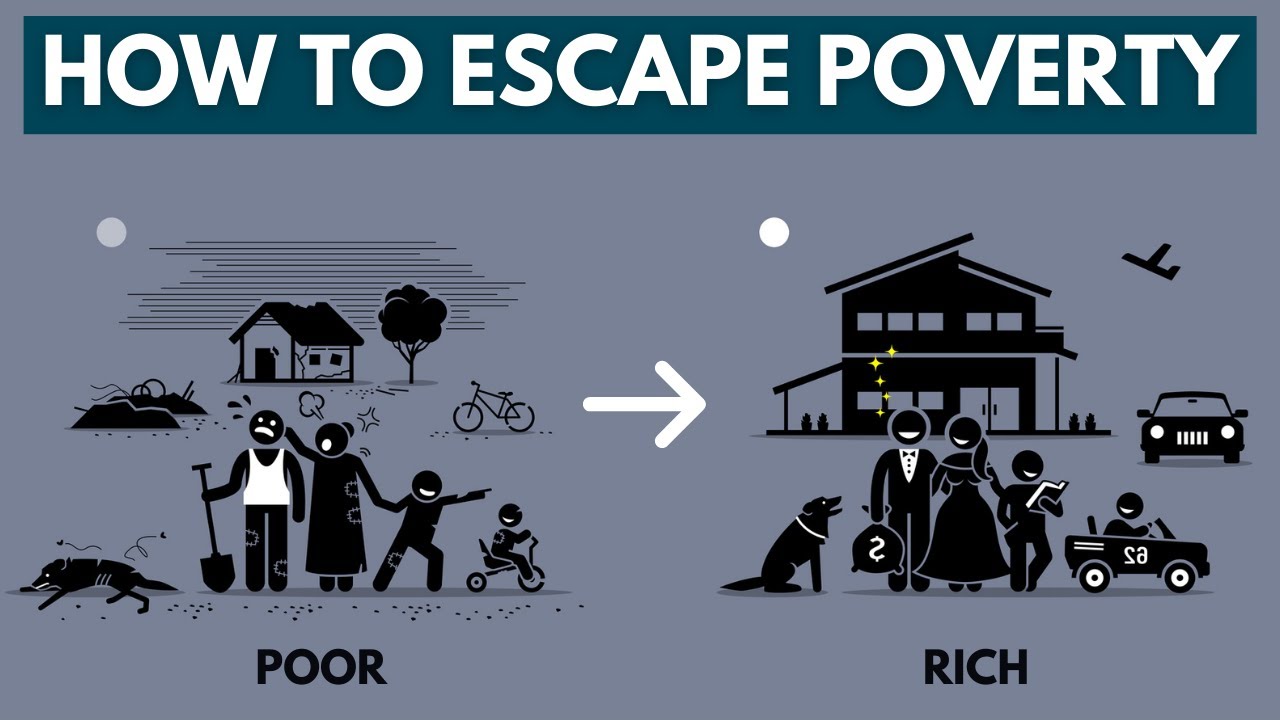
Poverty is about a lack of money, but also about a lack of hope. People living in poverty often feel powerless to change their situation. They can feel isolated from their community. If you want to overcome poverty, you need a combination of financial planning, a positive attitude, and a willingness to ask for help.
The global economic system is built on the exploitation of the majority, mainly in the so called third world countries. The system needs cheap labourers to work as it does. Therefore, it does not allow too many poor to become wealthier simply because then they wouldn’t do the labour anymore. That would either mean reduced profits for the investors or increased prices up to the point where the normal people in the so called first world could not afford it anymore.
Stereotypes about how to get out of poverty have real consequences. Unfortunately, despite mountains of evidence, you may still have a hard time shaking the idea that the only thing standing between poor people and wealthy people is how hard they’ve worked and how much they wanted to succeed. Even more unfortunately, this belief – when held by voters and reinforced by lawmakers eager to please their constituents – has led to troubling and even dangerous policies that perpetuate the cycle of poverty.
Poverty is an intersectional issue We don’t often look at the ways that poverty intersects with the issues of marginalized groups, and instead, tend to treat it as a separate ailment. In reality, poverty is caused by much more than just a lack of jobs or expensive housing. For many communities, poverty is a by-product of other systemic issues. Poverty is a complex cycle of factors. One of the most important aspects of conceptualizing how poverty impacts people is to understand that it is more than just not having money. We often think of poverty as monetary status – someone doesn’t have money right now; thus, they are poor – rather than a cycle. Put more simply, poor people are just like not-poor people, except they have less money right now. But chronic poverty (the kind that impacts families and entire communities) is not the same as being broke, and it’s not the same as being low on funds before your parents deposit your rent money.
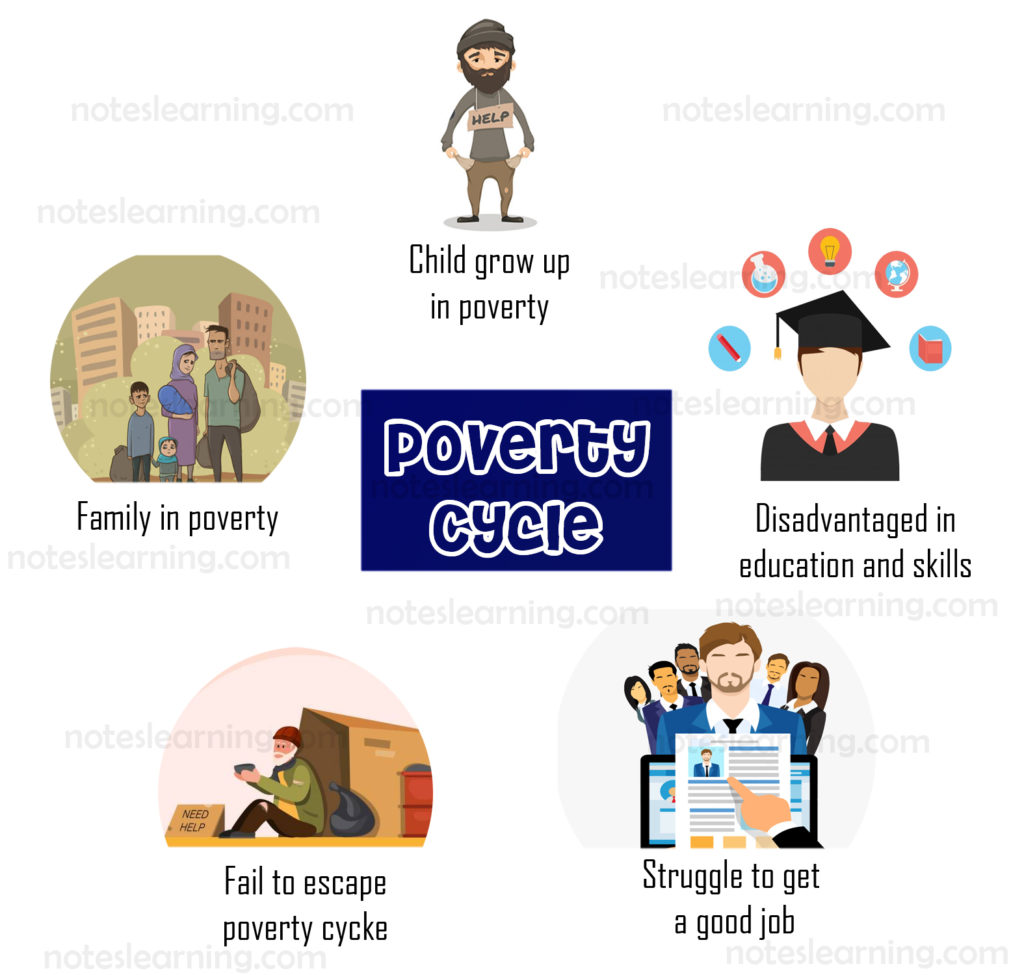
In economics, a poverty trap or cycle of poverty is caused by self-reinforcing mechanisms that cause poverty, once it exists, to persist unless there is outside intervention. It can persist across generations, and when applied to developing countries, is also known as a development trap. Families trapped in the cycle of poverty have few to no resources. There are many self-reinforcing disadvantages that make it virtually impossible for individuals to break the cycle. This occurs when poor people do not have the resources necessary to escape poverty, such as financial capital, education, or connections. Impoverished individuals do not have access to economic and social resources as a result of their poverty. This lack may increase their poverty. This could mean that the poor remain poor throughout their lives.
Controversial educational psychologist Ruby K. Payne, author of A Framework for Understanding Poverty, distinguishes between situational poverty, which can generally be traced to a specific incident within the lifetimes of the person or family members in poverty, and generational poverty, which is a cycle that passes from generation to generation, and goes on to argue that generational poverty has its own distinct culture and belief patterns
Factors maintaining personal poverty
Once poor, people can experience difficulty escaping poverty because many changes that would allow them to do so require money they don’t have, such as:
Education and retraining with new skills
Child care which would enable a single parent or second parent to work or take classes
Transportation to a distant job
Migration to an area with better economic opportunities
Starting a new business, which might require market research, technical assistance, and startup funding
Obtaining land for subsistence farming
Cure a health condition that prevents work, including diseases of poverty which don’t affect people outside of the “cycle of poverty”
This vicious cycle is harmful to those in poverty and those outside of it. Mainstream economic models think people are rational actors who weigh the costs and benefits of their options and choose the most advantageous path forward. If those in poverty know they’ll get no net benefit from working they’re incentivized to remain on government assistance. Of course, people works for many reasons including societal norms and personal values .but income is major incentive in pursuing new employment. When less people take on jobs the economy slows down keeping people in poverty and potentially pushing people in the cusp of poverty over the edge. Some of them suggest feedback loop could be removed by eliminating government assistance programmes all together. But most agree this solution is neither realistic nor humane. So how can we redesign benefits in a way that doesn’t penalize people for working? Many countries have tried different ways to circumvent this problem. Some allow people to continue receiving benefits after finding a job. Others faze out benefits gradually as income increases. These policies still removes financial incentive to work but the risk for welfare trap is lower. Other Gov. provide benefits like education, Child care or medical care, equally across all their citizens. One proposed solution takes this idea of universal benefits even further. Universal basic income would provide a fixed benefit all members of society regardless of wealth or employment status this is the only known policy that removes welfare trap since earned wages would supplement benefit rather than replace it. In fact creating a stable income floor which no one can call basic income might prevent people from falling into poverty in the first place. Numerous economists, thinkers have championed this idea. Eighteenth century. But for now universal basic income remains largely hypothetical. Although it’s been tried in some places on a limited scale these local experiments don’t tell us much about how the policy will play out across the entire nation or a plant. Whatever strategy government’s pursuit, solving the welfare trap requires respecting people’s agency and autonomy. Only by empowering individuals to create long term change in their lives and communities can we begin to break the cycle of poverty.
Poverty is about a lack of money, but also about a lack of hope. People living in poverty often feel powerless to change their situation. They can feel isolated from their community. If you want to overcome poverty, you need a combination of financial planning, a positive attitude, and a willingness to ask for help.
The global economic system is built on the exploitation of the majority, mainly in the so called third world countries. The system needs cheap labourers to work as it does. Therefore, it does not allow too many poor to become wealthier simply because then they wouldn’t do the labour anymore. That would either mean reduced profits for the investors or increased prices up to the point where the normal people in the so called first world could not afford it anymore.
Stereotypes about how to get out of poverty have real consequences. Unfortunately, despite mountains of evidence, you may still have a hard time shaking the idea that the only thing standing between poor people and wealthy people is how hard they’ve worked and how much they wanted to succeed. Even more unfortunately, this belief – when held by voters and reinforced by lawmakers eager to please their constituents – has led to troubling and even dangerous policies that perpetuate the cycle of poverty.
Poverty is an intersectional issue We don’t often look at the ways that poverty intersects with the issues of marginalized groups, and instead, tend to treat it as a separate ailment. In reality, poverty is caused by much more than just a lack of jobs or expensive housing. For many communities, poverty is a by-product of other systemic issues. Poverty is a complex cycle of factors. One of the most important aspects of conceptualizing how poverty impacts people is to understand that it is more than just not having money. We often think of poverty as monetary status – someone doesn’t have money right now; thus, they are poor – rather than a cycle. Put more simply, poor people are just like not-poor people, except they have less money right now. But chronic poverty (the kind that impacts families and entire communities) is not the same as being broke, and it’s not the same as being low on funds before your parents deposit your rent money.
In economics, a poverty trap or cycle of poverty is caused by self-reinforcing mechanisms that cause poverty, once it exists, to persist unless there is outside intervention. It can persist across generations, and when applied to developing countries, is also known as a development trap. Families trapped in the cycle of poverty have few to no resources. There are many self-reinforcing disadvantages that make it virtually impossible for individuals to break the cycle. This occurs when poor people do not have the resources necessary to escape poverty, such as financial capital, education, or connections. Impoverished individuals do not have access to economic and social resources as a result of their poverty. This lack may increase their poverty. This could mean that the poor remain poor throughout their lives.
Controversial educational psychologist Ruby K. Payne, author of A Framework for Understanding Poverty, distinguishes between situational poverty, which can generally be traced to a specific incident within the lifetimes of the person or family members in poverty, and generational poverty, which is a cycle that passes from generation to generation, and goes on to argue that generational poverty has its own distinct culture and belief patterns
Factors maintaining personal poverty
Once poor, people can experience difficulty escaping poverty because many changes that would allow them to do so require money they don’t have, such as:
Education and retraining with new skills
Child care which would enable a single parent or second parent to work or take classes
Transportation to a distant job
Migration to an area with better economic opportunities
Starting a new business, which might require market research, technical assistance, and startup funding
Obtaining land for subsistence farming
Cure a health condition that prevents work, including diseases of poverty which don’t affect people outside of the “cycle of poverty”
This vicious cycle is harmful to those in poverty and those outside of it. Mainstream economic models think people are rational actors who weigh the costs and benefits of their options and choose the most advantageous path forward. If those in poverty know they’ll get no net benefit from working they’re incentivized to remain on government assistance. Of course, people works for many reasons including societal norms and personal values .but income is major incentive in pursuing new employment. When less people take on jobs the economy slows down keeping people in poverty and potentially pushing people in the cusp of poverty over the edge. Some of them suggest feedback loop could be removed by eliminating government assistance programmes all together. But most agree this solution is neither realistic nor humane. So how can we redesign benefits in a way that doesn’t penalize people for working? Many countries have tried different ways to circumvent this problem. Some allow people to continue receiving benefits after finding a job. Others faze out benefits gradually as income increases. These policies still removes financial incentive to work but the risk for welfare trap is lower. Other Gov. provide benefits like education, Child care or medical care, equally across all their citizens. One proposed solution takes this idea of universal benefits even further. Universal basic income would provide a fixed benefit all members of society regardless of wealth or employment status this is the only known policy that removes welfare trap since earned wages would supplement benefit rather than replace it. In fact creating a stable income floor which no one can call basic income might prevent people from falling into poverty in the first place. Numerous economists, thinkers have championed this idea. Eighteenth century. But for now universal basic income remains largely hypothetical. Although it’s been tried in some places on a limited scale these local experiments don’t tell us much about how the policy will play out across the entire nation or a plant. Whatever strategy government’s pursuit, solving the welfare trap requires respecting people’s agency and autonomy. Only by empowering individuals to create long term change in their lives and communities can we begin to break the cycle of poverty.



 Eduindex
You must be logged in to post a comment.