

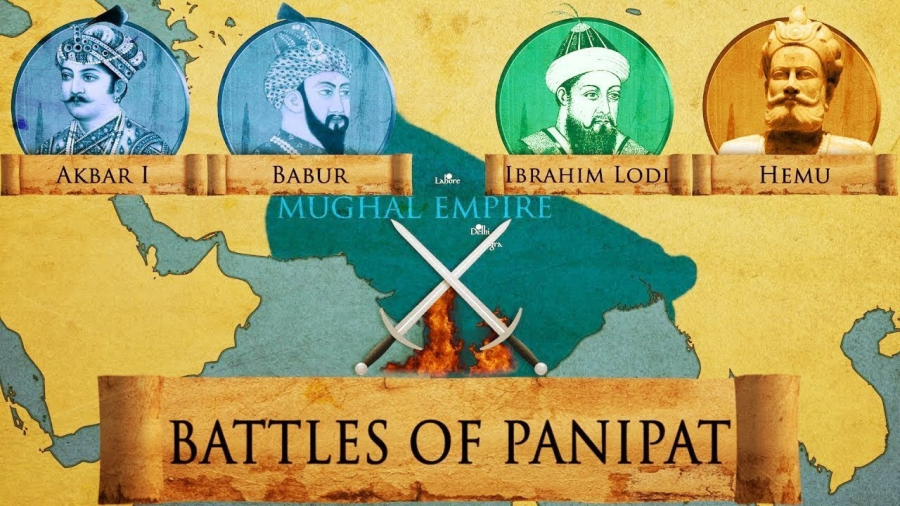
The First Battle of Panipat was fought on April 20, 1526. It was the decisive military confrontation between the Timurid Babur (1483-1530) and the last Sultan of Delhi, Ibrahim II (r. 1517-26), from the Afghan-born Lodi dynasty. Babur’s relatively small army was victorious over the numerically superior force of Ibrahim Lodi, who fell in battle. With Ibrahim’s death, the Delhi Sultanate was extinguished and replaced by the Mughal Empire, whose foundation had been laid by this victory.
The First Battle of Panipat was fought on April 20, 1526. It was the decisive military confrontation between the Timurid Babur (1483-1530) and the last Sultan of Delhi, Ibrahim II (r. 1517-26), from the Afghan-born Lodi dynasty. Babur’s relatively small army was victorious over the numerically superior force of Ibrahim Lodi, who fell in battle. With Ibrahim’s death, the Delhi Sultanate was extinguished and replaced by the Mughal Empire, whose foundation had been laid by this victory.
Result of the First Battle of Panipat
- Babur, the Timurid ruler of Kabulistan, defeated Ibrahim Lodi, Sultan of Delhi, and his much superior Mughal armies.
- Babur’s success allowed him to establish the foundations for the Mughal Empire in India.
- Ibrahim Lodi was betrayed by his feudatories and generals and killed on the battlefield (many of whom were mercenaries).
- The majority of the feudatories switched their loyalty to Delhi’s new ruler.
- Sultan Ibrahim’s fate may have been changed if he had lasted another hour of battle since Babur had no reserves left and his soldiers were quickly fatigued.
The Second Battle of Panipat
The Second Battle of Panipat took place on November 5, 1556, between the armies of Samrat Hem Chandra Vikramaditya, often known as Hemu, the Hindu ruler who ruled North India from Delhi, and the army of Akbar. Khan Zaman I and Bairam Khan, Akbar’s generals, won a decisive victory.
Background
- Samrat Hem Chandra Vikramaditya, often known as Hemu, was the Hindu ruler of Delhi after defeating Akbar/army Humanyun’s at the Battle of Delhi.
- Hemu was a descendant of Rewari, who served as an adviser to Sher Shah Suri’s son Islam Shah from 1545 until 1553. Between 1553 and 1556, as Prime Minister and Chief of the Army of Islam Shah, he defeated Afghan rebels in 22 battles.
- Humanyun, the Mughal king, died in Delhi on January 24, 1556, and was succeeded by his thirteen-year-old son, Akbar, at Kalanaur.
- King Akbar was enthroned on February 14, 1556. Mughal rule was limited to Kabul, Kandahar, parts of Delhi, and Punjab at the time of his accession to the throne.
Result of the Second Battle of Panipat
- Hemu was ready to defeat Akbar’s army while commanding his soldiers from atop an elephant when an arrow injured Hemu’s squinting eye.
- He went unconscious when the arrow pierced through his brain and out of the cup of his skull.
- Hemu’s army was defeated as a result of not spotting Hemu on his howdah (a seat for riding on the back of a horse).
- Shah Quli Khan Mahram found and captured dead Hemu several hours after the battle ended, and carried him to Akbar’s tent in the Panipat camp.
- Hemu’s supporters erected a Cenotaph at the location of his beheading, which may still be seen today in the village of Saudhapur on Panipat’s Jind Road.
The Third Battle of Panipat
The Third Battle of Panipat took place on 14 January 1761 at Panipat, about 60 miles (95.5 kilometres) north of Delhi, between a Maratha Empire northern expeditionary force and King of Afghanistan, Ahmad Shah Durrani, with two Indian Muslim allies— the Rohilla Afghans of the Doab and Shuja-ud-Daula, the Nawab of Oudh.
The battle is considered as one of the most important in the eighteenth century, with the highest number of casualties.
The Military Forces
The battle pitted the French-supplied artillery and Maratha’s cavalry against the Afghans’ and Rohillas’ strong cavalry and mounted artillery (zamburak and jezail) led by Ahmad Shah Durrani and Najib-ud-Daulah.(Ahmad Shah Abdali was also a name for Ahmad Shah Durrani.)
The Background
- The decline of the Mughal Empire after the 27-year Mughal-Maratha war (1680–1707), which resulted in rapid territorial gains for the Maratha Empire.
- Gujarat and Malwa came under Maratha rule under Peshwa Baji Rao. Finally, in 1737, Baji Rao defeated the Mughals on the outskirts of Delhi and gained possession of most of the old Mughal territory (south of Delhi).
- This brought the Marathas into direct conflict with Ahmad Shah Abdali’s Durrani empire.
- Ahmad Shah Abdali formed an army from Pashtun tribes in 1759 and made several gains in Punjab against the smaller Maratha garrisons. He, then formed a broad alliance against the Marathas with his Indian allies, the Gangetic Doab’s Rohilla Afghans.
The Result
- The battle put an end to further Maratha conquests in the north, as well as weakening their holdings, for around ten years. The rule of Peshwa Madhavrao, who is credited with restoring Maratha supremacy following the defeat at Panipat, lasted ten years.
- Peshwa Madhavrao sent a huge Maratha force into North India in 1771, ten years after Panipat, in an effort that was intended to:
- Restore the Maratha Empire’s dominance in North India.
- Punish rebellious nations that had either allied with the Afghans, like as the Rohillas or had tried to pull from Maratha control after Panipat.
- The campaign’s success may be regarded as the conclusion in Panipat’s long history.




 Eduindex
You must be logged in to post a comment.