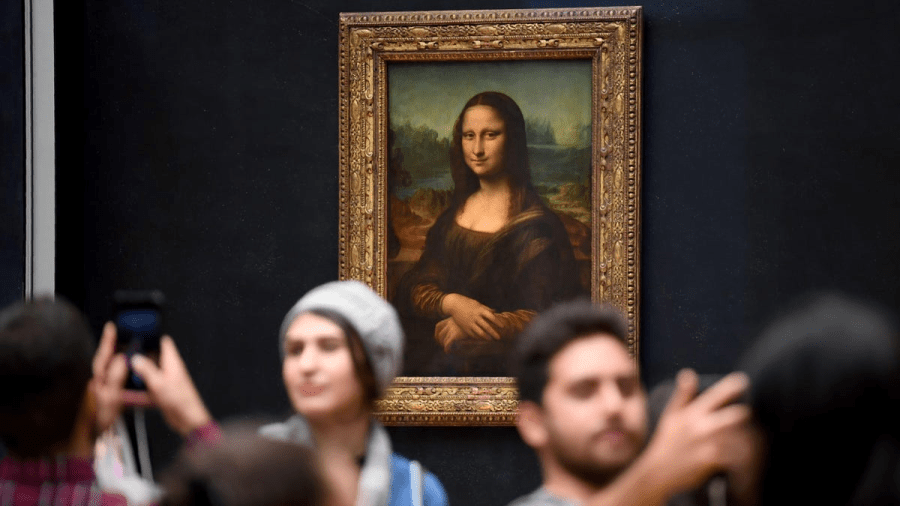
Mona Lisa-The famous painting

Some people are disappointed when they first see the most famous painting in the world.

Maybe at first glance it doesn’t give you the wow factor that other paintings give when you see. But the truth is, when you see how many people are surrounded every time just to see the masterpiece is on different level.

But the fact what we see is quite a contemplative portrait. A portrait which is the greatest psychological portrait ever painted. A portrait so ahead of its time, that centuries later we are still trying to figure it out.

In 1517, the French king, King Francis I offered Leonardo a job, court painter and engineer and architect to the king. Leonardo now in his sixties moved to the chateau of Amboise in France and never went back to Italy. He brought with him dozens of sketch books, but one painting i.e., Mona Lisa. leonardo knew how important it was. He know it was a master piece

Mona Lisa is the end product of the greatest inquisitive mind in history. A self made man with a voracious appetite for knowledge, a man who dedicated himself to the study of anatomy, geology and philosophy

For Mona Lisa he used a thin grained piece of popular tree and applied an undercoat of lead white. he painted with glazes that had a very small amount of pigment mixed with the oil. So, how dark you want your glass to be, depends on how much pigment you use. He used more like a wash, which he applied thin, layer by layer.

As we move around the painting, that light shifts around. he used tiny, almost invisible brushstrokes applied super slowly over months, or in Mona Lisa case, it’s years.

By contrast, on her skin, brush strokes were applied in an irregular way and that makes the grain of the skin, look more life like. All of these techniques pioneered by Leonardo, bring the painting to life. He made sure, we would not be distracted from the face of Mona Lisa.

Leonardo uses the classic pyramid shaped composition that was introduced during the renaissance. It is an important change from the paintings of the 15th century. The structure provides stability but more importantly it provides a clear center of focus and directs your gaze.

In Mona Lisa’s case, it is pulling us into her face. The Mona Lisa is the earliest Italian portrait to focus on the sitter in a 3 quarter length pose, rather than full length. But why? because he completely fills the frame with his subject, making the painting more intimate and cutting down on distractions.

The another thing is, portraits were usually done with an open sky as the background, a monotone background or a simple room. Mona Lisa is in front of a complicated landscape that only existed in Leonardo’s imagination. Paintings that are drawn during that period had both the subject and the background in sharp focus. Whereas the background of Mona Lisa seems to fade or become more blurred and out of focus. This is Arial perspective and Leonardo invented it


The perfect life of a student

Photo by Tirachard Kumtanom on Pexels.com

The life of a student is often seen as the “perfect life”. There is not much complexity to their life. After all, what they have to do is get up, get dressed, have their breakfast made by their mom and then rush to school without worrying about anything else. After their school, they return home, having everything prepared for them by their parents. What a perfect life, isn’t it? Nothing to worry about or to stress about! Everything they need is fulfilled by their parents. But in reality, is this what a student actually feels? Well, of course not! It’s only the point of view of everyone excluding the student himself who actually goes through the so- called “perfect life”? Let’s look more into it.

Nobody ever has a perfect life. Everybody has something that he wishes was not the way it is.

Stan Lee


The very notion of a “Perfect Life” is flawed. Nobody ever on the surface of earth has had a “perfect life”. Each and every person has been through or is going through some or the other kind of problem in their life. As in the case of students, the major issue faced by them is society’s expectations from them. As easy as it seems to have a student life, in reality it is nothing but a burden in today’s world. People, especially in many cases the parents, have high expectations from their children. They want their child to become doctor, engineer, administrative officials, etc., as per their expectations without paying any interest to what the child actually wants to do. Sometimes they force their child to take unnecessary tuitions and courses at an early age just to compete with others and to fulfill their expectations regardless of the child’s wish. This behavior, as normal and beneficial may seem, isn’t that encouraging and promising. Such behavior creates a stressful environment for the child who is subject to constant nagging and scolding if he/she defies the parents wish.

Photo by Pixabay on Pexels.com


The stress of exams is an additional issue that overcrowds the mind of a student. The need to complete the syllabus in time without leaving behind any portion, the need to complete the assignments in time, the need to be the best student in front of the teacher’s eyes and above all the need to fulfill the dreams of their parents are some of the never-ending thoughts which constantly consume the mind of a student. A student has to go through many hurdles in order to satisfy the wants of the society. Career options revolving around any kind of art form, fashion designing, management courses, etc., are still seen to be inferior to that of doctor and engineer. If both parents are doctors, then the child has to become a doctor as per the social tradition cum orthodox. It is not new that children are at risk to many mental health issues due to this reason. Mental health deterioration in children is often neglected in the society which in turn, results in some severe damage to the emotional capability of a child. Failure in exams is still one of the top reasons behind suicide and depression in India. Apart from all this, a child subject to all this kind of stress, when does not get proper aid and time from the parents, becomes prey to ADHD and in some cases, turns to alcohol and drugs which results in nothing but self-destruction. Mental health of a student is as important as the physical health in order to gain prosperity. The increasing levels of competition and stress, the constant nagging by the society to win in this so-called “rat race” takes a toll on the mental health of a student. Comparison with other students, no matter how constructively be suggested, results in self-doubt within the students.


In conclusion, no matter how easy the life of a student may seem, in reality it is not a cakewalk! The burden of fulfilling the wishes of the parents and the society results in nothing more than unnecessary stress, confusion and self-doubt. Thus, the parents need to be aware of the unwanted pressure they are putting on their child’s shoulder and rather be more attentive and invested in their child’s wishes and dreams.

Children are not thing to be molded, but people to be unfolded.

-Jess Lair

CAATSA

The Countering America’s Adversaries Through Sanctions Act (CAATSA) is a US federal law, enacted on 27th July, 2017 and came into effect from January 2018, that has imposed sanctions on Iran, North Korea and Russia. This act prevents trade partners of the United States in entering into bilateral contracts with these three nations. The Act empowers the US President to impose at least five of the 12 listed sanctions on persons engaged in a significant transaction with Russian defence and intelligence sectors. Its ultimate goal is to prevent revenue from flowing to the Russian Government. The Countering America’s Adversaries through Sanctions Act (CAATSA), aims at taking punitive measures against Russia, Iran, and North Korea. The Act primarily deals with sanctions on the Russian oil and gas industry, defenceand security sector, and financial institutions, in the backdrop of its military intervention in Ukraine and its alleged meddling in the 2016 US presidential elections.

Background of CAATSA :

The Countering America’s Adversaries Through Sanctions Act came against the backdrop of three events that would have serious implications regarding geopolitics. They are as follows:
• Iran’s Nuclear Missiles Program: The United States Government believed that any progress in Iran’s nuclear missile program would further destabilize the Middle-East as Iran has repeatedly made threats against Israel, a key NATO and United States ally. The CAATSA gives authority to the President of the United States to impose sanctions against any party involved in the sale and transfer of military technology to Iran.
• Curbing Russian influence: The Russian annexation of Crimea in 2014 and allegations of interventions in the US polls of 2016 was the catalyst for the CAATSA against Russia. Under the act sanctions can be imposed on Russia should the state or private individuals be found involved in activities such as cybersecurity, crude oil projects,  financial institutions, corruption,  human rights abuses etc.
• North Korea and weapons of mass destruction: North Korea has a nuclear weapons military program and as of 2020 it’s estimated missile arsenal includes 30-40 warheads with enough fissile materials to produce 6-7 missiles per year. North Korea has made repeated threats against its South Korea repeatedly and also against the United States.

Types of Sanctions:
The CAATSA contains 12 types of sanctions. There areonly two sanctions that may impact either India-Russia relations or India-US relations.
• Prohibition of Banking transactions: It is likely to have an impact on India-Russia relations.This would mean difficulties for India in making payments in US Dollars to Russia for the purchase of the S-400 systems.
• Export Sanction: The second sanction will have greater consequences for India-US relations. It has the potential to completely derail the India-US Strategic and Defence partnership, as it will deny the license for, and export of, any items controlled by the US.

India’s Concerns :

Seventy per cent of Indian military hardware is Russian in origin. While the US has become its second-largest defence supplier, mainly of aircraft and artillery, India still relies heavily on Russian equipment, such as submarines and missiles that the US has been unwilling to provide. The USA President was given the authority in 2018 to waive CAATSA sanctions on a case by case basis. A waiver of such CAATSA for India has been under consideration since the law had come into force. In fact, India was threatened with sanctions when it decided to buy the S-400 missile launchers from Russia and buy crude oil from Iran. What is also worrying for India is the example of Turkey who, despite being a key NATO ally, was expelled from the US F-35 fighter jet programme when it purchased S-400 missile systems from Russia. Yet India went ahead with the S-400 deal in 2018 with no negative reaction from the United States government. The delivery of the S-400s is expected to finish by 2025. However, the USA has repeatedly stated that India should not assume it will get a waiver. Now India could also face USA sanctions for purchasing the S-400 Triumf missile defense system from Russia under the CAATSA. If implemented stringently, CAATSA would impact Indian defence procurement from Russia. Lately, the United States Government has stated that although a waiver is not possible at this time, a blanket application of sanctions against India for its defence contracts with Russia is also not being considered. India stopped importing oil from Iran in mid-2019 following sanctions on the Persian Gulf nation by the Trump administration.Iran in 2017-18 was its third-largest supplier after Iraq and Saudi Arabia and met about 10% of total needs.Iran getting closer to China is also a serious concern for India.

India needs to balance its relation with both Russia and USA, so that its national interest is not compromised. Russia always saw India as a balancer that’s why Russia facilitated India’s inclusion into Shanghai Cooperation Organisation (SCO) and formation of Russia-India-China (RIC) grouping.The defence procurement for India has become significant amid deadly clashes with China on Line of Actual Control (LAC). Further, Russia is an all weather defence partner of India.India today is in a unique position to have a favourable relation with all great powers.It needs to develop closer ties with the United States, which could balance any moves towards a strategic partnership between China and Russia. Thus, India must leverage this position to help in building a peaceful world order.

Sources : The Hindu and Drishti IAS

Delhi's peak power demand reaches record high of 7,334 MW for June

The peak power demand in the national capital rose to 7,334 MW on Wednesday afternoon, the highest ever in June, amid increased use of cooling appliances to beat the intense heat, discom officials said.It is expected to hover around 8,200 MW in the coming days, they added.

“Before June 9, Delhi’s peak power demand had never crossed the 7,000 MW-mark during June.

However, on May 19 this year, it clocked 7,070 MW. It has already crossed 7,000 MW six times in June this year and once in May,” a power distribution company (discom) official said.

The power demand peaked to 7,334 MW at 3.35 pm on Wednesday.Delhi’s power demand crossed the 6,000 MW-mark on every single day this June, the official said.In 2021, it crossed the 6K mark on nine occasions through the month, five-times in 2020 and thrice in 2019.

Delhi’s peak power demand reaches record high of 7,334 MW for June

The peak power demand in the national capital rose to 7,334 MW on Wednesday afternoon, the highest ever in June, amid increased use of cooling appliances to beat the intense heat, discom officials said.It is expected to hover around 8,200 MW in the coming days, they added.

“Before June 9, Delhi’s peak power demand had never crossed the 7,000 MW-mark during June.

However, on May 19 this year, it clocked 7,070 MW. It has already crossed 7,000 MW six times in June this year and once in May,” a power distribution company (discom) official said.

The power demand peaked to 7,334 MW at 3.35 pm on Wednesday.Delhi’s power demand crossed the 6,000 MW-mark on every single day this June, the official said.In 2021, it crossed the 6K mark on nine occasions through the month, five-times in 2020 and thrice in 2019.

NGO ‘SAAHDEV for the Development of Farmers: A Case from Assam

Across the world and also in our country there are many Non-governmental Organizations (NGOs) working in various fields. Here, I am presenting the case of  “Society for Assam Agri-Horticultural Development” locally popular as  “SAAHDEV”  a Non-Governmental   Organisation (NGO) located in Guwahati which is working for the development of rural farming communities of Assam, especially for the resource crunch poor farmers. SAAHDEV   is comprised of senior citizens, who had long experience in the Agri-horticultural sector. It started its work in 2021 after registration under the Societies Registration Act of 1860.

Presently, SAAHDEV initiated a project for the production of quality winter paddy seeds viz.,  Ranjit Sub-1 variety, a submergence tolerance variety,  in a flood-prone area of Assam at   Durung village (Kamrup district) which is about 50 kilometers away from Guwahati. This variety was developed by the Assam Agricultural University and made available in 2018.

Incessant rain and a subsequent flood occur almost every year from June to September in this area (Durung village and its vicinity) and thus damage a vast area of paddy crops. Even if farmers try to do re-transplanting (if seedlings are available at that time), it will not help farmers to get their due return as the ideal time of transplantation is over. Therefore, the growing of submergence tolerance variety is one of the solutions at Durung village for which Ranjit Sub -1 variety is an alternative.

 SAAHDEV in collaboration with the Regional Agricultural Research Centre, Nagaon of Assam Agricultural University (AAU) organized a day-long programme on 12 Jun 2022 at Durung ( Khetri) distributing 20 Kilograms of breeder seeds to 20 farmers at the rate of one kilogram each. Also, imparted training to the farmers on the production of the breeder to foundation seeds, then to certified seeds of paddy.

It may be mentioned that Dr. Hemen Kalita, Agricultural Scientist, Regional Agricultural Research Centre, Nagaon, of Assam Agricultural University, attended as a resource person in the training and explained various aspects of seed production techniques to the farmers. Dr. Bhubaneshwar Burman, President of “SAAHDEV”, Bijoy Sarathi Sarma, Ramendra Kumar Bhuyan workers, and executive members of SAAHDEV attended the programme and discussed future steps on the project with the farmers and chalked out a detailed plan for production.  It is pertinent to mention that the yield of Ranjit Sub-1 is around 7,500 kilograms per hectare.

Further, it may be mentioned that the Government of India has already initiated measures to inspire farmers of flood-affected Kharif (sali) paddy to shift from regular sali paddy seeds to submergence tolerant varieties.  Indian Council of Agricultural Research (ICAR) and Agricultural Universities of India have developed other varieties viz., Swarna sub-1, Ranjit sub-1, etc.

It has to be admitted that the Government organizations cannot do it alone so, NGOs, Farmers’ Association, and others should come forward to take up seed production of such varieties in remote areas of the country, particularly in the flood-prone areas.

I extend my gratitude to my friend Bijoy Sarathi Sarma, Worker and Executive Member of SAAHDEV, Guwahati (bijoysarathi@yahoo.com) for providing the necessary inputs to publish the article.

NGO ‘SAAHDEV for the Development of Farmers: A Case from Assam

Across the world and also in our country there are many Non-governmental Organizations (NGOs) working in various fields. Here, I am presenting the case of  “Society for Assam Agri-Horticultural Development” locally popular as  “SAAHDEV”  a Non-Governmental   Organisation (NGO) located in Guwahati which is working for the development of rural farming communities of Assam, especially for the resource crunch poor farmers. SAAHDEV   is comprised of senior citizens, who had long experience in the Agri-horticultural sector. It started its work in 2021 after registration under the Societies Registration Act of 1860.

Presently, SAAHDEV initiated a project for the production of quality winter paddy seeds viz.,  Ranjit Sub-1 variety, a submergence tolerance variety,  in a flood-prone area of Assam at   Durung village (Kamrup district) which is about 50 kilometers away from Guwahati. This variety was developed by the Assam Agricultural University and made available in 2018.

Incessant rain and a subsequent flood occur almost every year from June to September in this area (Durung village and its vicinity) and thus damage a vast area of paddy crops. Even if farmers try to do re-transplanting (if seedlings are available at that time), it will not help farmers to get their due return as the ideal time of transplantation is over. Therefore, the growing of submergence tolerance variety is one of the solutions at Durung village for which Ranjit Sub -1 variety is an alternative.

 SAAHDEV in collaboration with the Regional Agricultural Research Centre, Nagaon of Assam Agricultural University (AAU) organized a day-long programme on 12 Jun 2022 at Durung ( Khetri) distributing 20 Kilograms of breeder seeds to 20 farmers at the rate of one kilogram each. Also, imparted training to the farmers on the production of the breeder to foundation seeds, then to certified seeds of paddy.

It may be mentioned that Dr. Hemen Kalita, Agricultural Scientist, Regional Agricultural Research Centre, Nagaon, of Assam Agricultural University, attended as a resource person in the training and explained various aspects of seed production techniques to the farmers. Dr. Bhubaneshwar Burman, President of “SAAHDEV”, Bijoy Sarathi Sarma, Ramendra Kumar Bhuyan workers, and executive members of SAAHDEV attended the programme and discussed future steps on the project with the farmers and chalked out a detailed plan for production.  It is pertinent to mention that the yield of Ranjit Sub-1 is around 7,500 kilograms per hectare.

Further, it may be mentioned that the Government of India has already initiated measures to inspire farmers of flood-affected Kharif (sali) paddy to shift from regular sali paddy seeds to submergence tolerant varieties.  Indian Council of Agricultural Research (ICAR) and Agricultural Universities of India have developed other varieties viz., Swarna sub-1, Ranjit sub-1, etc.

It has to be admitted that the Government organizations cannot do it alone so, NGOs, Farmers’ Association, and others should come forward to take up seed production of such varieties in remote areas of the country, particularly in the flood-prone areas.

I extend my gratitude to my friend Bijoy Sarathi Sarma, Worker and Executive Member of SAAHDEV, Guwahati (bijoysarathi@yahoo.com) for providing the necessary inputs to publish the article.

The Green Revolution in India

Photo by Pixabay on Pexels.com

The great increase in production of food grains(like rice and wheat) due to the introduction of high yielding varieties,to the use of pesticides, and to bettter management techniques is known as the Green Revolution in India.
A part of a larger initiative by Norman Borlaug, green revolution in India was founded by M.S Swaminathan. The aim was to increase agricultural productivity in the developing world with the use of technology and agricultural research. The Green Revolution started in 1965 with the first introduction of High yielding variety(HYV)seeds in Indian agriculture. The end result of the Green Revolution was to make India self sufficient when it came to food grains. The Green Revolution in India was first introduced in Punjab in the late 1960s as a part of a development program issued by international donor agencies and the government of India. During the British Raj, India’s grain economy hinged on a unilateral relation of exploitation. The Green Revolution resulted in increased production of food grains (especially wheatand rice) and was in large part due to the introduction into developing countries of new, high-yielding varieties, beginning in the mid-20th century with Borlaug’s work. Borlaug developed a short-stemmed (“dwarf”) strain of wheat that increased crop yields. Previously, taller wheat varieties would break under the weight of the heads if production was increased by chemical fertilizers. Borlaug’s short-stemmed wheat could withstand the increased weight of fertilized heads.Wheat production in Mexico multiplied threefold owing to this and other varieties.Following Borlaug’s success in Mexico, the Indian and Pakistani goverments requested his assistance. Borlaug began his agricultural revolution in Asia. With India and Pakistan facing food shortages due to rapid population growth, the importation of Borlaug’s dwarf wheat in the mid-1960s was a key element if Green Revolution in India and helped the country to become agriculturally self sufficient.

What are the main features of Green Revolution?
1) Introduction of new and high yielding variety of seeds
2) Increased use of fertilizers, pesticides and weedicides to reduce agricultural losses.
3) Increased application of fertilisers to enhance agricultural productivity.
4) Use of latest agricultural machinery like tractors, threshers and harvesters etc.
5) Use of disease resistant varieties so that production will enhance.

Pros and cons of Green Revolution
Pros:
1) increase in agricultural production
2) reduction in import of food grains
3) increase quality of food
4) increase tolerance to pests, diseases and weeds
5) prosperity of farmers and helps in rural employment
Cons:
1) expensive seeds
2) ecological problems like soil erosion, waterlogging, desertification etc.
3) creates lack of biodiversity
4) health impacts from increased pesticides and fertilisers
5) deforestation

The Green Revolution in India

Photo by Pixabay on Pexels.com

The great increase in production of food grains(like rice and wheat) due to the introduction of high yielding varieties,to the use of pesticides, and to bettter management techniques is known as the Green Revolution in India.
A part of a larger initiative by Norman Borlaug, green revolution in India was founded by M.S Swaminathan. The aim was to increase agricultural productivity in the developing world with the use of technology and agricultural research. The Green Revolution started in 1965 with the first introduction of High yielding variety(HYV)seeds in Indian agriculture. The end result of the Green Revolution was to make India self sufficient when it came to food grains. The Green Revolution in India was first introduced in Punjab in the late 1960s as a part of a development program issued by international donor agencies and the government of India. During the British Raj, India’s grain economy hinged on a unilateral relation of exploitation. The Green Revolution resulted in increased production of food grains (especially wheatand rice) and was in large part due to the introduction into developing countries of new, high-yielding varieties, beginning in the mid-20th century with Borlaug’s work. Borlaug developed a short-stemmed (“dwarf”) strain of wheat that increased crop yields. Previously, taller wheat varieties would break under the weight of the heads if production was increased by chemical fertilizers. Borlaug’s short-stemmed wheat could withstand the increased weight of fertilized heads.Wheat production in Mexico multiplied threefold owing to this and other varieties.Following Borlaug’s success in Mexico, the Indian and Pakistani goverments requested his assistance. Borlaug began his agricultural revolution in Asia. With India and Pakistan facing food shortages due to rapid population growth, the importation of Borlaug’s dwarf wheat in the mid-1960s was a key element if Green Revolution in India and helped the country to become agriculturally self sufficient.

What are the main features of Green Revolution?
1) Introduction of new and high yielding variety of seeds
2) Increased use of fertilizers, pesticides and weedicides to reduce agricultural losses.
3) Increased application of fertilisers to enhance agricultural productivity.
4) Use of latest agricultural machinery like tractors, threshers and harvesters etc.
5) Use of disease resistant varieties so that production will enhance.

Pros and cons of Green Revolution
Pros:
1) increase in agricultural production
2) reduction in import of food grains
3) increase quality of food
4) increase tolerance to pests, diseases and weeds
5) prosperity of farmers and helps in rural employment
Cons:
1) expensive seeds
2) ecological problems like soil erosion, waterlogging, desertification etc.
3) creates lack of biodiversity
4) health impacts from increased pesticides and fertilisers
5) deforestation

The White Revolution in India

Photo by Engin Akyurt on Pexels.com

The revolution associated with a sharp increase in milk production in the country is called the White Revolution in India also known as Operation Flood. White revolution period intended to make India a self-dependent nation in milk production.
Verghese Kurien ,the founder of Amul introduced White revolution in India. He is known as the father of white revolution in India.
Operation Flood started the White Revolution in India and made our country self-sufficient in milk and this was achieved entirely through the cooperative structure.One of the largest of its kind, the programme objective was to create a nationwide milk grid. It resulted in making India one of the largest producers of milk and milk products, and hence is also called the White Revolution of India. It also helped reduce malpractices by milk traders and merchants. The White Revolution in India was successful in transforming the country from a milk deficient nation to a world leader in milk production. It helped dairy-farming become India’s largest self-sustaining industry and also, India’s largest rural employment provider.

Advantages and disadvantages of white revolution
Advantage:
1) ended imports of milk solids in India.
2) India started exporting milk powder to many foreign nations.
3) dairy industries and infrastructures modernised and expanded.
4) more employment in the field of dairy farming.
5) dairy needs are met locally.
Disadvantage:
1) since livestock are prone to many diseases, milk obtained from them during such conditions leads to disease spreading.
2) adulteration of milk and dairy products.

The White Revolution in India

Photo by Engin Akyurt on Pexels.com

The revolution associated with a sharp increase in milk production in the country is called the White Revolution in India also known as Operation Flood. White revolution period intended to make India a self-dependent nation in milk production.
Verghese Kurien ,the founder of Amul introduced White revolution in India. He is known as the father of white revolution in India.
Operation Flood started the White Revolution in India and made our country self-sufficient in milk and this was achieved entirely through the cooperative structure.One of the largest of its kind, the programme objective was to create a nationwide milk grid. It resulted in making India one of the largest producers of milk and milk products, and hence is also called the White Revolution of India. It also helped reduce malpractices by milk traders and merchants. The White Revolution in India was successful in transforming the country from a milk deficient nation to a world leader in milk production. It helped dairy-farming become India’s largest self-sustaining industry and also, India’s largest rural employment provider.

Advantages and disadvantages of white revolution
Advantage:
1) ended imports of milk solids in India.
2) India started exporting milk powder to many foreign nations.
3) dairy industries and infrastructures modernised and expanded.
4) more employment in the field of dairy farming.
5) dairy needs are met locally.
Disadvantage:
1) since livestock are prone to many diseases, milk obtained from them during such conditions leads to disease spreading.
2) adulteration of milk and dairy products.

What is Cyberbullying and how to deal with it?

Photo by Valery on Pexels.com

Cyberbullying is a form of online harassment or bullying using electronic means.  It has become increasingly common, especially among teenagers. Cyberbullying includes sending, posting, or sharing negative, harmful, false, or mean content about someone else. It can include sharing personal or private information about someone else 
The most common places where cyberbullying occurs are:

• Social Media, such as Facebook, Instagram etc.

• Text messaging and messaging apps on mobile or tablet devices

• Online forums, chat rooms, and message boards, such as Reddit

• Email

• Online gaming communities

How we can stop or prevent cyberbullying?
1) Don’t respond to any emails, app messages, or text messages sent by cyberbullies.
2) Don’t be an accomplice by forwarding any of the messages to others kids.
3) Take screeshots as proof and evidence of cyberbullying.
4) If you are being bullied, tell an adult to get help solving the problem.

What is Cyberbullying and how to deal with it?

Photo by Valery on Pexels.com

Cyberbullying is a form of online harassment or bullying using electronic means.  It has become increasingly common, especially among teenagers. Cyberbullying includes sending, posting, or sharing negative, harmful, false, or mean content about someone else. It can include sharing personal or private information about someone else 
The most common places where cyberbullying occurs are:

• Social Media, such as Facebook, Instagram etc.

• Text messaging and messaging apps on mobile or tablet devices

• Online forums, chat rooms, and message boards, such as Reddit

• Email

• Online gaming communities

How we can stop or prevent cyberbullying?
1) Don’t respond to any emails, app messages, or text messages sent by cyberbullies.
2) Don’t be an accomplice by forwarding any of the messages to others kids.
3) Take screeshots as proof and evidence of cyberbullying.
4) If you are being bullied, tell an adult to get help solving the problem.

Another COVID-19 Pill-” Paxlovid”

Pfizer announced its investigational novel COVID-19 oral antiviral medicine , Paxlovid reduced hospitalization & death. The adminstration has also arranged to purchase 20 million corses of drug. It will be manufactured & distributed to pharmacies in weeks & months.

It is orally bioavailable drug used against HIV that is active against M*pro, a viral drug that play an essential role in viral replication by leaving the 2 viral polyproteins . It has demonstrated antiviral activity against all coronavirus that are known to infect humans. It is ritonavir , a strong cytochrome P450 ( CYP) 3 A4 drug and boosting agent that has been used to boost HIV . How may tablet are needed? After it is prescribed, Paxlovid is administered as three tablets taken together orally twice daily for five days, for a total of 30 tablets. What are the side effects? Possible side effects of Paxlovid include impaired sense of taste, diarrhea, high blood pressure and muscle aches, says the FDA. Using Paxlovid at the same time as certain other drugs may result in “potentially significant drug interactions.” Consult with your doctor. Using Paxlovid in people with uncontrolled or undiagnosed HIV-1 infection may lead to HIV-1 drug resistance, the FDA said. How did Paxlovid performed in clinical studies? Paxlovid significantly reduced the number of hospitalization or death from COVID-19 by 88 percent, compared to placebo among patients treated within five days of symptom onset and who did not receive COVID-19 therapeutic monoclonal antibody treatment.

It is developed by Pfizer and can be taken at home to help keep high- risk patients from getting so sick that they need to be hospitalized.

According to Kaiser health information it not always easy to find a prescription; one individuals told that RPR that it took an usual amount of knowledge and connections.

The medication company named Pfizer is taken a stepping towards vaccine named “Paxlovid” to reduce hospitalization and may offer to India at lower prices.

RAMSAY HUNT SYNDROME

Ramsay Hunt Syndrome is neurological disease in which a virus – Varicella Zoster – causes inflammation of the nerves involved in facial movements.

When the nerves get inflamed, they lose their ability to function, leading to temporary facial palsy or paralysis. Facial muscles in the infected person cannot receive necessary signals to function properly. There are 12 cranial nerves in the body. Ramsay Hunt Syndrome is the viral infection impacting the 7th cranial nerve that is involved in facial movements. The inflammation caused by the Varicella Zoster Virus makes the nerve ineffective.

The symptoms include painful, red rash and blisters in and around the ear, and facial paralysis on the same side. Patients also report hearing loss in the ear that has been impacted apart from Tinnitus or ringing sounds. Inability to close the eye causes dryness. A rash on the eardrum, the ear canal and the earlobe. Rashes can also appear inside the mouth, on the tongue. There is hearing loss, vertigo or spinning sensation. It causes weakness of one side of the face and causes difficulty in closing one eye and eating as food falls off from the affected side. There is drooping of the face.

The Varicella Zoster Virus (VZV) is the same virus that causes chickenpox and shingles.
This virus belongs to the Herpesvirus group and can stay in the body as a latent infection.
The virus can stay dormant in a person’s body and can reawaken to attack the nerves.
VZV can get reactivated due to weakening of the immune system. Stress is also considered a trigger, according to some studies, as it depresses the immune system. Some reports also suggest that T-cell dysfunction caused by coronavirus infection can reactivate VZV.

The disease is reversible. Patients get cured within 15 days to three months of starting the treatment.