Nothing has changed in the RBI’s view on cryptocurrencies. The Central Bank Governor, Dr. Shakktanta Das, clearly believes that cryptocurrencies pose a highly visible threat. He said so in the Financial Stability Report (FSR) released on Friday. He has also indicated that the RBI will also take appropriate steps to protect the country’s financial sector from the danger it poses. Regarding cryptocurrency, the RBI governor has said that it is baseless speculation and is promoted with a good name only on the basis of speculation. In the report, the RBI has said that cryptocurrency should not be treated as a currency as there is no one monitoring it. These are neither financial assets nor debt securities. This can lead to a variety of risks. Also in the past when attempts were made to manage currencies privately the results were very poor. The Financial Stability Report said the rapid rise in crude oil prices in the world market has led to a reduction in growth rate estimates.
According to another RBI report, banks’ gross NPAs fell to a six-year low of 5.9 percent in March 2022. By March 2023, this could fall further to 5.3 percent. However, the RBI has warned that NPAs could rise if macroeconomic conditions deteriorate.
PV Sindhu and HS Pranay, who played a key role in India’s Thomas Cup title win, recorded contrasting victories on Thursday to advance to the quarter-finals of the Malaysia Open Super 750 tournament. Prannoy pulled off the biggest upset of the day when he defeated world No.4 Chou Tien Chen of Chinese Taipei 21-15, 21-7 in a match lasting more than 30 minutes.Prannoy next meets Jonathan Christie of Indonesia, against whom he has won three games and lost five games.At the same time, former world champion Sindhu defeated Thailand’s Phitayaporn Cheiwan 19-21, 21-9, 21-14 in a match that lasted 57 minutes after losing the first game.The seventh-seeded Indian will face arch-rival Tai Tzu Ying of Chinese Taipei in the next round. The 29-year-old Prannoy, who made it to the semi-finals of the Indonesia Open last week, started slowly in both games but once he got going the Indian didn’t give his opponent a chance.
PV Sindhu and HS Pranay, who played a key role in India’s Thomas Cup title win, recorded contrasting victories on Thursday to advance to the quarter-finals of the Malaysia Open Super 750 tournament. Prannoy pulled off the biggest upset of the day when he defeated world No.4 Chou Tien Chen of Chinese Taipei 21-15, 21-7 in a match lasting more than 30 minutes.Prannoy next meets Jonathan Christie of Indonesia, against whom he has won three games and lost five games.At the same time, former world champion Sindhu defeated Thailand’s Phitayaporn Cheiwan 19-21, 21-9, 21-14 in a match that lasted 57 minutes after losing the first game.The seventh-seeded Indian will face arch-rival Tai Tzu Ying of Chinese Taipei in the next round. The 29-year-old Prannoy, who made it to the semi-finals of the Indonesia Open last week, started slowly in both games but once he got going the Indian didn’t give his opponent a chance.
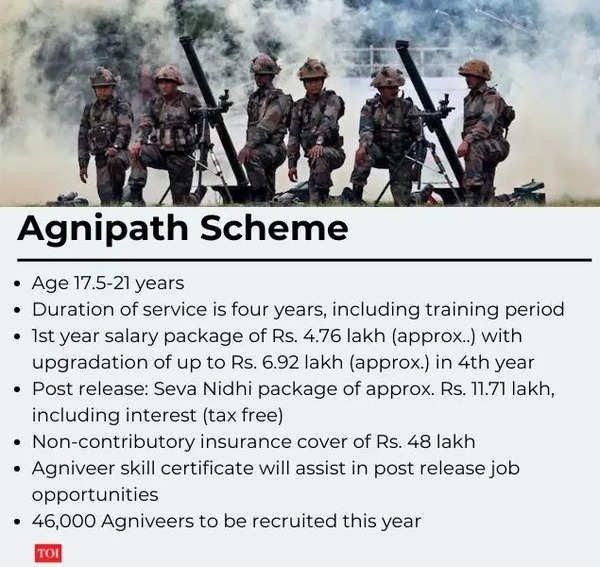
The Agnipath Program is a new program launched by the Government of India on June 14, 2022 to recruit soldiers under Corporal into three armies. The Agnipath program will be the only means of recruiting the military. All new employees will only be hired for 4 years. The personnel hired under this system are called Agniveers, a new military rank. The introduction of this system has been criticized for lack of consultation and open debate. The program is scheduled to start in September 2022. The Agnipath program was approved by the Government of India in June 2022 and will be implemented from September 2022. The announcement was made on June 14, 2022. This program is intended for both male and female applicants between the ages of 17.5 and 21. In widespread protests against the Agnipath program, the central government raised the cap from 21 to 23, but only in 2022. Recruitment under this program is held twice a year by the Indian Army, Indian Navy, and Indian Air Force. The available posts are below the executive list. The Agnipath program is the only way to serve in the army.
New employees, under the Agnipath scheme will be called “Agniveers,”who will have a four-year tenure, including six months of training followed by a 3.5-year deployment. After leaving the service, they have the opportunity to apply to continue in the army. Less than 25 percent of the retired group’s total strength is selected for the permanent roster. Employees who retire after four years of work are not eligible for a pension, but will receive a lump sum of approximately Rs 11,71,000 at the end of their tenure. The Government of India plans to hire 45,000-50,000 new employees each year through this program. In September 2022, 46,000 young people will be hired through this program. Prior to the start of the Agnipath program, soldiers were in the army for more than 15 years of service on a lifetime pension. As of 2019, there was no military recruitment for three years. The Government of India quoted the COVID-19 pandemic in India tye reason for no recruitment. Meanwhile, 50,000 to 60,000 soldiers continued to retire each year, leading to labor shortages and beginning to affect the military’s operational capabilities.
Credit- TOI
On June 16, 2022, fierce protests took place in several Indian states, where military candidates who were preparing for the armed forces were angry at the new system, demanding its rollback, and damaging public property. By June 17, 12 trains had been fired, affecting the movement of 300 trains. 214 trains were canceled, 11 trains were detoured, and 90 trains ended short of their destination. This scheme does not include long-term holdings, pensions and other benefits that existed in the old scheme. Individuals who wanted to join the army were disappointed with the rules of the new system. Of particular concern were short tenure, no early retirement pension, and an age limit of 17.5-21 years, making many of the current candidates unsuitable for serving in the Indian Army.
On June 20, a national strike called Bharat Bandh was summoned by a protesting organization calling for the withdrawal of the program. The call was made via social media without naming the organization. More than 600 trains were canceled due to a strike. Section 144 was imposed in parts of Rajasthan, Punjab, Uttar Pradesh and Haryana.


 Eduindex
You must be logged in to post a comment.