Women organizations and their role in India

Women’s Organisations emerged in India as a result of the spread of education and the establishment of the notion of the new woman. There was an improved level of communication among women which made them aware of the different problems that they faced and their rights and accountabilities in society. This awareness led to the upsurge of women’s organizations that fought for and signified women’s causes

An exclusive feature of the Indian women’s crusade is the fact that early efforts at women’s liberation were set in motion by men. Social reformers such as Raja Ram Mohan Roy, Maharishi Karve, and Swami Dayanand Saraswati challenged the conventional subservience of women, stimulated widow remarriage, and supported female education and impartiality in matters of religion, among other issues. Mahila mandals organized by Hindu reformist organizations such as the Arya Samaj and Brahmo Samaj encouraged women to go out of the boundaries of their homes and interact with other members of society. Pandita Ramabai, who was considered as one of the innovators of the feminist movement, with the help of Justice Ranade established the Arya Mahila Samaj in 1882. She envisioned creating a support network for newly educated women through weekly lectures and lessons at homes, where women could learn and gain confidence through interactions.

Women’s auxiliaries of general reform associations also served as a ground for women to deliberate social issues, express opinions, and share experiences. The Bharata Mahila Parishad of the National Social Conference was the most protruding among such opportunities. Though the National Social Conference was formed at the third meeting of the Indian National Congress in 1887, the Mahila Parishad was launched only in 1905.

These initiatives greatly influenced the social status of women. Early attempts at encouraging women to converse outside their families and local committees thus, stemmed from the broader social reform movement and efforts to upgrade the conditions of women.

The pre‐Independence period saw women’s issues related to the nationalist agenda at various junctures. In this period, a major enhancement of women was in terms of political participation of women, calling for a redefinition of conventional gender roles. Women began openly demonstrating their opposition to foreign control by supporting civil disobedience actions and other forms of protest against the British. Opportunities to organize and participate in agitations gave women much‐needed confidence and a chance to develop their leadership skills. Cutting across communal and religious barriers, women associated themselves with larger problems of society and opposed sectarian issues such as communal electorates. Political awareness among women grew, owing to a general understanding that women’s issues could not be separated from the political environment of the country. During this period, the initial women’s organizations formed within the historical background of the social reform movement and the nationalist movement were as follows.

•The Women’s India Association (WIA).
National Council of Women in India (NCWI).
•The All India Women’s Conference (AIWC) in 1917, 1925, and 1927 correspondingly.
Each of these organizations emphasized the importance of education in women’s progress.
•The WIA, created by Margaret Cousins in Madras, worked widely for the social and educational emancipation of women. •Associated with the Theosophical Society, it encouraged non‐sectarian religious activity and did creditable work in promoting literacy, setting up shelters for widows, and providing relief for disaster victims.
•Women in Mumbai, Chennai, and Kolkata through networks developed during World War I work, allied their associations together, and created the NCWI in 1925. A national branch of the International Council of Women, its most prominent member was Mehribai Tata, who aggressively campaigned against inert charity and advised men to support female education.
•The most important of the women’s organizations of the time was the All India Women’s Conference. Though its initial efforts were directed towards improving female education, its scope later extended to include a host of women’s issues such as women’s franchise, inheritance rights.

The Constitution of India enlisted in 1950 which permitted equal rights to men and women. Rights such as the right to vote, right to education, right to enter into public service, and political offices brought in satisfaction among women’s groups. In this period, there was limited activity in the area of women’s rights. Many women’s organizations such as the National Federation of Indian Women (1954) the Samajwadi Mahila Sabha (1559) were formed to work for supporting the cause of Indian women. Since the country was facing a social, political crisis after British rule, many demands of the women activists were not supported by the Government. But during this period from 1945, the Indian women got an opportunity to participate in confrontational politics.



In post-independent India, the women’s crusade was divided, as the common opponent, foreign rule, was no longer there. Some of the women leaders formally joined the Indian National Congress and took a powerful position as Ministers, Governors, and Ambassadors. Free India’s Constitution gave universal adult franchise and by the mid-fifties, India had fairly liberal laws concerning women. Most of the demands of the women’s movement had been met and there seemed few issues left to organize around. Women’s organizations now observed that there was an issue of implementation and consequently there was a pause in the women’s movement.

Some women organizations such as the Banga Mahila Samaj, and the Ladies Theosophical Society functioned at local levels to promote contemporary ideas for women. These organizations deal with issues like women’s education, abolition of social evils like purdah and Child marriage, Hindu law reform, moral and material progress of women, equality of rights and opportunities.

It can be believed that the Indian women’s movement worked for two goals.

•Uplift of women.
•Equal rights for both men and women.

Currently, there are many women organizations in India:

•All India Federation of Women Lawyers
•All India Women’s Conference
•Appan Samachar
•Association of Theologically Trained •Women of India
•Bharatiya Grameen Mahila Sangh
•Bharatiya Mahila Bank
•Confederation of Women Entrepreneurs
•Durga Vahini
•Friends of Women’s World Banking
•Krantikari Adivasi Mahila Sangathan

The major objective of this organization is:

•Strengthening and building new initiatives, networks, forums, etc., for protecting women’s rights
•Monitoring the Government of India’s commitments, implementing the Platform for Action with special focus on the eight-point agenda discussed at the Conference of Commitment, CEDAW, the Human Rights, and other United Nations Convention.
•Advocacy, lobbying, and campaigning on women-related issues.
•Information Dissemination and Documentation.
•Solidarity and linkages with other regional and global forums.


Another women organization in India is Swadhina (Self-esteemed Women) which was formed in 1986. It is principally a civil society organization focused on the Empowerment of women and Child Development based on Sustainable Development and Right Lively hood. At Swadhina, it is believed that positive social change has a direct effect on the lives of women and that change is possible only through equal and spontaneous participation of Women. Organization members are active in five states across the country in remote tribal districts of Singbhums in Jharkhand, Purulia, and West Midnapur in West Bengal, Kanya Kumari in Tamil Nadu, Mayurbhanj in Orissa, and East Champaran in Bihar.

Due to the women’s movement, several legislations were passed like the Equal Remuneration Act, Minimum Wage Act, Maternity Benefit Act, etc. to ensure equal status to women in society & more importantly at work. However, illiteracy amongst the major women workforce (87% of women are employed in the unorganized sector), fear of losing employment & lack of awareness of the laws enacted to protect them, make it difficult for women to benefit from them.


A girl should be two things:

who and what she wants.
CPA Exam Changes You Should Know About

 Certified Public Accountants (CPAs) are highly skilled professionals who provide critical financial services to businesses and individuals. They are state licensed and must meet rigorous education and experience requirements. You need to clear the exam to become a certified public accountant. 

Like any other exam, there have been CPA exam changes per the needs of the changing economic laws and scenarios. You must make these changes to clear the exam with flying colors, 

What Are the Exam Changes Everyone Should Know?

The first change is that starting in January 2019, the exam will be offered in a new computer-based testing format. It means you cannot take the exam on paper. Instead, the new format will allow you to take the exam on your schedule, and you will have more flexibility when scheduling your exams.

Another change that has been made is that the passing score for the exam has been raised from 75% to 80%. This change was made to align the exam with international standards.

Finally, the content of the exam has also been updated. The new content will focus on more advanced topics and will be more challenging than the previous versions.

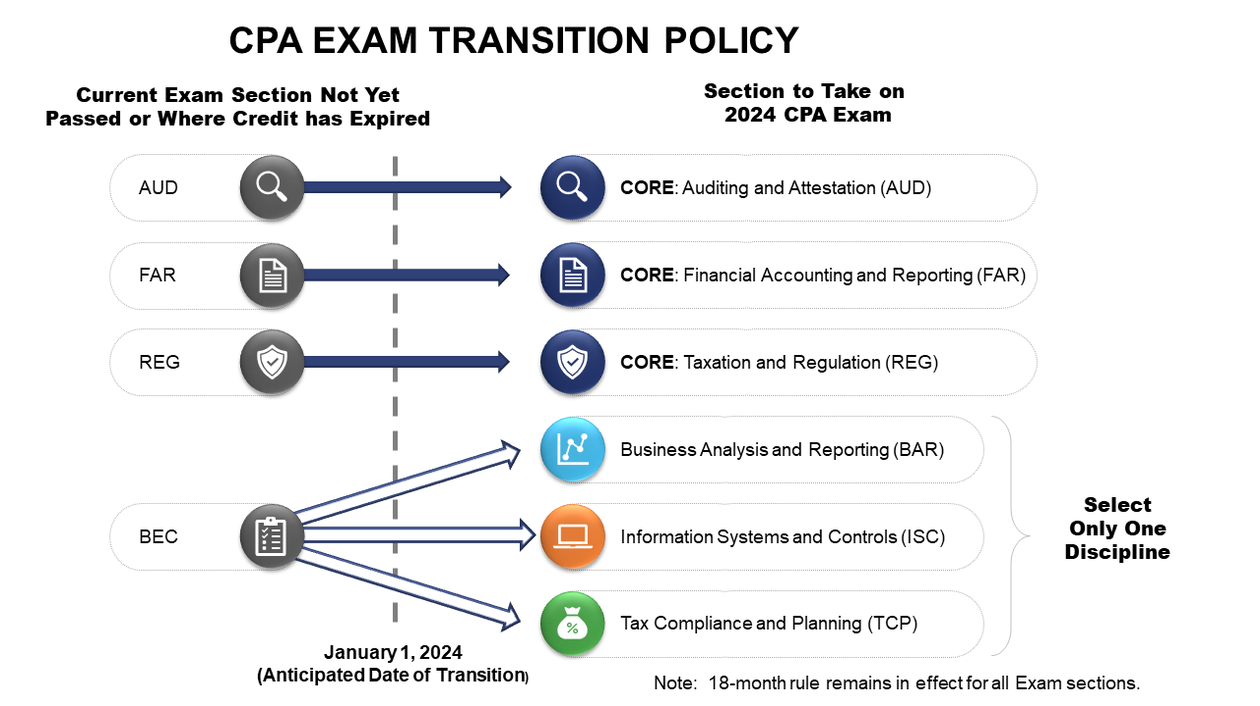
Understanding Core-Plus-Discipline Model 

The Core-Plus-Discipline Model is a new approach to the CPA Exam that emphasizes a greater focus on core knowledge, plus selected Depth and Breadth Disciplines. The model addresses the needs of all candidates by providing a more flexible and comprehensive testing experience. The Core-Plus-Discipline Model aims to ensure that all candidates have the opportunity to demonstrate their knowledge of core concepts and their ability to apply that knowledge to real-world situations. Under the new model, candidates can select Depth and Breadth Disciplines most relevant to their professional goals. The Core-Plus-Discipline Model will provide a more efficient and effective testing experience for all candidates.

Now that you know what CPA exam changes let’s know whether the exam has become difficult and what the role of a CPA is. 

Is CPA Exam Difficult?

It is considered one of the most difficult professional exams. The overall pass rate for the certified public auditor exam is 50%. The Uniform CPA Examination is a computer-based test that consists of four sections: Auditing and Attestation (AUD), Business Environment and Concepts (BEC), Financial Accounting and Reporting (FAR), and Regulation (REG). The AUD, FAR, and REG sections are divided into two parts, while the BEC section is divided into three. To become a licensed analyst, candidates must pass all four sections within 18 months. 

The exam is challenging because it tests students’ theoretical knowledge and ability to apply concepts in practical scenarios. In addition, the exam covers a broad range of topics, from financial reporting to taxation. 

While the exam is certainly challenging, it is not impossible to pass. Any candidate can overcome obstacles and earn their license with hard work and dedication.

Role of Certified Public Accountants 

CPAs play a crucial role in our economy by helping businesses to operate effectively and efficiently. They also provide critical guidance to individuals on matters related to personal finances. In addition, they also play a crucial role in Detecting and preventing fraud. As a result, they also play a critical role in safeguarding the financial interests of businesses and individuals.

In addition, this professional must adhere to strict ethical standards and complete continuing education on a regular basis. As a result,  they are uniquely qualified to provide a wide range of financial services, such as tax preparation, auditing, and financial planning.

<

p class=”MsoNormal” style=”font-family: Calibri, sans-serif;font-size: 11pt;line-height: 16.866666793823242px;margin: 0cm 0cm 10pt;text-align: justify”>Now that you have adequate information about the Certified Public Accountants exam and the recent changes in the exam structure, you can start preparing.  

What are Different Types of Pollution

There are various types of pollution chiefly arising as a result of anthropogenic causes. Also contributing to pollution is globalisation, where humanity’s constant need for natural resources has slowly started to change the face of the earth.

Though the quality of living has drastically improved, other new issues have risen that gradually impact human health and the environment. In this article, we shall explore the meaning, causes and types of pollution. Also, we shall analyse the repercussions of pollution on human health and the environment.

Types of Pollution

What is Pollution?

“Pollution is the introduction of substances (or energy) that cause adverse changes in the environment and living entities .”

Pollution need not always be caused by chemical substances such as particulates (like smoke and dust). Forms of energy such as sound, heat or light can also cause pollution. These substances that cause pollution are called pollutants.

Pollution, even in minuscule amounts, impacts the ecological balance.  Pollutants can make their way up the food chain and eventually find their way inside the human body. Read on to explore the types of pollution and their implications.

Types of Pollution

As stated before, there are different types of pollution, which are either caused by natural events (like forest fires) or by man-made activities (like cars, factories, nuclear wastes, etc.) These are further classified into the following types of pollution:

  • Air Pollution
  • Water Pollution
  • Soil Pollution
  • Noise Pollution

Besides these 4 types of pollution, other types exist such as light pollution, thermal pollution and radioactive pollution. The latter is much rarer than other types, but it is the deadliest.

Air Pollution

Air Pollution

Air pollution refers to the release of harmful contaminants (chemicals, toxic gases, particulates, biological molecules, etc.) into the earth’s atmosphere. These contaminants are quite detrimental and in some cases, pose serious health issues. Some causes that contribute to air pollution are:

  • Burning fossil fuels
  • Mining operations
  • Exhaust gases from industries and factories

The effects of air pollution vary based on the kind of pollutant. But generally, the impact of air pollution ranges from:

  • Increased risk of respiratory illness and cardiovascular problems
  • Increased risk of skin diseases
  • May increase the risk of cancer
  • Global warming
  • Acid rain
  • Ozone depletion
  • Hazards to wildlife

Among the other types of pollution, air pollution is theorized to have a planet-wide implication. Scientists have even speculated an apocalypse-like scenario where air pollution if left unchecked, can bring about an extreme form of global warming called the runaway greenhouse effect. Though this is purely speculative, it is a phenomenon that has already occurred on Venus.

Water Pollution

Water Pollution

Water Pollution

Water pollution is said to occur when toxic pollutants and particulate matter are introduced into water bodies such as lakes, rivers and seas. These contaminants are generally introduced by human activities like improper sewage treatment and oil spills. However, even natural processes such as eutrophication can cause water pollution.

Other significant causes of water pollution include:

  • Dumping solid wastes in water bodies
  • Disposing untreated industrial sewage into water bodies
  • Human and animal wastes
  • Agricultural runoff containing pesticides and fertilisers

The effects of water pollution are very pronounced in our environment.  Furthermore, toxic chemicals can bioaccumulate in living beings, and these chemicals can travel their way up the food chain, ultimately reaching humans.

Among the other types of pollution, water pollution has severe consequences on humans. For instance, in 1932, a grave case of water pollution incapacitated the inhabitants of an entire city in Japan with neurological diseases and mental illness for many decades. However, the immediate cause was not apparent but was eventually attributed to acute mercury poisoning. Methylmercury was dumped into the surrounding bay and had ultimately bioaccumulated inside the fish. The local population then consumed these fish, and this resulted in the manifestation of ill effects and neurological diseases.

Other consequences of water pollution include:

  • Disruption of the ecosystem
  • Threats to marine life
  • Increased risk of water-borne diseases
  • Increases toxic chemicals (such as mercury) in water bodies
  • Eutrophication

Soil Pollution

Soil Pollution

Soil pollution, also called soil contamination, refers to the degradation of land due to the presence of chemicals or other man-made substances in the soil. The xenobiotic substances alter the natural composition of soil and affect it negatively. These can drastically impact life directly or indirectly. For instance, any toxic chemicals present in the soil will get absorbed by the plants. Since plants are producers in an environment, it gets passed up through the food chain. Compared to the other types of pollution, the effects of soil pollution are a little more obscured, but their implications are very noticeable.

Some of the common causes of soil pollution are:

  • Improper industrial waste disposal
  • Oil Spills
  • Acid rain which is caused by air pollution
  • Mining activities
  • Intensive farming and agrochemicals (like fertilisers and pesticides)
  • Industrial accidents

The effects of soil pollution are numerous. Specific wastes, such as radioactive waste become particularly hazardous when they are not well-contained. A well-documented example is a nuclear accident in Chernobyl, which has left an area of 2,600 kmuninhabitable for several thousand years.

Other effects of soil pollution include:

  • Loss of soil nutrients, which renders the soil unfit for agriculture
  • Impacts the natural flora and fauna residing in the soil
  • Degrades vegetation due to the increase of salinity of the soil
  • Toxic dust (such as silica dust) can cause respiratory problems or even lung cancer

Noise Pollution

Noise Pollution

Noise pollution refers to the excessive amount of noise in the surrounding that disrupts the natural balance. Usually, it is man-made, though certain natural calamities like volcanoes can contribute to noise pollution.

In general, any sound which is over 85 decibels is considered to be detrimental. Also, the duration an individual is exposed plays an impact on their health. For perspective, a normal conversation is around 60 decibels, and a jet taking off is around 15o decibels. Consequently, noise pollution is more obvious than the other types of pollution.

Noise pollution has several contributors, which include:

  • Industry-oriented noises such as heavy machines, mills, factories, etc.
  • Transportation noises from vehicles, aeroplanes, etc.
  • Construction noises
  • Noise from social events (loudspeakers, firecrackers, etc.)
  • Household noises (such as mixers, TV, washing machines, etc.)

Noise pollution has now become very common due to dense urbanisation and industrialisation. Noise pollution can bring about adverse effects such as :

  • Hearing loss
  • Tinnitus
  • Sleeping disorders
  • Hypertension (high BP)
  • Communication problems

Frequently Asked Questions

What are the different types of pollution?

The different types of pollution include:

  • Air pollution
  • Water pollution
  • Soil pollution
  • Radioactive pollution
  • Noise pollution

Name the harmful pollutants responsible for polluting the environment.

The harmful pollutants responsible for polluting the environment are:

  • Nitrogen oxide
  • Sulphur oxide
  • Mercury
  • Particulate matter
  • Chlorofluorocarbon
  • Volatile organic compounds

What are the different types of pollutants?

The different types of pollutants are:

  • Primary Pollutants: These are the pollutants that are emitted directly from the sources such as volcanic eruptions, combustion of fossil fuel, etc. These include nitrogen oxide, sulphur oxide, etc.
  • Secondary Pollutants: These are the pollutants that are not directly emitted from the sources but are formed when primary pollutants react in the atmosphere. For eg., ozone.

What is radioactive pollution?

Radioactive pollution is the pollution caused by the release of radioactive substances in the atmosphere during activities such as nuclear explosions, mining of radioactive ores, etc.

What are the consequences of mercury pollution?

Mercury pollution is the pollution caused by the release of mercury from mercury products or emissions from coal-burning power plants in the air, water or land. Mercury pollution results in neurological and behavioural disorders in humans. Insomnia, memory loss, headaches, and tremors are some of the symptoms of mercury pollution

Top 5 things you must know about Canadian vaping law

Top5 THINGSTHAT YOU MUST KNOWABOUT CANADIAN VAPING LAW.

As we know, Vaping is rapidly becoming a lot more famous with Canadians. Too much is not good for anything, It looks quite confusing but, because of its use as a method to quit smoking, but also because young people are getting addicted to it. Vaping, or e-cigarettes, are battery-powered devices that simulate your smoking experience by using an inhalation procedure that vaporizes liquid within the device. 

According to the study, youth who are between 15 to 19 years old and young adults who are aged between 20 to 25 years, have the highest rate of using vaping in Canada, and now it is serving a problem for the government about the further increased use of vaping in youth.

Delivering the shortage of study on the long-term health effects of vaping products and their addictive essence, e-cigarettes should not be consumed by youth, by non-smokers, or by ex-smokers who have stopped completely.

But right now, vaping products are only allowed under the Tobacco and vaping products act, TVPA will be liable to significant restrictions to communicate the questions containing these products. These restrictions mainly focus on dealers, distributors, address manufacturing, sale, labeling, and growth. The laws, as defined by the TPVA will be are as follows:

1 . Availability and age limitations.

The sale of such products is prohibited, tobacco sales are prohibited and promotional materials for vapor products are not visible in the shops where they are sold. Advertising, advertising, and sponsorship of e-cigarettes are limited to products displayed at the point of sale. The bans on tobacco advertising also apply to vaping. 

In May 2018, the Federal Government passed Act S-5, the Tobacco and Steam Products Act (TVPA), which is in part intended to provide a legal framework to regulate the manufacture, sale, labeling, and promotion of nicotine-containing steam products sold in Canada.

2. Health clues on vaping products.

In May 2018 the federal government passed Act 5 the Tobacco and Steam Products Act (TVPA), the purpose of which is in part to provide a legal framework to regulate the production, sale, labeling, and promotion of nicotine-containing steam products sold in the country. TVPA aims to protect Canadians from nicotine dependence and tobacco incentives, in particular, from the consumption of juvenile vapor products. 

In addition to the Tobacco and Steam Products Act and related provisions, several provinces have imposed restrictions on the use of steam appliances, many of which include age limits, sales and sale restrictions for flavored products, and nicotine ceilings. 

Vaping products that make health claims to stop smoking contain products that contain nicotine and other medications within the meaning of the Food and Drug Act (FDA). The regulations adopted by Health Canada do not define requirements to inform consumers that vaping products contain nicotine, how much nicotine is present, or that nicotine is addictive. However, the rules require that the packaging of vapor products must include information on the presence or absence of nicotine, whether the product contains nicotine, and warnings about the risk of addiction to nicotine. 

3. Advertising and promotion restrictions.

The new rules, which make strict limits on the promotion of steam products and the advertising and promotion of steam products and make health warnings for steam products mandatory, are intended to ensure that young Canadians do not see advertisements for steam products in public spaces and convenience stores. Steamy product advertising rules are rules aimed at reducing the impact of steam advertising on young people by prohibiting the advertising of a steaming product or associated brand elements when the advertising is in a way that can be seen or heard by a young person. Advertising is permitted in some cases, but the new rules require that advertising of the product and its related brands and elements must include the necessary health warnings about the product and its emissions. 

On May 23rd, 2018 the Act S-5, Amending the Tobacco and Non-Smoking Health Act and the resulting amendments to other laws entered into force in Canada, a significant change to the Canadian regulatory framework. Implementation of the Tobacco and Vapor Products Act (TVPA) established a national approach to regulating vapor products and tobacco products.

4. Public space bans.

Federal law prohibits the use of e-cigarettes at all places where smoking is forbidden, including federal workplaces (with a few exceptions), residential premises, and workplaces where a person has access to during the shift, such as vehicle workplaces. Advertising, advertising, or sponsorship of an e-cigarette is limited to product displays at outlets. 

In Canada, smoking is prohibited indoors, on public transport, and in the workplace, including restaurants, bars, and casinos in all territories, provinces, and the federal government. Since 2005, smoking in public spaces and workplaces has been prohibited in all provinces under the Smoke-Free Environment Act, including liquor stores and bingo halls licensed under the law. Subnational legislation prohibits smoking in all public indoor spaces and workplaces with the limited exception of designated smoking areas in residential groups and nursing facilities as well as some hotel rooms. 

5. Marketing restrictions.

The new regulations are part of a 10-point plan to protect young people from the harm caused by vaping by introducing limits on the nicotine content of vapor pods and liquids, restricting the sale of flavored products, introducing new labeling requirements, including plain packaging and health warnings, tightening restrictions on the public advertisement and increasing the national sales tax on vapor products and accessories from 7% to 20%. The proposals are expected to affect teens and adults who smoke or vaporize, as well as the vaping industry in Nova Scotia, NS, Prince Edward Island, and PEI provinces and territories, where regulations prohibit the sale of all flavored e-cigarette liquids except tobacco flavors, which will be in effect from April 2020 to March 2021. 

Most forms of tobacco advertising, promotion, and sponsorship are prohibited with a few exceptions. Advertising and sponsorship of e-cigarettes are limited to product displays at the point of sale. 

They also prohibit the use of tobacco products in many retail stores. The restrictions on outdoor advertising and advertising materials in vape shops are visible from the outside. The bans that apply to tobacco advertising also apply to vape shops. 

CONCLUSION:

Other serious concerns about the risks of tobacco use include recent reports of serious lung damage in young people who smoke. In addition to the development of an addiction that can lead to tobacco smoking, research has shown that nicotine can alter adolescent brain development, impair memory and concentration and impair adolescents’ ability to learn.

References:

https://practicesource.com/top-5-things-you-must-know-about-canadian-vaping-laws/

https://www.canada.ca/en/health-canada/services/smoking-tobacco/vaping/product-safety-regulation.html

https://www.cbc.ca/news/canada/vaping-regulations-1.3812180

https://canadavapes.com/info/canadian-e-cigarette-laws.html

Top 5 things you must know about Canadian vaping law

Top5 THINGSTHAT YOU MUST KNOWABOUT CANADIAN VAPING LAW.

As we know, Vaping is rapidly becoming a lot more famous with Canadians. Too much is not good for anything, It looks quite confusing but, because of its use as a method to quit smoking, but also because young people are getting addicted to it. Vaping, or e-cigarettes, are battery-powered devices that simulate your smoking experience by using an inhalation procedure that vaporizes liquid within the device. 

According to the study, youth who are between 15 to 19 years old and young adults who are aged between 20 to 25 years, have the highest rate of using vaping in Canada, and now it is serving a problem for the government about the further increased use of vaping in youth.

Delivering the shortage of study on the long-term health effects of vaping products and their addictive essence, e-cigarettes should not be consumed by youth, by non-smokers, or by ex-smokers who have stopped completely.

But right now, vaping products are only allowed under the Tobacco and vaping products act, TVPA will be liable to significant restrictions to communicate the questions containing these products. These restrictions mainly focus on dealers, distributors, address manufacturing, sale, labeling, and growth. The laws, as defined by the TPVA will be are as follows:

1 . Availability and age limitations.

The sale of such products is prohibited, tobacco sales are prohibited and promotional materials for vapor products are not visible in the shops where they are sold. Advertising, advertising, and sponsorship of e-cigarettes are limited to products displayed at the point of sale. The bans on tobacco advertising also apply to vaping. 

In May 2018, the Federal Government passed Act S-5, the Tobacco and Steam Products Act (TVPA), which is in part intended to provide a legal framework to regulate the manufacture, sale, labeling, and promotion of nicotine-containing steam products sold in Canada.

2. Health clues on vaping products.

In May 2018 the federal government passed Act 5 the Tobacco and Steam Products Act (TVPA), the purpose of which is in part to provide a legal framework to regulate the production, sale, labeling, and promotion of nicotine-containing steam products sold in the country. TVPA aims to protect Canadians from nicotine dependence and tobacco incentives, in particular, from the consumption of juvenile vapor products. 

In addition to the Tobacco and Steam Products Act and related provisions, several provinces have imposed restrictions on the use of steam appliances, many of which include age limits, sales and sale restrictions for flavored products, and nicotine ceilings. 

Vaping products that make health claims to stop smoking contain products that contain nicotine and other medications within the meaning of the Food and Drug Act (FDA). The regulations adopted by Health Canada do not define requirements to inform consumers that vaping products contain nicotine, how much nicotine is present, or that nicotine is addictive. However, the rules require that the packaging of vapor products must include information on the presence or absence of nicotine, whether the product contains nicotine, and warnings about the risk of addiction to nicotine. 

3. Advertising and promotion restrictions.

The new rules, which make strict limits on the promotion of steam products and the advertising and promotion of steam products and make health warnings for steam products mandatory, are intended to ensure that young Canadians do not see advertisements for steam products in public spaces and convenience stores. Steamy product advertising rules are rules aimed at reducing the impact of steam advertising on young people by prohibiting the advertising of a steaming product or associated brand elements when the advertising is in a way that can be seen or heard by a young person. Advertising is permitted in some cases, but the new rules require that advertising of the product and its related brands and elements must include the necessary health warnings about the product and its emissions. 

On May 23rd, 2018 the Act S-5, Amending the Tobacco and Non-Smoking Health Act and the resulting amendments to other laws entered into force in Canada, a significant change to the Canadian regulatory framework. Implementation of the Tobacco and Vapor Products Act (TVPA) established a national approach to regulating vapor products and tobacco products.

4. Public space bans.

Federal law prohibits the use of e-cigarettes at all places where smoking is forbidden, including federal workplaces (with a few exceptions), residential premises, and workplaces where a person has access to during the shift, such as vehicle workplaces. Advertising, advertising, or sponsorship of an e-cigarette is limited to product displays at outlets. 

In Canada, smoking is prohibited indoors, on public transport, and in the workplace, including restaurants, bars, and casinos in all territories, provinces, and the federal government. Since 2005, smoking in public spaces and workplaces has been prohibited in all provinces under the Smoke-Free Environment Act, including liquor stores and bingo halls licensed under the law. Subnational legislation prohibits smoking in all public indoor spaces and workplaces with the limited exception of designated smoking areas in residential groups and nursing facilities as well as some hotel rooms. 

5. Marketing restrictions.

The new regulations are part of a 10-point plan to protect young people from the harm caused by vaping by introducing limits on the nicotine content of vapor pods and liquids, restricting the sale of flavored products, introducing new labeling requirements, including plain packaging and health warnings, tightening restrictions on the public advertisement and increasing the national sales tax on vapor products and accessories from 7% to 20%. The proposals are expected to affect teens and adults who smoke or vaporize, as well as the vaping industry in Nova Scotia, NS, Prince Edward Island, and PEI provinces and territories, where regulations prohibit the sale of all flavored e-cigarette liquids except tobacco flavors, which will be in effect from April 2020 to March 2021. 

Most forms of tobacco advertising, promotion, and sponsorship are prohibited with a few exceptions. Advertising and sponsorship of e-cigarettes are limited to product displays at the point of sale. 

They also prohibit the use of tobacco products in many retail stores. The restrictions on outdoor advertising and advertising materials in vape shops are visible from the outside. The bans that apply to tobacco advertising also apply to vape shops. 

CONCLUSION:

Other serious concerns about the risks of tobacco use include recent reports of serious lung damage in young people who smoke. In addition to the development of an addiction that can lead to tobacco smoking, research has shown that nicotine can alter adolescent brain development, impair memory and concentration and impair adolescents’ ability to learn.

References:

Top 5 Things You Must Know About Canadian Vaping Laws

https://www.canada.ca/en/health-canada/services/smoking-tobacco/vaping/product-safety-regulation.html

https://www.cbc.ca/news/canada/vaping-regulations-1.3812180

https://canadavapes.com/info/canadian-e-cigarette-laws.html

Marine Biology

The ocean’s beauty, mystery, and variety of life, are the main attractions for people to study marine biology. Marine biology is the more general science of biology applied to the sea. Most of the disciplined in biology are represented in marine biology. Marine biology has many branches, viewpoints, and approaches. It is also closely related to oceanography, the scientific study of the oceans. Geological oceanographers study the sea floor, chemical oceanographers study ocean chemistry, and physical oceanographers study waves, tides, currents, and other physical aspects of the sea.


Life on earth is believed to be originated in the sea, therefore the study of marine life teaches us much about all life on earth, not just in the sea. Marine life helps determine the very nature of our planet. Marine organisms produce much of the oxygen we breathe and help regulate the earth’s climate. Thus, to make full and wise use of the sea’s living resources, to solve any kind of problems marine organisms may create, and to predict the effects of human activities on the life of the sea, we must learn all we can about marine life. In addition, marine organisms provide clues to the earth’s past, the history of life, and even our own bodies that we must learn to understand. This is the challenge, the adventure, of marine biology.

From the first time people saw the ocean, they started to learn about marine life. Archaeologists have found ancient harpoons and simple fishbooks of bone or shell. While they gathered food, people learned through experience which things were good to eat and which were bat-tasting or harmful. Knowledge of the ocean and its organisms expanded as people gained skills in seamanship and navigation.

The Phoenicians were the first accomplished Western navigators and by 2000 B.C. they were sailing around the Mediterranean Sea, Red Sea, Black Sea, eastern Atlantic Ocean, and Indian Ocean. Ancient Greeks had considerable knowledge of nearshore organisms in the Mediterranean region. They even used an electric ray (Torpedo) to deliver the first electrical simulation therapy. During the 4th century B.C., the Greek philosopher Aristotle described many forms of marine life. He even recognized, among other things, that gills are the breathing apparatus of fish. Therefore, Aristotle is considered by many the first marine biologist. During the 9th and 10th centuries the Vikings continued the exploration of the northern Atlantic Ocean and they discovered Vinland, what we now call North America. Furthermore, Arab traders and people in the Far East also continued to explore and learn about the sea.

During the Renaissance, a lot of voyages of exploration began by the Europeans. Christopher Columbus rediscovered the “New World” in 1492. In 1519 Ferdinand Magellan embarked on the first expedition to sail around the globe. Fairly accurate maps, especially of places outside Europe, began to appear for the first time. The explorers were soon interested and curious about the ocean they sailed and the things that lived in it. James Cook, an English sea captain, was one of the first to make scientific observations along the way and to include a full-time naturalist among his crew. Furthermore, Cook was the first to make use of a chronometer” that enable him to prepare reliable charts.

By the nineteenth century it was common vessels to take a naturalist along to collect and study the life forms that were encountered. Perhaps the most famous of these shipboard naturalists was the Englishman, Charles Darwin. He sailed around the world on HMS Beagle for five years, horribly seasick most of the time. The Beagle’s primary mission was to map coastlines, but Darwin used the opportunity to make detailed observations of all aspects of the natural world. This set off a train of though that led him, years later, to propose the theory of evolution by natural selection”. Darwin made many other contributions to marine biology. He explained, for example, the formation of the distinctive rings of coral reef called atolls.


“I felt the full breadth and depth of the ocean around the sphere of the Earth, back billions of years to the beginning of life, across all the passing lives and deaths, the endless waves of swimming joy and quiet losses of exquisite creatures with fins and fronds, tentacles and wings, colorful and transparent, tiny and huge, coming and going. There is nothing the ocean has not seen.”

-Sally Andrew

Marine Biology

The ocean’s beauty, mystery, and variety of life, are the main attractions for people to study marine biology. Marine biology is the more general science of biology applied to the sea. Most of the disciplined in biology are represented in marine biology. Marine biology has many branches, viewpoints, and approaches. It is also closely related to oceanography, the scientific study of the oceans. Geological oceanographers study the sea floor, chemical oceanographers study ocean chemistry, and physical oceanographers study waves, tides, currents, and other physical aspects of the sea.

Life on earth is believed to be originated in the sea, therefore the study of marine life teaches us much about all life on earth, not just in the sea. Marine life helps determine the very nature of our planet. Marine organisms produce much of the oxygen we breathe and help regulate the earth’s climate. Thus, to make full and wise use of the sea’s living resources, to solve any kind of problems marine organisms may create, and to predict the effects of human activities on the life of the sea, we must learn all we can about marine life. In addition, marine organisms provide clues to the earth’s past, the history of life, and even our own bodies that we must learn to understand. This is the challenge, the adventure, of marine biology.

The Phoenicians were the first accomplished Western navigators and by 2000 B.C. they were sailing around the Mediterranean Sea, Red Sea, Black Sea, eastern Atlantic Ocean, and Indian Ocean. Ancient Greeks had considerable knowledge of nearshore organisms in the Mediterranean region. They even used an electric ray (Torpedo) to deliver the first electrical simulation therapy. During the 4th century B.C., the Greek philosopher Aristotle described many forms of marine life. He even recognized, among other things, that gills are the breathing apparatus of fish. Therefore, Aristotle is considered by many the first marine biologist. During the 9th and 10th centuries the Vikings continued the exploration of the northern Atlantic Ocean and they discovered Vinland, what we now call North America. Furthermore, Arab traders and people in the Far East also continued to explore and learn about the sea.

During the Renaissance, a lot of voyages of exploration began by the Europeans. Christopher Columbus rediscovered the “New World” in 1492. In 1519 Ferdinand Magellan embarked on the first expedition to sail around the globe. Fairly accurate maps, especially of places outside Europe, began to appear for the first time. The explorers were soon interested and curious about the ocean they sailed and the things that lived in it. James Cook, an English sea captain, was one of the first to make scientific observations along the way and to include a full-time naturalist among his crew. Furthermore, Cook was the first to make use of a chronometer” that enable him to prepare reliable charts.

By the nineteenth century it was common vessels to take a naturalist along to collect and study the life forms that were encountered. Perhaps the most famous of these shipboard naturalists was the Englishman, Charles Darwin. He sailed around the world on HMS Beagle for five years, horribly seasick most of the time. The Beagle’s primary mission was to map coastlines, but Darwin used the opportunity to make detailed observations of all aspects of the natural world. This set off a train of though that led him, years later, to propose the theory of evolution by natural selection”. Darwin made many other contributions to marine biology. He explained, for example, the formation of the distinctive rings of coral reef called atolls.


“I felt the full breadth and depth of the ocean around the sphere of the Earth, back billions of years to the beginning of life, across all the passing lives and deaths, the endless waves of swimming joy and quiet losses of exquisite creatures with fins and fronds, tentacles and wings, colorful and transparent, tiny and huge, coming and going. There is nothing the ocean has not seen.”

-Sally Andrew, Writer

By Ajeetha.R

Commonwealth Games 2022: PM Modi will hold talks with the Indian team going to participate in Commonwealth Games today, will give victory mantra

Prime Minister Narendra Modi will interact with the Indian contingent prepared for the 2022 Commonwealth Games (CWG) via video conference on Wednesday.The Prime Minister’s interaction is part of his ongoing efforts to motivate athletes ahead of their participation in major sporting events.PM Modi will interact with the Indian team via video conference PM Modi will interact with the Indian team via video conference.This includes players and coaches.The Prime Minister will speak to the players at 10am. PM Modi was already interacting with athletes before the Tokyo Olympics Last year PM Modi interacted with the contingent of Indian athletes participating in the Tokyo 2020 Olympic Games as well as the Indian para-athletes for the Tokyo 2020 Paralympic Games. The prime minister was also very interested in the progress of the athletes at sporting events. PM Modi calls to congratulate athletes On several occasions, PM Modi personally called the athletes to congratulate them on their achievements and sincere efforts and motivate them to do even better. Apart from that, the Prime Minister also met and chatted with the athletes upon their return to the country.Commonwealth Games to be held from July 28th to August 8th The 2022 Commonwealth Games are scheduled to be held in Birmingham from July 28th to August 8th .A total of 215 athletes will represent India at the CWG 2022 in 141 events across 19 sports.

Commonwealth Games 2022: PM Modi will hold talks with the Indian team going to participate in Commonwealth Games today, will give victory mantra

Prime Minister Narendra Modi will interact with the Indian contingent prepared for the 2022 Commonwealth Games (CWG) via video conference on Wednesday.The Prime Minister’s interaction is part of his ongoing efforts to motivate athletes ahead of their participation in major sporting events.PM Modi will interact with the Indian team via video conference PM Modi will interact with the Indian team via video conference.This includes players and coaches.The Prime Minister will speak to the players at 10am. PM Modi was already interacting with athletes before the Tokyo Olympics Last year PM Modi interacted with the contingent of Indian athletes participating in the Tokyo 2020 Olympic Games as well as the Indian para-athletes for the Tokyo 2020 Paralympic Games. The prime minister was also very interested in the progress of the athletes at sporting events. PM Modi calls to congratulate athletes On several occasions, PM Modi personally called the athletes to congratulate them on their achievements and sincere efforts and motivate them to do even better. Apart from that, the Prime Minister also met and chatted with the athletes upon their return to the country.Commonwealth Games to be held from July 28th to August 8th The 2022 Commonwealth Games are scheduled to be held in Birmingham from July 28th to August 8th .A total of 215 athletes will represent India at the CWG 2022 in 141 events across 19 sports.

What is BIS and what are its functions

Hello friends, today’s article is going to be very useful for you because in this we will tell you about BIS Full Form and what is BIS, what are its functions and what are its benefits, we will tell you complete information related to them and along with it other useful related Information is about to tell.

Often we all hear different types of words many times, which often contain short form words, BIS is also one of those about which you will often get to hear but many people know BIS Full Form and what is BIS. If you do not know about it, then you should read our complete article for its information.

BIS FULL FORM – BUREAU OF INDIAN STANDARDS

It is the National Standards Ministry of India, which deals with the work of consumer affairs, standards, product and system certification schemes etc. of the country.

What is BIS

What is BIS


As we have told you that this is the Bureau of Indian Standards and its work is the certification of consumer affairs, products and standard system of the Government of India and if we tell it in simple language, then it certifies the purity of any precious commodity or metal etc. As we must have seen that the gold that we buy is in different carats, it is the work of BIS to certify them.

It examines and certifies many different valuable items like gold, silver and many metals like diamond and platinum and its functions are as follows.

  • quality check
  • creating standards
  • quality certification and control
  • Developing a National Strategy for Recognition of Standards
  • Related to Foreign Manufacturer Certification Scheme
  • related to hallmark
  • Creating a laboratory accreditation plan
  • tracking user activities

As you all know that the valuable Vastu of any country is very useful for that country and it plays an important role in maintaining the economy to this there is always a danger of adulteration in it, sotIS to protect it. It was formed to do the work of checking and certification valuables.

WHAT IS BIS HALLMARK


As you know that BIS works to certify any valuable item and it shows the certified item in the following way, we are telling you about the hallmark of gold which is something like this.

  • If the hallmark number is 354 then it means 35.4% pure gold.
  • If the hallmark number is 465 then it means 46.5% pure gold.
  • If the hallmark number is 580 then it means 58.0% pure gold.
  • If the hallmark number is 648 then it means 64.8% pure gold.
  • If the hallmark number is 705 then it means 70.5% pure gold.
  • If the hallmark number is 836 then it means 83.6% pure gold.
  • If the hallmark number is 965 then it means 96.5% pure gold.
  • If the hallmark number is 164 then it means 16.4% pure gold.
  • If the hallmark number is 264 then it means 26.4% pure gold.
  • If the hallmark number is 1000 then it means 100% pure gold.

In this way, a metal like gold is shown as a hallmark and it shows the purity of any metal and how much adulteration is there in it.

It was established on 23 December 1986 and its headquarter is located in Manek Bhawan Old Delhi, but keeping in mind its large area in India, its 5 other offices have been established which are located in Chandigarh, Chennai, Mumbai, Delhi and Kolkata. Is.

What is a BIS certificate and why is it necessary


By the BIS certificate, original and adulterated metals etc. are checked as inexpensive items, as if any expensive metal from abroad is imported into India, then first it has to go through the BIS check, they check it in their way. After that, when it gets approval from BIS, then that metal can come to India and it can be sold in the market.

After checking them, its certificate is also made and it takes up to 6 months to make a BIS license after checking it, the hallmark of BIS can be put on the Vastu so that the public can know that it is the original product. And people should have faith in it and people can shop without any fear or hassle.

Conclusion – In this article, we have given you information about BIS Full Form and what is BIS and what are its functions, we hope that You must have found the information given by us useful, if you like the information, then definitely share it with your friends and if you want to ask any question related to it, then you can tell us by commenting.

What is Ayushman Bharat Scheme and how to see Ayushman Bharat List

Today we are going to tell you about what is Ayushman bharat yojana and how to do ayushman Bharat registration and how to see its list, through this article we are going to tell you very special information related to Pradhan Mantri ayushman Bharat yojana.

As you know that every day some useful scheme keeps coming in our country, out of which Ayushman bharat scheme is also one, this scheme is very useful for all the people but many people do not know about it, then this article In this we are going to tell you complete information about ayushman Bharat yojana.

What is Ayushman Bharat Yojana Scheme

Ayushman Bharat Scheme


Pradhan Mantri Ayushman Yojana has been started for the people who come below the poverty line, under this it has been started for the people who come below the poverty line for their good hospital treatment, in these poor people also without spending any money. You can get yourself treated in a good hospital.

Those people who come below the poverty line can take advantage of this scheme. Any member of the family of any person doing this is treated free of cost.

Benefits of the Ayushman bharat Scheme


The way the government has started this scheme shows how many benefits it has, first of all, we are going to tell you about the benefits of this scheme so that you can be aware of its benefits.

  • You do not have to do any separate application or registration to apply for this.
  • You can take advantage of this plan for free
  • Under this scheme, treatment of 5 lakhs is done for free.
  • A poor person can get treatment in a big hospital under this scheme
  • Under this scheme, 24 government hospitals and medical colleges will be built.
  • Under this scheme, hospital expenses up to 5 lakh will be given to each essential family.
  • Ayushman Bharat Health Insurance. is cashless
  • Patients suffering from serious diseases like heart, kidney, sugar etc. can take advantage of this scheme.


How to see the Ayushman Bharat Yojana List


To take advantage of this scheme, it is necessary to have your name on the list, but many people do not know how they can see their name on the list, so for this, you should follow the steps given by us.

  1. First, you click on PMJAY
  2. Now you will get the option of mobile number and captcha code, in that you solve the captcha by entering your mobile number
  3. Now click on OTP Generate and a number will come on your phone, enter it
  4. Now you have to select your state
  5. Now you will get the option to select the category, in that you select the category as per your wish.
  6. Now fill in the requested information related to the category you will select.
  7. Now click on search
  8. Now the complete list of this scheme will come in front of you, in that you have to find your name and if you want, you can also download it, if you have a name in this list then you can take advantage of this scheme.

How to see Ayushman Bharat Eligibility


If you have not applied in it and now you want to apply in it, then for this you should first check the ayushman Bharat eligibility once whether you can apply in it or not, then follow this process to see the eligibility in it.

  • First of all, you have to go to the official website of Ayushman Bharat
  • Now you will see the option of “AM I Eligible”, you have to click on it
  • Now a new page will open in front of you, in which you will be asked to log in, and enter your mobile number and OTP and log in.
  • Now you will get two options to get family eligibility information, out of which you have to choose your state and choose a mobile number or ration card.
  • Now you have to fill in the requested information
  • Now you have to click on the search or search option
  • In this way, you can very easily see the eligibility in Ayushman Bharat and if you are found applying for it then you can also apply for it later.

Documents to apply for Ayushman Bharat


If you want to apply for this, then you must have some important documents for this, only then you will be able to apply for it.

  • Aadhar card
  • of all family members
  • Ration card
  • mobile number
  • address proof

After having all these documents, you can apply online very easily in this, to apply this, you follow the process given by us.

How to do Ayushman Bharat Registration


Now we will talk about how you can apply for this scheme or how to register for it, for this, you should follow our given method so that you can easily apply for it.

  • first of all you go to the service centre, after that you have to submit a copy of all the documents
  • Now they verify your documents and after that, you register yourself in it.
  • After applying for this, you will get the golden card of Ayushman Bharat in 10 to 15 days.
  • In this way, you can also apply online for Pradhan Mantri ayushman Bharat yojana very easily and when you apply in it, then after that you are in any hospital by this you are working under this scheme there You can get free treatment up to Rs 5 lakh
Conclusion – In this article, we have given you information about the ayushman Bharat Yojana and what is this scheme and how to apply it, we hope that you must have liked the information given by us, if you like the information then Do share this with your friends through social media and if you want to ask any question related to it, then you can also tell us by commenting.