Prevention of human trafficking in railways

 Police’ and ‘Public Order’ are State subjects under the Seventh Schedule to the Constitution of India and, as such, State Governments are responsible for prevention, detection, registration and investigation of crime and maintaining law and order etc. on Railways through their law enforcement agencies viz. Government Railway Police (GRP)/local Police. Railway Protection Force (RPF) supplements the efforts of GRP/local Police to provide better protection and security of passenger area and passengers and for matters connected therewith. RPF is not empowered to investigate cases of Human Trafficking and whenever any case of suspected human trafficking is detected by RPF, the same is reported to GRP/District Police. The persons rescued and apprehended are handed over to concerned Police for further necessary action as per law.

Children in need of care and protection coming in contact with Railways, who can be prospective victim of Human Trafficking are rescued regularly, in accordance with the provisions of the Standard Operating Procedure (SOP) issued by Railways in coordination with Ministry of Women & Child Development and NCPCR (National Commission for Protection of Child Rights) under the Operation ‘Nanhe Farishte’ launched by RPF for rescue of such children.

In order to strengthen action against Human Trafficking, more than 750 Anti Human Trafficking Units (AHTUs) have been setup by RPF over the Indian Railways. These AHTUs coordinate with AHTUs of Police & CAPFs (Central Armed Police Forces) i.e. BSF & SSB functioning at district level/state levels/International Borders and with Intelligence Units, NGOs and other stakeholders and take effective action on traffickers as per law.

RPF has signed a Memorandum of Understanding (MOU) with Association of Voluntary Action (AVA) also known as Bachpan Bachao Andolan (an NGO), who is assisting in training and capacity building of RPF, GRP and other railway staff on all child protection issues and in implementation of sensitization and awareness campaigns. Also, AVA shares intelligence information pertaining to suspected traffickers and their activities with RPF to conduct raids and help in rescue of trafficked children.

Further, a pan India Drive ‘Operation AAHT’ is undertaken by RPF focused to take effective action in cases of Human Trafficking through railways. During the current year (upto June), total 150 children being trafficked through railway system have been rescued by RPF from the clutches of traffickers under ‘Operation AAHT’.

Further, the following steps are being taken by the Railways in coordination with GRP/District Police to prevent Human Trafficking through trains and railway premises:-

  1. Train escorting parties and staff deployed in mass contact areas have been sensitized and trained to identify the potential victims of trafficking and immediate action taken to rescue them.
  2. An Exhaustive Security circular No.03/2022 dated 02.02.2022, detailing action plan to be taken by RPF against Human Trafficking have been issued.
  3. To supplement the efforts of State Police, Cyber cells of RPF have been instructed for cyber patrolling of the web/social media to look for digital footprints/traces of human trafficking in the internet and to cull out the clues helpful in taking action against Human Trafficking through railways.
  4. The subject of “Human Trafficking” have been included in all training courses conducted in RPF Training Centres. Also, time to time Special seminars are organised to sensitize RPF personnel and train them in identification of victims and traffickers.
  5. Periodic   review   meetings   are    held    with    Nodal    Officers    of    Anti    Human Trafficking    Units    and     other     concerned     agencies     from     time     to     time     to review the efforts undertaken to combat human trafficking.
  6. Surveillance is kept through CCTV cameras provided in 5882 coaches and 861 Railway Stations for enhanced security of passengers.

Mantra of "reform, perform and transform"

 Union Minister of State (Independent Charge) Science & Technology; Minister of State (Independent Charge) Earth Sciences; MoS PMO, Personnel, Public Grievances, Pensions, Atomic Energy and Space, Dr Jitendra Singh today said that besides making governance technology driven, Prime Minister Narendra Modi has also introduced innovation in governance reforms. This is the essence of the success story of Modi’s Mantra of “reform, perform and transform”, he said.


Speaking after the launch of 16th edition of Central Secretariat Manual of Office Procedure (CSMOP) 2022, the Minister said, there is continuous innovation in reforms under Modi, who takes personal interest in all governance related issues. He also informed that some of the success stories in governance reforms implemented by Modi as Chief Minister of Gujarat are being replicated at the Centre like the abolition of interviews, prompt redressal of grievances and weeding out of obsolete laws.

Dr Jitendra Singh said, since 2014, when Modi took charge at the centre, there is a visible change in the work culture and all the Ministries are strictly adhering to timelines in execution of projects. Referring to CSMOP 2022, the Minister said, after 2019, this is the 2nd Manual prepared by DARPG within such a short time under Modi Government and this is a clear-cut reflection of continuity, consistency and innovation in reforms.

Referring to productive and result-oriented reforms in grievance redressal, Dr Jitendra Singh said, Department of Administrative Reforms & Public Grievances (DARPG) in the union Ministry of Personnel has emerged as a role model, which many of the States and UTs are trying to emulate. He also pointed out that requests are pouring in from several States and UTs for linking their grievance portal with Central CPGRAMS. He said, after Jammu and Kashmir, Uttar Pradesh and Madhya Pradesh, several such requests are being received.

Apart from the launch of 16th edition of Central Secretariat Manual of Office Procedure (CSMOP) 2022, Dr Jitendra Singh also launched Impact Evaluation Report of the Initiative for Increasing Efficiency in Decision Making in the Central Secretariat 2022, Swachhta Assessment Report 2022 and CPGRAMS Monthly Report July 2022.

Dr Jitendra Singh said, the Central Secretariat Manual of Office Procedure 2022 is the 16th Edition of the CSMOP first published in 1955 to enable the march to a digital central secretariat. He said, the 16th Edition has focused on the 4-pronged approach of Delayering, Delegation, Operationalization of Desk Officer System, Digitization of Central Registration Units and Implementation of e-Office ver 7.0 as part of the silent transformation under way in the context of “Maximum Governance – Minimum Government”.

The Swachhta Assessment Report 2022 highlights that the Swachhta Campaign has resulted in holistic process improvement in disposal of pending matters by Central Ministries/ Departments with focus on cleanliness process adoption. The Swachhta Campaign activities are implemented on a regular basis in all Ministries/ Departments for 3 hours/ week. The success of the Campaign is highlighted by the efficient management of the space and bringing pendency down by significant margin. 12 lac sq. feet of space was freed and scrap worth Rs. 62 crore was disposed.

V. Srinivas, Secretary DARPG said that the CPGRAMS Monthly Report, is a unique initiative to present a comprehensive analysis on types and categories of public grievances in Government of India and nature of disposal along with relative performance of Ministries/ Departments. The CPGRAMS Monthly Report says that 68576 PG cases were redressed in July 2022 along with 8539 appeals. The CPGRAMS Monthly Report contains the Grievance Redressal Index which ranks Ministries/ Departments on the overall quality and timely disposal of grievances. For the month of July 2022, Department of Land Resources, Department of Public Enterprises and Department of Expenditure are the top performers in the Grievance Redressal Index for July 2022.

All the 4 reports will be available at www.darpg.gov.in.

The launch function was attended by all Senior Officers of DARPG, all Nodal Appellate Authorities, all Nodal Grievance Officers as also all Nodal Officers of the Special Swachhta Campaign in Government of India.

Promotion of e-Lok Adalat

 Steps taken by Legal Services Authorities to promote e-Lok Adalats include – Standard Operating Procedure for conduct of e-Lok Adalat, Technical training through System officers to the Court Staff, Whatsapp groups for litigants, advocates and respondents for conveying them relevant information/ link for attending e-Lok Adalats and Video conferencing link and cause list displayed on the website of the District Courts.

Lok Adalat is not a permanent establishment and is organised at such intervals as felt required with a view to reduce pendency of cases in courts and settle disputes at pre-litigation stage. During the covid pandemic, the Legal Services Authorities under the aegis of National Legal Services Authority (NALSA) ingeniously integrated technology to move Lok Adalat on to the virtual platform, better known as e-Lok Adalats. Since e-Lok Adalats are organized simultaneously with regular Lok Adalats, benches are constituted on the basis of volume of cases referred by various courts or tribunals and institutions for pre-litigation cases.

e-Court Mission Mode Project

 As part of the National eGovernance Plan, the eCourt project is an integrated Mission Mode Project under implementation since 2007 for ICT development of the Indian Judiciary based on the “National Policy and Action Plan for Implementation of Information and Communication Technology in the Indian Judiciary”. The e-Court Integrated Mission Mode Project was launched with the objective of improving access to justice using technology. The Phase I of eCourts was concluded in 2015 in which 14,249 Court sites were computerized. Under Phase II, 18,735 District & Subordinate courts have been computerised so far. The details of status of implementation of the said project is as below:

  1. WAN: As part of WAN project, connectivity to 2972 of 2992 court complexes (99.3% sites) have been provided with 10 Mbps to 100 Mbps bandwidth speed using various technologies like OFC, RF, VSAT.
  2. Case Information Software (CIS) based on customized Free and Open-Source Software (FOSS) has been developed.  Currently CIS National Core Version 3.2 is being implemented in District Courts and the CIS National Core Version 1.0 is being implemented for the High Courts. A COVID-19 Management Patch has been developed in the CIS to help in smart scheduling of cases thereby enabling judicial officers to retain urgent cases and adjourn cases not urgent on cause list.
  3. Using National Judicial Data Grid (NJDG), developed under the eCourts Project with elastic search technology, lawyers and litigants can access case status information of 20.86 crore cases and more than 18.02 crore orders/judgments. Reason for delay of cases has also been included. Open APIs have been introduced which allows the Government departments to use the NJDG data for research and analysis.
  4. 7 platforms for Citizen centric services or service delivery channels for providing real time information on case status, cause lists, judgements etc. to lawyers/litigants. The services are SMS Push and Pull (2,00,000 SMS sent daily), Email (2,50,000 sent daily), multilingual and tactile eCourts services Portal (35 Lakh hits daily), Judicial Service centres (JSC), Info Kiosks, eCourts Mobile App for lawyers/litigants (with 79.65 lakh downloads till 30th April 2022) and JustIS app for judges (17,369 downloads till 4th July 2022).
  5. Virtual Courts: As on 04.07.2022, there are 20 Virtual Courts in 16 States / UTs viz. Delhi (2), Haryana, Tamil Nadu, Karnataka, Kerala (2), Maharashtra (2), Assam, Chhattisgarh, Jammu and Kashmir (2), Uttar Pradesh, Odisha, Meghalaya, Himachal Pradesh, Madhya Pradesh, Tripura and West Bengal to try traffic offences. Virtual Court can be administered by a Judge over a virtual electronic platform whose jurisdiction may extend to the entire State and function 24X7. These courts have heard more than 1.69 crore cases and realised Rs. 271 crore in fines. Delhi High Court has recently started 34 Digital Courts to hear cheque bounce cases under the Section 138 NI Act.
  6. Using Video Conferencing, the District and High courts have heard District courts heard 1,28,76,549 cases while the High Courts heard 63,76,561 cases (totalling 1.92 cr) till 30.04.2022 using video conferencing. The Supreme Court held 2,61,338 hearings till 13.06.2022 since the beginning of lockdown period. VC facilities have also been operationalized between 3240 Courts and corresponding 1272 Prisons. Funds for setting up 2506 VC Cabins have been made available. Additional 1500 VC Licenses have been acquired. Mobile e-courts van equipped with Wi-Fi and computers for video conferencing for speedy disposal of cases have been started in Telangana and Uttarakhand. Live Streaming of video conferencing of proceedings has been started in High Courts of Gujarat, Orissa, Karnataka, Jharkhand, Patna and Madhya Pradesh thus allowing media and other interested persons to join the proceedings.
  7. An eFiling system (version 3.0) has been rolled out for the electronic filing of legal papers with advanced features like online submission of Vakalatnama, eSigning, online video recording of oath, online payment, filing of multiple IAs/application, Portfolio Management and bilingual mode etc. Online payment of court fees, fines, penalties and judicial deposits has also been initiated through https://pay.ecourts.gov.in.
  8. eSewa Kendras: To make justice delivery inclusive and to mitigate handicaps caused by digital divide, eSewa Kendras have been rolled out to provide e-filing services to lawyers and litigants. As on 30.04.2022, 500 eSewa Kendras have been made functional under 26 High Courts. A Nyay Kaushal Centre started in Nagpur to provide all e-facilities.
  9. ‘Judgment & Order Search’ portal has been inaugurated for the convenience of its stakeholders in searching judgments easily by providing a repository for Judgments and Final Orders of the High Courts. It can be reached at https://judgments.ecourts.gov.in, which encapsulates the features such as search by Bench, Case Type, Case Number, Year, Petitioner/ Respondent Name, Judge Name, Act, Section, Decision: From Date, To Date and Full Text Search.
  10. National Service and Tracking of Electronic Processes (NSTEP) has been developed for technology enabled process serving and issuing of summons. It has currently been implemented in 28 High Courts.
  11. Justice Clock: To bring awareness to the public about justice sector, advertising various schemes of the department and to give status of various fields to the public, 32 Justice Clocks have been installed at 21 High Courts.
  12. Secure, Scalable & Sugamya Website as a Service (S3WAAS) Website: A new divyang friendly website for eCommittee, based on S3WaaS platform is live in 13 regional languages including English & Hindi.All other court websites are being upgraded from the existing system to the S3WAAS platform which are secure, scalable and accessible. Content published on the website is accessible so that even Divyang users will be able to access the information using assistive technologies.
  13. IEC and Training: As part of IEC campaign several initiatives have been taken to educate the Judicial Officers, lawyers and public about the facilities available under eCourts Project, such as
    1. eCommittee Website: Launched exclusively for the e-Committee and linked to the website of the DoJ for dissemination of information relating to eCourts Project amongst all stakeholders and to enable High Courts to upload their achievements and best practices.
    2. Awareness and familiarization of e-filing: Webinars for Bar Council of Tamil Nadu, Goa, Maharashtra and Delhi were held. Manual and Brochure on eFiling is made available on eFiling Portal.
    3. YouTube Channel: Under the title ‘eCourts Services’ for video tutorials on eFiling. 12 help videos in 7 regional languages have been uploaded apart from Hindi and English and circulated for advocates as part of awareness, through eFiling portal help desk and also on social media through eCommittee YouTube channel.
    4. eCommittee Training at National and State level: Training and awareness programmes on the ICT have been conducted covering nearly 3,60,993 stakeholders including Judges of States, Courts staff and Advocates. 25 Master Trainers have been trained in each High Court who in turn has already trained 5409 Master Trainers across the country. These, 5409 Master Trainers have in turn imparted training programme on eCourts Services and e-filing in each district of the country for advocates in their regional languages and also identified Master Trainer Advocates. e-Committee has acknowledged and appreciated Master trainers by issuing Digital certificates with QR Code for online verification by hosting certificates on eCommittee website. These certificates can be authenticated by scanning QR Code from mobile.

In the Phase II of the eCourts project, out of total outlay of Rs. 1670 crore, the Government has released a sum of Rs. 1668.43 crore as on 31.03.2022 to various organizations involved in the implementation of the project. This includes a sum of Rs. 1164.37 crore released to all High Courts.

18735 District and Subordinate Courts are computerized and are ICT enabled under eCourts phase-II so far.

Steps taken ICT enablement of Courtsare as follows:

  1. ₹646.16 Crore have been provided for additional Hardware for 14,249 Courts, computerisation of new courts and computerisation of expected Courts.
  2. ₹271.02Crore have been released for setting up technical infrastructure at existing Courts Complexes and new Courts Complexes.
  3. ₹14.32Crore have been provided for replacement of obsolete Laptops provided to Judicial Officers in Ph-I and provisioning of Laptop and other IT facilities to new Judicial Officer.
  4. ₹6.31Crore have been provided for installation of VC equipment in Courts and Jails.
  5. ₹ 124.98Crore have been released for providing cloud connectivity in all Court Complexes.
  6. ₹ 317.96 Crore have been released for providing WAN Connectivity.
  7. ₹ 36.6 Crore have been released for providing solar energy in 5% Court Complexes.
  8. ₹ 62.27 Crore have been provided for various software development components like CIS, eFiling, ePayments, etc.

The steps taken to provide efficient and time bound access to citizen centric services of courts to plaintiffs having no access to internet and facing digital divide:

  1. eSewa Kendras have been rolled out to bridge the digital divide by providing e filing services to lawyers and litigants. Covering all High Courts and one District Court as pilot project, it is being expanded to cover all court complexes. Government has released Rs. 12.54 crore for setting up 235 eSewa Kendras. The eSewa Kendras are being set up at the entry point of the court complexes with the intention of facilitating the lawyer or litigant who needs any kind of assistance ranging from information to facilitation and e filing. As on 30.04.2022, 500 eSewa Kendras have been made functional under 26 High Courts. These have been funded both by the eCourts project as well out of state funding.

On 30 October 2020, India’s first e-Resource Center was inaugurated at Nagpur in Maharashtra. The e-Resource Centre “Nyay Kaushal” will facilitate e-filing of cases in Supreme Court India, High Courts and District Courts across the country. It will also assist the lawyers and litigants in access online e-Courts services and shall be the saviour for those who cannot afford the technology. It will provide benefits in saving time, avoidance of exertion, travelling long distances, and saving cost by offering facilities of e-filing of cases across the country, to conduct the hearing virtually, Scanning, Accessing e-Courts services etc.

  1. Using SMS pull facility stakeholders can receive case status by sending sixteen characters CNR number of a case to the number 97668-99899
  2. SMS push facility is provided to stakeholders like litigants and advocates to get SMS on the occurrence of each event in a case like filing, registration, adjournment, scrutiny, listing, transfer of the case, disposal, uploading of orders etc., on their mobile registered with the court.
  3. Service desk to be set up for internal stakeholders to get the relevant information.
  4. Kiosks are installed at various court complexes across the country. Litigants and advocates can view case status, cause lists etc., on the kiosk. The same information can also be obtained from the Judicial Service Centre established at each court complex.

ffordable Judicial Process for Weaker Sections

 Government is making every efforts in providing access to justice to the dalits, backward classes and other weaker sections of the society. National Legal Services Authority (NALSA) has been constituted under the Legal Services Authorities (LSA) Act, 1987 to provide free and competent legal services to the weaker sections of the society including beneficiaries covered under Section 12 of the Act, to ensure that opportunities for securing justice are not denied to any citizen by reason of economic or other disabilities, and to organize Lok Adalats to secure that the operation of the legal system promotes justice on the basis of equal opportunities.

For this purpose, the legal services institutions have been setup from the Taluk Court level to the Supreme Court. The activities/programmes undertaken by Legal Services Authorities include legal aid and advice; legal awareness programmes; legal services/empowerment camps; legal services clinics; legal literacy clubs; Lok Adalats and implementation of victim compensation scheme.

To enable quick and equitable access to justice, National Legal Services Authority (NALSA) has launched Legal Services Mobile App on Android and iOS versions to enable easy access to legal aid to common citizens.

Further, a scheme on Access to Justice titled “Designing Innovative Solutions for Holistic Access to Justice in India“ has been launched by the Government of India which aims to strengthen pre-litigation advice and consultation through Tele-Law: Reaching the Unreached; ensure  pan – India dispensation framework to deliver Pro Bono legal Services through Nyaya Bandhu (Pro Bono Legal Services) programme; facilitate disposal of 15 year old pending cases at the district level through its Nyaya Mitra programme and to empower citizens through Pan India legal literacy and legal awareness programme. The Scheme embeds use of technology and developing contextualized IEC (Information, Education and Communication) material in regional / local dialect to supports its intervention and to achieve easy accessibility of legal services to the poor and weakest sections of the society. All these services are provided free of cost to all citizens including the dalits, backward classes and other weaker sections of the society.

4th National Water Awards Launched on Rashtriya Puraskar portal

 The Department of Water Resources, River Development and Ganga Rejuvenation, Ministry of Jal Shakti has launched the 4th National Water Awards on the Rashtriya Puraskar portal. All the applications will be received through the online Rashtriya Puraskar portal (www.awards.gov.in) only. General public may refer to this portal or the website of this Department (www.jalshakti-dowr.gov.in) for further detail. The last date for submitting application is 15th September, 2022.

Eligibility for the awards:

Any State, District, Village Panchayat, Urban Local Body, Media, School, Institution, Industry, Non-Governmental Organisation, or Water User Association that has done exemplary work in the field of water conservation and management are eligible to apply.

Trophy and Citation:

For the categories – ‘Best State’ and ‘Best District’, winners will be felicitated with a trophy and citation. In the remaining categories – ‘Best Village Panchayat’, ‘Best Urban Local Body’, ‘Best Media’, ‘Best School’, ‘Best Institution for campus usage’, ‘Best industry’, ‘Best NGO’, ‘Best Water User Association’ and ‘Best Industry for CSR activities’, winners will be felicitated with cash prize along with trophy and citation. The cash prizes for the 1st, 2nd, and 3rd rank winners are Rs.2 lakhs, Rs.1.5 lakhs, and Rs.1 lakh, respectively.

Selection Process:

All applications received for the 4th National Water Awards are placed before the Jury Committee which is constituted by the Department of Water Resources, River Development, and Ganga Rejuvenation. No Award is conferred except on the recommendation of the Jury Committee. The recommendation of the Committee is submitted to the Union Minister (Jal Shakti) for approval. Thereafter, the names of the winners are announced on a suitable date.

Details of the awards:

Sl.

No.

Name of category

Eligible Entity

Award

No. of Award

1.

Best State

State Government/UT

Trophy with Citation

3Awards

2.

Best District

District Administration/ DM/ DC

Trophy with Citation

3 Awards

3.

Best Village Panchayat

Village Panchayat

Cash Awards

& Trophy with Citation

3 Awards:

First award:

Rs.2 lakh

Second award: Rs.1.5lakh

Third award: Rs.1lakh

4.

Best Urban Local Body

Urban Local Body

-do-

-do-

5.

Best Media (Print & Electronic)

Newspaper/Magazine/ TV Shows

-do-

-do-

6.

Best School

School

-do-

-do-

7.

Best Institution for Campus usage

Institution/ RWA/ Religious/ Higher Education organization

-do-

-do-

8.

Best Industry

Small/Medium/ Large            Scale Industry

-do-

-do-

9.

Best NGO

Registered NGOs

-do-

-do-

10.

Best Water User Association

Water User Association

-do-

-do-

11.

Best Industry for CSR Activities

Large/ Medium/Small Industry

-do-

-do-


The National Water Awards (NWAs) were introduced to recognize and encourage exemplary work and efforts made by States, Districts, individuals, organizations, etc. across the country in accomplishing the government’s vision ‘Jal Samridh Bharat’. It aims to sensitize the public about the importance of water and motivates them to adopt the best water usage practices. The award winners in different categories will be presented with a citation, trophy, and cash prize. The objective of the National Water Awards is to encourage the stakeholders to adopt a holistic approach toward water resource management in the country as surface water and groundwater play a significant role in the water cycle. In order to embrace these objectives, the first edition of the National Water Awards was introduced in the year 2018 by the Department. The distribution ceremony was successfully organized on 25 February 2019 in New Delhi, and 82 winners under 14 categories were awarded. Thereafter, the 2nd National Water Awards 2019 was successfully organized, and 98 winners under 16 categories were awarded by the Vice President of India on 11-12 November 2020. The 3rd National Water Awards were successfully organized on 29th March 2022 and 57 winners under 11 categories were felicitated with awards by the President of India. 

*****

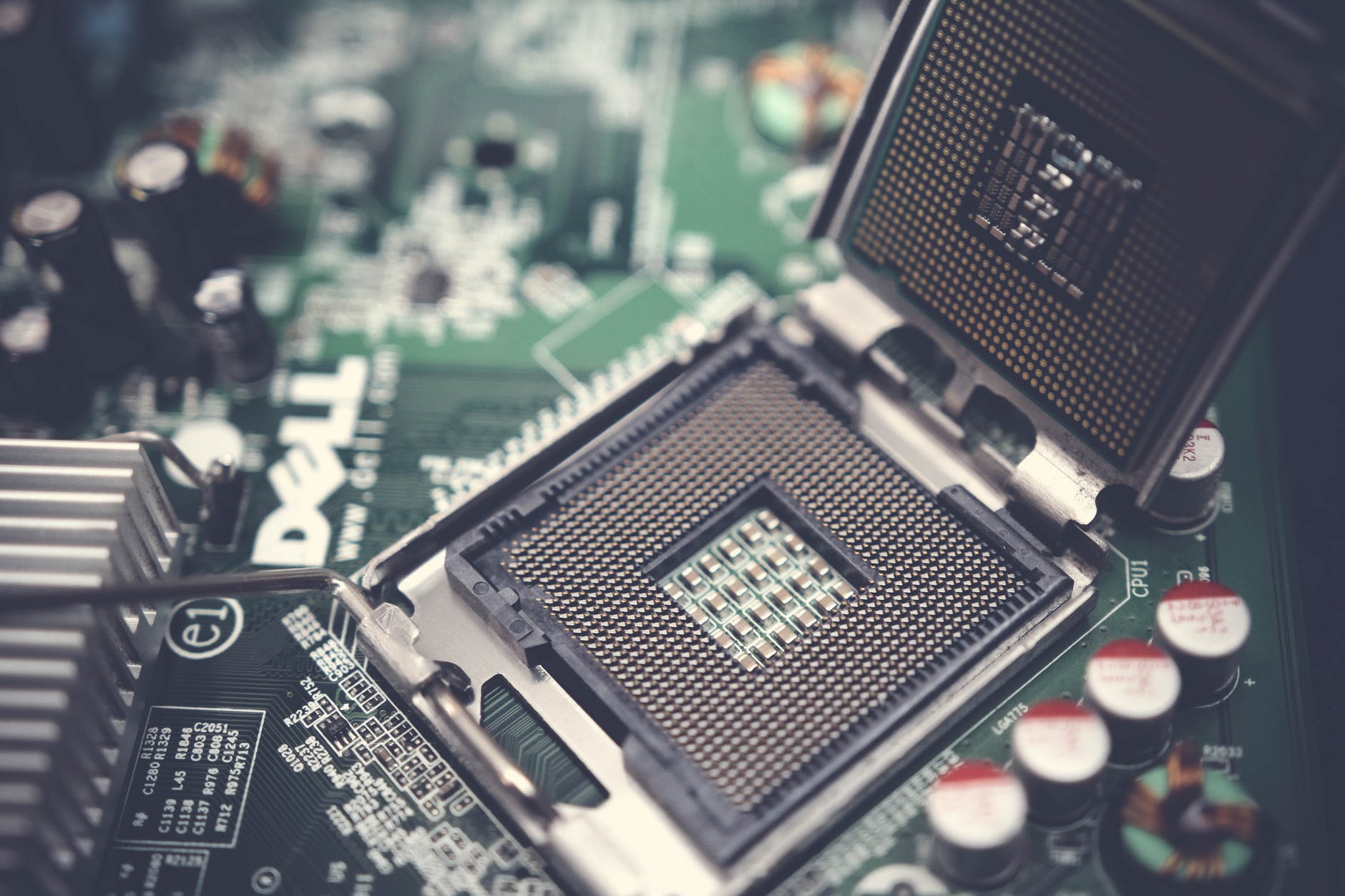
Prevailing Semiconductor Crisis.

Already under pressure due to the surging demand for semiconductors amid the COVID-19 pandemic followed by the Russia-Ukraine war and now inflation, the chip industry is now witnessing signs of stress following US House Speaker Nancy Pelosi’s visit to Taiwan.

The effects of the global chip shortage last year, highlighted the world economy’s reliance on Taiwan. The semiconductor shortage had massive knock-on effects for the auto industry, for example, forcing many large firms to halt production. Taiwan Semiconductor Manufacturing Company (TSMC) is the world’s largest chip foundry and it’s Apple’s main producer of chips. During her visit to Taiwan, Pelosi met Mark Liu, chairman of the TSMC.

Cutting TSMC off from the rest of the world would currently be a major threat to the global economy, so tensions are obviously high. If production were to stop at the Taiwanese manufacturer, supply shortages would inevitably occur. These shortages could cause a global recession and stock market crash, which would likely lead to a spike in unemployment numbers at a time when many countries like the UK are currently enduring an ongoing cost of living crisis. 

The negative consequences that dependencies such as these can have are currently being demonstrated more clearly than ever before by the war in Ukraine. To avoid the downside of globalization, countries are therefore increasingly turning to their own chip or semiconductor production. This is not only the case in China. In the USA and Europe, too, there are programs with the Chips Act for America and the European Chips Act, respectively, which are intended to ensure local semiconductor production.

Seeing the situation, the Indian government has launched the ‘Semiconductor Mission’ to establish a self-reliance and give boost to India’s fast-expanding electronics manufacturing and innovation ecosystem. The Union Cabinet has approved the ‘Semicon India’ programme with a total investment of Rs 76,000 crore in the growth of the country’s semiconductor and display manufacturing ecosystem. Through India Semiconductor Mission (ISM), the central government wants to encourage the use of secure microelectronics and the establishment of a reliable semiconductor supply chain, including raw materials, speciality chemicals, gases, and production equipment.

Prevailing Semiconductor Crisis.

Already under pressure due to the surging demand for semiconductors amid the COVID-19 pandemic followed by the Russia-Ukraine war and now inflation, the chip industry is now witnessing signs of stress following US House Speaker Nancy Pelosi’s visit to Taiwan.

The effects of the global chip shortage last year, highlighted the world economy’s reliance on Taiwan. The semiconductor shortage had massive knock-on effects for the auto industry, for example, forcing many large firms to halt production. Taiwan Semiconductor Manufacturing Company (TSMC) is the world’s largest chip foundry and it’s Apple’s main producer of chips. During her visit to Taiwan, Pelosi met Mark Liu, chairman of the TSMC.

Cutting TSMC off from the rest of the world would currently be a major threat to the global economy, so tensions are obviously high. If production were to stop at the Taiwanese manufacturer, supply shortages would inevitably occur. These shortages could cause a global recession and stock market crash, which would likely lead to a spike in unemployment numbers at a time when many countries like the UK are currently enduring an ongoing cost of living crisis. 

The negative consequences that dependencies such as these can have are currently being demonstrated more clearly than ever before by the war in Ukraine. To avoid the downside of globalization, countries are therefore increasingly turning to their own chip or semiconductor production. This is not only the case in China. In the USA and Europe, too, there are programs with the Chips Act for America and the European Chips Act, respectively, which are intended to ensure local semiconductor production.

Seeing the situation, the Indian government has launched the ‘Semiconductor Mission’ to establish a self-reliance and give boost to India’s fast-expanding electronics manufacturing and innovation ecosystem. The Union Cabinet has approved the ‘Semicon India’ programme with a total investment of Rs 76,000 crore in the growth of the country’s semiconductor and display manufacturing ecosystem. Through India Semiconductor Mission (ISM), the central government wants to encourage the use of secure microelectronics and the establishment of a reliable semiconductor supply chain, including raw materials, speciality chemicals, gases, and production equipment.

Expression of essence of India not possible without Doordarshan and All India Radio

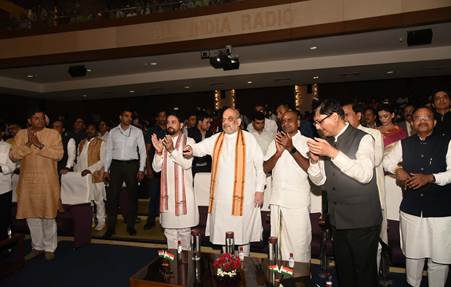
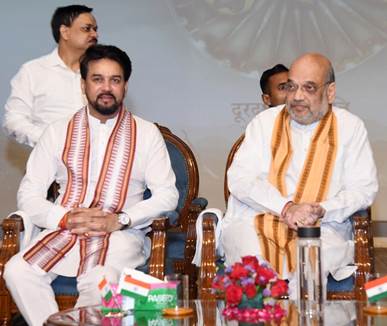
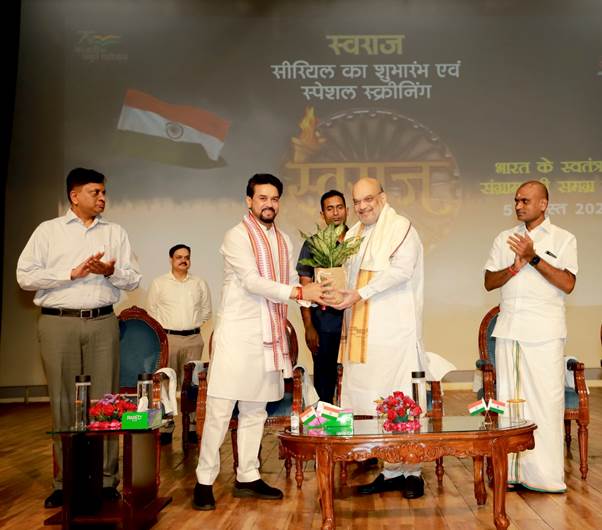
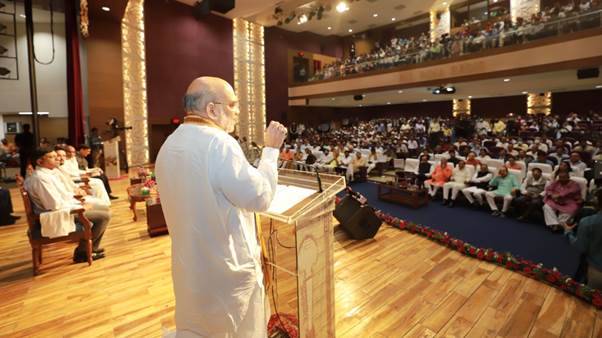
 Union Minister of Home Affairs and Cooperation Shri Amit Shah and Union Minister for Information and Broadcasting (I&B) today launched a serial Swaraj – Bharat Ke Swatantrata Sangram ki Samagra Gatha at Akashwani Bhawan in presence of Union Minister of State for I&B Dr. L. Murugan , Secretary of I&B Shri Apurva Chandra and CEO Prasar Bharati Shri Mayank Agarwal.

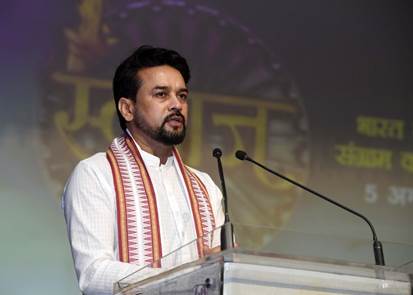
Union Minister Shri Anurag Thakur while speaking on the occasion remarked that Doordarshan and All India Radio had done a commendable job of reviving the valiant stories of over 550 freedom fighters and enabling the acquaintance of the younger generations with these unsung heroes.

Speaking about the serial the Minister said that it is aimed at reimagining the vision behind the idea of swaraj and tell the stories of the leaders that moulded that idea into a reality. The serial is a manifestation of our pride in these heroes from the past. With satisfaction in his expressions the Minister stated that intense research had gone into making of the serial and information and documents have been collected from all the corners of the country to bring to life these stories from our freedom struggle.


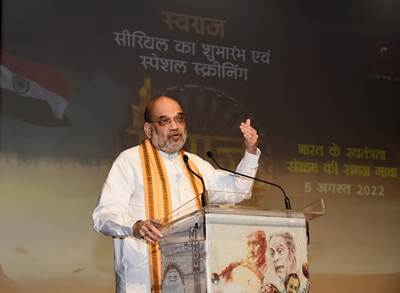
Union Minister of Home Affairs and Cooperation Shri Amit Shah while speaking about the role played by the public broadcaster recalled the time stalwarts like Pandit Jasraj and Ustal Bismillah Khan had said that if it had not been for Akashwani, they would not have existed. He said “It is not possible to spread the expression of the essence of India without Doordarshan and All India Radio.”


The Minister deliberated on the meaning of celebration of Azadi Ka Amrit Mahotsav and said it is not just a celebration of our freedom struggle but also of the achievements of the past seventy-five years since independence, of the sacrifices of the sung and unsung heroes of our freedom struggle. This is also a time when we are visualizing the contours of the future of India and India is only going to attain greater heights of excellence from here, he added.

Swaraj is an intricate concept and Shri Amit Shah dwelled on the idea and said Swaraj is not just limited to the idea of self-rule. It is the process of governing the country in our own unique way and this includes own languages and own culture and till the time we cannot imbibe this all-encompassing idea of swaraj, India has not really achieved it. In the centenary year, it will be important to preserve our languages and pass on our historic legacies and our culture to the future generations, he added.  


The Minister credited the crew behind the serial for their diligence. He said that from education to wealth, from culture to governance, historically India was much more advanced than the colonial powers, but a false narrative was manufactured about India and an inferiority complex created in the people. He said that the serial Swaraj will eliminate all inferiorities from the collective conscience of the people of the country.

Various Members of Parliament, Senior officials of the Ministry, Doordarshan and All India Radio news were present on the occasion.


Chief Executive Officer of Prasar Bharati Shri Mayank Agarwal said that the serial will be broadcast on Akashwani along with Doordarshan. Shri Agarwal expressed his gratitude to the team behind the production of this serial for their extensive research and diligence.

About Swaraj – Swatantrata Sangram ki Samagra Gatha

Swaraj is a 75-episode serial produced in 4K/HD quality and will air every Sunday from 9 to 10 pm on Doordarshan National from August 14. It is being dubbed in nine regional languages ​​along with English. The serial in regional languages Tamil, Telugu, Kannada, Malayalam, Marathi, Gujarati, Oriya, Bengali and Assamese ​​will be broadcast on Doordarshan’s regional channels from August 20. Starting from the landing of Vasco-da-gama in 1498 the serial presents a rich saga of the heroes of this land. This includes many unsung heroes of the likes of Rani Abbakka, Bakshi Jagabandhu, Tirot Sing, Sidhu Murmu and Kanhu Murmu, Shivappa Nayaka, Kanhoji Angre, Rani Gaidinliu, Tilka Majhi etc. along with famous freedom fighters like Rani Lakshmibai, Maharaj Shivaji, Tatya Tope, Madam Bhikaji Kama etc. 

********

Doordarshan's Serial “Swaraj: Bharat ke Swatantrata Sangram ki Samagra Gatha”

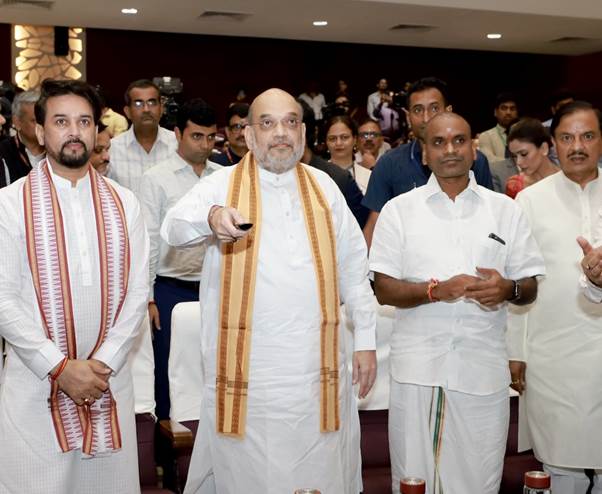
 Union Home and Cooperation Minister Shri Amit Shah attended the launch and special screening program of Doordarshan’s“Swaraj: “Bharat ke Swatantrata Sangram ki Samagra Gatha” serial as the Chief Guest in New Delhi today. Union Information and Broadcasting Minister Shri Anurag Singh Thakur, Minister of State for Information and Broadcasting Dr. L. Murugan, Secretary, Ministry of Information and Broadcasting, ShriApoorva Chandra, Chief Executive Officer of PrasarBharati, Shri Mayank Kumar Agrawal and many other dignitaries were also present.

https://static.pib.gov.in/WriteReadData/userfiles/image/image001PGAT.jpg 

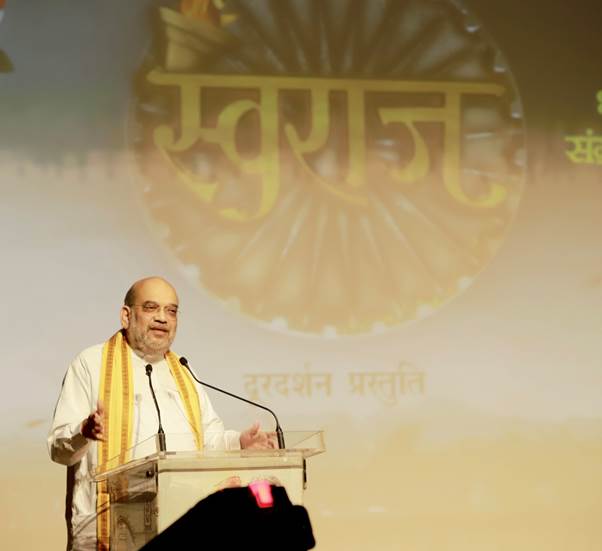
Speaking on the occasion, Shri Amit Shah said Doordarshan and All India Radio have stirred up the country from time to time through various programmes by cultivating and channelizing emotions and finally bringing together creative power. Shri Shah said only All India Radio and Doordarshan can express the feeling of India.

https://static.pib.gov.in/WriteReadData/userfiles/image/image002DJIT.jpg

The Union Home Minister said today’s programme has a special significance in itself because under the leadership of Prime Minister Narendra Modi, we are celebrating Azadi Ka Amrit Mahotsav which is very important for the Nation. We are glorifying our Independence in the country and abroad and our national achievements over the last 75 years. Millions of people, knowingly or unknowingly, sacrificed their lives so that we got ourFreedom, and we are also rememberingthem. At the same time, we are resolving to make a great India during the period from the AmritMahotsav to the Centenary of our Independence, and we are also expressing our strong willingness to put in the ideal efforts to fulfill these resolutions. Shri Amit Shah said that after the leap that the country is about to take,no one can stop India from becoming great. Doordarshan has undertaken production of75 episodes of the “Swaraj” serial under the leadership of Union Information and Broadcasting Minister Shri Anurag Singh Thakur.

https://static.pib.gov.in/WriteReadData/userfiles/image/image003DMBM.jpg 


Shri Amit Shah said that the meaning of the word Swaraj in India is not limited to self-government. The word Swaraj in itself means to make the whole of India Independent and to run our affairs in our own way. The word Swaraj means swa-bhasha, swa-dharm and swa-sanskriti and our own arts. Unless we understand the spirit of Swaraj literally, India cannot achieve Swaraj in the true sense. He said that over the past 75 years, everyone has made efforts to take the nation forward. But if we are not able to save our languages when the Centenary of Independence is celebrated, if we cannot pass on our history to the next generation and if we cannot save our culture which has been continuous for thousands of years, then can we achieve Swaraj? He said those who ruled us had destroyed our excellently developed systems. They could rule over us only if they created an inferiority complex in us, because we were ahead of them in every field. We were far ahead of them in humanitarian and governance values. The India which has given the Gita, the Vedas, the numeral zero and astronomy to the world. Those who ruled over us also tried to create myths about the knowledge we possessed, they created an inferiority complex about our languages, our culture, and our ability to govern.

https://static.pib.gov.in/WriteReadData/userfiles/image/image004CJT0.jpg


The Union Home Minister said the 75-week long “Swaraj” serial will be translated and shown in all Indian languages. The purpose of the serial should be to uproot every inferiority complex and bring a sense of pride in our people, it is only then that will we be able to fulfill the objectives of Swaraj and this will be the biggest achievement of Azadi Ka Amrit Mahotsav. Shri Shah told the youth gathered at the function, that those who do not glorify the positive aspects of their history, can never create a great future for themselves. If the country has to have a great future, then our great history has to create pride in the youth. The Home Minister said he has complete faith that this serial will move our youth and create pride amongst them about our history and we will move forward with greater speed towards the creation of a great Indiaunder the leadership of Prime Minister Narendra Modi.

********

Free Diagnostics Service Initiative’ (FDSI)

 The Ministry of Health and Family Welfare, Government of India supports ‘Free Diagnostics Service Initiative’ (FDSI) programme under National Health Mission. The programme was launched in July 2015 with the aim to provide accessible and affordable pathological and radiological diagnostics services closer to the community which in turn reduces the Out-of-Pocket Expenditure (OOPE). A minimum set of essential diagnostic tests has been recommended as per the Essential Diagnostic List at each level of public health facility.


A guidance document for implementing laboratory services has been shared with all states and UTs. The guidelines also recommend expanded range of diagnostics at all levels of public health facilities (14 tests at Sub Centres (SCs), 63 tests at Primary Health Centres (PHCs), 97 tests at Community Health Centres (CHCs), 111 tests at Sub-District Hospitals (SDHs) and 134 tests at District Hospitals (DHs).

Under NHM, ‘Free Diagnostic Service initiative’ is delivered through in-house, Public Private Partnership (PPP) and Hybrid mode by the States/UTs in the country. Free Laboratory service is operational in 33 States, out of which 11 States/UTs (Arunachal Pradesh, Assam, Delhi, Himachal Pradesh, Jharkhand, Maharashtra, Manipur, Meghalaya, Odisha, Tripura, and Uttarakhand) are providing the services through PPP/hybrid mode and 22 States/UTs (Andhra Pradesh, A&N Island, Bihar, Chandigarh, Chhattisgarh, D&N Haveli-Daman & Diu, Goa, Gujarat, Haryana, Jammu & Kashmir, Karnataka, Kerala, Lakshadweep, Madhya Pradesh, Nagaland, Puducherry, Punjab, Sikkim, Tamil Nadu, Telangana, Uttar Pradesh, West Bengal) provide the services through In-house mode.

Further, free Tele-Radiology (Tele-reporting of X-rays) service is operational in 13 states/UTs (Andhra Pradesh, Assam, Bihar, Himachal Pradesh, Jammu & Kashmir, Maharashtra, Meghalaya, Odisha, Rajasthan, Uttarakhand, Uttar Pradesh, and West Bengal, Tripura). Free CT Scan service is operational in 27 States/UTs out of which 17 States (Andhra Pradesh, Assam, Chandigarh, Chhattisgarh, Delhi, Haryana, Himachal Pradesh, Jharkhand, Karnataka, Madhya Pradesh, Meghalaya, Maharashtra, Odisha, Rajasthan, Tripura, Uttar Pradesh, West Bengal) are providing it in PPP mode and 10 states (A&N island, Bihar, D&N Haveli-Daman & Diu, Goa, Jammu & Kashmir, Lakshadweep, Kerala, Puducherry, Tamil Nadu, Telangana) provide through In-house mode.

Preparedness and response activities against biological emergencies

 Ministry of Health and Family Welfare provides requisite guidance and logistic support to the States/UTs. The Integrated Disease Surveillance Programme through its State and District units conducts disease surveillance in the country through a decentralized State based surveillance system for epidemic prone diseases to detect the early warning signals, so that effective public health actions can be initiated in response to health challenges in the country.

For preparedness and response against health emergencies, the National Disaster Management Authority in 2008 has issued detailed guidance on management of biological disasters (available at https://ndma.gov.in/sites/default/files/PDF/Guidelines/biological_disasters.pdf). 

Further, National Disaster Management Authority has also issued and widely circulated National Disaster Management Plan 2019 which provides an all-hazard plan with clarification on roles and responsibilities for preparedness and response activities against biological emergencies.

As per the information received from the Department of Biotechnology (DBT), the DBT has notified a “List of Infective Microorganisms corresponding to different Risk Groups, 2021” which provides the list of Infective Microorganisms corresponding to different Risk Groups, which determine the operational practice and minimum physical containment requirements and accordingly, allows selection of appropriate biosafety level facilities. The list can be accessed from https://dbtindia.gov.in/sites/default/files/Updated%20Risk%20Group13122021.pdf .

Furthermore, 138 bio-safety laboratories have been set up across the country under the Department of Health Research (DHR)’s Scheme- Setting up of Nation-wide network of Laboratories for managing Epidemics and Natural Calamities (VRDL). Indian Council of Medical Research (ICMR) has a well-established laboratory infrastructure, to combat biosafety and biosecurity threats to the country, including apex lab at National Institute of Virology (NIV), Pune

DBT has notified the “Guidelines for the Establishment of containment facilities: BioSafety Level 2 (BSL-2) & 3 (BSL-3) and Certification of BSL-3 facility” and Regulations & Guidelines for Recombinant DNA Research and Biocontainment, 2017. The guidelines encompass biosafety standards laid by various international agencies. All the biosafety laboratories specifically BSL-4 and BSL-3 established at ICMR and its network laboratories are trained in Biosafety laboratory operationalization. The key scientific staff of ICMR-NIV, Pune has also been trained at Center for Disease Control and Prevention (CDC), USA in biosafety practices.

Steps to strengthen the Healthcare System in India

 The healthcare system of the country involves a three-tier system with Sub Health Centre (Urban and Rural), Primary Health Centre (Urban and Rural) and Community Health Centre (Urban and Rural) as the three pillars of Primary Health Care System in India. Rural Health Statistics (RHS) is an annual publication, based on Health care administrative data reported by States/UTs.

Similarly, District Hospital (DH), Sub-District Hospital (SDH) and First Referral Unit – Community Health Centres provide secondary care services whereas Medical Colleges and State-level Institutions provide tertiary care services.

Ministry of Health and Family Welfare, Government of India provides technical and financial support to the States/UTs to strengthen the public healthcare facilities. To address the healthcare challenges, particularly in rural areas, the National Rural Health Mission (NRHM) was launched in 2005 to supplement the efforts of the State/UT governments to provide accessible, affordable and quality healthcare to all those who access public health facilities. Currently, NRHM is a sub-mission of National Health Mission (NHM).

Support is provided to states/UTs under the National Health Mission (NHM) for strengthening of health care facilities as per norms based on the requirements posed by them in their Programme Implementation Plans (PIPs) and within their overall resource envelope. Under NHM, States are supported for several interventions towards strengthening the primary healthcare services in the country.

XV-Finance Commission Health Grants through Local Government announced as part of Union Budget 2021-22, for strengthening the healthcare system at primary healthcare level, has recommended grants aggregating to Rs. 70,051 Crores over the period of five years (2021-2026) through local government to strengthen the healthcare system in states.

Pradhan Mantri Ayushman Bharat Health Infrastructure Mission (PM-ABHIM) with an outlay of Rs. 64,180 Crores aims to fill critical gaps in public health infrastructure especially in critical care facilities and primary care in both urban and rural areas. It is a Centrally Sponsored Scheme with some Central Sector components. The Centrally Sponsored Scheme (CSS) Components includes support for infrastructure development for Sub-Health Centres, Urban Health and Wellness Centres, Support for Block Public Health Units, Integrated District Public Health Laboratories and Critical Care Hospital Blocks.


National Leprosy Eradication Programme (NLEP)

 The Government is implementing the National Leprosy Eradication Programme (NLEP) with the goal of making India leprosy free. NLEP is a Centrally Sponsored Scheme under the umbrella of National Health Mission (NHM). This programme is implemented in all the States/UTs.

The major focus of the Programme is to detect the cases of leprosy at an early stage and to provide complete treatment, free of cost, in order to prevent the occurrence of disability.

Major initiatives under NLEP are as follows:

  1. Leprosy Case Detections Campaign (LCDC) in high endemic districts.
  2. Focused Leprosy Campaign (FLC) in low endemic districts for case detection.
  3. Special plans for Hard-to-Reach areas for early case detection and treatment.
  4. ASHA Based Surveillance for Leprosy Suspects (ABSULS).
  5. Sparsh Leprosy Awareness Campaign on 30th January every year.
  6. Active Case Detection and Surveillance both in rural and urban areas.
  7. Convergence of leprosy screening under Rashtriya Bal Swasthya Karyakram (RBSK) for screening of children (0-18 years) and under Ayushman Bharat for screening of people above 30 years of age.
  8. Monitoring of the programme by Joint Monitoring Investigation and Advisory Group (JMIAG).
  9. Certificate, award and performance linked financial incentive are given to the districts for achieving leprosy elimination.
  10. Contact tracing is done and Post Exposure Prophylaxis (PEP) with Single dose of Rifampicin (SDR) given to the eligible contacts of index case in order to interrupt the chain of transmission.

Further, 12 packs of MDT (Multi Drug Therapy) blister packs are given to Multi Bacillary Leprosy cases as per the Standard Treatment Protocol.

India has achieved the elimination of leprosy as a public health problem as per WHO criteria of less than 1 case per 10,000 population at the National level in 2005. However, there are few districts within States where leprosy is still endemic.

As per Monthly Progress Report of Central Leprosy Division, Directorate General of Health Services (as on 31st May 2022), 72,914 leprosy patients, as informed by the States/UTs, are under treatment in the country.

IMPLEMENTATION OF PMFME

 Ministry of Food Processing Industries (MoFPI) is implementing a centrally sponsored “PM Formalisation of Micro food processing Enterprises (PMFME) Scheme” for providing financial, technical and business support for setting up / upgradation of micro food processing enterprises in the country. The scheme is operational for a period of five years from 2020-21 to 2024-25 with an outlay of Rs. 10,000 Crore. The details of assistance available under the scheme is placed at Annexure.

MoFPI does not set up Food Processing Industries on its own. However, it assists entrepreneurs in establishing such Industries across the country including Tamil Nadu through its Central Sector Umbrella Scheme Pradhan MantriKisan SAMPADA Yojana (PMKSY), Production Linked Incentive Scheme for Food Processing Industry (PLISFPI) and Centrally sponsored PMFME Scheme.

ANNEXURE

The details of assistance available under PMFME Scheme


(i). Support to Individual / Group Category Micro Enterprises: Credit-linked capital subsidy @35% of the eligible project cost, maximum ceiling Rs.10 lakh per unit;

(ii). Support to SHGs for seed capital: Seed capital @ Rs. 40,000/- per member of SHG engaged in food processing for working capital and purchase of small tools subject to maximum of Rs. 4 lakh per SHG Federation.

(iii). Support for Common Infrastructure: Credit linked capital subsidy @35% subject to maximum of Rs. 3 crore to support FPOs, SHGs, Cooperatives and any Government agency for setting up of common infrastructure. The common infrastructure will also be available for other units and public to utilize on hiring basis for substantial part of the capacity.

(iv). Branding and Marketing Support: Grant upto 50% for Branding and Marketing to groups of FPOs/ SHGs/ Cooperatives or an SPV of micro food processing enterprises.

(v). Capacity Building: The scheme envisages training for Entrepreneurship Development Skilling (EDP+): program modified to meet the requirement of food processing industry and product specific skilling.