

सत्य और अहिंसा के पुजारी महात्मा गाँधी के जीवन से जुड़े किस्से और कहानियां काफी रोचक रही हैं।आज भी गाँधी जी को श्रद्धांजलि अर्पित करने और सम्मान देने के लिए प्रतिवर्ष उनकी पुण्यतिथि पर याद किया जाता है। राष्ट्रपिता महात्मा गाँधी ने भारत की आजादी में महत्वपूर्ण भूमिका निभाई। उनका पूरा नाम मोहनदास करमचंद गांधी है लेकिन भारतीय स्वतंत्रता संग्राम में अहम योगदान और महान कर्मों से उन्हें राष्ट्र के पिता, महात्मा और बापू भी कहा जाता हैं।गाँधी जी बचपन से ही बहुत ईमानदार थे। यह बात इस छोटी सी कहानी से साबित होती है। एक बार स्कूल में शिक्षकों ने सभी छात्रों से कुछ अंग्रेजी शब्दों की स्पेलिंग लिखवायी। सभी बच्चों ने स्पेलिंग लिखी।शिक्षक ने सभी बच्चों की स्लेट्स इकठ्ठा की। उन्होंने देखा की गाँधी की स्पेलिंग गलत थी। उन्होंने गाँधी से इशारा किया की अपने पास के बच्चे की स्पेलिंग की नकल करो। लेकिन गाँधी ने ऐसा नहीं किया।परीक्षा के अंत में शिक्षक ने गाँधी से पूछा की तुमने नकल क्यों नहीं की? मैंने तुम्हें इशारा किया, तुमने देखा नहीं। तो गाँधी बोले, गुरूजी मुझे नकल नहीं करनी थी। शिक्षक बोले, तुम अकेले हो जिसका उत्तर गलत है।गाँधी बोले, मैं जानता हूँ गुरूजी पर मैं गलत रास्ता अपनाना नहीं चाहता। गाँधी के बचपन से जुड़ी इस घटना से यह पता चलता है कि महात्मा गाँधी बचपन से ही ईमानदार रहे थे।इसके साथ साथ गांधीजी एक जागरूक पत्रकार थे उन्होंने “यंग इंडिया”, नवजीवन और हरिजन जैसे समाचार पत्र प्रकाशित किए। उन्होंने समाचार पत्र का इस्तेमाल आंदोलनों के आयोजन में अहिंसा के उपयोग के संबंध में अपनी अनूठी विचारधारा और विचारों को फैलाने के लिए किया और पाठकों से ब्रिटेन से भारत की अंतिम स्वतंत्रता के लिए विचार करने, संगठित करने और योजना बनाने का आग्रह किया। साथ ही में गांधीजी एक कामयाब वकील भी थे।
Day: August 20, 2022
गाँधी जी – एक ईमानदार इंसान
सत्य और अहिंसा के पुजारी महात्मा गाँधी के जीवन से जुड़े किस्से और कहानियां काफी रोचक रही हैं।आज भी गाँधी जी को श्रद्धांजलि अर्पित करने और सम्मान देने के लिए प्रतिवर्ष उनकी पुण्यतिथि पर याद किया जाता है। राष्ट्रपिता महात्मा गाँधी ने भारत की आजादी में महत्वपूर्ण भूमिका निभाई। उनका पूरा नाम मोहनदास करमचंद गांधी है लेकिन भारतीय स्वतंत्रता संग्राम में अहम योगदान और महान कर्मों से उन्हें राष्ट्र के पिता, महात्मा और बापू भी कहा जाता हैं।गाँधी जी बचपन से ही बहुत ईमानदार थे। यह बात इस छोटी सी कहानी से साबित होती है। एक बार स्कूल में शिक्षकों ने सभी छात्रों से कुछ अंग्रेजी शब्दों की स्पेलिंग लिखवायी। सभी बच्चों ने स्पेलिंग लिखी।शिक्षक ने सभी बच्चों की स्लेट्स इकठ्ठा की। उन्होंने देखा की गाँधी की स्पेलिंग गलत थी। उन्होंने गाँधी से इशारा किया की अपने पास के बच्चे की स्पेलिंग की नकल करो। लेकिन गाँधी ने ऐसा नहीं किया।परीक्षा के अंत में शिक्षक ने गाँधी से पूछा की तुमने नकल क्यों नहीं की? मैंने तुम्हें इशारा किया, तुमने देखा नहीं। तो गाँधी बोले, गुरूजी मुझे नकल नहीं करनी थी। शिक्षक बोले, तुम अकेले हो जिसका उत्तर गलत है।गाँधी बोले, मैं जानता हूँ गुरूजी पर मैं गलत रास्ता अपनाना नहीं चाहता। गाँधी के बचपन से जुड़ी इस घटना से यह पता चलता है कि महात्मा गाँधी बचपन से ही ईमानदार रहे थे।इसके साथ साथ गांधीजी एक जागरूक पत्रकार थे उन्होंने “यंग इंडिया”, नवजीवन और हरिजन जैसे समाचार पत्र प्रकाशित किए। उन्होंने समाचार पत्र का इस्तेमाल आंदोलनों के आयोजन में अहिंसा के उपयोग के संबंध में अपनी अनूठी विचारधारा और विचारों को फैलाने के लिए किया और पाठकों से ब्रिटेन से भारत की अंतिम स्वतंत्रता के लिए विचार करने, संगठित करने और योजना बनाने का आग्रह किया। साथ ही में गांधीजी एक कामयाब वकील भी थे।
How to Achieve Sustainable Development Goals
1. SIGN THE W.A.S.H. PLEDGEImage Source: W.A.S.H Pledge
Businesses can be some of the biggest offenders in the wastage of water, so when they take the lead in water conservation, they can make a huge impact on awareness in their communities.
Support SDG 6 – Clean Water and Sanitation by committing your business to a WASH (water, sanitation, and hygiene) pledge to “[implement] access to safe water, sanitation, and hygiene at the workplace”. This will not only help keep your community clean but set a standard and expectation for others to follow – including your competitors!
And if you could, go one step further and ensure the same thing happens in a community in remote areas of the world too. Discover some of the water and sanitation projects here.
2. PROVIDE A HEALTHY WORKPLACE
Most people spend about one-third of their adult lives in a workplace environment.
It is essential to ensure that people have a workplace conducive to maintaining good health. Businesses are thus the key drivers for SDG 3 – Good Health and Well-being and SDG 8 – Decent Work and Economic Growth. Emphasize safe practices in the workplace through frequent training and refreshers. Implement health and fitness programs for your team. Also, consider carefully selecting your suppliers and other B2B partners based on how they regard the health of their own employees.
3. REVIEW YOUR SUPPLY CHAIN AND IMPLEMENT SUSTAINABLE PRACTICES
Businesses are often the endpoint in a long supply chain that begins with basic materials and supplies taken from the very land on which we live.
Review your supply chain from top to bottom to make sure that all of the stages uphold human and labor rights, promote and adopt sustainable environmental practices and work against corruption in all its forms. If you’re unsure how to start, check out this guide from the UN.
4. GIVE TO PROJECTS THAT SUPPORT THE SDGS
Expand the reach of your impact by giving to projects that support the SDGs. You can choose to give to multiple projects or focus on one – that’s entirely up to you. Some projects may support multiple SDGs at the same time.
If you don’t have time to consider different projects and do your own vetting, consider partnering up with a third-party organization that helps you do so.
5. INVEST IN RENEWABLE ENERGY
More and more people are packing into urban areas each year. The sustainability of cities is vital to the future of humanity, but they are eating up our consumable natural resources. Being big consumers of energy, businesses can help by taking the lead on SDG 11 – Sustainable Cities and Communities. Invest in renewable energy resources such as solar, wind, and biofuel. By joining initiatives such as the UN Global Compact, you can be one of the businesses to lead the charge toward a more sustainable future.
6. ENCOURAGE ‘REDUCE, REUSE, RECYCLE’
The usage of single-use plastic bags, plastic bottles, and other containers puts great pressure on our Earth.
Your business can support SDG 13 – Life on Land and SDG 14 – Life below Water by doing your part to reduce the amount of plastic waste produced by your business activities.
Do you have a business that provides plastic bags for customers?
Start switching to polypropylene bags (green reusable bags) if you have not already. Then, encourage your customers to reuse those bags. (Fun fact: these bags should be reused 35 times before being used as a bin liner or discarded to minimize their impact on the environment). You could even implement a reward system for customers who brought their own bags.
Another change you can adopt is to have a water fountain or cooler instead of a vending machine that distributes plastic drink bottles in office. Remember, every small change makes a huge impact in the long run.
7. SUPPORT EDUCATION OF THE FUTURE GENERATION – LOCALLY OR GLOBALLY
Education is the pathway out of poverty and the foundation for a better future. There is no dispute on that.
Sponsor local school scholarships or give to causes that build schools, supply books and train teachers in remote areas of the world. By helping remove some of the barriers to education, you’re not just enriching their individual lives and leveling the playing field – you’re also adding talent to the workforce. Who knows? You could be helping to educate a future employee!
8. THE $2 – A-DAY CHALLENGE
Could you survive on $2 a day?
It’s an interesting hypothetical for some, but a cold reality for too many others. Sometimes it takes putting ourselves in someone else’s shoes to catalyze our empathy and energize us to do good. In support of SDG 1 – No Poverty, try living on just $2 by having “$2 days”. Encourage your employees, partners, clients, even your friends and family to do the same. Can you give up the things that you love by living this way? What trade-offs do you have to make? Knowing that millions live on this much or less is an eye-opener and a potent motivator.
9. GIVE PAID VOLUNTEER DAYS
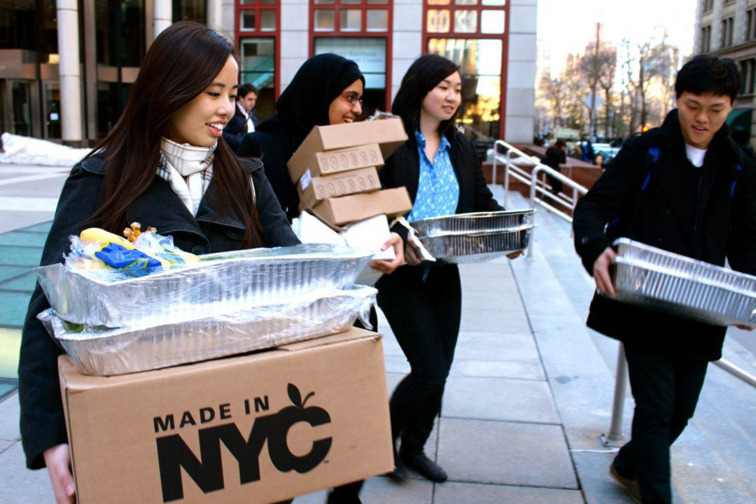
We can all agree that nobody should go hungry in such an affluent world, but our own communities are where we can actually do something about it.
SDG 2 – Zero Hunger shows us a pathway to change the world by feeding our needy neighbors. Businesses can make a big impact by providing paid days off for employees to volunteer in hunger-related activities. Soup kitchens, food banks, and home food delivery programs for the needy and elderly are always in need of eager volunteers. There’s typically a greater need during the holiday season.
10. REWARD RESPONSIBLE BEHAVIORS
“Employee of the Month” recognitions are typically reserved for workers with the most sales or best productivity – the ones bringing the most money for the company. But what if employees were recognized for moving the company toward better environmental practices?
To support SDG 12 – Responsible Consumption and Production, consider offering bonuses or award luncheons for your more environmentally conscious team members – especially those who move your business closer to more responsible practices.
11. TAKE IT TO THE NEXT LEVEL THROUGH PARTNERSHIPS WITH OTHER BUSINESSES
SDG 17 – Partnerships For The Goals encourages businesses to become part of partnerships for responsible action in pursuit of any and all of the global goals.
By combining their enthusiasm for certain goals, partnerships become greater than the sum of their parts. You don’t have to stop at implementing sustainable programs at your workplace. Participate in changemaker events like sustainability education programs or retreats that let you see the effects of change. Network with like-minded business leaders and see what more you can do!
12. CHOOSE TO GIVE TO CAUSES THAT YOU CARE ABOUT THE MOST
When it comes to giving, we always recommend starting with causes that are close to your heart, be it education, environment, health or human rights. In this case, simply start with the SDG that you feel most strongly about and give towards causes that support it.
“Make In India” explained.
Make in India program was launched by Prime Minister Narendera Modi on 25th September 2014 as an initiative to encourage various companies to manufacture in India. Make in India is an initiative under Atma Nirbhar Bharat Abhiyan which is dedicated to developing a modern independent India. Make in India’s movement is to attract foreign capital to invest in Indian manufacturing companies to create more employment options and to transform India into a global design and manufacturing hub. This initiative is to promoting manufacturing companies to produce goods and services in India instead of importing it from other countries and encouraging citizens to use the made in India products only.
The ideology behind the Make in India plan was to generate more employment, saving the nation’s money from exporting goods that can be or used to manufacture in India, and to create a conducive environment for investments. This movement can help to develop India to become a developed nation quickly. Make in India help to develop a modern and efficient infrastructure and open up new sectors for foreign capital especially after the 100% ownership of FDI.
GoI aimed so many targets to be done successfully under the Make in India mission. A few of the objectives are listed out below:
- A rise in the domestic value addition and technological depth in the manufacturing sector.
- Raise in manufacturing sector growth to 12-14% per year.
- Increase in the manufacturing sector’s share in the GDP to 25% by 2022.
- Create 100 million extra jobs in the manufacturing sector by 2022.
- Expanding the global competitiveness of the Indian manufacturing sector.
- Creating required skill sets among the urban poor and the rural migrants to foster inclusive growth.
- Having environmentally sustainable growth.
This program is destined to facilitate foreign direct investment and convincing Indian and foreign companies to produce their goods in India. Its key features are.
• It is estimated that such facility of producing goods would increase the demand for employment in various sectors and would lead to better employment conditions.
• This program is competent in attracting foreign currency to be invested in the Indian industrial sectors.
• It would create a demand of skilled people in specific sectors, which would also create a requirement to train people in various sector and skills, to satisfy the demand of such industrial requirements.
• It has already soared the position of India in the context of ease of doing business on its land. It has far more potential to take the India at much better ranking through this program alone.
• It has cleared the vague picture of deciding FDI ratio in railways and defense sector and applied the determined terms in the form of this scheme.
"Make In India" explained.
Make in India program was launched by Prime Minister Narendera Modi on 25th September 2014 as an initiative to encourage various companies to manufacture in India. Make in India is an initiative under Atma Nirbhar Bharat Abhiyan which is dedicated to developing a modern independent India. Make in India’s movement is to attract foreign capital to invest in Indian manufacturing companies to create more employment options and to transform India into a global design and manufacturing hub. This initiative is to promoting manufacturing companies to produce goods and services in India instead of importing it from other countries and encouraging citizens to use the made in India products only.
The ideology behind the Make in India plan was to generate more employment, saving the nation’s money from exporting goods that can be or used to manufacture in India, and to create a conducive environment for investments. This movement can help to develop India to become a developed nation quickly. Make in India help to develop a modern and efficient infrastructure and open up new sectors for foreign capital especially after the 100% ownership of FDI.
GoI aimed so many targets to be done successfully under the Make in India mission. A few of the objectives are listed out below:
- A rise in the domestic value addition and technological depth in the manufacturing sector.
- Raise in manufacturing sector growth to 12-14% per year.
- Increase in the manufacturing sector’s share in the GDP to 25% by 2022.
- Create 100 million extra jobs in the manufacturing sector by 2022.
- Expanding the global competitiveness of the Indian manufacturing sector.
- Creating required skill sets among the urban poor and the rural migrants to foster inclusive growth.
- Having environmentally sustainable growth.
This program is destined to facilitate foreign direct investment and convincing Indian and foreign companies to produce their goods in India. Its key features are.
• It is estimated that such facility of producing goods would increase the demand for employment in various sectors and would lead to better employment conditions.
• This program is competent in attracting foreign currency to be invested in the Indian industrial sectors.
• It would create a demand of skilled people in specific sectors, which would also create a requirement to train people in various sector and skills, to satisfy the demand of such industrial requirements.
• It has already soared the position of India in the context of ease of doing business on its land. It has far more potential to take the India at much better ranking through this program alone.
• It has cleared the vague picture of deciding FDI ratio in railways and defense sector and applied the determined terms in the form of this scheme.
Make in India- A great Initiative
Make in India Scheme- A Great Initiative

Make in India is an initiative by the government of India to encourage companies to manufacture products in India. This program is designed to facilitate investment, foster innovation, enhance skill development, protect intellectual property and build best-in-class manufacturing infrastructure in the country. It was launched by Prime Minister in September 2014 as part of a wider set of nation-building initiatives.
The aim is to transform India into a global design and manufacturing hub. The primary objective of this initiative is to attract investments from across the globe and strengthen India’s manufacturing sector. This program is very important for the economic growth of India as it aims to utilize the existing Indian talent base, creating employment opportunities and empowering the secondary and tertiary sectors.
Make in India needed a different kind of campaign, instead of the typical newspaper advertisements, this exercise required messaging that was informative, well-packaged and most importantly, credible. It had to inspire confidence in India’s capabilities amongst potential partners abroad, the Indian business community, and citizens at large; provide a framework for a vast amount of technical information on 25 industry sectors; and reach out to a vast local and global audience via social media and constantly keep them updated about opportunities, reforms, etc.
The Department for Promotion of Industry and Internal Trade (DPIIT) worked with a group of highly specialized agencies to build brand new infrastructure, including a help desk and a mobile-first website that simply contain information. The focus of the Make in India program is on 25 sectors. These include automobiles, automobile components, aviation, biotechnology, chemicals, construction, defense manufacturing electrical machinery, electronic systems, food processing, IT & BPM, leather, media and entertainment, mining, oil and gas, pharmaceuticals, ports and shipping, railways, renewable energy, roads and highways, space, textile and garments, thermal power, tourism and hospitality, and wellness.
DPIIT initiated this process by inviting participation from Union Ministers, Secretaries to the Government of India, state governments, industry leaders, and various knowledge partners. A National Workshop on sector-specific industries in December 2014 brought Secretaries to the Government of India and industry leaders together to debate and formulate an action plan for the next three years, aimed at raising the contribution of the manufacturing sector to 25% of the GDP by 2020. This demonstrated the transformational power of public-private partnership and has become a hallmark of the Make in India initiative.
In a short period, this initiative grows a lot with a transparent and user-friendly system. The ministry has engaged with the World Bank Group to identify areas of improvement. Now, the credibility of India becomes stronger. There are visible changes in the business sector of India as this program opened doors for investors and promoted entrepreneurs. Now India is on its way to becoming the largest and most powerful economy.
Top 10 E – learning platform in India
Top 10 E – learning platform in India
As we all know nowadays students refer online learning as it is easy to learn as well as in low cost . We also save our transportation money . Every student wants to learn more apart from their studies. They want to gain more knowledge and want to explore more for this the e – learning platform is best .
There are top 10 E – learning platform which are popular in India.
1) BYJU’s
Labelled as the most valued EdTech start-ups in India, BYJU’s is a cost-effective platform for online education in India. It is known for its engaging educational content (like videos, interactive games, etc.). And offers a 15 day free trial period for the users. Post the completion of this period a user needs to purchase a program to unlock the content further. Byju’s is the largest online learning platform in India with 15 million students and has 900,000 paying subscribers.
Features:
NCERT Solutions
Mock Board exam
Mock test for JEE, JEE Advanced, and NEET
Offers programs for competitive exams including IAS
Live doubt solving feature (in BYJU’s classes)
Classes- Available for students from LKG to class 12th


2) Unacademy
The next name on this list of top online education platform in India is Unacademy. It is known for being the largest online learning platform for multi-lingual education. It offers interactive live online classes, and the users can purchase a subscription to unlock the offerings. Unacademy is one of the top online education platform in India with more then 60,000 educators and 7 lakh active subscribers
Features:
Unlimited access to courses created by top educators
Weekly mock tests
Interactive live classes
Live doubt solution
Personal study planner
Classes – 6th to 12th and is available for all competitive exams


3) Vedantu
Vedantu is another popular platform for personalized online learning. It offers regular tuitions for both CBSE and ICSE boards. In addition, students can also choose micro- courses with both recorded and live options. Students attend one-on-one live online classes; Vedantu cover all the major boards (CBSE, ICSE, IGSCE, IB, and state board).
Features:
Live classes and engaging online content
Live quizzing and student interactions
Free study material (NCERT solutions, popular book solutions, solved questions, etc.)
Vedantu Super Kids (Reading classes, English program, and coding classes)
Classes – Pre-school, grades 1 to 12, JEE and NEET

4) Toppr
Toppr is an Indian multinational educational platform. The company headquarter is in Mumbai, Maharashtra, India. It is incorporated on 2013 by Hemanth Goteti. It is India’s leading after-school learning app. The company is an extremely passionate team of engineers, educators, and designers making consistent strides in product innovation to enhance user experience. Toppr helps students in preparing for various school, board and competitive exams. The company use artificial intelligence based machine learning algorithms on top of this strong infrastructure, to create personalized learning paths for millions of students.

5) Doubtnut
Doubtnut is an Indian multinational educational platform. The company headquarter is in Gurgaon, Haryana, India. It is established in 2016 by Tanushree Nagori and Aditya Shankar. The company provide technology to make education accessible for all. The company created an app using which students can ask study questions in math by clicking the picture of the problem or concept. Doubtnut is providing video solutions of the problem. The company is working on developing technology to automate answering of questions asked previously using image recognition and natural language processing.

6) Khan Academy
Founded by an American Educator Salman Khan, Khan Academy is an E-Learning app which is a completely non-profit app and its sole purpose is to provide better learning tools to students for free. The App offers a wide variety of simplified courses ranging from math, science and engineering, computing, arts and humanities, economics and finance.
The app hosts more than 10,000 video lectures on different academic subjects majorly focused on Mathematics and science. They have partnered with institutions like NASA, MIT, the modern museum of art for specialized content to empower the learners outside the classrooms as well. The most amazing thing about this E-learning platform is that it is free.

7) Meritnation
Meritnation is an online learning platform for K-12 students. It was launched by Pavan Chauhan in Delhi in the year 2009, as a division of Applect Learning Systems based. The Ed-Tech startup started by providing online classes for grades 6-12 for CBSE, ICSE, other state board streams of education and later started providing courses for entrance exams like IIT-JEE, NEET, CA CPT and other exams like BBA and NDA. With the mobile application of Meritnation having millions of users worldwide, the annual revenue is estimated to be about $5.2M.

8) Motion learning app
Nitin Vijay Sir wanted to offer an accessible and easy user interface medium to students preparing for NEET, JEE, NTSE, Boards, KVPY, or any other exam. This led to the invention of the Motion Learning App, where students can find well-drafted, errorless, and updated study material. In addition, there are various free and paid packages that students can opt for along with the Customized Practice Sheet (CPS). One can find previous years’ question papers, evaluate their performance and watch video lectures or attend live classes through the app. Best online learning platforms in India for School Students, Kids.

9) Coursera
The Coursera app is one of the largest online learning platforms in India that allows you to learn on the go with access to more than 1,000 courses and specializations developed by 140+ of the best colleges and universities in the world.
It helps you to advance in your career or continue your education by mastering subjects from Python programming and data science to photography and music.

10) Udemy
Udemy tops the list of online education platforms in India aimed at professional adults and students.
Using Udemy’s course development tools, people can upload videos, PowerPoint presentations, PDFs, audio, ZIP files, and live classes to create courses.
Students take courses largely as a means of improving job-related skills. Some courses generate credit for technical certification. Udemy has made a special effort to attract corporate trainers seeking to create coursework for employees of their company.

Ajeetha.R
Articles by Ajeetha.R

2.Women organizations and their role in India
3.History of India & Indian National Movement.
4.Genral issues on Environmental ecology
5.Salient features of world’s physical geography
9. Criminal Justice System in India
10.Pharmacology
11.Anthropology
12.Linkages between development and spread of extremism
13. Poverty in India
15.Demography
16.Agriculture
19.Role of civil services in a democracy .
20.India and its neighborhood- relations
21.Indian Army
22.Achievements of India in the field of Science and Technology
24.National Educational Policy
26.Inclusive growth and issues arising from it
27.Central Bureau of Investigation
28.Fracking
complete guide to youtube marketing
complete guide to youtube marketing
Everyone watches youtube .around 75% people of in America age 15 and over are on youtube. it seems like 2 billion people are monthly active users which makes youtube the most popular and used website in the world after Google.
the network of a wide audience is a reason for marketing your business on youtube but yes just running in a crowd without having a plan does not make any sense as it won’t give you any outcome. you need a proper strategy or plan for execution so today we will discuss 7 steps for winning in youtube marketing.
.jpg)
what is youtube marketing? it simply means promoting your brand, service, or product on youtube which may comprise these 3 tactics:
- create organic promotional videos
- work with influencers
- advertising on the platform
7 steps youtube marketing strategy:
1: create a youtube channel for business:
the first thing you need to do is to open a youtube channel, particularly for your brand for that you need to create a google account as youtube is a part of google and then log in with your brand account ID & password so you can open it as well as by your personal account but it is not a good idea as brand account allows other company people also to use it which a normal account doesn’t.
2: Learn about your audience:
after setting up a youtube channel you need to do research about your target audience like what they actually watch on youtube or what kind of stuff they like on youtube so it can help you to make your own strategy to decide what you need to run or give them stuff which they will like.
3: competitor research:
after knowing your users, you need to find out what your competitor is doing yes because it will help you in finding what tactics they are using which will give you more insights into your target audience so the things you need to focus upon are subscriber, average views per video, people comments, the topic of content and many more.
4: learn from your favorite channel:
As it is not necessary that the channel which is related to your business on youtube can only help or give you insights about youtube or the audience there are many channels that are growing and getting good responses from the users so they can also give you some info like how to set good quality or video which you may use in your businesses.
5: optimize your channel :
Youtube algorithm is quite similar to google as it is part of google so you need to make your channel as per the google algorithm otherwise it doesn’t worth out for which you need to focus on some basic things which are doing keyword research like on google we do, give the proper title and attach a link of your video, add tags and proper deception of video.
6: upload or schedule video:
After making your video you can directly publish it or schedule it. you need to decide how often you will post your video whether it is weekly , monthly or daily and what will the time on which you will post your video everytime because it really matter in generating the traffic.
7:use of influencer marketing:
influencers are growing very rapidly whether its on social media or on youtube. influencer are basically someone who is a celebrity which have good following they can convey your message easily to your users for that you just need to find out the influscer who completely matches with your business goal.
 Eduindex
You must be logged in to post a comment.