Nykaa Success Story

About Nykaa

Nykaa is a brand based in India that specializes in multi-beauty and personal care products. It had originally been set up as a sole e-commerce medium until it later began building up various retail outlets in many other urban cities across India.

Nykaa Founders

A graduate with MBA from IIM Ahmedabad, Falguni Nayar begins to work at Kotak Mahindra in investment banking after her graduation. She became the Managing director at Kotak in 2005. She worked for Kotak Mahindra for about 18 years, during which she decided to move beyond the banking sector and experience in other sectors. She recognized the unexplored potentiality of the online beauty sector. 


Nykaa was started in 2012 by Falguni Nayar and is headquartered in Mumbai. She entered the market to remove the irregularities in the beauty industry. Despite high demand, the industry was not up to the mark. Her expertise in Investment banking has made her value the sustainability of the business.


Despite being a capital-intensive industry, she decided to raise and accommodate funds accordingly. The company has pioneered in providing a one place shopping experience for all domestic brands, international brands, luxury & prestige brands, premium brands, niche, and cult brands.

Business Model of Nykaa


Its business model revolves mainly around inventory management as the company purchases the products directly from brands or distributors and then provides them to the customers on its platform. 


Thinking about how it is different from marketplace models like that of Amazon or Flipkart?

Well in the latter, products are listed by third-party sellers for the customers to make a purchase, which is not the case of Nykaa. This helps Nykaa to secure its customers from any fraudulent sellers and maintain the authenticity of the platform. 

Apart from this, exclusive collaborations with big brands in beauty and fashion, the creation of private labels across categories, and having a physical presence have all helped it stand out in a competitive e-commerce industry where buyers are generally vendor-sceptic and looking for the best deal.


Furthermore, the company’s offline stores are present in 3 formats – On Trend, Luxe, and Kiosks. On Trend & Luxe deals with trending and fashionable brand products. While Kiosk is specifically for featuring premium and luxury brands including Dior, MAC, Huda Beauty, Estee Lauder, and many more prestigious brands.


Apart from Amazon and Flipkart, purple.com is a direct competitor of Nykaa. Purple is one of the companies present in the online retailer business in the same segment. 

Further, in order to interact with beauty enthusiasts, the company formed an online platform – Nykaa Network. This helps them connect better with the customers and provide them with a unique experience.  

Nykaa’s Marketing Strategy

The main element is to promote brands and products via multiple channels, websites, and blog pages. It pitches the products digitally to reach customers in all regions of the country. To directly reach the right audience, the company also collaborated with Femina to conduct Femina Miss India over the last few years.


Another key to its success is its ability to create relevant, engaging, and relatable content for its audience. The focus is to connect with beauty enthusiasts through their YouTube and Instagram handles. The company’s ability to establish itself as a legitimate voice in beauty and, increasingly, fashion talks through social media platforms.

How is Nykaa operating now?

This India-based startup originally began as the sole e-commerce platform. Since then, the company is continuously expanding its operations.


It started with the online operations but then diversified into offline stores as well. Currently, the company has 76 brick-and-mortar stores. Earlier, it was only operating in the women’s segment. But in 2019, it entered into the men’s segment by launching Nykaa Men. As of now, the company has 300+ brands in its catalogue under the women, men, and kidswear sections.

Conclusion

The company is planning to expand further in the offline mode through its brick-and-mortar stores. It is planning to open 180+ stores by 2024. This will help the company to boost its sales and revenue. Apart from this, the company is launching an IPO soon, which could take its valuation to 4 billion dollars. It will be the first company in the online beauty marketplace to launch an IPO. Besides, the company is also planning to achieve profitability before going public. 

We could say that Nykaa has become the amazon of the beauty industry. This platform has been instrumental in dispelling the misconception that e-commerce and beauty retail does not work well in India. Due to a continuous rise in sales and the profitability of the company, its plan to launch the IPO has been preponed.


One can say Nykaa has become into the Amazon of the cosmetics sector. Because of this platform, the myth that e-commerce and beauty retail don’t function well in India has been decisively disproven. The company’s plan to start the IPO has been postponed due to an ongoing increase in sales and profitability.
Appeals to the people, especially youth, to unite & fight against drug addiction

 Raksha Mantri Shri Rajnath Singh has appealed to the Nation, especially the youth, to unite and fight against drug addiction, terming the menace as one of the stumbling blocks for India to achieve its full potential. He was interacting with National Cadet Corps (NCC) cadets and youth at a function ‘An Interaction with NCC cadets and Pledge Against Drug Abuse’, organised by Ministry of Social Justice & Empowerment in New Delhi on September 12, 2022. Cadets from all 17 State Directorates and youth from different parts of the country joined the event through video conferencing. The Raksha Mantri urged them to fight and eliminate drug addiction on the same scale as the country’s revolutionaries fought for the freedom struggle and ensured independence.

“India is moving forward in the direction of becoming one of the superpowers of the world. But, there are some limitations which are preventing us from achieving our true potential. Drug addiction is one such limitation. Despite having all qualities, our country has not yet been able to stand in the line of developed countries, as there are many people, especially the youth, who are in the grip of drugs. Youth are the future of the country. They are the cornerstones of the nation. If their present is intoxicated, their future can be easily guessed. We need to wedge a fight against drugs like we did for our Independence,” Shri Rajnath Singh said.

Elaborating more on the ill-effects of the drugs, the Raksha Mantri stated that it not only adversely affects the maintenance of law and order in society, but also gives rise to terrorist activities at national and international levels. He added that many international organisations accept that the money earned from illegal drug trade is used to aid terrorist organisations, which threaten the defence and security of many countries. There is an urgent need to work together and get rid of the menace from all sections of society, he said.

Shri Rajnath Singh urged the NCC cadets to form a group of 3-4 cadets and try to reach out to the youth addicted to drugs, informing them about the ill-effects of drug use. He exhorted them to first gain knowledge about the harmful effects of drug use as well as the how to easily approach de-addiction centres set up by the Government at various places. Through this, the cadets will be able to help those who wish to free themselves from the clutches of drugs. ‘Our NCC cadets are in a way another avatar of our armed forces. If our forces are protecting the country from external enemies, then our NCC cadets can protect the country from internal enemies like drugs’, he said.

The Raksha Mantri exuded confidence that the Nation will be free from the menace of drugs in ‘Amrit Kaal’ through the concerted efforts from all sections of society.

The interaction event was jointly presided over by Minister for Social Justice & Empowerment Dr Virendra Kumar. The Department of Social Justice & Empowerment is the Nodal Department in the Government of India for Drug Demand Reduction. To create awareness among youth, children and community, Nasha Mukt Bharat Abhiyaan (NMBA) was launched by the government on August 15, 2020 in 272 identified districts. So far, more than eight crore people, including three crore youths, two crore women and 1.59 lakh educational institutions have become a part of NMBA.

With active involvement of NCC Cadets, the Department of Social Justice & Empowerment is expected to take this Abhiyaan to newer heights and achieve its objective of Nasha Mukt Bharat.

All India Institute of Ayurveda launches 6-Weeks programme on Ayurveda Day 2022

 All India Institute of Ayurveda (AIIA), under the Ministry of Ayush, today launched the Ayurveda Day 2022 programme. AIIA has been chosen as the nodal agency for driving the Ministry of Ayush’s mandate for Ayurveda Day this year. The theme for the celebration is ‘Har Din Har Ghar Ayurveda’.

Ayurveda Day curtain raiser for the six-week long programme (12th September-23rd October) saw the virtual presence of Minister of Ayush Shri Sarabananda Sonawal,  MoS for Ayush Dr Munjapara Mahendrabhai Kalubhai, Secretary Vaidhya Rajesh Kotecha, Special Secretary Shri  P.K Pathak and  NCSIM chairman Vaidya Jayant Deopujari.

The Ministry of AYUSH celebrates Ayurveda Day every year on Dhanvantari Jayanti and this year it will be celebrated on 23 October. This year the Ministry is celebrating it in   collaboration with all the Ministries and departments of Government of India so that every person of the nation is  made aware of traditional system of medicine.

Speaking at the occasion, Shri Sonawal said, “The six-week programme is a noble endevour to take forward the vision of Prime Minister Narendra Modi ji. The success of this programme will be possible only if we are able to reach every citizen of India, and therefore, over the coming weeks, we will focus all our energies to interact with and sensitise the people so that the message of Ayurveda can percolate down to all levels. ‘Har Din Har Ghar Ayurveda’ stresses on creating awareness of ‘Ayurveda for Holistic Health’ in every household. This will help our nation become healthy and strong.”

Sharing his views, Dr. Mahendrabhai said, “By joining hands with other countries, we aim to take Ayurveda to every house and make true the vision of “From Healthy India to a Healthy World”.

Director AIIA Prof. Tanuja Nesari shared the details of the programme and highlighted the key events that will take place over the next few weeks. The programme will see participation from various ministries of the Government of India with the aim of 3Js – Jan Sandesh, Jan Bhagidari, and Jan Aandolan.       


More than tenfold increase in share in ‘domestic transportation of small passenger vehicles(cars)’

 Railways, being a cleaner mode of transportation, not only helps automobile industry to quickly transport bulk volumes over long distances, but also gives opportunity to reduce their carbon footprint. Automobile traffic over Indian Railways has witnessed a tremendous growth during the recent past. This growth in automobile traffic has been the result of various initiatives viz. availability of specialized privately owned wagons. On the basis of the issues raised by the stakeholders in the automobile industry, including Society for Indian Automobiles Manufactures (SIAM), the Automobile Freight Train Operator (AFTO) policy has been liberalized from time to time. It allows automobile manufacturers to own their wagons specialized for their needs.

To accommodate SUV cars, new design of auto-carrier wagons is under finalization in RDSO in addition to existing BCACBM wagons.

To facilitate loading /unloading of automobiles, design-modification to the existing NMG wagons is also under execution (NMGH and NMGHS) based on the suggestions received from investors/logistics providers.

Also, for increasing short lead traffic, freight rate has been revised for NMG/BCCNR and BCACM wagons upto -1200 km. More terminals are being opened up for automobile traffic as per demands of the industry.

Presently, Indian Railway has a fleet of 90 NMG rakes. In addition, 43 BCACBM rakes have been inducted by approved Train Operators under AFTO scheme.


Number of rakes loaded

2019-20

1,599

2020-21

2,681

2021-22

3,344

2022-23 (till Aug)

2,206


Comparison with last year:


Number of rakes loaded

2021-22

2022-23

April

270

369

May

123

392

June

284

443

July

317

494

August

320

508


Therefore, volume of transportation of small passenger vehicles(cars) by railways has increased by 68% YoY during the first five months of the current FY.

Modal share in ‘domestic’ transportation of ‘passenger vehicles (cars)’*:

2013-14: 1.50%

2014-15: 2.08%

2015-16: 3.62%

2016-17: 4.13%

2017-18: 4.50%

2018-19: 7.06%

2019-20: 11.17%

2020-21: 14.71%

2021-22: 16.00%

* These are estimates based on transportation of cars only. Domestic traffic of 2-wheelers and commercial vehicles have not been taken into account.

***
 

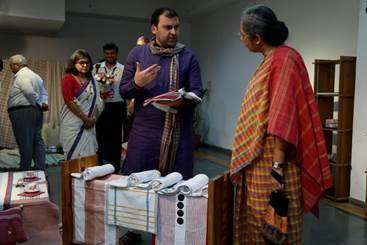
Khadi India organised an Exhibition and a Fashion Show ‘Aheli Khadi’ at NIFT Gandhinagar

 by Shashikant Nishant Sharma 

 Prime Minister Shri Narendra Modi’s pivotal call has been the core objective of Khadi and Village Industries Commission to position Khadi as a Fashion Fabric. It has been a constant effort of the Prime Minister to promote Khadi for all, especially the beacons of our society- the youth.

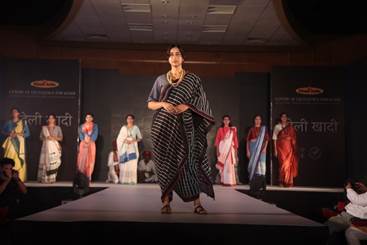
With the intention to reach out to young audience and global market, an exhibition and to popularise khadi as a fabric and showcase its use for traditional and contemporary cloths ‘Aheli Khadi’ a Fashion Show was organized by Khadi India at the Tana Riri Auditorium, NIFT Gandhinagar on Sunday.

Shri Manoj Goel, Chairman of KVIC graced the function as chief guest. Eminent designers, fashion industry members, students and khadi institutions graced the fashion show. 

Khadi is symbolic of the Swadeshi movement, and has been a front runner in establishing its robustness as a fabric that is both empowering and modern in its interpretation. That’s why Khadi has found favour with the younger generation, as it transcends from being termed as fabric and showcase its use for traditional and contemporary clothing, “Aheli” khadi means pure khadi; was showed during the fashion show.

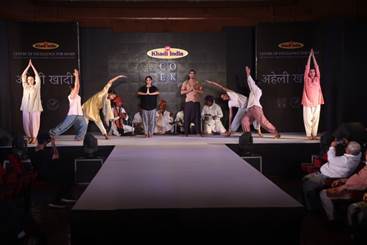
Apparel for Yoga as “SWADHA” chic, now accepted as an effective medium of communication designed by NIFT designer was the prominent attraction of the fashion show.

Another attraction of the fashion show was Aheli”; the fabric showcased at ramp was sourced from the khadi institutions to design for pan generational consumer. NIFT designers designed six distinct collections of apparel and sarees ranging from ethnic, fusion, western and casual look. Hand embroidery, stitch detailing and hand block printing has been used to add value to the exquisite khadi. Home linen collections were designed with Khadi fabrics of different weights and yarns combining Indian crafts with an International look to position Khadi as Global.

The show was designed and presented by NIFT students, who walked on the ramp as models.

Shri Manoj Goel, Chairman, KVIC in his key note addressed said; our effort will be to make “Khadi Global”. The aim of KVIC is to promote and pitch Khadi at a relatable, high design level, it also wishes to encourage use of khadi as an environmentally sustainable fabric to replace non-biodegradable unsustainable product in the domain of home and apparel.


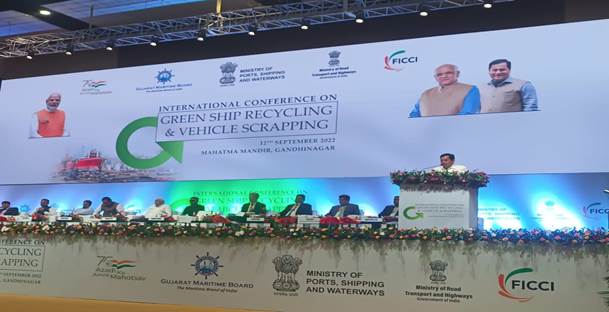
International Conference on Green Ship Recycling & Vehicle Scrapping and Review Meeting of Development of National Maritime Heritage Complex

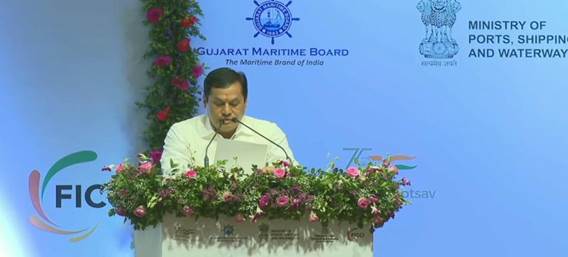
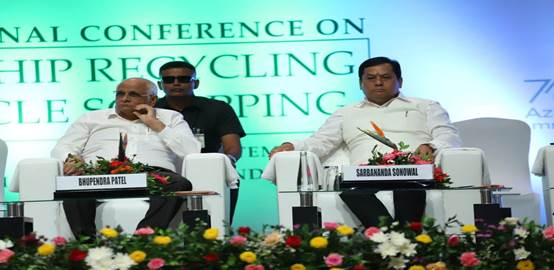
Union Minister of Ports, Shipping and Waterways Shri Sarbananda Sonowal has said that Gujarat is the business gateway of India and one of the world’s preferred maritime destinations. Addressing International Conference on Green Ship Recycling and Vehicle Scrapping in Gandhinagar today he said with a coastline of 1,600 km, Gujarat handles over 40% of India’s cargo throughput and contributes 18% of the total cargo transported using coastal shipping. He said Gujarat was the first state in the country to privatise the port sector, and by virtue of its strategic location, proactive policies, and robust infrastructure has emerged as the flag bearer of India’s maritime success story. Shri Sonowal said India is a leading destination for ship recycling and the planned doubling of capacity of Alang-Sosiya shipyard in Gujarat will create a large number of employment opportunities and bring in more economic prosperity to Gujarat and the country. 


Taking about the Sagarmala Programme, Shri Sonowal  said it has given impetus to the thriving maritime sector in Gujarat with projects such as port modernisation, rail, road, cruise tourism, RO-RO & passenger jetties, fisheries, coastal infrastructure, skill development, etc. There are 74 projects worth Rs. 57,000 crore under Sagarmala Programme in Gujarat, of which 15 projects worth Rs. 9,000 crore have been completed, 33 projects worth over Rs. 25,000 crore are under implementation and 26 projects worth Rs. 22,700 crore are under development, he said.

Speaking on the occasion Chief Minister Shri Bhupendra bhai Patel said under the leadership of Prime Minister Narendra Modi, Gujarat is now moving towards port-led development. Gujarat is India’s coastal gateway. He said the state is home to Alang, the largest ship-breaking yard in the world. Just as Gujarat has been dominant in ship breaking-recycling sector, it will also be in green recycling. He said Gujarat has the potential and the political will to become a hub for green ship recycling. The Gujarat government is committed to making Gujarat a global centre for green recycling. He said Alang also has a well-developed ecosystem and capacity for vehicle scrapping and will contribute majorly to the vehicle scrapping policy.

The International Conference on Green Ship Recycling and Vehicle Scrapping is showcasing the current status of ship recycling industry in Gujarat and the adoption of HKC Convention compliances. The conference is also facilitating discussion on how the EU shipping industry can take advantage of ship recycling facilities in Gujarat, and explore partnerships with EU member countries.

Highlighting the significance of the conference, MK Das, Additional Chief Secretary of Ports and Transport Department, Government of Gujarat, said the conference will put Alang on the global map as a preferred destination for sustainable ship recycling that has safe and environmentally sound ship recycling best practices in place. He said the conference will also help in exploring synergies between Alang’s ship recycling industry with the vehicle scrapping industry, and enable Alang to emerge as a vehicle scrapping hub.


Two sessions were also organised as a part of the conference. The first session on “Ship Recycling Industry in India and Compliances” focused on the Ship Recycling Act, the role of GMB, compliance with HKC and EU Ship Recycling Regulation (EUSRR), and safe and sustainable recycling.

The second session was on Vehicle Scrap Policy and saw an overview of the policy. It also showcased Alang’s capabilities as a hub of vehicle scrapping.

Representatives from the Ministry of Ports, Shipping & Waterways, CEOs, and national and international industry representatives from the shipping sector including shipping lines, ship recyclers, ship owners, etc. participated in the conference. The conference will be followed by a visit to the Alang ship breaking yard on September 13.

Shri  Sonowal also visited the site of proposed National Maritime Heritage Complex near Lothal and reviewed the progress of the project in presence of senior officers of Government of Gujarat and Ministry of Ports, Shipping and Waterways. The project is being developed by the Government of India through MoPSW for an estimated amount of Rs.3500 crore. The proposed Complex would showcase India’s rich and diverse maritime heritage and will be the first of its kind in the country and one of the world’s largest maritime museums dedicated to the legacy of maritime heritage of India.

Life size architecture of the Lothal will be depicted in the museum. The various components like, lower town, middle town, Citadel, cemetery, houses, pattern of the street, sanitation system, wells, industries/workshop and marketplace, etc. will be depicted in the museum. To provide First-Hand Experience to visitors, a working model of the Lothal dockyard, functioning of the warehouse etc. will also be showcased along with typical Harappan house with components like, oven, etc. The museum will portray renowned Harappan Water Harvesting and Management system excavated at the site of Dholavira.

Renowned architecture firm Ms. Architect Hafeez Contractor has been appointed as the Project Management Consultant of the project and have already prepared Concept Design & Plan for following 5 Galleries of phase 1A:

a) Gallery- 1 Orientation and oceanic mythology

b) Gallery-2 Harappans: The Pioneer Seafarers

c) Gallery- 3 Post Harappan Trajectories: The Impact of Climate change

d) Gallery- 4 India’s contact with the Greco-Roman world

e) Gallery- 5 Special exhibitions

The work on concept design of Gallery 6 (Emergence of Indian Navy) is in progress by Ms. Architect Hafeez Contractor in consultation with the officials of Indian Navy and consolidated list of artefacts for the galleries has been finalized.

The EPC work of the NMHC phase 1A has been awarded to Tata Projects Ltd. in Mar 2022 and is targeted to be completed by Mar 2024.

The project will boost the tourism in the state of Gujarat in turn developing the economy of the region including the nearby villages namely Saragwala and Utelia. The proposed six galleries planned in the NMHC project will focus on different time periods of the Maritime history to the visitors.

Speaking after the visit Shri Sonowal stated that the project will be developed as a new international destination for tourist and to stand at par with other renowned international museums of the world under the Sagarmala program of the Ministry of Shipping. He said It will also create an opportunity of employment for the local people and help them develop a number of cottage industries thus materializing the vison of Atmanirbhar Bharat of Prime Minister Shri Narendra Modi.

What is Business Process Outsourcing (BPO)?

Business Process Outsourcing (BPO) is the delegation of the Ownership, Administration, and Operation of a process to a third party. Many people see it as an evolution from Information Technology Outsourcing (ITO). Business Process Outsourcing (BPO) is the delegation of one or more IT-intensive business processes to an external provider that in turn owns, administers and manages the selected process based on defined and measurable performance criteria. Business Process Outsourcing (BPO) is one of the fastest growing segments of the Information Technology Enabled Services (ITES) industry.

Several MNCs are increasingly unbundling or vertical disintegrating their activities i.e. they have begun outsourcing activities which formerly performed in house and concentrating their energies on a few functions. Outsourcing involves withdrawing from certain stages/activities and relying on outside vendors to supply the needed products, support services or functional activities. These outside vendors are called BPOs. The outsourcing industry is growing from strength.

Why do everything yourself, when someone else can do it at low cost? In the current scenario, the theory says exactly the same. The global market today is highly competitive and continuously changing. A company must, thus, focus on improving productivity and at the same time, cut down costs. This is the basic premise of outsourcing. Outsourcing works because what is non-core for one organisation, is core for another.

In brief, business process outsourcing can be seen as a process in which a company delegates some of its in-house operations or processes to a third party. Thus, it is a transaction through which one company acquires services from another, while maintaining ownership and ultimate responsibility for the processes.

The company then informs its provider what it wants, and how it wants the work to be performed. The main motive for business process outsourcing is to allow the company to invest more time, money and human resources into core activities and building strategies, which fuel company growth.

What is Business Process Outsourcing (BPO)?

Business Process Outsourcing (BPO) is the delegation of the Ownership, Administration, and Operation of a process to a third party. Many people see it as an evolution from Information Technology Outsourcing (ITO). Business Process Outsourcing (BPO) is the delegation of one or more IT-intensive business processes to an external provider that in turn owns, administers and manages the selected process based on defined and measurable performance criteria. Business Process Outsourcing (BPO) is one of the fastest growing segments of the Information Technology Enabled Services (ITES) industry.

Several MNCs are increasingly unbundling or vertical disintegrating their activities i.e. they have begun outsourcing activities which formerly performed in house and concentrating their energies on a few functions. Outsourcing involves withdrawing from certain stages/activities and relying on outside vendors to supply the needed products, support services or functional activities. These outside vendors are called BPOs. The outsourcing industry is growing from strength.

Why do everything yourself, when someone else can do it at low cost? In the current scenario, the theory says exactly the same. The global market today is highly competitive and continuously changing. A company must, thus, focus on improving productivity and at the same time, cut down costs. This is the basic premise of outsourcing. Outsourcing works because what is non-core for one organisation, is core for another.

In brief, business process outsourcing can be seen as a process in which a company delegates some of its in-house operations or processes to a third party. Thus, it is a transaction through which one company acquires services from another, while maintaining ownership and ultimate responsibility for the processes.

The company then informs its provider what it wants, and how it wants the work to be performed. The main motive for business process outsourcing is to allow the company to invest more time, money and human resources into core activities and building strategies, which fuel company growth.

How Social Media Creates Required Attention For A News

N kavya

At the touch of a screen, most people now get their news information online, especially from social media. Social media reaches a maximum audience. In a recent survey, 50 percent of internet users said that they get to know about the latest news via social media even before it is on a news station. Social media in reporting is that the news does not get spread fairly quickly. If information is correct then it can be an excellent way of getting the news.

Positive -:

1. The news on social is immediate, while traditional media, can be delayed due to press times
2. Social media is versatile (you can make changes or delete once published. Whereas traditional media, once published, is set in stone.
3. The accessibility of social networks across devices makes them easy to use on the go and one of the most convenient ways to read the news.
4. RVCJ media page that provides the latest news on Instagram

Negative -:

1. There is a fierce media competition
2. Social platforms have control over what news and information we see. Our social media friends have become “managing editors” deciding what we see. An article needs to be liked and shared multiple times before many see it in their feed. Therefore, social media friends have control over what news pieces we see and what we do not.
3. The authentic content is hard to come by now. In fact, fake news is actually more likely to spread than the truth. 4. Falsehood diffused significantly farther, faster, deeper, and more broadly than the truth in all categories of information.

Conclusion -:

News happens fast now. Today’s story will be tomorrow’s forgotten story. It is easy to miss things now because of how quick stories can get turned around and shared. While having so much information at our fingertips is great, it is worth always checking sources and not taking headlines as truth. With social media as our new news managers, it is up to us to be the new fact checkers for media.

KERALA

 Kerala

Kerala was formed on 1st November 1956. Chief language of state is malayalam. Main rivers are Periyar, Bharatapuzha, Pamba,Chaliyar, Achenkovil, Muvattupuzha. Mountains are Anamala is the highest peak, Karinkulam, Mukutti, Devimala. The main beaches are Kovalam, Varkala, Vizhinjam, Shankumukham(trivandrum)etc. The main waterfalls are Athirapally, Palaruvi and Vazhachal. The wildlife sanctuaries include Peppara lNational park, Silent valley, Parambikulam National Park, Periyar National Park, Eravikulam National Park known for its Nilgiri Tahr.

Thiruvananthapuram (Trivandrum) is the capital of Kerala, it is a beautiful city with art galleries, palaces, beaches etc. Main places to visit are Sri Padmanabhaswami temple, Kuthiramalika palace museum, Kanakakkunnu palace, Science and technology museum and planetarium, Observatory tower, Napier museum, Sri Chitra Art gallery. Kovalam beach, Veli tourist village, Neyyar dam andvwildlife sanctuary , ponmudi hill resort and Varkala beach.

Kumarakom

At Kumarakom house boat sailing on backwaters. The kottayam, kollam, alapuzha route is famous for scenic beauty. Boat races are held here annually and it’s a royal attraction. Kumarakom bird sanctuary, Vembanadu lake is place for water ride.

Thekkady

Periyar wildlife sanctuary with artificial lake surrounded by evergreen forest and grasslands. It’s home to bison, antelopes, sambhar, monkeys, langur, elephants, tigers etc.Thekkady is centre inside Park with hotels and boat jetty. Kumily is the closest town.

Kochi

Kochi consist of Ernakulam, Wellington Island, Bolgatty, Mattanchery, Vypin Island, Fort Cochin etc. St. Francis church with tombstone of Vasco da Gama, the Mattanchery palace, the Jewish synagogue constructed in 1568. Other attractions are Bolgatty Island, Harbour, Chinese fishing nets, ParishathThampuran museum and Veegaland amusement park.

Thrissur

Thrissur is known as kerala’s cultural capital. Places to visit are Vadakumnatha temple, churches include Our Lady of Lourdes cathedral, Puthenpalli, Chandran church etc. Many important temple festivals including thrissur pooram, peruvanam pooram, Arattupuzha pooram, thaipooya maholsavam etc. Kerala Kalamandalam and Guruvayoor Sree Krishna temple is situated in thrissur.

Kannur 

Kannur is the best place to enjoy Kerala’s ritual art Theyyam. Regular Theyyams are held in Parassinikadavu temple and at Kerala folklore academy. The Portuguese built St. Angelo fort and Kanjirode weavers cooperative are worth visiting. The famous Bakel fort and Kappil beach are places to visit.

Himachal pradesh


Himachal Pradesh

Himachal Pradesh was formed on 25 January 1971. The capital is Shimla. The languages spoken by people are Pahari, Hindi, Punjabi and Kinnauri. The main towns are Shimla, Mandi,Dharmashala, Kullu, Manali,Bilaspur, Chamba, Kye- lang, Kalpa and Kangra. For shopping Pashmina shawls are famous, rugs, gudma, namdas are attractions. Dal housie- kulu shawls and Tibetan handicrafts, lakkar bazar are worth visiting. The main rivers are Beas, Chenab,Ravi, Satluj, Yamuna. Mountain ranges are Great Himalaya , Punjab Himalaya, Saket hills, Shimla hills, Shiwalik range, Missouri range. The main valleys are Kangra Valley, Mahasu Valley, Lahul Valley, Baspa Valley etc.

The famous places to visit in Himachal pradesh are Shimla known as summer capital of British India. The summer hill and the Prospect hill, the Viceregal lodge(Rashtrapati niwas), and botanical garden, the Indian Institute of Advanced Studies, the Himachal State Museum etc are worth visiting. Many beautiful places to visit like Jakhu hill and temple, Skating rink, Annandale, Chadwick falls, Chail, Malhotra etc.

Dharamsala

It is ideal location for meditation, quiet walks, trekking, rock climbing etc. It is also referred to as “ Little Lhasa”.Tibet museum and the Tsunglagkhag temple. St. John’s church, the Kangra art museum, Tibetan institute of performing arts, Dip Tse- Chok Ling Gompa, library of Tibetan works, Tibetan medical and astrological institute, Dharamkot, Bhagsunath waterfall, Machhirial waterfall etc.

Chamba

Chamba on the banks of the river Ravi is famous for shikara hindu temples,Chamba rumal(miniature paintings), Brajeshwari Devitemple, Chamunda devi temple, Rang mahal, Bhuri Singh Musuem, Saloni and Bhandal valley.

Dalhousie

It is a hill station spreading over five hills. Main attractions include Gandhi Chowk, Subhash Chowk, Panjpulla, Moti Tibba, Karelnu, Khajjiar meadow.

Kullu

Kullu is famous and colorful during Dussehra festival in October and filled with picturesque lush green valleys. Mandi is gateway to Kullu Valley and the junction of roads from Kullu Valley, Kangra Valley and Shimla. Rani Amrit Kaur park, Rewalsar lake, prashar lake, Roerich gallery, Naggar castle, great Himalayan National Park etc are main attractions.Manali is the North of Kullu. The nearest airport is Bhuntar to Kullu and Manali. It is ideal place for trekking, mountaineering, rafting, skiing, jeep safaris, fishing etc.

Robber Barons

N kavya

The super rich industrialists and financiers such as John D. Rockefeller, Andrew W. Mellon, Andrew Carnegie, Henry H. Rogers, J.P. Morgan, Cornelius Vanderbilt of the Vanderbilt family, and the prominent Astor family were labeled as “robber barons” by the common people.

A robber baron is a term used frequently in the 19th century during America’s Gilded Age to describe successful industrialists whose business practices were often considered ruthless or unethical. Robber baron is a term that is also sometimes attributed to any successful businessperson whose practices are considered unethical or unscrupulous. This behavior can include employee or environmental abuse, stock market manipulation, or deliberately restricting output to charge higher prices.

These practices included exerting control over natural resources, influencing high levels of government, paying subsistence wages, squashing competition by acquiring their competitors to create monopolies and raise prices, and schemes to sell stock at inflated prices to unsuspecting investors. The term combines the sense of criminal (“robber”) and illegitimate aristocracy (a baron is an illegitimate role in a republic). This monopoly was achieved in part by crushing rivals and systematically cheating Native Americans of fur pelts.

During 19th century the chief complaint that was capitalists were becoming monopolists. Fear over the robber barons and their monopoly practices increased public support for the Sherman Antitrust Act of 1890 (The Sherman Anti-Trust Act authorized the federal government to institute proceedings against trusts in order to dissolve them). Many so-called robber barons. became wealthy entrepreneurs through product innovation and business efficiency. Of the goods and services they provided, supply grew, and prices fell rapidly, greatly boosting Americans’ standards of living. This is the opposite of monopolistic behavior.

Some Of The Major Robber Barons -:

1. James Fisk, one Wall Street’s first great financiers, accumulated much of his fortune by fraudulent stock market practices. The venture brought them vast sums but led to a securities market panic that began on September 24, 1869, a day that was long remembered as Black Friday.

2. Leland Stanford became involved in Republican politics in California and was elected governor in 1861. With three colleagues, he formed the Pacific Association and used their combined assets to bribe congressmen and others with political influence in the country’s capital. In return, the association was provided 9 million acres (3.6 million hectares) and a $24 million loan financed by federal bonds.

3. John D. Rockefeller made his immense riches from monopolizing America’s oil industry. Conspiring with refinery owners, he helped found what became known as the Standard Oil monopoly. Those who stubbornly resisted were confronted with price wars. By 1890, the Rockefeller trust controlled approximately 90 percent of the petroleum production in the United States, a situation that led to the passage of the Sherman Antitrust Act that same year.

4. J.P. Morgan who organized a number of major railroads and consolidated the United States Steel, International Harvester, and General Electric corporations

5. Andrew Carnegie who led the enormous expansion of the American steel industry in the late 19th century; shipping and railroad magnate

6. Cornelius Vanderbilt, Industralist

7. George Pullman the inventor of the Pullman sleeping car

8. Henry Clay Frick who helped build the world’s largest coke and steel operations.

Common criticisms of the early robber barons -:

Poor working conditions for employees, selfishness, and greed. Some robber barons including Robert Fulton, Edward K. Collins, and Leland Stanford earned their wealth through political entrepreneurship. Many wealthy railroad tycoons during the 1800s received privileged access and financing from the government via extensive use of lobbyists.

The major considerations of robber barons are – :

•While robber barons took advantage of their workers, they sometimes offered better working conditions than the norm of the day


•Some tycoons rank among the most noted philanthropists of all time. Rockefeller donated around 10% of every paycheck he ever earned.


•Railroad tycoon James J. Hill publicized and provided free education about crop diversification, and would transport immigrants at reduced rates if they promised to farm near his railroads.

Radio In India

N kavya

Radio broadcasting began in India in 1922. The Government owned radio station All India Radio dominated broadcasting since 1936.

Broadcasting in India actually began about 13 years before AIR came into existence. In June 1923 the Radio Club of Bombay made the first ever broadcast in the country. This was followed by the setting up of the Calcutta Radio Club five months later. The Indian Broadcasting Company (IBC) came into being on July 23, 1927, only to face liquidation in less than three years.

In April 1930, the Indian Broadcasting Service, under the Department of Industries and Labour, commenced its operations on an experimental basis. Lionel Fielden was appointed the first Controller of Broadcasting in August 1935. In the following month Akashvani Mysore, a private radio station was set up. On June 8, 1936, the Indian State Broadcasting Service became All India Radio.

The Central News Organisation (CNO) came into existence in August, 1937. In the same year, AIR came under the Department of Communications and four years later came under the Department of Information and Broadcasting. When India attained independence, there were six radio stations in India, at Delhi, Bombay, Calcutta, Madras, Tiruchirapalli and Lucknow. The following year, CNO was split up into two divisions, the News Services Division (NSD) and the External Services Division (ESD). In 1956 the name AKASHVANI was adopted for the National Broadcaster. The Vividh Bharati Service was launched in 1957 with popular film music as its main component

The phenomenal growth achieved by All India Radio has made it one of the largest media organisations in the world. With a network of 262 radio stations, AIR today is accessible to almost the entire population of the country and nearly 92% of the total area. A broadcasting giant, AIR today broadcasts in 23 languages and 146 dialects catering to a vast spectrum of socio-economically and culturally diverse populace.

Programmes of the External Services Division are broadcast in 11 Indian and 16 foreign languages reaching out to more than 100 countries. These external broadcasts aim to keep the overseas listeners informed about developments in the country and provide a rich fare of entertainment as well.

The News Services Division, of All India Radio broadcasts 647 bulletins daily for a total duration of nearly 56 hours in about 90 Languages/Dialects in Home, Regional, External and DTH Services. 314 news headlines on hourly basis are also being mounted on FM mode from 41 AIR Stations. 44 Regional News Units originate 469 daily news bulletins in 75 languages. In addition to the daily news bulletins, the News Services Division also mounts number of news-based programmes on topical subjects from Delhi and its Regional News Units

AIR operates at present 18 FM stereo channels, called AIR FM Rainbow, targeting the urban audience in a refreshing style of presentation. Four more FM channels called, AIR FM Gold, broadcast composite news and entertainment programmes from Delhi, Kolkata, Chennai and Mumbai. With the FM wave sweeping the country, AIR is augmenting its Medium Wave transmission with additional FM transmitters at Regional stations.

In April 2020, as per a survey by AZ Research PPL, commissioned by the Association of Radio Operators for India (AORI) Radio listenership in India touched a peak of 51 million.

Does radio have a future?

The consoles, connected watches and TV’s that we use every day will be just another way in which radio stations can broadcast and increase their audience numbers. Since its creation, radio has continually evolved with the times

Why Radio is still popular?

Portable and Inexpensive: Radio is portable among many modes of communication. They can be used in cars, stores, and other places, which helps to reach the targeted audience. According to researchers, broadcast radio reaches 99% of the Indian population today.

The Government decision for transition to the digital mode of transmission, AIR is switching from analog to digital in a phased manner. The technology adopted is the Digital Radio Mondiale or DRM. With the target of complete digitization by 2017, the listeners can look forward to highly enhanced transmission quality in the near future.

IFSCA Issues Guidelines and Application Form for IFSCA FinTech Incentive Scheme, 2022

  The International Financial Services Centres Authority (“Authority” or “IFSCA”), with an overall objective to promote the establishment of a world-class FinTech Hub, at GIFT International Financial Services Centre (IFSC) in India, launched the IFSCA (FinTech Incentive) Scheme for providing financial support to FinTech activities in the form of specific grant(s). The Scheme was notified vide Gazette Notification number IFSCA/2021-22/GN/022 dated 2nd February, 2022.

This scheme shall be open to –

  1. Domestic FinTechs seeking access to overseas markets;
  2. Domestic FinTechs seeking listing on IFSCA recognised stock exchanges;
  3. Foreign FinTechs seeking market access to IFSCs in India and work within the Authority’s regulatory framework;
  4. Foreign FinTechs seeking access to domestic market under Inter-Operable Regulatory Sandbox (IORS) framework;
  5. Domestic FinTechs extending business to the IFSCs either by way of authorisation or registration or through the regulatory sandbox.

The types of incentives for eligible applicants are:

  1. FinTech Start-up grant- This grant shall be utilized for developing a product or a service and related ‘go-to market’ initiatives for a start-up with a novel FinTech idea or solution with a focus on converting the idea into an MVP.
  2. Proof of Concept (PoC) grant- This grant shall be utilized for the purpose of conducting a PoC by an early or mature FinTech Entity (FE) in domestic market or overseas.
  3. Sandbox grant- This grant shall be utilized by FEs to experiment with innovative products or services in a sandbox.
  4. Green FinTech Grant- This grant shall be utilized towards developing solutions facilitating sustainable finance and sustainability linked finance, including ‘Environmental, Social and Governance (ESG)’ investments.
  5. Accelerator Grant- This grant shall be utilized for supporting accelerators at the IFSC for capacity building, build capabilities around mentors, bringing investors, bringing more projects or PoC, tie ups, etc.
  6. Listing Support Grant – The grant shall be utilized for supporting Domestic FE aspiring to go for listing on stock exchanges recognised by the Authority.

The Grants contemplated under this scheme shall be available to eligible FEs:

  1. who are part of the Authority’s Regulatory or Innovative Sandbox;
  2. which are referred to the Authority under a FinTech bridge arrangement with a Counterpart Regulator
  3. which have either participated or are participating in any Accelerator or Cohort or Special Programme supported or recognised by the Authority; or
  4. who are referred to by the entity(ies) including regulatory or supervisory bodies having Memorandum of Understanding (MoU) or collaboration or special arrangement with the Authority.

The detailed Guidelines of the Scheme for implementation as well as the Application Form are hereby being issued.

The detailed guidelines and the application form may be accessed at:   https://ifsca.gov.in/Viewer/Index/343 

Please refer to IFSCA Circular (may be accessed at https://ifsca.gov.in/Viewer/Index/292 ) dated April 27, 2022 on “Framework for FinTech Entity in the IFSCs” to obtain authorisation as FinTech Entity (FE).

****