QUEEN ELIZABETH II DEATH: THE END OF A LEGENDRY MONARCH


We all are shocked by the death of Queen Elizabeth II (Elizabeth Alexandra Mary) who reigned over the United Kingdom and Commonwealth nations from 6 February 1952 until she died in 2022. During her lifetime, she reigned over 32 sovereign nations, with 15 remaining at the time of her death. Her reign was the longest of any British queen and the longest documented reign of any female monarch in history, lasting 70 years and 214 days. 
Her legacy started when her father died in February 1952, at the age of 25 years. She became queen of seven separate Commonwealth countries: the United Kingdom, Canada, Australia, New Zealand, South Africa, Pakistan, and Ceylon (now known as Sri Lanka), as well as the Commonwealth’s Head of State. Elizabeth’s coronation in 1953, as well as her Silver, Golden, Diamond, and Platinum jubilees in 1977, 2002, 2012, and 2022, are significant events of her life. Although she faced criticism along with her family on certain occasions, especially after the breakdown of her children’s marriages, her annus horribilis in 1992, and the death in 1997 of her former daughter-in-law Diana, Princess of Wales, support for the monarchy in the United Kingdom remained consistently high throughout her lifetime, as did her personal popularity. The queen died peacefully in 2022 at the age of 96 at Balmoral Castle in Aberdeenshire and was succeeded by her eldest child, Charles III. Hers was the first state funeral held in the United Kingdom since Winston Churchill’s in 1965.

SILVER JUBILEE

Elizabeth celebrated the Silver Jubilee of her accession in 1977. Parties and events were held around the Commonwealth, with many of them coinciding with her connected national and Commonwealth visits. Despite nearly coincidental bad news coverage of Princess Margaret’s split from her husband, Lord Snowdon, the celebrations reaffirmed Elizabeth’s popularity.  In 1978, Romania’s communist leader, Nicolae Ceaușescu, and his wife, Elena, paid an official visit to the United Kingdom, despite Elizabeth personally believing they had “blood on their hands.” The next year saw the unmasking of Anthony Blunt, former Surveyor of the Queen’s Pictures, as a communist spy, and the killing of her relative and in-law, Lord Mountbatten, by the Provisional Irish Republican Army.

GOLDEN JUBILEE

The queen celebrated her Golden Jubilee, the 50th anniversary of her ascension, in 2002. Her sister and mother died in February and March, respectively, and the media debated whether or not the Jubilee would be a success.  She embarked on another extended tour to her kingdoms, beginning in Jamaica in February, where she dubbed the departure supper “memorable” when a power outage dropped the King’s House, the governor-formal general’s house, into darkness. There were street dances and memorial festivities, as there had been in 1977, and monuments were named in honour of the occasion. One million people attended each of the three days of the major Jubilee celebration in London, and the public’s passion for Elizabeth was stronger than many journalists had imagined.

DIAMOND JUBILEE

Elizabeth’s Diamond Jubilee in 2012 commemorated her 60th year on the throne, and festivities were staged across her countries, the Commonwealth, and beyond. Her husband and she went on a lengthy tour of the United Kingdom, while her children and grandchildren went on royal visits to other Commonwealth countries on her behalf. Jubilee beacons were lighted across the world on June 4th.  Elizabeth and her husband celebrated their blue sapphire wedding anniversary in November (65th). On December 18, she became the first British royal since George III in 1781 to attend a peacetime Cabinet meeting.

PLATINUM JUBILEE

Elizabeth’s Platinum Jubilee began on February 6, 2022, celebrating 70 years after her father’s death, when she ascended to the throne. On the eve of the wedding, she hosted a reception at Sandringham House for retirees, members of the local Women’s Institute, and charitable volunteers. Elizabeth repeated her promise to a lifetime of public service, which she made in 1947, in her accession day statement. Later that month, Elizabeth, along with several employees and family members, developed “moderate cold-like symptoms” and tested positive for COVID-19. She cancelled two virtual audiences on February 22, but spoke with British Prime Minister Boris Johnson the next day about the crisis on the Russian-Ukrainian border, after which she made a gift to the Disasters Emergency Committee (DEC) Ukraine Humanitarian Appeal. On 28 February, she was reported to have recovered and spent time with her family at Frogmore. On 7 March, Elizabeth met Canadian prime minister Justin Trudeau at Windsor Castle, in her first in-person engagement since her COVID diagnosis. She later remarked that COVID infection “leave[s] one very tired and exhausted … It’s not a nice result”.

Elizabeth was deeply religious and civic-minded, and she took her Coronation Oath seriously.  In addition to her formal religious function as Supreme Governor of the established Church of England, she attended both that church and the national Church of Scotland.  She advocated for interfaith dialogue and visited with leaders from different churches and religions, including five popes: Pius XII, John XXIII, John Paul II, Benedict XVI, and Francis. Her annual Christmas Message to the Commonwealth frequently included a personal comment about her beliefs. Elizabeth supported around 600 organisations and charities.  According to the Charities Aid Foundation, Elizabeth helped raise almost £1.4 billion for her patronages during her reign. Her major hobbies were equestrianism and pets, particularly her Pembroke Welsh Corgis.  Her lifelong passion for corgis began in 1933 with Dookie, her family’s first corgi Scenes of carefree, casual home life were occasionally observed; she and her family made dinner together and cleaned the dishes together occasionally.

TITLES 

  • 21 April 1926 – 11 December 1936: Her Royal Highness Princess Elizabeth of York
  • 11 December 1936 – 20 November 1947: Her Royal Highness The Princess Elizabeth
  • 20 November 1947 – 6 February 1952: Her Royal Highness Princess Elizabeth, Duchess of Edinburgh
  • 6 February 1952 – 8 September 2022: Her Majesty The Queen

What is ‘ONDC’ initiative by GoI.

To reduce the dominance of e-commerce giants like Flipkart and Amazon, the government rolled out its big initiative — Open Network for Digital Commerce (ONDC) — for public in Bengaluru. With the help of ONDC, government plans to help small retailers and create an alternative to dominant global giants like Amazon and Walmart, who controls over half of India’s fast-growing e-commerce market.

The platform aims to create new opportunities, curb digital monopolies and by supporting micro, small and medium enterprises and small traders and help them get on online platforms. It is an initiative of the Department for Promotion of Industry and Internal Trade (DPIIT) under the Ministry of Commerce and Industry.

The government says existing platforms work in silos and are tightly controlled, keeping out many small players. It expects ONDC to increase competition and foster innovation by start-ups.
It also hopes to bring in logistics firms and others who can collaborate with sellers to deliver products to customers.

The focus would be on small merchants and rural consumers, with apps in Indian languages.
ONDC officials liken the network to a mall with 1,000 gates instead of just two, thereby limiting opportunities for selected sellers to receive preferential treatment – a common accusation against major e-commerce companies. Users will be able to rate service providers on ONDC, which will be applicable and visible across the network. The government says ONDC will help to end “predatory pricing, especially in high-margin, high-value products”. Amazon and Flipkart deny that they have engaged in predatory pricing.

How does ONDC work?

The ONDC platform lies in the middle of the interfaces hosting the buyers and the sellers. So far, the buyer side interface is being hosted by Paytm, whereas the seller side interface is being hosted by other players like GoFrugal, etc.

When a buyer searches for an item on the Paytm app, from where ONDC has gone live, the app will connect to the ONDC platform, which will connect it to seller side interfaces that will list all the companies from where you can buy the particular item.

On ONDC, there will be several other backend partners such as logistics service providers, enterprise resource planners, e-commerce store hosting service providers, etc.

What is 'ONDC' initiative by GoI.

To reduce the dominance of e-commerce giants like Flipkart and Amazon, the government rolled out its big initiative — Open Network for Digital Commerce (ONDC) — for public in Bengaluru. With the help of ONDC, government plans to help small retailers and create an alternative to dominant global giants like Amazon and Walmart, who controls over half of India’s fast-growing e-commerce market.

The platform aims to create new opportunities, curb digital monopolies and by supporting micro, small and medium enterprises and small traders and help them get on online platforms. It is an initiative of the Department for Promotion of Industry and Internal Trade (DPIIT) under the Ministry of Commerce and Industry.

The government says existing platforms work in silos and are tightly controlled, keeping out many small players. It expects ONDC to increase competition and foster innovation by start-ups.
It also hopes to bring in logistics firms and others who can collaborate with sellers to deliver products to customers.

The focus would be on small merchants and rural consumers, with apps in Indian languages.
ONDC officials liken the network to a mall with 1,000 gates instead of just two, thereby limiting opportunities for selected sellers to receive preferential treatment – a common accusation against major e-commerce companies. Users will be able to rate service providers on ONDC, which will be applicable and visible across the network. The government says ONDC will help to end “predatory pricing, especially in high-margin, high-value products”. Amazon and Flipkart deny that they have engaged in predatory pricing.

How does ONDC work?

The ONDC platform lies in the middle of the interfaces hosting the buyers and the sellers. So far, the buyer side interface is being hosted by Paytm, whereas the seller side interface is being hosted by other players like GoFrugal, etc.

When a buyer searches for an item on the Paytm app, from where ONDC has gone live, the app will connect to the ONDC platform, which will connect it to seller side interfaces that will list all the companies from where you can buy the particular item.

On ONDC, there will be several other backend partners such as logistics service providers, enterprise resource planners, e-commerce store hosting service providers, etc.

nuclear power reactors at Jaitapur site in Ratnagiri district of Maharashtra

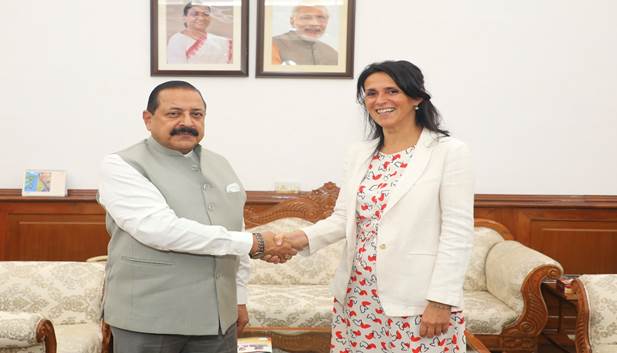
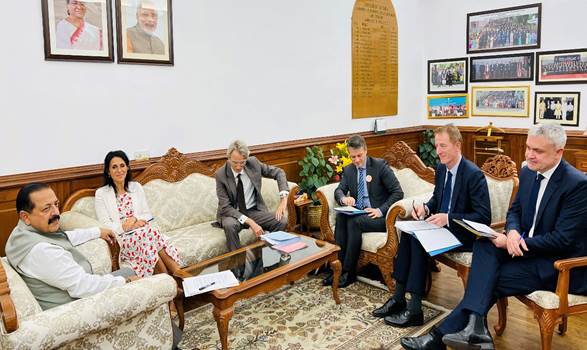
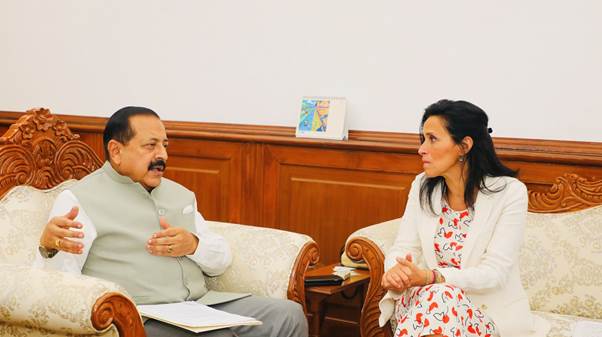
 France Minister, Ms. Chrysoula Zacharopoulou, currently on India visit, called on Union Minister of State (Independent Charge) Ministry of Science & Technology, Minister of State (Independent Charge) Ministry of Earth Sciences, MoS PMO, DoPT, Administrative Reforms, Public Grievances, Pensions, Space and Atomic Energy, Dr Jitendra Singh at North Block, New Delhi to discuss Indo-French collaboration in Nuclear Energy. She was accompanied by a high-level French delegation.

The two sides discussed ways to speed up the setting up of the nuclear power reactors at Jaitapur site in Ratnagiri district of Maharashtra by joint collaboration. Emmanuel Lenain, Ambassador of France to India and other French officials including Thomas Mieusset, Nuclear Counsellor joined the deliberations. 

https://static.pib.gov.in/WriteReadData/userfiles/image/image001VS0O.jpg

Indian Government has already accorded ‘In-Principle’ approval for setting up six nuclear power reactors of 1650 MW each in technical cooperation with France which would make it the largest nuclear power generating site with a total capacity of 9900 MW as part of an umbrella nuclear deal signed with France in September 2008

The French company EDF last year submitted to Nuclear Power Corporation of India Ltd (NPCIL) its binding techno-commercial offer to build six European Pressurised Reactors (EPRs) at Jaitapur. In May, this year, a high-level team from EDF visited India and held detailed talks with NPCIL officials.

Dr Jitendra Singh assured the France Minister that the technical, financial and civil nuclear liability issues will be resolved at the earliest by both the sides and well before the scheduled visit of the French president Mr Emmanuel Macron in early 2023 as announced by Ms Chrysoula Zacharopoulou. The France Finance Minister Bruno Le Maire is also scheduled to visit India by the middle of December.

https://static.pib.gov.in/WriteReadData/userfiles/image/image002SX12.jpg

Referring to warm and all-encompassing bilateral ties between the countries, Dr Jitendra Singh underlined that Indian Prime Minister Narendra Modi, who was on a 3-day Europe visit, met President of France, Emmanuel Macron in Paris during the final leg of his tour in May this year. Both the leaders spoke on various subjects, including bilateral and global issue, and Mr Modi remarked that “India and France are proud developmental partners and this partnership is being spread across different sectors”.

In today’s meeting, both the sides reaffirmed the commitment to the success of the strategic Jaitapur EPR project for access to reliable, affordable and low-carbon energy and agreed to sort out the pending issues at the earliest. 

NPCIL will be responsible for the construction and commissioning of the units, as well as obtaining all necessary permits and consents in India as the owner and future operator of the plant. This includes certification of the EPR technology by the Indian regulator.

Dr Jitendra Singh recalled that nuclear power is clean and environment friendly, apart from having a huge potential to ensure the country’s long term energy security on a sustainable basis. The nuclear power plants have so far generated about 755 billion Units of electricity saving about 650 million Tons of CO2 emission.

https://static.pib.gov.in/WriteReadData/userfiles/image/image003KL2N.jpg

Dr Jitendra Singh said that the net zero targets are expected to be met through a combination of various clean energy sources including nuclear power. In this context, the present nuclear power capacity of 6780 MW is planned to be increased to 22480 MW by 2031 on progressive completion of projects under construction and accorded sanction. 


Digi Locker Partner Organizations to provide Subscriber Centric online Services

 Central Record Keeping Agencies (CRAs) of Pension Fund Regulatory and Development Authority (PFRDA) have become Digi Locker Partner Organizations to provide Subscriber Centric online Services .

  As a tribute to 75 Years of India’s Independence Day Celebration and to commemorate Azadi Ka Amrit Mahotsav, PFRDA is providing following additional features through Digi Locker:

  1. Account opening using Driving License (DL) through Digi Locker
  2. Updation of existing address using DL through Digi Locker

 The facility can be availed by prospective subscribers opening their accounts with Protean CRA and existing subscribers of Protean CRA for updating their address.

Digi Locker is a key initiative under Digital India, the Government of India flagship program with a vision to transform India into a digitally empowered society and a pensioned Society. Digi Locker embraces Digital India’s vision areas of providing the Citizens a shareable private digital space with a consent framework and making all documents/certificates digitally available and accessible at ease. The number of Registered Users of Digi Locker are nearly 13 cr and 5.60 billion issued documents under various Categories viz Central/ State Governments, Banking & Insurance, Education, Health etc.

Steps for opening the NPS account using Driving License issued in DigiLocker

  1. Open the NPS registration page on Protean CRA website. (https://enps.nsdl.com)
  2. Select the option of New Registration with Documents with DigiLocker and select Driving License (DL).
  3. Applicant will be redirected to DigiLocker Website, where he can login with login credentials and provide consent for sharing of documents/information with CRA.
  4. Allow NPS to access DigiLocker and issued documents.
  5. The demographic Information and the photo as per Driving License will be auto populated in the account opening Page.
  6. Provide PAN, personal details, Information related to Bank Account, Scheme & Nomination and other details to complete the application.
  7. Payment can be made towards NPS Contribution.
  8. NPS Account generated successfully.

Steps for updating the address in NPS account using Driving License issued in DigiLocker

  1. Login to NPS account using credentials on Protean CRA website
  2. Select the option Update Personal Details under the tab Demographic Changes
  3. Select Update Address Details and further select through DigiLocker and select Driving License under documents.
  4. Applicant will be redirected to DigiLocker Website, where he can login with login credentials and provide consent for sharing of documents/information with CRA.
  5. Allow NPS to access DigiLocker and issued documents and submit.
  6. Address as per Driving License will be updated in NPS account.