
Mauryan Empire( 322 BCE – 184 BCE)

In Ancient India, many significant empires evolved. One of them was the Mauryan empire. Founded by Chandragupta Maurya, the Mauryan empire was an important dynasty in our history. The last of the Nanda rulers, Dhana Nanda was highly unpopular due to his oppressive tax regime. Also, post-Alexander’s invasion of North-Western India, that region faced a lot of unrest from foreign powers. Chandragupta, with the help of an intelligent and politically astute Brahmin, Kautilya usurped the throne by defeating Dhana Nanda in 321 BC.

Source – Wikipedia

Founder of Mauryan Empire – Chandragupta Maurya

Chandragupta Maurya was an ancient Indian emperor who ruled from around 321 BCE to 297 BCE. He was the founder of the Maurya Empire, which at its height, encompassed most of the Indian subcontinent.

Chandragupta Maurya was born in the Magadha region of ancient India, in present-day Bihar. He was the son of a chief of a small tribe called the Mauryas. As a young man, he was inspired by the teachings of the philosopher Chanakya, who later became his mentor and advisor. Under Chanakya’s guidance, Chandragupta Maurya built a powerful army and overthrew the reigning Nanda dynasty in 321 BCE. He then established the Maurya Empire, which became one of the largest and most powerful empires in the world at the time.

Chandragupta Maurya was known for his administrative and military skills. He implemented a centralized system of government, with a complex bureaucracy that included officials in charge of taxation, law and order, and intelligence gathering. He also built a large army, which was organized into different units and divisions.

Chandragupta Maurya’s reign was marked by several military conquests. He defeated the Seleucid Empire in the northwest and extended his empire as far south as the Deccan Plateau. He also maintained diplomatic relations with other kingdoms, including the Hellenic kingdoms in the west.

After ruling for more than 20 years, Chandragupta Maurya abdicated his throne in favor of his son Bindusara and became a Jain monk. He spent the rest of his life in the pursuit of spiritual enlightenment and died in around 297 BCE.

Second Ruler of Mauryan Empire – Bindusara


Bindusara was an ancient Indian emperor who ruled from around 298 BCE to 272 BCE. He was the second ruler of the Maurya Empire, succeeding his father Chandragupta Maurya.

Not much is known about Bindusara’s early life or accession to the throne. However, it is known that he continued his father’s policies of expansion and consolidation of the empire. Bindusara is said to have conquered the Deccan region and parts of southern India, as well as parts of present-day Afghanistan.

Bindusara was known for his patronage of the arts and learning. He was said to be a great supporter of Buddhism and invited several Buddhist scholars to his court. According to some accounts, he also patronized Jainism and other religious sects.

Bindusara had several wives and concubines, and his favorite wife was named Dharma. He had two sons, Susima and Ashoka, who were born to different mothers. Susima was initially named as his successor, but Ashoka ultimately became the emperor after a power struggle.

Bindusara ruled for more than 25 years and died in around 272 BCE. He was succeeded by his son Ashoka, who went on to become one of the most famous and powerful emperors in Indian history.

Third Ruler of the Mauryan Empire – Ashoka

Ashoka was an ancient Indian emperor who ruled from around 268 BCE to 232 BCE. He was the third ruler of the Maurya Empire and is widely considered to be one of the greatest rulers in Indian history.
Ashoka was the son of Emperor Bindusara and was appointed as the governor of the province of Avanti during his father’s reign. After a succession battle with his brothers, Ashoka eventually emerged as the victor and became the emperor in 268 BCE.
Ashoka’s reign was marked by several military campaigns, including a campaign against the Kalinga kingdom in eastern India. The war was said to be brutal and caused a great deal of suffering, leading Ashoka to embrace Buddhism and renounce violence.
After his conversion to Buddhism, Ashoka began to focus on promoting peace, tolerance, and non-violence. He instituted several reforms, including the construction of hospitals, rest houses, and universities throughout his empire. He also established a set of ethical guidelines known as the “Ashoka’s Dhamma” which promoted values such as compassion, honesty, and respect for all life.
Ashoka’s legacy has endured throughout history, and he is often regarded as one of the greatest emperors in Indian history. His conversion to Buddhism and his embrace of non-violence has had a profound influence on the history of the region, and his edicts can still be found throughout India and neighboring countries today.
The Most Frightening Spain’s Sports: Bullfighting

 Spain is a highly developed country ranked 27th on
the Human Development Index, a secular parliamentary democracy, and a
constitutional monarchy. It is a high-income country and an advanced economy,
with the world’s sixteenth-largest economy by nominal Gross Domestic Product (
GDP) and the sixteenth-largest by Purchasing Power Parity (PPP). PPP  is a
popular metric used by macroeconomic analysts that compare different countries’
currencies through a “basket of goods” approach. On the other hand,
GDP refers to the total monetary value of the goods and services produced
within one country, generally in a year. Nominal GDP calculates the monetary
value in current, absolute terms.  Anyway, Spain has the twelfth-highest
life expectancy in the world. It ranks particularly high in healthcare quality,
with its healthcare system considered to be one of the most efficient
worldwide. It is a world leader in organ transplants and organ donation. Spain
is a member of the United Nations, the European Union, the Eurozone, the
Council of Europe (CoE), a de facto member of the G20, the Organization of
Ibero-American States (OEI), the Union for the Mediterranean, the North
Atlantic Treaty Organization (NATO), the Organisation for Economic Co-operation
and Development (OECD), Organization for Security and Co-operation in Europe
(OSCE), the World Trade Organization (WTO), and many other international
organizations.
In this country with so-called highly developed
people with high per capita income enjoy some  cruel sports.  From,
the newsletter of People for the Ethical Treatment of Animals (popularly
known as PETA), I am sharing three cases of cruelty inflicted upon bulls in the
name of sports. And another from a different source, about the
burning of the horns of the bull. 
 Case 1) “In bullfights,
matadors drive lances and barbed sticks into each bull’s back and spine before
stabbing the tormented animal with a sword or dagger. If the public praises the
matador’s performance enough, he might cut off the dying bull’s ears and/or tail
as a trophy – sometimes while he (bull) is still conscious but paralyzed”.
Case 2) “PETA has shared the cruelest video,
recorded by PACMA,
(PACMA means Partido Antitaurino Contra el Maltrato
Animal) which shows a becerrada ( Spanish word that means fighting with the
young bull), in which an apprentice bullfighter attacks a young calf – who
doesn’t even have fully formed horns and hasn’t been weaned from his mother’s
milk”. In the video, it is observed that the young bull who was still in the
stage of drinking his mother’s milk was cruelly tortured to death in the name
of sports. Many people enjoyed it. Also, it may be mentioned that “the
young, terrified animal staggers around – as he is stabbed repeatedly and
bleeds from multiple wounds – before he falls to the ground and his ears are
cut off”.
Case 3) “Another disturbing video showed children
as young as 14 years learning how to stab calves as part of a practical exam at
a bullfighting school in Madrid”. According to the United Nations: “The
participation of children and adolescents in bullfighting activities
constitutes a grave violation of the articles of the Convention on the Rights
of the Child … as they are being indoctrinated for a violent act”. 
Case 4) This case has been collected from www.hsi.org/news-media/fire_bull_fiestas/ but initially, PETA shared the video with me.  “Every November in the village of Medinaceli in the Castilla y León
region of northern Spain, El Toro Jubilo, or the Jubilation Bull, festival
takes place. “Late in the evening, a bull is roped to a post in the town square
whilst flaming torches are attached to its horns.
Unshackled once the torches above its head are
ablaze, the bull dashes about the square trying to avoid roaring bonfires, as
spectators rush in, trying to goad it. The animal tosses its head again and
again, as it turns in one direction and then the next, trying desperately to
escape the fire burning above its head. As the fire burns, drops of the
flammable liquid fall onto the head and body of the animal and loud
firecrackers explode above the square. These events can last for up to 40 minutes”.
I observed many people enjoyed it. In this sport, because of the burning, the
bull  cries to the maximum extent, and
its heart-wrenching cries disturbed my sleep for many days because people
sitting in the audience enjoyed its cries. 
I am a simple person with no money power or spiritual or political
power even then I request the Government of Spain please close down all sorts
of bullfighting sports. Anyway, PETA UK asked me to sign the form for banning the
bullfight which I signed and they have sent me mail as mentioned here “Dear
Prof Shankar, Thank you for taking action against bullfighting schools. Your
e-mail has been sent to Spain’s Ministry of Education, Culture, and Sport and
will help create pressure to end the government-funded abuse of children and
animals at these horrific institutions”.
Dr. Shankar Chatterjee, Hyderabad 

Chola Art and its Architecture

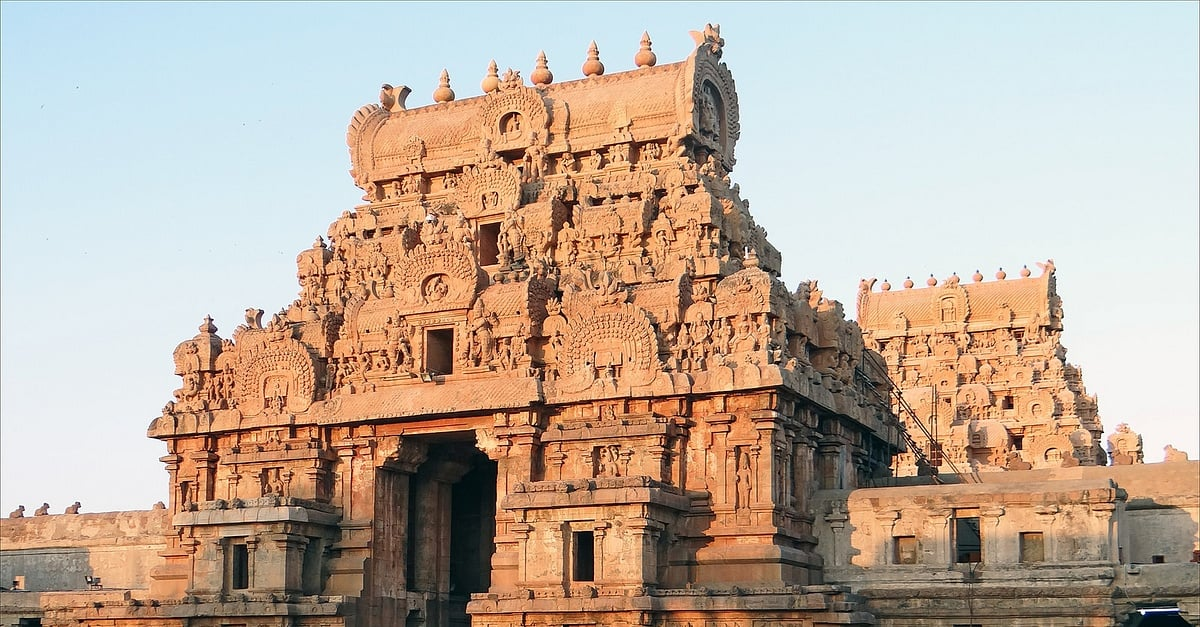
The Cholas were incredible builders. They continued and developed the art tradition of the Pallavas and Pandyas, whom they succeeded in building long-lasting stone temples and exquisite bronze sculptures. Under the Cholas, temple architecture, particularly the Dravida or south Indian style of temple building, reached its pinnacle of glory. During the Cholas’ nearly four-century rule, the entire Tamil country was studded with temples, and Chola art traditions were adopted and followed in Sri Lanka and other parts of South India.

Monumental Gateway, Brihadishvara Temple, Thanjavur
(CC by Jean-Pierre Dalbera)

Chola Architecture’s main characteristics included:

  • The gopuram or the gateway.
  • The garbhagriha or the main shrine.
  • The mandapa or the audience hall.
  • The vimanas or the towers above the main shrine.
  • The spacious courtyards.
The Chola temples were notable for their massive towers, known as vimanas. The vimana or tower in the Brihadeswara or Rajarajesvara temple, built by Rajaraja I and dedicated to Lord Shiva, is approximately 57 metres high and consists of thirteen successive storeys. It is crowned by a single block of granite that stands 7.5 metres tall and weighs approximately 80 tonnes. Similarly, Rajendra I built a magnificent temple in his new capital. Cholapuram, Gangaikonda. Other temples built during this time period include Rajaraja Chola II’s Airavateswara Temple at Darasuram near Thanjavur and Kulothunga Chola III’s Kampaharesvara Temple at Tribhuvanam near Kumbakonam.During this time, the Chola temples were the hub of social activity. The temple received numerous generous donations. These temples also created a lot of job opportunities by hiring people to help with the day-to-day operations of these places. The temple authorities also pursued many welfare activities, such as temples serving as schools.

Nataraja Temple

Source – freepik.com


The Cholas also promoted plastic art; the metal and stone images cast during the period are exquisitely executed and exude vigour, dignity, and grace. The famous Nataraja or Dancing Shiva image at Chidambaram’s great temple is a masterpiece of Chola sculpture. Many of these images were also cast in bronze. The Chola period’s “cultural epitome” has been described as this Nataraja.

The Cholas were also fans of painting. Of all the Chola paintings, the most important are those in the pradakshina passage of the Rajarajesvara Temple. Chola wall paintings, also known as frescoes, can be found on the walls of the Vijayalaya Cholesvara Temple. Large painted figures of Mahakala, Devi, and Shiva adorn it. Scenes depicting Lord Shiva in his abode of Kailash as Nataraja and tripurantaka are painted on the walls of the Rajarajesvara Temple in large and forceful compositions.

ICMR2023 Conference

International Conference on Multidisciplinary Research (ICMR) 2023 – ICMR 2023 aims to improve its ability to bring together worldwide researchers and professionals, encourage intellectual development of scholars and provide network opportunities for conference attendees for making long lasting academic cooperation. To reach its goal, ICMR2023 benefits from its advisory board members consist of well-known academicians all around world and provide publication opportunities.


Any scholar or professional interested in engineering, science and education around the world is welcome to attend ICMR2023 conferences, which are held couple of times a year.

List of Topics

  • Engineering Topics 
  • Industrial Engineering
  • Textile Engineering
  • Civil and Architecture Engineering
  • Mining Engineering
  • Mechanical Engineering
  • Renewable Energy
  • Chemical Engineering
  • Electrical-Electronics Engineering
  • Metallurgical and Materials Engineering
  • Environmental Engineering
  • Computer and Informatics Engineering
  • Food Engineering
  • Geological Engineering
  • Science Topics 
  • Social Sciences
  • Theology
  • International Relations
  • Communucation Studies
  • Political Science and Public Administration
  • Linguistics
  • Medical Sciences
  • Applied Sciences
  • Law
  • Agriculture
  • Education Topics 
  • Vocational and Technical Education
  • Early Childhood Education
  • Science Education
  • E-learning
  • Secondary Science Education
  • Elementary Education
  • Primary Education
  • Professional Development & Teacher Training
  • Foreign Language Training
  • Educational Sciences
  • Mathematics Education

Venue

The conference will be held in Zoom meeting

Contact

All questions about submissions should be emailed to icmr2023@edupub.org or editor@edupub.org

Important Things to Note

Important Dates

Date for Submission of Papers

20 March 2023 (without Late fee)

30 March 2023 (with late fee)

Acceptance Mail for Papers

10 April 2023

Date of Online Conference

20-22 April 2023

Email id for Submission of Papers

Email: icmr2023@edupub.org

Special Issue for Conference Papers

Visit conference Official Site at https://icmr.edupub.org/

ISBN for Conference Proceedings 

ICMR 2023

International Conference on Multidisciplinary Research (ICMR) 2023 is one of the substantial and most reputable international events of Business, Economics, Social Sciences and natural sciences. Appealing outstanding researchers from over 100 countries worldwide, the conference exhibits a friendly, supportive environment to accept feedback, exchange ideas and find inspiration. The main aim is to provide a forum for people coming for different academic backgrounds to interact and present their researches. Moreover, the conference generates the possibility for publications of research papers in indexed and organized journals. International Conference on Emerging Trends in Multidisciplinary Research (ICMR-2023) will provide a platform for debating on issues and challenges in the aforementioned fields. The objective is to back discussions on strategies that will accelerate worldwide growth and economic recovery as well as evolution in technology and scientific research.  

EDUPUB® is an india based international consulting firm serving the world’s leading businesses, governments, public and private universities of world and not for profit organizations in every field of life. Its mandates is to develop stakeholders in diverse fields ranging from the basic necessities like sustainable health conditions, reduction in the poverty and the basic human rights to the more complicated and glittering demand of time like science and technology, entrepreneurship and telecommunication by focusing on the findings of extensive research conducted by researchers all around the world.

Conference Tracks

Academics from various fields, with an interest in the above themes, are welcome to present their papers. The conference has a multidisciplinary emphasis and, therefore, inviting contributions from across disciplines, e.g.

  •        Social Sciences,
  •        Development and Sustainable Development Studies,
  •        Education,
  •        Science and Technology,
  •        Business and Economics,
  •        Management,
  •        Philosophy,
  •        Psychology,
  •        Sociology,
  •        Political Science
  •        Others.


Send papers to editor@edupub.org

Publication

IJR – International Journal of Research with ISSN 2348-6848 and book with conference proceedings 

Important Things to Note

Important Things to Note

Important Dates

Date for Submission of Papers

20 March 2023 (without Late fee)

30 March 2023 (with late fee)

Acceptance Mail for Papers

10 April 2023

Date of Online Conference

20-22 April 2023

Email id for Submission of Papers

Email: icmr2023@edupub.org

Special Issue for Conference Papers

Visit conference Official Site at https://icmr.edupub.org/

ISBN for Conference Proceedings