Frequency of extreme rainfall is likely to increase over the Western Ghats and Northeast river basins, while an increase in heavy rainfall intensity is projected over the Upper Ganga and Indus basins. The study explored the new possible hotspot regions for future urban flooding due to increasing heavy rainfall patterns over different Indian River Basins.
In the past few decades, the increased frequency of hydroclimate extreme events over the Indian River basins (IRBs) due to global warming has led to a significant rise in flood-related disasters, mortality rates, and economic losses, ultimately affecting the gross domestic product. In this context, it becomes exceedingly essential to examine the future hydroclimate extremes and identify hotspot regions over the Indian River Basins (IRBs) that are most susceptible to hydroclimate extremes. This can enable the prioritization of urgent policy interventions, mitigation and adaptation strategies.
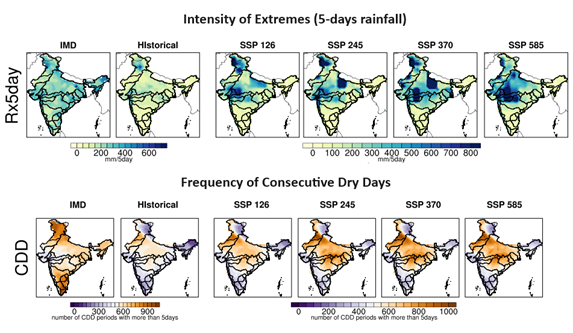
A research led by Prof. R. K. Mall, Cordinator of the Department of Science & Technology-Mahamana Centre of Excellence in Climate Change Research (DST-MCECCR) at Banaras Hindu University (BHU), including Ph.D. scholar Pawan Kumar Chaubey, used high-resolution simulated precipitation from Coupled Model Intercomparison Project-6 (CMIP6) experiments to examine the future hydroclimate extremes over the different River Basins of India. The work supported under the Climate Change Program of the Department of Science & Technology (DST), projected intense precipitation specially over the Western Ghats and Northeast river basins, and an increase in heavy rainfall intensity (14.3%) over the upper Ganga and Indus basins as well as intensification of severe droughts.
The study highlighting an agricultural drought in the lower Ganga basin due to a decline in mean rainfall was published in the renowned journal Earth’s Future, American Geophysical Union (AGU). Iturged policymakers to devise strategies to cope with water surplus or scarcity.
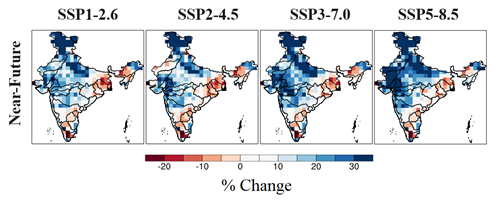
The research elaborated that approximately 4% to 10% of the heavy rainfall is projected to increase over the western part of Indian River basins. In the mid-future, under certain carbon emission scenarios, a significant increasing change of about 30% precipitation per day was likely over the West flowing River Kutch & Saurashtra, including Luni, Indus, and Upper Ganga River Basins.
The results also showed that the significant changes in the frequency of hydro-climate extreme events may have a considerable impact on agriculture, health, and other socio-economic conditions of the society. The major hotspots of highly populated cities identified for future urban flooding could help policymakers design appropriate basin-wise climate adaptation and mitigation strategies, including water and emergency services policies to minimize risk due to extremes in the basins.
Fig. 1 Increasing and decreasing trend of annual mean precipitation change (%) from low to high emission scenarios for Near-future (2021–2040) relative to 1995–2014.
Fig. 2 Spatial changes in observed and projected intensity of extreme precipitation events (5-day rainfall) and frequency of extreme events (dry days).
Department of Empowerment of Persons with Disabilities organized Special Campaign 3.0 to reduce pendency and effective management of space with special attention on field/outstation offices in addition to the Department’s attached/ subordinate offices.
As part of the Campaign, the Department had adopted various initiatives to create better/appealing workplace, not only in the Department but also in National Institutes and some Public Places for betterment of the people. Some initiatives, taken by the Department and its attached/subordinate officers, are as under:-
Special Campaign 3.0
Shramdaan Activities at the Tikamgarh Railway Station, and District Disability Rehabilitation Centre, Tikamgarh, Madhya Pradesh by Dr. Virendra Kumar, Hon’ble Minister of Social Justice and Empowerment and other officers/officials and volunteers Special Campaign 3.0
Shramdaan Activities by cleaning the nearby Hospital and Tilak Bridge Railway Station in New Delhi by the officers/ officials of PDUNIPPD:
Nukkad activities during Special Campaign 3.0 by NIEPMD for creating awareness:
Swachhta Campaign by CRC at A&N:
As part of the observance of Special Campaign 3.0, NIEPMD organized Human Chain formation for awareness:
NITI Aayog organised a workshop on India-AU Collaboration for a Better inclusive World in partnership with the Observer Research Foundation (ORF) at the Taj Palace, New Delhi today. The workshop focused on deliberations to implement the commitments laid out in the New Delhi Leaders’ Declaration (NDLD) which was signed recently concluded G20 Conference.
Dr. V K Saraswat, Member, NITI Aayog, analysed the various aspects of India-AU cooperation and said that India and the AU have a lot to offer each other in terms of knowledge, skills, and resources. He urged the participants to come up with concrete proposals for cooperation in the three key areas of inclusive growth, sustainable infrastructure, and migration management.
Prof. Ramesh Chand, Member, NITI Aayog, spoke about the importance of agricultural growth and potential mutual learning between the two regions. He said that India and the AU can learn from each other’s experiences in agriculture and agribusiness. He also highlighted the need for cooperation in areas such as agricultural research, technology transfer, and market access.
Shri Dammo Ravi, Secretary, Ministry of External Affairs (MEA) highlighted the importance of India-AU cooperation in areas such as trade, investment, and development. Addressing the participants, Shri Sudhendu J. Sinha, Advisor, NITI Aayog emphasized the importance of India and the African Union (AU) to work together to achieve the goals of the NDLD.
The workshop brought together over 50 experts and participants from prominent National and International think tanks, academia, and diplomats from India and the African Union (AU). The participants had in-depth discussions on three key themes:
Indo-AU collaboration for an inclusive world: The participants discussed methodologies to promote inclusive growth and development, reduce poverty and inequality, and ensure that all people have access to basic necessities such as food, water, healthcare, and education.
Indo-AU collaboration for sustainable and resilient infrastructure: The participants discussed cooperation to develop sustainable and resilient infrastructure, including in the areas of energy, transportation, and water management. They also discussed how to support economic growth and development and make the world more resilient to climate change and other shocks.
Managing Migration: The role of Indo-AU Partnership: The participants deliberated on managing migration in a safe, orderly, and humane manner. They also discussed the root causes of migration, providing support to migrants and refugees, and combating trafficking in persons.
The workshop received immense interest from the participants who gave valuable inputs. NITI Aayog will endeavour to use these inputs to develop an Action Plan that would facilitate in the implementation of the commitments laid out in the NDLD.
The Prime Minister, Shri Narendra Modi interacted with and addressed India’s Asian Para Games contingent at Major Dhyan Chand National Stadium, in New Delhi today. The programme is an endeavor by the Prime Minister to congratulate the athletes for their outstanding achievement at the Asian Para Games 2022 and to motivate them for future competitions.
Addressing the para-athletes, the Prime Minister said that he always looks forward to meeting them and sharing their experiences. “You bring along new hopes and renewed enthusiasm whenever you come here”, the Prime Minister said. He emphasized that he is here only for one thing and that is to congratulate the para-athletes on their successes. He underlined that he was not only following the developments at the Para Asian Games very closely but also living through it. He lauded their contributions and also congratulated their coaches and their families. Shri Modi expressed gratitude on behalf of 140 crore citizens of the country.
Underling the extremely competitive nature of sports, the Prime Minister also dwelled on the internal competition of the athletes within themselves as they compete with each other. He acknowledged the highest level of practice and dedication of the athletes. “All of you present here, some came back winners, some wiser but none came back defeated”, the Prime Minister said. “There is no losing in sports, only winning or learning”, the Prime Minister underlined as he highlighted the learning process involved in sports. He also noted the selection from 140 crore citizens as a huge achievement for the para-athletes. “Your success inspires the entire nation and also instills a feeling of pride among the citizens”, Shri Modi said, noting the record-breaking success in terms of the total medal count of 111.
The Prime Minister related with the athletes for their record-breaking performance and recalled the feeling when he was congratulated by Shri Atal Bihari Vajpayee for record electoral performance in Lok Sabha from Gujarat. “These 111 medals are not just numbers but 140 crore dreams”, he added. He informed that the number is three times the number of medals won in 2014 while the number of gold medals is ten times more and India moved from 15th place in medal tally to top 5.
The Prime Minister highlighted India’s recent achievements in the field of sports during the past few months and said, “Your success at the Para Asian Games is the icing on the cake”. He mentioned the Gold Medal at the World Athletics Championship in Budapest in August, the Badminton Men’s Team’s first gold medal at the Asian Games, first medal by Women’s Pair in Table Tennis, Thomas Cup victory by Men’s Badminton Team, record 107 medals including 28 gold medals at Asian Games, and the most successful medal tally at the Asian Para Games.
Recognizing the special nature of Para Games, the Prime Minister said that a sports victory by a divyang is not a matter of inspiration in sports only but it is a matter of inspiration in life itself. “Your performance can re-energise any person howsoever deep in the grip of despondency”, PM Modi said. The Prime Minister highlighted the progress of India as a sporting society and its sporting culture. “We are trying to organize the 2030 Youth Olympics and the 2036 Olympics”, he said.
The Prime Minister said that there are no shortcuts in sports and said that players rely on their own capabilities but a little help has a multiplier effect. He stressed the need for collective support of families, society, institutions and other supporting ecosystems. He mentioned changing the outlook towards sports in the families.
“Society has started recognizing sports as a profession, unlike earlier times”, the Prime Minister remarked. He highlighted the transformation in approach by the present government from ‘athletes for the government’ to ‘government for the athletes’ and credited the sensitivity of the government towards the success of athletes. “When the government recognizes the dreams and struggles of the athletes, its impact can be witnessed in its policies, approach and thinking”, PM Modi emphasized. He lamented the lack of policies, infrastructure, coaching facilities and monetary assistance for the athletes by the previous governments and said that it had become a huge hurdle in attaining success. In the past 9 years, the Prime Minister said that the nation has grown out of the old system and approach. He mentioned that 4-5 crores are being spent on various athletes today. “Government’s approach today is athlete-centric”, the Prime Minister said as he underlined that it is removing obstacles and creating new opportunities for them. “Potential plus Platform is equal to Performance. Performance gets a boost when potential finds the needed platform”, he remarked and mentioned the Khelo India Scheme which catapulted the athletes to success by identifying them on the grassroots levels and nurturing their talent. He also mentioned the TOPS Initiative and a Disability Sports Training Center.
The Prime Minister said that the athletes’ resilience in the face of difficulties is their greatest contribution to the nation. He said that you have overcome insurmountable obstacles. This inspiration is recognized everywhere, the Prime Minister mentioned the praise for para-athletes on social media platforms. Every section of society is drawing inspiration from the para-athletes. “Your participation in every tournament is the victory of human dreams. This is your biggest legacy. And that is why I am confident that you will work hard like this and keep making the country proud. Our government is with you, the country is with you”, the Prime Minister said.
The Prime Minister concluded by reiterating the power of resolve. He said that as a nation we don’t stop at any milestone and rest on our laurels. “We have reached among the top 5 economies, I emphatically say that we will be among the top 3 economies within this decade and in 2047 this nation will become Viksit Bharat”, he said.
Union Minister for Youth and Sports Affairs, Shri Anurag Singh Thakur, President of Paralympics Committee of India, Smt. Deepa Malik, Union Minister for Tribal Affairs, Shri Arjun Munda and Union Minister of State for Youth Affairs & Sports, Shri Nisith Pramanik were present on the occasion.
Background
India won a total of 111 medals including 29 gold medals in the Asian Para Games 2022. The total medal tally at the Asian Para Games 2022 witnessed a 54% increase over the previous best performance (in 2018), and the 29 gold medals won were almost twice as won in 2018.
The programme was attended by the athletes, their coaches, officials from the Paralympic Committee of India & Indian Olympic Association, representatives from National Sports Federations, and officials from the Ministry of Youth Affairs and Sports.
REPL Global, is an Indian planning firm that specializes in various aspects of urban and infrastructure planning and development. It is a well-established organization that has been involved in numerous projects aimed at enhancing urban environments, real estate development, and smart city initiatives across India. Some key aspects of REPL Global’s activities include:
Urban and Regional Planning: REPL Global engages in comprehensive urban and regional planning, helping cities and regions design and develop sustainable infrastructure, transportation networks, and land use plans. They focus on creating well-designed urban environments that promote economic growth, environmental sustainability, and quality of life for residents.
Smart City Initiatives: The firm is involved in India’s Smart Cities Mission, which aims to transform selected cities into technologically advanced, sustainable, and citizen-centric urban areas. REPL Global plays a role in planning and implementing smart city projects, which may include IoT-based infrastructure, digital services, and innovative urban solutions.
Real Estate Development: REPL Global is also active in real estate development, encompassing residential, commercial, and mixed-use projects. They contribute to the design and execution of real estate ventures, often with a focus on sustainable and environmentally friendly development.
Infrastructure Development: The firm takes on infrastructure projects that involve the construction and maintenance of critical transportation, utility, and public facilities. These projects aim to improve connectivity and accessibility in urban areas.
Consultancy Services: REPL Global provides consulting services in the fields of architecture, engineering, project management, and more. They work with public and private sector clients to bring projects from concept to completion.




 Eduindex