A meeting was held for the launch of the report titled “Synchronizing energy transitions towards possible Net-Zero for India: Affordable and clean energy for All” prepared by IIM Ahmedabad as part of a study project which was sanctioned in November 2021 by the Office of the Principal Scientific Adviser to the Government of India with part-funding (one-third) from Nuclear Power Corporation of India Ltd (NPCIL). The launch was held in Committee Room ‘A’, Vigyan Bhawan Annexe, New Delhi on 3rd April, 2024 at 2pm.
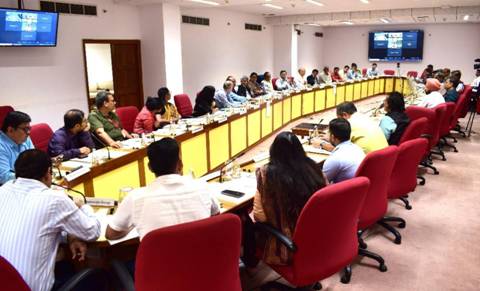
[Meeting for the launch of the report on energy transitions to achieve India’s net-zero targets]
The report was launched by Prof. Ajay Kumar Sood, Principal Scientific Adviser (PSA) to the Government of India in presence of dignitaries Dr. V. K. Saraswat, Member, NITI Aayog; Dr. A. K. Mohanty, Secretary, Department of Atomic Energy (DAE) and Chairman, Atomic Energy Commission (AEC); Shri P. A. Suresh Babu, Distinguished Scientist and Director (HR), NPCIL who joined on behalf of CMD, NPCIL; Dr. (Mrs.) Parvinder Maini, Scientific Secretary, Office of PSA. Dr. Anil Kakodkar, Chancellor, Homi Bhabha National Institute (HBNI) and former Chairman, AEC was the Guest of Honour and he had joined the meeting online.
A need was felt to undertake an analytical study on the energy transition required towards a net-zero energy basket for India. Accordingly, the study was sanctioned with the objective of conducting a comprehensive study with rigorous methods for minimizing the cost of power at consumer end and to work out an optimum mix for all sources of power, aiming for net-zero emission.
The project team at IIM Ahmedabad led by Prof. Amit Garg, Public Systems Group, has successfully completed the study, under the guidance of an expert group constituted by the Office of PSA, having experts from diverse sectors of power generation including coal, nuclear, solar, wind, biofuels, etc. The expert committee is chaired by Dr. R. B. Grover, Emeritus Professor, HBNI and Member, AEC, and the other members are Dr. K. Balaraman, former Director General, National Institute of Wind Energy; Dr. Bharat Bhargava, Former Director General, ONGC Energy Centre; Shri S. C. Chetal, Former Director, Indira Gandhi Centre for Atomic Research and Ex-Mission Director, AUSC (Advanced Ultra Super Critical) Mission; Dr. Rajeev Sukumaran, Senior Principal Scientist and Head, Biofuels and Biorefineries Section, National Institute for Interdisciplinary Science and Technology; Shri B. V. S. Sekhar, Associate Director (CP&CC), NPCIL and Ms. Remya Haridasan, Scientist ‘D’, Office of PSA. After rigorous review by the expert group, the report was independently reviewed by Tata Consulting Engineers Limited which was a further value-addition and the final document was launched at the meeting.
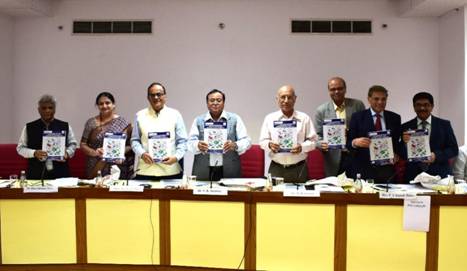
[Launch of the report on energy transitions required to achieve India’s net-zero targets by Dr. A. K. Mohanty, Secretary, DAE and Chairman, AEC; Dr. (Mrs.) Parvinder Maini, Scientific Secretary, Office of PSA; Prof. Ajay Kumar Sood, PSA to the Government of India; Dr. V. K. Saraswat, Member, NITI Aayog;Dr. R. B. Grover, Emeritus Professor, HBNI and Member, AEC; Prof. Amit Garg, Public Systems Group, IIMA(Principal Investigator of the project); Prof. Tirthankar Nag, Professor and Dean (Research), Strategy, Innovation and Entrepreneurship, International Management Institute, Kolkata (co-Investigator of the Project) and Shri P. A. Suresh Babu, Distinguished Scientist and Director (HR), NPCIL]
The report attempts to answer key questions related to India’s energy trajectory such as how much energy does India need to achieve high value of Human Development Index (HDI); what are pathways to achieve this; what are the energy mix projections for this until 2070 (our declared net-zero target year); what would be the cost of electricity to the end user; what would be the carbon emissions until 2070; what would be the investments required for energy transitions towards net-zero at 2070; estimation of other challenges and opportunities (RE integration, requirement of critical minerals, Carbon Capture Utilisation and Storage (CCUS), natural gas, ethanol, hydrogen) in energy transitions towards achieving net-zero in 2070.
The main conclusions of the report are given below:
- There is no silver bullet to achieve net-zero. The transition needs multiple pathways to be adopted with co-existence of myriad technologies in our energy basket.
- Coal is projected to continue until the next two decades as the backbone of the Indian energy system.
- Net-zero is not possible without substantial nuclear power and Renewable Energy (RE) generation by 2070.
- To achieve net-zero energy systems by 2070, the electricity sector will need to decarbonize well before that.
- India’s emissions would range between 0.56 btCO2 and 1.0 btCO2 in 2070. It is expected that the remaining gap in emissions will be offset through sequestration in forestry and tree cover as envisaged in our Nationally Determined Contributions (NDCs).
- Additionally, the coal phase-down will require active policies on critical minerals and carbon dioxide removal technologies.
- Clean, affordable electricity at low levelized cost of electricity (for consumers) can be achieved in net-zero pathways, especially with a focus on nuclear power and renewable power.
- Widespread electrification of end-use sectors i.e upto 47-52% electricity share in Total Final Electricity Consumption (TFEC) compared to 18% at present.
- Financial requirements during 2020-2070 would be to the tune of Rs 150-200 lakh Crore (about US$ 2-2.5 trillion, or US$ 40-50 billion/year). Considerable financial flows must be international.
Prof. Ajay Sood, PSA to Government of India, in his opening remarks, stated that the report is a comprehensive study, bringing together aspects from all sectors of power generation in one place, providing a holistic view of the Indian energy sector and throwing light on the potential pathways for a development-led transition to net-zero. He added that these pathways also need large resources to be put in place, hence, we need to synergise our efforts in various sectors. He stated that this report is a good beginning and more such studies are needed.
Dr. Anil Kakodkar, former Chairman, AEC welcomed the study as the need of the hour which is an energy transitions study done from India’s perspective. He also highlighted the need for the development of technologies for low-cost hydrogen production.
Dr. V. K. Saraswat, Member, NITI Aayog expressed his satisfaction in the findings of the study which were in alignment with the simulation studies done by NITI Aayog. He appreciated that the study is based on a development-led approach which is the right approach to clean energy transition. He also acknowledged that such a transition is also going to be expensive, as highlighted in the report. He agreed with the premise that more RE penetration is needed with baseload energy source as nuclear. He emphasised that without nuclear energy, the storage requirements for RE will be very high to tackle the intermittency of its supply. This will, in turn, enhance the dependence on critical minerals which is not sustainable. He further added that for the nuclear sector, a transition is needed from large reactors to Small Modular Reactors (SMRs), with participation of industry. There is also a need to promote alternate nuclear fuel options such as Thorium to reduce dependence on Uranium import.
Dr. A. K. Mohanty, Secretary, DAE and Chairman, AEC, gave an overview of the on-going nuclear programme in the country and the plans for increasing the nuclear installed capacity by 100GW by 2047. He also appreciated the report and stated that is a vital input for further policy formulations.
Prof. Ajay Sood concluded by saying that he firmly believes that this report will be taken seriously by all the relevant stakeholder ministries, departments and industries and will be helpful in the planning stages of our endeavours in clean energy.
Access the report here: https://psa.gov.in/CMS/web/sites/default/files/publication/ESN%20Report-2024_New-21032024.pdf
****