Toruń – The Polish town stuck in the medieval ages

 Meet Toruń, the Polish town coined by UNESCO to be a remarkably well preserved example of a medieval European trading and administrative centre. Situated on the banks of Vistula River, Toruń was founded when Christianity was being spread through Eastern Europe by the military monks of the Teutonic order and expanding trade between the countries of the Baltic Sea and Eastern Europe was being driven forward by the Hanseatic League (The Hanseatic League was a commercial and defensive confederation of merchant guilds and market towns in Northwestern and Central Europe in the 1100s). The town went on to become a leading member of the Hanseatic League in the territories ruled by the Teutonic Order.
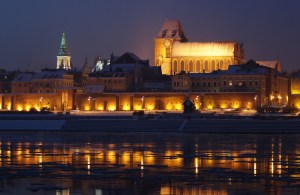
An image of the city of Toruń on the banks of Vistula River
Toruń by the Vistula River

The town can be divided into three parts – The Teutonic Castle, the Old Town and the New Town. The combination of the castle with the two towns, surrounded by a circuit of defensive walls, represents a rare form of medieval settlement agglomeration.

The Toruń Castle

The castle was one of the pioneering ones built by the Teutonic order in the land succeeded to them by the Duke Conrad of Mazovia. The castle took a hundred years to build, since it’s conception in the 13th century. The palace’s historic value comes from the fact that it was the base for the Teutonic Knights when they began their first mission to colonize pagan Old Prussians, and subsequently the formation of the Teutonic state. The majority of the castle – which was built in a horseshoe-shaped plan in the mid-13th century as a base for the conquest and evangelization of Prussia was destroyed during an uprising in 1454, when the local townspeople revolted against the Teutonic Order. The city rebelled on 4 February, and a few days later the small Teutonic garrison negotiated a surrender. They were allowed to leave the castle and the city. Shortly afterward, on 8 February, the castle was plundered, and then the Toruń city council decided that it would be demolished to prevent the Teutonic Knights from reoccupying it. This event marked the beginning of the Thirteen Years’ War.

The ruins and the archaeological remains have been excavated and safeguarded.
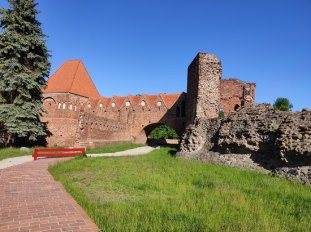
A picture of the exterior of the Toruń castle
The Medieval Toruń castle


The Old Town and New Town

The Old Town was granted an urban charter in 1233, which swiftly led to its expansion as a major commercial trading centre. The adjacent New Town developed from 1264, mainly as a centre for crafts and handiwork. Both urban areas bear witness to the interchange and creative adaptation of artistic experience that took place among the Hanseatic towns.

An exceptionally complete picture of the medieval way of life is illustrated in the original street patterns and early buildings of Toruń. Both the Old Town and the New Town have Gothic parish churches and numerous fine medieval brick townhouses, many of which have retained their original Gothic facades, partition walls, stucco-decorated ceilings, vaulted cellars, and painted decoration. Many townhouses in Toruń were used for both residential and commercial purposes. A fine example is the house in which Nicolas Copernicus was reputedly born in 1473.

Medieval nature of the town

All the elements that sustain the Outstanding Universal Value of the Medieval Town of Toruń are located within the boundaries of the property. The property’s medieval urban layout encircled by a ring of defenses remains intact, including two market squares, Town Hall, townhouses, churches, and the Teutonic Castle. This layout and Toruń’s compact, cohesive architectural fabric are substantially of medieval origin. The historic panoramas of the town are unaltered, shaped by the monumental silhouettes of the Gothic churches and Town Hall that dominate the skyline, rising above multiple varieties of townhouses with diverse facades and various geometries of ceramic-tiled roofs. The administrative, commercial, and tourist functions of contemporary Toruń (concentrated within the Old Town) do not pose a threat to the property, which does not suffer from adverse effects of development and/or neglect.

The Medieval Town of Toruń is remarkably authentic in terms of its location and setting, forms and designs, and materials and substances. It is an original, unchanged example of medieval town planning based on a regular grid of quarters, streets, and building blocks, designed in keeping with 13th-century regulations and extant in a recognizable form. The authenticity of the Teutonic Castle, built in a horseshoe-shaped plan surrounded by a curtain wall and moats, is attested by conservation records, its structure, the functions of its rooms, and its historic fabric, even though the castle survives only in the form of ruins. Its location between two medieval towns, set on the high bank of the Vistula River, is entirely authentic. The material substance of the buildings is likewise authentic: the Gothic origins of the city walls, gates, towers, churches, walls defining building plots, and townhouses are evidenced by their structures, cellars, interior walls, elevations, architectural details, and interior decor.

The authenticity of the urban planning concept linking Toruń with Hanseatic Europe, and of the surviving architectural structures, provide evidence of the continuity of traditional construction techniques and technologies incorporating templates, forms, and colour schemes widely used throughout the city and region.

Oh, and did I mention, Toruń is a UNESCO World Heritage site, making it a must see for all wanderlusters.


Indian Council of Medical Research (ICMR)

 Centre has reconstituted the six Empowered Groups into ten groups to tackle the COVID situation in the country. The decision is aimed at further improving the efforts in catering the current need of COVID management. NITI Aayog Member (Health) Dr VK Paul will head the Emergency Management Plan Group and the ten-member panel on Vaccination.

Health Secretary Rajesh Bhushan will be the convener of the Empowered Group on Emergency Response Capabilities. It will look into the issues related to hospitals, equipment and medicines. A separate Empowered Group has been formed under the chairmanship of Road and Transport Secretary, Giridhar Aramane on oxegen production, import and other related issues.

Indian Council of Medical Research (ICMR) Director General Balram Bhargava has been made the convener of the panel on COVID testing, while NITI Aayog CEO Amitabh Kant will head the group which will take care of work of private sector, NGOs and international organisations.

Economic and Welfare Measures group which has been tasked with emerging issues related to growth and employment, will be headed by Department of Economic Affairs Secretary Ajay Seth.

Home Secretary Ajay Bhalla will be the convenor of 12 member Empowered Group on Pandemic Response and Coordination. An 11 member group headed by Information and Broadcasting Secretary Amit Khare will look after the steps on information, communication and public engagement.

Poornachandra tejaswi


ABOUT TEJASWI

Poorna Chandra Tejaswi was renown Indian author and novelist in kannada with a pen name poochanthe. He is son of jnanapith awardee, a famous kannada poet, Raashtrakavi kuvempu and Hemavati. Tejaswi was born on 8 September 1938 in kuppalli in Shimoga district of Karnataka state. Tejaswi has written poems, short stories, novels and also translated many English works into kannada.

His first story is “Linga Banda” which described about the western Ghats from a small boy`s perspective. The story got best story award by newspaper Prajavaani. He graduated from from Maharaja college Mysore and moved to Mudigere Chikmagalur district in Karnataka. because of his immense interest in nature Tejaswi took up farming. If you read his works you will understand the immense love he had for nature. He makes you roam Mudigere while you are sitting in your room through is works.

Tejaswi is known as a navya sahithi, a writer of navya period. He is also a Bandaya poet, a genre of protest literature. He was a polymath. He did farming, writing, photography, painting and many more things. Tejaswi has won many awards like Rajyotsava award, Pampa award, kannada sahithya academy award, Karnataka state film award for his many of his works. Some of his famous works include karvalo, Chidambara rahasya, Jugari cross, huliyoorina sarahaddu, Bellandoorina narabhakshaka, Sahaja krushi, Missing link, Hejje Moodada haadi, Papillon and many more.

He is married to Rajeshwari Tejaswi. Susmitha Tejaswi and Eshanye Tejaswi are his children. He died of cardiac arrest on 5 April 2007 at his farmhouse Niruttara, Mudigere, Chikmagalur district.

Why Tejaswi is everyone’s favorite?

Yes, Tejaswi is everyone’s favorite and mine too. That’s mainly because of his storytelling technique. You go into the dark thick forest while reading his books. You feel the presence of that human eating tiger when he describes it. You are in the adventure while reading his books. He hooks the reader right from the start. he is honest, hilarious and clever at the same time.

Lets take a book called karvalo. In the book they take an adventure to find a strange flying lizard Draco dussumieri, a flying lizard which is capable of gliding from tree to tree found in western Ghats. at the end when the characters, scientist karvalo, the farmer and his fellowmen try to catch the weird creature, but it escapes through the jungle. But the reader, you will feel the fatigue of the efforts they made, you will be annoyed because they didn’t able to catch it.

Not only his storytelling, the other thing that make you read Tejaswi again and again is the knowledge he hides in his books. His book missing links talks about human evolution. The set of three books headed Vismaya , talks about variety of species and facts about them you wouldn’t know ever existed. He doesn’t only entertain you, but he gives nutritious food to your brain.

Tejaswi always links science and philosophy. The incidents that happen in his stories become guard and guide your life. he grows morals in the reader. He grows love and appreciation for nature. Tejaswi puts you in a sense of responsibility towards nature. He makes you believe in simple living. He will push you to think about problems of agriculturists. He talks about culture and and history. He perfectly reaches out to youth.

Seven Ages of Man: Summary

 In the poem, Seven Ages of Man Shakespeare compares the entire world to a theatrical stage, where all the human beings perform their allotted role given by the God. Every individual has to go through seven acts that are seven stages of man’s life. Shakespeare has divided human life into seven stages, with each stage having its own qualities and characteristics. Shakespeare considers the world a stage and men and women actors on the stage of life. They play seven roles on the stage depending upon their age.

The first stage, in this phase of his life man, appears as a child in the world. As a child, he is a helpless creature. He cries in the arms of his nurse for one reason or the other. He cries and vomits.

The next phase of his life man appears as a child in the world. He goes to school with a bag hanging from his shoulder. He goes to the school creeping like a snail. He marches to the school unwillingly.

In the third stage of his life, a man plays the part of a lover. He grows into a young man full of desires, ambitions, and dreams. He becomes a romantic young man. He falls in love and sights like a furnace. He begins to write sad poems to his beloved he cannot control his sad feelings.

In the fourth stage of his life man becomes a foul-mouthed soldier who has learned queer words at this stage, he tries to give himself a formidable look with a beard like a part. He is emotional and jealous. He quarrels with others for his honor and grace. He hankers after temporary and bubble fame.

In the fifth stage of his life, he becomes a judge. He becomes mature and experienced in his thoughts. The heat of youth has completely cooled down and he becomes very realistic. He wishes to grab wealth by foul or fair means. He begins to accept bribe and thus adds much to his material comforts. He becomes ease-loving and therefore becomes fat. His belly becomes round. He eats healthy fowls and chicken presented to him as a bribe. His eyes become severe and he grows the beard of formal cut.

Then, in the sixth stage of his life, man grows old. He looks quite ridiculous in his movements. He wears glasses because his eyesight is weak. His shoes become wide for his feet. His voice suffers a change. It becomes a shrill and quivering whistle

However, in the final stage, the man turns into a child once again. He seems to forget everything. He becomes ‘toothless’. His eyesight is weakened and he is deprived of taste. He is ready to leave this world.

Shakespeare has the seven stages of man’s life with a touch of satire and cynicism. In each stage, man imagines himself great and important, but there is something ridiculous in his behavior all through his life. Shakespeare has described each of the man’s life stage with great economy of words. He uses living and concrete images to describe the different stages of life. The use of the word ‘mewling’ of the infant’s cry and the school boy’s reluctance for going to school described in phases ‘creeping like a snail’ are examples of living images.

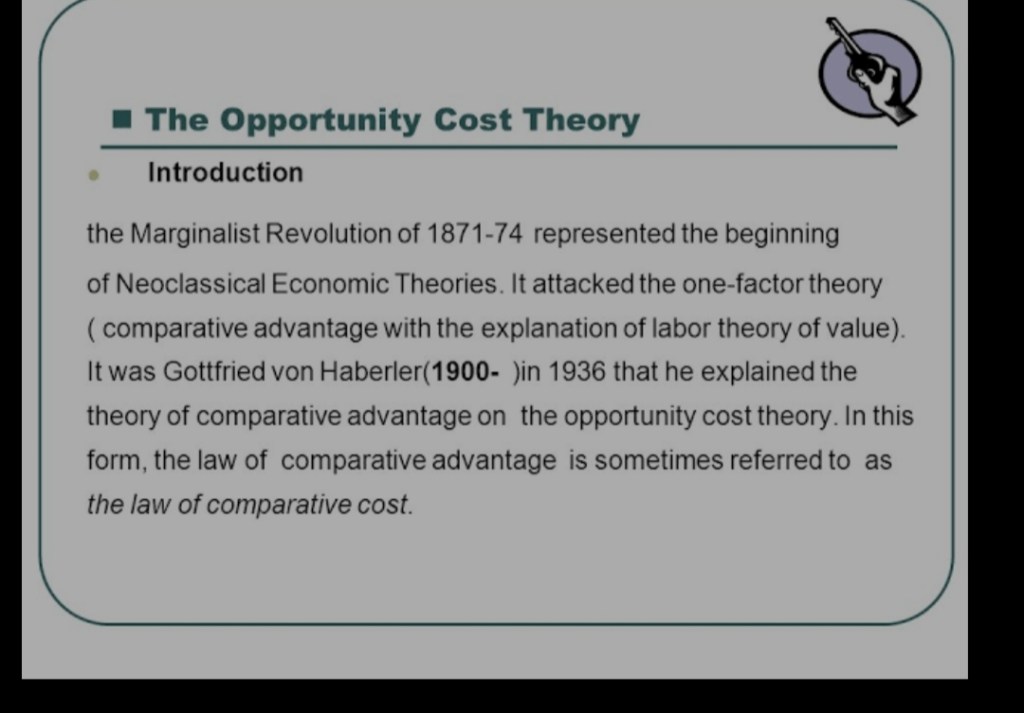
Opportunity Cost Theory ( Assumptions , Explanation , Criticism )


Innumerable theories are formulated by Haberler , Ohlin , Samuelson , Leontief , Hecksher and many others dealing with the macro and micro parts of international trade .

The principle of Comparative Cost theory by Ricardo, despite being the basis of international trade, has been criticized by many economists .
Ricardo’s theory of comparative cost is based on the labour theory of value which means that labour is the only factor of production and labour is homogeneous .
Such assumptions are found to be unrealistic .

Gottfired Haberler ‘ s theory of opportunity cost overcomes these shortcomings and explains the doctrine of the theory in terms of ” the substitution curve’ ‘ or as Samuelson entitled it as ” production possibility curve “or “transformation curve ” .

Lerner called it the ” production indifference curve ” or ” production frontier .”

Haberler’s theory is found to be more realistic .

The Theory of Opportunity cost


Opportunity cost is the value of loss when choosing between two or more commodities.

To elaborate more ,
The opportunity cost theory says that if a country can produce either commodity X or Y , the opportunity cost of commodity X is the amount of the other commodity Y that must be given up in order to get one additional unit of commodity X .

The exchange ratio between the two commodities is expressed in terms of their opportunity costs .
The decrease in the quantity of the second commodity represents the opportunity cost of the additional quantity of the given commodity.

Haberler used the concept of opportunity cost with production possibility curves to illustrate international trade theory.

Assumptions :-

The following assumptions are formulated by Haberler to illustrate the theory :-

• There are only two countries , (A,B)
• Each country possesses two factors of production – labour and capital.
• Each country can produce two commodities , ( X and Y ,)
• There is perfect competition in both the factor and commodity markets .
• The price of each commodity equals its marginal money costs .
• The price of each factor equals its marginal value productivity in each employment .
• The supply of each factor is fixed .
• Factors are immobile between the two countries.
•. There is no change in technology .
• Trade between the two countries is completely free and unrestricted.


Key terms :-

Production possibility curve :-

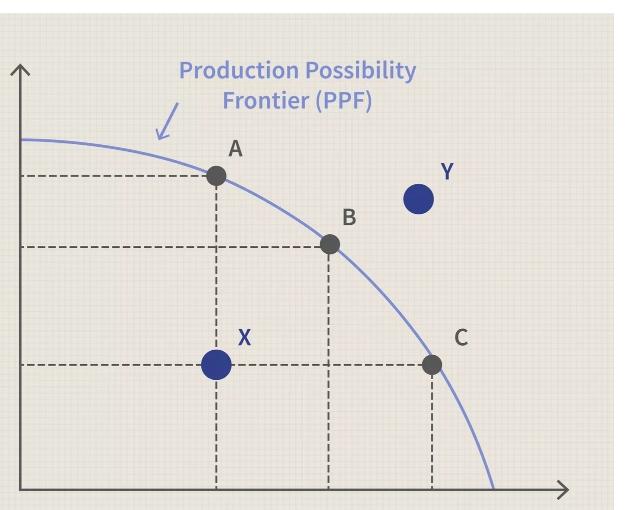
A production possibility curve or transformation curve is the curve that shows various combinations of two goods that can be produced with available amounts of resources .
Production possibility curve shows that if an economy wants to produce more of one commodity ,it will have to transfer or divert resources from the production of another commodity to produce the one .


Different points on the production possibility curve show different combinations of the two goods . Points outside the curve are unattainable because of the scarce quantity of resources available.


Marginal Cost of Production :-
The marginal cost of production measures the change in the total cost of a good that arises from producing one additional unit of that good.


Marginal Rate Of Transformation :-
The marginal rate of transformation is the number of units of one product that can be increased by reducing the quantity of another product. It shows the number of goods that will be foregone to produce an additional unit of other goods while keeping the factors of production constant.


Comparative advantages: – A country can produce one commodity at a lower cost
than the other because of comparative advantages such
as favourable climate, natural resources, geographical
situation and efficiency of labour.


Explanation Of the Opportunity Cost Theory


The production possibility curve indicates such combinations of two commodities .
The shape of the production possibility curve determines the basis and the gain from international trade under the theory of opportunity curve .


The slope of the production possibility curve is determined by the ratio of units of the commodity given up in order to have one unit of the other commodity i.e by Marginal rate of transformation. (MRT)

MRT xy = ∆Y/ ∆X , where ,

X and Y are being produced by a country and some quantities of labour and capital input are used from the production of Y into the production process of commodity X.


Trade can take place only when each nation has a different MRT. The gains from trade for a particular nation depend on how much the
international exchange rates differ from that nation’s MRT. The greater the difference, the
greater is the gains from trade. The gains from trade rest further upon the amount of trade taking place. A larger volume of trade allows larger gains from trade and a greater
increase in the standard of living.


Following the assumptions , two countries say A and B enter into a trade together .


Two commodities X and Y are being produced by using various alternative combinations that a country can produce most efficiently by fully utilising it’s factor of production i.e labour and capital ,are homogeneous , with the available technology in the fixed proportion due to perfect substitutability .

Conditions :-

1:
Trade under Constant Opportunity Cost


The production possibility curve under constant opportunity cost is a straight line .

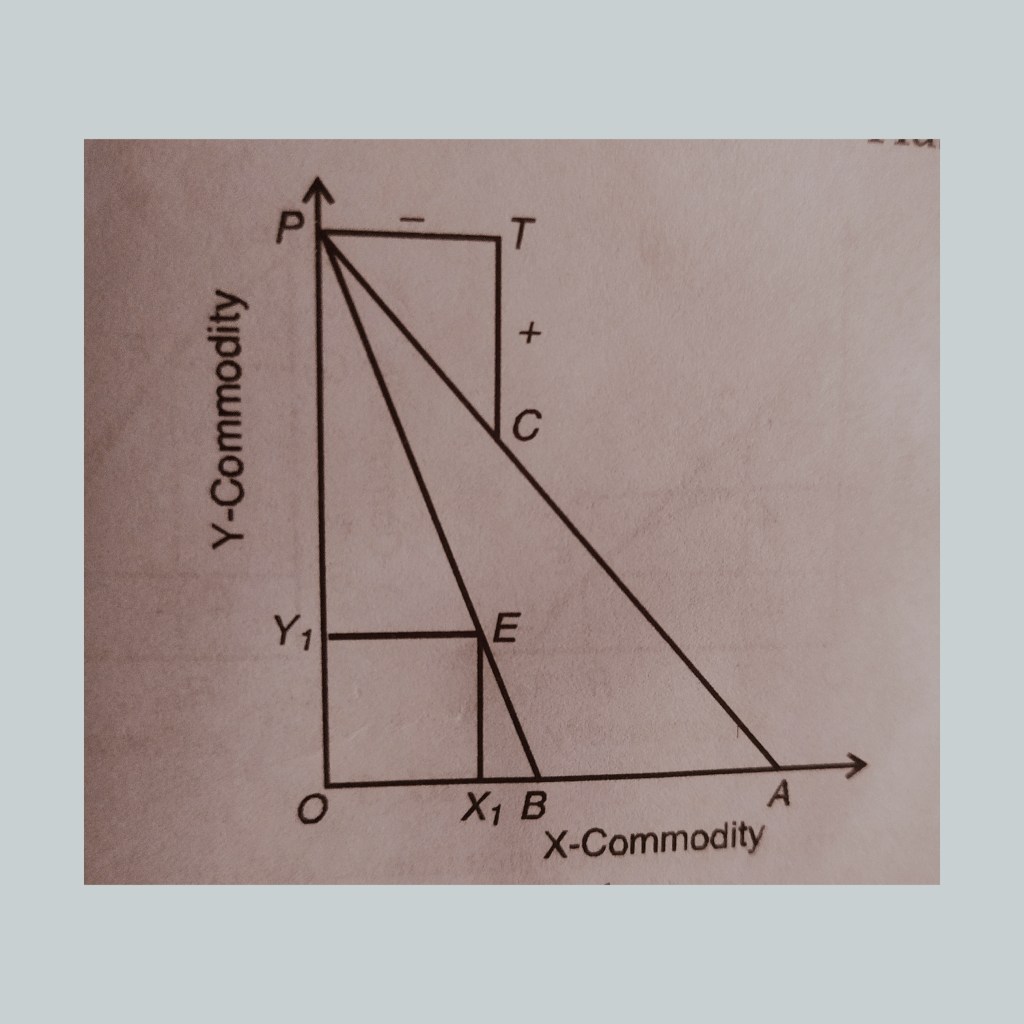
In the figure ,
PA is the production possibility curve of country A ,
PB is the production possibility curve of country B .

Country A can produce either
OP of Y , or
OA of X

Similarly , Country B can produce
OP of Y
OB of X .

The slope of the production possibility curve determines the relative price of the two commodities , since the opportunity cost of leaving a unit of one commodity in order to have an additional unit of another is constant , the cost ratio ( relative price ) is the same on all the points on the production possibility curve.

Since , the MRT is constant i.e the slope of the production possibility curve is also constant, trade between the two countries is not possible as no country stands to gain through the trade .


Trade Under Increasing Opportunity Cost :-


The production possibility curve under the increasing opportunity cost is concave to the origin because when a country specialises in the production of one commodity ,in which it possesses comparative advantage ,its opportunity costs increase .

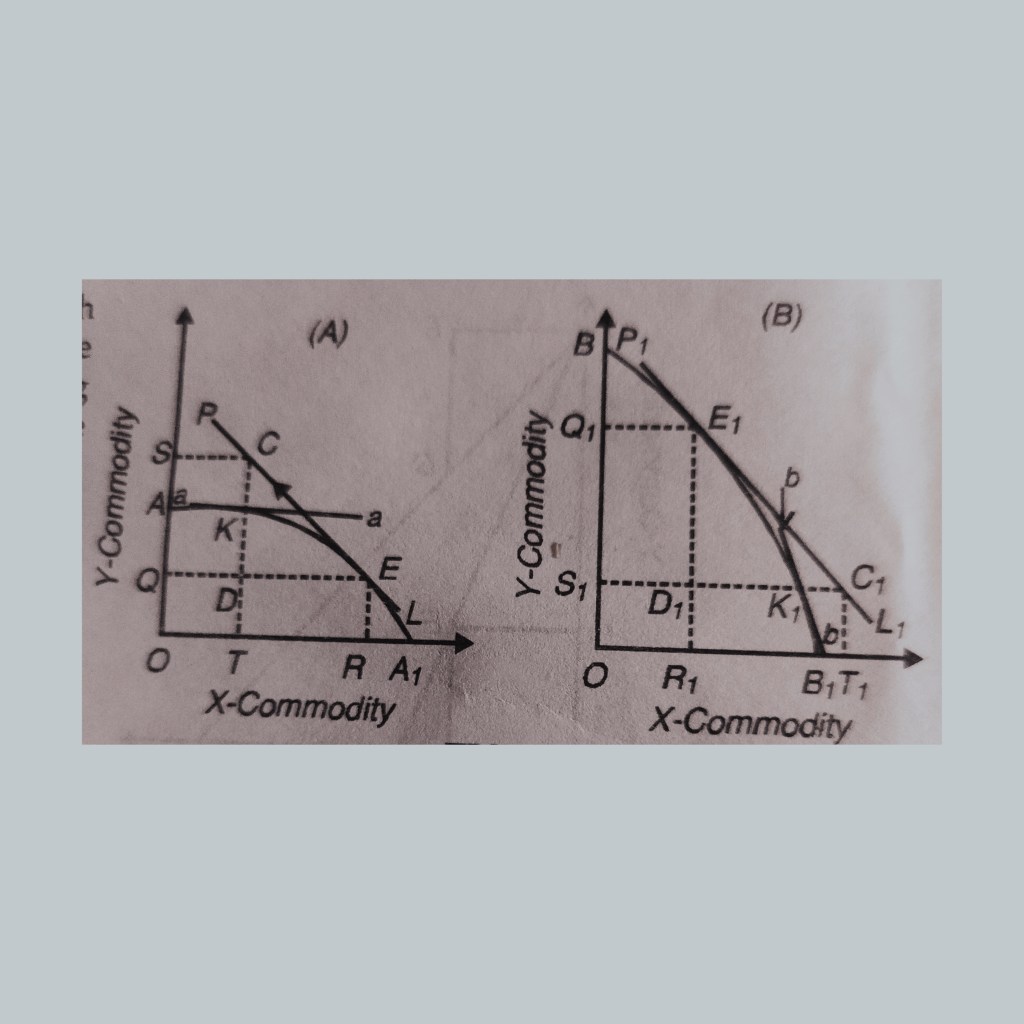
In the above figure ,
AA1 is the production possibility curve of country A which is concave to the origin .
The slope of this curve shows that country A will specialise in the production of commodity X .
The larger amount of commodity Y will be given up to have additional amount of commodity X as we move from point A to A1
Thus ,the country faces increasing opportunity costs .

BB1 is the production possibility curve of a country which is concave to the origin .
The slope of this curve shows that country B will specialise in the production of commodity Y.
The larger amount of commodity Y will be given up to hsv additional amount of commodity Y as we move from B1` to B .
Thus , the country faces increasing opportunity costs.

Let us assume the international price ratio is given by the line PL in country A ,
and PL1 in country B.

The slope of line PL is greater than domestic price line aa ,making commodity X expensive in international market than in domestic market and resulting in the interest of country A to shift some factor of production from the production of commodity Y to commodity X , moving it’s production level from point K to point E.

It will export TR of X and import QS of Y ,
domestically consuming OT of X ,and OQ of Y .
The export and import can be shown by the “trade triangle ” CDE .


The slope of line PL1 is less steep than domestic price line bb ,making commodity Y expensive in international market than in domestic market and resulting in the interest of country B to shift some factor of production from the production of commodity X to commodity Y , moving it’s production level from point K1 to point E1

It will import D1C1 of X and export D1E1 of Y ,
domestically consuming OS1 of Y ,and OR1 of X.
The export and import can be shown by the “trade triangle ” C1E1D1.

Trade Under Constant Decreasing :-


When two countries experience decreasing opportunity costs their production possibility curves are convex to the origin.
Under decreasing opportunity costs , each country completely specialises in the production of only one commodity after trade because there are increasing returns based on internal economies of production .

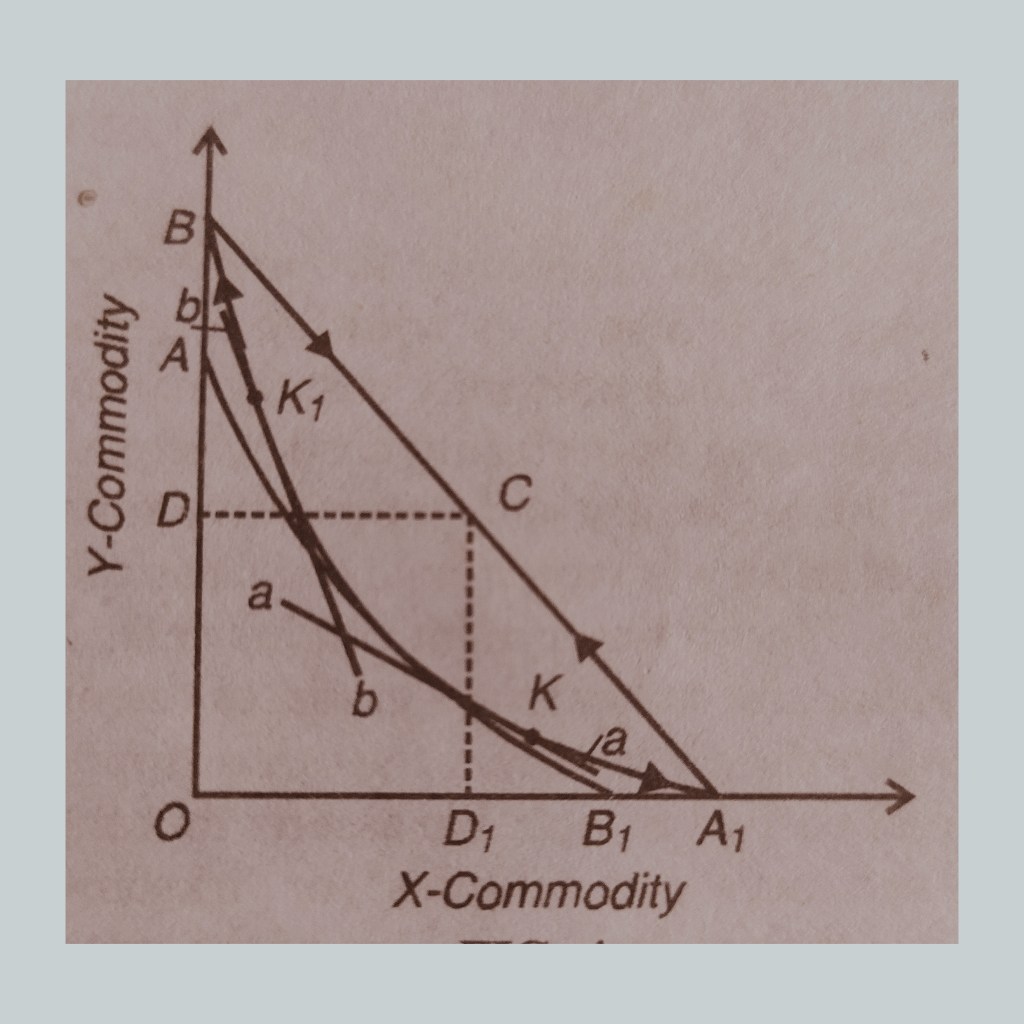
In the figure ,
The production possibility curve of country A is AA 1 and B is BB1.

The pre trade production and consumption point of country A is K where it’s domestic price line aa is tangent to its production possibility curve and country B is K1 , where it’s domestic price line bb is tangent to its production possibility curve.

The international price line being BA1, if both the countries enter the trade ,
BA1 is steeper than the domestic line of country A , making X more expensive in the international market and resulting in shifting of resources of production to X from K to A1 .

On the other hand , the international price line BA1 is flatter than the domestic price line bb of the country making Y commodity expensive in the international market than in the domestic market and resulting in shifting of resources of production to commodity Y and moving from K1 to B .

Thus , country A will completely specialise in commodity X and B in commodity Y .
Now both the countries will move along with the international price line BA1,
Country A from A to point A1 upward , country B from B to point B1 downward and reach point C in consumption.


Note :-

The straight line tangent represents :-

‘A straight line tangent to the transformation curve indicates the ratio of market prices
of the two commodities, and the condition of tangency expresses equilibrium in production, that is, equality between prices and marginal costs stated in opportunity terms. Domestic demand conditions enter into this construction via community indifference curves, or simply
as a consumption point determined by a given arrangement of production and income distribution.”


Finally, tangency of a line representing the equilibrium international price ratio to
both transformation function and community indifference curve indicates equilibrium in
exchange, that is:

(i) Equality domestically between the marginal rate of substitution in consumption and marginal rate of transformation in production, and

(ii) Equality of the value of exports and the value of imports.


Critical Appraisal

As an alternative to classical comparative theory , the opportunity cost theory is more realistic .

The opportunity cost theory analyses pre- trade and post – trade situations under constant , increasing and decreasing opportunity cost whereas comparative advantage theory is based on constant cost of production within a country and comparative advantage and disadvantage between two countries.

Jacob Viber in his ” Studies in The Theory of International Trade ” ( 1937) criticized the opportunity cost theory of values which is the basis of Haberler’s theory .
Some of his criticism were :-

• Neglecting of welfare
• Failure in measuring in terms of strain , sacrifice or disutility.
• Neglecting Change in Factors of Supplies .
• Unrealistic Assumptions .


Despite criticism ,the opportunity cost theory has been regarded as more fertile because it can be readily extended into a general equilibrium system .

Top Restaurants in Pune

Daily writing prompt
What is your favorite restaurant?

Pune, a vibrant city in Maharashtra, India, is renowned for its rich culinary heritage, blending traditional Maharashtrian flavors with diverse culinary influences from across India and the world. Here’s a glimpse into some of the top restaurants in Pune that offer an exquisite dining experience:

Photo by Helena Lopes on Pexels.com
  1. Shreyas: Nestled in the heart of Pune, Shreyas is celebrated for its authentic Maharashtrian thali, showcasing a delightful array of traditional dishes served in a classic ambiance. From delectable sabzis to fragrant rice and mouthwatering desserts, Shreyas offers a culinary journey through the flavors of Maharashtra.
  2. Paasha: Perched atop the JW Marriott Hotel, Paasha offers panoramic views of Pune along with an extensive menu of North Indian cuisine. With its elegant décor and sumptuous dishes, Paasha promises a memorable dining experience, featuring flavorful kebabs, rich curries, and indulgent desserts.
  3. Baan Tao: Located in the Hyatt Pune, Baan Tao invites diners to savor the flavors of Asia in a contemporary setting. Specializing in Thai, Chinese, and Vietnamese cuisine, this restaurant offers an innovative menu crafted with fresh, high-quality ingredients and impeccable presentation.
  4. Malaka Spice: Known for its vibrant ambiance and eclectic menu, Malaka Spice is a beloved destination for lovers of Southeast Asian cuisine. From fragrant Thai curries to tangy Vietnamese salads, Malaka Spice offers a diverse culinary experience that delights the senses.
  5. German Bakery: A Pune institution, the German Bakery is cherished for its cozy atmosphere and delectable baked goods. Whether it’s freshly baked bread, savory quiches, or decadent pastries, this charming café is a favorite among locals and tourists alike.
  6. Café Moshes: Tucked away in Koregaon Park, Café Moshes is renowned for its relaxed vibe and delicious comfort food. From hearty sandwiches to indulgent desserts, this café offers a menu that caters to diverse tastes, making it a popular choice for casual dining.
  7. The Flour Works: With its emphasis on fresh, seasonal ingredients and artisanal bread, The Flour Works has carved a niche for itself in Pune’s culinary scene. Whether it’s a leisurely brunch or an intimate dinner, this charming café offers a menu that celebrates the joys of simple yet flavorful cuisine.
  8. Arthur’s Theme: Inspired by the legendary King Arthur, this restaurant exudes old-world charm and sophistication. Known for its European-inspired menu and extensive wine list, Arthur’s Theme offers an elegant dining experience that transports diners to a bygone era.

These are just a few highlights from Pune’s vibrant culinary landscape, which continues to evolve with new flavors and experiences waiting to be discovered. Whether you’re craving authentic regional cuisine or international flavors, Pune’s top restaurants promise a gastronomic adventure like no other.

Book – Farming at Home

 Welcome to “Farming at Home”. In today’s fast-paced world, where urbanization is on the rise and environmental concerns loom large, reconnecting with nature and integrating it into our living spaces has become more crucial than ever. This book is a comprehensive guide to help you embark on a journey of creating vibrant greenery within the confines of your home, whether it’s a cozy apartment, a suburban house, or a bustling urban rooftop.


The book help to explore the diverse range of topics we’ll explore together. From unraveling the intricate relationships between plants and people to understanding the benefits of indoor plants in purifying the air we breathe, from combatting pollution with green solutions to harnessing the power of sustainable water management and alternative energy sources, this book covers it all.
We delve into practical advice on setting up your own mini gardens, whether it’s a nutritional kitchen garden brimming with fresh herbs and vegetables or a rooftop oasis flourishing with vibrant blooms. We also explore innovative techniques like vertical farming and soil-less food production, revolutionizing the way we think about agriculture and food sustainability.
Moreover, we provide insights into how you can incorporate backyard poultry rearing for a steady supply of protein and explore homemade recipes to nurture your indoor plants and gardens. We even guide you through the process of fixing your own water utilities, ensuring that every drop is utilized efficiently.
Our aim with this book is not just to provide information but to inspire action. We want to empower you to transform your living spaces into green sanctuaries that promote not only your well-being but also contribute positively to the environment.
So, whether you’re a seasoned gardener looking to expand your horizons or a novice eager to embark on your green journey, “Farming at Home” has something for everyone. Let’s embark together on this enriching and rewarding adventure of cultivating green spaces for a healthier, happier home.

Published By: Edupedia Publications Pvt Ltd, New Delhi

Copyright © 2024

Editors: Prof. C. Swaminathan, Dr. V. Geethalakshmi, Dr. S. Pazhanivelan and Dr. P. Kathirvelan

© Authors / EduPub

Year: 2024

Edition: First

Pages: 251

ISBN: 978-93-92585-71-5

DOI: https://doi.org/10.5281/zenodo.10969053

Imprint: EduPub

Publisher: Edupedia Publications Pvt Ltd

Format: Print

Genre: Gardening & Landscape Design

Price: Rs. 500

eBook LINK      eBook on Amazon or Kindle Book on Amazon