Union Health Secretary visits pharmaceutical Bilthoven Biologicals, Netherlands; has engaging meeting with CEO

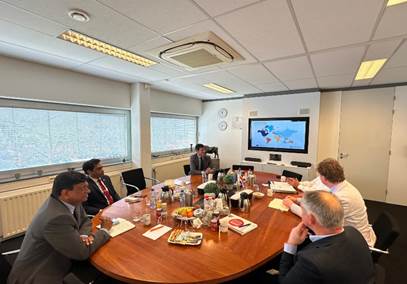
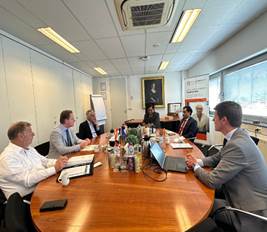
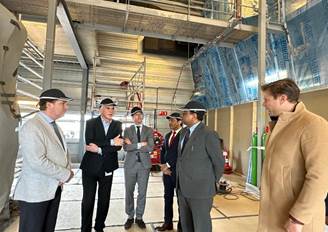
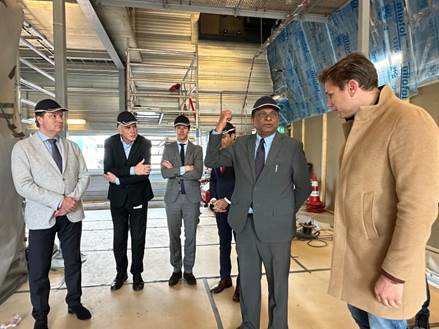
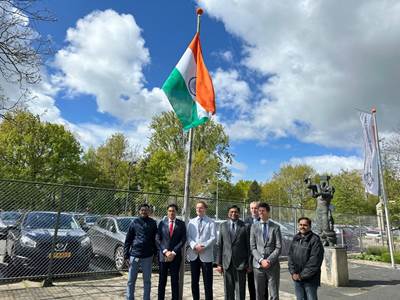
 Union Health Secretary Shri Apurva Chandra today visited the manufacturing unit of global pharmaceutical company Bilthoven Biologicals at Utrecht, Netherlands. He had an engaging meeting with CEO Mr. Juergen Kwik & CEO of Poonawalla Science Park (PSP) at Bilthoven Mr. Jef De Clercq on EU pandemic preparedness partnership and collaboration on production of vaccines. He met the senior management and was briefed on the various manufacturing units of the facility. A detailed presentation was made on their future manufacturing plans. Bilthoven Biologicals B.V. Co., manufactures pharmaceutical products such as vaccines for polio, diphtheria-tetanus-polio, and tetanus along with bacillus calmette-guerin (BCG).


The bioengineering and vaccine production firm Bilthoven Biologicals was purchased by Serum India Ltd., in 2012. This has strengthened its capacity of producing vaccines and also provided it with a valuable manufacturing base in Europe. Recently Serum and Bharat Biotech have announced collaboration for enhanced production of OPV. Bharat Biotech will collaborate with Netherlands-based Bilthoven Biologicals B.V, a wholly-owned arm of Serum Institute of India. An agreement has been signed under which Bharat Biotech will procure drug substances for manufacturing oral polio vaccines to be supplied within India and globally. This will contribute to supply security of oral polio vaccines. With this partnership, the capacity of BBIL to manufacture Oral Polio Vaccine (OPV) has increased to 500 million doses every year. 


Universal Immunisation Programme (UIP) of the Union Health Ministry is one of the key interventions for protection of children from life threatening conditions by providing vaccination, including vaccine against polio.  India has been certified free of Polio in March 2014. However, to maintain the polio-free status, polio vaccine is given to children as part of the high quality national and sub-national polio rounds across the country. A sustained supply of OPV is essential for keeping India polio free. The partnership between BBIL and Serum will contribute to providing a sustained supply of OPV in the country.

****

INDIAN ARMY CONDUCTS A SEMINAR CUM EXHIBITION ON THEME “YEAR OF TECH ABSORPTION, EMPOWERING THE SOLDIER”

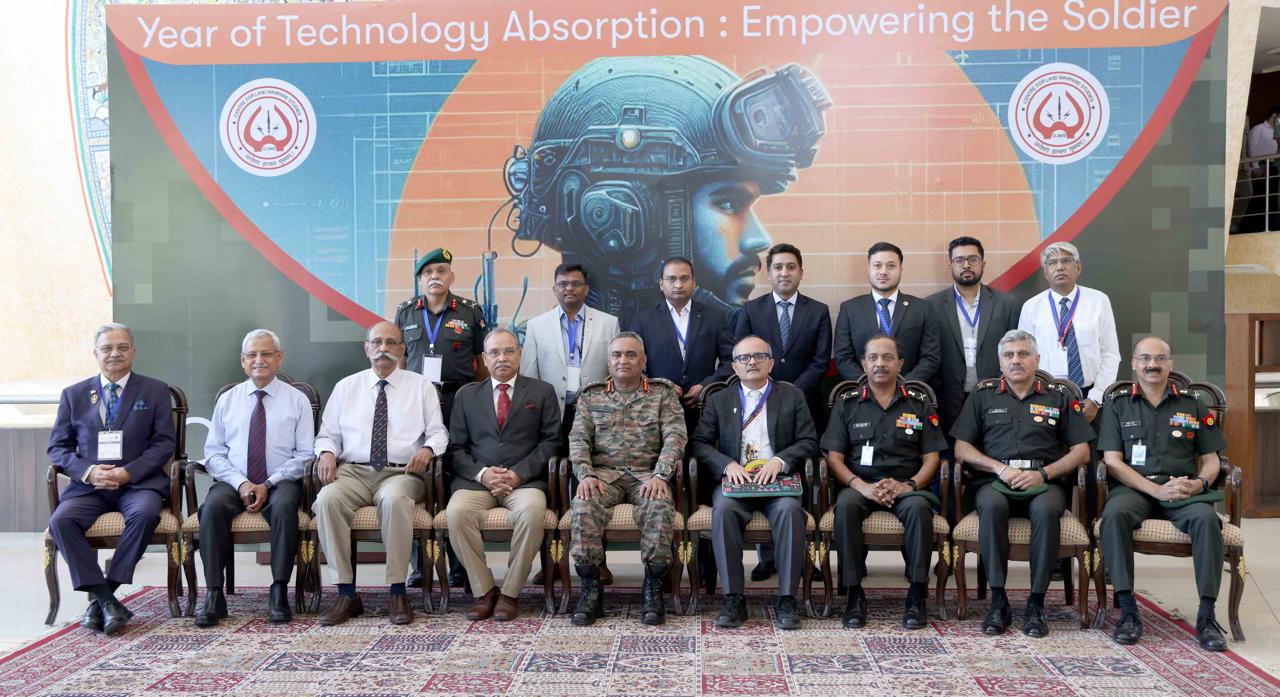
 A seminar cum exhibition was conducted today by the Indian Army on the theme “Year of Technology Absorption – Empowering the Soldier”. The event was conducted by the Centre for Land Warfare Studies (CLAWS), on behalf of the Indian Army in Manekshaw Centre.

The seminar brought together technology experts and industry professionals to deliberate on the adoption of modern technologies like Artificial Intelligence and advanced hardware in the military domain. It aimed at fostering a collaborative environment for academia and the defence industry to fast-pace the ongoing initiatives for technological absorption in the military.

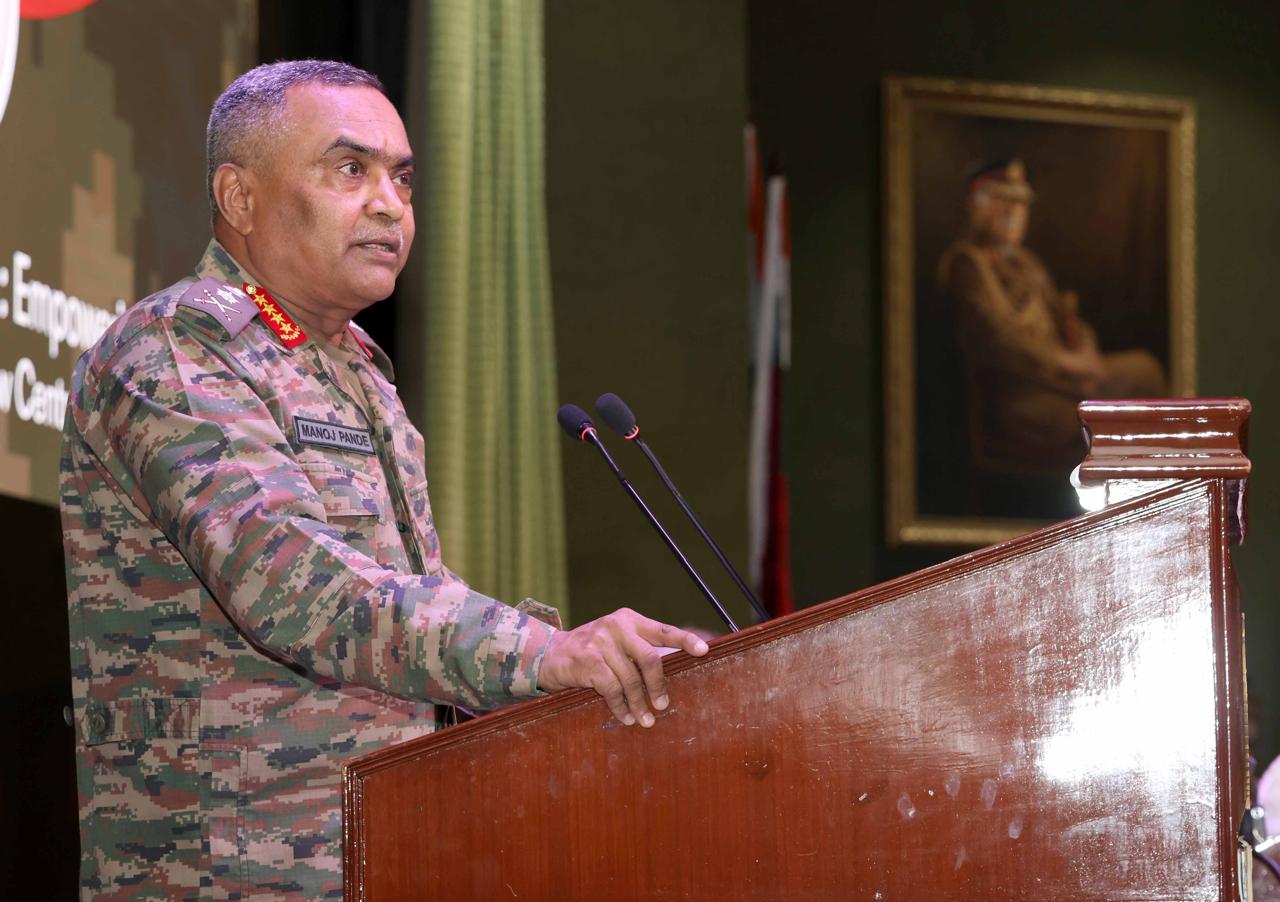
The event commenced with an inaugural address by General Manoj Pande, Chief of the Army Staff (COAS). Keynote Address was delivered by Dr Chintan Vaishnav, Mission Director, Atal Innovation Mission (AIM, NITI AAYOG). This was followed by an exhibition, demonstrating the progress and capabilities of India’s Defence Sector.

The COAS underscored the vital need of being self-reliant in warfighting platforms and systems besides achieving self-sufficiency in critical technologies through indigenous Research & Development. He emphasised that the Technology has emerged as the new strategic arena of competition which drives geo-political powerplay. He also said that technology is being leveraged for weaponisation of varied domains, ranging from Information to Supply Chains. Citing examples from recent conflicts, he mentioned that disruptive and dual use technologies are proliferating at unprecedented scale and transforming the Character of Modern Wars.  He mentioned that a suite of digital technologies encompassing Electronic Warfare, Micro-electronics, Drones, Precision Attack Systems, Loiter Munitions and Star-link Terminals are challenging traditional force multipliers.

The COAS reiterated the commitment of Indian Army to continue its pursuit towards transitioning into a modern, agile, adaptive and technology enabled future ready force. He urged all stakeholders, the Services, Industry Partners, Start-Ups, Research & Development institutions, Academia and Policy Makers to synergise their efforts and develop a vibrant national defence eco-system.           

The seminar was conducted in three sessions, with first session focussed on “Contemporary Technology and Industry Capabilities”. The session was moderated by Lieutenant General Vineet Gaur, Director General Capability Development and the speakers were eminent personalities from academia and industry such as Prof Mayank Vatsa (IIT Jodhpur), Dr Mandira Majumder, Shri Rajiv Mehrotra, Shri Vaibhav Gupta, and Colonel Karandeep Singh (Retired). This session analysed the emerging role of the Indian Defence Industry in strengthening of overall defence architecture. The speakers also deliberated upon the technology developed so far and future roadmap to build cutting-edge technologies for military usages.

The second session was moderated by Lieutenant General Subrata Saha (Retired) and focussed on “Empowering Soldiers: Amplifying Impact Through Modern Technologies”.  Major General Sunil Mehrotra from Signals Directorate and Shri SB Taneja from DRDO examined options to leverage present and next-generation technologies to enhance the capabilities of Indian Army. Looking beyond the domain of land, this session analysed the role of space and cyber domains in the present context and future scenarios.

The final session on “Maximising Technology Effectiveness & Soldier Preparedness” was moderated by Lieutenant General PR Shankar (Retired). The speakers were Lieutenant General Rajesh Pant (Retired), Mr Geo George Philip, Dr K Mohanavelu, and Major General Ajay Sharma. The participants brainstormed wide-ranging options ranging from military applications of cyberspace, impact of drones and satellites on the modern battlefield, besides delving upon hardware and software options to empower soldiers.

The seminar culminated with closing remarks by Lieutenant General Tarun Kumar Aich, Deputy Chief of the Army Staff (Strategy). Reflecting positive thoughts on impressive trajectory of Indian Army’s transformation, he reiterated that adoption of niche technology in tandem with agile doctrinal reforms is extremely crucial. He also stated that Indian Army will continue to foster a spirit of collaboration with the industry and academia to empower the soldiers.       

The proceedings underscored the importance of technology absorption in empowering soldiers besides providing a snapshot of available solutions and highlighted the contributions of the Indian Defence Industry, delineating their strengths, future trajectories, and their pivotal role in ensuring future ready armed forces. 

****

6th edition of International Conference on Disaster Resilient Infrastructure

 The Prime Minister, Shri Narendra Modi addressed the 6th edition of the International Conference on Disaster Resilient Infrastructure via video message today.

Addressing the gathering, the Prime Minister extended a warm welcome to all the dignitaries and said that their participation would strengthen the global discourse and decisions on the important issue of Disaster Resilient Infrastructure. Reflecting on the impressive growth of the Coalition for Disaster Resilient Infrastructure since its inception in 2019, the Prime Minister underlined that it is now a global coalition of 39 countries and 7 organizations. “This is a good sign for the future”, he added.

Noting the growing frequency and severity of natural disasters where the damage caused is usually evaluated in dollars, the Prime Minister highlighted that its true impact on people, families and communities is beyond numbers. Shri Modi drew attention to the impact of natural disasters on humans and mentioned earthquakes destroying houses making thousands of people homeless and natural disasters disrupting water and sewage systems putting people’s health at risk. He also touched upon natural disasters that can impact energy plants leading to potentially dangerous situations.

The Prime Minister emphasized, “We must invest in resilient infrastructure today for a better tomorrow.” He stressed that resilience must be factored into new infrastructure creation while also being a part of post-disaster rebuilding. The Prime Minister pointed out that the focus should shift towards resilience in infrastructure once relief and rehabilitation are carried out after a disaster strikes.

Underlining that nature and disasters have no borders, the Prime Minister said that disasters and disruptions cause widespread impact in a highly interconnected world. “The world can be resilient collectively, only when each country is resilient individually”, PM Modi said. He stressed the importance of shared resilience due to shared risks and said that CDRI and this conference will help the world come together for this collective mission.

“To achieve shared resilience, we must support the most vulnerable”, the Prime Minister remarked. Referring to the Small Island Developing States at high risk of disasters, Prime Minister Modi mentioned a CDRI program for funding projects across 13 such places. He gave examples of resilient housing in Dominica, resilient transport networks in Papua New Guinea, and enhanced early warning systems in the Dominican Republic and Fiji. He expressed satisfaction that CDRI also has a focus on the Global South.

The Prime Minister recalled the formation of a new Disaster Risk Reduction Working Group with financing at the heart of its discussions during India’s G20 Presidency and said that such steps will take the world to a resilient future along with the growth of CDRI. He concluded his address by expressing confidence about the fruitful deliberations at ICDRI over the next two days.

***

HUMAN SOCIETY IS MAKING THE MISTAKE OF FORGETTING THE IMPORTANCE OF FORESTS

 Human society is making the mistake of forgetting the importance of forests. Forests are life givers. The reality is that forests have preserved life on earth, said the President of India, Smt Droupadi Murmu while addressing the officer trainees of Indian Forest Service (2022 batch) at their convocation ceremony at the Indira Gandhi National Forest Academy, Dehradun today (April 24, 2024).

The President said that today we talk about the Anthropocene Age, which is the period of human-centric development. During this period, disastrous results have emerged along with development. Unsustainable exploitation of resources has brought humanity to a point where the standards of development have to be re-evaluated. She stressed on the importance of understanding that we are not the owners of the earth’s resources, but we are trustees. Our priorities should be ecocentric along with anthropocentric. In fact, only by being ecocentric we will be able to be truly anthropocentric, she stated.

The President said that in many parts of the world the loss of forest resources has occurred very rapidly. Destruction of forests is in a way – destruction of humanity. It is a well known fact that conservation of earth’s biodiversity and natural beauty is a very important task which we have to do very quickly.

The President said that human life can be saved from the crisis through conservation and promotion of forests and wildlife. We can repair the damage at a faster pace with the help of Science and Technology. For example, the Miyawaki Method is being adopted in many places. Artificial Intelligence can help in identifying suitable areas for afforestation and area specific tree species. She stated that there is a need to assess various such options and develop solutions suitable to the geographical conditions of India.

The President said that the chariot of development has two wheels – tradition and modernity. Today human society is bearing the brunt of many environmental problems. One of the main reasons for this is a special type of modernity, the root of which is the exploitation of nature. Traditional knowledge is neglected in this process.

The President said that tribal society has made the eternal laws of nature the basis of their life. People of this society conserve nature. But, under the impulse of unbalanced modernity, some people consider the tribal community and their collective wisdom primitive. Tribal society has no role in climate change but the burden of its ill effects is disproportionately more on them.

The President said that it is very important to understand the importance of the knowledge accumulated by tribal society over centuries and use it to improve the environment. She stated that their collective wisdom can help us move forward on an ecologically sustainable, ethically desirable and socially justifiable path. She stressed that we will have to unlearn many misconceptions and relearn from the ideals of a balanced lifestyle of the tribal society. We have to move forward with the spirit of climate justice.

The President said that the Industrial Revolution in the 18th and 19th centuries increased the demand for timber and other forest products. New rules, regulations and methods of forest use were adopted to cope with the demand. To implement such rules and regulations, the Imperial Forest Service, the predecessor service of the Indian Forest Service, was formed. The mandate of that service was not to protect the tribal society and forest wealth. Their mandate was to promote the objectives of the British Raj by exploiting India’s forest resources to the maximum.

Referring to the mass hunting of wild animals during the British period, the President said that when she visits museums where animal skins or severed heads adorn the walls, she feels that those exhibits are telling the story of the decline of human civilization.

The President said that she was confident that the officers of the Indian Forest Service had become completely free from the colonial mentality and outlook of the former Imperial Forest Service. She stated that IFS officers not only have to conserve and augment India’s natural resources but also use the traditional knowledge in the interest of humanity. They have to protect the forest wealth by synchronizing modernity and tradition and advancing the interests of the people whose life is based on forests. By doing this, they will be able to make a contribution that is truly inclusive and congenial to the environment.

The President said that the Indian Forest Service has given many officers to the country who have done unparalleled work for the environment. IFS officers such as Shri P. Srinivas, Shri Sanjay Kumar Singh, Shri S. Manikandan have sacrificed their lives in the line of duty. She urged the officer trainees to make such officers their role models and mentors and move forward on the ideals shown by them.

The President urged IFS officers to spend time among the tribal people in the field and earn their affection and trust. She said that they should learn from the good practices of the tribal society. She also urged them to take ownership of their responsibilities and become a role model.

Click here to see the President’s speech in Hindi.

***

The Importance of Book Publication Before Retirement from a Professorial Career

Daily writing prompt
When is the last time you took a risk? How did it work out?

In the academic world, the adage “publish or perish” underscores the critical importance of publication to a professor’s career. However, as professors approach retirement, the publication of a book can serve as a capstone to their academic journey, offering a synthesis of their life’s work, contributing to their field’s body of knowledge, and securing their legacy. Here, we explore the value of publishing a book before retiring, particularly through academic publishers like Edupedia Publications Pvt Ltd, which offers tailored services to help educators consolidate their scholarly contributions.

Photo by Anna Shvets on Pexels.com

Legacy and Contribution to Knowledge

For many academics, the culmination of a lifelong career in education and research is epitomized in the publication of a book. This work not only encapsulates their significant contributions but also ensures that their methodologies, insights, and innovations persist beyond their active years in the academia. According to a report by The Chronicle of Higher Education, many retiring professors view book publication as a means to leave behind a tangible legacy that will inspire and inform future generations of scholars and practitioners (Chronicle of Higher Education, 2022).

Reflecting on a Career’s Worth of Knowledge

The process of writing a book allows retiring professors to reflect on their careers, distill decades of research and teaching, and articulate their philosophical and practical viewpoints. This not only aids the academic community but also provides a reflective practice for professors themselves, offering them a sense of closure and accomplishment. As noted in a study published in the Journal of Higher Education Outreach and Engagement, the act of writing can provide senior academics with a means to revisit and reevaluate their work through a new lens, often leading to new insights even at the end of their careers (Smith, J., 2019).

Educational Impact and Continuing Influence

Publishing a book can extend a professor’s influence far beyond their immediate academic circle. Through textbooks, monographs, or compilations of research, retired academics can continue to shape their fields, contribute to curriculum development, and influence current and future students. Edupedia Publications Pvt Ltd, known for its focus on academic publications (www.edupub.org), provides platforms and services that facilitate this process, ensuring that the academic’s work is accessible and impactful.

Financial and Professional Benefits

Beyond the academic and philosophical benefits, publishing a book can also offer financial advantages. Royalties from book sales provide a passive income stream, which can be particularly beneficial in retirement. Moreover, a well-received book can lead to speaking engagements, consultancies, and other professional opportunities that enrich a professor’s retirement both intellectually and financially.

Facilitating the Transition with Edupedia Publications Pvt Ltd

Choosing the right publisher is crucial. Edupedia Publications Pvt Ltd specializes in academic and educational publishing, offering a range of services from editorial support to global distribution. Their expertise in handling the specific needs of retiring academics ensures that the publication process is smooth and that the final product aligns with the professor’s vision and academic standards.

In conclusion, the publication of a book before retirement is more than a milestone; it is a beacon that continues to illuminate the path for future explorations in the field. It offers a unique opportunity for professors to summarize and share their life’s work, influence future generations, and transition smoothly into retirement with a lasting contribution to their academic community. As such, engaging with experienced publishers like Edupedia Publications Pvt Ltd can greatly enhance the quality and reach of their final scholarly contributions.

Privacy

 Privacy Policy for Eduindex

24.04.2024

1. Introduction
Welcome to Eduindex, a unit of Edupedia Publications Pvt Ltd. We are committed to protecting the privacy and security of our users’ information. This Privacy Policy outlines our practices concerning the collection, use, and disclosure of your information through the use of our website www.eduindex.org (“Website”).

2. Information We Collect

  • Personal Information: We collect personal information that you voluntarily provide to us when you register on our Website, subscribe to our newsletter, or otherwise contact us. This information may include your name, email address, contact details, educational interests, and other personal data.
  • Non-Personal Information: We automatically collect non-personal information when you interact with our Website. This may include your IP address, browser type, operating system, and other usage information about your use of our Website.

3. How We Use Your Information
We use the information we collect for several purposes:

  • To provide and maintain our Website;
  • To improve our Website and services;
  • To communicate with you, including responding to your inquiries and sending you educational materials;
  • To conduct research and analysis;
  • To comply with legal obligations.

4. How We Share Your Information

  • Service Providers: We may share your information with service providers who perform services on our behalf, such as hosting, data analysis, email delivery, and customer service.
  • Legal Requirements: We may disclose your information if required to do so by law or in response to valid requests by public authorities (e.g., a court or a government agency).

5. Security of Your Information
We implement reasonable security measures designed to protect the security of any personal information we process. However, please also remember that we cannot guarantee that the internet itself is 100% secure.

6. Your Data Protection Rights
Depending on your location, you may have certain rights under applicable data protection laws. These may include the right to (i) request access to and correction of your personal information, (ii) request deletion of your personal information, (iii) request restriction of processing of your personal information, and (iv) object to the processing of your personal information.

7. Third-Party Websites
Our Website may contain links to third-party websites. We are not responsible for the privacy practices or the content of third-party websites. Please read the privacy policy of any website you visit.

8. Changes to This Privacy Policy
We may update our Privacy Policy from time to time. We will notify you of any changes by posting the new Privacy Policy on this page.

9. Contact Us
If you have any questions about this Privacy Policy, please contact us:

  • By email: editor@pen2print.org