Atal Innovation Mission and World Intellectual Property Organization

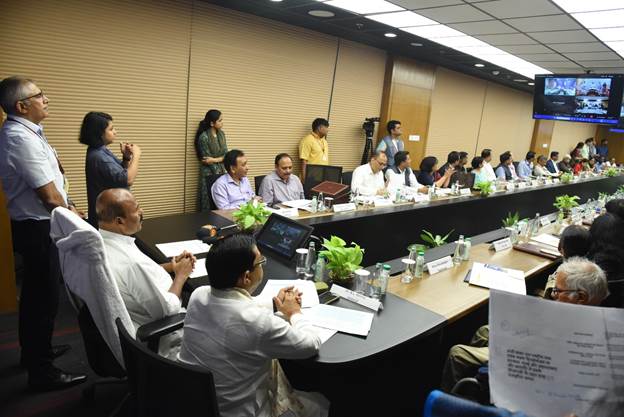
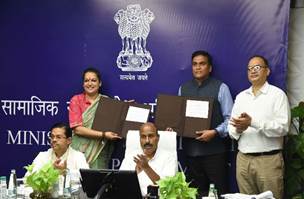
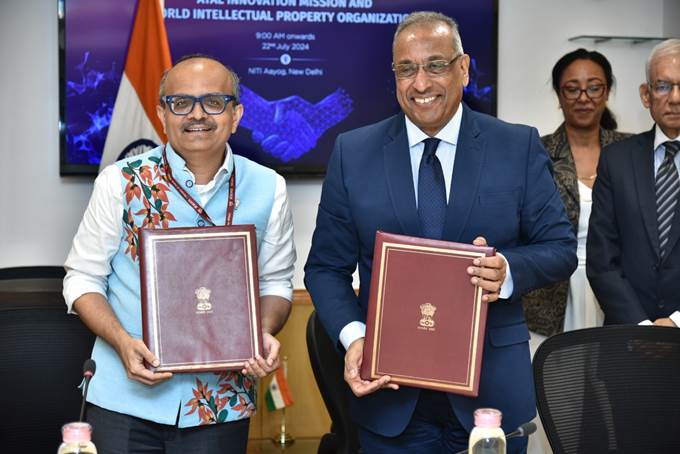
 A high-level delegation from World Intellectual Property Organization (WIPO) comprising of Mr. Sherif Saadallah, Executive Director, WIPO Academy and Ms. Altaye Tedla, Head WIPO Academy visited NITI Aayog for signing of a Joint Letter of Intent (JLoI) between Atal Innovation Mission (AIM) and WIPO. The JLoI is aimed at building programs for Innovation, Entrepreneurship & Intellectual Property (IP) for countries in the Global South.

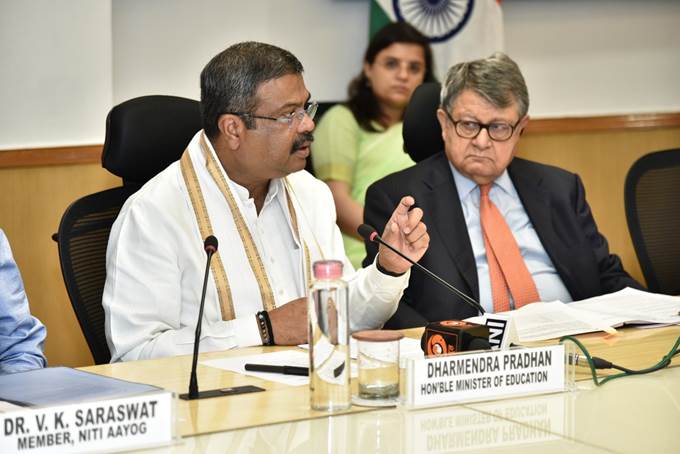
Shri Dharmendra Pradhan, Cabinet Minister for Education and Skill Development and Entrepreneurship in the Government of India graced the occasion with his presence. From NITI Aayog the dignitaries present included Shri Suman Bery, Vice Chairperson, NITI Aayog, Dr. V.K. Saraswat, Member NITI Aayog, and Dr. Chintan Vaishnav, Mission Director, Atal Innovation Mission.
Shri Dharmendra Pradhan Cabinet Minister for Education and Skill Development and Entrepreneurship, Government of India said “I am very pleased to see that India’s innovation ecosystem is going global. Innovation is India’s strength. This pathbreaking partnership between AIM and WIPO will take the best of India’s innovation models to countries that are on similar development trajectories, and will enhance understanding and awareness about IPR right from the school-level and unlock the innovation potential of the world as well as foster inclusive and sustainable economic growth.
Mr. Sherif Saadallah, Executive Director, WIPO Academy during his address said – “Intellectual property (IP) is a powerful catalyst for innovation and creativity, essential for addressing development of youth and achieving the Sustainable Development Goals. Our focus on youth is an integral part of our work to build a more inclusive global IP ecosystem, and our partnership with Atal Innovation Mission demonstrates WIPO’s commitment to ensure youth’s participation in innovation and creativity so that IP ecosystems are utilized by a wider demographic, fostering a more innovative and creative global economy.”

Last year, Mr. Daren Tang, Director General, WIPO had visited the AIM ecosystem and advocated for Atal Tinkering Labs (ATL) and Atal Incubation Centers (AIC) to be a good template for innovation and entrepreneurship through South-South cooperation. His observations prompted WIPO to invite Dr. Chintan Vaishnav, Mission Director AIM to showcase these flagship initiatives earlier this year in front of the member nations at the Committee on Development and Intellectual Property (CDIP) at the WIPO headquarters in Geneva, Switzerland. The agreement signed today has transpired from these conversations.

Speaking at the occasion, Shri Suman Bery Vice Chairperson, NITI Aayog said “WIPO’s recognition of India’s entrepreneurship development model is a proud moment for India and NITI Aayog which hosts the Mission. This deepens an already productive relationship between NITI Aayog and WIPO on national competitiveness”

As one of the specialized agency of the United Nations, WIPO is the nodal institution that releases the Global Innovation Index (GII) annually. As per the GII 2023 report, India had retained the 40th position of 132 economies featured in the GII ranking. As per WIPO Report 2022, India has experienced sixth straight year of growth in patent filing, posting the highest growth of 31.6% globally. Importantly, a substantial increase in resident filings was the main driver of growth overall in 2022.

Dr. V.K. Saraswat, Member NITI Aayog in his address underlined that, “In the last few years, India has made huge strides in its entrepreneurial journey in line with our international aspirations in this domain. This partnership between AIM and WIPO would help position India as a global leader in innovation, leveraging our vast talent pool and dynamic market to attract international investments. This partnership can be a game changer in fostering a culture of IP-led Innovation and hence safeguarding the future of our nation’s technological advancements.”
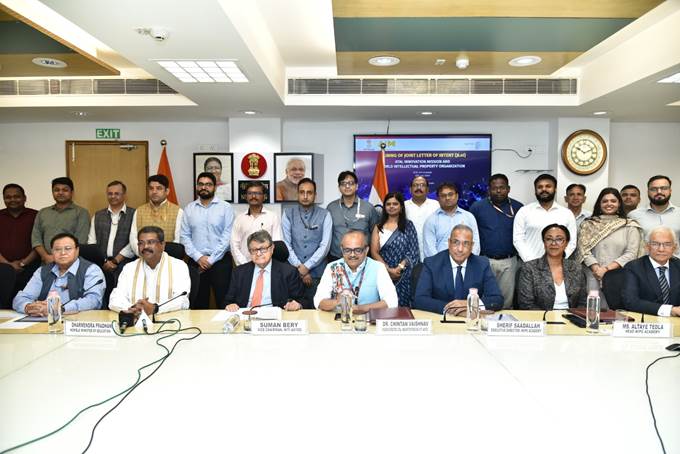
Sharing his thoughts on the importance of this JLoI, Dr. Chintan Vaishnav, Mission Director Atal Innovation Mission said, “It is our hope that the AIM-WIPO partnership will benefit many nations for whom models such as Atal Tinkering Labs and Atal Innovation Centres are needed to build their innovation ecosystems. The experience of the two sides coming together helps us make these models significantly more holistic as now Innovation & Entrepreneurship meets Intellectual Property (IP) in a serious way.”

The WIPO delegation is on a 4 day visit to India, and will take part in a workshop on Intellectual Property in Innovation organised at AIC GGSIPU, Dwarka, on 23rd July. The delegates will also interact with school students from Atal Tinkering Labs and Industry Experts from FICCI, NASSCOM, PHDCCI among others during their visit.

About Atal Innovation Mission:
Paving the Path to Success

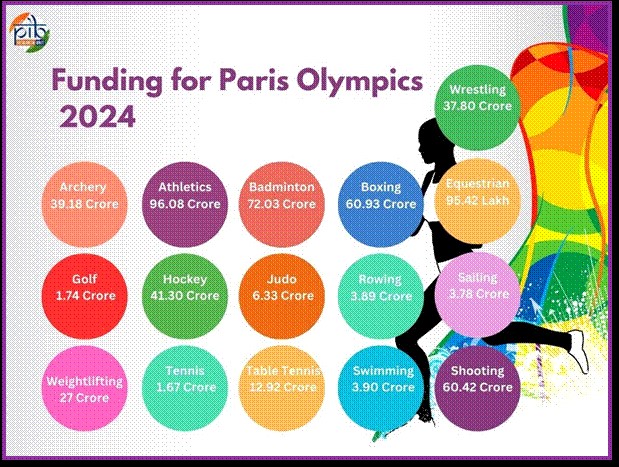
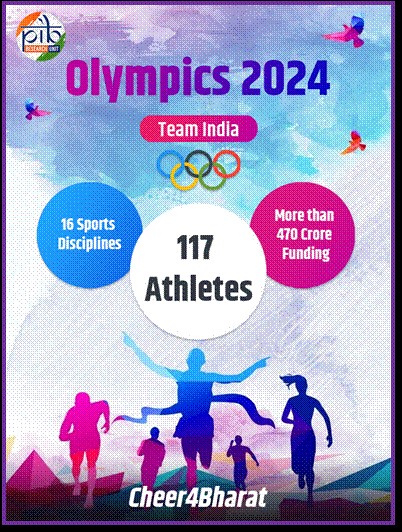
  As the world turns its gaze to Paris for the 2024 Olympics, India proudly announces its largest-ever contingent for the games, consisting of 117 athletes across 16 sports disciplines. This diverse team, which includes 70 men and 47 women, will compete in 69 events with a total of 95 medals at stake. Supported by an impressive funding allocation of over 470 Crore rupees, the Indian athletes are primed to make their mark on the global stage.


Sports landscape in India

India’s sports ecosystem has evolved into an athlete-centric model, with the motto “Athlete-First.” This integrated ecosystem includes the Ministry of Youth Affairs and Sports (MYAS), the Sports Authority of India (SAI), the Indian Olympic Association (IOA), and the National Sports Federations (NSFs). Together, these bodies ensure that athletes can focus solely on their training and competition, with logistics and other support taken care of by the system. Corporate sponsors, CSR partners, athlete families, fans, broadcasters, and media have all played crucial roles in sustaining Olympic sports in India.

Government Efforts for Efficiency and Growth

The Indian government has significantly ramped up its efforts to support athletes and boost the country’s performance in the Olympics. These efforts encompass a variety of initiatives and programs designed to enhance the training, preparation, and overall performance of Indian athletes on the global stage.


  • Target Olympic Podium Scheme (TOPS)

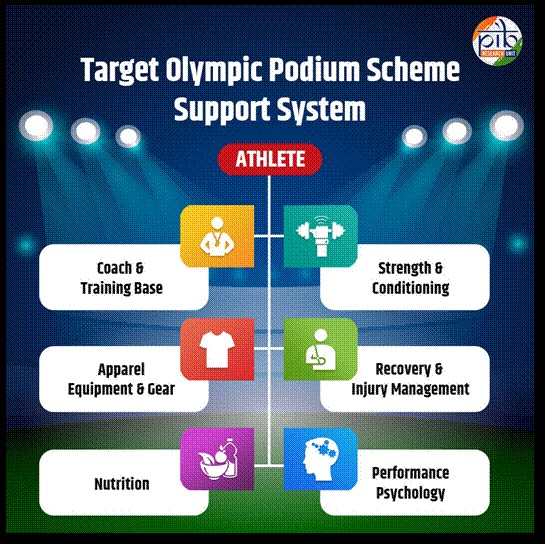
The Target Olympic Podium Scheme (TOPS) is a flagship program aimed at providing targeted assistance to potential Olympic medalists. TOPS offers support in several key areas:

  • Training and Camps: National Coaching Camps and international training sessions.
  • Foreign Exposure: Opportunities for athletes to compete and train overseas.
  • Specialized Support: Hiring of foreign experts, coaches, and support staff.
  • Equipment and Facilities: Provision of necessary sports equipment and training facilities.
  • Financial Assistance: Direct funding to cover various aspects of athletes’ preparation.

The TOPS scheme includes a Core Group of over 170 athletes preparing for the 2024 Olympics and a Development Group of over 130 athletes targeted for the 2028 and 2032 Olympics.


  • National Sports Development Fund (NSDF)

The NSDF supplements the TOPS by providing additional financial support for the specialized training and competition needs of elite athletes. This ensures that athletes receive comprehensive support tailored to their specific requirements.

  • Corporate Support and CSR Initiatives

Corporate sponsors and CSR partners play a crucial role in sustaining Olympic sports in India. Their contributions include funding for training programs, equipment, and other resources necessary for athletes’ development.

  • International Competitions and Exposure

The government has facilitated extensive international exposure for athletes across various sports. This includes participation in international competitions and training camps abroad, which are critical for gaining competitive experience and improving performance.

  • Focus on High Priority Disciplines

The government’s strategy involves focusing on high-priority disciplines with strong medal prospects. These sports include archery, athletics, badminton, boxing, hockey, shooting, and wrestling. For each of these disciplines, detailed funding and support plans have been implemented, ensuring athletes have the best possible preparation.

  • Mission Olympic Cell (MOC)

The Mission Olympic Cell (MOC) is a dedicated body that oversees the implementation of the TOPS. It includes representatives from past elite athletes, IOA, NSFs, and other stakeholders. The MOC is responsible for approving customized programs for athletes, recommending financial disbursements, monitoring performance, and addressing athletes’ immediate needs.

 Achievements and Impact

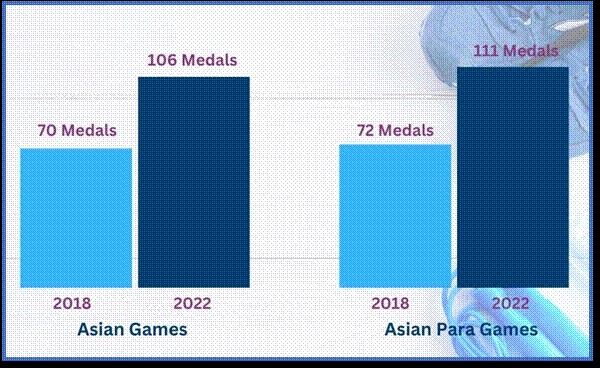
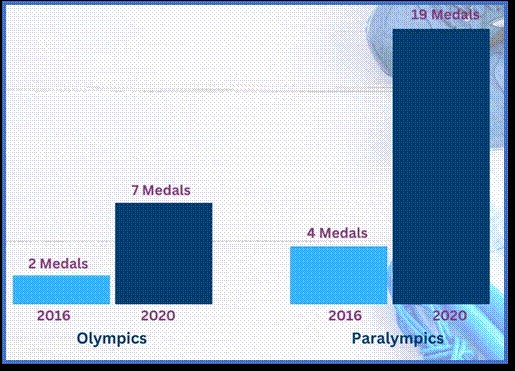
The impact of these efforts is evident from the significant increase in medals won across recent competitions. From winning 2 medals in Rio 2016 to 7 in Tokyo 2020 and from 4 to 19 medals in the Paralympics, India’s performance reflects the enhanced support system, including the Target Olympic Podium Scheme (TOPS), National Sports Development Fund (NSDF), and extensive corporate backing. The nation’s medal count at the Asian Games and Asian Para Games also surged, showcasing the success of an athlete-centric sports ecosystem and comprehensive government initiatives. This upward trajectory underscores India’s commitment to achieving excellence in global sports.

The Indian government’s comprehensive and targeted approach towards supporting its athletes is a reflection of its commitment to achieving excellence in sports. With a robust support system in place, India aims to significantly improve its performance at the Paris Olympics 2024 and beyond, showcasing the nation’s potential on the global sports stage.

References

https://pib.gov.in/PressReleasePage.aspx?PRID=2034434

https://x.com/pibyas/status/1814278906356334618

https://olympic.ind.in/paris-2024

https://pib.gov.in/PressReleseDetailm.aspx?PRID=2034434#:~:text=Union%20Minister%20highlighted%20that%20India,in%20these%20disciplines%2C%20he%20added.

https://pib.gov.in/PressReleaseIframePage.aspx?PRID=2029762

https://pib.gov.in/PressReleaseIframePage.aspx?PRID=2029657

https://sportsauthorityofindia.nic.in/sai/documents

Pathway to Paris pdf: https://static.pib.gov.in/WriteReadData/specificdocs/documents/2024/jun/doc2024629346101.pdf

Click here to see in PDF.

****

ECO-TOURISM

 Ministry of Tourism promotes India in a holistic manner, through various initiatives. As part of its on-going activities; promotion of various tourism destinations and products of India including Eco Tourism are taken up.

In order to position India as a preferred global destination for Eco Tourism and adventure tourism, Ministry of Tourism has formulated National Strategies for Eco Tourism and Adventure Tourism.

Eco-Circuit is one of the themes for development of tourism infrastructure under Swadesh Darshan scheme of the Ministry. The details of funds allocated under Swadesh Darshan Scheme is placed at Annexure.

ANNEXURE

Details of funds allocated under the Eco-Circuit theme of Swadesh Darshan Scheme in the country

(Amount in ₹ Crore)

S. No.

Name of State

Year

Project Name

Amount Sanctioned

Amount Released

1.

Uttarakhand

2015-16

Integrated Development of Eco-Tourism, Adventure Sports and Associated Tourism RelatedInfrastructure for

Development Tehri Lake & Surroundings as New Destination-District Tehri

69.17

69.17

2.

Telangana

2015-16

Development of Circuit in Mahaboobnagar districts (Somasila, Singotam, Kadalaivanam, Akkamahadevi, Egalanpanta, Farahabad,

Uma Maheshwaram, Mallelatheertham)

91.62

91.25

3.

Kerala

2015-16

Development of Pathanamthitta- Gavi- Vagamon- Thekkady.

64.08

64.08

4.

Mizoram

2016-17

Development of Eco-Adventure Circuit at Aizawl -Rawpuichhip – Khawhphawp – Lengpui – -Chatlang- Sakawrhmuituaitlang – Muthee – Beratlawng -Tuirial Airfield – Hmuifang

66.37

53.09

5.

Madhya Pradesh

2017-18

Development of Gandhisagar Dam- Mandleshwar Dam- Omkareshwar Dam- Indira Sagar Dam- Tawa Dam- Bargi Dam- Bheda Ghat- Bansagar Dam- Ken River

93.76


93.59

6.

Jharkhand

2018-19

Development of Eco Tourism circuit: Dalma- Betla National park- Mirchaiya- Netarhat

30.44

28.04

Total

415.44

399.22

72 MoUs between DEPwD with various startups and private organizations across multiple disability sectors to bring tangible benefits to Divyangjans

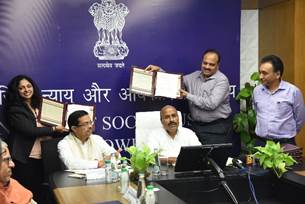
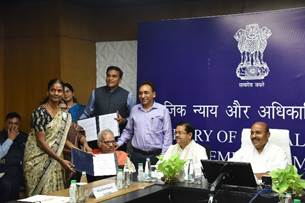
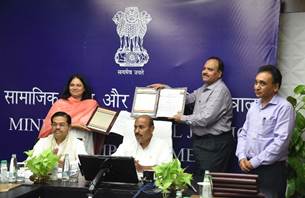
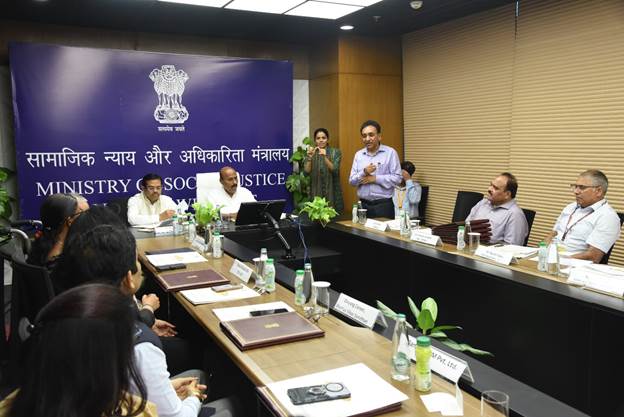
 As part of the ongoing efforts of the Department of Empowerment of Persons with Disabilities (DEPwD) to empower persons with disabilities socially, educationally and economically, various National Institutions and Composite Regional Centres (CRCs) under the department signed 72 MoUs with private institutions and start-ups. Union Minister of Social Justice and Empowerment, Dr. Virendra Kumar presided over the ceremony as Chief Guest, in New Delhi today. Minister of State in the Ministry, Shri B.L. Verma, also graced the occasion with his esteemed presence.

In today’s era of technological advancement, numerous initiatives and cutting-edge products are being developed in the private sector to enhance the lives of persons with disabilities and foster an inclusive society. In April and May 2024, the department organized six Purple Talks sessions/workshops. Purple Talks focused on engaging with Indian start-ups, companies, academic institutions, and organizations that have developed innovative, technology-based products and programmes to empower persons with disabilities. Over 100 organizations participated, presenting their products, innovations, and technologies in areas such as physical disabilities, intellectual disabilities, visual impairments, hearing impairments, education and skill development, and employment and entrepreneurship for persons with disabilities. Consequently, national institutions and CRCs were instructed to sign MoUs with these start-ups and organizations to expand the department’s scope and meet the needs of persons with disabilities.


On this occasion, Dr. Virendra Kumar stated that under Prime Minister Shri Narendra Modi’s leadership over the past decade, the DEPwD has consistently played a significant role in the social, economic, and educational empowerment of persons with disabilities. He noted that under Prime Minister’s vision of a self-reliant India, many institutions are manufacturing useful devices within the country at low costs to make the lives of persons with disabilities easier. In addition to governmental efforts, the cooperation of various social organizations is crucial for the empowerment and employment of persons with disabilities. They are an essential part of our society and need our continuous efforts. Effective collaboration between the government and various organizations is vital in this endeavor. The work done by the organizations present here in the field of disability is highly commendable. Our government and department have always been keen to work with organizations that strive for positive change and create an inclusive environment, he emphasized.

Addressing the programme, Minister of State Shri B.L. Verma, highlighted that the MoUs signed today demonstrate our commitment to persons with disabilities. He stated that the persons with disabilities possess immense potential, the only thing they only need are opportunities. Their indomitable will to work serves as an inspiration to the general public. The MoUs signed today by the national institutions and CRCs with various organizations will provide them with this platform.

Secretary (DEPwD) Shri Rajesh Aggarwal remarked that there is a significant shift in society’s perspective towards persons with disabilities. Many private institutions present at this event have been working extensively to provide employment to persons with disabilities, which is a commendable initiative towards positive change. He noted that while the government is creating excellent policies, it is also helping to scale up efforts in collaboration with private organizations.

The MoUs will promote the creation of innovative, technology-based products aimed at empowering families of persons with disabilities, raising awareness about disabilities, preventing and treating clubfoot, and building the capacity of trainers and teachers. Various companies and start-ups from across the country, including Zomato, IIT Madras, EnAble India, Neo Motion, Cure India, Assam Rifles, and Radio Udaan, participated in the program. The event was attended by senior officials of the Ministry, Directors of national institutions, and representatives from participating companies.

*****

PROMOTION OF ADVENTURE TOURISM

 Ministry of Tourism promotes India in a holistic manner, through various initiatives. As part of its on-going activities; it regularly releases campaigns to promote various tourism destinations and products of India including Adventure Tourism.

Development of tourism is an ongoing activity undertaken by the Government.

Ministry of Tourism has taken several steps/initiatives over the years to make the country visitor friendly and to boost tourism sector in the country, details of which are:

(i)        Launched Dekho Apna Desh initiative with the objective of creating awareness among the citizens about the rich heritage and culture of the country and encourage citizens to travel within the country.

(ii)       Conducting Programmes under the ‘Capacity Building for Service Providers’ (CBSP) Scheme to train and upgrade manpower to provide better service standards.

(iii)      Launched Incredible India Tourist Facilitator Certification Programme, a digital initiative that aims at creating an online learning platform with the objective of creating a pool of well-trained professional tourist facilitators across the country to support tourists.

(iv)      24×7 toll free Multi-Lingual Tourist Helpline.

(v)       E-Visa is presently available under seven sub-categories i.e. e-Tourist Visa, e- Business Visa, e-Medical Visa, e-Medical Attendant Visa, e-Conference Visa, e- Ayush Visa and e-Ayush Attendant Visa. e-Tourist visa is available under 3 options – (i) 05 years with multiple entry; (ii) 1 year with multiple entry and (iii) one month with double entry.

(vi)      Under RCS UDAN Tourism, Ministry of Tourism has collaborated with Ministry of Civil Aviation and has got 53 tourism routes operational for better connectivity of important tourist places including Iconic sites.

(vii)     The Ministry of Tourism is also promoting cultural and heritage tourism by providing financial assistance to State Governments/Union Territory Administrations/Central Agencies under the ‘Swadesh Darshan’, ‘National Mission on Pilgrimage Rejuvenation and Spiritual, Heritage Augmentation Drive (PRASHAD)’ and ‘Assistance to Central Agencies for Tourism Infrastructure Development’ Schemes for the development of tourism related infrastructure and facilities to provide an enriching tourism experience to the visitors.

(viii)    Ministry of Tourism provides financial assistance to States/UTs for organizing fairs & festivals and tourism related events such as seminars, conclaves, conventions etc. under the Domestic Promotion & Publicity including Hospitality (DPPH) scheme.

In order to position India as a preferred global destination for Adventure Tourism, Ministry of Tourism has formulated National Strategies for Adventure Tourism.

Ministry of Tourism under its scheme of ‘Swadesh Darshan’ provides central financial assistance to State Governments/UT Administrations etc. for development of tourism infrastructure in the country and the projects under the scheme are sanctioned in consultation with the State Governments/UTs subject to availability of funds, submission of suitable detailed project reports, adherence to scheme guidelines and utilization of funds released earlier etc.

Detail of funds granted by Ministry under ‘Swadesh Darshan’ Scheme for North-East India Circuit and Himalayan Circuit is placed at Annexure.

Details of the funds allocated for North-East India Circuit theme under Swadesh Darshan Scheme

(Amount in ₹ crore)

S. No.

Name of State

Year

Project Name

Amount Sanctioned

Amount Released

1.

Arunachal Pradesh

2014-15

Development of Circuit at Bhalukpong- Bomdila and Tawang.

49.77

47.28

2.

Manipur

2015-16

Development of Circuit at Imphal- Khongjom

72.23

61.32

3.

Sikkim

2015-16

Development of Circuit linking Rangpo (entry) – Rorathang- Aritar- Phadamchen- Nathang-Sherathang- Tsongmo- Gangtok-Phodong- Mangan- Lachung-Yumthang- Lachen- Thangu-Gurudongmer- Mangan- Gangtok-TuminLingee- Singtam (exit).

98.05

97.41


4.

Mizoram

2015-16

Development of Thenzawl & South Zote, Districts Serchhip and Reiek

92.26

92.26

5.

Arunachal Pradesh

2015-16

Development of Jirigaon, Nafra, Seppa, Pappu, Pasa, Pakke Valleys, Lumdung, LafangSohung Lake, Taro Yar, New Sagalee, Ziro, Yomcha

96.72

91.88

6.

Tripura

2015-16

Development of North East Circuit: Agartala – Sipahijala – Melaghar – Udaipur – Amarpur- Tirthamukh- Mandirghat– Dumboor- NarikelKunja- Gandachara– Ambassa

82.85

77.76


7.

Meghalaya

2016-17

Development of Umium (Lake View), U Lum Sohpetbneng-Mawdiangdiang – Orchid Lake Resort.

99.13

99.11


8.

Sikkim

2016-17

Development of Tourist Circuit Linking Singtam– Maka- Temi-BermoikTokel- Phongia- Namchi –Jorthang- Okharey- Sombaria-Daramdin- Jorethang- Melli (Exit)

95.32


95.32

9.

Tripura

2018-19

Development of Surma Cherra- Unakoti- Jampui Hills- Gunabati-Bhunaneshwari- Matabari- Neermahal- Boxanagar- Chottakhola- Pilak- Avangchaarra

44.83

35.25

10.

Meghalaya

2018-19

Development of West Khasi Hills (Nongkhlaw- KremTirot – Khudoi&Kohmang Falls – Khri River- Mawthadraishan, Shillong), Jaintia Hills (Krang Suri Falls- Shyrmang- Iooksi), Garo Hills (Nokrek Reserve, KattaBeel, Siju Caves)

84.97

84.96

Total

816.13

782.55

Details of the funds allocated for Himalayan Circuit theme under Swadesh Darshan Scheme

S.

No.

Name of State

Year

Project Name

Amount Sanctioned

Amount Released

1.

Jammu & Kashmir

2016-17

Development of Tourism Infrastructure Projects-Bhagwati Nagar

77.33

67.37

2.

Jammu & Kashmir

2016-17

Development of Tourist Facilities at Jammu-Rajouri-Shopian-Pulwama

81.60

67.35

3.

Jammu & Kashmir

2016-17

Development of Tourist Facilities under the Construction of Assets in lieu of those Destroyed in Floods in 2014 under PM Development Package for J&K

90.43

74.70

4.

Jammu & Kashmir

2016-17

Development of Tourist facilities at Mantalai & Sudhmahadev

91.99


91.92

5.

Jammu & Kashmir

2016-17

Development of Tourist Facilities at Anantnag- Kishtwar- Pahalgam – Daksum – RanjitSagar Dam.

86.39

69.95

6.


Jammu & Kashmir

2016-17

Development of Tourist Facilities at Gulmarg-Baramulla-Kupwara-Leh

91.84

82.16

7.

Himachal Pradesh

2016-17

Development of Himalayan Circuit in Kiarighat, Shimla, Hatkoti, Manali, Kangra, Dharamshala, Bir, Palampur, Chamba

68.34

64.54


587.92

517.99

India’s Skill India Mission, Ministry of Skill Development and Entrepreneurship delivers skill, re-skill and up-skill training through skill development centres / institutes

 Under the Government of India’s Skill India Mission (SIM) , the Ministry of Skill Development and Entrepreneurship (MSDE) delivers skill, re-skill and up-skill training through an extensive network of skill development centres / institutes under various schemes, viz. Pradhan Mantri Kaushal Vikas Yojana (PMKVY), Jan Sikhshan Sansthan (JSS), National Apprenticeship Promotion Scheme (NAPS) and Craftsman Training Scheme (CTS) through Industrial Training Institutes (ITIs), to all the sections of the society across the country including the State of Maharashtra and Uttar Pradesh. The SIM aims at enabling youth of India to get future ready, equipped with industry relevant skills. The brief of these schemes is as under:

Pradhan Mantri Kaushal Vikas Yojana (PMKVY): PMKVY Scheme is for imparting skill development training through Short-Term Training (STT) and up-skilling and re-skilling through Recognition of Prior Learning (RPL) to youth across the country including rural areas.

Jan Shikshan Sansthan (JSS) Scheme: The main target of the JSS is to impart vocational skills to the non-literates, neo-literates and the persons having rudimentary level of education and school dropouts upto 12th standard in the age group of 15-45 years, with due age relaxation in case of “Divyangjan” and other deserving cases. Priority is given to Women, SC, ST, OBC and Minorities in the rural areas and urban low-income areas.

National Apprenticeship Promotion Scheme (NAPS): This Scheme is for promoting apprenticeship training and increasing the engagement of apprentices by providing financial support for payment of stipend to apprentices. Training consists of Basic Training and On-the-Job Training / Practical Training at workplace in the industry.

Craftsmen Training Scheme (CTS): This scheme is for providing long-term training through Industrial Training Institutes (ITIs) across the country. The ITIs offer a range of vocational/skill training courses covering a large number of economic sectors with an objective to provide skilled workforce to the industry as well as self-employment of youth.

District-wise number of candidates trained under the schemes of MSDE during last three years (2021-22 to 2023-24) in the States of Maharashtra, Uttar Pradesh and Bihar is placed at Annexure-I.

Further, placements were tracked in the STT component of PMKVY in the first three versions of the scheme which is PMKVY 1.0, PMKVY 2.0 and PMKVY 3.0 implemented from FY 2015-16 to FY 2021-22. Placement is delinked from PMKVY 4.0, the current version of the scheme under implementation from FY 2022-23, onwards. District-wise number of candidates trained and reported placed under STT component during 2019-20, 2020-21 & 2021-22 in the States of Maharashtra, Uttar Pradesh and Bihar is placed at Annexure-II.

Since the details in aforesaid Annexure-I and II are too lengthy, these have been uploaded on Ministry’s website at https://msde.gov.in/en/useful-links/parl-ques/lok-sabha

A robust and comprehensive assessment system is in place to accurately evaluate the skills and knowledge gained by candidates during the training process. After completing the training program, the candidate undergoes a meticulous assessment conducted with fairness and objectivity by accredited Assessment Agencies. These agencies are recognized by National Council for Vocational Education and Training (NCVET). Upon successfully passing the assessments, the candidate is awarded a certificate by an Awarding Body approved by the National Council for Vocational Education and Training (NCVET).

SKILL INDIA DIGITAL AND TO IMPROVE EMPLOYABILITY OF YOUTH

 Under the Skill India Mission (SIM), the Government delivers skill, re-skill and up-skill training through an extensive network of skill development centres/institutes , under various schemes, viz. Pradhan Mantri Kaushal Vikas Yojana (PMKVY), Jan Sikhshan Sansthan (JSS), National Apprenticeship Promotion Scheme (NAPS) and Craftsman Training Scheme (CTS) through Industrial Training Institutes (ITIs) to all the sections of the society across the country. The SIM aims at enabling youth of India to get future ready, equipped with industry relevant skills.

Following specific steps have been taken to align the training programs to market needs and improve the employability of trainees:

  1. The training programmes offered under the schemes of MSDE are developed in collaboration with industries, keeping in view market demands. 36 Sector Skill Councils (SSCs), led by industry leaders in the respective sectors, have been set up by National Skill Development Corporation (NSDC) which are mandated to identify the skill development needs of respective sectors as well as to determine skill competency standards.
  2. Future ready job-roles addressing the requirement of Industry 4.0, emerging sectors like Drone, Artificial Intelligence (AI), Robotics, Mechatronics, etc., have been prioritized under PMKVY 4.0. Under CTS also, new age courses have been developed to meet the demand of futuristic job roles in emerging technologies.
  3. The National Council for Vocational Education and Training (NCVET) has been set up as an overarching regulator establishing regulations and standards to ensure quality in the Technical and Vocational Education and Training (TVET) space.
  4. The Awarding Bodies recognised by NCVET are expected to develop the qualifications as per the industry demand and map them with the identified occupations as per the National Classification of Occupation, 2015, of Ministry of Labour and Employment and obtain industry validations.
  5. Directorate General of Training (DGT) is implementing Flexi MoU Scheme and Dual System of Training (DST). These initiatives are meant to provide training to ITI students in industrial environment.
  6. Courses aligned to National Skills Qualification Framework (NSQF) also have components of On Job Training (OJT) and employability skills.
  7. DGT has also signed MoU with IT Tech companies like IBM, CISCO, Future Skill Rights Network (erstwhile Quest Alliance), Amazon Web Services (AWS) and Microsoft to ensure industry linkages for the institutes at the state and regional levels under Corporate Social Responsibility (CSR) initiatives.
  8. NSDC, under the Market led program, provides support to training providers that collaborate and align skill courses with industry demand.
  9. Under NAPS, apprenticeship training and increasing engagement with industrial establishments for undertaking apprenticeship programmes is promoted.
  10. Government of India has signed Migration and Mobility Agreement with ten countries viz., U.K.; France, Germany, Israel, Taiwan, Austria, Mauritius, Australia, Portugal and Finland for aligning skilling with demand in these countries.
  11. Government of India has announced setting up of 30 Skill India International Centers for catering to the demand for skilled workers for foreign countries.

Skill India Digital Hub (SIDH) plays a crucial role in preparing the Indian workforce for Industry 4.0 by offering futuristic courses on Big Data, Machine Learning and Analytics, etc. provided by its digital learning partners. Industry 4.0 course such as Python with Advanced AI, Artificial Intelligence Foundation, Generative AI, Build Classical Machine Learning Models with Supervised Learning, Data Analytics Essentials, Analytics Data in a Relational Data Warehouse, Cyber security Essentials, Introduction to Data Science, Kisan Drone Operator, EV Service Technician, Bio- waste Management, along with other certification courses, are being offered on the platform.

The Number of Centers under the schemes of MSDE in Pali district of Rajasthan are as under:

Name of Scheme

No. of Training Centers

PMKVY

9

NAPS

28*

CTS (ITIs)

17

*No. of Establishments

Skill India Digital Hub (SIDH) is at the intersection of two of the most important priorities of the Government – Skill India and Digital India. It is a mobile – first digital platform designed to synergize India’s skill development, education, employment and entrepreneurship landscape. Its primary objective is to expand the reach of skilling and provide opportunity to youth of the country to skill, re-skill and upskill digitally without depending only upon physical training infrastructure. It provides a comprehensive and accessible platform for skill enhancement, offering industry- relevant skill courses, apprenticeship and job opportunities, and entrepreneurship support. SIDH is a digital expansion of skilling opportunities and integrated platform that have digital job exchange between stakeholders. The SIDH platform and its mobile application were launched in September 2023.

SIDH is designed on the principles of India’s Digital Public Infrastructure (DPI) for skill development, education, employment, and entrepreneurship landscape. It is a citizen-centric platform that empowers every citizen to select and learn skill courses aligned to their knowledge and interests. It helps to select skill courses aligned with the education and career goals and hosts both online and classroom-based skill courses. SIDH is integrated with UIDAI, e-Shram, NCS and Digilocker, empowering learners to earn, bank and redeem the credits they have earned through skill courses and / or through work experience. SIDH caters diverse needs of a citizen through Learning Management System for digital skilling, Portable Verified Credentials and Multi-lingual choice to ensure inclusivity, etc. It also enables the convergence of skilling program for all Ministries/ Departments of Central Government and of the State Governments, empowering every citizen to select from multiple skilling programs as per their preference.

SKILL DEVELOPMENT PROGRAMME IN SCHOOL

 Under the Government of India’s Skill India Mission (SIM) , the Ministry of Skill Development and Entrepreneurship (MSDE) delivers skill, re-skill and up-skill training through an extensive network of skill development centres/institutes under various schemes, viz. Pradhan Mantri Kaushal Vikas Yojana (PMKVY), Jan Sikhshan Sansthan (JSS), National Apprenticeship Promotion Scheme (NAPS) and Craftsman Training Scheme (CTS) through Industrial Training Institutes (ITIs), to all the sections of the society across the country including rural and urban areas of the State of West Bengal. The SIM aims at enabling youth of India to get future ready, equipped with industry relevant skills. The brief of these schemes is as under:

Pradhan Mantri Kaushal Vikas Yojana (PMKVY): PMKVY Scheme is for imparting skill development training through Short-Term Training (STT) and up-skilling and re-skilling through Recognition of Prior Learning (RPL) to youth across the country including rural areas.

Jan Shikshan Sansthan (JSS) Scheme: The main target of the JSS is to impart vocational skills to the non-literates, neo-literates and the persons having rudimentary level of education and school dropouts upto 12th standard in the age group of 15-45 years, with due age relaxation in case of “Divyangjan” and other deserving cases. Priority is given to Women, SC, ST, OBC and Minorities in the rural areas and urban low-income areas.

National Apprenticeship Promotion Scheme (NAPS): This Scheme is for promoting apprenticeship training and increasing the engagement of apprentices by providing financial support for payment of stipend to apprentices. Training consists of Basic Training and On-the-Job Training / Practical Training at workplace in the industry.

Craftsmen Training Scheme (CTS): This scheme is for providing long-term training through Industrial Training Institutes (ITIs) across the country. The ITIs offer a range of vocational/skill training courses covering a large number of economic sectors with an objective to provide skilled workforce to the industry as well as self-employment of youth.

Imparting computer training is an integral part of the various schemes under Skill India Mission (SIM). All the courses and qualification packs developed and imparted to trainees under SIM are National Skills Qualification Framework (NSQF) aligned and have dedicated modules to impart digital and soft skills imbedded in the course. Presently, under PMKVY 4.0, the training is imparted in 17 computer related job roles like Web Developer, Software Programmer, Database Administrator, Ai- Data Scientist, AI-Data Engineer, etc. Under JSS scheme, the training is provided for the job roles like Computer Application, Domestic Data Entry Operator, Assistant Computer Operator, etc. All courses under PMKVY give over thirty hours of training on digital literacy. Also, the digital literacy is an integral part of the curriculum of the CTS training programs. Training is imparted in computer related trades like Computer Operator and Programming Assistant, Database System Assistant, Software Testing Assistant, etc. Under NAPS, apprentices can opt for the designated trades like ICT System Maintenance, CAD-CAM Operator cum Programmer, etc.

Further, the Ministry in partnership with industry is enhancing the knowledge and exposure of students in emerging technologies like Artificial Intelligence and Virtual Reality through Skill Hub Initiative (SHI), in which utilizing the existing infrastructure of schools and other educational institutions, advance vocational courses in Computer Science, AI, digital technologies etc. are imparted across the country to students of class IX to XII.

Funds released under PMKVY to the State of Gujarat is Rs. 13.08 Crore during FY 2023-24. Funds are being released under JSS scheme to Non-Governmental Organizations (NGOs) directly. The funds released to the NGOs in the State of Gujarat is Rs. 4.48 Crore during FY 2023-24. Funds are not released directly to the districts. Day to day administration as well as financial control in respect of ITIs lies with the respective State Government/ UT Administration. Under NAPS, the establishments are incentivized by way of stipend support.

UNDER PM VISHWAKARMA SCHEME, as on 15th July, 2024, a total of 5,03,161 candidates have been certified after basic training on pan India basis

 The PM Vishwakarma Scheme was launched on 17.09.2023. The Scheme aims to provide end-to-end support to artisans and craftspeople who work with their hands and tools. The Scheme components include recognition through PM Vishwakarma Certificate and ID Card, Skill Upgradation, Toolkit Incentive, Credit Support, Incentive for Digital Transactions and Marketing Support. Under the skilling component, the scheme aims to help artisans enhance their traditional skills, acquire new techniques and produce improved products.

The scheme covers 18 trades. These artisans and craftspeople are usually self-employed and are generally considered a part of the informal or unorganized sector of the economy. The beneficiaries under the scheme are also registered on the Udyam Assist Platform (UAP) which makes them eligible to be considered for Priority Sector Lending.

The contours of the Scheme were finalized based on extensive consultations held with stakeholders, including artisans, craftspeople, Central Government Ministries and Departments, State/UT Governments, MSMEs, Industry Associations, NGOs, Banks, etc.

As on 18.07.2024, a total of 20,46,805 applications have been received from the State of Andhra Pradesh, out of which 83,378 applications are successfully registered under the PM Vishwakarma Scheme.

Beneficiaries under PM Vishwakarma Scheme are eligible for advance training only after the completion of basic training under the Scheme. As on date, advance training is yet to commence under the PM Vishwakarma Scheme. Further, as on 15th July, 2024, a total of 5,03,161 candidates have been certified after basic training on pan India basis while 46,726 candidates have been certified in the State of Andhra Pradesh. The State wise details of Basic Training conducted is given in Annexure I.

Marketing support under PM Vishwakarma includes creating physical and online presence for the products and services of the Vishwakarmas, listing products on e-commerce portals, brand building, connecting Vishwakarmas to exporters and traders, participation in trade fairs and exhibition, support for ensuring quality of products, packaging support and other common use facilities, design and development support, providing support for identifying Government infrastructure which can be used as retail space for display of products.

The district wise, trade wise details for Andhra Pradesh including Bapatla district is voluminous and as such may please be seen (Annexure II) on the website of this Ministry at the link https://www.msde.gov.in/en/useful-links/parl-ques/lok-sabha

Rs. 23.02 Crores were allocated and utilized for promotional/awareness campaign during FY 2023-24. The details of promotional/awareness campaigns which were organized is given below:

  1. Seminar cum Awareness programmes and workshops were organized at various locations pan India.
  2. Placement of permanent hoardings/ standees in field offices and District Industries Centers (State Government Offices).
  3. Television commercials/Advertisements (TVC) in 14 languages.
  4. Short films on PM Vishwakarma.
  5. ⁠Print advertisement in newspapers.
  6. Dissemination through Radio Jingles at Community Radio, Private FM and All India Radio.
  7. Outdoor publicity through Hoardings, Billboards, Bus wraps, Flex, etc.
  • viii. Audio Announcements at Railway Stations and Bus Stops.


Annexure I

State/ UT wise no. of Basic Training certified candidates under PM Vishwakarma


S.No.

State/ UT

No. of candidates certified

1

Andhra Pradesh

46,726

2

Assam

28,015

3

Bihar

3,800

4

Chandigarh

33

5

Chhattisgarh

13,926

6

Goa

2,425

7

Gujarat

79,632

8

Haryana

7,202

9

Himachal Pradesh

1,225

10

Jammu And Kashmir

81,485

11

Jharkhand

8,343

12

Karnataka

1,09,172

13

Kerala

576

14

Ladakh

1,009

15

Madhya Pradesh

16,548

16

Maharashtra

35,879

17

Manipur

691

18

Nagaland

194

19

Odisha

6,585

20

Punjab

1,547

21

Rajasthan

23,338

22

Telangana

12,127

23

Tripura

3,211

24

Uttar Pradesh

16,273

25

Uttarakhand

3,199


Grand Total

5,03,161


Skill India Digital Hub is a mobile-first digital platform

 Under the Government of India’s Skill India Mission (SIM), the Ministry of Skill Development and Entrepreneurship (MSDE) delivers skill, re-skill and up- skill training through an extensive network of skill development centres/colleges/ institutes etc. under various schemes, viz. Pradhan Mantri Kaushal Vikas Yojana (PMKVY), Jan Shikshan Sansthan (JSS), National Apprenticeship Promotion Scheme (NAPS) and Craftsman Training Scheme (CTS) through Industrial Training Institutes (ITIs), to all the sections of the society across the country. Opening of Skill Development Centres is demand based.    The SIM aims at enabling youth of India to get future ready & industry ready skills.  There are 10,006 number of Training Centres under PMKVY, 290 centres under JSS, 15,034 ITIs under CTS and 46,764 Establishments under NAPS.

The Government has taken various initiatives to promote employment and/or micro entrepreneurship across the Country.  The detailed initiatives taken by the Government in this regard are as under:


  1. The Government of India has announced Aatmanirbhar Bharat package to provide stimulus to business and to mitigate the adverse impact of Covid 19.  This package comprises of various long terms schemes/ programmes/ policies for making the country self-reliant and to create employment opportunities.
  2.  The Aatmanirbhar Bharat Rojgar Yojana (ABRY) was launched with effect from 1st October, 2020 to incentivize employers for creation of new employment and restoration of loss of employment during Covid-19 pandemic. The terminal date for registration of beneficiaries was 31.03.2022.
  3. The Government is implementing Prime Minister Street Vendor’s AtmaNirbharNidhi (PM SVANidhi Scheme) since June 01, 2020 to facilitate collateral free working capital loan to street vendors to restart their businesses, which were adversely impacted during the Covid-19 pandemic.
  4. Pradhan Mantri Mudra Yojana (PMMY) was launched by the Government for facilitating self-employment. Under PMMY, collateral free loans up to Rs. 10 lakh, are extended to micro/small business enterprises and to individuals to enable them to setup or expand their business activities.
  5. The Production Linked Incentive (PLI) scheme is being implemented by the Government with an outlay of Rs. 1.97 lakh crore, for a period of 5 years starting from 2021-22 which have potential for creating 60 lakh new jobs.
  6. PM GatiShakti is a transformative approach for economic growth and sustainable development. The approach is driven by seven engines, namely, Roads, Railways, Airports, Ports, Mass Transport, Waterways and Logistics Infrastructure. This approach is powered by Clean Energy and Sabka Prayas leading to huge job and entrepreneurial opportunities for all.
  7. The Government of India is encouraging various projects involving substantial investment and public expenditure on schemes like Prime Minister’s Employment Generation Programme (PMEGP), Mahatma Gandhi National Rural Employment Guarantee Scheme (MGNREGS) and Deen Dayal AntodayaYojana-National Urban Livelihoods Mission (DAY-NULM) etc. for employment generation.
  8. Besides these initiatives, various flagship programmes of the Government such as Make in India, Start-up India, Stand-up India, Digital India, Housing for All etc. are also oriented towards generating employment opportunities.


Skill India Digital Hub (SIDH) is a mobile-first digital platform designed to synergize India’s skill development, education, employment, and entrepreneurship landscape. Its primary objective is to provide a comprehensive and accessible platform for skill enhancement, offering industry-relevant skill courses, job opportunities, and entrepreneurship support. SIDH is a digital expansion of skilling opportunities and integrated platform that have digital job exchange between stakeholder.

The platform is designed to encompass all training programs implemented by various Ministries / Departments of the Central Government and State Governments. By integrating government training programs, the platform endeavors to create a unified and centralized hub for skill development initiatives.

SIDH is at the intersection of two of the most important components of the Government- Skill India & Digital India. Built on Mobile-First approach, SIDH caters diverse needs of a citizen for skill development such as discovery of courses, schemes, apprenticeships, and job opportunities based on preferences and aspirations, Learning Management System for digital skilling, Portable Verified Credentials and Multi-lingual to ensure inclusivity, etc. It aims to serve India’s Digital Public Infrastructure (DPI) for the skill development, education, employment and entrepreneurship landscape of India. The platform aligns with the vision articulated in the G20 outcome document for building DPIs.

SIDH supports Industry 4.0 by offering futuristic courses on Big Data, Machine Learning and Analytics, etc. provided by its digital learning partners. Focusing on digital technology and skills, SIDH ultimately paves the way for a more skilled and dynamic workforce needed for Industry 4.0. Industry 4.0 courses such as Python with Advanced AI, Artificial Intelligence Foundation, Generative AI, Build Classical Machine Learning Models with Supervised Learning, Data Analytics Essentials, Analyze Data in a Relational Data Warehouse, Cybersecurity Essentials, Introduction to Data Science, Kisan Drone Operator, EV Service Technician, Bio-waste Management, along with other certification courses, are being offered on the platform.

COVERAGE OF UJJWALA YOJANA

 Pradhan Mantri Ujjwala Yojana (PMUY) was launched on 01.05.2016 to release deposit free LPG connection in the name of adult woman member of poor households across the country. The primary objective of the PMUY is to provide access to clean cooking fuel LPG to such poor households thereby protecting their health by reducing the serious health hazards associated with use of conventional cooking fuel such as firewood, coal, cow dung etc. which cause severe indoor household air pollution. Use of LPG as cooking fuel frees women from the drudgery of collecting firewood, reduces time spent on cooking and prevents deforestation. As on 31.01.2024, 10.15 Crore PMUY connections have been released across the country.

In order to augment LPG coverage in the country various steps have been taken inter alia, including organizing campaigns for promotion of PMUY, organizing melas/camps to enroll and distribute connections, promotion through Out of Home (OOH) hoardings, radio jingles, Information, Education and Communication (IEC) Vans etc., spreading awareness about advantages of using LPG over other conventional fuels and safe usage of LPG through LPG Panchayats, enrolment/awareness camps under Viksit Bharat Sankalp Yatra, facilitation of consumers and their families for Aadhar enrolment and opening of bank accounts for getting PMUY connections, simplification of process of getting LPG connection, online application for PMUY connection at http://www.pmuy.gov.in, nearest LPG distributors, Common Service Centres (CSC) etc., option of 5 Kg Double Bottle Connection (DBC), swap option from 14.2 Kg to 5 Kg, provision for Migrant Families to avail new connection on Self-Declaration instead of Proof of Address  and Ration Card. Further, OMCs are continuously commissioning new LPG Distributorships, especially in rural areas. Since the launch of PMUY scheme, OMCs have commissioned 7905 Distributorships across the country, out of which 7325 (i.e. 93 %) are catering to rural areas (commissioned during 01.04.2016 to 30.06.2024). As a result of these efforts, the per capita consumption for PMUY beneficiaries has improved to 3.95 refills per year. Further, LPG coverage in the country has improved from 62% in April 2016 to near saturation now.

Independent studies and reports have shown that PMUY scheme has had a significant positive impact on the lives of rural households, especially women and families in rural and remote areas. Some key benefits are briefly explained below:

(i) PMUY had resulted in a shift from traditional cooking methods that involve burning solid fuels like wood, dung and crop residues. The use of cleaner fuel lowers indoor air pollution, leading to improved respiratory health, particularly among women and children who are traditionally more exposed to household smoke.

(ii) Households in rural areas, especially those in remote locations, often spend a significant portion of their time and energy in collecting traditional cooking fuels. LPG has reduced drudgery and the time spent on cooking by women of poor households. The free time, thus, available with them can be utilized in multiple spheres for enhanced economic productivity.

(iii) Transition from biomass and traditional fuels to LPG reduces the dependency on wood and other biomass for cooking purposes, leading to a decrease in deforestation and environmental degradation. This benefits not only the households but also contributes to broader environmental conservation efforts.

(iv) The use of LPG for cooking reduces the risk of accidents related to open fires, which is particularly important for the safety of women and children. Accidental burns and injuries associated with traditional cooking methods are minimized, contributing to a safer household environment.

(v) With improved cooking facilities, there is a potential positive impact on nutrition. Families may find it easier to cook a variety of nutritious meals, contributing to better overall health.

4th Capacity Building Program for the Civil Servants of the Socialist Republic of Sri Lanka commences today at National Centre for Good Governance (NCGG), Mussoorie

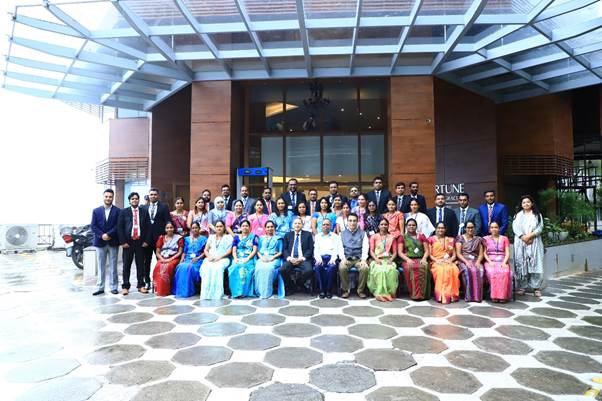
 The National Centre for Good Governance (NCGG) has launched the 4th Capacity Building Program for senior civil servants from the Socialist Republic of Sri Lanka today at NCGG, Mussoorie. The program will be organized from 22nd July to 2nd August 2024, with 40 distinguished participants.

Shri V. Srinivas, Director General of NCGG and Secretary of the Department of Administrative Reforms and Public Grievances (DARPG) addressed the inaugural session. In his address, Shri V.Srinivas emphasized on India’s vision of ‘Viksit Bharat 2047’. He highlighted the critical role of modern infrastructure and cutting-edge technology and the policy maxim of “Maximum Governance, Minimum Government.”  Highlighting India’s commitment to good governance through policies focused on social justice, transparency and accountability, aiming to provide equal opportunities for all citizens.

During the programme, Dr. AP Singh, Associate Professor, provided an overview of NCGG’s workings and the program’s focus. The program includes lectures on topics such as the Changing Paradigm of Governance, Overview of Indian Services, Climate Change and its Impact on Biodiversity: Policies and Global Practices, Right to Service: Ease of Living, E-Office, Planning and Building Eco-Friendly Smart Cities, Public-Private Partnerships, Digital India, Land Records Management (Swamitva Scheme & DILRMP), India’s Growth Story, Disaster Management, and Approaches to Achieving SDGs by 2030, among others. Participants will also visit key institutions and sites, including the Indira Gandhi Forest National Academy, Forest Research Institute, District Attachment to Panchkula, Cyber Crime Centre in Chandigarh, National Institute of Solar Energy, International Solar Alliance, Pradhanmantri Sanghralaya, and the Taj Mahal.

This program aims to educate participants on India’s good governance and advanced technology models, facilitating the implementation of better governance practices in Sri Lanka. The National Centre for Good Governance (NCGG), in partnership with MEA, has imparted training to civil servants of 17 countries, viz. Bangladesh, Kenya, Tanzania, Tunisia, Seychelles, Gambia, Maldives, Sri Lanka, Afghanistan, Laos, Vietnam, Nepal, Bhutan, Myanmar, Ethiopia, Eritrea, and Cambodia.

A group of people posing for a photoDescription automatically generated

****

Government initiatives to increase Hydrocarbon Production

 The government has been taking various steps to increase hydrocarbon production whichinter- alia include:

  1. Policy for Relaxations, Extensions and Clarifications under Production Sharing Contract (PSC) regime for early monetization of hydrocarbon discoveries, 2014.
  • ii. Discovered Small Field Policy, 2015.
  1. Hydrocarbon Exploration and Licensing Policy (HELP), 2016.
  2. Policy for Extension of Production Sharing Contracts, 2016 and 2017.
  3. Policy for early monetization of Coal Bed Methane 2017
  4. Setting up of National Data Repository, 2017. Further, the National Data Repository (NDR) is now being further upgraded to a cloud-based system for seamless dissemination of Exploration & Production data to global investors.
  5. Appraisal of Un-appraised areas in Sedimentary Basins under National Seismic Programme, 2017;
  6. Re-assessment of Hydrocarbon Resources, 2017.
  7. Policy framework to streamline the working of Production Sharing Contracts in Pre- NELP and NELP Blocks, 2018.
  8. Policy framework for extension of Production Sharing Contracts for Discovered Fields and Exploration Blocks under Pre-New Exploration Licensing Policy (Pre-NELP), 2016 and 2017.
  9. Policy to Promote and Incentivize Enhanced Recovery Methods for Oil and Gas, 2018.
  10. Policy framework for exploration and exploitation of Coal Bed Methane (CBM) from areas under Coal Mining Lease allotted to Coal India Limited (CIL) and its subsidiaries, 2018.
  11. Policy Framework for exploration and exploitation of Unconventional Hydrocarbons under Existing Production Sharing Contracts (PSCs), Coal Bed Methane (CBM) Contracts and Nomination Fields, 2018.
  12. Reforms in Hydrocarbon Exploration and Licensing Policy for enhancing domestic exploration and production of oil and gas, 2019.
  13. Natural Gas Marketing Reforms, 2020.
  14. Reforms in Model Revenue Sharing Contracts (RSCs) for Blocks under Open Acreage Licensing Programme (OALP), 2023.
  15. Lower Royalty Rates, Zero Revenue Share (till Windfall Gain) and no drilling commitment in Phase-I in OALP Blocks under Category II and III to attract bidders.
  16. Release of about 1 Million Sq. Km. ‘No-Go’ area in offshore which were blocked for exploration for decades. In these erstwhile ‘No-Go’ area, after the release now, so far bids/ expression of interests received for 1,52,325 Sq. Km. area.Two gas discoveries have also been made by ONGC in Mahanadi offshore recently in a block having 94% area in ‘No-Go’ area.  Andaman offshore area has also been opened for exploration and production activities after a long time post removal of restrictions imposed by defence and space agencies in 2022.
  17. Till now, 12 hydrocarbon discoveries have been made in blocks awarded under OALP, one already producing gas (0.44 MMSCMD) and condensate (819 BBL/Day) in Gujarat while other discoveries are under appraisal.
  18. Government is spending about Rs.7500 Cr. for acquisition of seismic data in onland and offshore areas and drilling of stratigraphic wells to make quality data of Indian Sedimentary Basins available to bidders.
  19. Government has also approved acquisition of additional 2D Seismic data of 20,000 LKM in onland and 30, 000 LKM in offshore beyond Exclusive Economic Zone (EEZ) of India.
  20. Production of Coal Bed Methane (CBM) has reached 2 Million Standard Cubic Meters per day and will increase further in coming years. More blocks are being identified for offer in future bid rounds.
  21. Cumulative production from Discovered Small Fields (DSF) till FY 2023-24 are ~5,56,000 bbl Oil and ~139 MMSCM Gas. More fields are being planned for offer in future rounds.

Various steps have been taken to reduce import of crude oil. These inter alia include demand substitution by promoting usage of natural gas as fuel/feedstock across the country towards increasing the share of natural gas in economy and moving towards gas based economy, promotion of renewable and alternate fuels like ethanol, second generation ethanol, compressed bio gas and biodiesel, refinery process improvements, promoting energy efficiency and conservation, efforts for increasing production of oil and natural gas through various policies initiatives, etc. To give a major thrust to Ethanol Blending Programme, Government of India through Oil Marketing Companies (OMCs) is establishing 2G Ethanol plants across the country.Also, for promoting the use of Compressed Bio Gas (CBG) as automotive fuel, Sustainable Alternative Towards Affordable Transportation (SATAT) initiative has been launched.

Major steps taken by Government for Water Conservation and Rainwater Harvesting to reduce Water Stress in the country

 Water conservation through rainwater harvesting is one of the foremost priorities of the Government, stated Union Minister of State for Jal Shakti, Shri Rajbhushan Choudhary, while giving a written reply to a question in Rajya Sabha today. Major steps taken by the Government for water conservation and rainwater harvesting to reduce water stress in the country are as follows:

  1. Government of India has been implementing a scheme namely Mahatma Gandhi National Rural Employment Guarantee Scheme (MGNREGS) which inter-alia includes water conservation and water harvesting structures.
  2. Financial assistance is given to various States under 15th Finance Commission tied grants which can be inter-alia utilized for rainwater harvesting.
  3. The Ministry of Jal Shakti has been implementing Jal Shakti Abhiyan (JSA) since 2019 on an annual basis. In the current year, Ministry of Jal Shakti is implementing Jal Shakti Abhiyan: Catch the Rain (JSA: CTR) 2024, 5th in the series of JSAs, in all the districts (rural as well as urban) of the country. JSA: CTR is a convergence of various Central Government schemes and funds like MGNREGS, Atal Mission for Rejuvenation and Urban Transformation (AMRUT), Per Drop More Crop, Repair, Renovation and Restoration Components under the Pradhan Mantri Krishi Sinchai Yojana (PMKSY), Compensatory Afforestation Fund Management and Planning Authority (CAMPA), Finance Commission grants, State Government schemes, Corporate Social Responsibility (CSR) funds etc. One of the major interventions undertaken under the campaign includes constructions and repair or rainwater harvesting structures including rooftop and water harvesting structures.
  4. Atal Mission for Rejuvenation and Urban Transformation (AMRUT) 2.0 has provisions for harvesting the rainwater through storm water drains into water body (which is not receiving sewage/effluent). Through preparation of ‘Aquifer Management Plan’ cities targets to strategize groundwater recharge augmentation by developing a roadmap for improving rain water harvesting within city limits. Through IEC campaign, awareness is created about practices for water conservation like rainwater harvesting.
  5. Ministry of Housing & Urban Affairs has formulated guidelines for the States to adopt measures suitable to local conditions, such as Unified Building Bye Laws (UBBL) of Delhi, 2016, Model Building Bye Laws (MBBL), 2016 and Urban and Regional Development Plan Formulation and Implementation (URDPFI) Guidelines, 2014 with adequate focus on requirement of rainwater harvesting and water conservation measures.
  6. Government of India is implementing Atal Bhujal Yojana, in 8,213 water stressed Gram Panchayats (GPs) in 80 districts of 7 States, viz., Haryana, Gujarat, Karnataka, Madhya Pradesh, Maharashtra, Rajasthan and Uttar Pradesh. The scheme marks a paradigm shift from groundwater development to groundwater management.
  7. Government of India has been implementing “Pradhan Mantri Krishi Sinchai Yojana (PMKSY)” with an aim to enhance physical access of water on farm and expand cultivable area under assured irrigation, improve on farm water use efficiency, introduce sustainable water conservation practices etc. PMKSY has three components/ schemes namely Har Khet Ko Pani (HKKP), Repair, Renovation & Restoration (RRR) Scheme of Water Bodies and Surface Minor irrigation (SMI) Scheme.
  8. The Ministry of Jal Shakti has set up the Bureau of Water Use Efficiency (BWUE) under the National Water Mission on 20.10.2022, to act as a facilitator for promotion of improving water use efficiency across various sectors namely irrigation, drinking water supply, power generation, industries, etc. in the country.
  9. Mission Amrit Sarovar was implemented in the recent times with provisions for creation/rejuvenation of at least 75 Amrit Sarovars in every district of the country with the purpose to harvest and conserve water.
  10. Central Ground Water Board (CGWB) has completed the National Aquifer Mapping (NAQUIM) Project in the entire mappable area of about 25 lakh sq. km. which has been shared with the respective State agencies for implementation. The management plans include various water conservation measures through recharge structures.
  11. CGWB has also prepared a Master Plan for Artificial Recharge to Groundwater- 2020 in consultation with States/UTs which is a macro level plan indicating various structures for the different terrain conditions of the country including estimated cost. The Master Plan has provisions for construction of about 1.42 crore Rain water harvesting and artificial recharge structures in the country to harness 185 Billion Cubic Metre (BCM) of monsoon rainfall.
  12. CGWB, under Ground Water Management and Regulation Scheme, has also implemented several successful artificial recharge projects in the country for demonstrative purpose which enable the State Governments to replicate the same in suitable hydro-geological conditions.
  13. National Water Policy (2012) has been formulated by Department of Water Resources, RD & GR, which inter-alia advocates rainwater harvesting and conservation of water and also highlights the need for augmenting the availability of water through direct use of rainfall.
  14. Department of Land Resources (DoLR) implements Watershed Development Component of Pradhan Mantri Krishi Sinchai Yojana (WDC-PMKSY) for the development of rainfed and degraded lands in the country. The activities undertaken, inter-alia, include ridge area treatment, drainage line treatment, soil and moisture conservation, rainwater harvesting, nursery raising, pasture development, livelihoods for asset-less persons etc. WDC-PMKSY, through these interventions, seeks to ensure sustainable development through improved natural resource management and better resilience of farmers to climate change.

Water is a State subject and the Central Government supplements the efforts of the States through technical and financial support, the Minister added.

*****

Carbon Emission in India

 Despite being one of the fastest-growing economies in the World, India’s annual per capita carbon emission is only about one-third of the global average, states Economic Survey 2023-24, which was tabled in Parliament today by Union Minister of Finance and Corporate Affairs, Smt. Nirmala Sitharaman.

Delving further into India’s achievements on addressing climate change, the Survey quoted a recent report by the International Finance Corporation, which highlighted that India is the only G20 nation in line with 2-degree centigrade warming. The survey further mentioned that the hallmark of India’s growth strategy is to manage the impact of climate change and at the same time give desired focus to developmental priorities.

Significant Progress Made by India on Climate Action

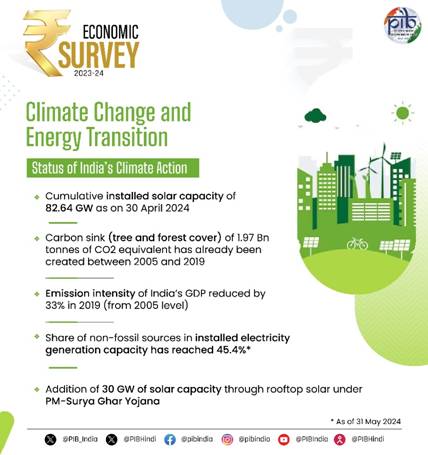
India achieved most targets of the first NDC well in advance. Nation achieved 40 per cent cumulative electrical power installed capacity from non-fossil fuel-based energy sources in 2021 and reduced the emission intensity of India’s GDP from 2005 levels by 33 per cent in 2019– nine and eleven years before the target year of 2030, respectively.

Further, as of 31 May 2024, the share of non-fossil sources in the installed electricity generation capacity has reached 45.4 per cent up from 32 per cent in April 2014. India is also on track to make an additional carbon sink of 2.5 to 3.0 billion tonnes through tree and forest cover by 2030, with a carbon sink of 1.97 billion tonnes of CO2 equivalent having already been created from 2005 to 2019.

India’s GDP between 2005 and 2019 has grown with a Compound Annual Growth Rate (CAGR) of about seven per cent, whereas the emissions grew at a CAGR of about four per cent. i.e., the rate of emissions growth is lower than the rate of growth of our GDP. This shows that India has successfully decoupled its economic growth from greenhouse gas emissions, reducing the emission intensity of its GDP.

India’s total adaptation-relevant expenditure has increased from 3.7 per cent of GDP in 2015-16 to 5.60 per cent of the GDP in 2021-2022, indicating integration of climate resilience and adaptation into development plans.

Low Carbon Development and Energy Composition

India’s energy needs are expected to grow 2 to 2.5 times by 2047 to meet a growing economy’s developmental priorities and aspirations. Considering that resources are limited, the survey pointed out that the pace of energy transition would need to factor in alternative demands on the resources for improving resilience to climate change and for sustained social and economic development.

Challenges for Energy Transition and Way Forward

Highlighting various challenges to India’s development of a low-carbon path, Economic Survey mentioned that expanding renewable energy and clean fuels will increase demand for land and water. Most renewables are land-intensive and demand the highest land use requirements among the different energy sources. Further, the expansion of renewable energy requires battery storage technologies which in turn require the availability of critical minerals and the source of such minerals is geographically concentrated.

Recognising the importance of energy efficiency measures in accelerating clean energy transitions while supporting energy security, the Survey highlighted several initiatives taken by the Government to improve energy efficiency. Some of them include implementing Energy Conservation Building Code (ECBC) for buildings, Standards and Labelling (S&L) and Star-rated program for appliances, Lifestyle for Environment (LiFE) initiative for encouraging the adoption of sustainable lifestyles, Perform, Achieve, and Trade (PAT) scheme for industrial sector, and Charging Infrastructure for Electric Vehicles for transport sector, among others.

All above mentioned initiatives translates to a total annual cost savings of approximately ₹1,94,320 Crore and an annual CO2 emissions reduction of around 306 million tonnes.

Finance for Sustainable Development

The Survey outlines that country has taken many measures to improve the business environment and catalyse greater quantum of resources. The Government undertook the issue of sovereign green bonds amounting to ₹16,000 Crore in January-February 2023 to raise proceeds for public sector projects that would contribute to the efforts to reduce the intensity of the economy’s emissions, followed by ₹20,000 Crore raised through sovereign green bonds in October-December 2023.

Further, RBI has implemented the Framework for Acceptance of Green Deposits for the Regulated Entities to foster and develop a green finance ecosystem in the country. In addition, the RBI promotes renewable energy through its Priority Sector Lending (PSL) rules.

India’s Innovative Green Credit Program

The Survey talks about the Government of India’s Mission LiFE, which is envisaged as a mass movement to address climate change and foster sustainable living based on conservation and moderation principles. It further states that to bolster LiFE’s effort and encourage eco-friendly practices, the Government also supports voluntary environmental actions such as the Green Credit Programme (GCP), which incentivises individuals, communities, private sector industries, and companies to participate in environment-positive activities by offering green credits as rewards.

India leading International Initiatives Addressing Climate Change Issues

The survey extensively talks about India leading several international initiatives towards climate change mitigation and building resilience. The International Solar Alliance (ISA), One World, One Sun, One Grid (OSOWOG), the Coalition for Disaster Resilient Infrastructure (CDRI), the Infrastructure for Resilient Island States’ (IRIS) and the Leadership Group for Industry Transition (LeadIT) are some of such important examples.

******