National Workshop on Higher and Technical Education with Secretaries of States/UTs

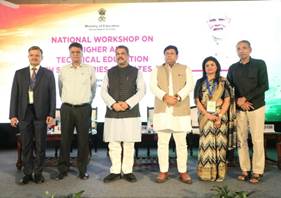
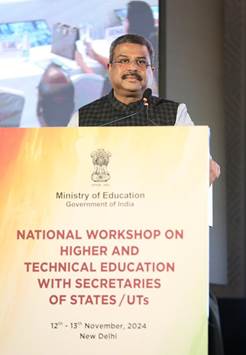
Union Minister for Education, Shri Dharmendra Pradhan, inaugurated a two-day National Workshop on Higher and Technical Education with Secretaries of States/UTs in New Delhi today. Minister of State for Education and the Development of North Eastern Region, Dr. Sukanta Majumdar, was also present at the event. Secretary, Department of Higher Education, Shri K. Sanjay Murthy; Additional Secretary, Department of Higher Education, Shri Sunil Kumar Barnwal; Chairman, UGC, Prof. M. Jagadesh Kumar; Joint Secretary, Department of Higher Education, Smt. Manmohan Kaur; Secretaries of States/UTs, academicians, Head of the Institutes, and officials of the Ministry were also present.
Image

While addressing the event Shri Pradhan said that the workshop will serve as a platform for rigorous academic brainstorming, particularly how education can bring substantive improvements in furthering ease of living, enhancing per capita income and achieving national priorities set by Prime Minister Shri Narendra Modi. He also said that the country has to become a producing economy by utilising the opportunities presented by Industry 4.0 and leapfrog and develop the education infrastructure that surpasses global standards. Education infrastructure is a multi-dimensional concept and beyond just developing brick-and-mortar structures, he added.
Image

The Minister suggested five key areas for the academic leaders and administrators to focus on. These were strengthening public universities through innovative modes of funding; setting up think tanks for aligning and tailoring curriculum as per the demand of industry and also as per the needs and aspirations of states/UTs; adopting a multidisciplinary approach to research and innovation for assuming leadership in solving global problems; promoting Academic Leadership Development Programmes in each state/UT through collaborations with eminent central/state institutions; and reviving vibrancy of campus life through sports, debate, poetry, drama, performing arts (already creditized through NEP) and giving primacy to these non-scholastic areas.

Shri Pradhan also emphasised the importance of teaching in Indian languages. Stressing the accountability towards the students of the country, he said everyone will have to work together to establish India’s global leadership in education.

Dr. Sukanta Majumdar, in his address, expressed his gratitude to Prime Minister Shri Narendra Modi for his vision to reshape India’s educational landscape through the National Education Policy (NEP) 2020. NEP is not just a policy; it is a roadmap to make India a global knowledge superpower, he added. Highlighting the five pillars of NEP 2020, which are access, equity, quality, affordability, and accountability, Dr. Majumdar said that these are the foundation for a modern, inclusive, and globally competitive education system. He urged the states and UTs to adopt NEP 2020 in both its letter and spirit. By implementing the policy, states can foster economic growth, build a skilled workforce, and enhance innovation and technological advancement, he said.

Shri K. Sanjay Murthy, in his address, set the context for the workshop. He briefly described the 14 technical sessions that would be held during the event. He also highlighted the key factors that emerged from serious deliberations over the past three years and mentioned that twenty guidelines have been developed, providing a framework for the universities. Additionally, he expressed his gratitude to Shri Dharmendra Pradhan for spearheading the implementation of NEP 2020 and for offering valuable guidance through his insights.

The objective of this workshop is to disseminate various approaches and methodologies to implement NEP 2020; effectively articulate the roadmap and implementation strategies, fostering knowledge exchange; provide a common platform for all stakeholders to come together and network for effective and smooth implementation of the NEP 2020 and encourage its adoption in state institutions, paving the way for a more robust, inclusive, and globally competitive education system across India.

Adopting NEP 2020 offers numerous benefits for states’ higher education systems. It can drive economic growth by creating a more skilled workforce, attracting investments, and boosting development. By aligning higher education with international standards, it enhances the global competitiveness of states’ education systems, potentially attracting more international students and collaborations. The policy’s emphasis on research and a multidisciplinary approach fosters innovation ecosystems within states, leading to technological advancements and economic benefits.

Successful implementation of NEP 2020 in higher education requires active participation and commitment from state governments. By leveraging central government schemes and aligning state policies with NEP 2020, states have the opportunity to transform their education systems to meet the challenges of the 21st century while preserving their unique cultural identities.

During this two-day workshop, 14 technical sessions on the themes of NEP 2020 Implementation – Challenges and Roadmap; Technology in Education; Collaboration in Education; Digital Governance; Capacity Building & Leadership; and Financing of Higher Education are going to be held by eminent panellists.

*****
Johns Hopkins University and Gupta-Klinsky India Institute

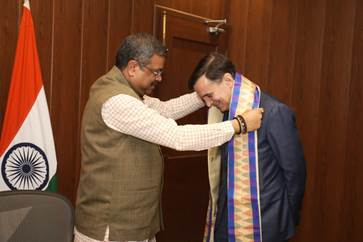
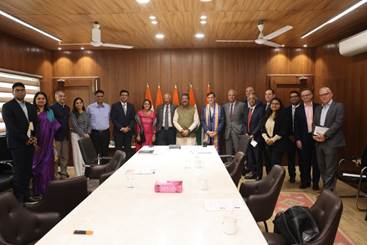
Union Minister for Education Shri Dharmendra Pradhan today met with a high-level delegation led by Mr. Ronald J. Daniels, President, Johns Hopkins University (JHU), Baltimore, Maryland, USA. The delegation also included officials from Gupta Klinsky India Institute (GKII), an internal unit of JHU with a mandate to bring the JHU community with Indian partners through research, education, policy and practice.

Secretary, Higher Education, Shri K. Sanjay Murthy; senior officials of the Department of Higher Education, Ministry of Education and Ministry of External Affairs attended the meeting.

Image

Shri Pradhan highlighted the transformative opportunities enabled by the National Education Policy 2020 (NEP 2020), which has paved the way for academic collaborations and advancing India’s education sector. Shri Pradhan appreciated the university’s commitment towards building robust partnerships with Indian HEIs, contributing to the global exchange of knowledge, particularly in the areas of dual and joint degree programmes, two-way mobility of students and faculty, and research partnerships in emerging fields like data science, artificial intelligence, and futuristic technologies. He emphasised the potential for these collaborations to foster innovation and entrepreneurship among students in both nations.

The discussion centred on strengthening academic and research collaborations between JHU and premier Indian Higher Education Institutions (HEIs). The delegation actively discussed establishing an offshore JHU campus in India.

Image

The visit by Mr. Daniels and the delegation highlights the growing significance of India-US educational cooperation. As part of their multi-city tour of India, the delegation will visit various Indian university campuses and engage with key government officials, academic leaders, and embassy representatives to strengthen JHU’s operations in India and advance the internationalisation efforts.

The 12-member delegation included distinguished academicians and administrators such as Fritz W. Schroeder, Senior Vice President for Development and Alumni Relations; Alexander Triantis, Dean of the Carey Business School; Judd Walson, Chair of the Department of International Health at the Bloomberg School; Sridevi Sarma, Vice Dean of Graduate Education at the Whiting School of Engineering; Jon Goldstein, Senior Associate Director of Development for International Programs; and Amita Gupta, Director of the Division of Infectious Diseases at Johns Hopkins University and Co-Founder of the Gupta-Klinsky India Institute (GKII).

Prominent Indian-origin faculty from JHU, such as Mathuram Santosham, Professor of Paediatrics and International Health, and Chirag Parikh, Professor of Medicine and Director of the Division of Nephrology, also participated. The delegation further included GKII officials and members of its advisory board, including Raj and Kamla Gupta, Deepak Raj, Kunal Pal, and Neetisha Besra.

*****

Over 1.76 crore school students from all 36 States and UTs participate in Project Veer Gatha 4.0

More than 1.76 crore school students from all 36 States and UTs have participated enthusiastically in Project Veer Gatha 4.0. The students have sent poems, paintings, essays, videos, etc. in honour of the acts of bravery and sacrifice of the officers/personnel of the Armed Forces.

Project Veer Gatha was instituted in 2021 with the aim of disseminating the inspiring tales of valour, selfless sacrifice and courage of the Gallantry Awardees and the life stories of these bravehearts among the students to inculcate the spirit of patriotism amongst them. Project Veer Gatha enhanced this noble aim by providing a platform for the school students to do creative projects/activities based on heroic deeds and sacrifice of gallantry award winners.

Three editions of the Veer Gatha Project have been conducted in 2021, 2022 and 2023, respectively. Under the Veer Gatha Project 4.0, the following activities have been conducted till date:

Activities at the School Level: Schools have conducted various projects/activities (from 16.09.2024 to 31.10.2024) and have uploaded a total of 4 best entries from each school, on the MyGov portal.

Simultaneously, to enrich the knowledge about the gallant heroes and unsung stories among school students, the Ministry of Defence, through its field organisations or Army/Navy/Air Force, has organized virtual meets/face-to-face awareness programmes/sessions for schools across the country.

Since its inception, the project has witnessed increasing participation of students across the country. It may be noted that 8 lakh students had participated in the Veer Gatha Project (Edition-I); 19.5 lakh students participated in the second edition and the third edition saw a participation of 1.36 crore students.

During the Veer Gatha Project Editions I and II, 25 winners (Super 25) were selected and their felicitation was done by the Ministry of Education and Ministry of Defence in New Delhi. In Veer Gatha Project 3.0, 100 winners (Super 100) were selected at the National Level. This year too, under Project Veer Gatha 4.0, 100 winners will be selected and their felicitation will be done jointly by the Ministry of Education and Ministry of Defence in New Delhi. Each winner will be awarded a cash prize of Rs. 10,000. Also, there will be 4 winners each at the District level and 8 winners each at the State/UT level and all such winners will be felicitated by the respective District & State/UT.

*****

Young athletes from Kendriya Vidyalayas and Navodaya Vidyalayas

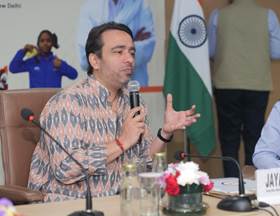
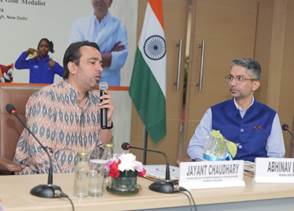
Union Minister of State for Skill Development and Entrepreneurship (Independent Charge) and Minister of State for Education, Shri Jayant Chaudhary, interacted with young athletes and para-athletes from Kendriya Vidyalayas and Navodaya Vidyalayas, who have excelled in various national and international sports events today. The first Indian to win an individual Olympic Gold and the first Indian to win a World Championship Gold in Air Rifle shooting, Shri Abhinav Bindra was also present at the event. Secretary, Department of School Education & Literacy, Shri Sanjay Kumar; Commissioner, KVS, Smt. Nidhi Pandey, and other officials of the Ministry of Education, KV and NV were also present at the event. Fourteen award-winning student-athletes interacted with the Minister and Shri Bindra, and hundreds of students and teachers from KV and JNV connected virtually in the event.

Shri Jayant Chaudhary, during his address, highlighted that the day was dedicated to celebrating the achievements of the student-athletes and expressed gratitude to Shri Bindra for sharing his insights. He stressed that sporting champions are not necessarily made on the field alone; a specific mindset, structured approach, and discipline are essential for achieving success on the field. He mentioned that both the Ministry of Education and the Ministry of Skill Development and Entrepreneurship are keen on providing exposure to various streams at a young age. Using Shri Bindra as an example, he underscored the importance of reinventing oneself and embracing lifelong learning, as emphasized in the NEP 2020.

Shri Abhinav Bindra, while interacting with the students emphasised how sports play an important role in education and expressed his gratitude to the Minister for conceiving this programme that will motivate the students. He briefly described his 22-year-long journey and the learning that he received during it. Sports taught him not about wins and losses, the importance of hard work, integrity and honesty, listening intently, respecting rules, competitors, outcomes, and self-respect, he stressed. He also mentioned three Olympic values: Excellence, Respect, and Friendship.

Shri Sanjay Kumar expressed his gratitude to Shri Jayant Chaudhary for envisioning the programme and noted that the presence of Shri Bindra among the children would serve as a source of motivation. He also highlighted how the key components and vision of the National Education Policy 2020 are being implemented in Kendriya Vidyalayas and Navodaya Vidyalayas to ensure a bright future for the students of the country.

Fourteen student-athletes—six from KV and eight from NV—shared their achievements and experiences with the dignitaries, who commended and appreciated their efforts. Additionally, several students who participated virtually had the opportunity to ask their questions to Shri Bindra, who thoughtfully addressed each of their queries.

*****