



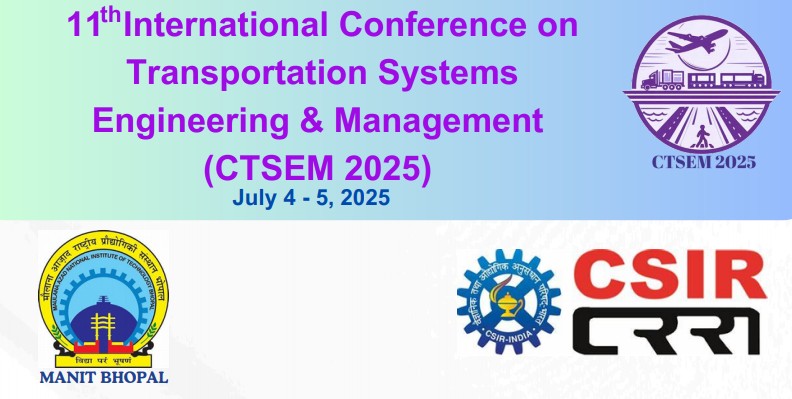
Bhopal, India – Maulana Azad National Institute of Technology (MANIT) Bhopal, in collaboration with CSIR-Central Road Research Institute (CRRI), New Delhi, is set to host the 11th International Conference on Transportation Systems Engineering & Management (CTSEM 2025) on July 4-5, 2025. The conference aims to bring together researchers, academicians, scientists, and transportation professionals to discuss emerging challenges and advancements in transportation engineering and management.
Conference Leadership
- Chief Patron: Dr. Manoranjan Parida, Director, CSIR-CRRI, New Delhi
- Conference Chairperson: Dr. P.K. Agarwal, MANIT Bhopal
- Conference Secretaries:
- Dr. Siddhartha Rokade, MANIT Bhopal
- Dr. Pritikana Das, MANIT Bhopal
- Dr. Bivina G.R., MANIT Bhopal
Conference Highlights
CTSEM 2025 will provide a platform for experts to discuss key issues related to transportation systems, including:
- Sustainable and Intelligent Transportation Solutions
- Traffic Management and Congestion Mitigation
- Road Safety and Infrastructure Development
- AI, Big Data, and IoT in Transportation
- Public Transport Planning & Management
- Urban Mobility and Non-Motorized Transport (NMT)
- Freight Transport and Logistics
The event will feature pre-conference workshops, networking sessions, technical visits, and best paper awards, making it a valuable gathering for professionals in the field.
Paper Submission and Publication Opportunities
Authors are invited to submit their full papers via the MSCMT platform by April 15, 2025, with final acceptance notifications to be sent by June 1, 2025. Selected high-quality papers will be published in SCOPUS-indexed conference proceedings by Springer, and some outstanding papers will be considered for publication in the Journal of Traffic and Transportation Engineering (JTTE) by Elsevier.
Sponsorship Opportunities
CTSEM 2025 welcomes industry sponsors to participate, with sponsorship categories ranging from Platinum (INR 3 lakhs) to Bronze (INR 0.5 lakh). Sponsors will receive branding and promotional benefits, exhibition space, and recognition during the conference.
About MANIT Bhopal and CSIR-CRRI
MANIT Bhopal, one of India’s premier technical institutions, has been at the forefront of engineering education and research. The Civil Engineering Department is a key center for academic excellence, fostering innovative solutions for urban and rural transportation challenges. CSIR-CRRI, a leading research institute, is known for its contributions to road and transportation planning, playing a crucial role in shaping India’s infrastructure.
Venue and Connectivity
The conference will be held at MANIT Bhopal, located in the heart of Bhopal City, known as the City of Lakes. Bhopal is well-connected by air, rail, and road, with the campus just 20 km from the airport and 8 km from the railway station.
Contact Information
CTSEM 2025 Organizing Committee
Transportation Engineering Division, Civil Engineering Department
Maulana Azad National Institute of Technology (MANIT), Bhopal, India
Email: ctsem2025manit@gmail.com
Website: CTSEM 2025
With a rich history of successful editions hosted by reputed institutions across India, CTSEM 2025 at MANIT Bhopal promises to be an enriching event for professionals in the transportation sector. Don’t miss the opportunity to be part of this significant international conference!
 Eduindex
You must be logged in to post a comment.