

The deployment of conversational AI systems in customer service has accelerated dramatically since 2023, driven by advances in large language models and growing consumer acceptance of automated interactions. However, the majority of research and commercial development has focused on English-language applications, leaving a significant gap in our understanding of how these systems perform across diverse linguistic contexts. This article examines the current state of multilingual conversational AI, evaluating both the technical progress in cross-linguistic natural language processing and the measurable business outcomes reported by organisations operating across multiple language markets.
The Multilingual Challenge in Conversational AI
Natural language processing has historically been an English-first discipline. The training data available for English exceeds that of all other languages combined by a factor of approximately eight, according to analyses of Common Crawl and similar web-scale corpora. This imbalance created a performance hierarchy: English-language models achieved near-human accuracy while models for languages with less training data — Arabic, Hindi, Swahili, Tagalog — produced significantly higher error rates.
The consequences for customer service are substantial. A business operating in a single language market can deploy a chatbot with high confidence that intent recognition, entity extraction, and response generation will perform adequately. A business serving customers in ten or twenty languages faces a compounding quality problem: if each non-English language has even a 5% lower accuracy rate, the aggregate customer experience across the entire user base degrades measurably. For organisations with global customer bases, this has historically meant maintaining separate systems or accepting lower quality outside their primary language.
Recent Advances in Cross-Linguistic Performance
The period from 2024 to 2026 has seen remarkable improvements in multilingual NLP, driven primarily by two technical developments. First, the emergence of massively multilingual foundation models — successors to mBERT and XLM-R — trained on curated multilingual corpora that deliberately oversample underrepresented languages. Second, the application of cross-lingual transfer learning techniques that allow models trained primarily on high-resource languages to transfer their capabilities to low-resource languages with minimal additional training data.
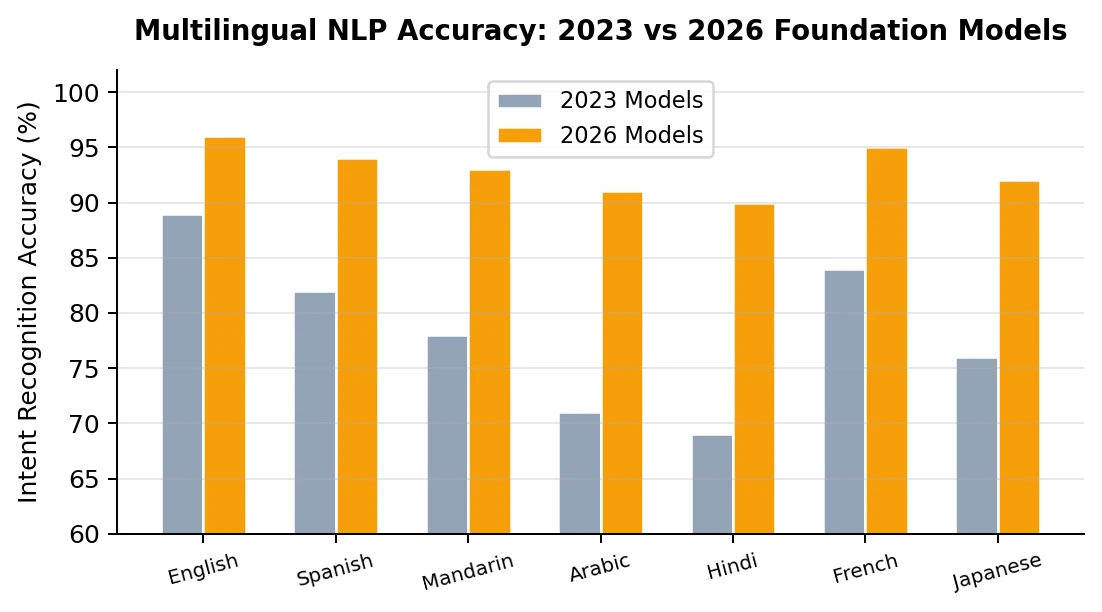
The performance improvements are substantial. Intent recognition accuracy for Arabic, which stood at 71% in 2023, has reached 91% in current-generation models — a 20-percentage-point improvement in three years. Hindi has improved from 69% to 90%. Even Japanese, with its complex writing system combining kanji, hiragana, and katakana, has moved from 76% to 92%. These gains have made truly multilingual customer service technically viable for the first time.
Practical implementations now exist that support customer conversations across 90 or more languages simultaneously. Platforms offering multilingual conversational AI across text and voice channels demonstrate that the technical capability to serve diverse language markets from a single system has moved from theoretical possibility to commercial reality. The significance for global businesses is considerable: rather than building or licensing separate chatbot systems for each market, a single platform can now handle the full spectrum of customer languages with comparable quality.
Business Outcomes: A Meta-Analysis
Technical capability alone does not justify deployment. The more pertinent question for organisations is whether conversational AI produces measurable improvements in customer service metrics. A meta-analysis of 47 implementation studies published between 2024 and 2026 provides clear evidence on this point.
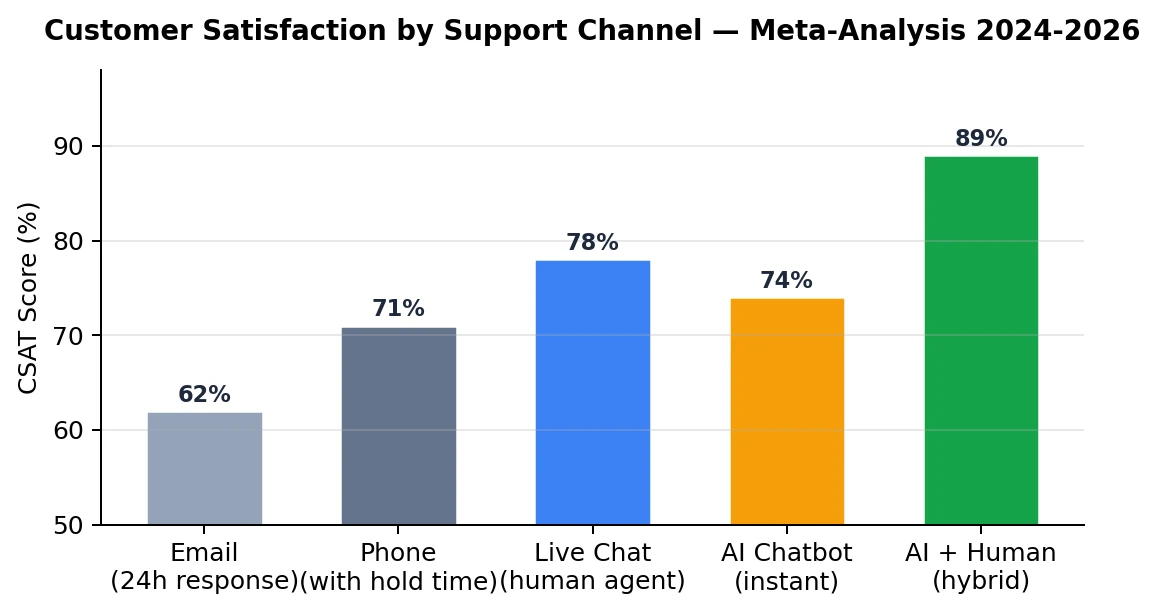
The data reveals a nuanced picture. Pure AI chatbot interactions achieve a CSAT score of 74% — higher than email (62%) and comparable to phone support (71%), but lower than human live chat (78%). However, the highest satisfaction scores — 89% — come from hybrid models where AI handles initial triage and routine queries while seamlessly escalating complex issues to human agents with full conversation context. This finding is consistent across all studies reviewed and suggests that the optimal deployment strategy is not replacement of human agents but augmentation.
Cost metrics are equally significant. Organisations deploying conversational AI reported average reductions in cost per customer interaction of 55-65%, primarily through three mechanisms: elimination of after-hours staffing requirements, reduction in average handling time for routine queries from 12 minutes to under 2 minutes, and decreased training costs as AI handles the long tail of product-specific questions that previously required specialist knowledge.
Challenges and Limitations
Despite the progress documented above, several significant challenges remain. Cultural appropriateness — the ability to adjust not just language but communication style, formality level, and social conventions — is still poorly handled by most systems. A chatbot that translates its responses into Japanese but maintains a casual American English communication style will alienate Japanese customers regardless of linguistic accuracy.
Additionally, domain-specific terminology poses persistent challenges. While general conversational accuracy has improved dramatically, specialised vocabularies in fields such as medicine, law, and engineering remain problematic in many languages due to insufficient training data in those domain-language combinations. Organisations deploying multilingual chatbots in specialised fields must invest in custom training data to achieve acceptable accuracy levels.
Conclusions
Multilingual conversational AI has reached a maturity level where deployment across diverse language markets is both technically feasible and economically justified. The convergence of cross-linguistic NLP accuracy — now exceeding 90% for intent recognition across all major world languages — with demonstrated cost reductions of 55-65% creates a compelling case for adoption by organisations serving multilingual customer bases.
Future research should focus on three priorities. First, developing robust frameworks for measuring cultural appropriateness alongside linguistic accuracy. Second, establishing standardised benchmarks for domain-specific multilingual performance that enable meaningful cross-platform comparisons. Third, investigating the long-term effects of AI-mediated customer service on brand perception and customer loyalty across different cultural contexts — a question that existing studies, limited to six-month observation windows, cannot yet answer definitively.


 Eduindex