As online trading continues to expand in Nigeria, more users are evaluating international platforms that promise access to global markets. Among them, IQ Option remains one of the most discussed names, raising questions about both legitimacy and security.
As covered by Tribune Online, the platform has been operating for over a decade and serves millions of users across different regions. While longevity can indicate stability, traders still need to assess how the platform functions and what safeguards are actually in place.
From a security perspective, IQ Option follows standard industry protocols. It operates under SKY LADDER LLC, registered in Antigua and Barbuda, and implements SSL encryption to protect data transmission. Account-level protection includes two-factor authentication, which adds an extra verification step during login. Another structural element is the separation of client funds from company funds—this is intended to prevent misuse and ensure that user balances are not tied to operational expenses.
Functionality plays a major role in evaluating platform safety. IQ Option offers a multi-asset environment where users can trade forex pairs, cryptocurrencies, stocks via CFDs, commodities, indices, and options. Having all instruments accessible within one interface simplifies the trading process, especially for users who want to diversify without switching platforms. The system also includes analytical tools such as RSI, MACD, and Bollinger Bands, which help traders interpret price movements and make more informed decisions.
One of the more notable features is how the platform structures risk. Unlike margin-based systems where losses can exceed deposits, IQ Option limits the maximum loss to the amount placed on a trade. This means traders cannot accumulate debt through trading activity. Additional tools enhance this control:
Stop-loss orders automatically close positions to limit downside risk
Take-profit settings secure gains once a target level is reached
Early closure allows traders to exit positions before expiration
Price alerts notify users when specific levels are reached
These mechanisms are built into the platform rather than offered as optional add-ons, which contributes to a more controlled trading environment.
Despite these safeguards, user feedback reveals some recurring concerns. Most complaints are related to withdrawal timing, particularly when accounts are undergoing verification. This process—commonly known as KYC (Know Your Customer)—requires identity and address confirmation before funds can be released. While standard across financial platforms, it can create delays if users are unprepared. Another common issue involves bonus terms, where traders activate promotions without fully understanding the conditions attached.
The onboarding process itself is relatively straightforward. New users can begin with a demo account that includes virtual funds, allowing them to explore the interface risk-free. Transitioning to a live account requires a minimum deposit, and Nigerian users can fund accounts through local payment systems. Withdrawals are processed back to local bank accounts, typically within several working days depending on verification status.
It is also important to consider regulatory context. IQ Option does not hold a Nigerian SEC license, which means it operates without local regulatory oversight. For some traders, this may be a significant factor when evaluating trust and accountability. Others may prioritize functionality, accessibility, and global presence instead.
In practical terms, the platform’s safety depends not only on its technical infrastructure but also on how it is used. Trading inherently involves financial risk, and no system can eliminate the possibility of loss. Tools and protections can reduce exposure, but they cannot replace strategy, discipline, or market understanding.
Overall, IQ Option presents itself as a legitimate trading platform with established security measures and operational history. For Nigerian traders, the key is to approach it with realistic expectations: use the demo environment first, understand all terms—especially bonuses—and ensure full account verification before initiating withdrawals.
Daily writing prompt
What are the biggest benefits of minimalist living?
Barabat, M., & Junio, O. (2026). Design And Implementation of a Blockchain-Based Certificate Management System for the Office of the Registrar of Cavite State University – Trece Martires City Campus. International Journal of Research, 4(13). https://doi.org/10.26643/ijr/edupub/17
Marjorie Barabat, Oliver Junio
c1-241-02095@uphsl.edu.ph, omj@uphsl.edu.ph
University of Perpetual Help System Laguna
Abstract
It is essential for educational institutions to possess efficient, transparent, and dependable administrative services that manage student information and certificates. The Office of the Registrar is responsible for maintaining confidential records, including grades, registration details,
and certificates. However, when these offices are required to perform tasks manually and on paper, they encounter numerous challenges. Traditional methods frequently result in errors, delays, and susceptibility to tampering, thereby diminishing the reliability of academic records and impeding
service delivery. At Cavite State University—Trece Martires City Campus, computer systems remain incompatible, and certificates continue to be distributed manually. Emerging technologies
such as web-based tracking, automation, and blockchain have been considered potential solutions;
however, options remain limited at present. Typically, they concentrate on one aspect or the other,
but never concurrently.
Smart contracts, blockchain technology, and the idea of making computers run themselves are what the answer is based on. Three things work together to keep them safe and healthy. The blockchain is what the system is built on. Student records are safe from fraud and cannot make any changes since this is under the use of blockchain, tampering credentials is not accessible in this system. This system assures the user that they process the request for the right owner of the credentials. It also easier to do administrative tasks, it lessens the manual work for the registrar employee all the process is automated, faster work and more accurate process. The Registrar’s Office can add information of the students to process the request of the certificates in blockchain- based certificate management system since it is the safe way to get the request of the student. On the blockchain check credentials quickly and since the system are created with blockchain, smart contracts, and automation, the certificates cannot be tampered. It will gain more trust to the university transaction in terms of releasing student credentials. The risk of fake certificates goes down, and it easier for students and employers to check them and it helps Cavite State University – Trece Martires City Campus to have a better manage certificates.
The ISO/IEC 25010:2011 software quality model was utilized to thoroughly evaluate the system, with feedback gathered from students, registrar staff, and IT experts. As anticipated, the acceptance scores remained high, falling within the “Excellent” range. The system received an average score of 4.85 from students, indicating that it performed well in terms of user interaction, safety, and security. However, it could benefit from the ability to integrate with other systems and adapt to changing circumstances. Registrar employee rating the system with a high average score of 4.96, reflecting their strong approval. They rated it highly in safety, dependability, functionality, and performance, suggesting confidence that it would enhance operational efficiency at the institution. IT experts provided a mean score of 4.95, praising its safety, security, ease of maintenance, and flexibility. They proposed strategies to improve its functionality and performance. A Cronbach’s alpha of 0.870 indicates that the evaluation tool demonstrates high reliability, making it trustworthy. Overall, the results affirm that the blockchain-based certificate management system is safe, reliable, and effective. Consequently, it is suitable for immediate implementation in educational institutions to meet their long-term needs.
The results indicate that the blockchain-based certificate management system is a reliable, secure, and effective method for tracking academic records and digital credentials. It effectively meets user needs by ensuring that the processes for issuing and verifying certificates are accurate, transparent, and difficult to alter. This technology safeguards records against unauthorized changes, thereby enhancing data integrity. Additionally, it streamlines and accelerates transactions
at the Registrar’s Office, increasing overall efficiency. The consistently high ratings from students,
registrar staff, and IT experts demonstrate a strong confidence in its functionality, user- friendliness, and technical performance. This overwhelmingly positive feedback suggests that the system is both practical and suitable for real-world application. In summary, the results indicate that the system is ready for implementation in educational institutions, with opportunities for continued improvement to maintain its usefulness, adaptability, and reliability over time.
Introduction
The study emphasizes the critical role of efficient, transparent, and secure management of academic records and certificates in higher education institutions. It identifies the Office of the Registrar as the central unit responsible for handling sensitive student data, including grades and credentials. However, traditional paper-based and manual processes remain prevalent, leading to inefficiencies, delays, human errors, and vulnerability to document tampering. These issues are particularly evident at Cavite State University – Trece Martires City Campus, where limited system integration and reliance on manual workflows hinder effective certificate management.
The introduction highlights emerging technologies—such as web-based systems, automation, and blockchain—as potential solutions to these challenges. Prior studies suggest that while these technologies improve accuracy, efficiency, and security, existing implementations often address only isolated aspects rather than providing a comprehensive solution. Blockchain technology, in particular, is recognized for its decentralized and immutable nature, enabling secure, tamper-proof, and transparent verification of academic credentials while reducing reliance on intermediaries.
Despite these advancements, a gap persists in the local implementation of integrated blockchain-based certificate management systems. The study addresses this gap by proposing the design and implementation of a blockchain-based system tailored to the university’s needs. The proposed system aims to automate certificate issuance, enhance data security, prevent forgery, and improve overall administrative efficiency. Ultimately, the research seeks to modernize academic record management, strengthen trust among stakeholders, and provide a reliable, secure, and efficient mechanism for issuing and verifying academic credentials.
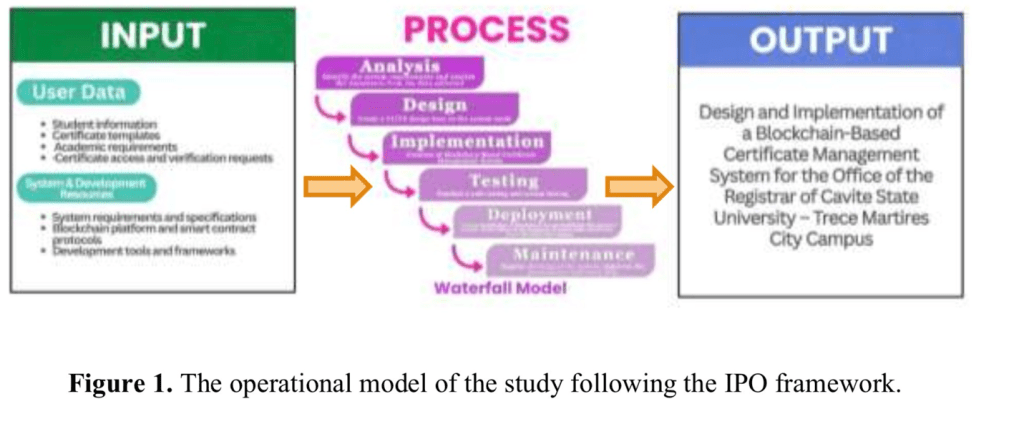
The system follows an Input–Process–Output (IPO) operational model, where inputs such as student data, certificate templates, and academic requirements are processed through system development phases (planning, analysis, design, testing, and deployment) using a structured methodology, resulting in outputs that include automated, blockchain-secured certificates and a reliable verification mechanism accessible to stakeholders. This integrated approach aims to modernize academic record management, reduce administrative burdens, prevent fraud, and strengthen trust among students, institutions, and external verifiers.
METHODOLOGY
This part presents the research methodology employed in the study, focusing on the systematic processes used to design, develop, and evaluate the proposed blockchain-based certificate management system. The study adopts a descriptive-developmental research design, which is appropriate as it not only examines existing issues in certificate management but also develops a technological solution. The research is structured into three major phases: first, analyzing the current practices of the Registrar’s Office; second, designing and developing the blockchain-based system using smart contracts; and third, evaluating the system through expert validation and user testing to determine its effectiveness and usability.
The system development follows the Waterfall Software Development Methodology, ensuring a structured and sequential approach. This includes analysis of system requirements, design of system architecture and user interface, implementation through coding and blockchain integration, testing using the ISO/IEC 25010:2011 software quality model, deployment within the Registrar’s Office, and continuous maintenance for improvements. This step-by-step process ensures that the system is thoroughly planned, tested, and aligned with institutional needs, resulting in a secure, efficient, and reliable certificate management solution.
The study utilizes both primary and secondary data sources. Primary data are gathered from key stakeholders, including registrar employees, students, and IT experts, who serve as system users and evaluators. A total of 30 participants are selected using purposive sampling to ensure relevant expertise and experience. Secondary data are obtained from existing literature on blockchain, smart contracts, and digital credentialing, providing theoretical and technical support for system development. Data collection is conducted through structured questionnaires designed to assess usability, functionality, and technical performance of the system.
To evaluate the system, the study employs a validated survey instrument based on the ISO/IEC 25010:2011 software quality model, covering key attributes such as functionality, performance efficiency, usability, reliability, security, maintainability, compatibility, flexibility, and safety. Responses are measured using a five-point Likert scale, and the results are analyzed using weighted mean scores to determine overall acceptability and effectiveness. The evaluation process ensures a comprehensive assessment of both user experience and technical quality, confirming the system’s readiness for implementation in an academic environment.
Results and Discussion
This part presents the results and interpretation of data gathered from students, registrar employees, and IT experts regarding the developed blockchain-based certificate management system. The results reveal that the existing practices in the Registrar’s Office are largely manual, characterized by paper-based processing, delays, inefficiencies, and vulnerability to errors and document tampering. These findings validate the need for a more secure, automated, and integrated system. The developed blockchain-based solution directly addresses these issues by introducing automation, secure data handling, and a transparent verification mechanism, thereby improving both administrative processes and user experience.
The evaluation of the system shows a very high level of acceptability among end users. Students rated the system with a mean score of 4.85, indicating excellent performance in usability, security, and interaction capability. Registrar employees provided an even higher mean score of 4.96, reflecting strong agreement on its effectiveness in improving efficiency, reliability, and operational performance. These results suggest that the system successfully meets user expectations by simplifying certificate requests, reducing manual workload, and ensuring faster and more accurate processing of academic credentials.
From a technical perspective, IT experts also evaluated the system positively, assigning a mean score of 4.95. The system was highly rated in terms of security, maintainability, flexibility, and overall system integrity. Experts confirmed that the integration of blockchain technology and smart contracts effectively ensures data immutability, prevents unauthorized modifications, and enables secure and transparent verification of certificates. However, they also recommended further enhancements, particularly in system integration and scalability, to improve adaptability to future institutional requirements.
Statistically, the overall evaluation demonstrates strong reliability and consistency. The use of the ISO/IEC 25010:2011 software quality model and a five-point Likert scale allowed for systematic measurement of system performance across multiple criteria. The computed Cronbach’s alpha value of 0.870 indicates high internal consistency of the evaluation instrument, confirming that the results are reliable and dependable. The consistently high weighted mean scores across all respondent groups fall within the “Excellent” range (4.20–5.00), validating the system’s effectiveness, usability, and security. Overall, the statistical analysis supports the conclusion that the blockchain-based certificate management system is a robust, efficient, and ready-for-implementation solution for improving academic record management.
Conclusion
The findings confirm that the Blockchain-Based Certificate Management System is a dependable, secure, and efficient solution for managing academic records and digital credentials. It successfully addresses user needs by delivering accurate, transparent, and tamper-resistant processes for certificate issuance and verification. The system further strengthens data integrity by safeguarding records against unauthorized modification, while enhancing operational efficiency in the registrar’s office through faster and more streamlined transactions.
Furthermore, the high level of acceptance from students, registrar employees, and IT experts demonstrates strong confidence in its functionality, usability, and technical performance. This collective positive assessment indicates that the system is both practical and suitable for real-world application. Overall, the results suggest that the system is ready for institutional deployment, with opportunities for further enhancement to sustain effectiveness and adaptability over time.
Recommendations
Based on the findings, several recommendations are proposed to further enhance the system. Although the blockchain-based certificate management system received excellent ratings overall, improvements in interaction and user experience are suggested, particularly since students gave a slightly lower score (4.73) for interaction capability. Enhancing the user interface by simplifying navigation, improving visual clarity, and incorporating more user-friendly features can make the system easier and more intuitive to use. In addition, strengthening system maintainability is essential through regular updates, comprehensive documentation, and established maintenance procedures to ensure smooth operation and easier troubleshooting.
To sustain the system’s reliability, it is also important to maintain strong security measures by conducting regular audits, vulnerability assessments, and continuous system monitoring to safeguard academic records and certificates. Furthermore, providing training sessions for both students and registrar staff will help ensure effective system utilization, while establishing a feedback mechanism will allow users to report issues and suggest improvements. By implementing these measures, the institution can further enhance the system’s performance, usability, and sustainability, ensuring its long-term effectiveness in securing and managing academic credentials.
References:
Alharby, M., & van Moorsel, A. (2017). Blockchain-based smart contracts: A systematic mapping study. arXiv preprint arXiv:1710.06372. https://arxiv.org/abs/1710.06372
Andrade, A. J. E., & Amate, F. C. (2024). A smart contract based application for certificate issuance and student verification. arXiv preprint arXiv:2401.12345.
Akinnifesi, A. S., & Balogun, J. M. (2025). Design and implementation of a blockchain-based certificate verification system for secure academic credential authentication. University of Ibadan Journal of Science and Logics in ICT Research, 15(1), 209–218.
Bhumichitr, K., & Channarukul, S. (2021). AcaChain: Academic credential attestation system using blockchain. In Proceedings of the 18th International Joint Conference on Computer
Castro, R. Q., & Au-Yong-Oliveira, M. (2021). Blockchain and higher education diplomas. European Journal of Investigation in Health, Psychology and Education, 11(1), 154–167.
DIAR: A blockchain-based system for generation and verification of academic diplomas. (2021). Discover Applied Sciences. SpringerLink.
Gao, Y., Xu, L., Chen, L., & Shi, W. (2020). SmartCert: Redesigning digital certificates with smart contracts. In 2020 IEEE International Conference on Blockchain (Blockchain) (pp. 226– 233). IEEE. https://doi.org/10.1109/Blockchain50366.2020.00036
Jenifer, A., Mahadik, P., Sanskar, S., Gupta, T., & Meshram, Y. (2024). Certificate issuing and verification application using blockchain. International Journal of Software Computing and Testing, 10(1), 12–20.
Kistaubayev, Y., Mutanov, G., Mansurova, M., Saxenbayeva, Z., & Shakan, Y. (2023). Ethereumbased information system for digital higher education registry and verification of student achievement documents. Future Internet, 15(1), 3. https://doi.org/10.3390/fi15010003
Liu, M. (2021). A hybrid blockchain-based event ticketing system (Master’s thesis, University of Saskatchewan). University of Saskatchewan. https://harvest.usask.ca/handle/10388/13456
Nakamoto, S. (2008). Bitcoin: A peer-to-peer electronic cash system.
Oluwaseyi, O. S., & Akinyede, R. O. (2024). Utilizing blockchain technology for university certificate verification system. International Journal of Applied Information Systems, 12(45), 23–40. https://doi.org/10.5120/ijais2024451977
Páez, J., Pérez, M., Ramírez, G., & Montes, J. (2020). An architecture for biometric electronic identification document system based on blockchain. Future Internet, 12(1), 10.
Patil, R. V., & Kolhe, T. D. (2022). Blockchain-based academic certificate verification system. International Journal of Progressive Research in Engineering Management and Science.
Prasad Reddy, P., Srinivas, R., Raghavendran, C. V., Lalitha, R., & Annapurna, B. (2021). A zeroknowledge proof-enabled blockchain based academic record verification system. EURASIP Journal on Information Security. MDPI.
Raimundo, R., & Rosário, A. (2021). Blockchain applications in higher education: Enhancing security, transparency, and trust in academic credentials. Education Sciences, 11(1), 21.
Saeed, M., Alharbi, A., Ullah, I., & Alkhaldi, A. (2023). Blockchain-powered education: A sustainable approach for secured and connected university systems. Sustainability, 15(3), 2104. https://doi.org/10.3390/su15032104
Shinde, S., Myanewa, I. R., Nimbal, S., & Randhir, H. (2025). Blockchain-based academic credential verification system. International Journal of Engineering Research & Technology (IJERT), 14(1), 1–8. https://doi.org/10.5281/zenodo.18114880
Srinivasarao, N., Devakinandan, P., Srujan, S., & Kaliyamurthie, K. P. (2022). Event ticket management with blockchain implementation. Bharath Institute of Science & Technology.
Sriram, R., Kumar, S., & Ahmed, F. (2025). Enhancing digital identity and access control in event management using blockchain. UAE University Research Publications.




 Eduindex
You must be logged in to post a comment.