It was the day of retirement of our Boss. Everyone had tears in their eyes on the day of his farewell. One of the employees said“ Sir,there is one thing we want to learn from you. You worked here for so many years. Leave aside about scolding your subordinates,we have never seen you even shouting at them. We have scolded our subordinate on pressure of work or for other reasons. We want to know about “the seed of your patience”. The Boss said,“This all comes from the incident of my childhood,My father was working,as a lower level employee in an office. He was a very nice person. He was respected very much in our family. It happened one day, “ I was studying in 4th standard”. I had gone to my father’s office. I saw that my father was not on his seat. I waited outside. After some time his Boss door opened and he came out. I was taken back seeing the fair face of my father had turned red. He was standing in a corner and looking outside the window. He had not seen me. I went to him and called him slowly. He was stunned and surprised to look at me. I was stream of tears flowing down his eyes. He was slightly disturbed,he did not find time to wipe out of his tears.“CAN MY FATHER CRY ANYTIME?”.. He was a strong man. I ran straight to my father’s Boss room and asked “Why did you make my father Cry?” My father apologized and took me out and tried to meke me understand. But that day I decided to become a Boss one day, But I will not make my subordinates cry anytime. People say it is not possible to control others without scolding them. But I say “WHAT IS LOVE THEN FOR?”. “People who come to work are the ones who devote their best quality time of the day to work, leaving not much for their families”.
Anger doesn’t solve anything Anger builds nothing But Anger can destroy everything
Our character basically is a composite of our habits. ” Sow a thought, reap a habit; Sow an action, reap a habit so habit reap a character; So a character reap a destiny.”
Formula : B2 PTS 3
1. B- ” Be productive” Be a responsible person
2. B- “Begin with the end in mind” Be clear with your destiny
3. P- “Put first things first” Prioritize your work
4. T- “Think to Win” You also win, I also win.
5. S- “Seek first to understand then to be understood” First listen what others are saying then you talk.
Sounds are all around us,from birds chirping and waves lapping against a costline to cars honking in traffic. But sometimes sounds are put together in purposeful ways to create a specific atmosphere or to express ideas or emotions. Such organized sounds are called Music
Music is a collection of coordinated sound or sounds. Making music is the process of putting sounds and tones in an order, often combining them to create a unified composition. People who make music creatively organize sounds for a desired result,like a Beethoven symphony or one of Duke Ellington’s jazz songs. Music is made of sounds, vibrations,and silent moments,and it doesn’t always have to be pleasant or preety. It can be used to convey a whole range of experiences , environments,and emotions.
Music is a language of emotions in that it can represent different feelings and barge into the soul with no boundaries or limitations. People are always challenged by the fact that”no one understand them” or know how they “really feel”,so they turn to music… music also has the capacity to imitate emotions.
Music treated in a number of articles. For the history of music in different regions,see African music; Oceanic music and dance; western music; Central Asian arts: Music; Chinese music; Japanese music; Korean music; Islamic arts; Native American music; South Asian arts: Music; and Southeast Asian arts: Music. See also folk music. Aspects of music are treated in counterpoint, harmony, instrumentation,mode,music criticism,music composition, music performance, music recording,musical sound,music notation, rhythm,scale and tuning and temperament. See also such articles as blues, Chamber music,choral music,concerto, electronic music,fugue,jazz, opera, rhythm and blues,rock, symphony,sonata, theatre music,and vocal music. Musical instruments are treated in electronic instrument, keyboard instrument, percussion instrument,stringed instrument,and wind instrument,as well as in separate articles on individual instruments, such as clarinet,drum,guitar,kayagum,piano,tabla and theremin.
“There is growing Scientific evidence showing that the brain responds to music in very specific ways,”says Lisa Hartling,PhD, professor of pediatrics at the University of Alberta and lead author of the study.”Playing music for kids during painful medical procedures is a simple intervention that can make a big difference”.
“There’s just something about music–– particularly live music–– that excites and activates the body,”says Loewy, whose work is part of a growing movement of music therapists and psychologists who are investigating the use of music in medicine to help patients dealing with pain, depression and possibly even Alzheimer’s disease.”Music very much has a way of enhancing quality of life and can,in addition, promote recovery”.
” Music is a higher revelation than all wisdom and Philosophy “.
Governor General Cornwallis, himself a big landlord in England, wanted to create landforms in India on the English model. There were already revenue farmers under the Mughals. Cornwallis came to a settlement with them, treating them as landforms. The outcome was that for the first time in India there was a class of zamindars or landlords with a right to own, bequeath and inherit land. The cultivators, on the other hand,were reduced to the position of mere tenants. The British dealt with the landlords or zamindars directly, and gave them total freedom to do what they liked with their tenants. This settlement made with the zamindars of Bengal, Bihar and Orissa is called the Permanent settlement (1793).
The Ryotwari system was a different revenue system introduced in South India. Under the system,the peasant was the proprietor and paid tax on the land. The government dealt with him directly, without the intervention of a middleman or a tax-farmer. He was entitled to remain in possession of land acquired by him so long as he paid the land revenue. In case of default,apart from eviction and attachment of livestock,even household property or personal belongings could be attached. The Ryotwari system introduced the concept of private property in land. The individual holders were registered and permitted to sell, lease out, mortgage or transfer their right over the land.
Land Revenue and the Pauperisation of Peasantry
The land tax which was the main source of revenue to the British was collected forcibly. Even in times of famines no remission was given to the peasants. They had to even mortgage or sell their prosperty including their land to pay the landlord’s rent and the land tax. As no credit facilities were provided by the state, they had to depend on moneylenders to borrow money. A system of money lending was followed by professional money-lenders who belonged to various communities such mahajans, sahukars, and bohras. In the Tamil speaking areas there were Nattukottai Chettiyars. The colonial state pursed a policy of commercials crops like cotton, jute, groundnuts, oilseeds, sugarcane, tobacco,etc.,
Arthur cottonPennycuick
depending on the market demands fetched better prices than food grains. So in his bid to clear his debt and to pay up the revenue dues to the state, instead of producing for home consumption,the peasant began to raise crops for the market. He had to depend on the price trend in international markets for selling his agricultural goods. Ignorant of market forces the peasants often came to distress,when the demand in the local market, which was now linked to the world market, crashed.
Irrigation
The British neglected irrigation in the first half of nineteenth century. Major irrigation canals were bulit only after millions of people died in a series of major famines that broke out periodically from the middle of 19th century. Even then the money earmarked for irrigation was meagre, but due to the initiative of some well meaning British officials and engineers like Arthur Cotton, and later Pennycuick guaranteed protected irrigation became possible in certain areas. Even where such efforts were taken, the British collected am extra cess adding to the misery of the peasents who were already groaning under the oppressive land revenue system.
Famines
The policy of free trade and the forcible collection of land revenue resulted in the outbreak of famines. Tbe Odisha famine of 1866-67,was a severe and terribel event in the history of that region in which about a third of the population died. The famine of 1876-78,also known as the Great Famine of 1876-78(called Thathu Varusha Panjam in Tamil, caused a large migration of agricultural labourers and artisans from Southern India to British colonies,where they worked as indentured labourers on plantations. The death toll-about 10.3 million––was huge.
Odisha famine of 1886
In the Madras presidency,the famine of 1876-78 was preceded by droughts. The situation was made worse because of the colonial government’s policy of laissez faire in the trade of food-grains. For example, two of the worst famine-afflicted areas in the Madras presidency,the districts of Ganjam and Vizagapatam, continued to export grains throughout the famine. These famines were typically followed by various infectious diseases such as bubonic plague and influenza,which attacked and killed a population already weakened by starvation. The memory of this famine is still preserved in various folk songs and ballads.
Indentured labour
The indentured labour system was a form of debt bondage, by which 3.5 million Indians were transported to various British colonies to provide labour for the plantations (mainly sugar). It started from 1843, the year of abolition of slavery in India and Continued until 1920. This resulted in the development of a large Indian diaspora, which spread from the Indian Ocean (Reunion and Mauritius) to Pacific Ocean (Fiji), as well as contributing to the growth of Indo-Caribbean and Indo-African population.
Towards the close to the 15th century Portugal became the first European power to establish a trade link with India. Rounding the Cape of Good Hope Vasco da Gama arrived in Calicut in 1498. Soon other European powers joined Portugal in establishing their presence in India. The European powers in India since 16th century are given below:
In the rivalry among four major European powers – Portuguese,Dutch,French and English – the English,after three Carnatic Wars, eliminated the French by the end of the eighteenth century. The British conquered all the regional powers, in particular the most potential challengers,the Mysore Sultans and the Marathas,by defeating them in three Anglo-Mysore and three Anglo-Maratha Wars. The conquest of the Gurkhas (1816), the Sindhis (1843) and the Sikhs (1849) enabled them to emerge as a territorial power in India.
The colonisation of Indian Economy
We can divide the process of the colonisation of India into three phases.
Phase I Mercantilist Capitalism
Phase II Industrial Capitalism
Phase III Financial Capitalism
Colonisation of Indian Economy: Mercantilist Phase (outright plunder;18th century).
At the beginning of the 18th century the East India Company was still a marginal force in India. It relied on concessions from Indian rulers for its trading posts along the coast. But soon it managed to establish strong ties with Indian merchants who sold their textiles and other goods from the interior. Before it gained dominion in India the East India Company carried on a very profitable business selling Indian-made cotton textiles and skills and printed cloth. According to the Indian nationalist economist R.C. Dutt, “weaving was the national industry of the people and spinning was the pursuit of millions of women”. Indian textiles went to England and other parts of Europe, to China and Japan and Burma and Arabia and Persia and parts of Africa. It was during this period that the textile lobby in Lancashire and Birmingham succeeded in making the parliament enact a law prohibiting the import of Indian textiles. Those who were found in possession of or dealing in Indian cotton goods were fined 200 pounds. In the 1750s and the early 1760s, Robert Clive gained control of the wealthiest part of the old Mughal
Robert Clive
Empire. The Company exacted concessions such as exemption of Company goods from transit duties, which even Indian merchants had to pay. After the Battle of Plassey (1757), the company got 1.2 million pounds out of which Clive himself took 31,500 pounds besides a jagir which provided an annual income of 27,000 pounds. After the Battle of Buxar(1796), the Murshidabad treasury was looted. The company acquired the Diwani right in 1765 and became the revenue farmer of the Mughal Emperor.
Metabolic activities continuously take place in living cells. All metabolic products produced by the biochemical reactions are not utilized by the body because certain nitrogenous toxic waste substances are also produced. They are called excretory products. In human beings urea is the major excretory product. The tissues and organs associated with the removal of waste products constitute the excretory system. The human excretory system consists of a pair of kidney, which produce the urine, a pair of ureters which conduct the urine is stored temporarily and urethra through which the urine is voided by bladder contractions. If the waste products are accumulated and not eliminated, they become harmful and poisonous to the body. Hence, excretion plays an important role in maintaining the homeostatic condition of the body. Some of the excretory organs other than kidneys are skin (removes small amounts of water, urea, and salts in the form of sweat) and lungs (eliminate carbon-dioxide and water vapour through exhaling).
Skin
Skin is the outer most covering of the body. It stretches all over the body in the form of a layer. It accounts for 15% of an adult’s human body weight. There are many structures and glands derived from the skin. It eliminates metabolic wastes through perspiration. The human body functions normally at a temperature of about 37°C. When it gets hot sweat glands start secreting sweat, which contains water with small amounts of other chemicals like ammonia,urea,lactic acid and salts(mainly sodium chloride). The sweat passes through the pores in the skin and gets evaporated.
Kidneys
Kidneys are bean-shaped organs reddish brown in colour. The kidneys lie on either side of the vertebral column in the abdominal cavity attached to the dorsal body wall. The right kidney is placed lower than the left kidney as the liver takes up much space on the right side. Each kidney is about 11cm long, 5cm wide and 3cm thick. The kidney is covered by a layer of fibrous connective tissue,the renal capsules,adipose capsule and a fibrous membrane. Internally the kidney consists of an outer dark region, the cortex and an inner lighter region, the medulla. Both of these regions contain uriniferous tubles or nephorns. The medulla consists of multitubular conical masses called the medullary pyramids or renal pyramids whose bases are adjacent to cortex. On the inner cancave side of each kidney, a notch called hilum is present through which blood vessels and nerves enter in and the urine leaves out.
Ureters: Ureters are thin muscular tubes emerging out from the hilum. Urine enters the ureter from the renal pelvis and is conducted along the Uretet by peristaltic movements of its walls. The ureters carry urine from kidney to urinary bladder.
Urinary bladder: Urinary bladder is a sac-like structure, which lies in the pelvic cavity of the abdomen. It stores urine temporarily.
Urethra: Urethra is a membranous tube, which contacts urine to the exterior. The urethral sphincters keep the urethra closed and opens only at the time of micturition(urination).
Longitudinal section of human kidney
Functions of kidney
Maintains the fluid and electrolytes balance in our body.
Regulates acid-base balance of blood.
Maintains the osmotic pressure in blood and tissues.
Helps to retain the important plasma constituents like glucose and amino acids.
Structure of Nephron
Each kidney consists of more than one million nephorns. Nephrons or uriniferous tubles are structural and functional units of the kidneys. Each nephron consists of Renal corpuscle or Malphigian corpuscle and Renal tubule. The renal corpuscle consists of a cup-shaped structure called Bowman’s capsule containing a bunch of capillaries called glomerulus. Blood enters the glomerulus capillaries through afferent arterioles and leaves out through efferent arterioles. The Bowman’s capsule continues as the renal tubule which consists of three regions proximal convoluted tubule, U – shaped hair pin loop, the loop of Henle and the distal convoluted tubule. The distal convoluted tubule opens into the collecting tubule. The nitrogenous wastes are drained into renal pelvis which leads to ureters and stored in the urinary bladder. Urine is expelled out through the urethra.
Mechanism of Urine Formation
The process of urine formation includes the following three stages.
Glomerular filtration
Tubular reabsorption
Tubular secretion
Glomerular filtration: Urine formation begins with the filtration of blood through epithelial walls of the glomerulus and Bowman’s capsule. The filtrate is called as the glomerular filtrate. Both essential and non-essential substances present in the blood are filtered.
Tubular reabsorption: The filtrate in the proximal tubule consists of essential substances such as glucose, amino acids, vitamins,sodium, potassium, bicarbonates and water that are reabsorbed into the blood by a process of selective reabsorption.
Tubular secretion: Substances such as H+ or K+ ions are secreted into the tubule. This tubular filtrate is finally known as urine, which is hyperbolic in man. Finally the urine passes into collecting ducts to the pelvis and through the ureter into the urinary bladder. When the urinary bladder is full the urine is expelled out through the urethra. This process is called micturition. A healthy person excretes one to two litres of urine per day.
Structure of Nephron
Dialysis or Artificial kidney: when kidneys lose their filtering efficiency, excessive amount of fluid and toxic waste accumulate in the body. This condition is known as kidney (renal) failure. For this, an artificial kidney is used to filter the blood of the patient. The patient is said to be put on dialysis and the process of purifying blood by an artificial kidney is called haemodialysis.when renal failure cannot be treated by drug or dialysis,the patients are advised for kidney transplantation.
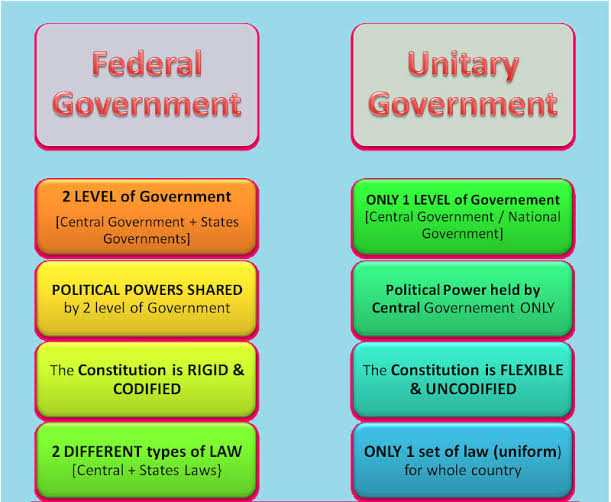
Government is the main agency of state. It comprises of several members belonging to political and administrative wings. It serves as the instrument for delegation and execution of the state policies for the welfare of the people. It formulates, expresses and realises the will of the state. It exercises certain legislative, executive and judicial powers, based on the constitution and the laws. There are three organs in government,namely – legislature, Executive and Judiciary. These organs carry out the activities of the state. Governments are classified into unitary, federal, parliamentary and presidential forms.
Types of Constitution
Unitary Form of Government
A unitary system of government or unitary state, is a sovereign state governed as a single entity. The central government is supreme and the administrative divisions exercise only powers that the central government has delegated to them. England, France, Japan and Sri Lanka are examples of Unitary Form of governments. The term Government is derived from old French ‘governor’, derived from Latin ‘gubernare’ to direct, rule, guide, govern”.
In a Unitary Form of government, all the authority and power is vested in a single centre, whereas in a federal form of government authority and power is distributed between centre and the constituent units. Even in a Unitary Form of Government,there might be a lot of decentralisation of authority,but we cannot claim it as a federal system.
Merits of Unitary form of government
• Suitable for small countries. • There is no conflict of authority and responsibility. • A unitary government will make prompt decisions and take speedy action. • A unitary government is less expensive. • Amendments to the Constitution are easy. • There is unity, uniformity of law, policy and administration.
De-merits of Unitary form of government
• It is not suitable for big countries. • The central government will have to tackle so many complex problems that lead to administrative delay • The central government will not concentrate on local problems, local interest and initiative. • The concentration of powers may pave way for the despotism of the central government.
Unitary features of the Indian constitution
• Strong Centre • Central Government’s control over state territory • Single Constitution • Flexibility of the Constitution • Unequal representation of states • Emergency Provisions • Single Citizenship • Single Integrated Judiciary • All India Services • Appointment of Governor by the Central government
Federal form of government
The classification of governments into Unitary and federal is based on the nature of relations between the national and the regional governments. A federal government is one in which powers are divided between the national government and the regional governments by the Constitution itself and both operate in their respective jurisdictions independently. U.S.A, Switzerland, Australia, Canada, Russia, Brazil, Argentina have federal form of governments. In a federal model, the national government is known as the Federal government or the central government or the Union government and the regional government is known as the state government or the provincial government.
Merits of federal form of government
• Reconciliation of local autonomy with national unity • Division of power between centre and states leads of administrative efficiency • It gives rise to big states • Distribution of powers check the despotism of central government • More suitable for bigger countries • It is good for economic and cultural progress
De – merits of federal form of government
• Federal government is weaker when compared to the unitary government • Federal government is more expensive • Provincial tendencies are very common • Lack of uniformity in Administration • Threat to national unity • Distribution of powers between centre and states lead to conflicts • Double Citizenship • Rigid constitution cannot be a mended easily for changing needs • The state governments sometimes place hindrances in the foreign policy
Federal features of Indian constitution
• Dual Government • Written Constitution • Division of powers • Supremacy of the Constitution
The Constitution is the supreme law of the land. The laws enacted by the Centre and the states must confirm to its provisions.
Diffence between Unitary form and federal form of government
Parliamentary form of government
Modern democratic governments are classified into parliamentary and presidential on the basis of the nature of relations between the executive and the legislative organs of the government. The parliamentary system of government is the one which the executive is responsible to the legislature for its policies and acts. The parliamentary goverment is also known as cabinet government or responsible government and is prevalent in Britian, Japan, Canada and India among others.
Features of parliamentary form of government
• Norminal and Real Executives • Majority party Rule • Collective Responsibility • Dual Membership • Leadership of the Prime Minister
Merits of the parliamentary form of government
• Harmony between Legislature and Executive • Responsible Government • Prevents Dictatorship • Wide Representation
Demerits of the parliamentary form of government
• Unstable Government • No Continuity of policies • Dictatorship of the Cabinet • Against Seperation of powers
The presidential form of government
The presidential form of government is also known as Non-parliamentary or fixed executive system of government, basically built on the principal of seperation of power and is prevalent in the USA, Brazil, Russia and Sri Lanka among others.
Features of presidential form of government
The president as the head of state,he occupies a ceremonial position. The president is elected by an electoral college for a fixed tenure of four years. The president governs with the help of a cabinet or a smaller body called ‘Kitchen Cabinet’. The legislative, executive and judicial powers of the government are separated and vested in three independent organs of the government.
Merits of the presidential system of government
• Democratic • Effective Control by the President • Facilitate decision-making • State government
Demerits of the presidential system of government
• Can degenerate into Dictatorship • Strain relationship between executive and legislative • Lack of Harmony between the legislature and Executive.
Local government which are function in villages are called Village Panchayats. The President and ward members are directly elected by the people. (Those who have attained the age above 18 to contest in the election one must have attained the age of 21 years) and their term of office is five years. District Collector act as the Inspector of Village Panchayat. Village Panchayats are constituted in each and every village wherever the population is above 500.
Functions of the Village Panchayat
• Supply of drinking water • Maintenance of street lights • Maintanence of roads • Maintanence of Village libraries • Maintanence of small bridges • Granting permission to the housing plots • Maintanence of drainage • Construction of group houses • Cleaning of streets • Maintanence of burial grounds • Maintanence of common lavatory facilities
Voluntary Functions
According to the Tamil Nadu Local Government Act passed in 1994, the following functions to be performed as voluntary functions to be local governments
• Maintanence of street lights in the villages • Maintanence of markets and fairs • Implantation of trees • Maintanence of play grounds • Maintanence of parking vehicles, slaughter houses and cattle sheds • Control over places of exhibition
Revenue
Village Panchayat was the only one local government which was empowered to levy taxes in the three-tier system of Village Panchayat.
Historical Origin and Development of Local self Government in Tamil Nadu
In the post independence era, the first enactment in democratic decentralisation in the state was the Madras Village Panchayats Act, 1950. Pursuant to the White paper on the ‘Reform of local Administration’ in 1957, the Madras panchayats Act, 1958 and Madras District Development Council Act were enacted with the following salient features.
Taxes
• Property Tax • Professional Tax • House Tax • Taxes for connection of drinking water • Land Tax • Taxes levied on shops
Meeting of Gram Sabha
In each and every village,the people living within its jurisdiction will be the members of panchayat. The President of the Panchayat will preside over its meetings. In the meeting of the Grama Sabha, the income and expenditure and the beneficiary of the schemes in the village are discussed.
Grama Sabha
Meetings of the Grama Sabha are conducted four times a year
1. January 26 – Republic Day 2. May 1 – Labourer Day 3. August 15 – Independence Day 4. October 2 – Gandhi jayanthi
Panchayat Union
Panchayat Union is formed by grouping of villages. Members of the Panchayat Union are directly elected by the people. The Chairman of the Panchayat Union is chosen from among the members.
Functions of the Panchayat Union
• supply of drinking water • Maintanence of Village Health centres • Maintanence of roads • Establishment of Maternity Homes • Establishment of Public fairs • Establishment of Veterinary hospitals • Maintanence of Social forests • Repairing of Primary School buildings
The district collector, planning officer, concerned to supervise the development functions of the Panchayat Union.
District Panchayat
A district Panchayat is constituted in each district. One district Panchayat is constituted for every 50,000 people and the ward members are directly elected by the people. The Chairman is elected from one among its members and their term is 5 years.
Functions of District Panchayat
Advising the government about the developmental schemes of the Village Panchayat and Panchayat Union.
Supervising the functions of District planning Commission.
Town Panchayat
The area where more than 10,000 people live is called a Town Panchayat. Members and President of the town Panchayat are directly elected by the people. There is an Executive officer to look after the administration of the Town Panchayat and their term of office is 5 years and he is appointed by the government.
Municipality
The area where more than 1,00,000 people live is called a Municipality. The Members and the directly elected by the people and their term of office is five years. A Municipal Commissioner is appointed by the government to administer the Municipality.
Corporation
Municipal corporations are established in big cities where the city has many lakhs of population. The Municipal Commissioner is the Administrative Officer. The Mayor is the Chairman of the corporation. The term of office of the Mayor and other members is five years. The Municipal Commissioner will be a person from the Indian Administrative Service (IAS). All the decisions of the Corporation Council will be implemented by him. He will be assisted by the office of the corporation.
Important functions of the Mayor
• He acts as a bridge between the members of the corporation and the government • He presides over the meetings of the Corporation Council • He receives the dignitaries from foreign countries
Types of other Panchayats
• Notified Area Committee • Town Area Committee • Cantonment Board • Township • Port Trust • Special Purpose Agency
Elections to the local government in Tamil Nadu
The State Election Commission conducts the elections to the local government like general elections. The electrol roll is prepared ward wise. Seats are reserved for the SC &ST and also for the women in proportion to the population by rotation basis.
Problems and Challenges facing the Local Self Governments
Local self goverments are the crucial basis for our democracy. The Constitutional status of local self goverments adds more significance to their functioning. There are, however,a few critical concerns in the working of local self goverments in India. Major problems and Challenges may be mentioned as below:
• Lack of clear demarcation of powers and functions of local bodies • Allocation of funds and needs assessment are not matched • Role of caste, class and religion in decision-making at the local self goverments • Poor accountability of elected members and officials at the grassroot levels of democracy
A biome is a geographical extensive ecosystem where all flora and fauna are found collectively. It is the total assemblage of plant and animal life interacting within the biosphere. Biomes are defined by abiotic factors like,relief, climate,soils and vegetation. They are classified into two broad categories,
Terrestrial biomes
aquatic biomes
Terrestrial Biomes
Terrestrial biomes is a group of living organisms that live and interact with one another on land. They are mainly determined by temperature and rainfall. Some of the major terrestrial biomes of the world are
A. Tropical Forest Biomes B. Tropical Savanna Biomes C. Desert Biomes D. Temperature Grassland E. Tundra Biomes
Classification of Biomes
A. Tropical Forest Biomes
The tropical forest biome is comprised of several sub-biomes, including evergreen rainforest, seasonal deciduous forest etc.
Tropical forest have the highest biodiversity and primary productivity of any of the terrestrial biomes. The Amazon basin, Congo basin and Indonesian islands are the major regions of this biome. These regions have very dense forests and so have great economic importance. Human settlements are found scattered here. They sustain their livelihood through food gathering, fishing, lumbering and shifting cultivation. Due to the humid nature of this biome, the people get afflicted to tropical diseases like malaria, yellow fever etc. The chief trees found here are rubber, bamboo, ebony,etc. Bats, pheasants, jaguars, elephants, monkeys etc. are the important birds and animals found here.
B. Tropical Savanna (Grasslands) Biomes
Tropical grasslands are generally found between tropical forests and deserts. Tropical Savanna biomes are found between 10° to 20°N and S latitudes. These grasslands are generally flat and are found in the Sahel, south of Sahara in East Africa and in Australia. This biome is generally hot and dry and experiences moderate to low rainfall. So, the grass which grow here are tall and sharp. Hence the chief occupation of the people found here is herding. The primitive people living here are nomadic. The common animals found here are the lion,leopard, tiger,deer, red oats grass, lemon grass etc. are found in this biome.
C. Desert Biomes
Deserts are usually found on the western margins of the continents between 20° and 30° N and S latitudes. The annual rainfall is less than 25cm in these regions. Due to the lack of rainfall and arid conditions, these regions do not possess any vegetaion but have special vegetaion type called Xerophytes. As the soil is sandy and saline, deserts remain agriculturally unproductive. Drought resistant throny scrubs and bushes, palms are found here.
Tribal people who live here practice food gathering and hurting. They move their temporary settlements frequently in search of pasters. Transportation becomes very difficult here and is carried on by camels. Reptiles like snakes, lizards, scorpions etc., are most commonly found here.
D. Temperate Grassland Biomes
Temperate Grasslands are usually found in the interior of the continents and are characterized by large seasonal temperature variations, with warm summer and cold winter. The type of grassland in these regions strongly depends upon precipitation. Higher precipitation leads to talk and short and soft grass. These regions favour wheat cultivation. Extensive mechanised agriculture is practised due to lack of farm labour. Pastrol industry becomes the main occupation, thereby facilitating slaughtering of animals, packing of raw and processed meat, dairy products etc. The common birds and animals are grass hopper, wolf, bison, prairie dog etc.
E. Tundra Biomes
These vast lowlands are found where the ground remains frozen. Greenland, Arctic and Antarctic regions and Northern parts of Asia, Canada and Europe fall in this biome. These regions are also called Barren lands. This biome experiences long severe winter and short cool summer. Due to the prevailing of low temperature and short growing seasons, the net primary productivity is very low in tundra. People are nomadic. Hunting and fishing are their major occupations. The population here is extremely sparse and the harsh environment makes them change their settlement frequently. They live in igloos in winter and in tents during summer. Arctic moss, Arctic willow, lichens etc. grow here. Fauna like the polar bear, wolverine, reindeer, snowly owl are found here.
Aquatic Biomes
Aquatic biome is a group of living organisms that live and interact with one another and its aquatic environment for nutrients and shelter. Like terrestrial biomes, aquatic biomes are influenced by a series of abiotic factors.
Fresh water biomes
Marine biomes
A. Fresh water Biomes:
It comprises lakes, ponds, rivers, streams, wetlands etc. It is influenced by various abiotic components such as the volume of water, water flow, composition of oxygen, temperature,etc. Humans rely on freshwater biomes for drinking water, crop irrigation, sanitation and industry. Water lily,lotus, duck weeds etc. are the common plants found here. Trout, salmon,turtles, crocodiles etc. are the animals found here.
B. Marine Biomes:
They are the largest aquatic biomes on earth. They are continuous bodies of salt water and provide a wide range of habitats for marine plants and animals. Coral reefs are a second kind of marine biomes within the ocean.Estuaries, coastal areas where salt water and fresh water mix, form a third unique marine biome. As water provides maximum mobility to marine organisms, nutrients are circulated more quickly and efficiently here than the terrestrial biomes. Apart from animals, plants such as kelp, algae, phytoplankton etc. also grow in water. Aquatic biomes are not only important for plants and animals, but also for humans. Humans use aquatic biomes for water, food and leisure activities. Some of the threats and issues to aquatic biomes are overfishing. Pollution and rise in sea level.
Conservation
The biosphere extends from the deep ocean trenches to lush rain forests. People play an important role in maintaining the flow of energy in the biosphere. At the same time, the primary cause of today’s loss of biodiversity is habitat alteration caused by human activities. The ever increasing population results in over exploitation of biological resources. This has an adverse impact on flora and fauna on earth. There are places on earth that are both biologically rich and deeply threatened. Hence it is man’s duty to conserve and care for the earth and make it a better place to live in.
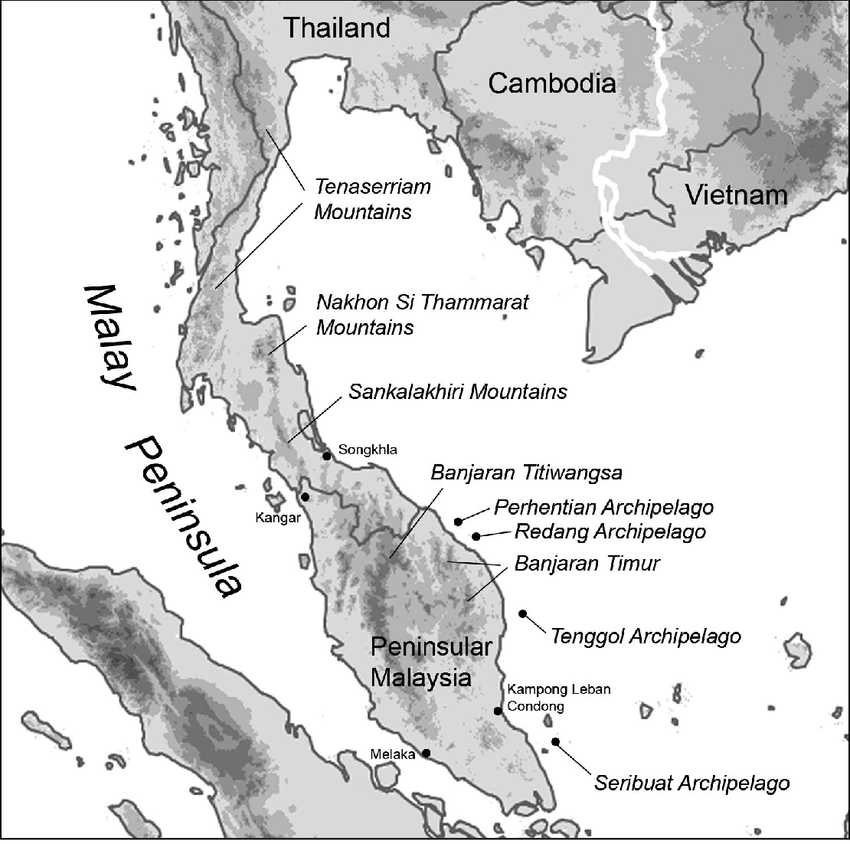
The term “south East Asia” has only been used since the world war. It denotes the area that originally covered Malaya, Dutch East Indies, Burma, Siam, French Indo-China and the Philippines. With the exception of Siam(Thailand), which remained independent,the area was divided between the Dutch, the British and the French.
Malaya Peninsula
When European traders crossed the Indian Ocean at the close of the 15th century, they came for the spices of South-east Asia. When the Portuguese conquered the great international emporium of Malacca for the king of Portugal, the empires of Sri Vijaya and Majapahit had split into many small states. Albuquerque,the Portuguese soldier who conquered Goa and Malacca, and his successors were interested in the spice trade. Towards this end they built a chain of fortified trading stations linked by naval power. Initially they did not interfere with the native rulers. After the arrival of the Dutch and the English there was a challenge to the presence of Portuguese and the rivalry of these three European powers dominated the seventeenth century. The Dutch began their conquest of the Portuguese settlements by capturing Malacca in 1641. After establishing a base at Batavia(now Djakarta) in 1619, they interfered in succession disputes among the neighbouring Sultans.Gradually they extended their control over Java, expelling the British from Bantam in 1682. They had already driven them out of the Spice islands after the Massacre of Amboina(1623) and by the seizure of Macassar (1667), thereby forcing the English East India company to turn to the China trade. The Spanish established themselves, begining from their conquest of Manila, which expanded into a larger territory of Spanish East Indies.
Anglo – Dutch Rivalry
Penang Island had been brought to the attention of the East India company by Francis Light. In 1786, the settlement of George Town was founded at the north eastern tip of Penang Island; this marked the beginning of British expansion into the Malay Peninsula. In 1819, Stamford Raffles established Singapore as a key trading post for Britain in their rivalry with the Dutch. However, their rivalry cooled in 1824 when an Anglo – Dutch treaty demarcated their respective interests in Southeast Asia. By 1826 Singapore and Malacca had been linked with Penang to form the strait settlements.
Between 1874 and 1895 to there was a civil war between the remaining five Malay states. The British intervened and signed an agreement with each of the Sultans. British Residents were appointed to the courts of Sultan’s,who had to act in accordance with the advice given by the Residents. In 1896 four of the states were formed into the Federated Malay States. In 1900 there were the Straits settlements,the four Federated Malay States and Johore. The population was about a million, of whom,half were Malay and the merchants, planters and workers in the ports and big plantations were Chinese.Economically Malaya was prosperous
Indonesia
The Dutch had occupied and Sumatra (Indonesia) as early as 1640. But they conquered the other outer islands of East India only in the second half of the nineteenth century,excepting the British possession of North Borneo, Brunei and Sarawak. Initially the Dutch were not interested in politics. But from the beginning of the twentieth century they adopted measures for the social and economic advance of the people they governed. Most Indonesians were fishermen and smell peasents and worked on European sugar, tobacco ,tea, coffee plantations. Heavy investments in these plantations and other concerns, and the discovery of oil in 1900 made Indonesia a valuable colony for the Dutch.
Burma
The British conquered Burma after fighting three wars. Burma remained part of India from 1886 to 1937. Burma was administered by a Lieutenant Governor with the assistance of a nominated Legislative Council. Burma with its fertility of soil became a big exporter of rice and most of South India was depended on Burmese rice. During World war II when Burma fell to the Japanese, south India experienced acute scarcity of rice leading to a famine.
Indo – China
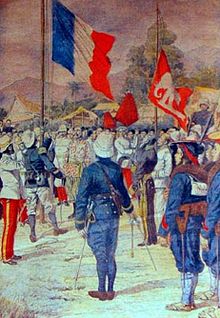
The French conquered Indo-China after strong resistance from the people. Starting in 1858, they brought the Indo- Chinese Union under their control by 1887. Indo-China consisted of Annam, Tongking ,Cambodia and Cochin-China. Laos was added six years later. Of them only Cochin-China was directly under French control, i.e., as a French colony. The remaining four were protectorates. Under this system,the local rulers remained, but they governed under the instructions of French Residents. Hanoi was the capital of the French government. Rice, rubber and wheat were the main exports. Laos reamained undeveloped.
French in Indo-China
The Philippines
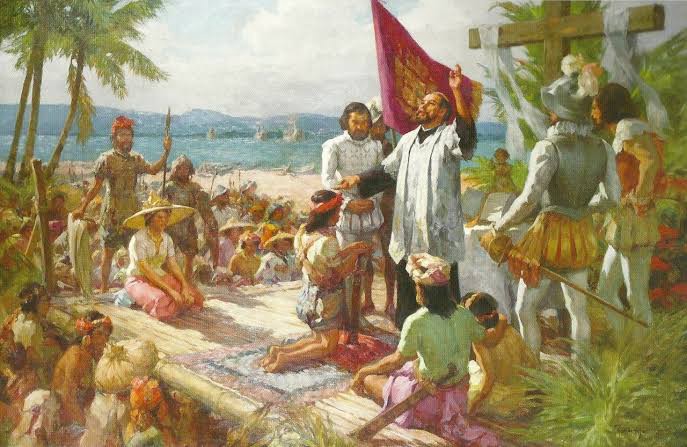
Spanish in philippines
Spain ruled the Philippines for over 300 years, imposing its language, culture and religion.Consequently the population became predominantly Roman Catholic. Nationalism developed among the Filipinos during the latter part of the nineteenth century. There were the serious revolts in 1872 and 1896, which were crushed by the Spanish colonial government. In 1898, however,spain was defeated by the United States in a war over Cuba, and as a result Phillipines became an American colony.
Siam (Thailand)
Thailand was spread the experience of foreign rule, though it too was greatly affected by the power politics of the Western powers. The administrative reforms of the late 19th century, continuing up till around 1910, imposed a Westernised form of government on the country’s partially independent cities called ‘Mueang’. Western powers, however, continued to interfere in its internal and external affairs.
In the fourteenth and fifteenth centuries, Western Europe underwent dramatic changes in the political,Social, cultural, religious and economic spheres. The Italian humanist Petrarch’s Canzoniere, German theologian Martin Luther’s ‘Ninety-five These’ and Portugal prince Henry’s Navigation school heralded the dawn of the modern era. The Holy Roman Empire and the Roman church became weak and discredited. In their place nation states,new Churches that emphasized individual faith, and a commercial revolution based on mercantilism emerged. The modern era was characterized by freedom of thought, individualism, rationalism, and economic and scientific progress. let us look at the changes ushered in by the Renaissance, Reformation and Geographical Discoveries.
1. Renaissance
With the coming of the scholars and artists from Constantinople there was a surge of enthusiasm and interest in studying classical literature and art of Greeks and Romans in the Italian city States. This creative upsurge was reflected in their writings, art, Architecture and music. This cultural florescence is known as the renaissance. The origin of the world renaissance is from the Italian word renascita meaning rebirth. Greek scholar Manuel Chrysoloras who taught Greek classics in Italy, Guarino and Giovanni Aurispa, to name just a few, visited Constantinople several times to collect Greek manuscripts. Later they printed what they collected. This provided stimulus to the flowering of renaissance.
Why Italy became the birth place of Renaissance?
Italian city-states such as Florence,Milan, Venice, and Rome profited immensely from the Mediterranean trade. This led to the emergence of a rich and vibrant urban culture. The rich families of these city States such as Medicis of Florence patronized literature, art and music. The highpoint of this period was between 1475 A.D.(C.E) and 1525 A.D.(C.E). Italian universities taught humanities viz., linguistic, grammar, rhetoric, history, science and ethics, which prepared the students for public life, commerce and administration. The study of humanities was so popular in Italian University that students from all over Europe flocked there. Classical Greek and Latin literature introduced the idea of Humanism which got reflected in the paintings, sculptures, architecture,music and writings of that period.
Humanism in Literature
The idea of humanism was first expressed in literature. The humanists were critical of medieval ideas and institutions and greatness. Petrarch (1304 – 1374 A.D.(C.E)) was the first to adopt ideas of classical humanism in his works and is therefore called the Father of Humanism. Dante, influenced by the classics, wrote Divine comedy. Machivelli wrote a political treatise called The Prince. In this book, he wrote about the virtues that a ruler should possess. He declared that a ruler should possess. He declared that a ruler should be Lion and Fox in one. For him, the end was more important than means. Erasmus (1466-1536 A.D.(C.E)), known as the Prince among Humanists, wrote In praise of Folly, a satirical work on the activities and rituals of the Church. Sir Thomas more of England wrote Utopia,a satire on the political evils of his time. Cervantes of Spain wrote Don Quixote, another satire on Medieval chivalry and valour.
Impact on Art
Renaissance paintings and sculptures were realistic and naturalistic. They improved over Medieval paintings and sculptures which were stylized, unrealistic and two dimensional. They portrayed natural landscapes,human anatomy,emotions and ideas.
Mona lisa
In the field of art ,great artists like Leonardoda Vinci, Michelangelo and Raphael dominated the scene and produced some of the finest artistic works. Leonardo da Vinci (1452-1519 A.D.(C.E)) was a versatile genius. He was a painter, sculptor, architect, millitary engineer, anatomist, and poet. His paintings of Mona Lisa(La Giaconda), The last supper and The virgin on the Rocks are illustrious examples of his talent.
Madonna
Michelangelo (1475-1564 A.D. (C. E)) was a painter, sculpture of David depicts the youthful strength and energy of the giant Slayer. He is also famous for his paintings in the ceilings of the Sistine Chapel in Rome. Raphael (1483-1520 A.D. (C.E)) painted beautiful Madonnas . His painting of the school of Athens reveals the ideological debate of his times, namely,the conflict between spiritualism and humanism.
Science during Renaissance
The advances in science were inspired by Ptolemy, Archimedes,Euclid and others of the classical period. In the medieval period the Aristotelian view that earth was the centre of the universe strengthened the Church’s view of creation and its own centrality to mankind. However,the influence of Palto and other classics challenged it, laying the foundations of modern science. William Harvey discovered the circulation of blood. Copernicus proved the earth revolved around the sun through a mathematical model. Galileo provided the telescope he invented. However,he was forced by the Inquisition to withdraw his findings on the threat of death penalty. The Church thus continued to prevent the growth of science as it undermined its importance. Nevertheless, scientific discoveries and inventions continued apace leading to the Scientific Revolution.
Effects of Renaissance
The impact of renaissance was profound and far-reaching. Its most important contribution was the idea of humanism. It marked a definite shift towards individualism, secularism and nationalism The introduction and practice of writing in the vernacular, starting from Dante, enriched the growth of vernacular languages which in turn provided the intellectual basis for the rise of nation-states . Renaissance made a beginning in criticizing the corrupt and worldly practices of the Church. Erasmus and Thomas More indirectly encouraged the reformation movement. The curiosity kindled by the remaining played a decisive role in the discovery of new land routes and remapping of the world. The spirit of adventurism and quest for knowledge impelled the Mariners to sail into the high seas. Similarly, inquisitiveness and empiricism of renaissance combined with knowledge of the classical science led to new inventions in science-Copernican revolution in astronomy and Willam Harvey’s contribution to human anatomy.
In the Gangetic plain,iron plough agriculture required the use of bullocks. But the indiscriminate killing of cattle for Vedic rituals and sacrifices caused resentment. The founders of Jainism and Buddhism did not prescribe killing as religious rite. They secured their livelihood mostly by alms. Celibacy and abstinence from holding property made the new teachers much more acceptable than the Brahman priests. The people’s resentment about the expensive and elaborate Vedic rituals, animal sacrifice and desire for wealth eventually took them towards Jainism and Buddhism. Mahavira and Buddha lived a life of purity and exemplified simplicity and self-denial. They lived in the times of Bimbisara and Ajatshatru,the famous kings of Magadha. The commercial development of the northern cities like Kaushambi, Kushinagara, Benaras, Vaishali and Rajagriha added importance to the Vaishyas who turned to Buddhism and Jainism in their eagerness to improve their social status.
Jainism
Mahavira : Birth and life
Mahavira
Vardhamana Mahavira was born in 599 BC (BCE) at Kundagrama near Vaishali. His mother was Trishala, a Lichchavi princess. He spent his early life as a prince and was married to a princess named Yashoda. The couple had a daughter. At the age of thirty ,he left his home and became an ascetic. For over twelve years, Mahavira wandered from place to place, subjecting himself to severe penance and self-morification . In the thirteenth year of his asceticism ,he acquired the highest knowledge and came to be known as Jaina (the conqueror) and Mahavira (great hero). Jains believe that Mahavira came in a long line of Tiruthankaras and he was the twenty fourth and the last of them. Rishabha was the first Tiruthankara and Parshvanath the penultimate or the twenty third. Mahavira travelled extensively as a preacher in the kingdoms of Magadha. Videha and Anga. Magadha rulers Bimbisara and Ajatshatru were influenced by his teachings. Thousands of people became his followers. After 30 years of preaching,Mahavira died at Pawapuri in 527 BC (BCE) at the age of seventy two.
Teachings of Mahavira
The three principles of Jainism,also known as Tri-ratnas, are the following: 1. Right faith : Belife in the teachings and wisdom of Mahavira. 2. Right knowledge : Acceptance of the theory that there is no God and that the world existed without a creator. 3. Right action : It refers to the Mahavira’s observance of the five great vows: (a) ahimsa, (b) honestly, (c) kindness, (d) truthfulness and (e) not converting or desiring things belonging to others.
Spread of Jainism
In order to spread his new faith, Mahavira founded monasteries. The Jaina monks who led a very austere life. In North India, this new faith was patronised by rulers such as Dhana Nanda, Chandragupta Maurya and Kharavela. There was a notable followers of Jainism in Karnataka and western India during the 4th century BC (BCE). Jainism encouraged the public spirit among all who embraced it. Varna system practiced by Brahmas was challenged. People were spared from the costly and elaborate rituals and sacrifices. Mahavira believed that all objects,both animate and inanimate,have souls and various degress of consciousness. They posses life and feel pain when they are injured.
Split in Jainism
In course of time, Jainism split into two branches,namely the Digambaras (sky – clad) and the Svetambaras (white – clad).
Decline of Jainism
The lack of royal patronage,its severity ,factionalism and spread of Buddhism led to the decline of Jainism in India.
Buddism
Gautama Buddha : Birth and life
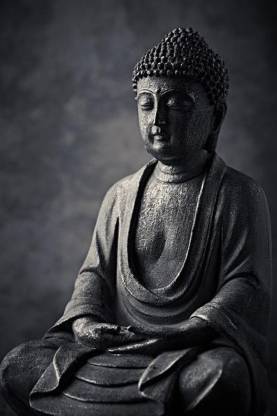
Gautama Buddha
Gautama Buddha was the son of Suddhodana, the chief of a Kshatriya clan of the Sakyas of Kapilavastu in present-day Nepal. His given name was Siddhartha. As he belonged to the Sakya clan, he was also known as’Sakya Muni’. He was born in 567 BC (BCE) in Lumbini Garden, near Kapilavastu. His mother, Mayadevi ( Mahamaya) ,died after a few days of his birth and he was brought up by his step-mother. In order to divert his attention towards worldly affairs, his father got him married at the age of sixteen to a princess called Yashodhara. He led a happy married life for some time and had a son by name Rahula.One evening, while Siddhartha was passing through the city, he came across an old man who had been abandoned by his relatives, a sick man crying with pain and a dead body surrounded by weeping relatives. Siddhartha was deeply moved by these sights. He also saw an ascetic who had renounced the world and found no sign of sorrows. These ‘Four Great slights’ prompted him to renounce the world and search for the cause of suffering. In 537 BC (BCE), he left his palace and went into the forest in search of truth. In the course of his wanderings, he sat under a peepal tree for several days untill he attained enlightenment. The place where he attained enlightenment,the Mahabodhi temple, still exists in Bodh Gaya (Bihar). After his enlightenment,Buddha decided to impart his knowledge to the people. He went to Varanasi and gave his first sermon at Sarnath. He preached in the kingdoms of Magadha and Kosala. A large number of people became his followers including his own family. After forty five years of preaching,he breathed his last in 487 BC (BCE) at Kushinagar (near Gorakhpur in Uttar Pradesh)at the age of eighty.
Teachings of Buddhism
(I) Four Great Truths : (1) There is suffering and sorrow in this world. (2) The cause of human suffering is desire and craving. (3) This pain or sorrow can be removed by suppressing desire and craving. (4) This is to be achieved by leading a disciplined life or by following what Buddha called the ‘ Noble Eight – fold path’.
(II) Attainment of Nirvana: According to Buddha, a person should aim at attainment of Nirvana or the highest bliss, and it could be achieved by any person by leading a virtuous life and by following the Noble Elight-fold path.
(III) The noble Elight – fold path: Buddha preached a new path to attain the purest state of mind: (1) right views,(2) right aspirations,(3) right speech,(4) right action,(5) right livelihood,(6) right effort ,(7) right mindfulness (8) right contemplations or meditation. Buddha preached that he who practices the eight-fold path can attain the highest and purest state of mind.
Spread of Buddhism
Buddha,in order to carry his message to different parts of India, established the Buddhist sangha or the Holy order of Monks. The bikshus (monks) and the bikshunis (nuns) were enlisted for spreading the faith and they were required to lead a life of purity and poverty. Buddhism spread to Central Asia, Sri Lanka, Tibet, Southeast Asia,as well as the eastern countries of China, Mongolia ,Korea, Japan and Vietnam.
The split in Buddhism
During the reign of Kanishka, the Buddhist monk Nagarjuna initiated reforms in the way Buddhism was followed. As a result, Buddhism was split into two as Hinayana and Mahayana.
( I )The Hinayana (Lesser Vehicle) was the original creed preached by Buddha. The followers of this form regarded Buddha as their guru and did not worship him as God. They denied idol worship and continued with the people’s language,Pali.
(II) In Mahayana (Greater Vehicle) ,Buddha was worshipped as God and Bodhisattva as his previous Avatar. The followers made images and statues of Buddha and Bodhisattva and offered prayers,and recited hymns (mantras) in their praise. Later, they wrote their religious books in Sanskrit. This form of Buddhism was patronised by Kanishka.
Disaster is a very common phenomenon in the human society. It has been experienced by people since time immemorial. Though its form may be varied,it has been a challenge for society. The latest development which has been discovered in the world Disaster reports recently is that, the disasters have increased in frequency and intensity. India is one of the most disaster prone countries in the world. It has some of the world’s most severe droughts,famines, cyclones, earthquakes, chemical disasters,rail accidents and road accidents. The high density of population in the developing countries, especially in the high developing countries, especially in the high risk coastal areas, results in millions of people getting affected by natural disasters, especially in recurring disasters like floods, cyclones,storm surges,etc. A disaster is a serious disruption of the functioning of a society involving human and material loss. Disaster is broadly classified into natural and man-made disasters.
Natural Disasters
Earthquake
The sudden shaking of the earth at a place for a short spell of time is called an earthquake. The duration of the earthquake may be a few seconds to some minutes. The point where an earthquake originates is called its ‘focus’. The vertical point at the surface from the focus is called ‘epicentre’.
Volcanoes
Volcanoes are openings or vents where lava, small rocks and steam erupt onto the earth’s surface.
Tsunami
Tsunami are waves generated by earthquake, Volcanic eruptions and underwater landslides.
Cyclones
A low pressure area which is encircled by high-pressure wind is called a cyclone.
Floods
An overflow of a large amount of water, beyond its normal limits, especially on the rainfed areas is called a flood.
Landslide
The movement of a mass of rocks, debris,soil etc., downslope is called a landslide.
Avalanche
A large amount of ice, snow and rock falling quickly down the side of a mountain is called an Avalanche
Thunder and lightning
Thunder is a series of sudden electrical discharge resulting from atmospheric conditions, this discharge results in sudden flashes of light and trembling sound waves which are commonly known as thunder and lightning.
Man – made disasters
Fire Massive forest may start in hot and dry weather as a result of lightning,and human carelessness or from other causal factors.
Destruction of buildings Demolition of buildings by human activities.
Accidents in industries Chemical, biological accidents that occur due to human error. (e.g.) Bhopal gas tragedy.
Accidents in Transport Violation of road rules , carelessness cause accidents.
Terrorism The social unrest of differences in principles leads of terrorism.
Stampede The term stampede is a sudden rush of a crowd of people, usually resulting in injuries and death from suffocation and trampling.
Tsunami and Floods
A killer Tsunami hit the south east Asian countries on the 26th of December,2004. A massive earthquake with a magnitude of 9.1 – 9.3 in the Richter scale epicentre in the Indonesian island of Sumatra. It triggered one of the biggest Tsunamis the world had ever witnessed. The massive waves measuring up to 30 metres that killed more than 2,00,000 people of Asia. In India, over 10,000 people were killed by this disaster. Tamil Nadu alone accounted for 1,705 deaths.
All the coastal districts were affected, Nagapattinam was the worst hit in the state of Tamil Nadu. Fishermen, tourists morning walkers, children playing in the state of Tamil Nadu. Fishermen, tourists, morning walkers, children playing in beach and people living on the coast were unprepared for the waves. So they were unprepared for the waves. So they lost their life and the most of the loss of lives and damage to property was within 500 metres of the shore. After that the Indian government set up a Tsunami Early warning system at Indian National centre for Ocean Information services (INCOIS), Hyderabad in 2007.
Tsunami – Do’s and Don’ts
You should find out if your home, school etc., are in valunarable areas along sea shore.
Know the height of your street above sea level.
Plan evacuation routes and practise your evacuation routes.
Discuss tsunamis with your practise your evacuation routes.
Discuss tsunamis with your family. Review safety and preparedness measures with your family.
If you see the sea water receding, you must immediately leave the beach and go to higher ground far away from the beach.
Don’t go to the coast to watch the Tsunami.
Don’t try to surf the tsunami waves.
Be aware facts about tsunami.
Floods
Floods are high stream flows,which overlap natural or artificial banks of a river or a stream and are markedly higher than the usual flow as well as inundation of low land.
Types of floods
Flash floods: Such floods that occur within six hours during heavy rainfall.
River floods: Such floods are caused by precipitation over large catchment areas or by melting of snow or sometimes both.
Coastal floods: Sometimes floods are associated with cyclone high tides and tsunami.
Causes of floods
> Torrential Rainfall. > Encroachment of rivers bank. > Excessive rainfall in catchment. > Inefficient engineering design in the construction of Embankments, dams and canals.
Effects and floods
> Destruction of drainage system > Water pollution > Soil erosion > Stagnation of water > Loss of agricultural land and cattle > Loss of life and spread of contagious diseases.
Do’s
> To find out if the settlement area is to be affected by flood or not. > Keeping radio, torch and additional batteries, storing drinking water,dry foods items, salt and sugar, safeguarding materials like kerosene, Candle , match box, clothes and valuable things. > Keeping umbrella and bamboo poles. > Keeping first aid box and strong ropes to bind things. > To dig canals from the farm land, to drain the excessive water keeping sand bags etc.,
Don’ts
> Try to connect electricity once it is cut. > Operate vehicles > Swim against floods > Avoid going on excursions. > Neglect flood warning messages
During floods
> Curt off gas connection and electricity > Keep sand bags on drainage holes and bathroom holes. > Leave immediately through the known passage or prescribed passage > Drink hot water. > Use bleaching powder to keep your environment hygenic. > Before using match sticks and candles, ensure that there is no gas leakage. > Don’t eat more food when you are affected by diarrhoea. > Don’t try to take anything that floats in flood.
Disaster Risk Reduction (DRR)
Disaster Risk Reduction: The practice of reducing disaster risks through systematic efforts to analyze and manage the causal factors of disasters. There are four key approaches to public awareness for disaster risk reduction. Campaigns,participatory learning, informal education, and formal school based interventions.
Forecasting and Early warning
Weather forecasting, Tsunami Early warning system, cyclonic forecasting and warning provide necessary information which help in reducing risks during disasters. School Disaster Management Committee, Village Disaster Management Committee, State and central government institutions take mitigation measures together during disaster. Newspaper,Radio Television and social media bring updated information and give alerts on the vulnerable area, risk, preparatory measures and relief measures including medicine.
During the eleventh century, the Turkish horsemen pillaged northern India and due to their persistent campaigns, they succeeded in seizing political control of the Gangetic plain by the next century. Though the success of their conquests could be attributed to their audacity and ferocity ,their success is really due to the failure of Indians to defend themselves and their territories. Indians viewed each other with distruct , failing to take note of the success of Islam in early years of its spread. The superior military might of Muslim soldiers was yet another factor that contributed to success in their conquests. In this lesson,we discuss how Turkish warriors set about founding and consolidating their Islamic rule till the advent of Babur.
Slave Dynasty (1206 – 1290)
Muslim rule in India was established by Muhammad Ghori in 12th century A.D.(CE). As he had no sons,he nurtured special slaves called bandagan (a Persian term used for slaves purchased for military service). These slaves were posted as Governors and they were later raised to status of Sultans. After Ghori’s death in 1206 ,one of his slaves Qutb-ud-din-Aibak who had been left behind by Muhammad Ghori to govern the territories he had conqured, proclaimed himself ruler of the Turkish territories in India. He laid the foundation of the slave Dynasty. This dynasty is also known as Mamluk dynasty. This dynasty is also known as Mamluk dynasty. Mamluk is an Arabic word meaning “slave”.Qutb-ud-din-Aibak, Shams-ud-din-Iltutmish and Ghiyas-ud-din-Balbam were the three great Sultan’s of this dynasty. The slave Dynasty ruled over the sub – continent for about 84 years.
Qutb-ud-din-Aibak (1206 – 1210)
Qutb-ud-din-Aibak began his rule by establishing Lahore as the capital of his kingdom. later he shifted his capital to Delhi. He was active all through his rule in Delhi conquering new Territories and suppressing rebellions. He personally led military campaigns to the central and western Indo-Gangetic plain and left the conquest of the eastern Gangetic plain ( Bihar,Bengal) to the care of Bakhtiar Khalji. Aibak built the Quwwat-ul-Islam Masjid (mosque) in Delhi. This mosque is considered to be the oldest in India. He also laid the foundation of the Qutb-Minar,but he was unable to complete it. It was later finished by his son – in – law and his successor Iltutmish. Aibak died injuries received during an accidental fall from a horse, while playing Polo in 1210.
Quwwat-ul-Islam Masjid
Iltutmish (1210 – 1236)
Aibak’son aram Shah proved incompetent and so the Turkish noble chose Iltutmish,the son-in-law of Aibak as the Sultan,who served as a military commander of Aibak.Iltutmish firmly established his control over the territories by suppressing rebellions.It was during his reign that the threat of Mongols under chengis Khan loomed large over the frontiers of India.He averted the impending danger by refusing to provide shelter to the kwarezm Shah jalal-ud-din,who had been driven out by chengis Khan.In order to counter the possible attact of the Mongols, Iltutmish organised Turkish nobility into a select group of 40 nobles known as chahalgani or the Forty.Iltumish granted iqtas (land) to members of his army. Iqta is the land granted to army officials in lieu of a regular wage. The iqta holder is called the iqtadar or muqti who had to provide the Sultan with military assistance in times of war. The iqtadar collected revenue from his iqta to meet the cost of maintaining his troops and horses.
Qutb-Minar
Iltutmish completed the construction of the Qutb -Minar ,started by Aibak. Iltutmish died in April 1236 after ruling for 26 years.
Razia (1236 – 1240)
As the most capable son of Iltutmish,Rukn-ud-din-Firuz,was dead, Iltutmish nominated his daughter Razia Sultana as his successor to the throne of Delhi. Razia was an able and brave fighter. But she had a tough time with Turkish nobles as she favoured non-Turkish nobles. She also faced the situation of the ferocious Mangola raiding Punjab during her reign.Razia made an Ethiopian slave named Jalal-ud-din Yakut as her personal attendant and started trusting him completely.This led to a revolt of the Turkish nobles who conspired against her and got her murdered in 1240.
Ghiyas-ud-din-Balbam (1266–1287)
After Razia,three weak rulers in succession ascended the throne. After them came Ghiyas-ud-din-Balbam . Balban abolished the forty as it was hostile to him. He established a department of spies to gather intelligence about the conspirators and the trouble makers against his rule. He dealt with insubordination and defiantly of royal authority sternly. Tughril Khan, a provincial governor of Bengal, who raised a banner of revolt against Balban,was captured and beheaded. He was ruthless in dealing with enemies like Meos of Mewat. Balban, however,took care to maintain cordial relationship with the Mongols. He obtained from Hulagu Khan ,a grandson of Chengiz Khan and the Mongol viceroy in Iran,the assurance that Mongols would not advance beyond Sutlej. Balban built forts to guard his empire against the Mongol attacks. He patronised the famous persian poet Amir Khusru. Balban died in 1287. Balban’s son Kaiqubad turned out to be weak. In 1290 Malik Jalal-ud-din Khalji,the commander of the army, assumed the office of Naib and ruled the kingdom in the name of Kaiqubad. Then one day, Jalal-ud-din sent one of his officers and had Kaiqubad murdered. Jalal-ud-din then formally ascended the throne. With him began the rule of Khalji dynasty.















 Eduindex
You must be logged in to post a comment.