The Egyptian Civilisation

As one of the oldest civilisations,the Egyptian Civilisation is known for its monumental architecture, agriculture,arts, sciences and crafts at a very early age.

Geography

Egypt lies in the north-eastern corner of the African continent.It is bounded by the Red sea on the east and Mediterranean sea in the north.Egypt is irrigated by the River Nile,

Early world civilisations

Which originates in Lake Victoria in the south and flows into the Mediterranean sea in the south and flows into the Mediterranean sea in the north.Deserts are seen on both sides of the Nile River. The Egyptian Civilisation depended solely upon the flow of Nile River,and hence Egypt as called the Gift of Nile by the Greek historian Herodotu. The Nile also served as a means of transport. The Nile valley is very rich and fertile as the river deposits fresh alluvium every year.This alluvium nurtured agriculture and helped to produce surplus of food grains, leading to the development of Egyptian Civilisation.The dry regions on both the sides of the Miles, however remained deserts.
                             Egypt became initimately connected with the Sangam Age Tamilagam by the sea route.

The Hyksos were the rules of the 15th of Egypt and they were probably from West Asia.
Persians are the people from the region of Persia,the ancient Iran.
Greek refers to the language and people of modern-day state of Greece in Europe.
Rome refers to the ancient Roman Empire, which had as its capital the city of Rome in Italy.

Pharaohs,Society and Administration

The Egyptian king was known as the Pharaoh.The people treated pharaoh as a divine form.Under the pharaoh,there was a hierarchy of officials including viziers,the governors of provinces,local mayors and tax collectors.The entire social system was supported by the work and production of artisans including stone cuttors, masons,potters, carpenters,coppersmiths and goldsmith, peasants and workers. Land belonged to the king and was assigned to the officials. Slavery was not common,but captives were used as slaves.Viziers were the high officials who administered territories under the direction of the Pharaohs.The Egyptians believed in life after death.Therefore,they preserved the dead body. The art of preserving the dead body is known as mummification.Pyramids and tombs were built to preserve the body of Pharaohs.The famous Egyptian pharaoh Tutankhamen’s (who ruled from 1332 to 1322 BC (BCE)) tomb with a rich variety of offerings is located near Luxor in Egypt.The mask of his mummy made of gold and decorated with precious stones is an important artefact of the Egyptian Civilisation.

Agriculture and Trade

The Egyptians cultivated wheat,barley,millets, vegetables,fruits,papyrus and cotton.
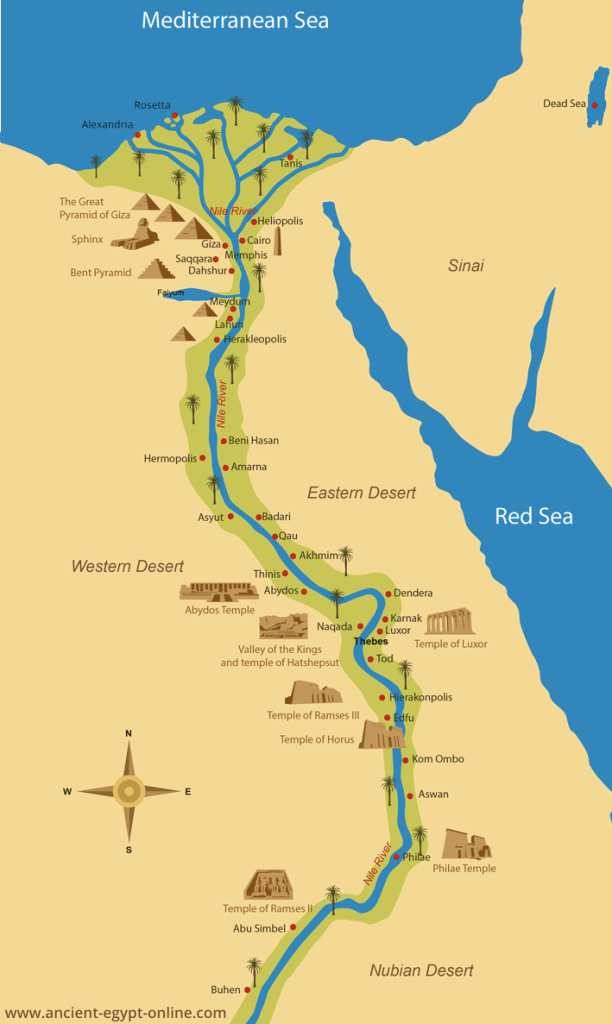
The cities of Egyptian Civilisation

Papyrus was used for making rope mats sandals and later for producing paper.They domesticated cattle,sheep,goat and pigs,and hunted wild animals.They had pets such as dogs,cats and monkeys.The Egyptians had trade relations with Lebanon,Crete,Phoenicia, Palestine and Syria. Gold,silver and ivory were imported,and they acquired the Lapis Lazuli,a precious stone of bluish colour,from Afghanistan.
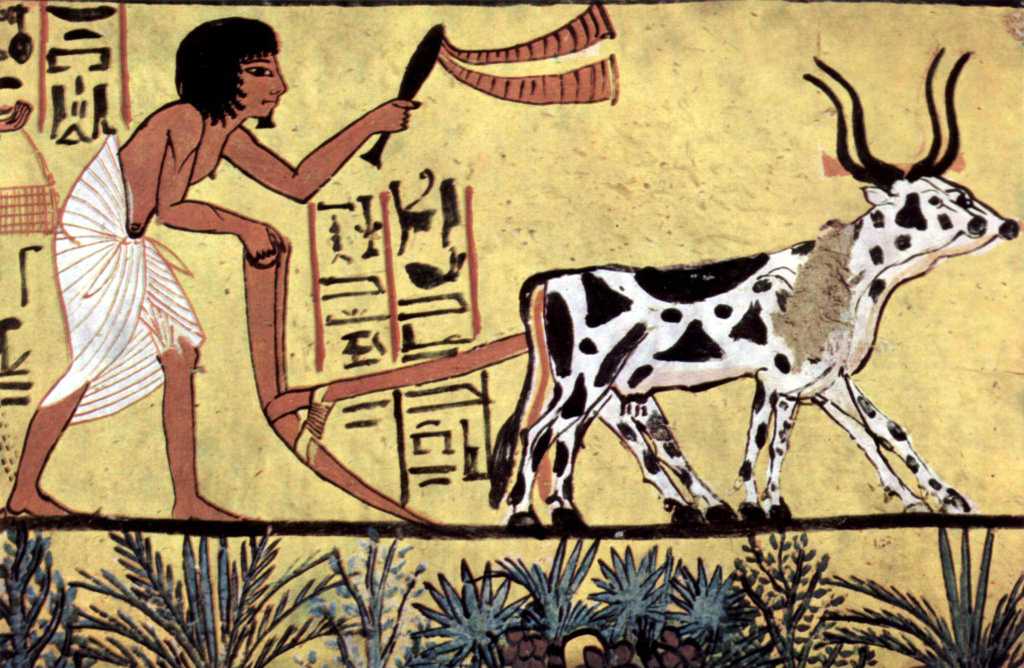
A ploughing farmer,1200 BC (BCE)
Depiction of grain harvest

Art and Architecture

The Egyptians excelled in artan architecture.Their writing is also a form of art.Numerous sculptures,painting and carvings attest to the artistic skills of the Egyptians.The pyramids are massive monuments built as tombs of mourning to the Pharaohs.The great pyramids of mourning to the Pharaohs.The great pyramids near Cairo are known as the Giza pyramids.

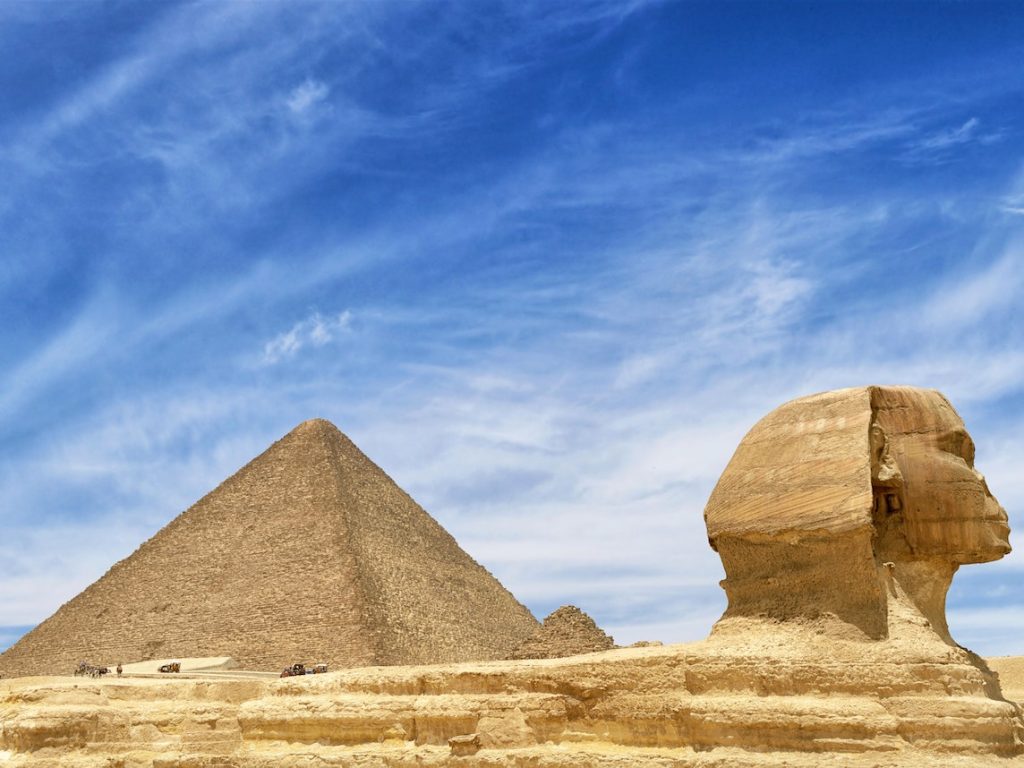
The Great Sphinx of Giza is a massive limestone image of a lion with a human head.It is dated to the time of Pharaoh Khatre.It is one of the largest sculptures of the world and measures seventy three metres in length and twenty metres in height.
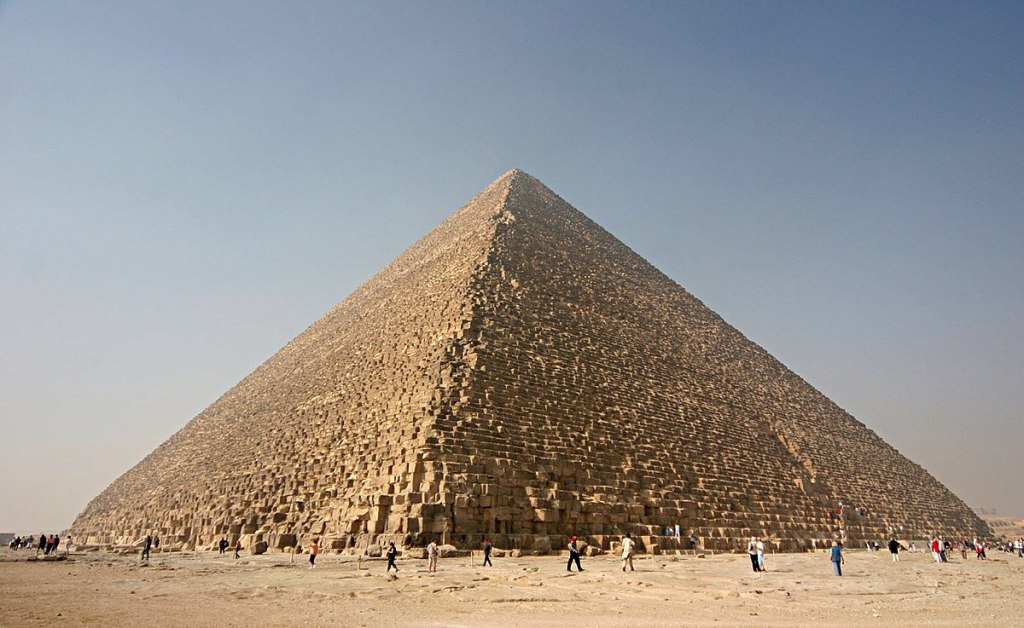
The Great pyramid of Giza
View of the sphinx with the Great pyramid, Egypt

Religion

The Egyptians practiced polytheism.Amon,Re,Seth,Thoth,Horus and Anubis are some of the gods of Egyptians. They worshipped many Gods,but the Sun God,Re,was the predominant one. Later on,the sun God was called Amon.

Philosophy, Science and Literature

The Egyptian Civilisation excelled in science, literature, philosophy, astronomy, mathematics and the measurement system. Sundial ,water clock and glass were developed by the Egyptians. They devised a solar calendar that consisted of twelve months of thirty days each,with five days added to the end of the year. This calendar was introduced as early as 4200 BC (BCE). Literally works included treatises on mathematics, astronomy, medicine,magic and religion. The Egyptians also distinguished themselves in painting,art, sculpture,pottery,music and weaving.

Ancient Egyptian Gods

Writing system

The Egyptians are well known for their writing system. Their form of writing is known as hieroglyphic. Hieroglyphic was used in the inscriptions on seals and other objects. The heretic, an another form of writing, was used for common purposes. This form of writing used a pictogram-based system. It was developed around 3000 BC (BCE) and many texts and books were written using this script.Now this inscription is on display in British Museum,London.

Hieroglyphic script on a Rosetta Stone

Characteristics and Contributions of the Egyptian Civilisation

  1. The Egyptians developed a solar calendar system.
  2. The pyramids and their designs show their mathematical and surveying skills.
  3. Hieroglyphic writing system attests to their skills in handling symbols.
  4. Preservation of human body in the form of Mummies.
  5. They applied innovation in the use of science and technology.

Invertebrata

Phylum porifera

These are multicellular,non – motile aquatic organisms, commonly called as sponges.They exhibit cellular grade of organization.Body is perforated with many pores called Ostia and leads to a canal system.It circulates water throughout the body and carries food, oxygen.The body wall contains spicules,which form the skeletal framework.Reproduction is by both asexual and sexual methods.e.g-Euplectella sycon.

Sycon
Pore bearers

Phylum coelenterata ( Cnidaria )

Coelenterates are aquatic organisms, mostly marine and few fresh water forms. They are multicellular, radically symmeterical animals with tissue grade of organization. Body wall is diploblastic with two layers. An outer ectoderm and inner mesoderm are separated by non- cellular jelly like substance called mesoglea. It has a central gastrovascular cavity called coelenteron with mouth surrounded by short tentacles.The tentacles bear stinging cells called cnidoblast or nematocyst.

Jelly fish

Many coelenterates exhibit polymorphism,which is the variation in the structure and function of the individuals of the same species. They reproduce both asexually and sexually.e.g. Hydra, Jelly fish.

Phylum platyhelminthes (Flat worms)

They are bilaterally symmetrical,triploblastic,acoelomate (without body cavity) animals. Most of them are parasitic in nature. Suckers and hooks help the animal to attach itself to the body of the host. Excretion occurs by specialized cells called flame cells. These worms are hermaphrodites having both male and female reproductive organs in a single individual.e.g – Liverfluke, Tapeworm.

Phylum Aschelminthes ( Round worms )

Aschelminthes are bilaterally symmetrical, triploblastic animals. The body cavity is a pseudocoelum. They exist as free-living soil forms or as parasites. The body is round and pointed at both the ends.It is unsegmented and covered by thin cuticle. Sexes are separate. The most common diseases caused by nematodes in human beings are elephantiasis and ascariasis.e.g – Ascaris, Wuchereria.

Liver fluke
Tape worm

Phylum Annelida ( segmented worms )

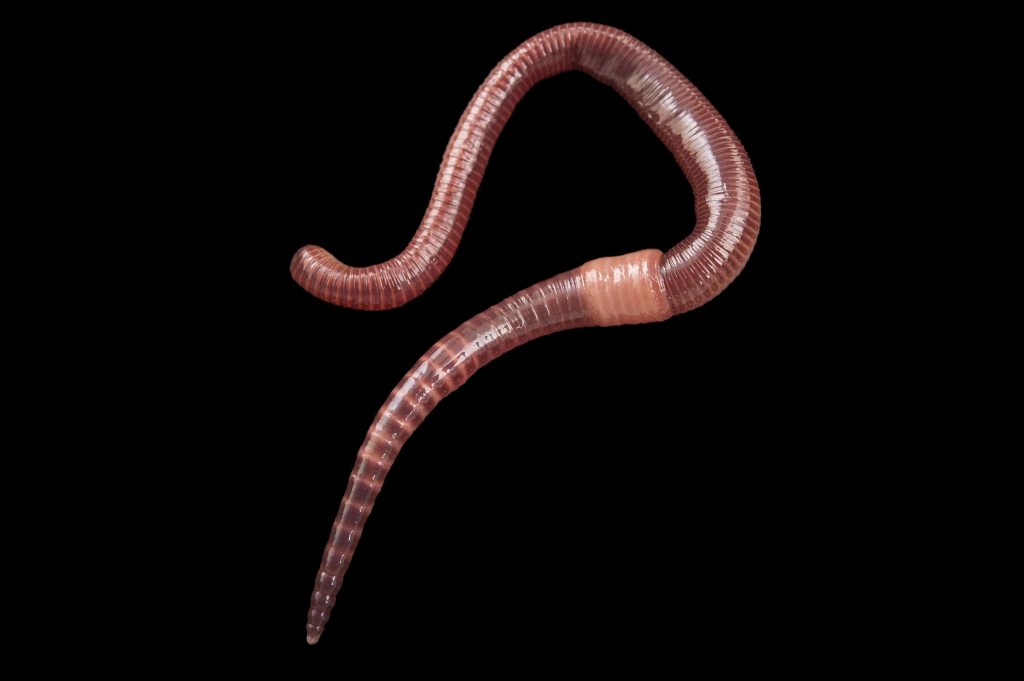
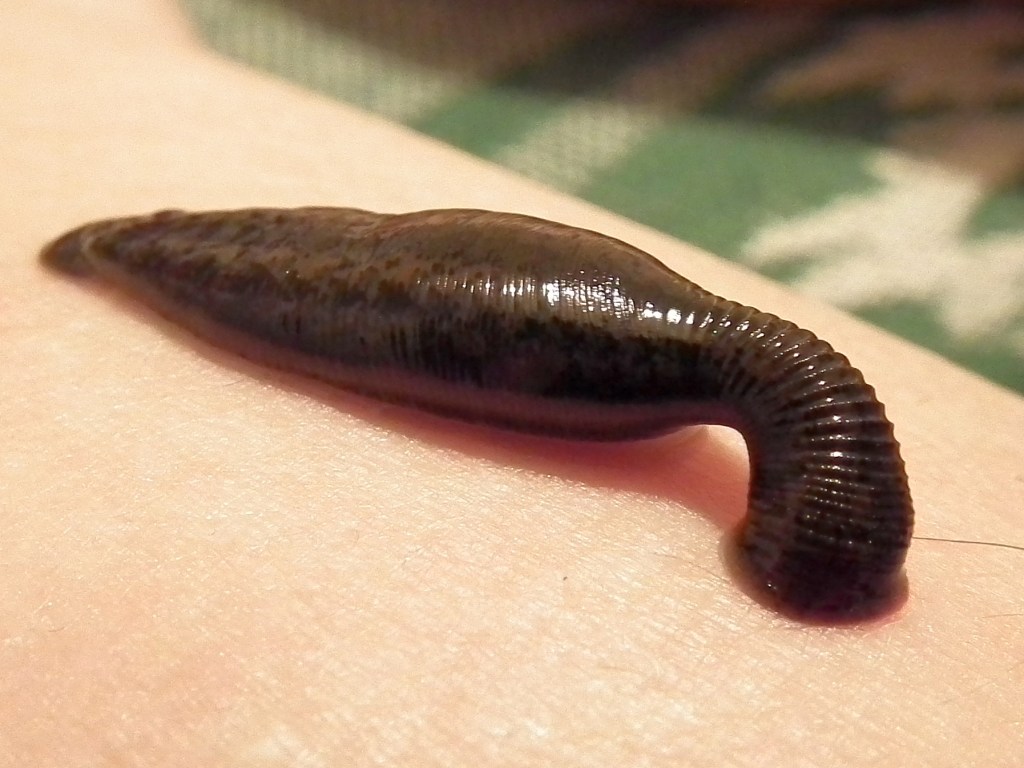
These are bilaterally symmetrical, triploblastic,first true coelomate animals with organ-system grade of organization.Body is externally divided into segments called metameres joined by moist thin cuticle. Setae and parapodia are locomotor organs. Sexes may be separate or United (hermaphrodites).e.g. Nereies, Earthworm,Leech.

Earthworm
Leech

Phylum Arthropoda (Animals with jointed legs )

Arthropoda is the largest phylum of the animal kingdom. They are bilaterally symmetrical, triploblastic and coelomate animals. The body is divisible into head,thorax and abdomen.Each segment bears paired jointed legs. Exoskeleton is made of chintin and is shed periodically as the animal grows. The casting off and regrowing of exoskeleton is called moulting.

Body cavity is filled with haemolymph (blood).The blood does not flow in blood vessels and circulates throughout the body (open circulatory system) . Respiration is through body surface,gills or tracheae(air tubes). Excretion occurs by malphigian tubules or green glands.Sexes are separate.e.g., Prawn,Crab, Cockroach,Millipedes, Centipedes,Spider ,Scorpions.

Centipede
Millipede

Phylum Mollusca ( soft Bodied Animals )

They are diversified group of animals living in marine,fresh water and terrestrial habitats.Body is bilaterally symmetrical,soft and without segmentation. Is is divided into head, muscular foot and visceral mass. The foot helps in locomotion. The entire body is covered with fold of thin skin called mantle, which secretes outer hard calcareous shell. Respiration is through gills (ctenidia) or lungs or both. Sexex are separate with larval stages during development.e.g.Garden snail, Octopus.

Phylum Echinodermata ( spiny skinned Animals )

They are exclusively free-living marine animals. These are triploblastic and true coelomates with organ-system grade of organization. Adult animals are radially symmetrical. A unique feature is the presence of fluid filled water vascular system. Locomotion is affected by tube feet.Body wall is covered with spiny hard calcareous ossicles.e.g. -Star fish,Sea urchin.

Phylum Hemichordata

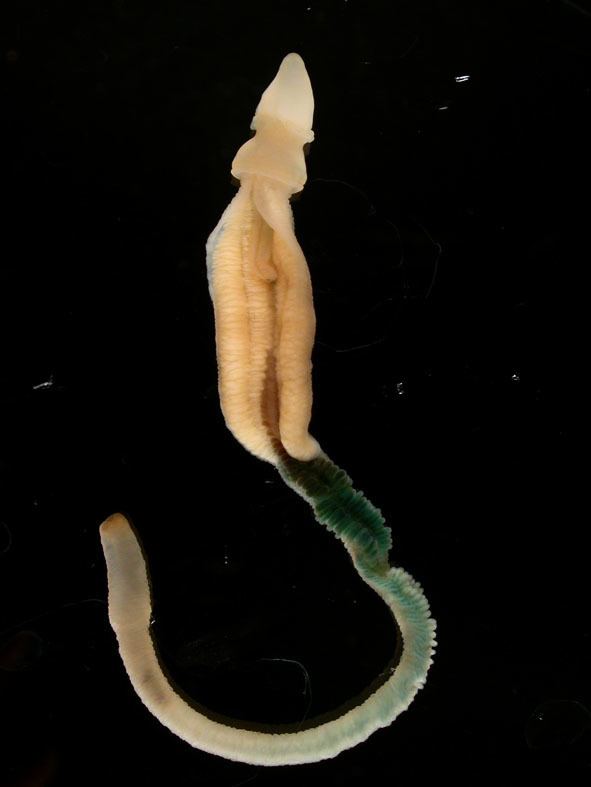
Hemichordates are marine organisms with soft ,vermiform and unsegmented body. They are bilaterally symmetrical, coelomate animals with non-chordate and chordate features. They have gill slits but do not have notochord. They are ciliary feeders and mostly remain as tubiculous forms.e.g.- Balanoglossus(Acron worms).

Balanoglossus

✨Think about it✨

” IF YOU LIGHT A LAMP FOR SOMEONE ELSE IT WILL ALSO BRIGHTEN YOUR PATH “

” EVERYTHING THAT HAS A BEGINNING HAS AN ENDING “

” TO UNDERSTAND EVERYTHING IS TO FORGIVE EVERYTHING “

” YOU WILL NOT BE PUNISHED FOR YOUR ANGER,YOU WILL BE PUNISHED BY YOUR ANGER “

” LIFE IS SUFFERING “

” HEALTH IS THE GREATEST GIFT, CONTENTMENT THE GREATEST WEALTH, FAITHFULNESS THE BEST RELATIONSHIP “

” KINDNESS IS LOVING PEOPLE MORE THAN THEY DESERVE “

” RULE YOUR MIND OR IT WILL RULE YOU “

” ISN’T EMPTY IT’S FULL OF ANSWERS “

” THE TROUBLE IS YOU THINK YOU HAVE TIME “

” WHEN YOU LEARN TO ACCEPT INSTEAD OF EXPECT,YOU’ll HAVE FEWER DISAPPOINTMENTS “

” NEGATIVE THOUGHTS WILL DESTROY YOU ,ALWAYS KEEP A POSITIVE ATTITUDE “

” OVERTHINK IS THE BIGGEST CAUSE OF UNHAPPINESS

” TO CONQUER YOURSELF IS A GREATER TASK THAN CONQUERING OTHERS “

” JUDGE NOTHING WILL BE HAPPY. FORGIVE EVERYTHING YOU WILL BE HAPPIER. LOVE EVERYTHING YOU WILL BE HAPPIEST “

Mauryan Empire

Sources

Mauryan Empire – India’s First Empire

Chandragupta Maurya

The Mauryan Empire was the first largest empire in India.Chandragupta Maurya established the empire in Magadha.
Bhadrabahu,a Jain monk,took Chandragupta Maurya to the southern India
Chandragupta performed Sallekhana(Jaina ritulas in which a person fasts unto his death) in Sravanbelgola (Karnataka).

Bindusara

Real name of Bindusara was Simhasena.He was the son of Chandragupta Maurya.Greeks called Bindusara as Amitragatha, meaning`slayer of enemies ′.During Bindusara’s reign Mauryan Empire spread over large parts of India.He appointed his son Ashoka as a governor of Ujjain.After his death , Ashoka ascended the throne of Magadha.

Ashoka

Ashoka was the most famous of the Mauryan kings.He was known as ‘Devanam piya’ meaning’beloved of the gods’.

Ashoka fought the Kalinga war in 261 BC (BCE).He won the war and captured Kalinga.
The horror of war was described by the king himself in the Rock Edict XIII.

Lion capital of Ashoka

The Emblem of the Indian Republic has been adopted from the Lion capital of one of Ashokas pillars located at Sarnath.The wheel from the circular base,the Ashoka chakra is a part of the National Flag.

Chandasoka (Ashoka,the wicked) to Dhammasoka (Ashoka the ringteous)

After the battle of Kalinga,Ashoka became a Buddhist.He undertook tours ( Dharmayatras) to different parts of the country instructing people on policy of Dhamma.The meaning of Dhamma is explained in Ashoka’s – pillar Edict II
It contained the noblest ideas of humanism,forming the essence of all religions.He laid stress on

  • Compassion
  • Charity
  • Purity
  • Saintliness
  • Self-control
  • Truthfulness
  • Obedience and respect for parents, preceptors and elders.

Ashoka sent his son Mahinda and Sanghamitta to Srilanka to propagate Buddhism.He also sent missionaries to west Asia, Egypt and Eastern Europe to spread the message of Dhamma.The Dhamma – mahamattas were a new cadre of officials created by Ashoka.Their job was to spread dhamma all over the empire.Ashoka held the third Buddhist council at his capital Pataliputra.

Edicts of Ashoka

The 33 Edicts on the pillars as well as boulders and cave walls made by the Emperor Ashoka, describe in detail Ashoka’s belief in peace, righteousness, justice and his concern for the welfare of his people.The Rock Edicts II and XIII of Ashoka refer to the names of the three dynasties namely Pandyas,Cholas ,the Keralaputras and the Sathyaputras.

Mauryan Administration

Centralized administration King

  • The king was the supreme and sovereign authority of the Mauryan Empire.
  • Council of ministers known as mantriparishad assisted the King.Assembly of ministers included a Purohit,a senapathi,a Maha mantri and the Yuvaraja.
  • King had an excellent spy system.

Revenue system

  • The land was the most important source of revenue for the state.Ashokan inscription at Lumbini mentions bali and bagha as taxes collected from people.The land tax(bhaga) collected was 1/6 of the total produce.
  • Revenue from taxes on forests,mines,salt and irrigation provided additional revenue to the government.
  • Much of the state revenue was spent on paying the army,the officials of the royal government,on charities and on different public,road construction etc.

Judical system

  • The king was the head of the Judiciary.He was the highest court of appeal.
  • King appointed many judges subordinate to him.The punishments were harsh.

Military Administration

The king was the supreme commander of the army.A board of 30 members divided into six committees with five members on each,monitored

  • Navy
  • Armoury (transport and supply)
  • Infantry
  • Cavalry
  • The war chariots
  • The war elephants

Municipal Administration (cities and Towns)

  • Board of 30 members divided into six committees.Each had 5 members to manage the administration of the city.
  • Town administration was under Nagarika.He was assisted by Sthanika and Gopa.

Currency

Money was not only used for trade; even the government paid its officers in cash.
The punch marked silver coins (panas) which carry the symbols of the peacock,and the hill and crescent copper coins called Mashakas formed the imperial currency.

Trade and Urbanization

Trade flourished particularly with Greece (Hellenic) Malaya, Ceylon and Burma.The Arthashastra refers to the regions producing specialized textiles-kasi (Benares), Vanga(Bengal),Kamarupa (Assam) and Madurai in Tamilnadu

Mauryan coins

Mauryan Art and Architecture

Mauryan Art can be divided into two

Indigenous Art – statues of Yakshas and Yakshis
Royal Art. – palaces and public buildings
– Monolithic pillars
– Rock cut Architecture
– Stupas

Stupas

Sanchi near Bhopal, MP

A stupa is a semi- spherical dome like structure constructed on brick or stone.The Buddha’s relics were placed in the centre of the dome.

Monolithic pillar – Sarnath

The crowning element in this pillar is Dharma Chakra.

Monolithic pillar – Sarnath

Beginning of Rock cut Architecture

Rock – cut caves of Barabar and Nagarjuna Hills.

Lomas Rishi cave, Barabar

There are several caves to the north of Both Gaya.Three caves in Barabar hills have dedicative inscription of Ashoka. and three in Nagarjuna hills have inscriptions of Dasharaths Maurya ( grand son of Ashoka)

Reasons for the Decline of the Mauryan Empire

  • Ashoka’s successors were very weak
  • Continuous revolts in different parts of the empire.
  • Invasion by the Bactrian Greeks weakened the empire.
  • Invasion by the Bactrian Greeks weakened the empire.
  • Last Maurya ruler Brihadratha was killed by his commander Pushyamitra Sungha who established Sungha dynasty.

Hardware and software

Computer is a device comprising both hardware and software.The functions of hardware and software combines together to make the computer functional.A hardware device helps to enter input information.The software processes the input data and gives the output in the monitor,a hardware device.Thus computer is like a human body,where human body is the hradware and soul is the software.

Hardware

Hardware

Hardware is the parts of the computer which we can touch and feel.Hardware includes Input and output devices, Cabinet,Hard Disk,Mother Board,SMPS,CPU,RAM,CD Drive and Graphics card.

Software

Hardware is lifeless without software in a computer.Software are programmed and coded applications to process the input information.The software processes the data by converting the input information into coding or profmgrammed language.Touching and feeling the software is not possible but we can see the functions of the software in the form of output.

Software

Types of software

The software is divided into two types based on the process.They are

  1. System software (operating system)
  2. Application software

System software

System software is software that makes the hardware devices process the data inputted by the user and to display the result on the output devices like Monitor.Without the opening devices like Monitor . Without the operating system, computer cannot function on its own.Some of the popular operating system are Linux, windows,Mac, Android etc.

Application software

Application software is a program or a group of programs designed for the benefit of end user to work on computer.The application programs can be installed in the hard disk for the usage on a particular computer.This type of application program completes one or more than two works of the end user.The following are the examples of application program:

  • Video player
  • Audio player
  • Word processing software
  • Drawing tools
  • Editing software,etc.

System and Application software types

The opening system and application software are available in two forms.They are:

  1. Free and open source
  2. Paid and proprietary software

Free and open source

Free and open software is available at Free of cost and can be shared to many end users.Free software is editable and customisable by the user and his leads to updation or development of new software.Examples of free and open source software:LINUX,open office , operating system,Geogebra etc.

  • Conventional software developers, distributors and sellers fear that FOSS will undercut their profits.
  • Abuse of FOSS privilege may lead to questionable claims of copyright or trademark protection,thereby spawning litigation.
  • The monetary value of FOSS is unclear, so government’s have trouble figuring out how to tax it.

Paid and proprietary software

There is software that is to be paid to use either permanently or temporarily,these types of software are paid and need a licence to use it.The licence of the software would not be provided unless it is purchased.Similarly the end users are legally prohibited to steal the software program or to use the pirated version of the paid and proprietary software.Some of the examples of paid & proprietary software are: windows, Microsoft office,Adobe photoshop,etc.

South Indian Kingdom

By the early 7th century, synchronising with the Harsha’s region in the north,the fat south had come under the control of the pallava kings of Kanchipuram.Pallava sovereignty included the domains of the Cholas and the Pandyas.The latter were then emerging as ruling dynasties in their respective river valley regions.Much of the central and eastern Deccan was under the Chalukyas of Badami(Batali),who were then pushed away by the Rashtrakutas.The Medieval period in India was marked by thee mergence of regional centres of power.There was no single imperial power like Mauryas or Guptas who exercised control over the greater part of India in this period.

The pallavas

The pallava kings ruled around the prosperous agraian settlement and important trade centre of India.Kanchipuram was well known to Chinese and Roman merchants.From the flourishing trade centre of Kanchipuram,the later pallavas extended their sovereignty over all the Tamil-speaking regions during the 7th and 8th centuries.The central part of their kingdom, however,was Thondaimandalam,a large political region comprising northern parts of Tamil Nadu and the adjoining Andhra districts.

Pallava Genealogy (prominent kings)

There were early pallava rulers who were feudatories of Satavahanas.Simhavishnu,son of Simhavarman I I (around 550AD(CE),created a strong pallava kingdom after destroying the Kalabhras.He defeated many kings in the south including the Cholas and the pandyas.His able son was Mahendravarman I .He was succeeded by his son Narasimha Arman I .The other prominent pallva rulers were Narasimha Arman I I or Rajasimha and Nandivarman II. The last pallava ruler was Aparajita.
Mahendravarman (c.600-630AD(CE)) contributed to the greatness of the pallava kingdom.Mahendravarman I was a follower of Jainism in the early part of his rule.He embraced saivism by the Saivite saint Appar (Tirunavukkarasar).He was a great parton of art and architecture.He is known for introducing a new style to Dravidian architecture ,which is referred to as ‘Mahendra style’ . Mahendravarman also wrote plays, including (c.620) Mattavilasaprahasana.(The Delight of the Drunkards )in sanskrit,which denigrates Buddhism.
Mahendravarman’s reign involved constant battles with the Western Chalukya kingdom of Badami under PulakesinI I . Pulakesin seems to have defeated Mahendravarman in one of the battles and taken over a large part of his territory in the north.His son Narasimavarma I avenged the defeat by capturing Batali,the capital of Chalukyas.He set Vatapi on fire, killing Pulakesin in the process.
Narasimavarma II(c.695-722),also known as Rajasimha,was a great military strategist.He exchanged ambassadors with China.His reign was comparatively free from any political disturbance.Therefore,he could concentrate on temple-building activities.During his reign,the famous kailasanatha temple at Kanchipuram was built.

Pallava’s contribution to Architecture

Pallava period is known for architectural splendour.The shore Temple and various other temples carved from granite monoliths and the Varaha cave(7th century) at Mamallapuram,are illustrious examples of pallava architecture.In 1984 , Mamallapuram was added to the list of UNESCO World Heritage sites.Pallava architecture can be classified as

  1. Rock-cut temples – Mahendravarman style
  2. Monolithic Rathas and sculptural Mandapas – Mamallan style
  3. Structural Temples – Rajasimha style and Nandivarman style

Mahendra style

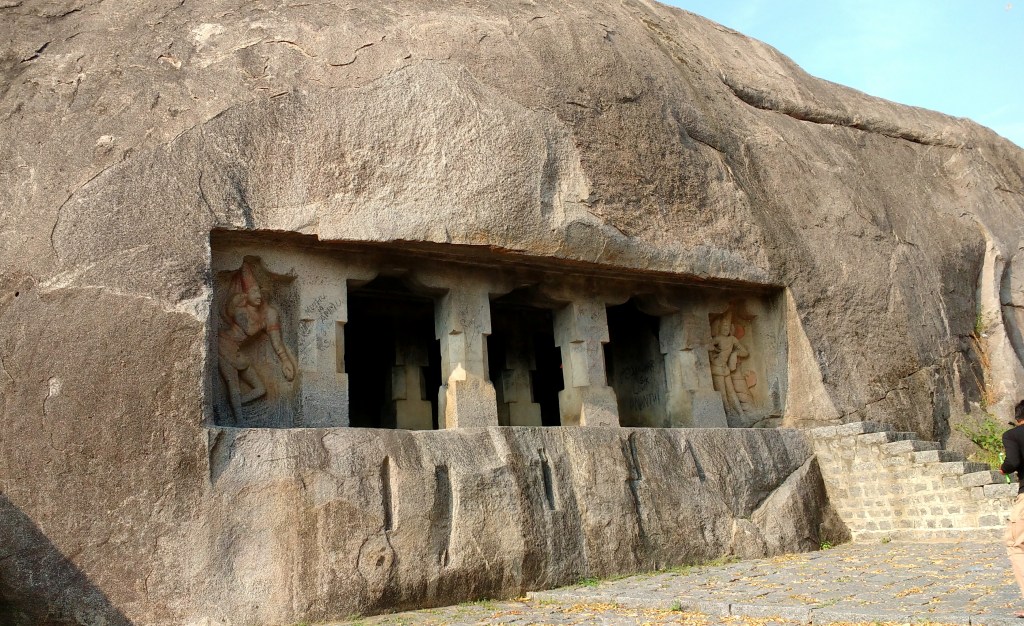
The best example of Mahendravarma style monuments are cave temples at Mamdagapattu,Mahendravadi,Mamandur,Dalavanur, Tiruchirapalli,Callam,Tirukazhukkundram and Siyamangalam.

Cave Temple Mamdagapattu

Mamalla style

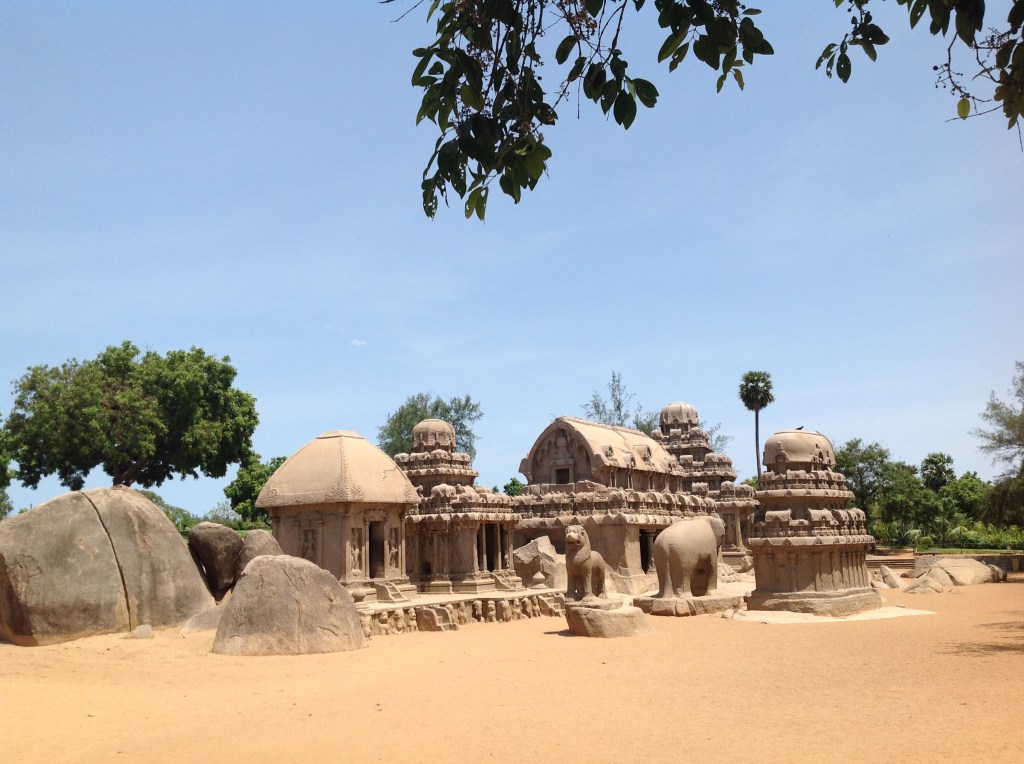
The five Rathas,popularly called Panchapandavar rathas, signify five different style of temple architecture.Each ratha has been carved out of a single rock.So they are called monolithic.The popular Mandapas(pillars pavilions)they built are Mahishasuramardhini mandapam,Thirumoorthi mandapam and Varaha mandapam.

Panchapandavar Rathas

The most important among the Mamalla style of architecture is the open art gallery.Several miniature sculptures such as the figure of lice-picking monkey, elephants of huge size and the figure of the ascetic cat have been sculpted beautifully on the wall of a huge rock.The fall of the River Ganga from the head of Lord siva and the Arjuna’s penance are notable among them.The Great penance panel is considered to be the world’s largest open-air bas relief.

Rajasimha style

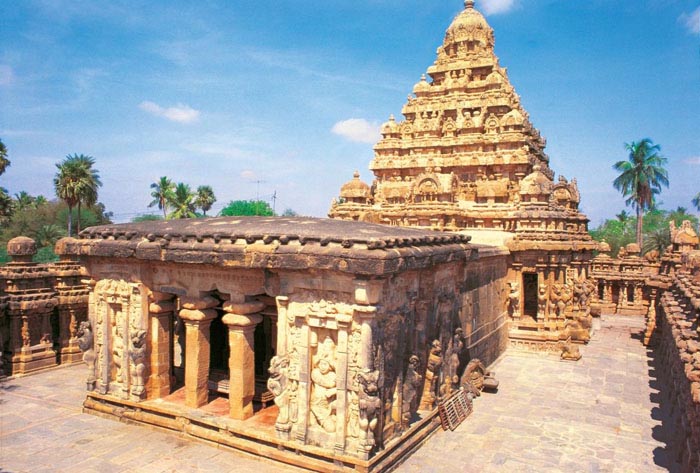
Narasimavarma II,also known as Rajasimha,constructed structural temples using stone blocks.The best example for the structural temple is kailasanatha temple at Kanchipuram.This temple was built by using sand stones.Kailasanatha temple is called Rajasimheswaram.

Kanchi Kailasanatha Temple

Nandivarma style

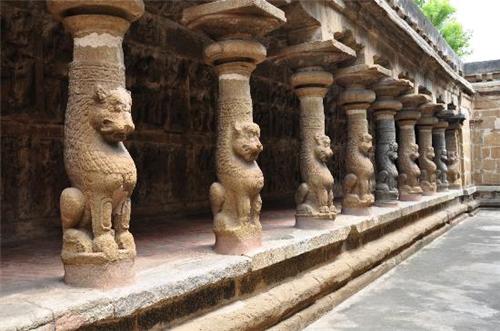
The last stage of the pallava architecture is also represented by structural temples built by the later pallavas.The best example is Vaikunda perumal temple at Kanchipuram.

Society and culture

The Pallava supported Jainism, Buddhism and the Vedic faith.They were great patrons of music, painting and literature.Some of the Pallava kings patronised the Azhwars and Nayanmars.These exponents of Bhakti Cult Preached a new form of Vaishnavism and Saivism.Among the Saivites were Appar and Manikkavasakar.Among the Vaishnatives were Nammazhvar and Andal.The Bhakti movement aimed at preaching a popular faith,in which prayers in Tamil were preferred to those in sanskrit.Women were encouraged to participate in the religious congregations.The Tamil devotional cult was competitive with Buddhism and Jainism.Therefore the latter suffered a gradual decline in most parts of Tamil Country.

Pallava Art

The Pallava kings had also patronised fine arts.The music inscriptions in Kudumianmalai and Thirumayam temples show pallava’s interest in Music.The famous musician Rudracharya lived during Mahendravarma I .The sculptures of this period depict many images in dancing postures.

Russian Revolution and its Impact

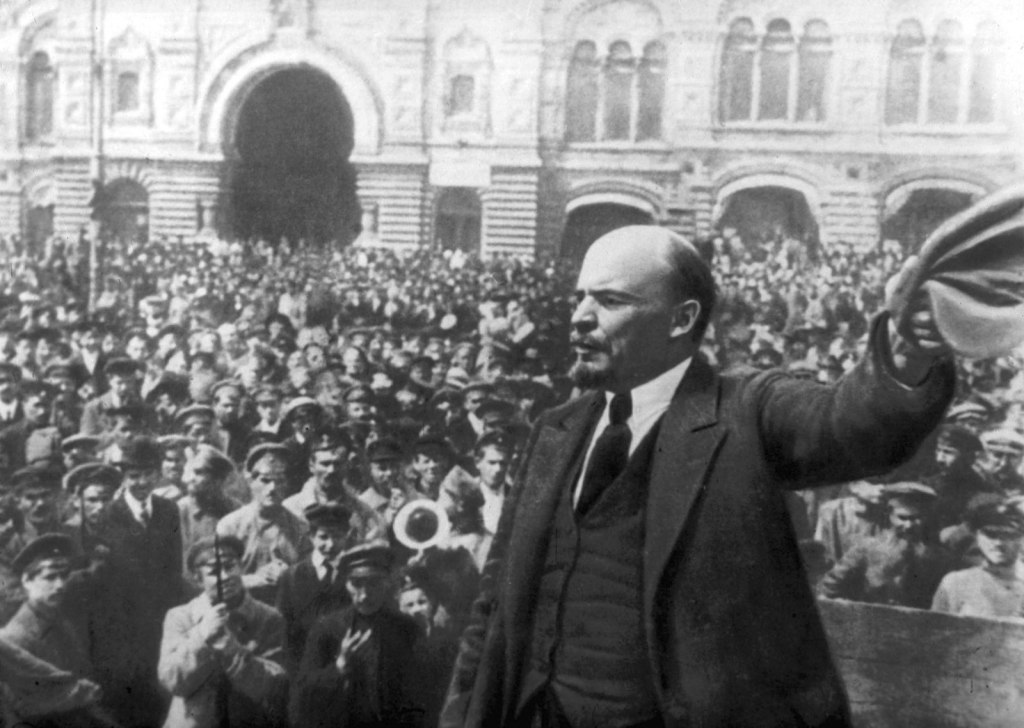
The biggest outcome of the war,the Russian revolution,was unique in world history.The socio political and economic conditions prevailing in Russia were brought to head by the War.There were really two revolutions in the year 1917 ,one in March and the other in November.On the abdication of the Tsar the bourgeois government which followed, wanted to continue the war.But the people were against it.So there was a second great uprising under the guidance their leader Lenin,who seized power and established a communist government in Russia.

Causes of the Revolution

Social causes

In Russia Peter the Great and Catherine I I attempted westernisation without changing the social conditions.The Russian peasents were serfs tied to lands owned by wealthy Russians.Afer Russia’s defeat in the Crimean War,some reforms were introduced.In 1861 Tsar Alexander I I abolished serftom and emancipated the serfs .But they were not given enough land to subsist.These peasents became the powder keg for the revolution.The labourers and workers whose number had increased on account of industrialisation were aggrieved as they got very low wages.

Role of Revolutions

The spread of revolutionary ideas among the intelligentsia and their repression by the Tsar’s government made the socialistically inclined students to carry their propaganda to the peasantry.In course of time these students disillusioned with the outcome of their work with the peasants,took to “terrorism”.yet the revolutionary forces swelled ,with the joining of the many minority groups like Jews and poles.Soon,based on the Marxist philosophy,new ideas began to take shape and a social and Democratic Labour party was formed.The Marxists declared themselves against acts of terriosm.They believed that the working class had to be roused to action,and inky by such mass action could they achieve thier goal.

Autocracy of the Tsar

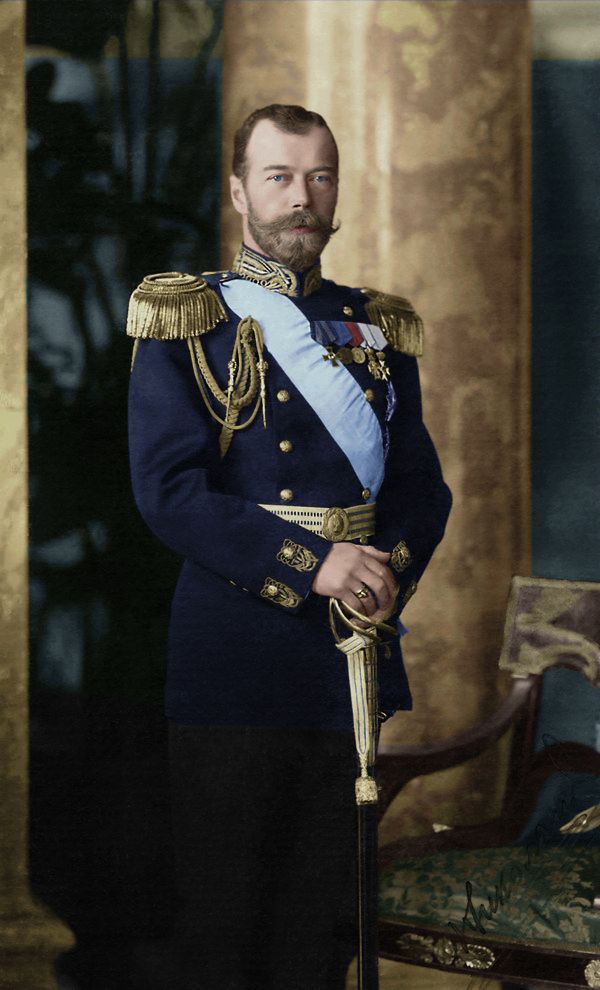
Tsar Nicholas I I of Romanow dynasty had little experience of government.His wife Tsarina Alexandra was a dominant personality and Nicholas was under her strong influence.Nicholax mistrusted most of his ministers and he was surrounded by flatters.Determined that Russia should not be left out in tha scramble for colonial possessions, Nicholas encouraged Russian expansion in Manchuria.This provoked a war with Japan in 1904.The resulting Russian defeat led to strikes and riots.On 23 January 1902 Father Gapon,a priest,organised a march of men, women and children on the Tsar’s winter palace in St.Petersburg demanding a representative national assembly and agraian and industrial reforms.But police and soldiers fired on the procession.Hundreds were killed and many thousands wounded.The events of this day led to riots, strikes and violence in which the governor-general of Moscow,an uncle of the Tsar,was killed by a bomb.Nicholas was forced to grant a constitution and establish a parliament,the Duma.This was no longer satisfactory to the left-wing parties that formed a Soviet of workers delegates in St Petersburg,led by Trotsky.Similar Soviets were set up in other cities.The Duma gave the middle classes,a voice in government.So the moderates were supportive of the government’s policy,while the left wing continued their opposition.

Opposition to Tsar and Dissolution of Duma

The outbreak of the First world war had temporarily strengthened the monarchy,as Russia allied to France and Britian.As there was rumour of a palace revolution.Nicholas made himself the commander-in-chief of the army.At the end of 1916 ,Rasputin,who had a domineering influence over the Tsar and the Tsarina,was murdered by a member of the Tsar’s family.The members of the St.Petersburg Soviet were arrested.Whenever the Duma opposed the Tsar’s move,it was dissolved and fresh elections held.Without change of government policy,the fourth Duma ended with the revolution of 1917.

Popular uprisings

Even on 23 February 1917,when the socialists celebrated International working Women’s Day on that day ,The Tsar seemed unchallengeable.But he had to abdicate on the morning of 2 March.Though none called for strikes fearing that the time was not ripe for militant action,the bread shortages among women textile workers,many with husbands in the army, forced them to go on strike anyway and March through the factory areas of Petrograd ,the capital of the Russian Empire.Masses of women workers demanding “Bread for workers “waved their arms towards factory workers and shouted”Come out !” “Stop work!” The city’s 4,00,000 workers joined the movement the next day (24 February)

Abdication of Tsar

The government used the troops to break the strike.But soon mutinies broke out in the barracks.The Tsar ordered a declaration of material law.But his order was not broadcast in the city,as there was no one to do this job.The Tsar then tired to return to Petrograd.The railway workers stopped his train.The generals at the front and some leaders in petrograd, frightened by these developments pleaded with the Tsar to abdicate.On 15 March, Nicholas I I abdicated.

The revolutionary Tamil poet Bharathiyar cheerfully welcomed the revolution in Russia by penning these poetic lines…

The Mother Great,the power supreme,
Turned her galance benign towards Russia,
The Revolution of the Age,
Behold the wonder ,rises high
The tyrant howling falls down limp,
The shoulders of the heavenly god’s,
Are swelling now with joy and pride,
Eyes hot with unshed tears,the demons,perish.O people of the world, Behold this mightly change!

Provisional Government

There were two parallel bodies to take on government functions.One was of the bourgeois politicians of the old state Duma, comprising prospertied classes.On the other there were workers’ delegates drawn together in a workers council,or Soviet.The workers’ delegates in the Soviet were influenced by the underground left-wingers .Those in the Duma were able to form a provincial government with the consent of the Soviets.The Soviet was dominated by Mensheviks and the minority Bolshevik were timid and undecided.The situation changed with the arrival of Lenin.

Failure of provisional Government

Lenin was in Switzerland when the revolution broke out.Lenin wanted continued revolution.His slogan of All power to the Soviets soon won over the workers leaders.Devasted by war time shortages,the people were attracted by the slogan of ‘Bread ,peace and Land’.But the provisional Government made two grave mistakes.First,it postponed a decision on the demand for the redistribution of land and the other was government decided to continue with the war.Frustrated peasent soldiers deserted their posts and joined those who had restored to land grabbing.

Takeover by the Bolshevik party under Lenin’s leadership

In Oct Lenin persuaded the Bolshevik central Committee to decide on immediate revolution.Trotsky prepared a detailed plan.On 7 November the key government buildings, including the winter palace,the prime minister’s headquarters,were sized by armed factory workers and revolutionary troops.On 8 November 1917 a new Communist government was in office in Russia.Its head this time was Lenin.The Bolshevik party was renamed the Russian Communist party.

Outcome of the Revolution

The Russian Communist party eliminated illiteracy and poverty in Russia within a record time.Russian industry and agriculture developed remarkably.Women were given equal rights, including rights to industries and banks were nationalised.Land was distributed to poor peasents.Lenin thought the most important factor for the fall of provisional Government was its failure to withdraw from world war.So Lenin immediately appeared for peace.unmindful of the harsh terms dicated by the central powers,Lenin opted for withdrawing from the war to concentrate on the formation of new government.In March 1918 the treaty of Brest-Litovsk was signed.

Global Influence of the Russian Revolution

The revolution fired people’s imagination across the world.In many countries, communist parties were formed.The Russian Communist government encouraged the colonies to fight for their freedom.Debates over key issues,and reforms,social welfare, workers’ rights and gender equality started taking place in a global context.

Emergency of New Kingdoms in South India:Later Cholas

1.The Later Cholas

The Cholas are one among the popular and well-known Tamil morarchs in the history of South India.The elaborate state structure,the extensive irrigation network,the vast number of temples they built, their great contributions to art and architecture and their overseas explots have given them a pre-eminent position in history.

Revival of the Chola Rule

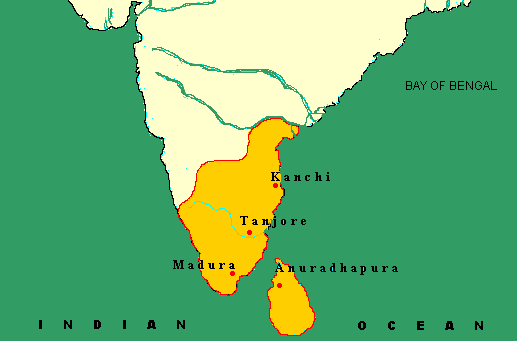
The ancient Chola kingdom resigned supreme with the Kaveri delta forming the core area of its rule and with Uraiyur (present-day Tiruchirapalli) as its capital.It rose to prominence during the regine of Karikala but gradually declined under his successors.In the 9th century vijayalaya, ruling over a small territory lying north of the Kaveri,revived the Chola Dynasty.He conquered Thanjavur and made it his capital.Later Rajendra l and his successors ruled the empire from Gangaikonda Cholapuram,the newly built capital.
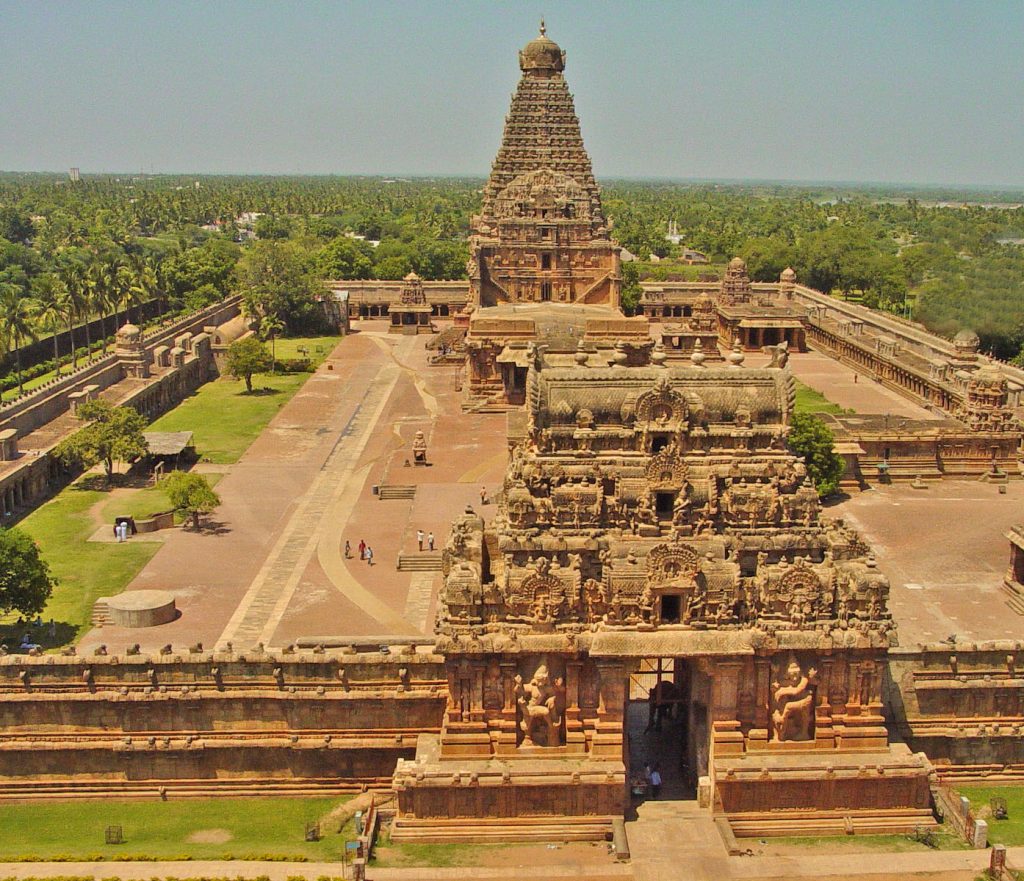
Rajaraja |(A.D.(CE) 985–1014) was the most powerful ruler of Chola empire and also grew popular beyond his times.He established Chola authority over large parts of South India.His much–acculaimed naval expeditios led to the expansion of Cholas into the West Coast and Sri Lanka.He built the famous Rajarajeswaram (Brihadeshwara) Temple in Thanjavur.His son and successor, Rajendra Chola |(A.D.(CE)1014 – 1044,matched his father in his ability to expand the empire.The Chola empire remained a powerful force in South India during his region.After his accession,his striking military expedition was to northern India,capturing much territory there. He proclaimed himself the Gangaikondan.The Gangaikonda Cholapuram temple was built to commemorate his victories in North India.The navy of Rajendra Chola enabled him to conquer the kingdom of Srivijaya (southern Sumatra ).Cholas control over the seas facilitated a flourishing overseas trade.

Decline of the Chola Empire

Rajendra Chola’s three successors were not capable rulers.The third successor Veerarajendra’s son Athirajendra was killed in civil unrest.with his death ended the vijayalaya line of Chola rule.

On hearing the death of Athirajendra,the Eastern Chalukya prince Rajendra Chalukya seized the Chola throne and began the rule of Chalukya-Chola dynasty as Kulothunga |. Kulothunga established himself firmly on the Chola throne soon eliminating all the threats to the Chola Empire.He avoided unnessary wars and earned the goodwill of his subjects.But Kulothunga lost the territories in Ceylon.The Pandya territory also began to slip out of Chola control.Kanchipuram was lost to the Telugu Cholas.The year 1279 marks the end of Chola dynasty when king Maravarman Kulasekara Pandyan | defeated the last king Rajendra Chola lll and established the rule of the pandyas in present -day Tamil Nadu.

Administration

The central administration was in the hands of king.As the head of the state ,the king enjoyed enormous powers.The king’s orders were written down in palm leaves by his officials or inscribed on the temple walls. The Kingship was hereditary in nature.The ruler selected his eldest sona as the heir apparent.He was known as Yuvaraja.The Yuvarajas wer e appointed as Governers in the provinces mainly for administrative training.The Chola rulers established a well- organised system of administration.The empire,for administrative convenience,was divided into provinces or mandalams.Each mandalam was sub-divided into naadus.Within each naadu,there were many kurrams.The lowest unit was the gramam(village).

Local Governance

Local administration worked through various bodies such as Urar,Sabhaiyar ,Nagarattar and Nattra.With the expansion of agriculture, numerous peasant settlements came up on the countryside.They were Known as Ur.The Urar,who were landholders acted as spokesmen in the Ur.Sabhaiyar in Brahman villages also functioned in carrying out administrative, financial and judical functions.Nagarattar administrated the settlement of traders.However,skilled artisans like mansons,blackmiths ,goldsmiths,weavers and potters also lived in Nagaram.Nattur functioned as an assembly of Nadu and decided all the disputes and issues pertaining to Nadu.The assembles in Ur,Sabha,Nagaram and Nadu worked through various committees.The committees took care of irrigation,roads, temples,gardens, collection of revenue and conduct of religious festivals.

Uttiramerur Inscriptions

Uttiramerur presently in Kanchipuram district was a Brahmadeya village (land grants given to Brahmins).There is a detailed description of how members were elected to the committees of the village sabha in the inscriptions found there.One member was to be elected from each ward.There were 30 wards in total.The eligibility to contest was to men in the age group of 35-70, well-versed in Vedic texts and scriptures, and also owned land and house.The process of election was as follows:The names of qualified candidates from each ward were written on the palm-leaf slips and put into a pot.The eldest of the assembly would engage a boy to pull out one slip and declare in this way.

Revenue

The revenue of the Chola state came mainly from the land.The land tax was known as Kanikadan.The Chola rulers carried out an elaborate survey of land in order to fix the government’s share of the land revenue.One – third of produce was collected as land tax.It was collected mostly in Kind.In addition to land tax,there were taxes on profession and tolls on trade.

Social structure Based on Land Relations

The Chola rulers gifted tax-free lands to royal officials, Brahmins, temples and Jain institutions was called pallichchandam.There were also of vellanvagai land and the holders of this land were called Vellalars.Ulu-kudi,a sub-section of Vellalar, could not own land but had to cultivate Brahmadeya and Vellanvagai lands.The holders of vellanvagai land retained melvaram.The ulu-kudi got kil-varam.Adimai and panicey-makkal occupied the lowest rung of society.In the intermediate section came the armed men and traders.

Irrigation

Cholas gave importance to irrigation.The 16 – mile long embankment built by Rajendra Chola in Gangaikonda Cholapuram is an illustrious example.Vati-vaykkal,a criss-cross channel,is a traditional type of harnessing rain water in the cauvery delta.Vati is a drainage channel and a vaykkal is the supply channel.The commonly owned village channel was called ur-vaykkal.

Religion

Chola rulers were ardent saivites.Hymns,in praise of the deeds of Lord siva,were composed by the Saiva saints,the Nayanmars.

Temples

The Chola period witnessed an extensive construction of temples.The temples in Thanjavur, Gangaikonda Cholapuram and Darasuram are the repository of architecture, sculpture, paintings and iconography of the Chola art . Temples during the Chola period were not merely places of worship.They were the largest landholders.Temples promoted education ,and devotional forms of art such as dance,music and drama.The staff of the temples included temple officials, dancing girls, musicians,singers ,players of musical instruments and the priests.

Trade

There was a flourishing trade during the Chola period.Trade was carried out by two guild-like groups: anju-vannattar and mani-gramattar.Anju-vannattar comprised west Asians,Arabs,Jews, Christians and Muslims.They were maritime traders and settled on the port towns all along the west Coast.It is said that mangi-gramattur were the traders engaged in inland trade.In due course,both groups merged under the banner of ai-nutruvar and disai-ayirattu -ai-nutruvar functioning through the head guild in Ayyavole, Karnataka.This ai-nutruvar guild operated the maritime trade covering South-east Asian countries.

Reproduction and Modification in plants

We know already that flowering plants have root,stem and leaves.They are called vegetative organs.Flowers,fruits and seeds in a plant are called reproductive organs.In earlier classes we have seen that new plants can be grown from seeds.In this lesson,we are going to know how a flower changes itself into a fruit,and the modifications of root,stem and leaves of a plant.

Reproduction

We can see from this activity that watermelon plant is produced from that seeds.potato plant is not from seed,but from the steam Tuber (Vegetative part).seed is not only the source for new generation,even vegetative part of a plant can be used to produce a new plant.The process by which plants and animals produce young ones and increase their number is known as ‘reproduction’. Drumstick tree can be grown from both seeds and stem cuttings.When plants are reproduced from the seeds we call that process as sexual reproduction.All other ways of reproduction without seed are called as asexual reproduction.

Sexual reproduction

Seed is produced from a flower by the process of pollination and fertilization.This is known as sexual reproduction.To understand how seeds are formed in a flower, first we need to understand parts of a flower.

Parts of a flower

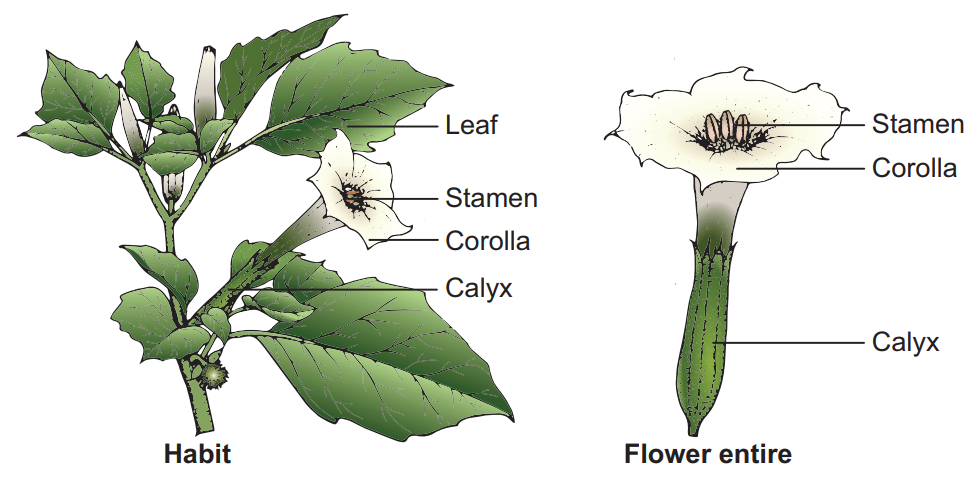
Let us compare few buds and opened flowers of Hibiscus and Datura.Observe bud and opened flower of Hibiscus and Datura.we can tabulate the characteristics of Hibiscus and Datura flowers as below.

In a bud ,we can see a green colour,leaf like structure which cover the whole bud or flower.Each of these green leaf like structure present as an outermost layer is called as sepal.This outer most ring of sepals is known as Calyx.Petals are the largest part of flowers.They are often attractive, brightly coloured, sometimes sweet scented and attract the insects.The ring of petals together is called corolla.

Inside corolla,in Hibiscus,we can observe a long tube on which many stamens are arranged.But,in Datura we can see only five stalked structures,stamens.This ring or whorl of a flower is called androecium.Each stamens consists of two parts-a stalk called filament and a lobe called anther.If you touch these lobes in a mature flower,we can get a powdery substance called pollen grains

Inside androecium whorl,we can find a female reproductive part of the flower, called gynoecium.You will find this part with a swollen bottom part.

This is a ovary.Seeds are produced in this part.On top of the ovary there is a slender tube like structure called style.The top most striky tip of the style is stigma.Pollen grains are received by the stigma.This is the fourth whorl of a flower.

Types of flowers

Flowers can be divided into two types.They are explained below.

Complete Flower

If all the four whorls-calyx,corolla,stamens and pistil are present,then it is called as complete flower.complete flowers are bisexual flowers.

Incomplete Flower

If any of these four whorls is missing,then it is called as incomplete flower.Incomplete flowers are unisexual flowers.There are two types of Unisexual flowers,male flowers and female flower.The flower with androecium and without gynoecium is called as male flower and the one with gynoecium and without androecium is known as female flowers.

Pollination

We know that flowers of pumpkin are unisexual-that is some flowers are male while many are female flowers.We can easily identify the male and female flower of pumpkin,even before the buds bloom.To understand how a flower develops into fruit,let us perform an experiment on pumpkin plant.The process by which pollen grains reach stigma is called as pollination.The flower that receives pollen grains is called pollinated flower while the one that did not receive pollen grains is called as unpollinated flower.In the above experiment we transferred the pollen grains from male flower to the female flower. This is called as an artificial pollination.However ,in nature there are many ways in which pollen grains reach the stigma of the flower and it is called as natural pollination.
In some plants like grasses, pollen grains are light.Staments shed pollen grains,and are carried by wind to other flower.Insects ,birds are also agents of pollination.Bees, butterflies and variety of birds hover around flowers. They help to carry pollen from one flower to another.Pollen grains stick to their legs,wings or abdomen when they move from one flower to another.This is called as cross pollination.when you shake,pollen grains fall.Thus,when wind shakes the flower or when a butterfly agitates the flower,pollen grains could fall into the sigma of the same flower.Some plants that have both the male and female parts within a single flower (bisexual) pollinate by this means.This is called as self pollination

Beans(Fabaceae) and tomatoes (Solanaceae) commonly self-pollinate.Even though,for example,tomato self pollinate,they need the help of the insects to create vibrations within the flowers that will effectively loosen the pollen.Paddy is mostly self pollinating using just gentle wind as the pollinating agent.The agents that are helping in pollination are called as pollinators.In many plants,pollens have to come from some other flowers.This is obvious in case of plants which have distinct male and female flowers like pumpkin.In some flowers the gynoecium matures first before the androecium shed pollens.Such as apples,plums, strawberries, pumpkins use insects for cross-pollination.

Fertilization

During pollination,pollen grains reach stigma.What happens to them after this? substance produced on the stigma causes the pollen grain to germinate.During the germination a tube develops from the pollen grain which carries male gametes and ultimately reaches female inside the ovary through the style.Male gamete fuses with the female gamete to form zygote .This process is known as fertilization.Where is this female gamete located? Inside the ovary,small rounded structures,ovules are present.In these ovules, female gamete is present.To know more about this,we should cut ovary of a flower in longitudinal and transverse ways.cut a ovary of a flower both vertically and horizontally.Observe the ovules.compare the ovary and ovules from few different flowers.Are there one or more ovules? Can you see any connection between the number of ovules in the ovary number of seeds in each fruit?

Collect some fruits like tomato,brinjal, lady’s finger(vegetable),mango,peas and custard apple and observe.You can see some green part above brinjal and lady’s finger.what are they?
Compare mango, custard apple and peas.All these are single fruits but custard apple has many small parts in it,each with a seed .Mango has a single seed and pea has many seeds.what do you understand from the above observations?
♦ A green part above fruit of brinjal and lady’s finger are sepals of a flower.In some plants,after fertilization,sepal will not fall from fruit and remain or persist with fruit.
♦️ Custard apple is made up of many fruits, aggregated together.Each fruit part is thin, membranous with some granule like, which is edible.
♦️ In mango the outer skin and middle pulpy are edible and sweet .The inner most part is with single seed.
♦️ In pea the fruit is not fleshy,but forms a convering pouch for many seeds.

In all the above fruits, Ovary,a lower most swollen part of pistil develops into a fleshy fruit.Ovules present inside the ovary gets transformed into a seed.

Disease

A disease is the functional or physically change from a noraml state that affects the health of a person by causing disability or discomfort.The following are the conditions that could lead to the development of disease in an individual.
→ Infection caused by disease-causing microbes.
→ Lack of balanced diet.
→ poor lifestyle and unhealthy habits.
→ Malfunctioning of one or more body parts or organs.
The prevention and treatment of diseases ca be considered in two groups for their better understanding. They are communicable and non- communicable disease.

Communicable Disease


Communicable diseases are those diseases that spread from one person to another.Healthy persons must be protected from people with communicable diseases.Diseases spread through contaminated air, water,food or vectors (insects and other animals).

a) Diseases caused by Bacteria


Communicable diseases like tuberculosis,Cholera and typhoid,are caused by bacteria.These diseases spread through air, water and some other organisms.

1. Tuberculosis

Tuberculosis (TB) is caused by Mycobacterium tuberculae and spreads from one person to another through air, spitting, prolonged contact and sharing materials of the patient.The symptoms are fever, weight loss,chronic cough, bloody spitting and difficulty in breathing.

Prevention and treatment

> BCG Vaccination
> Giving special attention to the patient
> Regular medication like DOT.

2.Chloera

Prevention and treatment

> Good hygenic practices like washing hands before eating.
> Avoid eating uncovered food from street vendors.
> Drinking boiled water
> Getting vaccinated against Chloera

3.Typhoid

Typhoid is caused by salmonella typhi and spreads by contaminated food and water.The symptoms are anorexia, headache,rashes on abdomen, dysentery and high fever up to 104°F

Prevention and treatment

> Drinking boiled clean water
> Proper disposal of sewage
> Vaccination

b. Diseases caused by Virus


Viral diseases are extremely widespread infections caused by many type of viruses.Some diseases caused by viruses are hepatitis chickenpox and radies.

1. Hepatitis

Hepatitis is one of the most dangerous and fatal diseases caused by Hepatitis virus A,B,C,D,E.Its mode of transmission is contaminated water, sharing of needles and blood transfusion.The symptoms of hepatitis is loss of appetite (anorexia), vomiting,eyes and urine turning to yellow colour.

Prevention and treatment

> Drinking boiled water
> proper cleaning of hands

2.Chickenpox

Chickenpox also known as varicella is a highly contagious infection caused by the varicella zoaster virus.This disease spreads through air and contact with an infected person.Its symptoms are appearance of rashes on the whole body,fever, headache and tiredness .

Prevention and treatment

> The chickenpox (varicella) vaccine is the best way to prevent chickenpox
> special attention should be given to the infected persons.

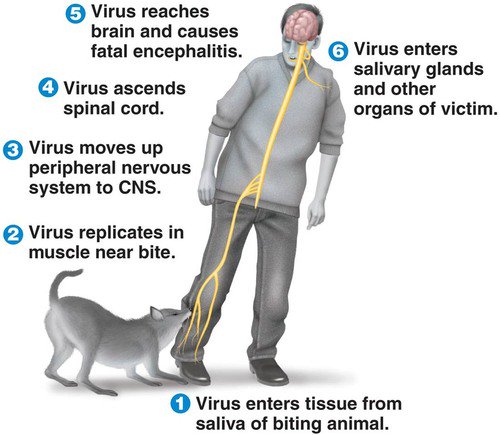
3.Rabies

Rabies is a fatal disease which is transmitted by the bite of the infected dog, rabbit, monkey,cat,etc.The virus present in the saliva of dog enters the brain via neurons.The symptoms of rabies are hydrophobia (extreme fear for water),fever for 2-12 weeks and exaggerations in behaviour.

Prevention and treatment

> In early stages rabies is very difficult to defect.
> After an animal is bitten it usually takes two to twelve weeks to show any symptoms and it may take as long as two years also.
>Fatality can be prevented by timely vaccination before the onset of symptoms.

Non-communicable diseases

Non-communicable diseases do not spread from person to person.They are caused by other factors.Therefore ,it is important to know which diseases are communicable and which are not.They are never caused by germs, bacteria,or other living organisms that infect the body.Antibiotics or medicines that fight against germs do not help to cure non-communicable diseases.Some of the non-communicable diseases are explained below.

a. Wearing our of body parts

Rheumatism,heart attack, epileptic seizures,stroke, migraine headache, cataract and cancer.

b. External harmful agents entering the body

Allergies, asthma, poisons, snakebite, cough from smoking, stomach ulcer, alcoholism.

c. Lack of trace elements in the body

Anemia,pellagra,night blindness and xerophthamia,goiter and hypothyroidism.

d. Malnutrition

Nutritious food is needed for a person to grow well,work hard, and stay healthy.Many common sickness are caused by malnutrition.

Minerals

Mineral is a natural substance of organic or inorganic origin with definite chemical and physical properties.The process of extracting mineral from the earth is known as mining.The mines near the earth crust are known as open pit mines while the deep mines are known as shaft mines.

Types of Minerals

On the basis of chemical and physical properties, minerals are broadly grouped under two categories.They are metalic and non-metalic minerals.

a) Metalic Minerals

Metalic Minerals are the minerals which contain or more metalic elements in them.Metalic minerals oocur in race, naturally formed concentrations known as mineral deposits.These deposits consist of a variety of valuable metals such as iron,manganese, copper,bauxite,nickel,zinc,lead,gold etc.

i ) Iron ore

Iron ore is the most widely distributed elements of the earth crust,rarely occurs in a free state.It enters into the composition of many rocks and minerals especially from igneous and metamorphic rocks.The total recoverable reserves of iron ore in India are about 9602 million tons of haematite and 3408 million tons of magnitude.About 79% haematite deposits are found in Assam,Bihar, Chhattisgarh, Jharkhand,Odisha and Uttur Pradesh.About 93% magnitude deposits occur in Andhra Pradesh,Goa, Karnataka alone contributes about 72% of magnetite deposits of India.
Jharkhand is the leading producer of iron ore with 25% the country’s production.Singhbhum,Hazaribagh,Dhanbad and Ranchi districts are its major producers.Odisha with 21% production ranks second.Sundargarh,Mayurbhanj,Sambalpur and Keonjhar districts are its major producers.The magnitude production of Chhattisgarh,Shimoga and (Chikmagalur, Chitradurga,Shimoga and Dharwad districts are its major producers). Andhrapradesh and Karnataka produce about 5% each.Kurnool,Guntur,Cuddapah and Anantapur districts in Andhra Pradesh and Salem, Namakkal,Thiruvannamalai, Tiruchirapalli, Coimbatore,Madurai and Tirunelveli districts in Tamil Nadu are notable for the production of iron ore.

ii) Maganese

Manganese is a silvery grey element.Ir is very hard and brittle in nature.Ir is always available in combination with iron and steel and serves as basic raw material for alloying.It is the most important mineral for making iron and steel.Nearly 10 kg maganese is required for manufacturing one ton of steel.It is also used in the manufacturing of bleaching powder, insecticides,paints and batteries.Manganese deposits oocur mainly as metamorphosed bedded sedimentary deposits.The largest deposits of manganese is found in Odisha (44%)followed by Karnataka (22%),Madhya Pradesh (12%), Maharashtra &Goa(7% each), Andhra Pradesh (4%) and Jharkhand (2%). Rajasthan, Gujarat, Telengana and west Bengal together constitute about 2% of the India’s manganese resource.Nagpur,Bhandara and Ratnagiri districts in Maharashtra and Balaghat and Chhindwara district mts in Odisha is the third largest producer with 24% Other producers are Andhra Pradesh (13%) and Karnataka (6%). Srikakulam, Visakhapatnam, Cuddapah and Guntur districts in Andhra Pradesh and the districts of Shimoga, Bellary, Chitradurga and Tumkur are the important districts mineral for making iron and steel.India is the fifth largest producer of manganese in the world.

iii) copper

Copper is the first metal that prehistoric man has started using for many purposes.Being flexible,it can be made into utensils of any shape.Brass and Bronze are obtained when the copper alloys with zinc and tin respectively.Copper has been commonly used for making cooking utensils and other objects of common utility.In modern days,it ia extensively used in vast variety of electrical machinery,wires and cables.Largest reserves of copper ore is in the state of Rajasthan (53.81%) followed by Jharkhand (19.54%) and Madhya Pradesh (18.75%).The states of Andhra Pradesh, Gujarat, Haryana, Karnataka, Maharashtra, Meghalaya, Nagaland,Odisha ,Sikkim, Tamilnadu, Telangana, Uttarakhand and West Bengal account for 7.9% of the total copper reserves of India.
Jharkhand is the largest producer of copper with62% of India’s production.Singhbhum and Hazaribagh districts are its leading producers of copper.Odisha is the other major producer with 50.2% production.The districts of Khetei,Alwar and Bhilwara are notables in this state.The states of Uttarakhand (Dehradun and Garhwal districts),Andhra Pradesh (Guntur,Kurnool and Nellore districts ),and Tamil Nadu contributes about 7% of production each.

iv) Bauxite

Bauxite is an important ore from which aluminium is extracted.It is found in the rock consisting mainly of hydrated aluminium oxides.Bauxite is widely distributed as surface deposits in the areas of laterite soil.Being light in weight and tough, aluminium is used in the manufacture of aircraft and automobile engines.Bauxite is also used in the manufacture of cement and chemicals.
The main bauxite deposits occur in Odisha-50.2%, Gujarat-15.8%(Junagadh Amreli and Bhavnagar districts), Jharkhand -11.9%(Ranchi and Gumila districts), Maharashtra-9.9%(Sindhu durg and Ratnagiri), Chhattisgarh-6.2%(Ballarpur and Durg districts),and Tamil Nadu-2.7%.Being light in the manufacture of aircraft and automobile engines.Bauxite is also used in the manufacture of cement and chemicals.Orissa is the largest producer of bauxite in India with appox.1,370.5 million tonnes.India’s state and central Government is very supportive in production of Bauxite and other Industrial Minerals in Orissa, Jharkhand,Tamil Nadu.

b) Non-Metalic Minerals

These minerals do not contain metal in them.Mica, limestone, gypsum, nitrate,potash, dolomite,coal, petroleum etc are the Non-Metalic Minerals.

I ) Mica

In ancient time,Mica was used in ayurvedic medicine.Mica became very popular with the development of electrical indusrtry.Abhrak is a good quality mica.It is translucent, easily splitable into thin sheets,flat,colourless, elastic and incompressible.Mica is used in making of insultating properties,as it withstands high voltage and has low power loss factor.Since it is a non conductor of electricity, it is exclusively used in electrical goods.It is also used in making of lubricants,, medicines, paints and Varnishes.
The major deposits of mica are found in Andhra Pradesh (41%) with Nellore, Visakhapatnam,West Godavari and Krishna are its major districts.other important states in mica deposits are Rajasthan (21%) and Odisha(20%).Bhilwara, Jaipur and Ajmer are the notable districts in Rajasthan and , Rayagada, Bolangir and Sundargarh districts are the major producers in Odisha.Dhanbad,Palamu,Ranchi and Singhbhum districts are the major mica mines in Jharkhand state.

ii) Lime stone

Limestone is associated with rocks composed of either calcium carbonate or the double carbonate of calcium and magnesium or mixture of both.Limestone also contains small quantities of Silica,aluminia,iron oxides, Phosphorus and Sulphar.Limeatone is used in the industries of chemicals for soda ash, caustic soda, bleaching powder,paper, cement,iron and steel,glass and fertilizers.The major producing areas:Andhra Pradesh produces about 20% with major concentration in Cuddapah,Kurnool and Guntur districts.Telengana also accounts for about 20% of the country’s producion with the districts of Nalgonda,Abilabad,Warangal and Karimnagar as major producers.Rajasthan produces about 18% (Jodhpur and Santa districts)and Tamilnadu about 8.4% (Salem, Kanchipuram, Tiruchirapalli, Thoothukudi Thirunelweli and virudhunagar districts ) of limestone production of India.In terms of the reserves of limestone,the state of Karnataka leads with 27% followed by Andhra Pradesh and Rajasthan (12% each), Gujarat (10%), Meghalaya (9%), Telangana (8%), Chhattisgarh and Madhya Pradesh (5% each) and the remaining by other states.

iii) Gypsum

Gypsum is a hydrated of calcium which occurs as white ,Opaque or transparent minerals in beds of sedimentary rocks such as limestone, sandstone and shale.Gypsum is used in the manufacture of cement, fertilizers,wall board ,plaster of Paris and in soil conditioning.The state of Rajasthan alone accounts for 81% of its reserves.14% its reserves is found in Jammu and Kashmir and 2% in Tamil Nadu.The remaining 3% resources are found in the states of Gujarat, Himachal Pradesh, Karnataka, Uttarakhand, Andhra Pradesh and Madhya Pradesh.
Rajasthan produces 82% of the country’s producion.Jodhpur , Bikaner and Jaisalmer are notable districts.Jammu and Kashmir produces 14% of country’s gypsum.Baramula,Doda and Uri districts are its major producers.The states of Gujarat, Uttarakhand, Andhra Pradesh and Tamilnadu are the other producers with about 4% each.

Interior of the Earth

The earth,our homeland,is a dynamic planet.The earth’s surface has lofty mountains,high plateaus, large plains and deep valleys etc.The earth’s surface is constantly undergoing changes inside and outside.Have you ever wondered what lies in the interior of the earth?what is the earth made up of?Let us learn about this in detail.

The structure of the earth may be compared to that of an apple.On the bais of the study of earthquake waves the spherical earth is found to be three concentric layers.
They are:
1. The crust,
2. The mantle and
3.The core

1. The crust

The crust is the outermost layer of the earth.Its thickness varies from 5 to 30km.It is about 35km on the continental masses and only 5 km on the ocean floors.Despite greater thickness,the continental crust is less dense than the Oceanic crust because it is made of both light and dense rock types.The oceanic crust is composed mostly of dense rocks such as basalt.The crust comprises two of distinct parts.The upper part consists of granite rocks and forms the continents.It has the main mineral constituents of silica and alumina.So it is referred to as sial.It has an average density of 2.7g/cm³.The lower part is a continuous zone of denser basaltic rocks forming the ocean floors.Comprising mainly of silica and magnisium.It is therefore called Sima.It has an average density of 3.0g/cm³.The sial and the sima together from the earth’s crust.Since the sial is lighter than the sima,the continents can be said to be ‘floating’ on a sea of denser sima.

2. The Mantle

The next layer beneath the crust is called the mantle.It is separated from the crust by a boundary called Mohorovicic discountinuity.The mantle is about 2,900 km thick.It is divided into two parts.(i) The upper mantle with a density of 3.4 – 4.4g/cm³ extents down to 700 km.(ii) The lower mantle having a density of 4.4 – 5.5g/cm³ extends from 700 to 2,900 km.

3. The Core

The innermost layer of the earth is called the core.It is also known as barysphere.It is separated from the mantle by a boundary called Weichart-Gutenberg discontinuity.The core is also divided into two parts.

(i) The outer core , which is rich in iron,is in liquid state.It extends between 2,900 – 5,150 km.
(ii) The inner core, composed of Nickel and Ferrous (Nife),is solid in state.The central core has very high temperature and pressure.It extends from 5,150 km to 6,370 km.The average density of core is 13.0g/cm³

The Earth Movements

The lithosphere is broken into a number of plates known as the lithosphere plates.Each plate, oceanic or continental moves independently over the asthenosphere.The movement of the tectonic movements.The energy required to move these plates is produced by the internal heat of the earth.These plates move in different directions at different speed.

At places ,these plates move away from each other creating wide rifts on the earth’s surface.At some plates,these plates come closer and collide.When an Oceanic plate collides with a continental plate,the denser oceanic plate is forced below the continental plate.As a result of the pressure from above the rocks heats up and melts.The molten rocks rise again forming volcanic mountains along the continental edge.Alternatively,a trench may be formed between two plates
In some cases when two continental plates converage, neither plate can be forced under the other.Instead,folds may be created.Great mountain ranges like the Himalayas have been formed in this way.
The movement of these plates causes changes on the surface of the earth.The earth movements are divided on the basis of the forces which cause them.The forces which act in the interior of the earth are called as Endogenic forces and the forces that work on the surface of the earth are called as Exogenic forces.
Endogenic forces produce sudden movements and Exogenic forces produce sudden movements and Exogenic forces produce slow movements.Endogenic movements produce earthquakes and volcanoes that cause mass destruction over the surface of the earth.

Earthquake

A sudden movement of a portion of the earth’s crust which produces a shaking or trembling is known as an earthquake.The point where these vibrations originate is called the focus of the earthquake.

The point of the earth’s surface directly above the focus is called the epicentre of the earthquake.From the focus,the earthquake vibrations travel in different directions in the form of Seismic waves.
The earthquake waves are recorded by an instrument known as Seismograph.The magnitude of an earthquake is measured by the Richter scale.The numbers on this scale range from 0 to 9.

Causes of Earthquake

The chief cause of earthquake is the sudden slipping of the portion of the earth’s crust along fractures or faults.The movement of the molten rocks underneath the rocks apart.The sudden shifting of landmass causes upheavals in the crust of the earth sending vibrations or waves into the surrounding portions of the earth.Sometimes the surface of the earth itself cracks.

Effects of Earthquake

Earthquake may cause changes in the earth’s surface.Vibrations often set landslides in mountainous regions.A greater danger in an earthquake is the falling of buildings.Most of the houses which collapsed were made of mud and bricks and proved to be death traps.Underground water system is naturally disturbed by such movements.Fire is another great danger.

There are three types of earthquake waves:


P waves or longitudinal waves
S waves or transverse waves
L waves or surface waves

An earthquake which originates below or near the sea causes great disturbance in the water.The floods and waves cause great loss of life, sometimes more than the earthquake itself.Tsunami, a Japanese term,is the name given to the huge waves caused in the sea by an earthquake.Tsunamis are quite common along the coasts of Japan and other regions in the Pacific Ocean.

Distribution of Earthquake

The world’s distribution of earthquakes coincide very closely with that of volcanoes.Regoins of greatest sesimicity are circum-pacific areas,with the epicenters and the most frequent occurrences along the Pacific Ring of Fire.It is said that about 68% of earthquakes occur in this belt.Remaining 31%of earthquakes take place in the Mediterranean-Himalayan belt including Asia Minor,the Himalayas and parts of norh-West China.The remaining percent of earthquakes occur in Northern Africa and Rift valley areas of the Red sea and Dead sea.In India,the Himalayan region and the Ganga-Brahmaputra valley are prone to earthquakes.A number earthquakes have been experienced in this region.Some of them were very severe and caused extensive damage,e.g., the earthquake if Uttar Kashi in 1991 and Chamoli in 1999.The Deccan Plateau,which was supposed to be comparatively free from the dangers of the earthquakes,has experienced two severe earthquakes in the past,the Koyna(Maharashtra) earthquake in 1967 and the Latur earthquake in 1993.

Volcanoes

A volcano is vent or an opening in the earth’s crust through which hot magma erupts from deep below the surface.The opening is usually circular in form.volcanic eruptions may also take place through a long crack or fissure through which steam and other materials flow out.
The molten rock material within the earth, together with gases, is called magma.after it rises to the surface,it is called as lava.

In course of time,lava and other materials flow out of a volcano accumulate around the opening and form a conial hill or a mountain vent is an opening or mouth of a volcano.The top of this cone is usually marked by a funnel-shaped depression,which is called a crater.If the crater of a volcano is of great size and is shaped like a basin,it is called a caldera.Calderas are caused by violent explosions which blow away entire tops of great cones.

Causes of volcanic Activity

The temperature increases as the depth increases at the rate of 1°C for every 32 metres.There is also great pressure.At a depth of about 15 km the pressure is about 5 tonnes per cm² of rock.Under these circumstances,the interior of the earth is in a semi-molten state called magma.The magma,under great pressure has the capacity to dissolve great pressure has the capacity to dissolve great volume of gas;some gases are also combustible.This makes volcanic Material burst forth through the weak spots in the earth’s crust.

Types of volcano

Volcanoes are classified according to their periodicity of eruptions and state of activity such as
1. Active volcano
2. Dormant vaolcano
3. Extinct volcano

Active volcano

Valcanoes that erupt frequently are called active volcanoes.Most of the active volcanoes lie in the Pacific Ring of Fire belt which lies along the Pacific coast.There are about 600 active volcanoes in the world,such as Mt.Stromboli in Mediterranean sea,st.Helens in USA,pinatubo in philipines.Mauna Loa in Hawaii is the world’s biggest active volcano.

Dormant volcano

These volcanoes have shown no sign of activity for many years but they may become active at any time.These are called sleeping volcanoes.Vesuvius mountain of Italy,Mt Fujiyama of Japan,Mt.Krakatoa of Indonesia are famous examples of this types.

Extinct volcano

A Volcano has not erupted in past 1000 years is often listed as Extinct Volcanoes.The top of extinct Volcanic mountains have been eroded.Mt Popa of Myanmar and Mt.Kilimajaro and Mt.Kenya of Africa are examples of extinct volcanoes.

Sources of Medieval India

The periods from A.D..(CE) 700 to 1200 and from A.D.(CE) 1200 to 1700 are classified as Early Medieval and Later Medieval periods, respectively,in Indian history.Numerous and varied sources are fortunately available to the historians engaging in the study of Medieval India.Added to the information that can be gleaned from inscriptions, monuments and coins are the accounts left by Arab,Persian and Turkish chronicles.These accounts are rich in detail and have given first-hand information on the life of kings, though they provide very little information on the life of the common people.The opinions of the countries and chronicles are often one-sided, written in a hyperbolic language, exaggerating the king’s achievements.Let us now explore the various sources available for the study of the history of Medieval India.

Sources

Sources are the supporting materials, documents or records in the form of evidence that help to reconstruct the past.

We examine the details of political, economic and social-cultural developments with the aid of sources.

Primary sources:

Inscriptions, monuments and coins, and the information available in them.

Secondary sources:

Literary works, Chronicles, travelogues, biographies and autobiographies.

Inscriptions

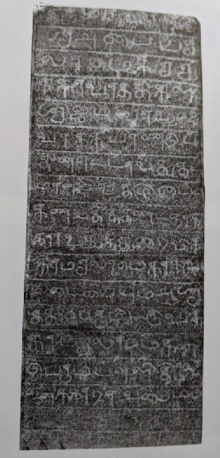
Several copper-plate grants issued during the later Chola period (10th 13th century)record gifts to individual priests or teachers who were Hindu, Buddhist,or Jaina,or to persons of eminence.Both the giver and the receiver are very elaborately described.By Contract, most stone inscriptions differ in their content.In stone inscriptions,the beneficence of a donor is recorded.The major focus is upon the giver.Tiruvalangadu plates of Rajendra Chola are notable examples.Uttiramerur inscriptions in Kanchipuram district provide details of the way in which the village administration was conducted.various types of lands gifted by the Chola kings are known from the inscriptions and copper plates.They are:

Monuments

Temples, palaces,mosques,tombs,forts,minars and mirnarates are called by the collective name monuments.

The Sultans if Dekhi introduced a new type of architecture.The monuments they built had arches,domes and mirnarates as the main features.The inscriptions in these monuments contain rich information, which can be used to construct history.The Medieval Khajuraho monuments (Madhya Pradesh)and temples in Konark (Odisha)and Dilwara(Mt.Adu, Rajasthan)constitute valuable sources to understand the religion-centered cultural evolution in northern India.Temples in Thanjavur (Brihadeshwara),Gangaikonda Cholapuram and Darasuram symbolise the magnificent structure the Later Cholas built in Tamil Nadu.Vitala and Virupaksha temples at Hampi similarly speak of the contribution of Vijayanagara rulers(15th century)

Quwwat-ul Islam Masjid ,Moth-ki-Masjid,Jama Masjid,Fatehpur Sikri Dargah(all in and around Delhi)and Charminar (Hyderabad)are the important mosques belonging to the Medieval times.

The forts of historical importance are Agra Fort,Chittar Fort, Gwalior Fort and Delhi Red fort as well as the forts of Daulatabad (Aurangabad)and Firoz Shah Kolta(Delhi).Palaces in Jaipur, Jaisalmer and Jodhpur signify the greatness of the Rajput dynasty that wielded enormous power from these places.Qutb Minar and Alai-Darwaza,the tombs of Iltutmish,Balban and all the Mughal rulers are the other prominent of information.Cities in ruin such as Firozabad and South India remain rich repositories of the history of Medieval India.

Coins

The portrait and legend on the coins convey the names of kings with thier titles, events,places,dates, dynasties and Royal emblems.The composition of metals in the coins gives us information on the economic condition of the empire.Mention of king’s achievements like military conquests,territotmrial expansion,trade link and religious faith can also be found in the coins.Muhammad Ghori had stamped the figure of Goddess Lakshmi on his gold coins and had his name inscribed on it.This coin tells us that this early Turkish invader was in all likelihood liberal in religious outlook.Copper jitals are available for the study of the period of the Delhi Sultans,

Silver Tanka introduced by Iltutmish,Ala-ud-din Khalji’s gold coins, Muhammad-bin-Tughluq’s token currency are indicative of coinage as well as the economic prosperity or otherwise of the country of the time.

Religious Literature

Devotional movement in South India and later in North resulted in the development of bhakti or devotional literature.The Chola period was known as the period of devotional literature and works such as Kamna Ramayanam,Sekkizhar’s Periyapuranam,Nalayira Divyaprabhandham,composed by 12 Azhwars and complied by Nathamuni,Devaram composed by Appear,sambandar and Sundarar and complied by Nambiyandar Nambi,Manikkavasakar’s Thiruvasagam,all were scripted during the Chola times.Jayadeva’s Gita Govindam(12th century)was a follow-up of the Bhakti Movement in South India.Kabir Das, a 15th century mystic poet,also had an influence on the Bhakti Movement in India.

Secular Literature

Madura viniyam and Amuktamalyatha were poems composed by Gangadevi and Krishnadevaraya respectively that help us gain insight into the events and individuals associated with the Vijanagara Empire.Chand Bardai’s Prithiviraj Raso portays the Rajput king’s valour.For pre-Islamic periods the only exception was Kalhana’s Rajtarangini (11th century).

Travellers and Travelogues

Marco Polo,a ventain traveller , visited when the Pandya kingdom was becoming the leading Tamil power in the 13th century.Marco Polo was twice in Kayal,which was a port city (presently in Thoothukudi district of Tamilnadu).It was full of ships from Arabia and China.Marco Polo tells us that he himself came by a ship from China.According to Marco Polo, thousands of horeses were imported into southern India by Sea from Arabia and Persia.Al-Beruni (11th century) accompanied Mahmud of Ghazni in one of his campaigns,and stayed in India for 10years.The most accurate account of Mahmud’s Somnath expedition is that of Alberuni.As learned man and a scholar,he travelled all over India trying to understand India and her people.He learnt sanskrit and studied the lhilo of India.In his book Tahquiq-i-Hind,Alberuni discussed the Indian conditions, systems of. knowledge ,social norms and religion.
Ibn Battuta(14th century),an Arab-born Morocco scholar, travelled from Morocco right across North Africa to Egypt and then to central Asia and India.His travelogue (Rihla [The Travels]) contains rich details about the people and the countries he visited.According to him,Egypt was rich then, because of the whole of the Indian trade with the west passed through it.Ibn Battuta tells us of caste in India and the practice of sati.we learn from him that Indian merchants were carrying on a brisk tamrade in foreign ports and Indian ships in the seas.He diescribes the city of Delhi a vast and magnificent city.Those were the days when Sultan Muhmmad bin Tughluq transferred his capital from Delhi to Devagiri in South,converting this city into a desert.
In the south,Vijanagar had many foreign visitors who left behind their detailed accounts of the state.An Italian named from Heart(the court of Great Khan in Central Asia) in 1443.Domingo Paes,a Portuguese traveller, visited the city in 1522.All of them recorded their observations, which are very useful for us today to know the glory of the Vijanagar Empire

Political Parties

Political parties are the voluntary associations of individuals with broad ideological identity who agree on some policies,formulate an agenda and programme for the society.Political parties seek to implement thier policies by winning people’s support through election.Parties vary in size and in the ways they organize themselves as well as in the ways they organize themselves as well as in their policies.Any political party has three basic components
• the leader
• the active members
• the followers

Importance of political parties

Political parties are the backbone of democracy.Parties are not part of the formal arrangement of a government but they are essential elements to form the government.They formulate public opinion.They serve as intermediaries between the citizen and the policy makers.

A party is recognized if
• it has been engaged in political activity for five years
• its candidates secure at least six percent of total votes in the last general election.

Characteristics of Political parties

Political parties

• consist a group of persons of common goals and shaved values.
• have its own ideology and programme.
• capture power only by constitutional means.
• endeavour to promote the national interest and national welfare.

Types of Party system

There are three major types of Party system.

Single party system:
a system in which a single political party has the right to form the government.Single party is existed in the communist countries such as China.North Korea and Cuba.

Bi-party system:
In Bi – Party system the power is usually shared between two parties.Of the two parties one becomes the ruling party and the other becoms opposition.eg Bi – Party system can be seen in U.K.(the labour and the conservative party) and in U.S.A(the Republican party and the Democratic party)

Multi – party system:
When the competition for power is among three or more parties,the system is known as multi party system.This type of party system is in existence in India, France, Sweeden and Norway etc.

Party system in India

Countries that follow a federal system have two kinds of parties.India’s party system originated in the late 19th century.In fact India has the largest number of political parties in the world.In India we find the existence of political parties at three levels.They are National parties, Regional parties,and Registered but unrecognised parties (independent candidates). Every party in the country has to register with Election Commission.

Criteria for Recognition

The election Commission of India has some criteria for the recognition of political parties in India.

Recognized parties

Parties that fulfill these criteria are called recognized parties.They are given a unique symbol by the Election Commission.A registered but unrecognized political party cannot contest election on its own symbol.Thia party has to choose one symbol form free symbol ‘poll panel’ announced by the Election Commission.

Majority party

The political party whose number of candidates elected is more than the others is called the majority party.The Majority party forms and runs the government.They select and appoint their ministers to run the government.They play a decisive role in making laws for the country.

Minority party

Those with lesser number of elected candidates are called the minority party.

Opposition party

The party which gets second largest number of seats next to the majority party in the election is called the Opposition party.An effective opposition of the democracy.They are as important as that of ruling party.They check the autocratic tendencies of the ruling party.They critically examine the policies and bills introduced by the government.They raise their voice on the failures and wrong policies.They highlight important issues which are not acted upon the Government.The leader of the Opposition party enjoys the rank of Cabinet Minister.

Coalition Government

In a Muliparty system a single party sometimes may not secure the majority required to form the government.In such a case,some parties join together to form the government.Such government is called Coalition Government.

Electoral symbols and its importance

An electoral symbol is a standardized symbol allocated to a political party.They paly an important role in elections.They can be easily identified, understood, remembered and recognized by the voters.The election Commission has stopped allocating are the lion and the elephant.The only exceptions are the lion and the elephant.The symbol of nationally recognized parties is standard throughout India.That symbol will not be allocated to any other party or individual.state parties are allocated to certain symbols that no other party to certain symbols that no other party can use the symbol in that particular state but which different parties in different states can use the same symbol.(e.g.Shiv sena in Maharashtra and Jharkhand Mukti Morsha in Jharkhand use bow and arrow as their symbol).Both National and Regional parties trigger the growth of the nation and work for the welfare of the people.

Landforms

The landscape is being continuously worn down by two processes – weathering and erosion.Weathering is the breaking and falling apart into small pieces of the rocks on the earth’s surface.Erosion is the wearing down of the landscape by different agents like water,wind,ice and sea waves.The eroded material is carried away by water,wind ,etc.and eventually deposited.This process of erosion and deposition create different landforms on the surface of the earth.

River

The water flowing from its source to river mouth,along a definite course is called a River.Rivers generally originate from a mountain or hill.The place of origin from a mountain or hill.The place of origin of the river is known as it’s source.The place where it joins a lake or sea or an ocean is known as River mouth

The running water in the river erodes the mountains track,which creates a steep-sided valley like the letter’V’ known as ‘V’shaped valley.

Falling of river water over a vertical step in the river bed is called waterfall.It is formed when the soft rocks are removed by erosion.E.g.Coutrallam falls across the river Chittar in Tamil Nadu.Plunge pool is a hollow feature at the base of a waterfall which is formed by cavitation.Alluvial fan is a deposition of sediment occurs at which the rivers enters a plain or the foot-hills.As the river enters the plain it twists and turns forming large bends known as Meanders.Eg.Meanders along the river Vellar near Sethiyathope in Cuddalore District,Tamil Nadu.Due to Continuous erosion and deposition along the sides of the meander,the ends of the meanders loops come closer.In due course of time the meander loop cuts off from the river and forms a cut-off lake,also called an Ox-bow lake

At times the river overflows its banks.This leads to the following of the neighbouring areas.As the river floods,it deposits layers of fine soil and other material called Sendiments along its banks.This leads to the formation of a flat fertile floodplain.The raised banks are called levees.As the river approaches the sea,the speed of the flowing water decreases and the river begins to break up into a number of streams called distributaries.The velocity of the river becomes so slow that it begins to depositi its load.The collection of sediments from all the mouths form Delta.Deltas are excellent productive lands.E.g.Cauvery delta,Ganges delta,Mississippi delta.

Glacier

A large body of ice moving slowly down a slope or valley due to gravity is called a glacier.Glaciers are grouped into Mountain or valley Glaciers and Continental Glaciers.

Continental Glacier

The glacier covering vast areas of a continent with thick ice sheets.E.g.Antarctica,Freeland

Mountain or valley Glaciers

Is a stream of ice, flowing along a valley.It usually follows former river courses and are bounded by steep sides.E.g.The Himalayas and the Alps.Glaciers ,expose the solid rocks of earth by removing the loose materials found on it.

Cirque is a glacially eroded rock basin,with a steep side wall and steep head wall, surrounding an armchair-shaled depression.E.g.Corrie-Scotland (United Kingdom),Kar-Germany.As the ice melts,they get filled up the cirque with water and become beautiful lakes in the mountains called as Tarn Lake.when two adjacent cirques erode towards each other,the previously rounded landscape is transformed into a narrow rocky,steep-sided ridges called Arete.

U’ shaped valley is found beneath the Glaciers which is deepened and widened by the lateral and vertical erosion.The material carried by the glacier such as rocks – big and small,sand and silt get deposited.These deposits form glacial moraines.

Wind

Have you ever visited a desert? Try to collect some pictures of sand dunes.An active agent of erosion and deposition in the deserts is wind.

Winds erode the lower section of the rock more than the upper part.Therefore ,such rocks have narrower base and wider top wider top rocks in the shape of a mushroom, commonly called mushroom rocks.An isolated residual hill, standing like a pillar with rounded tops are called Inselbergs.E.g.Inselberg in the Kalahari Desert of South Africa.

When the wind blows,it lifts and transports sand from one place to another.when it stops blowing the sand falls and gets deposited in low hill-like structures.These are called sand dunes.The crescent shaped sand dunes are called When the grains of sand are very fine and light,the wind can carry it over very very long distances.when such sand is deposited in large areas,it is called Loess.Large deposits of loess are found in China

Sea waves

A part of the land adjoining or near the sea is called the Sea coast.The boundary of a coast line.The coastal areas are subject to change due to wave erosion and wave deposition.

The erosion and deposition of the sea waves give rise to coastal landforms.Sea Cliffs are steep rock faces formed, when the sea waves dash against them.Sea waves continuously

Strike at the rocks.So cracks develop.Over time they become larger and wider.Thus,hollow like caves are formed on the rocks.They are called Sea waves.