The Right Kind of Freedom

English Version | Fashion for Freedom | Vogue.pt

 As Maya Angelou rightfully says, “Each time a woman stands up for herself, without knowing it possibly, without calming it, she stands up for all women.” Everyone must be wondering why I choose to write articles that mainly revolve around equality, freedom for women most of the time. The reason is that we are moving so rapidly in the world and yet slow when it comes to feminism, equality, and freedom for women. I believe by writing some articles I have at least some kind of contribution towards speeding up this process that needs to change for a better future. This is not just for women but for society and the world as well.

Today the topic that I am going to talk about is something that every woman, a girl goes through daily. It is about how women are supposed to dress. It is very sad and disheartening when I realize that I have gone through similar instances myself and while writing about this topic, I have a flashback of several instances. It is time we realize that the only person who can decide what to wear is by the individual and nobody else. Let me ask all the readers out there a question. How many times have you seen or even had an experience of family members or relatives or friends or anybody else questioning the attire you are wearing? It is sad and disheartening how women or girls do not have complete control over their attires and clothing while under several circumstances men and boys have all the control over their attires and clothing.

Another thing that I have come across is that men or boys of any class, race, religion, and economic hierarchy can wear whatever they feel comfortable. One of the most common examples that I can give is shorts. However, that is not the case with dressing sense with women or girls. There are certain rules regulations that they need to follow while choosing to wear what they want. I am not specifying any one religion, caste, race, or ethnicity. It is seen everywhere. While women and girls are dressing up so many external factors that play a role and often whatever they choose to wear has to pass through these factors. One of the biggest reasons for this gender clothing discrimination is patriarchy. It seems to root itself in every single aspect. Unfortunately, patriarchy and the rules and regulation of women’s dressing sense seeps in not just men but also women. It has come to a pathetic state where the way one treats a woman is according to how they dress.

The fault does not lie just with the common people but also with the way movies, series, etc represent women according to the way they dress. To show a shy, timid, and introverted woman or girl they dress in ethnic wear, or with glasses, hair tied into a braid, etc. While to show a so-called “out of control” woman or girl they wear shorts, dark color clothes, hair left open, etc. The basis for ideal and non-ideal dressing for women is about in this way to the society, which needs to change. Over the years, we have had politicians and other famous people make the horrendous connection of rape to women’s dressing sense. It is a frightening reality of today’s world. Even if it is burning hot summer and men roam around with a sleeveless shirt and shorts, women still cannot do that. The reason is not because of choice but because they would have to deal with snarky comments, catcalling, etc. I am not saying this will happen to everybody but I can say that a majority of females will have to face this. Labeling of women happens even today according to the way they choose to dress and it is not surprising. Let any woman or girl dress the way they want whether it be jeans, pants, tops, kurta, or sari, the society still manages to give them a name and a label.

Is hate speech legal? - FIRE

In the millennial world of social media where people are trying to bring about some change and create awareness about how it is time for women and girls to dress according to their ideas and perspectives without keeping any factor in mind. However, often even these people face backlash, mean comments, rape, and death threats by people who do not even know them. The idea of culture and tradition is always brought up while making such horrible comments. Limiting women’s choice of dressing in the name of culture, tradition, and even upbringing is visible even today, which is sad and painful.

Under several circumstances, I have seen people justify this behavior saying things like ‘we stop or object women from dressing the way they want for their safety and protection.’ To everyone who says this, I would like to ask shouldn’t the safety and protection of women and girls be a priority regardless of what kind of dress they choose to wear. The other thing that we fail to recognize is that the idea of protecting and safe keeping that is done by the society is towards something that comes by the society. Society, community, government, every single person is responsible for the emergence of these evils in the society that threatens and plays a role in the way women and girls choose dress. It is high time we stop blaming women’s attires and rather hold the problems into account and find solutions to bring about a better change in the society rather than making it a normal thing.

It is high time women get their freedom and equal opportunities to dress according to their wish and will they choose to without any restrictions or barriers. Women and girls should be able to dress the way they want at any time, place, or event and should not face any negativity because of that. This is not something that needs to be asked for rather that should be naturally present as it is for men and boys. This article today revolves more about the freedom of women’s dressing choice than men though men also suffer the same kind of problem under several circumstances is because the percentage of women and girls going through this still a higher number than men and boys. This does not mean men do not deserve their freedom or equality to dress but it sure means that the press and requirements for women are needed at a faster rate.

To conclude, with just a single line that I read and says, “All women and girls should be respected regardless of their clothing.”

References

  1. Google searches for images and quotes.

The Stream of Judgment

Streams After 10th - Arts (Humanities), Commerce & Science

Before I start with the topic of this article, I would like to quote a great man’s wise words where he says, “Education is the most powerful weapon which you use to change the world.” The great man is none other than Nelson Mandela. I would like to ask all the Indian readers specifically out there. How many times have you come across criticism and comments about choosing the arts and humanities stream? I do know a lot of people would have because I too have seen and come across criticism, comments, statements, judgments for choosing the arts and humanities stream and not science, medical, engineering, or commerce stream like people around me.

Importance of the Stream of Arts and Humanities

Though we all know that all streams of education are important for society, community, and the world we still seem to be shunning and showing negativity to the stream of arts and humanities. Not many people realize this but, the stream of arts and humanities is so very important in human society and its well-being but people still seem to show negativity towards it due to prejudice and assumptions. I also have to put it here that people who graduated from the stream of arts and humanities and took the role of psychologist, journalist, dancer, painter, comedian, or any other job with this stream played an equally important role like doctors, biologists, engineers, and investors during the tough and gruesome time of the pandemic. That is something we should not forget. This stands as proof of how equally important the stream of arts and humanities is in the world.

The stream of arts and humanities has equal importance like any other stream or sometimes even more in other countries. However, in India that is not the case at least, this is what I feel. I will also agree when people say that things are slowly changing and people have become more accepting with the stream of arts and humanities. This has been possible because the younger generations are standing for their choices, breaking the stereotype, creating more awareness, breaking the chain of choosing to engineer, medical or science stream like everyone else in the family and so much more. This has been possible not just because of a certain age group but also because of the collective work of the community, society, government, and people of the country. Nevertheless, this is not enough. There is still a lot that needs to be done so that all streams are considered equal in the eyes of the people.

Let me tell all the readers out there something very important that we need to remember before we make critical statements and judgments about the stream of art and humanities. Our daily lives would be incomplete even till today had there not been people taking the stream of arts and humanities. Let me explain. We would not have content in the newspaper if people had not chosen to become news reporters, journalists, editors, or even for those matter writers. Yes, with the use of science and technology, people invented the machines that print newspapers but then what is the point of that invention if there are no people who have taken arts and humanities stream and decided to become a part of writing and bringing the news to people. We all enjoy and entertain ourselves with movies, TV shows, OTT series, and so much more these days. However what we fail to understand is that without people choosing the stream of arts and humanities there would not be actors, cinematographers, content writers, makeup artists, costume designers, production houses, etc. psychologists, therapists, etc play such a massive role during the pandemic and in our daily lives. If these people would not have chosen the stream of arts and humanities and pursued psychology then our mental health would have a negative impact on our physical and emotional health.

I can go on and on for a long time by giving basic and daily life examples about the importance of the stream of arts and humanities. It is high time now that we stop giving our judgment and criticism about the people who have chosen this stream and this stream in general.

Petition · Put a stop to all negative views , bias and criticisms against  the Humanities/Arts Stream. · Change.org

Is the Stream of Arts and Humanities easier than other streams?

Let me ask all the readers out there, how many times have people around you, ask the question “Did you choose arts because science was tough?” or questions like ‘Did you choose arts because you don’t like it or you are weak in math?” or something like “Did you score less in your board exams and that is why you took arts?” I for sure came across all this. I still do under so many different circumstances. The prejudiced idea that arts are something very easy and people who study this do not have to work hard is one of the biggest reasons for these kinds of questions.

However, what people fail to understand is that there is nothing easy about arts. If you ask me, it is tougher than the other streams. Let me tell you why. The reason is that in other streams there are definite notes, definitions, diagrams, tables, etc. Yes, some streams of arts and humanities have these too, for example, psychology. However, there are still many more subjects under this stream that do not have these definite things. Students who study the course of arts and humanities have to do their research, go through different sites and read about different things for their answers, should know the information of the past, present and sometimes even the future to be able to write their answers. These are just some of the things I mention that arts and humanities students do most of the time. There is so much more.

I have even met people who say “Arts is so easy and you still do not score well why?” This statement comes not just from outside people but sometimes even from our parents. This is because of the belief that arts and humanities are easy. Nevertheless, the stream of arts and humanities is over the years has become more complex with the rapid growth and changes in society and the world. The other thing, which many people are not aware of, is that students cannot get the complete marks for their answers even if their answers have everything that needs to be there. This is something that is often omitted and not taken into consideration by people who are not part of the arts and humanities stream. Just because answers do not get full marks, does not mean some people score above 95% and just because some people do does not mean everyone can.

The stream of arts and humanities is so important in society. Students who study through this course are aware not just of the information that is there in their syllabus but also so much more than that. This includes everything that is happening in society and the world. I can go on and on about the benefits of the stream of arts and humanities stream. The reason I chose this topic for my article is that it is high time that this stream is not judged and rather accepted with an open mind and heart.

 To conclude, with a quote by Michelle Obama where says, “The arts and humanities define who we are as people. That is their power to remind us of what we each have to offer, and what we all have in common. To help us understand our history and imagine our future. To give us hope in the moments of struggle and to bring us together when nothing else will.”

References

  1. Google searches for images and quotes.

The Chosen Family

Family vs. Friends: Comparing Key Relationships | LoveToKnow

 I was going through my phone and, I read these meaningful and deep lines that say, “A Friend is someone who accepts who you are, but also helps you become who you should be.” By this, everyone knows what my article is going to be about today. Yes, today the article is all going to be about friendship. Let me ask all the readers out there.

 How many times have we told out of anger, dismay, or sadness that we can stay alone and we do not need any friends? I am sure we all have said that at some point of time in our lives. Nevertheless, this entirely cannot be true. We human beings are social animals and therefore, we cannot be alone for long. We constantly need people around us even if we say otherwise. It is not necessary that we need to find our friends with human beings themselves. It can even be animals, plants anything that helps us have a strong bond and connection

Our progress and development over the years have always been about bringing people together, keeping them connected, meeting new people and so much more about just making things for humanity. Friendship is such an important thing in everyone’s life. Friendship plays such an important role in our lives. The reason I say that friendship is a chosen family is that it is you who decide with whom you want to spend your time. We tend to spend many hours outside our houses. Hence, what kind of friends we have plays a very important role in how things pan out for us. Yes, this might sound very cliché but it is very true. Friends tend to influence your actions, behaviors, thoughts and so much more. Sometimes we can see it but most of the time this happens unconsciously. When I say that one needs to see whether they are good people or not I do not mean it through their religion, looks, ethnicity, color, etc that one sees to judge a person. By right people, I mean through their thinking, actions, behavior, and goodness in their heart. These are true judges of the characters of a person.

There is another thing that one needs to keep in mind concerning friendship. Even if the friendship ends, people should not have any negative feelings about it. They should not speak badly about those people or have a sense of revenge. Rather I would suggest that they could cherish the good memories and move ahead positively about it. Friendship is a balance. If one takes it for granted then it is bad but if one takes it so seriously that it negatively affects them then that is also bad. This article is not to lecture anybody about their friendships rather just different perspectives, ideas, and thoughts that are present in the world.

Happy Friendship Day 2021: Wishes, Messages, Quotes, Images, Pictures and  Greeting Cards | The Times of India

Is there a right type of friendship?

Often there is confusion about whether there is a right type of friendship or not. According to me, it is both yes and no. Let me explain the answer. Yes, there is a certain type of friendship. A friendship is something that helps people in it grow and move forward and in the right manner. If only one person is moving forward and the other one is facing the negative impact of being in that friendship then it is clear that it is not the right type of friendship. Again, this might sound very cliché but friends are often those people outside your family that help you grow and become better individuals in society.

 Friendship is one of those relations where people do not judge you for your actions and at the same time if your judgment is wrong then they guide you show you a new path. Friendship is so precious because this relation helps you have your individuality and at the same time bring about the right changes in each other’s lives. The right type of friendship is when there is a positive impact on everyone’s life that is a part of the friendship. The decision of the rightness of a friendship should not be a decision made by someone outside the friendship. These are decisions that one has to make take on their own after seeing all the factors that play a role in their lives. Another thing, which makes any friendship right, is when mistakes are made by anyone in those relations they apologize and make sure that these do not happen again. If the idea of personal ego exists in a friendship negatively between anyone and that friendship is not right for anyone. There is nothing wrong with apologizing when you make a mistake, especially in a friendship.

When I say no there is no there is nothing like the right type of friendship I mean in the things that go about in the friendship. There is no certain type of friendship. People in a friendship do not necessarily have to talk every day to be under the category of friendship. People can talk once in a blue moon and still have the same feelings and connections in their friendship. People do not have to meet every day or see day to be in a friendship. When there can be long-distance relationships they why cannot there be long-distance friendships. People do not need to have alike thoughts, ideas, or perspectives to be friends and share a good relation. There are so many more things that society has set labels for good or strong friendship that do not necessarily have to be true. Though in friendship certain needs to be in mind and should follow however, there is no rulebook for friendship.

Yes, some friendships last for years together and some friendships last only a few years, weeks, or months and that is completely okay and natural. It is high time that we understand and normalize growing out of the friendship. It is completely okay to have two friends, as it is completely okay to have ten friends in your friendship circle. Friendship has and does not have limitations and boundaries. Some are crossable and some are not crossable. The decision is all of the individuals.

To conclude, with a beautiful quote by Invajy where he says, “A friend is someone who understands your past, believes in your future, and accepts you just the way you are.”

References

  1. Google searches for images and quotes.

Feminist Literary Critisim

Feminist literary criticism is literary criticism informed by feminist theory, or more broadly, by the politics of feminism. It uses the principles and ideology of feminism to critique the language of literature.

This school of thought seeks to analyze and describe the ways in which literature portrays the narrative of male domination by exploring the economic, social, political, and psychological forces embedded within literature.This way of thinking and criticizing works can be said to have changed the way literary texts are viewed and studied, as well as changing and expanding the canon of what is commonly taught. It is used a lot in Greek myths.

Traditionally, feminist literary criticism has sought to examine old texts within literary canon through a new lens. Specific goals of feminist criticism include both the development and discovery of female tradition of writing, and rediscovering of old texts, while also interpreting symbolism of women’s writing so that it will not be lost or ignored by the male point of view and resisting sexism inherent in the majority of mainstream literature. These goals, along with the intent to analyze women writers and their writings from a female perspective, and increase awareness of the sexual politics of language and style were developed by Lisa Tuttle in the 1980s, and have since been adopted by a majority of feminist critics.

The history of feminist literary criticism is extensive, from classic works of nineteenth-century female authors such as George Eliot and Margaret Fuller to cutting-edge theoretical work in women’s studies and gender studies by “third-wave” authors. Before the 1970s—in the first and second waves of feminism—feminist literary criticism was concerned with women’s authorship and the representation of women’s condition within the literature; in particular the depiction of fictional female characters. In addition, feminist literary criticism is concerned with the exclusion of women from the literary canon, with theorists such as Lois Tyson suggesting that this is because the views of women authors are often not considered to be universal.

Additionally, feminist criticism has been closely associated with the birth and growth of queer studies. Modern feminist literary theory seeks to understand both the literary portrayals and representation of both women and people in the queer community, expanding the role of a variety of identities and analysis within feminist literary criticism.

Feminist scholarship has developed a variety of ways to unpack literature in order to understand its essence through a feminist lens. Scholars under the camp known as Feminine Critique sought to divorce literary analysis away from abstract diction-based arguments and instead tailored their criticism to more “grounded” pieces of literature (plot, characters, etc.) and recognize the perceived implicit misogyny of the structure of the story itself. Others schools of thought such as gynocriticism—which is considered a ‘female’ perspective on women’s writings—uses a historicist approach to literature by exposing exemplary female scholarship in literature and the ways in which their relation to gender structure relayed in their portrayal of both fiction and reality in their texts. Gynocriticism was introduced during the time of second wave feminism. Elaine Showalter suggests that feminist critique is an “ideological, righteous, angry, and admonitory search for the sins and errors of the past,” and says gynocriticism enlists “the grace of imagination in a disinterested search for the essential difference of women’s writing.”

More contemporary scholars attempt to understand the intersecting points of femininity and complicate our common assumptions about gender politics by accessing different categories of identity (race, class, sexual orientation, etc.) The ultimate goal of any of these tools is to uncover and expose patriarchal underlying tensions within novels and interrogate the ways in which our basic literary assumptions about such novels are contingent on female subordination. In this way, the accessibility of literature broadens to a far more inclusive and holistic population. Moreover, works that historically received little or no attention, given the historical constraints around female authorship in some cultures, are able to be heard in their original form and unabridged. This makes a broader collection of literature for all readers insofar as all great works of literature are given exposure without bias towards a gender influenced system.

Women have also begun to employ anti-patriarchal themes to protest the historical censorship of literature written by women. The rise of decadent feminist literature in the 1990s was meant to directly challenge the sexual politics of the patriarchy. By employing a wide range of female sexual exploration and lesbian and queer identities by those like Rita Felski and Judith Bennet, women were able attract more attention about feminist topics in literature.

Since the development of more complex conceptions of gender and subjectivity and third-wave feminism, feminist literary criticism has taken a variety of new routes, namely in the tradition of the Frankfurt School‘s critical theory, which analyzes how the dominant ideology of a subject influences societal understanding. It has also considered gender in the terms of Freudian and Lacanian psychoanalysis, as part of the deconstruction of existing relations of power, and as a concrete political investment. The more traditionally central feminist concern with the representation and politics of women’s lives has continued to play an active role in criticism. More specifically, modern feminist criticism deals with those issues related to the perceived intentional and unintentional patriarchal programming within key aspects of society including education, politics and the work force.

When looking at literature, modern feminist literary critics also seek ask how feminist, literary, and critical the critique practices are, with scholars such as Susan Lanser looking to improve both literature analysis and the analyzer’s own practices to be more diverse.

Structuralism

The advent of critical theory in the post-war period, which comprised various complex disciplines like linguistics, literary criticism, Psychoanalytic Criticism, Structuralism, Postcolonialism etc., proved hostile to the liberal consensus which reigned the realm of criticism between the 1930s and `50s. Among these overarching discourses, the most controversial were the two intellectual movements, Structuralism and Poststructuralism originated in France in the 1950s and the impact of which created a crisis in English studies in the late 1970s and early 1980s. Language and philosophy are the major concerns of these two approaches, rather than history or author.

Structuralism which emerged as a trend in the 1950s challenged New Criticism and rejected Sartre‘s existentialism and its notion of radical human freedom; it focused instead how human behaviour is determined by cultural, social and psychological structures. It tended to offer a single unified approach to human life that would embrace all disciplines. Roland Barthes and Jacques Derrida explored the possibilities of applying structuralist principles to literature. Jacques Lacan studied psychology in the light of structuralism, blending Freud and Saussure. Michel Foucault‘s The Order of Things examined the history of science to study the structures of epistemology (though he later denied affiliation with the structuralist movement). Louis Althusser combined Marxism and Structuralism to create his own brand of social analysis.

Structuralism, in a broader sense, is a way of perceiving the world in terms of structures. First seen in the work of the anthropologist Claude Levi-Strauss and the literary critic Roland Barthes, the essence of Structuralism is the belief that “things cannot be understood in isolation, they have to be seen in the context of larger structures they are part of”, The contexts of larger structures do not exist by themselves, but are formed by our way of perceiving the world. In structuralist criticism, consequently, there is a constant movement away from the interpretation of the individual literary work towards understanding the larger structures which contain them. For example, the structuralist analysis of Donne‘s poem Good Morrow demands more focus on the relevant genre (alba or dawn song), the concept of courtly love, etc., rather than on the close reading of the formal elements of the text.

With its penchant for scientific categorization, Structuralism suggests the interrelationship between “units” (surface phenomena) and “rules” (the ways in which units can be put together). In language, units are words and rules are the forms of grammar which order words.

Structuralists believe that the underlying structures which organize rules and units into meaningful systems are generated by the human mind itself and not by sense perception. Structuralism tries to reduce the complexity of human experiences to certain underlying structures which are universal, an idea which has its roots in the classicists like Aristotle who identified simple structures as forming the basis of life. A structure can be defined as any conceptual system that has three properties: “wholeness” (the system should function as a whole), “transformation” (system should not be static), and “self-regulation (the basic structure should not be changed).

Structuralism in its inchoate form can be found in the theories of the early twentieth century Swiss linguist, Ferdinand de Saussure (Course in General Linguistics, 1916), who moved away from the then prevalent historical and philological study of language (diachronic) to the study of the structures, patterns and functions of language at a particular time (synchronic). Saussure’s idea of the linguistic sign is a seminal concept in all structuralist and poststructuralist discourses. According to him, language is not a naming process by which things get associated with a word or name. The linguistic sign is made of the union of “signifier” (sound image, or “psychological imprint of sound”) and “signified” (concept). In this triadic view, words are “unmotivated signs,” as there is no inherent connection between a name (signifier) and what it designates .

The painting This is Not a Pipe by the Belgian Surrealist artist Rene Magritte explicates the treachery of signs and can be considered a founding stone of Structuralism. Foucault‘s book with the same title comments on the painting and stresses the incompatibility of visual representation and reality.

Saussure’s theory of language emphasizes that meanings are arbitrary and relational (illustrated by the reference to 8.25 Geneva to Paris Express in Course in General Linguistics; the paradigmatic chain hovel-shed-hut-house-mansion-palace, where the meaning of each is dependent upon its position in the chain; and the dyads male-female, day-night etc. where each unit can be defined only in terms of its opposite). Saussurean theory establishes that human being or reality is not central; it is language that constitutes the world. Saussure employed a number of binary oppositions in his lectures, an important one being speech/writing. Saussure gives primacy to speech, as it guarantees subjectivity and presence, whereas writing, he asserted, denotes absence, of the speaker as well as the signified. Derrida critiqued this as phonocentrism that unduly privileges presence over absence, which led him to question the validity of all centres.

Saussure’s use of the terms Langue (language as a system) and Parole an individual. utterance in that language, which is inferior to Langue) gave structuralists a way of thinking about the larger structures which were relevant to literature. Structuralist narratology, a form of Structuralism espoused by Vladimir Propp, Tzvetan Todorov, Roland Barthes and Gerard Genette illustrates how a story’s meaning develops from its overall structure, (langue) rather than from each individual story’s isolated theme (parole). To ascertain a text’s meaning, narratologists emphasize grammatical elements such as verb tenses and the relationships and configurations of figures of speech within the story. This demonstrates the structuralist shift from authorial intention to broader impersonal Iinguistic structures in which the author’s text (a term preferred over “work”) participates.

Structuralist critics analyse literature on the explicit model of structuralist linguistics. In their analysis they use the linguistic theory of Saussure as well as the semiotic theory developed by Saussure and the American philosopher Charles Sanders Peirce. According to the semiotic theory, language must be studied in itself, and Saussure suggests that the study of language must be situated within the larger province of Semiology, the science of signs.

Semiology understands that a word’s meaning derives entirely from its difference from other words in the sign system of language (eg: rain not brain or sprain or rail or roam or reign). All signs are cultural constructs that have taken on their meaning through repeated, learned, collective use. The process of communication is an unending chain of sign production which Peirce dubbed “unlimited semiosis”. The distinctions of symbolic, iconic and indexical signs, introduced by the literary theorist Charles Sande  Peirce is also a significant idea in Semiology. The other major concepts associated with semiotics are “denotation” (first order signification) and “connotation” (second order signification).

Structuralism was anticipated by the Myth Criticism of Northrop Frye, Richard Chase, Leslie Fiedler, Daniel Hoffman, Philip Wheelwright and others which drew upon anthropological and physiological bases of myths, rituals and folk tales to restore spiritual content to the alienated fragmented world ruled by scientism, empiricism and technology. Myth criticism sees literature as a system based or recurrent patterns.

The French social anthropologist Claude Levi-Strauss applied the structuralist outlook to cultural phenomena like mythology, kinship relations and food preparation. He applied the principles of langue and parole in his search for the fundamental mental structures of the human mind. Myths seem fantastic and arbitrary yet myths from different cultures are similar. Hence he concluded there must be universal laws that govern myths (and all human thought). Myths consist of 1) elements that oppose or contradict each other and 2) other elements that “mediate” or resolve those oppositions (such as trickster / Raven/ Coyote, uniting herbivores and carnivores). He breaks myths into smallest meaningful units called mythemes. According to Levi-Strauss, every culture can be understood, in terms of the binary oppositions like high/low, inside/outside, life/death etc., an idea which he drew from the philosophy of Hegel who explains that in every situation there are two opposing things and their resolution, which he called “thesis, antithesis and synthesis”. Levi-Strauss showed how opposing ideas would fight and also be resolved in the rules of marriage, in mythology, and in ritual.

In interpreting the Oedipus myth he placed the individual story of Oedipus within the context of the whole cycle of tales connected with the city of Thebes. He then identifies repeated motifs and contrasts, which he used as the basis of his interpretation. In this method, the story and the cycle part are reconstituted in terms of binary oppositions like animal/ human, relation/stranger, husband/son and so on.

Concrete details from the story are seen in the context of a larger structure and the larger structure is then seen as an overall network of basic dyadic pairs which have obvious symbolic, thematic and archetypal resonance. This is the typical structuralist process of moving from the particular to the general placing the individual work within a wider structural content.

A very complex binary opposition introduced by Levi-Strauss is that of bricoleur (savage mind) and an engineer (true craft man with a scientific mind). According to him, mythology functions more like a bricoleur, whereas modern western science works more like an engineer (the status of modem science is ambivalent in his writings). In Levi-Strauss’s concept of bricolage, what is important is that the signs already in existence are used for purposes that they were not originally meant for. When a faucet breaks, the bricoleur stops the leak using a cloth, which is not actually meant for it. On the other hand the engineer foresees the eventuality and he would have either a spare faucet or all the spanners and bolts necessary to repair the tap.

Derrida, the poststructuralist, opposes Levi-Strauss‘s concept of bricolage in his Structure, Sign and Play, saying that the opposition of bricolage to engineering is far more troublesome that Levi-Strauss admits and also the control of theory and method, which Levi-Strauss attributes to the engineer would seem a very strange attribution for a structuralist to make.

In Mythologies he examines modern France from the standpoint of a cultural theorist. It is an ideological critique of products of mass bourgeois culture, like soaps, advertisements, images of Rome etc., which are explained using the concept of ‘myth’. According to Barthes, myth is a language, a mode of signification. He reiterates Saussure’s view that semiology comprises three terms: signifier, signified and sign, in which sign is a relation between the signifier and signified. The structure of myth repeats this tri-dimensional pattern. Myth is a second order signifying system illustrated by the image of the young Negro in a French uniform saluting the french flag, published as the cover page of the Parisian magazine, Paris Match, which reveals the myth of French imperialism at the connotative level.

The complexity and heterogeneity of structuralism, which is reflected even in the architecture of this period (eg., structuralist artefacts like Berlin Holocaust Memorial, Bank of China Tower, etc) paved the way to poststructuralism which attacked the essentialist premises of structuralism. Poststructuralism argues that in the very examination of underlying structures, a series of biases are involved. Structuralism has often been criticized for being ahistorical and for favouring deterministic structural forces over the ability of people to act. As the political turbulence of the 1960s and 1970s (especially the student uprising of May 1968) began affecting the academy, issues of power and political struggle moved to the centre of people’s attention. In the 1980s deconstruction and its emphasis on the fundamental ambiguity of language—rather than its crystalline logical structure—became popular, which proved fatal to structuralism.


How BTS Saved Millions of Lives

BTS

In 2013, a group of seven boys, all from different backgrounds, who left behind their friends and family to follow their dream of becoming K-pop artistes, were about to debut. But soon afterwards, their hopes were crushed as the bad press from the media, internal strife and lack of proper finance forced them to almost disband multiple times. But they kept on fighting for their dream, even if that meant living in one cramped dorm room and having to beg people to come to their concerts. These boys had very humble beginnings – one of the members, Yoongi, recently had a surgery to repair a torn shoulder labrum. The tear was related to an injury that occurred in 2012, when the performer was hit by a car during one of his delivery-boy shifts.

Flash forward to years later, that same group of boys from South Korea, Bangtan Sonyeondan (BTS), are now one of the biggest boy bands in the world. Among other outstanding achievements, they have multiple No. 1 albums in the US Billboard Hot 100, 15 Guinness World Records and over 300 awards. BTS are the youngest recipients of South Korea’s Order of Cultural Merit award and the first ever K-pop act to receive a Grammy nomination. They are changing the world and the face of K-pop forever, paving the way for others.

For years, BTS struggled to get their music heard. They were not an overnight success, like some people might believe. But because of their struggles and despite of it, they became worldwide superstars and South Korea’s pride and joy. BTS refuse to be confined within the boundaries of the “K-pop” industry, instead often experimenting with different, versatile styles and musical genres like Hip-Hop, Jazz, EDM, R&B, Latin pop, Ballad, Country and Rock among others. Each of the seven members embody various roles and positions in the group, such as dancer, vocalist, leader, rapper, producer, choreographer, and more.

BTS

BTS’s music transcends language, time and cultural barriers; their raw and relatable lyrics resonates with people, going through different stages of life. The healing power of their music does not discriminate. The majority of their self-written and self-produced songs discuss socio-political issues found in contemporary society such as mental health, toxic-masculinity, women’s empowerment, self-love, capitalism, burn-out and the struggles of growing up among other things. Most of their topics are still taboo in the culturally-conservative Asia and are often brushed away as non-existent.

The Korean music industry is known for their “manufactured” and “engineered” sound, where the artistes themselves have no say in what they are singing about, but instead, have their music written and produced by a group of professionals fit for the industry standards. BTS breaks all those preconceived rules by having a voice in their own music. They have started a new trend for Korean singers to explore more complex and impactful themes.

These motifs are often seen in both their studio albums and individual mixtapes. In their latest album “BE”, which was released on November 20, 2020, BTS shared their experiences and hopes during the pandemic, as they as embrace “Be”-ing in this new reality. The relatable lyrics and catchy beats in titles like “Fly to my Room”, “Dis-ease”, “Stay” and “Telepathy” are contrasted with the raw, emotional ballads like “Blue & Grey” and “Life Goes On”.

This album also features their first ever completely English language song, “Dynamite”. It consoles anyone struggling with their mental health during these times and is a beacon of hope for listeners that everything will be okay and life goes on. To me, this album feels like a warm hug from a loved one on a cold winter morning.

BTS’s fans, known as ARMY (short for Adorable Representative MC for Youth) are a group of passionate and creative individuals, from all walks of life, who stand by BTS and each other through thick and thin. Shehrin Tabassum Odri, a digital marketer and an ARMY since 2018, shared her story of how much of an impact BTS has had in her life. “When I was at my loneliest, having hit rock bottom and losing the will to live, BTS was there for me. It was the day they released their ‘Life Goes On’ music video,” she says. “The song was like a wakeup call. It made me realise how many future opportunities and loved ones I will be losing if I give up now and that I’m not the only one feeling this miserable and lost, the members of BTS have gone through this phase too. If they have found a way to stay hopeful for the future to change and better times to come, maybe I should hold on a bit longer too. BTS gave me the hope to keep living.”

 “In conservative countries like ours, masculinity is associated with tall, bearded men with deep voices,” mentions Sumaiya Islam, a Nuclear Science and Engineering student.  “In a society where men struggle to be vulnerable and be seen as ‘manly’ enough, BTS breaks the gender norms by wearing makeup, jewellery, gender-neutral clothes, and long, colourful hair. They have completely changed my viewpoint on Asian men.”  Sumaiya has been an ARMY since 2018.

Atanu Roy Chowdhury shared that the band makes him feel “seen”. “Mental health is affecting our lives, but people don’t want to talk about it.  BTS is using the universal language of music to tell the world how important mental health is,” he says. “One of my closest friends died by suicide in 2012, and there are times when it still breaks my heart thinking that I will never see her or talk to her again. Songs from BTS albums help to ease the pain.  Having my favourite musicians talk about such issues makes me feel more connected to them.”

By breaking down age-old, ignorant ideas like “men don’t cry” and “only girls can wear makeup”, openly talking about their struggles and sharing their emotions, BTS are showing the world that gender does not have to confine anyone and there should be no one standard of being. Group members Min Yoongi (Suga), Kim Namjoon (RM) and recently, Kim Taehyung (V) and Kim Seokjin (Jin), are known for being open about their struggles with anxiety, depression and burn-out. “I have been called ‘girly’ because I like cooking, cleanliness and keeping my hair long. Even the way I walk has been criticised. Terms like ‘girly’ and ‘gay’ are so easily used as insults, when they should not be,” adds Atanu. “Toxic masculinity is so ingrained in us, and it affects people of all ages. BTS is fighting a difficult fight, and kudos to them for that!” Seeing someone like BTS’ Jungkook be named “Sexiest International Man Alive 2020”, in a sphere usually dominated by white men, can do wonders for brown, Asian men worldwide, giving them an ideal person they can actually relate to.  Another ARMY, Niaz Ahmed, shared that messages from the band to “Love Yourself” (a trilogy of their albums in 2018) resonated with him. “Their music was eye-opening, and helped me to start thinking that being happy with who I am is very important,” he says.

Subyeta Sarwar mentioned how being a part of the BTS fandom in Bangladesh has helped her connect with other ARMYs easily, creating deep bonds and long-lasting friendships. Going to different events such as the BD Korean Festival, hosted by BD K-Family, has helped her socialise and meet fellow ARMYs. Since there is a lack of K-pop concerts in Bangladesh, these events are the closest fans can get to experiencing them.

 For fans who have been with BTS for a couple of years like myself, it feels like we are growing up with them, experiencing the highs and lows of their lives and career alongside them, not as a distant fan, but as a close friend. There is a popular saying in the fandom, “If you are not a fan of BTS now, it’s because you’re not at a point where you need them yet. Just wait, they’ll find you and come to you when you need to be healed, never too early or too late.”

In the pop-dominated culture we live in, BTS have successfully utilised their music platform to spread the message of social inequality and injustice, which the youth often face. By speaking up about these issues, BTS are not only breaking the preconceived societal stereotypes and creating awareness, they are also urging their fans to do the same. To quote the group’s leader, Kim Namjoon (RM), from his UNICEF speech at the United Nations in 2018, “No matter who you are, where you’re from, your skin colour, gender identity: speak yourself.” 

Education is an important tool for national character building

Prime Minister Shri Narendra Modi addressed the inaugural conclave of Shikshak Parv on 7 September, 2021 via video conferencing. The inaugural conclave was followed by a technical session on the current year’s theme: “Quality and Sustainable Schools: Learnings from Schools in India”. Smt. Annapurna Devi, Minister of State for Education was the chief guest on the occasion. The session was chaired by Dr. K. Kasturirangan, Chairman, National Education Policy Committee. Prof. J.S. Rajput Former Director, NCERT and senior officials of the Ministry were present on the occasion.

Speaking on the occasion Smt Annapurna Devi stated that the development of a nation is dependent on education as education is an important tool for national character building.  Therefore capacity building of children is essential. Follow the website to ensure better capacity for your child.  She stressed that it is important that both teachers ad children learn together, they must also learn the local skills and acquire experience based learning to make education more relevant in present times. She also mentioned that quality and sustainability are two sides of the same coin. Smt Annapurna Devi hoped that the discussions and ideas that emerge out of this conclave will help in realising the vision of our Prime Minister of strengthening the education system of our country.

Sh. Kasturiangan appreciated the efforts of the Ministry of Education in organising this important conclave with the Prime Minister setting the tone of the deliberations for the forthcoming sessions and also lauded the initiatives that have been taken to realised the vision of NEP 2020. He also appreciated the efforts taken by Sh. Dharmendra Pradhan, Minister of Education for the steps taken by him to realise the goals of NEP in such a short span of time. He pointed out that owing to the outbreak of Covid 19 there were some disruptions as well as learning loss among children and hopes that many of these issues and challenges will be addressed during the conclave.  He emphasised on focusing on four issues in this regard: Firstly, the Foundational Literacy and Numeracy is an important aspect mentioned in NEP 2020. Secondly, community engagement and support is also required to ensure that all children are retained in school. The thirds point is curricular transformation with regard to which the NEP focuses on lessening the burden so that there is more scope for other forms of learning. The fourth issue relates to the teachers who are central to the education system and have an important role to play in bridging the gap of learning loss.   Thus restoring quality education and maintaining sustainability are the two major challenges, beside the challenges posed by the pandemic. 

Prof. J.S. Rajput said there is a need to restore respect for teachers. He further said that, teachers must also remember that they must first know the child, understand the mind of the child and remember that nothing can be taught but learnt. Learning is the treasure within, teachers can only   inspire the learners to realise the treasure from within, he added.

Prof. Rajput highlighted that there is a social responsibility of parents, principals, teachers and community to feel a sense of belonging towards the school. The pandemic has given us a chance to improve the environment of government schools in terms of access, security and quality of teaching, teacher student ratio, etc., he added. He concluded by saying that three things are very important to re- establish the glory of rich educational heritage of India in the world:   Lifelong Learning, Learning to Learn and Learning to Live Together.

Prof. Sridhar Srivastava, Director, NCERT, welcomed the participants to the concluding session of the Conclave. He highlighted the active role played by NCERT during the pandemic situation by supporting the education in the online mode, developing teaching-learning resources such as the Alternative Academic Calendar, PRAGYATA Guidelines and NISHTHA 2.0 online training modules for supporting teachers. He further said that this year’s Shikshak Parv adopts a “whole-school” approach; one that extends beyond the curriculum and addresses the entire planning, operation and management of the school facility. He informed that the upcoming nine National Webinars during Shikshak Parv will focus on various themes that will help all those connected to the Parv learn from schools and teachers. NCERT will incorporate the learnings from schools into the National Curriculum Framework (NCF), which is under development at present, he added.

Smt. Anita Karwal thanked Smt Annapurna Devi, Dr. K. Kasturirangan, Prof. J.S. Rajput and all the speakers. She stated some of the initiatives taken by teachers are eye openers such as starting entrepreneurship for grade I, exposure of nature these are excellent examples of connecting learning to real life. There is need to build capacity of school, society and of parents to participate hand in hand to bring sustainability, she added.

*****

Webinar on ‘Foundational Literacy and Numeracy: A Pre-requisite to Learning and ECCE’

 Ministry of Education is organizing 9-days webinars on different themes as part of celebration of Shikshak Parv during 5-17 September 2021. The theme for today’s webinar was ‘Foundational Literacy and Numeracy: A Pre-requisite to Learning and ECCE’. Smt Anita Karwal, Secretary (SE&L), MoE, Shri Maneesh Garg, Joint Secretary (SE&L); Prof. Sridhar Srivastava, Director NCERT and senior officials of the Ministry attended the webinar.

Smt Anita Karwal stated that Foundational Literacy and Numeracy (FLN) has been given a lot of emphasis in NEP 2020. She informed that all the states have begun the process of allocating resources for Nipun Bharat, so the discussion on its implementation gains significance. Smt Karwal said that FLN will be spearheaded by teachers so they need to develop a mindset of recognizing the uniqueness of each child, and thus use unique interventions. She urged that administrators, planners, and experts have developed Nipun Bharat guidelines, which may be followed by States.

Shri Maneesh Garg stressed on the importance of FLN in school education. He highlighted that the vision of Nipun Bharat is to create an enabling environment that leads to universalization of FLN to ensure universal acquisition of FLN in primary classes within 5 years so that every child achieves the desired learning competencies in reading, writing and numeracy at the end of Class III. He informed that a five-tier implementation mechanism for Nipun Bharat will be set up at the National, State, District, Block and School level in all states and UTs. All stakeholders will have a specific role in the implementation of the mission targets and measureable key performance indicators will be developed for monitoring of the mission, he added.

Prof. Sridhar Srivastava, Director NCERT made a presentation on developmental goals and codification of Learning outcomes. He explained the three developmental goals of FLN i.e. children maintain good health and wellbeing; children become effective communicators and children become involved learners and connect with their immediate environment. He elaborated on the underlying competencies under each goal in detail, and explained the codification of the Learning Outcomes under each goal. Further he added that the competencies are age appropriate based on 21st century skills and the learning outcomes are progressive and are in continuum.

******

SHAKESPEAREAN ROMANCES

Romance” was not a generic classification in Shakespeare’s time. The plays of Shakespeare’s final period (1608-12) are called Romances. In Shakespeare’s own time they were simply classified as tragedies or comedies. These plays are Pericles, Cymbeline, The Tempest, and The Winter’s Tale. Perhaps another play The Two Noble Kinsmen also may be included in this group. They are called romances because they exhibit several characteristics of romance literature. 

Shakespeare must have written these plays under the influence of his younger contemporaries Beaumont and Fletcher whose tragic comedies were becoming very popular. The masques at the court of James 1 also must have influenced Shakespeare. Shakespeare’s romances are, in fact, neither tragedies nor comedies but are a mixture of both.
Dowden has pointed out that the last plays of Shakespeare reveal sobriety, serenity, and sanity as contrasted with the storm and strain of the tragedies. They supplement the tragedies with their more relaxed atmosphere and are marked by great forbearance, a sense of reconciliation, and forgiveness. However, Lytton Strachey thinks that these plays express a mood of boredom rather than serenity.

Romance is a natural step in describing the human experience after a tragedy. In Romance, time seems to be “reversible”; there are second chances and fresh starts. As a result, categories such as to cause and effect, beginning and end, are displaced by a sense of simultaneity and harmony. The tragedy is governed by a sense of Fate (Macbeth, Hamlet) or Fortune (King Lear); in Romance, the sense of destiny comes instead from Divine Providence.
Tragedy depicts alienation and destruction, Romance, reconciliation, and restoration. In tragedies, characters are destroyed as a result of their actions and choices; in Romance, characters respond to situations and events rather than provoking them. Shakespeare had made use of romance material throughout his career The Two Gentlemen of Verona is based on a famous romance, for instance, and small-scale masques are performed in many plays, while others contain masque-like elements.

The romances of Shakespeare have certain common characteristics. They have motifs common in romance literature such as improbable happenings, separation, wanderings, reunion, and reconciliation. They contain several elements of the tragicomedies made popular by Beaumont and Fletcher. There are only a few memorable characters in these plays Shakespeare has returned to his lyrical style of the earlier plays.

The main characteristics of the Shakespearean romances:

  • The scene of these plays is unknown, remote and the setting is imaginary. Cymbeline is set in early Britain and the setting of The Tempest is somewhere in the Mediterranean.
  • The happenings are fanciful. There is no logical cause-and-effect relationship. In the light of reason, the events may appear absurd. The feats of magic in The Tempest, the concealment of Hermione for sixteen years in The winter’s Tale, and the abduction of the two sons of Cymbeline would appear unnatural. But in Shakespeare’s world of imagination, these events are delightful.
  • Characters are types. They do not have the marked personalities of the characters in the great comedies or tragedies. However, heroines are more memorable than heroes. Miranda, Perdita, and Imogen are lovely but weak. Villains like Iachimo in Cymbeline and Leontes in The Winter’s Tale are not hardened, villains. Even Ferdinand in The Tempest is no match for Benedick or Orlando.
  • The supernatural element is predominant in romances. The Tempest and Cymbeline are examples. The Tempest also shows Prospero’s magic and the elusive character Ariel. In The Winter’s Tale, the Delphic Oracle is introduced and in Pericles, the King’s wife Thaisa becomes a priestess in the temple of Diana. 
  • In romance’s sea is dominant. There is a shipwreck in Pericles and The Tempest. Sea voyages are mentioned in all of them. Sea is the symbol of regeneration.
  • The romances are marked by a spirit of reconciliation and forgiveness. In The Tempest, Prospero forgives his wicked brother Antonio; in Cymbeline posthumous reconciles with Hermione.

Four Year Integrated Teacher Education Programme

 Ministry of Education notifies the Four Year ITEP, a dual-major holistic bachelor’s degree offering B.A. B.Ed./ B. Sc. B. Ed. and B.Com. B.Ed. which is one of the major mandates of the National Education Policy 2020 related to Teacher Education.As per the NEP, 2020, teacher engagement from the year 2030 onwards will be only through ITEP. It will be offered in pilot mode initially in about 50 selected multidisciplinary institutions across the country. 

National Council for Teacher Education (NCTE) under Ministry of Education has devised the curriculum of this course in such a way that it enables a student-teacher to get a degree in education as well as a specialised discipline such as history, mathematics, science, arts, economics, or commerce. ITEP will not only impart cutting-edge pedagogy, but will also establish a foundation in early childhood care and education (ECCE), foundational literacy and numeracy (FLN), inclusive education, and an understanding of India and its values/ethos/art/traditions, among others.  The Year ITEP will be available for all students who choose teaching as a profession after secondary, by choice. This integrated course will benefit students since they will save one year by finishing it in four years rather than the customary five years required by the present B.Ed. plan. The commencement of Four Year ITEP will be from the academic session 2022-23. Admission for the same will be carried out by the National Testing Agency (NTA) through the National Common Entrance Test (NCET). This course will be offered by multidisciplinary institutions and will become as the minimal degree qualification for schoolteachers.

The Four Year ITEP is a milestone achievement in fulfilling one of the major mandates of National Education Policy 2020. The course will contribute substantially to the revitalization of the whole teacher education sector. The prospective teachers passing out of this course through a multi-disciplinary environment, grounded in Indian values and traditions will be instilled with the needs of 21st century on global standards, and hence will be largely helpful in shaping the future of New India.   

******

Development of North Eastern Region (DoNER), Culture and Tourism

 Key Highlights

  1. The long standing demand of the people of Manipur, Tripura and South Assam was fulfilled by inauguration of special trains Jan Shatabdi connecting Agartala – Jiribam – Agartala. The inaugural special trains were flagged off from Agartala and Jiribam railway stations simultaneously.
  2. The priority that the Prime Minister accords to the North eastern states is evident from the fact that budgetary allocations to the North Eastern states have nearly doubled in the last 7 years Rs. 36,107.56 crore in 2014-2015, to Rs. 68,020 crore in 2020-2021.=
  3. The government is consistently working towards the Hon’ble Prime Minister’s ‘HIRA’ model of development that prioritizes Highways, Information ways, Railways and Airways.

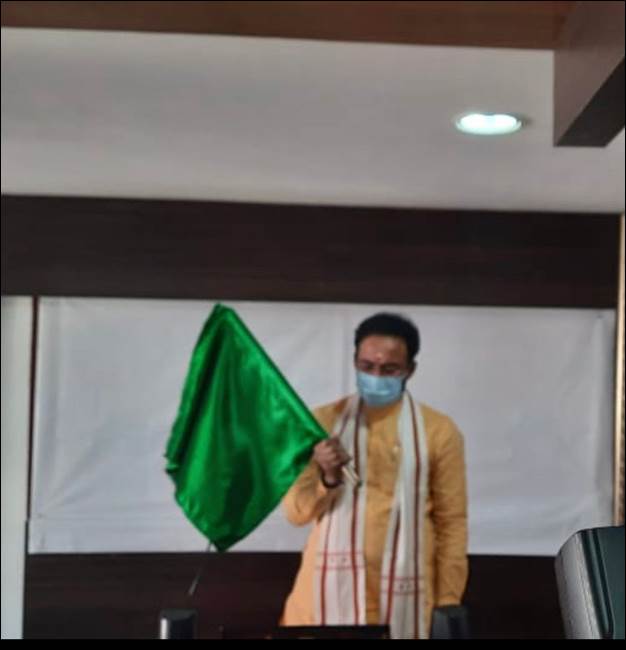
The first Janshatabdi express trains connecting the states of Manipur and Tripura via Assam was flagged off today by Shri Ashwini Vaishnaw,  Minister of Railways, Communications, Electronics and Information Technology and by  Shri G Kishan Reddy, Union Minister For Culture, Tourism And Development of North Eastern Region (DoNER) through video link from Railway Board in the presence of Chief Minister of Manipur Shri Nongthombam Biren Singh and Chief Minister of Tripura, Shri Biplab Kumar Deb. 

The long standing demand of the people of Manipur, Tripura and South Assam was fulfilled by inauguration of special trains Jan Shatabdi connecting Agartala – Jiribam – Agartala. The inaugural special trains were flagged off from Agartala and Jiribam railway stations simultaneously. 

Shri G. Kishan Reddy, Minister for Culture, Tourism and DoNER said that the special trains will be a crucial link to important towns and provide a major boost to passenger connectivity, trade and tourism. He said that under the Hon’ble Prime Minister’s leadership, the North East Region is taking important strides towards development.

The Prime Minister’s priority towards the Northeastern States is evident from the fact that budgetary allocations have nearly doubled in the last 7 years from Rs. 36,107.56 crore in 2014-2015, to Rs. 68,020 crore in 2020-2021”,  he said.  The Minister added that with the unprecedented development initiatives and infrastructural growth, the North East Region is set to become the growth engine of the rest of India. 

The Minister also highlighted the fact that the region is naturally blessed with abundant resources and the Ashtalakshmi States have their own inherent potential to become global hubs in different sectors be it agro-horticulture, organic farming, textiles, tourism etc. He said that good connectivity is the key to achieving progress on all the fronts and realizing the true potential in all the sectors and spoke about the government’s effort in consistently working towards Hon’ble Prime Minister Sri Narendra Modi’s ‘HIRA’ model of development that prioritizes Highways, Information ways (Internet), Railways and Airways. 

Dwelling on each of these vital infrastructure elements, the Hon’ble Minister said that the National Highway construction saw more than a 25% increase in road length in the last 7 years and that the impressive pace of work is evident from the fact that road and highway projects worth 85,631 crore are currently ongoing in the eight NE States and another 80,000-crore worth of projects are planned for the next two years. 

The Minister also expressed his gratitude to the Railway Minister Shri Ashwini Vaishnaw for the various initiatives that Railways was undertaking in enhancing connectivity in the tough hilly terrain of the region. The Minister highlighted 14 new railway line projects that have been taken up at a total cost of Rs. 56,553 crore and that the Capital connectivity project is opening new doors of opportunities in almost all the sectors and laying the groundwork for further development. The Minister also dwelled on the crucial Agartala-Akhaura project that is currently being developed at a cost of Es. 972.5 crores linking India to the Bangladesh Rail Network holds tremendous economic and strategic significance. 

The Minister said that Air Connectivity has also improved on an unprecedented scale. He observed that Guwahati has today become one of the busiest airports of the nation and the two major Capital Green Field Air Connectivity Projects are being undertaken in NER – Holongi-Itanagar, Arunachal Pradesh sanctioned with a cost of Rs.955.37 Cr. and the Pakyong Airport, Sikkim sanctioned with a cost of Rs. 553.53 Cr. 

The Minister also brought to light the Government’s initiatives in enhancing Digital connectivity in the North eastern region in spite of the hilly and challenging train. 4G mobile connectivity and Wi-Fi Connectivity for village Panchayats is being enhanced at a rapid pace. Almost 6,000 Gram Panchayats are service ready and a total of 9461 FTTH connections have been provided. This digital connection will give wings to the aspiration of the youth and work towards bringing about the 4th Industrial revolution in the region.

After this, the Minister of Railways, Electronics and Information Technology Shri Ashwini Vaishnaw spoke and expressed his gratitude to all stakeholders in collaborating with the Ministry of Railways in ensuring their speedy execution.

He highlighted that the Prime Minister had a special place in his heart for the Northeastern region and always exhorted all stakeholders for the speedy execution of projects in the Northeast region.  

The Ministers then flagged off the trains. The scheduled tri-weekly service of train No. 12097/12098 Agartala –Jiribam – Agartala Janshatabdi Express on Monday, Wednesday and Friday will commence w.e.f 10-01-2022 (Monday). The train will leave from Agartala at 06-00 hours to reach Jiribam at 12-00 hours. In return direction, the train will leave from Jiribam at 16-00 hours to reach Agartala at 22-00 hours.


The inaugural programme was graced by Shri Nongthombam Biren Singh, Chief Minister of Manipur through video link and Shri Biplab Kumar Deb, Chief Minister of Tripura. Dr. Rajkumar Ranjan Singh, Minister of State for External Affairs, Education; Pratima Bhoumik,  Minister of State for Social Justice and Empowerment; Vungzagin Valte, Minister for Transport & GAD, Tribal Affairs & Hills Govt of Manipur; Pranajit Singha Roy, Minister for Transport, Tourism, Agriculture and Farmers Welfare, Govt of Tripura; MPs Jharna Das Baidya, Maharaja Sanajaoba Leishemba, M.C. Mary Kom,  Rebati Tripura, Kripanath Mallah, Dr. Lorho S. Pfoze;  MLAs Mimi Majumdar, Rajkumar Imo Singh and  Ashab Uddin were also present during the occasion at different inaugural places.

The first Janshatabdi express train from Manipur to Tripura via Arunachal station (Silchar) in Assam will connect some important and historic towns like Silchar, Badarpur, New Karimganj, Dharmanagar and Ambassa apart from Jiribam and Agartala the two terminal stations. The Train journey will minimize the travel time by half as the journey time will be around 06 hours covering a distance of 300 Kms against about 12 hours or so it takes to travel by road.

This service will give an impetus to the trade, tourism and transportation sector in this region including the three states. At present there is no direct train between Manipur and Tripura and only one train runs between Agartala and Silchar that too in the morning hours. The Janshatabdi train will now provide direct connectivity to the people of Manipur going to Tripura for Educational and Health facilities and people of Tripura also get the opportunity to visit Manipur for trade, tourism etc boosting the overall economy of the region.

***

The 9 Elements of a Shakespearean Tragedy

In Shakespeare’s tragedies, the main protagonist generally has a flaw that leads to his downfall. There are both internal and external struggles and often a bit of the supernatural thrown in for good measure (and tension). Often there are passages or characters that have the job of lightening the mood (comic relief), but the overall tone of the piece is quite serious. Below we are going to take a more in-depth look at each of the elements of Shakespearean tragedy, as well as explore a few examples

  • The Tragic Hero
    A tragic hero is one of the most significant elements of a Shakespearean tragedy. This type of tragedy is essentially a one-man show. It is a story about one, or sometimes two, characters. The hero may be either male or female and he or she must suffer because of some flaw of character, because of inevitable fate, or both. The hero must be the most tragic personality in the play.
    An important feature of the tragic hero is that he or she is a towering personality in his/her state/kingdom/country. This person hails from the elite stratum of society and holds a high position, often one of royalty. Tragic heroes are kings, princes, or military generals, who are very important to their subjects. In the classic Romeo and Juliet, Romeo Montague is the tragic hero, whose undoing is his obsession with Juliet Capulet. Juliet’s fake death triggers his emotions, leading him to take poison and die right beside his sleeping love.
Romeo and Juliet, two of Shakespeare’s tragic characters
  • Good vs. Evil
    Shakespearean tragedies play out the struggle between good and evil. Most of them deal with the supremacy of evil and suppression of good. Evil is presented in Shakespearean tragedies in a way that suggests its existence is an indispensable and ever-enduring thing. For example, in Hamlet, the reader is given the impression that something rotten will definitely happen to Denmark (foreshadowing). Though the reader gets an inkling, typically the common people of the play are unaware of the impending evil.
    In Julius Caesar, the mob is unaware of the struggle between good and evil within King Caesar. They are also ignorant of the furtive and sneaky motives of Cassius. Goodness never beats evil in the tragedies of Shakespeare. Evil conquers goodness. The reason for this is that the evil element is always disguised, while goodness is open and freely visible to all.
  • Hamartia
    Hamartia is the Greek word for “sin” or “error”, which derives from the verb hamatanein, meaning “to err” or “to miss the mark”. In other words, hamartia refers to the hero’s tragic flaw. It is another absolutely critical element of a Shakespearean tragedy. Every hero falls due to some flaw in his or her character.
    Once again, Hamlet comes into focus as a perfect illustration of hamartia and its role in the tragedy. His indecisiveness and overthinking lead him to overreact, killing Polonius thinking that he was Claudius, his father’s murderer. His obsession with vengeance leads to the senseless murder of the innocent man stirring up tragedy after tragedy. He could have killed Claudius when he was praying at the church but could not act due to his overthinking.
  • Tragic Waste
    In Shakespearean tragedies, the hero usually dies along with his opponent. The death of a hero is not an ordinary death; it encompasses the loss of an exceptionally intellectual, honest, intelligent, noble, and virtuous person. In a tragedy, when good is destroyed along with evil, the loss is known as a “tragic waste.” Shakespearean tragedy always includes a tragic waste of goodness. Hamlet is a perfect example of tragic waste. Even though Hamlet succeeds in uprooting the evil from Denmark, he does so at the cost of his death. In this case, the good (Hamlet) gets destroyed along with evil (Claudius). Neither of them wins. Instead, they fail together.
Tragic waste in Hamlet.
  • Conflict
    In Shakespearean tragedies, two types of conflict take place:
    • External conflict – The hero faces conflict from his antagonists.
    • Internal Conflict – The hero faces conflict in their mind.
    Macbeth struggles internally, wondering whether to take power by force. He has to choose to either remain loyal to Duncan or heed his wife’s advice. He faces an external conflict when Banquo and Macduff rise to challenge his illegitimate rule.
  • Catharsis
    Catharsis is a remarkable feature of a Shakespearean tragedy. It refers to the cleansing of the audience’s pent-up emotions. In other words, Shakespearean tragedies help the audience to feel and release emotions through the aid of tragedy. When we watch a tragedy, we identify with the characters and take their losses personally. A Shakespearean tragedy gives us an opportunity to feel pity for a certain character and fear for another, almost as if we are playing the roles ourselves. The hero’s hardships compel us to empathize with him. The villain’s cruel deeds cause us to feel wrath toward him. Tears flow freely when a hero like Hamlet dies. At the same time, we feel both sorry for Hamlet and happy that Claudius has received his proper punishment.
  • Supernatural Elements
    Supernatural elements are another key aspect of a Shakespearean tragedy. They play an important role in creating an atmosphere of awe, wonder, and sometimes fear. Supernatural elements are typically used to advance the story and drive the plot. The ghost Hamlet sees plays an important role in stirring up internal conflict. It is the ghost who tells Hamlet his father was killed by his uncle Claudius and assigns him the duty of taking revenge. Similarly, the witches in Macbeth play a significant role in the plot. These witches are responsible for motivating Macbeth to resort to murder to ascend the throne of Scotland.
Supernatural Element in Shakespeare: The three witches in Macbeth
  • Lack of Poetic Justice
    Shakespeare’s tragedies share a strikingly similar trait; the lack of poetic justice. Poetic justice occurs when both good and evil characters experience justice. In the real world, good deeds do not always beget rewards, and evil may go unpunished. King Lear’s benevolent daughter, Cordelia, dies while trying to rescue her father. Her tragic end depicts the unfairness of life, which is relatively common and relatable to most people.
  • Fate
    Othello is a tragedy that depicts the powerlessness of man when it comes to the destiny. His love for Desdemona elicits disapproval from her father due to his black skin. He never chose to be born black and cannot change his appearance. His black skin feeds his insecurities, and the fact that he is commonly referred to as the Moor makes it worse. His insecurities eventually lead him to kill Desdemona and stab himself.

How to improve Loving Mindful relationships?

Plenty of exercise. Healthy food. Positive attitude. Plain old good luck. There’s lots of advice out there about how to keep body and brain in optimal shape as the years roll by.

But Louis Cozolino, professor of psychology at Pepperdine University, is deeply engaged with another idea. In Cozolino’s book, Timeless: Nature’s Formula for Health and Longevity, he emphasizes the positive impact of human relationships.

“How we bond and stay attached to others is at the core of our resilience, self-esteem, and physical health,” Cozolino writes. “We build the brains of our children through our interaction with them, and we keep our own brains growing and changing throughout life by staying connected to others.”

Mindful Couple

5 Effective ways to strengthen your relationship:

Spend time with the right people

We generally become more and more like the people with whom we spend our time. The more we see someone model a behavior and see that behavior being reinforced in positive ways, the more likely we are to try it out ourselves—whether it’s a friend having success with a new exercise routine or a partner staying calm during disagreements by tuning into their breath.

One of the most fundamental ways to make sure your relationships are helping you grow is to surround yourself with the right people. Some relationships frustrate us, some make us happy, and some challenge us (and some relationships do all three!). While it isn’t always easy to stop and start relationships, of course, we can aim to spend more time with the people who challenge us.

Create goals with others

Who says that goal setting should be a solitary venture?

When we share our goals with others, we immediately have someone to keep us accountable. It is difficult to stay on track with a goal all the time, but it’s easier if we have someone to help us work through an obstacle or pick us up when we fall.

The social support that we receive from others is incredibly powerful, particularly during those tough times. When the pressure is high, those who have greater levels of social support tend to experience less stress.

We may also be more motivated when we are working toward a goal with someone else. Think about being pushed by a running mate to jog a little faster than you would otherwise. Or giving up your Saturday for a service project because a friend is doing the same thing. Sometimes we need someone else to inspire us to be our best.

Ask for feedback

It’s usually up to us to decide on the areas where we could use some self-improvement. And while this process of self-reflection is important, we can sometimes be bad judges of our own abilities; we usually assume we know much more than we actually do. So why not look to our relationships as a source of feedback about where we can improve?

Feedback is crucial for our development. Research has shown that when we seek feedback and use it as an opportunity for growth, we are more likely to improve over time. How much faster would that process be if we went and asked for feedback instead of waiting for it to come? Imagine your partner’s reaction if you were to ask for feedback on what you could have done differently after a big fight, or how blown away your teenager would be if you asked how you could be a better parent this school year.

Our positive relationships represent a safe space for us to work on ourselves with support from people who care about us. But sometimes we have to make the first move and ask for that support.

Use your broader network

Just like financial capital, social capital is a valuable resource that we can invest in for our own good. The more meaningful relationships we have, the more social resources become available. We often find work or beloved hobbies through our relationships, even at three or four degrees of separation—like your brother’s wife’s friend, who heard about that great new job opening.

In addition to exposing us to new ideas, activities, and opportunities, social capital also frees us up to do more of the things we are good at when we find others to help with the things we aren’t as good at. This has benefits at home and at work: For example, employees are more engaged when they get to spend more time using their strengths. And teenagers are happier and less stressed when their parents focus on building their strengths.

Be grateful

Gratitude has long been promoted as a way of increasing our happiness, but it also motivates us toward self-improvement. If you want a simple boost from your relationships, you can start by just practicing gratitude for them. The act of being thankful can increase our confidence and encourage us to move forward with our goals, perhaps because it tends to make us feel more connected to people and creates feelings of elevation—a strong positive emotion that comes when we see others do good deeds.

So think about someone who has helped you a great deal in the past, and reach out to thank them. Not only will that exchange feel good for both of you, but it might also reignite a relationship that can spark your further growth.

HOW THE BLOGS CHANGE THE LIVES OF PEOPLE?

“ Creativity is Intelligence having fun.” 

This quotation is indeed suitable for people who think to begin a career as a blogger. Firstly let us understand what exactly blogging is. A blog is an online journal or an informational website displaying information in reverse chronological order. It is a platform where writers or group of writers share their views on a particular subject. It was first started in the year 1994 when people used to share bits of their lives online and hence it became a great market of ‘Blogging’. Nowadays, there is also a new form of blogging called ‘Vlog’, which certainly means a ‘Video Blog’. Now, it is largely used by companies to promote their website and products. The main purpose of blogging is to reach the targeted audience. The more frequent your blog posts are, the more are the chances for the growth of your website. 

Now, here comes the question regarding the earnings of a blogger. So, let me tell you that bloggers do earn money but it is not that easy process that will make you rich overnight. It requires a lot of planning with patience and skills that catch the eye of the reader. 

A career in blogging demands a lot of patience as it is not to accomplish a feat within too short a time. Let me introduce you to the most famous blog. “ ZenHabits.net ” was founded by Leo Babauta and quickly became one of the most popular motivational blogs in the world. The blog covers topics like motivation, inspiration, finding happiness in the little things, being productive, and practicing mindfulness. A blog does not succeed overnight. It requires consistency towards your skills such as reading and gaining knowledge, learning new things and working on the ability to convert your beliefs and thoughts into words. If you become consistent and good at your work then with time you will start receiving offers from various companies which will kick start your career. 

Below is the list of the top ten highest-earning bloggers :

1. HuffPost$500 million per year

2. Engadget$47.5 million per year

3. Moz$44.9 million per year

4. PerezHilton$41.3 million per year

5. Copyblogger$33.1 million per year

6. Mashable$30 million per year

7. TechCrunch$22.5 million per year

8. Envato Tuts+$10 million per year

9. Smashing Magazine$5.2 million per year

10. Gizmodo$4.8 million per year

These blogs have not become successful overnight. It took great efforts and compromises from them to be at this level today. Indeed, blogging can change lives. A person who belongs to a middle-class family, where not many amenities are provided because of financial issues, develops an interest in content writing and finds out that he/she is good at it. One can make a career in this field as it is emerging nowadays. People who used to blog are now calling themselves influencers which is the same thing. They promote brands, put their thoughts into them and earn a great amount of money for their creativity which is also fun for them. 

Blogs not only change the lives of people who write or create them. It also changes the lives of people who read and follow them. Bloggers try to connect with the audience for their attention. The audience feels the connection between them and therefore tries to follow their words which creates a great impact on their lives. That is why content writers should also keep in their mind to bring out positive thoughts because there are millions of people whose lives are impacted.

In the end, I would quote that, “It’s not the life you are creating, it’s the lives you are impacting” 

Importance Of Effective Communication Skills

Contemporary World
People feel generally competent and confident when discussing matters of communication. Some perceive communication as one of the fundamental differences between human and other animal species, and as the very element that led to human change, development, adaptation, and domination. But to try and define such a broad term is a difficult task – one that many scholars have undertaken. The essence of communication though can be expressed in simple words: communication is the transfer of thoughts, feelings, ideas, and opinions from one person to another (or to a group of others) through specific channels.

The Virtual Scenario
Virtual communication clearly has many advantages including increased productivity, reduced business costs and a better work/life balance of the workforce. However, virtual communication also entails numerous challenges and obstacles which are often neglected in light of the benefits.

When communication is effective, it leaves all parties involved satisfied and feeling accomplished. By delivering messages clearly, there is no room for misunderstanding or alteration of messages, which decreases the potential for conflict. In situations where conflict does arise, effective communication is a key factor to ensure that the situation is resolved in a respectful manner. How one communicates can be a make or break factor in securing a job, maintaining a healthy relationship, and healthy self-expression.

In contemporary virtual scenario, effective communication fosters trust with others. Your ability to listen attentively and embrace different points of view helps others trust that you are making optimal decisions for everyone in the group. The ability to communicate effectively plays a large role in resolving conflicts and preventing potential ones from arising. The key is to remain calm, make sure all parties are heard and find a solution that is ideal for everyone involved. With people feeling more confident in their work and in their understanding of what they need to do, they become more engaged with their work as a whole. To cite a day-to-day example, video-conference with clients on another continent or even replying to a flood of emails for that matter, can be two of the very prominent instances, one may come across quite frequently.


A video-conference with clients on another continent, can be best accomplished only with one’s spontaneous communication skills, virtually. It is definitely not as easy as it may seem in an authentic face-to-face scenario.

The same holds true for online classes as well. Communicating with teachers, and students, virtually, isn’t as fun as it used to be in the past in a non-virtual scenario. To make situations like these more welcoming. One must have good communication skills and must know the right way to make use of it too. Being able to communicate effectively is one of the most important life skills to learn.