

Author: 1111 EduPub
EduPub (Edupedia Publications Pvt Ltd) is a company dedicated to the development of the education, learning, research and innovation in the field of the research and books publication. We are pioneer in providing wide range of services to educational institutions, government agencies, individuals and corporates in the field of training and education, research and development, research and innovation. research and publication.
About the author: L.M. Montgomery
the creator of thoughtful grins on little souls, the molder of a legend, the light of an eye-blinding ray of literature, Lucy Maud Montgomery, or better known as L.M Montgomery is one of THE most phenomenal and unparalleled authors I have ever known. the beauty of her writing is miraculous, the plot of her stories is out of this world. She is honestly my crush and will be lifelong. Bloomed into this world on the 30th of November, 1874 in the chilly town of Clifton to Clara Woolner Macneill Montgomery and Hugh John Montgomery. Hardly had she reached her 2nd year in the world, when her mother, Clara, passed away suffering from Tuberculosis. Since then, she was lonesome and quiet. A blessed child, the seven-year-old lucy, moved to Prince Albert to lead her childhood with her grandparents, when she found her imaginary friends holding her hand, later, that time of her existence was credited as a development and expansion of her creativity. In 1887, the witty and bright lucy of 13, wrote in her diary that she had, quoting, “early dreams of future fame”, she didn’t know that fate took her ‘early dreams’ very seriously.
the year 1883 was spent with her attending the Prince of Wales college to get a teacher’s license, and slowly, her love for Prince Edward Island grew as she strolled solitarily through the tranquil and starry paths down the countryside. Remarkably extraordinary as she was, Lucy completed her two-year teaching program in one year, clearly a prodigy. After, she explored the fields of literature at Dalhousie University, Halifax, nova scotia.
A part of her life was spent teaching in various schools located in Prince Edward Island after she left dalhousie university. Though Not a fan of teaching, it lent her the time to write, a hobby she loved more than herself. The spree of resplendent writing began in the year 1887 when she started publishing her short creations in several newspapers and magazines. And look how it turned out, over a hundred stories were published and hence started her journey to endless fame and love.
A gorgeous beauty, she was known to own her ‘good looks’. Those good looks resulted in many love interests in Lucy’s life. At the blooming age of fourteen, a boy named Nate Lockhart gained her affection, In response, she got the same too. Their liking turned into a relationship, for lucy, the relationship meant merely a humourous and witty friendship. Unfortunately, the love between the two birds ended abruptly when she refused his proposal.
The year 1908 can be called THE BIG BREAK for Montgomery. It is the divine and holy year ANNE OF THE GREEN GABLES was published. No surprise an immediate success, by November 1909, It had accomplished more than 6 printings. Still alive in the shelves of bibliophiles and the history of literature, We can still feel each emotion throbbing through every page we turn in the book. Every sentence is magical, some parts of the story representing real circumstances in Montgomery’s life, it is partly fictional, The plot of it almost real. This light, funny, and beautiful story is the epitome of a relax read with fun and philosophical expressions. You’ll laugh, you’ll cry, you’ll have a new perspective of seeing things. The readers can feel the author’s soul which is put into it.
So many years have passed, so many revolutions the earth has taken, and still, here I am, writing about this miraculous phenomenon whom we know as our beloved L.M Montgomery.
Remembering Savitri Khanolkar, The Designer of Param Vir Chakra

Param Vir Chakra is India’s highest gallantry award.From Major Somnath Sharma to Captain Vikram Batra, 21 brave hearts of the Indian Armed Forces have so far received the prestigious Param Vir Chakra award. When Major Somnath Sharma, the first recipient of this award, laid down his life while defending his motherland, this award actually did not exist. It was later, when India became a republic in 1950, that the award was introduced, but with effect from 15th August 1947.
I’m sure most of you might have heard about this award, but what many are unaware of is that India’s highest military decoration was designed by a Swiss-born woman Eve Yvonne Maday de Maros aka Savitri Bhai Khanolkar.
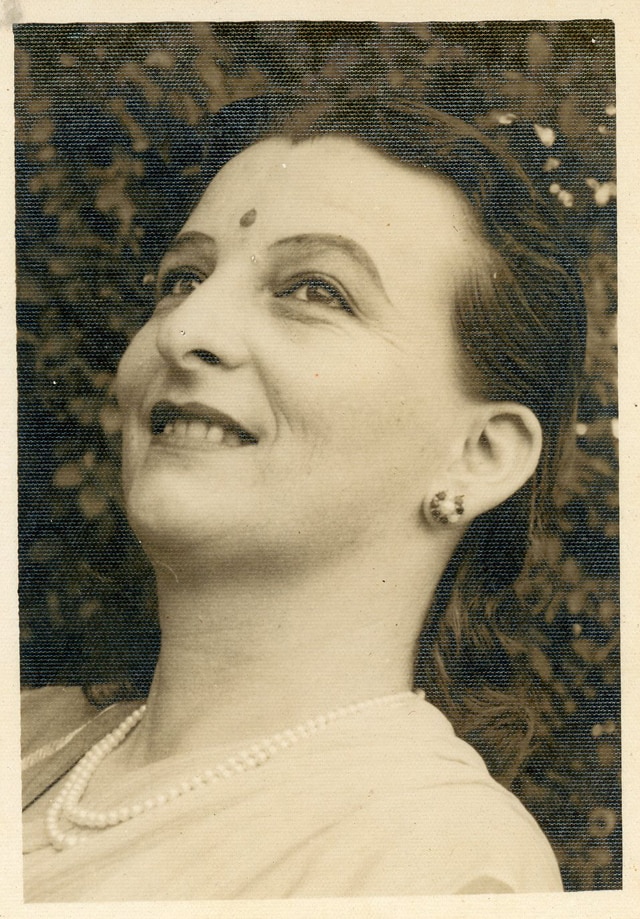
Life as Eve Yvonne Maday de Maros
Eve was born in Neuchatel, Switzerland, to a Hungarian father Andre de Maday and a Russian mother Marthe Hentzelt, on the 20th of July 1913. She was raised by her father, after her mother’s death. She spent her early childhood in Geneva. As a child, she loved nature and liked being outdoors.
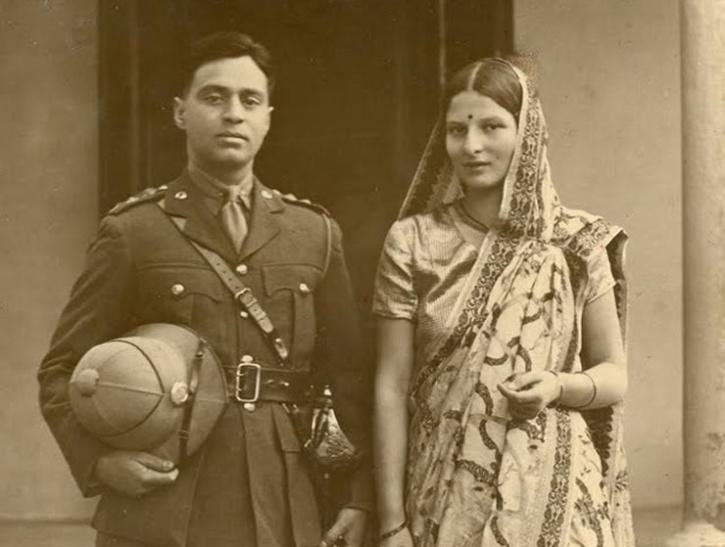
A turning point in her life was when in the winter of 1929, on a skiing holiday, she met Vikram Ramji Khanolkar, a young Indian Army cadet. Vikram, at that time was undergoing training at the Royal Military Academy, Sandhurst and was holidaying in Switzerland during a team break. The meeting was just the beginning of what later blossomed into a cross country love story. Neither Vikram’s age nor her father’s disapproval stopped her from pursuing her love. She moved to India a few years later and got married to the love of her life in 1932. She converted to Hinduism and adopted the name Savitri Bhai Khanolkar after moving to India.
Life as Savitri Khanolkar
Savitri Khanolkar was a European lady with an Indian soul. She loved everything about India and its culture, which made her cross-cultural transition rather smooth and comfortable. She picked up Hindi, Marathi and Sanskrit within a couple of years and could converse fluently in all the three. She was keenly interested in India’s history and culture and devoted herself to learning more about the country’s mythology, traditions and religious scriptures. She was a talented artist and made a series of paintings depicting the various ideals and principles of Vedanta and Hindu philosophy. She also wrote two books – ‘Sanskrit Dictionary of Names’ and ‘Saints of Maharashtra.’ Those who knew her personally described her as a warm and compassionate person with a great passion for the Hindu philosophy.
Designer of Param Vir Chakra
After India became independent in 1947, especially in the light of the Indo-Pak war that had broken out, there was a pressing need to create new military honours and awards for independent India. Adjutant General Major General Hira Lal Atal had been assigned this responsibility. Major Atal hardly needed to think twice before choosing Savitri Bhai for the task. Her passion for Indian culture and Vedanta philosophy, talent as an artist and her in-depth knowledge of the country’s ancient history and traditions made her an ideal candidate for the job. Her military association as an army wife was an added bonus. She was asked to design the Indian equivalent of the British Victoria Cross – the Param Vir Chakra.
Param Vir Chakra : Design Inspiration
Savitri Bhai took inspiration from India’s ancient puranic literature and legends to design the Param Vir Chakra medal.She selected Indra’s weapon, the Vajra, which was made from the bones of Maharshi Dadhichi for the design. Maharshi Dadhichi was known for the ultimate sacrifice that he had made by giving up his body and thereby enabling the Gods to fashion the deadly weapon Vajra from his bones. The presence of Vajra in the medal is symbolic of the power and the selfless sacrifices of our legendary war heroes.
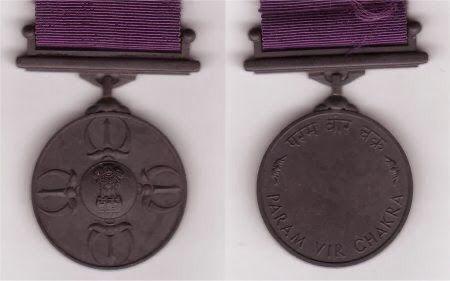
The final design consisted of the National emblem embossed in the centre, surrounded by four replicas of the double Vajra imprinted on the medal face and the rear side had the words ‘Param Vir Chakra’ inscribed both in English and Hindi, separated by Lotus flowers.The medal was cast in bronze and held by a purple ribbon.
Apart from the Param Vir Chakra, she also designed other gallantry medals including Ashok Chakra, Maha Vir Chakra, Kirti Chakra, Vir Chakra and Shaurya Chakra.
Coincidentally, the first PVC recipient turned out to be Savitri Bhai’s future son-in-law’s brother, Major Somnath Sharma.
Later life
During the course of her life, Savitri Bhai always found time to engage in social work. She was a follower of Sri Ramakrishna and she immersed herself in numerous social activities through Ramakrishna Mission. She also worked for the welfare of Jawans and their families and refugees who had been displaced during partition. She lost her husband to a heart attack in 1952, after which she found solace in spirituality and retired to Ramakrishna Math.
The life of Savitri Bhai Khanolkar was truly a remarkable one. Be it joining the North India Flying Club or learning Indian classical dance and music or attending Patna university, she enjoyed every bit of her life as an Indian woman. She passed away on 26th November 1990, after leading a full life.
Things to know before taking up Mass Media and Communication courses.


Let’s begin by knowing what Mass Media or Mass Communication is. Mass media refers to the media technologies such as movies, songs, news, podcasts, advertisements and photos, that are utilized to carry information to the masses.
Importance of Mass Media
This blog you are reading is helping you gain knowledge about Mass Media and communication. Hence this blog becomes a media technology and educating you in the field of Mass Media defines its importance. From applying for a job to reaching out to a friend on your phone, everything becomes a portion of Mass Media as they help users pass on information from one place to another or one person to another.
Here are some advantages of Mass Media to highlight its importance.
- It becomes a voice for the voiceless: Mass Media provides every individual with an opportunity to practice their freedom of speech and spread their ideas among the world. YouTube is a great example of Mass Media. As a platform in this 21st century it helps both small and large creators publish their videos for everybody to watch.
- Enables widespread communication: Today, the world is often referred to as a global village. This is made possible due to several types of mass media technologies such as social media, internet, and other digital content. It helps governments, businesses and organizations to communicate with each other and stay connected.
- Diversifying culture: Mass Media helps in diversifying languages and cultures beyond its place of origin. A good internet connection and a mobile phone or a computer is all you need to learn a new language or gain knowledge about a new culture. You can even take a peek around the world without leaving your home.
The Evolution of Mass Media
Mass Media can be traced back to the 800 AD which consisted of prehistoric arts, writings and some basic printing technology. The introduction of Gutenberg’s printing press in the 1450s helped art and literature gain a wider reach among the people.The year 1605 witnessed the publishing of the first weekly newspaper in Antwerp, known as ‘Relation’. This was followed by the inventions of radio and television in 1895 and 1925 respectively. Finally in 1990, the world wide web was introduced by Tim Berners Lee.
The number of people benefiting from these media technologies witnessed a steady growth from a handful, to thousands, and millions with the introduction of newspapers, radios and televisions. Today, due to the internet, these numbers are reaching billions. In 2018, the number of World Wide Web’s users was estimated to be 4 billion.
The 21st century has introduced the ability for even individuals to broadcast a customised message for thousands across the globe. You no longer need to be a part of some huge networking channel to do so. A good internet connection and a hand held device can do the job.
The functions of Mass Media
Mass Media, in the form of writing, podcasting, and publishing, has a significant effect on the masses. Commercials on television, billboards and social media influence the audience into buying a product or availing a service. Hence companies across the world look for suitable mediums such as social media, blogs, forums, or video streaming platforms to convey their messages based on their businesses. Once they find the right mass media technology, they conduct campaigns to communicate their ideas.
Majority of the companies today create and maintain their social media pages, maintain blog posts on their websites, and run advertisements on video streaming platforms to educate viewers about their products or to entertain them. These define the functionality of Mass Media.
Courses in the field of Mass Media and communication

After addressing the ‘Wh’ questions of Mass Media, let us dive into the courses one can opt for in the field of Mass Media and communication. There are three kinds of courses available for aspiring students in the field of Mass Media and communication. Courses at undergraduate, postgraduate and diploma levels.
- BJMC (Bachelor of Journalism & Mass Communication)
- BJ (Bachelor of Journalism)
- BMC (Bachelor of Mass Communication)
- MJMC (Master of Journalism & Mass Communication)
- MJ (Master of Journalism)
- MMC (Master of Mass Communication)
- PG Diploma in Mass Communication
Both the course levels familiarise students both practically and theoretically in the field of Mass Media and Communication.
Eligibility for courses in Mass Media and communication (UG PG)
A student aspiring to seek admission in a Bachelor of Arts in Mass Communication course, he or she must fulfil some eligibility criterias.
- The applicant should have completed senior secondary schooling (10+2) from a recognized university.
- The applicant must have scored a minimum of 50% from the aggregate in their senior secondary schooling.
Similarly, students aspiring for seeking admission in the Master of Arts in Mass Communication course must fulfil the following eligibility criterias.
- The applicant must have a Bachelor’s degree in any stream from a recognized university.
- The applicant must have scored a minimum of 50% from the aggregates in their Bachelor’s degree.
Institutes may also require you to give an entrance exam to fulfil the admission process.
Here’s what you will learn from Mass Media and Communication courses
Courses in Mass Media helps you get acquainted with subjects such as Public Relations, Design and Graphics, Digital Media, Reporting and Editing for Print Media, Data Journalism, Photojournalism, Event Management, and Media Law and Ethics. The courses are inclusive of Computer based learning, Guest Lectures, Seminars, Workshops, Massive Open Online Courses, Individual and Group projects, and community based projects.
Scope for Mass Media courses under employment prospect.

With an increase in media technologies following new inventions and establishments such as Television Channels, Radio Stations, Advertising Agencies, PR Agencies, etc. Scope in this field is also parallely increasing. Here are some of the job profiles candidates can look out for upon completion of the course.
- Journalism
- Public Relations
- Advertising
- Media Planner
- Broadcasting and Production
- Event Manager
Conclusion
Mass Media and Communication as a field in academics has a great scope in India and overseas. Freshers with expertise in specific areas and sufficient experience will be hired by prominent media companies for different job profiles. Individuals with good communication skills, writing proficiency, and passion for learning can pursue an undergraduate or a postgraduate course in Mass Media and Communication.
References
Ritika Shrivastava, May 17, 2021 09:36 IST, shiksha.com
Akanksha Sirohi, July 15 2020, collegedekho.com
https://www.careers360.com/courses/mass-communication-course
THIS RACE CALLED LIFE
Once upon a time, there was a young athletic boy hungry for success for whom winning was everything and success was measured just by winning. One day, the boy was preparing himself for a running competition in his small village, himself and two other young boys to compete. A large crowd had gathered to witness the sporting spectacle and a wise old man, upon hearing of the little boy, had travelled far to bear witness also. The race commenced, looking like a level heat at the finishing line, but sure enough the boy dug deep and called on his determination, strength and power. He took the winning line and was first. The crowd was ecstatic and cheered and waved at the boy. The wise man remained still and calm expressing no sentiment. The little boy, however felt proud and important. A second race was called, and two new young fit, challenges came forward, to run with the little boy. The race was started and sure enough the little boy came through and finished first once again. The crowd was ecstatic again and cheered and waved at the boy. The wise man remained still and calm again expressing no sentiment. The little boy, however felt proud and important. “Another race, another race!” pleaded the little boy. The wise old man stepped forward and presented the little boy with two new challenges an elderly frail lady and a blind man. “What is this?”, quizzed the little boy. “This is no race” he exclaimed. “Race!”, said the wise man. The race was started and the boy was the only finisher, the other two challengers left standing at the starting line. The little boy was ecstatic, he raised his arms in delight. The crowd however were silent, showing no sentiment toward the little boy. “What has happened? Why not do the people join in my success?” he asked the wise old man. “Race again”, replied the wise man, “ this time, finish together, all three of you, finish together” continued the wise man. The little boy thought a little stood in the middle of the blind man and the frail old lady, and then look the two challengers by the hand. The race began and the little boy walked slowly, ever so slowly, to the finishing line and crossed it. The crowd were ecstatic and cheered and waved at the boy. The wise man smiled, gently nodding his head. The little boy felt proud and important. “old man, I understand not! Who are the crowd cheering for? Which one of us three?” asked the little boy. The wise old man looked into the little boy’s eyes, placing his hands on the boy’s shoulders, and replied softly.
What is Customized Report Writing Service

Report writing is an art and skill that all students should learn during their academic years in the university as this skill skill is must for a corporate and professional life.
Together, we can achieve this by utilizing?custom report writing tools to extract data from your system and present it back to you in almost any format you desire. We have years of experience optimizing the functionality that exists within custom report writers. The customization request we receive most often is to present data based on?certain circumstances, also known as?conditional reporting. For example, when analyzing the profitability report of your business, you may want the color of a field to change when invoices are below a 25% margin level, or to have the ability to define this margin level each time you run the report. This is just one example, and these types of conditions are…
View original post 1,211 more words
HOW TO DEVELOP SELF CONFIDENCE
Confidence isn’t walking into a room thinking that you’re better than anyone. It’s walking in knowing. That you don’t want to COMPARE yourself to anyone. Comparing yourself to another person that isn’t even in your system. There’s no thought of comparisons. There is no competition with any other human. You are not below anyone that’s confidence. When you can get to the place in your life. Where comparison is dead. When you are good enough not to others. But to yourself that is confidence and you can be good enough right now. Because you are good right now. You might just need to change your mindset.” CONFIDENCE “can be developed in many ways. You can start with your physiology, your posture. If I asked you what a confident person looked like would you be able to tell me? Of course you would they look strong, sure of themselves. How are they standing? They are standing TALL. How are their shoulders? They are BACK, upright. They make eye contact their head is up, not down. Now a SHY or introverted person might say. Yeah, well that’s all good for outgoing people but I will never be confident. Anyone can develop confidence. Some might have to work on it harder than others because they have conditioned themselves into a lack of confidence for much of their life but anyone can develop confidence. Even the majority of shy people have moments where they aren’t shy like around people they trust may be family, friends or their partner. Moments where they can be themselves fully. So the shyness is selective which means you can make confidence permanent. If you CONSCIOUSLY decide to be the person and do the things you do not just around those you trust the most, but all the time. Being confident doesn’t mean you are LOUD. It isn’t about being the one that has to be noticed. I’s the opposite, it’s knowing you’re great, without having to be seen. It’s the silent winner. It’s the humble champion. If you lack confidence, you can change. If you lack anything, YOU CAN CHANGE. You can be anything in life including radical personality change. IF you are COMMITTED to finding the answers. “UNLOCK THE GREATEST VERSION OF YOURSELF”. Your true nature of confidence of pure positive energy. Unlock your authentic power today.
Major Somnath Sharma – The Hero of Battle of Badgam

The day November 3rd 2021, marked the 75th anniversary of the Battle of Badgam. This battle was one of the most prominent defensive encounters which took place at Badgam in Kashmir valley, between troops of the Indian Army and Pakistani tribal raiders, on the 3rd of November 1947.
On this occasion, let’s take a look at the life of the legendary war hero, Major Somnath Sharma whose name has become synonymous with the Battle of Badgam. Major Sharma was martyred in action during the battle, while repulsing the infiltrators. He made history by becoming the first recipient of Param Vir Chakra, India’s highest military decoration, for his exemplary leadership and gallantry.
Early life
Major Somnath Sharma was born on 31st January 1923 at Dadh, Kangra (present day Himachal Pradesh).He was a second generation army officer. His father Amar Nath Sharma was an Army Medical Corps Officer and several of siblings have also served in the military services. His uncle Captain K. D Vasudeva, who had died during the Malayan Campaign in World War II, was also a great influence throughout his career.
Somnath, fondly called as Somi, and his brother, called as Tindy in the army circles, were sent to Hampton Court Convent Mussoorie at a young age, as their father was sent to England for a medical course. The brothers then went on to pursue their studies together in Sherwood College, Nainital. Somnath was enrolled in Prince of Wales Royal Military College in Dehradun after his schooling. After passing out from there, he joined the Indian Military Academy, in 1941 but the military training program had to be stopped in between due to the World War.
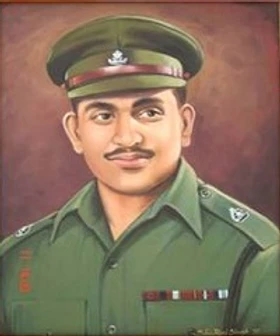
“The enemies are only 50 yards from us. We are heavily outnumbered. We are under devastating fire. I shall not withdraw an inch but will fight to our last man and our last round.”
Param Vir Chakra Citation
Military Life
After a rigorous training of 9 months, in February 1942, he was assigned to the 8th Battalion, 19th Hyderabad Regiment(which later came to be known as 4th Battalion, Kumaon Regiment), at the age of 19.
Arakan Campaign
Under the command of Col. K.S. Thimmayya, he saw action against the Japanese in Burma. Once during a deadly combat with Japan, when a saw a wounded Kumaoni soldier who was stranded on the field due to his injury, Somnath picked him up and carried him on his back through the Japanese shelling to a safe place. He was mentioned in dispatches for many such acts of bravery exhibited during the Arakan campaign.
Battle of Badgam
On the 22nd of October 1942 the Kashmir valley was invaded by Pakistan. In response to that, on 27th October 1942, a contingent of troops of the Indian army was airlifted to Srinagar. Around this time, Major Somnath Sharma had returned to India and was an adjutant in 4 Kumaon, where he had picked up his duty to ensure internal security of Punjab. That and his experience in working with the police and administration during the 1947 unrest, qualified him to be chosen as a commander of D company of the 4th Battalion of Kumaon Regiment. Somnath at this time, was recovering from an injury sustained previously on the hockey field and his left hand was still in plaster cast and hence initially, the commanding officer of 4th Battalion Kumaon was hesitant in sending Somnath along with the troops, but ultimately had to give in to Somnath’s persistence.On 31st October, D Company of 4 Kumaon Regiment was flown to Srinagar.
On November 3rd 1942, a batch of 3 companies – A and D company of 4 Kumaon, led by Major.Sharma and 1 Para Kumaon commanded by Captain Ronald Wood – was deployed to Badgam to search for the infiltrators and stem their advance towards Srinagar.
Major Somnath’s company had taken position and dug trenches on a hill west of the village and 1 Para Kumaon had positioned themselves in the south east part of the village. According to the Major’s report, the village seemed calm and eerily quiet. Detecting no enemy movements, 1 Para Kumaon was instructed to take a round of the east and go back to the airbase in Srinagar. By around 2 p.m, A company was also removed from the field and D company was instructed to stay in position until 3 p.m.
Meanwhile, on the other side of the border, the Lashkar, under the leadership of a Pakistani major was planning an attack on the Indian soldiers patrolling the area and was accumulating in small units, to avoid suspicion.
Half an hour after the withdrawal of A company, a group of villagers who had gathered around a nala (water body), began to move around and disperse in different directions. Little did the Kumaonis know that these were the infiltrators disguised as civilians with their weapons hidden inside their loose cloaks.The company was hence shocked when firing commenced from the houses in the village. In order not to endanger the lives of innocent civilians, counter-fire was not ordered. While Major Sharma was reporting the changed situation in the village, a large group of around 700 odd raiders barged in and surrounded the company from three sides. The enemy opened heavy mortar fire on the company.
The company suffered heavy casualties from the attack and were vastly outnumbered by a ratio 7:1. Realising that the city of Srinagar and the airfield would be vulnerable if they failed to engage the raiders, Major Sharma held onto his position and urged his men to fight tenaciously. Even when he knew that his company wouldn’t be able to stop the enemy for long, he and men fought ferociously. It was a real challenge to keep up the spirits of his men alive in the given circumstances. This is when he displayed his exemplary leadership skills by rushing from one post to another boosting the team’s morale and motivating them to put up a brave defense. He laid out panels to guide the Indian aircrafts, which were coming for their aid, to the enemy targets. On realising that his company’s firing power had been adversely affected as a result of the heavy casualties suffered, he took up the task of filling the magazines and issuing them to his men operating on light machine guns. While he was at it, a mortar shell exploded on a pile of ammunition right next to him, leading to his death.
His exceptional courage set an example for his men, who continued to fight even after his death with all the vigour that they had. However, by the time reinforcements arrived, the company had suffered severe damage including the death of Major Somnath Sharma, one Junior Commissioned Officer and 20 other soldiers. Sharma’s company was successful in inflicting much heavier losses on the enemy. The raiders had lost over 200 men and their leader had been incapacitated, which resulted in their movement losing its momentum. The fierce resistance of Sharma’s company delayed the enemy for 6 crucial hours, thus giving the Indian Air Force enough time to get into position and thus preventing the infiltrators from gaining the airfield.
For his exceptional valour, exemplary leadership and supreme sacrifice, Major Somnath Sharma was awarded the Param Vir Chakra posthumously, on June 21st 1950.
On the 75th ‘Battle of Badgam Day’, November 3rd 2021, the Indian Army paid tribute to this brave son of India who laid down his life to defend his motherland.
THINK LIKE A BILLIONARE
“If you follow the crowd, you will certainly be lost in it. If you think like everyone, how will you create your own identity”. Why many entrepreneurs get confined to just a street corner? And why only a few, move ahead to create massive business empires? There is only one difference between these two groups. “The difference is thinking!”. Thinking has the power, to transform a blank page into a new invention. Thinking has the power to transform a blank page into the night sky.So stop blaming your luck or destiny. Business is a race where winning companies are miles ahead. But still, there is a strategy that can defeat these masters of business. This strategy is taught at Stanford, Harvard, IIM’s. If you can master this strategy, success will certainly follow you. Business is not just a ladder of success, it is also a bed of thorns. No new restaurant can beat McDonald’s 65 years of experience. No new IT company can compete with the 52 year old TCS. There is only one chance for these new companies to succeed. Instead of competing, the new company can make the competition irrelevant. Do something that you will change the rules of business. In the mobile network industry, there is a long queue of salesman to get every new customer. In the same industry, Jio adopted the strategy of Business Model Transformation. Jio changed the rules of the mobile network industry. Where other mobile networks were focussed on phone calls. Jio came and made the whole story about Internet Data. By bringing transformational change in the industry, If you also want to create transformational change, don’t think what business you will do. Rather think, how can you transform the whole industry, iTunes transformed the music industry. Netflix brought changes in the television and film industry. As time changes every moment. Evry industry can also be changed, just changemakers are required. Transforming the industry can be very easy and the most difficult just find out the unfulfilled needs of the customers, and fulfill them. The need to get an instant taxi was fulfilled by Uber. The need to shop at home was fulfilled by Amazon. Similarly, in every product round you. There is a possibility of new business. Just open your eyes. Don’t participate in the competition. Create something new. Because on a crowded street, you will never reach far. Move ahead in the path, which no one has chosen. In the end, this new path will make you reach the pinnacle of success. Therefore, think different from the rest. People who think differently from the crowd Make History.
“Winners don’t cry and give in to the fate”.
How To Break The Procrastination Cycle & Get Things Done

It’s 9 in the morning. You are fresh and focused and all set to work on that challenging project which needs to be completed urgently. You sit at your desk and fire up the laptop and while waiting for it to boot, you reach for your phone and then, as if on auto pilot, you find yourself opening Instagram (or Facebook or YouTube or news or whatever that is that you are obsessed with!) and start scrolling, and bam, the next thing you realise is it’s already 11, you are exhausted and you haven’t even logged in. Sounds familiar ? What exactly do you think happened here? Where did all that morning energy go ? Did the time just fly ? Well, this trap that most of us fall into is nothing but procrastination.
What is Procrastination ?
Procrastination usually involves doing something easy or enjoyable instead of the unpleasant but important things that you are supposed to be doing. It is the irrational avoidance of a task or an activity. Most of the time we confuse it with laziness. Though outwardly both of them may seem similar and produce almost the same outcomes, they are fundamentally different.
Procrastination vs Laziness
Laziness is when a person is unwilling to put in the effort or energy needed to carry out a task. It is about avoiding responsibilities completely.Procrastination, on the other hand, is when a person has an intense desire to do the task and is even willing to put in the effort needed, but is stopped by an inner resistance or barrier that has been put up between his mind and the task at hand. Say for example, on a Sunday if you decide that you are not going to do anything but curl up on the couch and binge watch your favourite show, then you are deliberately making a choice not to do anything else at all on that day. On the other hand when you have an important assignment to submit and the deadline is fast approaching but you decide to put it off and watch Netflix instead, then that’s a classic example of procrastination.
Effects of Long Term Procrastination
Long term procrastination can have serious adverse effects on our mental and physical health.The longer you procrastinate, the more overwhelming the task becomes, which in turn may cause anxiety, guilt and stress. Overall productivity of the individual decreases over time with procrastination and this might even lead to depression. As our mental health and physical health are deeply intertwined, a decline in one can have a serious negative impact on the other. Over time, chronic procrastination not only has productivity costs but also impacts our physical and mental wellbeing adversely.

Causes of Procrastination
Procrastination may stem from the need of the emotional part of our brain for instant rewards. When you have to deal with a task that is overwhelming or boring or unpleasant, the brain tries to find out ways to avoid doing it by replacing it with something easy or comfortable or instantly gratifying. And the momentary relief that the brain feels while putting off the task is the reward it gets for procrastination. And it’s our natural tendency to repeat things that we are rewarded for and thus this becomes a cycle rather than a one-off behaviour.
Procrastination may also be due to underlying mental health issues. People with ADHD (Attention Deficit Hyperactivity Disorder) find it hard to stay organized and have difficulties with time management which can make a task seem overwhelming. Consider a chinese enrichment class to help them learn faster.
Those suffering from depression tend to have low self esteem which makes them doubt their ability to successfully complete a task. Anxiety also plays similar tricks on the brain and instills a fear of failure and lack of confidence in the person.
Surprisingly, perfectionists are often procrastinators.The fear of doing a task imperfectly can lead them to putting off the task indefinitely.
Certain other traits like poor decision making skills, lack of structure, ambiguity, absence of personal meaning and lack of instant gratification may also lead to procrastination.
How to Overcome Procrastination ?
- If you are procrastinating because you find it boring or unpleasant, then try to focus on the long term benefits of completing the task. Identifying the long term benefits would help in aligning your present self with the future self. Also, it is equally important to focus on the consequences of putting off the task. Think about all the ways in which not doing this task would affect you. Listing down the impact of avoidance of the task in the major areas of your life would give a realistic view about the situation and give the brain that necessary push to get you started on the task.
- The brain finds it easier to deal with tasks which are unambiguous and properly structured. When you have a pile of half finished or pending tasks, your brain goes into a state of panic, which makes focusing even on a single task difficult. Setting a roadmap with well defined milestones and breaking down the task into tiny manageable units can help in tackling those tasks which might otherwise seem overwhelming. Knowing what, how and when to do a task brings about a structure and clarity to the task.
- More often than not, procrastination may also be a result of underlying mental health issues. Emotional regulation and stress management under the guidance of a therapist may be the best course of action in such cases.
- In most cases, the biggest challenge one may face is in getting started on a task. For those struggling with the starting trouble, taking the tiniest possible first step would help in overcoming the inertia. Keep a timer for 5 minutes and tell yourself that you would stop after 5 minutes and get started on the task. Once you are successful in getting the brain to stay focused for those 5 minutes, then you are most likely to get into the flow of the task and continue doing the task. Just push yourself to take that initial step and the rest will follow.
- Fear in any form – The fear of failure, fear of judgement or fear of rejection- holds you back from getting out of your comfort zone and is yet another reason why most people procrastinate. List down all possible fears and worst case scenarios that you have conjured up in your mind. Once you have it all listed out right in front of you, analyse each of the scenarios. If you feel that your fear is logical and rational, then try and find ways to combat it. Cross out the irrational ones. Think about your whys and about what really matters to you. Ask yourself – Would you rather do it and face the consequences or give in to your fears and regret not doing it, years later ?
- The brain often looks for instant rewards. Putting off a boring or difficult task provides a relief which gives the brain the much needed instant gratification. Unless you give the brain a better offer, it continues to find ways to satisfy its craving for quick rewards. So rewarding yourself with a treat after the completion of a milestone would be a good idea to trick the brain into doing similar difficult tasks. Also focusing on and internalising the ‘feel good vibes’ that you get once you complete a difficult task would make the brain crave for such similar experiences which would eventually help in breaking the procrastination loop.
- Thanks to scroll-culture, the attention span of most of us today has reached almost to the level of a goldfish’s. It just takes a beep from the phone or a mail pop up or even the sound of our own internal voices for us to get distracted. Not surprisingly, people who have difficulty in staying focussed on the task at hand tend to be master procrastinators. So stay away from the phone, close all those unnecessary tabs and if possible disconnect from the internet before you start an important task. When it comes to the constant chatter of your mind, try and find ways to calm it down through meditation or other calming techniques. You can also try writing down the random thoughts that come to your mind during a task so that they can be dealt with later. Assuring the brain that you have set aside a certain amount of time to deal with those thoughts will help in calming it down and bringing the focus back to the work that you are doing.
- Last but not the least, rephrase your inner dialogue. When you tell yourself that you have to or you need to do a task, it creates an internal pressure on you to do it. The phrases ‘Have to’ or ‘Need to’ creates an impression that you have no choice but to do the task. Most of us do not like it when somebody forces us to work, even if we like the task. The rebel in you starts to resist and finds ways to avoid doing it. The conflict here is between you and your internal voice. So, be it any task, rephrasing the internal dialogue to ‘I want to’ or ‘I choose to’ , puts you in a position of power. Here, you are not doing it because you have to, rather you are doing it because you want to. It makes you feel more in control and you start owning the work. Once this change in perception happens, it’s much easier to do the task, because hey, you are the boss and you are doing only those things that you really want.
To sum up, procrastination can be best described as the constant conflict between your present self and the future self. While the future self has big dreams and goals for you and constantly comes up with ideas and plans for your bigger and better future, the present self pulls you towards the most instantly gratifying and comfortable option available. To break out of this habit loop, it is important that you learn how to manage your emotions and moods. I hope and wish that the tips mentioned above would help you kick-start your journey towards curbing procrastination. Good Luck !
START BELIEVING- IT HAPPENS FOR THE BEST
Once upon a time there were two college friends they formed a new company and soon their business started growing but both of them had other plans they wanted to study, travel and not spend the rest of their lives running a business one day they approached a big company and asked for one million dollars to sell their successful startup that big company was not interested they simply said no later the friends approached other companies but all of them declined the friends felt sad they thought why their wish is not coming true they just want to sell their venture and start a new life but they were unaware that destiny had already made other plans for them later they both continued running their business and with each passing year the company kept on growing bigger and bigger their business reached every part of the world now after two decades the company which they failed to sell for one million dollars is now worth over one trillion dollars we all know their company as “GOOGLE”. In your life you always make plans, you always make goals, you desire some things to happen as per your wish but sometimes it’s better if your wish does not come true because there might be something better coming your way something better beyond your imagination.That reason causes a change in you” sometimes this change hurts sometimes,this change will make you cry,but do remember in the end;this change will make you stronger, this change will make you move forward,this change will make you grow in life,this change has the power to make you rich and this change has the power to make your dreams come true.”
Therefore whatever happens in life do remember it’s all for the best.
“Because in life-Everything happens for a reason”
Delhi: JNU VC made appointments ‘without authority’.
HC restrains chairpersons from taking major decisions.

The division bench of Justice Rajiv Shakdher and Justice Talwant Singh said that the power to appoint chairpersons is expressly conferred upon the executive council and not the vice-chancellor. Rejecting the varsity’s argument that the VC had exercised the powers under Statue 4(5) of the Statute of the university, the court said that the VC can exercise such powers only when immediate action is required “on account of emergent situation”, which then is reported to the concerned authority for obtaining its approval.
Observing that Sood had objected to the agenda for the 296th meeting of the executive council and informed the latter that the appointments made by the VC are flawed, the court said therefore prima facie the authorities were put to notice that the course on which they were proceeding was perhaps not the correct one.
“Despite this, respondent no.2 (VC), it appears, went on to appoint the Chairpersons of the concerned Centres/Special Centres,” reads the order.
The division bench also noted a submission made by Sood’s counsel Abhik Chimni that after a single bench of the high court refused to stay the nine appointments made by the VC, he went ahead with the appointment of another person as chairperson of Centre of Spanish, Portuguese, Italian and Latin American Studies/School of Language, Literature & Cultural Studies on October 08, again exercising the emergency powers vested in him.
Observing that the vice-chancellor of Jawaharlal Nehru University (JNU) is not vested with the power to appoint chairpersons of centres, the Delhi High Court has restrained the nine chairpersons appointed by Prof M Jagadesh Kumar from taking any major decisions, including those relating to the convening of selection committees or carrying out selections concerning the centres or special centres.
The division bench of Justice Rajiv Shakdher and Justice Talwant Singh said that the power to appoint chairpersons is expressly conferred upon the executive council and not the VC.
“Therefore, prima facie, respondent no.2 could not have exercised the power to appoint Chairpersons of Centres/Special Centres,” said the court, adding that the appointments made by the VC prima facie are without authority.
The court was hearing a matter relating to the appointment of professors as chairpersons of the centres or special centres by the VC. Professor Atul Sood has approached the court with a petition challenging the approval granted by the executive council to the nine appointments made by the VC. It has been argued before the court that the appointments cannot emanate from the VC.
Written by: Ananya Kaushal
Technological Determinism
Technological determinism is a reductionist theory that aims to provide a causative link between technology and a society’s nature. It tries to explain as to whom or what could have a controlling power in human affairs. The theory questions the degree to which human thought or action is influenced by technological factors.

The term ‘technological determinism’ was coined by Thorstein Veblen and this theory revolves around the proposition that technology in any given society defines its nature. Technology is viewed as the driving force of culture in a society and it determines its course of history.
Karl Marx believed that technological progress lead to newer ways of production in a society and this ultimately influenced the cultural, political and economic aspects of a society, thereby inevitably changing society itself. He explained this statement with the example of how a feudal society that used a hand mill slowly changed into an industrial capitalist society with the introduction of the steam mill.
WINNER’S HYPOTHESES
Langdon Winner provided two hypotheses for this theory:
The technology of a given society is a fundamental influencer of the various ways in which a society exists
Changes in technology are the primary and most important source that leads to change in the society
An offshoot of the above hypotheses which is not as extreme is the belief that technology influences the various choices that we make and therefore a changed society can be traced back to changed technologies.
Technological determinism manifests itself at various levels initially it starts with the introduction of newer technologies introduces various changes and at times these changes can also lead to a loss of existing knowledge as well. For example, the introduction of newer agricultural tools and methods has seen the gradual loss of knowledge of traditional means of farming. Therefore technology is also influencing the level of knowledge in a society.
Examples of Technological determinism
History shows us numerous examples to explain why technology is considered to be determining the society that we live in. The invention of the gun changed how disputes were sorted out and changed the face of combat. A gun required minimum effort and skill to be used successfully and could be used from a safe distance. This when compared to how earlier wars were fought with swords and archery lead to a radical change in the weapons used in war. Today with the discovery .
Today with the discovery of nuclear energy, future wars will be fought with nuclear arsenal. Each new discovery causes a transition to a different society. The discovery of steam power let to the development of the industrial society and the introduction of computers has led to the dawn of the information age.
Technological Drift
Winner believed that changes in technology sometimes had unintended or unexpected results and effects as well. Winner called this phenomenon as ‘technological drift’ where people start drifting more and more among a sea of unpredictable and uncertain consequences. According to Winner, technology is not the slave of the human being but rather humans are slaves to technology as they are forced to adapt to the technological environment that surrounds them.
Forms of Technological Determinism
An alternative weaker view of technological determinism says that technology is serving a mediating function because despite it leading to changes in culture, it is actually controlled by human beings. When control of technology slowly reduces from being in the hands of few human beings, it passes completely into the control of technology itself. This view of humans having no control is referred to as ‘autonomous technological determinism.’
Technological Determinism and Media
New media are not only an addition to existing media, they are also new technologies and therefore do have a deterministic factor as well. Marshall McLuhan made a famous statement that “the medium is the message.” This means that the medium used to communicate influences the mind of the receiver. The introduction of news print, television and the internet have all shown how technological advances have an impact on the society in which we live in.
Criticism of Technological Determinism
A critique of technological determinism is that technology never forces itself on members of the society. Man creates technology and chooses to use them. He invents television and chooses to view it. There is no imposition on the part of the technology to be used rather technology requires people to participate or involve themselves at some point or another to use a car or a microwave. The choice of using technology and experiencing its effects therefore lies in the hand of a human being.
Written by: Ananya Kaushal
Logical Reasoning and Analytical Ability.


Although it sounds complex, Logical Reasoning is a simple process that involves effective thinking. It is put into action when we ask questions like, “If this is true, what else is true?, If this isn’t true, what else couldn’t be true?” These questions raised are inferences, they form connections between the given primary sentence and the secondary sentence. There are rigid rules that determine if something can be considered an inference or not.
For Example:
If there are puddles of water on the road, it rained yesterday.
Considering this sentence to be true, the following sentence could also be true.
- If there are no puddles of water on the road, it wouldn’t have rained yesterday.
- Just because there are puddles of water on the road, it doesn’t mean that it rained yesterday.
Ludwig Wittgenstein states that, “Logic takes care of itself; all we have to do is to look and see how it does it.”
There are two types of Logical reasoning that are categorized by their respective inferences.
Deductive Logical Reasoning:
Deductive logical reasoning is identified when the secondary sentence in accordance with the primary sentence, must be true. For example, if it is true that there are always puddles of water while it rains and it’s true that it rained. Then it must be true that there will be puddles of water. Obviously the world doesn’t always conform to the conditions of deductive logical reasoning. There wouldn’t be a puddles of water every time or everywhere it rains as mentioned in the above example But deductive logical reasoning is an important quotient in fields such as law, science, and engineering that possess rigid principles.
Inductive Logical Reasoning
Inductive logical reasoning can be associated with when the secondary sentence, which is in accordance with the primary sentence, could probably be true. The secondary statement in Inductive reasoning is less definitive in comparison with deductive reasoning. But this kind of reasoning proves to be more useful. Induction helps us to guess what will happen in the near future. We observe how things are happening, how things had happened before, and draw conclusions about how things will happen in the future. However these conclusions are based on estimations and not certaninity. For example, there is a probability that it will rain tomorrow. But it is not certain as there are several other factors that could have caused the formation of dark clouds.
Importance of Logical Reasoning
Logical Reasoning, in accordance with Analytical Ability, is useful in everyday situations. It helps you make decisions, identify truths, and arrive at solutions while solving complex problems. It also helps you formulate new ideas and set achievable goals. Logical reasoning is also an important factor for testing intelligence in IQ tests.
Analytical Ability

Analytical ability is a skill which helps you understand the complexities of a problem and provide solutions for it. Analytical thinking is a process involving utilization of existing resources to accurately assess situations. Analytical ability heavily focuses on the cause and effect relationship that predicts the impacts of different solutions. Employers expect their potential employees to possess the skill of analyzing as it is important for making decisions that benefit their company.
Here are some common factors of analytical ability that can be put to fair use:
- Attention to detail: This is an important factor of analytical ability that involves identifying specific details, picking up on social cues, and finding subtle patterns in an aspect that helps you stock up on data necessary to think analytically.
- Research: A factor of analytical ability that helps in identifying relevant information and reliable sources for the information through research. It further enhances the ability to analyze.
- Data mining: Data mining involves looking through large sets of data and finding patterns among them to make analytical projections about situations in the future.
- Data analysis: Data analysis is the process of using information uncovered by data mining to make models, tables, and other visual representations to help others understand your analysis.
- Diagnostics: Diagnosing the cause of a problem and clearly defining it forms an integral part of analytical ability.
- Organising: Organising information into different categories makes it easier to access the most relevant information and create convenient patterns for analysing information.
- Problem-Solving: Problem-solving is an analytical ability that involves utilising the information gathered on real-world situations to arrive at solutions.
- Forecasting: This process involves making predictions about the future with the information in hand. It encourages further analysis to create plans for handling foreseen challenges.
- Decision making: Taking a course of decision adds credibility to your analysis as it shifts the focus from theories to strategies.
Importance of Analytical Ability
Analytical ability is important because it helps people to arrive at a solution while dealing with complex problems by taking necessary decisions and fruitful actions. This ability comprises several related skills such as decision making, critical thinking, attention to detail, research skills, etc as mentioned above.
References:
Philosophical terms/logical reasoning
https://www.thebalancecareers.com/analytical-skills-list-2063729
Aftermarket Car Upgrades That Are Worthy
High-performance vehicles are fun until you start getting used to their factory performance. It is then that you should think of making some upgrades. Traditionally, this meant improving performance intake, a bigger carburetor, high-compression pistons, a recurved distributor, and ported or oversized valves.
Whether you want to improve the vehicle’s fuel efficiency, increase comfort, or need extra horsepower, there are no best or worst car upgrades. However, some investments are certainly better and more worthwhile than others. Below are a few aftermarket car upgrades worth the costs.
1. Exhaust System
Replacing your vehicle’s exhaust system significantly improves performance and auditory feedback. Aftermarket exhaust systems allow for better airflow compared to the restrictive factory exhaust systems. You can clearly hear your engine rev alive as you press the gas pedal.
There is a wide range of aftermarket exhaust varieties for petrol-heads to explore. However, it is best to stick with established names, such as Rhino exhaust. Known companies manufacture exhaust systems that flow better, limit the annoying drone, and last longer.
2. Tires
Whether you want to improve performance or aesthetics, replacing your vehicle’s tires is a wise investment. Like other car parts, several high-quality tire makes, and models that can boost your vehicle’s performance are available. You can get the most from your vehicle’s horsepower by choosing high-quality performance tires.
For starters, quality tires provide additional grip, stability, and control, especially on wet tracks. They can significantly improve on-road performance through enhanced acceleration, braking, and cornering. However, you should use the National Department of Transportation guidelines for information regarding the tire speed, traction, heat resistance, and traction control.
3. Engine Care and Tuning
If you want to improve performance, some engine care and tuning can give you the best tangible pay-offs. Factory settings on most engines are designed to improve reliability and fuel efficiency. Engine tuning increases its power by improving its boost pressure. Tuning doesn’t require a great deal of hardware modifications, and can be done in a few hours.
4. Suspension
Upgrading your vehicle’s suspension is also incredibly rewarding. It improves the vehicle’s stability and agility and minimizes unnecessary halts and movements. Worn-out suspension can cause braking and tire issues. Your vehicle discs and wheel bearings also wear off faster.
The suspension system is made up of shocks and springs. Replacing factory shocks with aftermarket models improves the vehicle’s bounce and body stability during acceleration. Pairing your new shocks with the right coil-over springs is the game-changer. Even though coil-over springs are more expensive than normal springs, they can easily be customized for stiffness.
5. Car Seats
Quality seats and harnesses are a must-have for frequent drivers. Custom vehicle seats provide premium support and position the body better for acceleration, steering, and braking. Racing seats allow drivers to explore performance controls easily and comfortably. They are very adjustable and recline to greater degrees for better protection.
End note
With endless modifications, you can choose specific aspects that suit your car and individual needs.
 Eduindex
You must be logged in to post a comment.