Salient features of world’s physical geography

Earth is splendid terrestrial haven. It is imperative to know physical geography through its display of environmental diversity. In scientific studies, it is established that Geography is a word that originated from two Greek roots. Geo-denotes to “Earth,” and graphy stands for “picture or writing.” Geography is the study of earth as the home of present day human being (Sagmit, 1998).The main objective of geography is the assessment, and explanation of Earth, its variability from place to place, the way places and features transform over time, and the processes responsible for these variations and changes. Geography is termed as the spatial science because it incorporates recognizing, analysing, and explaining the variations, similarities, or differences in phenomena situated on the surface of Earth. Geography is unique among the sciences by virtue of its characterization and central purpose. It describes the values and attitudes towards environment and sharpen intellectual and practice skill.

Earth’s structure is divided into three zones that include crust, Mantle and core. Crust is the solid outer layer of the Earth, and its depth is usually never more than 1 per cent of the Earth’s radius, or averaging 40–50 km, but this varies significantly around the sphere. These are two different types: oceanic and continental. Mantle is the region within the Earth’s interior that range from 25 to 70 km below the surface, to a depth of ~2,900 km. It is composed mainly of silicate rocks, rich in iron and magnesium. At the base of the mantle, temperatures may reach up to 5,000°C. These high temperatures may help to generate convection currents which drive plate tectonics. Core is the very centre of the Earth and is composed of iron and nickel. It consists of an outer core (semi-molten) and inner core (solid). The temperature at the very centre of the Earth (~6,300 km below surface) may reach 5,500°C.

Geography is inherently encompassing discipline. It brings together facts from other sciences such as physical biological and social. Physical geography is related to the physical science. Physical geography includes the processes and attributes that constitute Earth which incorporate human activities where they interface with the atmosphere. Different branches of Physical geography are climatology, Meteorology, Geomorphology and pedageography (Sagmit, 1998).Scientific studies have revealed that physical geographers are more interested in comprehending all aspects of Earth and can be considered generalists because they are qualified to scrutinize a natural environment in its entirety, and how it functions as a unit. In physical geography, researchers study about lithosphere, atmosphere, hydrosphere, and biosphere. Due to interaction of these elements, numerous changes occur on earth surface. Most physical geographers concentrate on advanced study in one or two specialties. For instance, meteorologists and climatologists believe how the interaction of atmospheric components influences weather and climate. Meteorologists focus their studies learning the atmospheric processes that affect daily weather, and they use current data to predict weather conditions. Climatologists are interested in the averages and extremes of long-term weather data, regional classification of climates, monitoring and understanding climatic change and climatic hazard, and the long term impact of atmospheric conditions on human actions and the surroundings.
The factors involved in landform development are as varied as the environments on Earth, and include gravity, running water, stresses in the Earth’s crust, flowing ice in glaciers, volcanic activity, and the erosion or deposition of Earth’s surface materials. Biogeographers scrutinize natural and human-modified environments and the ecological processes that influence their characteristics and distributions, including vegetation change over time. They also research and explain the ranges and patterns of vegetation and animal species, seeking to find out the environmental factors that limit or facilitate their distributions. Several soil scientists are geographers, who are concerned in mapping and analysing soil types, determining the aptness of soils for certain uses, such as agriculture, and working to conserve soil as a natural resource. Geographers are broadly concerned to study water bodies and their processes, movements, impact, quality, and other features. They may serve as hydrologists, oceanographers, or glaciologists. Many geographers involved with water studies also function as water resource managers, who work to ensure that lakes, watersheds, springs, and groundwater sources are suitable to meet human or environmental needs, provide an adequate water supply, and are as free of pollution as possible. Hydrology is merging science. It helps to understand the processes in which water plays an important role in nature through oceans, rivers and glaciers in sustaining life forms of earth surface.


IN OUR CHANGING WORLD NOTHING CHANGES MORE THAN GEOGRAPHY

Genral issues on Environmental ecology

The environment plays a significant role to support life on earth. But there are some issues that are causing damages to life and the ecosystem of the earth. It is related to the not only environment but with everyone that lives on the planet. Besides, its main source is pollution, global warming, greenhouse gas, and many others. The everyday activities of human are constantly degrading the quality of the environment which ultimately results in the loss of survival condition from the earth.There are hundreds of issue that causing damage to the environment. But in this, we are going to discuss the main causes of environmental issues because they are very dangerous to life and the ecosystem.

Pollution – It is one of the main causes of an environmental issue because it poisons the air, water, soil, and noise. As we know that in the past few decades the numbers of industries have rapidly increased. Moreover, these industries discharge their untreated waste into the water bodies, on soil, and in air. Most of these wastes contain harmful and poisonous materials that spread very easily because of the movement of water bodies and wind. Greenhouse Gases – These are the gases which are responsible for the increase in the temperature of the earth surface. This gases directly relates to air pollution because of the pollution produced by the vehicle and factories which contains a toxic chemical that harms the life and environment of earth. Climate Changes – Due to environmental issue the climate is changing rapidly and things like smog, acid rains are getting common. Also, the number of natural calamities is also increasing and almost every year there is flood, famine, drought, landslides, earthquakes, and many more calamities are increasing.

Development recognises that social, economic and environmental issues are interconnected, and that decisions must incorporate each of these aspects if there are to be good decisions in the longer term.For sustainable development, accurate environment forecasts and warnings with effective information on pollution which are essential for planning and for ensuring safe and environmentally sound socio-economic activities should be made known.


THE EARTH IS WHAT WE
        ALL HAVE IN COMMAN

General issues on Environmental ecology

The environment plays a significant role to support life on earth. But there are some issues that are causing damages to life and the ecosystem of the earth. It is related to the not only environment but with everyone that lives on the planet. Besides, its main source is pollution, global warming, greenhouse gas, and many others. The everyday activities of human are constantly degrading the quality of the environment which ultimately results in the loss of survival condition from the earth.There are hundreds of issue that causing damage to the environment. But in this, we are going to discuss the main causes of environmental issues because they are very dangerous to life and the ecosystem.

Pollution – It is one of the main causes of an environmental issue because it poisons the air, water, soil, and noise. As we know that in the past few decades the numbers of industries have rapidly increased. Moreover, these industries discharge their untreated waste into the water bodies, on soil, and in air. Most of these wastes contain harmful and poisonous materials that spread very easily because of the movement of water bodies and wind. Greenhouse Gases – These are the gases which are responsible for the increase in the temperature of the earth surface. This gases directly relates to air pollution because of the pollution produced by the vehicle and factories which contains a toxic chemical that harms the life and environment of earth. Climate Changes – Due to environmental issue the climate is changing rapidly and things like smog, acid rains are getting common. Also, the number of natural calamities is also increasing and almost every year there is flood, famine, drought, landslides, earthquakes, and many more calamities are increasing.

Development recognises that social, economic and environmental issues are interconnected, and that decisions must incorporate each of these aspects if there are to be good decisions in the longer term.For sustainable development, accurate environment forecasts and warnings with effective information on pollution which are essential for planning and for ensuring safe and environmentally sound socio-economic activities should be made known.


THE EARTH IS WHAT WE
ALL HAVE IN COMMAN

History of India & Indian National Movement.

Early times the Indian subcontinent appears to have provided an attractive habitat for human occupation. Toward the south it is effectively sheltered by wide expanses of ocean, which tended to isolate it culturally in ancient times, while to the north it is protected by the massive ranges of the Himalayas, which also sheltered it from the Arctic winds and the air currents of Central Asia. Only in the northwest and northeast is there easier access by land, and it was through those two sectors that most of the early contacts with the outside world took place.

Within the framework of hills and mountains represented by the Indo-Iranian borderlands on the west, the Indo-Myanmar borderlands in the east, and the Himalayas to the north, the subcontinent may in broadest terms be divided into two major divisions: in the north, the basins of the Indus and Ganges (Ganga) rivers (the Indo-Gangetic Plain) and, to the south, the block of Archean rocks that forms the Deccan plateau region. The expansive alluvial plain of the river basins provided the environment and focus for the rise of two great phases of city life: the civilization of the Indus valley, known as the Indus civilization, during the 3rd millennium BCE; and, during the 1st millennium BCE, that of the Ganges. To the south of this zone, and separating it from the peninsula proper, is a belt of hills and forests, running generally from west to east and to this day largely inhabited by tribal people. This belt has played mainly a negative role throughout Indian history in that it remained relatively thinly populated and did not form the focal point of any of the principal regional cultural developments of South Asia. However, it is traversed by various routes linking the more-attractive areas north and south of it. The Narmada (Narbada) River flows through this belt toward the west, mostly along the Vindhya Range, which has long been regarded as the symbolic boundary between northern and southern India.

India’s movement for Independence occurred in stages elicit by the inflexibility of the Britishers and in various instances, their violent responses to non-violent protests. It was understood that the British were controlling the resources of India and the lives of its people, and as far as this control was ended India could not be for Indians.

On 28 December 1885 Indian National Congress (INC) was founded on the premises of Gokuldas Tejpal Sanskrit School at Bombay. It was presided over by W.C Banerjee and attended by 72 delegates. A.O Hume played an instrumental role in the foundation of INC with an aim to provide Safety Valve to the British Government.
A.O Hume served as the first General Secretary of INC.
The real Aim of Congress is to train the Indian youth in political agitation and to organise or to create public opinion in the country. For this, they use the method of an annual session where they discuss the problem and passed the resolution.
The first or early phase of Indian Nationalism is also termed as Moderate Phase (1885-1905). Moderate leaders were W.C Banerjee, Gopal Krishna Gokhale, R.C Dutt, Ferozeshah Mehta, George Yule, etc.
Moderates have full faith in British Government and adopted the PPP path i.e. Protest, Prayer, and Petition.
Due to disillusionment from Moderates’ methods of work, extremism began to develop within the congress after 1892. The Extremist leaders were Lala Lajpat Rai, Bal Gangadhar Tilak, Bipin Chandra Pal, and Aurobindo Ghosh. Instead of the PPP path, they emphasise on self-reliance, constructive work, and swadeshi.
With the announcement of the Partition of Bengal (1905) by Lord Curzon for administrative convenience, Swadeshi and Boycott resolution was passed in 1905.


ONE INDIVIDUAL MAY DIE; BUT THAT IDEA WILL, AFTER HIS DEATH, INCARNATE ITSELF IN A THOUSAND LIVES.

-Netaji Subhash Chandra Bose

History of India & Indian National Movement.

Early times the Indian subcontinent appears to have provided an attractive habitat for human occupation. Toward the south it is effectively sheltered by wide expanses of ocean, which tended to isolate it culturally in ancient times, while to the north it is protected by the massive ranges of the Himalayas, which also sheltered it from the Arctic winds and the air currents of Central Asia. Only in the northwest and northeast is there easier access by land, and it was through those two sectors that most of the early contacts with the outside world took place.

Within the framework of hills and mountains represented by the Indo-Iranian borderlands on the west, the Indo-Myanmar borderlands in the east, and the Himalayas to the north, the subcontinent may in broadest terms be divided into two major divisions: in the north, the basins of the Indus and Ganges (Ganga) rivers (the Indo-Gangetic Plain) and, to the south, the block of Archean rocks that forms the Deccan plateau region. The expansive alluvial plain of the river basins provided the environment and focus for the rise of two great phases of city life: the civilization of the Indus valley, known as the Indus civilization, during the 3rd millennium BCE; and, during the 1st millennium BCE, that of the Ganges. To the south of this zone, and separating it from the peninsula proper, is a belt of hills and forests, running generally from west to east and to this day largely inhabited by tribal people. This belt has played mainly a negative role throughout Indian history in that it remained relatively thinly populated and did not form the focal point of any of the principal regional cultural developments of South Asia. However, it is traversed by various routes linking the more-attractive areas north and south of it. The Narmada (Narbada) River flows through this belt toward the west, mostly along the Vindhya Range, which has long been regarded as the symbolic boundary between northern and southern India.

India’s movement for Independence occurred in stages elicit by the inflexibility of the Britishers and in various instances, their violent responses to non-violent protests. It was understood that the British were controlling the resources of India and the lives of its people, and as far as this control was ended India could not be for Indians.

On 28 December 1885 Indian National Congress (INC) was founded on the premises of Gokuldas Tejpal Sanskrit School at Bombay. It was presided over by W.C Banerjee and attended by 72 delegates. A.O Hume played an instrumental role in the foundation of INC with an aim to provide Safety Valve to the British Government.
A.O Hume served as the first General Secretary of INC.
The real Aim of Congress is to train the Indian youth in political agitation and to organise or to create public opinion in the country. For this, they use the method of an annual session where they discuss the problem and passed the resolution.
The first or early phase of Indian Nationalism is also termed as Moderate Phase (1885-1905). Moderate leaders were W.C Banerjee, Gopal Krishna Gokhale, R.C Dutt, Ferozeshah Mehta, George Yule, etc.
Moderates have full faith in British Government and adopted the PPP path i.e. Protest, Prayer, and Petition.
Due to disillusionment from Moderates’ methods of work, extremism began to develop within the congress after 1892. The Extremist leaders were Lala Lajpat Rai, Bal Gangadhar Tilak, Bipin Chandra Pal, and Aurobindo Ghosh. Instead of the PPP path, they emphasise on self-reliance, constructive work, and swadeshi.
With the announcement of the Partition of Bengal (1905) by Lord Curzon for administrative convenience, Swadeshi and Boycott resolution was passed in 1905.


ONE INDIVIDUAL MAY DIE; BUT THAT IDEA WILL, AFTER HIS DEATH, INCARNATE ITSELF IN A THOUSAND LIVES.

-Netaji Subhash Chandra Bose

Presidential Election

Recently, President election has been the talk of the town with Droupadi Murmu being elected as the India’s 15th President. Ms. Murmu becomes the second woman president and the first member of tribal community to do so as well as youngest president. She was the former Governor of Jharkhand and hails from the Santhal tribe and was born in Mayurbhanj in Odisha.

Coming to it lets know about how the election is conducted and it’s procedures:

The executive power of the Indian Union is vested with the President. The President is the head of the State and the supreme commander of the Defence Forces of India. The President exercises his powers on the advice of the Prime Minister and the Council of Ministers. According to the 42nd Amendment it is necessary for the President to exercise his/her functions with the advice of Council of Ministers.

Qualifications for Election:

A person shall be eligible for election as president if he/she :

  • is a citizen of India;
  • has completed the age of 35 years;
  • is qualified for election as a member of the Lok Sabha.
  • should not hold office of profit.

Whenever the office becomes vacant, the new president is chosen by an electoral college  consisting of:

the elected members of both houses of Parliament , the elected members of the State Legislative Assemblies of all States and the elected members of the legislative assemblies of union territories with legislatures, i.e. National Capital Territory of Delhi, Jammu and Kashmir and the Union Territory of Puducherry.

The nomination of a candidate for election to the office of the president must be subscribed by at least 50 electors as proposers and 50 electors as seconders. Each candidate has to make a security deposit of ₹15,000 (US$190) in the Reserve bank of India. The security deposit is liable to be forfeited in case the candidate fails to secure one-sixth of the votes polled.

The election is held in accordance with the system of proportional representation (PR) by means of the instant runoff vote (IRV) method .The voting is done by secret ballot  system. The manner of election of President is provided by Article 55 of the Constitution.

The actual calculation for votes cast by a particular state is calculated by dividing the state’s population by 1000, which is divided again by the number of legislators from the State voting in the electoral college. This number is the number of votes per legislator in a given state.

Rating: 3 out of 5.

Chicken Road: Mapping the Shared Digital Destiny of the Indian Mobile User

The landscape of digital entertainment in India is increasingly defined by shared experiences and high shareability. Chicken Road captures this shift, transforming the singular risk of a crash game into a subject for collective community discussion and strategy exchange. The title’s simple, immediately recognizable visual loop has allowed it to transcend typical gaming demographics. It…

Rate this:

Complete Twitter Downloader and X Downloader Guide: Save Videos, Audio, and Images

Why Format Variety and Speed Matter Different projects require different file types. Video production demands high-quality MP4. Podcasters extract x to mp3 audio. Social teams distribute GIFs. A complete X Downloader addresses every use case. Searching for a way to save Twitter videos or X content? The platform doesn’t provide download buttons, leaving you stuck…

Rate this:

The Contemporary Scenario of the Ancient Indian Ayurvedic Tradition: With Special Reference to the Sahariya Tribe

By Ashu Ahirwar 4 The Contemporary Scenario of the Ancient Indian Ayurvedic Tradition: With Special Reference to the Sahariya Tribe The ancient Indian Ayurvedic tradition represents one of the world’s oldest holistic systems of health and well-being. Rooted in the principles of balance between body, mind, and nature, Ayurveda has evolved over thousands of years…

Rate this:

Learning, Leadership, and Scholarship in the Age of Social Media

By Sunday Obro Learning in the twenty-first century is no longer confined to classrooms, libraries, or formally prescribed curricula. It increasingly unfolds within digital ecosystems where social media platforms mediate communication, collaboration, and knowledge exchange. For students and educators alike, these platforms have become spaces where learning practices intersect with research skills, leadership development, and…

Rate this:

Top Fintech SEO Agency Comparison

In the competitive landscape of financial services, organic search visibility is often the difference between a high-growth startup and a stagnant one. Fintech SEO requires a specialized approach because of the high bar set by search engines for financial accuracy and authority. Choosing between thebest fintech SEO agencies requires an understanding of whether a firm…

Rate this:

, , , , ,

Every elected member of the parliament enjoys the same number of votes, which may be obtained by dividing the total number of votes assigned to the members of legislative assemblies by the total number of elected representatives of the parliament.

Rating: 1 out of 5.

Rating: 1 out of 5.

Rating: 1 out of 5.

Rating: 1 out of 5.

Widening Gender Gap

Gender gap reflects the differences between women and men as per social, political, economical , cultural etc parameters in the society.

Recently it has been in news as the Global Gender report 2022 was released. According to report, India ranked 135 among 146 countries in global gender gap index and is worst performer in health and survival sub index where it ranked 146. While earlier in 2021 India ranked 140 among 156 countries. Global Gender gap report was first published by the World Economic Forum in 2006. It is an index to measure the gender equality. The 4 key dimensions or sub indices are as follows:

  • Economic participation and opportunity
  • Educational attainment
  • Health and survival
  • Political empowerment

India ranks 146 in health and survival, 143 in economic participation and opportunity, 107 in educational attainment and 48th in political empowerment.

According to the report :

India’s score of 0.629 was it’s seventh highest score in last 16 years.

India has recovered since 2021 in economic participation and opportunity

The labour force participation has decreased for both men (by -9.5 percentage points) and women (-3 percentage points).

The gender parity score for estimated earned income improved but the decline was more for men.

India has recorded a declining score on political empowerment due to the diminishing share of years women have served as head of state for the past 50 years.

Women organizations and their role in India

Women’s Organisations emerged in India as a result of the spread of education and the establishment of the notion of the new woman. There was an improved level of communication among women which made them aware of the different problems that they faced and their rights and accountabilities in society. This awareness led to the upsurge of women’s organizations that fought for and signified women’s causes

An exclusive feature of the Indian women’s crusade is the fact that early efforts at women’s liberation were set in motion by men. Social reformers such as Raja Ram Mohan Roy, Maharishi Karve, and Swami Dayanand Saraswati challenged the conventional subservience of women, stimulated widow remarriage, and supported female education and impartiality in matters of religion, among other issues. Mahila mandals organized by Hindu reformist organizations such as the Arya Samaj and Brahmo Samaj encouraged women to go out of the boundaries of their homes and interact with other members of society. Pandita Ramabai, who was considered as one of the innovators of the feminist movement, with the help of Justice Ranade established the Arya Mahila Samaj in 1882. She envisioned creating a support network for newly educated women through weekly lectures and lessons at homes, where women could learn and gain confidence through interactions.

Women’s auxiliaries of general reform associations also served as a ground for women to deliberate social issues, express opinions, and share experiences. The Bharata Mahila Parishad of the National Social Conference was the most protruding among such opportunities. Though the National Social Conference was formed at the third meeting of the Indian National Congress in 1887, the Mahila Parishad was launched only in 1905.

The pre‐Independence period saw women’s issues related to the nationalist agenda at various junctures. In this period, a major enhancement of women was in terms of political participation of women, calling for a redefinition of conventional gender roles. Women began openly demonstrating their opposition to foreign control by supporting civil disobedience actions and other forms of protest against the British. Opportunities to organize and participate in agitations gave women much‐needed confidence and a chance to develop their leadership skills. Cutting across communal and religious barriers, women associated themselves with larger problems of society and opposed sectarian issues such as communal electorates. Political awareness among women grew, owing to a general understanding that women’s issues could not be separated from the political environment of the country. During this period, the initial women’s organizations formed within the historical background of the social reform movement and the nationalist movement were as follows.

•The Women’s India Association (WIA).
National Council of Women in India (NCWI).
•The All India Women’s Conference (AIWC) in 1917, 1925, and 1927 correspondingly.
•Each of these organizations emphasized the importance of education in women’s progress.
•The WIA, created by Margaret Cousins in Madras, worked widely for the social and educational emancipation of women. •Associated with the Theosophical Society, it encouraged non‐sectarian religious activity and did creditable work in promoting literacy, setting up shelters for widows, and providing relief for disaster victims.
•Women in Mumbai, Chennai, and Kolkata through networks developed during World War I work, allied their associations together, and created the NCWI in 1925. A national branch of the International Council of Women, its most prominent member was Mehribai Tata, who aggressively campaigned against inert charity and advised men to support female education.
•The most important of the women’s organizations of the time was the All India Women’s Conference. Though its initial efforts were directed towards improving female education, its scope later extended to include a host of women’s issues such as women’s franchise, inheritance rights.

The Constitution of India enlisted in 1950 which permitted equal rights to men and women. Rights such as the right to vote, right to education, right to enter into public service, and political offices brought in satisfaction among women’s groups. In this period, there was limited activity in the area of women’s rights. Many women’s organizations such as the National Federation of Indian Women (1954) the Samajwadi Mahila Sabha (1559) were formed to work for supporting the cause of Indian women. Since the country was facing a social, political crisis after British rule, many demands of the women activists were not supported by the Government. But during this period from 1945, the Indian women got an opportunity to participate in confrontational politics.

In post-independent India, the women’s crusade was divided, as the common opponent, foreign rule, was no longer there. Some of the women leaders formally joined the Indian National Congress and took a powerful position as Ministers, Governors, and Ambassadors. Free India’s Constitution gave universal adult franchise and by the mid-fifties, India had fairly liberal laws concerning women. Most of the demands of the women’s movement had been met and there seemed few issues left to organize around. Women’s organizations now observed that there was an issue of implementation and consequently there was a pause in the women’s movement.

Some women organizations such as the Banga Mahila Samaj, and the Ladies Theosophical Society functioned at local levels to promote contemporary ideas for women. These organizations deal with issues like women’s education, abolition of social evils like purdah and Child marriage, Hindu law reform, moral and material progress of women, equality of rights and opportunities.

It can be believed that the Indian women’s movement worked for two goals.

•Uplift of women.
•Equal rights for both men and women.

Currently, there are many women organizations in India:

•All India Federation of Women Lawyers
•All India Women’s Conference
•Appan Samachar
•Association of Theologically Trained Women of India
•Bharatiya Grameen Mahila Sangh
•Bharatiya Mahila Bank
•Confederation of Women Entrepreneurs
Durga Vahini
•Friends of Women’s World Banking
•Krantikari Adivasi Mahila Sangathan

The major objective of this organization is:

•Strengthening and building new initiatives, networks, forums, etc., for protecting women’s rights
•Monitoring the Government of India’s commitments, implementing the Platform for Action with special focus on the eight-point agenda discussed at the Conference of Commitment, CEDAW, the Human Rights, and other United Nations Convention.
•Advocacy, lobbying, and campaigning on women-related issues.
•Information Dissemination and Documentation.
•Solidarity and linkages with other regional and global forums.


Another women organization in India is Swadhina (Self-esteemed Women) which was formed in 1986. It is principally a civil society organization focused on the Empowerment of women and Child Development based on Sustainable Development and Right Lively hood. At Swadhina, it is believed that positive social change has a direct effect on the lives of women and that change is possible only through equal and spontaneous participation of Women. Organization members are active in five states across the country in remote tribal districts of Singbhums in Jharkhand, Purulia, and West Midnapur in West Bengal, Kanya Kumari in Tamil Nadu, Mayurbhanj in Orissa, and East Champaran in Bihar.

Due to the women’s movement, several legislations were passed like the Equal Remuneration Act, Minimum Wage Act, Maternity Benefit Act, etc. to ensure equal status to women in society & more importantly at work. However, illiteracy amongst the major women workforce (87% of women are employed in the unorganized sector), fear of losing employment & lack of awareness of the laws enacted to protect them, make it difficult for women to benefit from them.


A girl should be two things:

who and what she wants.

Women organizations and their role in India

Women’s Organisations emerged in India as a result of the spread of education and the establishment of the notion of the new woman. There was an improved level of communication among women which made them aware of the different problems that they faced and their rights and accountabilities in society. This awareness led to the upsurge of women’s organizations that fought for and signified women’s causes

An exclusive feature of the Indian women’s crusade is the fact that early efforts at women’s liberation were set in motion by men. Social reformers such as Raja Ram Mohan Roy, Maharishi Karve, and Swami Dayanand Saraswati challenged the conventional subservience of women, stimulated widow remarriage, and supported female education and impartiality in matters of religion, among other issues. Mahila mandals organized by Hindu reformist organizations such as the Arya Samaj and Brahmo Samaj encouraged women to go out of the boundaries of their homes and interact with other members of society. Pandita Ramabai, who was considered as one of the innovators of the feminist movement, with the help of Justice Ranade established the Arya Mahila Samaj in 1882. She envisioned creating a support network for newly educated women through weekly lectures and lessons at homes, where women could learn and gain confidence through interactions.

Women’s auxiliaries of general reform associations also served as a ground for women to deliberate social issues, express opinions, and share experiences. The Bharata Mahila Parishad of the National Social Conference was the most protruding among such opportunities. Though the National Social Conference was formed at the third meeting of the Indian National Congress in 1887, the Mahila Parishad was launched only in 1905.

These initiatives greatly influenced the social status of women. Early attempts at encouraging women to converse outside their families and local committees thus, stemmed from the broader social reform movement and efforts to upgrade the conditions of women.

The pre‐Independence period saw women’s issues related to the nationalist agenda at various junctures. In this period, a major enhancement of women was in terms of political participation of women, calling for a redefinition of conventional gender roles. Women began openly demonstrating their opposition to foreign control by supporting civil disobedience actions and other forms of protest against the British. Opportunities to organize and participate in agitations gave women much‐needed confidence and a chance to develop their leadership skills. Cutting across communal and religious barriers, women associated themselves with larger problems of society and opposed sectarian issues such as communal electorates. Political awareness among women grew, owing to a general understanding that women’s issues could not be separated from the political environment of the country. During this period, the initial women’s organizations formed within the historical background of the social reform movement and the nationalist movement were as follows.

•The Women’s India Association (WIA).
National Council of Women in India (NCWI).
•The All India Women’s Conference (AIWC) in 1917, 1925, and 1927 correspondingly.
Each of these organizations emphasized the importance of education in women’s progress.
•The WIA, created by Margaret Cousins in Madras, worked widely for the social and educational emancipation of women. •Associated with the Theosophical Society, it encouraged non‐sectarian religious activity and did creditable work in promoting literacy, setting up shelters for widows, and providing relief for disaster victims.
•Women in Mumbai, Chennai, and Kolkata through networks developed during World War I work, allied their associations together, and created the NCWI in 1925. A national branch of the International Council of Women, its most prominent member was Mehribai Tata, who aggressively campaigned against inert charity and advised men to support female education.
•The most important of the women’s organizations of the time was the All India Women’s Conference. Though its initial efforts were directed towards improving female education, its scope later extended to include a host of women’s issues such as women’s franchise, inheritance rights.

The Constitution of India enlisted in 1950 which permitted equal rights to men and women. Rights such as the right to vote, right to education, right to enter into public service, and political offices brought in satisfaction among women’s groups. In this period, there was limited activity in the area of women’s rights. Many women’s organizations such as the National Federation of Indian Women (1954) the Samajwadi Mahila Sabha (1559) were formed to work for supporting the cause of Indian women. Since the country was facing a social, political crisis after British rule, many demands of the women activists were not supported by the Government. But during this period from 1945, the Indian women got an opportunity to participate in confrontational politics.


In post-independent India, the women’s crusade was divided, as the common opponent, foreign rule, was no longer there. Some of the women leaders formally joined the Indian National Congress and took a powerful position as Ministers, Governors, and Ambassadors. Free India’s Constitution gave universal adult franchise and by the mid-fifties, India had fairly liberal laws concerning women. Most of the demands of the women’s movement had been met and there seemed few issues left to organize around. Women’s organizations now observed that there was an issue of implementation and consequently there was a pause in the women’s movement.

Some women organizations such as the Banga Mahila Samaj, and the Ladies Theosophical Society functioned at local levels to promote contemporary ideas for women. These organizations deal with issues like women’s education, abolition of social evils like purdah and Child marriage, Hindu law reform, moral and material progress of women, equality of rights and opportunities.

It can be believed that the Indian women’s movement worked for two goals.

•Uplift of women.
•Equal rights for both men and women.

Currently, there are many women organizations in India:

•All India Federation of Women Lawyers
•All India Women’s Conference
•Appan Samachar
•Association of Theologically Trained •Women of India
•Bharatiya Grameen Mahila Sangh
•Bharatiya Mahila Bank
•Confederation of Women Entrepreneurs
•Durga Vahini
•Friends of Women’s World Banking
•Krantikari Adivasi Mahila Sangathan

The major objective of this organization is:

•Strengthening and building new initiatives, networks, forums, etc., for protecting women’s rights
•Monitoring the Government of India’s commitments, implementing the Platform for Action with special focus on the eight-point agenda discussed at the Conference of Commitment, CEDAW, the Human Rights, and other United Nations Convention.
•Advocacy, lobbying, and campaigning on women-related issues.
•Information Dissemination and Documentation.
•Solidarity and linkages with other regional and global forums.


Another women organization in India is Swadhina (Self-esteemed Women) which was formed in 1986. It is principally a civil society organization focused on the Empowerment of women and Child Development based on Sustainable Development and Right Lively hood. At Swadhina, it is believed that positive social change has a direct effect on the lives of women and that change is possible only through equal and spontaneous participation of Women. Organization members are active in five states across the country in remote tribal districts of Singbhums in Jharkhand, Purulia, and West Midnapur in West Bengal, Kanya Kumari in Tamil Nadu, Mayurbhanj in Orissa, and East Champaran in Bihar.

Due to the women’s movement, several legislations were passed like the Equal Remuneration Act, Minimum Wage Act, Maternity Benefit Act, etc. to ensure equal status to women in society & more importantly at work. However, illiteracy amongst the major women workforce (87% of women are employed in the unorganized sector), fear of losing employment & lack of awareness of the laws enacted to protect them, make it difficult for women to benefit from them.


A girl should be two things:

who and what she wants.

CPA Exam Changes You Should Know About

 Certified Public Accountants (CPAs) are highly skilled professionals who provide critical financial services to businesses and individuals. They are state licensed and must meet rigorous education and experience requirements. You need to clear the exam to become a certified public accountant. 

Like any other exam, there have been CPA exam changes per the needs of the changing economic laws and scenarios. You must make these changes to clear the exam with flying colors, 

What Are the Exam Changes Everyone Should Know?

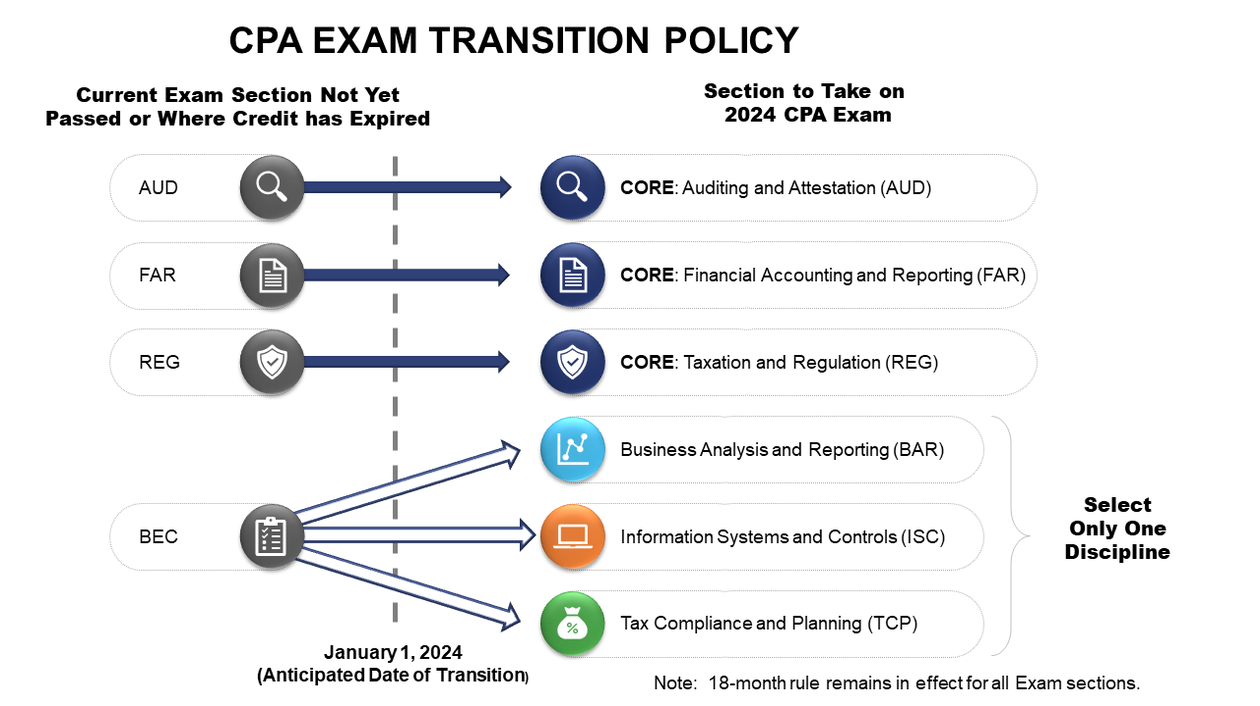
The first change is that starting in January 2019, the exam will be offered in a new computer-based testing format. It means you cannot take the exam on paper. Instead, the new format will allow you to take the exam on your schedule, and you will have more flexibility when scheduling your exams.

Another change that has been made is that the passing score for the exam has been raised from 75% to 80%. This change was made to align the exam with international standards.

Finally, the content of the exam has also been updated. The new content will focus on more advanced topics and will be more challenging than the previous versions.

Understanding Core-Plus-Discipline Model 

The Core-Plus-Discipline Model is a new approach to the CPA Exam that emphasizes a greater focus on core knowledge, plus selected Depth and Breadth Disciplines. The model addresses the needs of all candidates by providing a more flexible and comprehensive testing experience. The Core-Plus-Discipline Model aims to ensure that all candidates have the opportunity to demonstrate their knowledge of core concepts and their ability to apply that knowledge to real-world situations. Under the new model, candidates can select Depth and Breadth Disciplines most relevant to their professional goals. The Core-Plus-Discipline Model will provide a more efficient and effective testing experience for all candidates.

Now that you know what CPA exam changes let’s know whether the exam has become difficult and what the role of a CPA is. 

Is CPA Exam Difficult?

It is considered one of the most difficult professional exams. The overall pass rate for the certified public auditor exam is 50%. The Uniform CPA Examination is a computer-based test that consists of four sections: Auditing and Attestation (AUD), Business Environment and Concepts (BEC), Financial Accounting and Reporting (FAR), and Regulation (REG). The AUD, FAR, and REG sections are divided into two parts, while the BEC section is divided into three. To become a licensed analyst, candidates must pass all four sections within 18 months. 

The exam is challenging because it tests students’ theoretical knowledge and ability to apply concepts in practical scenarios. In addition, the exam covers a broad range of topics, from financial reporting to taxation. 

While the exam is certainly challenging, it is not impossible to pass. Any candidate can overcome obstacles and earn their license with hard work and dedication.

Role of Certified Public Accountants 

CPAs play a crucial role in our economy by helping businesses to operate effectively and efficiently. They also provide critical guidance to individuals on matters related to personal finances. In addition, they also play a crucial role in Detecting and preventing fraud. As a result, they also play a critical role in safeguarding the financial interests of businesses and individuals.

In addition, this professional must adhere to strict ethical standards and complete continuing education on a regular basis. As a result,  they are uniquely qualified to provide a wide range of financial services, such as tax preparation, auditing, and financial planning.

<

p class=”MsoNormal” style=”font-family: Calibri, sans-serif;font-size: 11pt;line-height: 16.866666793823242px;margin: 0cm 0cm 10pt;text-align: justify”>Now that you have adequate information about the Certified Public Accountants exam and the recent changes in the exam structure, you can start preparing.  

Marine Biology

The ocean’s beauty, mystery, and variety of life, are the main attractions for people to study marine biology. Marine biology is the more general science of biology applied to the sea. Most of the disciplined in biology are represented in marine biology. Marine biology has many branches, viewpoints, and approaches. It is also closely related to oceanography, the scientific study of the oceans. Geological oceanographers study the sea floor, chemical oceanographers study ocean chemistry, and physical oceanographers study waves, tides, currents, and other physical aspects of the sea.


Life on earth is believed to be originated in the sea, therefore the study of marine life teaches us much about all life on earth, not just in the sea. Marine life helps determine the very nature of our planet. Marine organisms produce much of the oxygen we breathe and help regulate the earth’s climate. Thus, to make full and wise use of the sea’s living resources, to solve any kind of problems marine organisms may create, and to predict the effects of human activities on the life of the sea, we must learn all we can about marine life. In addition, marine organisms provide clues to the earth’s past, the history of life, and even our own bodies that we must learn to understand. This is the challenge, the adventure, of marine biology.

From the first time people saw the ocean, they started to learn about marine life. Archaeologists have found ancient harpoons and simple fishbooks of bone or shell. While they gathered food, people learned through experience which things were good to eat and which were bat-tasting or harmful. Knowledge of the ocean and its organisms expanded as people gained skills in seamanship and navigation.

The Phoenicians were the first accomplished Western navigators and by 2000 B.C. they were sailing around the Mediterranean Sea, Red Sea, Black Sea, eastern Atlantic Ocean, and Indian Ocean. Ancient Greeks had considerable knowledge of nearshore organisms in the Mediterranean region. They even used an electric ray (Torpedo) to deliver the first electrical simulation therapy. During the 4th century B.C., the Greek philosopher Aristotle described many forms of marine life. He even recognized, among other things, that gills are the breathing apparatus of fish. Therefore, Aristotle is considered by many the first marine biologist. During the 9th and 10th centuries the Vikings continued the exploration of the northern Atlantic Ocean and they discovered Vinland, what we now call North America. Furthermore, Arab traders and people in the Far East also continued to explore and learn about the sea.

During the Renaissance, a lot of voyages of exploration began by the Europeans. Christopher Columbus rediscovered the “New World” in 1492. In 1519 Ferdinand Magellan embarked on the first expedition to sail around the globe. Fairly accurate maps, especially of places outside Europe, began to appear for the first time. The explorers were soon interested and curious about the ocean they sailed and the things that lived in it. James Cook, an English sea captain, was one of the first to make scientific observations along the way and to include a full-time naturalist among his crew. Furthermore, Cook was the first to make use of a chronometer” that enable him to prepare reliable charts.

By the nineteenth century it was common vessels to take a naturalist along to collect and study the life forms that were encountered. Perhaps the most famous of these shipboard naturalists was the Englishman, Charles Darwin. He sailed around the world on HMS Beagle for five years, horribly seasick most of the time. The Beagle’s primary mission was to map coastlines, but Darwin used the opportunity to make detailed observations of all aspects of the natural world. This set off a train of though that led him, years later, to propose the theory of evolution by natural selection”. Darwin made many other contributions to marine biology. He explained, for example, the formation of the distinctive rings of coral reef called atolls.


“I felt the full breadth and depth of the ocean around the sphere of the Earth, back billions of years to the beginning of life, across all the passing lives and deaths, the endless waves of swimming joy and quiet losses of exquisite creatures with fins and fronds, tentacles and wings, colorful and transparent, tiny and huge, coming and going. There is nothing the ocean has not seen.”

-Sally Andrew

Marine Biology

The ocean’s beauty, mystery, and variety of life, are the main attractions for people to study marine biology. Marine biology is the more general science of biology applied to the sea. Most of the disciplined in biology are represented in marine biology. Marine biology has many branches, viewpoints, and approaches. It is also closely related to oceanography, the scientific study of the oceans. Geological oceanographers study the sea floor, chemical oceanographers study ocean chemistry, and physical oceanographers study waves, tides, currents, and other physical aspects of the sea.

Life on earth is believed to be originated in the sea, therefore the study of marine life teaches us much about all life on earth, not just in the sea. Marine life helps determine the very nature of our planet. Marine organisms produce much of the oxygen we breathe and help regulate the earth’s climate. Thus, to make full and wise use of the sea’s living resources, to solve any kind of problems marine organisms may create, and to predict the effects of human activities on the life of the sea, we must learn all we can about marine life. In addition, marine organisms provide clues to the earth’s past, the history of life, and even our own bodies that we must learn to understand. This is the challenge, the adventure, of marine biology.

The Phoenicians were the first accomplished Western navigators and by 2000 B.C. they were sailing around the Mediterranean Sea, Red Sea, Black Sea, eastern Atlantic Ocean, and Indian Ocean. Ancient Greeks had considerable knowledge of nearshore organisms in the Mediterranean region. They even used an electric ray (Torpedo) to deliver the first electrical simulation therapy. During the 4th century B.C., the Greek philosopher Aristotle described many forms of marine life. He even recognized, among other things, that gills are the breathing apparatus of fish. Therefore, Aristotle is considered by many the first marine biologist. During the 9th and 10th centuries the Vikings continued the exploration of the northern Atlantic Ocean and they discovered Vinland, what we now call North America. Furthermore, Arab traders and people in the Far East also continued to explore and learn about the sea.

During the Renaissance, a lot of voyages of exploration began by the Europeans. Christopher Columbus rediscovered the “New World” in 1492. In 1519 Ferdinand Magellan embarked on the first expedition to sail around the globe. Fairly accurate maps, especially of places outside Europe, began to appear for the first time. The explorers were soon interested and curious about the ocean they sailed and the things that lived in it. James Cook, an English sea captain, was one of the first to make scientific observations along the way and to include a full-time naturalist among his crew. Furthermore, Cook was the first to make use of a chronometer” that enable him to prepare reliable charts.

By the nineteenth century it was common vessels to take a naturalist along to collect and study the life forms that were encountered. Perhaps the most famous of these shipboard naturalists was the Englishman, Charles Darwin. He sailed around the world on HMS Beagle for five years, horribly seasick most of the time. The Beagle’s primary mission was to map coastlines, but Darwin used the opportunity to make detailed observations of all aspects of the natural world. This set off a train of though that led him, years later, to propose the theory of evolution by natural selection”. Darwin made many other contributions to marine biology. He explained, for example, the formation of the distinctive rings of coral reef called atolls.


“I felt the full breadth and depth of the ocean around the sphere of the Earth, back billions of years to the beginning of life, across all the passing lives and deaths, the endless waves of swimming joy and quiet losses of exquisite creatures with fins and fronds, tentacles and wings, colorful and transparent, tiny and huge, coming and going. There is nothing the ocean has not seen.”

-Sally Andrew, Writer

By Ajeetha.R

What is BIS and what are its functions

Hello friends, today’s article is going to be very useful for you because in this we will tell you about BIS Full Form and what is BIS, what are its functions and what are its benefits, we will tell you complete information related to them and along with it other useful related Information is about to tell.

Often we all hear different types of words many times, which often contain short form words, BIS is also one of those about which you will often get to hear but many people know BIS Full Form and what is BIS. If you do not know about it, then you should read our complete article for its information.

BIS FULL FORM – BUREAU OF INDIAN STANDARDS

It is the National Standards Ministry of India, which deals with the work of consumer affairs, standards, product and system certification schemes etc. of the country.

What is BIS

What is BIS


As we have told you that this is the Bureau of Indian Standards and its work is the certification of consumer affairs, products and standard system of the Government of India and if we tell it in simple language, then it certifies the purity of any precious commodity or metal etc. As we must have seen that the gold that we buy is in different carats, it is the work of BIS to certify them.

It examines and certifies many different valuable items like gold, silver and many metals like diamond and platinum and its functions are as follows.

  • quality check
  • creating standards
  • quality certification and control
  • Developing a National Strategy for Recognition of Standards
  • Related to Foreign Manufacturer Certification Scheme
  • related to hallmark
  • Creating a laboratory accreditation plan
  • tracking user activities

As you all know that the valuable Vastu of any country is very useful for that country and it plays an important role in maintaining the economy to this there is always a danger of adulteration in it, sotIS to protect it. It was formed to do the work of checking and certification valuables.

WHAT IS BIS HALLMARK


As you know that BIS works to certify any valuable item and it shows the certified item in the following way, we are telling you about the hallmark of gold which is something like this.

  • If the hallmark number is 354 then it means 35.4% pure gold.
  • If the hallmark number is 465 then it means 46.5% pure gold.
  • If the hallmark number is 580 then it means 58.0% pure gold.
  • If the hallmark number is 648 then it means 64.8% pure gold.
  • If the hallmark number is 705 then it means 70.5% pure gold.
  • If the hallmark number is 836 then it means 83.6% pure gold.
  • If the hallmark number is 965 then it means 96.5% pure gold.
  • If the hallmark number is 164 then it means 16.4% pure gold.
  • If the hallmark number is 264 then it means 26.4% pure gold.
  • If the hallmark number is 1000 then it means 100% pure gold.

In this way, a metal like gold is shown as a hallmark and it shows the purity of any metal and how much adulteration is there in it.

It was established on 23 December 1986 and its headquarter is located in Manek Bhawan Old Delhi, but keeping in mind its large area in India, its 5 other offices have been established which are located in Chandigarh, Chennai, Mumbai, Delhi and Kolkata. Is.

What is a BIS certificate and why is it necessary


By the BIS certificate, original and adulterated metals etc. are checked as inexpensive items, as if any expensive metal from abroad is imported into India, then first it has to go through the BIS check, they check it in their way. After that, when it gets approval from BIS, then that metal can come to India and it can be sold in the market.

After checking them, its certificate is also made and it takes up to 6 months to make a BIS license after checking it, the hallmark of BIS can be put on the Vastu so that the public can know that it is the original product. And people should have faith in it and people can shop without any fear or hassle.

Conclusion – In this article, we have given you information about BIS Full Form and what is BIS and what are its functions, we hope that You must have found the information given by us useful, if you like the information, then definitely share it with your friends and if you want to ask any question related to it, then you can tell us by commenting.

What is Ayushman Bharat Scheme and how to see Ayushman Bharat List

Today we are going to tell you about what is Ayushman bharat yojana and how to do ayushman Bharat registration and how to see its list, through this article we are going to tell you very special information related to Pradhan Mantri ayushman Bharat yojana.

As you know that every day some useful scheme keeps coming in our country, out of which Ayushman bharat scheme is also one, this scheme is very useful for all the people but many people do not know about it, then this article In this we are going to tell you complete information about ayushman Bharat yojana.

What is Ayushman Bharat Yojana Scheme

Ayushman Bharat Scheme


Pradhan Mantri Ayushman Yojana has been started for the people who come below the poverty line, under this it has been started for the people who come below the poverty line for their good hospital treatment, in these poor people also without spending any money. You can get yourself treated in a good hospital.

Those people who come below the poverty line can take advantage of this scheme. Any member of the family of any person doing this is treated free of cost.

Benefits of the Ayushman bharat Scheme


The way the government has started this scheme shows how many benefits it has, first of all, we are going to tell you about the benefits of this scheme so that you can be aware of its benefits.

  • You do not have to do any separate application or registration to apply for this.
  • You can take advantage of this plan for free
  • Under this scheme, treatment of 5 lakhs is done for free.
  • A poor person can get treatment in a big hospital under this scheme
  • Under this scheme, 24 government hospitals and medical colleges will be built.
  • Under this scheme, hospital expenses up to 5 lakh will be given to each essential family.
  • Ayushman Bharat Health Insurance. is cashless
  • Patients suffering from serious diseases like heart, kidney, sugar etc. can take advantage of this scheme.


How to see the Ayushman Bharat Yojana List


To take advantage of this scheme, it is necessary to have your name on the list, but many people do not know how they can see their name on the list, so for this, you should follow the steps given by us.

  1. First, you click on PMJAY
  2. Now you will get the option of mobile number and captcha code, in that you solve the captcha by entering your mobile number
  3. Now click on OTP Generate and a number will come on your phone, enter it
  4. Now you have to select your state
  5. Now you will get the option to select the category, in that you select the category as per your wish.
  6. Now fill in the requested information related to the category you will select.
  7. Now click on search
  8. Now the complete list of this scheme will come in front of you, in that you have to find your name and if you want, you can also download it, if you have a name in this list then you can take advantage of this scheme.

How to see Ayushman Bharat Eligibility


If you have not applied in it and now you want to apply in it, then for this you should first check the ayushman Bharat eligibility once whether you can apply in it or not, then follow this process to see the eligibility in it.

  • First of all, you have to go to the official website of Ayushman Bharat
  • Now you will see the option of “AM I Eligible”, you have to click on it
  • Now a new page will open in front of you, in which you will be asked to log in, and enter your mobile number and OTP and log in.
  • Now you will get two options to get family eligibility information, out of which you have to choose your state and choose a mobile number or ration card.
  • Now you have to fill in the requested information
  • Now you have to click on the search or search option
  • In this way, you can very easily see the eligibility in Ayushman Bharat and if you are found applying for it then you can also apply for it later.

Documents to apply for Ayushman Bharat


If you want to apply for this, then you must have some important documents for this, only then you will be able to apply for it.

  • Aadhar card
  • of all family members
  • Ration card
  • mobile number
  • address proof

After having all these documents, you can apply online very easily in this, to apply this, you follow the process given by us.

How to do Ayushman Bharat Registration


Now we will talk about how you can apply for this scheme or how to register for it, for this, you should follow our given method so that you can easily apply for it.

  • first of all you go to the service centre, after that you have to submit a copy of all the documents
  • Now they verify your documents and after that, you register yourself in it.
  • After applying for this, you will get the golden card of Ayushman Bharat in 10 to 15 days.
  • In this way, you can also apply online for Pradhan Mantri ayushman Bharat yojana very easily and when you apply in it, then after that you are in any hospital by this you are working under this scheme there You can get free treatment up to Rs 5 lakh
Conclusion – In this article, we have given you information about the ayushman Bharat Yojana and what is this scheme and how to apply it, we hope that you must have liked the information given by us, if you like the information then Do share this with your friends through social media and if you want to ask any question related to it, then you can also tell us by commenting.

What is Social Media Marketing?

Social Media Marketing, know all the information related to it.

Hello friends, maybe I do not need to tell you at all how big is social media, fast it is spreading, and also the number of people using it are also increasing rapidly. The speed of social media has become faster than the Internet.

Today everyone is using the Internet, and more than 3 billion people are using social media all over the world, and it is increasing.

While you are reading this post, you may have missed the figure. And with all this, many social media platforms have also come, and if we talk about the trending social media platforms now, then they are Facebook, Instagram, Twitter, YouTube, Whatsapp, Linkedin, and many more social media platforms. There are media platforms but all of them are the most famous in today’s date.


To know about social media marketing, you must read about digital marketing and want to know more about it, so let us now know what is social media marketing? And we are going to tell you many more things about it.

What is Social Media Marketing?

What is Social Media Marketing


Social media marketing is a work in which any social media platform such as Facebook, Instagram, and Twitter is used to promote any business and products.

So that any products or services can reach to as many people as possible, and a brand image of any products or services can be created in the mind of the people, s that they can use the products or services.

With the help of social media marketing, it helps any brand or company to reach and talk to its target customers, and they get to know more about the brand or company.

In today’s time, social media marketing has become a big thing for any business, if you want to make your business bigger, or take your old business further, then you must take the help of social media marketing for that. have to take,

Only then you can reach your products or services to all your customers, and for this, you should also have the idea of ​​social media marketing.

What is Social Media Marketing?

We want to tell you how powerful and beneficial a social media account can be for your business.

By being active in social media, you can make your business very big, because in today’s time everyone is going digital, and everyone is coming online if you have not brought your business online yet. So bring it as soon as possible or else it will be too late.

What is Social Media Marketing Video

Benefits of Social Media Marketing- Benefits of Social Media Marketing-

There are many benefits of social media marketing, with the help of which you can get a lot of profit for your business or your website.

In social media marketing, you only need to know about some things online, if you know the website, then you will also know very well about the power of social media, let us know what are the benefits that will help you. Social media will be beneficial.

Increase brand awareness for your brand or website.

If your product is good and can be of great use to the people, and if you are not able to sell it well, then it means that you have not taken any good steps regarding its marketing,

Or even if you have done marketing, then you have made some mistake, in such a situation, social media is a very good platform for how useful those people can be about your website about your product.

Social media can be a very effective thing to tell better about your brand or product and to give more information to people about it. You can easily do many things with the help of social media marketing, and you can give good information about your brand and product to people so that they can use your products.

Generate Leads and Boost Conversions

Generate Leads and Boost Conversation By this means, when you promote your products on social media, with the help of this you can connect with a lot of people, and give them some of their information about whom the leads speak, such as can generate leads by taking their name, mobile number and email ID.

Whenever you launch a new product of yours, then these leads will work for you.

Come, you can tell them all about your new products, and you can give information about them, so that they may get attracted and like your product and also buy it.

What is Social Media Marketing?

a good relationship with customers With the help of social media, you can build a good relationship with your customers, by providing them with good things, and if they have any problems using any of your products, or they want to get information about any products. , then you can take the help of social media, and by helping them you can build a good relationship with them.

Learn from your competitors.

If someone like you is making products, like if you have a shoemaking company, and you make shoes, then it is not that you are just making shoes, many such people in the market make shoes.

So with the help of social media, you will get to know about your competitors, how they are doing, how they are making products, why their products are being sold, and why not us?

So in a way, you will get a lot of information about the competitors with the help of social media, which will be of great use to you, and will also help in taking your business forward.

How to do Social Media Marketing?

Doing social media marketing does not require many skills, but even then you must have some basic knowledge about it, only then you will be able to do social media marketing well.

First of all, you have to create an account on all the famous social media platforms in the name of your brand, let’s know how to do good social media marketing.

First, find out about your target audience. For social media marketing, you have to first select the right audience for your product and brand, if your product is related to children, then you have to find marketing ideas like them,

If your products are for females or males, you will need to find anyone who is over 18 years of age. In this way, first of all, find a target audience for your product.

Create a good social media profile.

You have to keep your social media profile good, keep your brand logo good, prepare a good post daily for social media, and keep in mind, what your product or brand sells, or your website is about Post only related content on social media.

Show your good and best things first.

Share your good stuff first and foremost on social media, post the most and focus on the things that your audience or your customers like the most, and at the same time keep your new ones. Keep informing people about the products or services as well.

What are the best platform forms for social media marketing?

So friends, after understanding what is social media marketing, let us now tell you which social media platform will be good for you, and on which social media platform you should focus the most, and do marketing.

Although nowadays everyone can get good returns due to the internet being available almost everywhere the ones which are trending the most right now are Instagram, Facebook. Let us first know about Instagram marketing.

Instagram marketing:

Friends, if Instagram is most famous for something, then it is, to market your products on Instagram for photos, you have to make good photos and designs of your products or services,

And at the same time, you have to use good hashtags, so that your post can reach more people, and you have to post on Instagram every day and work on it regularly.

Facebook marketing:

If you talk about the most users, then you will find them on Facebook. On Facebook, you have to create a page with the name of your brand, in which you will also have to post well like Instagram,

Also, if you want to run paid ads, then you can run them on Facebook as well as you will get the option to run Facebook’s ads on Instagram.

conclusion-

So friends, in this way now you must understand what is social media marketing and how it is done. Today in this post we have told you Many things have been told about social media marketing.

If you also know anything else about social media marketing, or you have any questions, then you can ask us through the comment box given below.