Humanity, History, And The Human Era

Source: In A Nutshell

It seems a fitting close to the year to think about humanity. As a nation about to embark on a new era in governmental politics, the likes of which we have not seen, it is important to take a moment and reflect on change and how it affects all of us. We’ve used the video called the History Of The World In Seven Minutes for years with our students to demonstrate not only how improvements in technology changed the course of civilizations but also how progress moved at an exponential speed as it advanced.

Source: In A Nutshell


Every December 31, we celebrate the start of a new year, and we generally think in terms of the last 2016 years. But what if we rethink when the human era began? The video animation from In a Nutshell, entitled A New History For Humanity – The Human Era, does just that by marking the history of the human era according to the Holocene calendar. It could change the way we think about history; we would not be forgetting 10,000 years of human progress. A year zero could apply to all humanity and all cultures.


So as we approach the year 12, 017 HE, let us kick off a new year by building peacemakers and peacekeepers for all of humanity.

Visual Tools To Help Learners Understand The Refugee Crisis

Source: TED

In the aftermath of one of the most divisive elections in our history, and in light of the possible presidential immigration ban barring people from entering the United States, we’re left with trying to explain to our learners what it all means. Their study of human rights along with a diverse classroom population adds further importance to our role as educators in a global world.

Learners need to know that refugees, asylum seekers, and migrants fall under the category of immigration, but there is a difference. They need to understand the enormity of the refugee crisis. This includes not only where they come from but also who makes up the majority of the refugee population.

The following resources proved invaluable in helping our students put the refugee crisis in perspective. It helped them realize the massive humanitarian needs refugees face around the world.

What Does It Mean To Be A Refugee?

This animation from TED Education helps students understand what the term refugee means and how it is different from asylum seeker and migrant. The video provides the perfect introduction to the topic and can easily be used with elementary students.


The UN Refugee Agency: Our Story

This is the story of how the United Nations High Commission for Refugees (UNHCR) was established to help those whose lives were uprooted by conflict or natural disaster. The video explains the historic role of the UNHCR from 1950 to the present.


The Refugee Project

The interactive map plots the migration of refugees around the world along a timeline that begins in the year 1975. The project uses United Nations data to tell the story of the millions of registered refugees under UN protection. The circles around each country adjust in size to show the flow of refugees as they expand and contract from a particular location. The lines that branch out indicate where the refugees sought asylum.

Source: The Refugee Project


9 Maps and Charts That Explain The Global Refugee Crisis

With the number of displaced people reaching the highest levels since post World War II, these maps and charts provide students with a visual look at the statistical information regarding the spike in the number of refugees around the globe.

Source: Vox


Rescue Facts: Refugee Facts

Historically, the United States has never shut the door on refugees; yet, the political rhetoric and misinformation over the last several weeks regarding the immigration ban has confused some of our learners. This video from the The International Rescue Committee seeks to present the real facts about refugees seeking asylum in the United States and the vetting process.


UNHRC Global Trends Data 2015

The magnitude of the current global refugee crisis is highlighted in this UNHCR video. The forced displacement rose significantly in 2015, and it is the first time in history that the number of displaced persons surpassed 60 million. We believe students need to recognize this crisis beyond media blasts to ban immigration; this is about real people, and sadly many of them are the same ages as those we teach.


One of the projects our students complete each year is the study of immigration from the early nineteenth century to modern day. They learn that people leave their homelands because of political, economic, and social reasons. It’s not unusual for a student to discover or report on how their own ancestors were forced to flee their homelands. They, too, were refugees.

Teaching Social Literacy Through Communication Design

Source: TED

As middle school advisors, we constantly deal with the trials and tribulations resulting from miscommunication. One thing we try to convey to the middle school mind is that in order to fully understand a message, they need to recognize that key factors play into how information is received.

The relationship between communication and interaction goes hand in hand with perception. The more we can develop their acuity in reading verbal and written cues, the more we can decrease the problems of misreading messages. Without a doubt, our job becomes increasingly more difficult due to electronic media pushing response times to lightning speed.

Since communication is central to design and relies heavily on how media connects with people, it stands to reason that we need to help our students identify where things can get misconstrued. We see it as “social literacy.” Like other literacies, they need to learn the skills in how to respond in order to avoid any misinterpretations that might arise.

While it isn’t always easy, we found that using the video entitled \”How To Recognize Misinformation\” with our advisees helps. It promotes healthy discussions as well as practical techniques for students to role-play.


The animation visually communicates how people get the wrong idea by failing to recognize their own personal responses to gestures, tone, and body language. These missed social cues can lead to confusion, animosity, and uncertainty.

We often tell students to use their words to explain their feelings, but if we don’t give them the skills to understand perceptual misunderstandings, our advice falls on deaf ears.

For this reason, the four key skills for good communication provide a great place to start.


If we can reinforce these skills with continued practice with our learners, as well as model them as adults, we can come to a common understanding of what we mean together.

Design is communication. If we dissect the word, it is after all “de + SIGN” and is the backbone of logos, icons, brands, media, and more.

Student Projects In MySimpleShow – Explainer Videos Have Never Been So Easy To Create

Source: MySimpleShow


Explainer videos use clean graphics and voiceover narrations to teach viewers about a particular subject. They often include clever icons and whiteboard-style backgrounds. They once were produced exclusively by high-end design studios, since complex software and marketing professionals were required to create dynamic motion graphics. Now, thanks to the extremely intuitive interface of MySimpleShow, any layperson — or student — can combine text, images, and voice to yield an extremely effective animated movie.


Explainer videos are pitch-perfectly suited for student projects, because they hit all the sweet spots of higher-ordered thinking and layered proficiencies. They require storyboarding to map out each clip. They demand a smooth script to educate the audience. They also benefit from logical reasoning in transitioning clearly from screen to screen. Finally, they rely on the core tenets of graphicacy, in picking symbols to represent crisp visual meanings and metaphors.


Source: MySimpleShow

MySimpleShow (@mysimpleshow) makes the design and publication of these videos enormously easy. For students and teachers, they offer pre-made templates to guide the text and the progression. The intelligence of the video creator automatically searches and provides pictures to correspond to the nouns in the script. And the superb narrative options allow users either to upload their own voices or to select from two automated personas. For our middle schoolers, who are often nervous about recording their own voices, the choice of a “robot” narrator was a blessing in and of itself.

Source: MySimpleShow


Although the team at MySimpleShow has apparently been producing videos for years for corporate clients, this new consumer version seems to have benefited from high-quality feedback in providing a welcoming and successful tool. Without overstating it, the account creation, built-in tutorials, interface understanding, text-to-speech rendering, icon menus, upload options, and download ease are among all the best in the #edtech world. Our kids quickly figured out how to create their own videos (even though their teacher did watch the step-by-step tutorial).


The student project featured in this post centered on inventions of the late 1800s. During their history class unit about the Gilded Age, each eighth-grader researched a new technology and animated it thanks to the range of graphics and transitions within MySimpleShow. They then easily uploaded their class creations to YouTube, to share via Twitter and in digital portfolios.

The students also immediately began to realize other fun ways to use MySimpleShow — in their other academic subjects, when they had a choice of visual projects, and in their family lives, for birthdays and social media channels. This tool is a valuable addition to the suite of video creators that help bring kids’ ideas to visual life.

For other ideas about video projects, check out:

Building Common Ground Through Respect and Curiosity, Not Fear Of The Unknown

Source: Pocket Stories

Just by chance today as we looked through our resources, we came across the video entitled \”Migration vs. Travelling: An Infographic Journey.\” It could not be timelier as we watch the growing turmoil around the country at town hall meetings and in debates about immigration searches or transgender rights.


In light of the first 30 days of a new administration, with echo chambers propelling confirmation bias on a scale not witnessed in decades, as well as a media that dwells on the hype or gingerly participates in press conferences, it’s hard to present a balanced look at issues based on facts. We also want our learners to see the human side of reality. Social media and news feeds breed biases and falsehoods that continually need to be questioned.


It’s disheartening as educators of young learners to see the strife, and it\’s why we continue to share as much as we can to present the facts to our learners. This video, which compares migrants and travelers, explores the stereotypes associated with each. Why is it that migrants are seen as “something negative,” whereas travelers are viewed as “something positive”? Our hope, as always, is to provide as many resources as we can to present the facts behind the issues.

Source: Pocket Stories


Media literacy is essential today. Learners need to understand how messages can influence others, as well as recognize how they can be skewed toward a particular point of view. As educators, we must show students both sides of an issue based on facts — not alternative facts, but real facts.

Make Your Mission Matter: From Vision To Values – NAIS 2017

The National Association Of Independent Schools (NAIS) 2017 Annual Conference just wrapped up in Baltimore, Maryland. The two days of sessions, speakers, and confabs all highlighted the evolving roles of schools and school leaders within the ever-competitive learning landscape.

We want to express our sincere thanks to the room full of educators who came to our Friday session, “Where Learning Meets Design: Taking Control Of The Visual Classroom.” The questions and ideas made for a terrific conversation about graphicacy and the importance of visual proficiency in both a student’s and a teacher’s toolkit.

Source: ASIDE 2017


All of the links, resources, and videos from our workshop are posted on our “Visual Classroom” website. The PowerPoint from our presentation is also now live on the page. If you happen to take a look at the slides and graphics, please feel free to get in touch with your feedback and additions.

We also appreciate the enormous encouragement from our school’s Headmaster and Director of Communications in supporting our trip. It was a real treat as well to see our former head from 15 years ago pop into the back of the session room.

Source: ASIDE 2017


The highlight of this year\’s conference was without a doubt the lively and thought-provoking talk by Sir Ken Robinson. With characteristic wit and insight, Robinson reminded us that children are learning organisms. They love the internalization of language and ideas, but they don’t always love “education.” This is because the nation\’s school systems operate on efficiency, not talent. They prioritize shared cultural knowledge, rather than the inner yearning for discovery.

Source: NAIS

Other speakers included Susan Cain and her ruminations about the power of introverts to change the world, as well as intriguing sessions that focused on data-driven assessments and alumni engagement. The most fun, however, came from the accidental hallway encounters with long-time friends and colleagues from across the country. These sorts of run-ins are what make this gathering so meaningful.

Obviously, we didn’t make it out of Baltimore without sampling some crab cakes. We recommend The Oceanaire for their super-fresh, super-local seafood. Also, BricknFire Pizza Co. in the Baltimore Marriott Inner Harbor makes the best caramelized onion and mushroom pizza we’ve ever had.

Thanks to all of the NAIS organizers for staging such a smooth conference. And if you weren’t able to attend this year’s symposium, follow the #NAISAC tag on Twitter for great on-sight reporting and resources.

Top 10 Famous Book Fairs of the World

EduINDEX tries to participate in all important international book fairs.


  • Delhi World Book Fair 


  • Frankfurt Book Fair 


  • London Book Fair 


  • Abu Dhabi Book Fair 


  • Capetown Book Fair 


  • Nigeria Book Fair 


  • Ghana Book Fair 


  • Mauritius Book Fair 


  • Sharjah International Book Fair 


  • Tokyo International Book Fair


  • Book Expo America


  • Taipei International Book Fair

Educational Technology article – Attributes of Open Pedagogy: A Model for Using Open Educational Resources

 My article – Attributes of Open Pedagogy: A Model for Using Open Educational Resources has recently been published in Educational Technology the magazine for managers of change in education. This article brings together some of the ideas about Open Education Practices that I have been posting over the past year. Your comments are welcomed.

Abstract
Open Educational Resources (OER) have swept in on a tide of digital information and brought sweeping changes to learning and teaching. In this article, the author establishes a rationale for the term open pedagogy, and, using current research, presents eight attributes of open pedagogy grounded in the concept of openness and Open Educational Practice (OEP). Participatory technologies present many challenges for educators, who may not know how to use them appropriately to effect change in the new culture of learning that is evolving. The question is, how can an open pedagogy benefit learners and teachers alike, and precipitate creative and inclusive communities in an OEPosphere?

Wiley’s Law: You should never use “open” as an adjective unless you can clearly describe how the “open” thing differs from the normal thing.

Student Engagement in Learning and Teaching

I\’ve been doing a lot of thinking about engagement lately. The term is used a lot in educational articles and materials but what does it mean? The Community of Inquiry model illustrates several components associated with engagement. In my reading of the literature, the presence of the teacher is pivotal for developing characteristics associated with engagement.

Source: Wikipedia Community of Inquiry model – image by Matbury (2014)

The teacher is not only primarily responsible for designing learning activities and assessments but is also the person setting up and facilitating the learning environment (i.e., aspects in the categories: physical, psychological, resources and infrastructure) ((Knowles, Holton & Swanson, 2012).
Therefore, it makes sense that the teacher is the most important factor influencing student engagement.

  • So how will you know if your students are engaged? 

This is not just about them paying attention and taking part in activities, as you will see by this list of attributes. Students are known to demonstrate particular characteristics (attributes) when engaged in their learning.

Attributes of student engagement 

  1. Self-determination – take control, organising, setting goals and timelines, decide what they want to learn and when. 
  2. Self-efficacy – belief in own abilities, persistence and prepared to take risks.
  3. Autonomy – able to work alone, or with peers, make own decisions, independent of teacher.
  4. Collaboration – work with others to create something, make decisions with peers. 
  5. Peer interaction – connecting, communicating, sharing with peers. 
  6. Problem-solving – sorting out challenges independent of teacher and asking for assistance, asking questions.
  7. Immersion in learning tasks – interested, emotionally connected, curious, actively learning.
  8. Curiosity and interest –  students are motivated to learn and seek out information.
  9. Enjoyment – learning is regarded as fun.
  10. Positive attitude to learning – self-organised and willing to participate in the learning process.
  11. Satisfaction – happy with the learning experience.
  12. Willingness to respond to challenges – enjoys being questioned, problem-solving and when expected to do better.
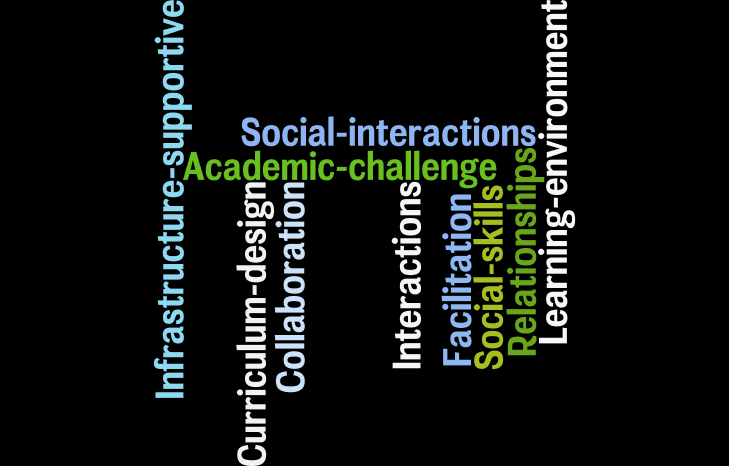
Students may exhibit that they are engaged in different ways, but the role of teachers is known to be really important in helping them to develop their capacity to take part in the learning process (Zepke, Leach & Butler, 2010). The main influencing factors for encouraging engagement are shown in the diagram. As you can imagine, the way in which the learning environment and the learning process is designed and facilitated is crucial.
Factors influencing student engagement
Wordle by Bronwyn Hegarty (2018)


A number of researchers have explored the components of engagement and how they influence students to take part in the learning process. These lists in this post include the main ideas I have gleaned from my reading and are also based on two seminal measures of engagement; the AUSSE (Australasian Survey of Student Engagment) and the SSES (Staff Survey of Student Engagement) (Richardson & Radloff, 2014).

This post is based on an article that is currently being prepared for publication, and a link to this will be provided (with all the references) once this is published.

Teaching Strategies that Create Empowered Learners

Did you know that you can create kids that are motivated and confident? You can – and these particularly enlightened students are often referred to as empowered learners.
To create empowered learners, you need to use teaching strategies that can instill a sense of confidence – enough to prep students enough to get students prepped enough to address and solve challenging tasks.
Janelle Cox, a seasoned educator and writer based in Upstate New York, knows a few things about creating empowered learners. With that enlightened background, Janelle takes a look at some teaching strategies that will get you to think about creating empowered leaders.
Janelle’s ideas include:
  •  Teaching Strategies to Understand Student Interests
  • Consider Students’ Readiness Level
  • Give Students Responsibility
  • Invite Student Input
  • And More!

Janelle sums up her article thusly: “Empowering students may feel like quite a task to accomplish. However, by doing so, you may just end up with a classroom filled with motivated and engaged students.

Science Congress highlights opportunities for women to overcome hurdles to pursue science

The 9th Women Science Congress (WSC) organised as part of the Indian Science Congress (ISC) at the University of Agricultural Sciences, Bangalore showcased the achievements of women scientists and motivated young women to actively participate in science to identify and find simple solutions to a range of problems through Science and Technology.

Dr. Tessy Thomas, Director General, Aeronautical Systems, DRDO highlighted the remarkable contributions of renowned women scientists like Marie Curie, Kadambini Ganguly, Rajeshwari Chatterjee and Kiran Kiran Mazumdar Shaw and their participation in the overall development of the country through S&T.

She encouraged the young women to learn from the exemplary courage of eminent women scientists who had overcome several hurdles to contribute to science.

The event which was inaugurated at the University of Agricultural Sciences, Bengaluru on 5th January highlighted opportunities that can help women overcome the hurdles they face because of their gender in the pursuit of Science.

Dr. Trilochan Mohapatra, Secretary, Department of Agricultural Research and Education & Director General, ICAR strongly emphasised that women need to be brought into the mainstream of national development.

He pointed out that girls should be inspired at the home, school and college levels. He mentioned about gender bias at home, which is a behavioural problem that needs to change. He asked to WSC to deliberate and delve deep on these issues and bring out recommendations.

Dr. Namita Gupta, Scientist ‘G’, Department of Science and Technology highlighted the DST schemes especially for women. “Women are applying in large numbers to utilise schemes like ‘KIRAN’ available for women and they are benefiting immensely,” she added.

KIRAN (Knowledge Involvement in Research Advancement through Nurturing) is the women-exclusive scheme of DST with the mandate to bring gender parity in S&T through gender mainstreaming. Different programs and components of KIRAN like Women Scientist Scheme-A (WOS-A), Women Scientist Scheme-B (WOS-B) deal with various crucial issues (break in career primarily due to family responsibilities, self employment, part time career, relocation and so on) faced by women scientists in their career path.

The women’s science congress, an important platform for participants to share their knowledge and learn from each other, is one of the main events in 107th Indian Science Congress, which was inaugurated by the Prime Minister, Narendra Modi on January 3, 2020.

Renowned women scientists are showcasing their work and delivering lectures at this two-day event with the aim to empower young women and to inculcate scientific interest and temper among them.


***

Governmentof India’s UJALA & Street Lighting National Programme Complete Five Successful yearso f Illuminating India

Launched by Hon’ble Prime Minister Shri Narendra Modi on January 5th, 2015, the Government of India’s zero subsidy Unnat Jyoti by Affordable LEDs for All (UJALA) and LED Street Lighting National Programme (SLNP), marked its fifth anniversary today.

SLNP is the world’s largest streetlight replacement programme and UJALA is the world’s largest domestic lighting project. Both have been spearheaded and implemented by Energy Efficiency Services Limited (EESL), a joint venture of PSUs under the Ministry of Power, Government of India.

Under the SLNP programme, over 1.03 crore smart LED streetlights have been installed till date, enabling an estimated energy savings of 6.97 billion kWh per year with an avoided peak demand of 1,161 MW and an estimated greenhouse gas (GHG) emission reduction of 4.80 million tCO2 annually. LED streetlights have been installed in various states across the country, helping generate approximately 13,000 jobs to support GoI’s Make in India initiative.

Through the UJALA initiative, over 36.13 crore LED bulbs have been distributed across India. This has resulted in estimated energy savings of 46.92 billion kWh per year, avoided peak demand of 9,394 MW, and an estimated GHG emission reduction of 38 million t CO2 annually.

With the concerted efforts towards building a robust ecosystem for LED in India, these programmes have bagged global awards like the prestigious South Asia Procurement Innovation Award (SAPIA) 2017 and for the innovative use of IT and the business results achieved in Street Lighting National Programme (SLNP), it won 2019 CIO 100 award. The highly successful UJALA and SLNP have also bagged the Global Solid State Lighting (SSL) award of excellence for the transformational contribution to the LED sector.

UJALA project brought the market transformation in energy efficiency sector. Prices of LED bulbs being distributed under UJALA programme have fallen to one-tenth of their rates in 2015 from INR. 310 to INR 38 in 2018. The switch from inefficient incandescent bulbs to LEDs is helping families reduce their electricity bills while also enabling them to access better brightness in homes. The money saved adds to a household’s disposable income and lifetime savings, thus improving their quality of life, generating prosperity in local communities, and in expanding energy access to all. With the average household electricity bills down by 15 per cent, the annual energy saving is equivalent to a week’s average earning. The sale of LED bulbs in the Indian market increased from 0.1 per cent of the lighting market in 2014 to 15 per cent within a year, with a projected increase to 60 per cent by 2020. The domestic LED market has also grown significantly beyond the UJALA programme, with the industry selling over 1.15 billion LEDs, far exceeding the UJALA programme’s target of 700 million LED unit sales.

Apart from this, the Government of India initiated the Gram Swaraj Abhiyan (GSA) in 2018, which was aimed at promotion of social harmony by apprising rural communities of various government welfare schemes and initiatives. As a part of GSA, 21,058 Indian villages with a significantly large number of poor households were able to buy LED bulbs for a special price under UJALA programme. The LED bulbs equipped homes with energy-efficient, cost-effective lighting, and higher lumen output than conventional incandescent bulbs.

Simultaneously, LED Street Lighting National Programme has enabled citizens to increase productivity at night and made roads safer for pedestrians and motorists due to enhanced brightness and reduced dark spots. The power utilities of states where the installation of LEDs has been implemented save up to 50 per cent in electricity bills, while ensuring 95 percent of streetlight uptime. As these lights are automated, they switch on and off at sunrise and sunset thereby reducing wastage. Utilities can also remotely track and rectify any faults with support of CCMS. In the last five years, the LED streetlights installed have illuminated 3,00,000 km of roads in India, enabling public safety and energy efficient lighting.

Functioning of Gram Panchayats (GP) has a direct impact on the everyday life of millions of rural people. Hence, the role of GP is critical for overall inclusive development and for deepening democracy through participatory governance. The estimated number of streetlights in GPs of India is 3.08 crores, by retrofitting these 3.08 crores conventional streetlights to LED streetlights can enable energy savings of approx. 3420 Million kWh & CO2 emission reduction of approx. 29 lakh tons. Till date, under Street Lighting National Programme, approx. 23 lakhs LED streetlights have already been retrofitted in the Gram Panchayats in Andhra Pradesh, Telangana, Goa and Andaman & Nicobar Islands.

By March 2020, SLNP aims to replace 1.34 crore conventional streetlights in India with smart LEDs. This ambitious goal will make a tremendous difference, enabling peak demand reduction of about 1500 MW, annual energy savings of 9 billion kWh, and reduction in 6.2 Million tons of CO2 per year.  EESL has an ambitious plan in this portfolio for next 4-5 years where it intends to bring investment to the tune of INR 8,000 crores by 2024 by covering entire rural India. It is expected that more than 30 million LED streetlights would be retrofitted/installed by EESL.


***

3-day Capacity Building Programme on GFR, E-procurement, GeM concludes

The deliberations of the three-day training programme on Capacity Building conducted by Department of Administrative Reforms and Public Grievances (DARPG) in collaboration with National Institute for Financial Management (NIFM), National Centre for Good Governance (NCGG) and Institute of Management, Public Administration and Rural Development (IMPARD)  concluded here today with Government e-Marketplace (GeM) remaining focus of speakers on day three. 

Chairing the valedictory session, Advisor to Lt. Governor, J&K, Shri Farooq Khan called upon the officers to get maximum benefit out of today’s session on GeM so that the public exchequer could be used genuinely. He exhorted that if Govt. purchase is done properly and timely, it would serve the basic purpose of the welfare of the people. He also complemented DARPG, NIFM, NCGG and IMPARD for organising such event. 

Speaking during the practical session on procurement through GeM, Joint Secretary, Govt. of India, Ministry of Commerce and Chief Finance Officer, GeM, Shri Rajeev Khandpal said that this Capacity Building Programme will give more exposure to the officials of J&K regarding General Financial Rules (GFR) and other financial matters while dealing with their day to day administrative and financial work.

Commenting on ‘GeM Samvaad’, an outreach programme launched by the Government of India, Shri Rajeev Khandpal said that ‘GeM Samvaad’ has been launched by the Govt. of India with an aim and objective to get an onspot feedback from all the States and UTs regarding GeM. He added that by this outreach programme, senior officials of GeM will visit all States and UTs to get feedback on how GeM portal can be made more user friendly. The Governments of different States and UTs can save upto 25% of public exchequer by procuring various departmental equipments throgh GeM, he added.

During the afternoon session, Business Facilitator, GeM, Shri Kush Tyagi delivered a presentation on ‘Introduction to Functionality of Buyer’ which highlighted the a pre-requisities for registration as primary and secondary user on GeM portal. The speaker gave an onspot demonstration on how to register as a buyer on GeM portal to the officials of J&K. 

Earlier during the morning session, a detailed and an insightful presentation on GeM was delivered by Director, GeM, Shri Deepesh Gehlot highlighting the procedure of registration on GeM portal. He also explained the mechanism of procurement on GeM portal to the participating officials. 

On January 3, the three day Capacity Building Programme was inaugurated by the Union Minister of State, PMO, Personnel, Public Grievances and Pensions, Dr Jitendra Singh in presence of Chief Secretary, Union Territory of J&K, Shri BVR Subrahmanyam, Additional Secretary, DARPG, Shri V Srinivas and Finance Commissioner, Dr. Arun Kumar Mehta.

During the three day programme, various technical sessions were held on wide ranging issues like GFR-2017 and Procurement of Goods, Manual for Procurement of Goods-2017, Outsourcing of non-consultancy services, Hiring of Consultancy Services, Manual for Works 2019, GeM: an introduction and registration process and procurement through GeM. The trainers had a threadbare discussion on the subjects they spoke about. They elaborated the contents of their topic with respect to the relevant sections of the GFR.

As a part of the conference, several interactive sessions were held in every module to provide participants an opportunity to attain better understanding of various topics covered in the programme.

Pertinently, the programme was held with an aim to promote good governance practices and evolve transparent public policy in the Union Territory of Jammu and Kashmir after the abrogation of Article 370. Around 385 senior high level officers of J&K Government participated in the three-day Capacity Building Programme.

******


First Antarrashtriya Yoga Diwas Media Samman to be conferred to 30 media houses.

Union Minister of Information & Broadcasting, Shri Prakash Javadekar will confer the first ‘Antarrashtriya Yoga Diwas Media Samman’, in New Delhi on 07th of January, 2020.

Acknowledging the positive role & responsibility of media in disseminating the outreach of Yoga in India and abroad, the Ministry of I&B had instituted the first Antarashtriya Yoga Diwas Media Samman (AYDMS) in June, 2019 to mark the contribution of media in spreading the message of Yoga.


The Samman to be conferred on Media Houses would be given under the following categories:

  • Thirty (30) Sammans under Three (3) categories will be conferred.
  • Eleven Sammans to be conferred under the category “Best Media Coverage of Yoga in Newspapers.
  • Eight Sammans to be conferred under the category “Best Media Coverage of Yoga in Television.
  • Eleven Sammans to be conferred under the category “Best Media Coverage of Yoga in Radio.

The Samman will comprise of a special medal/plaque/trophy and a citation. The contribution of Media in popularizing of Yoga and the entrieswas assessed by a Jury comprising of 6 members and was headed by Justice C. K. Prasad, Chairman, Press Council of India.

Brief on International Day of Yoga

The International Day of Yoga has been celebrated annually on 21 June since 2015. The idea of International Day of Yoga was first proposed by the Prime Minister of India, Shri Narendra Modi, during his address at the United Nations General Assembly (UNGA), on 27 September 2014.

While proposing the idea the Prime Minister stated:

“Yoga is an invaluable gift of India’s ancient tradition. It embodies unity of mind and body; thought and action; restraint and fulfillment; harmony between man and nature; a holistic approach to health and well-being. It is not about exercise but to discover the sense of oneness with yourself, the world and the nature. By changing our lifestyle and creating consciousness, it can help in well being. Let us work towards adopting an International Yoga Day.”

Following this initial proposal, the UNGA held informal consultations on the draft resolution, entitled “International Day of Yoga”, on 14 October 2014. The consultations were convened by the delegation of India.On 11 December 2014, India’s Permanent Representative introduced the draft resolution in the United Nations General Assembly. The draft text received broad support from 177 Member States who sponsored the text, which was adopted without a vote. This initiative found support from most global leaders. A total of 177 nations co-sponsored the resolution, which is the highest number of co-sponsors ever for any UNGA resolution of such nature.

***

GK

800 FPOs registered on Farmer Connect Portal of APEDA

The Agri Export Policy was announced last year with an objective of doubling the export and ensuring doubling of farmers’ income. In order to achieve this objective, Agricultural and Processed Food Products Export Development Authority (APEDA) has been adopting a focused approach for ensuring greater involvement of the State governments for effective implementation of Agri Export Policy (AEP). Throughout the year APEDA held a series of meetings with the State Government officials and other stakeholders for the preparation of State Action Plan which included all essential components like production clusters, capacity building, infrastructure and logistics and R & D and budget requirements for the implementation of AEP. Several rounds of discussions were held with Ministry of Agriculture and Farmers’ Welfare, Department of Animal Husbandry & Dairying, Ministry of Food Processing Industries and other agencies under Line Ministries for seeking the inputs for formulating a strategy to increase exports and address the existing bottlenecks in the trade.

Many States have nominated Nodal agency and Nodal officer. Maharashtra, Uttar Pradesh, Kerala, Nagaland, Tamil Nadu, Assam, Punjab and Karnataka have finalized the State Action Plan and other States are at different stages of finalization of the action plan.

State level Monitoring Committees have been formed in many of the States. Cluster visits have been made by APEDA Nodal officers to the product clusters at Jalandhar (Potato), Jodhpur (Isabgol), Banaskantha (Dairy products), Sangli (Grapes), Solapur (Pomegranate), Nagpur (Orange), Chittoor (Mango), Theni (Banana), Salem (Poultry products), Indore (Onion) and Chikkaballapur (Rose onion). The roadmap for cluster development in the clusters notified under AEP was prepared to address the identified interventions during the cluster visits. As a result of cluster visits by APEDA, the cluster level committee has been constituted in the States viz. Potato in Punjab, Isabgol in Rajasthan, Pomegranate, Orange and Grapes in Maharashtra and Banana in Tamil Nadu.

APEDA has organised a number of seminars and meetings for the implementation of Agri Export Policy throughout the year. A workshop on the role of state nodal agencies in agriculture exports was organised in New Delhi on 3rd September, 2019 where majority of the states actively participated for brainstorming on implementation of AEP in States.

An MoU was signed with National Cooperative Development Corporation to include Co-operatives for their active role in AEP. A Farmer Connect Portal has also been set up by APEDA on its website for providing a platform for Farmer Producer Organisations (FPOs) and Farmer Producer Companies (FPCs) to interact with exporters. Over 800 FPOs have been registered on the portal.

Buyer Seller Meet (BSM) cum Workshops between exporters and FPOs were organized in association with the State Nodal agency at Ujjain (M.P)., Mehboobnagar, Mahbubabad, Sangareddy (Telangana), Kandhamal (Odisha), Chitradurga (Karnataka), Shillong (Meghalaya), Shimla (H.P), Kadapa (Andhra Pradesh), Kolkata (West Bengal), Agartala (Tripura), Nagpur, Sangli (Maharashtra) and Dehradun (Uttarakhand).

A Market Intelligence Cell was set up in APEDA and the activity of dissemination of e-market intelligence reports comprising detailed market analysis, international trade issues, current scenario of the interest to Indian exporters in important markets and statistical information has been started from 25th November 2019. All e-reports are available on APEDA website https://apeda.gov.in. Till now 27 reports have been disseminated for mango, basmati rice, non-basmati rice, groundnut, grapes, gherkins, dehydrated onion, pomegranate, banana, potato, buffalo meat, swine meat, fresh cut flowers, wine, egg, dairy products (SMP & cheese), biscuits, jaggery, millets, vegetable seeds, moringa, makhana, fruit juices, mango pulp, potato flakes and cereal preparations.


***