Author: Admin
Sachdeva Card Centre
Customer centricity is at the core of Sachdeva Card Centre in Chawri Bazaar. This business has a wide range of product offerings and the list includes visiting cards, wedding cards, sagan envelopes, etc.
There is always an option for you to customize as per your own will and wish. They provide you with a solution that will fulfill your requirements for all the functions and events and will bring a smile on your face. Sachdeva Card Centre is the most perfect option for you and your loved ones.
What is microclimate in climatology?
Shreyas Singh
Articles written by Shreyas Singh
1. https://news.eindex.org/2022/08/business-application-software-to.html
2. https://news.eindex.org/2022/08/why-vocational-studies-is-right-choice.html
3. https://news.eindex.org/2022/08/reasons-to-consider-darjeeling-as-your.html
4. https://news.eindex.org/2022/08/what-is-artificial-intelligence-ai.html
5. https://news.eindex.org/2022/08/what-is-make-in-india.html
6. https://news.eindex.org/2022/08/what-is-machine-learning.html
7. https://news.eindex.org/2022/08/what-is-sustainable-development.html
8. https://news.eindex.org/2022/08/the-smart-city-mission.html
9. https://news.eindex.org/2022/09/what-is-web-hosting.html
10. https://news.eindex.org/2022/09/hindi-diwas.html
11. https://news.eindex.org/2022/09/world-ozone-day-2022.html
12. https://news.eindex.org/2022/09/international-day-of-peace.html
13. https://news.eindex.org/2022/09/world-tourism-day.html
14. https://news.eindex.org/2022/10/national-unity-day.html
15. https://news.eindex.org/2022/10/united-nations-day.html
16. https://news.eindex.org/2022/11/world-polio-day-2022.html
17. https://news.eindex.org/2022/11/national-education-day.html
18. https://news.eindex.org/2022/11/world-pneumonia-day.html
19. https://news.eindex.org/2022/11/childrens-day.html
20. https://news.eindex.org/2022/11/national-law-day.html
21. https://news.eindex.org/2022/11/world-aids-day.html
22. https://news.eindex.org/2022/11/world-human-rights-day.html
23. https://news.eindex.org/2022/11/international-animal-rights-day.html
24. https://news.eindex.org/2022/11/indian-air-force-day-2022.html
25. https://news.eindex.org/2022/11/national-energy-conservation-day.html
26. https://news.eindex.org/2022/11/national-mathematics-day.html
27. https://news.eindex.org/2022/11/national-farmers-day.html
28. https://news.eindex.org/2022/11/world-kindness-day.html
29. https://news.eindex.org/2022/12/national-milk-day-2022.html
30. https://news.eindex.org/2022/12/republic-day-holiday-2023.html
31. https://news.eindex.org/2022/12/international-world-braille-day.html
32. https://news.eindex.org/2022/12/national-human-trafficking-awareness-day.html
33. https://news.eindex.org/2022/12/national-youth-day.html
34. https://news.eindex.org/2022/12/indian-army-day.html
35. https://news.eindex.org/2022/12/national-girl-child-day.html
36. https://news.eindex.org/2022/12/world-cancer-day-is-observed-annually.html
37. https://news.eindex.org/2022/12/safer-internet-day.html
38. https://news.eindex.org/2023/01/international-womens-day.html
39. https://news.eindex.org/2023/01/world-ngo-day.html
40. https://news.eindex.org/2023/01/zero-discrimination-day.html
41. https://news.eindex.org/2023/01/world-consumer-rights-day.html
42. https://news.eindex.org/2023/01/national-civil-services-day_5.html
43. https://news.eindex.org/2023/01/world-autism-awareness-day.html
44. https://news.eindex.org/2023/01/international-mother-earth-day.html
45. https://news.eindex.org/2023/01/world-malaria-day.html
Why should you be hired for this role?
I should be hired for this role because since childhood I love to work for others. During my school time, I have done social work along with my friends by helping in studies and by providing books to the needy students. In my opinion, by investing little time from our daily routine can make a big difference in someone’s life. I always feel fulfill when I am able to help others. Making a difference in my community is something that drives me every day. Also, working for needy people have always brought happiness to me that I am being able to make a difference in the life of a person. We often feel that if we haven’t done a thousand good deeds it is not worth it but in reality, every small action that makes even one person’s life better is commendable. When you are working with an NGO or any social organization, you are helping multiple people in different ways. Apart from this, you can learn a lot while doing social work, it enhances your perception of the world, and you understand the sociological aspects necessary to create an impact. You can interact with like-minded individuals that can help in your growth and development. It has a lot of benefits for you as well as the people you are helping. In addition to this, I have an advanced level proficiency in English langauge as recently I have given a TOEFL exam (Total scores – 96).
2023 Science Vision
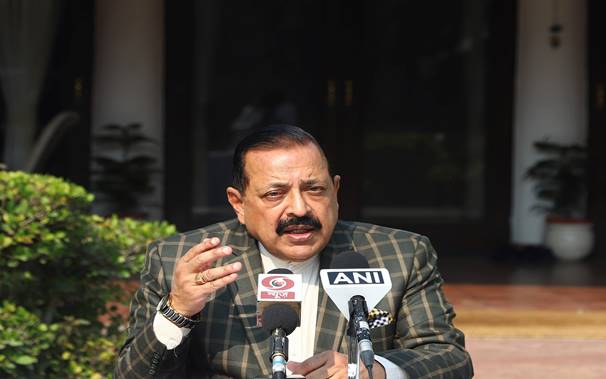
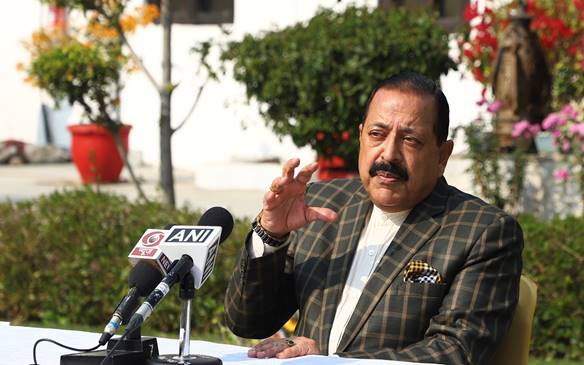
In a media interaction on the first day of the New Year, Union Minister of State (Independent Charge) Science & Technology; Minister of State (Independent Charge) Earth Sciences; MoS PMO, Personnel, Public Grievances, Pensions, Atomic Energy and Space, Dr Jitendra Singh today said, 2023 Science Vision will define India at 2047.
Dr Jitendra Singh added that the year 2023 also happens to be the first of the last 25 years or the last quarter of the calendar before independent India turns 100 at 2047 and realizes its century dreams.
This is also the year, the Minister said, when India under PM Narendra Modi reiterates its stature in the international fora as the host of G20 as well as the Nation on whose proposal the world is observing International Year of Millets.

Dr Jitendra Singh said, “The future belongs to those who have innovative ideas and out-of-box goals, and have the conviction and courage to achieve the same. The Minister emphasized that today we have a Prime Minister, who not only thinks out of box, but inspires 130 Crore Indians to take decisions with courage of conviction.
Referring to Prime Minister Narendra Modi’s penchant for “Innovation”, Dr Jitendra Singh pointed out to his Independence Day address, where he had said, “Till today we always remember our revered Lal Bahadur Shastri ji for his inspirational clarion call of Jai Jawan Jai Kisan meaning “Hail the Soldier, Hail the Farmer”. Later Atal Bihari Vajpayee ji added a new link of Jai Vigyan which meant “hail science” and we gave it utmost importance. But in this new phase Amrit Kaal now it is imperative to add jai anusandhaan that is “hail innovation”. “Jai Jawan Jai Kisan Jai Vigyan Jai Anusandhaan.”
Dr Jitendra Singh underlined that in the Centre –State Science Conclave held in September, 2022 also, Modi had highlighted that in order to make India a global center of research and innovation in this Amrit Kaal, we have to work on many fronts simultaneously and stressed the need to take science and technology-related research to the local level.

Departments dealing with Science and Technology have already outlined their focus and thrust areas for the year 2023.
ISRO, after the opening up of Space Sector to private participants on the intervention of PM Modi, today has more than 100 StartUps in a short span of time. At the same time, its focus is on scientific exploration missions, Technology Demonstration missions and Human spaceflight programme “Gaganyan” in 2024.
The department of Biotechnology (DBT) would take forward the successes of COVID-19 vaccine mission by investing in improvement of vaccines for the existing and emerging diseases. Significantly, major missions would also be launched on millets and patho-genomics of plant viruses in the International Year of Millets.
CSIR in 2023 will also focus on Green Hydrogen as it has already made a headway in Green Hydrogen indigenous as part of clean energy mission.
The Ministry of Earth Sciences (MoES) will focus on Deep Sea mission & technologies which will add value to India’s economy in the years to come. 2023 will also witness further headway in Blue Economy. Significantly, PM Modi referred to Deep Ocean Mission twice in his Independence Day address, first in 2021 and then again in 2022.
Department of Atomic Energy, DAE in its contribution to India’s Electoral Management will deliver about 21.00 lakh equipment for the Election Commission of India which includes Ballot Units (BU), Control Units(CU) and Voter Verifiable Paper Audit Trail (VVPAT) to be completed by ECIL by Sept/Oct 2023.
How to Get Published in Top Ranking Journal Scientific Reports by Spri…
Soldier Saint concept that secures physical boundaries as well as spiritual wellbeing of the Nation
Raksha Mantri Shri Rajnath Singh said that the World today recognizes India as military power to be reckoned with, due to the Government’s pitching in for ‘Self-reliant India” which is based on ‘‘Prosperity through industry” preaching of Shri Narayan Guru of Sivgiri Mutt. He was addressing the congregation of saints and learned elders gathered at Sivagiri Mutt, Kerala to celebrate the Tirthdanam Mahotasav on 30th December, 2022. “His preaching of prosperity through industry is the basis of the Government of India’s resolution of “Self-reliant India”. Today India is one of the largest economies of the world because of its hard work and enterprise. Today India has become the top five economies of the world”,Said shri Rajnath Singh and added that “It was the far-sightedness of Sree Narayana Guru that he ordered Sivagiri Math to spread consciousness among the common people on subjects like education, cleanliness etc. And with the grace of Guruji and the blessings of revered saints, our government has also focused its special attention on these subjects.”
Invoking the Soldier Saint concept, the Raksha Mantri pointed that as a Defence Minister he is securing the physical boundaries of the country on the strength of the bravery and valour of the soldiers, likewise the saintly soldiers are protecting the culture of the country. “If we are protecting the body of the country, then you are protecting the soul of this country. And a Nation can survive till eternity only when both its body and soul are safe. I congratulate you for this.”
Shri Rajnath Singh added that Self-reliance has been an intrinsic part of India’s culture. Shri Narayan Guruji spread this message of self-reliance in the public through his teachings, and today Sivagiri Mutt is also working to take it forward continuously. Guruji was not only in favor of modernity, but also maintaining a balance between India’s ancient culture and modernity, which is relevant even today. It has been corroborated by India becoming one of the largest economies of the world through hard work and enterprise, he said.
Paying his tribute to the sacred land of Kerala that has produced great saints, philosophers, and poets who not only ingrained high ideals and values in the heart of the common man, but also united the entire nation, the Raksha Mantri said that Acharya Shankara, born in a small village Kaladi, traveled all over India and culturally integrated the entire nation. It was unprecedented in itself. “The principle of oneness of the whole world as postulated by his philosophy of Advaitvaad, is still embedded in the soul of the country inspiring different sections of the society to remain united and equal. Sree Narayana Guru ji is undoubtedly one such name in the chain of enriching cultural unity”, he said.
Discarding the criticism of Indian tradition, thinking and philosophy not being concerned with equality, liberty and fraternity, which is considered as Western concept, Shri Rajnath Singh said that the concept of human equality and fraternity has been prevalent in the ancient literature, tradition and thinking of India. Rather It is more comprehensive and inclusive than that of the western one. Whereas the West talks about equality, liberty and fraternity only among human beings, the Indian tradition, in the form of ‘Vasudhaiva Kutumbakam’ i.e. ‘Whole world is one family’ sees equality, fraternity and unity between human beings and animals, between animate and non-animate beings and in fact entire World and Universe . “And this is the reason why India was recognized as Vishwaguru in ancient times”, he said.
The Raksha Mantri further elaborated upon the equality and unity of world by quoting various texts and tenets of Ved, Upanishad, Gita and Ramayan. He apprised the gathering of the ‘Adaitvaad’ of Acharya Shankara which is a synonym for universal equality. He mentioned that Shri Narayan Guru gave the slogan of “freedom through education” during the freedom struggle. “It is also found in our ancient commentaries that knowledge liberates a man. Education leads to enlightenment, which leads to freedom.”
Sivagiri Mutt is a famous tourist pilgrimage place in Varkala town of Thiruvananthapuram district in Kerala. The Mutt also headquarters Sree Narayana Dharma Sangham, an organisation of Sree Narayan Guru’s disciples and followers. Sivagiri pilgrimage, known as Sivagiri Theerthadanam in Malayalam is another important festival celebrated in the Mutt.
****
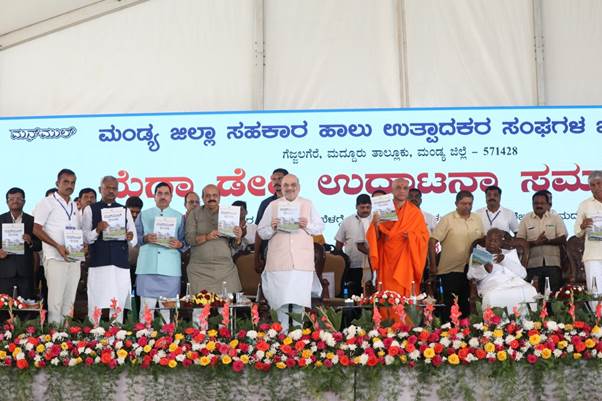
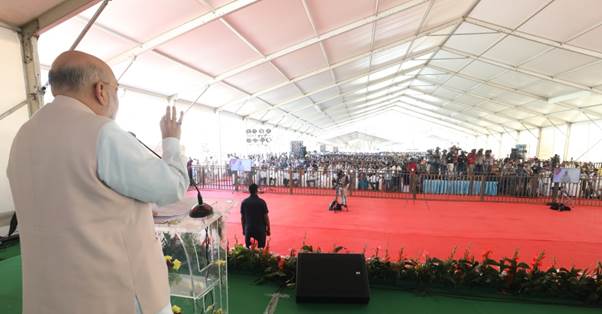
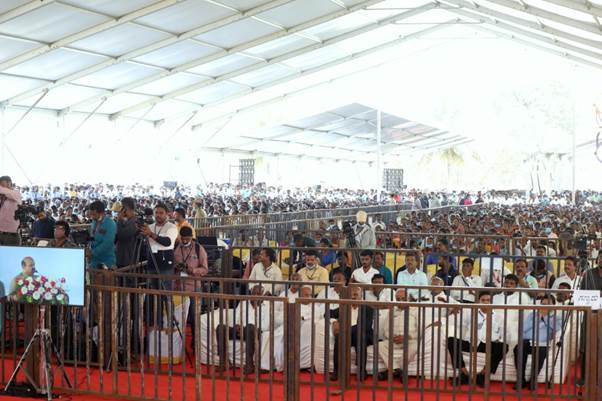
Mega Dairy at Mandya, Karnataka
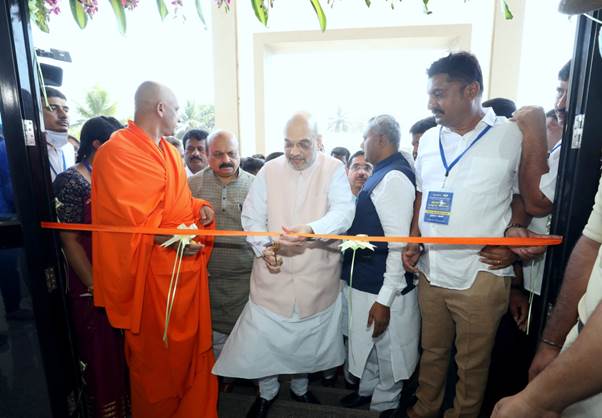
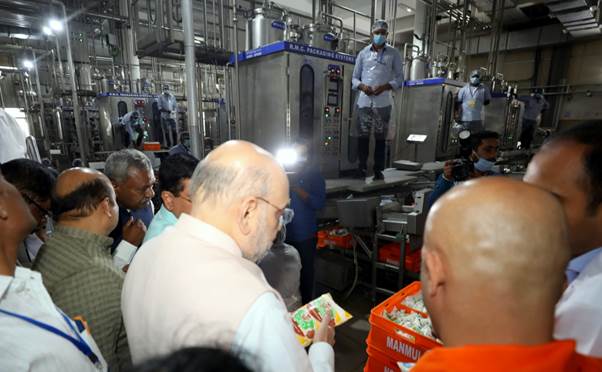
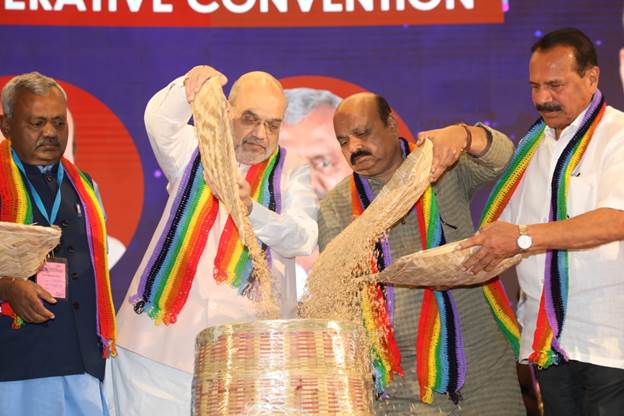
Union Home and Cooperation Minister Shri Amit Shah inaugurated Mega Dairy at Mandya in Karnataka today. Several dignitaries including Nirmalanandanatha Mahaswamiji, the 72nd Pontiff of Sri Adichunchanagiri Mahasamsthana Math, Mandya, Chief Minister of Karnataka, Shri Basavaraj Bommai, former Prime Minister Shri HD Deve Gowda and Union Minister of Parliamentary Affairs and Coal and Mines Shri Pralhad Joshi were present on the occasion.

Condoling the demise of Prime Minister Narendra Modi’s mother, Shri Amit Shah paid tributes to her and said that the whole country is standing with the Prime Minister in this hour of grief. The Union Home and Cooperation Minister said that since independence, the farmers of the country had demanded a Ministry of Cooperation separate from the Ministry of Agriculture. He said that he would like to thank Prime Minister Narendra Modi for paving the way for the development of farmers by forming a separate Ministry of Cooperation. Shri Shah said that from the inaugural platform of Mandya Mega Dairy, he wants to tell the cooperative workers across the country that it is the decision of the Government of India that there will be no injustice to the cooperatives.

The Union Cooperation Minister said that the mega dairy inaugurated today at a cost of Rs 260 crore would process 10 lakh liters of milk per day and the will have the capacity to increase it upto 14 lakh liters per day. He said that when 10 lakh liters of milk is processed, prosperity reaches the homes of lakhs of farmers. Shri Shah said that in Karnataka, the cooperative dairy is working very well. Today, there are 15,210 village level cooperative dairies in Karnataka, in which about 26.22 lakh farmers deliver their milk daily and through 16 district level dairies, Rs 28 crore is deposited into the accounts of 26 lakh farmers every day.

Shri Amit Shah said that around 66,000 kg milk used to be processed daily in Karnataka in 1975 while today over 82 lakh kg milk is processed daily and 80% of the total turnover goes to the farmer. The Union Cooperation Minister said that the White Revolution in Gujarat has changed the fortunes of the farmers and through Amul, 60,000 crore rupees is deposited into the bank accounts of about 36 lakh women annually. He said that he would like to assure all the farmer brothers and sisters of Karnataka that Amul and Nandini will work together towards establishing primary dairies in every village of Karnataka and in next three years there will not be a single village in Karnataka where primary dairy has not been established. Shri Amit Shah said that the government has decided that the National Dairy Development Board (NDDB) and the Ministry of Cooperation will establish a primary dairy in every panchayat of the country in the next three years and a complete action plan has been prepared in this regard. He said that with this, two lakh primary dairies will be established at the village level across the country in three years, through which India will emerge as a big exporter in the milk sector by connecting the farmers of the country with the White Revolution.

The Union Home and Cooperation Minister said that Karnataka Milk Federation will be provided with technical support, cooperative sector support and overall functioning support from Amul and all its requirements will be addressed by the Ministry of Cooperation. He said that Gujarat and Karnataka together can work for the welfare of the milk producing farmers of the whole country. Union Cooperation Minister appreciated the Government of Karnataka under the leadership of Chief Minister Basavaraj Bommai for ensuring depositing Rs 1,250 crore directly to bank accounts of milk producing farmers through DBT at the rate of Rs 5 per liter during the year. Shri Amit Shah said that Government led by Shri Bommai is crediting Rs. 1,250 crore annually through DBT to the accounts of milk producing farmers and also to remove malnutrition among children through the Ksheer Bhagya scheme, milk is being provided to 65 lakh children in 51,000 government schools and 39 lakh children in 64,000 Anganwadis .Shri Amit Shah congratulated the Chairman of Mandya Milk Producers Committee for his efforts to increase the income of all the farmers of Mandya district through dairy.

****
Cooperative Beneficiaries Conference in Bengaluru, Karnataka
by Shashikant Nishant Sharma
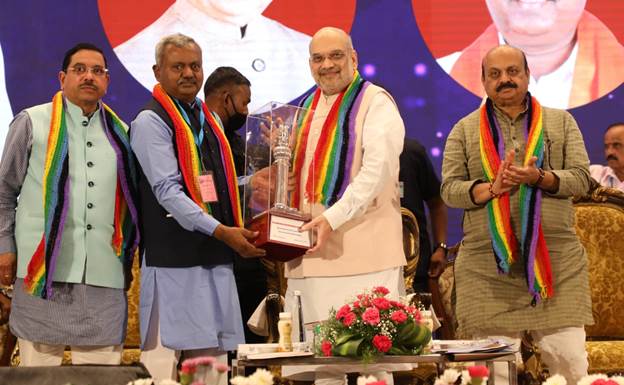
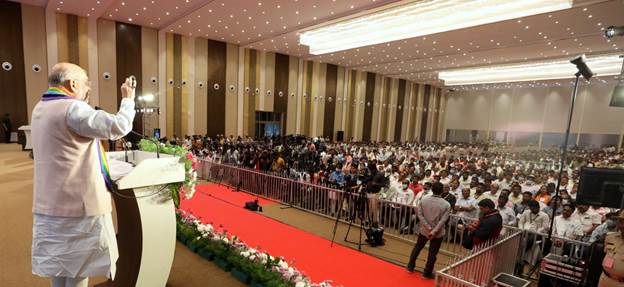
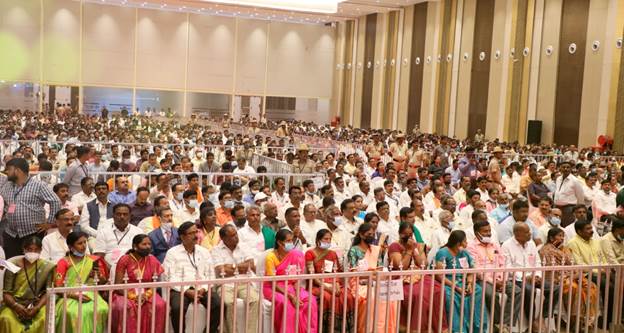
Union Minister of Home and Cooperation, Shri Amit Shah addressed the ‘Cooperative Beneficiaries Conference’ in Bengaluru, Karnataka today. Several dignitaries including Chief Minister of Karnataka Shri Basavaraj Bommai and Union Minister Shri Pralhad Joshi were present on the occasion.

In his address, Shri Amit Shah said that the cooperative movement in Karnataka has been progressing at a good pace for more than 100 years. He said that the first cooperative society in the whole country was established in Gadag district of Karnataka in 1905. The cooperative movement that started from there, today stands as an example in front of the world with many successful models like Amul, KRIBHCO, IFFCO, Lijjat Papad.

The Union Minister of Cooperation said that under the Nandini brand in Karnataka, about 23 lakh farmers, mostly women, are paid Rs 28 crore per day, which makes their lives more prosperous which is a huge achievement. He said that the beauty of the cooperatives is ‘Production for Masses, Production by Masses’.
Shri Amit Shah said that the Prime Minister Narendra Modi has given new momentum and long life to the cooperative movement by creating a separate ‘Ministry of Cooperation’ in the country. He said that out of 30 lakh cooperatives in the whole world, 9 lakh cooperatives are in India only. About 91 percent of India’s population is linked to a cooperative in one way or another, with cooperatives covering 70 percent of the country’s farmers through PACS. He said that there are 33 state level cooperative banks, 363 district level cooperative banks and 63,000 PACS in the country. Shri Shah said that today 19 percent of our agriculture finance is done through cooperative societies. 35 percent fertilizer distribution, 30 percent fertilizer production, 40 percent sugar production, 13 percent procurement of wheat and 20 percent of paddy procurement is done by cooperatives only.
The country’s first Minister of Cooperation said that since the government led by Prime Minister Narendra Modi came in the country many farmer-centric schemes has been made and accelerated further. He said that after the formation of the Ministry of Cooperation, many decisions were taken, such as to bring transparency in cooperatives, computerization of 63,000 PACS across the country has been done at a cost of Rs. 2,500 crores. Apart from this, one cooperative society will be formed in every panchayat of the country, which will be multi-purpose and NABARD, NDDB and the Ministry of Cooperation have prepared an action plan to form 2 lakh new such cooperative societies in three years. Shri Shah said that after this scheme, the coverage of cooperatives in the country, turnover and the number of its beneficiaries will increase more than three times.

Shri Amit Shah said that on the basis of Amul Model, a multistate cooperative Society is being established for the sale of organic products across the world, so that the profit goes directly to the farmers. A multistate cooperative society is also being formed for seed production and breed promotion of Indian seeds. He said that there is also a plan to set up a Cooperative University in the country, to create a national database of all cooperatives across the country work has started and formulation of a new cooperative policy has also begun. Shri Shah said that we are going to expand the role of NCDC along with NABARD so that cooperative societies can get finance in a better way. For conducting of transparent Elections a model act has also been prepared and sent to all the states. To bring transparency and fix accountability in the Multi-State Co-operative Societies Act, a bill has come which has been sent to the Standing Committee. He said that earlier more tax was being collected from the cooperative societies than the companies, but in the last budget Prime Minister Narendra Modi has brought the cooperatives at par with the companies by reducing the surcharge of the cooperative society from 12% to 7% by and reducing the alternative tax from 18% to 15%. Shri Shah said that the housing loan limit of Urban Cooperative Bank has been increased by 3 times by RBI, loan limit on commercial property has also been increased and door step banking has also been allowed.

The Union Home and Cooperation Minister said that it is not only the responsibility of Karnataka to strengthen the cooperative movement of Karnataka, some ideals have to be established so that the states across the country get the message and from here all the states can adopt the best practices and create a new model of cooperation in their respective states. He said that Prime Minister Narendra Modi’s decision to form the Ministry of Cooperation to speed up the cooperative movement will strengthen the efforts to fill the gaps in the cooperative movement across the country so that the cooperative movement progress uniformly across the country.
**************
Youth Parliament Program
The Youth Parliament Program is run with a view to strengthen the roots of democracy, inculcate health habits of discipline, develop tolerance of divergent views and to familiarize the student community about the working and functioning of Parliament. The Youth Parliament Program is organized in 2 modes:-
-
- Youth Parliament Competition (YPC):
The following YPCs were organized this year: –
- Group Level Competition of the 16th National Youth Parliament Competition (NYPC), 2019-20 for Universities / Colleges wherein 35 institutions participated
- 33rd NYPC, 2022-23 for Kendriya Vidyalayas wherein 150 institutions participated
- Regional Level Competition of 24th NYPC, 2022-23 for Jawahar Navodaya Vidyalayas wherein 80 institutions participated
- 55th YPC for schools under Directorate of Education, Govt. of NCT of Delhi and NDMC wherein 39 institutions participated
2) Web-portal of National Youth Parliament Scheme (NYPS):
The web-portal of the NYPS was launched on 26th November, 2019 to increase the outreach of the youth parliament program to every nook and corner of the country. The registration on the first edition of NYPS was closed on 31st July, 2022. 8317 registrations and 373 event completion reports were received on the portal. The registration for the second edition of NYPS was opened on 1st August, 2022. Till 30th November 2022, 1702 successful registrations and 367 event completion reports have been received on the portal. The last date for registering for the second edition is 31st December, 2022.
Consultative Committees:
The Ministry constitutes Consultative Committees of Members of Parliament and makes arrangements for holding their meetings during session and inter session periods. After the constitution of 17th Lok Sabha, 37 Consultative Committees had been constituted for various Ministries/Departments. 38th Consultative Committee in respect of the Ministry of Labour and Empowerment was constituted on 28th July, 2020. The following activities were undertaken during the year 2022: –
- One Consultative Committee for the Ministry of Law and Justice (39th) was constituted on 20th April, 2022.
- 60 meetings of the Consultative Committees were held till November, 2022.
- 73 Members of Parliament (Lok Sabha & Rajya Sabha) were nominated on various Committees/Councils/boards etc. set up by the Government of India.
- Deletion of membership of 69 MPs were done from the various Consultative Committees due to their resignation/ retirement/ demise etc.
Digitization of Legislatures through National e-Vidhan Application (NeVA)
National e-Vidhan Application (NeVA) is an end-to-end cloud based digital solution for bringing all the 39 Legislatures (Lok Sabha + Rajya Sabha + 31 Assemblies + 6 Councils) across the country including the 2 Houses of the Parliament on a single platform. It has been developed on the theme of ‘One Nation- One Application’. The Ministry of Parliamentary Affairs (MoPA) has been entrusted with the responsibility of rolling out NeVA in all the Legislatures across the country.
The NeVA Application has been developed to cater various stakeholders like Members, Ministers, House Secretariat personnel, Govt. Department personnel and Citizens at large. Developed as a member centric application, it enables them to handle diverse House Business smartly by putting entire information needed by them in their hand-held devices/ tablets. It also helps the Ministers to have access to all the House Information like Question Replies, Bills, other Papers laid, etc. It equips all the Branches of Legislatures/ Department to handle it efficiently and creating an efficient inclusive database thereby overhauling the way our legislatures work with facilities for Live webcasting. Moreover, NeVA not only aims to bring democracy closer to our citizens by giving the citizens access to the bills, the questions and answers, the documents tabled in the Houses in an easy manner, but also to empower them by providing an opportunity to the citizens for meaningful engagement with the democracy which can be achieved through e-Constituency Management Module and Grievance Module.
Operationalization of this electronic platform would account for huge savings on papers (App. 340 Cr annually), thereby leading to reduction of carbon footprints and moving a step forward in the achievement of UN’s SDGs (15)- ‘Life on Earth’.
The President and Prime Minister had also urged the Presiding Officers for digitalization of all the Legislative Houses in the country by adopting the NeVA to reap the benefits of the Digital Legislatures in the present scenario.
The MoPA has recently developed the new module ‘Digital Archive’ for management of the legacy data of respective House for the benefit of Members and citizen equally. The Reporter’s module has also been re-developed. Digital House module, Question processing module, committee module, member’s module, master content management module, user management module, etc. have also been upgraded as per the requirements of various Legislatures. The NeVA website has also been updated with various new features and latest designs.
As far as the current status of implementation of NeVA is concerned, a total of 21 Legislatures (19 States) viz. Punjab, Odisha, Bihar {both Houses}, Meghalaya, Mizoram, Manipur, Gujarat, Arunachal Pradesh, Nagaland, Puducherry, Tripura, Himachal Pradesh, Chhattisgarh, Tamil Nadu, Sikkim, Haryana, Uttar Pradesh{both Houses} Jharkhand ,Jammu & Kashmir have signed the Memorandum of Understanding (MoU) with MoPA, out of which 17 legislatures (15 States) viz. Punjab, Odisha, Bihar (Both Houses) Nagaland, Manipur, Sikkim, Tamil Nadu, Meghalaya, Haryana, Tripura Uttar Pradesh (Both Houses), Mizoram, Gujarat, Jharkhand, Puducherry have been sanctioned the project along with the release of required funds. At present, 8 Legislatures, viz. Bihar Council, Nagaland Assembly, Uttar Pradesh Assembly, Haryana Assembly, Mizoram Assembly, Meghalaya Assembly, Uttar Pradesh Council and Tamil Nadu have already been transformed into Digital House through NeVA. Other Houses are also on the path of becoming paperless shortly.
Key achievements of the Department of Space for the last 8 years
Indian Space Programme and its ecosystem have been in a state of unprecedented vibrancy with various achievements. The glimpse of key milestones embraced by the department since 2014 till date is highlighted as below:
Key missions
- Altogether 44 spacecraft missions, 42 launch vehicle missions and 5 technology demonstrators, have been successfully realized, since 2014 till date.
- In January 2014, the first successful flight with indigenous Cryogenic Upper Stage, in the GSLV-D5 launch vehicle was achieved and GSAT-14 was placed into GTO.
- In September 2014, India’s Mars Orbiter Spacecraft successfully entered into an orbit around planet Mars, putting India into a league of select nations which had sent a spacecraft to the Red Planet. The spacecraft is still functional even after 7 years of operation against the designed life of 6 months and serving nation with a lot of interesting science data.
- In December 2014, the country witnessed the experimental flight of the next generation launch vehicle – the GSLV MKIII. The LVM3-X/CARE Mission, the first experimental suborbital flight of the vehicle, launched the Crew Module Atmospheric Re-entry experiment (CARE).
- AstroSat launched by PSLV in September 2015, is the first dedicated Indian astronomy mission aimed at studying celestial sources in X-ray, optical and UV spectral bands simultaneously. AstroSat has made major breakthroughs by discovering five new galaxies.
- ISRO has established and operationalised Navigation with Indian Constellation (NavIC) which provides highly accurate Position, Navigation and Time information to users in India and its surroundings. A total of 7 satellites form the Indian Regional Navigation Satellite System [IRNSS] – all launched by PSLV, with IRNSS-1G completing the constellation in 2016.
- Various NavIC based services have been rolled out in many key sectors like – integration of NavIC-enabled devices with the enrolment architecture of UIDAI Aadhar enrolment, incorporation of NavIC in the Continuously Operating Reference Stations (CORS) network, In agricultural drones and Radio Technical Commission for Maritime Services (RTCM) etc.
- Successful flight testing of Reusable Launch Vehicle-Technology Demonstrator (RLV-TD) was done on May 23, 2016 from Satish Dhawan Space Centre (SDSC) SHAR, Sriharikota. RLV-TD is one of the most technologically challenging endeavours of ISRO towards developing essential technologies for a fully reusable launch vehicle to enable low cost access to space.
- The first experimental mission of ISRO’s Scramjet Engine towards the realisation of Air Breathing Propulsion System was also successfully conducted in 2016 from SDSC SHAR, Sriharikota.
- In 2017, PSLV C-37 created a world record by successfully placing 104 satellites in orbit during a single launch.
- As idea mooted by the Hon’ble Prime Minister in 18th SAARC summit, ISRO has launched the 2.2 Ton communication satellite in 2017 to support neighbouring countries.
- The first developmental mission of GSLV Mk-III D1 was successfully accomplished in June-2017 and boosted GSAT-19 satellite into geosynchronous transfer orbit.
- ISRO demonstrated a crucial technology element of Human spaceflight in July 2018- The Pad Abort Test (PAT) to qualify the Crew Escape System (CES). The Pad Abort Test flight was a demonstration of the capability of CES to evacuate the Crew in case of a contingency at launch Pad.
- In the Independence Day address – 2018, the Hon’ble Prime Minister announced the “Gaganyaan Programme”, marking India’s foray into the new age of human space exploration.
- GSAT-29 high throughput communication satellite was successfully launched on November 14, 2018, on-board GSLV Mk III-D2. It is providing satellite based connectivity to Jammu & Kashmir and North Eastern regions of India.
- In 2018, ISRO’s next generation high throughput communication satellite, GSAT-11 was successfully launched on December 05, 2018 from Kourou, French Guiana by Ariane-5 VA-246. Weighing about 5854 kg, GSAT-11 is the heaviest satellite built by ISRO.
- India’s second mission to Moon, Chandrayaan-2 was successfully launched on July 22, 2019 on-board GSLV Mk III-M1, first operational flight of this new launch vehicle. Chandrayaan-2 Orbiter is providing valuable science data for the research community.
- The launch of PSLV-C48/ RISAT-2BR1 in Dec 2019 marked the 50th launch of PSLV, the workhorse launch vehicle.
- Quantum entanglement based real time Quantum Key Distribution (QKD) over 300m atmospheric channel along with quantum-secure text, image transmission and quantum-assisted two-way video calling was demonstrated on 27 January 2022.
- The Hon’ble Minister of State (Department of Space) dedicated ISRO System for Safe & Sustained Operations Management (IS4OM) to the nation in Jul-2022.
- LVM3 (GSLV MkIII) M2/OneWeb India-1 Mission was successfully accomplished on 23rd October 2022. With this launch, LVM3 exemplifies Atmanirbharata and enhances India’s competitive edge in the global commercial launch service market.
- As part of Gaganyaan programme, new Test Vehicle for testing critical systems is developed. ‘Integrated Main Parachute Airdrop Test (IMAT)’ of crew module deceleration system was successfully carried out at Babina Field Fire Range (BFFR), Jhansi, Uttar Pradesh on 18th November 2022.
- ISRO successfully demonstrated new technology with Inflatable Aerodynamic Decelerator (IAD) – a game changer with multiple applications for future missions.
- Recently, PSLV-C54 was successfully launched EOS-06 satellite on 26th November 2022 along with Eight Nano-satellites including INDIA-BHUTAN SAT (INS-2B).
Academic support, Capacity building and Outreach
- In order to boost the space research activities, Space Technology Incubational Centres (STIC) at some of the key locations of the country were established, since 2018. Under this initiative, at present, nine Space Technology Cells (STC) are operational at academic institutions, six Space Technology Incubational Centres (STIC) are operational at Agartala, Trichy, Jalandhar, Rourkela, Nagpur & Bhopal and six Regional Academic Centre for Space (RACS) at Varanasi, Kurukshetra, Jaipur, Guwahati, Suratkal & Patna. Recently, Satish Dhawan Centre for Space Sciences is jointly established by ISRO/DoS and Central University of Jammu. A number of Non-Disclosure agreements (NDAs) and MOUs have been signed between ISRO and Academia.
- In June 2018, India announced a capacity building training programme UNNATI (UNispace Nanosatellite Assembly &Training by ISRO) on Nanosatellites development through a combination of theoretical coursework and hands-on training on Assembly, Integration and Testing (AIT). First batch of UNNATI Programme was conducted from 15th January to 15th March 2019 wherein 30 participants from 17 countries had benefitted. Second batch was held in Oct-Dec 2019 and third batch was held in Oct-Dec 2022.
- In 2019, ISRO launched an annual special programme called “Young Scientist Programme” or the “YUva VIgyani KAryakram” (YUVIKA) in 2019, in line with the Government’s vision “Jai Vigyan, Jai Anusandhan”. The Program is primarily aimed at imparting basic knowledge on Space Technology, Space Science and Space Applications to the young talents with the intent of encouraging them in the fascinating domain of outer space. Second batch of YUVIKA programme was held in May 2022.
- Indian Space Research Organisation (ISRO) and Social Alpha today signed an MoU in Dec 2022 to launch SpaceTech Innovation Network (SpIN), India’s first dedicated platform for innovation curation and venture development for the burgeoning space entrepreneurial ecosystem.
Reforms and enhanced participation of industries
- In 2019, the NewSpace India Limited (NSIL) got incorporated, as a wholly owned Government of India Undertaking/ Central Public Sector Enterprise (CPSE), under the administrative control of Department of Space (DOS), to enable Indian Industries to scale up high-technology manufacturing base for space programme and to commercially exploit the products and services emanating from the Indian Space Programme for meeting the domestic and global customer needs
- On June 26, 2020, the Government of India announced Space Sector Reforms – a major transformation of Indian Space Sector with enhanced participation of private players in Indian space programme and playing key roles to boost India’s market share in Global Space Economy. IN-SPACe Headquarters at Ahmedabad was inaugurated by the Hon’ble Prime Minister in Jun-2022.
- Setting up of Indian National Space Promotion and Authorisation Centre (IN-SPACe) and enhancing the role New Space India Limited (NSIL) are the two major thrust areas in the Reform.
- The establishment of IN-SPACe was announced in June 2020 by Government of India, as an autonomous body under Department of Space, to create eco-system of industry, academia and start-ups and to attract major share in the global space economy, by authorizing and regulating activities of NGEs in space sector through detailed guidelines and procedures.
- Launch of Vikram-S (Prarambh mission), a suborbital launch vehicle from M/s Skyroot Aerospace Pvt. Ltd., Hyderabad, was accomplished successfully on 18th November 2022.
- First private launchpad & mission control center established by M/s Agnikul Cosmos Pvt. Ltd., Chennai in ISRO campus at SDSC, SHAR on 25th November 2022. Agnilet Semi-cryogenic rocket engine developed by Agnikul was successfully hot tested at ISRO facility on 04th November 2022.
- HAL and L&T consortia will be Indian Industry partner for end-to-end production of 5 Nos. of PSLV, with a contract value of Rs. 824 crores.
- Two nano-satellites from Indian space start-up M/s DhruvaSpace were launched as a rideshare passenger in PSLV-C54 mission. Gen-1 satellites from M/s OneWeb was launched using LVM3 (GSLV Mk-III).
- GSAT-24 communication satellite which is the first demand driven mission of NSIL was launched from Kourou, French Guiana, in June 2022.
- NSIL has signed 19 Technology Transfer Agreements and has successfully transferred 8 ISRO developed Technologies to Indian Industry.
- Indian Space Policy – 2022 policy is cleared by the Space Commission. The Policy has undergone extensive deliberations with industry groups, inter-ministerial consultations, has been reviewed by Empowered Technology Group and is under further approval process.
Disaster Management
Monitoring flood inundation (about 250+ flood inundation maps/ flood season), generation of flood hazard zonation atlases (Assam, Bihar, Odisha, West Bengal, Andhra Pradesh & Uttar Pradesh) of flood prone states, developing flood early warning models (Brahmaputra, Godawari & Tapi), multiple daily detections & dissemination of active forest fires (>35,000 detections/ forest fire season), forecasting cyclone track; intensity & landfall, damage assessment due to earth quakes and landslides, etc. were carried out.
COVID-19 related supports
During the COVID-19 pandemic period, devices like Mechanical Ventilator & Medical Oxygen Concentrator were developed and the technologies are transferred to Indian industries.
North East as the new engines of growth
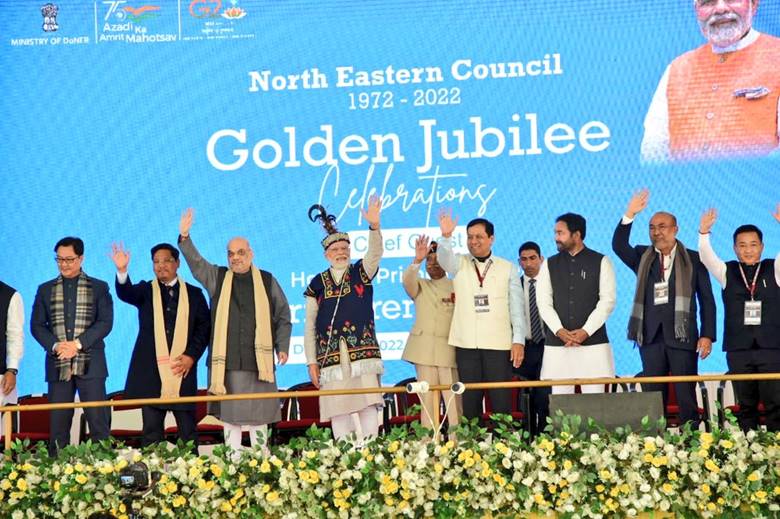
Union Minister of Ports, Shipping & Waterways and Ayush, Shri Sarbananda Sonowal has said the North Eastern Council (NEC) has been the catalyst of growth in the North East. He said under the visionary leadership of the Prime Minister North East as the new engines of growth, is poised to drive the forward journey of new India.

Sharing his views after attending the Golden Jubilee Celebration of NEC in Shillong, Shri Sonowal said, “Today, the Honourable Prime Minister of India, Shri Narendra Modi ji laid the foundation stones and dedicated projects worth ₹2450 crore on the Eve of Golden Jubilee celebration of Northeast Council (NEC) in Shillong. With these launches, it is a true reflection of the Modi ji’s vision of ‘Sabka Saath, Sabka Vikas, Sabka Vishwas, Sabka Prayas’ for the holistic development of the country. Under the dynamic leadership of Prime Minister Modi ji, the road to growth & development of Northeast Region has been laid out with permanent peace & respect to the communities to become partners in this wonderful journey of the region. These projects, inaugurated by the PM Modi today, will accelerate development of not just Meghalaya but of the entire Northeast. I convey my sincere gratitude to Honourable Prime Minister Shri Narendra Modi ji for recognising the Northeast as the Astalakshmi and heralding a new age of development in the region.”
************
India has jumped from 7th to 3rd global ranking in scientific publications
India has jumped from 7th to 3rd global ranking in scientific publications. This was disclosed here today by Union Minister for Science & Technology, Dr Jitendra Singh after a review with Union Secretary Department of Science & Technology (DST) Dr S. Chandrasekhar.
Lauding the consistent efforts of India’s scientific fraternity, Dr Jitendra Singh gave all credit to an enabling milieu and freedom of working provided by Prime Minister Narendra Modi. He said, the very fact that such quantum leaps in our scientific pursuits are happening only in the last few years is a testimony to the push given by PM Modi both in terms of the ease of policy as well as his personal indulgence and prioritisation.
Dr Jitendra Singh informed that as per the National Science Foundation (NSF)’s Science & Engineering Indicators 2022 report of the United States, India’s position globally in scientific publications, has improved from 7th position in 2010 to 3rd position in 2020. He also added that India’s scholarly output increased from 60,555 papers in 2010 to 1,49,213 papers in 2020.
Dr Jitendra Singh said, this became possible only because of Prime Minister Narendra Modi, who not only has a natural predilection for science but is also forthcoming in supporting and promoting science and technology based initiatives and projects in the last 8 years. He said, India’s scientific prowess is going to have a major role in the making of “AtmaNirbhar Bharat ”.
Dr Jitendra Singh said, India’s research performance in science and technology has improved significantly over the past few years which is visible through large amount of scientific knowledge in terms of research publications, development of technologies and innovations contributing to overall development.
Dr Jitendra Singh also took pride that India now ranks 3rd in terms of number of PhDs in science and engineering. He was also apprised of the fact that the number of patents granted to Indian scientists at India Patent Office (IPO) during the last three years has also increased from 2511 in 2018-19 to 4003 in 2019-20 and 5629 in 2020-21.
The National Science Foundation is an independent agency of the United States government that supports fundamental research and education in all the non-medical fields of science and engineering.
It may be recalled that as per the Global Innovation Index (GII) 2022 brought out by World Intellectual Property Organization (WIPO), India’s GII ranking has also improved significantly from 81st in 2014 to 40th position in 2022.
Dr Jitendra Singh said, the government has taken several steps to boost the science and technology sector which includes successive increase in allocations for Scientific Departments, incentivizing investment by private sector to increase their share in GERD, improving the ease of doing business in the Science, Technology and Innovation (STI) activities; introducing flexible tools for public procurement; creating avenues for collaborative STI funding through portfolio-based funding mechanisms such as Public-Private-Partnerships and other innovative hybrid funding mechanisms.
A senior official informed that the Department of Science and Technology is likely to get 20 percent more money in the upcoming Union Budget 2023-24 in comparison to last year.
In the last budget, DST received Rs 6,002 Crore, which was 42 percent of the total fund of Rs 14,217 Crore allocated to the Ministry of Science and Technology. DSIR received Rs 5,636 Crore (40%), while DBT got Rs 2,581 Crore (18%).
The Government has allowed corporate sector to make R&D investments under the provision of Corporate Social Responsibility (CSR). Corporates can invest in technology business incubators or contribute in research efforts carried out by institutions and national research laboratories as a part of their CSR. There are specific investment incentives offered such as Location-based tax incentives that enables 100% deductions of profits generated from establishing and doing business in northeastern states of India.
*******


.png)

.png)
.png)

You must be logged in to post a comment.