The Covid-19 Survivor

                                                               (Photo: Shutterstock)

They have been to the edge and back. Some survived, some died, and some struggled with isolation. This Covid-19 has messed up with everyone’s mind. The best thing that you can do is don’t let it take over your mind because if your mind gives up, then your body will give up too.

This story is of a guy named Danish Akhtar, 24 years old, from a district named Koderma in Jharkhand, who tested covid positive a month back. He never ever dreamt of getting covid positive. It was like a nightmare for him. He used to cough so much that his throat and chest would literally burn. He got the virus from his friend who in turn tested positive. His friend got infected from his father who condition was very critical. With so much things happening around, Danish was too shocked. His mental state has also deteriorated. A cool and fun- loving guy like him would be in such a state, this itself was shocking for his family and friends. Having reported chronic cough and fever, he was taken to the local -government hospital and was there for 14 days. He was only let out once he tested negative for the virus. His friends and family supported him a lot. Initially, he was blank but his inner will help him a lot to recover. “And yet I would turn away”, says Danish.

After he got back from hospital, the destiny had something else in store for him. The very next day his father started having symptoms of the virus (fever, body ache, loss of smell, etc.). Danish started blaming himself for his father’s condition. The guilt was clearly visible in his eyes. But he didn’t give up. He used to stay awake and took great care of his father. Days passed, taking care and praying to Allah for his father’s recovery. At last, after 14 days, he took his father to the hospital for the covid test and to everyone’s happiness, he tested negative. Danish was exhausted, delirious, ecstatic, sleepless but also grateful to Allah.

Now all Danish wants to do is put the whole ordeal behind him as just one bad dream. His advice to those currently infected is, “Be prepared for a tough battle. Don’t let covid mess up with your mind. No matter what, don’t give up.”

India had killed 300 Chinese soldiers in Nathu La, but The Dragon refuse to talk about the war…

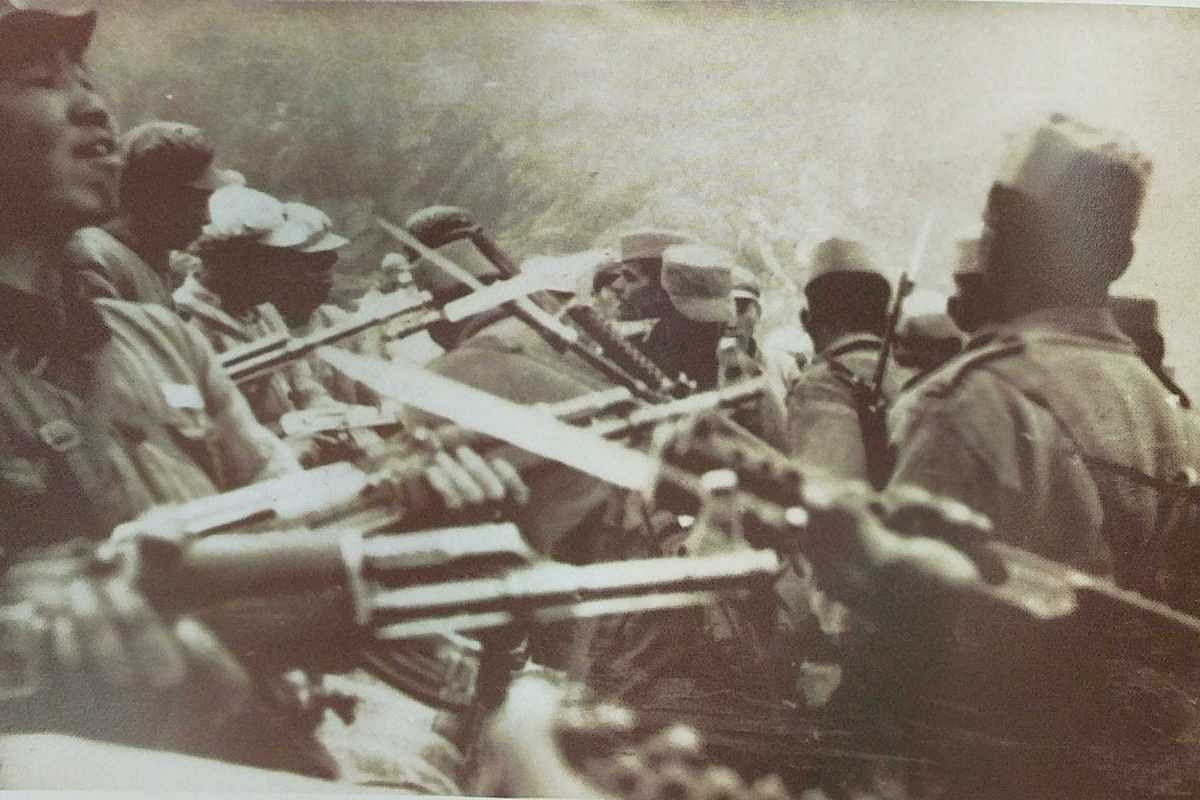
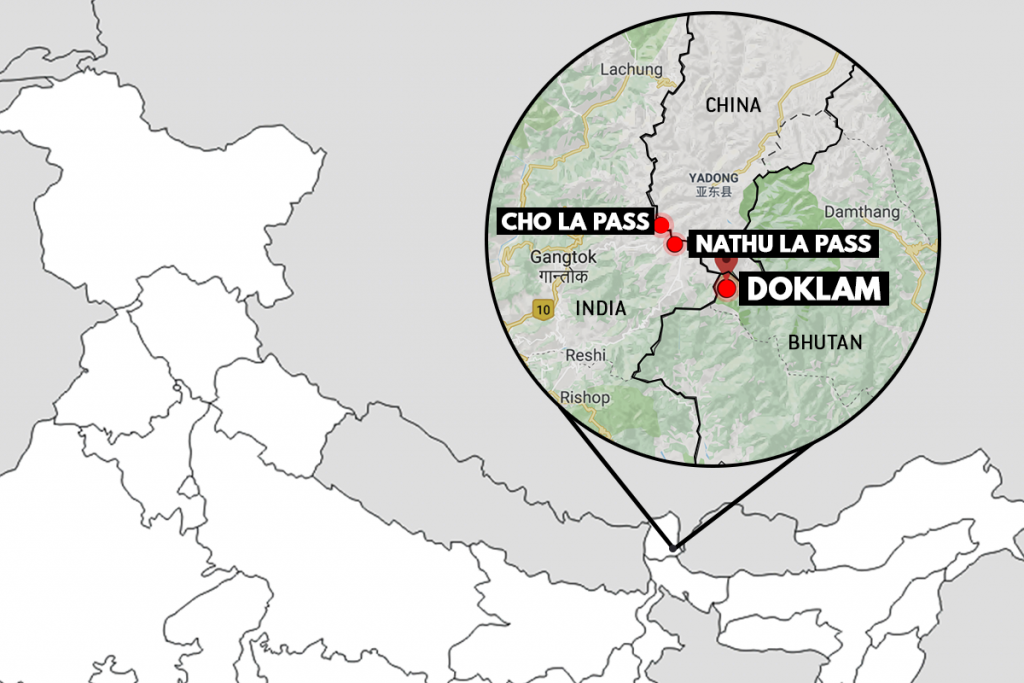
During the two-and-a-half-month standoff between India and China in Doklam, the Chinese media repeatedly reminded India of the 1962 war defeat. But only about five years after that war, there was a border fight between India and China, which China does not like to talk about. This battle between the two armies took place at Nathu La. This area is not far from Doklam valley. In this four-day battle, 300 Chinese soldiers were killed and 65 Indian soldiers were martyred. Let us tell you that 722 soldiers of China were killed in the 1962 war that lasted about a month. The 1967 Nathula battle between China and India was the last violent clash between the two countries.

Nathula, located 14,200 feet above sea level, is an important pass on the Tibet-Sikkim border, which is an important part of the Gangtok-Yatung-Lhasa trade route. Chinese and Indian soldiers are stationed here at a distance of about 30 meters. The soldiers of both the countries are closest in Nathu La on the 3,488 km long border of India and China. The northern side of this pass is controlled by China and on the southern side by India. At that time Sikkim was not officially a part of India. India had taken the responsibility of his security. Indian soldiers were stationed on the China and Sikkim border. On 13 June 1967, China expelled two Indian diplomats from Peking (the old name of Beijing) on ​​charges of espionage. The rest of the embassy staff were held hostage. In response, India fired Chinese embassy officials. On July 3, the Chinese encirclement was removed from the Indian embassy, ​​but the relations between the two countries had become very strained.

Major General (Retd) Sheru Thapliyal, who was commanding the Nathu La Brigade at that time, says that China had warned India to clear Nathu La and Jelep La Pass after the Indo-Pak war of 1965. When this news reached the Indian Army, it vacated the Jelep La Pass and it is still occupied by China. But Major General Sagat Singh (who later became a lieutenant general and a hero of the 1971 Indo-Pak war) refused to clear the Nathu La pass. The Chinese warned from loudspeakers in Nathu La to be prepared for a 1962-like fate. The Chinese army moved towards the border in large numbers, but after reaching the border, the Chinese withdrew. Sagat Singh did not give value to this swirl of his, due to which Sugar became more furious.

In the years 1966 and early 1967, China had used propaganda, threats and infiltration all to occupy Indian territory. In August 1967, China installed 29 loudspeakers at the south end of Nathu La. Sagat Singh decided to put up a three-layer barbed fence on the border. On 20 August the Indian Army started erecting barbed fencing. On 23 August, about 75 Chinese soldiers in war dress with weapons reached the additional area of ​​​​the border and came and stopped there. The leader of his detachment came to the border and read some things from Mao Zedong’s Red Book and the rest of the detachment kept repeating his words behind him. His troop hero was the only person in the Chinese contingent who could speak a little bit of English. The Indian Army kept watching this action of the Chinese with full vigilance. After about an hour the Chinese returned. Even after that many times the Chinese did similar acts.

On 5 September 1967, the Indian Army started replacing the barbed fence with concertina coils. The chief of the Chinese contingent discussed this with the Indian commanding officer, Lt Col Rai Singh, after which the work was halted but the work resumed on 7 September. After this, about 100 Chinese soldiers rushed to the spot. A clash broke out between the two sides. The soldiers of the Jat regiment beat up the Chinese. The Chinese started pelting stones. The Indians responded in any way.

On 10 September, China sent a stern warning to the Indian embassy that India would be responsible for dire consequences if Indian troops indulge in provocative incursions. According to Sagat Singh’s biographer, Major General VK Singh (retired), Sagat Singh was to go on leave from September 12. He had asked to complete the fencing work by September 11. When the fencing work started that day, the Chinese commander stopped it. Rai Singh started going to talk to Sagat Singh. Then the Chinese opened fire which hit Rai Singh. Seeing its commanding officer injured, the Indian Infantry Battalion attacked the Chinese post. Indian soldiers were defeated in front of the open machine guns of the Chinese. Several soldiers including two Indian officers were killed. Both the officers later received gallantry awards. After that the Indian troops retaliated and all the nearby Chinese posts were buried in the ground. A large number of Chinese soldiers were killed in India’s retaliation.

The Chinese were stunned by this befitting reply of India. They started threatening to deploy fighter aircraft. When the Indian army refused to back down, the Chinese news agency Xinhua denied the news of bringing the fighter plane. There are many anecdotes about this fight with China, but the most reliable detail is the personal diary of Second Lieutenant (Signal) NC Gupta at that time. He was present on the spot. He later received the Sena Medal (while recommended for the Maha Vir Chakra). Along with the stories of bravery associated with that battle, there is also the fact that about three dozen Indian soldiers fled the scene for which they were court-martialed.

On September 12, India offered China an unconditional ceasefire on the morning of September 13 (from 5.30 am). China turned it down but from 14 September the situation was almost peaceful. On 15 September, China returned the bodies of Indian soldiers. China said that it is doing this to save “India-China friendship”. Gupta writes that many Indian soldiers lay under the sky for about six days. Gupta has written that the survival of these soldiers was nothing short of a miracle. After this, on October 1, there was a situation of conflict on the Chola Pass, but Indian soldiers drove the Chinese. Since then the spirit of the 1962 war has remained almost silent.

National Handloom Day

 7th August is celebrated as the National Handloom Day to mark the significance of the Handlooms in Indian history. This day, in 1905, the Swadeshi movement was launched. The foreign clothes were discarded as a mark of protest against the colonial rule and revival of Swadeshi goods, especially the Indian textiles were promoted. 

History of Indian Handloom

The origin of Indian Handloom can be traced back to ancient times. One of the earliest hand woven fabrics had a design of a swan (hansa). Some finely woven clothes were also found in Mohenjodaro which was from the era of Indus Valley civilization. The beautiful Indian Floral prints date back to the 18th century. 

Many renowned personalities such as Bernier, Voltaire, and Daniel Defoe had expressed their love for the fine beauty of Indian Handlooms. The colonial era played a major role in the decline of Indian handloom industry. The machine made British clothes were promoted and Indian textiles were suppressed using heavy duty tax levied on it. This period saw a boom in the machine made clothes which were made available at a very affordable price. 

The Indian Handloom has played a significant role in our fight for independence. Mahatma Gandhi reintroduced Khadi and popularized hand spinning and weaving. The spinning wheel, famously known as the “Charkha” became a symbol of self-reliance(Swadeshi) and boycott of British goods. 

Because of the tough competition with the British clothes, many artisans in India lost their livelihood. Several families of weavers struggled to revive their livelihood in the post-independence period. A number of institutions were established to promote the handlooms. The All India Handloom Board was established in 1945. To popularize the Handloom industry, the All India Handloom Fabrics Marketing Co-operative Society was formed in 1953. Later, in 1982, two institutions were merged to form the All India Handlooms and Handicrafts Board. 

There are different types of textiles made in different parts of India. Some popular works include, Chanderi work from Madhya Pradesh, Muga silk from Assam, Kanjeevaram silk from Tamil Nadu, Pashmina from Kashmir, Phulkari from Punjab, Daccai from West Bengal, Brocades from Banaras, Tie and Dye print from Gujarat and Rajasthan and many more.

The tourism sector has helped in increasing the foreign demand of Indian Handloom. Today, with the growth of international clothing brands, the Indian Handloom industry faces a tough competition. A large number of artisans from the rural and semi-urban areas are involved in the Handloom industry. It is a source of livelihood for many women in the rural areas. 

 These beautiful textiles are made manually, using skilled and detailed work by the artisans. Indian Handloom should be encouraged because it is an integral part of our history and the pride of our culture.


Hockey magician Major Dhyan Chand, now in whose name Khel Ratna, know his unique story

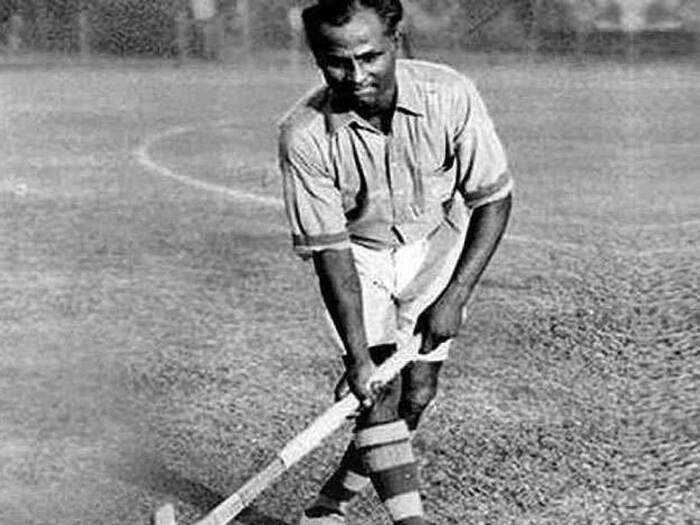
Major Dhyan Chand (29 August 1905 – 3 December 1979) was an Indian field hockey player widely regarded as one of the greatest in the history of the sport.[3] He was known for his extraordinary goal-scoring feats, in addition to earning three Olympic gold medals, in 1928, 1932 and 1936, during an era where India dominated field hockey. His influence extended beyond these victories, as India won the field hockey event in seven out of eight Olympics from 1928 to 1964.

Dhyan Chand was born in Allahabad on 29 August 1905 in a Bais Rajput family. He was the elder brother of another hockey player Roop Singh and the son of Sharadha Singh and Sameshwar Singh. Dhyan Chand’s father was enlisted in the British Indian Army, and he played hockey for the army.

Dhyan Chand had two brothers – Mool Singh and Roop Singh. Because of his father’s numerous army transfers, the family had to move to different cities and as such Chand had to terminate his education after only six years of schooling. The family finally settled in Jhansi, Uttar Pradesh, India.

Chand graduated from Victoria College, Gwalior in 1932. Being in the military, his father got a small piece of land for a house.

Young Chand had no serious inclination towards sports though he loved wrestling. He stated that he did not remember whether he played any hockey worth mentioning before he joined the Army, though he said that he occasionally indulged in casual games in Jhansi with his friends.

Some Interesting Facts:

While winning the bronze medal in hockey in the Tokyo Olympics, the players gave a chance to the countrymen to rejoice, while on Friday, Prime Minister Narendra Modi gave another chance to the hockey lovers to rejoice. He has changed the name of Rajiv Gandhi Khel Ratna Award, the biggest award in the field of sports, to Major Dhyan Chand Khel Ratna Award. Prime Minister Narendra Modi gave this information through a tweet.

For the first time this award was given in 1991-92. It is given to those sportspersons who have excelled in the field of sports at the international level. Hockey lovers have expressed their happiness after the name of this award is named after the legendary player Major Dhyan Chand, who is called the magician of hockey.

Hockey magician Major Dhyan Chand had a wonderful art of scoring goals, when his hockey rose in the playground, the opposition team was shattered. Born in Allahabad, this great player has won gold medals for India in 3 Olympic Games. Till now you must have heard many things about their game, today we will tell some interesting facts related to them.

Dhyan Singh, as he was formerly known. At the age of 16, he joined the Indian Army as a soldier and started playing hockey. Because Dhyan Singh used to practice in the moonlight at night, his friends started calling him Chand, after which he came to be called Dhyan Chand.

India defeated Germany 8–1 in the 1936 Olympic hockey final. In which Dhyan Chand alone scored 3 goals. After this victory of India, Hitler immediately left the stadium and left. In the evening, when Hitler asked Dhyanchand what do you do other than playing hockey, his answer was that I am a soldier of the Indian Army. After this Hitler offered him to join the German army. But he refused saying that it is my responsibility to take the country forward.

  • This great hockey player represented the country in the 1928, 1932 and 1936 Olympics and managed to get the country gold medals on all three occasions.
  • Residents of Vienna have erected a four-handed statue of Dhyan Chand in a sports club in honor of Dhyan Chand, holding a hockey stick in all four hands, depicting him as a hockey god.
  • It is said that once while playing hockey, Dhyan Chand could not score any goal, due to which he argued that the goal post was small, when the goal post was measured, it turned out to be small, everyone was surprised to see this.
  • Film actor Prithviraj Kapoor was a fan of Dhyan Chand, once he brought famous singer Kundan Lal Sehgal ( K. L. Sehgal ) with him to a match in Mumbai. When no goal could be scored till half time, Sehgal said that we have heard many names of both the brothers, I am surprised that neither of you could score even a goal till half time. Dhyan Chand then asked Sehgal if you would make us recite songs like Hum Jeet Gol Mare, he said yes, then in the second half, both the brothers scored 12 goals together.

    AI IN POWER SYSTEMS

    ARTIFICIAL INTELLIGENCE IN POWER SYSTEM

    The term Artificial Intelligence was coined by John Mc Carthy in the year 1956. It is the art of science and engineering, which makes intelligent machines.


    WHAT IS AI IN POWE SYSTEM?

    • High efficiency                                            
    •  Problem solving
    • Accuracy                                                      
    • Critical thinking
    •  Speed                                                          
    •  Applicable
    • Easy Adoption                                              
    • Especially for power systems where conventional methods                                          which experience difficulty
    • Precision
    • Vast  Data Management 
    • Memory


    Three major families of AI,

    1. Expert system Techniques
    2. Artificial Neural Network
    3. Fuzzy Logic System

    EXPERT SYSTEM


    An expert system provides information about the specified domain from the human experts and convert into the machine implementable form. 
    They are computer programs which have proficiency and competency in the particular field.
     They are also known as the Knowledge based system or ruled based system. They solve the problems which are very difficult to solve by human skill and intellectual. 
    Any modifications can be easily done because they are just computer programs. Estimation of values can be done and efficiency is easily estimated.


    ARTIFICIAL NEUTRAL NETWORKS

    Artificial neural networks are biologically inspired system which converts a set of outputs by a network of neurons, where each neuron are able to produce output.
    The understanding and working process and the pattern are interconnected with the computers by solving real world problems of classification of patterns and pattern recognition.
    As ANNs operate in biological instincts and perform biological evaluation of real world problems in generations and transmission and distribution of electric cars can be fed to ANN so that suitable solution can be obtained.
    Example: The value of inductance, capacitance and resistance in a transmission and distribution can be calculated by various factors.


    FUZZY LOGIC SYSTEM

    Fuzzy logic is the standardization system of any logical reasoning system.
    They provide Data to produce information based on the human decision making which is accurate and reliable.
    It is what exactly human brain works and they can perform exactly like machines.
    They provide solutions such as high excessive date, capacity for modelling data with high generality.


    EXPLANATION

    Fuzzy diagram can be used for the fault diagnosis.

    Expert and ANNs can be used in the performance of the line. Environmental sensors sense the environment and atmospheric conditions and they give input to the system. They provide output with the validation.

    CONCLUSION

    The main feature of the power system technique is reliability, conventional technique and they don’t fulfil the probabilistic essence of the power system, this provides the increased operations and maintenance costs. A lot of research is now being processed for the monitoring of the efficient electricity market as they are power system which is the renewable form in the operations.


    IS TECH THE REASON FOR DESTRUCTION OF NATURE ?

     In today’s world, humans are in a very relaxed cycle: they eat, they watch television, they sleep. What most people do not realise are the health risks they are taking every day when they do their daily tasks. Humans are becoming more and more reliant on machines to do simple activities, such as changing the channel or traveling. I agree that technology does make activities uncomplicated, and genuinely makes life easier, but how can a person stay physically fit and healthy when he/she does nothing himself/herself? In Ishmael by Daniel Quinn, many environmental issues are discussed. Among the issues, Quinn talks about technology and how humans believe it to be a turning point in society, but will eventually lead to the downfall of humans.

    People are at great risk to their health with the advancements in technology. Not only have individuals fabricated new ways of entertainment, but have built factories, which pollute the air they breathe and water they drink. In Ishmael, Quinn tells of man trying to fly; when man fails, he does not just simply give up and wait to fly, but creates a new way, that is not fool-proof. Humans will do anything to make life easier, but for no reason than to make life easier. But is this really making life relaxing? People still have to go to work, still have to breathe in polluted air, and other such effects, all of which may be hazardous to their health. Humans keep creating objects that are harmful to the environment, and they call this “technology.” Well, this may be “technology,” but obviously citizens do not see that it is taking control of their lives. Most technology is for luxury and entertainment, while a select few fabrications are necessities, (airplanes, food machines, etc.). People really need to stop relying on artificial intelligence for simple tasks.

    LGBT RIGHTS IN INDIA


                                                                       (Photo: iPleaders Blog)

    Every cloud has a silver lining.” This proverb goes well with the historic judgement passed by the Supreme court on 6th September 2018 in the favor of LGBT community rights. This has been much debated topic since a long time. Nothing could be more blessing than the enactment of Article 377 for the relief of LGBT community. The hearing of the petitions began with a bench consisting of Chief justice Dipak Misra and justices DY Chandrachud, AM Khanwilkar, Indu Malhotra, and Rohinton Fali Nariman. It was truly a landmark decision which struck down a 19th century law criminalizing homosexuality in India.


    What role does the Indian Constitution play towards the emancipation of the society’s most marginalized and excluded? What vision does the Constitution espouse with respect to basic fundamental rights and freedoms? And what conception of inclusion and pluralism does the Constitution pursue in a society that remains deeply divided and disjointed? All these searching questions came to form a distinct part of the decision of the Indian Supreme Court (Court) when it was called upon to rule on the constitutional validly of Section 377 of the Indian Penal Code, 1860. It was not the first time however, that the Court was examining Section 377 on the touchstone of the Constitution, as the case previously travelled through several levels of judicial adjudication involving different jurisdictional procedures.


    Embodying the ethos of Victorian morality, Section 377, a colonial-era law, criminalized ‘…carnal intercourse against the order of nature with any man, woman or animal…’. Anything that was not penal-vaginal sexual encounter was ‘against the order of nature’ and as a consequence ‘unnatural’. Through this provision, homosexual acts even between consenting adults was considered and proscribed as a criminal offense punishable with imprisonment. Thus, a significant section of the population comprising the LGBT+ community remained perpetually ostracized by the Indian society, persecuted by State authorities and marginalized in the discourse of constitutional rights. Therefore, when the Court decided in Navtej Johar v Union of India that Section 377 in so far as it criminalizes same sex acts between consenting adults, violates the constitutional mandate enshrined under the Fundamental Rights chapter, especially, Art. 21 (life and personal liberty), Art. 14 (equality and equal protection of laws), Art. 15 (non-discrimination) and Art. 19 (Freedom of expression), truly, it was a historic undoing of injustice towards the LGBT+ people. In other words, as a result of this decision, LGBT+ people who were historically and by default considered ‘criminals’ under the law, came a bit closer to acquiring an ‘equal moral membership’ of the society and the State. It was a tough as well as a long road but at the end everything seemed to be mightier.

    Let us look back into the history of India from where the seeds of this discrimination were actually sown. India has a long tradition of tolerance for all kinds of beliefs, faiths, philosophies, and ways of living. This takes us back to the 1800s. Lord Macauley first created this law in 1860 when he was the President of the Indian Law Commission. The reason for this law was because the British WANTED TO “impose Victorian values” on the colony of India. Not only were such values trying to be inflicted on the Indian society but also the Constitution of India wanted to “…narrow constructions of patriarchal gender relations and heteronormativity” (Ramasubhan 91).

     What’s important and a reflection of the movement itself is that the support has come not just from the queer people, but across a range of actors, movements and institutions.  Progressive groups, state bodies like the National Human Rights Commission, teacher’s associations, professional associations including the medical and mental health establishments, women’s groups, student groups, trade unionists and private companies came out publicly against the judgement. Thousands across the country stood together, repeating the chant that brought together our resistance: ‘No Going Back’.


    In declaring Section 377 to be unconstitutional, however, the Court was deeply reflective about the fact that for Constitutional rights to acquire a meaningful purpose for the marginalized communities, disciplining State action alone will not be sufficient. In this regard, the Court did not mince words when it stated that it is both, criminality of the law and the ‘silence and stigmatization’ of the society towards the LGBT+ community that orchestrates the marginalization and the exclusion of the former. Implicit in that claim was the understanding that inequality, hierarchy and prejudice transpires as much from State action as it does from societal sanctions, community conventions and private relationships. In the context of such social realities, what is the stated role of the Constitution and the laws? Is the mandate of the Constitution simply confined towards ordering the relationship between the State and the individual (vertical) or does the Constitution have an equal role to play in shaping normative values among individuals within the society?


    The Court unequivocally embraced the latter narrative and found that the Indian Constitution envisions an expansive role for both the State and the individual to actively promote social change within the contours of the Constitution. It seeks transformative change ‘in the order of relations not just between the State and the individual, but also between individuals’. The transformative potential in Indian Constitution is a conscious ‘attempt to reverse the socializing of prejudice, discrimination, and power hegemony in a disjointed society’. Therefore, the Constitution, the Court surmises, obliges not only the State not to violate fundamental rights, but also individuals to ‘act in a manner that advances and promotes the Constitutional order of values’.


    “Sexual orientation” is an essential attribute of privacy. Discrimination against an individual on the basis of sexual orientation is deeply offensive to the dignity and self-worth of the individual. This judgement can be considered as a revolutionary one in a society like India. But every judgement has two parts, one is written and other is its execution. The written part is progressive and reformist and its execution includes sensitizing the society and institutions in accepting what is written in this judgement. That may take time. Till then I would like to put forth some suggestions. The first step is sex education in schools and at homes. The second step is that the law enforcement agencies such as the police needs to be more sensitized towards the LGBT people. Similarly, our media and film fraternity can play a very important role in imparting knowledge and disseminating true information about LGBT people.


    To conclude, we all are equal.  Nobody should be discriminated on whatsoever ground.  In the last few years LGBT are gaining acceptance in many parts of India. Many Bollywood films have dealt with homosexuality. They have also fair well at the box office. There’s a transformative constitutionalism which is happening and the real import of transformative constitutionalism lies in positive measures that the State ought to take in bringing the Constitution closer to the most deprived. Indian society needs to shrug off its old thinking and come out of the widely prevailing homophobia.




    Puri: First city in India with "Drink-from-Tap" facility

     Puri, located in Odisha, became the first Indian city with 24×7 clean drinking water from tap facility. The “Drink from Tap Project” was inaugurated on 2nd August 2021. The drink from tap facility has been initiated by the Water Corporation of Odisha under the “Sujal” scheme. While inaugurating the project the CM of Odisha claimed that this project will enable the people of Puri to collect water directly from the tap and it would not be necessary to store or filter it further for the purpose of drinking. 

    Drink-from-Tap Project

    Under the Sujal scheme, the water is taken from the Bhargavi river and then it is channelised to a reservoir. The water is then sent to Samang for water treatment procedures like purification and chlorination. 

    Sujal scheme aims to provide clean drinking water from taps to nearly 1.5 million people in 15 towns of Odisha by 2023.  Puri’s water requirement is around 32-34 million litres per day and the plants have been claimed to purify around 42 million litres of water each day. 

    The “Drink from Tap” project is said to benefit the 2.5 lakh residents of Puri. As Puri is known as the holy town of Odisha, it would also benefit the 2 crore tourists who visit Puri. Another impact is that it can reduce the number of plastic bottles bought, mostly by tourists. It can drastically reduce the disposal of plastic waste. People can directly consume the water from the 400 fountains installed in the city. 

    But it is also important to maintain stringent rules on the quality of water supplied. Contaminated water can pave the way to a number of diseases. Constant monitoring of the water quality is essential. The scheme is in its initial stage and it is imperative to maintain the availability and purity of water in the long run. 

    Clean drinking water in India

    According to the UNICEF reports, less than half of the people in India have access to safe drinking water. Harmful chemicals such as Arsenic and Fluoride are found in 1.96 million dwellings.  The report also indicates another major concern, that is unavailability of water in many areas. 

    School attendance decreases in the areas where children are sent to collect water. They spend hours collecting water which affects their education. In the drought hit states, a 22% rise in school drop out rates was recorded. 

    Therefore it is important to ensure the availability of clean drinking water to the people. Safe drinking water is a fundamental aspect of public health.


    RESEARCH REPORTS

    RESEARCH REPORT

    Oral presentation based on the written document or simply the written document that gives the purpose, scope, methodology, findings and finally suggesting the best to the others.

    Oral presentations are done by one of the seminar, conferences etc. Written document always starts with the issues and finally gives the solution to the audience.


    TYPES OF RESEARCH REPORT

    • Technical report
    • Popular report
    • Analytical report
    • Informative report
    • Descriptive report
    • Comprehensive report
    • Monographs

    TECHNICAL REPORT

    It is based on the experiment, diagnosis, which we get information and analyze them in a technical way. It is a large documentation of the report as we have technical audience here.

    CONTENTS

    • Summary
    • analysis of data
    • research design
    • findings
    • conclusion
    • bibliography
    • conclusions
    • index

    POPULAR REPORT

    The Report should be made in the simplest language, Objective should be short and sentences to be directed. The Report should be minimized.The Report ‘s emphasis is given based on policy implications. The newspaper information and magazines come under popular report.

    CONTENTS
    • Findings
    • recommendation of action
    • pictures and graphs
    • Techniques used 
    • results

    ANALYTICAL REPORT

    The Report is purely based on the scientific research. Research should be feasible and made easy for understanding purposes.

    CONTENTS
    • Table of contents
    • Contrasting views
    • Antithesis
    • Bibliography
    • Appendices

    INFORMATIVE REPORT

    The Objective should provide information. The Memo should provide a reason.

    CONTENTS
    • Introduction
    • Paragraphs
    • Graphics
    • Subheadings

    DESCRIPTIVE REPORT

    Simple report given by desired information. The actual reports are reinforced by tables.

    CONTENTS
    • Graphical form of representations
    • Pie chart
    • Bar chart
    • Frequency distributions

    COMPREHENSIVE REPORT

    Broader Objective should be determined for future growth. Gathering data and analysis should be done for the alternative solutions. The Report should be elaborated in a detailed way.

    CONTENTS
    • pros and cons
    • Basic Research on Issue
    • Benefit in statement of cost

    MONOGRAPHS
    Special type of book written on specialized topics by the researchers. It looks like a way a book looks like.

    CONTENTS
    • Title
    • Abstract
    • Introduction
    • Methodology section
    • Literature review
    • Results section
    • Discussion section Conclusion
    Hence, these are the important research reports.


    SPYWARE

                                                       SPYWARE

    BY : NEHA SHAHAB


    PEGASUS IS A SPYWARE DEVELOPED BY NSO GROUP , AN ISRAIL SURVEILLANCE FIRM THAT HELPS SPIES HACK INTO PHONES.

     IN 2019 THEN WHATSAPP SUED THE FIRM IN A US COURT , THE MATTER CAME INTO LIGHT. IN JULY 2021 , AMNESTY INTERNATIONAL ALONG WITH 13 MEDIA OUTLETS ACROSS THE GLOBE RELEASED A REPORT ON HOW THE SPYWARE WAS USED TO SNOOP INDIVIDUALS , INCLUDING INDIANS.WHILE NSO CLAIMS THAT ITS SPYWARE IS SOLD ONLY TO GOVERNMENT AND NONE OF THE NATIONS HAVE COME FORWARD TO ACCEPT THE CLAIMS.

    THE SUPREME COURT OF INDIA ON THURSDAY MADE IT CLEAR THAT THE TRUTH HAS TO COME OUT REALLY SOON IN THE PEGASUS SNOOPING ISSUE. 

    THIS SPYWARE TARGETED THE MINISTERS , PARLIAMENTARIES , ACTIVISTS , JOURNALISTS , CIVILIANS. IN INDIA , THE NAMES OF 125 POTENTIAL TARGETS OUT OF 300 ODD VERIFIED ONES FROM OVER 2000 INDIAN NUMBER FOUND ON THE LEAKED LIST HAVE BEEN MADE PUBLIC.

    FRANCE PRIME MINISTER , EMMANEUL MACRON PHONE NUMBER ARE IN THE LEAKED DATABASE AND HE HAS ASKED THE ISREAL PRIME MINISTER NAFTALI BENETT FOR A PROPER INVESTIGATION.

    ITS TIME TO BOOST UP

                                                          ECONOMY BOOST UP

    BY : NEHA SHAHAB


    INDIA ECONOMY HAS SHOWN SIGNS OF RECOVERY IN JULY AS FACTORY ACTIVITY REBOUNDED  ON THE RISING DOMESTIC AND INTERNATIONAL DEMAND. A FALL IN ACTIVE CASE OF COVID 19 CASES LED TO A ALLOWING BUSINESSESS TO RAMP UP MANUFACTURING ACTIVITY. 

    THE REOPENING OF THE ECONOMY HAS LED TO HIGHER DEMAND AND SUPPLY. EXPORTS HAS ALSO WITNESSED A HEALTHY RISE AS ORDERS GREW AT THE FASTEST RATE SINCE APRIL.

    EMPLOYMENT HAS ALSO INCREASED FOR THE FIRST TIME SINCE MARCH 20 , BREAKING 9 TO 15 MONTH CHAIN OF JOB SHEDDING. HOWEVER , THE PACE OF HIRING REMAINS MILD AND THE COUNTRY JOB CRISIS IS FAR FROM OVER. RISING INFLATION IS ANOTHER MAJOR HURDLE IN THE PATH OF ECONOMY RECOVERY. 

    A RECENT POLL CONDUCTED BY NEWS AGENCY REUTERS SIGNALS A FURTHER RISE IN INFLATION DUE TO HIGHER FUEL PRICES. AS THE CASES NOW FALLING THERE IS REASON TO HOPE THAT THE ECONOMY WILL GET BACK TO IMPROVED ACTIVITY IN THE NEXT QUARTER.