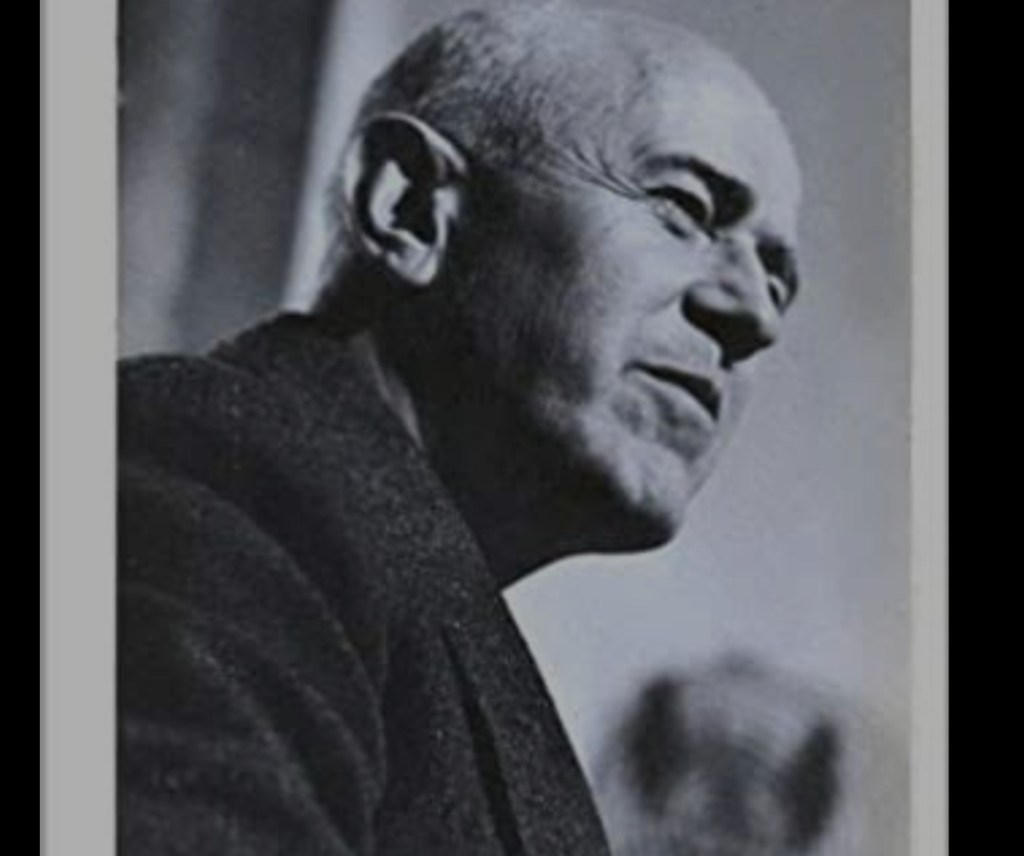
Essay explanation ” El Dorado “by Robert Louis Stevenson

It seems as if a great deal were attainable in a world where there are so many marriages and decisive battles ….” 

                                        – El Dorado by R.L Stevenson.

” El Dorado ” by Robert Louis Stevenson is one of the most famous and inspiring essays about the journey for the travellers .

El Dorado ”  means gilded one in Spanish .

It is a legendary city or historical region of the New World , often thought to be in South America that was fabled for its great wealth of gold and precious jewels and eagerly sought by 16th and 17th century explorers including Sir Walther Raleigh. 

This imaginary land of fabulous gold is a symbol of the unattainable

El Dorado essay by R.L Stevenson is about the journey of  travellers which is more pleasurable than arriving at the destination .

Stevenson, who was fond of traveling , expounds here his philosophy of traveling without ever resting . 

According to him

There is always a new horizon for onward looking men .”

He discovers the secrets of happiness in the fact that our hopes and aspirations striving goes on for life .

” Our hopes are inaccessible like stars and the term of hoping is prolonged until the end of life .”

Incessant striving and perpetual chase for something make life meaningful and fruitful rendering perennial pleasure to a man .

Stevenson says “An aspiration is a joy forever ” . 

Desire and curiosity are two eyes through which man sees the world in the most enchanted and captivating colours .

Desire and curiosity  needs to be satisfied and perpetually renewed to keep up the interest in one’s life .

Stevenson mentions a story of a young fellow who finished the works of Thomas Carlyle and weeped about no book of Carlyle left to read .

Alexander the Great wept because he has no countries to conquer .

He states that one who volume or measure his interest and desire has a fear to come to an end and be left with nothing to accompany his last stage of journey.

Desire and curiosity is what keeps man continuing to exist .

“Interests are only plucked up to sow themselves again ,like mustard “.

Stevenson further says ,

And when we discover a continent or cross a chain of mountains , it is only to find another ocean or another plain upon the further side . “

Life can be thrilling and exciting when we go forward led by desire and curiosity.

“Aspirations “ means desire to have more and more knowledge and experience in life .

Aspirations can keep us going, making our life worth living .

Stevenson points out that even a small corner of earth can offer us something new to start . Life and nature have infinite riches to be explored by curiosity and hence ,the journey of traveling continues life long .

He concludes by advising man to remain engaged in some noble pursuits.

He say, 

To travel hopefully is better than to arrive and the true success is to labour .”
About Robert Louis Stevenson 

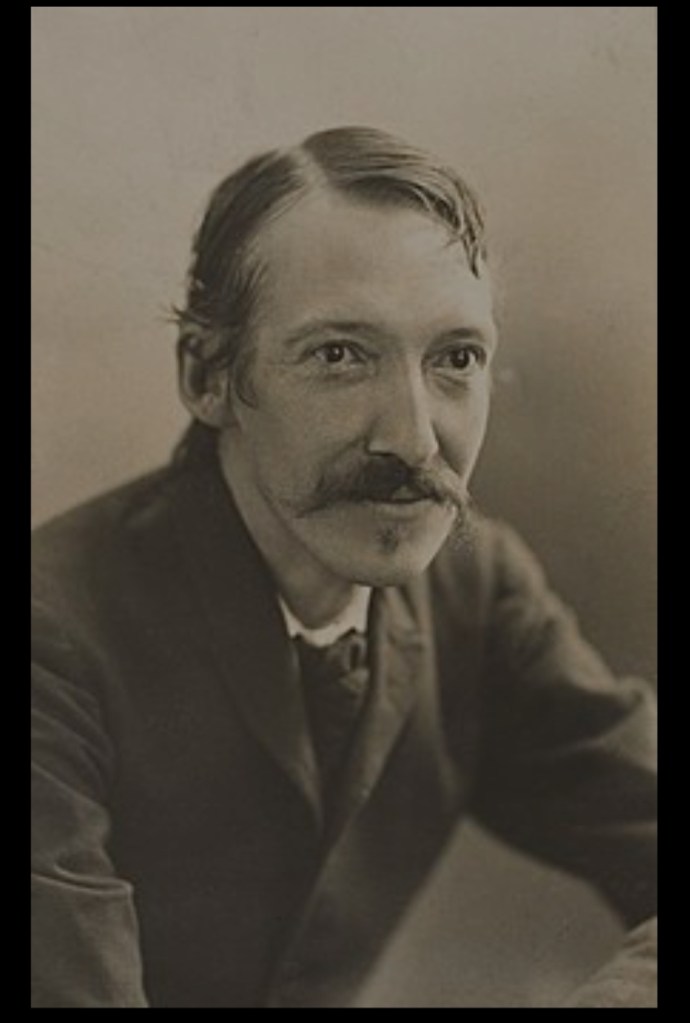
Robert Louis ( Balfour) Stevenson was a Scottish novelist ,poet , essayist and travel writer .

He was born in Edinburgh on 13 November 1850 .

His fourth four year life was a nearly constant journey in search of adventure and relief from the agonies of tuberculosis ,with which he was afflicted from early childhood .

Stevenson attempted every species of writing but it is chiefly as an essayist that he continues to live .He was essentially an artist in words .He was an amazing storyteller ,an acute and sensitive critic , a genial and whole hearted lover of life .He was a master of rich , resilient prose style .

There is a kind of primitivism in his writing which wins over the reader by its message of courage and virility – the traits which characterize Stevenson’s own life.

Stevenson As an Essayist 
Stevenson is considered one of the greatest essayists of the Victorian Age .He was influenced by Wiliam Hazlitt .

He was a personal essayist and he himself became the subject matter of his essays .His essays are like mirrors which reflect his personality and show real aspects of his life .

Stevenson’s essays are filled with whimsical paradoxes , keen and witty as those of Bernal Shaw . His work is invariably ethical.

He wrote essays on different topics such as nature , philosophy , morality , children science etc. 

Few of his essays deal with human miseries and problems of human life .

Some of his essays and other works are , 

. Travels with a Donkey, Virginibus Puerisque ,Familiar Studies of Men and Books , New Arabian Nights , Treasure Island ,  Prince Otto,  A Child’s Garden of Verses ,More New Arabian Nights., The Dynamiter. StrangEnglish Case of Dr. Jekyll and Mr. Hyde , Kidnapped , El Dorado , Memories and Portraits etc.

His essays are highly  personal and autobiographical. He was a craftsman and artist who cared passionately about his writings.

Hence , we can say Stevenson was a versatile genius of his age .

___________________________________________

Referral link :- More about R.L Stevenson Read El Dorado online
Problem Play – A Form of Drama .

The term “drama” comes from a Greek word meaning “action” .

Drama is the specific mode of fiction represented in performance: a play, opera, mime, ballet, etc., performed in a theatre, or on radio or television.


A problem play is a type of drama .
As the name suggests, problem play discusses problems openly in the form of play in theatre or stage.
It is a drama built around a specific problem. The problem is generally of a sociological nature.
Problems such as prostitution, inadequate housing, unemployment, labour unrest, etc. are mostly found as major subject matter of the play .
It examines a specific social or political problem with the aim of igniting public debate.

It was established in France in the 19th century to deal with controversial social issues in a realistic manner openly to the audience.
It flourished in England in the period between the last years of the nineteenth century and the middle of the twentieth.

It deals with the social problems or ills through debates between the characters on stage, exposing the conflicting points of view within a realistic social context.

According to Albert Guerated ,
” The problem play is the presentation of a contemporary question through realistic techniques”

The dramatists of the problem play were preoccupied with the vital problem of contemporary life and morality and the drama which was directly inspired by the society of the time could be effective only if it adopts a realistic form or medium.

___________________________________________

The beginning of the problem play was introduced into England towards the end of the nineteenth century by Henry Arthur Jones & and Sir A. W. Pinero .
Towards the end of the 19th century the English
society started feeling the need of something new and refreshing
on the stage and therefore the start of problem play began .

Pinero’s most popular play is The Second Mrs Tanqueray which deals with the marriage of “a woman with a past.

G. B. Shaw and Galsworthy took the problem play to its height in the twentieth century.

G.B Shaw plays ,
Widowers’
Houses, Mrs.Warren’s Profession ,Arms and the Man and many
other plays are concerned ,as the writer saw it, less with the
crimes of society, and more with its romantic follies and with the
struggles of the individuals against these follies.

Some other examples of problem play are :-

The earliest forms work of Alexandre Dumas, dealt with the subject of prostitution in The Lady of the Camellias.


Shakespeare ‘s All’s Well That Ends Well, Measure for Measure, and Troilus and Cresside written between the late 1590s and the first years of the seventeenth century:
These plays are difficult to classify because their sombre themes and cynical tones contrast oddly with their comedic elements, and the moral issues raised are not satisfactorily resolved.

Ibsen’s plays are mostly problem plays.
His works usually concentrated on the moral dilemmas of a central character which dealt with a social problem such as in A Doll’s House (1879), sexually-transmitted disease in Ghosts (1882) and provincial greed in An Enemy of the People (1882).

In America the problem play was associated with the emergence of debates over civil rights issues. Racial issues were tackled in plays such as Angelina Weld Grimké’s, Rachel

Shaw’s Mrs Warren’s Profession (1902), examining attitudes towards prostitution; and Galsworthy’s Justice (1910), exposing the cruelties of solitary confinement and the legal system.

Some plays by later writers such as A. Wesker, J. McGrath, Caryl Churchill, H. Brenton, and D. Hare also raises contemporary issues, in the form of problem play.

___________________________________________

The problem play is also termed as “thesis play,” or “discussion play “ .
As the play discusses the social ill and opens a room for discussion over certain important topics for the audience.
Using the serious subjects it brings to life some contemporary controversy of the public,by creating a somewhat simplistic, didactic thesis with the audience .

The problem play is sometimes called “the propaganda play,” for the obvious reason that its intent is overtly didactic and propagandist.

Problem play or a play of ideas deals with a particular social or
moral problem related to love, marriage, sex, war, peace, justice
or crime etc. and tries to suggest a solution to it. It profusely
takes the recourse of wit, intellect, materialism and realism. A
problem play finally opposes and rejects all types of narrowness,
confusion and falsehood, and adheres to the principles of
equality, freedom or justice .

Scoffing at the romantic
view of life the new genre of drama examined the social institutions and social ills .
Slum landlords, prostitution, marriage conventions ,social prejudices,
romanticized soldier, glamorous historical figure, medical
profession, critics, religion- these are but some of the people
and things which come under the major theme of problem plays during the 19th & 20 th century .

Many dramatists used problem play for the theme of socialist and socialism.

The problem play is supposed to have arisen out of sentimental drama of the nineteenth century and has often been identified with ‘serious drama ‘ ; a dramatic form distinctly serious but not tragic that aims at presenting the real life problems using fiction on a realistic level.

___________________________________________

Referral link :- Shakespeare’s problem plays. G.B Shaw ‘s Play

Dramatic Monologue – A Form of Poetry .

Monologue is made up of two Greek words ” μόνος mónos,” which means “alone, solitary” and λόγος lógos, “speech”


In general the term monologue means a speech presented by a single character, most often to express their thoughts aboud.

It is a speech given by a single character in a story. In drama, it is the vocalization of a character’s thoughts; in literature, the verbalization. It is traditionally a device used in theater—a speech to be given on stage.

There are different types of Monologue:

1. Dramatic monologue,
2. Soliloquy,
3. Interior monologue,

What is a dramatic monologue?

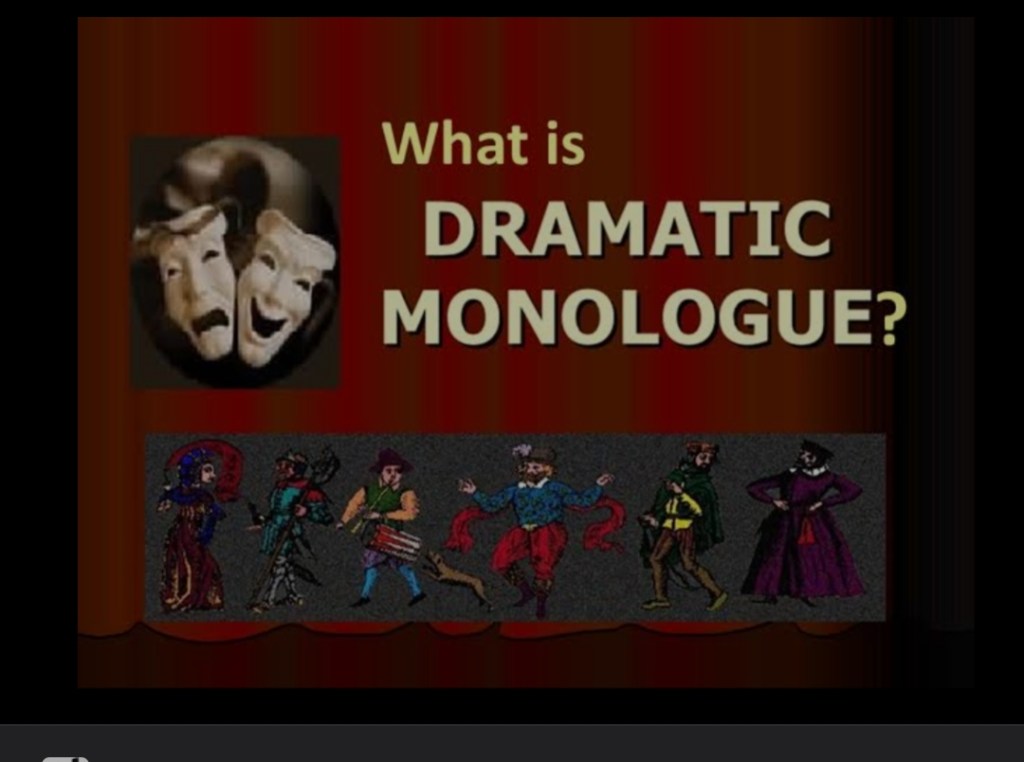
Dramatic monologue refers to a type of poetry. It is a type of poetry written in the form of a speech of an individual character.

These poems are dramatic in the sense that they have a theatrical quality; that is, the poem is meant to be read to an audience.
It is a literary form where the writer takes on the voice of a character and speaks through them.

Although dramatic monologues are found in theater and prose, the term most frequently refers to a poetic form where the poet creates a character who expresses a point of view or the main subject matter .


A dramatic monologue is also called a personal poem.
The character speaking in the poem is referred to as a “persona.”

Dramatic monologues can be told by a period , animals, objects, places, or abstract concepts like fate , love , etc.


M.H. Abrams notes the following three features of the dramatic monologue :-

• The single person, who is patently not the poet, utters the speech that makes up the whole of the poem, in a specific situation at a critical moment.

• This person addresses and interacts with one or more other people; but we know of the auditors’ presence, and what they say and do, only from clues in the discourse of the single speaker.

• The main principle controlling the poet’s choice and formulation of what the lyric speaker says is to reveal to the reader, in a way that enhances its interest, the speaker’s temperament and character.

Dramatic monologue was invented and practiced by Robert Browning followed by many famous poets like Alfred Tennyson , Dante , T. S Elliot and other Victorian poets .

The form remained popular in the 19 th and 20th century. The Victorian period represented the high point of the dramatic monologue in English poetry.

Robert Browning produced his most famous work in this form of dramatic monologue “My Last Duchess” which is quite famous till date .Browning’s poem “My Last Duchess” was one of the first dramatic monologues of the Victorian era.

Alfred, Lord Tennyson’s Ulysses, published in 1842, was a remarkable dramatic monologue in English literature during the Victorian era .

In the Modernist era, poets like T.. S. Eliot and Ezra Pound wrote persona poems
The Love Song of J. Alfred Prufrock” by T.S Elliot being one the most famous works as a dramatic monologue.

With the prevailing trend of confessionalism in poetry, during 1950s and 1960s, great poet like Gwendolyn Brooks, John Berryman, and Sylvia Plath all made notable contributions by writing dramatic monologues that grappled with subjects like the African American urban experience, mental illness, addiction, and suicidal ideation.

___________________________________________

Types of Dramatic monologue

Dramatic monologues can be categorised in three ways :-

Romantic monologues

Poems where a character speaks about a romantic relationship, either past, current, or desired is called a romantic monologue .

For example,
Dilemma” by Anthony Hecht is a romantic monologue.

Conversational Monologue

Conversational monologues are poems where the dramatic monologue is presented by the speaker as if it is part of a conversation.
Samuel Taylor Coleridge’s “The Eolian Harp” is one example.
.
Philosophical Monologue

Philosophical monologues are poems where the character explicates their personal philosophy or theories about the world.

“Lines Written a Few Miles above Tintern Abbey” by William Wordsworth is one example of a philosophical monologue.

___________________________________________

The dramatic monologue was written in the voice of a fictional character, the form sometimes makes use of a character who is already well-known so the poet can explore larger themes.
Use of dramatic monologues made the poet write about situations and subject matter that is not taken from their own lives.

Dramatic monologues are a way of expressing the view of a character and offering the audience greater insight into the character’s feelings .
Dramatic monologue was a famous form to write poetry because of its powerful way to create narrative tension as the speaker reveals crucial information to the reader in a way that allows the reader to feel the real emotions . ___________________________________________

Referral link :-How to write dramatic monologue (tips)

What is an Ode ?

John Keat , William Wordsworth , Thomas Gray , Alexander  Pope , Percy Bysshe Shelley etc are some renowned ode  poets of the past  centuries .

The word ode comes from two   Ancient Greek words ὁδός which means ” path or way ” and  word aeidein, which means to “sing or to chan“.

In English poetry ,

Ode is a poetic form that can be generalized as a formal address to someone or something.

M.H Abrams defined the ode as , ” a long poem that is serious in subject and treatment elevated in style and elaborate in its stanzaic structure .”

It is a structured poem praising or glorifying an event or individual, describing nature in lyric form  often  in ceremonial, and formal tone.

Originally  the Greek odes were pieces of poetry  performed with musical or without music  accompaniment , sung or recited . 

It is seen that an ode can be in the form of  sonnet or elegy. 

It is patterned in lyrical literary technique which is not very lengthy. The subject matter of the poem is highlighted in a serious but formal tone with elaborated patterns of stanzas.

 Besides addressing some animate or inanimate objects or abstract ideas , the ode is sometimes used to commemorate important public events.

 A salient feature of ode is its uniform metrical feet, but poets generally do not strictly follow this rule though use highly elevated themes.

Some examples of odes are 

Ode on Intimations of Immortality from Recollections of Early Childhood (By William Wordsworth),

Ode to the Confederate Dead (By Allen Tate),

The Progress of Poesy: A Pindaric Ode (By Thomas Gray,

Ode on a Grecian Urn (By John Keats), etc.

___________________________________________

 Structure of an Ode Poem 

An lyrical form poem , ode is traditionally divided into three stanzas:

• The strophe • the antistrophe • the epode 

Traditional odes are an example of lyric poetry, which means that they have a regular rhyme scheme, pertain to feelings or emotions and generally use only one speaker’s perspective. The characteristics of an ode vary depending on the time period and geographical location in which it was written. 

• The strophe. In a Greek ode, the strophe usually consists of two or more lines repeated as a unit. In modern usage, the term strophe can refer to any group of verses that form a distinct unit within a poem.

•The antistrophe. The second section of an ode is structured the same way as the strophe, but typically offers a thematic counterbalance.

The epode. This section or stanza typically has a distinct meter and length from the strophe and antistrophe, and serves to summarize or conclude the ideas of the ode.

Types of ode 

Traditionally ode is of three types 

Pindaric, 

Horatian, and

 Irregular or English ode 

Pindaric ode :-

Pindaric odes were performed with a chorus and dancers, and often composed to celebrate athletic victories.

The Pindaric is named for the ancient Greek poet Pindar, who is credited with innovating this choral ode form.

The ode contains  formal opening,( strophe,) with a complex  metrical structure, followed by an antistrophe, which mirrors the opening, and an epode, the final closing section of a different length and composed with a different metrical structure.

Best example of Pindaric ode is  William Wordsworth ‘s  poem “Ode on Intimations of Immortality from Recollections of Early Childhood” 

     There was a time when meadow, grove, and stream,

     The earth, and every common sight

                                To me did seem

                        Apparelled in celestial light,

     The glory and the freshness of a dream.

     It is not now as it hath been of yore;—

                          Turn wheresoe’er I may,

                            By night or day,

     The things which I have seen I now can see no more.

The Horatian ode :-

The Horatian ode, named for the Roman poet Horace.

This type of ode contains two or four lines stanzas that share the same metric rhyme scheme and length.

It is generally more tranquil and contemplative than the Pindaric ode.

 Less formal, less ceremonious, and better suited to quiet reading than theatrical production.

Best example of Horatio ode  is the Allen Tate poem “Ode to the Confederate Dead,” 

     Row after row with strict impunity

     The headstones yield their names to the element,

     The wind whirrs without recollection;

     In the riven troughs the splayed leaves

     Pile up, of nature the casual sacrament

     To the seasonal eternity of death;

     Then driven by the fierce scrutiny

     Of heaven to their election in the vast breath,

     They sought the rumour of mortality.

English  Ode ( Irregular Ode )

English ode is the type of ode which neither follows the Pindaric form nor the Horatian form .

It follows irregular versus structure and stanza pattern , hence also known as irregular ode . There is no formal rhyme scheme in this kind of ode .

 For example, 

Ode on a Grecian Urn” by John Keats ,  Percy Bysshe Shelley’s “Ode to the West Wind,” Robert Creeley’s “America,” Bernadette Mayer’s “Ode on Periods,” and Robert Lowell’s “Quaker Graveyard in Nantucket ”  are some examples of irregular ode .

An ode usually expresses feelings in a dignified and sincere manner with a formal tone of imagination and discursive expounding of philosophical ideas .

___________________________________________

Significance of ode 

In the  history of literature, odes are seen to hold elevated positions . 

Romantic poets used odes to celebrate their strongest sentiments and deepest administrations . Ode was a famous form of poetry in both 18 th and 19th centuries. 

Odes are usually written in appreciation or reflection. They are almost always written about a significant event, or someone or something that the poet admires and hence has its significance in the history of literature.

___________________________________________

What is Open Market Operations ( OMO ) ?

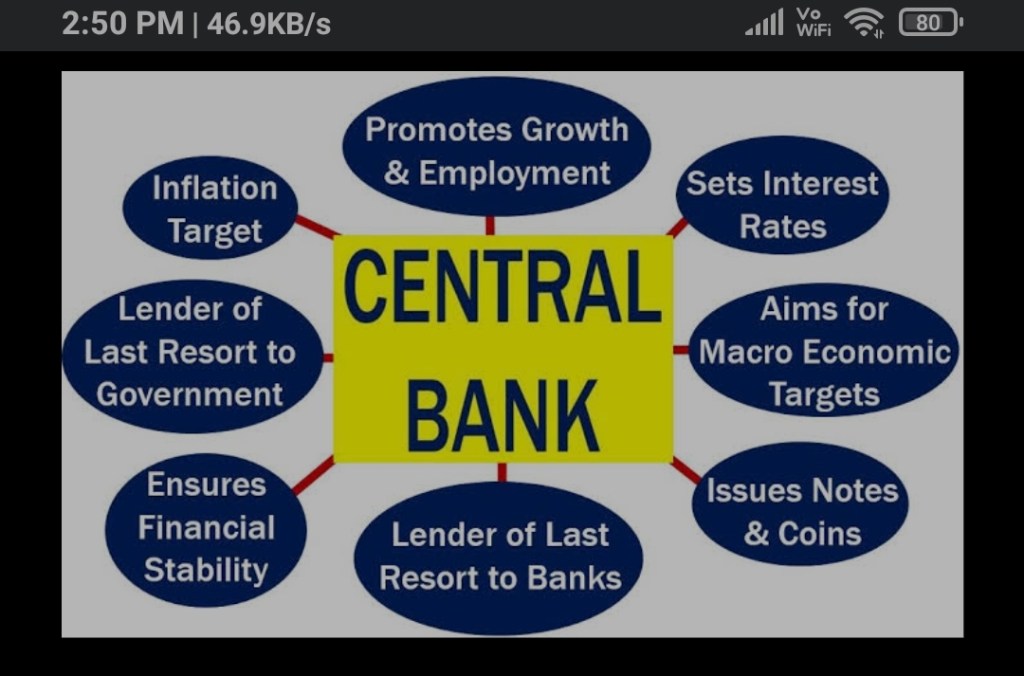
A central bank is the apex institution of the monetary and banking structure of the country.

It performs several important monetary  functions in the banking system.

According to A.C.L. Day a central bank ” helps and controls and stabilizes the monetary and banking system .

Along with several other essential functions, the central bank ‘s most important function is to control the credit creation power of commercial banks .

“Central Bank also known as Controller of Credit “

Credit control is the means to control the lending policy of commercial banks by the Central Bank .

The central bank controls credits in accordance with the needs of business and with a view to carrying out the broad monetary policy adopted by the state.

It adopted two methods of credit control :-

Quantitative Credit Control Methods

Qualitative Credit Control Methods

Open market is one of the methods of quantitative credit control used by the central bank .

What is open market Operations ( OMO ) ?

Open market Operations in general terms means dealing with government securities and bonds.

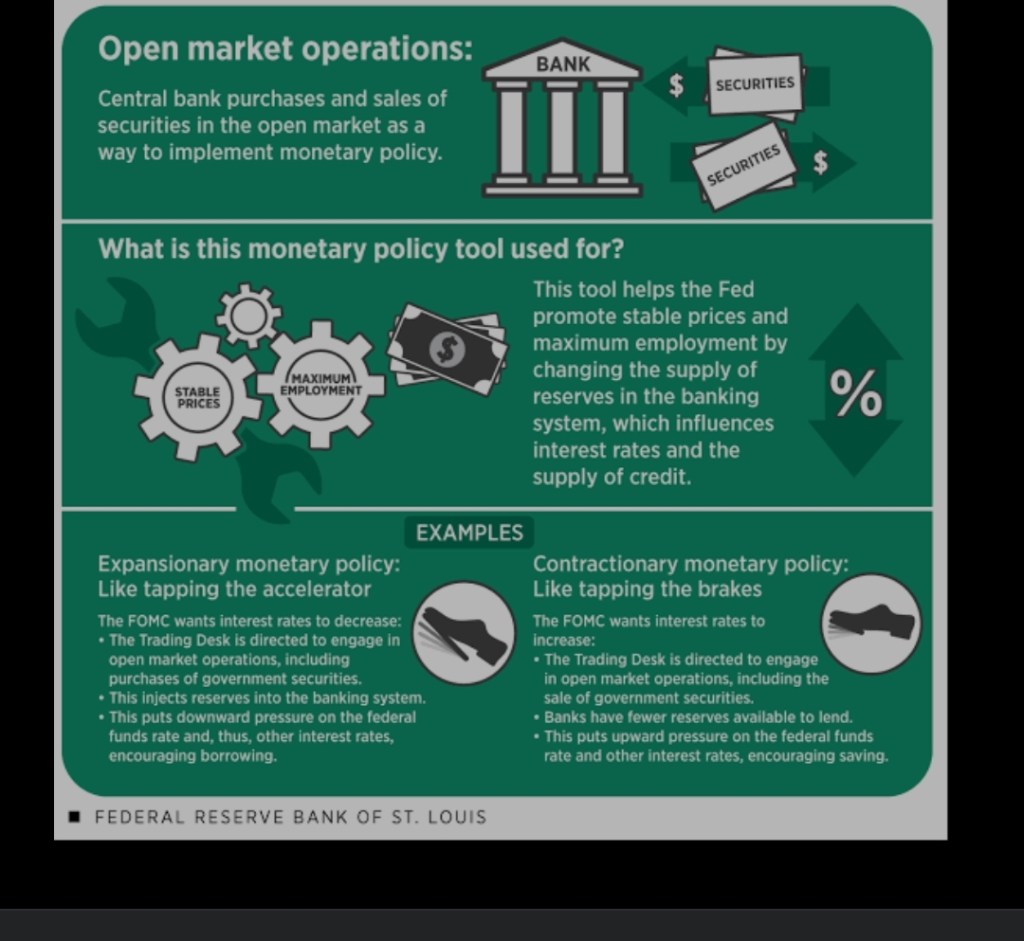
To elaborate more, Open Market Operations  refers to the sale and purchase of securities , bills and bonds of government as well as private financial institutions by the Central Bank . 

OMO is an activity by a central bank to give or take  liquidity in its currency to or from a bank or a group of banks.

There are two principle motives of open market Operations

• to influence the reserves of commercial bank in order to control power of credit creation 

• to affect the market rates of interest and supply of base money

In order to manipulate the short-term interest rate and the supply of base money in an economy, i.e to  indirectly control the total money supply, the central bank  buys and sells government securities, or other financial instruments.

 Monetary targets, such as inflation, interest rates, or exchange rates, are used to guide this implementation.

In the given figure , S is the supply curve of bank money which shifts to the left as S¹ showing a decrease in the supply of bank money from B to A , given the level of interest rate r .

When the central bank aims at an expansionary policy during a recessionary period , it purchases government securities from the commercial banks and institutions dealing with such securities .

The supply curve of bank money shifts from S¹ to S², showing an increase in the supply of bank money from B to C .

The bank will now lend more at the given rate of interest r.

As the result of change in supply of bank money in market through the open market operations

The market rates of interest also change .

A decrease in the supply of bank money through sale of securities will raise the interest market  rates and an increase in supply of bank money will reduce the market rate interest. ___________________________________________

Open Market Operation policy in India 

The  fact that India  is a developing country its  capital flows are very different from those in developed countries which influence   the Open Market Operation policy .

 India’s central bank, the Reserve Bank of India (RBI), has to make policies and use instruments accordingly.  RBI’s major source of funding and control over credit and interest rates was the cash reserve ratio (CRR) and the SLR (Statutory Liquidity Ratio). But after the reforms, the use of CRR as an effective tool was deemphasized and the use of open market operations increased. OMOs are more effective in adjusting. 

RBI use two types of OMOs :- 

Outright purchase (PEMO):

 It is  outright buying or selling of government securities. 

Repurchase agreement (REPO):

It  is short term, and is subject to repurchase.

OMOs are the most effective credit control instrument with the central bank and are preferred over other methods.

__________________________________________

Limitations of Open Market Operations

Although being an effective method OMO has certain limitations such as :-

Lack of Securities Market :-. It is important to have an organised security market system for central banks to buy or purchase securities on a large scale.

Unstable Cash Reserve Ratio:-  The buying and selling of securities and bonds by central banks highly influence the cash reserve ratio which is to be maintained at a fixed rate .

Penal Bank Rate  : – According to Profs Aschheim penal rate is one the necessary conditions for success of open market operations. If the penal bank Rate of discount is higher than the market rates of interest , the commercial bank can not increase their borrowings.

Pessimistic and Optimistic Attitude :- The pessimistic and optimistic attitude of the business community also limits the operations of open market policy. A business may be unwilling to take the risk of taking out a loan during a depression . 

Velocity of Credit and Money not Constant :- The velocity of credit increases during periods of brisk business activities and decreases in periods of falling prices. Hence ,the unstableness of velocity of credit and money constantly affects open market operations. 

Despite the given limitations , the central banks find the Open Market Operations instrument the most successful for controlling credit in developed as well as developing countries.

Outsourcing of Services

A Business refers to a set of organised activities for production and exchange of goods and services, with an objective to earn profits.

It includes several services to complete the process for managing business enterprise.

There are certain important services that are rendered outside the business to enable the enterprise perform its primary functions smoothly.

These services include financial services , advertising services , customer support services , etc.

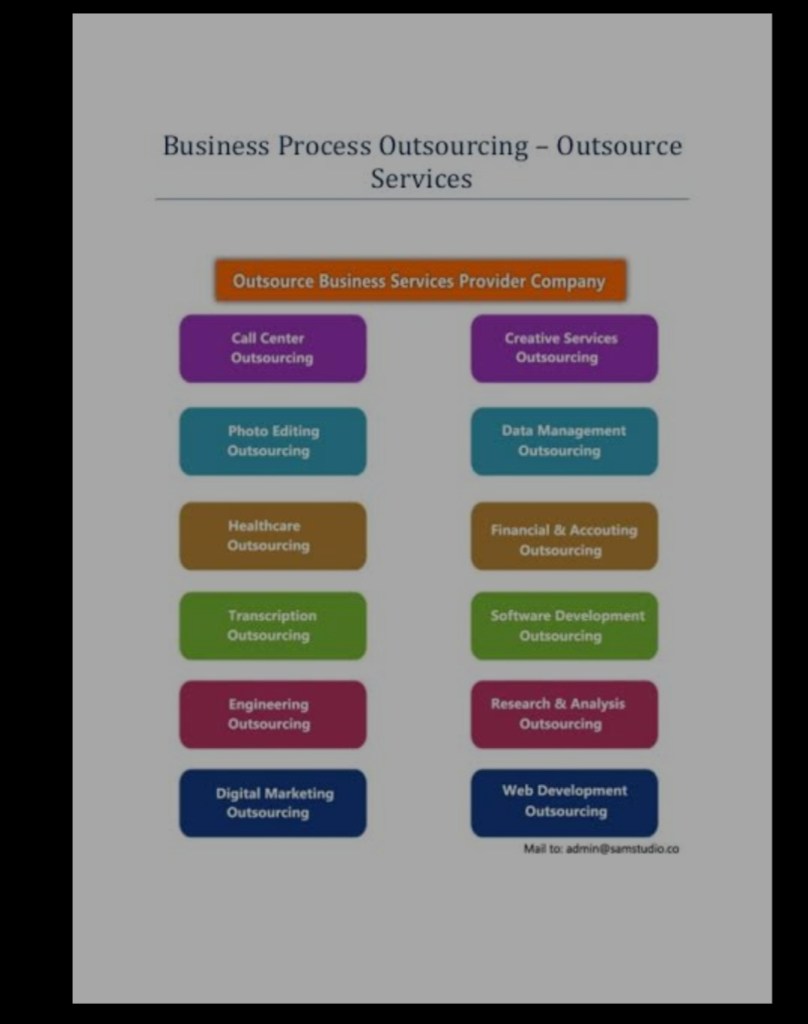
Services done through specialised agencies outside the business enterprise are known as outsourcing of services .

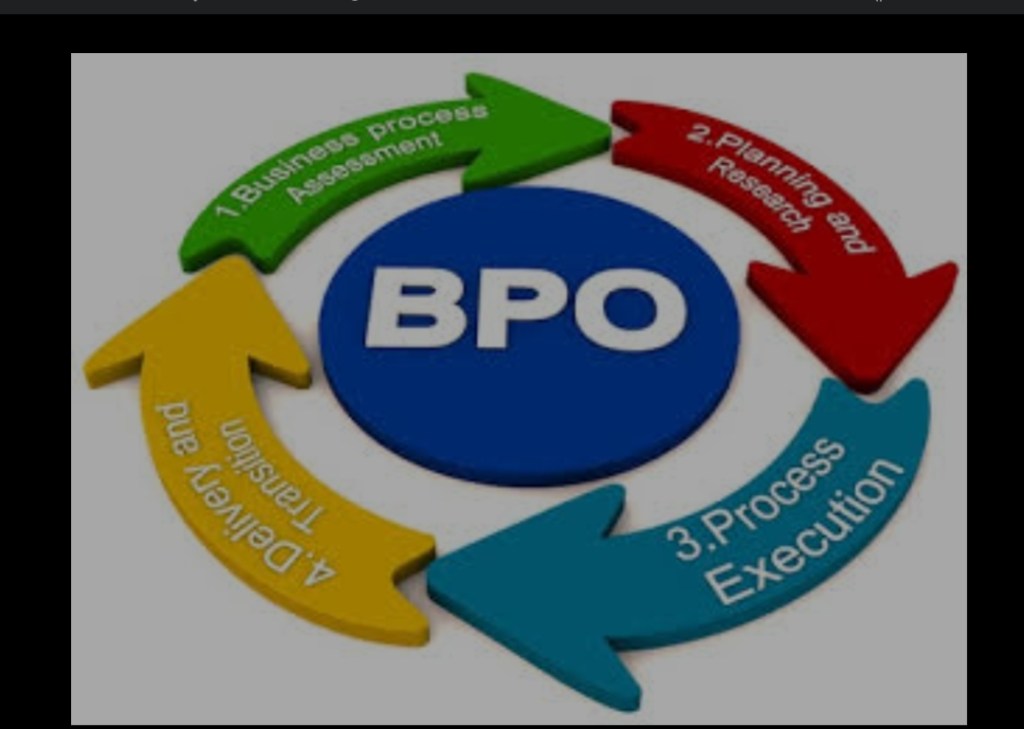
This practice is called Business Process Outsourcing (BPO ) .

Outsourcing means getting an external source service rather than an internal source of the enterprise.

Hence , instead of setting up it’s own department business enterprise outsource it from other external specialised agencies.

A business enterprise prefers to outsource those services that are specialised in nature and performed on a regular basis. These services include accounting data processing, content development , customer care , customer contact , legal services , repair work , advertising services, fittings , employment of employees , training of employees, payroll accounting,etc.

The outside company,  the service provider or a third-party provider, arranges for its own system of labour and technical activities  to perform the tasks or services by the hired  company .

In today’s competitive environment ,the main focus is to concentrate on core specialization and core – competency areas and outsource the rest activities. 

The main intention of outsourcing service is that the business enterprise can concentrate on its core areas of competence and leave the additional work to be outsourced . Outsourcing of services is preferred for better quality and economy .As a result a business enterprise can focus its core task through the front office and leave the rest work meant for the outsourcing.

Business enterprises  often outsource as a way to lower costs, improve efficiencies and gain speed . The benefit underlying this  service is that because the third-party provider focuses on that particular task, it is able to do it better, faster and cheaper than the hiring company could.

Given such benefits, companies often decide to outsource supporting functions within their businesses so they can focus their resources more specifically on their core competencies, thereby helping them gain competitive advantages in the market. ___________________________________________

Concept of BPO and KPO 

Business Process Outsourcing (BPO ) :- 

BPO involves contacting external agencies for performing specific business functions . 

Services like call centre jobs meant for customers , contact and payroll preparation , accounting services , courier services , advertising services , customer related services , etc. are some BPO jobs .

BPO job is often divided into two categories 

• Bank office outsourcing which includes internal business functions such as billing , purchasing etc. 

• Front office Outsourcing which includes customer related services such as marketing , technical support etc.

five BPO exporters according to NASSCOM are Genpact , TCS , WNS Global Services , Wipro and Aegis LTD.

 Broadly there are a few different types of BPO  based on the distance between the two members of the relationship. These types are:

On – shoring :- . Relocating work or services to lower-cost locations in the company’s own country.

Off-shoring:- Relocating work or services to third-party providers overseas.

Near-shoring:- . Relocating work or services to people in nearby, often bordering regions and countries

BPO helps the company to focus on its core competencies without being burdened with routine activities. It helps in increasing the speed of various business processes  and allows business enterprises to retain their entrepreneurial speed and agility .

Knowledge Process Outsourcing ( KPO ) :-

KPO stands for knowledge process outsourcing. Outsourcing of knowledge results in the emergence of a new business activity known as KPO .

 Knowledge process is a high value added process that depends on the skills , knowledge and experience of the people carrying out various activities .

KPO calls for application of highly specialised knowledge .

India still maintains the competitive advantage for providing the most cost – effective and high quantity manpower . KPO derives its strength from the depth of knowledge , experience and judgement factor.

The scope of KPO is vast and it covers information technology (IT) enabled services ,legal processes , intellectual property patent related services , engineering services , web development application , CAD / CAM applications , business research analytics ,legal research , clinical research , publishing market research, etc .

Advantages of Outsourcing :-

• Getting good quality services :-  A business enterprise cannot be expected to have specialization in all activities . As a result , the need for outsourcing services is generally necessary.  Expert advice from outside agencies facilitates success of the business.

• Concentrating on core activities :-  Outsourcing ensures overall better performance of the business enterprise as it can concentrate on core activities of its strength and competence . This has a positive effect on the quantity of service.

• Avoiding Labour Trouble :- Outsourcing reduces the employee related problems as the agencies include their own staff which are not included as enterprise staff . 

• Cost effective Services :- Sometimes , it is economical to outsource some services instead of maintaining a separate department for it which may cost more than expected budget and leads to increase in cost production.

• Avoiding Fixed Investment :- Instead of investing for a separate department a business enterprise gets service from outsourcing . This results in investment savings which can be used for profiting business .

Hence , outsourcing has been viewed as a way to lower costs and gain efficiencies, it is increasingly becoming a strategic tool for companies.

___________________________________________

Disadvantages of Outsourcing .

There are certain Disadvantages that come along with outsourcing .

Disadvantages such as  ,

• Outsourcing Supplier No Longer Able To Supply the service to the Business enterprise which can cause emergency problems .

•. Confidentiality Risk that a business enterprise takes when it selects the option of Outsourcing .

•  By giving away a function of business to an outsource the  enterprise gains the advantage of having an expert for the service but  loses control over that particular function .

• The service may Be more costly than actually expected causing an increase in cost of production.

• Maintaining and securing a trusted relationship is essential in outsourcing efforts and is more complex than establishing service levels and relationships.

Despite disadvantages , outsourcing is opted by my many business enterprises .

The  disadvantages or problems could be avoided by having a trusteeship outsourcing contract and by  examining service level agreements, timeframes ,  rewards, and regular review strategies . 

___________________________________________

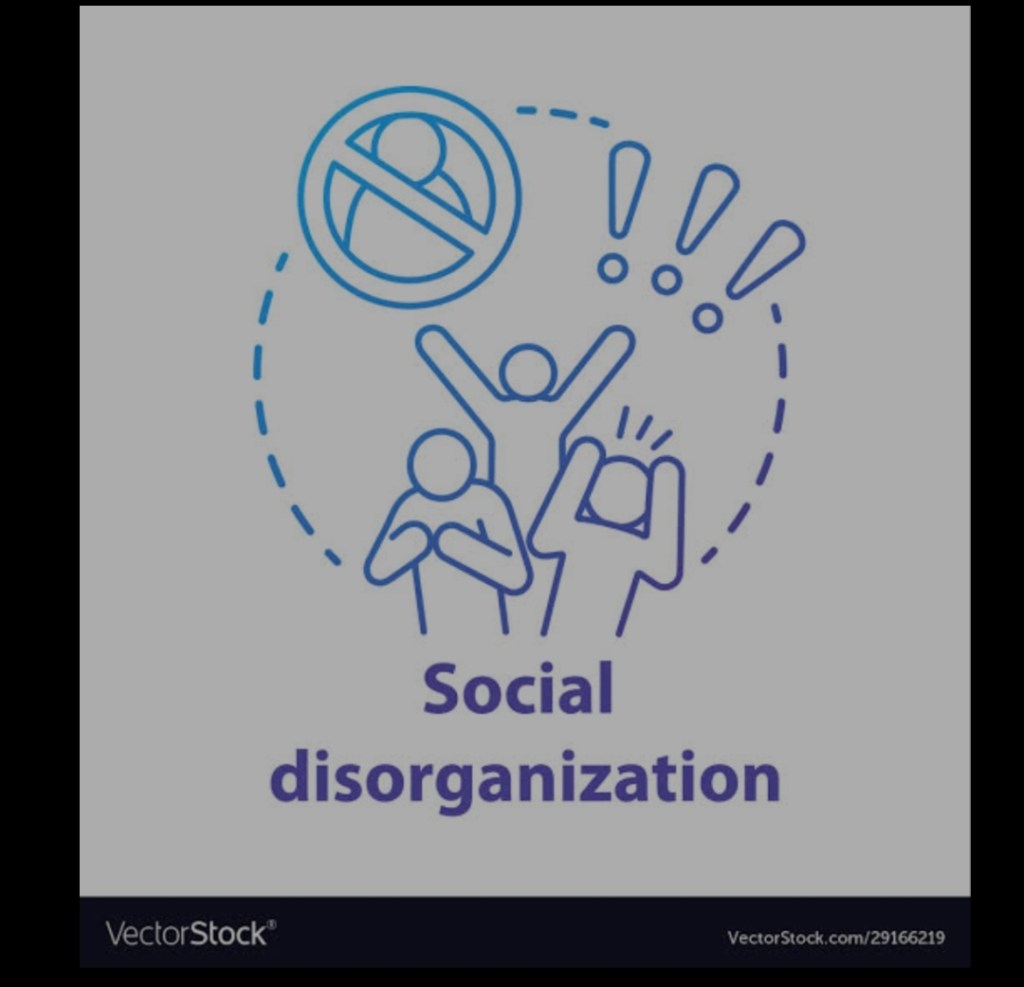
What is Social Disorganisation?

Disorganisation is a disturbance of the balance existing in the functioning of parts . The criterion of disorganisation is the function of what is done or not done …” 

                           Ogburn and Nimkoff 

Human are part of nature and just like nature 

Humans have their own order . The orderliness depends on its internal strength to maintain its equilibrium . Society is said to be in equilibrium or orderliness as long as all the orders are functioned properly .

Whenever social equilibrium a severely disturbed ” social disorganisation ” sets in .Thus ” social disorganisation ” can be understood as nothing but the state of social disequilibrium in  which the smooth functioning of various parts of society gets disturbed .

Disruption or breakdown of the students of social relations and values resulting in the loss of social controls over individual and group behaviour is disorganisation .

Concept of Disorganisation 

The concept of ” disorganisation ” occupies a prominent place in modern sociological literature. 

The concept was developed by Thomas and Zanaiecki in their famous book , ” The Polish Peasant in Europe and America .”

According to them the term ” social disorganisation” refers to the decrease in the influence of the existing social rules of behaviour upon individual members .

Social Disorganisation is the process opposed to social organisation . Social organisation concept in an orderly relationship of parts .

Stuart A. Queen , Walter B Bolenjafter and Ernest B. Harper described social disorganisation in their book , ” Social Organisation and Disorganisation” as the counterpart of social organisation.

The term social organisation and social disorganisation are relative terms . They represent two aspects of the whole functioning of the social system

Comparing social disorganisation with social organisation Queen & Harper writes , 

If social organisation means the development of relationships which persons and groups find mutually satisfactory , disorganisation means their replacement by relationships which are disappointed, thwarted ,wishes , irritation and unhappiness. “

Hence , When the social equilibrium is disturbed and society gets out of gear i.e get disorganized.

Definitions:-

Emile Durkheim defined social disorganisation as , 

“a state of disequilibrium and lack of social solidarity or consensus among the members of society.”

According to Mowever , social disorganisation is ” the process by which the relationships between members of a group are shaken “

Robert Eolofairs states , ” social disorganisation is a disturbance in the pattern and mechanism of human relations .”

According to Elliot and Merrill , ” Social disorganisation represents a breakdown in the equilibrium of forces , a decay in the social structure , so that old habits and forms of social control no longer function effectively.”

Thus , social organisation implies a breakdown in bonds of relationship , coordination , teamwork and morale among groups and interrelated persons so as to impair the functions of the society or smaller social organisation. ___________________________________________

Characteristics of Social Disorganisation 

Conflicts of Mores and of Institutions :- Mores and institutions are part of every society which regulate the social life of members .

The urge to innovate and liberalise with the passage of time makes old mores and institutions less effective and leads to the rise of new ideas and institutions  according to new needs .

This leads to an unwanted conflict disturbing the social order and causing social consensus.

Many social practices , ideals and institutions relating to female education , patriarchal family , widow marriage , dowry system , sati system etc are examples of such  conflicts .

Individuation :-  Man is more prone to think of himself and in terms of his own pleasure and leisure. The modern system has a great impact on individuation or individualistic aspects . The individuation affects the group behaviour of the society . Important issues such as education , marriage , occupation , etc , have become matters of individual decisions which are caused by the changing social values . This causes disturbance in social organisation and states towards disorganisation.

• Inconsistency between expectations and achievements :-  In disorganised society considerable inconsistency is visible between the expectations embodied in the social role and the extent to which these expectations can be realised by most persons.

When a large number of people in the society try to achieve goals in and anti – social manner there is a clear indication of the society being in a state of social disorganisation .

Transfer of functions from one group to another :-  Society undergoes many changes of social groups  time to time due to its dynamic nature . These changes result in social disorganisation as many do not respond well with changing the group pattern or functions of group in the society .

Inconsistency between status and rule :– Status and role of each individual are well defined . Changing social values and norms conditions may bring  the possibility of a conflict taking place between statuses of individuals and their roles .

Hence , disorganisation is characterized by an extreme uncertainty of social rules .

Types of Disorganisation 

Elliot and Merrill stated three types of disorganisation which are interrelated to each other .

Three types of disorganisation are :-

Personal Disorganisation

He stated ,

the symptoms of persons disorganisation includes  juvenile delinquency , various types of crime , Insanity , drunkenness , suicide and gambling.

Family disorganisation

It includes divorce , illegitimate births , desertion , venereal disease.

Community Disorganisation.

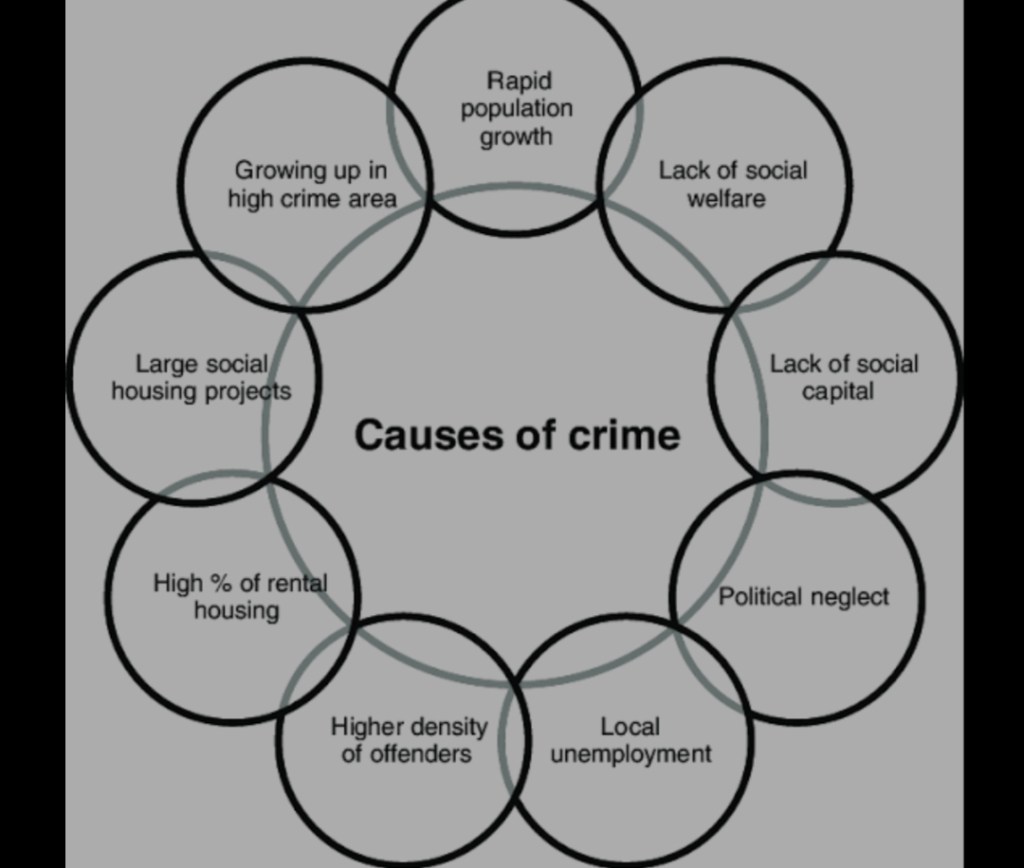
It includes poverty, unemployment, overpopulation , lawlessness , and political corruption .

____________________________________________

Causes of Disorganisation 

Social disorganisation is a complex process. To face challenges of social disorganisation it is necessary to study the nature of its causes . There are a number of factors that cause social disorganisation .

According to Sorokin , social disorganisation is the result of cultural degeneration of values in various spheres like arts , religion , law , family , economy , etc. 

Hence , the change from Idealistic and ideational  culture to sensate culture is the main cause of disorganisation.

Elliot and Merril mentioned four major causes of disorganisation, ( •) the process under the three main heads :- cultural , political and economical.

(•) cultural Lag (•) conflicting attitudes and values (•) social crisis. 

G.R. Madan has listed few factors that causes disorganisation such as

•  psychological factors 

• physical and geographical factors.

• biological factors

• ecological factors

• Social problems 

• degeneration of Values 

Social disorganisation has been and is always present in every society. Society is in equilibrium as long as its parts are properly adjusted and fulfilled .Social Disorganisation breaks down the normal functioning of the parts and disturbances leading to some other kind of problems . Disorganisation leads to functional imbalance between various elements of social structure.

The remedies of social disorganisation can be taken after understanding the true nature of that particular  social control caused due to disorganisation.

___________________________________________

What is Social Conformity ?

The society maintains its order by means of the Normative system .
Normativity is the phenomenon in human societies of designating some actions or outcomes as good or desirable or permissible and others as bad or undesirable or impermissible. A norm in this normative sense means a standard for evaluating or making judgments about behavior or outcomes.

Normative system refers to the system of rules which the people are expected to accept , obey and appreciate .

When the people act in consonance with the norms they become “Conformists “.

People often choose to conform to society rather than to pursue personal desires – because it is often easier to follow the path others have made already, rather than forging a new one.

Norms which are implicit, specific rules, shared by a group of individuals .
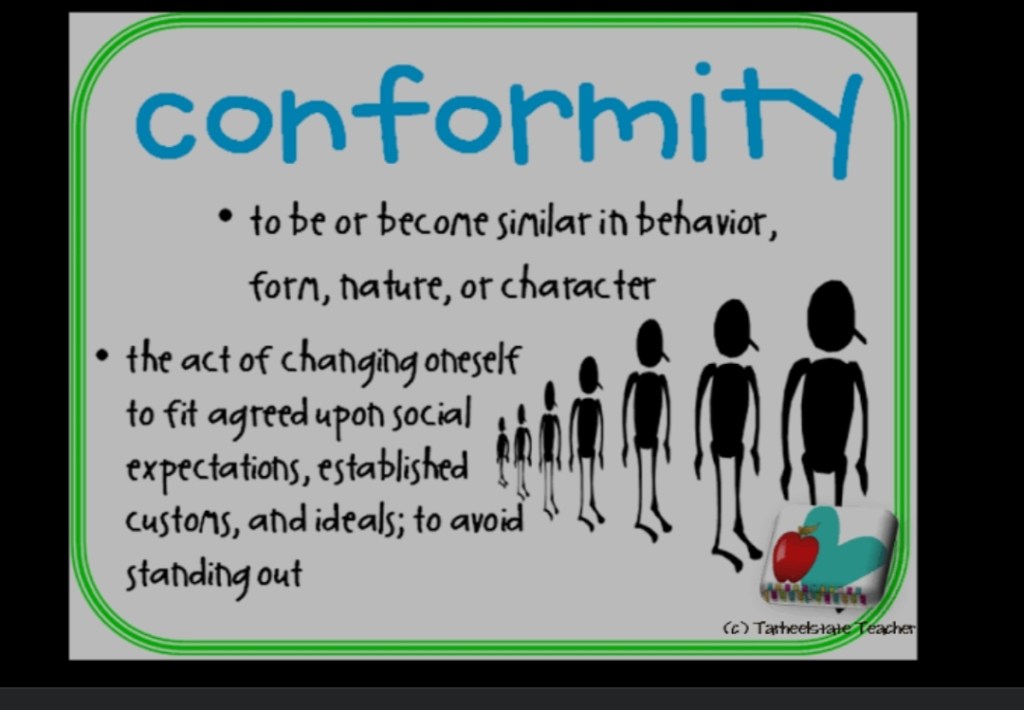
Conformity is action that is oriented to social norms and falls within the range of behaviour permitted by the norms .

Hence , conformity is the act of matching attitudes, beliefs, and behaviors to group norms.
Unwillingness to conform carries the risk of social rejection. Conformity strongly affects humans of all ages.

Conformity implies behaving in accordance with the norms .
It implies that the individual consciously approves of a particular behaviour and is presented to follow the same .


___________________________________________

Types of Conformity :-


Kelman stated three different types of conformity:

Compliance (or group acceptance)

According to Kelman, , this occurs
when an individual accepts influence because he hopes to achieve a favorable reaction from another person or group. He adopts the induced behavior because….he expects to gain specific rewards or approval and avoid specific punishment or disapproval by conformity “

Compliance stops when there are no group pressures to conform, and is therefore a temporary behavior change.

Internalization (genuine acceptance of group norms)
According to Kelman , this occurs ‘

when an individual accepts influence because the content of the induced behavior – the ideas and actions of which it is composed – is intrinsically rewarding. He adopts the induced behavior because it is congruent [consistent] with his value system”


This is the deepest level of conformity where the beliefs of the group become part of the individual’s own belief system. This means the change in behavior is permanent. Internalization always involves public and private conformity. A person publicly changes their behavior to fit in with the group, while also agreeing with them privately.


Identification (or group membership)

According to Kelman , this occurs

when an individual accepts influence because he wants to establish or maintain a satisfying self-defining relationship with another person or group.”

Individuals conform to the expectations of a social role, e.g.doctorsv, lawyers , nurses, police officers. It is similar to compliance as there does not have to be a change in private opinion.
___________________________________________

Causes of Conformity:-

Harry Johnson established a few causes of Conformity to the social norms .
Some of them are :-

Socialisation :- it is through the process of socialisation that social norms are internalised by the individuals. Hence , norms become an inseparable part of their personality . Proper social training always supports conformity.

Hierarchy of Norms :- Norms are ranked in order of precedence . The hierarchy of norms as well their time and place aspect is part of culture .
For instance , a soldier may be put to such a conflicting situation in which either he will have to attend to the needs of the ailing mother who is on the deathbed or rush to the battle ground to attend to the urgent call of the army .
The hierarchy values and norms of his society help the soldier to make the appropriate decision.

It is through the socialisation hierarchy aspects of the norms are learnt . If the different aspects of the culture system are properly integrated an individual will have no difficulty in following the expected forms of behaviour .

Social Control :- Various formal as well as Informal means of social control help the socialised actor to imagine and anticipate what would happen to him if he violated the norms . Thus sanctions lead to conformity even though they are not actually applied .

Ideology :- People’s conformity to group norms depends to some extent upon the ideas and ideology that they hold . The norms partly express broader values that are more purely and precisely emphasized in ideology . Ideology strengthens faith in the existing system. Ideology adds to the norms themselves a kind of an “Intellectual ” support . Hence helps to motivate people to conform to its norms.

Vested Interest :- Conformity to social norms does not always depend upon idealistic motives alone . Sometimes , due to vested interest or self – interest also people conform to them . Norms define rights as well as obligations . They protect our rights also .
Some of the rights protect the exclusion of other members . Those who enjoy such advantages are likely to be satisfied with the norms that protect them . Hence , they support these norms with a greater sense of conviction than the disadvantaged persons . Property rights are a good example in this regard.

Other causes

Robert Bierstedt gives four causes for the question – ” why we conform to the norms “
Some causes are :-

• Indoctrination :- We conform to the norms simply because we have been indoctrinated to do so . Indoctrinated refers to the process of injecting into the personality of the child the group norms . The norms that are indoctrinated become a part and parcel of the personality of the individual. Conformity to the norms becomes very natural because of indoctrination.

Habituation :- What is customary is likely to become habitual in many cases . Some norms are indoctrinated in the beginning , but they become habitual practices afterwards.
We are taught to wash our hands and mouth before and after meals but after a while it becomes a matter of habit . Repetition makes a practice a habit and most of the folkways come to be rooted in the individual in this way .
Habituation reinforces the norms and guarantees the regularity of conformity.

Utility :- Norms help us interact with others with much comfort and ease . We appreciate the unity of norms and hence we conform to them . In many social situations we realised the utility of the norms to which we conform.

Group Identification :– We conform to the norms of our own social groups rather than to those of groups to which we do not belong . We thus conform to the norms because conformity is a means of group identification . By conformity to the norms we express our identification with the groups .
Sometimes , some groups even conform to some irritating folkways because they are their own and they identify them with their society and their own social groups.

___________________________________________

Social Control and Conformity

Social control ” refers to various ways and means by which a group or society attempts to achieve social order . Social Order could be achieved by making the people accept and follow the group norms . Behaving in accordance with norms or rules can be referred to as Conformity.

Thus , one of the main purposes of social control is conformity . Social control also involves the processes and means whereby deviations from social norms are limited by the group.

Conformity to institutionalised norms is ,of course , ‘normal ‘. The individual having internalised the norms , feels something like to need to conform.

Both internalised need and sanctions are effective in bringing about conformity .
Conformity is achieved by two different ways –
: Immediate conformity which is the result of social pressure or control
: Long term result of conformity which is the product of socialisation .

Social factors constrain the individual to follow the group pattern . The reason an individual greatly values group life is because the group provides us many advantages and satisfaction.

The social control towards conformity is always in terms of the prevailing norms .
Many individuals who don’t agree with certain norms accept and conform to them outwardly . Those who are not convinced of them lack the power to resist them .

Thus in conformity we find two factors which may or may not be consistent :compliance and conviction .

“Conformity without conviction occurs when the individual cannot withdraw from the group or values much his membership in the group and does not wish to offend or is afraid of the consequences of non Conformity. “

Group norms are actually group standards which the members are encouraged to imitate or follow . But some deviation is bound to be there in every group.

As the deviation from the norm becomes greater the more serious the offence becomes in the eyes of the group and the more serves becomes the penalty .

Conformity influences the formation and maintenance of social norms, and helps societies function smoothly and predictably by the self-elimination of behaviors seen as contrary to unwritten rules.

Hence, for social control it’s important to have social conformity where deviations from social norms are limited by the group .

What are Folkways ?

What are social norms ?

Social norms refer to the group shared standards of behaviour .It is a pattern setting limits on individual behaviour .
Norms are said to be ” blueprints ” for behaviour .
They determine , guide , and control human behaviour .
Norms are not systematically classified by Sociologists . But they are grouped into –
” Folkways “, “mores ” , “fashions “, “rites “, “ceremonies “, “customs ” etc. .


What are folkways ?

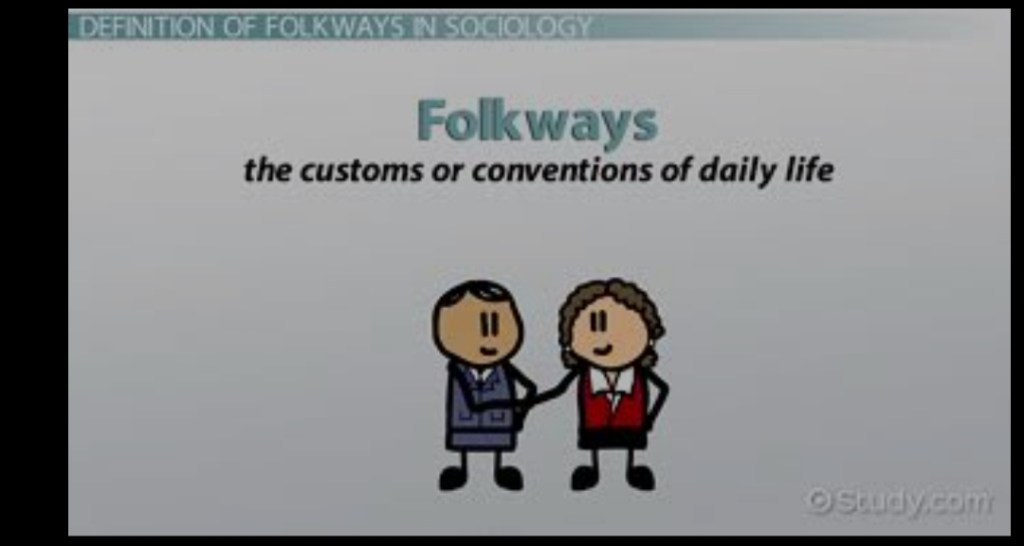
In general , folkways means “ the ways of folk “.
The term ‘folk’ represents people and ‘ways’ represent their behavioural habits .
Folkways are the customary, normal and habitual ways of the group to meet certain needs or solving day-to-day problems.


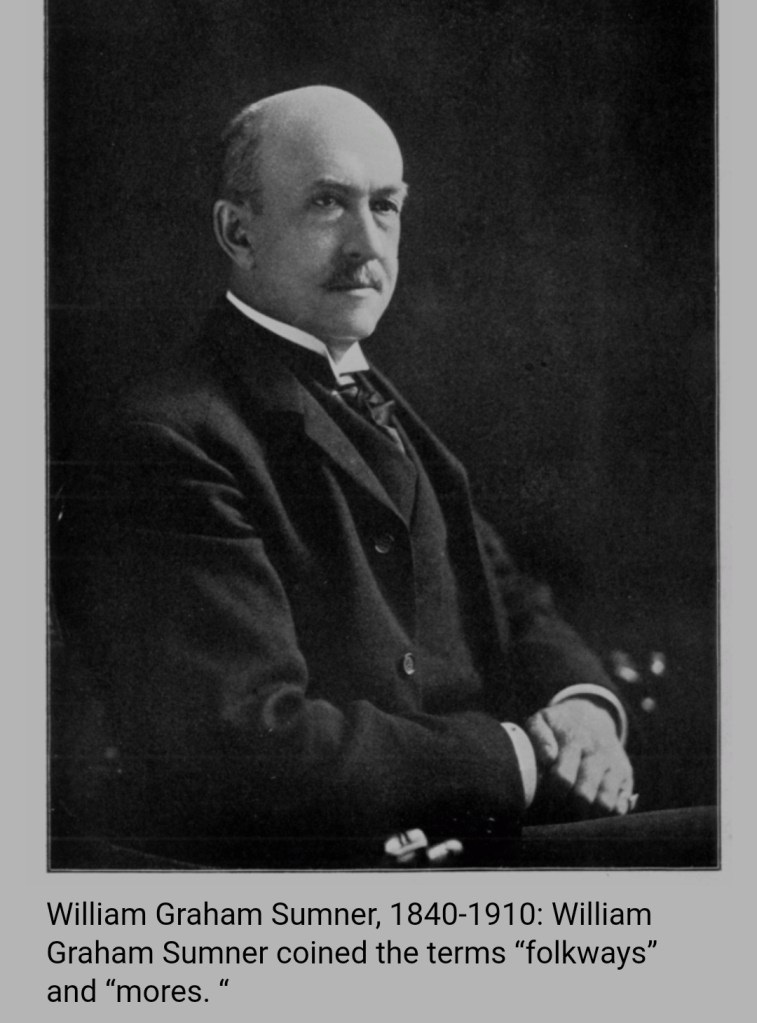
The term folkways was introduced into Sociology literature by W.G .Summer in a book with the title , ” Folkways: A Study of the Sociological Importance of Usages, Manners, Customs, Mores, and Morals ” published in 1906.


Folkways are accepted ways of behaviour.
According to Summer ,
” folkways represent man’s unique means of adapting himself to the environment .


Examples of Folkways :-

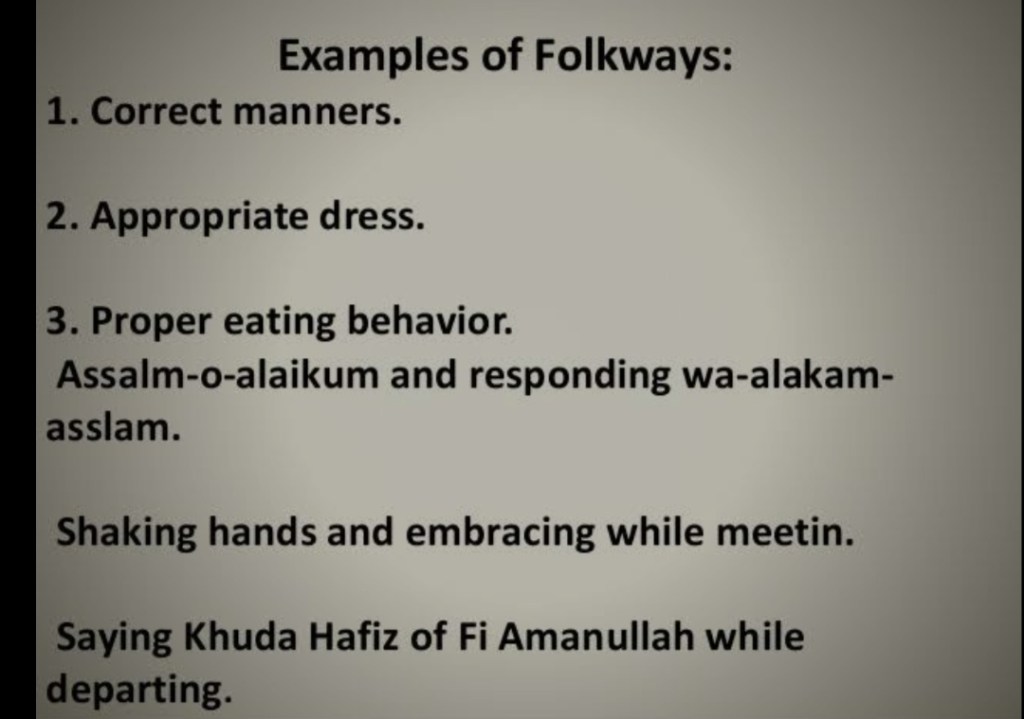
The ways of eating , talking , dressing , playing , walking , working , greeting , conversing ,etc. represent folkways .

The daily activities become an individual’s habits ,but folkways are termed as habits of a group though Not all (group) habits become general. They differ from individual to individual and place to place.

Folkways are a learned process of socialisation. They become the second nature of the individual.

Habits are socially approved habits which are followed by a number of persons in a society are referred as folkways,

Habits of exchanging greetings and courtesies like bidding ‘Namaste’ with joined palms is an.examples of Indian folkways .

Walking on right side if the road , taking three meals a day , Wearing different clothes at different occasions, showing respects to elders , love and affection to younger ones ,
Wearing a cap, hat or turban,.shaking hands, eating with forks and knives, driving on the left or right hand side of the street, attending classes in paints and skirts rather than gowns or bathing suits etc..are some folkways followed by difficult individuals.


Definitions :-


Folkways are behavioural patterns of e everyday life which generally arise unconsciously in s group .”
-.Gillin and Gillin

According to Reuter and Hart (1933),
“The folkways are simple habits of action common to the members of the group; they are the ways of the folks that are somewhat standardised and have some degree of traditional sanction for their persistence”.

Maclver and Page (1949) defined it as:
“Folkways are the recognized or accepted ways of behaving in society.”

A.W. Green opines ,
Those ways of acting that are common to a society or a group and that are handed down from one generation to the next are known as folkways .

Lundberg stated ,
“. Folkways are the typical or habitual beliefs , attitudes and styles of conduct observed within a group or community .”

In simple words , folkways are “repetitive petty acts of the people .”
___________________________________________

Characteristics of Folkways

• Social in Nature :- Folkways are the products of man’s group life . They are created by the groups for their sustenance and maintenance . Individuals get social recognition by comforting the folkways .

Repetitive in Character:– A social practice becomes a folkway when the majority of people observe it constantly and regularly . The often repeated practices of the majority normally become the folkways . These practices become standardized practices by constant repetitions .

Unplanned Origin :– The origins of Folkways are very obscure . Summer believed that they arise automatically and unconsciously . They are not the result of any advance planning . Someone in the group starts a new way and in course of time it becomes popular and a good number of people may start following it but by the time it becomes folkways the origin trace fades away.

Informal Enforcement :– Folkways constitute one of the types of informal means of social control . Folkways are not as compulsive and obligatory as that of laws or morals . Conformity to the folkways is neither required by law nor enforced by any special agency of society. They are not absolutely obligatory though they are considered as necessary .

Folkways Differ a Lot :- Folkways Differ from group to group and society to society . They may also undergo changes in course of time within the same group or society .
For example , table meals are common in the West whereas the majority of Indians used to squat on the floor and take their meals with their hands .

Folkways vary with age and sex in almost all places . They even vary according to social status , religion , ethnic groups , racial groups etc .

Folkways are Numerous :- It is not possible for anyone to enlist all the folkways . There are so diverse and numerous folkways . They range from most trivial acts and behaviour patterns to the most serious ones .

Folkways are subject to Change :- Just like everything folkways are also subject to change . Folkways change according to changes in social conditions .
Summer is referred to as ” fashion ” .
Fashion related to dress , hairstyle , architecture designs , etc. undergo rapid changes .
___________________________________________

Social importance of Folkways

The folkways are the foundation of every culture . They give us a better understanding about a particular culture.
When fully assimilated they become personal habits .

Summer believed , ” the life of society consists in making folkways and applying in them . The science of society must be construed as the study of them .

Folkways have become a universal characteristic of human societies. No society does or could exist without them . Hence they constitute an important part of the social structure . They are most powerful and control the behaviour of individuals in society even more than the state action.

They become a part and parcel of the personality of the infant through the process of socialisation. An individual learns different folkways at different stages of socialisation . They become a form of unstated premises of our mental life .

Folkways play a major part in social control in society, as folkways are informal means of social control.

Hence , folkways are not compulsory or obligatory but constitute an important part of social structure as they become personal habits that contribute stability and order in social relations .

What is World Trade Organisation ( WTO ) ? ( History , Objectives , Principles , Structure )

The World Trade Organisation is the successor of General Agreement on Tariffs and Trades (GATT ).
The WTO Agreement is the Uruguay Round agreement where the original GATT is now part of the WTO Agreement which came into force from January 1,1995.

WTO is a multilateral organisation .It has its headquarter in Geneva , Switzerland. It is the central body that facilitates global trade .


It is the only international organization that deals with global rules of trade between nations.
It provides a framework for conduct of international trade in goods and services.


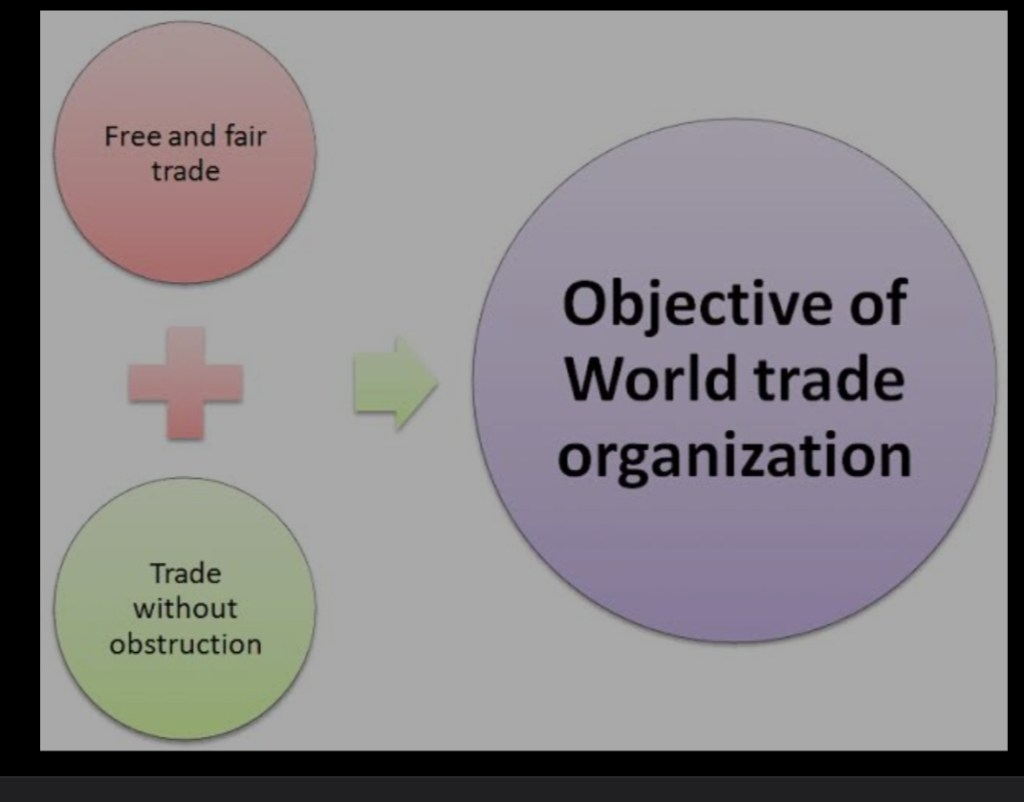
The fundamental objective of the rule-based system of international trade under the WTO is to ensure that international markets remain open and their access is not disrupted by the sudden and arbitrary imposition of import restrictions.


It lays down the rights and obligations of governments in the set of multilateral agreements.
It also covers a wide range of issues related to international trade, such as protection of intellectual property rights and dispute settlement, and prescribes disciplines for governments in formulation of rules, procedures, and practices in these areas.


Structure of WTO

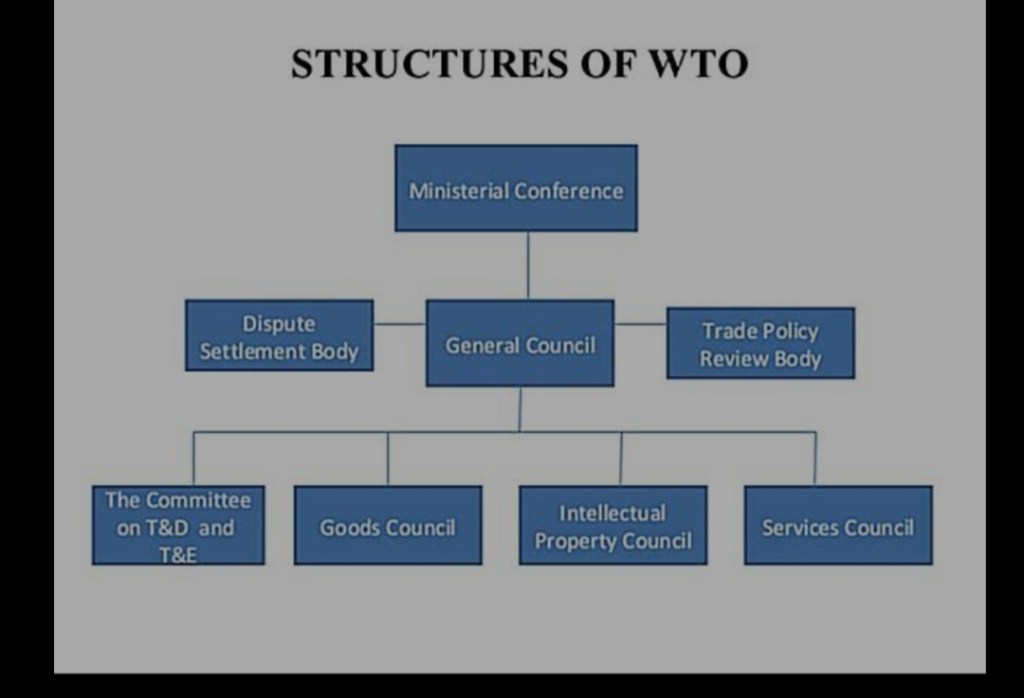
The structure of WTO is headed by the Ministerial Conference composed of representatives of all members which meet at least once every two years.
It carries out the functions of the WTO and takes actions necessary to this effect .

The Ministerial Conference is the supreme authority of the WTO .
The Ministerial Conference operations by different authority bodies.

General Council composed of representatives of all members to oversee the operation of the WTO Agreement and ministerial decisions on a regular basis. It also acts as a Dispute Settlement Body (DSB) and a trade policy review body (TPRB) ,each having its own Chairman.

The Director General , who is the secretariat head of WTO . The Ministerial Conference appoints the Director General and sets out his power duties , conditions of services and term of office. The Director General appoints the members of Staff of the Secretariat and determines their duties in accordance with the regulations adopted by the Ministerial Conference.

There is the Council of Trade in goods , The council for Trade in Services and the Council for Trade Related Aspects of Intellectual Property Right (TRIPs) which operates under the General Council .

Principle of WTO

Five important principles of WTO are :-

Non-discrimination
Reciprocity
Binding and enforceable commitments
Transparency
Safety values

___________________________________________


Objectives

The Preamble of the organisation , The Agreement establishing the WTO lays down the following objectives :-

• It’s relation in the field and economic endeavour shall be conducted with a view to raising standards of living , ensuring full employment and large and steadily growing volume of real income and effective demand and expanding the production and trade in goods and services.

• To allow for the optional use of the world’s resources in accordance with the objectives of sustainable development , to protect the environment and to enhance the means for doing so in a manner consistent with respective needs and concerns at different levels of economic development.

• To make positive efforts designed to ensure that developing countries , especially the least developed among them , secure a share in the growth in international trade commensurate with the needs of their economic development.

• To achieve these objectives by entering into reciprocal and mutually advantageous arrangements directed towards substantial reduction of tariffs and other barriers to trade and the elimination of discriminatory treatment in international trade relations.

• To develop an integrated , more viable and durable multilateral trading system encompassing the GATT , the results of past liberalisation efforts and all the results of the Uruguay Round of multilateral trade negotiations .

• To ensure linkages between trade policies , environment policies and sustainable development.

___________________________________________

Functions :-

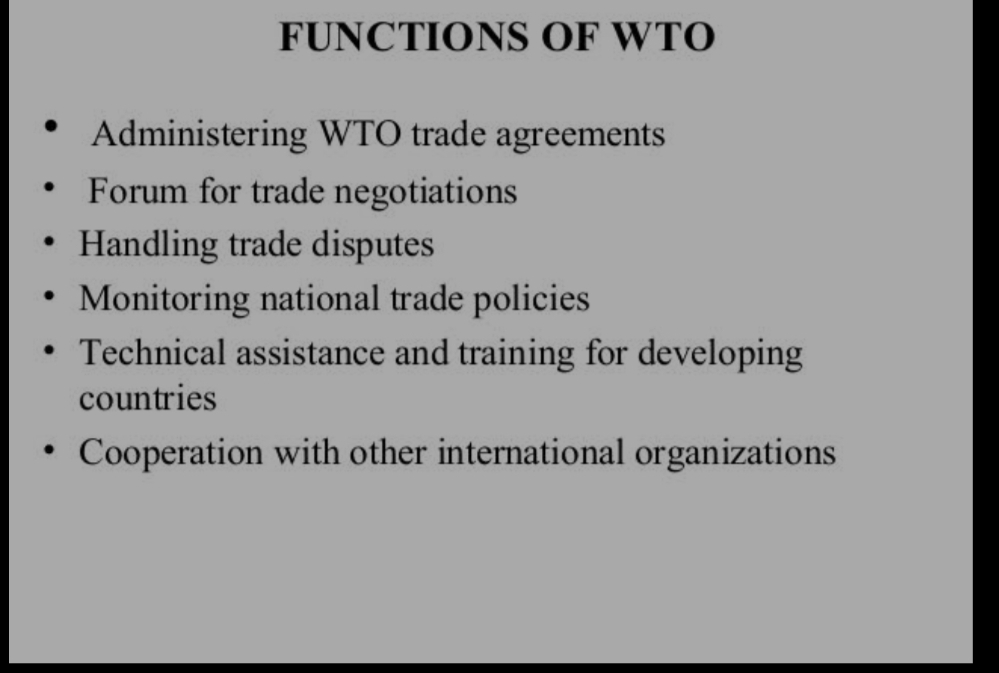
The main functions of WTO are :-

1. To facilitate implementation, administration and operations of the objectives of the Agreement and of the Ministerial Trade Agreement.

2. To provide the forum for negotiations among its members concerning their multilateral trade relations , in matters relating to the agreements .

3. To provide a framework for implementation, administration and operation of multilateral and bilateral agreements of world trade.

4. To administer the understanding of rules and Procedures governing the Settlement of dispute .

5. To ensure the optimum use of world resources.

6. To assist international organizations such as, IMF and IBRD for establishing coherence in Universal Economic Policy determination.

___________________________________________


WTO Agreements

The Agreement establishing WTO consists of the following :-

1: Multilateral Agreements on Trade in Goods :

The general agreement on trade in goods defines the GATT 1994 and includes various agreements dealing with Different aspects related to trade in goods.

• GATT Rules 1994
,•Agreement on Agriculture
•Agreement on Textiles and Clothing
•Agreement on Technical Barriers to Trade
• Agreement on Trade Related Aspects of Investment Measures ( TRIMs)
• Agreement on Anti – Dumping


2: General Agreement on Trade in Services .

This agreement covers all Internationally traded services .It also sets out special conditions relating to individual sectors .

In financial services , it establishes the right of governments to take appropriate measures for the protection of investors , depositors and policy holders to ensure integrity and stability of the financial system.

In telecommunications ,the Agreement requires a Member to establish , construct , acquires ,lease , operate or supply telecommunications transport networks and services and make it available to the public

The GATS also contains consultations and dispute settlement and the establishment of a Council on Services.


3: Agreement on Trade – Related Aspects of Intellectual Property Right ( TRIPs) .

The TRIPs covers seven categories of intellectual property –

• Copyright and Related Rights.
• Trademarks
• Geographical Indications
• Industrial Design
• Patents
• Integrated Circuits
• Trade Secrets

This agreement refers to controls of anti competitive practices for developed countries to bring their legislation and practices into conformity for the implementation of TRIPs.


4:. Understanding on Rules and Procedures governing the Settlement of Disputes.

This agreement applies to consultations and the settlement of disputes between Members concerning their rights and obligations under the provisions of the Agreement establishing the WTO .
For this, a Dispute Settlement System was established .


5: Plurilateral Trade Agreement .

This agreement consists of the Agreement on Trade in Civil Aircraft , Agreement on Government Procurement , International Dairy Agreement and International Bovine Meat Agreement . The first Agreement was made at Geneva in April 1979, as subsequently modified , rectified or amended . The latter three Agreements were done at Marrakesh on April 15,1994.


6: Trade Policy Review Mechanism.

The TPRM aims to carry out reviews of the trade policies and practices under the Multilateral Trade Agreements and the Plurilateral Trade Agreements for the smoother functioning of the multilateral trading system.To operate this purpose , Trade Policy Review Body ( TPRB) was established. For better transparency each member reports regularly to the Trade Policy Review Body about the trade policies and practices pursued by it .

__________________________________________

What is The International Monetary Fund ?

Intergovernmental organisations (IGOs) have always played a very important role in the global economy . These groups are generally created through the enactment of a treaty and are composed of a group with member states . The goal of individual IGOs depends on their genre of function and membership . Some of the most common and widely known IGOs include the United Nations , the World Bank and International Monetary Fund ( IMF)

International Monetary Fund () IMF also called The Fund , based in Washington ,D.C. is an international monetary institution established by 44 nations under the Bretton Woods Agreement of July 1994.

The IMF was established to promote economic and financial cooperation among its members in order to facilitate the expansion and balanced growth of world trade . It started functioning from March 1,1947 , the Fund has currently 189 member countries each of which has representation on the IMF ‘s executive board in proportion to its financial importance .

IMF is an international organisation that promotes global economic growth and financial stability, encourages international trade and reduces poverty Quotas of member countries .

IMF ‘s mission is

“To foster global Monetary cooperation ,secure financial stability , facilitate international trade , promote high employment and sustainable economic growth and reduce poverty around the world.”

Origin :-

IMF was originally created in 1945 ,as part of the Bretton Woods Agreement, which attempted to encourage international which attempted to encourage international financial cooperation .

The principal aim was to avoid the economic mistakes of the 1920s and 1930s . The attempts of many countries to return to the old gold system after the First World War failed miserably.

The World Depression of the thirties forced every country to abandon the gold standard .This led to adoption of nationalist policies which marked decline in world trade and extension of depression.
44 nations assembled at the United Nations Monetary and Financial Conference at Bretton Woods, New Hampshire from July 1 to July 22,1944 and established The International Monetary Fund .

The Article of Agreement of the IMF provided the basis of the international monetary system .


Structure of The Fund


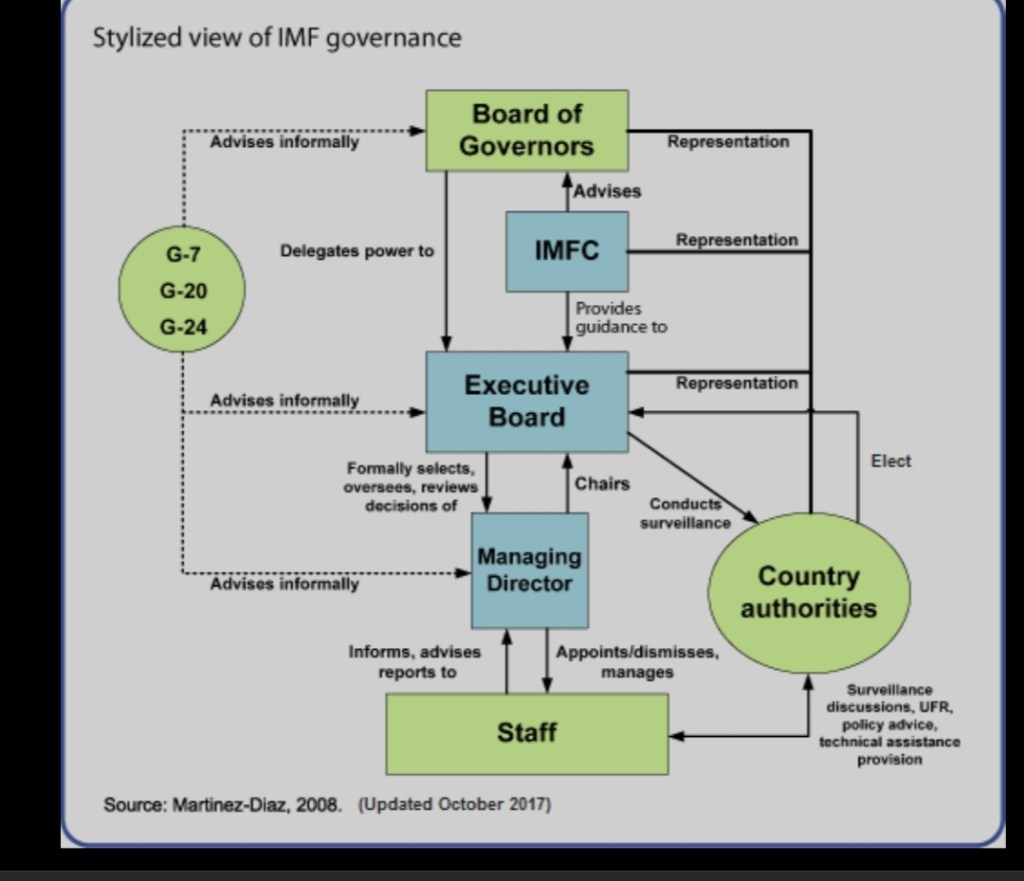
The structure of The Fund consists of a Board of Governors , an Executive Board , A Managing Director, a Council and a staff with its headquarters in Washington DC, USA.

The Board of Governors is the top in the structure of The Fund . They are decision making organs of the Fund..They exercise power and make decisions that are binding on members and the Fund .

The board of the Governors, which now has 24 members ,meets annually in which details of the Fund activities for the previous year are presented.

Other members include :-

The Executive Board , which has 21 members at present . Five Executive Directors are appointed by the five members ( USA , UK , Germany., France and Japan ) having longest quotas .

The Managing Director is elected by the Executive Directors .He is usually political or any other international official.

The Interim Committee (now IMFC ) , is established to advise the Board of Governors on supervising the management and adoption of international monetary policy .

The Development Committee advises and reports to the Board of Governors on all aspects of the transfer of real resources to developing countries .


Objectives :-

The fundamental purposes and objectives of the Fund had been laid down in Article 1 of the original Articles of Agreement . The major six objectives of IMF are :-

1: To promote international monetary cooperation through a permanent Institution which provides the machinery for consumption and collaboration in international monetary problems.

2: To facilitate the expansion and balanced growth of international trade, and to
contribute thereby to the promotion and maintenance of high levels of employment and
real income and to the development of the productive resources of all members as
primary objective of economic policy.

3: To promote exchange stability, to maintain orderly exchange arrangements among
members, and to avoid competitive exchange depreciation.

4: To assist in the establishment of a multilateral system of payments in respect of
current transactions between members and in the elimination of foreign exchange
restrictions which hamper the growth of world trade.

5: To give confidence to members by making the general resources of the Fund temporarily available to them under adequate safeguards, thus providing them with the
opportunity to correct maladjustments in their balance of payments, without resorting
to measure destruction of national or international prosperity.

6: In accordance with the above, to shorten the duration and lessen the degree of dis –
equilibrium in the international balance of payments of members.
___________________________________________

Functions of IMF

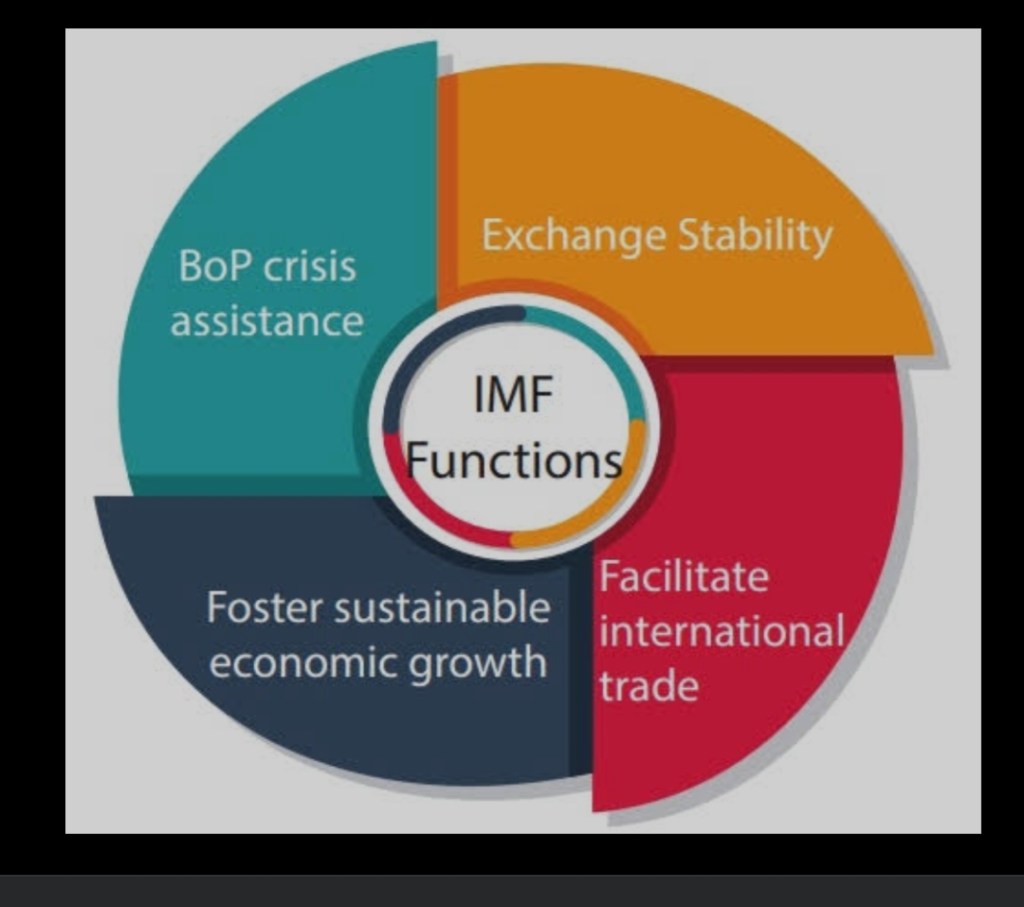
The principal function of the IMF is to supervise the international monetary system.
Several other functions performed by the IMF .
Three major functions of IMF are :-


Surveillance over Members Economic Policies :-

The IMF closely monitors each member’s country’s economic and financial development . The IMF holds a conference with member countries on a regular basis Usually once each year to assess its economic conditions with a view to providing policy recommendations .


Financial Assistance :-

IMF functions as an agency of providing resources to meet short term and medium term
. It lends to its member countries facing BOP disequilibrium .

IMF loan is usually provided under an “arrangement ” requiring a borrowing country to undertake the specific policies and measures to resolve it’s balance of payments problem as specified in a “Letter of Intent ” .
Most IMF loans are primarily financed by its member countries through payment of quotas .


Consultative Function:

It functions as a centre for international cooperation and a source of counsel and
technical assistance to its members.IMF provides technical assistance to help member countries strengthen their capacity to design and implement effective policies in four areas :- monetary and Financial policy ; fiscal policy; statistics ; and economic and financial legislation.

Other functions :-

• Stabilizing Economics
• Maintaining Balance between demand and supply of member countries.
• Maintenance of Liquidity .
• Reducing tariffs.
• General watch .
___________________________________________

Financial Resources of The Fund :-

The bulk of financial assistance performed by the IMF has its financial resources from two sources .


(i) Subscription or quota of the member nations :-

Each member country is required to subscribe to an amount equivalent to its quota. It is
the quota on which payment obligations, credit facilities, and voting right of members
are determined. As soon as a country joins the Fund, it is assigned a quota which is
expressed in Special Drawing Rights (SDRs).


(ii) Borrowings :-

The Fund is authorised to borrow in special circumstances if its own resources prove to
be insufficient. It sells gold to member countries to replenish currency holdings. It is
entitled to borrow even from the international capital market. Though the Articles of
Agreement permits the Fund to borrow from the private capital market.

The IMF has two accounts of
operation—the General Account and the Special Drawing Account.
The Fund burrows under the General Arrangements to Borrow in order to forestall or cope with an impairment of the international monetary system.
__________________________________________

Credit Tranches :-

To meet the severe BOP disequilibrium , the Fund has been gradually raising the limit of borrowing by its members under the credit tranche.
Since the 1960s , the Fund has created several credit facilities for its members.

Some borrowing facility provided by the Fund are :-

(i) Stand-by Arrangements:
The term “stand-by” here
means that, subject to conditionality, a member has a right to draw the money made available, if needed.
This method of borrowing has become the most normal form of assistance by the Fund.
Under this form of borrowing, a member state obtains the assurance of the Fund that,
usually over 12-18 months, requests for drawings of foreign exchange (i.e., to meet
short- term BOP problems) up to a certain amount will be allowed if the country
concerned wishes.
However, the stand-by arrangements can be extended up to 3 years while repayments
are required to be made within 3-5 years of each drawing.


(ii) Extended Fund Facility (EFF):
Stand-by arrangements to stabilise a member’s BOP run usually for a period of 12-18
months. Developing countries suffer from chronic BOP problems which could not be
remedied in the short run. EFF provides credit upto a period of 10 years and loan upto 300 percent of a member’s Quotas are allowed.


(iii) Compensatory Financing Facility (CFF):
Apart from the ordinary drawing rights, there are some ‘special finances’ windows to
assist the developing countries to tide over BOP difficulties. CFF, introduced in 1963, is
one such special drawing provision.
It can now draw up to 45 p.c. Since the mid- 1990s, this has been the least-used facility.


(iv) Structural Adjustment Facility (SAF) and the Enhanced SAF (ESAF):
In 1986 a new facility—the SAF—was introduced for the benefit of low income
countries.
Under it, credit facilities for economic reform programmes are available at a low
interest rate of 0.5 p. c compared to 6 p.c. for most Fund facilities. Loans are for 10
years with a grace period of five and a half years.
SAF provides to undertake medium-term structural
adjustment programmes to foster economic growth and improve BOP conditions
The ESAF has been replaced
by a new facility, called Poverty Reduction and Growth Facility in 1999.


(v) Poverty Reduction and Growth Facility (PRGF):
The PRGF that replaced the ESAF in November 1999 provides concessional lending to
help the poorest member countries with the aim of making poverty reduction and
economic growth —the central objectives of policy programmes.


(vi) Supplemental Reserve Facility (SRF):
This instrument provides additional short-term financing to member countries facing
exceptional BOP difficulties because of a sudden and disruptive loss of market
confidence reflected in capital outflows of countries concerned. Consequent upon the
After the eruption of the East Asian financial crisis, the SRF was introduced in 1997.

___________________________________________

India And The IMF

India is one of the founder members of the IMF . It signed the Fund Agreement on 27 December , 1945 . Till 1970 India ‘s Quotas in the Fund was the fifth and it had the power to appoint permanent Executive Directors.


With increase in the Fund Quotas of other countries like Canada , Italy , Japan etc . India ceased to hold a permanent position as Executive Directors .
With the Eleventh Review of Quotas , India’s quota in the IMF declined from 2.09 per cent . As a result , India’s position in the Fund quota came down to 13th .

The current IMF data shows India’s position at seventh .


India has been benefited in certain ways by the IMF by receiving loans to meet the deficit in its balance payment in several years .India has been getting advisory help from the Fund under the Fund surveillance conditionality .
Hence , as a member India has gained much help from the IMF to have an economically stable system.

Credit Creation by Commercial Bank . ( Explanation , Assumptions , Mathematical Representation , Process , Limitations )


Banks play an important role in financial stability and the economy of a country.
It is a financial institution that accepts deposits from the public and creates a demand deposit while simultaneously making loans.


Credit creation is one of the most important functions performed by commercial banks. It separates a bank from other financial institutions . In simple terms credit creation is the expansion of deposits. A bank expands the demand deposit into multiple cash reserves as demand deposits are the principal medium of exchange.

In words of Newly ” Credit Creation refers to the power of commercial bank to expand secondary deposits either through the process of making loans or through investment in securities “

Credit Creation is a situation in which banks give more loans to consumers and businesses with the result that the amount of money in circulation increases . In other words , it refers to the unique power of banks to multiply loans and advances and hence create credit on the basis of the primary deposit of the account holder .

According to G.N Halm ,
“The creation of derivative deposits is identical with what is commonly called the Creation of Credit .”
__________________________________________
Arguments Regarding Credit Creation .

There have been two views on the Credit Creation by bank by two economists
Hartley Withers
Walter Leaf .

According to Withers , banks can create credit by opening a deposit , every time they advance a loan . This is because every time a loan is sanctioned , payment is made through cheques . As long as a loan is due , a deposit of the amount remains outstanding in the books of the bank . This every loan creates a deposit .


Walter Leaf did not agree with this view . According to them, banks cannot create money out of thin air . They can lend only what they have in cash . Therefore , they cannot and do not create money .

The given argument was related to single bank and hence ,as pointed out by Prof Samuelson ,
“The banking system as a whole can do what each small bank cannot do : it can expand its loan and investments many times the new reserves of cash created for it , even though each small bank is lending out only a fraction of its deposits .”

Thus , banks are able to create credit or deposits by keeping a small cash in reserves and lending the remaining amount .


Basis of Credit Creation


Demand deposits are an important constituent of money supply and the expansion of demand deposits means the expansion of money supply . The entire structure of banking is based on credit . Credit basically means getting the purchasing power now and providing to pay at some time in the future .

Bank deposits form the basis of credit creation.


Bank deposits can be divided into two types :-

Primary Deposits :- A bank accepts cash from the customer and opens a deposit in his name . This is a primary deposit . These deposits simply convert currency money into deposit money . These deposits form the basis for the creation of credit. These deposit creates a loan .

• Secondary or Derivative Deposit :- A bank grants loans and advances instead of giving cash to the borrower , opens a deposit account in his name . This is the secondary or derivative deposit . Every loan creates a deposit . The creation of a derivative deposit means the creation of credit .

Banks can expand their demand deposits as a multiple of their cash reserves because demand deposits serve as the principal medium of exchange .


Aspects of Credit Creation


The two important aspects of credit creation are :-

Liquidity :- The bank must pay cash to its depositor when they exercise their right to demand cash against their deposit .

Profitability :- Banks are profit – driven enterprises . Therefore a bank must grant loans in a manner which earns higher interest than what it pays on its deposit .


Assumptions :-


The bank’s credit creation is based on the assumption that during any time interval only a fraction of its customers genuinely need cash . The bank also assumes that all its customers would not turn up demanding cash against their deposit at the same time .


Concepts of Credit Creation.


Bank deposit :- Bank deposits are the basis of credit creation . Bank deposits constituent of primary deposit and secondary deposit .

Bank as a Business institution :- Bank is a business institution which tries to maximize profit through loans and advances from deposits.

Borrowing rate :- The rate at which commercial banks accept deposits is known as the borrowing rate.

Lending rate :– The rate at which the commercial banks lend money to the customers is known as the lending rate.

Spread :- The difference between the lending rate and the borrowing rate is known as the spread.

Spread = Lending rate – Borrowing rate.

Concept of Cash Reserve Ratio :- It is legally compulsory for the bank to keep a certain minimum fraction of the deposit as a reserve. This is known as Cash Reserve Ratio (CRR) or Legal Reserve Ratio (LRR).

Banks only keep a fraction of deposits as cash reserves because all depositors do not approach the bank for withdrawal of money at the same time.
There is a constant flow of new deposits into the banks.

• Excess Reserves :- The reserves over and above the cash reserves are the excess Reserves used for loans and credit creation .

Concept of Credit Multiplier :- The credit multiplier or deposit multiplier measures the amount of money that the banks are able to create in the form of deposits with every unit of money that it keeps as a reserve.

It is calculate as,

Money Multiplier (MM or K) = 1/ CRR times


Given a certain amount of cash , a bank can create credit multiple times . In the process of multiple credit creation , the total amount of derivation deposits that a bank creates is a multiple of initial cash .


Mathematics representation of Credit Creation


Formula for Credit Creation :-

Total Credit Creation =

Cash deposit ( initial deposit ) X Credit Multiplier Coefficient .

where , credit multiplier coefficient = 1/ r

r = Cash Reserve Ratio .

Extending the above formula,

Total deposit = Cash Deposit + Credit Deposit .


Let ,

Cash Deposit = ∆ D
Cash Reserve Ratio = r
Total deposit = ∆ M


Derivation :-

∆ M = ∆ D + (1- r) ∆ D + ( 1- r ) ² ∆ D +( 1- r )³ ∆D +……….( 1-r ) ^ n-1 ∆ D .
– (i)

By multiplying both side by (1-r) in equation (i)

( 1- r) ∆M = (1-r ) ∆ D +(1-r)² ∆D + (1-r)³ ∆D ………..(1-r)^ n ∆ D.
-( ii )


Subtracting equation i and ii we get ,

( 1-r) ∆ M – ∆M = – ∆ D + ( 1- r) ^n ∆ D.

∆ M ( 1-r-1 ) = – ∆ D [ 1- ( 1-r) ^n ]

If n = ~
Then , (1-r) ^n =0

So ,

r ∆M = ∆ D ( 1-0 )
r∆ M = ∆ D

∆ M = 1/r × ∆ D .


Hence ,proved ,

Total deposit = Cash deposit × Credit Multiplier Coefficient.


Process of Credit Creation


There are two ways of analyzing the credit creation process:

• Single bank Credit creation system.

• Multiple bank Credit creation system.


Single Bank Credit Creation:-.


In this system, one bank operates all the cash deposits and cheques.

Explanation with hypothetical example :-.

Assumption :-

Bank receives a cash deposit from person A , of Rs. 1000.

The bank requires a CRR of 20 percent.

The remaining money is lent to another person B , C , D …and so on.

Explanation :-

Person A deposits 1,000 rupees with the bank, then the bank keeps only 200 rupees in the cash reserve and lends the remaining 800 to another person B.

They open a credit account in the borrower’s name for the same.

Similarly, the bank keeps 20 percent of Rs. 800 (i.e. Rs. 160) and advances the remaining Rs. 640 to person C.

Further, the bank keeps 20 percent of Rs. 640 (i.e. Rs. 128) and advances the remaining Rs. 512 to person D.

This process continues until the initial primary deposit of Rs. 1,000 and the initial additional reserves of Rs. 800 lead to additional or derivative deposits of Rs. 4,000 (800+640+512+….).

Adding the initial deposits, we get total deposits of Rs. 5,000.

In this case, the credit multiplier is 5 (reciprocal of the CRR) and the credit creation is five times the initial excess reserves of Rs. 800.


Multiple Credit Creation by the Banking System


In multiple credit creation by a bank , deposit of one bank is the gain of deposit for some other bank.
This transfer of cash within the banking system creates primary deposits and increases the possibility for further creation of derivative deposits


Multiple banking system includes the following assumptions :-

• There are. many banks , say A,B, C ,.etc.

• First Bank has a cash deposit of Rs. 1000.

• The bank requires a CRR of 20 percent.

• The remaining money is lent to another bank B , C , D …and so on.


The initial deposit of Rs. 1,000 with bank A leads to a creation of total deposits of Rs. 5,000.


Limitations :-


Commercial banks have limited power in the creation of credit . The following are the limitations on the power of commercial banks to create credit.

•The credit creation power of banks depends upon the amount of cash they possess .

• An important factor that limits the power of banks to create credit is the availability of adequate securities .

• The banking habits of the people also govern the power of credit creation on the part of banks .

• The minimum legal reserve ratio of cash deposits fixed by the central bank is an important factor which determines the power of banks to create credit.

• The process of Credit Creation is based on the assumption that banks stick to the required reserve ratio by the Central Bank .

• If there are leakages in the credit creation steam of the Banking system , credit expansion will not reach the required level.

• The power of credit creation is further limited by the behaviour of the other banks .

___________________________________________

Referral links :-Cash Reserve Ratio, Credit Multiplier.

World Population Day – 11 July , 2021.

” We do not believe in anarchy in material production and we do not believe in anarchy in human reproduction . Man must control nature and he must control his number “

Population of the world has been consistently increasing especially after world war II .
In demographic terms ,the world is experiencing a period of population explosion .
Population itself is not a problem .
Qualitatively good population with manageable size , represents the strength of a nation but if the size becomes unmanageable, the same population invites unwanted problems . It not only halts economic progress but also innumerable challenges to the social system .

The Governing Council of The United Nations Development Programme established , ” World Population Day ” an annual event, observed on July 11 every year in 1989 , to seek and raise awareness of global population issues .

World Population Day aims to increase people’s awareness on various population issues such as the importance of family planning, gender equality, poverty, maternal health and human rights


History :-

World Population Day was established by the United Nations in 1989. It was inspired by the public interest in Five Billion Day on July 11 in 1987, the approximate date on which the world’s population reached five billion people.

A resolution was passed on July 11, 1990 by the United Nations General Assembly (UNGA) deciding to continue observing World Population Day every year to enhance awareness about population issues, including their relations to the environment.


Theme , 2021


The theme is organised by the Population Division of the United Nations Department of Economic and Social Affairs (DESA).

The theme for World Population Day 2021 is “Rights and Choices are the Answer: Whether baby boom or bust, the solution to shifting fertility rates lies in prioritising all people’s reproductive health and rights.”

This year’s theme raises awareness about ‘the impact of the Covid-19 pandemic on fertility i.e on sexual and reproductive health and reproductive behaviour globally.


Significance of World Population Day

World Population Day is observed every year with the aim of highlighting the unwanted problems created by overpopulation as well as raising awareness about the harmful effects of overpopulation in an ecosystem.

Through this great awareness celebration, people are encouraged to take part in the event to know about population issues like importance of family planning towards the increasing population, gender equality, maternal and baby health, poverty, human rights, right to health, sexuality education, use of contraceptives and safety measures like condoms, reproductive health, adolescent pregnancy, girl child education, child marriage, sexually transmitted infections, etc.

Sexuality related issues are very necessary to solve among youth, especially those between 15 to 19 years of age.


This year the significance of World Population Day is about how a pandemic has compromised health care systems particularly in the area of sexual and reproductive health.

The World Population Day also spread awareness about gender-based inequities.

According to UNFPA research in March, an estimated 12 million women experienced disruptions to family planning services.

Gender-based violence as well as the sharp rise of unplanned pregnancies has increased under lockdown.
The condition of the women didn’t change any better this pandemic , they are being exploited by restricting their freedom of taking decisions .
Despite being empowered educationally, economically and politically women are not allowed to exercise choice over their bodies and fertility.

UNFPA lays out joint health service programmes to educate people about the fertility and reproductive health service and advises against policy which can be extremely harmful and violate rights, health and choices aiming particularly for women education regarding health service and choices.


Population growth


” No social problem is beyond human control and solution “.

The actual measure of the real problem of overpopulation has been superlatively seen during the present days of the Covid-19 pandemic.

The world population is continuously increasing . Several nations of the world are gripped by the problem of overpopulation .

The unsustainable population growth and lack of access to reproductive health care also puts pressure on human communities, reducing the facilities to save life at risk during this pandemic and making it harder for the most vulnerable communities to come out of this death threatening time .

About 95% of World population growth is occurring in developing countries. One/ third of the world’s population is under 15 and will soon enter the reproduction bracket , giving more potential for population growth .
The UNFPA estimates that the world population is most likely to nearly double to 10 billion people in 2050 , peaking at 11.6 billion reaching 20.7 billion a century later .
World population is currently growing at 176 people per minute .

The world population is indeed increasing at an alarming rate . This speedy growth of population is one the greatest obstacles to the economic and social advancement of the majority of people in the underdeveloped world.


“Population growth is the primary source of environmental damage.”
– Jacques Yves Cousteau


Overpopulation brings down per capita income and national income , bringing down the standard of living of the people . It becomes difficult to face the challenges of poverty , unemployment and underemployment .


Celebration :-

Every year, on World Population Day , various events and activities are organized, mostly in schools and colleges like seminar discussions, educational information sessions, and essay competitions to draw attention to the issues of the growing population.
They also talk about family planning, poverty, gender equality, maternal health, and human rights, and also the health issues faced by childbearing women.


The pandemic has wreaked a devastating toll on this generation. UNFPA and other United Nations agencies and civil society stakeholders are practicing programs to improve health care and social services,

There are several programs. providing detailed knowledge about sexuality and delaying marriages till they become able to understand their responsibilities , educating youths to avoid unwanted pregnancies by using reasonable and youth friendly measures.

A serious problem like “the population explosion ” requires immediate solution . Though it cannot be solved by an act of legislation or by the Presidential promulgation ,it can very well be handled skillfully and efficiently by creating general social awareness. Hence as a member of society it’s our duty to provide a lasting solution to this problem.

__________________________________________

Read current news on World Population Day ,India . New Population policy by Uttar Pradesh Chief Minister .

Theory of Cultural Lag

Culture is a term that refers to a large and diverse set of mostly intangible aspects of social life. According to sociologists, culture consists of the values, beliefs, systems of language, communication, and practices that people share in common.

Culture is the speed and direction of social change .
It not only influences our social relationship ,it also influences technological inventions .

The complex combination of technology and social values produce conditions that encourage further technological change .
Cultural factors play a positive as well as negative role in bringing about technological change .
Cultural factors such as habits , customs , traditions , conversation , values etc. can resist technological changes or diversification of social values can contribute to technological inventions .


William F. Ogburn ,in his famous book , “Social change ” and his work Respect to Culture and Original Nature in 1922,
has formulated the hypothesis of ‘ cultural lag “.


Ogburn has divided culture into two parts namely :, material and non – material culture , and the difference between material culture and nonmaterial culture is known as cultural lag.
‘ Lag ‘, in its general term, denotes crippled movement .
Here culture means the faltering of one aspect of culture behind another .

In a more precise way , cultural lag occurs whenever there is an unequal rate of change between different parts of culture causing a gap between material and non-material culture.

By material culture Ogburn means civilization which includes tools , utensils , machines , dwelling , science ,means of transport and technology , in brief ,
the whole apparatus of life “

By non – material culture he means just ‘ culture’ in its ordinary sense which includes beliefs , practices , customs , traditions , morals , values and institutions like family , morality , religion , education n,etc.

According to Ogburn , referred cultural Lag as “imbalance in the rate and speed of change between these two parts of culture “

Cultural lag is a theory and explanation that identifies and explains social problems to predict future problems in society that are caused because of the difference between the two cultures during social changes.


According to Ogburn , changes are quick to take place in the material culture . These in turn stimulate changes in the non- material culture which are slower to respond giving rise a gap or a lag between both cultures

Cultural Lag theory resonates with the ideas of Technological Determinism which assumes that technology has independent effects on society at large.
Cultural Lag creates problems for a society in a multitude of ways .

When new technologies are considered,
For example , the development in the field of industry requires a corresponding change in the system of education . The failure of education to cater to the needs of modern industrial development leads to the cultural lag .

Ogburn’s classic example of cultural lag was the period of adaptation when automobiles became faster and more efficient. It took some time for society to start building infrastructure and development of new, more efficient, vehicles. This is because people are not comfortable with change and it takes them a little time to adapt.


According to sociologists William F. Ogburn, cultural lag is a common societal phenomenon due to the tendency of material culture to evolve and change rapidly and while non-material culture tends to resist change and remain fixed for a far longer period of time.


This happens due to the fact that ideals and values are much harder to change than physical things are.
Non-Material culture tends to lag behind material culture due to the fact that it is easier to create a physical object that people will use than it is to create a system of beliefs or ideals that people will use and follow.

Ogburn lists
and discusses six general reasons

1. Scarcity of invention in the adaptive culture.
2. Mechanical obstacles to adaptive changes
3. The heterogeneity of society-The need for change in the adaptive
culture may be felt by only one class, whereas the change must be made
by society as a whole.
4. The closeness of contact with material culture
5. The connection of the adaptive culture with other parts of culture.
6. Group valuations.


Non-material culture tends to be very different because people from different backgrounds and areas in the world were raised on different ideals and beliefs that help shape society and culture .


For example , India opposed technological innovations and refused to accept and use many of the technological products during the early stages of British rule .
On the other hand , America welcomed almost all kinds of technical inventions.

Technology is the creation of man . Men are always moved by ideas , thoughts , values, beliefs , etc. These are elements of culture .
These elements sometimes decide and influence the direction in which technology undergoes change

But due to the opposing nature of non material culture, adaptation of new technology becomes rather difficult.

Cultural Lag is a common societal phenomenon .
If the society is to maintain its equilibrium it has to seek ways and means of bridging this gap .

Hence, Ogburn concluded that , “the problem of adjustment in modern life is chiefly one of enabling the non +material aspects of culture to catch up , as it were ,with material aspects .”

Juvenile Delinquency ( Meaning , Definitions Causes and Prevention Measures )

Juvenile Delinquency is one of the most serious problems of the society , a huge cause of disorganisation.


Mr. G.C.Dutt states,
Juvenile Delinquency is rapidly becoming a serious menace in India and with the progressive industrialization of many parts of the country , this problem will soon assume the same proportion as many of the Western Countries . ”


What is Juvenile Delinquency ?


Delinquency undoubtedly is a social evil.
It is a socially unacceptable behaviour .Delinquency in general means misconduct .
When an individual deviates from the course of normal social life ,his behaviour is called delinquency.
Delinquency implies conduct that does not conform to the legal or moral standards of society; it usually applies only to acts that, if performed by an adult, would be termed criminal.

Delinquency in the view of Coleman (1981) refers to “behaviour of youths under 18 years of age which is not acceptable to society and is generally regarded as calling for some kind of admonishment, punishment or corrective actions”.

Delinquency includes all sorts of crimes committed by children.
Starting from the business and use of illegal drugs and homicide murder, it may include various types of dangerous criminal offences.

It is a crime categorized mainly based on age. The age of juvenile delinquency has not been similarly determined in all countries . It varies from country to country but is within the usual limits of 16 and 20 .


Definitions :-

Cyril Burt defines delinquency as occurring in a child ” When his antisocial tendencies appear so grave that they become the subject of official action .”

Friedlander says , ” Delinquency is a juvenile misconduct that might be dealt with under the law .”

The Second United Nations Congress on the Prevention of Crime and Treatment of Offenders (1960) states , ” By juvenile Delinquency should be understood the commission of an act which , if committed by an adult , would be considered a crime .”

C.B Mamoria writes , ” The phrase ‘ juvenile delinquency ‘ may be loosely used to cover any kind of deviant behaviour of children which violates normative rules , understanding or expectations of the social system .”

In simple words , juvenile delinquency is a type of abnormal or antisocial behaviour by a juvenile who is below an age specified by statute .


Who is a juvenile delinquent ?

Juvenile delinquents are minors, usually defined as being between the ages of 10 and 18, who have committed some act that violates the law. Read on to learn about different types of delinquent acts as well as how to detect and prevent juvenile delinquency.
Deliquescent acts may include running away from home , spending time idly beyond limits , visiting gambling centers , committing sexual offences etc.


Offence Committed :-

Offenses committed by juveniles aren’t called “crimes” as they are for adults.
Rather, crimes committed by minors are called “delinquent acts.”
Instead of a trial, the juvenile has an “adjudication,” in which they receive a “disposition” and a sentence.

Juvenile proceedings differ from adult proceedings in a number of other ways as well.

Delinquent acts generally fall into two categories.

The first type of delinquent act is one that would be considered a crime had an adult committed it. For particularly serious crimes, some jurisdictions will even try children as adults. When children are tried as juveniles, on the other hand, parents are often required to pay the court costs for the child.

The second type of delinquent act is one that wouldn’t normally be a crime had an adult performed it. These are typically known as “status” offenses since it’s considered an offense because of the person’s age. The most common examples of status offenses are staying out past curfew, alcohol possession or consumption, and truancy, which is the continued failure to attend school.


Causes of Juvenile delinquency :-


There’s no single cause or simple reason for the development of delinquent behaviour .
Causes can be external factors including social elements or internal factors including physical and psychological Causes.

In the book , “ Approach and Concept of Criminology “ , the causes of Juvenile delinquency may be classified under two major factors
• Social Factors
• Personality Factors

1) Social Factors includes :

• Family:-
The major situations in the family that cause many factors that may lead to juvenile delinquency .
Situations such as a broken house , attitude of parents , conduct of parents etc.

A study of juvenile delinquency has revealed that the greatest number of delinquents come from broken families . A broken family ,as the term indicates home where all ties are broken ,where there’s no interaction or family love to make one feel like they belong .
Interaction in home is a very important means for teaching the child socialisation .
Lack of parents’ affection , security , absence of loving mother or father etc. has a huge contribution in factors in spreading juvenile delinquency.


• Poverty :-

Crime and poverty are intimately related. Study conducted by Shaw , McKay and Elliot revealed that among juvenile delinquents a majority belonged to families with a high poverty ratio .
According to Bonger and Fornasiri , poverty acts as an incentive to crime .

Poverty compels the children to consciously or unconsciously join hands with gangsters and become delinquents.
Poverty leads to family quarrels and dissensions , inadequate education , lack of affection from parents , necessity of basic life products etc. which are more active factors that lead to juvenile delinquency behaviour .

• Delinquency Areas :-

The delinquents come mostly from the areas that are underground , crime dominated , liquor shops , motels and clubs etc. Such a neighborhood places a high influence upon a child .

• Bad Company :-

Charles Shaw said ,” delinquency is a product of community forces ” .

As a child grows older he goes into the neighborhood and becomes a member of the peer group . If by chance he joined the group or the gang that fosters delinquent attitudes he is likely to become a delinquent.
In slum areas peculiar social groups called gangs are found . These gangs are found to be associated with crime in all aspects like delinquency , rioting , corrupt politics , etc.

According to famous criminologist Edwin H. Sutherland , criminal behaviour is acquired through interactions with others .
Hence , bad companionship leads to juvenile delinquency behaviour.


• School Dissatisfaction :-
Some students get dissatisfied with school life and such dissatisfaction makes them regularly absentee , wandering around in the streets forming gangs if their own , gambling , eve teasing , pickpocketing , smoking , drugs etc. leads them on .


2) Personality Factors

Personality factors are mainly factors related to mental deficiency and emotional disturbances .

• Mental Deficiency

It has been observed that a good number of delinquents are mentally deficient .
Some Psychiatrists and neurologists believe that the psychopathic personality is a cause of crime .
According to Tappan , psychopathic children are very crude , obstinate , suspicious , self centered , lonely , revengeful , hyper sexual , etc .
Such persons are devoid of repentance over their own crude doing and the pain and suffering of others.

Emotionally/ Psychological Problems of the Individual :-

Emotional instability is one of the most common causes of crime .
A child’s personality is rendered unbalanced through lack of love and affection, emotional insecurity , strict discipline , feeling of insufficiency and inferiority, such factors that inspire the mind of the child to criminal behavior.
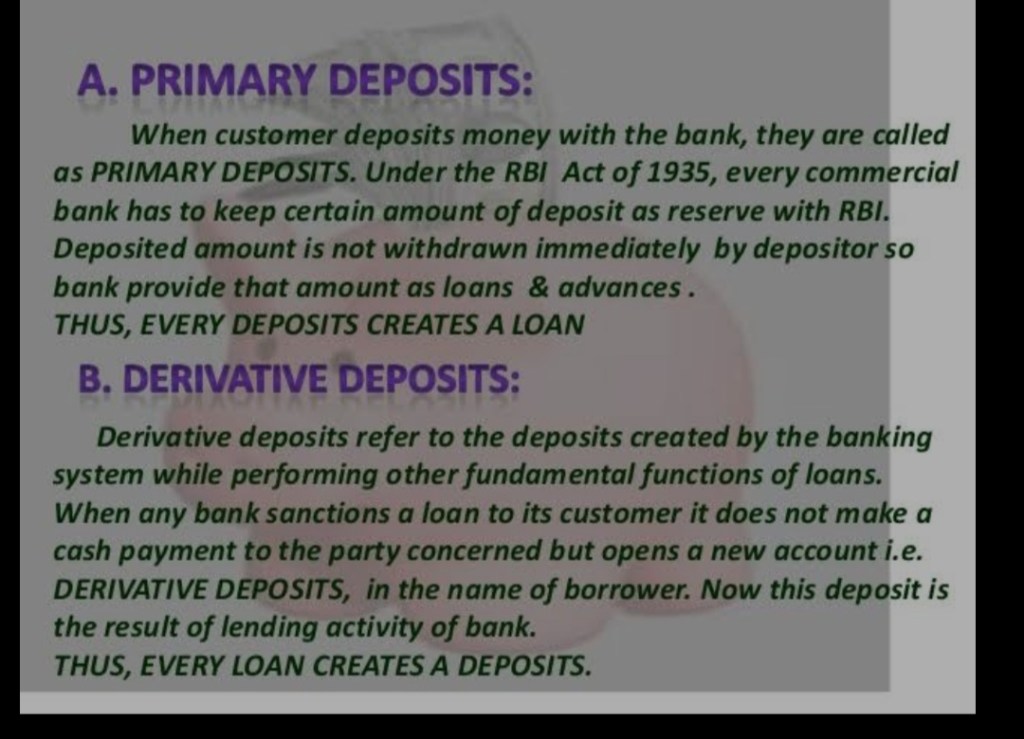
From a psychological point of view , “Delinquency is a rebellion and an expression of aggression which is aimed at destroying , breaking down or changing the environment .”
This rebellion is mostly against the social conditions which deny the individual his basic rights and the satisfaction of his fundamental needs . Thus delinquents are not born but they become so due to social circumstances and personal deficiencies .

The delinquent individual who is governed by the “pleasure principle “ wants to get immediate pleasure and immediate satisfaction for his needs and so they become a victim to his own impulses.


Remedies For Juvenile Delinquency

It is said , “ a delinquent child today may turn out to be a chronic criminal tomorrow “.
Discussions have been made at national and international level by scholars to seek out effective remedies for this problem .

The three most suggested methods are
• Preventive measures
• Rehabilitative or curative measures.
• Legislative Measures


1) Preventive Measures

• Giving proper training to the members and staff of all organisations concerned with delinquency control .

• Establishing child guidance clinics to give appropriate treatment to the disturbed and maladjusted children.

• Educating the family so as to help the parents to realise the importance of giving proper attention to the needs of their young children .

• Establishing wholesome recreational agencies to prevent young children from becoming law abiding .

• Improving the social environment – slum areas , busy market places , gambling centers etc .

• Spotting potential delinquents by predictive tests in schools or society and giving treatment to such cases.

• The problem of beggary and poverty are to be removed or controlled and the general economic standards of the people must be increased to prevent children from becoming delinquents due to economic exigencies.

2) Rehabilitation or Curative Measures

The main purpose of the method of rehabilitation is not to punish or to treat them mentally disabled but the intention is to help the delinquent children to get proper guidance and training so that they don’t become victims of their own impulses and lead a normal life .

Some institutions to rehabilitate Juvenile Delinquents :-

Juvenile Courts :- Juvenile Courts are established in order to treat Juvenile delinquents and adult criminals separately. There are currently 39 Juvenile Courts in India .
This court is different from the normal civil courts . Juvenile delinquents cannot be chained or produced to courts by police , no advocate arrangements are made for plead .
The intention behind this treatment is to create positive feelings in the minds of juveniles .

• Remand Homes :- When a child is arrested under the Act ,he is produced before the magistrate within 24 hours and kept in Remand Homes till the case is investigated.
The child is kept until the final disposal of the case .. Sometimes persons convicted are sent to Remand Homes for a few days and released later .

Certified School :- Certified Schools are established to give some general education and technical training to children . Children are sent for long term treatment and voluntary bodies or local authorities with financial assistance of the government and the public .
There are two types of schools :-
• Junior School for under 12
• Seniors Schools for under 16

The children are confined here for about 2 to 3 years .
After the release they are put under the charge of a Welfare or Probation officer who watches their activities .

Auxiliary Homes :- The auxiliary homes are attached to Certified Schools just like remand homes are to juvenile courts . Here the convicted delinquents are kept for some time and studied by a social worker and sent later to certified school on the basis of their attitude and behaviour.

Reformatory Schools :- In states where there are no Children Acts , Reformatory Schools are established . They are meant for the education and vocational training of delinquent children. The young convicted offenders below 15 years are detained here for 3to 7 years . The delinquents are removed from bad environments through these schools .

Borstal Institutions :- Under Borstal Institutions special treatment is provided for adolescent offenders between the ages of 15 to 21 years . Offenders are sent to Borstal Institutions for rehabilitation rather than kept under imprisonment . The term of Borstal Institutions are 2 to 3 year but may exceed in any serious case . Separate arrangements are made for offenders , training , physical and education are given to prevent them from committing offences again .

Fit persons Institutions and Uncared Children Institutions :- These two non government institutions managed by private bodies and give refuge and protection to destitutes , neglected children and children in pre – delinquent stage .


3) .
Legislative Measures :-

Various legislations have been made in India from time to time to deal with juvenile delinquency .
Some acts are :-

• Apprentices Act of 1850
• Reformatory Schools Act 1897
• Children Acts
• Juvenile Smoking Acts
• Suppression of Immoral Traffic Acts .
• Probation of Offenders Act
• Borstal Schools Act for Adolescents.
• Provision in the Criminal Procedure Code ( under section 399 of ICPC )


A grave problem such as juvenile delinquency cannot be solved by means of legislation , government or private institutions efforts alone . The public attitude towards juvenile delinquents must also change to make them feel accepted and initiate their treatment as a cure not abnormality .
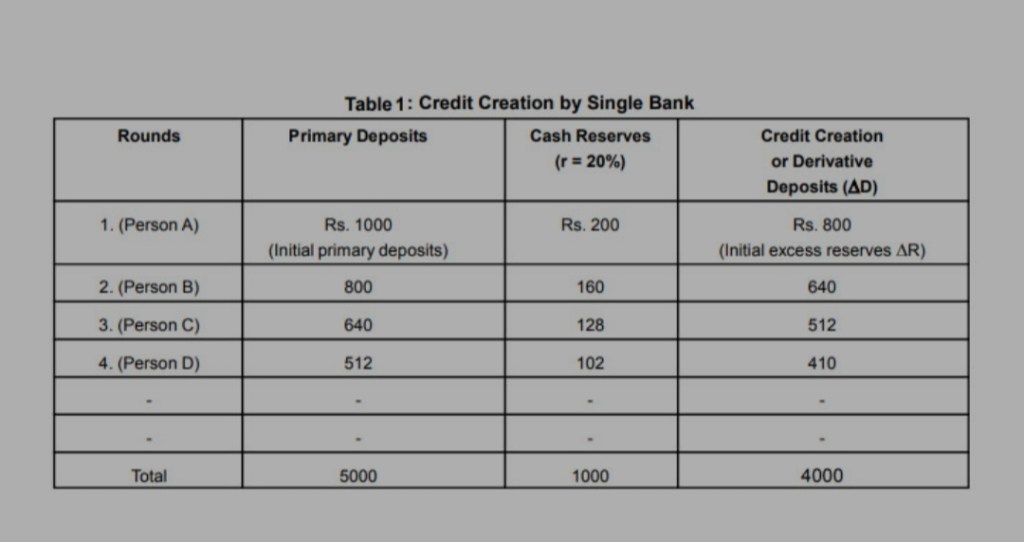
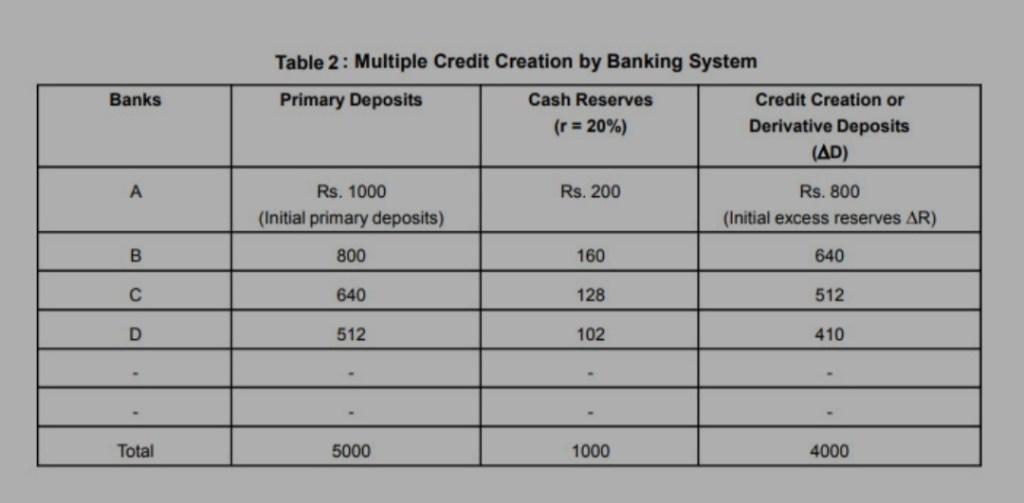
A juvenile delinquent is a product of unwholesome environmental factors hence in order to change his attitude he needs to be supported emotionally , mentally and physically by all .