Social Change ( Meaning, Definitions, Causes )

Nothing social remains the same , nothing social abides .

Nature is never at rest . Change is present in the world because change is the Law of Nature .
Like Heraclitus an ancient Greek philosopher said ,
” It is impossible for a man to step into the same river twice “
According to Heraclitean philosophy , “Neither remains the same “, ” the reality of change , the impermanence of being the inconstancy of everything but change itself “

Society we live in is changing .
It’s not a static phenomenon but a dynamic entity . It’s an “ongoing process “subject to constant change due to many forces and factors that irresistibly cause changes .

The perfect example can be observed in our own history , where the man’s rise and growth from the Paleolithic age to the Neolithic age, then to the Stone Age and next to the copper age to development over time, technologies expand, ideologies and values take on new components; institutional functions , modernization etc .

Incessant changeability is the very inherent nature of human society .
Hence , social change is due to the fact that humans are dynamic beings and undergo variation .

Meaning of social change

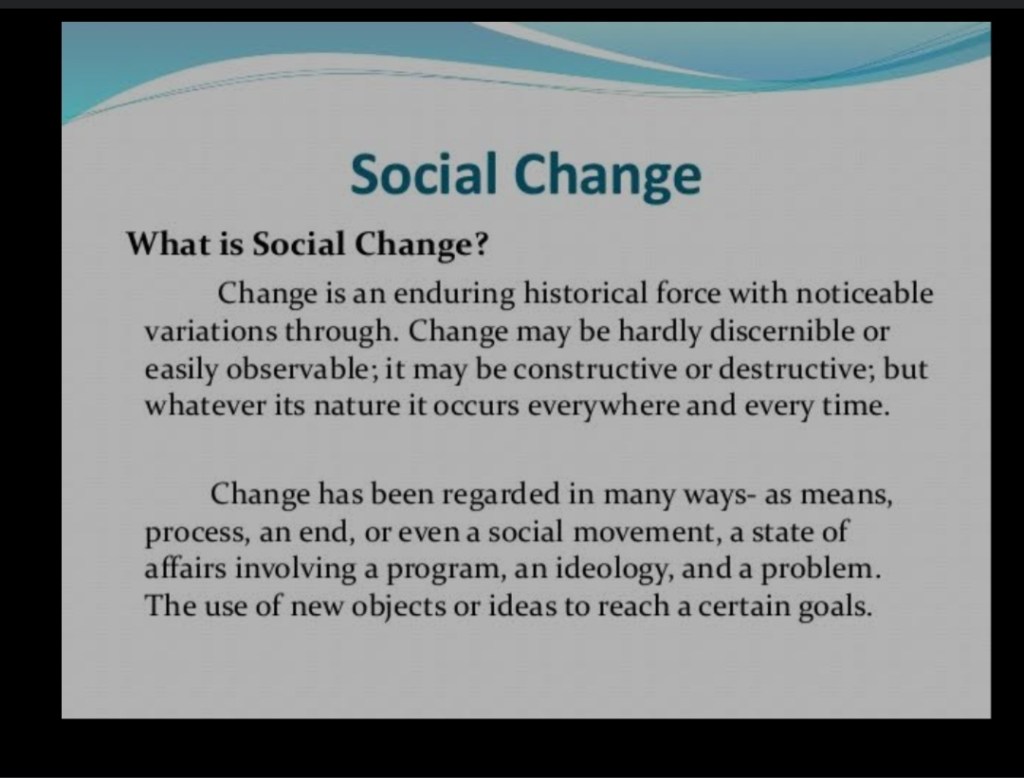
Social change in general means change in society .
Society is a web of Social relationships .

Social relationships include social processes and social interactions .

Hence , ‘social change ‘ is used to indicate the changes that take place in human interaction and interrelations .

Society is composed of a vast and complex network of patterned human relationships in which all humans participate.
When human behaviour is in process of modification , this is another way of indicating social change.
Thus , apparent alteration in the mutual behaviour between individuals which takes place is a sign of social change .
Definitions :-

Social change is a term used to describe variations in or modification of any aspect of social processes , social patterns , social interactions or social organisation .”
– M.E. Jones

By social change is meant only such alterations as occur in social organisation , that is structure and functions of society “
– Kingsley Davis

Social change may be defined as a new fashion or mode , either modifying or replacing the old ,in the life of a people – or in the operation of society “
– Majumdar ,.H.T

Social change refers to a ‘ process ‘ responsive to many types of changes ; to changes in the man-made conditions of life ; to changes in the attitudes and beliefs of men , and to the changes that go beyond human control to the biological and the physical nature of things .”
– MacIver and Page

MacIver also refers to social change as simply a change in human relationships .

Thus , social Change includes alternations in the structure and functions of the society .


Characteristics of Social Change

1:
Social Change is Continuous

2:
Social change is universal

3:
Social Change in Environment

4:
Social Change is Human change

5:
Social Change Results from Interaction of a Number of Factors

6:
Social Change May Create Chain Reaction

7:
Social Change Involves Tempo (or Rate) and
Direction of Change

8:
Social Change maybe planned or unplanned

9:
Social Change is an Objective Term

10:
Social Change can be a short as well as long run process.

11:
Social Change is Temporal


Sources of Social Change

There are several factors due to which social relationships undergo constant alterations .
Sociologists as well as many anthropologists have been debating and discussing the sources of social change .

Fundamentally , there are two factors that are major sources of social change according to various discussions by several sociologists.

Diffusion
• Inventions

The source of social change is to be found in both diffusion and invention .

Social change takes place due to cultural diffusion i.e spread of elements of culture from one local group to another .
Every society borrows the cultural elements of another society for its progress directly or indirectly . Many tribes became more civilized by diffusion of cultural elements from several local groups.

Social change also takes place because of the inherent capacity of people to invent .
Invention refers to the rearrangement of known traits into new patterns or configurations .
Inventions in every field whether industrial , agricultural , communication or transportation had a huge impact on society .
Hence , inventions constitute the major source of social change.


Causes of Social Change
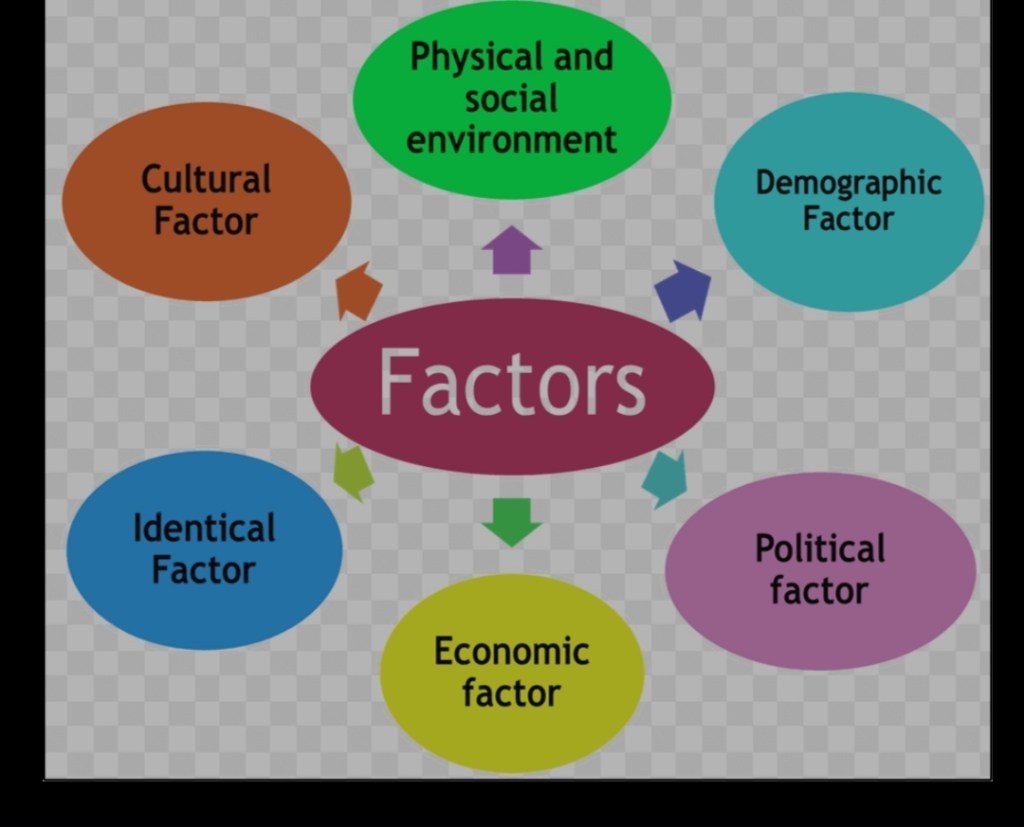


There is no single cause that produces change in society . Several factors operate together to cause social changes .

According to Harry M. Johnson the cause of social change are of three types

i) the causes of social change are inherent either in the general social system or in any specific social system.

ii) the change is caused because of some impact from the social environment of the social system.

iii) changes due to impact from a non – social environment .

The physical , biological , cultural and the technological factors have been generally regarded as the potential factors of social change.
Lapiere regarded these factors as ‘intervening variables ‘ rather than just ‘ causal or determining ‘ factors .


Geographical / Physical Factors


This factor emphasised the impact of the geographical environment upon human society .
According to Huntington ,. alternation in climate is the sole cause of the evolution and devolution of civilization and cultures.
Some social ecologists have attributed much importance to geographical factors for social change.
The physical factors such as climate , rivers ,climate , mountains , natural vegetation etc have profound influence on human society but these factors cannot solely explain the cause of rise and fall of civilization . Hence , the influence of geographical factors are neither decisive nor negligible.

Biological Factors

Biological factors include living and non living creatures. Man is influenced by non-human biological factors and modifies them to serve his purposes .
The biological factors influence the numbers , the composition ,the birth rate , the death rate , the fertility rate and hereditary quality of the successive generations.
Among the biological factors is the qualitative aspect of population , that produces major social change which has dynamic relations with man and society.

Cultural Factors

According to Max Weber theory of comparative study of religious and economic institutions , the main cause of social change is cultural factors.
Cultural factors consist of values and beliefs , ideas and ideologies , morals and manners , customs and traditions and various institutions .
Ideas and ideals , ideologies and philosophies are inherently changeful ,hence not only social values direct social changes but change themselves .
Dawson and Getty have written that culture gives speed and direction to social change and determines the limits beyond which social change cannot occur .
Our behaviour , living , thinking etc are influenced by the changes in social values.

Technological Factors

Technological Factors have immense influence on social change .
Ogburn stated , ” Technology changes society by changing our environments to which we ,in turn , adapt . The change is usually in a material environment and the adjustment we make to the changes often modifies customs and social institutions .”

The increase in new machines , new discoveries had a very great influence upon society.
Technology is the product of civilization .It is a systematic knowledge through which using tools and running machines helps to serve human purpose .
A single invention may have innumerable social changes . In the modern age technological factors are among the predominant causes of social change.


Role of Great Men in Social Change

Great Men like Buddha , Mahavira , Shankaracharya , Jesus Christ , Zoroaster , Prophet Mohammed , Confucius and many other great personalities introduced revolutionary change in the realms of religion .
Napoleon Bonaparte, Washington , Lincoln , Karl Marx, Lenin , Mao Tse Tung , Kemal Pasha , Mahatma Gandhi , Hitler , Mussolini , Khomeini and many others have caused revolutionary changes in the political field .
Similarly many writers , scientists , philosophers have many contributions to social changes .

Great Men and their leadership , revolutionary thoughts , extraordinary talents , powerful expression , ability and efficiency have brought revolutionary and long lasting changes in society .

All Social changes occur because of the actions of men and women .

As Robert Bierstedt said ,

Culture is not self innovating , ideas are not self creating , and technology is not self inventing . Somehow , somewhere , in a society , a man breaks however slightly from tradition . He does some things in a different way . He finds a shortcut . He has a new idea or makes a new discovery . When that happens whether he is a ‘ great man’ or not , he has distributed the stream of culture and like a stone , tossed into the waters , it’s ripples may go on forever . It may affect a while , all the compartments of culture and all the sectors of society .”

What is Race ? “The concept of Racial Superiority is a Myth”.

J.B.S Haldane in his book ” What is Race ” published by UNESCO ,wrote
” Race is a group which shares in common a certain set of innate physical characters and a geographical origin within a certain area .”

A race lives in a definite geographical origin and has some definite innate characteristics.

The term race is a controversial concept for it is understood differently by different people .
Race can mean all of humanity , nationality or even group which is mixed in nearly all respects but socially designated as different.

In the past race was considered as a biological concept but Social scientists recognise that there is no such thing as a race based purely on objective biological differences .
Hence , races are regarded as social concepts.


Definitions

” A race is a larger , biological human grouping with a number of distinctive , inherited czar sctri which vary within a certain range .”
A.W .Green

” A race is a large group of people distinguished by inherited physical differences “
J. Biesanz and M. Biesanz

“A race is a biologically inherited group possessing a distinctive combination of physical trails that tends to breed true from generation to generation ”
Hoebel

” A race is short is a group of related inter marrying individual , that is a population which differs from other population in the relative common ness of cert hereditary traits “
L.C . Dunn

“A race is a broad association of persons of similar biological heritage ,who are untied in settlement by common cultural traditions and who in time of conflict seek to claim rights to a better social position on the basis of an inherited quality “
In this definition , race has been biologically interpreted .
Sutherland and Woodword

“A race is a large division of characteristics presumed to be biologically inherited and remaining relatively constant through numerous generations .”
Paul A.F . Walter .


View by UNESCO

UNESCO arranged a conference of all the prominent Sociologists , anthropologists and psychologists in order to determine a single conception of race .

The judgements given during the conference :-

• Fundamentally , the entire human species has on origin and all men are homo sapiens .

• National groups , religious groups , geographical groups , cultural groups , linguistics groups etc. , are all entirely unconnected with and unrelated to race . These groups do not give indication of any race .

• Distinctions can be made between races on the basis of differences in physical characteristics but not on the basis of cultural characteristics .

• The differences found to exist between the physical characteristics of men are due both to hereditary and to the environment . Differences in heredity arise due to the process known as mutation and in breeding .

• Some races make claims of purity but this is not true . Today pure races cannot be found anywhere in the world . The process of mixing of races originated long back .

• Human races can be classified but these classifications are based solely on physical traits . They have no relation of any kind of mental or intellectual superiority or inferiority .

• The inner capacity for the development of mind and culture is found equally in every race . Hence distinctions between races cannot be based on cultural differences or levels of intelligence . Intelligent people are to be found in all races .

• It is possible that in one nation the degree of racial differences may be greater while in another nation it may be of greater or lesser degree .

• Evidence in support of the fact that the race has no important effect in the social and cultural differences between various human groups has been found in historical
and sociological studies . By no stretch of imagination can one conceive of any relation between changes in racial forms and social changes .

• That from a biological viewpoint , mixing of races is deleterious , is an essential incorrect and invalid belief .

Therefore , Race is a group of intermarrying people who are born of common ancestors , possess similar physical traits and a ‘, we feeling ‘ . Inbreeding renders permanent the physical characteristics of the race and due to them one race can be distinguished from another . One major cause of inbreeding is geographical isolation . Besides geographical isolation a race originates due also to mutation , migration , selection and adaptation.

Determinants of Race

How is race determined ?

In the past , race was regarded as a biological concept and so race was determined by physical characteristics .

These physical traits are two types –
• Indefinite Physical traits
• Definite physical traits.


Indefinite Physical traits
These traits which are amenable to any measurement are called indefinite physical traits , such as the colour of the skin . Hence they can be described .
These traits included :-

• Colour of Skin :- Usually , on the basis of colour of the skin people differentiate between the white , yellow , brown and black races . But it is difficult to distinguish between the microscopic differences in the colour of the skin since the colour of the skin alters with the effect of the climate . Hence , anthropologists do not lay much emphasis on the colour of the skin in trying to discover the race .
The following distinctions can be made by the colour of the skins :-
Leucoderma as Caucasian
Xanthoderma is Monogolian
Melanoderm as Negro .

As the skin is subject to change and subtle variation it is difficult to determine race on the basis of colour .

• Texture and the colour of hair :-
The texture and colour of hair is another indefinite physical trait of race . There are the three following distinctions of hair on the basis of texture
* Leiotrichous ( soft straight hair ) as of the Mongols and Chinese .
* Cymotrichous ( smooth curly hair ) as of the inhabitants of India , Western Europe , Australia and North East Africa
* Ulotrichy ( thick curly hair ) as of Negroes .

• Structure and the colour of eyes
There are three distinctions of the colour of eyes – white ,grey , brown , black and blue . The structure of the orifice of the eye is usually horizontal but at some places diagonal eyes are found as in Southern Europe and North Africa.


Definite Physical Traits
Definite physical traits are those which can be measured .
It includes the following :-

• Stature :- Different races are distinguished on the basis of differences in stature .
Topinard has classified height in the following manner
i ) Tall stature ( 170 cm ) or above
ii) Above Average stature ( 165cm )
iii) Short Stature ( 160 cm) .

The average height of the Pategonian people is the greatest and of the African bushmen the shortest .

• Structure of Head :-
Heads can be classified on three classes according to the ratio of length and width
i) Dolichocephalic
ii) Meson- cephalic
iii) Brachy – cephalic

The structure of the head can be known by its length to its breath .
In India the Brachy cephalic is found in Bengal , Meson-cephalic is found in Bihar and Dolichocephalic in Uttar Pradesh.

In the past much importance was attached to the structure of the head in the determination of race but since Boas proved that changes in environment changes the structure of the head ,it has lost much of its effect as a determinant of race .

Structure of Nose :- Nasal index is used to determine the structure of the nose .
The nasal index can classify the structure of Nose into three classes
i) Leptorrhine ( thin ) mostly found in Punjab .
ii) Mesorrhine ( medium ) mostly found in Uttar Pradesh.
iii) Platyrrhine ( short wide ) mostly found in Madras , Madhya Pradesh and Chota Nagpur areas of India .

• Perimeter of Chest :- Differences in the chest measurement between people of different races is to be found .

It is impossible to find all the traits of one race in the people of any country . Hence , all races of the world have been intermixed and no race is pure anywhere.

Hence , the concept of Pure Race is a Myth.
All existing Sociological and biological evidences point conclude that there is no such things as a ” pure race”
Different population groups have been inbreeding for years and categories of race are only the creation of observers, not of nature .

Human groups have exchanged their genes through mating to such an extent that any attempt to identify ‘ pure races’ is bound to be fruitless “


The concept of Racial Superiority.


The concept of Racial Superiority is a psychological myth .
This phenomenon is often interpreted as “racism “.
Modern societies consist of people who belong to different racial and ethnic groups . Some of these racial groups are able to live together in harmony and mutual respect but others are in a state of constant antagonism and conflict . The dominant race tries to impose its will on the weaker ones .
This domination of one race over another leads to suppression and exploitation .

Some examples of racism ,
The domination of the western world by European powers during the late 20th century .
The partial extermination and subsequent segregation of native American
The oppression of Black Americans first as slaves and then as exploited minorities.

Racism or racialism is set of beliefs , ideologies and social processes that discrimination , exploitation or violent oppression is known as racism “
– Collins Dictionary of Sociology

Racism is a phenomenon in which a group that is seen as inferior or different is exploited and oppressed by a dominant group .”
– Blauner


The root of racism is said to be the extreme ethnocentric attitudes which are found to be at the root of racism .
According to most people their own norms , religion , attitudes , values and cultural practices are right and proper , while those other groups are peculiar , idiotic and sometimes immortal .

The ethnocentric attitudes that are functional for one group may prove to be highly dysfunctional for another group .
Under certain conditions , ethnocentric attitudes can take an extreme and aggressive form and can be used to justify the oppression treatment of other racial or ethnic groups.
This leads to racism .

Ideology of Racism

“Racism is an ideology based on the belief that an observable , supposedly inherited trait ,such as skin colour ,is a mark of inferiority that justifies the discriminatory treatment of people with that trait “

The ideology of racism supports the existing inequalities by the social process of the “self fulfilling prophecy ”

American sociologist W.I Thomas explained this idea in the form of a simple statement which is popularly known as “, Thomas Theorem ”
“If men define situation as real ,they are real in consequences ”

Merton explained further using an example ,
” If people wrongly believe that a bank will go bankrupt , they will rush to withdraw their money ”
The self fulfilling prophecy is a false definition of a situation but the definition leads to behaviour that makes prediction come true .

Self fulfilling prophecy also causes cases of race relations . The racist ideology of the dominant group defines the minority as inferior and hence considered unfit for higher status jobs , higher education etc.

Root of Racism :-

Simpson and Yinger highlighted four roots of Racism in their classic text

• The doctrine of biologically superior and inferior races
• Members of different races have different personalities
• That ethical standards differ from one race to another .


J.L.Gillin criticized the theory of Racism and brought forward the objection that Racism is confused with culture and nationality .
Modern scientific tests have proved that no race can be consid inferior in any respect and that the conception of racism is completely wrong and unscientific.

Schizophrenia . A Mental Disorder not A Character Flaw .


What about the world of a schizophrenic? Maybe it’s as real as our world. Maybe we cannot say that we are in touch with reality and he is not, but should instead say, His reality is so different from ours that he can’t explain his to us, and we can’t explain ours to him. The problem, then, is that if subjective worlds are experienced too differently, there occurs a breakdown in communication … and there is the real illness.”

When, Philip K. Dick questioned about the reality we live , didn’t it remind you of Francesca Zappia the author of Made You Up quoting ,

“Sometimes I think people take reality for granted.”

And then there are people who have no luxury to take reality for granted because their reality may not really be real .
It may be hallucinations or delusions or just random voices in the head or all of them together which is notably entitled as
Schizophrenia .


Schizophrenia is a long-term mental disorder .
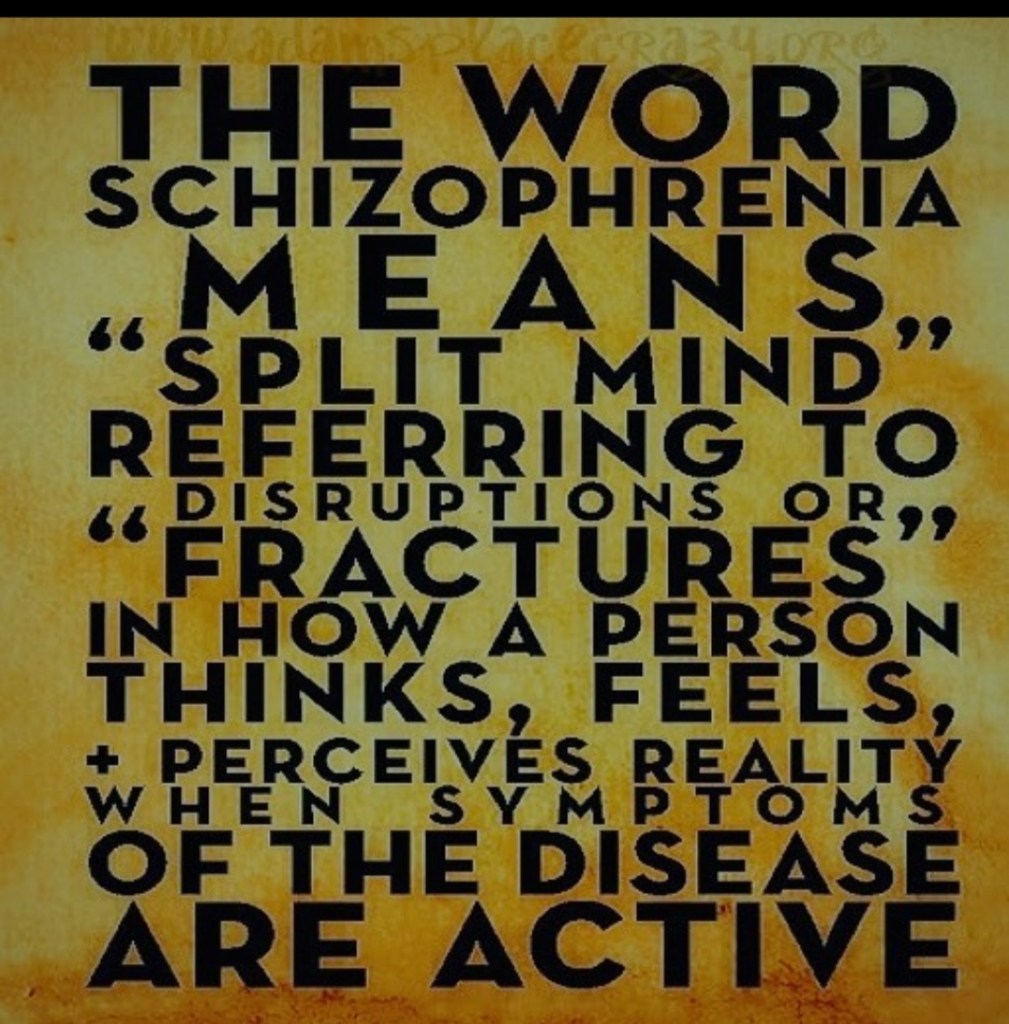
Schizophrenia has its origin from Greek word :- skhizein ‘to split’ + phrēn ‘mind’.
Due to its origin ,Schizophrenia is among the most misunderstood of mental health disorders.
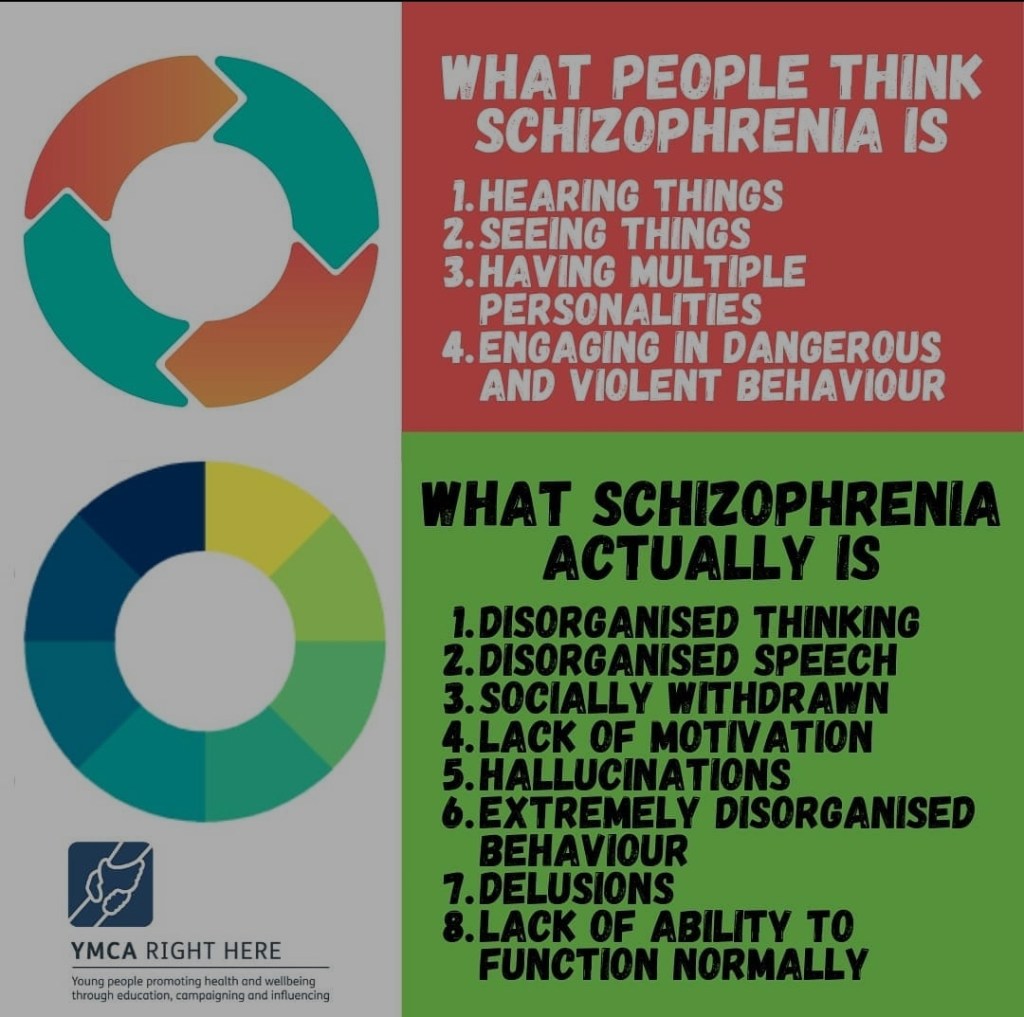
The etymology of the word schizophrenia has led many to confuse it with multiple personality disorder ( Dissociative Identity Disorder).


The term “schizophrenia” was first used in 1911 by a Swiss psychiatrist, Eugen Bleuler. He used this term to emphasize the mental confusion and random thinking characteristic of people with a disorder . But people confused the actual meaning with split or multiple personality confusion which has become an ingrained myth regarding schizophrenia that continues to this day.

So what is really Schizophrenia ?

Schizophrenia is a chronic and severe mental disorder . People with schizophrenia may be said to have lost touch with reality leading to unsound perceptions and actions , fantasies and delusions .

Schizophrenia is a mental disorder that affects how a person acts, thinks, and feels. It can keep one from seeing the world in a normal way , making their own reality different from us .
People with schizophrenia have difficulty in distinguishing reality from fantasies .


Schizophrenia affects men and women equally. Schizophrenia can occur at any age , the most common age to be diagnosed with schizophrenia is late teen to early 20s for men and late 20s to early 30s for women .


Some people with schizophrenia are dishevelled and disorganized n
That doesn’t mean a person with schizophrenia can’t live a normal life .


“I have schizophrenia. I am not schizophrenic. I am not my mental ill. My illness is a part of me.”

– Jonathan Harnisch, (Novelist, artist, filmmaker )

There are people who have actually lived with schizophrenia and have managed to lead highly productive and satisfying lives.

People like :-


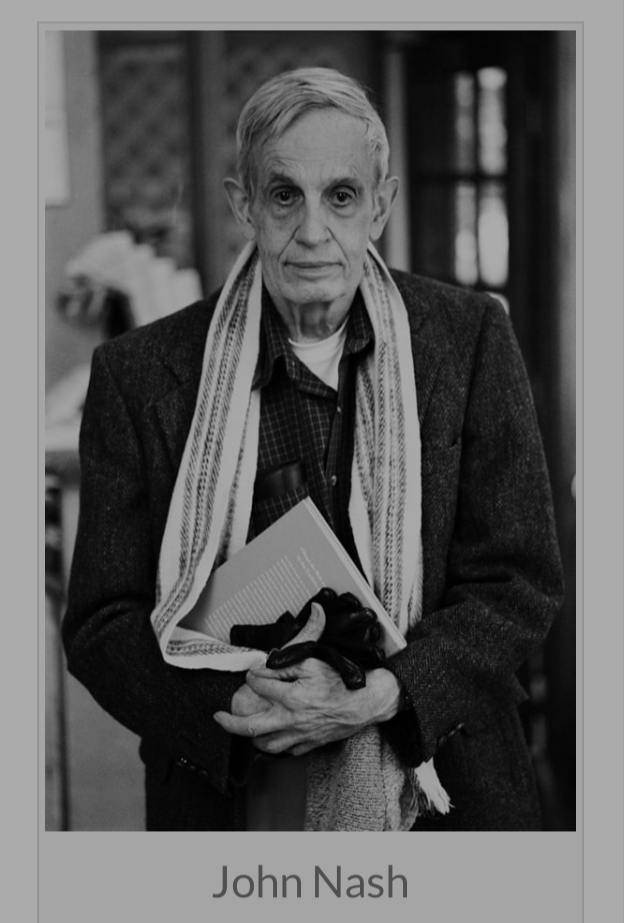
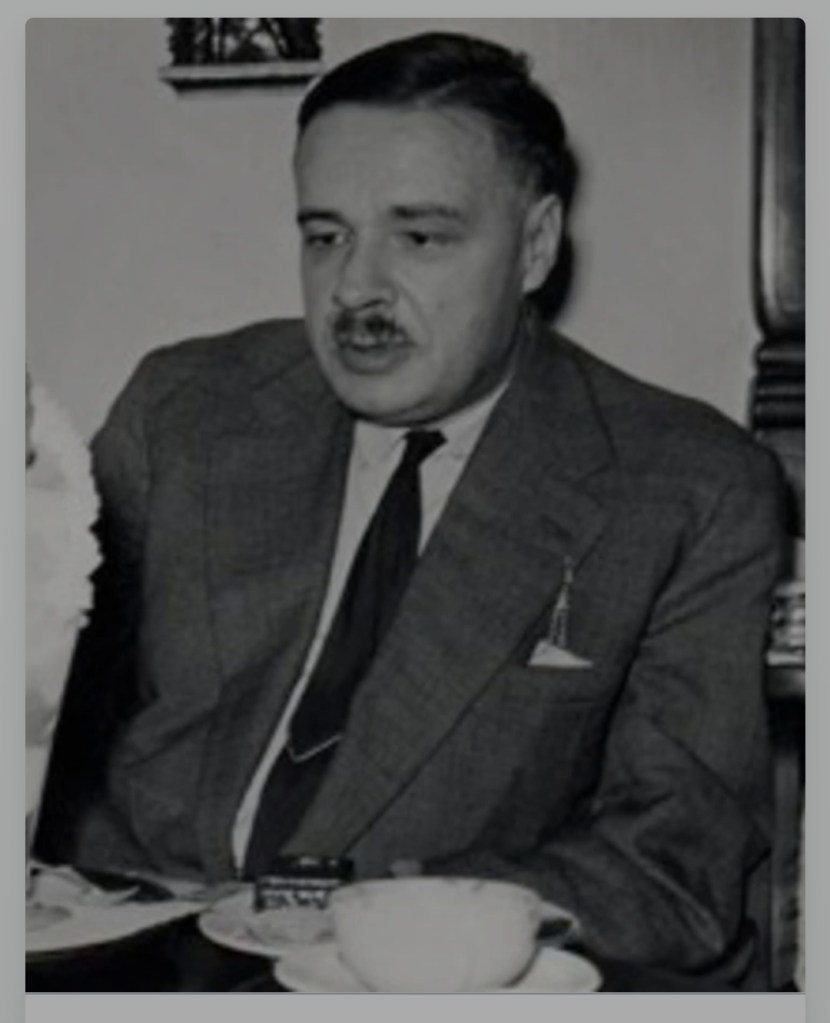
John Nash Jr. ,
one of the world’s most brilliant mathematicians. The Nobel Prize winner Economics suffered from paranoia, delusions, and other symptoms of schizophrenia.

Eduard Einstein ,

The youngest child of Albert Einstein was studying medicine when he was diagnosed with schizophrenia at age 20.

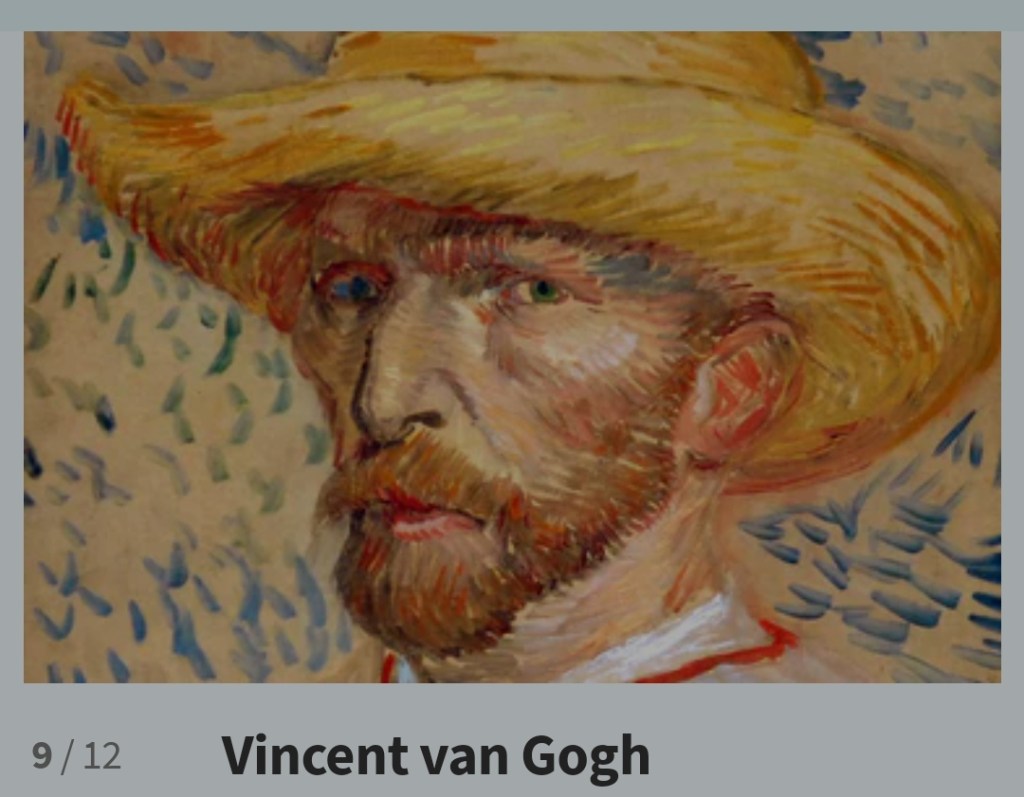
Vincent van Gogh,
the Dutch post-impressionist painter who posthumously became one of the most famous and influential figures in the history of Western art, suffered from several
common symptom of schizophrenia like
Hallucinations, including hearing voices .

Contrary to other people’s opinion , people with schizophrenia have no split or multiple personalities and most pose no danger to others .
It is possible to live well with schizophrenia.

Symptoms :-


People diagnosed with schizophrenia are characterized by episodes in which the person is unable to distinguish between real and unreal experiences.

The symptoms fall in three categories :-

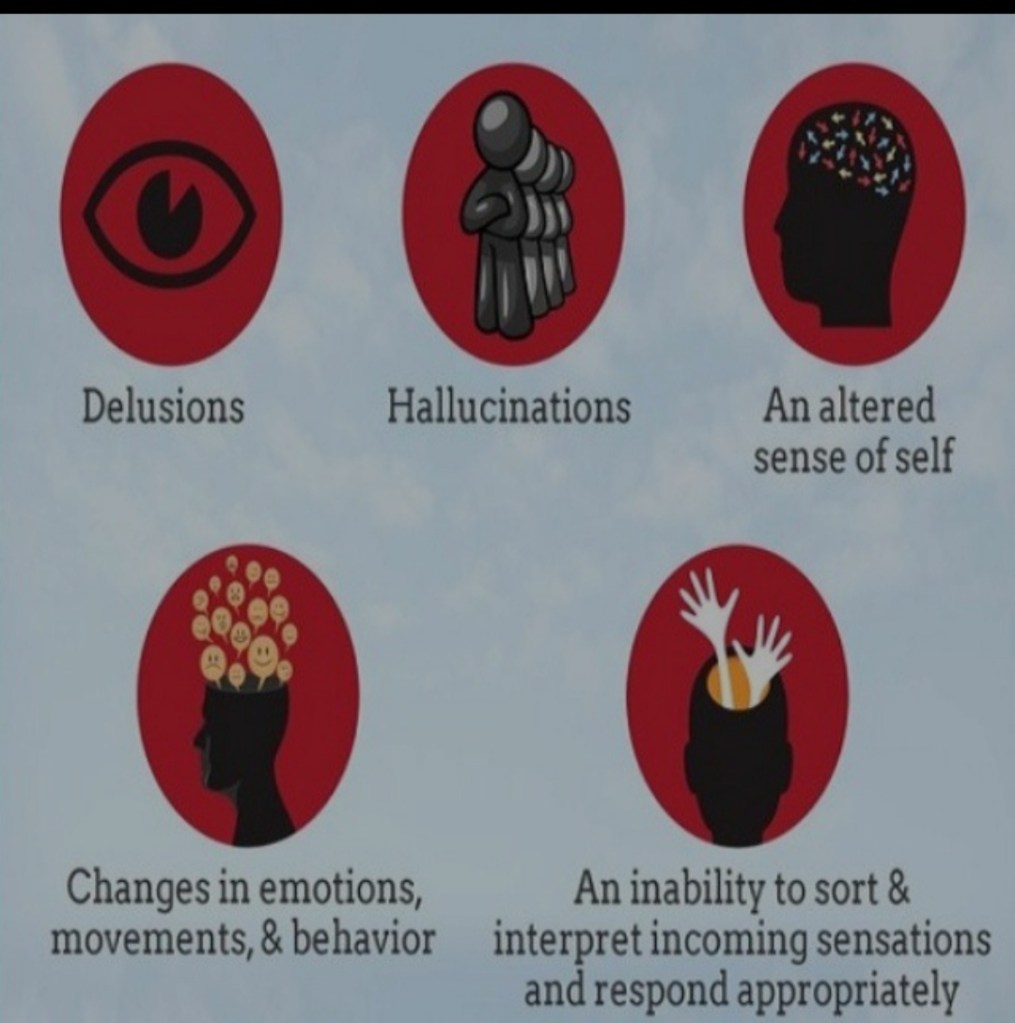
1: Positive symptoms: these symptoms are those that are abnormally present . They can be mild or severe depending on its nature.
They include


Hallucinations ( hearing different multiple voices which may be critical and threatening ,
hallucinations can affect all the senses like for instance, for example, a person may also see, feel, taste, or smell things that are not really there.)

Delusions ( experiencing delusions may believe that something is true when there is no strong evidence for it to be unrealistic , paranoid , confused thoughts , false beliefs )

Thought disorder ( dysfunctional thoughts making it difficult to put cohesive thoughts together or make sense of speech )

Movement disorder ( clumsiness , unusual mannerisms , repetitive actions , motionless rigidity )


2: Negative symptoms: These symptoms are those that are abnormally absent in most of the patients . These symptoms disrupt a person’s normal ability .

These includes :-

• A loss or a decrease in the ability to initiate plans
• Finding no pleasure in living .
• Disorganized symptoms.
• lack of facial expression
• lack of emotional expression
• lack of motivation
• difficulty concentrating
• Neglecting everyday activities, including self-care.
• Withdrawal from social life ( possibly through fear that somebody is going to harm them.)


3: Cognition symptoms :-. These symptoms are another area of functioning that is affected in schizophrenia leading to problems with attention, concentration and memory, and to declining educational performance.
Patients with cognitive symptoms find it hard to lead a normal life .

These includes :-

Anosognosia ( a lack of ability to perceive the realities of one’s own condition. It’s a person’s inability to accept that they have a condition that matches up with their symptoms or a formal diagnosis)

• Trouble in paying attention or focusing .

• Problem with working memory ( difficulty understanding and using information.)


Severe psychotic symptoms often decreases as the person becomes older
Like any illness, the severity, duration and frequency of symptoms vary from person not person however, in persons with schizophrenia.


Schizophrenia is a lifelong condition, but treatment can help manage the symptoms.


Types of schizophrenia

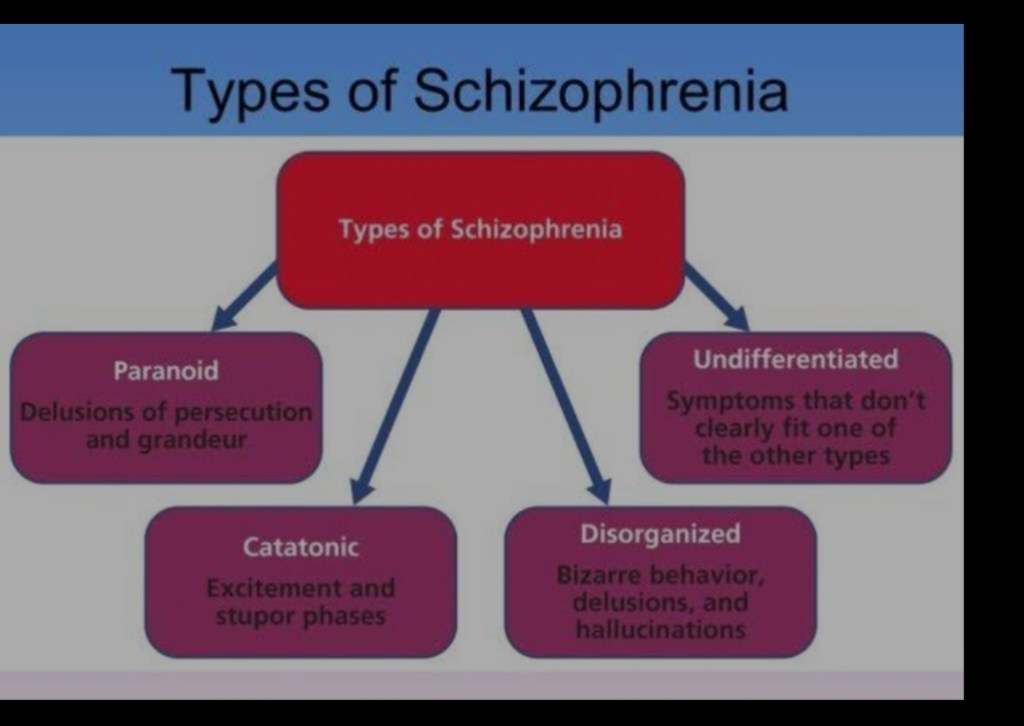
There are several types of schizophrenia.

Paranoid schizophrenia :-


This is the most common type of schizophrenia. Symptoms include hallucinations and/or delusions, but your speech and emotions may not be affected.

Hebephrenic schizophrenia :-

Also known as ‘disorganised schizophrenia’, Symptoms include disorganised behaviours and thoughts, alongside short-lasting delusions and hallucinations.


Catatonic schizophrenia :-

This is the rarest schizophrenia diagnosis, characterised by unusual, limited and sudden movements. The patient may often switch between being very active or very still. They may not talk much, and you may mimic others’ speech and movement.

Undifferentiated schizophrenia :-

This type of schizophrenia may have some signs of paranoid, hebephrenic or catatonic schizophrenia, but it doesn’t obviously fit into one of these types alone.

Residual schizophrenia :-

You may be diagnosed with residual schizophrenia if you have a history of psychosis, but only experience the negative symptoms (such as slow movement, poor memory, lack of concentration and poor hygiene).

Simple schizophrenia :-

This includes both positive and negative symptoms .
Symptoms such as slow movement, poor memory, lack of concentration and poor hygiene are most prominent early and worsen, while positive symptoms such as hallucinations, delusions, disorganised thinking are rarely experienced.

Cenesthopathic schizophrenia :-

People with cenesthopathic schizophrenia experience unusual bodily sensations.


Treatment :-


There’s a tremendous need to implode the myths of mental illness, to put a face on it, to show people that a diagnosis does not have to lead to a painful and oblique life… We who struggle with these disorders can lead full, happy, productive lives, if we have the right resources.”
– Elyn R. Saks


As the cause of schizophrenia is unknown there is no cure . So a doctor’s treatment includes medications that can ease symptoms and prevent them from coming back.

Such treatments include :-

Antipsychotics:

These medications tame Psychosis ( delusions , hallucinations , etc.)
The medications doctors prescribe most often for schizophrenia are called antipsychotics.
This medication is taken as pills or liquid form . Some antipsychotics included injections given once or twice a month .
These drugs work on chemicals in the brain such as dopamine and serotonin.

Schizophrenia patients are most likely to have to take schizophrenia medication their entire life .


Psychosocial Treatment :-

The term psychosocial refers to an individual’s psychological development in and interaction with their social environment. Psychosocial treatments (interventions) include structured counseling, motivational enhancement, case management, care-coordination, psychotherapy and relapse prevention.


Coordinate Speciality care :-


“There are a number of things that family and friends can do to help a person with schizophrenia. One of the simplest and most effective is to create a positive environment around the person.”
– Milt Greek (Mental health advocate and author of Schizophrenia: A Blueprint for Recovery)

Creating a positive environment and showing support can make schizophrenia patients believe in the reality we live in rather than the reality they think is real .

Coordinate Speciality care includes model integrated medications and psychotherapist , family support , education and employment support etc.


Recovery After an Initial Schizophrenia Episode (RAISE) project.
The goal of RAISE was, and is, to help decrease the likelihood of future episodes of psychosis, reduce long-term disability, and help people to get their lives back on track so they can pursue their goals.


Schizophrenia can make it hard to stick to a medication plan. One needs a strong support system to continue the medication.


Medication for schizophrenia can improve symptoms and sometimes help keep them from coming back.

Therapy can help people living with schizophrenia learn to recognize signs of an episode and explore strategies to manage symptoms and the distress they cause.

One must support in positive, supportive ways without making the patient feel criticized or helpless.


Schizophrenia is NOT A Character Flaw

Just like any other mental disorder schizophrenia is not a choice nor it is a character flaw , it’s a disease which needs to be treated .

People with schizophrenia have no luxury of taking reality for granted .
But that doesn’t stop them from living in a reality which is different from ours .
Their multiple voices doesn’t make them psycho or split personalities , those voices are voices of the subconscious that’s much more superficial than others .


I thought of the voices as… something a little different from aliens. I thought of them more like angels … It’s really my subconscious talking, it was really that… I know that now.”
– John Forbes Nash, Jr. (Nobel Prize winning mathematician )


The stigmatisation that often accompanies mental illness can be cruelest .

This stigma unfairly causes people to feel ashamed for something that is out of their control and prevents many from seeking the help they need.

This stigmatization is due to the misconceptions or myth that mental illnesses are usually the cause of laziness or personal behaviour , a weakness that can be controlled on its own .

In reality a mental illness is not a character flaw. It is an illness that has nothing to do with being weak or lacking willpower.

Seeking appropriate help is a sign of strength, not weakness. Mental illness should not be treated as a problem rather it should be accepted as part of self that needs little more care and self love .

Since there’s no cure of schizophrenia ,it seems a lot more scary .

But as Elyn R. Saks said ,

” My good fortune is not that I’ve recovered from mental illness. I have not, nor will I ever. My good fortune lies in having found my life.”

A person with schizophrenia is not schizophrenic. He is not his mental illness rather it is a part of him . They are not different than us they just think differently .

Mental illness is not contagious . Hence being kind towards people diagnosis from any kind mental illness can’t hurt us . Support and spread awareness . Make them feel their worth which is much more than their illness .

The Memorandum of Association . ( Meaning , Definitions, Clauses , Importance )

Pc:- Google

A joint stock company does not come into existence on its own .

The Indian Companies Act contains provisions regarding the legal formalities for setting up a company .


The formation of a joint stock company passes through the following stages :-


• Promotion; • Incorporation ; • Raising of Capital ; • Commencement of Business .


Incorporation of a company requires legal documents to be filled with the Registrar of Companies of the State in which the registered office of the company is to be suitable .
Therefore, several legal documents and papers are prepared and filed with the Registrar of Companies.
Three most important documents include :-

• Memorandum of Association
Articles of Association
Prospects or Statement in lieu of prospectus.


Memorandum Of Association ( MOA):-

Memorandum of Association of a Company is one of the most important documents.
According to Palmer, “It is a document of great importance in relation to the proposed company.


Memorandum of Association required to be filed with the Registrar of Companies at the time of formation of a company.
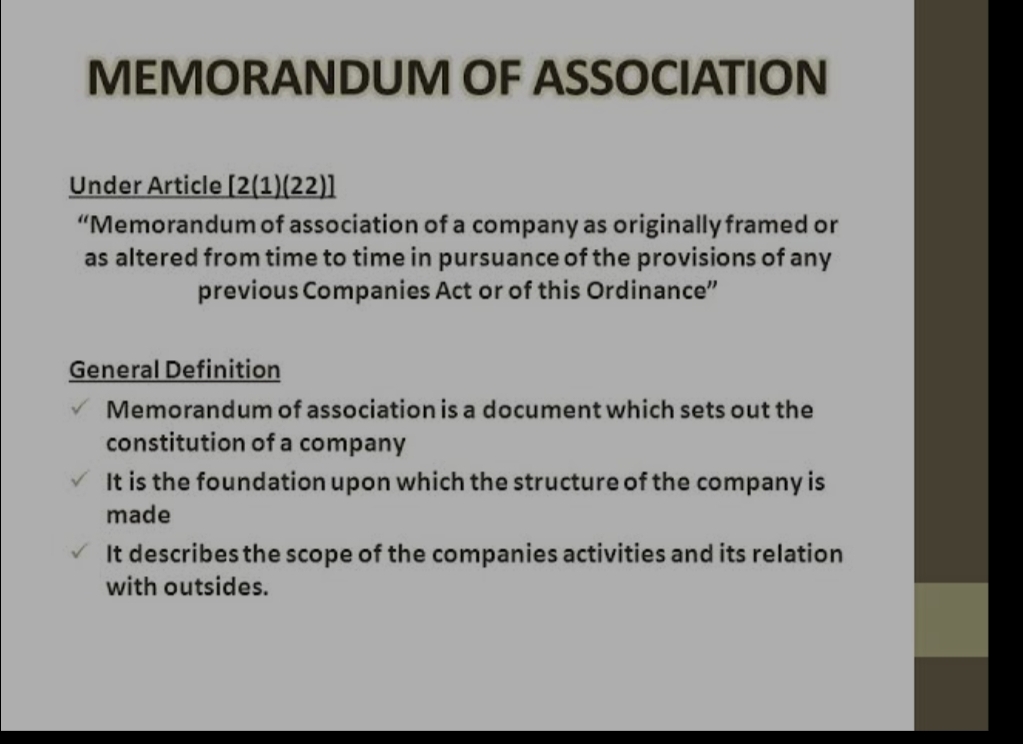
It defines the objects and scopes of the company’s activities as well as its relation with the outside world.
MOA is a document which contains the fundamental rules and regulations regarding the constitution and activities of a company .

MOA states the limits to which a company can proceed.
A company is said to be ‘ultra vires’ if it proceeds beyond the limits mentioned in the memorandum.

Memorandum of association is a public document .The entire structure of the company is detailed in the Memorandum of Association. Through the Memorandum of Association he will get all the details of the company. To know the company details one can contract with the company by obtaining the Memorandum of Association ,which can be obtained by paying the required fees to the Registrar of Companies.

Memorandum of Association is a legal document which describes the purpose for which the company is formed.
It is a foundation on which the superstructure of the company is built. It is mandatory for every company to have a Memorandum of Association.

Thus , Memorandum of Association is the charter of a company .


Definitions :-


Pc:- Google

The Memorandum of Association of a company is it’s charter and it defines the limitations of the power of the company . The memorandum contains the fundamental conditions upon which alone the company is allowed to be incorporated.”
– Lord Cairns


“The purpose of the memorandum is to enable the shareholders , creditors and those who deal with the company to know it’s permitted range of activities .”
– Lord Macmillan.


According to the Indian Companies Act

“Memorandum means the Memorandum of Association of a company ,as originally framed or as altered from time to time in pursuance of any previous Companies Act .”
– Section 2(56) of Indian Companies Act , 2013.


Clauses of The Memorandum of Association


Pc:- Google

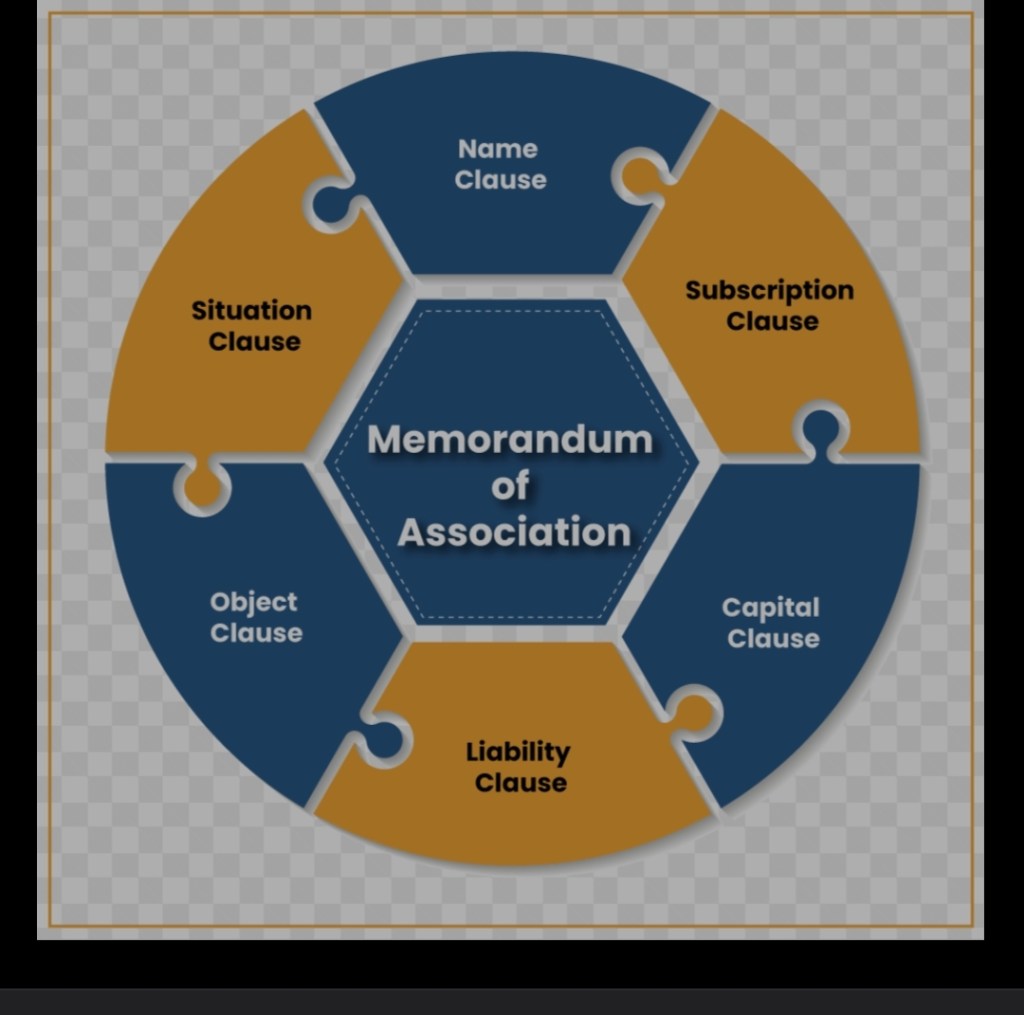
The Memorandum of Association contains the following clauses :-

1:
Name clause :-

•The name of the proposed company is mentioned in this clause.
• The name of the a company must end with the word ‘Limited ‘ in the case of public company and
‘ Private Limited ‘ in the case of a private company .
•The name should not be identical with the name of the existing company .
• The name should not be misleading i.e creating confusion regarding its nature of business .

2:
Registered office (i.e domicile ) clause :-

•The name of the ‘State ‘ in which the registered office of the company is to be situated is mentioned in this clause.
•This clause determines the jurisdiction of the Registrar of Companies and the court .
• This clause also ascertains the nationality of the company .
• The full address of the registered office must be communicated to the Registrar of Companies for future communication.

3: Object clause :-


This clause states the object with which the company is proposed to be established . A company is not legally entitled to do any business other than the specified in the object clause .

The object clause should include the following :-
•.the main objects to be pursued after incorporation ;
• incidental objects ancillary to the attainment of the main objects ;

The object clause must not include anything which is illegal or opposed to the public interest or against the general law of the country or Contradictory to the Companies Act itself.

4:
Liability Clause :-

This clause states the nature not the liability of the members of the company i.e whether limited by shares or by guarantee or unlimited .
• In the case of a company limited by shares , the member’s liability is limited to the face value of the shares .
• In case of a company limited by guarantee ,the liability clause must state the extent of liability of each individual member in the event of its being wound up .
• In case of an unlimited company ,the liability clause does not appear in the memorandum of association .

5:
Capital Clause :-

•This clause states the total capital of the proposed company .
• A company cannot collect funds exceeding the authorised capital.

The division of capital into equity share capital and preference share capital should also be mentioned.The number of shares in each category and their value should be given in the Memorandum.

6:
Subscription / Association Clause :-


The name , addresses , signature and descriptions of the signatories to the memorandum are given in this clause

This clause also states the amount and number of shares taken by the signatories of the memorandum . The number of signatories to the memorandum shall not less than :
• seven in case of public company
• two in the case of a private company.


Importance of Memorandum of Association

1:. Basis of Incorporation :- It is the basis of Incorporation of a company . A company cannot be registered without filing this document .

2: Informing the name , address, object , capital and liability of the company to outsiders :- Every outsider can easily obtain information about the company regarding its name , address , object , capital and liability etc., through the Memorandum of Association.

3: Determine the extent of working of the company :- It lays down the objects and scope of activities outside the scope of the fundamental will be ultra vires’ and void .

4:. Unalterable document :- The provisions of this document cannot be changed without passing a special resolution (passed by 75% majority ) . In certain cases ,the change can be made by seeking permission from the Company Law Board or Central Government .

5: Determining the relationship between the company and others :- It enables outsiders to know whether the company is authorised to enter into a particular transaction or not .


Difference between Memorandum of Association and Articles of Association .

• Memorandum of Association is the fundamental charter of a company whereas articles are subsidiary to the charter .

• Memorandum defines the relationship between the company and an outsider whereas articles contain provisions for internal management of the company .

• Memorandum is the supreme document. It provides the area within the articles are to operate whereas articles are to act within the orbit of the memorandum .

• Memorandum cannot be altered easily whereas alteration of articles is easy .

• Registration of the memorandum is compulsory whereas registration of articles is not necessary in the case of a public company.

Do you know how to say “No To Plastic “? 3rd July , International Plastic Bag Free Day .

Do you know about   Skrap organisation  ? Or about Paperman and Saahas Zero Waste? 

Do you know about Ryan Mario Yasin ?

Or about Joanna Sandler or about  Aweko Faith or Andrew Mupuya ?

I will assume that your answer is no .

Because we are busy being Fantastic that we forget to avoid using Plastic .

But these organisations and people don’t .

Skrap

Mumbai-based Skrap environment sustainability management organization.   They analyse waste generation data based on the type and size of event, devise a customised plan and implement it on the premises . They provide an end-to-end process of waste management at events and offices.

Paperman

Paperman was established in 2010 with the objective to accelerate recycling in India, Paperman launched a mobile app offering on-demand doorstep recycling, which people could use to directly connect with local ragmen to sell their waste. Along with this, the organisation’s initiatives also include public awareness programmes.

Saahas Zero Waste

Saahas Zero Waste is  a Bengaluru-based NGO established in 2001 , they specialise in handling bulk waste produced by MNCs, residential communities, universities, tech parks and other organisations and using sustainable management to recycle the waste .

Ryan Mario Yasin , developed Children’s wear made out of recycled plastic bottles that can grow 7x their size .

Joanne Sandler genetically engineered bacteria that could turn plastic bottles into a valuable ingredient i.e vanilla .

Aweko Faith, along with her two friends , developed a durable and waterproof bag from plastic waste they collect .

Andrew Mupuya ,a 16 year old who handcrafted 20,000 eco-friendly  bags in a week to eradicate plastic use .

We are too ignorant towards our environment because it’s always just “one bag of plastic ” by “8 million people “.

It is foreseeable that plastic pollution has become one of the world’s most tremendous  environmental crises. The increasing production rate of plastic has surpassed the world’s ability to recycle ,hence  making  plastics take over our lands and water bodies.

This pollution is  extremely dangerous which can have a catastrophic influence on biodiversity. 

 Plastic particles in the ocean attract toxins, which in turn affects us, as the toxins enter the food chain making our water bodies have plastics swimming in them leading to  millions of deaths of animals  from ingestion of plastic every year.

I assume you already know the harmful effects of plastic . But do you know how to say ”  No to Plastics ” ?

We humans have become dependent on plastic for a range of uses, from packaging to products. Reducing our use of plastic bags is an easy place to start getting our addiction under control.” 

David Suzuki

3 July , International Plastic Bag Free Day 

International Plastic Bag Free Day is observed all around the world on 3 July  every year. 

This day  emphasizes the plastic bag-free world and spreads awareness about the devastating effects of plastics on the environment. 

International Plastic Bag Free Day was created by Bag Free World. It was created as a worldwide initiative for the purpose of getting rid of the single-use of plastic bags around the world. 

On this day many organizations and thousands of responsible citizens  work together to raise awareness on the impact of plastic bags and encourage the use of other eco-friendly bags. 

One must promote  environmental conservation by encouraging  all to stay away from the use of plastic bags and use  eco-friendly alternatives.

Ways to celebrate this day :- 

” It’s when plastic takes on a life of its own that the food chain will be disrupted.”

…. –  Anthony T. Hincks

There are many steps one  can take to honor this important date :-

• By volunteering the primary three ways Plastic Waste Management i.e :-

•Reduce

•Reuse

•Recycle .

•  Volunteering by giving our  money or  time to an environmental organization or charity that is focused on cleaning landmasses and water of plastic bags. 

Groups  such as Greenpeace, Plastic Pollution Coalition, Clean Ocean Project etc .

• By  making and selling eco-friendly handbags and  shopping bags .

I think, on a personal level, everybody, when you go through the checkout line after you get your groceries and they say, ‘Paper or plastic?’ We should be saying, ‘Neither one.’ We should have our own cloth bags. “

Woody Harrelson

•  By organizing or taking part in raising awareness to stop the usage of single-use plastic bags. 

• By  conducting a workshop based on using reusable plastic bags. 

• By volunteering to clean up some mess of plastic bags on streets and in the ocean.

• By Adopting  the habit of using reusable bags.

• By using  social media  and spreading awareness , sharing information and  and #PlasticBagFreeDay slogan .

• By  supporting and out- spreading  the alternatives for single-use plastic bags such as recyclable bags, cloth bags, canvas bags, and a lot more, which may help in saving the environment and animals.

It is in the hands of each and everyone in  the world to make a plastic bag-free society possible. 

Effects Of Plastics:- 

To make a plastic bag-free world, it is essential to teach the public about the harmful  effects of throwing plastic into the environment. 

Plastic pollution leads to  extremely detrimental effects on the environment, wildlife and indeed human health.

BPA is just one chemical used to make plastic baby bottles and in the lining of food, beverage, and infant formula containers. Research shows that children are exposed to BPA by drinking from polycarbonate bottles and consuming food from containers made using BPA.”

– Suzy Shuster

The marine ecosystem is  suffering immensely as a result of plastic pollution.  Over 250 species have become entangled in plastic , leading to suffocation and death.

Littering of plastics in open spaces creates unhygienic conditions. Plastics do not undergo degradation, thus, stay in the soil for many years, which affects soil fertility and degrades the soil quality.

The improperly disposed of plastic bags , when eaten by animals, cause harmful diseases   leading to  death.

When plastic artifacts enter the drainage and sewerage system, they block the pipes and the drains causing waterlogging.

3 July , International Plastic Bag Free Day , is a global initiative to eradicate or reduce the use of these dangerous plastics and to make people aware of its harmful effects. We must foresee the future dangers that will soon affect our ecosystems and  our vision of  sustainable development.

This day is just like any other day where one  can voice their opinion and use it to save the  environment from a global  man made catastrophe i.e plastic pollution.

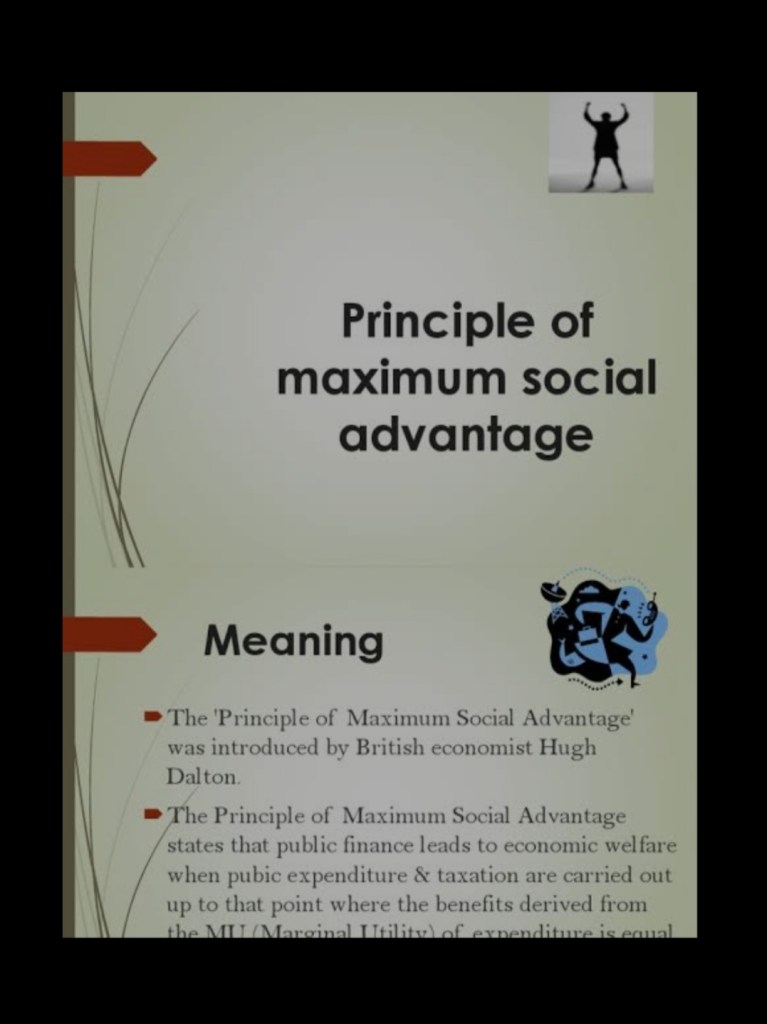
The Principle Of Maximum Social Advantage. ( Meaning , Assumptions , Explanation , Theories , Limitations )


“The Principle of Public Finance means the fundamental rule by which the financial policy of the state is determined.
This fundamental rule of principle of public finance is called “The Principle of Maximum Social Advantage “

The credit for the implementation of this principle goes to Prof. Pigou and Prof. Dalton .
Just like an individual seeks to maximize his satisfaction or welfare by the use of his resources ,the state ought to maximize social advantages or benefit from the resources at its command .

According to Dalton , principle lies “at the root of public finance “.
The principles of maximum social advantage are applied to determine whether the tax or the expenditure has proved to be the optimum benefit .

He stated “The best system of public finance is that which secures the maximum social advantage from the operation which it conducts “
This principle is also called as ” Principle of Maximum Social Benefits “

Prof Pigou called this principle ” The Principle of Maximum Aggregate Welfare


Significance of the principle :-

Public revenue and public finance are two important financial operations of the state. These operations should be performed on fundamental principles so as to obtain maximum social benefit .

Prof. Hugh Dalton and Prof. Pigou were two famous economists who implemented the principle of Maximum Social Advantage to give the fundamental basis of the function performed by the state to earn revenue and to spend the revenue in the best possible way to Maximum benefit incrementation in the welfare of the public .


Prof. Dalton has expressed it in these words ,
As a result of operations of public finance ,the nature and quantity of money produced and between the categories and different persons there are many changes in the distribution of that money . The question is do these changes ; leave a profitable impact on society ? If it is so then it will be considered that the operations of public finance are justified , otherwise not .The best system of public finance is that can obtain maximum social profit by the operation organised by them .”

Therefore , the Principle of Maximum Social Advantage is the principle that guides the operation of financial activities of the government to obtain economic welfare of the society .

According to Dalton , attainment of the principle requires :-

• Public expenditure and taxation should be carried out up to certain limits i.e where marginal utility received by the Government expenditure must be equal to marginal disutility due to taxation ( government income ).

• Public expenditure should be utilised among the various uses in an optimum manner

• The different sources of taxation should be so trapped that the aggregate sacrifice entailed is the minimum .


Assumptions :-

• The public revenue consists of only taxes ( and not gifts , loans , fees ,etc.,) and the state has no surplus or deficit budgets.

•Public expenditure is subject to diminishing marginal social benefits and the taxes are subject to increasing marginal cost or disutility .


Principle Of Maximum Social Advantage:-

The Principle states that :-

The state should collect revenue and spend the money so as to maximize the welfare of the people. When the state imposes taxes, some disutility is created. On the
On the other hand, when the state spends some money, there is a gain in utility. The state should so adjust revenue and
expenditure that surplus of utility is maximised and disutility is minimised.”

According to Dalton , “ maximum social advantage is at a point where the Marginal Social Sacrifice of Taxation ( MSS) and Marginal Social Benefit ( MSB) are equal .
The point of equality between MSS and MSB is referred to as the point of maximum social advantage or least aggregate social sacrifice .


Maximum social sacrifice of taxation :-

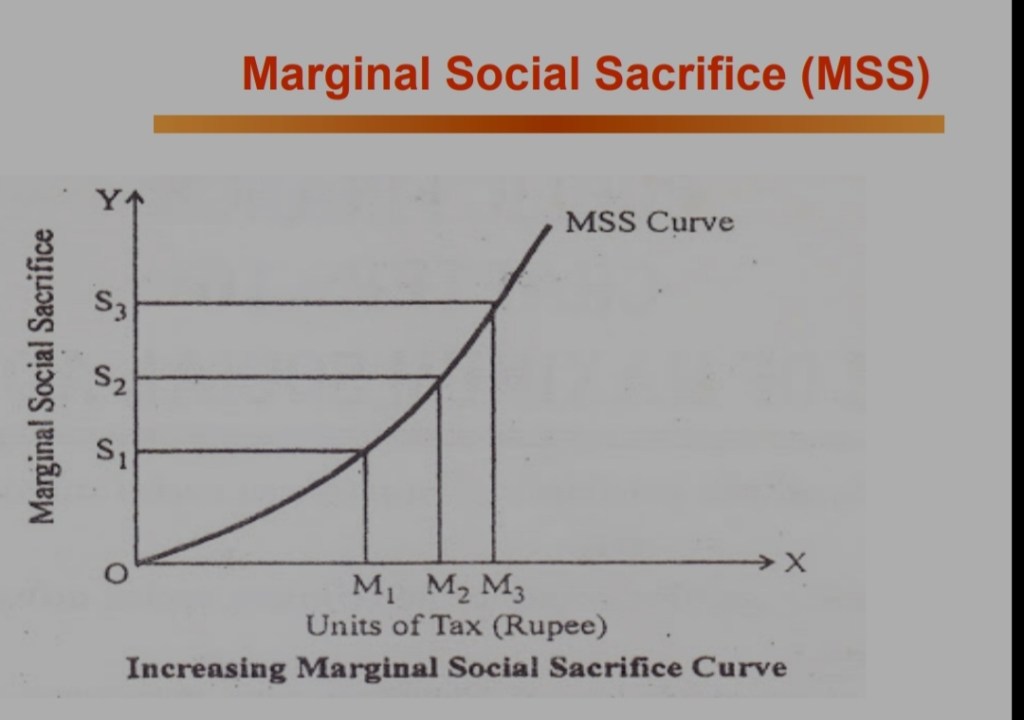
The amount of social sacrifice undergone by the public due to the imposition of an additional unit of tax is called Maximum Social Sacrifice of taxation .
Every unit of tax imposed by the government taxes result in loss of utility.

According to Dalton ,
“The additional burden (marginal sacrifice) resulting from additional units of taxation goes on increasing. Every additional unit of taxation creates greater amount of sacrifice on the society”


The Marginal Social Sacrifice (MSS) curve rises upwards from left to right. This indicates that with each additional unit of taxation, the level of sacrifice also increases.


•. Marginal Social Benefit :

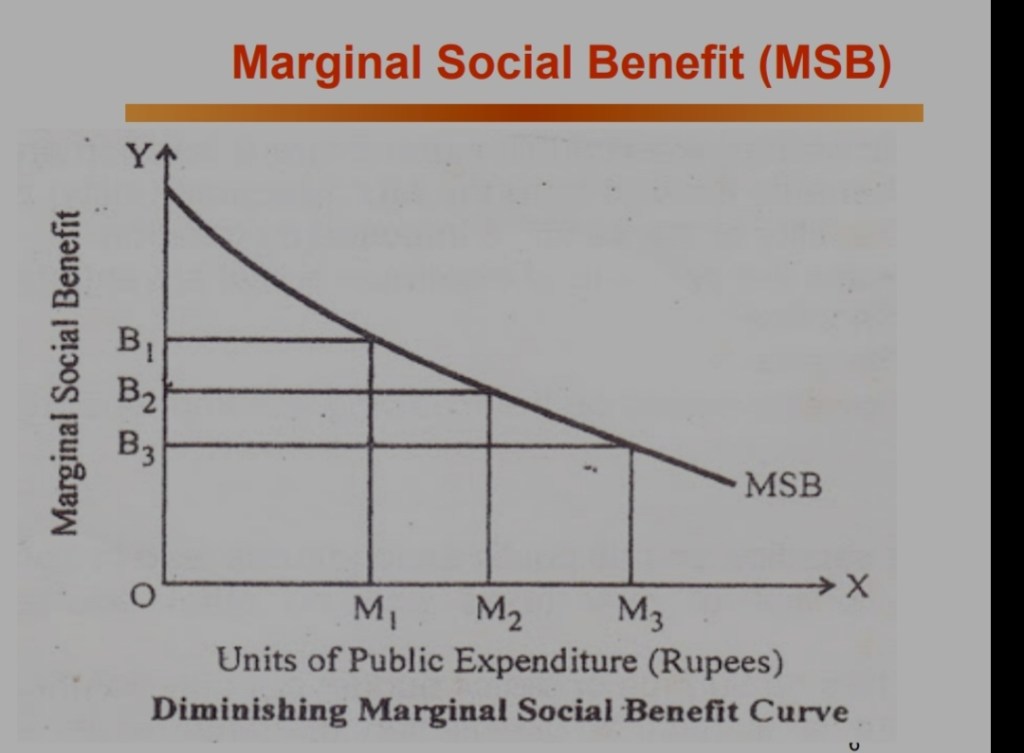
The benefit conferred on the society, by an additional unit of public expenditure is called the Marginal Social Benefit curve .

The social benefit from each additional unit of public expenditure declines as more and more units of public expenditure are spent. The marginal utility from commodity to a consumer declines as more and more units of the commodity are made available to him .


MSB curve slopes downward from left to right. This indicates that the social benefit derived out of public expenditure is reducing at a diminishing rate.


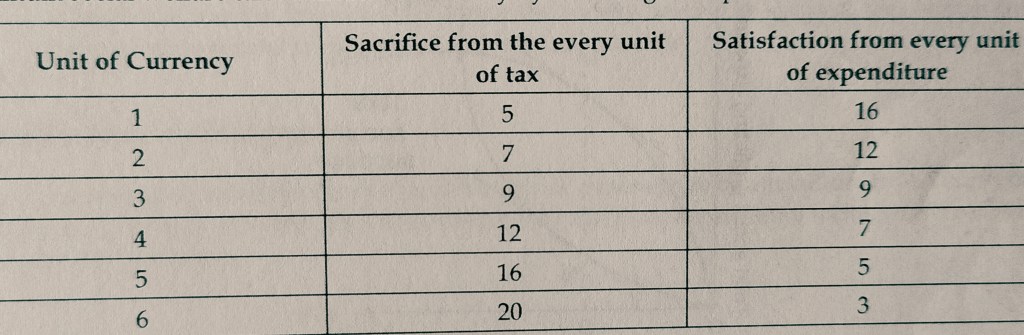
Maximum social welfare can be understood by the following example :-


Table

It can be seen in the above table that marginal sacrifice is increasing due to the increase in every unit weight of tax on society.
Inversely , from every additional unit of Government expenditure ,its utilities diminish .

On the third unit of currency , marginal social sacrifice is equal to marginal social advantage ( 9 units ) . At this point the tax and public expenditure will be fixed .

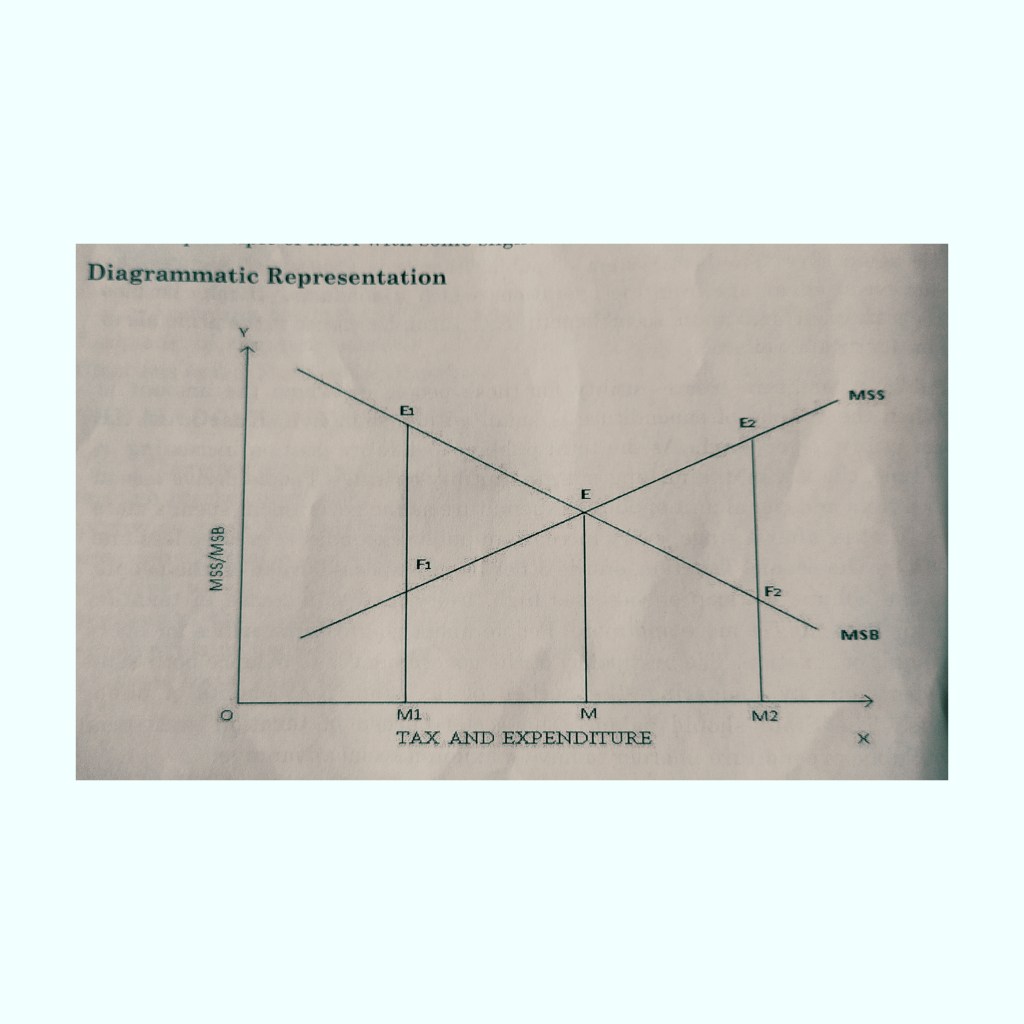
In the above given figure ,
MSS represent marginal social sacrifice of the taxation curve , slopes upward since taxation increases resulting in Increasing of MSS,.
and MSB represents the marginal social benefit of the public expenditure curve , slopes downwards showing that public benefit goes on declining with every unit increase in public expenditure.

The point E where the MSS curve intersects MSB curve , is the ideal point of financial operations where the government collects OM taxation from the society and uses it for public expenditure .


According to Dalton ,
“Public expenditure in every direction should be carried just so far that the advantage to the community of a further small increase in any direction is just counterbalanced by the disadvantage of a corresponding increase in taxation or in receipts from any other source of public income . This gives the ideal public expenditure and income.”


Musgrave’s View :-

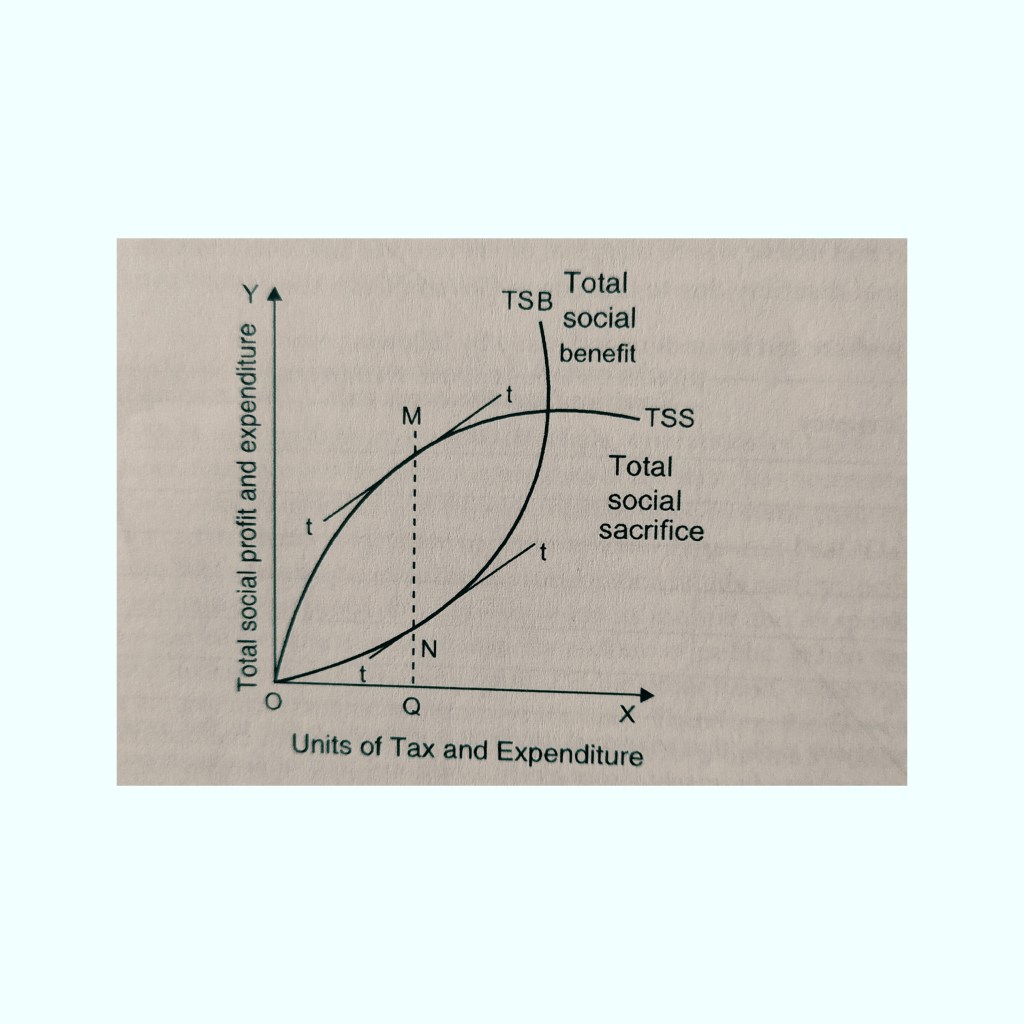
The Principle of maximum social advantage can be explained using total sacrifice and total benefit curve as well .

Musgrave called Dalton ‘s principle as
“Maximum Welfare Principle Of Budget Determination “
According to him , the difference between total social benefit and total social sacrifice is the net social benefit where maximum social benefit is obtainable .

The TSB curve represents total social benefit received from public expenditure which slopes upward but decreases after some time , showing that as public expenditure increases total social benefit increases .
The TSS curve represents total social sacrifice produced due to tax showing that as total social sacrifice increases with increase in amount of tax but rapidly .

Maximum social benefit will be achieved at a point where the difference between total social benefit and total social sacrifice is maximum .
MN denotes the difference between TSB and TSS showing net social benefit.


Objective Tests Of Social Advantage :-

Dalton has given the following three objective Tests which can lead to Maximum Social Advantage :-

• To preserve the Community :-
According to Dalton , the first test is the need to preserve the community against internal disorders and external attacks. The financial operations of the state to preserve the society in this manner leads to maximum social advantage .

• To increase Economic Welfare :-
Increasing the economic welfare of the community leads to maximum social advantage . According to Dalton ,this can be achieved by improvements in production and improvements in the distribution of national product ( or income ) through state’s financial operations .

• To provide for Future Generation :-
According to Dalton , the financial operations of the state should provide for the future generation . The state should prefer a larger social advantage in the future to a smaller one in the present .


Limitations of Maximum Social Advantage :-

In spite being guiding principle of financial operations of the state , the principle of maximum social advantage possesses the following limitations :-

Vague and Abstract :- The terms “benefit ” and “sacrifice ” are vague and abstract concepts. It is not possible to quantify them and find out their exact implications.


Different Areas :-
It is not possible to compare the marginal benefits accruing to people in one area from a given public expenditure with marginal sacrifice undergone by persons who are taxed in some other areas .

Lack of Divisibility :-
In order to equate the marginal benefit from public expenditure with the marginal sacrifice from taxation , the resources are required to be divided into smaller units . But it is not possible because of the lack of Divisibility of public expenditure and taxes in small units .

Ignores Non- Tax Revenues:
This principle takes into consideration the sacrifice on the part of direct tax payers and ignores Non- tax revenues like fines , fees ,market borrowing , profits of public undertaking ,etc., are equally important sources of revenue and in the effects on social benefit are as important as those of taxes.

Maintaining Balance :-
It is a difficult task for the state to maintain balance between disutility and utility produced due to imposing tax and utility obtained by people from the Government expenditure as the government is not a single person but different servants at different places in different departments .

Simultaneous Calculation not Possible :-
This principle requires simultaneous calculations and equating marginal social benefits from public expenditure and sacrifices from taxation which is not easy .
As put by Prof. Buchana , ” To match them is a function for the’ fiscal brain ”and ‘computers ‘. “

According it Dalton , despite these limitations ,the principle of maximum social advantage is “the best system of public finance “.

National Doctor’s Day . Celebrate and Appreciate The Life Savers of the World .

It is said ,
“diamonds are chunk of coals that did well under pressure”

Do you know about human diamonds ?
Think again, you might know them .
Yes you might have seen them ,even talked ,shared your problems ,they might have shined for you ,helped you solve your issues physically , mentally , emotionally .

Yes ,yes you are going the right way pal.
They help us without any time limit . They are available anytime whether it’s day or night .


Yes you got their dress code right,
They wear white coats and stethoscopes as their ornament .

Finally, here’s your answer.
They are doctors.


Amid the Covid-19 outbreak, when the world had no hope , when there was no Almighty omnipresent to save the world , when death threatening situation have elevated tremendously, the medical doctors have been working 24/7 risking their lives and desperately making an attempt to save several lives. Standing at the frontline battle of Covid -19 , facing the life threatening situations , instead of thinking about their own safety and their family’s safety they choose to serve the nation, putting their own lives at risk with selfless determination for the sake of saving lives despite of every possible chance of not seeing the world again .


The doctors and the staff have gone above and beyond everything one can ever expect them to during this Covid-19 battle.

Just like diamonds , taking pressure just to shine for others .
Doctors are just humans with white coats but with extraordinary will to serve and save people .

No words are enough to appreciate their service.
But one can always give a day to celebrate and appreciate their commitments.

In India , July 1st is celebrated as National Doctor’s Day .
A day when one can show their gratitude for all the support, dedicated service, care, and humbleness and surely the effective treatment by doctors .


National Doctor’s Day :-

Every year, July 1 is celebrated as National Doctors’ Day by the Indian Medical Association (IMA).
The day is dedicated to all the doctors and healthcare workers who have been serving the people by risking their lives.


History of Doctor’s Day in India :-


The National Doctor’s Day 1st July was first observed in 1991, commemorating the birth and death anniversary of former Bengal’s Chief Minister Dr Bidhan Chandra Roy to honour his contribution in serving humanity as a doctor .


About Dr Bidhan Chandra Roy :

Bidhan Chandra Roy , was an Indian physician, educationist, philanthropist, freedom fighter and statesman who served as the Chief Minister of West Bengal .


Dr Roy was a great doctor who made an enormous contribution to the medical field. He was born on July 1, 1882.


On 1 July 1962, his 80th birthday, around 11 in morning , after treating his patients , he died . He had gifted his house for running a nursing home named after his mother, Aghore Kamini Devi. He had also constituted a trust for his properties at Patna to carry out social service, with eminent nationalist Ganga Sharan Singh (Sinha) .


He played a significant role in establishing medical institutions like Jadavpur T.B. Hospital, Chittaranjan Seva Sadan, Kamala Nehru Memorial Hospital, Victoria Institution (college), Chittaranjan Cancer Hospital and the Chittaranjan Seva Sadan for women and children.
He was responsible for setting up a framework for dispensing grant-in-aid to hospitals and charitable dispensaries
He was honoured with Bharat Ratna, on February 4, 1961.

July 1 is celebrated as ‘National Doctor’s Day’ as National Doctors’ Day by the Indian Medical Association (IMA) in account of his service and for being the pedestal of the medical line in India .

Celebration around the world :-

The date of celebrating National Doctor’s Day varies from nation to nation depending on the event of commemoration that is marked as the national Day of celebrating the service of doctors.


Cards or red carnations are gifted to doctors , physicians and their spouses to celebrate their commitment and service by patients and staff.
A flower is also placed on the graves of deceased physicians.

Red Carnations bouquets are specially gifted to doctors because of its specific symbol. Red carnations symbolises love, affection and sacrifice which represents the gratitude of a patient towards his healthcare professionals.

The day is celebrated by health care organizations as well .


Significance The National Doctor’s Day :-

This day is observed to pay heed towards the medical doctors’ role and responsibilities in serving lives. The day is supposed to recognise their functions and obligations as well as their service of healing mankind .
A good doctor who works hard to serve humanity and handle his/her patient with care always deserves appreciation . Thus , doctor’s day is a day to celebrate and appreciate their selfless service.


“Medicines can cure, but a good doctor’s inspirational words can give the strength to fight from within “

Being at hospital can be a terrible experience for a person but a good doctor not only provides the best treatment but also strength to fight the disease and treat a person not only physically but also mentally and emotionally with their positive thoughts .

Oncologists, pediatricians, cardiologists, neurologists, general physicians, dermatologists, gynecologists, and psychiatrists , all such kinds of doctors take the Hippocratic Oath and through this oath, they swear to follow ethics laid down for medical practices.

Doctor’s services are the foremost necessary for life.
Doctors all over the world are given the stature next to God because of their life saving role play .

So let us all appreciate and show your gratitude to the Warriors and Life Savers for all their commitments and selfless deeds .

Free Trade Policy . (Meaning , Advantages , Disadvantages)

What is Free trade policy?

Free trade policy refers to a trade policy without any tariffs , quantitative restrictions and other devices obstructing the trade of goods between countries ..

According to Adam Smith,
The policy of free trade is a system of commercial policy which draws no distinction between the domestic and foreign commodities and thus neither impose additional burden on the latter nor grants any special favour to the former “

The theoretical case for free trade is based on Adam Smith’s argument about absolute comparative advantage , that the division of labour among countries leads to specialization, greater efficiency, and higher aggregate production.

Free trade therefore , signifies a non discriminatory trade policy that places no artificial barriers upon free international movement of goods and services .

Definitions :-

Prof Jagdish defines free trade policy as , ” absence of tariffs , quotas, exchange restrictions , taxes , subsidies on production , factor use and consumption “

Prof Lipsey gives a very simple definition ,
“A world of free trade would be one with no tariffs and no restrictions of any kind on importing or exporting . In such a world a country would import all those commodities that it could buy from abroad at a delivered price lower than the cost of producing at home .”

In Haberler’s words , ” free trade is the external trade system of liberation which opposes every interference by the state with the free play of economic forces .”

Thus ,the policy of free trade means simply complete freedom of international trade without any restrictions on the movement of goods between countries.

Free trade, also called laissez-faire,
a policy by which a government does not discriminate against imports or interfere with exports by applying tariffs (to imports) or subsidies (to exports).

However sometimes, governments with generally free-trade policies still impose some measures to control imports and exports.
For instance , in the United States, most industrialized nations negotiate “free trade agreements(FTA ),” or , with other nations which determine the tariffs, duties, and subsidies the countries can impose on their imports and exports.

Theories Of Free Trade :-


The years of debates over the benefits versus the costs of free trade policies to domestic industries, two predominant theories of free trade have emerged: mercantilism and comparative advantage.

Mercantilism

The theory of maximizing revenue through exporting goods and services is Mercantilism. High tariffs on imported manufactured goods are a common characteristic of mercantilist policy.
Mercantilist policy helps governments avoid trade deficits, in which expenditures for imports exceeds revenue from exports.
The goal of mercantilism is a favorable balance of trade, in which the value of the goods a country exports exceeds the value of goods it imports.
Mercantilism lost its popularity as it often led to colonial expansion and wars.

Today many multinational organizations such as the WTO work to reduce tariffs globally, free trade agreements and non-tariff trade restrictions supersede mercantilist theory.

Comparative Advantage

David Ricardo in his book “Principles of Political Economy and Taxation,” 1817 , stated the law of comparative advantage which refers to a country’s ability to produce goods and provide services at a lower cost than other countries.
The Comparative advantage theory is that worldwide openness in trade will improve the standard of living in all countries.
Comparative advantage holds that all countries will always benefit from cooperation and participation in free trade.


Advantages ( pros ) of Free Trade Policy.

Free trade policy has many advantages for a country.
The following are some pros of free trade policy :-

1: Maximum of Output :- Under free trade the country specialises in the production of those commodities which it is relatively best suited to produce and exports them in exchange for those imports which it can obtain more cheaply . This maximises the output of all the participating countries because all gain from trade which in turn , increases the real national income of the world economy . Thus free trade leads to the maximisation of output income and employment.


2: International Specialization :-
Free trade causes international specialisation as it enables the different countries to produce those goods in which they have comparative advantage . International trade enables countries to obtain the advantage of specialisation . If there were no international trade many countries would have to go without some products .

3: Optimisation of Consumption :-
Free trade secures the optimisation of consumption . In other words ,it benefits the consumers when they are able to buy a variety of commodities from abroad at the minimum possible prices . This results in raising their standard of living .

4:. Link with others Countries :-
International trade and commercial relations often lead to an interchange of knowledge ,ideas and culture between nations . This often produces a better understanding among those countries and leads to amity and reduces the possibility of commercial rivalry and war .

5:. Prevent Monopolies :-
Free trade prevents the establishment of monopolies . Under free trade, the country specialises in the production of a few commodities ,and the firms or industries are of the optimum size so that the cost of production of each commodity is the minimum . Thus , free trade ensures a lower price for exports as well as imports and the price mechanism under perfect competition prevents the formation of Monopolies.

6:. Higher Efficiency and optimum Utilisation of Resources :-
Free trade stimulates home producers who face to foreign competition to put forth their best efforts and thus increase managerial efficiency . Again as under free trade each country produces those goods in which it has the best advantages , the resources of each country are utilised in the best possible manner.

7:. Best policy for Economic Development :-
Haberler points out that “substantial free trade with marginal insubstantial corrections and deviations is the best policy from the point of view of economic development “
Besides the direct gains of free trade noted above , free trade fosters development in the following ways
(a) it leads to the importation of capital goods , and raw material ;
(b) it instills new ideas and brings technical know-how, skills , managerial talents and entrepreneurship to the developing countries ;
(c) it facilitates the flow of foreign capital and fosters healthy competition and checks inefficient and exploitative monopolies.


Disadvantages ( cons ) of Free Trade

Despite having several advantages , there are certain theoretical and practical difficulties in following free trade policy .

Some of those disadvantages are :-

1:
Excessive dependence :- Free Trade policy leads to unwanted dependence for goods among countries which leads to major problems in a countries economy if there is some conflicts between the Countries due to some matter .

2:
Obstacles to Development of home Industries :-
If foreign goods are imported freely , the domestic industries of the developing countries would not be able to develop rapidly due to the superior strength of foreign industries .

3:
Empire Builder :- Under the free trade the foreign traders particularly the dominant ones may try to become empire builders in future . In the past it is see ,free trade gave rise to colonialism and imperialism.

4:
Import of Expensive Harmful Goods :- With no restrictions it’s easy to import expensive harmful foreign goods . This leads to diminution of social welfare . Trade restrictions on import goods become necessary.

5:
Less job opportunity :- While free of tariffs, products imported from foreign countries may be seemingly good for consumers, it makes it hard for local companies to compete, forcing them to reduce their workforce. It causes job loss through outsourcing: Tariffs tend to prevent job outsourcing by keeping product pricing at competitive levels. with lower wages cost less.


In conclusion , we can say that at present no country in the world follows the policy of free trade . Every country imposes some restrictions on the import and export of goods .
T.Scitovsky has pointed out that free trade can be shown to be beneficial to the world as whole but has never been proved to be the best policy for a country .


However , poor countries that have adopted free-trade policies have experienced high economic growth, with China and India as prime examples. Free trade allows companies from rich countries to directly invest in poor countries, sharing their knowledge, providing capital and giving access to markets.

Socialisation ( Meaning , Definitions , Types , Agents , Stages )

It is said ,  Little of man’s behaviour is instinctive , rather his  behaviour is ‘ learnt ‘.

 At birth the human child possesses the potentialities of becoming human . 

The human child comes into the world as a biological organism and becomes a social being by learning social ways of acting . 

The child becomes a man or a person 

( Purush)  through various experiences .

Socialist referred it as “socialised person “

Every society has its own way of making a biological organism into a socialised being .

This social training is called “Socialisation “

Hence , the process of moulding and shaping the personality of a human infant is called “Socialisation “.

Sociologists have often referred to socialisation as “transmission of culture “.

A man is not only social but also a cultural being .

 Cultural learning is the process by which the individual learns the fundamental culture pattern of the society in which he lives or will live . Culture includes not only its living members but also members of past generations and those yet unborn . Culture defines social conditions for us like what we eat , drink , wear , God we worship , our beliefs etc. 

Still cultural learning does not completely define socialisation . 

Socialisation is an aspect of all activities within human societies and are socialised in the course of the activities. 

Socialisation is the process of adjustment of an individual to conditions of his social environment . There are some  relevant internal forces that direct or limit socialisation like instinct , urges , capabilities , education , reflexes , etc .In the process of socialisation an individual learns culturally approved habits , ideas ,. beliefs . He is taught his  rights and duties ,his position and responsibilities. The culture rules are so completely internalised that they become part of individual personality .

Definitions :-

Lundberg says that socialisation consists of the ” complex processes of interaction through which the individual learns the habits , beliefs ,skills and standards of judgement that are necessary for his effective participation in social groups and communities .

Peter Worsley explains socialisation as the process of “transmitted culture, the process whereby men learn the rules and practice of social groups “.

Socialisation is the process of working together ,of developing group  responsibility or being guided by the welfare needs of others ” 

               –   Bogardus 

W.F. Ogburn defines Socialisation as  “,  the process by which the individual learns to conform to the norms of the group “.

Hence , Socialisation is a process of transforming the human animal into human being ,of converting the biological being into social being .

Characteristics of Socialisation :-

• It is a continuous process .

• Socialisation is also referred to as ” transmission of culture “.

• Socialisation is social learning .

• Socialisation can be informally or formally conducted

• Socialisation means internalisation of norms .

• The process of Socialisation emerges from the development of “self “.

• Timing is an important concept of Socialisation .

Types of Socialisation

Ian Robertson in his book “Sociology “( 1977) described four types of Socialisation . According to him , an individual undergoes four types of socialisation in his lifetime .

1:

Primary Socialisation :-

Many Sociologists like  Sigmund Freud, George Herbert Mead, Charles Cooley, Jean Piaget and Talcott Parsons ,  have contributed to the theory of primary socialization. 

Primary Socialisation is the most essential and fundamental type of socialisation. Period early in a person’s life during which they initially learn and build themselves through experiences and interactions around them is the period of primary socialisation.

It takes place in the early years of life of a newborn individual .It includes teaching of language and cognitive skills , internalisation of culture and norms , developing a perspective , emotional ties etc.

Primary socialization starts with the family teaching children how to bond, create relationships, and understand important concepts including love, trust, and togetherness.

“Internalisation of norms ” is the most important aspect of primary socialisation . It is a process where the norms of the society become a part of an individual .

Several agents reinforce an individual’s learning of norms , the right and wrong behaviour .

2:

Secondary Socialisation:

Secondary socialisation generally refers to the social training received by the child in institutional or formal settings and continues throughout the rest of his life.The process can be seen at work outside the immediate family, in the ‘peer group’. The growing child learns very important lessons in social conduct from his peers. He also learns lessons in school. Hence, socialisation continues beyond and outside the family environment. 

3: 

Anticipatory Socialisation :- 

According to Merton , the process whereby men socialise themselves into the culture of groups with the anticipation of joining that group .

Men learn not only the culture of the group which they belong to but also about the group they don’t. An individual may socialise into groups of which they are already members or into groups to which they wish to become attached. 

For instance , a person starts doing his physical exercises and learns to become tough mentally and physically if he intends to join the military.

Socialisation is not a process that takes place merely in early childhood but also at different times and places throughout life .

4:

Developmental Socialisation and Resocialisation :- 

According to Ian Robertson ,

It builds on already acquired skills and knowledge as the adult progresses through new situations such as marriage or new jobs . These require new expectations , obligations and roles . New learning is added to and blended with old in a relatively smooth and continuous process of development “.

Developmental Socialisation is based on learning on the achievements of primary socialisation. A person learns more developed  beliefs, values and norms through which he learns how to act in his new role.

Re- Socialisation fundamentally means ” stripping away of the learned patterns and substitution you f new ones “

Re- Socialisation takes place mostly when a social role is radically changed during periods of rapid mobility .

Agents of Socialisation 

Socialisation includes moulding and shaping the personality of an individual . The continuous process of socialisation includes some agents who help an individual human being to become a social being .

Family and Parents :-

The first stage of socialisation starts from the foetal form , where the mother plays an important role . The process of socialisation begins with parental , particularly maternal influence on an individual.

Parents are the first to introduce the child to the society system and culture of his group.

The family acts as the fundamental agent in internalisation of roles for an individual.

Peers :- 

As the child grows he starts associating with other individuals outside his family . He learns from these individuals in school or in the playground or on the street . 

The peers group forms perspective on several important topics .

In modern society the peer group has surpassed the importance of the parental group. An individual has more communication understanding with his peers than his own family.

The child maintains an egalitarian relationship with those who are of the same age or gender .

It’s with the peers group that an individual learn more information regarding culture , manners , fashion , styles , gender etc. 

Teachers :-

  School is the most influencing place where an individual learns how to behave and form an independent personality . Teachers are major agents of socialisation. School is a formal conduct in the process of socialisation . Teachers help an individual to be responsible and mature . 

Literature and Mass of Communication :-

Entertainment media , mass.media , literature , plays an important Agent I’m socialising . The different opinions or perspectives on several important topics like political , economical , social , etc are highly influenced by these agents.

The attitudes and ideologies ,the words written by someone  impact a person in guiding and forming a perspective in a new light . 

Stages of Socialisation

Socialisation is a continuous process of learning. AC children are taught about social life in various stages . The form of socialisation begins with ‘ simplicity to complexity’ as the social world gets wider and wider and the child is confronted with several things to learn and adjust .

At each stage of socialisation the child internalises a ‘ system ‘ of roles . 

Socialisation consists of four stages from infancy to adulthood .

The first stage –

The Oral Stage  :-  Oral Stage begins with the birth of the child . It lasts till the child completes his one year .In the foetal form the child feels the comfort of his mother’s womb . 

In this stage the child establishes his oral dependency by whimpering or bawling for everything .

Sigmund Freud ,an Australian Psychiatrist ,called this stage as primary identification as a child tries to internalise his and his mother’s role . 

2:

The Second stage 

The Anal Stage :- The next stage in socialisation is the Anal Stage which begins just after the completion of the oral stage . In this stage the child is taught to do some fundamental tasks such as eating , Cleaning , toileting , etc .

In the first stage the oral dependency starts to fade and the child learns that he cannot depend completely on his mother .

In this stage the child’s mother is the socialising agent .The child in this stage separates his and his mother’s role and understands the social system to a larger extent than in the first stage .

3:

The Third stage 

The Oedipal Stage :- 

The thirst stage starts from the fourth year of the child and lasts till puberty i.e 12-13 years .

The third stage the child establishes his role on the basis of his sex . 

The boys and girls learn about their roles in the society and identify themselves as part of the social system and starts internalising according to their sex , the role of others and their identities on the basis of their gender .

The Fourth Stage :-

The Stage of Adolescence :- The fourth is the stage where the child becomes free from their parental control and establishes independence . Parents play an important role in a child’s life at all stages . Despite the freedom from parental control ,they help the child to make some very important decisions in his life . They encourage and help them to take new roles during this period of Adolescence . They expect the child to learn new responsibilities and new roles that are assigned to them .

In modern society ,the parents intend to give more freedom than traditional societies where parents take mostly all the important life decisions of the child .

This stage is the most important stage in socialisation as the child’s behaviour and personality depends on the kind of learning he / she  learns and the decision he/ she takes that affects the society . During adolescence the child goes through several physiology and psychological changes ,which affects mentally and emotionally and hence establishes more new experiences  than any other stages .

 Socialisation makes an individual a social being who transmits cultural ideas , beliefs , languages , skills etc from generation to generation, learns rules and practices of social groups  and contributes to forming a society .

Stock Exchange Market ( Meaning, Definitions , Functions , Members , Stock Exchange Market in India , Trading procedure , Members)

Stock exchange Market

What is a stock exchange market?

A market is said to be an arrangement between buyers and sellers to exchange goods or services for money.
A stock exchange is a highly organised market ,where listed securities are bought and sold under a code of rules and regulations.

A stock exchange Market is also known as a ‘security exchange or ‘, ‘security market ‘ or ‘share bazar ‘.

It is an organised market for the purchases and sale of industrial and financial securities or where financial instruments like stocks, bonds and commodities are traded.

It is a platform where buyers and sellers come together to trade financial tools or securities , adhering to SEBI’s well-defined guidelines. SEBI’s responsibility is to ensure that the securities market in India functions in an orderly manner.

( About SEBI )


Definitions

” A stock exchange is an association of persons engaged in buying and selling of shares , stocks , debentures and bonds for public on commission and are guided by certain Rules and usages “
…….. Dr. K.L Garg

” A stock exchange is an organised auction market where buyers and sellers come together through their brokers ,to effect transactions in securities admitted to listing on the exchange and unlisted securities for which a market is maintained “
……… Charles W. Gerstenberg .


” A stock exchange is a marketplace where securities that have been listed thereon ,may be bought and sold for either investment or speculation “
…….. W.Pyle .

” Stock exchange means a body of individuals ,whether incorporated or not , constituted for the purpose of assisting ,regulating and controlling the business of buying , selling and dealing in securities .”
…….. Securities Contracts ( Regulation ) Act , 1956


The stock market is a market where exchange of regular activities of buying, selling, and issuance of shares of publicly-held companies take place.


Key meaning :-

• it is an organised market where securities are purchased and sold
• transaction takes place between the members or their authorized agents on behalf of the investors.
• securities refer to shares , stocks , debentures and Government bonds .
• Securities are traded in a stock exchange in a systematic manner for investment .
• only listed securities are traded in a stock market.
• functions on the basis of rules and regulations.
•It is managed by the Board Of Directors elected by the shareholders .
• brings a huge amount of capital necessary for the economic progress of a country .


Names and locations of stock exchanges in India :-

At present there are 24 recognised stock exchanges in India .


The major stock exchanges in India :-


1: Bombay ( Mumbai ) Stock Exchange :-
This stock exchange was formed on 13th December , 1887 in the name of Native Share and Stock Brokers Association .
It is a non – profit making voluntary association . It is organised and controlled by Bombay Securities Control Act . The rules and regulations of this exchange are its own and approved by the Government of Maharashtra.


2: Calcutta ( Kolkata ) Stock Exchange :-
This stock exchange was set up in the year 1908 at Royal Exchange place , Calcutta . In 1923 , it was registered in the name of Calcutta Stock Exchange Association Ltd. with 300 members . It is a public company limited by shares .


3: National Stock Exchange ( Greater Mumbai ):- This stock exchange was recognised by the Central Government on 26th April , 1993 . The object of its establishment was to convert the exchange market into a professional market . It provides security (i.e , shares , debentures , bonds , etc.) trading facilities at the national level through satellite communications systems .


4: Over the Counter Exchange (OTCE) :-

(About OTCE )

This stock exchange was established in 1992 . It has been promoted jointly by ICICI , UTI , IFCI , IDBI , SBI , GIC ,LIC , Capital Market Ltd. and Canara Bank Financial Services Ltd. These institutions are the sponsor members of this exchange. Its head office is in Mumbai . It has four regional offices at Kolkata , Delhi , Chennai and Mumbai . It helps smaller companies to raise funds at low cost .


There are two types of stock exchange market investment :-


Primary market – Primary market creates opportunities for the issuer to issue shares and bonds , and acts as a market where companies meet their investment requirements . The companies enlist their shares for the first time in the market and sell their shares through an Initial Public Offering or IPO.

(About IPO )


Secondary market – The secondary market is a trading market platform for investors or issuers , and is also known as the stock market. It is a market where shares of a company are traded after being initially offered to the public in the primary market by the help of brokers or agents . It is a market where buyers and sellers meet directly.

Functions and Services of a Stock Exchange:-


Stock exchange renders the following services :-

1:
Services to the Investors :-

• Investment guide :- Stock Exchange periodically publishes the quotations of listed securities. Investment can decide about purchase and sale of securities on the basis of stock exchange and quotations . Thus , the investors can get the maximum benefit from their investment.

• Liquidity of Investment :- Stock Exchanges are ready and continuous markets for purchase and sale of securities .The securities can easily be converted into cash as the needs of the investors arise .

• High Collateral Value of Listed Securities :- Listed securities in any stock high collateral value . These securities are preferred by rational investors . The securities of such companies can be sold easily . The investors have no fear of risk while trading in listed securities.

• Better use of Capital :-
The prices of shares reflect the profitability and efficiency of the company concerned . A stock exchange helps the investors in choosing good companies for their investment .

• Protection from Bad deliveries :- Securities in the stock exchanges are listed after the proper scrutiny . It prevents the trading of false and duplicate securities .

2:
Services to corporate sector

• Wide market for new securities :-
A stock exchange serves as a sales counter for new securities . Once a company gets listed in a stock exchange, it’s shares are traded freely in that exchange . Therefore , a company can raise a huge amount of capital from different types of investors.

• Increasing Goodwill of the company:-
The shares of only those companies are listed in the stock exchange which are financially sound . Therefore , listing of shares adds to the goodwill and credit standing of a company.

• Transfer of Securities at suitable prices :-
In the event of a merger or amalgamation ,the company whose securities are listed ,is in a better position than the company whose securities are not listed.

• Assist development of companies :-
A stock exchange is an essential adjunct of companies for quick capital formation . It provides a wider and a ready market for the secur of companies . It ensures higher bargaining power to companies in the event of further expansion and merger.

• Knowledge about future investment :-
Companies can get relevant information regarding trends of investment , investors choices and priorities etc., From the stock exchange on a regular basis .The companies can plan their future issue of capital on the basis of such information.

3: Services to Society :-

• Capital formation :- A stock exchange provides good investment opportunities to investors .It promotes the habit of savings and investment.

• Industrial Development :-
A stock exchange helps to mobilize public savings for the economical development of the country.This leads to industrial and commercial development .

• Utilizing scarce capital for productive purposes :- Idle lying funds can be invested in securities on account of stock exchange .

• Useful to Government :- The government plays a vital role as an entrepreneur in the promotion and management of commercial and industrial enterprises . A stock exchange helps the Government in raising sufficient funds for rapid industrial growth .


Operators In A Stock Exchange

Stock market operators are market participants who form a organise stock securities purchases and sales .

Generally found operators:-

Broker :-
A broker acts as a link between the investors and the jobber . He is a commission agent of buyer or seller of securities . A broker charges commissions from both the buyers and the sellers.
He does not specialize in any particular security .He assists in buying and selling all types of securities .

Jobber :-
Jobber can sell and purchase securities in his own name . He is a professional operator . He gets no commission for his service. His income is the profit in purchase and sale of his securities. The service of a jobber is both useful for both the investors and the stock exchange.


Speculators in Stock Exchange

On the basis of Zoological characters , speculators are of four types :-

Bull

In India , bull speculator is known as
Tejiwala “.
The stock market is called a ” bullish market ” when there are large numbers of bulls speculators .
A ‘bull’ is an optimistic speculator who buys securities with the exception of a rise in their prices . He makes purchases of Securities to be sold in future at a higher price to make profit .

Bear

In India , a ‘ bear ‘ speculator is known as a
Mandiwala “. When a stock market has large number of bears ,it is known as ” bearish market “.
A bear speculator expects a fall in the prices of securities . He sells securities with the hope of buying the same at a lower price before the date of delivery.

Stag

A ‘stag ‘ is a ” premium hunter “. He never holds securities as a permanent investment. He issues shares by the new company on the basis of their issued prospectus .He sells these shares at a premium soon after the allotment is made . The premium earned became his profit.

Lame & duck :-
A ‘lame-duck’ is a bear speculator struggling against the difficulties involved in meeting his commitments. He struggles like a duck to purchase shares so that he may deliver the same to another party . He is a bear speculator who is in no position to find shares .


Trading procedure in a Stock Exchange.

Trading in stock markets means the transfer (in exchange for money) of a stock or security from a seller to a buyer. This requires these two parties to agree on a price.


Procedure :-

• Selection of a broker
• Placing the order
• Executing the order
• Preparing the contract note
• Final settlement.

Know More about Drug Abuse this United Nations International Day Against Drug Abuse and Illicit Trafficking.

You must have heard about the word addiction.
According to its etymology , the root of the word addict comes from the Latin word addictus which means “to devote, sacrifice, sell out, betray or abandon.”

Tess Callahan , a recovered drug addict defined addiction as ,
Addiction is just a way of trying to get at something else. Something bigger. Call it transcendence if you want, but it’s a rat in a maze. We all want the same thing. We all have this hole. The thing you want offers relief, but it’s a trap.”

Addiction is a trap , a disorder. One can refer to addiction as , Substance use disorder (SUD) .
Drugs , alcohol , smoking and many others are some common types of addiction .

It’s nerve racking to think something so pernicious is something so common for the world we live in .


What is a drug addiction ?

WHO defines drug addiction as _”, a state of periodic or chronic intoxication detrimental to the individual and to society produced by the repeated consumption of drugs , natural or synthetic …”

Drug abuse , drug addiction ,drug trafficking have been the tragedies of the 20tj century and have been passed on with no less vigour to the 21st century .


International Day Against Drug Abuse and Illicit Trafficking

26th June ,has been celebrated as the United Nation International Day Against Drug Abuse and Illicit Trafficking since 1989 .

The International conference in Vienna during 17-26 June ,1987 on Drug abuse and Illicit Trafficking, two important texts , Comprehensive Multidisciplinary Outline of Future Activities in Drug Abuse Control & Declaration of the International Conference on Drug Abuse and Illicit Trafficking were adopted and 26th June was declared as United Nation International Day Against Drug Abuse and Illicit Trafficking in 1989.

Every year , The United Nations Office on Drugs and Crime (UNODC) releases a World Drug Report . The report provides data and facts about the intensity of drug problems around the world. The data is completely key statistics and factual data obtained through official sources. UNODC also provides practical solutions to get to grips with these problems and abiding to be committed to attaining a vision of good health .

The World Drug Report provides a global overview of the supply and demand of drugs (such as opiates, cocaine, cannabis, amphetamine-type stimulants and new psychoactive substances ) , as well as their evil effects on health .


World Drug Report — 2021 , focuses not only on drug addiction potential effects but also on the impact of the COVID-19 pandemic, assisting Member States in addressing challenges that may arise in the near future.

The 2021 report , consisting of five separate booklets, providing an in-depth analysis of the global drug markets and giving a comprehensive picture of the measurable effects and potential impact of the COVID-19 crisis on the world drug problem. Covid -19 has already made the heedless public aware about the importance of health on a global level.

World Drug Day is a day to spread awareness , put the kibosh on use of drugs , to research and share life saving facts , help people recover , to do their part by taking a firm stance against misinformation , while being staunch supporter against drug abuse and illicit trafficking and sharing only the real help facts on drugs and save lives.


Theme 2021 :-

This year, the theme of International Day Against Drug Abuse and Illicit Trafficking is ‘Share Facts On Drugs, Save Lives”

Information sharing makes a profound impact on individuals’ lives. It ensures that an individual receives the right information at the right time. . Facts about health risks posed by drug abuse and solutions to tackle the problem will help us move towards a society free of drug abuse.It’s like an imperative guard which promotes welfare .

The theme of the 2021 International Day Against Drug Abuse and Illicit Trafficking aims at restraining misinformation and promoting sharing real facts on drugs and their evil effects on health and solutions to tackle the world drug problem.


Causes of Addiction :-

Dr Lawrence Kolb, the first medical director of the Public Health Service Narcotic Hospital in Lexington shared THE PSYCHOLOGY OF ADDICTION according to him
” addicts are thrill seekers; they are modest people who use drugs to overcome feelings of inferiority. Drugs allowed them to feel “grandiose” in life. They use their DRUG to escape their problems and feel like they can deal with any problem that they are subjected to. Each drug seeking episode is another opportunity to outsmart anyone, feel the thrill of the hunt and come back alive to feel the ‘high’ again.”

According to his research , for an individual to become an addict, factors like, biological, social, cultural and environmental factors have a big contribution.
“Peer pressure” is a common cause for any addict to begin their journey of addiction.

According to Ram Ahuja , a known sociologist , causes of drug abuse can be classified as follows :-
• Psychological Causes
• Physiological Causes.
Social Causes
• Miscellaneous Causes.


Some special causes include :-

• Using drugs for ” kicks “or “thrill “.
• Peer Group Influence .
• Feeling of Alienation and lack of motivation
• To Escape from the Pressure and Conflicts of Life .


Recovery from drug addiction :-

James Lee Curtis on addiction recovery said ,
“Recovery is an acceptance that your life is in shambles, and you have to change it.”


An addiction to drugs isn’t a character flaw or a sign of weakness, but it’s a trap like Johann Hari said , ” Addiction is an adaptation. It’s not you–it’s the cage you live in.”

To recover from drug addiction takes much more willpower than it actually seems. Abusing illegal drugs can create changes in the brain, causing powerful cravings and a compulsion to use it over and over again and being sober feels like an untouchable goal .

But ,
” If you chased your recovery like you chased your high, you would never relapse again.”
– By Unknown with words of encouragement for those in drug addiction recovery

No matter how hopeless the situation seems or how many times any individual fails . With the right treatment and support, change is always possible.


Control of Drug Abuse :-


There are many ways to control drug addiction :-

Educational Approach :-

As 2021 , theme of UN international Day Against Drug Abuse and Illicit Trafficking is
” ‘Share Facts On Drugs, Save Lives”,
It’s important to have education about the evil effects of drug consumption .

Cannabis, heroin, opium , marijuana, morphine , cocaine , codeine and many such drugs are recorded to be the most commonly used . There has also been evidence of an increasing prevalence of methamphetamine as well.
There are different types of drugs which are consumed and get addicted by the public with zero awareness about its harmful effects .
Methamphetamine Addiction, Cannabis Addiction, alcoholism etc are different types of addiction.
It is important to have information from credible sources and restrain others from spreading misinformation.


Behaviour therapy :

Therapy and counseling may be done with an individual, a family or a group can be as helpful as medical treatment .
Therapists suggest strategies to individuals to cope with drug craving , help in medication during relapse , can suggest alternative activities which help in preventing drug abuse etc.

There are basic three types of behavioural therapy :-

1: Cognitive-behavioral therapy, which seeks to help patients to recognize, avoid and cope with situations in which they are most likely to relapse
.
2: Multidimensional family therapy, which is designed to support the recovery of the patient by improving family functioning.

3:Motivational interviewing, which is designed to increase patient motivation to change behavior and enter treatment.


Community Approach ( Institutions & Self Help groups ) :-

Many communities , such as Narcotics Anonymous, Alcoholics Anonymous help people with their addiction .A 12-step recovery support group, like Narcotics Anonymous (NA), is one the best help for an addict.

The community supports a vision that addiction is a chronic disorder with a danger of relapse.

Institution like , NIDA,
The National Institute on Drug Abuse (NIDA) is one of the institutes under the National Institutes of Health , and is responsible for funding more research on drug abuse and addiction than any other agency in the world. Many NIDA-funded studies focus on achieving a deep and essential understanding of substance abuse of drugs .
NIDA seeks to educate the public and keep them updated on their new findings and how these findings may indicate the need for changes in legislation, medical care, or prevention efforts.


Treatment Centers :-

Treatment centres offer help for people who have an addiction problem. A rehabilitation centre would offer individual, group or family therapy sessions. Such centers focus on understanding the nature of addiction, finding solutions and helping individuals to be drug-free and preventing relapse.

Such treatment center perform “Detoxification

The goal of detoxification, also called “detox” or withdrawal therapy, is to enable you to stop taking the addicting drug as quickly and safely as possible .

These treatment centers provide medication like methadone and buprenorphine that can be used to treat addiction to prescription opiates, and behavioral therapies can be used to treat addiction to prescription stimulants, benzodiazepines, and other drugs.

Self -help :-

Overcoming an addiction and staying drug-free require a persistent effort.
But as Vince Lombard said ,
” Once you learn to quit, it becomes a habit.”

Committing to sobriety is a big one step towards controlling addiction
. Recovery requires time, motivation, and support, but by making a commitment to change, you can overcome your addiction and regain control of your life.


Kurt Cobain on the futility of substance abuse ( drug abuse ) says ,

“Drugs are a waste of time. They destroy your memory and your self-respect and everything that goes along with your self-esteem.”

Every year on 26th June , one can help others to regain their self esteem and overcome addiction which seems impossible.

Many people struggle with addiction, the first step toward recovery is the toughest .


” One of the hardest things was learning that I was worth recovery.” – Demi Lovato.
One can help addicts restructure their life and replace destructive habits and behaviour with healthy ones ,let them know their worth and help them lead a positive and healthy life.

So share facts about drugs and save lives .

Information about bank . Its origin , history ,types and functions .

(Sample information about bank for project assignment .)


Introduction :-

Chamber’s Twentieth Century Dictionary defines a bank as an ” institution of keeping , lending and exchanging etc. of money .”


Banks play an important role in financial stability and the economy of a country.
It is a financial institution that accepts deposits from the public and creates a demand deposit while simultaneously making loans.


The word has it’s origin from Old High Germanic origin banc, banke meaning “bench, counter”. Though some people trace its origin from the French word “Banque “.and the Italian word ‘Banca.


History of banking :-


The First stage of banking system :-

It was a merchant banker who first established the system of banking by trading commodities rather than money . Their trading activities required the remittances of money from one place to another ,for this they issued “ hundis “( letter of transfer ) to remit the funds . In India such merchant bankers were known as “Seths
Although , before 1640 the practice of self saving and self keeping were found in the temple of Babylon .

The Second stage :-

The next to merchant bankers in the establishment of the banking system were goldsmiths . The goldsmith started charging something for taking care of money and bullion . He started issuing receipts as evidence for receiving valuables . He started lending gold and silver as there were no marks of the owner .
Goldsmith receipts became like cheques as a medium of exchange and a means of payment.

The Third stage :-

Next to the goldsmith were moneylenders to strengthen the growth of the banking system.The moneylenders became the bankers who started performing the two functions of modern banking ,that is accepting deposits and advancing loans .


The first bank called the ‘Bank of Venice ‘ was established in Venice , Italy I’m 1157 to finance the monarch in his wars .
But modern banking began with the English goldsmith’s after 1640 . The first bank in India was the ‘Bank of Hindustan ‘ started in 1770 by Alexander & Company; an English agency house in Calcutta .
But the first bank in the modern sense was established in the Bengal Presidency as the Bank of Bengal in 1806.


Definition :-

Many Economists have defined banks highlighting its various functions .

According to Crowther , ” The banker’s business is to take the debts of other people to offer his own in exchange ,and thereby create money “.

Kent defines a bank as ” an organ whose principal operations are concerned with the accommodation of the temporarily idle money of the general public for the purpose of advancing to others for expenditures “


Sayers define bank as ,” Ordinary banking business consists of changing cash for bank deposits and bank deposits for cash ; transferring bank deposits from one person or cooperation ( one ‘depositor ‘) to another ; giving bank deposits in exchange for bills of exchange , government bonds , the secured or unsecured promises of businessmen to repay etc. ” .


Cairn Cross stated bank as ,
“ Bank is a financial intermediary institution which deals in loans and advances”.


In words of P.A. Samuelson ,
“ Bank provides service to its clients and in turn receives perquisites in different forms. ”


Indian Company Law 1936 defines Bank as
“ a banking company which receives deposits through current account or
any other forms and allows withdrawal through cheques or promissory notes “.


Thus , a bank is an institution which accepts deposits from the public and in turn advances loans by creating credit . It is different from other financial institutions as other institutions do not create credit .


Types of Bank :-


Banks can be classified on the basis of :-
functions , consumer , structure , ownership and organisation .

The above flow chart shows various classification of banks .


Functions of bank :-

Bank as an institution of keeping , changing , lending and creating money , performs various functions all together .


Functions of bank are divided into two categories :-

1:Primary functions.

2:Secondary Functions


Primary Functions of Bank :-

Primary function of bank include major two functions :-

A:-. Accepting of deposits
B:- Advancing loans .


A:- Accepting deposits :-

This is the oldest function of a bank. While banking was developing into an institution bankers used to charge a commission for keeping the money in its custody .
Accepting of Deposit is considered to be the fundamental function of a bank . The bank accepts the deposit by the public , guaranteeing safety and interest .

Banks accept different types of deposits from the public . These deposits can be divided as the following :-

1: Saving Deposits :-

Saving deposit is a deposit on which the bank pays small interest to the depositors who are usually small savers . The process of opening the account for saving deposits can be said as a plain sailing process . It can be opened in a single name or in joint names. The depositors just need to maintain minimum balance . This type of deposit is suitable for small savers and wage earners .Such deposit encourages saving habits among the public. The rate of interest is low and there is no restriction on the number and amount of withdrawals.

2:Fixed Deposits:

Fixed deposits are mainly for savers who do not need money for stipulated periods from 6 months to longer periods ranging up to 10 years or more. Money is deposited for a fixed tenure . Bankers pay higher rates of interest on such deposits and the rate increases with the length of the time period of the fixed deposit But there is always a limit of the interest rate which can be paid .
There is no withdrawal money allowed during the maturity period . In case depositors withdraw before maturity, banks levy a penalty for premature withdrawal.

3:Current Deposits:

Businesses keep deposits in their current account . They can withdraw any amount standing to their credit in current deposit by cheques without notice . These deposits act as a short term loan to meet urgent needs. The bank does not pay interest on such accounts but charges a high-interest rate along with the charges for overdraft facility on a nominal sum for services rendered to its customers.

4:Recurring Deposits:

This type of deposit is mainly made by salaried paid persons or traders . Certain amount of money is deposited in the bank at a regular interval. Money can be withdrawn only after the expiry of a certain period. A higher rate of interest is paid on the deposit .


B:- Advancing Loans.

Another of the primary functions of a bank is to advance loans to its customers .A bank earns profit and carries on its business by lending a certain percentage of cash lying in deposits at a higher interest rate than it pays on such deposits.
Bank offers the following types of Loans and Advances:-

1: Cash Credits:

The bank advances loans to businessmen or individuals against certain specified securities .i.e against mortgage of certain property tangible assets or guarantees. It is a short term loan facility up to a specific limit . Cash credit can be given to any type of account holder as well as to those who do not have an account with a bank.
The amount of the loan is credited to the current account of the borrower . Interest is charged on the amount withdrawn . The borrower can withdraw cash through cheques according to his requirements.


2:.Call Loans :-


These are very short term loans advanced to bill brokers for not more than fifteen days . They are advanced against first class bills or securities . Such loans can be reduced at very short notice .


3: Bank Overdraft:


A bank often permits to draw cheques for a sum greater than the balance lying in his current account . This is done by providing the overdraft facility up to a specific amount . This facility is for current account holders. The interest for overdraft is paid only on the borrowed amount for the period .An overdraft facility is granted against collateral security.

4: Discounting the Bill of Exchange:

It is a type of short term loan, where the bank provides money to the creditor holding a bill of exchange by discounting the bill of exchange . The bank gets the payment on maturity of the bill from the drawee or acceptor of the bill .


Secondary Functions of Bank:-

Secondary functions of the bank have the same level of importance as the primary function. The secondary functions are also classified into two parts:

A:- Agency functions
B :- Utility Functions


A:- Agency Functions of Bank

The bank provides various Agency services to its customers . Banks are considered as agents for their customers .
Various Agency services of bank include :-

• Transfer of Funds that include mobilising of funds from one branch/place to another .

• Collection and Payment :-
of dividend, salary , pension , rents , electricity bills , bills of exchange , the money of the cheques through the clearing section of the customer’s.

• Bank also buys and sells the shares and debentures of the clients and debits or credits the account. This is known as portfolio management.

• Bank acts as an income tax consultant to its clients as well as acts as a trustee and executor of property and will of its customers.


(For some services the bank charges a normal fee while it renders others free of charge .)


B:- Utility Functions of Bank

• Besides other services banks also perform a number of other services .
It acts like the custodian of the valuables of its customers by providing them lockers where they can keep their jewellery and valuable documents .

• It issues various forms of credit instruments such as cheques , drafts , travellers cheques etc which facilitate transactions.

• Bank also acts as a referee to clients and issues letters of credit.

• It also deals in foreign exchanges ,social welfare programmes, project reports etc.

• Banks also publish journals which provide statistical information about the money market and business trends of the economy .


Function that differs a bank to other financial institutions.

Other than the primary and secondary functions the most important function of a bank which distinguishes it with other financial institutions is the Credit Creation .

Credit creation :-

Credit creation is one of the most important functions performed by commercial banks. It separates a bank from other financial institutions . In simple terms credit creation is the expansion of deposits. A bank expands the demand deposit into multiple cash reserves as demand deposits are the principal medium of exchange.

In words of Newly ” Credit Creation refers to the power of commercial bank to expand secondary deposits either through the process of making loans or through investment in securities ”


Note :- the function of banks can be used in the sense of a commercial bank functions .

Book Review Sample :- ” The Alchemist ” by Paul Coehlo.


Book information :-

English Title :- The Alchemist
Original Title :- O Alquimista
Author :- Paul Coehlo, Brazilian author.
Genre :- Quest , Adventure , fantasy.
Language:- Portuguese
English translation by :- Margaret Jull Costa
Publisher ( English Translation ) :- Harper Torch , 1993.
Pages:- 208 pages ( 1st English translation )


Book Cover :-
The cover has a very enchanting and beautifully designed which attracts reader on the first basis.


When you want something all the universe conspires in helping you to achieve it “


About author :-

Paul Coehlo is a Brazilian lyricist and novelist .He belongs to a middle-class family in Rio de Janeiro, Brazil.


He is best known for his novel The Alchemist, which holds the Guinness World Record for most translated book by an author, and selling more than 65 millions copies in more than 150 countries as one of the best-selling books in history.

Paul Coehlo is considered as the world’s most popular spiritual writer. His books including -, The Alchemist, The Devils and Miss Prym , The fifth mountain, Manual of Warrior of light , Veronica Decides to Die , , covers various serious topic such as love , magic , dreams , spirit , suicide , real meaning of life etc.

He wrote The Alchemist only in 2 weeks . He explained that he was able to write at this pace because ” the story was already written within his soul “.
He described the book as a film that takes place in the mind of the reader , an allegorical novel about a young shepherd’s journey of finding his dreams .

Summary :-

The Alchemist is about the journey of a boy Santiago of Andalusia who is a shepherd . His parents have continually struggled for basic necessities of life and have smothered their own ambition accordingly . Santiago on the other hand can read and wants to travel .
One day Santiago retires for the night in an abandoned church with his flock of sheep. An enormous sycamore tree has grown in the place where the sacristy used to be. This is where Santiago falls asleep and dreams a recurring dream of a child who tells him that he will find a hidden treasure if he travels to the Egyptian pyramids.


Santiago visits the village of Tarifa. There he meets an old woman who interprets dreams, which she says are the language of God.
The old woman tells Santiago that this dream is prophetic , in what she calls “the language of the world,” and that Santiago needs to travel to the pyramids, where he will find a treasure that will make him rich. Santiago is uncertain, however, since he enjoys the life of a shepherd.

Santiago meets a mysterious old man who introduces himself as Melchizedek, or the King of Salem. He tells Santiago about good and bad omens .
Santiago started traveling after selling his flock and purchasing a ticket to Tangier in Northern Africa . He was unfortunately robbed which made him look for a way to make enough money to return home. He finds work in the shop of a crystal merchant.


After eleven months of working in the shop,he meets an Englishman who wants to learn the secret of alchemy, or turning any metal into gold, from a famous alchemist who lives at an oasis on the way to the pyramid.


While traveling, Santiago begins listening to the desert and discovering ” The Soul of the World “. The caravan eventually reaches the oasis, and there Santiago meets an Arab girl named Fatima and falls in love with her instantly but had to leave eventually with a promise to return again , in search of his treasure


Santiago wanders from the oasis into the desert and, seeing two hawks fighting in the sky, has a vision of an army entering the oasis and gets into trouble because of the tribal wear .

He meets an Alchemist who offers to cross the desert with Santiago.
Soon the two men enter into an area of intense tribal warfare. Warriors hold the two men captive, but eventually allow them to continue their journey

. The alchemist tells Santiago that he needs to return to the oasis, and that the rest of the trip is Santiago’s to make alone so that he can claim his treasure whom he referred as “Personal Legend”.

Santiago arrives at the Egyptian pyramids and begins to dig. He finds nothing buried in the ground. Thieves beat Santiago and rob him of his money. After he tells them of his dream, though, one of the thieves recounts his own dream about a buried treasure in the sacristy of an abandoned church.

Returning to Andalusia, Santiago goes back to the church where he dreamed of the treasure near the pyramids. He digs where he slept, beneath a sycamore tree, and there he finds his treasure Santiago’s treasure.


Analysis of the book :-

The Alchemist is a fable about following your dreams .

“My heart is afraid that it will have to suffer , the boy said ‘

“Tell your heart that the fear of suffering is worse than suffering itself and that no heart has ever suffered when it goes in search of its dream , because every second the search is a seconds encounter with God and with eternity .”

The Alchemist is a diversified allegorical story about a shepherd who cross boundaries just to follow his recurring dream which was entitled as “the language of the heart “ by the gypsy woman and a man whose encounter made him ” follow his omens “

Paul Coehlo in his interview stated that “omens are individual languages in which God talks to you . They are this strange ,but very individual language that guides you towards your own destiny . They are not logical ,but talk to your heart directly .”


The writing style in the book is simple yet contains powerful emotions, interesting and deep characters, plots twists and inspiring wisdom.


Santiago journey is a spiritual quest ,where he travels through the desert ,speaks to the wind and ‘Soul of the world’ which is connected by everyone’s heart desires or as the Alchemist said ” Personal Legend “

The novel is figurative and metaphorical in style . The omens , Personal Legend , Soul of the world , the talk with the wind , holds symbolic meaning which may seem as fantasies fantasized by us somewhere some day .

The story not only aids one to follow his dream but connects it with the Soul of the world ,the universe where everyone is bonded with an invisible wire and makes us one .

The story is like living in a magical realism , getting enchanted by the omens , talking with winds being a part of the universe that we all are but tend to forget and finally following our dream despite the hurdles because following our heart desire means encountering eternity .

when you really want something, the whole universe conspires in helping you to achieve it”

The book explains the major purpose of people living , that’s finding one’s treasure i.e Personal Legend and traveling to find it because following the personal legend is like connecting to something deeper of the universe ,to the threat that connects universe and our hearts , something that makes us follow our heart and reach our dreams which fear paralyse for us .

The fear of suffering is the mammoth hurdle one faces while taking the first step towards their dream .
The Alchemist , mystically addresses the fear of suffering as worse than fear itself .

Paul Coehlo in his interview said ” the only way that you can learn the language of the soul is by making mistakes . I made my mistakes but then I started to connect with the signs that guide me “

Making mistakes is the key to finding one’s Personal Legend . But fear of taking risks only lets one suffer with regret of not trying to reach out for their dreams .

The world is conspiring for us ” , it symbolizes the determination one has for his dreams. Without hope and determination one can never know about the universe doing it all to make the dream come true .


Conclusion :-


Santiago struggles with what he is told versus what is real , between reality and the spiritual. He moves from hopeless to hopeful .


The book , with the magical realism genre leaves the reader with many questions.
The questions are left to the reader’s imagination .

But Paul Coehlo said “there are some questions in life that we don’t know . We can’t have answers for everything . But we try to find good questions and not good answers “

Santiago represents the transforming power of our dreams, whether real or imagined and the importance of listening to our hearts.


The book is for one’s who want not only to escape reality but also to understand reality . The Alchemist can offer the best of both worlds.
Each person has a destiny that exists independently of others. Only through devotion to the dream is the ‘soul of the world’ revealed to us, the knowledge that destroys fear of suffering and gives power.
The Alchemist tells us that dreams have a price but, as Coelho has said in interviews, not living your dreams also has a price.


The book shares the Magic with the world , and affects so many lives.
The Alchemist is an unforgettable story about the wisdom of listening to our heart and following our dreams .

Dreams are made to be followed
Life is meant to be loved
Some books are meant to be read ,
Loved and passed on
The Alchemist is one of those books “

United Nation Public Service Day , 23rd June 2021.


You must have heard about stories of superman with Cape , flying high in the sky, fighting selflessly to save people , dodging punches and being as far as one can be from reality , being all fiction .

But do you know about hero’s born without a Cape , one with no flying ability ,no superpower like reading minds and breaking buildings  or spider webs spilling from their wrist  to climb the walls ?

You must have heard them being designated as unsung heroes , humans as heroes. Being human does limit us if you contrast them with fiction but the truth is  reality always challenges fiction .

To make it more comprehensive ,  stating , David Harris Bradfield, words

Everyday somewhere in the world
another unsung hero is born.
Someone who is willing,
to lay his life on the line
to save another living creature,
on this wonderful planet of ours.
To go out of their way,
and risk life and limb to save something,
from danger and certain death.
These unsung heroes don’t want medals,
glory or even fame.
In fact, most would walk away afterwards,
without anyone ever knowing their name.”
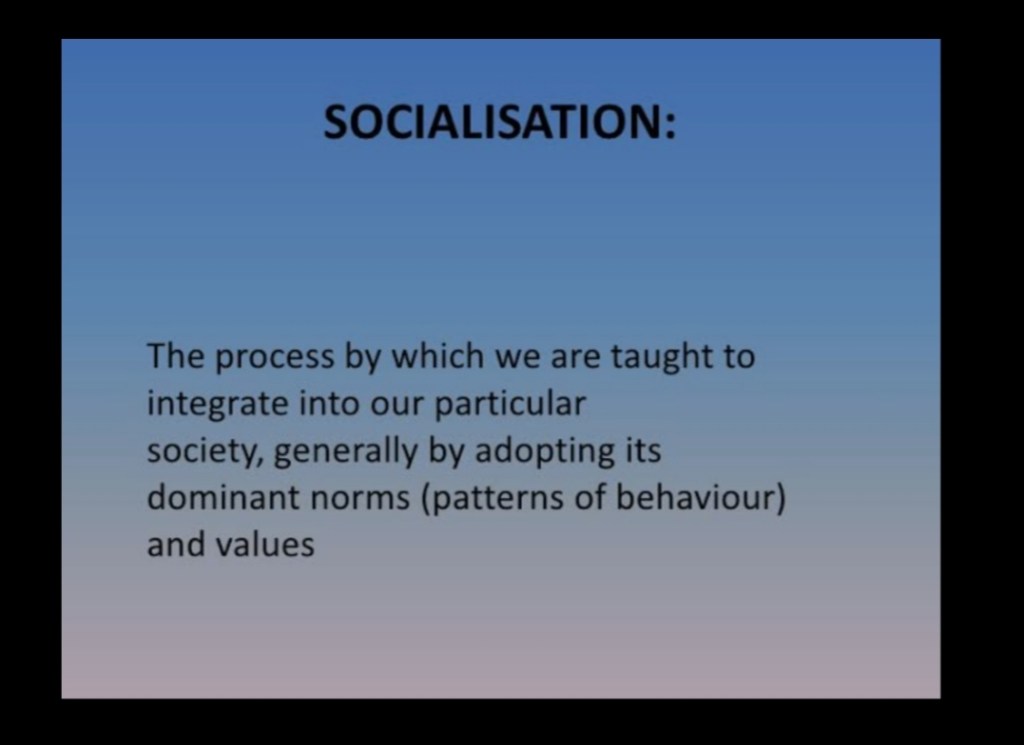

Going out of the context but have you watched the NESCAFÉ  ad ?
Where they tell us we meet nearly 80,000   people in our lives.
I assume you do .

They weren’t lying. We do meet 80,000 people. Some or the other help us to live ,some help us to eat ,some help us to be safe , some and some and some ….who are these some ?

They are public servants .
Yes the hero without Cape ,the unsung heroes who are willing to lay their life on the line .


23rd June , Public Service Day :-

23rd June of every year is celebrated as
The United Nations Public Service Day “. The UN Public Service Day was designated by the United Nations General Assembly’s in 2003, to “celebrate the value and virtue,  the willingness to serve , the unsung heroes , and their public service to the community”.


Public Service Day  reminds us of the unmatched sacrifices of the public servants in making this society a better place to live in.


Theme 2021:-

This year, the United Nations Public Service Day will be celebrated under the theme of “Innovating the Future Public Service: New Government Models for a New Era to Reach the SDGs”.


The theme focuses on innovation and technology playing an important role in the delivery of public services. The pandemic itself highlights the rapid adoption of technology at its best .  The theme also considers the  preparation of future public service for a new era, so as to reach the 2030 sustainable development goals.

The  digital revolution that changed the way we inhabit our lives helped us to bide during the pandemic . The 2020 Covid-19 pandemic manifested  the digital service ,  virtual service , new technology ,an  increase in digitalization  leading firms and educational  institutions, and work-from-home service .  
Every country needs to reform and set the future for the   fundamental changes in the public service , to be  nimble footed  as well as tech savvy with  the new innovations and technology.


Origin & Events .:-


The General Assembly entitled 23 June as Public Service Day by adopting a resolution on 20 December 2002.
To  appreciate and celebrate  the contribution of public service in the development process ,Their selfless service , and to  encourage youth  to pursue careers as public servants ,the UN   inducted 23rd June as Public Service day. To acknowledge  the value of public service, the United Nations established the UN Public Service Awards (UNPSA) programme in 2003, which was reviewed in 2016 to align  with the Agenda for Sustainable Development 2030.

Several other events are organised by public service organizations to  recognise the role of public servants in making developments and improvements in the community.


Public Service the Major Instrument :

Every kind of service necessary to public good   becomes  honourable by being necessary “
                   Albert Schweitzer


Public servants  are the major instrument   in improving people’s lives. Sustainable development is evidently impossible without public servant administration .  Modernization , digitalisation and this pandemic gave us the picture  that human  existence is impossible without public administration.

Government service , Education , Public safety , Emergency service , healthcare , Environmental protection, justice , consumer protection, custom & immigration , transportation, infrastructure, global affairs, public broadcasting, social service,  postal service , art & culture , agriculture , natural resources ,
Urban & rural development planning , etc. are some common typical standard public services .

The local government try to balance the community choices  and goals to make it better together ,  the doctors saving life risking their own, the soldiers and police administration  who are never coming home and the ones who come home but never remain the same after the tragedies faced to keep the security blanket around civilians , the cleaners doing their best to fight the virus and deadly disease for public to have a safe environment to walk around ,  come  together to accomplish a common goal to find meaning 
beyond our political beliefs or opinions regarding their service .


The public servant, regardless of position or title work together with a share passionate and  vision, a purpose and  commitment to the importance and value of
public community.


Selfless Public Service  during Covid -19  :-

The frontline battle of Covid -19 is more scary than we see it flooding on social media. We can rarely discern reality and social media but that’s because we are incapable not because there is nothing to comprehend .
The life threatening  pandemic has finally sailed and became death threatening  .
While  we remain confined in our  homes dealing with  online education   institution system and doing online work  , seeing the virus becoming lethal  and  shutting down all the possible chances of facing the lethality  ,  doctors, health-care workers, and medical staff members and all the other public servants are leading the battle against COVID-19 , putting their own lives at risk with selfless determination for the sake of saving lives despite of every possible chances of actually been dead threaten. 

  Putting their own health, families, and most importantly their own lives at risk, the least we can do is appreciate their efforts and celebrate their audacious  gallant effort  on this entitled day of Public Service .


Public service is the most difficult job in a modern society.  Their  work too often goes unnoticed . Today , 23rd June this is a chance to
acknowledge their efforts and celebrate their  willingness to sacrifice themselves for the public and are 
most passionate about finding meaning in their service  then  profit .

Let’s glorify the virtue and passion of the public servants on this designated Public Service Day  by showing our gratitude for their altruistic service .