Global warming.

Since the Industrial Revolution, the global yearly temperature has expanded altogether by somewhat more than 1 degree Celsius, or around 2 degrees Fahrenheit. Between 1880—the year that precise recordkeeping started—and 1980, it rose on normal by 0.07 degrees Celsius (0.13 degrees Fahrenheit) like clockwork. Since 1981, nonetheless, the pace of increment has dramatically increased: For the most recent 40 years, we’ve seen the global yearly temperature ascend by 0.18 degrees Celsius, or 0.32 degrees Fahrenheit, each decade.

The outcome? A planet that has never been more blazing. Nine of the 10 hottest years since 1880 have happened since 2005—and the 5 hottest years on record have all happened since 2015. Climate change deniers have contended that there has been a “stop” or a “lull” in rising global temperatures, however various investigations, including a 2018 paper distributed in the diary Environmental Research Letters, have invalidated this case. The effects of global warming are now hurting individuals all throughout the planet.

Presently climate researchers have presumed that we should restrict global warming to 1.5 degrees Celsius by 2040 in case we are to stay away from a future wherein regular daily existence all throughout the planet is set apart by its most exceedingly terrible, most destroying impacts: the outrageous dry seasons, rapidly spreading fires, floods, hurricanes, and different calamities that we allude to by and large as climate change. These impacts are felt by all individuals somehow yet are capable most intensely by the oppressed, the financially minimized, and ethnic minorities, for whom climate change is regularly a vital driver of neediness, dislodging, yearning, and social agitation.

What causes global warming?

Global warming happens when carbon dioxide (CO2) and other air toxins gather in the climate and ingest daylight and sunlight based radiation that have bobbed off the world’s surface. Ordinarily this radiation would escape into space, yet these contaminations, which can keep going for quite a long time to hundreds of years in the climate, trap the warmth and cause the planet to get more sultry. These warmth catching poisons—explicitly carbon dioxide, methane, nitrous oxide, water fume, and engineered fluorinated gases—are known as ozone harming substances, and their effect is known as the nursery impact.

However regular cycles and variances have made the world’s climate change a few times in the course of the most recent 800,000 years, our present time of global warming is straightforwardly inferable from human action—explicitly to our consuming of petroleum derivatives like coal, oil, fuel, and flammable gas, which brings about the nursery impact. In the United States, the biggest wellspring of ozone harming substances is transportation (29%), followed intently by power creation (28%) and mechanical action (22%).

Controling perilous climate change requires exceptionally profound cuts in discharges, just as the utilization of options in contrast to non-renewable energy sources around the world. Fortunately nations all throughout the planet have officially dedicated—as a feature of the 2015 Paris Climate Agreement—to bring down their outflows by setting new principles and creating new arrangements to meet or even surpass those norms. The not very great news is that we’re not working quick enough. To stay away from the most noticeably terrible effects of climate change, researchers reveal to us that we need to decrease global fossil fuel byproducts by as much as 40% by 2030. For that to occur, the global local area should take prompt, substantial strides: to decarbonize power age by evenhandedly progressing from petroleum derivative based creation to sustainable power sources like breeze and sun oriented; to jolt our vehicles and trucks; and to amplify energy productivity in our structures, apparatuses, and enterprises.

How is global warming connected to outrageous climate?

Researchers concur that the world’s rising temperatures are energizing longer and more smoking warmth waves, more continuous dry spells, heavier precipitation, and all the more impressive typhoons.

In 2015, for instance, researchers reasoned that an extensive dry season in California—the state’s most noticeably awful water deficiency in 1,200 years—had been strengthened by 15 to 20 percent by global warming. They additionally said the chances of comparable dry seasons occurring later on had generally multiplied over the previous century. Furthermore, in 2016, the National Academies of Science, Engineering, and Medicine declared that we can now certainly ascribe some outrageous climate occasions, similar to warm waves, dry spells, and weighty precipitation, straightforwardly to climate change.


Gender Identity and Gender Roles.

Gender roles in society means how we’re expected to act, speak, dress, groom, and conduct ourselves based upon our assigned sex. For example, girls and women are generally expected to dress in typically feminine ways and be polite, accommodating, and nurturing. Men are generally expected to be strong, aggressive, and bold.

Every society, ethnic group, and culture has gender role expectations, but they can be very different from group to group. They can also change in the same society over time. For example, pink used to be considered a masculine color in the U.S. while blue was considered feminine.

How do gender stereotypes affect people?

A stereotype is a widely accepted judgment or bias about a person or group — even though it’s overly simplified and not always accurate. Stereotypes about gender can cause unequal and unfair treatment because of a person’s gender. This is called sexism.

There are four basic kinds of gender stereotypes:

  • Personality traits — For example, women are often expected to be accommodating and emotional, while men are usually expected to be self-confident and aggressive.
  • Domestic behaviors — For example, some people expect that women will take care of the children, cook, and clean the home, while men take care of finances, work on the car, and do the home repairs.
  • Occupations — Some people are quick to assume that teachers and nurses are women, and that pilots, doctors, and engineers are men.
  • Physical appearance — For example, women are expected to be thin and graceful, while men are expected to be tall and muscular. Men and women are also expected to dress and groom in ways that are stereotypical to their gender (men wearing pants and short hairstyles, women wearing dresses and make-up.

Hyperfemininity is the exaggeration of stereotyped behavior that’s believed to be feminine. Hyperfeminine folks exaggerate the qualities they believe to be feminine. This may include being passive, naive, sexually inexperienced, soft, flirtatious, graceful, nurturing, and accepting.

Hypermasculinity is the exaggeration of stereotyped behavior that’s believed to be masculine. Hypermasculine folks exaggerate the qualities they believe to be masculine. They believe they’re supposed to compete with other men and dominate feminine folks by being aggressive, worldly, sexually experienced, insensitive, physically imposing, ambitious, and demanding.

These exaggerated gender stereotypes can make relationships between people difficult. Hyperfeminine folks are more likely to endure physical and emotional abuse from their partners. Hypermasculine folks are more likely to be physically and emotionally abusive to their partners.

Extreme gender stereotypes are harmful because they don’t allow people to fully express themselves and their emotions.  For example, it’s harmful to masculine folks to feel that they’re not allowed to cry or express sensitive emotions. And it’s harmful to feminine folks to feel that they’re not allowed to be independent, smart or assertive. Breaking down gender stereotypes allows everyone to be their best selves.

Economy of Ireland.

Introduction
In this research paper we are going to be discussing about the micro-economic issues of Ireland, The economy of Ireland is a highly developed knowledge economy; a knowledge economy focuses on the production of goods and services induced by knowledge intensive activities. In the case of Ireland , it is focused on services in high-technology , life sciences, financial services and agriculture including agrifood . Ireland is also an open economy (6th on the Index of Economic Freedom), an open economy means that the country not only posses domestic actors but is also engaged in trade of products in the form of managerial exchange and technology transfers .  In the global GDP per capita tables, Ireland ranks 4th of 186 in the IMF (international monetary fund) , table and 4th of 187 in the World Bank rankings. Foreign-owned multinationals make up a significant percentage of Ireland’s GDP. The “multinational tax schemes” used by some of these multinational firms contribute to a distortion in Ireland’s economic statistics; including GNI, GNP and GDP.
Despite the two jurisdictions using two different currencies (the euro and pound sterling), a growing amount of commercial activity is carried out. This has been possible by the two jurisdiction’s shared membership of the European Union, business communities and policymakers are all for the creation of an “all-Ireland economy” to take advantage of cost and boost competitiveness
There are two multi-city regions on the island of Ireland:

Dublin – Belfast corridor
Cork – limerick – Galway corridor

Current micro-economic status of Ireland
Since the end of the EU-IMF in 2013, Ireland has experienced steady economic growth, and has proven itself to be the fastest growing European economy. In 2019, the Irish economy continued to grow at a rapid pace, but experienced a slowdown ahead of the UK’s departure from the Euro zone. It experienced a 8.3% increase of GDP in 2018, then a growth slowdown of 5.5% of GDP in 2019 according to the IMF. The national economy has been supported by strong domestic demand and by the activities of multinational companies operating in the country. According to the updated International monetary fund reports from 14th April 2020, due to the outbreak of the COVID-19, GDP growth is expected to fall to -6.8% in 2020 and pick up to 6.3 %, subject to the post-pandemic global economy recovery, this might also be the conclusion of post-Brexit transition period.
The IMF expects the unemployment trend to be heavily affected by the negative economic impact of the COVID-19 pandemic, the rate being currently estimated to increase to 12.1% in 2020 and decrease slightly to 7.9% in 2021.

Types of social movements.

There is no single, standard typology of social developments. As different researchers center around various parts of developments, various plans of order arise. Henceforth any friendly development might be portrayed as far as a few measurements.

Numerous endeavors at order focus on the goal of the development. The social foundation in or through which social change is to be achieved gives one premise to sorting social developments as political, strict, monetary, instructive, and such. It could be contended that all developments will in general be either political or strict in character, contingent on whether their technique targets changing political designs or the virtues of people.

An ordinarily utilized yet exceptionally abstract qualification is that among “change” and “progressive” developments. Such a qualification infers that a change development advocates a change that will save the current qualities however will give further developed method for carrying out them. The progressive development, then again, is viewed as pushing substitution of existing qualities. Perpetually, in any case, the individuals from a purported progressive development demand that it is they who value the genuine upsides of the general public and that it is the adversaries who characterize the development as progressive and incendiary of essential, customary qualities.

A few endeavors to portray developments include the course and the pace of progress pushed. Modifiers like revolutionary, traditionalist, moderate, liberal, and moderate are regularly utilized for such purposes. In this setting the assignments “progressive” and “change” are frequently utilized in a fairly unexpected sense in comparison to that portrayed above, with the ramifications that a progressive development advocates fast, steep change while a change development works for moderate, transformative change.

The American humanist Lewis M. Killian progressed still another typology dependent on the bearing of the change supported or went against. A traditionalist development advocates the rebuilding of a past condition of get-togethers, while a reformist development contends for another social game plan. A moderate development goes against the progressions proposed by different developments, or those appearing to create through social float, and promoters conservation of existing qualities and standards.

Killian and the American analyst Ralph H. Turner contended that it is helpful now and again to arrange social developments based on their public definition, the personality of the resistance evoked, and the method for activity accessible to the development. This plan is intended to kill the abstract assessment of objectives intrinsic in such classes as reformist and progressive. A development that doesn’t seem to undermine the qualities or interests of any critical portion of society is freely characterized as decent. In case there is no contending development supporting a similar goal, it is additionally nonfactional. The good nonfactional development should fight principally with the issues of lack of engagement and token help, yet it approaches genuine method for advancing its qualities. A decent factional development should battle with contending developments pushing a similar general target yet additionally approaches real method for expanding its impact. A development that seems to compromise the upsides of incredible and critical vested parties inside the general public is freely characterized as progressive and experiences savage concealment. Thus, it is denied admittance to real method for advancing its program. Another kind of development is characterized as neither good nor risky yet as exceptional; this sort, seen as odd yet innocuous, experiences disparage and has restricted admittance to genuine means.

Social developments may likewise be ordered based on the overall person of their methodology and strategies; for example, regardless of whether they are authentic or underground. The well known qualification among extremist and moderate developments mirrors this kind of arrangement. An undeniable contrast between kinds of developments relies upon their dependence upon rough or peaceful strategies. However, a peaceful development may likewise be characterized as progressive or revolutionary since it acknowledges common defiance, as opposed to legitimate or parliamentary moving, as a significant element of its procedure. It ought to be added that the qualification among vicious and peaceful developments is a relative one in light of the fact that a development might move quickly from one to the next as it creates.

Social Movements.

Social movements seek to bring in social change in our everyday society and our everyday lives, Social movement’s role in society is not necessarily to achieve an agenda or solely change laws. Social movement’s role is to allow people the opportunity to come together, speak their mind, and make people aware of an issue that is close to their heart. Social movements often arise with the aim of bringing about changes on public issues which concern a specific group. Social movements are a prime example of our democratic rights. Being able to practice free speech, organize peaceful protests and having the power to make a difference in our government are all great privileges of living in our country. Social movements have achieved many great things like women’s rights, environmental rights, rights for backward caste and classes and Dalit’s. People can practice their constitutional rights, while making a difference in the world they live in.

Across India, the post-independence movements of women, students, SCs, STs and peasants had a particular significance as they were deprived in the British Period of some fundamental rights and remained largely non-beneficiary of development gains. Social movements in India, contribute to the emergence of a radically new social, economic and political structure. The majority of social movements strive to create new ideas which are expected to be adopted and implemented by the leaders of the party. We had some hope for the upliftment of the Indian Constitution and subsequent legislative initiatives. Now they are motivated to suit the affluent sectors of Indian society. The revolution that started in India’s struggle for liberty centered on throwing the British Empire out of control by becoming self-sufficient Swadesh. This motivated people to speak against their authority and the courage to share their opinions.

 Sometimes, these social movements don’t work or are ineffective but, just because their main goals aren’t met or nothing was achieved on their “agenda” does not mean the social movement was not successful.  For a social movement to be successful, all they have to do is make someone aware of an issue, that they were not aware of before. Overall, social movements have played an integral role in our societal advancement and have ensured that the people have the power to make a difference in their government, one of the great privileges that come along with living in our country.

Social development, an approximately coordinated however supported mission on the side of a social objective, ordinarily either the execution or the counteraction of an adjustment of society’s construction or qualities. Albeit social developments contrast in size, they are on the whole basically aggregate. That is, they result from the pretty much unconstrained meeting up of individuals whose connections are not characterized by rules and strategies however who simply share a typical attitude toward society.

Aggregate conduct in groups, alarms, and rudimentary structures (processing, and so on) are of brief term or wordy and are directed generally by motivation. At the point when brief motivations offer approach to long haul points, and when supported affiliation replaces situational groupings of individuals, the outcome is a social development.

Qualities of social developments

A development isn’t just a propagated swarm, since a group doesn’t have authoritative and persuasive instruments fit for supporting enrollment through times of inaction and pausing. Besides, swarm components can’t be utilized to accomplish correspondence and coordination of movement over a wide region, like a country or landmass. A development is a combination of association and suddenness. There is typically at least one associations that give character, initiative, and coordination to the development, however the limits of the development are never coterminous with the associations.

Cyber Crimes and Privacy.

Words and expressions that barely existed 10 years prior are presently essential for our regular language, as hoodlums utilize new advancements to submit cyberattacks against governments, organizations and people. These violations know no boundaries, either physical or virtual, cause genuine mischief and posture genuine dangers to casualties around the world.

Cybercrime is advancing at an amazingly high speed, with recent fads continually arising. Cybercriminals are turning out to be more spry, abusing new advances with lightning speed, fitting their assaults utilizing new strategies, and helping out one another in manners we have not seen previously. Complex criminal organizations work across the world, planning multifaceted assaults surprisingly fast. Police should in this manner stay up with new advancements, to comprehend the conceivable outcomes they make for hoodlums and how they can be utilized as apparatuses for battling cybercrime.

There are numerous protection concerns encompassing Cybercrime when classified data is caught or revealed, legally or something else. Globally, both legislative and non-state entertainers take part in cybercrimes, including secret activities, monetary burglary, and other cross-line wrongdoings. Cybercrimes crossing worldwide boundaries and including the activities of no less than one country state are now and then alluded to as cyberwarfare. Warren Buffet portrays Cybercrime as the “number one issue with mankind.Computer extortion is any untrustworthy distortion of reality expected to let another to do or shun accomplishing something which causes misfortune. In this specific circumstance, the misrepresentation will bring about acquiring an advantage by:

Changing in an unapproved way. This requires minimal specialized ability and is a typical type of robbery by workers modifying the information before section or entering bogus information, or by entering unapproved directions or utilizing unapproved measures; Changing, obliterating, stifling, or taking yield, as a rule to hide unapproved exchanges. This is hard to distinguish , Changing or erasing put away information Government authorities and data innovation security experts have archived a huge expansion in Internet issues and worker examines since mid 2001. There is a developing worry among government offices like the Federal Bureau of Investigations (FBI) and the Central Intelligence Agency (CIA) that such interruptions are important for a coordinated exertion by cyberterrorist unfamiliar insight administrations, or different gatherings to plan potential security openings in basic frameworks. A cyberterrorist is somebody who threatens or forces an administration or an association to propel their political or social destinations by dispatching a PC based assault against computers, organizations, or the data put away on them.

Cyberterrorism, as a rule, can be characterized as a demonstration of psychological warfare submitted using the internet or PC assets (Parker 1983). Thusly, a basic publicity piece on the Internet that there will be bomb assaults during special times of year can be viewed as cyberterrorism. There are additionally hacking exercises coordinated towards people, families, coordinated by bunches inside networks, having a tendency to cause dread among individuals, exhibit power, gathering data important for demolishing people groups’ lives, burglaries, extorting, and so on.

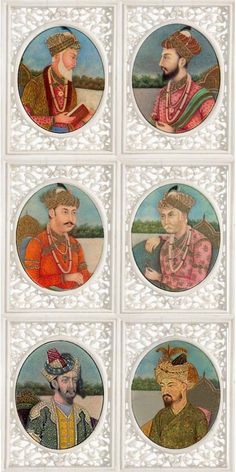
Rulers of the Mughal empire.

In India, the Mughal Empire was perhaps the best domain ever. The Mughal Empire administered countless individuals. India became joined under one guideline, and had extremely prosperous social and political years during the Mughal rule. There were numerous Muslim and Hindu realms split all through India until the organizers of the Mughal Empire came. There were a few men like Babar, grandson to the Great Asian victor Tamerlane and the vanquisher Genghis Khan from the northern district of Ganges, stream valley, who chose to take over Khyber, and at last, the entirety of India.

Babar (1526-1530):

the extraordinary grandson of Tamerlane and Genghis Khan, was the first Mughal sovereign in Quite a while. He went up against and crushed Lodhi in 1526 at the main skirmish of Panipat, thus came to build up the Mughal Empire in India. Babar governed until 1530, and was prevailed by his child Humayun.

Humayun (1530-1540 and 1555-1556):

the oldest child of Babar, succeeded his dad and turned into the second head of the Mughal Empire. He managed India for almost 10 years however was removed by Sher Shah Suri, the Afghan ruler. Humayun meandered for around 15 years after his loss. In the interim, Sher Shah Suri passed on and Humayun had the option to crush his replacement, Sikandar Suri and recapture his crown of the Hindustan. Nonetheless, before long, he kicked the bucket in 1556 at a youthful age of 48 years.

Sher Shah Suri (1540-1545):

was an Afghan chief who assumed control over the Mughal Empire in the wake of overcoming Humayun in 1540. Sher Shah involved the seat of Delhi for not over five years, but rather his reign end up being a milestone in the Sub-landmass. As a lord, he has a few accomplishments in his credit. He set up an effective policy management. He set up an income assortment framework dependent on the estimation of land. Equity was given to the everyday person. Various common works were completed during his short rule; planting of trees, wells and working of Sarai (hotels) for voyagers was finished. Streets were laid; it was under his standard that the Grand Trunk street from Delhi to Kabul was assembled. The money was additionally changed to finely printed silver coins called Dam. Notwithstanding, Sher Shah didn’t endure long after his increase on the seat and kicked the bucket in 1545 after a short rule of five years.

Akbar (1556-1605):

Humayun’s beneficiary, Akbar, was brought into the world in a state of banishment and was just 13 years of age when his dad kicked the bucket. Akbar’s reign holds a specific noticeable quality ever; he was the ruler who really invigorated the establishments of the Mughal Empire. After a progression of triumphs, he figured out how to curb the greater part of India. Regions not under the realm were assigned as feeders. He additionally embraced a placating strategy towards the Rajputs, henceforth diminishing any danger from them. Akbar was an incredible victor, yet a fit coordinator and an extraordinary manager too. He set up a large group of establishments that end up being the establishment of a managerial framework that worked even in British India. Akbar’s standard additionally stands apart because of his liberal approaches towards the non-Muslims, his strict advancements, the land income framework and his popular Mansabdari framework. Akbar’s Mansabdari framework turned into the premise of Mughal military association and common organization.

Akbar passed on in 1605, almost 50 years after his rising to the seat, and was covered outside of Agra at Sikandra. His child Jehangir then, at that point accepted the seat.

Jehangir:

Akbar was prevailed by his child, Salim, who took the title of Jehangir, signifying “Hero of the World”. He wedded Mehr-un-Nisa whom he gave the title of Nur Jahan (light of the world). He cherished her with dazzle enthusiasm and gave over the total reins of organization to her. He extended the realm through the expansion of Kangra and Kistwar and merged the Mughal rule in Bengal. Jehangir did not have the political endeavor of his dad Akbar. Be that as it may, he was a fair man and an open minded ruler. He strived to change society and was lenient towards Hindus, Christians and Jews. Be that as it may, relations with Sikhs were stressed, and the fifth of the ten Sikh masters, Arjun Dev, was executed at Jehangir’s orders for giving guide and solace to Khusrau, Jehangir’s defiant child. Craftsmanship, writing, and design succeeded under Jehangir’s standard, and the Mughal cultivates in Srinagar stay a suffering declaration to his imaginative taste. He passed on in 1627.

Shah Jahan:

Jehangir was prevailed by his second child Khurram in 1628. Khurram took the name of Shah Jahan, for example the Emperor of the World. He further extended his Empire to Kandhar in the north and vanquished the majority of Southern India. The Mughal Empire was at its apex during Shah Jahan’s standard. This was because of right around 100 years of unmatched thriving and harmony. Therefore, during this rule, the world saw the extraordinary advancement of expressions and culture of the Mughal Empire. Shah Jahan has been known as the “modeler ruler”. The Red Fort and the Jama Masjid, both in Delhi, stand apart as transcending accomplishments of both structural designing and workmanship. However regardless of anything else, Shah Jahan is recalled today for the Taj Mahal, the gigantic white marble sepulcher developed for his better half Mumtaz Mahal along the banks of the Yamuna River in Agra.

Aurangzeb:

Aurangzeb climbed the seat in 1658 and controlled preeminent till 1707. Along these lines Aurangzeb governed for a very long time, coordinating with Akbar’s reign in life span. However, lamentably he got his five children far from the regal court with the outcome that none of them was prepared in the specialty of government. This end up being exceptionally harming for the Mughals later on. During his 50 years of rule, Aurangzeb attempted to satisfy his aspiration of bringing the whole Sub-landmass under one principle. It was under him that the Mughal Empire arrived at its top in matter of region.

The Indus Valley Civilization

The Indus River Valley Civilization, 3300-1300 BCE, otherwise called the Harappan Civilization, stretched out from advanced upper east Afghanistan to Pakistan and northwest India.

Significant advancements of this civilization incorporate normalized loads and measures, seal cutting, and metallurgy with copper, bronze, lead, and tin.

Little is perceived about the Indus script, and subsequently, little is thought about the Indus River Valley Civilization’s establishments and frameworks of administration.

The progress probably finished because of environmental change and relocation.

Geology and time period

In 1856, British pilgrim authorities in India were occupied with checking the development of a railroad interfacing the urban communities of Lahore and Karachi in cutting edge Pakistan along the Indus River valley.

As they kept on working, a portion of the workers found many fire-prepared blocks stopped in the dry landscape. There were countless genuinely uniform blocks, which appeared to be very old. Regardless, the laborers utilized some of them to develop the street bed, ignorant that they were utilizing old antiques. They before long found among the blocks stone antiques made of soapstone, including multifaceted creative markings.

However they didn’t know it then, at that point, and however the main significant unearthings didn’t occur until the 1920s, these rail line laborers had stumbled upon the remainders of the Indus Valley Civilization, otherwise called the Harappan Civilization, after Harappa, the first of its destinations to be uncovered, in what was then the Punjab area of British India and is currently in Pakistan. At first, numerous archeologists thought they had discovered remnants of the old Maurya Empire, an enormous domain which overwhelmed antiquated India somewhere in the range of c. 322 and 185 BCE.

Prior to the unearthing of these Harappan urban communities, researchers imagined that Indian progress had started in the Ganges valley as Aryan migrants from Persia and focal Asia populated the area around 1250 BCE. The revelation of old Harappan urban communities agitated that origination and moved the course of events back another 1500 years,situating the Indus Valley Civilization in a completely unique natural setting.

Alleviation guide of Pakistan including the starting points of the Indus Valley realm, Mehrgarh, in the lower regions of a mountain pass. Guide shows Pakistan, Afghanistan, the northwest piece of India and Punjab, and part of the Arabian Sea.

Help guide of Pakistan including the starting points of the Indus Valley realm, Mehrgarh, in the lower regions of a mountain pass. Guide shows Pakistan, Afghanistan, the northwest piece of India and Punjab, and part of the Arabian Sea.

Alleviation guide of Pakistan. Picture kindness Wikimedia Commons.

Researchers are as yet sorting out data about this baffling civilization, however they have taken in an extraordinary arrangement about it since its rediscovery. Its starting points appear to lie in a settlement named Mehrgarh in the lower regions of a mountain pass in current Balochistan in western Pakistan. There is proof of settlement around here as right on time as 7000 BCE.

The Indus Valley Civilization is regularly isolated into three stages: the Early Harappan Phase from 3300 to 2600 BCE, the Mature Harappan Phase from 2600 to 1900 BCE, and the Late Harappan Phase from 1900 to 1300 BCE.

This guide shows the degree of the Indus Valley Civilization during the Mature Harappan Phase. Civilization is featured in brown in the space of current Pakistan and northern India. The remainder of the guide is green and is an incomplete guide of India and the region northwest of Pakistan.

This guide shows the degree of the Indus Valley Civilization during the Mature Harappan Phase. Progress is featured in brown in the space of advanced Pakistan and northern India. The remainder of the guide is green and is an incomplete guide of India and the region northwest of Pakistan.

Indus Valley Civilization in the Mature Harappan Phase (2600-1900 BCE). Picture civility Wikimedia Commons.

At its pinnacle, the Indus Valley Civilization may have had a populace of more than 5,000,000 individuals. The Indus urban communities are noted for their metropolitan arranging, a specialized and political cycle worried about the utilization of land and plan of the metropolitan climate. They are additionally noted for their prepared block houses, elaborate waste frameworks, water supply frameworks, and groups of huge, nonresidential structures.

The Indus Valley Civilization started to decay around 1800 BCE. Archeological proof shows that exchange with Mesopotamia, found to a great extent in present day Iraq, appeared to have finished. The high level seepage frameworks and showers of the extraordinary urban communities were worked over or impeded. Composing started to vanish, and the normalized loads and measures utilized for exchange and tax collection dropped out of utilization.

Metropolitan framework and design

By 2600 BCE, little Early Harappan people group had formed into huge metropolitan places. These urban areas incorporate Harappa, Ganeriwala, and Mohenjo-daro in cutting edge Pakistan and Dholavira, Kalibangan, Rakhigarhi, Rupar, and Lothal in current India. Altogether, in excess of 1,052 urban areas and settlements have been discovered, mostly in the overall locale of the Indus River and its feeders.

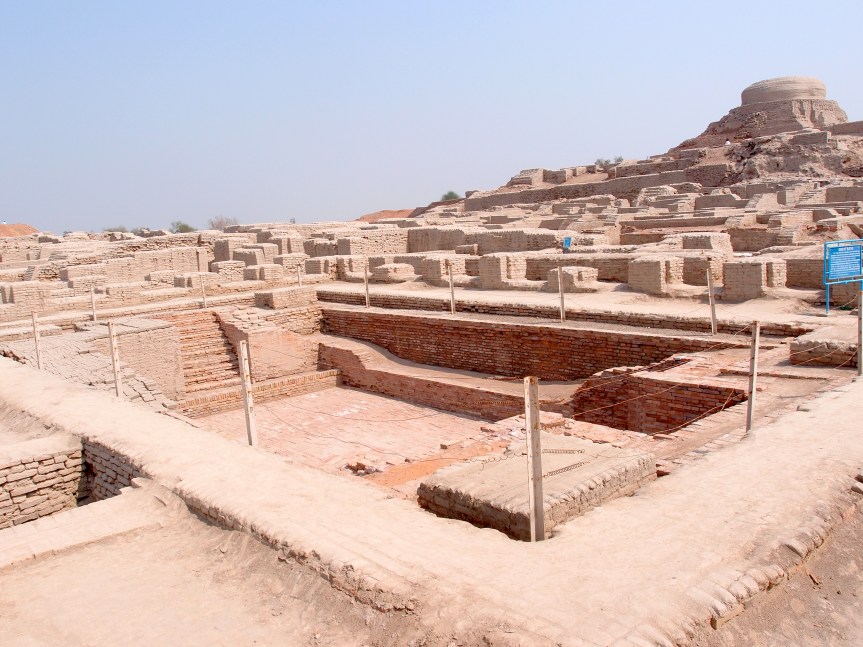
Mohenjo-daro is thought to have been underlying the twenty-6th century BCE; it became not just the biggest city of the Indus Valley Civilization however one of the world’s soonest major metropolitan communities. Found west of the Indus River in the Larkana District, Mohenjo-daro was quite possibly the most modern urban areas of the period, with cutting edge designing and metropolitan arranging.

Archeological remaining parts at the lower town of Lothal. The blocks are uniform in size and are dark earthy colored shaded. They are in a field of dead grass and are lined by low-lying green trees and bushes.

Archeological remaining parts at the lower town of Lothal. The blocks are uniform in size and are dark earthy colored hued. They are in a field of dead grass and are lined by low-lying green trees and bushes.

Archeological remaining parts at the lower town of Lothal, showing uniform fire-prepared blocks. Fire-prepared blocks will hold up to dampness, making them fit to building showers and sewers. Picture kindness Wikimedia Commons.

Harappa was a braced city in cutting edge Pakistan that is accepted to have been home to upwards of 23,500 inhabitants living in etched houses with level rooftops made of red sand and mud. The city spread more than 150 hectares—370 sections of land—and had sustained managerial and strict focuses of a similar sort utilized in Mohenjo-daro.

The two urban communities had comparative association and included strongholds, focal regions in a city that were vigorously sustained—ensured with protective military designs. Moreover, the two urban communities were arranged along the Indus River. This construction would have permitted those at the more significant levels of the structures in one or the other city to peer down the waterway and see into the distance.

The remaining parts of the Indus Valley Civilization urban communities show wonderful association; there were very much arranged wastewater seepage and garbage assortment frameworks and perhaps even open showers and silos, which are storage facilities for grain. Most city-inhabitants were craftsmans and shippers gathered in particular areas. The nature of metropolitan arranging proposes effective city governments that set a high need on cleanliness or strict custom.

Harappans exhibited progressed design with dockyards, silos, stockrooms, block stages, and defensive dividers. These huge dividers probably shielded the Harappans from floods and may have stopped military struggles. In contrast to Mesopotamia and Ancient Egypt, the occupants of the Indus Valley Civilization didn’t construct enormous, great designs. There is no convincing proof of royal residences or sanctuaries—or even of rulers, armed forces, or ministers—and the biggest designs might be storage facilities. The city of Mohenjo-daro contains the Great Bath, which may have been a huge, public washing and social region.

Colonialism

Expansionism or colonialism is an act of control, which includes the oppression of one individuals to another. One of the troubles in characterizing expansionism is that it is difficult to recognize it from colonialism. Every now and again the two ideas are treated as equivalent words. Like expansionism, colonialism additionally includes political and monetary power over a reliant domain. The historical underpinnings of the two terms, nonetheless, gives a few insights about how they vary. The term state comes from the Latin word colonus, which means rancher. This root helps us that the training to remember expansionism typically elaborate the exchange of populace to another region, where the appearances lived as perpetual pilgrims while keeping up with political loyalty to their nation of beginning. Colonialism, then again, comes from the Latin expression imperium, which means to order. Hence, the term dominion causes to notice the way that one nation practices control over another, regardless of whether through settlement, sway, or backhanded instruments of control.

The authenticity of expansionism has been a longstanding worry for political and moral savants in the Western custom. Essentially since the Crusades and the success of the Americas, political scholars have battled with the trouble of accommodating thoughts regarding equity and regular law with the act of European power over non-Western people groups. In the nineteenth century, the strain between liberal idea and pilgrim practice turned out to be especially intense, as territory of Europe over the remainder of the world arrived at its pinnacle. Amusingly, in similar period when most political rationalists started to guard the standards of universalism and correspondence, similar people actually safeguarded the authenticity of expansionism and dominion. One method of accommodating those obviously gone against standards was the contention known as the “edifying mission,” which recommended that a transitory time of political reliance or tutelage was important all together for “uncouth” social orders to progress to where they were fit for supporting liberal organizations and self-government.

The objective of this section is to break down the connection between Western political hypothesis and the task of imperialism. Subsequent to giving a more exhaustive conversation of the idea of imperialism, this passage will clarify how European masterminds advocated, legitimized, and tested political control. The third area centers around radicalism and the fourth segment momentarily talks about the Marxist custom, including Marx’s own safeguard of British expansionism in India and Lenin’s enemy of colonialist compositions. The fifth segment gives a prologue to contemporary “post-pilgrim hypothesis.” This methodology has been especially powerful in scholarly investigations since it causes to notice the different ways that postcolonial subjectivities are established and opposed through digressive practices. The last segment will present an Indigenous scrutinize of pioneer expansionism that arises both as a reaction to frontier practices of mastery and dispossession of land, customs and customary history and to post-pilgrim hypotheses of universalism. The objective of the passage is to give an outline of the tremendous and complex writing that investigates the hypothetical issues arising out of the experience of European colonization.

Expansionism is anything but a cutting edge wonder. World history is loaded with instances of one society slowly extending by consolidating a nearby area and settling its kin on recently vanquished region. The old Greeks set up settlements as did the Romans, the Moors, and the Ottomans, to give some examples of the most renowned models. Imperialism, then, at that point, isn’t confined to a particular time or spot. In any case, in the sixteenth century, expansionism changed unequivocally due to mechanical advancements in route that started to interface more far off pieces of the world. Quick cruising ships made it conceivable to arrive at far off ports and to support close ties between the middle and settlements. Hence, the advanced European frontier project arose when it became conceivable to get huge quantities of individuals across the sea and to keep up with political sway despite topographical scattering. This passage utilizes the term expansionism to depict the cycle of European settlement and political authority over the remainder of the world, including the Americas, Australia, and portions of Africa and Asia.

The trouble of characterizing expansionism originates from the way that the term is regularly utilized as an equivalent for government. Both expansionism and dominion were types of triumph that were relied upon to profit Europe financially and deliberately. The term imperialism is much of the time used to portray the settlement of North America, Australia, New Zealand, Algeria, and Brazil, puts that were constrained by an enormous populace of lasting European occupants. The term colonialism regularly portrays cases in which an unfamiliar government manages a domain without huge settlement; common models remember the scramble for Africa for the late nineteenth century and the American mastery of the Philippines and Puerto Rico. The qualification between the two, nonetheless, isn’t altogether reliable in the writing. A few researchers recognize states for settlement and provinces for monetary misuse. Others utilize the term expansionism to depict conditions that are straightforwardly represented by an unfamiliar country and difference this with colonialism, which includes backhanded types of mastery.

The disarray about the significance of the term government mirrors the way that the idea has changed after some time. Albeit the English word government was not ordinarily utilized before the nineteenth century, Elizabethans previously portrayed the United Kingdom as “the British Empire.” As Britain obtained abroad conditions, the idea of realm was utilized all the more as often as possible. Colonialism was perceived as an arrangement of military mastery and sway over regions. The everyday work of government may be practiced in a roundabout way through nearby congregations or native rulers who offered recognition, yet sway rested with the British. The shift away from this customary comprehension of realm was impacted by the Leninist examination of colonialism as a framework situated towards monetary abuse. As per Lenin, dominion was the essential and inescapable aftereffect of the rationale of collection in late private enterprise. Along these lines, for Lenin and resulting Marxists, government depicted a recorded phase of private enterprise instead of a trans-authentic act of political and military mastery. The enduring effect of the Marxist methodology is clear in contemporary discussions about American government, a term which generally implies American financial authority, whether or not such force is practiced straightforwardly or in a roundabout way (Young 2001).

Given the trouble of reliably recognizing the two terms, this passage will utilize imperialism as an expansive idea that alludes to the venture of European political control from the sixteenth to the 20th hundreds of years that finished with the public freedom developments of the 1960s. Post-imperialism will be utilized to portray the political and hypothetical battles of social orders that accomplished the change from political reliance to sway. This passage will utilize government as an expansive term that alludes to financial, military, political mastery that is accomplished without critical lasting European settlement.

  1. Normal Law and the Age of Discovery

The Spanish success of the Americas started a philosophical, political, and moral discussion about the utilization of military power to secure authority over unfamiliar terrains. This discussion occurred inside the system of a strict talk that legitimized military victory as an approach to work with the transformation and salvation of native people groups. The possibility of a “edifying mission” was in no way, shape or form the creation of the British in the nineteenth century. The Spanish conquistadores and pilgrims expressly defended their exercises in the Americas as far as a strict mission to carry Christianity to the local people groups. The Crusades gave the underlying stimulus to fostering a legitimate precept that supported the victory and ownership of unbeliever lands. While the Crusades were at first outlined as guarded conflicts to recover Christian grounds that had been vanquished by non-Christians, the subsequent hypothetical developments assumed a significant part in resulting endeavors to legitimize the success of the Americas. The center case was that the “Petrine order” to really focus on the spirits of Christ’s human run required Papal purview over fleeting just as profound issue, and this control stretched out to non-devotees just as adherents.

The transformation of the local people groups, be that as it may, didn’t give an unproblematic defense to the undertaking of abroad triumph. The Spanish success of the Americas was occurring during a time of change when humanist researchers inside the Church were progressively impacted by the regular law hypotheses of scholars like St. Thomas Aquinas. As per Pope Innocent IV, war couldn’t be pursued against heathens and they couldn’t be denied of their property essentially in light of their non-conviction. Affected by Thomism, Innocent IV presumed that power was real just in situations where unbelievers disregarded regular law. Nonbelievers had real domain over themselves and their property, however this territory was repealed in the event that they demonstrated unequipped for administering themselves as per rules that each sensible individual would perceive

Climate Change

Climate change incorporates both an Earth-wide temperature boost driven by human-initiated discharges of ozone harming substances and the subsequent huge scope shifts in climate designs. However there have been past times of climatic change, since the mid-twentieth century people remarkably affect Earth’s environment framework and caused change on a worldwide scale. The biggest driver of warming is the outflow of gases that make a nursery impact, of which over 90% are carbon dioxide and methane. Fossil fuel consuming (coal, oil, and gaseous petrol) for energy utilization is the principle wellspring of these outflows, with extra commitments from agribusiness, deforestation, and manufacturing.[4] The human reason for environmental change isn’t questioned by any logical assortment of public or global standing.[5] Temperature rise is sped up or tempered by environment criticisms, for example, loss of daylight reflecting snow and ice cover, expanded water fume (an ozone harming substance itself), and changes to land and sea carbon sinks.

Temperature ascend ashore is about double the worldwide normal increment, prompting desert extension and more normal warmth waves and wildfires. Temperature rise is additionally enhanced in the Arctic, where it has added to liquefying permafrost, frigid retreat and ocean ice loss. Warmer temperatures are expanding paces of vanishing, causing more serious tempests and climate extremes. Impacts on biological systems incorporate the movement or eradication of numerous species as their current circumstance changes, most quickly in coral reefs, mountains, and the Arctic. Climate change compromises individuals with food weakness, water shortage, flooding, irresistible sicknesses, outrageous warmth, financial misfortunes, and relocation. These effects have driven the World Health Organization to call environmental change the best danger to worldwide wellbeing in the 21st century. Even if endeavors to limit future warming are fruitful, a few impacts will proceed for quite a long time, including rising ocean levels, rising sea temperatures, and sea acidification. Energy streams between space, the air, and Earth’s surface. Current ozone depleting substance levels are causing a radiative lopsidedness of about 0.9 W/m2.

Large numbers of these effects are as of now felt at the current degree of warming, which is about 1.2 °C (2.2 °F).The Intergovernmental Panel on Climate Change (IPCC) has given a progression of reports that project huge expansions in these effects as warming proceeds to 1.5 °C (2.7 °F) and beyond. Additional warming likewise builds the danger of setting off basic edges called tipping points. Responding to environmental change includes moderation and adaptation. Mitigation – restricting environmental change – comprises of decreasing ozone harming substance discharges and eliminating them from the atmosphere strategies incorporate the turn of events and arrangement of low-carbon fuel sources, for example, wind and sun oriented, an eliminate of coal, upgraded energy proficiency, reforestation, and backwoods safeguarding. Transformation comprises of changing in accordance with genuine or expected climate, for example, through further developed coastline assurance, better fiasco the board, helped colonization, and the advancement of more safe yields. Transformation alone can’t deflect the danger of “serious, far and wide and irreversible” impacts.

Under the 2015 Paris Agreement, countries on the whole consented to continue to warm “well under 2.0 °C (3.6 °F)” through moderation endeavors. Notwithstanding, with promises settled on under the Agreement, a dangerous atmospheric deviation would in any case reach about 2.8 °C (5.0 °F) before the finish of the century. Limiting warming to 1.5 °C (2.7 °F) would require splitting outflows by 2030 and accomplishing almost zero emanations by 2050.

A worldwide temperature alteration is the drawn out warming of Earth’s environment framework saw since the pre-mechanical period (somewhere in the range of 1850 and 1900) because of human exercises, essentially petroleum derivative consuming, which builds heat-catching ozone harming substance levels in Earth’s climate. The term is habitually utilized reciprocally with the term environmental change, however the last alludes to both human-and normally delivered warming and the results it has on our planet. It is most normally estimated as the normal expansion in Earth’s worldwide surface temperature.

Since the pre-modern time frame, human exercises are assessed to have expanded Earth’s worldwide normal temperature by around 1 degree Celsius (1.8 degrees Fahrenheit), a number that is as of now expanding by 0.2 degrees Celsius (0.36 degrees Fahrenheit) each decade. A large portion of the current warming pattern is very possible (more noteworthy than 95% likelihood) the aftereffect of human movement since the 1950s and is continuing at an extraordinary rate over a long time to centuries.

Environmental change is a drawn out change in the normal climate designs that have come to characterize Earth’s nearby, territorial and worldwide environments. These progressions have an expansive scope of noticed impacts that are inseparable from the term. Changes saw in Earth’s environment since the mid twentieth century are fundamentally determined by human exercises, especially petroleum product consuming, which builds heat-catching ozone depleting substance levels in Earth’s climate, raising Earth’s normal surface temperature. These human-created temperature increments are regularly alluded to as an unnatural weather change. Regular cycles can likewise add to environmental change, including inside changeability (e.g., recurrent sea designs like El Niño, La Niña and the Pacific Decadal Oscillation) and outside forcings (e.g., volcanic action, changes in the Sun’s energy yield, varieties in Earth’s circle).

Researchers use perceptions starting from the earliest stage, and space, alongside hypothetical models, to screen and concentrate past, present and future environmental change. Environment information records give proof of environmental change key markers, for example, worldwide land and sea temperature expands; rising ocean levels; ice misfortune at Earth’s posts and in mountain icy masses; recurrence and seriousness changes in outrageous climate like tropical storms, heatwaves, fierce blazes, dry spells, floods and precipitation; and cloud and vegetation cover changes, to give some examples.

Colorism In British India .

British colonialism further exacerbated colourism. The British Raj, or the official British rule over India, began in 1858 and lasted until the independence of India and the partition of Pakistan in 1947. During this time, a pseudo-scientific concept called “social Darwinism” became popular. The term, a reference to Charles Darwin’s work on evolution, describes the common belief that factors such as skin colour, bone structure, and facial features were determinants of levels of intelligence, and it became part of the justification for Britain’s treatments of its colonised natives. In India, Britain’s general strategy seemed to involve keeping fair-skinned Indians as allies by privileging them over darker-skinned Indians. A system of institutionalised segregation was established and, while some institutions segregated against all “[coloured] people”, many segregated only against “black Indians”, with signs clearly stating: “Indians and dogs not allowed”. Conversely, lighter-skinned Indians were given preference over their darker counterparts and were hired more frequently.

Although there was some pushback against this mistreatment by the British, the Indian people were, in general, less motivated to protest because the caste system had already cemented clear divisions along racial lines. Centuries of rule by foreigners had already cemented the idea that power belonged to light-skinned individuals, and it meant that when an external, more malicious force came in to uphold those divisions, people were less inclined to object.

However, colourism has always been an intersectional issue. The oppression people face due to colourism is often paired with, and/or magnified by their gender, caste, social status, financial status, and education. Despite the longevity of the issue, civil society is only now beginning to dismantle institutional colourism. “Dark is Beautiful” is an organisation fighting colourism by organising workshops to educate the youth on the dangers of colourism and by creating petitions and lobbying against the leading fairness cream brands. In the future, it seeks to “involve… many people and [organisations], including politicians, sportspersons, and influential people.” “India’s Got Colour” is another campaign that aims to end systemic bias against skin colour. One of its ambassadors, Nandita Das, an actress and producer, travels around the country to educate children in schools on the pervasiveness of colourism and to share her story and recount the different treatment she received from the media due to her skin colour. In Bollywood, instances of brownface, the act of intentionally darkening one’s skin, have started receiving more public backlash than ever before.

Colourism refers to prejudice against individuals with a dark skin tone. In India, it is reflected in many parts of society, from advertisements on billboards to lyrics in songs to household anecdotes. It can manifest itself in very apparent ways, such as in advertisements for skin lightening products showcasing women achieving their dreams only after lightening their complexion, but it can also take on more subtle forms. Regardless, its influence is pervasive. In 2015, the Indian National Museum conducted a study where they surveyed one hundred college students from across the country, inquiring about the skin colour they considered to be a beauty ideal. When asked to describe “pretty”, 71% of the respondents cited words alluding to lighter skin tones, including “fair” and “light”. While this study featured a relatively small sample size, the trends it highlights are common in Indian society and perpetuated through the media. In fact, 90% of all Indian advertisements show lighter-skinned models, and most Bollywood movies feature a cast of exclusively light-skinned actors.

Beyond a lack of representation of dark-skinned individuals in the media, having darker skin is seen as a disadvantage for many other prospects as well, from “hireability” to chances of marriage. The latter is especially true in rural villages wherein women with a darker skin tone are seen as less desirable and face greater challenges in finding a spouse. Another damaging result of colourism is the rise of the ever-growing skin lightening market and the health risks this market presents. The Tata Institute of Social Science (TISS) conducted a study in which they surveyed 1,238 women and 746 men on their use of fairness creams. Of those, 59.6% of women and 46.1% of men reported using fairness products at some point in their lives. When asked why, 31.2% said they wanted to look “beautiful” and 36.2% believed looking fairer would help them “feel culturally accepted”. These skin lightening products have serious, and often long-lasting, side effects. In 2006, the Food and Drug Administration (FDA) released a notice stating that it no longer recognises over-the-counter skin bleaching products as safe or effective. Despite this, India’s skin lightening market is projected to continue growing with an April 2018 study estimating that by 2023, it would be worth “Rs. 5,000 crore”, or about $700 million USD.

The coronavirus (COVID‐19) pandemic’s impact on mental health

Throughout the world, the public is being informed about the physical effects of SARS‐CoV‐2 infection and steps to take to prevent exposure to the coronavirus and manage symptoms of COVID‐19 if they appear. However, the effects of this pandemic on one’s mental health have not been studied at length and are still not known. As all efforts are focused on understanding the epidemiology, clinical features, transmission patterns, and management of the COVID‐19 outbreak, there has been very little concern expressed over the effects on one’s mental health and on strategies to prevent stigmatization. People’s behavior may greatly affect the pandemic’s dynamic by altering the severity, transmission, disease flow, and repercussions. The present situation requires raising awareness in public, which can be helpful to deal with this calamity. This perspective article provides a detailed overview of the effects of the COVID‐19 outbreak on the mental health of people.

KIDS AND TEENS AT RISK

Kids, away from their school, companions, and partners, remaining at home can have numerous inquiries concerning the flare-up and they look toward their folks or guardians to find the solution. Not all kids and guardians react to pressure similarly. Children can encounter nervousness, trouble, social detachment, and an oppressive climate that can have short‐ or long‐term consequences for their psychological wellness. Some normal changes in youngsters’ conduct

To assist with balancing negative practices, expects guardians to try to avoid panicking, manage the circumstance carefully, and answer the entirety of the kid’s inquiries as well as could be expected. Guardians can set aside some effort to converse with their youngsters about the COVID‐19 flare-up and share some sure realities, figures, and data. Guardians can assist with consoling them that they are protected at home and urge them to participate in some solid exercises including indoor games and some physical and mental activities. Guardians can likewise foster a home timetable that can assist their youngsters with staying aware of their investigations. Guardians should show less pressure or nervousness at their home as kids see and feel negative energy from their folks. The contribution of guardians in solid exercises with their youngsters can assist with lessening pressure and nervousness and carry help to the general circumstance.

 ELDERS AND PEOPLE WITH DISABILITIES AT RISK

Older individuals are more inclined to the COVID‐19 flare-up because of both clinical and social reasons, for example, having a more vulnerable safe framework or other basic medical issue and removing from their families and companions because of their bustling timetables. As indicated by clinical specialists, individuals matured 60 or above are bound to get the SARS‐CoV‐2 and can create a genuine and life‐threatening condition regardless of whether they are healthy.

Physical separating because of the COVID‐19 episode can have exceptional adverse consequences on the emotional wellness of the old and handicapped people. Actual disengagement at home among relatives can put the old and incapacitated individual at genuine emotional wellness hazard. It can cause tension, trouble, and prompt a horrible circumstance for them. Old individuals rely upon youthful ones for their day by day needs, and self‐isolation can fundamentally harm a family framework. The old and crippled individuals living in nursing homes can confront outrageous psychological wellness issues. Be that as it may, something as straightforward as a call during the pandemic episode can assist with supporting old individuals. COVID‐19 can likewise bring about expanded pressure, uneasiness, and gloom among older individuals previously managing psychological well-being issues.

Specialists, medical caretakers, and paramedics functioning as a front‐line power to battle the COVID‐19 flare-up might be more defenseless to foster emotional well-being indications. Dread of contracting an illness, long working hours, inaccessibility of defensive stuff and supplies, patient burden, inaccessibility of powerful COVID‐19 prescription, passing of their associates after openness to COVID‐19, social separating and disconnection from their loved ones, and the critical circumstance of their patients may cause significant damage of the psychological wellness of wellbeing laborers. The functioning proficiency of wellbeing experts may diminish progressively as the pandemic wins. Wellbeing laborers should take brief breaks between their functioning hours and manage the circumstance tranquilly and in a casual way.

Colorism in India.

Ethnic complexities or relations in India have historically been complex. “Ethnic relations” refers to attitudes, behaviors and opinions towards people of other ethnicity or races. India is one of the most ethnically diverse countries, with more than 2,000 different ethnic groups. There is also significant diversity within regions, and almost every state/province has its own distinct mixture of ethnicities, traditions, and culture. Throughout the history of India, ethnic relations have been both constructive with mutual cultural influences and destructive with discrimination against other ethnicities. In this research paper we will talk about the progress or the current scenario of racial discrimination in India and its various problems.

Racism is most commonly used to name a form of prejudice in which a person thinks that their “race” is better or superior over other races. This most often takes the form of believing that those with other skin colors especially darker skin colors are inferior physically, intellectually, morally, and/or culturally, and mistreating and discriminating against them because of this. Such a belief typically promotes the notion that white people are “the default” that whiteness is “normal” and that people with other appearances are the ones who are “different” (and “inferior”).Racism has existed in our society from ages right from the time of colonization of India.

According to local sources, unity in diversity has been growing in India, making the country more tolerant. One World Values Survey reported 43.5% of Indians responded that they would prefer not to have neighbors of a different race.

What is race?

To fully understand racism, we have to understand the meaning of race. Throughout history, the word race has been used to classify humans based on various physical characteristics, especially skin color, facial form, and eye shape. But sorting people into such races is truly arbitrary they’re not based on meaningful scientific differences (like, for example, those used to determine legitimate scientific classifications such as species and genus). The obsession with the difference in people’s skin color is one of the foundations of racism.

Biases related to the caste system

Racism is linked to the prevalent caste system which is hierarchical in nature. The broad orderings and the sub-orderings in India seem complex and confusing as classifications are often overlapping: region, religion, caste, sub-caste, Jati, Gotra, Kula, Varna and language. “Any effort to simplify them beyond a point can lead to a distortion of social reality.”

earliest classification, as found in Rig Veda, was not based on birth but on the hierarchy that was determined by one’s occupation; however, it is certain that at some particular point in history it became birth-based and rigid

The killing or discrimination was not rooted in color, which some scholars mistakenly believe it to be the case rather this was a time of constant wars and conflicts between the invader immigrants and the actual tribal population of the time..

earliest classification, as found in Rig Veda, was not based on birth but on the hierarchy that was determined by one’s occupation; however, it is certain that at some particular point in history it became birth-based and rigid

The killing or discrimination was not rooted in color, which some scholars mistakenly believe it to be the case rather this was a time of constant wars and conflicts between the invader immigrants and the actual tribal population of the time.

Status of Racial discrimination in the 21st century

  • The next part of this research paper will discuss how skin tone is still so deeply      attached to the normal Indian psyche that it gets confused with the societal value system  of caste, class, and religion
  • Skin tone also forms various strata of variables and acceptability in society. Beauty ideals are now governed by the media, which glorifies lighter skinned models–both male and female–who are chosen to advertise almost all products over darker skinned models
  • In the wake of George Floyd’s death the debate about colorism and skin tone in India has been discussed in several media outlets, and as part of the general critique a big Indian matchmaking website, Shaadi.com has removed a filter where people could use to mark skin color preferences for their potential partner

In the state of Maharashtra, a group of young tribal girls trained to be flight crew through a government scholarship program that aimed to empower women; however, the program seems to have actually disempowered darker skinned women. The majority of girls were denied employment due to their darker skin tone. A few of those women obtained jobs, but only as out-of-sight ground crew.

LEARNING DISABILITIES AMONGST CHILDREN.

Learning disabilities are due to genetic and/or neurobiological factors that alter brain functions in a manner which affects one or more processes related to learning. These processing problems can interfere with learning basic skills such as reading, writing and/or math. They can also be related to with higher level skills such as organization, time planning, abstract reasoning, long or short term memory and attention. It is important to realize that learning disabilities can affect an individual’s life beyond academics and can impact relationships with family, friends and in the workplace. It can also be a source of bullying amongst smaller children.

“If a child can’t learn the way we teach, maybe we should teach the way they learn”. Learning disability, learning disorder or learning difficulty, is a condition in the brain that causes difficulties comprehending or processing information and can be caused by several different factors. Given the “difficulty learning in a typical manner”, this does not exclude the ability to learn in a different manner. Symptoms of dyslexia usually become more obvious when children start school and begin to focus more on learning how to read and write. People are often also quite unaware about this topic .The unknown factor is the disorder that affects the brain’s ability to receive and process information. This disorder can make it problematic for a person to learn as quickly or in the same way as someone who is not affected by a learning disability. People with a learning disability have trouble performing specific types of skills or completing tasks if left to figure things out by themselves or if taught in conventional ways.

Preschool children

In some cases, it’s possible to detect symptoms of dyslexia before a child starts school. Symptoms can include: delayed speech development compared with other children of the same age (although this can have many different causes) speech problems, such as not being able to pronounce long words properly and “jumbling” up phrases (for example, saying “hecilopter” instead of “helicopter”, or “beddy tear” instead of “teddy bear”) problems expressing themselves using spoken language, such as being unable to remember the right word to use, or putting sentences together incorrectly little understanding or appreciation of rhyming words, such as “the cat sat on the mat”, or nursery rhymes difficulty with, or little interest in, learning letters of the alphabet.

School children

Symptoms of dyslexia usually become more obvious when children start school and begin to focus more on learning how to read and write. Symptoms of dyslexia in children aged 5 to 12 include: problems learning the names and sounds of letters spelling that’s unpredictable and inconsistent putting letters and figures the wrong way round (such as writing “6” instead of “9”, or “b” instead of “d”) confusing the order of letters in words reading slowly or making errors when reading aloud visual disturbances when reading (for example, a child may describe letters and words as seeming to move around or appear blurred) answering questions well orally, but having difficulty writing the answer down difficulty carrying out a sequence of directions struggling to learn sequences, such as days of the week or the alphabet slow writing speed poor handwriting problems copying written language and taking longer than normal to complete written work poor phonological awareness and word attack skills.

Word attack skills

Young children with dyslexia can also have problems with word attack skills. This is the ability to make sense of unfamiliar words by looking for smaller words or collections of letters that a child has previously learnt. For example, a child with good word attack skills may read the word “sunbathing” for the first time and gain a sense of the meaning of the word by breaking it down into “sun”, “bath”, and “ing”.

Causes of disabilities

The causes for learning disabilities are not well understood, and sometimes there is no apparent cause for a learning disability. However, some causes of neurological impairments include:

Heredity and genetics Learning disabilities are often linked through genetics and run in the family. Children who have learning disabilities often have parents who have the same struggle.

Problems during pregnancy and birth A learning disability can result from anomalies in the developing brain, illness or injury. Risk factors are fetal exposure to alcohol or drugs and low birth weight (3 pounds or less). These children are more likely to develop a disability in math or reading.

Conclusion

Learning disabilities is a field that is constantly changing. With the advent of techniques that allow scholars to study the brain in action, we may understand not only the normal process of reading but also what happens when the system is not working. The hope is that we will be able to prevent learning disabilities or, at the least, to develop innovative and successful interventions. It is also hoped that we will become more adept at identifying children at earlier ages to prevent some of the emotional and social difficulties that can be associated with a learning disability. Neuroscience is now promising new avenues in our study of learning disabilities as is genetics. Families who have a history of learning disability need further study to provide appropriate support for them as well as to assist with early interventions

AN ANLYSIS ON OVERALL GROWTH IN THE INDIAN ECONOMY [2020-2021]

The following research paper discuses about the various aspects of the Indian economy, GDP, Economic slowdown etc. The COVID-19 pandemic ensued global economic downturn, the most severe one since the Global Financial Crisis. The lockdowns and social distancing norms brought the already slowing global economy to a standstill. Global economic output estimated to fall by 3.5% in 2020 (IMF January 2021 estimates).Governments and national banks across the globe conveyed different arrangement instruments to help their economies, for example, bringing down strategy rates, quantitative facilitating measures, and so forth India received a four-column methodology of control, financial, monetary, and long haul underlying changes: Calibrated financial and money related help was given, padding the defenseless during the lockdown and boosting utilization and speculation.

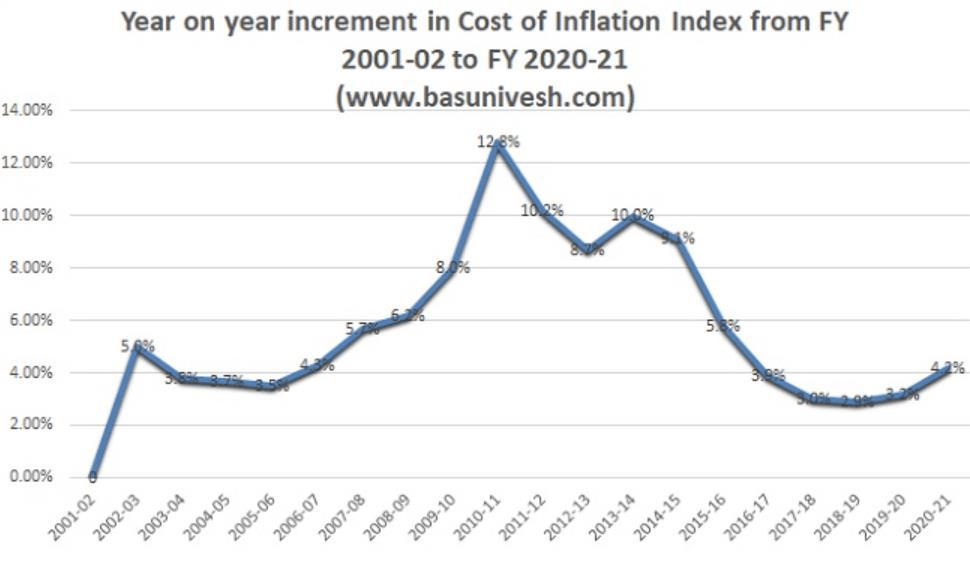
PRICES AND INFLATION

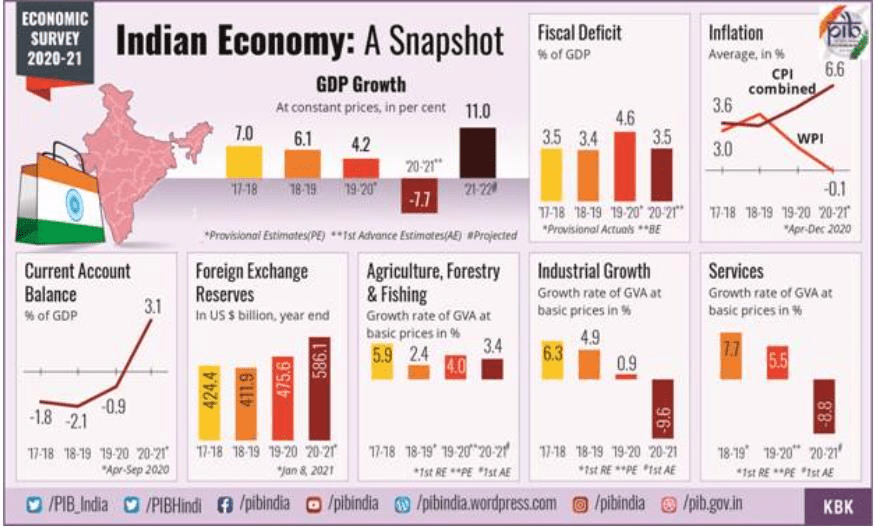
Averaged 6.6% during April-December, 2020 and remained at 4.6% in December, 2020, principally determined by ascend in food swelling (from 6.7% in 2019-20 to 9.1% during April-December, 2020, attributable to develop in vegetable costs) CPI feature and its sub gatherings saw swelling during April-October 2020, driven by significant expansion in value energy – because of the underlying interruptions brought about by COVID-19 lockdown Moderated value force by November 2020 for most sub gatherings, combined with positive base impact.

Sustainable Development and Climate Change

Voluntary National Review (VNR) presented to the United Nations High-Level Political Forum
(HLPF) on Sustainable Development . Limitation of SDGs is significant to any methodology pointed toward accomplishing the objectives under the 2030 Agenda. Sustainable advancement remains center to the improvement technique regardless of the remarkable COVID-19 pandemic emergency .Eight National Missions under National Action Plan on Climate Change (NAPCC) zeroed in on the targets of variation, relief and readiness on environment chances. India’s Nationally Determined Contributions (NDC) states that money is a basic empowering influence of environment change activity . The financing contemplations will subsequently stay basic particularly as the nation ventures up the objectives considerably .The objective of mutually preparing US$ 100 billion every year by 2020 for environment financing by the created nations has stayed tricky.

GDP

India’s real GDP has recorded a growth of 11 per cent in 2021-22 and the nominal GDP by 15.4 per cent- which has been the the highest since independence. The V-shaped economic recovery is supported by the initiation of a mega vaccination drives with the hopes of a robust recovery in the services sector and prospects for robust growth in consumption and investment. The Union Minister for Finance & Corporate Affairs, Nirmala Sitharaman presented the Economic Survey 2020-21 in Parliament, which stated that the rebound will be led by the low base and continued normalization in economic activities as the rollout of COVID-19 vaccines gathers traction. The fundamentals of the economy remain strong as gradual scaling back of lockdowns along with the astute support of Atmanirbhar.

Conclusion

India has evolved through the pandemic on the back of strong policy initiatives by the government, along with an optimistic outlook for economic recovery. India has administered ~4 million doses of COVID-19 vaccines in two weeks since January 16, 2021, becoming the fifth-largest inoculated country globally. India has become the world’s vaccine hub and extended support to 90+ countries seeking to stock up vaccines.

Since March 2020, early lockdown, health-infra ramp-up, incremental unlocking, blanket testing, social distancing, tailored fiscal stimulus (to reduce supply-side disruptions and revive demand) and structural reforms initiated by the government have helped restrict the fatality rate in India to 1.2%—one of the lowest in the world. India is emerging as the world’s fastest-growing major economy, with the IMF holding its growth forecasts as high as 6.8% for FY23. Also, the Economic Survey 2020-21 has drawn attention to the V-shaped economic growth—a testament to the burgeoning Indian economy and its intrinsic strength. India is not yet out of the danger of the pandemic. Social distancing continues to be the most effective tool to combat the pandemic as activity levels continue to rise in the economy boosted by the rapidly escalating inoculation drive in the country. Infrastructure to boost sectors to grow with unlocking of economy Terming investment in infrastructure “quintessential” to boost growth, the Economic Survey on Friday said post unlocking of the economy, infra sectors are poised for growth and construction of roads is expected to return to the high pace attained before COVID-19. The infrastructure sector will be the key to overall economic growth and macroeconomic stability, the Survey said emphasizing that the year after the crisis (2021-22) will require sustained and calibrated measures to facilitate the process of economic recovery and enable the economy to get back on its long term growth trajectory.