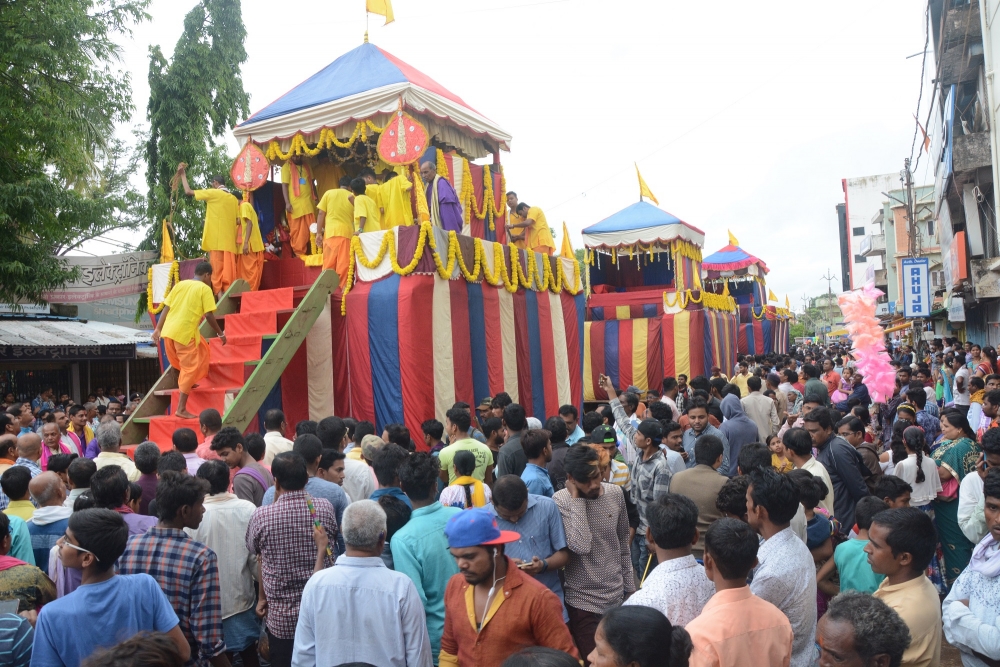
2021 marks the 614th year of a unique festival of chariots known as Goncha. It is specifically celebrated in the district of Bastar in Chhattisgarh state. This is just a variation of widely celebrated Rath Yatra in Puri. Goncha gets its name from dialect modulation of Gundicha- wife of the legendary King Indradyumna, who built the Puri Jagannatha temple.
There are many versions as to how the Bastar tribe started celebrating the festival. The King of Bastar, Maharaja Purushottam Dev visited Puri temple in 1408 on the occasion of Rathyatra known as ‘Gundicha’, which over time got converted to ‘Goncha’ in Bastar, Chhattisgarh. The king of Odisha gifted Maharaja Purushottam Dev, a 16-wheeled chariot, and gave him the title of ‘Rathadhipati’. 360 Aranyak Brahmin families from Odisha came to Bastar under the homage of Maharaja Purushottam Dev. These 360 families brought with them several idols of Lord Jagannath, Balbhadra and Subhadradevi to Bastar Chhattisgarh. 22 idols of Lord Jagannath, Balbhadra and Subhadradevi were consecrated in a single temple at Jagannath Temple in Jagdalpur.
Maharaja Purushottam Dev offered its 4 wheels to Lord Jagannath as homage and returned to Bastar with a 12-wheeled chariot. The 12 wheeled chariot was very heavy to pull so in 1810, it was separated into an eight wheeled and four wheeled chariots. The latter is called phool rath. From that time, the ritual of Rathayatra (chariot procession) during Goncha and Bastar Dussehra at Chhattisgarh got started. Bastar is the only place in Chhattisgarh where three chariots are made to carry 22 idols of Lord Jagannath, Balrama and Subhadra.
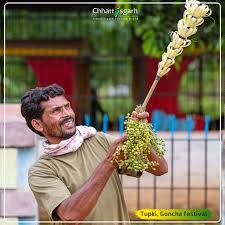
TUPKI
There are several customs associated with this Chhattisgarh Festival. The tribal people make a pistol using tukki or bamboo. It is a mock weapon that is constructed by them to follow the tradition of the tribe. The fruit pengu is used as a bullet. They use the pistol and the bullet, actually a bamboo stick cut in the shape of a pistol and a fruit to strike each other. Tupkis are used as Guard of Honour for Lord while in chariot procession. They are a source of unlimited joy for people. They find it very thrilling and exciting. Like Diwali, tukki sounds fill the atmosphere with fervor. The celebration of Festivals like these brings to the forefront the ethnicity of this part of the country.
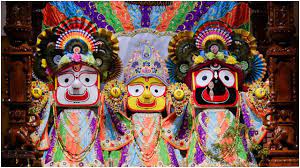
The Puri Rath Yatra begins on the Dwitiya Tithi in Ashadha, Shukla Paksha. This year, Ratha Yatra is being celebrated on July 12, 2021. The festival of Puri Rath Yatra is devoted to Lord Jagannath who is believed to be one of the incarnations of Lord Vishnu. Jagannath Rath Yatra is a nine-day festivity marked by various rituals and traditions. On this day, Lord Jagannath, Balbhadra and Subhadra proceed towards the Gundicha temple (a monument built in the memory of the Queen of Indradyumna) from the Puri shrine on their giant wooden chariots. It is believed that in order to pay their respects to Queen Gundicha, wife of the legendary King Indradyumna, who built the Puri Jagannatha temple, Lord Jagannatha along with brother Balabhadra and sister Subhadra leave their regular abode from the main temple and spend some time in this temple built by Gundicha in their honour. Lord Jagannatha, after resting for eight days in Gundicha temple, returns to his main abode. This day is known as Bahuda Yatra or Return Yatra. It is observed on the eighth day after Ratha Yatra on Dashami Tithi.
During Bahuda Yatra, the Lord makes a short stoppage at Mausi Maa temple, which is dedicated to Goddess Ardhashini. Remember, Lord Jagannatha, returns to his main abode just before Devshayani Ekadashi, when Lord Jagannatha goes to sleep for four months.
The rituals of Ratha Yatra start much ahead of Ratha Yatra day. Approximately 18 days before Ratha Yatra, Lord Jagannatha, his brother Balabhadra and his sister Devi Subhadra are given a famous ceremonial bath which is known as Snana Yatra. Snana Yatra day is observed on Purnima Tithi in Jyeshtha month, which is popularly known as Jyestha Purnima.
On the occasion of Puri Ratha Yatra, having a mere sight of Lord Jagannath on his chariot is considered very auspicious. Three chariots are made for the three respective deities.
Name of the three chariots
The names and important characteristics of the three raths (Chariots) belonging to the three deities are:
Lord Jagannath: Nandighosa
NANDIGHOSA
Lord Jagannath’s chariot is made of approximately 16 wheels
Lord Jagannath’s chariot is about 45 ft. high
Red and yellow canopy
Lord Balabhadra: Taladhwaja
TALDHWAJA
Lord Balabhadra chariot is made of 14 wheels
Lord Balabhadra chariot is 45.6 feet high
Red and bluish green canopy
Goddess Subhadra: Darpadalana
DARPADALANA
Goddess Subhadra’s chariot is made with 12 wheels
Goddess Subhadra’s chariot is 44.6 feet high.
Red and black canopy
Jagannatha literally means Lord of the Universe. It is believed that, if a person participates with full devotion in the Rath Yatra will be free from the cycle of birth and death. Rath Yatra symbolises harmony, brotherhood and unity. Thousands of devotees come here from different corners of the country to take part in this yatra and get good luck by pulling the chariot of the Lord. However in accord with the Covid 19 regulations, devotees were not allowed in the procession. Only the priests and workers with negative reports were allowed.
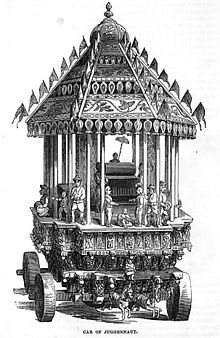
Car of Juggernaut as depicted in 1851. Source: Wikipedia
Lord Jagannath is one of the avatars of Lord Krishna. It is said that Rath Yatra is equal to hundred sacrifices. If a devotee takes part in this Rath Yatra and pulls the chariot of God, then he gets god’s blessings. Jagannath Rath Yatra is a ten-day festival. The preparations for the yatra begin with the construction of the chariots on the day of Akshaya Tritiya. According to religious beliefs, just by watching this Rath Yatra one gets freedom from all kinds of sins and salvation is attained after death.
ETYMOLOGY OF JUGGERNAUT
Jagannath is also the etymological origin of the English word ‘Juggernaut’. When the British first observed the Rath Yatra in the 18th century, they were so amazed that they sent home shocking descriptions which gave rise to the term ‘juggernaut’, meaning “destructive force”. They misunderstood that people sacrificed themselves infront of the chariot. However these were accidents which often occur during commotion in pulling of chariot. As a matter of fact sacrificial rituals are banned in Jagannath temple.
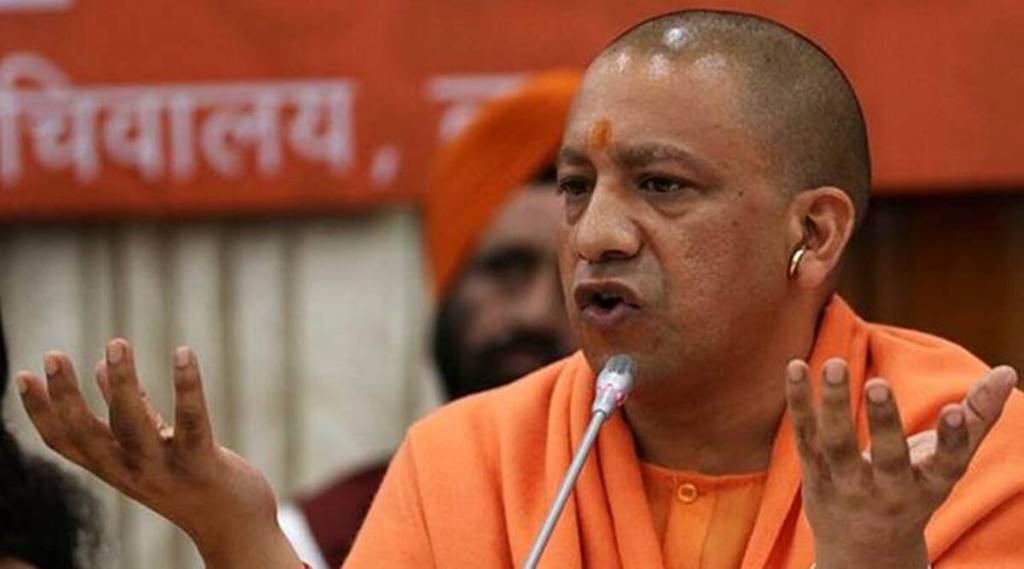
With the aim to provide stabilization in population growth and welfare to public, the Uttar Pradesh government has come up with draft of “Population Control Bill 2021”. The Uttar Pradesh Population (Control, Stabilisation, and Welfare) Bill, 2021 invites suggestions on it. The suggestions have been invited to improve the bill and have to be sent through e-mail – statelawcommission2018@gmail.com or by post, latest by July 19, 2021.
According to state census 2011, Uttar Pradesh is the most populous state with a population of 19.96 crores. The least populated state is Sikkim with a population of 6,07,688.
BPL couple with single child, who undergoes voluntary sterilization shall be benefited with one-time-lump sum amount of 80,000 if it is a boy and 1 lakh if it is a girl.
Whosoever procreates after the commencement of the Act shall be ineligible to contest in elections.
If the child is born at the time of enactment of the law, necessary applications must be undertaken within an year of commencement of Act.
It shall be the duty of government to inroduce a compulsary subject relating to population control in the state schools.
Measures in Mizoram
In contrary to this bill, recently the Mizoram minister had announced that he would reward a living man or woman having the largest number of offspring within his Aizawl East-2 assembly constituency with a cash incentive of ₹1 lakh. According to the minister, the infertility rate and the decreasing growth rate of the Mizo population have become a serious concern. Mizoram’s population was 1,091,014, according to the 2011 census.
“Mizoram is far below the optimum number of people to attain development in various fields because of the gradual decline in its population. The low population is a serious issue and hurdle for small communities or tribes like Mizos to survive and progress,”
Royte
Criticism
It is a good step towards population control. However the process of sterilization of BPL couple shall be done with great care because there have been reports of infections and death post operation.
Before starting with building, it’s important to have the base strong. Similarly, before diving into the sea of ministers, let us look into our parliamentary system.
Indian system of Parliament is based on British constitution. It is a bicarmel legilature composed of the President of India and the two houses: the Rajya Sabha (Council of States/ Upper House) and the Lok Sabha (House of the People/ Lower House.). The Lok Sabha members are chosen by the people as Member of Parliament. There are 543 members in the Lok Sabha currently. Out of these members, the party in majority choses the Prime Minister. Prime Minister holds the power to chose his ministers who help to run the country. This group of ministers is called Council of Ministers. Articles 74 and 75 deal with the council of ministers. Article 352 defines the cabinet as “The council consisting of Prime Minister and other ministers of cabinet rank appointed under Article 75. The council helps and advises president for any decision to be taken.
The part of council of ministers who holds important portfolios is called cabinet. The Ministers in this position are called Cabinet ministers. Some cabinet ministries are Minister of Defence, Finance, Home Affairs, External Affairs, Education, etc. The decisions of the cabinet are important for PM to take into consideration. Unlike the council, cabinet ministers have frequent meetings to formulate policies. Council is a wider body consisting up to 60-70 ministers and Cabinet is a smaller body with 15-20 ministers. However, the word cabinet was never mentioned in the constitution. It came into use in the 44th Constitutional Amendment Act, 1978.
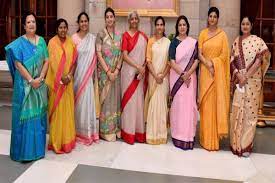
Prime Minister Narendra Modi’s Council of Ministers has been realigned recently. Many new faces have been appointed with an eye on next year’s assembly polls. A total of 43 political leaders have been sworn-in as union ministers, and some have been promoted. Council of Ministers now includes a wide range of youth and experienced leaders from across the board. Interestingly, the Union Cabinet has taken the number of women a notch up, inducting seven fresh faces to add to the existing scanty list. A diversity in terms of representation of caste, religion and gender was kept in mind. The Union Cabinet now consists a total of 11 women ministers.
Cabinet Ministers
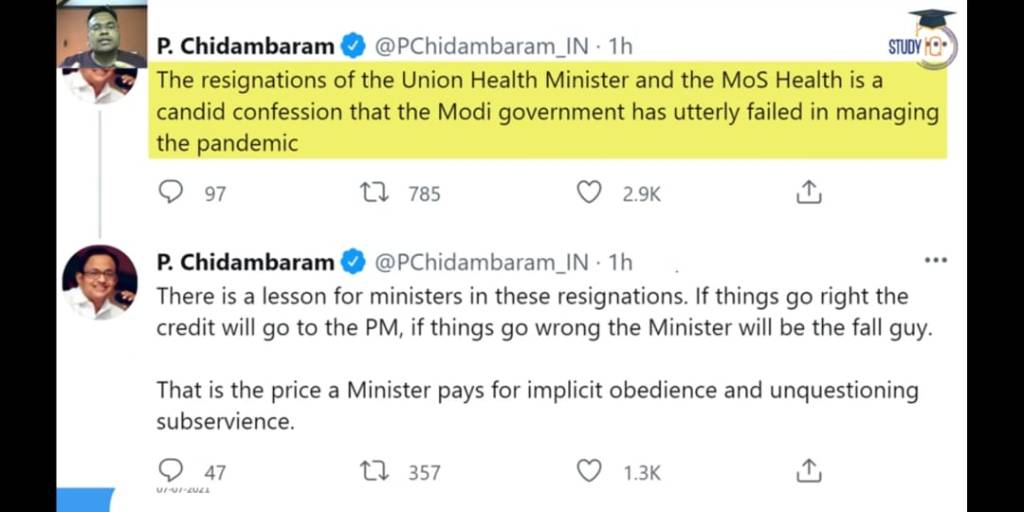
Union ministers Harsh Vardhan (Health), Ravi Shankar Prasad (Law/IT), Prakash Javadekar (Environment/I&B), Ramesh Pokhriyal (Education), Santosh Gangwar (Labour) and Sadananda Gowda (Chemicals & Fertilizers) etc. resingned from their posts. BJP leaders who were sworn in as Union ministers include Jyotiraditya Scindia (Aviation), Narayan Rane, Sarbananda Sonowal and Ashwini Vaishnaw(Railay) among the 43. The oath-taking ceremony was held at the Rashtrapati Bhavan in New Delhi.
7 new women MPs of PM Modi’s Council of Ministers:
Opposition party has clearly stated the step as Modi government’s failure in managing the situation. Also that the ministers are blamed solely whenever there is a collective error. Many also consider the political agenda as the reason- to attract people support in upcoming elections by selecting ministers from that particular state
Diamond mining in India dates back to ancient times. In the past, India was the only source of nearly all the world’s known diamonds, until the discovery of diamonds in South Africa in 1896. India has not been a major diamond-producing country since the 1900s, but diamond mining continues. But don’t we all know what is the price we have to pay for in order to make a mine?
Not recently have the forests of Buxwaha been in news for the wrong reasons. The diamond mine project, which is now with Aditya Birla Group’s Essel Mining & Industries Limited (EMIL), is once again facing dark clouds due to protests over ecological concerns, as it could result in the felling of over 2 lakh trees. Yes, this is the rate of a diamond mine currently!
The 55,000-crore rupees mining project spans over 300 hectares in Madhya Pradesh’s Chhatarpur district, in the drought-prone Bundelkhand region. The block is estimated to have 34 million carats of rough diamonds. The existing diamond mine, National Mineral Development Corporation’s (NMDC) is about 175 kilometres from Bunder.
The proposed Bunder diamond block in the Chhatarpur district of Madhya Pradesh has been in the news for the wrong reasons over the years. The forests of Buxwaha, located near the site, are home to tigers, leopards, Indian foxes, sloth bears and other wildlife. The area is also rich in minor forest produce such as Tendu leaves and Mahua. Over 200,000 trees are expected to be cut in the Buxwaha forest for the diamond project. Environmentalists fear that the mining project would result in loss of biodiversity as well as air and water pollution.
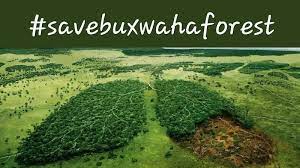
The Forest clearance report shows that the project would cost over 200,000 trees in the forest region and also use a lot of water. We are against the environmental destruction in our area, which is already a water distress area,” said Sankalp Jain, a local youth who is associated with one of the groups running social media campaigns such as ‘save Buxwaha forest’ and ‘India stands with Buxwaha forest’ last month.
Credits: Mongababy
It is to be noted that the project, once operational, has the potential to become one of the largest diamond mines in the Asian region. The company targets the execution of the mining lease by the end of the financial year 2022. But what potential be praiseworthy where Mother Nature gets compromised? In addition to trees and wildlife, the amount of water needed to build the mine will dry out the already water-scarce region of Buxwaha. A dam is to be constructed to divert a seasonal nallah.
Expectedly the project is facing strong opposition, including social media campaigns. Already, a Public Interest Litigation has been filed in the Supreme Court of India, seeking a stay on the project that had been secured by the Essel Mining & Industries Limited in 2019. In 2006, the Madhya Pradesh government had granted a prospecting licence to Rio Tinto Exploration India Private Limited, an Australian mining giant, to explore diamond mining in the Buxwaha region in the Chhatarpur district. Opposition was done even then.
Effects of Mine
2,00,000 trees are no joke. The ecosystem is no joke. Imagine the countless number of animal species residing in the woods, the amount of oxygen and water that is retained by these green guys.
The residents fear a massive loss of trees, including teak, ken, behda, banyan, jamun, tendu, arjuna and other medicinal trees as well as the devastation of the natural ecosystem if the project proceeds further.
“Despite the claims to provide jobs in mining, I feel the project will eat out the livelihood options in the area.” said a resident of Kasera village- closest village to mining site.
The villagers are dependent on minor forest produce and water for farming. The project involves the diversion of a nullah which is a lifeline for the area. It ensures groundwater level and water for wildlife.This project will lead to groundwater depletion as well.
Environmental activist Hari Krishna Dwivedi said the “whole Bundelkhand region is facing a water crisis and this forest is essential for the local ecology”.
The homes of people are going to be uprooted. What progress is this that uproots tribal people who have lived in the region for hundreds of years and generations, tending to the forests and taking only as much is their wont?
Born as Mohammed Yusuf Khan to a Hindko-speaking family in Qissa Khawani Bazaar, Kumar was one of the twelve children of his parents. Kumar was schooled at Barnes School, Nashik. He grew up in the same neighborhood as Raj Kapoor, his childhood friend, and later his colleague in the film industry.
Legend, Tragedy King, The First Khan, God of acting and many other monikers were given to Kumar in his illustrious career but how he acquired his screen name is a story unto itself. He was born Mohammed Yusuf Khan but Devika Rani, who was head of the Bombay Talkies where he joined as an actor, wasn’t too happy with the name. Dilip Kumar, she thought, would suit his “romantic image” which he was bound to acquire and would also have a “secular appeal”. And so Dilip Kumar it was.
He has been credited for bringing a distinct form of method acting technique to cinema. It is a range of training and rehearsal techniques, as formulated by a number of different theatre practitioners, that seeks to encourage sincere and expressive performances through identifying with, understanding, and experiencing a character’s inner motivation and emotions. Kumar holds the record for most wins for the Filmfare Award for Best Actor and was also the inaugural recipient of the award.
Mughal-e-Azam
Dilip Kumar debuted with the film Jwar Bhata (1944) which could not become a success in box office. He got his breakthrough with 1949 film Andaz, directed by Mehboob Khan. He starred alonside Raj Kapoor and Nargis. Shabnam was yet another blockbuster. He worked in over 65 films. In 1960, he played the role of Prince Salim in a highest grossing epic historical film in Indian History Mughal-e-Azam. Mughal-e-Azam was the highest-grossing Indian film through to the early 2010s. The film was mostly shot in black and white, with only some scenes in the latter half of the film shot in colour. 44 years after its original release, it was fully colorised and re-released in 2004.
Kumar is best known for his roles in Andaz(romantic), Aan, Daag (social drama), Devdas (dramatic), Azaad (comical), Mughal-e-Azam, Ganga Jamuna (dacoit crime) and the comedy Ram Aur Shyam.
Kumar was a member of the Rajya Sabha, the upper house of India’s parliament, from 2000 to 2006. He was nominated by the INC to represent Maharashtra. Kumar utilized a significant portion of his MPLADS fund towards the construction and improvement of the Bandstand Promenade and the gardens at Bandra Fort at Lands End in Bandra.
In 1976, Kumar took a five-year break from film performances and returned with a character role in the star studded film Kranti (1981) and continued his career playing leading roles in films such as Shakti (1982), Mashaal (1984), Karma (1986) and Saudagar (1991). His last film was Quila (1998).
Kumar is widely considered one of the greatest actors in the history of Bollywood. He holds the Guinness World Record for winning the maximum number of awards by an Indian actor. Over his career, he received eight Filmfare Awards for Best Actor (with 19 total nominations) and a Filmfare Lifetime Achievement Award (1993). He also received a Special Recognition Filmfare Award at the 50th Filmfare Awards for being one of the first recipients of Filmfare Awards along with Lata Mangeshkar (whom he considered his dear sister) and Naushad Ali. Many great actors including Shah Rukh Khan consider Kumar as their inspiration.Kumar was also known as “Tragedy King” because of the depressing but award-winning roles he took.
Dilip Kumar’s love life always remained in spotlight because of controversies it gained. He was attracted to Madhubala and both were in a relationship for almost seven years. However the relation ended with Kumar testifying against her in a case related to the film Naya Daur. Vijayanthimala, a south Indian actress was chosen in place of Madhubala. Vijayanthi was the most often starred against Kumar as the lead actress. According to reports, he even handpicked sarees for every scene for his Ganga Jamuna co-star. In 1966, Kumar married 22 year younger actress Saira Bano and lived in Bandra. They never had any child. According to his autobiography, Dilip Kumar: The Substance and the Shadow, Banu conceieved in 1972 however lost the baby to complications. They never again tried for babay.
He took his last breath at Hinduja Hospital, Mumbai, on 7th July 2021 at 7;30 am. He had been suffering from prostate cancer. With this demise India lost one more diamond of the industry.
Mourning his demise, Amitabh Bachchan had shared a picture from their special magazine shoot and wrote, “My idol Dilip Saheb .. lost .. never before never after .. “an epic era has drawn curtains .. never to happen again Peace and duas.”
If Winter comes, can Spring be far behind?
                               -Percy Bysshe Shelley (Ode to the West Wind)
Such spirited start, isn’t it? Poets literally can change our thoughts with mere lines. So are the poems that deal with Death.
“Elegy Written in a Country Churchyard”, “Prospice” and “Because I could not stop for Death” are on top of the list when it comes to overcome the fear of death. In the three years of my graduation I read these poems in the respective order and I must say there was an orderly development in my thought which I would like to share with you. Some of you might even connect with it.
Our generation is dealing with Death more closely than any other. With the help of advanced technology and advanced mutants of novel corona virus, the world is ‘connecting’ rapidly! It’s a time where no one is untouched by the feeling of anxiety or depression. Therefore it is crucial to keep the mind afresh. Why not to give a kick start to brain by reading through the lines of poetry instead of covid news every morning.
Gray and his Elegy
“The boast of heraldry, the pomp of pow’r, And all that beauty, all that wealth e’er gave, Awaits alike th’ inevitable hour. The paths of glory lead but to the grave.“
In his poem Elegy Written in a Country Churchyard(1757), Thomas Gray talks about inevitability of death. While the traditional elegy form memorializes an individual’s death, but Gray expands the form to encompass death as a phenomenon that all of humankind inevitably experiences. He talks of big ambitious people who look with contempt at the poor people, they all are lying buried in the ground. Thus giving the message that death is blind to mankind’s social constructs such as class distinction. Death is the ultimate leveler.
Reading this poem makes one realise how futile is living; living by boasting of all the achievements, all the wealth; because one day when the end comes one will have to leave all these behind. Here come the reality check.
Browning’s Prospice
Written after his wife’s death whom he loved dearly, Robert Browning describes his idea of combating Death in his 1861 poem Prospice.
“I was ever a fighter, so—one fight more, The best and the last! I would hate that death bandaged my eyes and forbore, And bade me creep past. No! let me taste the whole of it, fare like my peers..”
Browning treats Death as his enemy. The poet is not at all afraid of the physical troubles that come at the time of death. The symptoms of death does not deter him. Browning says that even the heroes of antiquity had to face death and fight it bravely. Common man should derive inspiration from them and be prepared to meet death bravely and cheerfully like them. If we do so, we can overcome it in one minute. Death is scary only when we are afraid of it. As a matter of fact, even the worst moment of death becomes enjoyable and appears to be the best for those who have got courage in them. After all, through death, we pass into another life and pass into Heaven if we are brave.
This verse is an absolute necessity. It radiates optimism- the need of the hour. And also the power to fight the fear.
Because I could not stop for Death by Emily Dickinson
“Because I could not stop for Death —
He kindly stopped for me —
The Carriage held but just Ourselves —
And Immortality.“
Emily Dickinson is one of the giants of American literature. She was little known during her life time but became immensely popular after the posthumous publication of her works. Dickinson’s poems reflect her “early and lifelong fascination” with illness, dying and death. The poem contains a gentlemanly appearance of personified Death. The use of words such as ‘kindly’, ‘civility’ create a positive image of usually feared Death in our mind. There are many guesses over the poem’s actual meaning. Some interpret it as the Christian belief in the afterlife. According to the Christian faith, that first life stops and following death we encounter immortality through our existence in the after life.
My personal interpretation was related to the thought “We are born to die”; such that since the birth Death waits for us and in the whole journey of life Death is the only constant companion. Nevertheless, the whole poem gave a soothing feel and therefore evolved my perspective about death.
“195 percent rise in sudden deaths within 5 days”, “toll tops 800”, “On Tuesday, June 29, 2021 Lytton recorded a blistering temperature of 121.1 degrees” “the hottest moment ever seen anywhere in Canada since record-keeping began”. … Well, these headings are spread across the news channels currently; akin to the heat wave that has spread it’s wings over Canada. Let’s spread more light about the basics of the Heat wave.
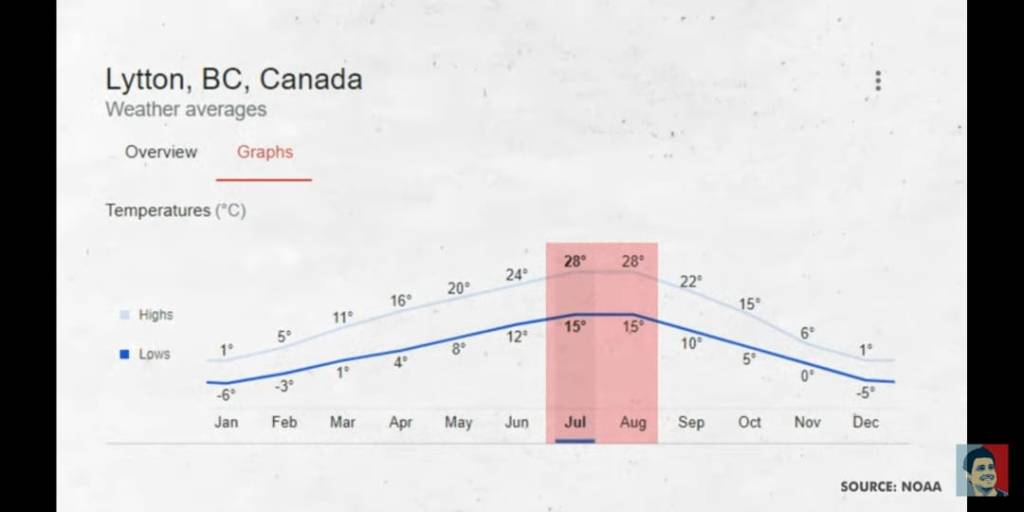
The town of Lytton has just a few hundred residents and is known for being one of the hottest locales in Canada because of its dry climate and low elevation. But during the epic heatwave that has swept western North America this month, Lytton’s previous high temperature records have been absolutely shattered by nearly ten degrees Fahrenheit.
Lytton and nearby Lillooet share the second highest temperature ever recorded in Canada. In July 1941, temperature reached a record of 44.4°C. On August 14, 2004, tempaerature again reached around 41°C. The minimum temperature the mercury touched was 31°C.
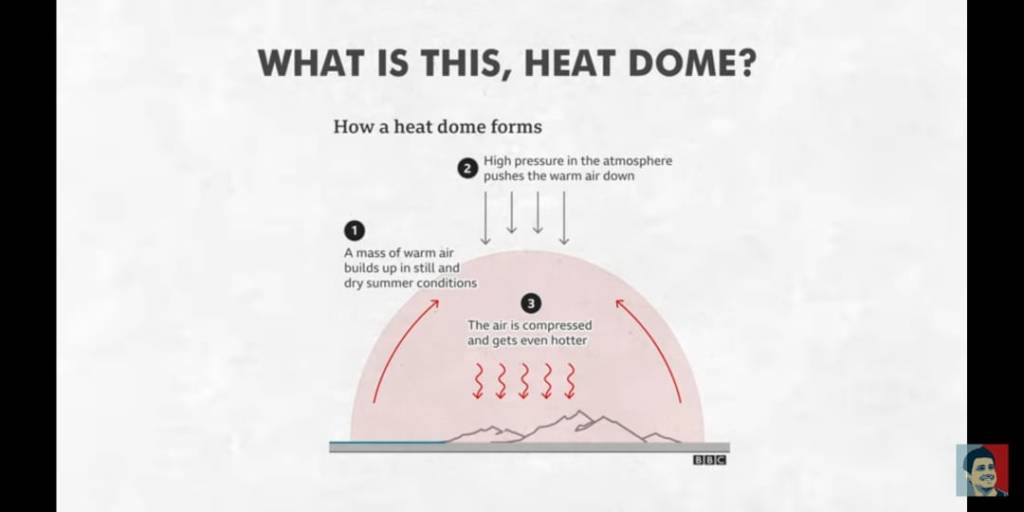
Climate change is being said the root cause. In technical terms, the condition is called Heat Dome. The warm air generally rises up but the high pressure in atmosphere from above, pushes down towards land. The pushed down air becomes even hotter. Extreme weather conditions are escalated with climate change.
West Pacific area has seen significant rise in heat as compare to the East Pacific. The strong change in ocean temperature from west to east is believed to be the core reason of heat dome. Hot air is trapped by the high pressure fronts and as it is pushed to the ground it heats up even more. The condition also prevents formation of clouds thereby giving sun more space to radiate heat on the ground.
The condition of heat dome produces heat wave. Heat wave is a period of abnormally high temperatures which lasts more than 2 days.
Effects of heat dome
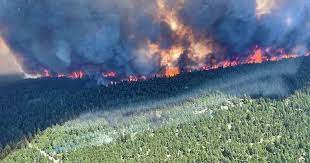
Temperature becomes unbelievably high leading to catastrophic deaths, crop damage, droughts. The rising temperature will demand high energy which will in turn increase the rate of electricity. Forest fires are no exceptions. In fact, the current situation is that half of the Lytton village is charred.
Fact
The temperature of Earth has already risen by 1° (totally a bad omen). The rise resultantly increases the chances of natural disasters exponentially. The studies show climate change can affect high-altitude regions at a faster rate. In the past 20 years, temperatures above 13,000 feet have warmed 75% faster than at altitudes below 2,000 metres (credits: Rutgers Today).
Possible Solutions
On an individual level, climate change cannot be solved anymore. Only government policy changes can prove most effective. Subsidies on fossil fuels should be removed, electric cars must be promoted, carbon tax to be imposed, more and more awareness to be raised on individual level.
If you are a ‘victim’ to Hallyu wave, you must be well aware of the pride Koreans (by Korea, I obviously mean South Korea!) take in glorifying their culture in big screen; which should be a lesson for other nations. However the living conditions portrayed in the web series are not all real. But Parasite is. Parasite is rather an extremely deep insight into the lives of lower strata of society.
Parasite is a 2019 South Korean film in the genre- Black comedy. It was directed by Bong Joon Ho. The wealth disparity, social inequality of late capitalism in South Korea has been shown in the movie. The Kim family, residents of a semi-basement do odd jobs to earn their livelihood. Kim Ki-woo, the son of the Kim family is hired as Da-hye’s (daughter of Park family) English tutor. This sets a series of comic events where the whole family plots to get recruited in the house. Kim Ki-jung (Jessica), the daughter of the Kim family who is hired as Da-song’s art therapist. The father Kim Ki-taek is hired as Park Dong Ik’s chauffer and the mother, Chung-sook takes over as the Parks’ housekeeper after the Kims exploit the peach allergy of the long-time housekeeper, Moon-gwang, to convince Mrs Park that she has tuberculosis.
After the Park family leaves for camping trip, Kims are shown enjoying in the living room when Moon-gwang abruptly appears at the door, telling Chung-sook she has left something in the basement. There was a bunker in the basement which was unknown to the Park family and Moon-gwang’s husband had been hiding there; from loan sharks. Things take different turn from this part of story. The sudden arrival of Park family from trip creates commotion and fight between both the parties. Moon-gwang and her husband Geun-sae are tied in the bunker itself and Kims escape somehow, unnoticed by the owners. There is a flood in their street and the family goes to gymnasium to spend the night. The next day Parks decide on throwing birthday party. Meanwhile we discover Moon gwang is dead in the basement because of concussion by the previous night’s fight. Enraged by the wife’s death, Geun-sae escapes and attacks Kim ki-woo. Then goes out at the party spot and stabs Kim Ki-jung. Chung-sook stabs Geun-sae in return. The son of Park family suffers seizure witnessing the events and Mr. Park asks the chauffer Kim Ki-taek to tkae him to hospital. However after seeing how he felt disgusted of Geun-sae, Ki-taek stabs Mr. park and flees.
Weeks later after Kim ki-woo recovers from injuries and discovers his sister is dead and father is missing. He spies on the bunglow which a german family has bought now, in hope to find a clue for his father. Meanwhile the father was at the basement all these time and gives out message every night using Morse code in hope of his son finding him. Ki-woo finally sees this and decodes. The film ends with the son writing a letter to his father that he will earn money and buy that house someday and his father will then be free.
The title of the film comes from the scientific meaning of parasite. However ‘Parasite’ is not only meant for the poor ones but also the rich. They do not know the basic house chores and suck out of the poor for this. How interesting is the cinematography; the partition of rich and poor are shown with literal partitions using subtle division in lines, lighting and angles. Both the families of Kim and Moon-gwang were divided by the dire need of money but united by struggle; Geun-sae hurts all members of Kim taek but when Mr. Park disgusts over Geun-sae’s smell, Kim Taek fumes in anger and stabs Park. The wealth stone gifted by Ki-woo’s friend stands as a symbol of wealth; when he keeps it properly, the family continues to work smoothly as soon as he disregards the stone, they shatter and ultimately Ki-woo is wounded by the same stone on head. This warns that wealth can be the cause of success and fall down. This is evident of the capitalism prevailing in the country. In the end when Ki-woo resolves to earn money, it is out of question this will not come true because of major disparity in rich and poor.
These are some of the major observations. There is a lot more to be discussed. This is a highly recommended movie.
Honestly, I am always tempted to define this novel as “The love story of Pride and Prejudice.”, but I’m afraid this does not do justice to it’s universality. Read further to know why.
The book was written by Jane Austen (1775-1817) and published in 1813. Austen is majorly known for her commentary upon the landed gentry towards the end of 18th century England in her novels. The prominent themes of her novel revolve around women and their dependence on marriage in pursuit of better life. The opening line “It is a truth universally acknowledged, that a single man in possession of a good fortune must be in want of a wife.”, establishes marriage motif of the novel. The story revolves around the character development of Elizabeth Bennet- the second daughter of Bennet family. We learn the repercussions of hasty judgements through Elizabeth in the mean course of novel.
The setting and language give proper English feel. The obligation of girls in general to marry in a wealthy family as described in the novel, regardless of love gives the taste of realism. Realism however comes with the twist of romance. Mr. Darcy and Mr. Bingely who are wealthy and socially respectable figures, fall in love with girls from lower gentry and a series of events takes place. Although the novel was majorly predictable, it was a sort of catchy. Writing style can be one of the main reasons for the same. One must note Jane Austen is the first female writer to write in the genre of comedy; in addition to the wit, the writing becomes all the more interesting.
The words pride and prejudice however must not be made limited as the metaphors for the main characters Mr. Darcy and Miss Elizabeth because every character in the novel possess these traits to some degree.
My personal favorite is Mr. Bennet, the head of Bennet family, a middle aged landed gentleman. He was different from the rest of the family members; quiet, witty, sarcastic and broad minded. His taking Elizabeth’s side for not marrying someone she did not approve of made him stand out from rest of the people. He liked Elizabeth the most because of her different temperament.
“Mr. Bennet was so odd a mixture of quick parts, sarcastic humour, reserve, and caprice, that the experience of three-and-twenty years had been insufficient to make his wife understand his character.”
The whole novel is centered around family, prestige, vanity, society and wealth. Being more inclined towards the modern and post-modern novels these themes feel mundane but surprisingly this book proved to be relaxing; like watching K-drama!
Musk is a physicist, entrepreneur, philanthropist and a great deal of an investor. he was born on 28th June, 1971 in Pretoria, South Africa to an African father and a Canadian mother. His childhood was not a bit happy. After his parents divorced he chose to live with his father. the relation of dad and son was eventually embittered; he called it the worst decision of his life. as a child he was bullied also. This rather turned him towards book. He was an avid reader and an independent learner. At the mere age of 12, he created a video game “Blastar” which he sold to a computer magazine.
He completed his bachelor’s in Economics and then again in Physics from University of Pennyslyvania. He left his Master’s in Applied Physics from Standford University just after 2 days to become an entrepreneur.
Foundations
ZIP2
X.com and PayPal
SpaceX
In 1995, Elon and Kimbal (brother) founded web software company. Zip2 provided and licensed an Internet city guide for the newspaper publishing industry, with maps, directions, and yellow pages. It allowed a two-way communication between users and advertisers.
X.com, which was later named as PayPal is one of the oldest online payment company. It was co-founded by Musk in March 1999. In March 2000, X.com merged with Confinity Inc., a software company based in Silicon Valley. Musk was attracted to Confinity because of its easy payment system. The name was changed to PayPal. eBay bought the company for US$1.5 billion in 2002.
Towards the coming of 2001, Musk was deeply inclined towards settling life in Mars. He traveled to Moscow to buy refurbished Intercontinental Ballistic missiles (ICBMs) that could send the greenhouse payloads into space. But he was overlooked as a novice. This put the founding stone of SpaceX in 2002. Musk decided to start a company that could build affordable rockets. The company holds expertise in it’s production of reusable thrusters (a small rocket attached to a spacecraft and used to control its attitude or translational motion).
This private company holds enormous achievements; from being the first private company to launch fully liquid-fueled rocket that reached orbit to becoming the largest commercial satellite constellation operator in the world. SpaceX has definitely distinguished itself with the reusable thrusters. On June 17, 2021, it launched GPS III-05 on Flacon 9 which was the second flight of booster B1062, for a ‘national security‘ mission (National security missions had previously only used new boosters).
Investments
“When something is important enough, you do it even if the odds are not in your favour.”
Elon Musk in an interview
An independent learner as he is, he has never believed in degree. He always gives importance to potential. With the same potential he could achieve such milestones, nevertheless having no former degree. Let us take a look at some eye-catching investments of the CEO of SpaceX and Tesla.
TESLA
Tesla is an American based company. it was originally founded by Martin Ebberhard and Marc Tarpenning as Tesla Motors. It is majorly based on electric vehicle and clean energy. Elon came up as an investor when the company was facing crisis in 2008. Later the board decided to appoint him the as CEO, noting his potential. Tesla first built an electric sports car, the Roadster, in 2008. With sales of about 2,500 vehicles, it was the first serial production of all-electric car to use lithium iron battery cells. This innovation was an instant success. Tesla stock has risen significantly; it became the most valuable carmaker in summer 2020.
HYPERLOOP
In 2013, Musk assigned a dozen engineers from Tesla and SpaceX to establish the conceptual foundations and initial designs of an airplane without wings. It is a concept for ultra-fast inter-city travel using travel pods inside metallic tubes.
THE BORING COMPANY
With an aim to enable rapid point-to-point transportation, Elon’s hopes that Boring Co. Tunnels will revolutionise transport by carrying people in giant, electric underground sleds.
On being asked about the number of tunnels that would fit, he replied “The deepest mines are much deeper than the tallest buildings are tall, so you can..”.
NEURALINK
In 2016, Musk co-founded Neuralink, a neurotechnology startup company to integrate the human brain with AI. Neuralink’s purpose is to create devices that are implanted in the human brain surgically, and with it, one will be able to communicate with machines. Musk has predicted that it would one day give people telepathy, cure paralysis, and enable vision.
STARLINK
Starlink is a low latency, high speed broadband intternet system aimed at providing free internet across the globe. The starlink satellites are a link of 12,000 satellites circling the earth. Starlink satellites are over 60 times closer to Earth than traditional satellites, resulting in lower latency and the ability to support services typically not possible with traditional satellite internet.
Musk’s thoughts are really beyond the world!
OPEN AI
This is a not-for-profit AI system. It aims to develop artificial general intelligence in a way that it is safe and beneficial to humanity. Musk is really concerned about the artificial intelligence technology as the field has not been studied fully yet. He therefore, always emphasizes on proper knowledge before application.
To conclude with the article, we learn an important lesson from Elon Musk’s life up till now;
Execution is greater than innovation.
Elon is just so fearless, even after facing numerous obstacles, he has overcome each of them. He never hesitates in taking risks. This boldness is serving us with unimaginable inventions.
Today marks the 4th year of implementation of Goods and Services Tax (First implemented on July 1 2017) The Union Budget. There have been some major reforms in the tax system following its implementation. Refer to https://wordpress.com/post/eduindex.org/18254 for more detailed insight.
The Union Budget for financial year 2021-22 had been laid in Parliment on February 1 2021. To deal with Covid 19 induced lockdowns several mini budgets had been proposed last year. The PM said to refer this budget as an extension of previous mini-budgets. Finance Minister Nirmala Sitharaman said that the Budget proposals for this financial year rest on six pillars — health and well-being, physical and financial capital and infrastructure, inclusive development for aspirational India, reinvigorating human capital, innovation and R&D, and ‘Minimum Government, Maximum Governance’. The budget was presented digitally for the first time by the first full time female Finance Minister of India, Nirmala Sitharaman. The budget made a statement that of all the structural reforms, the Goods and Services Tax has been the most iconic in our country. It has consolidated in itself several taxes and has been integrated the country economically.
The most effective gains were taken by the transport sectors. The abolition of check posts resulted in 20% efficiency of speed of delivery. There was a significant amount of increase in the tax filers as well. Significnt policy level changes have also been made. GST rate structure is also being directed to focus on issues like inverted duty stucture.
Let us take a look at some important changes in this session
Scope of term Supply enhanced: under supply come all the transactions which take place. It comes under clause 99 of Finance Bill. A New Clause (aa) under Section 7 had been made as to ensure levy tax on activities or transactions involving supply if goods or services for cash payments. These changes came into effect from 1st July 2017.
Input Tax Credit : New clause to sub section o of Section XVI of CGST act 2017 has been inserted to provide Input Tax Credit on invoice note. Invoice has been focused lot more in the new system of GST .
Interest on net tax liability: Section 50 of CGST Act 2017 provides interest on delayed payment of tax. Financial bill 2021 proposed to change interest on cash liability thus interest to be paid only on the part of debiting electronic cash ledger and not in ITC portion
GST Audit to be discontinued: The mandatory requirement of getting annual accounts audited in Section 35(5) and Section 44 on annual return is proposed to be substituted by a new section. There by removing the mandatory requirement of getting audited by specified professionals.
Seizure and confiscation of goods in transit are to be separated in the proceeding of recovery of tax. Jurisdictional Commissioner has bee empowered to call for information from any person according to section 151 and 168.
Restricted zero rated supply: Government will now notify the class of suppliers who can do zero rated supply on payment of IGST and the good will also be classified which the eligible zero rated suppliers can supply.
Goods and Services Tax (GST) is an indirect tax applicable throughout India which replaced multiple cascading taxes levied by the central and state government. It was introduced as The Constitution Act (Amendment101). It is used in India on the supply of goods and services. GST has replaced some indirect taxes in India such as the excise duty, VAT, services tax, etc. The Goods and Service Tax Act was passed in the Parliament on 29th March 2017 and came into effect on 1st July 2017.
BRIEF HISTORY
The start of reform in India’s indirect tax regulation dates back to Rajiv Gandhi’s government. It started with the introduction of Modified Value Added Tax (MODVAT) in 1986 by Vishwanath Pratap Singh, the then Finance Minister. Subsequently PM P.V. Narsimha Rao and his finance minister Manmohan Singh initiated early discussion on Value Added Tax (VAT) at the state level. A single common Goods and Services Tax was introduced during Atal Bihari Vajpayee’s government (1999); in a meeting between him and his economic advisory panel.
FORMATION
In 2016, the Lok Sabha passed the Constitution Amendment Bill. However due to disagreements on several statements in the bill and on opposition’s demand, the GST bill was sent back for review. A 21 member committee was formed to look in the proposed GST laws. After approval of Central Goods and Services Tax Bill 2017 (The CGST Bill), the Integrated Goods and Services Tax Bill 2017 (The IGST Bill), the Union Territory Goods and Services Tax Bill 2017 (The UTGST Bill), the Goods and Services Tax (Compensation to the States) Bill 2017 (The Compensation Bill), these bills were passed by Lok Sabha on March 29, 2017. The Rajya Sabha passed the bills on April 6, 2017. They were enacted as Acts on April 12, 2017.
IMPEMENTATION
Goods and Services Tax was launched all over India with effect from July 1 2017. The Jammu and Kashmir legislature passed its GST act on 7 July 2017, thereby ensuring the entire nation brought under a unified indirect taxation system. The GST has ben modified many times since it’s implementation, the latest being on 22 December 2018. The panel of federal and state finance ministers decided to revise GST rates on 28 goods and 58 services.
FEATURES OF GST IN INDIA
DUAL GST:
India has adopted dual GST
Central GST (CGST) and State GST/ Union Territories GST (SGST/ UTGST)
Central govt. and State/UT govt. collect respective GSTs.
This feature owes to Amendment 101 of constitution
Integrated GST is leviable on inter-state transactions. It is levied and collected by the Central Government. It is equal to CGST + SGST.
TAXES SUBSUMED IN GST:
Central Government
Central Excise Duty
Additional Excise Duty
Service Tax
Additional Customs Duty (CVD)
Special Additional Duty of Customs (SAD)
Excise Duty on Medicinal and Toilet Preparations.
State Government
Sales Tax/Value Added Tax (VAT)
Entertainment Tax (other than collected by local bodies)
Central Sales Tax (CST)
Octroi and Entry Tax
Purchase Tax
Luxury Tax
Taxes on Lottery, Betting and Gambling
BENEFITS
Removal of Cascading Effect: The earlier system where tax was levied upon tax thereby burdening the consumer was removed effectively. Black money also seems to be reduced.
Uniformity in tax rate therefore rate arbitrage: While there used to be fluctuation in some commodities due to manufacture and inter state business, GST has levelled the taxes to a lot extent.
Decrease in prices because of cascading effect and rate arbitrage.
Abolition of interstate check-posts placed to enforce taxes on cross border transactions. This also reduced long-distance travel time for goods and transportation by 20 percent.
Creation of Nation Common Market
SHORTCOMINGS
Large list of GST- exempted goods which make the system unnecessarily complicated.
The decision to exempt almost 50 percent of items in the consumer price index basket has narrowed the base.
High tax rates on automobiles, construction of buildings have slowed down the progress of these sectors.
CAG report observed “Post-implementation of GST, the Centre’s revenue from goods and services registered a decline of 10% in 2017-18 compard to the revenue from the subsumed taxes in 2016/17”
Government’s gross tax revenue collection in Apr-Jun grew at the slowest pace in 10 years.
Thus we see as many benefits as the disadvantages are. Lets look forward to future amendments and openly keep our thoughts, for India is a democratic country!
Do you ever feel the need of being diplomatic or is straightforwardness your only guide in life? Well, a peek at the events of Germany’s unification might enlighten your thoughts.
INTRODUCTION
It all started in the early 19th century with Napoleon Bonaparte, the fearless ruthless French emperor who took half of the Europe in a sweep. Germany was divided into 100 independent states. After the conquer Napoleon congregated them into 39 larger states. He also established the Confederation of the Rhine, a league of 16 German states. This brought further unification to Germany. Bonaparte was ultimately defeated in the Battle of Waterloo (1815). The defeat however arose in the Germans the collective feeling of Nationalism. They understood the concept of UNITED WE STAND, DIVIDED WE FALL. This created German Federation in 1815, containing all territories of the former Empire with majority German speakers. Prussia and Austria became the main powers.
Initial efforts at unification were not political but economic. Zollverin was a trade agreement in which the tariff barriers were removed, taxes decreased. Then came the Romantic movement. “The Wanderer above the Sea of Fog”, a painting by German romanticist Caspar David Friedrich dwelled upon the unknown future.
Congress of Vienna created in 1814–1815 after fall of Bonaparte was an international diplomatic conference. It aimed to restore the European political order after French and Napoleonic Wars. The conference however faced backlash due to its ignorance towards national and liberal impulses. The reaction against Congress of Vienna were the Revolutions of 1848 (which had spread across Europe). These revolutions did stir feelings of nationalism in public. However The Revolution of 1848 failed in its attempt to unify the German-speaking states because the Frankfurt Assembly reflected the many different interests of the German ruling classes.
ENTRY OF OTTO VON BISMARCK
King William I appointed Otto von Bismarck as the new Minister President of Prussia in 1862. After less than a decade, he served the public with a unified Germany! For this he chose the path of diplomacy.
Otto von Bismarck (1818- 1898) was a Conservative Statesman from Prussia. He believed in Mcachiavelli’s ideology of Real Politik i.e. policy to be applied rather than have a handbook. In his famous Blood Iron Speech he said:
“Germany does not look to Prussia’s liberalism
but to her power…not by speeches and
majorities will the Great Questions of the day
be decided- but by Iron & Blood.”
He was a master of complex politics. His diplomacy helped win support of Liberals and Socialists. For Liberals’ support-
Diminished church rights
The class struggle with Catholic churches was called Kulturkampbh
Bismarck was already a supporter of Industrialisation, this benefited in gaining liberal support
For Socialists’ support-
Socialist party was banned at first
Social welfare programs were started instead: Health insurance, accident insurance and old age pensions
WAR STRATEGIES
The unification of Germany was done with three wars and several layers of diplomacy.
First war included Prussia and Austria against Denmark (1864). It was a diplomacy to gain Austria’s support. Denmark lost and the states of Schleswig and Holstien were taken by Prussia and Austria respectively.
The second war saw clash between Austria and Prussia in Austria-Prussian War (1866). Prussia obviously won and Austria’s territories were annexed. This made Prussia the leader of German unification. Prussia was backed by Italy here because of a treaty signed between the two nations against Austria.
The final war of Franco-Prussia (1871) was a mind game played by Bismarck. He wanted France to attack on Germany to arouse Nationalism. For this first he declared that Spain would be ruled by German. Next, he modified the news that Kin William I insulted French ambassador Count Benedetti. This enraged France and accordingly it waged war.
CONCLUSION
With all the diplomacies, he provoked three short, decisive wars against Denmark, Austria, and France, aligning the smaller German states behind Prussia in its defeat of France. Therefore whenever it is said that Bismarck is the architecture of Unified Germany, it must be mentioned that Diplomacy was his tool.
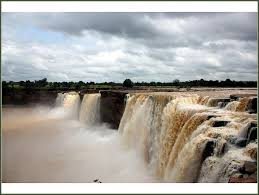
Situated at the foot of Indian state Chhattisgarh, Bastar is a tribal district. Nature has clearly lent Bastar it’s generous hands. There are nearly 5 to 6 waterfalls around the place, two of which are very near to Jagdalpur city (headquarter of Bastar district). Chitrakote Water fall is known by the name “Niagra Falls of India” because of it’s width. It is the widest fall in India, reaching a width of nearly 300 metres (980 ft) during the monsoon season. (Fun Fact: Chitrakote Fall has a Horse shoe shape and Chhattisgarh itself is in Seahorse shape!)
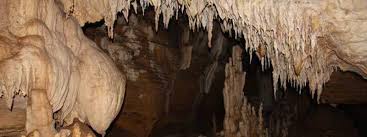
Formation of Stalectites and Stalagmites in Kutomsar Cave
The caves are much to be talked about. Kotumsarcave is a major attraction for people interested in ecotourism. It is a limestone cave formed on the Kanger limestone belt, situated near the bank of the River Kanger, a tributary of the Kolab River. Apart from this, there was a new species of Blind fish found inside the cave. there are yet another caves which are yet to be explored. Dandak Cave, for example is not open to public but forest officials. This clearly shows how people are concerned about not interfering with nature’s business.
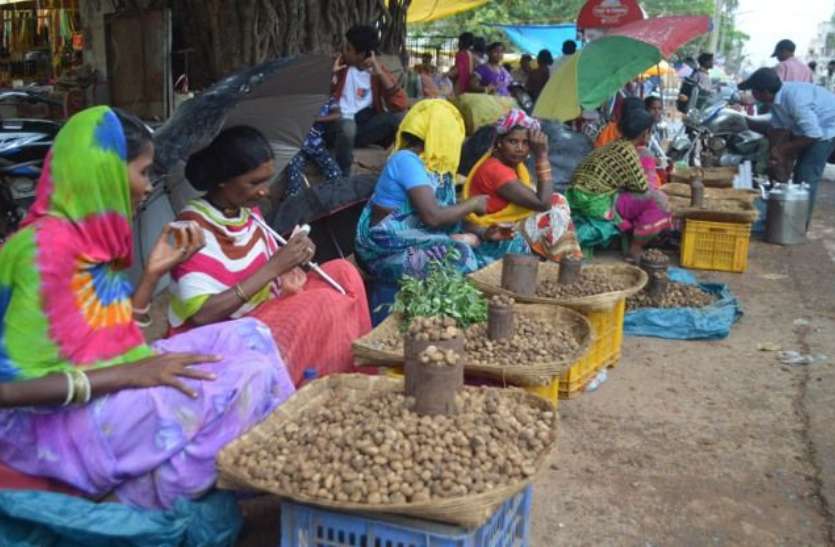
Talking of Boda (scientific name: Astraeus hygrometricus), it is a species of fungus which lives solely in a symbiotic relationship with the decayed Sal tree leaves and earth. Yes, Sal trees are the whole soul guardians to these spherical angels! During monsoon, when the leaves from Sal trees fall on ground, the exclusive juices from the trees help in development of these fungi. These little ball-like organisms are packed with carbohydrate and lots and lots of nutrition.
BAZAARS OF BODA IN BASTAR
You may shriek with amazement when I mention Boda’s price. These fungi remain in markets for about 2 months only and cost an arm and leg. During the first quarter of this time period, the price hikes up to Rupees 2000 per kilogram and more! Well this is no surprise for inhabitants rather it seems strange if the inflation does not occur. Obviously, the rarity and exertion which takes to search and pick the fungi out of ground make the price reasonable. And taste is definitely out of question. The outer layer is juicy and chewy while the inside part is as soft as butter.
The initial batches of Boda have darker outer cover; known as “Jaat Boda” while with the progress in time the outer layer becomes lighter and white; they are called “Laakdi Boda”. People mostly prefer Jaat Bodas because the are comparitively softer than their variation, Laakdi Boda. However the latter ones are no less good.
These fungi do not cease their limit here. They are also of vital importance in Medicinal field. Facial creams are made out of them for medicinal purposes.
But do NOT forget that all good things come at a price. Before you decide on enjoying these fungi as exotic food, you must brace yourselves for the cleaning process, for these underground beings are no joke to clean. They have a strong affinity for earth.
The two main lessons we learn are (a) the exclusive food of Bastar teaches us to PRESERVE TREES, therefore nature. For, how else is the world going to benefit from the treasury of mother nature? (b) Try your best to visit Bastar around early June to enjoy nature’s bounty at its fullest; with overflowing waterfalls, Boda, mangoes and much more!













 Eduindex
You must be logged in to post a comment.