Democracy

India is a democratic country. But do we all know what democracy actually is?What it is all about?

Democracy is the most significant topic in political science as well as political philosophy, and a generally accepted view. Democracy, or rule by the people, is an unrestricted form of government in which all the inhabitants of a nation determine public policy, the laws, and the actions of their state together. Democracy requires that all citizens have an equal opportunity to express their opinion. Practically, democracy is the extent to which a given system approximates this ideal, and a given political system is referred to as a democracy if it allows a certain approximation to ideal democracy. Although no country has ever granted all its citizens the right to vote, most countries today hold regular elections based on egalitarian principles, at least in theory.


Features of Democracy:

  1. Citizen Rule
    A democratic government grants adult citizens the right to elect their representatives. It also establishes clear guidelines for election cycles and term limits so that key positions are contested at regular intervals. Through this process of voting, citizens are regularly given the ability to hire or fire their representatives.
  2. Majority Rule and Minority Rights
    The principle of majority rule is an important part of the democratic system. The majority rules in the election process, but individual rights are protected by the maintenance of decentralized, local government bodies. In a democracy, all levels of government should be accessible to, and representative of, the people.
  3. Individual Rights
    Democracies value the protection of individual rights. The word freedom is used synonymously with democracy to describe individual liberties afforded in this type of government. In the U.S., the Bill of Rights serves as a summary of individual liberties. Freedom of speech and religion, protection from unlawful search and seizure and the right to bear arms are examples of individual liberties, afforded in a democracy. Equal treatment, under the law, is assured for everyone in a democratic society.
  4. Free and Fair Elections
    The key to the exercise of democracy is the election process. Free and fair elections are held at regular intervals for the election of representatives at all levels of government. In a free, democratic election, all adult citizens are given the right to cast votes which, in theory, ensures that the will of the people will be expressed.
  5. Citizen Participation
    Citizens of a democracy not only have the right to vote, but also the responsibility to participate. Informed participation is key in a democracy. When the people elect their representatives, they are ensuring the preservation of the democratic process Engaged citizenship is essential in a healthy democracy.
  6. Cooperation and Compromise
    Democracies also value cooperation and compromise to protect individual rights. To adequately safeguard diversity, and accurately represent all communities, a democracy must protect the right to be different. Anti-discrimination is at the heart of a true democracy. The freedom to assemble and voice opinion drives government accountability to ensure that underrepresented people have the same rights as the majority.
    Types of Democracy

Direct Democracy
A direct democracy is when citizens get to vote for a policy directly, without any intermediate representatives or houses of parliament. If the government has to pass a certain law or policy, it goes to the people. They vote on the issue and decide the fate of their own countries. The people can even bring up issues themselves, as long as they have a substantial consensus on the issue. Even taxes cannot be raised without the public support!
When the population is small, educated and mostly homogeneous (at least politically), a direct democracy doesn’t seem like a bad idea. Switzerland, for example, has had a long history of a successful direct democracy.

Representative Democracy


Representative democracy is type of democracy founded on the norm of elected people representing a group of people, as opposed to direct democracy. In modern democratic states, representatives are voted for by, and are ultimately accountable to the electorate. Different methods of selecting representatives are described in the article on electoral systems, but often a number of representatives are elected by, and responsible to, a particular subset of the total electorate: this is called his or her constituency. The representatives form an independent ruling body charged with the responsibility of acting in the people’s interest, with enough authority to exercise swift and resolute initiative in the face of changing circumstances.
Representative Democracy is typically associated with Liberal Democracy which describes the political system which originated in the USA and Western Europe and has subsequently been adopted in numerous Third World countries and may gradually be well established in the former USSR and its former satellites in Eastern Europe. Liberal Democratic regimes may be classified as either Presidential or Parliamentary systems and there are also important variations within these broad categories.

Participatory Democracy


The exact opposite of an authoritarian democracy is the participatory form of democracy. There are different types of participatory democracy, but all of them yearn to create opportunities for all members of a population to make meaningful contributions to the decision-making process. It empowers the dis-empowered by breaking up the state into small networks and prefers to empower community-based grassroots politics. It values deliberation and discussion, rather than merely voting.
Today, no country actively practices this form of democracy. Although the theories behind it are sound, the real-life application of this approach is fraught with complications. However, many social movements, like the international Occupy movement, the Bolivarian movement in Venezuela and the Narmada Bachao Andolan in India organize themselves around a participatory model of democracy.

Social Democracy


Social Democracy arose as a reaction to neoliberal policies in international economics. Under neoliberalism, profit-making entities like multinational corporations can easily infiltrate other political states. They maintain a level of sovereignty and mobility that no government can counter. The power of the political state seems flimsy in comparison.
Social Democracy aims at empowering the state over the mere whims of the neoliberal market. The state can increase its expenditure by providing free alternatives to overpriced private ventures. It may focus on providing free education or free healthcare, so that people don’t have to depend on profit-making corporations.

Differences between Democracy and Dictatorship:

  1. In a democracy the leaders of the party control most of their votes, but they still have to answer to their political party and the voters. In a dictatorship there is just one leader who has total control over the party and the country. Often propaganda, as well as genuine support, may paint them as the people’s hero.
  2. In a democracy political parties represent different points of view and compete for the votes of the electorate. In a democracy political power is secured by winning a fair election. In a dictatorship the government strictly control all the aspects of the state.
  3. In a democracy newspapers are free to print the truth and can criticise the government when mistakes are made or if there is disagreement. A dictatorship completely disregards the rights of individual citizens. The government and state will try to control all citizens through laws, police, spying and force. The government and state is the most important thing to a dictatorship.
  4. In a democracy there is usually less control over the films and books people can enjoy. In a dictatorship there is only one party, all opposition is destroyed and banned. Totalitarian states don’t allow opposition or elections.
  5. In a democracy the government has less control over people’s choice and belief. People are free to join clubs, political parties and other groups. The government in a dictatorship controls every element of people’s lives, including radio, cinema and newspapers.


DGCA extends fare capping, restricted operations of domestic passenger flights till November 24

New Delhi: Aviation regulator DGCA on Friday (July 24) said that the fare cap on domestic flights will continue until November 24, 2020, or until further orders. The decision comes after Aviation Minister Hardeep Singh Puri during a press briefing had said that the price cap on domestic routes will be applicable well beyond August 24.
In the wake of the coronavirus outbreak, the aviation ministry implemented a cap on domestic airfare in May.
On May 21, the aviation regulator DGCA issued the government-decided fare limits for these bands — domestic flights with less than 40-minute duration to have lower and upper limits of Rs 2,000 and Rs 6,000, for 40-60 minutes Rs 2,500 and Rs 7,500, for 60-90 minutes Rs 3,000 and Rs 9,000, for 90-120 minutes Rs 3,500 and Rs 10,000, for 120-150 minutes Rs 4,500 and Rs 13,000, and for 150-180 minutes Rs 5,500 and Rs 15,700.
In addition, DGCA has also extended domestic flight restrictions until November 24, 2020.
It is worth mentioning that the government had decided to enhance domestic flying to 45 per cent in June from the initial 33 per cent level which had been in place since domestic flying restarted on May 25.
All domestic, as well as international flights, were suspended due to the nationwide lockdown which was imposed due to the outbreak of Coronavirus in the country.

Earlier, the aviation secretary Pradeep Singh Kharola had said that the base minimum airfare of domestic flights ranges from Rs 2,000 to Rs 6,500, and the maximum range from Rs 6,000 to Rs 18,600. Airlines have to make available 40 per cent of total seats in an aircraft at less than the mid-point price between the highest and lowest fares.

Civil aviation minister Hardeep Singh Puri earlier said the move will mean that the lowest fare between Delhi and Mumbai, the busiest route in the country, will be capped at Rs 3,500 and Rs 10,000 at the higher end.

Kolkata airport suspends passenger flight operations from July 25 to July 29

Kolkata airport suspends passenger flight operations from July 25 to July 29

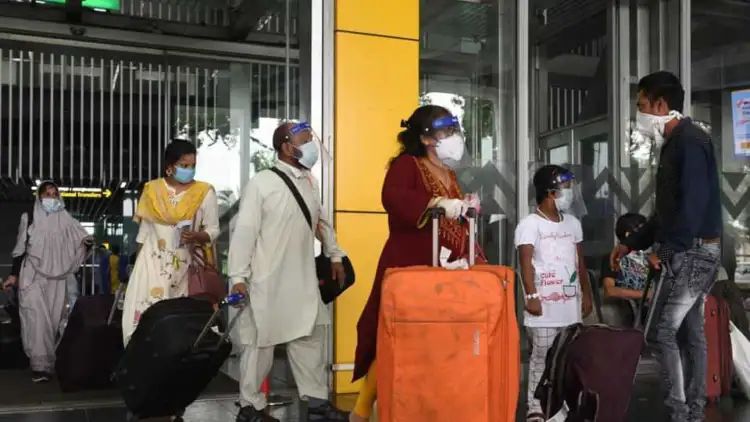
Passenger flight operations to and from Kolkata Airport have been suspended from July 25 to July 29 after the West Bengal government requested for the suspension of services, news agency ANI reported quoting West Bengal Airport sources. The West Bengal government has decided to impose a biweekly complete lockdown in the state to break the chain of COVID-19 transmission.

When asked if the rule would be extended to all those days when the total shutdown is enforced, the official said that was a possibility, but an announcement in this regard will be made by the state government.

“Most probably, it will be extended to all lockdown days. But the state government will make an announcement. As of now, these two dates have been confirmed. No flights to operate on July 25 and 29,” the official added.

Last week, the ban on passenger flights to Kolkata from Delhi, Mumbai, Chennai, Pune, Nagpur and Ahmedabad was extended till July 31.

The Entire Earth Is Vibrating Less Due to COVID-19 Lockdowns, Study Reveals

In a study conducted in 117 countries, researchers have found that the world is experiencing the most dramatic reduction in the seismic noise (the hum of vibrations in the planet’s crust) in recorded history due to global Covid-19 lockdowns.

Measured by instruments called seismometers, seismic noise is caused by vibrations within the Earth, which travel like waves and the waves can be triggered by earthquakes, volcanoes, and bombs – but also by daily human activity like travel and industry.

This quiet period, likely caused by the total global effect of social distancing measures, closure of services and industry, and drops in tourism and travel, the study published in the journal Science, reported.

The new research, led by the Royal Observatory of Belgium and five other institutions around the world including Imperial College London (ICL), showed that the dampening of ‘seismic noise’ caused by humans was more pronounced in more densely populated areas.

“Our study uniquely highlights just how much human activities impact the solid Earth, and could let us see more clearly than ever what differentiates human and natural noise,” said study co-author Stephen Hicks from ICL in the UK.

For the findings, the research team looked at seismic data from a global network of 268 seismic stations in 117 countries and found significant noise reductions compared to before any lockdown at 185 of those stations.

Researchers tracked the ‘wave’ of quietening between March and May as worldwide lockdown measures took hold.

The largest drops in vibrations were seen in the most densely populated areas, like Singapore and New York City, but drops were also seen in remote areas like Germany’s the Black Forest and Rundu in Namibia.

Citizen-owned seismometers, which tend to measure more localised noise, noted large drops around universities and schools around Cornwall, UK and Boston, US – a drop in noise 20 per cent larger than seen during school holidays.

The findings showed that countries like Barbados, where lockdown coincided with the tourist season, saw a 50 per cent decrease in noise.

“The changes have also given us the opportunity to listen in to the Earth’s natural vibrations without the distortions of human input,” the study authors wrote.

Earlier in April, a study published in the journal Nature, reported at least a 30 per cent reduction in that amount of ambient human noise since lockdown began in Belgium.

Restriction on domestic flights to remain in effect till November 24

The civil aviation ministry on Thursday extended the restrictions on domestic flights till November 24 in the view of the coronavirus pandemic. A notification by the ministry issued in the evening also said that the domestic airfare cap, too, will remain in place till November 24 or until further orders.

Domestic flights were suspended on March 25 as the government announced a nationwide lockdown to contain the spread of the disease. Union aviation minister Hardeep Puri had earlier this month said that he hoped that the number of domestic flights will reach 55 – 60 percent of the pre-coronavirus levels by Diwali this year.

He had also noted a continuous improvement in the domestic air traffic while stating that it had more than doubled by early July from the 30,000 fliers, who boarded flights on May 25, when phased reopening of the sector began after two months of suspension.

 No flight operations at Kolkata airport on July 25, 29

In an effort to boost the domestic sector, the ministry had last month cleared an increase in capacity of flight operations to 45% from 33% allowed previously. The Centre had capped domestic flights to a third of their approved summer schedule in an order passed on May 21.

The government has maintained that it aims to further open up domestic routes in a calibrated fashion.

According to ministry data, a total of 1,613 domestic flights operated on July 22 carrying 1,23,475 passengers.

For Coronavirus Live Updates

The domestic aviation industry is facing financial losses as they are operating at limited capacity with fares capped for different sectors. The poor load factor has also impacted the industry’s capacity to exploit their allowed quota of flights.

Country’s prominent private carrier IndiGo has decided to lay off 10% of its employees and a global aviation consultancy, CAPA, has predicted that a couple of Indian airlines may go out of business due to the current financial pressure.

Asia’s largest Solar Power Plant in Madhya Pradesh

By Udbhav Bhargava

Madhya Pradesh chief minister Shivraj Singh Chouhan had laid the foundation stone in December 2017. The solar plant will generate 750 MW electricity and was established with an investment of Rs 4,500 crore.

WHO DEVELOPED THE PROJECT?

The solar park was founded by Rewa Ultra Mega Solar Ltd (RUMSL), a joint venture between the Indian Solar Energy Corporation and MP Urja Vikas Nigam, with a 50 per cent stake on both sides. This project consists of three 250 MW solar electricity generating units each located on a 500-hectare plot of land located within a Solar Park (in the total area of 1500-hectare). This project would reduce carbon emissions equal to about 15,00,000 tons of CO2 each year.

Rs 138 crore has been granted by central financial assistance to RUMSL for the establishment of the Park. This is the first project in India to receive support from the Clean Technology Fund (CTF). This is the country’s first solar plant to crack the “grid parity barrier”. The Rewa project achieved the first-year tariff of Rs 2.97 per unit with a tariff escalation of Rs 0.05 per unit over 15 years compared with solar project tariffs of around Rs 4.50 per unit in early 2017.

WHO WILL UTILISE THE ELECTRICITY GENERATED FROM THE PROJECT?

 It will be the first clean energy project outside the state to bring to institutional clients. Delhi Metro will harvest 24 of the project’s capacity. The remaining 76 percent is being supplied to Madhya Pradesh ‘s state distribution firms. The project also won a Creativity and Excellence Award from World Bank Group Chief. It was included in the Prime Minister’s ‘A Book of Innovation: New Beginnings’.

WHY THE PROJECT IS IMPORTANT?

Prime Minister Narendra Modi has set the national target of achieving 100 GW of solar power generation potential by 2022 when India completes 75 years of its independence from British rule.

SOLAR PARK INITIATIVE The solar park is a focused area for the construction of projects for solar power generation and provides developers with an environment that is well defined, with adequate facilities and access to services and where project risk can be reduced. Solar Park is also helping developers by raising the amount of approvals required. It was planned to set up at least 25 solar parks, each with a capacity of 500 MW and above; Thereby targeting around 20,000 MW of solar power installed capacity.

Khudol Initiative

By Udbhav Bhargava

The UN Secretary-General ‘s Youth Envoy has listed Manipur’s Khudol among the top 10 global initiatives for an inclusive fight against the COVID-19 pandemic. Envoy of the United Nations Secretary-General on Youth The Envoy of the Secretary-General on Youth serves as a global advocate for addressing the needs and rights of young people and for getting the UN closer to them.

The Khudol Initiative

An Imphal-based NGO “Ya All” launched “Khudol” initiative The campaign guarantees the food, safety and hygiene needs of the LGBTQI+ population, people living with HIV, day-to-day wage earners, children and adolescents. This is a crowd-funded campaign that has organized a network of 100 volunteers to meet about 2,000 families and individuals’ basic needs. Khudol has been able to supply more than 1000 health kits, 1500 condoms and 6500 sanitary pads for about 2000 families and individuals.

Other activities of ‘Ya_all’

It was also the NGO that produced India’s first transgender football team. The NGO has gained recognition for the organisation of mental health workshops as well as the establishment of Meitram, a first co-working and networking space owned and run by Indian queer people Manipur and LGBTQ during COVID19

Manipur was one of the few states that accommodated the transgender community in the midst of the ongoing lockdown of COVID-19 and ensured that they were not placed into men’s quarantine centres.

The concept of inclusive safe space was developed by Ya all, who partnered with Imphal West District Administration to provide separate rooms and toilets for transgender people apart from a ramp for the differentiated in Imphal quarantine center.

Lockdown and Transgender Community in India  

The status quo of transgenders as a community is in a very precarious position. Source of livelihood disrupted   Rent, food (most have no ration cards) Access to medicines has been impaired – 1. Anti Retroviral Treatment (ART) for HIV/AIDS and 2. Hormone Replacement Therapy (HRT) required for gender transitioning

CASTE POLITICS IN INDIA

Caste is a social marvel of Indian culture. By taking an interest in the cutting edge political framework, standing is presently presented to troublesome impacts and another type of joining coming about because of another plan of universalist-particularity connections. caste has increased a compelling situation in India legislative issues.From one viewpoint, a structure of divisions and facilities, station gives to legislative issues. Furthermore, then again a strong component which retains strains and dissatisfaction. It becomes troublesome when question emerges of national solidarity. Yet, with respect to an area or gathering matter, it gives a durable power by joining individuals of a station.

The development job of position affiliation are likewise assuming as significant job in impacting casting a ballot design. Indeed, even ideological groups are thinking about rank as a vote bank. This empowered the lower positions to be politically powerful based on numerical dominance. In choosing possibility for decisions, ideological groups regularly offering thought to the standing creation of bodies electorate. At times a few standings are utilizing legislative issues in their endeavor to better their conditions or to accomplish their objective. Among the major disruptive powers influencing the commonwealth, standing remains the considerable one. It alludes to an inscription arrangement of status and order. Its central qualities are pecking order, commonality, limitations on marriage and innate occupation.

Its predominance is seen by M.N. Srinivas “Caste is so tacitly and so completely accepted by all, including those most vocal in condemning it, that it is everywhere the unit of social action.” British dealt with India by playing one caste or network against the other, their arrangement of training and organization helped in individualizing the Indian culture. In any case, while auxiliary and useful angles experienced change, political measurement strike its root. After the Independence, position started to get new turn in Indian legislative issues. Talking about the connection among standing and legislative issues, Rajni Kothari brings up three measurements.

Caste Factor in Political Socialization and Leadership Recruitment:

Distinctive position bunches host their loyalties behind various political gatherings and their belief systems. Directly from his introduction to the world, an Indian resident acquires a caste and grows up as an individual from a specific position gathering. He has a place either with one of the High Castes or to Scheduled Castes. During the time spent getting his political directions, disposition and convictions, he normally goes under the impact of rank gatherings and caste-ism. ‘Standing qualities’ and station intrigues impact his socialization and therefore his political reasoning, mindfulness and interest. He banks upon rank solidarity for possessing and playing out an influential position. Station impacts the procedure of administration enrollment. This is especially valid for profoundly ‘standing cognizant’s kin of certain states like Haryana, Bihar, UP, Tamil Nadu and Andhra Pradesh. In Haryana, the initiative comes either from the Jaats or from the Bishnois or Brahmins. In Andhra Pradesh, the Reddys, Kammas and Valamas give state pioneers.

Caste is a constituent of the Indian party framework. Some ideological groups have an immediate caste premise while others by implication bank upon specific station gatherings. Specifically, the provincial ideological groups stand overwhelmingly impacted by the position factor. The DMK and AIADMK are non-Brahmin rather against Brahmin ideological groups of Tamil Nadu. In Punjab, Akali Dal has a network pantheistic character yet stands impacted by the issue of Jaats versus non-Jaats. Every ideological group in India use station as a methods for making sure about votes in decisions. While the BSP banks upon the help of the Scheduled Castes, the BJP generally banks upon its prevalence among the high caste Hindus and the exchanging network.

Susanne H. Rudolphs, “the caste association provides the channel of communication and bases of leadership and organization which enables those still submerged in the traditional society and culture to transcend the technical political literacy which would otherwise handicap their ability to participate in democratic politics.” Caste stays a focal component of Indian culture and has energetic impact on vote based legislative issues.In practically all parts of life, caste considerations keep on having definitive job.

Dil bechara Review

late actor sushanth Singh Rajput last movie Dil Bechara is going to steaming in Disney + hotstar

Sara Ali khan shared movie poster on twitter for everyone to watch the movie,and also the movie is going to available for subscribes and non-subscribes

Dil Bechara stars sushanth Singh rajput, sanjana and directed by mukesh chhabra

No words to describe the movie, Sushant involved into the character, you laugh you cry and at the end manny ever and forever I really can’t stop my tears

Sushant Singh rajput will also be remembered

Review – ⭐⭐⭐⭐⭐

Development and Environment Protection Together?

Mahatma Gandhi once said that “Earth provides enough to satisfy every man’s needs, but not every man’s greed.” and this statement gives us reflect about the sort of advancement we need as an individual, one which can satisfy our necessities or one which can satisfy our covetousness. in the event that we need to get our requests satisfied, we have to regard the unstoppable force of life so our requirements can be tended to essentially.

With the changing time the need of individual has likewise changed. These changing needs are the reason for the improvement in different parts of life which was seen by the development of human. Chasing and assembling for food, imagining fire to cook, making hovels for cover, doing horticultural practices and so on are the different advancements through which early man went over. Since the modern upset, the quick improvement was seen over the world which brings about fast corruption of nature. In the journey of improvement, man disregarded the very condition which is essential for continuing the life on the planet earth.

The earth has been antagonistically influenced by the development of the world. The formative procedures like building dams, manufacturing plants and ventures, houses, schools and universities requires huge regions which is satisfied by deforestation for example chopping down of the timberland’s. The deforestation prompts natural surroundings loss of numerous creature species, pulverizing numerous therapeutic plants and spices, sea fermentation, soil disintegration, and so forth upsets the ecological parity.

Likewise, the smokes discharged by vehicles and industrial facilities, dumping of hurtful squanders in the dirt and releasing it into the water bodies closes into dirtying nature. For instance, the individuals of Tuticorin region in Tamil Nadu were fighting for the conclusion of the Vedanta’s Sterile Copper Plant which is dirtying the underground water around there. Likewise, the contaminated Ganga stream and the staining the Taj Mahal’s marbel are the significant worry of the Indian government.

Alongside the evolving time, our necessities are additionally changing, in antiquated occasions we people chased creatures for looking for the dinners, broke trees for making cover. every one of our necessities were tended to yet when we came to over the timetable from old age to mechanical age, we slowly began underestimating nature. only for our own preferred position, we began draining the assets more than ever. directly from utilizing nature to satisfying our needs, we came to abusing nature for our insatiability and results are among us. green house gases raise the temperature of globe. sun oriented ice is softening. ocean levels are expanding. there is shortage of maintainable advancement which can finish our requests yet can likewise shield our temperament.

Reasonable improvement is critical to deliver suitable answer for these issues. in any case, it is conceivable dispose of these difficulties and ongoing case of this is utilizing bio-fuel rather than non-renewable energy source. it tends to be seen that there has been effective trial of first bio-filled business flight. we are achieving our necessities of vitality from sustainable wellspring of vitality rather than customary petroleum product. we will be breathing natural air and increasingly sound way of life. likewise we will be building up our G.D.P. by maintainable improvement alongside smart use of regular assets. improvement with insurance of condition is conceivable and suitable which is a method of better living for our future and for age to come

Education system


Education  is an important tool which is very useful in everybody’s life. Education is what differentiates us from other living beings on earth. It makes man the smartest creature on earth. It empowers humans and gets them ready to face challenges of life efficiently. With that being said, education still remains a luxury and not a necessity in our country. Educational awareness needs to be spread through the country to make education accessible. But, this remains incomplete without first analyzing the importance of education. Only when the people realize what significance it holds, can they consider it a necessity for a good life.

Importance of Education

Education is the most significant tool in eliminating poverty  and unemplyloment . Moreover, it enhances the commercial scenario and benefits the country overall. So, the higher the level of education in a country, the better the chances of development are. In addition, this education also benefits an individual in various ways. It helps a person take a better and informed decision with the use of their knowledge. This increases the success rate of a person in life. Subsequently, education is also responsible for providing with an enhanced lifestyle. It gives you career opportunities that can increase your quality of life. Similarly, education also helps in making a person independent. When one is educated enough, they won’t have to depend on anyone else for their livelihood. They will be self-sufficient to earn for themselves and lead a good life.

Above all, education also enhances the self-confidence of a person and makes them certain of things in life. When we talk from the countriesviewpoint, even then education plays a significant role. Educated people vote for the better candidate of the country. This ensures the development and growth of a nation.

Doorway to Success


To say that education is your doorway to success would be an understatement. It serves as the key which will unlock numerous doors that will lead to success. This will, in turn, help you build a better life for yourself.An educated person has a lot of job opportunities waiting for them on the other side of the door. They can choose from a variety of options and not be obligated to do something they dislike. Most importantly, education impacts our perception positively. It helps us choose the right path and look at things from various viewpoints rather than just one With education, you can enhance your productivity and complete a task better in comparison to an uneducated person. However, one must always ensure that education solely does not ensure success. It is a doorway to success which requires hard work, dedication and more after which can you open it successfully. All of these things together will make you successful in life.

Conclusion


In conclusion, education makes you a better person and teaches you various skills. It enhances your intellect and the ability to make rational decisions. It enhances the individual growth of a person. Education also improves the economic growth of country . Above all, it aids in building a better society for the citizens of a country. It helps to destroy the darkness of ignorance and bring light to the world.

Starting new life

If I were given a chance to start my life, it would be something which I am dreaming right now. Might be, waking up early and wearing track suit, going for a walk then coming back and drinking a glass of healthy juice.I wish to put on some music and dancing on it’s beat. Enjoying a healthy breakfast with family on dinning table is the best to start the day.

I would do everything to make myself feel alive whether it’s like grabbing a cup of coffee along with a book in my own personalised garden or meditating in a peaceful environment that too designed by me. I want to just get myself lost in those things which adds spark to my life and don’t wish to have any regret later on.

A good relationship means that you are having a good life. Being surrounded with loving wife, supportive in-laws, bright kids and trustworthy friends what else I could have asked the God. not but least, I would love this lifestyle every day and thanksing god for showering all his blessings upon me whether may be if it is healthy food, relations, friends and materialistic things.

Interpersonal relation affects organisational culture. Discuss prons and cons

Interpersonal relationship skills at a workplace is very important for organisation culture , if in the organisation, the interpersonal relationship is not good with their employees then it creates conflicts in the employees and they do not work with effectively in the organisation. Interpersonal relationships affects organisation culture it create conflict among the employees and employers. And it affects the objectives of organisation and employees are not satisfied at workplace.

Interpersonal relationship skills at workplace allow a better understanding among employees as well as more effective communication. For individuals spending, on average, seven to eight hours of their day at work, it is irrational to believe they can work all by themselves. So we all ought to have healthy interpersonal relationships at work in order to be able to have a friendly ambience. Interpersonal relationship skills refer to the ability to build rapport with individuals having similar interests and goals as we do. In a workplace, interpersonal relationship skills allow us to share a special bond with our co-workers such that trust and positive feelings for one another are maintained.

Why are interpersonal relationships important

The importance of interpersonal relationships in workplace is evident from the following benefits:

▪︎Greater employee satisfaction

Human being is a social animal. Working in isolation makes an individual prone to stress and he starts to find his job monotonous. Therefore, interpersonal relationships give employees a chance to form close relationships with fellow co-workers, developing in them a sense of joy as well as satisfaction.

▪︎Better decision making

Any important decision making within an organization is based on its employees brainstorming to find the best ideas and strategies. However, this requires a platform such that every individual has the liberty and an equal opportunity to express his views and opinions. Such effective communication is best possible when employees have close associations with each other that allows for effective communication as well as some honest feedback.

How to improve interpersonal relationships skills

Interpersonal relationships in an organisation are critical for the job as well as career success of individual employees. However, they also require lot of efforts on the part of the employees to nature and maintain them. Following are some of the tips that can help you improve you interpersonal relationships skills and achieve the ultimate success you desire :

▪︎Interact with your colleagues or subordinates more often. Greet your colleagues every day you see them if they are from a different team. Also provide an open platform for everyone to discuss any issue at hand encourage honest feedback . Whether you use verbal or written communication method makes little difference but you must be able to make informed decisions. Hiding things from a co- worker or ignoring him may spoil your relationship with him.

▪︎Conduct as well as attend morning meetings , Leaders should make it a habit to arrange and members should make sure to attend morning meetings. However, these meetings should not be made too formal e.g. by allowing coffee mugs as well as informal interactions between the members during the meeting.

▪︎Arrange picnics as well as off-site meetings for team members. Meeting outside the office, in an effort to change the ambience , gives team members a special opportunity to open up each other and build strong bonds of friendship overtime.

  • self knowledge helps an individual know his/her strengths and weaknesses, and make the right decision when need arises. This can help enhance relationships with others.
  • Self-esteem helps you think highly of yourself. It allows you to express yourself which can be really empowering and necessary in a relationship.
  • one way you could increase your self esteem id by surrounding yourself with positive and inspirational people who can help make you feel worthy.
  • being in a romantic relationship that is loving increases happiness
  • an abusive one can be a painful experience
  • many opportunities for social events when in a great friendship
  • painful when a friendship dissolves
  • work relationships can be professional and personal
  • they can be polite and fun or stressful
  • family relationships can be friendship and work as well

Self knowledge and self esteem

Stimulation

A relationship with others gives you different types of stimulation

  • Intellectual from conversation,
  • Physical from touch,
  • Emotional from sharing emotions.
  • They give you many physical and emotional health benefits but also have some disadvantages.

Emotional & Physical Health

Life is filled with relationships ,and relationships are tricky! They have millions of complex components but no worries.

Advantages, the positivity in interpersonal communications that makes your life easier and uplift your health in many ways you would not think it could, e.g. Self-esteem and self-knowledge.

Disadvantages, the factors that lead to poor interpersonal relationships between the certain parties, such as; Jealousy and bullying.

There on forward poor interpersonal relationships leads to one not wanting to continue the relationships which can cause both mental and physical illness, whereas mental (depression) leads to physical illness (obesity, drugs and etc.) .

Loneliness

  • emotions and physical health are correlated
  • emotions are real and can be a positive attribute in relationships
  • being physical fit increases ‘endorphins’ which benefits personalities
  • moods can be a reflect, poor emotional state or physical health
  • Physical health places you in the spot light
  • Emotional health gives variety to expressions

Group Presenters pleasure and pain

  • How loneliness affects different kinds of relationships
  • If loneliness is an advantage or disadvantage in these different relationships
  • Family, work, romantic, online and friendship relationships show that loneliness can mostly be seen as an disadvantage
  • In some cases, loneliness can be seen as an advantage in family and work relationships.

India’s private hospitals and their exorbitant charges

Image courtesy- Social Media

On the month of May 14th in the current year 2020, Mr. Tushar Jindal, 40, a kidney patient, tested positive for novel coronavirus and his family shocked with the results made some calls to Sir Ganga Ram Hospital, India’s one of the elite private hospital situated in Delhi. The private hospital allegedly asked for an advance deposit of INR 5 lakhs for admission.

Since the amount was hefty for a middle class Indian family, following advice from Mr. Jindal’s nephrologist, they admitted him at Max Hospital in Saket, Delhi where an advance of INR 2.5 lakhs had to be paid.

“While I was admitted there, I barely received any treatment as my condition was stable. I was discharged within four days, but I was handed an exorbitant bill of ₹1.98 lakh,” claimed Mr. Jindal. He has sent a legal notice to the hospital contesting many of the items charged for and claiming that the bill issued to him was “faulty and fake and carries a lot of unnecessary and unreasonable charges”.

Mr. Jindal’s notice states that medicines and drugs which were not administered to him have been charged for in the bill and a charge of ₹71,000 questioned for “investigation” offered no other detail. Specifically, the notice states that being a kidney transplant patient, Mr. Jindal takes a particular brand of medicine prescribed by his nephrologist and he has been charged for a medicine he could never take, as it belongs to another company. He claims that he consumed his nephrologist-prescribed brand but has been charged for an alternative with four units and six times a day. Mr. Jindal was also charged ₹8,900 per day for PPE kits amounting to ₹35,600, hospital bills show. He was also charged ₹52,000 for “other charges”, which the notice terms “irrelevant and fake”.

Responding to queries, a Max Healthcare spokesperson said: “A patient’s attendants are counselled about the estimated cost of treatment at the time of admission itself, and they are required to sign an informed consent form for all treatment and procedures. Bill updates are also shared on a day-to-day basis on registered mobile numbers of attendants for any immediate concerns. The attendants of the patient were explained the overall consumption of PPEs during a 24-hour cycle, which is approximately nine PPEs per day per person in the COVID ICU, and the costs charged to the patient are in line with the costs incurred by the hospital in sourcing the PPEs.”

D.S. Rana, chairman of Sir Ganga Ram Hospital, said “the upfront payment is to tide over certain issues such as the family of a COVID-19 patient not being allowed to come to the hospital due to risk of infection. How will they make payments? We ask for INR 5 lakhs as advance from COVID-19 patients and refund the money if the bill is less than that,” he said.

Dr. Rana said, “The hospital follows a similar process for non-COVID-19 treatment too”.

“There is nothing to hide. Our expenses have gone up since the virus outbreak. Our hospital is just meeting expenses, not making any profit. The government can audit our accounts if they want,” he said.

Another case of a Journalist from nationalheraldindia shows another face of the overall situation and the huge differences in charging between government and private hospitals. The said journalist initially went seeking aid from an elite private hospital who gave a pricing quotation of INR 9 lakhs, the journalist was shocked with this pricing and with the mere fact that particular hospital called it as “a package for covid-19 treatment”, yes a package!

Shocked with the pricing, he decided to admit himself to the district civil hospital in the city where they charged him INR 50 (fifty) per day for three medicines and less than INR 1,000 per day for equipment that included oxygen cylinders and ventilators. With his multiple ailments, including chronic kidney disease, he should have had no hope of survival. But it is almost a miracle that the doctors at the district civil hospital pulled him out of danger and did not allow the comorbidity factors to undermine his chances of recovery. Out of hospital for a week now, he is fighting fit and back to the normal activities of a journalist.

Now what we can do to tackle these situations is to question the administrations, the system and governments ruling these systems, we need to ask our governments as to “why they are unable to curb the exorbitant charges by the prominent private hospitals of India”.

Making Women empowerment

Women empowerment refers to making women powerful to make them capable of deciding for themselves. Women have suffered a lot through the years at the hands of men. In earlier centuries, they were treated as almost non-existent. As if all the rights belonged to men even something as basic as voting. As the times evolved, women realized their power. There on began the revolution for women empowerment.

As women were not allowed to make decisionsfor them, women empowerment came in like a breath of fresh air. It made them aware of their rights and how they must make their own place in society rather than depending on a man. It recognized the fact that things cannot simply work in someone’s favor because of their gender. However, we still have a long way to go when we talk about the reasons why we need it.

Need for Women Empowerment

Almost every country, no matter how progressive has a history of ill-treating women. In other words, women from all over the world have been rebellious to reach the status they have today. While the western countries are still making progress, third world countries like India still lack behind in Women Empowerment.

In India, women empowerment is needed more than ever. India is amongst the countries which are not safe for women. There are various reasons for this. Firstly, women in India are in danger of honor killings. Their family thinks its right to take their lives if they bring shame to the reputation of their legacy.

Moreover, the education and freedom scenario is very regressive here. Women are not allowed to pursue higher education, they are married off early. The men are still dominating women in some regions like it’s the woman’s duty to work for him endlessly. They do not let them go out or have freedom of any kind.

In addition, domestic violence is a major problem in India. The men beat up their wife and abuse them as they think women are their property. More so, because women are afraid to speak up. Similarly, the women who do actually work get paid less than their male counterparts. It is downright unfair and sexist to pay someone less for the same work because of their gender. Thus, we see how women empowerment is the need of the hour. We need to empower these women to speak up for themselves and never be a victim of injustice.

How to Empower Women?

There are various ways in how one can empower women. The individuals and government must both come together to make it happen. Education for girls must be made compulsory so that women can become illiterate to make a life for themselves.

Women must be given equal opportunities in every field, irrespective of gender. Moreover, they must also be given equal pay. We can empower women by abolishing child marriage. Various programs must be held where they can be taught skills to fend for themselves in case they face financial crisis.

Most importantly, the shame of divorce and abuse must be thrown out of the window. Many women stay in abusive relationships because of the fear of society. Parents must teach their daughters it is okay to come home divorced rather than in a coffin.

Women’s empowerment is the process of empowering women. Empowerment can be defined in many ways, however, when talking about women’s empowerment, empowerment means accepting and allowing people (women) who are on the outside of the decision-making process into it. Women’s empowerment is the most crucial point to be noted for the overall development of a country. Many people think that the days of women fighting for their rights are over but those people are wrong because one out of every three women have been public ally sexually harassed by random men they don’t know. Every day women are put down and told how to act and that they were asking for it if you wear that making woman feel that it is their fault, it is not. Many celebrities are all for girl power such as Liza Koshy and Lilly Singh (who has her own late night show and has won many awards and also raised money for #girllove and other charities) “This puts a strong emphasis on participation in political structures and formal decision-making and, in the economic sphere, on the ability to obtain an income that enables participation in economic decision-making.”Empowerment is the process that creates power in individuals over their own lives, society, and in their communities. People are empowered when they are able to access the opportunities available to them without limitations and restrictions such as in education, profession and lifestyle. Feeling entitled to make your own decisions creates a sense of empowerment. Empowerment includes the action of raising the status of women through education, raising awareness, literacy, and training. Women’s empowerment is all about equipping and allowing women to make life-determining decisions through the different problems in society.

Alternatively, it is the process for women to redefine gender roles that allows them to acquire the ability to choose between known alternatives whom have otherwise been restricted from such an ability.There are several principles defining women’s empowerment such as, for one to be empowered, they must come from a position of disempowerment. For example: A stripper no longer has to take off her clothes to get money and now is a receptionist for a respectable company. Empowerment stems from self respect. Furthermore, one must acquire empowerment themselves rather than have it given to them by an external party. Other studies have found that empowerment definitions entail people having the capability to make important decisions in their lives while also being able to act on them. Lastly, empowerment and disempowerment is relative to other at a previous time; therefore, empowerment is a process, not a product.

Women empowerment has become a significant topic of discussion in developmentand economics. It can also point to the approaches regarding other trivialized gendersin a particular political or social context.

Women’s economic empowerment refers to the ability for women to enjoy their right to control and benefit from the resources, assetsincomeand their own time, as well as the ability to manage risk and improve their economic status and well being.

While often interchangeably used, the more comprehensive concept of gender empowerment refers to people of any gender, stressing the distinction between biological and gender as a role.

Entire nations, businesses, communities and groups can benefit from the implementation of programs and policies that adopt the notion of women empowerment.Empowerment of women is a necessity for the very development of a society, since it enhances both the quality and the quantity of human resources available for development Empowerment is one of the main procedural concerns when addressing human rights and development.

Women’s empowerment and achieving gender equality is essential for our society to ensure the sustainable development of the country. Many world leaders and scholars have argued that sustainable development is impossible without gender equality and women’s empowerment Sustainable development accepts environmental protection, social and economic development,and without women’s empowerment, women wouldn’t feel equally important to the process of development as men. It is widely believed that, the full participation of both men and women is critical for development. Only acknowledging men’s participation will not be beneficial to sustainable development. In the context of women and development, empowerment must include more choices for women to make on their own. Without gender equality and empowerment, the country could not be just, and social change wouldn’t occur. Therefore, scholars agree that women’s empowerment plays a huge role in development and is one of the significant contributions of development.