3D PRINTING

3D printing, also called additive manufacturing, is often defined as the construction of a three-dimensional object from a CAD model or a digital 3D model. The term “3D printing” is often explained as a spread of processes during which materials are deposited, solidified with computer control to present a three-dimensional object, with more material being added together typically layer by layer.

Looking at current scenarios 3D printing or additive manufacturing has been used widely for manufacturing, medical, industry etc. which facilitate 3D printing to become successful economical technology. The earliest application of 3D printing was on the toolroom end of the manufacturing spectrum.

HOW IT WORKS:

3D printers are available and are a neighborhood of the additive manufacturing family and use familiar methods to a standard inkjet printer- albeit in 3D. It takes a mixture of top-of-the-line software, powder-like materials and precision tools to make a three-dimensional object from scratch.

The various steps include :

3D Modeling Software:Modeling helps printers to form the merchandise come right down to the tiniest detail. The 3D modeling software ensures precision designs is why 3D printing is being hailed as a real and important changer in many industries.

Slicing the Model: Engineers are required to slice the model into layers to assist the printer to make the ultimate product. Slicing software takes scans of every layer of a model and can tell the printer the way to move so as to recreate that layer.

The 3D Printing Process: The printer acts an equivalent as a standard inkjet printer within the 3D printing , where a nozzle moves back-and-forth while dispensing a wax or plastic-like polymer layer-by-layer, expecting that layer to dry, then adding a subsequent level.

There are various types of 3D printing depending on size, shape and also time consumed in making one depends on these factors. 

ADVANTAGES :

  1. Fast Design and Production, helps design and print faster also production rate saves time. 
  2. Minimises Waste, little wastage compared to traditional methods. 
  3. Cost Effective, requires lesser products, machine cost can be saved by outsourcing the project. 
  4. Easy To Use, easily accessible by everyone. 
  5. Environmental Friendly, Fuel efficient and less wastage. 
  6. Flexible Design, helps design and print complex designs. 

SCOPE :

In the construction world , 3D printing is  used to create construction components or to print even entire buildings. Construction is well-accustomed to 3D printing as much of the information necessary to create an product will exist as a result of the design process, and the industry is already experienced in computer aided manufacturing.3d printing  is not a new technology, followed since the 1980s. Making a three-dimensional model, or prototype, from a computer made design by adding successive layers of material is now standard practice in many industries, ranging from aerospace and architecture to medicine and high-end manufacturing.

3D printing encompasses many sorts of technologies and materials as 3D printing is getting used in most industries you’ll consider . It’s important to ascertain it as a cluster of diverse industries with a myriad of various applications.
A few examples:
– consumer products (eyewear, footwear, design, furniture)
– industrial products (manufacturing tools, prototypes, functional end-use parts)
– dental products
– prosthetics
– architectural scale models & maquettes
– reconstructing fossils
– replicating ancient artefacts
– reconstructing evidence in forensic pathology
– movie props

Book Review for Haemin Sunim’s ‘Things You Can See Only When You Slow Down’

The Things You Can See Only When You Slow Down-How to be Calm and Mindful in a Fast-Paced World. As long as the book title is, it is small book with 173 pages but an ocean of thought. Published on 13 January 2013, this book sold over 4 million copies worldwide. I came across this book recently when the second wave of corona virus hit the country and all hopes of going back to normal were lost and honestly this book helps.

Haemin Sunim began this book with a simple question, “Is the world that’s busy? Or is it just my mind? The world moves fast but sometimes it is okay to take out some time for yourself and that does not make you selfish. An advice that the author gives in the beginning og this book is to take your time and to not rush thorigh it like a novel and to be honest, that is the only right way to read this. It is simple yet powerful. It has 8 chapters addressing various aspects of human’s life- rest, mindfulness, passion, relationships, love, life, the future and spirituality. He uses his real life experiences like when he first fell in love or when his teacher taight him the real meaning of spirituality or the time when he went backpacking trip with his friend and that increases the authenticity of this book. He says, ‘life isn’t a race against your friends, it is a lifelong marathon with yourself’. You have no one but yourself to compare to.

Everyone should give this book a chance. Its a real mind opener. For me this book was definitely a 5/5 and a 100% recommendation.

Narada case: SC judge recuses himself from hearing appeals of Mamata Banerjee, Bengal minister Moloy Ghatak

Justice Aniruddha Bose said the issue will now be placed before CJI NV Ramana. Banerjee and Ghatak will submit information about their role in CBI’s arrest of four TMC leaders

New Delhi: Supreme Court judge Justice Aniruddha Bose on Tuesday recused himself from hearing appeals of West Bengal chief minister Mamata Banerjee and state law minister Moloy Ghatak about their role on the day of arrest of four TMC leaders by the CBI in the Narada sting tape case 

As soon as a vacation bench of Justices Hemant Gupta and Bose assembled to commence the day’s proceedings, Justice Gupta said his brother judge is recusing himself from hearing these appeals.

Justice Gupta, presiding over the bench, said the issue would be now placed before Chief Justice of India NV Ramana who may take the decision and the pleas may be listed for hearing during the day itself.

The top court was scheduled to hear three appeals including that of the state government challenging the high court’s denial for filing of affidavits by her and the state Law Minister in their role on the day of arrest of four Trinamool Congress leaders on 17 May by the central agency in the case.

It has been alleged that the state ruling party leaders played a key role in stopping the CBI from performing its legal duty after arresting four leaders in the case.

History of vaccination in India

The world is in a pathetic situation fighting with a deadly pandemic named COVID-19. On 31st December 2019, the first case of COVID was reported in Wuhan, China, and on 30th January 2020 in India. The number of COVID cases is increasing rapidly all over the world. The world had become helpless and hopeless. The only ray of hope was the scientists trying their level best to find a vaccine for COVID. Currently, we have at least 13 different vaccines across 4 platforms. Pfizer/BioNtech comirnaty vaccine was the first successful vaccine introduced to the world, listed for WHO Emergency Use Listing (EUL) on 31 December 2020. The SII/Covishield and AstraZeneca/AZD1222 vaccines (developed by AstraZeneca/Oxford and manufactured by the State Institute of India and SK Bio respectively) were given EUL on 16 February.

The national regulator has approved two vaccines for Emergency Use Authorisation is Covid shield and Covaxin. India’s COVID vaccination drive was scheduled to start on February 16 with priority given to an estimated three crore healthcare workers and the frontline workers, said the Health Ministry. It also added that people above the age of 50 will be vaccinated, co-morbidities will be given to people below the age of 50.
Under the first formulated policy of vaccine distribution, half of the vaccines produced in India went to the federal government, and the other half to state administration and private hospitals. Although the states competed on the open market for the vaccine doses for the 18-44 age group, recipients were able to get them for free at the state government’s vaccination centers. Meanwhile, the federal government was vaccinating frontline workers and those aged above 45 years – also for free.
Under the new policy, the federal government will now buy 75% of all vaccines manufactured. It means that the state government will receive vaccines from the federal government based on the population, state of the virus, progress of the vaccine. This benefits the state authorities as they don’t have to pay high amount to the manufacturer than they offered to the federal government for vaccines. The announcement also happened just days after the previous policy attracted criticism from India’s top court, which called it “arbitrary” and “irrational”. It questioned the rationale behind making states pay more for vaccines than the federal government had to. States had to procure them on the open market, and so the financial burden on some of the poorest states such as Bihar, Jharkhand, and Uttar Pradesh significantly increased.
India’s previous record of 4.5 million doses was on April 5, followed by a sharp decline with average daily inoculation falling below 3 million. Experts have said India needs to administer 10 million doses a day to achieve its aim of inoculating 950 million adults by December. So far, India has fully vaccinated fewer than 5% with two doses. After this policy was brought to practice, India has broken its record after vaccinating 7.5 million people in a day.
“If supply remains consistent, we will be on course to innoculate most of our population by the end of the year, D N Patil, a senior health official in the country’s richest state of Maharashtra.
Government adviser Vinod Kumar Paul said on Monday that administering 10 million shots per day was not a “set goal”.
“As the ramping up takes place, speed of implementation should also ramp up and that would lead to a certain number,” Paul said in an interview with the CNBC-TV18 channel.
“There is a demonstration by the system of how much can be done on a given day, at least this is something that should become obvious by the end of the day.”
India’s vaccination drive has been a rollercoaster but sooner or later it will come back on track.

LEGEND OF THE BERMUDA TRIANGLE

The Bermuda Triangle is an imaginary area in the Atlantic Ocean bordered by Miami, Bermuda, and Puerto Rico where scores of ships and aeroplanes have vanished. Some of these incidents are shrouded in mystery, such as one in which the pilots of a squadron of US Navy bombers became disoriented while flying over the area; the planes were never discovered. Other boats and planes appear to have departed from the area in fair weather, without even transmitting distress signals. However, despite the fact that a plethora of fantastic theories have been suggested on the Bermuda Triangle, none of them establish that strange disappearances occur more frequently there than in other well-traveled areas of the ocean. In reality, individuals navigate the region without issue every day.

THE BEGINNING-The Bermuda Triangle, sometimes known as the Devil’s Triangle, covers approximately 500,000 square miles of ocean near the southeastern coast of Florida. When Christopher Columbus sailed through the area on his first voyage to the New World, he reported seeing a gigantic flame of fire fall into the water one night and a weird light arise in the distance a few weeks later. He also wrote of inconsistent compass readings, maybe because the Bermuda Triangle was one of the few sites on Planet where true north and magnetic north lined up at the time.William Shakespeare’s play “The Tempest,” which some academics believe was inspired by a real-life Bermuda disaster, may have added to the area’s mystique. Nonetheless, until the twentieth century, accounts of mysterious disappearances did not fully attract the public’s attention. The sinking of the USS Cyclops, a 542-foot-long Navy cargo ship carrying over 300 soldiers and 10,000 tonnes of manganese ore, occurred in March 1918, somewhere between Barbados and the Chesapeake Bay. Despite being able to do so, the Cyclops never sent out an SOS distress signal, and an exhaustive search turned up no wreckage. “Only God and the sea know what happened to the mighty ship,” later stated US President Woodrow Wilson. Two of the Cyclops’ sister ships vanished without a trace along nearly the same route in 1941.

PLANE VANISHED-A pattern purportedly began to emerge in which watercraft navigating the Bermuda Triangle either vanished or were discovered abandoned. Then, in December 1945, five Navy bombers carrying 14 personnel took out from an airport in Fort Lauderdale, Florida, to practise bombing missions over local shoals. However, because his compasses appeared to be malfunctioning, the mission’s leader, known as Flight 19, became seriously lost. All five planes flew aimlessly until they ran out of fuel and had to land at sea. On the same day, a rescue plane and its 13-man crew vanished. After a large weeks-long search yielded no results, the official Navy report stated that it was “as if they had gone to Mars.”

THEORIES AND COUNTER THEORIES– By the time author Vincent Gaddis invented the moniker “Bermuda Triangle” in a 1964 magazine article, more inexplicable mishaps had occurred in the area, including three passenger flights that crashed despite sending “all is good” communications. Charles Berlitz, whose grandfather founded the Berlitz language schools, fueled the legend even further with a sensational bestseller on the subject in 1974. Since then, scores of other paranormal writers have blamed the triangle’s supposed lethality on everything from aliens, Atlantis, and sea monsters to time warps and reverse gravity fields, while more scientifically minded theorists have pointed to magnetic anomalies, waterspouts, or massive eruptions of methane gas from the ocean floor. However, there is unlikely to be a single theory that solves the mystery. Trying to find a same cause for every Bermuda Triangle disappearance, as one sceptic put it, is no more plausible than trying to find a common cause for every vehicle accident in Arizona. Furthermore, while hurricanes, reefs, and the Gulf Stream can make navigation difficult, Lloyd’s of London, the world’s largest maritime insurance company, does not consider the Bermuda Triangle to be particularly dangerous. Neither does the United States Coast Guard, which claims that “after a review of many aircraft and vessel losses in the area over the years, nothing has been revealed that would indicate that casualties were the product of anything other than physical causes.” There have never been any unusual factors discovered.”

How systemic poverty is poisoning children

The Citarum River is the longest and largest river in West Java, Indonesia.Today it is known as the most polluted river in the world. When a group of journalists went to find out how this happened, the textile industry was found to be the culprit. The river water was severely polluted because the textile factories were mindlessly releasing their waste without any treatment. The amount of lead found in the water could permanently decrease the IQ of young children. Yet the same water was used to cook, clean and even water the paddy fields. This is what we call systemic poverty.

Let’s talk about india. India’s solid waste management system has two main factors causing the corruption & tipping fees and truck fee.Because of both these factors the people involved in this system do not want it to change. In fact they want the opposite. More garbage means more money for them.There is no incentive for change and betterment.From both these stories, what I want to highlight is that our system is poorly designed and is just a  tool for people to profit off of .

Individual action is important but it’s also limited. I often see Greta Thunberg receive a lot of flak for protesting so much. But these people have  failed to notice how she has started the biggest grassroots movement in climate history. Big companies are forced to change their ways and their unethical ways are exposed. Of course they are  changing not because they are concerned about the planet but because they are concerned about the customers,but that is okay. We need systemic change and that is of utmost importance. We must hold our representatives accountable for these changes and not let them gaslight us into thinking that this garbage catastrophe is only taking place due to citizens. 

The reason why citarum is the biggest example of systemic poverty is that despite major brands like H&M , Zara being responsible for the destruction , none of them are facing any charges. The innocent children are.

Madras HC Landmark Ruling on LGBTQ protection: Ignorance cannot justify Discrimination.

Since, June is considered as the pride month of the year and recently we got a landmark judgement from the Madras High Court regarding the LGBTQ+ Community.  Looking at these situations, we can see that society is changing their perspective towards these people, especially the current generation which looks for equality everywhere. This article will mainly focus on the LGBTQ+ people and the recent landmark judgement.

First of all, I would like to explain the kind of people who come under the LGBTQ community and their rights and what their current situation is in the country and then would make a small analysis of the recent judgement.

The LGBTQ/LGBTQIA+ (Lesbian, Gay, Bisexual, Transgender, Queer and/or Questioning, Intersex, and Asexual and/or Ally) Community can be simply defined as the group which contain same-sex couples. This community has been associated with certain symbols especially the flag which is denoted by rainbow colours where each colour signifies the value of the community.

The LGBTQ RIghts have evolved in India, but still they face social and legal issues which are not faced by the non- LGBTQ people. The country has however revoked the laws which were discriminating the homosexuals and transgender identities and they explicitly eludicated on Article 15 of the Constitution to restrain discrimination on the basis of sexual orientation and the gender identity of a person. But still, there are many legal protections which have not been provided which includes same-sex marriage, etc.

CASES WHICH GAVE JUSTICE TO THE COMMUNITY

One of the first landmark case which came in favour of this community was the case of Navtej Singh Johar v.  Union of India, where the Supreme Court of India decriminalised Article 377 of the Indian Constitution and allowed consensual homosexual intercourse excluding consensual homosexual sex between adults and those which are away from the scope.

Despite seeing and having strong political and social changes, there are still a majority of people who are homophobic in nature who still reject the same-sex relationships but also a acceptance and tolerance has been recognised in big cities.

Furthermore, there was another case, i.e, National Legal Services Authority v.  Union of India the Supreme Court of India held that discrimination whic is done on the basis of gender identity is prohibited.

CONVERSION THERAPY

Conversion therapy is the pseudoscientific practise of employing psychological, physical, or spiritual therapies to convert a person’s sexual orientation from gay or bisexual to heterosexual. Conversion therapy is unsuccessful and sometimes hazardous, according to medical institutions. There is no convincing evidence that sexual orientation can be reversed.

Its validity, efficacy, and ethics have been questioned by medical, scientific, and government groups in the United States and the United Kingdom. Conversion therapy is illegal in a number of places across the world.

Since, LGBTQ community is looked down upon in our country, the use of Conversion Therapy is used a lot here so that the people in this community convert themselve into the two dominant genders present in our country.

The recent landmark judgement S. Sushma v. Commissioner of Police has prohibited the Conversion Therapy in India.

SHORT ANALYSIS OF THE RECENT LANDMARK JUDGEMENT

The petitioner’s of this case is a lesbian couple whose relationship was opposed by both their respective parents, due to which they both fled to Chennai from Madhurai. The couple got help from the community in the financial matters. On the other hand their parents individually filed a missing complaint before the Inspector of Police and the two FIRs approached the couple as an apprehending threat to their safety and security.

Seeing it as a danger, the couple filed a petition regarding this matter which Justice N. Anand Venkatesh looked into and passed an interim order and asked their parents to undergo counselling with the psychologist Ms. Vidya Dinakaran and asked for a report after the first counselling. The report stated that their parents have understood the relationship between them and have agreed with the relationship, but still they feared that they might be against the relationship, the psychologist reported that that the parents are concerned about the society and the consequences they will have to face. In return the counsel for the petitioners asked for a set of guidelines which could help them live in peace. The judge in return took an unprecedented move, i.e, he himself said that he will take the counselling and look into the emotions and the problems the community faces in our country.

In the judgement he said that , he said that comprehensive measures should be taken to sensitize the society, state and federal government including the police and the judiciary to remove prejudices against the community. He also suggested that changes should be made in the school curriculum to educate and make the students understand this community. He also suggested that special NGOs should be made which professionally deal with the qeer community and. The court has also recognised  that there is an absence of laws which deal with the community, therefore they should work in the area and should try to protect the community. Lastly he says that the medical cures which deal with the change in sexual orientation should be prohibited. Lastly, it can be said that a lot of changes are required to help the LGBTQ in the society as well as in the legal system which can help the people of the LGBTQ community live a better life.

Active Involvement in a Commission of an Offence is not a Pre- Condition for Common Intention.

Recently, within the case of Subed Ali v. The State of Assam Home Department, the Supreme Court three-judge bench of RF Nariman, Navin Sinha, and Indira Banerjee, JJ, has ruled that it’s not essential for someone to be actively participating within the physical activity of assault before being convicted on the idea of common intention. Common purposes are often inferred if the character of the evidence shows a prearranged plan and other people operating united to hold it out.held that just an energetic involvement of someone during a commission of an offence can not be considered a precondition for a typical intention.

The judgement came through an appeal within which the appellants, who had been found guilty under Section 302/34 of the Indian legal code and sentenced to life in prison, had sought acquittal during a case within which two persons died as a result of the appellants’ assault. The Sessions Court acquitted two of the five defendants, giving them the good thing about the doubt. While eye witnesses testified that appellants 2 and three were the sole ones who assaulted the 2 deceased. There was no allegation that appellant no. 1 was in any way armed or attacked either of the 2 dead. As a result, it had been argued that there’s insufficient evidence to determine common purpose within the case of appellant no. 1.

The case mainly forbade the common intention aspect, and noted that a typical intention is defined as a gaggle of individuals who are operating together to pursue a same goal, while their responsibilities are diverse. It makes no difference whether the role is active or passive after a shared goal has been established.

The bench stated that,

“It’s hard to believe there’s any concrete proof of shared intent. It’s more of a matter of drawing inferences from a case’s facts and circumstances to support a cumulative evaluation of the sort of evidence against the participants.”

The Court explained that the concept of vicarious liability, which holds an individual accountable for the actions of individuals with whom he shares a standard intention, is that the foundation for conviction supported common intention. Without an actual involvement within the attack, the existence of the mental element or the will to perform the offence, if evidently proven, is sufficient for conviction.

As a result, it’s not required for an individual to be actively participating within the physical conduct of assault before being convicted on the idea of common intention. Common purpose is inferred if the character of the evidence shows a prearranged plan and folks operating mutually to hold it out. A shared purpose to realize a particular goal can emerge spontaneously among a bunch of individuals supporting the facts and circumstances of a given instance.

The bench further stated that,

“The gathering of the accused to the scene of the crime, some or all of whom could also be armed, the fashion of assault, the accused’s active or passive involvement are merely some of the materials from which conclusions may well be drawn.”

Therefore, through this case the Supreme Court held that only within the basis of mere common intention, the appellant can’t be held liable, but if the Court gets proven evidence where they get to understand that the appellant had taken part within the assault and has attacked the person, then the appellant are held liable.

New Plastic ammendments in india

Around the world, one to five trillion plastic sacks are devoured yearly. In the event that integrated, five trillion single-utilize plastic packs would cover a region twice the size of France. Before long, Indians should take cognisance of this ecological danger and embrace choices to convey sacks, straws and stick film as the nation begins to eliminate single-utilize plastic (SUP) beginning one year from now.

A focal government council has distinguished the SUP things to be prohibited dependent on a file of their utility and ecological effect. Ecological specialists have invited this move while plastic producers have communicated reservations and requested putting off the boycott by a year because of the pandemic-incited financial droop.

Resistance from the plastics business will make it harder to successfully execute the boycott, given how ineffectively existing boycotts have been authorized – as seen from a new request of the Public Green Court (NGT)- – and because of weaknesses in the draft warning, like inquiries over choices to SUP things, specialists say.

In this report, we inspect what the draft warning involves, the response of waste administration specialists and plastics exchange affiliations; the viability of existing boycotts and the part of expanded maker’s duty (EPR) in overseeing plastic waste.

What the notice looks to boycott

The new draft will supplant the current standards on plastic waste administration which were advised in 2016 and changed in 2018. The 2021 draft rules have proposed to restrict produce, import, loading, dispersion and offer of certain single-use plastics from January 1, 2022.

In the wake of looking for ideas and complaints on the draft from residents and partners for a time of two months until May 11, the service is presently thinking on the input it has gotten, service authorities told IndiaSpend, asking not to be named

In the three-stage boycott, the main class of SUP things proposed to be eliminated are plastic sticks utilized in inflatables, banners, candy, frozen yogurt and ear buds, and thermocol that is utilized in enhancements.

The subsequent class, proposed to be prohibited from July 1, 2022, incorporates things like plates, cups, glasses and cutlery like forks, spoons, blades, straws, plate; wrapping and pressing movies utilized in sweet boxes; greeting cards; cigarette parcels; stirrers and plastic standards that are under 100 microns in thickness.

A third classification of forbiddance is for non-woven sacks under 240 microns in thickness. This is proposed to begin from September 30, 2022.

The draft has, interestingly, characterized non-woven plastic packs – broadly utilized as shopping sacks – and brought brand proprietors (selling SUP under an enlisted brand name) just as plastic waste processors under its ambit. It has additionally, interestingly, characterized thermoset plastic- – which are irreversibly unbending and can’t be remolded- – and thermoplastics, which mellow on warming. Thermoset plastics are utilized in electrical fittings and flatware while thermoplastics are utilized in things, for example, toys, brushes and mugs.

The draft likewise proposes to build the thickness of do sacks made of virgin or reused plastic from 50 microns to 120 microns. The 2016 guidelines have effectively restricted utilization of plastic packs and sheets whose thickness is under 50 microns.

How things to be prohibited were distinguished

India has characterized SUP as expendable plastics (use-and-toss things) that are generally utilized for bundling and incorporate things proposed to be utilized just a single time before they are discarded or reused. These incorporate things, for example, convey sacks, food bundling, bottles, straws, compartments, cups and cutlery.

The SUP things to be eliminated have been related to the assistance of a report of a specialist board that was established by the Division of Synthetics and Petrochemicals. This panel was shaped after the public authority’s promise to dispense with SUP by 2022 to analyze, in addition to other things, classifications of SUP and to suggest which of them could be eliminated.

The 13-part master advisory group was going by resigned Association government secretary Indrajit Buddy, and included researchers and other specialized specialists who met multiple times in 2019. They cooperated with partners from industry bodies just as free specialists having a place with research foundations like The Energy and Assets Establishment (TERI) and non-benefit associations like Chintan and Toxics Connection. The report of this council had additionally noted in 2019 that yearly plastics utilization in India would cross 20 million metric tons by 2020.

The advisory group distinguished and suggested things for disallowance dependent on a file of the utility of a SUP and its unfriendly effect on the climate, according to their report. Five factors each for utility (cleanliness, item security, centrality, social effect and financial effect) and ecological effect (collectability, recyclability, probability of end-of-life arrangements, natural effect of substitute materials and littering penchant) were thought of. The SUP things were scored utilizing these 10 variables to measure their utility and ecological effects.

The things that had a low score on utility scale and high score on ecological effect scale were suggested for disallowance. Dainty convey sacks, non-woven convey packs and covers; little wrapping and pressing movies; straws, stirrers; frothed cutlery things; non-frothed cutlery things; plastic sticks; little drinking containers and plastic flags with thickness under 100 microns, and extended polystyrene utilized in enrichments were the things that were low on utility components and high in their effect on the climate.

Overall Effects

The measures taken will surely have a drastic impact on the future of non-sustainable use in India. Plastic being one of the major pollutants, needs to undergo immediate scrutiny under the environmental problems that it causes. And therefore, this step taken by India, even though small will have a drastic impact on the future of the country in terms of pollution and climate change.

Climate Change and its Immediate future in India

One of the significant regions that will be affected by environmental change in its furthest point in the near future is South Asia, particularly India principally due to its different territory. Environmental change is required to have a genuine effect around here as the nation is quickly debilitating its regular assets subsequently, annihilating its current circumstance generally because of “urbanization, industrialization and financial development.” 

India faces a disturbing ecological and financial test in its push to ensure its quick draining of normal assets. Water and air quality are deteriorating step by step because of the increase of different toxins in the air. Furthermore, the areas that will be exposed to the most noteworthy openness to environmental change are the country’s waterfront eco frameworks, biodiversity and farming efficiency. Additionally, the locale is as of now subject to regular dangers, for example, the 2013 Uttarakhand floods, landslides, the 2015 Chennai flood and the 2016 dry spell. 

There is additionally proof of unmistakable expansions in the force or potential recurrence of numerous outrageous climate occasions, for example, heat waves, expanded droughts and serious precipitation. The antagonistic effects of such calamities range from hunger, weakness to infections, loss of pay and livelihoods.15 According to the World Bank, an increment of 2°C on the planet’s normal temperature in the following not many years will just make India’s rainstorm more erratic. The change in downpour designs across India is anticipated to leave various regions submerged and others without enough water in any event, for drinking. 

“In India, over 60% of the harvest region is downpour taken care of, making it profoundly defenseless against environment instigated changes in precipitation designs. It is assessed that by the 2050s, with a temperature increment of 2°C-2.5°C contrasted with pre-modern levels, water for rural creation in the stream bowls of the Indus, Ganges and Brahmaputra will decrease further and may affect food sufficiency for about 63 million individuals.” 

A hotter environment is likewise expected to hinder the neediness decrease rate. Despite the fact that environmental change will influence everybody’s lives in the area, poor people will be the most influenced as they are the once generally subject to rain-based farming and have no or insignificant assets to support their business. An expansion of 2°C by the 2040s will hit crop creation in South Asia as well and will lessen the yield by 12%, requiring more imports to satisfy needs at home. Likewise, diminishing food accessibility would lead to extensive medical conditions particularly among ladies and youngsters. Dissolving of icy masses and loss of 

Snow presents a critical danger to solid water assets in India. Fundamental waterways like the Ganges, Indus and Brahmaputra, rely altogether upon snow and frosty dissolved water, which makes them even more vulnerable to unfavorable effects of a dangerous atmospheric deviation. This could additionally expand the danger of flooding of low regions and represent a danger to horticulture. Having momentarily investigated the effect of environmental change, the accompanying area will have an endless supply of the new climate occasions that were generally an immediate consequence of environmental change in India.

Lower-carbon improvement, however, could yield quick advantages, for example, cleaner air, more prominent energy security and fast occupation creation. India’s environment targets are viewed as ‘2°C viable’, for example a decent amount of worldwide exertion. Be that as it may, seeking after a cleaner, more asset productive way could invigorate a quicker, more attractive monetary recuperation and secure India’s thriving and seriousness in the long haul.

INTO THE WORLD OF WEBTOONS

Everybody has heard of K-Pop, many people know K-Dramas. After all, the Hallyu wave from Korea has been stunning the world for a long time now. With the addition of K-Dramas of various genres to Netflix and the exponential rise in fame of bands like BTS and Blackpink, Korean culture is taking over hearts in almost every part of the world. There is another part of Korean entertainment that is also making waves. Though not as prevalent yet, as Kdramas or Kpop, this part is also creating waves in its own way. What I am talking about are Webtoons.

Webtoon is an app that is part of the online portal developed in Korea called Naver. It was initially launched in Korea but soon after its rising popularity, it was launched globally in languages that included Chinese, Japanese, English, French, Indonesian, Spanish, Thai and German.

Webtoon is home to hundreds and thousands of comics across almost 20 different genres ranging from romance, to slice-of-life, to action and horror. Webtoon brought attention to the Korean equivalent of ‘Manga’, called ‘Manhwa’. The translations of these ‘Manhwa’ comics were released through the Webtoon app and has now gained a lot of popularity.

People still prefer reading Manga as books and their digitized copies are also in the form of ‘pages’. But, ‘webtoons’, as the comics on the app are called, are different. They are made solely for the mobile phones. They have a continuous style of page distribution, where one episode is generally one long page that you can scroll through easily on a phone. To be honest, the best experience of reading a webtoon is on the phone. Reading it on a desktop just does not have the same feel. This is bringing a lot of change in the way artists are planning out storyboards and layouts too.

That is another thing about webtoon. They have something called ‘Canvas’. This is a space where any artist can upload their comics for people from around the world to read. Through competitions and contests, many of these comics are recognized and taken up by the Webtoon corporation and made into an ‘Original’ on the app. When released as ‘Originals’, the artist is hired under the corporation and is financed by the corporation. The comic is serialized with proper release schedules and a more wider audience range. In this way, Webtoon is a great platform for aspiring comic book artists to get their works recognized and applauded.

During the lockdown, I came across the app and now I am fully hooked. There is so much variety both in terms of art styles and in terms of stories. So, I have decided to compile a list of my favourite webtoons for those who want to start reading and for those who already know and are looking for something new to read. So here goes!

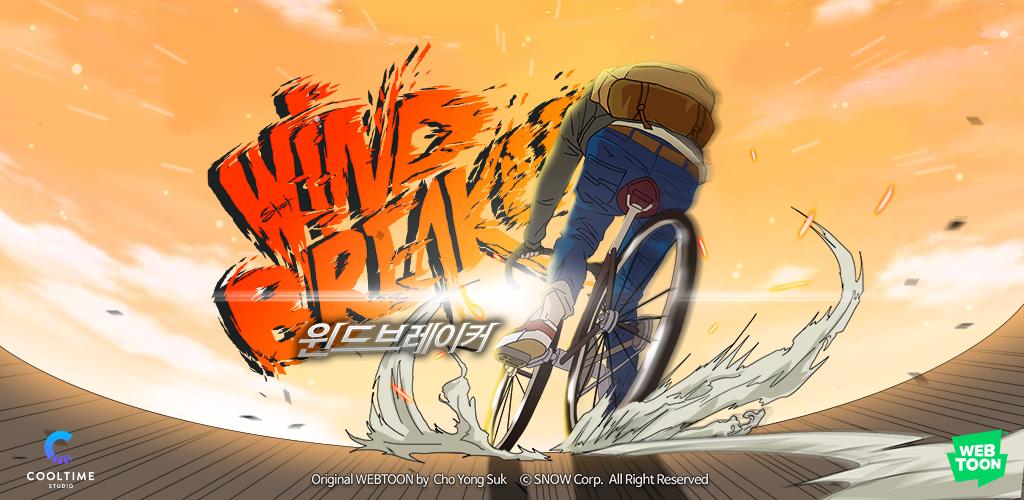
1. WINDBREAKER

Windbreaker.
(img source:https://lh3.googleusercontent.com/nAHfAX6QMG7ht_6nAITp8VP3ATnOECEH5DIdEDf3wNAhLtAiMv6CFtGitzBYcRF3Orm0=h500)
  • Status: Ongoing
  • Genre: Sports
  • No. of Eps: 339 (so far)

This webtoon is one of my all time favorites. It is a sports webtoon about extreme and street cycling. Reading this webtoon made me, a couch potato at the best of times, to also want to ride a bicycle. It follows a group of high school kids who start a cycling crew to enter a street cycling competition. It is about how they grow together both as riders and human beings in general.

The art is amazing, the story is amazing and every week I am waiting excitedly for a new episode to release. It is a really nice webtoon to start off your foray into this world, especially for those who love cycling and even for those who don’t. It is a very underrated webtoon that I hope gets a lot more love.

2. SPIRIT FINGERS

  • Status: completed
  • Genre: drama
  • No. of eps: 167

For anyone looking for a light hearted webtoon to start their day, this is the perfect one. It is the story about a girl who has lived all her life as an awkward teenager and lacking self-confidence. But then, she encounters a group of the ‘hippest, strangest, coolest (yet most welcoming)’ people ever in the form of an art club called ‘Spirit Fingers’. Then begins her journey of self discovery self love.

A webtoon filled with lovable characters, dumb incidents and just hilarious in many senses, it is one that also gives out the message that everyone is unique and a ‘COLOR’ of their own. It is just about taking our the time to find yourself and your group. It is a small webtoon compared to the others on the list with just 166 episodes but a fun read nevertheless. The art took me some getting used to. But it grows on you and by the end of it you are in love with not only ALL the characters but also with how they are drawn.

3.LOST IN TRANSLATION

lost in translation
(img source:https://i.quotev.com/ihmkhfxjzola.jpg)
  • Status: ongoing
  • Genre: drama
  • No. of eps: 71 (so far)

This is one of the webtoons I started reading as soon as it released, so I have been part of the whole journey so far. It is a webtoon that brings the two worlds of webtoons and the Kpop industry together. The webtoon is about an Idol group member whose stage name is ‘Wyld’. As ‘Wyld’ of group ‘Mayhem’ he is embroiled in scandals and has a persona of a player but in reality “Jaehwon’ is just a huge cinnamon roll who was forced to put on the persona by the company he works under. It is a new webtoon with not even a hundred episodes yet but I already love it. The art is distinctive and the story is really good so far. I cant wait to see how much better it is going to get.

Another thing about the band, Mayhem. It actually exists! It is a 2d band that has a huge fan following, basically readers of the series. If you go to YouTube and search for Mayhem, you can even listen to an original song along with a music video that was released by the band. Twitter pages for all band members is also there all having a huge amount of fan following. This is another thing about the webtoon that is keeping me hooked.

So there you have it. A small list of my favorite webtoons that I hope everyone will enjoy as much as me. There are so many more good ones that I haven’t included in the list. Many that can be found the minute you open the app. And new ones are getting added almost everyday. It is a new world in itself. One I have enjoyed stepping into and being a part of. I hope this helps you also in your foray into the world of webtoons.

The Hybrid Work From Home model: Businesses ponder over the future of work

What is a hybrid WFH model, and for what reason are countless organizations currently thinking about it for their staff and employees?

Details show telecommute (WFH) drives soar during the Coronavirus pandemic and haven’t eased back down. Representatives and organizations the same are getting a charge out of all the financially savvy and usefulness improving advantages of distant work.

Nonetheless, a few organizations actually see the advantage of having an on-premises team. However long chiefs can ensure satisfactory wellbeing measures, these groups could feel great getting back to the workplace.

So should your collaboration in-house, keep working distantly, or embrace a mixture WFH model?

In case you don’t know what a cross breed WFH model really is, this aide will separate it and cover every one of the upsides and downsides. Then, at that point you can choose which alternative is best for your business.

We should begin with the rudiments so we’re all in total agreement:

What is a Half breed WFH Model?

A half breed WFH model permits a few representatives to work distantly while others work on-premises.

Inside this design, you may have groups or divisions split between working distantly and working in-house. Your advertising group might be off-site, for instance, while your business team appears at the workplace each day.

You may even assign certain positions or positions of authority as completely distant or in-house across all divisions.

Something significant to note here: a cross breed WFH model doesn’t mean representatives split their time working distantly and at the workplace during the week. That is all the more an adaptable work style.

When a worker gets delegated WFH, they’ll burn through most workdays far off (with the potential for incidental office visits). In premises groups will do the polar opposite.

There are a few advantages for organizations going to this work style, which we’ll get into straightaway. However, this model accompanies its own arrangement of difficulties to think about as well.

Turning into a Hybrid WFH Organization: Upsides and downsides

A crossover organization has both far off and in-house colleagues. Since we talked about the advantages and disadvantages of turning into a distant cordial organization in this aide, we’ll just offer a concise synopsis here to save time.

Benefits of a Crossover WFH Model

Business can exploit these advantages when they become a half and half organization:

Recruit unfathomable ability locally and across the globe. At the point when you open situations to worldwide competitors, you’ll construct a group with uncommon abilities. They may even work in various timezones to give ‘nonstop inclusion or additional intellectual prowess during top useful hours.

Representatives work to their qualities and raise efficiency. You’ll have the option to permit colleagues who need to concentrate discreetly at home and the individuals who flourish better locally office setting the capacity to work where and when they’re generally useful.

Better oblige colleagues with incapacities. Telecommuting gives individuals with inabilities or ailments the opportunity to work serenely while remaining associated.

Lower overhead. Less individuals in the workplace implies organizations have less exorbitant office costs. You might have the option to cut back to a more modest office with less cash spent on lease and power, for instance.

Diminishing wellbeing openness chances. Less in-house workers implies your organization might have the option to bring down the odds of colds, influenza, or Coronavirus spreading around the group, which may bring about less days off.

Regardless of these experts, there are a few disadvantages to consider…

Disadvantages of the WFH Model

A crossover WFH model isn’t without drawbacks, for example,

Far off workers may feel confined, left out, and separated from the in-house group. They can’t stop by one another’s work areas to visit or joke around the water cooler. Also, WFH workers may pass up advantages like catered snacks, birthday celebrations, and friends glad hours.

Time contrasts can turn into a test. Your in-house colleagues may have to stand by hours (or an entire day!) for a basic answer or answer to an inquiry if a far off representative works in a distant timezone.

Correspondence requires additional exertion. All contact with WFH colleagues happens for all intents and purposes through courier applications like Leeway, video calls, messages, and so forth This requires heavenly relational abilities on the two closures and a promise to registration, which is more difficult than building compatibility in-house.

On-premises representatives may get special treatment or quicker advancements basically in light of the fact that directors can cooperate with them and see what they’re up to the entire day. Telecommuters may not get enough facetime with higher-ups and key leaders to demonstrate they merit the opportunity to ascend the stepping stool.

Fortunately, there are less drawbacks to turning into a half breed organization than potential gains. Furthermore, they’re all sensibly simple to defeat with the right arranging and arrangement.

YOGA IS IMPORTANT FOR SPIRITUAL DEVELOPMENT

What is yoga?
YOGA: a Hindu spiritual and ascetic discipline, a part of which, including breath control, simple meditation, and the adoption of specific bodily postures, is widely practiced for health and relaxation.

Why is 21st June celebrated as Yoga Day?
21st June every year is the longest day in the northern hemisphere and has different cultural importance in various regions. PM Narendra Modi has suggested keeping 21st June as yoga day. The commemoration of yogic practices was pitched by Indian PM Modi himself in September 2014, who referred to Yoga as an “invaluable gift of India’s ancient tradition”

What are the SPIRITUAL BENEFITS of yoga?
Nowadays, people’s interest in performing yogic activities has increased rapidly over the years. Attending yoga classes has become quite popular. When we hear the word yoga, the first thing that comes to our mind is a physical or mental activity. People tend to forget about the spiritual benefit of yoga. Ask twenty different yoga practitioners, what is the purpose of yoga for you, and you will get twenty different answers. But almost all will agree that yoga is a form of exercise that can have positive spiritual health benefits. The most accurate translation of the word itself is union and, fundamentally, yoga is about integrating the physical, mental, emotional, and spiritual self.


1)Pure potential – In recognizing that you are part of the universal field of consciousness you realize that your potential creativity is infinite.
2)Giving and receiving – If you want to keep love, and all else that is positive in this world circulating, you need to both offer yourself to others and accept the gifts that come your way.
3)Karma – The energy you put out into the world will eventually be returned in kind. So kindness is what you should aim for in all your actions.
4)Least effort – Fight the universe and life will be a struggle. Accepting the unfolding of life and traveling in the direction it takes you will lead you most surely to your true purpose.
5)Intention and desire – When you clearly define your pure intentions and hand them on to the infinite potential of the universe you maximize the ease with which your heart’s true desires can be fulfilled.
6)Detachment – Learning not to be disturbed by the trivial and sometimes mystifying unfolding of life. In the end, all will be as it should.
7)Dharma – Everything in life has a true purpose or Dharma. Yogis believe that the greatest joy and fulfillment is found by uncovering and offering up their unique talents to make this world a better and more loving place.

DRAUPADI : BOOK REVIEW

MAHASHWETA DEVI

Set in the late 1960s and early 1970s, against the backdrop of the dense forests of Jharkhand and Bengal where a large tribal population is present, the story is an account of the harrowing experiences of Dopdi Mejhen, while she was in police custody for inciting a tribal uprising and murdering an upper class landowner. The undercurrent of the story is dark and chilling and harks back to the time of the Naxalite uprising in 1967.

In the story, the protagonist, Dopdi Mejhen is a young woman of 27 years. She is a political extremist and outlaw. A bounty of One Hundred Rupees is placed on her head. The story is set against the Naxalite movement in
Bengal during 1967. Dopdi Mejhen belongs to the Santhal tribe. She is Robin Hood like figure to
the landless peasants of Bhakuli. She, her husband Dulna Majhi, along with
their comrades are responsible for the killing of wealthy landlord Surja Sahu
and his son, which explains the bounty placed on her head. The tension
between the peasants and upper caste men exists because of the drought
in the area. The peasants attacked and killed the landlord one night, who
had occupied all the wells and tube wells which were the only source of
water for the village. This incident brought upon the fury of the government
which launched Operation Forest in order to capture the escaped couple,
Dopdi and Dhulna, who are believed to be hiding in the Jharkhani forests,
which explains the deployment of the antagonist of the story, Senanayak,
an elderly Bengali specialist in combat and extreme left politics as explained
by the author.

Senanayak is adamant to capture Dropdi, in which he succeeds in the end. Senanayak’s hunt for Draupadi and other tribal extremist revolutionaries has already instilled in the latter an experienced knowledge that if they are caught, they will be countered – which is not the official police encounter but rather the undocumented state sponsored killings. As she is apprehended, Senanayak feels both triumphant and despondent at the same time. This despondency is due to the fact that Dropdi chose to stake herself for her community, ululating with the force of her entire being right before she is taken into custody alerting her fellow comrades to escape, therefore outmanoeuvring the attempt of Senanayak to quell the Naxal
insurgency. Senanayak instructs the army officers to ‘do the needful’ by raping her in order to extract the information about rebel uprising. The men easily succeed in stripping Dopdi in the narrative, which is the culmination of her political punishment by the representatives of the law.

Ironically, the same officers who violated her body, insist that she covers up
once she is ‘done with’ before they can take her to Senanayak. She walks
out, naked, bruised and wounded, refusing to hide the evidence of brutality
and unwilling to be shamed. This disturbs the officers and Senanayak, who
are unsure of what to do with this woman, who forces them to confront their
own depravity. She remains publicly naked at her own insistence rather than
saving her modesty, insisting that this is the place where the male
dominance stops. She confronts Senanayak, laughing. Her laughter, bursting
forth from her bloodied lips, continues to be unintelligible to the officers,
especially Senanayak. Her laughter and her blood challenge the Senanayak
and show that she refuses to be shamed into submission. Senanayak finds
himself bereft of language, too scared to speak at the end – ‘and for the first
time Senanayak is afraid to stand before an unarmed target, terribly afraid’.
Senanayak is completely defeated as she rejects the system of male
dominance that was supposed to undermine her. Her sexually mutilated
body is a weapon of naked protest. The body raped and tortured is used as
a weapon in the end. Dropdi refuses to be emotionally wounded even
though she is physically wounded. She recognises that a woman’s body is
an asset through which they can resist the socio-political objectification of
their bodies and overcome oppression.

There is a clear resemblance between the Draupadi described in the
ancient Hindu epic, the Mahabharata and the Dopdi described in
Mahashweta Devi’s short story. They almost share the same destiny. The
Draupadi in the Mahabharata suffers terribly as she is a queen condemned
to a life of living incognito and is disrobed in the presence of the entire
court. Her dignity and prestige was compromised. Yet she was the one who
fought to win her respect back and prayed to Lord Krishna to protect her. As
mentioned in the scriptures, Lord Krishna blessed Draupadi with a saree that
was so long that its end could not be found. However, in the short story,
Dopdi is on her own and nobody comes to her rescue or to clothe her. She
fights her oppressors while being fully naked and her nudity becomes her
strength as it forces her rapists to come face-to-face with the heinous crime
they had committed. Just like the Draupadi of Mahabharata refused to tie
her hair till she bathed in the blood of Duryodhana, the Dopdi of Devi’s story
refuses to wear her clothes till her rapists realise the implications of their
actions. Devi presents a strong woman who, despite facing marginalisation
and exploitation, transgresses conventional sexual and societal standards.
Dopdi subverts the physicality of her body from powerlessness to powerful
resistance.

124th constitutional amendments Reservations for Economically Weaker Sections

The 124th Constitutional Amendment was done to amend the Constitution of India to extend 10 per cent reservation in direct recruitment in government jobs and for admission in higher educational institutions to ‘economically weaker’ sections. The reservation seeks to provide for the advancement of economically weaker sections of all castes and communities including Christians and Muslims. It intends to help the poor among the upper castes.

In simple terms, reservation is about facilitating access to seats in the government jobs, educational institutions and even legislatures to certain sections of the population. In India, it is governed by government policies backed by the Indian Constitution. 

HISTORICAL CONTEXT

The origin of reservation system is rooted in the age-old caste system of India. These sections of society especially those of lower castes have faced historical injustice due to their caste identity. Historically, William Hunter and Jyotirao Phule in 1882 originally conceived the idea of caste-based reservation system.

The reservation system that exists today was introduced in 1933 when British Prime Minister Ramsay Macdonald presented the ‘Communal Award’. The award made provisions for separate electorates for Muslims, Sikhs, Indian Christians, Anglo-Indian, Europeans and the Dalits. After long negotiations, Gandhi and Ambedkar signed the ‘Ponna Pact’, where it was decided that there would be a angle Hindu electorate with certain reservations in it. After independence, initially reservation were provided only for SCs and STs and OBCs were included in the ambit of reservation in 1991 on the recommendations of the Mandal Commission.

INCREASE IN DEMAND FOR RESERRVATIONS

The increase in demand for reservation can be traced to the fact that it is being seen as a remedy for the adverse effects of ill-thought out development policies. A number of factors are responsible for violent agitation associated with demands for reservation. These are acute agrarian distress, increase in unemployment and loss of jobs among many others.

A widespread demand for reservations among different sections of society is being made; this includes Marathas in Maharashtra, Jats in Haryana, Rajput’s in Rajasthan, Kapus in Telangana and Andhra Pradesh and Patel Patidars in Gujarat among many others.

Increasing reservation demands among upper castes are also arising from the fear of losing privilege and the inability to cope with change. Thus, upper castes have begun to feel disadvantaged especially in context of government jobs as they don’t get similar advantages like the backward classes.

CONSTITUTIONAL PROVISIONS FOR EWS RESERVATION

In a significant move to address demands of the Economically Weaker Sections (EWS) of the society who were earlier not covered by any of the existing schemes of reservation. The 124th Amendment to the Constitution, 2019 was brought so as to provide 10% reservation for the weaker section of general category in direct recruitment for government jobs and admission to higher educational institutions. The Act amends Article 15 and 16 of the Constitution, by adding a clause which allows state to make special provision for the advancement of any economically weaker sections of general category. Accordingly, Articles 15(6) and 16(6) have been inserted in the Constitution to effect the reservation for EWS.      

ELIGIBLITY FOR EWS RESERVATION

The Union Government has set certain criterion to be eligible for reservation in EWS category. The reservation benefits can be availed by those persons who are not covered under the scheme of reservation for SCs, STs and OBCs and whose family has gross annual income below ₹ 8 lakh. Income shall also include income from all sources i.e. salary, agriculture, profession, etc., for the financial year prior to the year of application. Also, persons whose family owns or possesses any of the following assets shall be excluded from being identified as EWS, irrespective of the family income

  • 5 acres of agricultural land and above.
  • Residential flat of 1000 sq. ft. and above
  • Residential plot of 100 sq. yards and above in notified municipalities.
  • Residential plot of 200 sq. yards and above in areas other than the notified municipalities.

The property held by a ‘Family’ in different locations or different places/cities would be clubbed while applying the land or property holding test to determine EWS status. The term ‘Family’ for this purpose will include the person who seeks benefit of reservation, his/her parents and siblings below the age of 18years as also his\her spouse and children below the age of 18years. Further, the states will also determine the reservation criterion accordingly depending upon local factors. The applicability of the reservation is for both jobs in the government sector as well as for seats in higher educational institutions i.e. colleges and universities.  

CHALLENGES TO CONSTITUTIONAL STATUS FOR EWS QUOTA

As the Constitution stands amended, the only constitutional challenge left is conformity to the basic structure doctrine. So far, it has become an established principle that reservation shall have a cap of 50%. In the Indira Sawhney Case (1992), the Supreme Court said that such quotas cannot be provided for poverty alone. It has to be poverty plus social and educational backwardness and the backwardness should reflect historic injustice through generations. The court then said that reservations beyond 50% will hit Article 14 (Right to Equality). Half of jobs and seats in educational institutions must, therefore be for the general merit category. Equality is part of the basic structure, the court insisted. Hence, this step will also violate the Supreme Court ruling of Kesavananda Bharati Case which said that any amendment which offended the basic structure of constitution would be ultra vires.

CONCLUSION

Reservation is fair, as far as it provides appropriate positive discrimination for the benefit of the downtrodden and economically backward sections of the society. However, it also leads to associated problems, such as passing the benefits to only a privileged group who have already been benefited by reservation. The communities excluded from reservations often harbour animosity and prejudice against the castes included in the reservation category. When more people aspire for backwardness rather than of forwardness, the country itself stagnates. A strong political will is indispensable to find equilibrium between justice to the backwards, equity for the forwards and efficiency for the entire system.