Drugs and alcohol abuse

“Alcohol can make you hate someone,” these words are more than enough to justify the plot of this blog. Addiction, this term has a sense that even others who have experienced the repercussions of addiction will appreciate, whether in their communities or in certain situations, the addict himself. Let me be really specific here. I don’t criticize people who drink or smoke, it’s just that being addicted to it is obviously not healthy.

Addiction is a disease that affects your brain and your behavior. You can’t stop the temptation to use drugs while you’re addicted to narcotics, no matter how much damage the narcotics can do. Drug abuse is not just meth, crack, or other illicit substances. You can be hooked to caffeine, tobacco, prescription painkillers, and other controlled drugs.

Your brain is wired to make you want to repeat the experience that makes you feel good. So you’re motivated to do it again and again. Drugs that could be addictive to strike the dopamine function in the brain. Your brain is filled with a compound named dopamine. It induces a sensation of deep gratification. So you’re still taking the drug to chase that high. The brain is getting accustomed to excess dopamine over time. Then you would continue to take more medications to help you experience the same good. And other things that you enjoyed, like eating and hanging out with your family, may give you less pleasure.

Drug abuse is when you use legal or illegal substances in ways you’re not supposed to do. You may take more than a regular dose of pills, or you may use someone else ‘s prescription. You may use drugs to feel good, ease stress, or avoid reality. Yet you ‘re typically willing to alter your unhealthful habits or avoid doing them entirely.

Addiction is when you can’t stop it. Not when it puts your health at risk. Not unless it causes you or your loved ones physical, emotional, and other problems. The desire to get to consume narcotics will take up any minute of the day, even though you decide to leave. Dependence is a condition where the body allows the existence of a drug such as alcohol to function normally. Without it, the patient may suffer serious, potentially life-threatening symptoms of withdrawal. Alcohol dependence is often experienced in tandem with addiction. Those who are abusing or abusing alcohol are not necessarily addicted to or dependent on alcohol. Individuals may use alcohol without drinking on a consistent basis. For example, an individual who misuses alcohol may drink only once a week. Nevertheless, as they drink, they can place themselves in dangerous positions or drink sufficiently to trigger complications, such as alcohol poisoning.

Individuals who want to resolve issues with drug usage or who fear that they might have alcohol use disorder have a range of choices. According to the National Survey on Drug Use and Health, more than 2.4 million people aged 12 or older received substance use treatment on their own in 2017.8 Many people who are treated for alcoholism and alcohol abuse often seek outside help from treatment centers and treatment sessions.

Alcohol rehab services are built to assist those who become intoxicated or who use alcohol in a variety of ways. Some treatment centers require an individual to stay at the center for a certain amount of time while others offer outpatient treatment.

Inpatient therapy enables patients to seek care in a formal, regulated setting. For accommodation, psychiatric services and different types of counseling, inpatient medication can be better for people who may not have an adequate home support program or who are struggling with a more serious level of substance dependence. Outpatient rehabilitation is also an alternative for certain alcoholics. Outpatient rehab facilities are built to offer a forum for recovered alcoholics to overcome their addictive actions. Most residential rehab facilities offer open community sessions, as well as other services to help patients heal from their issues. With outpatient care, patients are not put in a regulated setting, and it is crucial that those who need outpatient services have a good program to focus on during therapy.

First Step towards making your site responsive

Being a user, have you ever thought about how a website is designed? How a single website attracts more users while others don’t? Obviously content is a considerable aspect but apart from content what matters is the interactivity it provides the support and functions it contains. And the most importantly the responsiveness of that site.

Okay, so for beginners or those web developers who are just freshers and are still learning, Responsive site mean how the site looks on different platforms like a desktop, a laptop, a tablet, or any mobo platform. As you very well know being a user you want and most importantly need to access a site on different devices and being a web designer it’s your responsibility to make that site fit for the utilization on every platform because it directly affects the traffic you site is going to experience.

And if you have any prior knowledge regarding this a very obvious question you must be having is why responsive? I mean you can also have other ways to make your site fit for any other device then why responsive? Okay, let’s do the comparison.

Responsive Website Design(RWD): Basically in this, you write multiple stylesheets for a single HTML file according to the device you think the user is going to use to access your site, but ultimately you have only one URL for your site. This makes your site more user friendly.

Adaptive Designs(Dynamic Serving): In this, the server sends you a different HTML and CSS document according to the device you are trying to access the site but still you only have a single URL for your site which is a little bit problematic because if due to any reason server detects the wrong device the user will be in trouble and this kind of sites are more redirecting which means takes more time to load and you have to update a lot of code while making changes in the site.

Separate Mobile Sites(.m type): In these type of sites you have a separate HTML and CSS document for the mobo platform and A single document for every other device used for accessing the site but you will have different URLs every time you try to access the site which makes it tough to share your site and hence reducing the traffic.

Now, let me try to start how to make a site responsive because I can’t encompass a lot here as this article is for beginners and those who are interested to learn. So the basic concept is how the content adjusts itself according to the resizing of the screen because it’s very annoying to have scrollbars now and again. So here comes the terms absolute and fluid(relative) measurements. It’s always a very good idea to do not hardcode your site and give users more power and that’s why using fluid measurements while writing your CSS code has always proven a good idea.

Absolute measurements:

  • pixels(px): one device pixel or dot of display. 1px=1/96th of an inch.
  • mm, cm, in basic units of length.
  • point(pt): one point equal to 1/72th of an inch.
  • pica(pc): one pica is equal to 12 points.

 Relative measurements :

  • %: always relative to another value, for example, a length.
  • em: relative to the font size of a parent element.
  • rem: relative to root size to the root element.
  • vw: viewport’s width, 1/100th of the width of the viewport.
  • vh: viewport’s height, 1/100th of the height of the viewport.

I recommend using ems because rems are not supported by many browsers now or vw and vh are also very good options when it comes to responsive sites. So here I am concluding this article as it’s a vast topic and I can’t encompass it in a single article.

Hope you guys find this helpful. Happy reading!

Angular and React

To increase the efficiency of programming these technologies are used by web developers especially frontend developers. Angular is a Typescript which is a superset of Javascript whereas React is a library used in javascript. By using these in-demand technologies you can take your programming skills to the next level, making code more clearer and user-interface more intuitive.

React

Maintained by Facebook, React.js is an open-source JavaScript framework for the creation of desktop, cloud, and smartphone device user interfaces. Unlike most websites, those built with React do not have server-side rendering but are rendered in the browser. This ensures that users don’t have to wait for a server answer to make a new tab. It’s a lot smoother ride, which is especially essential for smartphone apps.

The React Tool Library helps developers to create components that have been dropped to a web page. Such modules, which are like unique HTML parts, are what visitors can use on the web. Components can be shared through applications and can be modified even more quickly than digging for lines of code. Organizations utilizing React include Twitter (and Instagram), Uber, and Netflix, among many.

Angular

Angular is an all-in-one open-source JavaScript platform developed by Google to develop extremely sensitive single-page applications. Unlike React, the Angular-based platform can display any improvements created to the app in the window. Instead of connecting with a server to load info, the browser-side interface enables a website to make a more mobile-like interface easily. Angular, which recently saw the introduction of the newest edition of Angular 9, is based on TypeScript, a JavaScript superset.

Because React is a JavaScript library as opposed to Angular ‘s full JavaScript framework, many developers will add more libraries when using React to give it full framework functionality.

The output of the website itself is the most critical aspect for potential users of your application. Load time and runtime affect how long your consumers can connect with your web page.

Although Angular is usually a quick platform, its package size, which means the code created and uploaded for deployment, tends to be huge. For Angular now utilizing the Ivy generator, the scale of the stack is decreasing. It’s also built with enough optimizations that users are unlikely to encounter major performance issues on the larger Angular website. React continues to shine on smaller devices as it’s designed to prioritize certain page activities over others so that it feels smoother to the end-user.

Tell another app developer if you should go for Angular or React, and you’re sure to get a separate answer from each other. Sadly, there is no one-size-fits-all approach when it comes to software applications and repositories, or how they would better support the project or business needs. Until selecting one method over the other, continue playing with each one by testing the Angular and React courses.

Hope you guys find this helpful. Happy learning!

Freelancing

Amidst this pandemic, everyone whether a fresher or an experienced employee all are suffering. We all are thinking of working from home. So, here I am trying to encompass a topic which is very well known maybe but very less discussed surely freelancing. Now, who are freelancers?

They are the ones that are not committed to one kind of job, instead they can do any job according to the skills they have mastered and are paid accordingly. they are not considered employees by the company rather contractors. This is a field anyone can try hands-on whether he is a student-teacher or learner. Now how they work and what about their monthly income?

According to a survey by PayPal, most freelancers in India are getting 23 lakhs per annum as an average salary. According to Narsi Subramanian, Director – Growth, PayPal India, “We are focused on cross-border trade and we will continue to because that is where a significant opportunity lies for us. But, as far as our growth plan is concerned, the freelancer segment is something that we will focus on”.

Most of the international work comes from the countries UK, Australia, and the US. The report said, “Of the wide range of aspects, freelancers feel that they need external support in aspects such as setting up their website, finding and retaining clients, fee and negotiation advice, protection and insurance”. As an Indian freelancer to get a secured and stable life an average of 15 projects and 13 retailer clients is a threshold.

Now how to start working as a freelancer because this job is not as easy as it sounds and sometimes it’s even scary. But a smooth start can help you a lot.

Decide your skill: Discover your secondary skills do not limit yourself but that doesn’t mean you have to learn everything so make a reasonable list of skills and start working on it. (I had written articles for that too you can check them out. Hopefully, they will surely help.)

Make a portfolio: It could be as easy as making a Facebook page. It could be anything like a blog or a Behance profile, simply make sure your skill is showcased in the best possible way.

Choose what you want from free-lancing: First of all, decide what you want as free-lancer money or experience. Be clear for somethings before starting :

  • How much time you can invest in this field?
  • Mode of contact with the clients
  • types of clients you want to deal with
  • the number of clients, you want to deal with at a single time.

Start pitching: Now when you are clear from your side, start pitching the clients and it’s just a suggestion pitch clients from many ids but do not spam. You can simply forge on google how to pitch clients and all the stuff you can easily find out but do not go with nonsense.

Pre-work communication: It is always recommended to send your clients your terms when they try to hire you and try to be professional in this send them your payment needs, copyright terms, and other related stuff. I highly recommend to not compromise with payment because this sends a wrong impression on the clients. This is a complete myth that free-lancing is free from the boss, your client is your boss so choose them wisely.

Be confident and serious: To be very clear free-lancing is sole entrepreneurship so if you want to establish your business be serious and professional towards your work. Be ready to face criticism and failures. Persist until your industry starts trusting your work blindly.

Hope you guys found this helpful. Happy reading!

Edge Computing

Edge computing is a networking concept that seeks to get computation as close to the database as possible to reduce latency and bandwidth utilization. Simply put, edge computing involves running fewer cloud operations and transferring those operations to local sites, such as on a user’s phone, an IoT system, or an edge server. Bringing computation to the edge of the network minimizes the amount of long-distance communication between a client and a server that must occur.

Imagine a safe house with dozens of high-definition IoT video cameras. Those are ‘dumb’ cameras that essentially emit a raw video signal and send it continuously to a cloud server. On the cloud platform, a motion-detection program takes the video output from all the cameras to guarantee that only clips of action are transferred to the file archive. It ensures there is a persistent and substantial burden on the building’s Internet connectivity, as a large amount of video content being transmitted absorbs considerable bandwidth. Besides, there is a very heavy load on the cloud storage which will concurrently process the video footage from all the cameras.

Consider now that the processing for the motion sensor is pushed to the edge of the network. What if each camera used its internal computer to run the application for motion detection, and then submitted footage as needed to the cloud server? That will result in a substantial decrease in the usage of bandwidth, as most of the video footage would never have to move to the cloud server. The cloud service will now only be responsible for maintaining the relevant video, ensuring the system could connect with a greater range of cameras without overloading. And it feels like edge computing.The cost reduction alone will be a catalyst for several businesses to implement an edge-computing architecture. Companies who adopted the cloud for many of their applications may have noticed that bandwidth costs were higher than anticipated.

However, the main advantage of edge computing is potentially the potential to process and store data more efficiently, making for more effective real-time applications that are vital to businesses. A smartphone scanning a person’s face for facial recognition will need to run the facial recognition algorithm via a cloud-based database before edge computing which will take a lot of time to process.

For an edge computing model, considering the capacity of smartphones, the algorithm may be operated locally on an edge server or gateway, or even on the smartphone itself. Applications like virtual and augmented reality smart cities and even construction-automation systems need fast processing.Worldwide, 5 G broadband systems are introduced by networks that offer the advantages of broad speed and reduced latency for devices, enabling businesses to switch from a garden hose to a firehose for their network bandwidth. Instead of merely providing quicker speeds and advising companies to start storing data in the cloud, several providers are focusing on cutting-edge computing approaches in their 5 G implementations to provide quicker real-time processing, especially for mobile devices, connected cars, and self-driving cars.

It’s obvious that while the original aim for edge computing was to minimize IoT system latency costs over long distances, the proliferation of real-time apps needing local processing and storage resources would push the technology forward in the coming years.

So I am concluding this article here. Hope you guys enjoyed this!

Augmented Reality: Welcome to a new ethical minefield

Have you ever thought of living in a world whose reality is very close to the virtual world? Nowadays the developers are trying their hands over this fact and achieved a great success to even blur the line between real and virtual world. There are a lot of examples that use the concept of AR. Now, what is the basic principle of augmented reality?

Its system superimposes the picture of the CG over the user’s vision of the actual world. Unlike virtual reality, where all a user experiences are created by a machine, augmented reality retains the emphasis on the physical world, yet just incorporates features that are not present to improve the user’s experience.

This platform has been seen all around the globe from biomedical technologies to banking and even engineering – oogle is reintroducing Google Glass as a virtual reality device for the workplace. Several creative practitioners are now using virtual technology for their business cards.

If you’ve experienced Pokemon Go’s hubbub, you’ve witnessed increased reality in action. This video game allowed players to experience the world around them from their smartphone cameras while projecting game objects, including on-screen icons, ratings, and ever-famous Pokemon characters, as overlays that made them appear like they were right in your real-life neighborhood.

Google SkyMap is another well established AR device. It overlays details about constellations, planets, and more as you point your smartphone or tablet camera to the stars. Wikitude is an app that searches up information about a landmark or object by simply pointing it out with your mobile device. Would you need help visualizing the latest furniture in your living room? The IKEA Place app will have a new couch overlay for that room before you purchase it, so you can make sure it suits.

A few years back, Disney developed a groundbreaking way for children to display their beloved 3D characters using virtual reality. The development team created technologies utilizing AR to translate animated pictures from a coloring book to 3D renderings via a cell phone or laptop. This device is already in its infancy and has not yet been published to the public, however, this may contribute to a completely different opportunity for children to learn and interact using their imagination.

Since years, Tv News has been utilizing visual effects to enhance the image of the broadcast. Of starters, weathermen have been standing in front of green screens of years, posing as charts for audiences to display their weather predictions. The Weather Network is also pushing it a step forward to demonstrate severe weather and its consequences. In the past two years, the media channel has used artificial reality to view a 3D earthquake, demonstrate the height of the flooding during storm waves and hurricanes, and even driven a simulated car around the studio to illustrate how cars lose the power of snowy or frozen highways

Not all of the representations of virtual reality are fun and games. The United States Army is working with virtual reality systems to be deployed in the battle that can allow troops to differentiate between hostile and neutral forces, as well as to enhance night vision. This system is still in production and could be years away from implementation, but military leaders claim that this breakthrough will boost battle effectiveness and help to save lives.

Here, I’ve been trying to grasp the applications and possibilities of AR. This area is still growing rapidly and worth spending on time and energy.

Hope you guys find the piece interesting

Document Object Model(DOM)

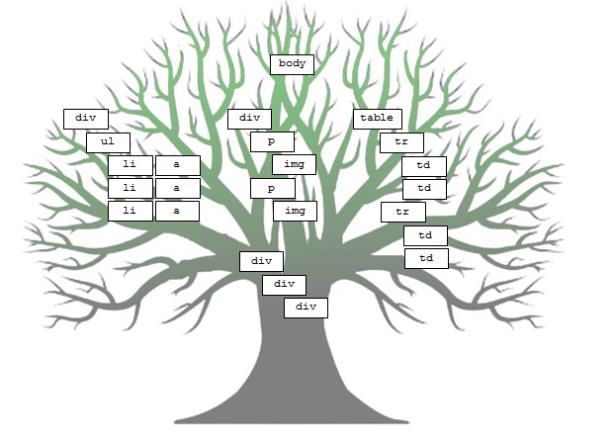
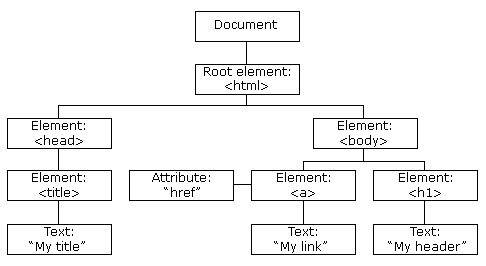
When it comes to design a site or a web page it plays a very important role, basically here we are talking about HTML DOM, with the help of this the javascript can interact with the HTML code and can find or change any element of HTML code. Let’s try to make it simpler, whenever any web page loads it creates a document object model, it has a tree-like structure and have nodes, every node has one parent and probably many children.

The Document Object Model (DOM) is the HTML and XML application development API. This determines the basic framework of the records and how the paper is obtained and exploited. The Document Object Model may be used in any programming language.

THE HTML DOM TREE OF OBJECTS

Java Script can change all the existing HTML elements and attributes of a page, all the CSS styles of the page and you can even add new ones. the HTML DOM is the standard of how to get, change, add, or delete HTML elements.

DOM and JavaScript

The DOM is not a programming language, but without it, the JavaScript language will have no concept or notion of web pages, HTML documents, XML documents, and their components ( e.g. elements). Each document element — the document as a whole, the heading, the column tables, the table headers, the text in the table cells — is part of the database object model for that column, so that they can all be accessed and controlled using the DOM and the JavaScript scripting language.

In the beginning, JavaScript and DOM were closely intertwined, but eventually, they evolved into separate entities. The output of the website is stored in the DOM and can be accessed and manipulated using JavaScript so that we can write this approximate equation:

API = DOM and JavaScript

The DOM was developed to be independent of any common programming language, allowing the conceptual representation of the text accessible from a single, coherent API. While we concentrate solely on JavaScript in this reference paper, DOM implementations can be designed for any language.

Accessing the DOM

You don’t have to do something different to continue using the DOM. Different browsers have different DOM implementations, and these implementations show varying degrees of compliance with the actual DOM standard (the subject we are trying to avoid in this documentation), but each web browser uses a document object model to make web pages accessible via JavaScript.

When you create a script–whether it’s inline in an <script> element or included in the web page through a script loading instruction–you can immediately begin using the API for the document or window elements to manipulate the document itself or to get at the children of that document, which are the various elements in the web page. As this is not a topic that can be covered at once.

So here I am concluding this. Hope you guys enjoy reading this!

Internet of Things(IoT)

The Internet of Things, or IoT, is a collection of interrelated computing systems, mechanical and digital computers, objects, animals, or individuals with unique identifiers (UIDs) and the ability to transmit data over a network without the need for human-to-human or human-to-computer interaction.

A device in the internet of things can be a human with a heart monitor implant, a farm animal with a biochip transponder, a vehicle that has built-in sensors that warn the driver when tire pressure is small or some other normal or man-made entity that can be given an Internet Protocol ( IP ) address that is capable of sending data over a network.

The IoT ecosystem consists of web-enabled smart devices that utilize embedded technologies, such as processors, sensors, and communication equipment, to capture, communicate, and respond to the data they obtain from their environments. IoT devices exchange sensor data obtained by linking to an IoT gateway or other edge node where data is either transmitted to the cloud to be processed or analyzed locally. Often, these devices interact with other similar devices and operate on the input they receive from each other. Devices do much of the work without human interference, but humans can communicate with the devices — for example, to set them up, send them directions, or access the data.

Now, a very important question of why we need IoT?

The Internet of Things allows people to live and function better and to have full influence on their lives. In addition to providing smart devices for home control, IoT is important for the enterprise. IoT offers businesses with a real-time glimpse into how their processes operate, offering visibility into everything from computer efficiency to supply chain and distribution activities.

IoT helps businesses to simplify operations and high labor costs. It also eliminates duplication and increases service quality, allowing it easier to produce and distribute products while ensuring consistency in consumer purchases.

Advantages of IoT

Some of the benefits of IoT are as follows:

  • Ability to view details from anywhere on any computer at any time;
  • Improved contact between linked electronic devices;
  • Pass data packets over the wired network saving time and money;
  • Automation of activities that can increase the efficiency of business services and the need for human interaction.

Disadvantages of IoT

  • If the amount of connected devices grows and more knowledge is exchanged between devices, the ability for hackers to access sensitive information is also growing.
  • Enterprises may potentially have to contend with large numbers — maybe even millions — of IoT devices, so gathering so handling data from all such devices would be difficult.
  • If there is a flaw in the network, it is possible that any linked computer would be compromised.
  • Because there is no universal IoT interface standard, it is challenging for products from various vendors to connect.

IoT benefits to organizations

The Internet of Things provides a range of opportunities to organizations. Many of the advantages are industry-specific, and others are common across various sectors. Some of the common benefits of IoT allow companies to:

  • Monitoring their total company processes;
  • Improving customer engagement (CX);
  • Save time and your money;
  • Enhance the efficiency of employees;
  • Integrate and change operating models;
  • Make sound company decisions;
  • Generate further money.

Here I’m concluding this. Hope you guys enjoy reading!

Robotics Process Automation

According to Chris Huff, chief strategy officer at Kofax- “RPA is software that automates rules-based actions performed on a computer.” It is an advanced technology where the machine records a specific task done by human and then perform the same task whenever required without any human intervention.

Every RPA system must include the three capabilities stated below:

  • Communicating with the other systems in either way screen scrapping or API integration.
  • Decision Making
  • Interface for bot programming.

One of the most amazing things about this is that it doesn’t need any prior coding knowledge, in fact neither this requires the development of code, nor it does require direct access to the code or database of any application. So, do not have to worry if you don’t know how to code or if in case you don’t like to code much, you can still learn this.

Robotic Process Automation (RPA) is the use of computer software ‘robots’ to perform routine, rule-based automated activities such as filling in the same information in various locations, downloading data, or copying and pasting.

RPA operates by collecting knowledge from current IT systems. There are several ways RPA software can work with the applications. One choice is to connect to databases and corporate network resources in the backend. Another is via front end or laptop interfaces, which have several types.

What is the safest way? It depends on the organization and the needs that the solution must tackle. With backend networking, automation can reach applications and resources under the power of a process automation server. This is most widely used for unattended automation, where the automated robots handle back-office functions such as reviewing insurance claims on a scale.

Types of RPA: 

  • Attended Automation: This requires human intervention while performing any task assigned.
  • Unattended Automation: This tool doesn’t require any human intervention while performing any task they are designed to have decision-making capabilities.
  • Hybrid RPA: This has the combined capabilities of both attended and unattended Automation.

Now, are RPA and any desktop application the same? And the answer is no, and the difference will be identified with their decision-making capability. Some general functions of RPA include

  • Opening different applications like emails, moving files, etc.
  • Integration with the existing tools.
  • Collecting data from different web portals.
  • Processing data which includes calculations, data extraction, etc.

Tools for RPA:

  • Blue Prism
  • Uipath
  • Automation Anywhere
  • Pega
  • Contextor
  • Nice Items

Ten years is a long time to forecast and RPA is a fairly young and developing market. Yet RPA has certainly proved it’s worth and will continue to expand rapidly. With these development tools, RPA deployment is becoming more of an area for creators of mobile robots, not just for casual business users. The RPA career is considered to be very successful. Emerging students should comfortably predict a substantial share of job opportunities in the country. Pay packages for specialists with skill sets in this area are often comparatively higher compared to other fields.

Industries that use RPA:

  • BPO.
  • Finance & Banking.
  • Insurance.
  • Healthcare.
  • Telecom.
  • Manufacturing.
  • Public Sector.
  • Retail & CPG.

Resources to learn RPA:

  • UiPath Academy. No learning cost its free for everyone, Complete UiPath RPA Developer Course.
  • Udemy. Complete UiPath RPA Developer Course.
  • Edureka!
  • IntelliPaat.
  • EpsilonAI Academy.

Hope you guys enjoyed this. Happy learning!

Lake Karachay: Most polluted place on earth

Look at the environment and there may be several sources of contamination — streams full of harmful substances from agricultural operations, waterways overflowing with field waste, garbage floating out from landfills, city sky filled in smog. Also, ecosystems that appear to be untouched can suffer the effects of emissions from sources located hundreds or thousands of miles away.

Pollution can create muddy fields, poison wetlands, and rivers, or destroy plants and animals. People are also routinely affected by pollution. Long-term exposure to air pollution, for example, can lead to chronic respiratory disorders, lung cancer, and other diseases. Toxic chemicals that accumulate in the top predators can make certain animals unsafe to eat. More than one billion people do not have access to safe water, and 2.4 billion do not have proper sanitation, placing them at risk of contracting deadly diseases.

Lake Karachay is located in the southern Ural mountains in Central Russia. In approx 1951, the Soviet Union used this site to dump radioactive waste and today it is filled and acts as near-surface permanent and dry nuclear waste storage facility. According to a report by Washington D.C. based on the Worldwatch Institute of Nuclear Waste, it is the most polluted open-air place from a radiological view.

The lake accumulated nearly 4.44 exabecquerels (EBq) of radioactivity is less than one square mile of surface, including 3.6 EBq of cesium-137 and 0.74 EBq of strontium-90. In contrast, the Chernobyl catastrophe emitted 0.085 EBq of Caesium-137, a significantly smaller volume, and over a thousand square miles. (The cumulative release of Chernobyl is estimated to be between 5 and 12 EBq of radioactivity, but ultimately only caesium-134/137 contributes to soil exposure because the remainder is too short-lived). As a result, the lake is biologically 42 times more radioactive than Chernobyl.

As of December 2016, the state of the lake is fully packed with unique concrete blocks, rock and gravel. It was fully refilled in November 2015 and then tracked until the final layer of rock and soil was laid. Monitoring results revealed a “strong decrease in the surface accumulation of radionuclides” after 10 months. A decades-long surveillance system for surface water was planned to be implemented soon afterward.

So here I am concluding this article. Hope you guys enjoyed it!

Emotion Recognition

Have you ever thought of any sort of interaction with any machine through emotion recognition? Yes, this is the area of the science which many want to uncover but still not able to encompass. With the constant advancement of Automated Emotion Evaluation(AEE), the emotion recognition technologies are trying to establish itself in the market. As we have a lot of advance technologies with us to make everything so easier and are still keen as mustard for more. This technology will definitely prove a boon for all of us.

Emotion recognition is a technique used in software that helps a computer to “sense” emotions on a human face through advanced image processing. Companies have been experimenting with integrating advanced algorithms with image processing techniques that have evolved in the last ten years to learn more about what the picture or video of a person’s face tells us about how he / she feels, and not only that, but also the possibility of mixed emotions a face may have.

AEE still influence a lot of great fields which are constantly developing like robotics, entertainment, education, and marketing.

  • in entertainment industries: to propose the most appropriate entertainment for the target audience
  • in education: used for improving learning processes, knowledge transfer, and perception methodologies
  • in marketing: to create specialized adverts, based on the emotional state of the potential customer
  • in robotics: to design smart collaborative or service robots which can interact with humans 

The literature presented in science attempts to classify the emotions, feelings, and set boundaries between emotions, mood, and their affects. According to the classifications done the definitions of some terms are:

  • “emotion” is a response of the organism to a particular stimulus (person, situation or event). Usually it is an intense, short duration experience and the person is typically well aware of it;
  • “affect” is a result of the effect caused by emotion and includes their dynamic interaction;
  • “feeling” is always experienced in relation to a particular object of which the person is aware; its duration depends on the length of time that the representation of the object remains active in the person’s mind;
  • “mood” tends to be subtler, longer lasting, less intensive, more in the background, but it can affect affective state of a person to positive or negative direction

The thesis also analyzes the concept of humanizing the Internet of Things and affective computing systems that have been validated by the systems developed by the authors of this analysis.Intelligent computers with human compassion are likely to make the planet a better place. The IoT sector is certainly moving ahead in recognizing human emotions thanks to advances in human emotion recognition (sensors and methods), computer vision, voice recognition, deep learning, and related technologies.

According to Stefan Winkler, CEO and Co-Founder of Opsis, the approach of his business is unique in that it provides fine-grained calculations in two dimensions: valence (positive vs. negative emotions) and anticipation (energy vs. passive expressions). This allows the machine to consider more emotions than the seven main ones – optimistic, sad, pleased, shocked, frightened, frustrated, and disgusted – in competing solutions.

Winkler noted that the understanding of feelings would only improve and improve the approval of consumers. “There have been several studies, such as Markets and Markets, that forecast that the Emotion Detection and Recognition Market will rise from US$ 6.72 billion in 2016 to US$ 36.07 billion by 2021, at a compound annual growth rate ( CAGR) of 39.9% between 2016 and 2021. Any recent high-profile acquisitions demonstrate the tremendous scope and increasing need for approaches for emotional identification. With all this high-profile takeover, A.I. is revealing. It’s set to grow, and these technologies are very much sorted out, “he said. “Our customers have been very receptive to this new avenue of recognition and understanding of the emotions of our customers.

Our clients, such as SP / SI, have shown interest in integrating feelings for a successful strategy and visualizing how consumers respond to their marketing strategies. OEM / SDK vendors are involved in integrating smart nation programs into their security approach. They expect that emotional awareness has a great potential to be incorporated in IoTs and Smart Nation for monitoring, wearable and end-sensing tools.

Machine learning: How to learn

Let’s assume that computers can learn something new without explicitly programmed or without any human interference. Isn’t this sound interesting? So, let’s talk about how this could be possible. This is where the concept of machine learning comes into the frame.

It is the application of Artificial Intelligence(AI) which gives computers the ability to learn itself by data stored, observations made, and examples. The computer gets the idea of how to react by using this data. Machine learning aims to make computers more self-dependent so that they can learn themselves.

Now what you have to learn to make your computer smart enough to learn itself.so, the top 10 languages for machine learning are

  • Python
  • c++
  • Java
  • Java Script
  • C#
  • R
  • Julia
  • Go
  • TypeScript
  • Scala

ML is a growing area of AI and there are a lot of languages which support the ML libraries and frameworks, but still, python is one of the most chosen and learned language for ML followed by C++, Java, and others.

This is all about which language you should use or prefer to learn for this purpose. Now if you are a beginner then one of the most important questions is how to learn this concept? You don’t have to pay a large sum of money for this, it’s is not mandatory that you have to have a good and prior knowledge of any above-mentioned programming language. You can simply learn them anytime so if you are a fresher and an enthusiast of learning ML, let’s begin.

First of all, don’t confuse this with data science, AI, predictive analysis, etc. although many concepts may overlap they are not the same.

And trust me guys the self-starter way of learning this is doing this. The companies don’t care about the proofs all they want to know how you can turn their data into gold. So instead of spending a lot of time in textbooks and theory and ultimately get frustrated and start considering this a very hard to learn the topic. Start switching between theory and practical, make projects, do experiments. You will surely have more fun and have something good for presenting on your portfolio.

In a nutshell, the self-starter way is better, practical, and faster.

The four steps to learn machine learning are:

  • Prerequisites -Build a foundation of statistics, programming, and a bit of math.
  • Sponge mode-Immerse yourself in the essential theory behind ML.
  • Targeted Practice-Use ML packages to practice the 9 essential topics.
  • ML projects-Dive deeper into interesting domains with larger projects.

You should definitely forge these aspects to start your learning journey but here it is just a brief way of how to learn and from where so I have not encompassed these topics as a whole here but once you start exploring you would surely get to know about them.

Now being a beginner it’s very easy to distract from your goals and you might think to drop the idea to learn in this lockdown so the tip which I would like to share is to nip the idea of giving up in the bud and be keen as mustard to explore this.

Please learn to walk before you run. Try to get focused on the core concepts first so don’t get fascinated by the advanced concepts. The advanced topics will get much easier to learn once you master the core ones.

Seek different perspectives. The way a statistician explains an algorithm will be different from the way a computer scientist explains it. Seek different explanations of the same topic.

And the most important try to alternate between practice and theory. And Don’t believe the hype. Machine learning is not what the movies portray as artificial intelligence. It’s a powerful tool, but you should approach problems with rationality and an open mind. ML should just be one tool in your arsenal!

Here is a rundown of some resources from where you can learn ML:

  • CS50’s Introduction to Artificial Intelligence with Python.
  • Python programming tutorials by Socratica.
  • Google’s machine learning crash course. 
  • ML and Big Data Analytics course. 
  • Machine learning course from Stanford.
  • Elements of AI. 
  • Machine learning with Python

So, all the best for your learning journey guys. Hope you guys enjoyed it!

Web Development

When browsing the internet and forging, do you ever feel like making various web pages? Ok, if yes, you can probably go to web development. One of the basic skills that almost every technological enthusiast should learn, this skill is one of the most fascinating and easiest. Now, what’s the web development?

Web development refers to building, creating, and maintaining websites. It includes aspects such as web designweb publishing, web programming, and database management.

While the terms “web developer” and “web designer” are often used synonymously, they do not mean the same thing. Technically, a web designer only designs website interfaces using HTML and CSS. A web developer may be involved in designing a website, but may also write web scripts in languages such as PHP and ASP. Additionally, a web developer may help maintain and update a database used by a dynamic website.

Web development includes many types of web content creation. Some examples include hand coding web pages in a text editor, building a website in a program like Dreamweaver, and updating a blog via a blogging website. In recent years, content management systems like WordPress, Drupal, and Joomla have also become a popular means of web development. These tools make it easy for anyone to create and edit their website using a web-based interface.

Web Development has many terms associated with it like front-end. back-end, and full-stack developer. What are they and in which perspective are they used?

front end developer

A front-end developer is a person who is responsible for the looks and design of the website. The design of the site aims to ensure that, when users open the site, they see the information in a format that is easily readable and relevant. This is further complicated by the fact that consumers are now using a vast range of devices of different screen sizes and resolutions, thereby requiring the designer to take these considerations into account when constructing the web. They need to ensure that their site is correctly positioned in different browsers (cross-browser), different operating systems (cross-platform) and different devices (cross-device), which require careful planning on the developer’s side.

The front end section is constructed using some of the languages discussed below:

HTML: HTML is the HyperText Markup Language. It is used to build the front end portion of a web page using a markup language. HTML is a mixture of Hypertext and Markup. Hypertext describes a connection between a web page. The markup language is used to define the text documentation within the tag that defines the web page structure.

CSS: Cascading Style Sheets affectionately referred to as CSS is a simple language designed to simplify the process of making web pages presentable. CSS allows you to apply styles to your web pages. More significantly, CSS helps you to do this independent of HTML.

JavaScript: JavaScript is a well-known scripting language used to build magic on blogs that render the web interactive for the user. It is used to improve the functionality of a website to run cool games and web-based applications.

Front End Framework and libraries

AngularJS: AngularJs is a front-end open-source JavaScript platform that is predominantly used to build single-page web applications (SPAs). It is a constantly growing and evolving platform that offers better ways to build web applications. Changes static HTML to dynamic HTML. It is an open-source project that can be freely used and updated by anyone. It extends HTML attributes with Directives, and data is bound with HTML.

React.js: React is a declarative, efficient, and flexible JavaScript library for creating user interfaces. ReactJS is an open-source, component-based front end library responsible for the view layer of the application only. It’s being maintained by Facebook.

Bootstrap: Bootstrap is a free and open-source collection of tools for creating responsive websites and web applications. It is the most popular HTML, CSS, and JavaScript framework for the development of responsive, mobile-first websites.

jQuery: jQuery is an open-source JavaScript library that simplifies the interaction between an HTML / CSS document or, more precisely, a Document Object Model (DOM) and a JavaScript document. Developing terminology, jQuery simplifies HTML document traversing and handling, browser event handling, DOM animations, Ajax interactions, and JavaScript cross-browser creation.

SASS: is the most accurate, mature, and robust CSS extension language. It is used to expand the features of the current site CSS, including everything from variables, inheritance, and nesting to ease.

Certain libraries and frameworks are Semantic-UI, Framework, Materialize, Backbone.js, Express.js, Ember.js, etc.

back-end developer

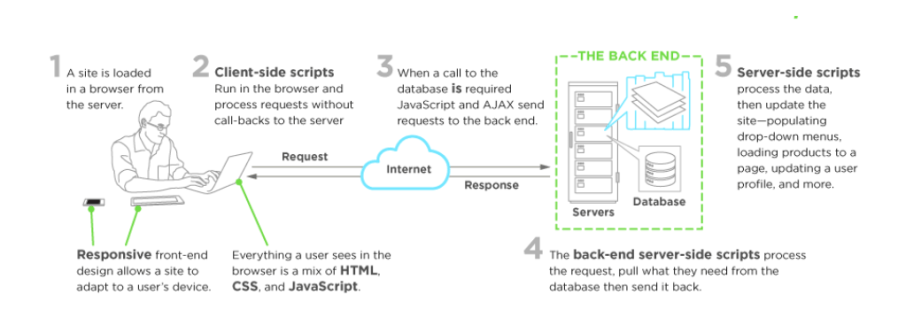
Backend is the server-side of the web. It stores and arranges data, and also ensures that everything on the client-side of the website works fine. It’s the part of the website you can’t see and interact with. It’s the portion of the software that doesn’t come into direct contact with users. Parts and features developed by backend designers are accessed indirectly by users through a front-end application. Activities such as writing APIs, creating libraries, and working with system components without user interfaces or even science programming systems are also included in the backend.

Back-end Languages

The back end component is built using some of the languages discussed below:

PHP: PHP is a server-side scripting language built specifically for web creation. Since PHP code is running on the server-side, it is called the server-side scripting language.

C++: It is a general programming language and is now widely used for competitive programming. It’s also used as a backend script.

Java: Java is one of the most common and widely used programming languages and platforms. It’s very scalable. Java components are readily available.

Python: Python is a programming language that helps you to work quickly and implement systems more efficiently.

JavaScript: Javascript can be used as both (front and back end) programming languages.

Node.js: Node.js is an open-source and cross-platform runtime environment for running JavaScript code outside the browser. You need to remember that NodeJS is not a framework and is not a programming language. Most people are confused and understand that it’s a framework or a programming language. We also use Node.js to create back-end services like Web App or Mobile App APIs. It is used in the development of major corporations such as Paypal, Uber, Netflix, Wallmart, and so on.

Back-end Frameworks

The list of back end frames is Express, Django, Rails, Laravel, Spring, etc.

The other back end programs/scripting languages are: C #, Ruby, REST, GO, etc.

Difference between Frontend and Backend:

Frontend and backend developments are quite different from each other, but there are still two aspects of the same situation. The frontend is what users see and interact with, and backend is how it works.

The frontend is a part of the website that users can see and interact with, such as the graphical user interface ( GUI) and command line, including design, navigation menus, text, pictures, videos, etc. Backend, on the other hand, is where part of the website users are unable to see and communicate.

The visual aspects of the website that users can see and experience are front-end. On the other hand, everything that happens in the background can be attributed to the backend

The languages used for the front end are HTML, CSS, Javascript, while those used for the backend are Java, Ruby, Python, .Net.

full stack developer

A full-stack web developer is a person who can develop both client and server software. Besides mastering HTML and CSS, he/she also knows how to:

Browser software (such as JavaScript, jQuery, Angular, or Vue)

Programming a server (like using PHP, ASP, Python, or Node)

Program a database (such as SQL, SQLite, or MongoDB)

Being a full-stack developer is a good practice because you know almost every aspect of web development. You can switch between front-end and back-end stuff according to the requirement.

Resources to learn

  • W3 School(Free)
  • Coursera(Paid)
  • Udemy(Paid)
  • FreeCode Camp(Free)
  • Treehouse(Paid)
  • Codeacademy(Free)
  • Traversy Media(Free)
  • HTMLDog(Free)

So, all the best guys for this amazing learning journey, hope you guys find this piece informative.


Being a shopaholic

It is one of the most interested, as well as overlooked, talk points of the modern century, particularly teenagers. We live in a community where we pretend to be down-to-earth by supporting the poor and vulnerable, while at the same time make them believe like they are not equal to the one who helped them. Society has greater confidence in the line “The first impression is the last impression” than “Don’t judge a book by its cover.”

Here what we call shopping addiction comes into the picture. So is it fair enough to link being a shopaholic and being materialistic?

Materialism, also referred to as physicalism, is, in theory, the belief that all facts (including facts concerning the human will and the course of human history) are causally or even reducible to real processes. For Marx and Engels, materialism meant that the natural universe, perceptible to the senses, had an empirical truth independent of mind or spirit. They did not deny the reality of mental or spiritual processes but affirmed that ideas could arise only as products and reflections of material conditions.

A shopaholic is a person who buys items not because he needs them, but because he likes them. And there’s a difference here. I’m not saying that buying things, and human desires are any sort of compulsion, but buying stuff simply for the sake of showing off is not a positive thing. Often it’s cool to buy the stuff you want, but to do so all the time and expose it to everyone is materialism.

Types of Shopaholics

1-Shop when they’re angry or upset: it’s not bad to be in this category until a frequent practice is practiced. Unless you’ve started to shop now and then. So this custom is putting you in debt. So you’re not just unpracticing this because you don’t have enough resources, because having to do so will lead to more anger.

2-Trophy shopaholics who just seek to find the right piece: these people purchase items because they consider them appealing and they think it’s nice to get the particular item regardless of how much it’s needless for them. Usually, they don’t look at money when they like something and want it at any cost.

3 – Shopaholics who like the reputation of being a big spender: they are someone who wants to show off at a far greater degree than most because their picture of culture is more important than everything else. They have an obsession with their status in society, and they judge everything from that perspective alone.

4-Bargain-seekers who buy when the item is on sale: they do not need any other excuse than because there is a discount on this particular item and they will need it in the future, or even someone else wants it. I’m not suggesting that buying anything for future use is not worth it, so at least you can know when you’re going to need it in the future.

Many people develop shopping addictions because they are addicted to how their brain feels when it comes to shopping. When they buy, their brains produce endorphins and dopamine, and over time, they become addicted. A professor of behavioral health sciences, Engs argues that 10 to 15 percent of the population could be predisposed to these emotions.

In certain situations, it can be impossible to predict whether you are a shopaholic or a loved one. A lot of people enjoy shopping, and a lot of people always waste so much money on this operation. It’s important to remember that going out once in a while doesn’t mean you ‘re a shopper. However, there are several signs and symptoms of shopping addicts that you might want to look for.

The short-term effects of a shopping addiction may be positive. In many cases, after a shopping trip, you may feel happy. However, such emotions are often combined with fear or remorse, and in most situations, remorse or fear may send you back to the store for even more shopping.

The long-term consequences of shopping addiction can vary in severity and duration. Most shoppers face financial difficulties, so they may be overburdened with debt. In some cases, they may max out their credit cards, but in some situations, they may take out a second mortgage on their house or make transactions on their company credit card. If you are addicted to shopping, your relationships can suffer as well. You that end up getting divorced or distancing yourself from your friends, children, or other loved ones.

National Education Policy 2020

The New Education Program was released on Wednesday, 29 July. Later in the day, the Union Cabinet endorsed a proposal aimed at revising the country’s education system. The Union Ministers for Information and Broadcasting (I&B) Prakash Javadekar and Human Resources Development (HRD) and Ramesh Pokhriyal Nishank released a statement on NEP-2020. Earlier on 1 May, Prime Minister Narendra Modi reviewed the NEP 2020 plan, which was prepared by a group of experts headed by former Indian Space Research Organization (ISRO) Chairman K Kasturirangan.

In the big changes, the 10 + 2 configuration of the school system has been replaced by the 5 + 3 + 3 + 4 configuration. This will require 12 years of education and three years of Anganwadi and pre-school. In comparison, instead of a year’s tests, school students can only take part in classes 3, 5, and 8.

NEP 2020 seeks to make “India a Global Knowledge Superior.” The new academic session will begin in September-October – a pause due to the ongoing epidemic of coronavirus disease (Covid-19) – and the government wants to enforce the program before the new session starts. 

Highlights of NEP 2020

  • The goal would be to increase the Gross Enrolment Rate of higher education, including technical education, from 26.3 percent to 50 percent by 2035.
  • The agenda of the New Education Policy (NEP) approved by the Union Cabinet on Wednesday seeks to bring about several significant reforms, including enabling top international universities to set up campuses in India, a greater proportion of students pursuing vocational education, and heading into institutions, including multidisciplinary IITs.
  • One of the stated goals of the policy is to cultivate “deep-rooted pride” in being an Indian, not only in thinking but also in spirit, intellect, and action, as well as in improving awareness, skills, principles, and provisions that encourage a conscientious contribution to human rights, sustainable development, and living and global well-being.
  • The strategy also aims at ‘light but secure’ oversight by a single higher education regulator, as well as expanded access, equality, and inclusion. The NEP stipulates that by 2040, all higher education institutions ( HEIs) must aim to become multidisciplinary institutions, each with the goal of providing 3,000 or more students. There should be at least one major multidisciplinary entity in or close each district by 2030.
  • A university should be a multidisciplinary institution providing undergraduate and doctoral degrees with high-quality instruction, research, and group engagement. The concept would require a variety of institutions, ranging from those that put equivalent emphasis on teaching and study, i.e. research-intensive universities to teaching-intensive universities.
  • Also, engineering colleges, such as IITs, will move towards more comprehensive and multidisciplinary education in the arts and humanities. Students in the arts and sciences may be involved in studying science.
  • Departments of Languages, Literature, Music, Psychology, Indology, Architecture, Dance, Theatre, Culture, Mathematics, Statistics, Pure and Applied Sciences, Sociology, Economics, Athletics, Translation, and Analysis, etc. will be developed and enhanced in all HEIs.
  • The degree would be either 3 or 4 years in length, with several exit options. For example, a credential after completing 1 year in a specialty or field, including technical and professional fields, or a diploma after 2 years of training, or a Bachelor’s degree after a 3-year program. However, the 4-year multidisciplinary Bachelor’s program is the favored choice.
  • An Academic Bank of Credit (ABC) shall be formed to store the academic credits received in digital form.
  • The 4-year curriculum can even lead to a degree ‘with study’ if the applicant conducts a comprehensive thesis project. A model of public universities for integrated and multidisciplinary education, at the same time as IITs, IIMs, etc., called MERUs (Multidisciplinary Education and Research Universities) would be developed.
  • Higher education institutions shall switch from high-level assessments to regular and thorough tests.
  • India should be advertised as a global research destination offering quality education at affordable prices. An International Students Office will be founded at each institution hosting foreign students.
  • High performing Indian universities will be encouraged to set up campuses in other countries. Selected universities like those from among the top 100 universities in the world will be facilitated to operate in India.
  • A statutory mechanism to encourage such admission will be placed in place and special dispensations will be given to these universities in respect of financial, governance, and quality requirements on a par with other autonomous institutions of India.
  • Within each educational setting, stress control and mental development therapy programs are in operation.
  • Efforts should be made to promote the merits of SC, ST, OBC, and other SEDG graduates.
  • Vocational programs should be incorporated into both schools and higher education institutions in a staggered fashion over the next decade. In 2025, at least 50 percent of learners across the school and higher education programs should be subjected to technical education.
  •  The B.Voc. degrees introduced in 2013 will continue to exist, but vocational courses will also be available to students enrolled in all other Bachelor’s degree programs, including the 4-year multidisciplinary Bachelor’s programs.
  • ‘Lok Vidya,’ i.e. essential vocational skills established in India, will be made available to students. The Minister of Health, which should be renamed the Minister of Health, will form the National Committee for the Development of Vocational Education (NCIVE).
  • The strategy also calls for the establishment of the National Research Foundation (NRF). The policy also refers to the establishment of the Indian Higher Education Commission (HECI).

Reviews

Beginning from the Vice-Chancellors of Private Universities to other business leaders, many of them expressed their opinions and questions regarding the New Education Strategy. Here’s a couple of them to try out.

  • Dr. Rupamanjari Ghosh, Vice-Chancellor, Shiv Nadar University, Greater Noida said, “We’ve been patiently waiting for this day. National Education Policy (NEP) 2020 has the potential to have a profound long-term effect on the social and economic structure of our society — that is the power of education, particularly given our demographics. NEP 2020 supports big changes in higher education – comprehensive and multidisciplinary curriculum, diversity in topic choices and plan durations, etc.
  • Dr. Dishan Kamdar, Vice-Chancellor at FLAME University, has named it a game-changer for the future. He said, “This is going to be a game-changer for the development of India’s education system. By 2030, multidisciplinary colleges in every district will promote liberal arts education to a significant degree. India will have the highest number of young people in the world by 2030.”
  • Aakash Chaudhry said, “The incorporation of the arts, humanities, athletics, physical education and vocational training in school education is a case in point. The Policy is also futuristic-exciting web content in English, Hindi and regional languages are exciting. “Sharad Mehra said,” The NEP is a transformational step in the right direction on a variety of fronts. The idea of the Center and States coming together to maximize public spending in the education sector to hit 6 % of GDP is a positive change.
  • Sumeet Jain, Yocket’s co-founder, and higher education analyst, congratulated the Government with its new education regulations. He said, “Under the NEP, the world’s top 100 international universities would be” facilitated “to work in India under a new regulation. According to the HRD Ministry paper, listing main policy features, “these (foreign) universities should be given special dispensation concerning administrative, governance, and quality requirements on a par with other autonomous institutions of India.”
  • At the other hand, Dr. Vishal Talwar, Dean-School of Management, BML Munjal University, said, “The new education policy unveiled today aims to respond to the changing realities of education by growing versatility, raising the degree of autonomy and seeking to increase the level of application of expertise along with a wider ability set. A key thing that needs to be looked at is how this program is applied.

What NEP 2020 has for teachers

The updated National Education Policy (NEP) 2020 released by the Center on Wednesday proposed a range of improvements to the country’s school system. As per the new legislation, a four-year integrated BED would be the minimum degree required for teaching by 2030. The Teacher Eligibility Test (TET) will now be updated as per the existing school program.

Previously, the TET was split into two components — part 1 and part 2. Now that the school system has been split into four parts — fundamental, preparatory, middle, and secondary — TET should also be built accordingly.

All that apply for TET would have to demonstrate or appear in an interview to demonstrate their understanding of the local language in compliance with the new regulation. As per the NEP, “Interview will become an important part of the recruiting of teachers.” Such interviews will also determine the ease and expertise of teaching in the local language. It will also be a must for private school teachers to apply for TET.

Hiring and openings in schools can be remotely controlled. A technology-based, systematic teacher-requirement preparation project will be undertaken by each state to determine the projected subject-specific shortage of teachers over the next two decades.

Some changes are also made in B.Ed, a lot of merit-based scholarships are also introduced to ensure that outstanding students enter the teaching profession – especially from rural areas, Teachers who have already been hired will be expected to participate in at least 50 hours of continuous professional development (CPD) every year.