In India, it is increasingly felt that education system is highly examination oriented. Exams and tests are held at regular intervals. Success in the exams is at index of once intelligence. Exams do cause a lot of stress rather it can be said that a student’s academic future simply depends on the marks scored by him. His admission in reputed college depends solely upon his performance in examination.
As a result, students finds studies stressful, monotonous and exasperating. Unachievable targets set by the parents and perceptors, unbearable peer pressure, cut throat competitions makes one question the usefulness of the examination system. In my sense, it is all futile. We cannot deny the fact that it is resulting into spate of suicides, absenteeism and even the percentage of dropouts has increased.
Exams should be cancelled and replaced by less stressful and more fruitful forms of assessments for several reasons including:
1) They do not define one’s skills and capabilities: Thomas Edison once said: “Tomorrow is my exam but I don’t care, a single paper can’t decide my future” and we all know what Edison achieved is his life, other successful people followed such a path and if they cared much about exams, they surely would not have achieved what they did.
2) They do not differentiate between students: Exams do not depend on someone’s preparation only, they are also dependent on their physical and mental health, and their social situation; you most luckily would not get a second chance if you developed a diarrhea during exam, such a factor would decide whether you’re among best or worst students no matter how intelligent you are, and how much you prepared for the exam. So you see how unfair the whole system is!
3) Cheating: The broken educational system values more grades than learning and that what obliged students to try any means –sometimes illegal ones- to pass to the next level, history is full of people who try every trick to cheat at exam time, modern technology also has made it much easier for students to pass their tests with less efforts and students’ last issue nowadays is knowledge.
4) Stress: Exams take a toll on a student’s body and mind through the forms of stress and anxiety and you might end up in a mental institution. Because of exams, a medical student was caught eating pages from one of their recommended texts since he failed to absorb information from taking his lectures too literally.
It is also felt that examinations don’t prepare students for life. They simply enable the students to become reasonably well informed, fact churning individuals. There should be a system of consistent evaluation throughout the year and, the examinee should not be tested only for facts and information acquired by him but should be tested for life skills. So, the examination system should be abolished instead of examinations being conducted at the end of the academic session.
It is rightly said woman is the backbone of society. From times immemorial, woman have been considered inferior to man in a patriarch society. Man has always treated woman not as an equal partner in life but as a mere slave. Biological superiority of man over woman has made him callous towards her. She has always being confined to the four walls of the house. Man has just treated her as an object of gratifying his sexual lust and physical desires.
Women have been denied most of the rights that give dignity of human beings. She has suffered a lot because of the whims and prejudices that man harbours towards her. But at the same time she has been called the better half of the man but unfortunately these are just sugar coated words. He abuses her physically, sexually, morally, economically and socially. There is no doubt that she has certainly been the victim of discrimination on the basis of sex. However, the scenario is changing very fast. The Constitution of India protects women’s rights by granting her equal status.
Woman have played a vital role in Indian struggle for freedom. Today, women are becoming more and more vigilant about their rights. They have discarded the Pardah system and have crossed the boundaries by exposing them in outer world. They are jostling with men in every walk of life braving their worth.
Education, political awareness and the impact of western culture have made her more vigil and aware about her rights. The concept of superiority of man is tottering. Today, woman have proved to be better doctors, administrators, pilots, academicians then many of the male counter parts. But despite this she is at the lower rung of the ladder in society. Though she is gaining economic independence but lately she is also exposed to sexual exploitation in offices and working places. Ironically, man still regards her as an unusual commodity.
“Money” is a medium of economic exchange in which prices and values are expressed. It is very important to live a life. Just like the three basic units of life- “food, cloth and shelter”. Money is also can be said to be the basic unit as we can but food, cloth and shelter with money only. So its management is also important. “Money Management” means budgeting, saving, investing, earning, spending money in the best way possible. Spending money to satisfy cravings/needs is a natural human phenomenon. The idea of managing money has been developed to reduce the amount of money that is spend on items that add no significant value to one’s living standards. In a nut shell money management means spending money carefully on the needs rather than on wants and wishes and also saving it for the better future.
In Indian Society, if we take a look, we can see that indian society people/groups were divided into different categories on the basis of their earning and living standards. People are divided on assets and income/expenditure. Based on these parameters there are broadly three categories (sub categories are also there) i.e., rich/upper class people, middle class people and poor/lower class people.
Rich/upper class refers to a group of individuals have highest place and status in society. These people are considered the wealthiest, lying above the poor and middle class in the social hierarchy. Middle class people fall between the poor class and upper class. They are neither poor nor rich. These people have a simple living and their earning are mostly equal or less than their expenditure resulting to short debts. Poor/lower class people are those who live under poverty. They are homeless, living on roads and slums, don’t have food to eat, usually dependent on begging and daily wage activities.
People ending up in the same category in which they are born, it is very less likely that a poor class person becomes a middle class one in this life span. There are chances that a rich person becomes a middle class one due to many reason but the chances of upgradation in class is very less.
The reason for such situations- “Wrong money management” and less/no knowledge of managing money. Rich people become more rich and poor become more poor and middle class reamains in debt, the reason behind this phenomenon is that knowledge of money management is not being taught in school and if we talk about poor class children dont even go to school. They don’t even know how to read and write. Money management is taught at home rather than in school. Many of us usually learn about money from our parents.
Talking about poor people, how can you say that they can teach their children about money when they themselves don’t have money to fill their stomach. Poor people just teach their children to go school and work hard. It might happen that the child will pass with excellent grades in his/her academic career but even after this their economic status and mindset remain poor and they keep running in the vicious cycle of poverty like a rat.
Children of upper class are given exposure and knowledge of money management from their childhood. As their parents have more than enough money and seeing their parents earning and managing money they also learn and their intellectual development happens in the same matter but it is not possible in the case of middle and lower class as they themselves don’t have enough money so how can they teach their children about the importance of the same.
Money management should be a topic of concern as it is an important aspect of one’s life which determines his/her status and standard of living. Money management be taught from school level only then children can understand the importance of it. Both government and private schools should organise lecture and seminars on the topic “money management”. If they can manage then parents should also be invited to attend such seminars and lectures. Parents should also give opportunities to their child to learn about the money, its expenditures, saving and management. Parents should send their children to the nearby shops to purchase small goods.
Tips for Money Management
1.Every child should be given the opportunity to go to schools. 2.Budgeting should be done to save money. 3.One should create a realistic monthly budget. 4.Everyone must track their spending. 5.One should build up their savings 6.Must pay your bills on time. 7.Have an investment plan. 8.Know your money priorities. 9.Differentiate between needs and wants.
Money is important to live a good life so as its management also. Money management is a skill that everyone must know to have a good present and better future. Children should be taught about money management at school from the very beginning. It is effectively must to manage money to have a good lifestyle. So don’t waste your time and manage your money now to have a healthy, happy and wealthy lifestyle.
Child labour is the worst form of child exploitation. There are more than 25 million child labourers in India. There is nothing more henious than this line. When it is time for children to play in the garden, they are forced to do banded labour. They have dreams to fulfill so it is need of the hour to stop this exploitation. They need play, education and nutrition. These must be provided to them but unfortunately they have to work in inhuman conditions. Childhood which is the most carefree period of a person’s life becomes a nightmare for them. they are mercilessly exploited at the hands of certain sections of the society.
Penury, in fact, is the root cause of all the troubles. It forces the poor parents to engage their children to work for them and earn something. The main culprits of the society are greedy contractors, the poor and uncaring parents and also the perceptors who do not teach. This gigantic wrong must stop and must be eliminated.
Law against child labour must be made strict and be enforced. Severe punishment should be given to those who indulged in or even encourage child labour. Though various steps have been taken by the government and many voluntree organisation are working to prevent the exploitation. Yet this social evil has not been eradicated completely. It is our foremost duty to look into this grave problem and take stringent actions in order to safeguard the rights of children.
The need of the hour for the government and NGOs is to come forward to establish institutes which provide free education and free meds. Primary education should be made mandatory. Until and unless we all get together to fight against the inhuman exploitation of children. We will not be able to eliminate this social stigma completely.
Section 148 defines the terms ‘bailment’, ‘bailor’ and ‘bailee’.
A bailment is the delivery of goods by one person to another for some purpose upon a contract that they shall when the purpose is accomplished be returned or otherwise disposed of according to directions of the person delivering them. The person delivering the goods is called the bailor and the person to whom the goods are delivered is called the bailee.
Essentials of Bailment
1.Delivery of the goods for some purpose
2.Return of the goods after the purpose is achieved, or their disposal according to the bailor’s directions.
Kinds of Bailment
Gratuitous Bailment: In gratuitous bailment it is without any consideration for benefit of bailor or bailee.
Non-Gratuitous Bailment: Benefit for both bailor and bailee. Also known as bailment for reward.
Bailment for benefit of bailor: Bailor delivers his goods to bailee for safe custody without any benefit or reward.
Bailment for benefit of bailee: Bailor delivers his goods to a bailee without any benefit for his own use.
Bailment for benefit of bailor and bailee: It is beneficial for both i.e. bailor and bailee.
Duty of Bailor
Section 150 mentions the following duty of bailor in respect of the goods bailed by him:
The bailor is bound to disclose the faults to the bailee in the goods bailed, of which the bailor is aware and materially interfere with the use of them, or expose the bailee to extraordinary risks; and if he does not make such disclosure, he is responsible for the damage arising to bailee directly from such faults.
If the goods are bailed for hire, the bailor is responsible for such damage, whether he was or was not aware of the existence of such fault in the goods bailed.
Duties of Bailee
Duty to take reasonable care of the goods bailed (Section 151 and 152).
Duty not to make unauthorised use of the goods bailed (Section 153 and 154).
Duty not to mix the bailor’s goods with his own goods ( Section 155,156,157).
Duty to return the goods on fulfillment of the purpose (Section 160,161 and 165,166,167).
Duty to deliver to the bailor increase or profit on the goods bailed (Section 163).
When two or more persons join hands to set up a business and share its profits and losses it is called Partnership. Section 4 of the Indian Partnership Act 1932 defines partnership as the ‘relation between persons who have agreed to share the profits of a business carried on by all or any of them acting for all’.
Partners are the persons who have entered into partnership individually with one another. Partners collectively are called ‘firm’. The essential features of the partnership are as follows:
Two or More Persons: There should be at least two persons coming together to form the partnership for a common goal. In other words, the minimum number of partners in a partnership firm can be two. Indian Partnership Act, 1932 has put no limitations on maximum numbers of partners in a firm. But however, Indian Companies Act, 2013 puts a limit on a number of the partners in a firm as follow: 1.For Banking Business, Partners must be less than or equal to 10. 2.For Any Other Business, Partners must be less than or equal to 20. 3.If the number of partners exceeds the limits, the partnership becomes illegal.
Agreement The partnership is an agreement between two or more persons who decided to do business and share its profits and losses. To have a legal relationship between the partners, the partnership agreement becomes the basis. The agreement can be in written form or oral form. An oral agreement is equally valid. But, preferably the partners should have a written agreement, in order to avoid disputes in future.
Business To carry on some business there should be an agreement. Mere co-ownership of a property does not amount to the partnership. The business must also be legal in nature, a partnership to carry out illegal business is not valid.
Mutual Agency The business of a partnership firm may be carried on by all the partners or any of them acting for all. This statement has two important implications. First, to participate in the conduct of the affairs of its business, every partner is entitled. Second that a relationship of mutual agency between all the partners exists. For all the other partners, each partner carrying on the business is the principal as well as the agent. He can bind other partners by his acts. And also is bound by the acts of other partners with regard to the business of the firm.
Sharing of Profit The agreement between partners must be to share profits and losses of a business. Sharing of profits and losses is important. The partnership is not for the purpose of some charitable activity.
Liability of Partnership Each partner is liable jointly with all the other partners. And also when is a partner, severally liable to the third party for all the acts done by the firm. Liability of the partner is not limited. This implies that for paying off the firm’s debts, his private assets can also be used.
Partnership Deed Agreement to carry on a business between the partners, partnership comes into existence. The partnership agreement can be either oral or written. The Partnership Act does not require that the agreement must be in writing. But when the agreement is in written form, it is called ‘Partnership Deed’. Partnership deed should be duly signed by the partners, stamped & registered.
Partnership deed generally contains the following details: 1)Names and Addresses of the firm and its main business; 2)Names and Addresses of all partners; 3)A contribution of the amount of capital by each partner; 4)The accounting period of the firm; 5)The date of commencement of partnership; 6)Rules regarding an operation of Bank Accounts; 7)Profit and loss sharing ratio; 8)The rate of interest on capital, loan, drawings, etc; 9)Mode of auditor’s appointment, if any; 10)Salaries, commission, etc, if payable to any partner; 11)The rights, duties, and liabilities of each partner; 12)Treatment of loss arising out of insolvency of one or more partners; 13)Settlement of accounts on the dissolution of the firm; 14)Method of a settlement of disputes among the partners; 15)Rules to be followed in case of admission, retirement, a death of a partner; and 16)Any other matter relating to the conduct of business. Normally, all the matters affecting the relationship of partners amongst themselves are covered in partnership deed.
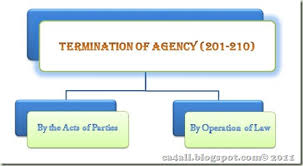
In a contract of agency, a person appoints another to act on his behalf with the third party it is called ‘Agency’. According to Section 183 of the said Act, Principal must be competent to contract. Any person may be an agent (Section 184). According to Section 185, in the contract of agency, consideration is not necessary. Termination of agency means putting an end to the legal relationship between principal and agent. Section 201 to 210 of the Indian Contract Act 1872 lay down the provision relating to the termination of Agency.
As above said termination of agency means putting end to the legal relationship between principal and agent. Section 201 to 210 of the Indian Contract Act 1872 lay down the provision relating to the termination of Agency.
Section 201, Indian Contract Act 1872 provides for termination of an agency –
An agency is terminated by the principal revoking his authority, or by the agent renouncing the business of the agency; or by the business of the agency being completed; or by either the principal or agent dying or becoming of unsound mind; or by the principal being adjudicated an insolvent under the provisions of any Act for the time being in force for the relief of insolvent debtors.
Agency may be terminated two ways – 1) By the Act of the Parties 2) By Operation of Law
1) By the act of the parties – i) By agreement – The Contract of Agency can be terminated at any time by mutual agreement between the principal and agent. ii) By revocation of the principal – The Principal revoke agency at any time by giving notice to the agent. iii) By Renunciation of an agent – Renunciation which means withdrawing from responsibility as Agent. Like Principal, Agent can also renounce the agency. According to Section 206 of the Indian Contract Act 1872, the agent must give to his Principal reasonable notice of renunciation. Otherwise, he will be liable to make good for the damage caused to the principal for want of such notice.
2) By operation of law – Agency can be terminated by operation of law- i) By the completion of agency – Agency can become to an end after the completion of work for which the agency is created. ii) By expiry of the time – Agency can also be terminated by the expiry of time. if the agency is created for the specific period, it is terminated after the expiry of the time. iii) Death or insanity of principal or agent – Section 209 of the Indian Contract Act 1872 imposes an agent, duty to terminate the contract of agency on the death of the principal. In other words, Agency comes to an end on the death or insanity of the principal or agent. iv) Insolvency of principal – According to Section 201 of the Indian Contract Act 1872, an insolvent or bankrupt is a person who is unable to run the business due to Excess of liabilities over assets. In this way, if the principal becomes an insolvent agency can be terminated. v) Destruction of the subject matter – If this subject matter of the agency is destroyed agency comes to an end. For example – Any agency is created for sale of an Airplane if the Airplane caught fire before the sale the agency comes to an end. In this contract Airplane is the subject matter. vi) Principal becoming an alien enemy – If the Principal becomes an alien enemy the contract of agency comes to an end. vii) Dissolution of company or firm – A Firm or company may be regarded as a Principal in the contract of Agency. If the company or firm is dissolved the agency comes to an end.
Relationship between Principal agent and sub agent
Relationship between principal agent and sub-agent depends on the question whether the agent has an authority to appoint sub-agent and whether the sub-agent is properly appointed. If then sub-agent is properly appointed: 1) The principal is bound by and responsible for the acts of a sub agent; 2) the agent is responsible to the principal for the acts of the sub-agent; 3) the sub agent is responsible for his acts to the agent, but not to the principal except in case of fraud or willful wrong.
It is of interest to observe clause (3) above. Sub-agent is responsible and accountable to the agent and not to the principal by clause (1). Principal is liable for acts of the sub-agent if he is properly appointed. Sub-agent is not responsible to the principal because there is no privity of contract between the principal and sub agent. It is case of fraud or willful wrong that the principal can proceed against the sub-agent. Principal can, however, against the agent for acts of a sub-agent. As far as the rights of a third party are concerned, he can enforce the wrongs of a sub-agent on the principal if the sub-agent is properly appointed. Principal is therefore liable for acts of the sub-agents if he is properly appointed.
If the sub-agent is not properly appointed: Where an agent has appointed a person to act as sub agent without having authority to do so, the principal shall not be deemed to be represented or responsible for the acts of the sub-agent so employed, nor is such a sub-agent responsible to the principal. The agent is responsible for the acts of such a sub- agent both to the principal and to third persons.
Sub-agent is said to be improperly appointed where agent delegates his powers without authority from the principal or where none of the circumstances stated above exist which necessitate appointment of a sub agent.
It will be observed that where a sub-agent is not properly appointed, the liability of agent is also towards third parties. As a rule, we have seen that an agent is responsible to the principal and it is the principal who is responsible for the acts of his agent to the third party. However, the section throws additional liability on the agent where he has improperly appointed a sub-agent. Agent stands liable to the third party for the acts of a sub-agent.
Termination of sub-agent’s authority: (Sec 210) Lastly it must be noted that the termination of the authority of an agent causes the termination of the authority of all sub-agents appointed by him
Liabilities of principal, agent and sub-agent: The agent is responsible to the principal for the acts of a sub-agent and the sub-agent is responsible for his acts to the agent but not the principal, except in cases of fraud and willful wrong.
Where an agent improperly appoints a sub-agent, the agent is responsible for his acts both to the principal and to third parties. The principal in such cases is not responsible for the acts of the sub-agent nor is the sub-agent responsible to the principal. But where a sub-agent is properly appointed, the principal as regards third person, is represented by the sub-agent, and is bound by and responsible for his acts, as if he were an agent originally appointed by the principal.
Where an agent under an express or implied authority has named another person to act for the principal, such a person is not a sub-agent, but an agent of the principal. There is no liability on the agent appointing him provided the agent so appointing exercises discretion as a man of ordinary prudence would exercise is his own case (Sec 194 & 195). Such an agent is called a substitute agent.
An “agent” is a person employed to do any act for another, or to represent another in dealing with third person. The person for whom such an act is done, or who is so represented, is called the “principal”. The contract between Principal and Agent is called ‘Contract of Agency’. Section 182 of the act defines the terms “Agent” and “Principal”.
Types of an Agent
Brokers
Factors
Del Ceredere Agents
Auctioneers
Duties Of An Agent
Agent’s duty in conducting principal’s business (Section 211): An agent is bound to conduct the business of his principal according to the directions given by the principal, or, in the absence of any such directions, according to the custom which prevails in doing business of the same kind at the place where the agent conducts such business. When the agent acts otherwise, if any loss be sustained, he must make it good to his principal, and, if any profit accrues, he must account for it. Illustration: B, a broker in whose business it is not the custom to sell on credit, sells goods of A on credit to C, whose credit at the time was very high. C, before payment, becomes insolvent. B must make goods the loss to A.
Skill and diligence required from an agent (Section 212): An agent is bound to conduct the business of the agency with as much skill as is generally possessed by persons engaged in similar business, unless the principal has notice of his want of skill. The agent is always bound to act with reasonable diligence, and to use such skill as he possesses; and to make compensation to his principal in respect of the direct consequences of his own neglect, want of skill or misconduct, but not in respect of loss or damage which are indirectly or remotely caused by such neglect, want of skill or misconduct.
Duty to render proper accounts (Section 213): According to Section 213 of the Indian Contract Act 1872, an agent is bound to render proper accounts to his principal on demand.
Duty to communicate with principal (Section 214): It is the duty of an agent, in cases of difficulty, to use all reasonable diligence in communicating with his principal, and in seeking to obtain his instructions.
Not to deal on his own account: Section 215 of the Indian Contract Act 1872 deals with rights of principal when the agent deals, on his own account, in the business of agency without principal’s consent. Section 215 runs as follows- If an agent deals on his own account in the business of the agency, without first obtaining the consent of his principal and acquainting him with all material circumstances which have come to his own knowledge on the subject, the principal may repudiate the transaction, if the case shows either that any material fact has been dishonestly concealed from him by the agent, or that the dealings of the agent have been disadvantageous to him.
Not to make Secret Profits: Section 216 of the Indian Contract Act, deals with Principal’s right to benefit gained by the agent dealing on his own account in the business of agency. An agent, without the knowledge of his principal, should not deal in the business of agency on his own to make secret profit. Illustrations: A directs B, his agent, to buy a certain house for him. B tells A it cannot be bought, and buys the house for himself. A may, on discovering that B has bought the house, compel him to sell it to A at the price he gave for it.
Duty to pay sums received for principal: According to Section 218 of the said act, an agent is bound to pay to his principal all sums received on his account. It is the duty of an agent to maintain secrecy of the business of agency and should not reveal the confidential matters.
Duty not to delegate his duties (Section 190): When an agent has undertaken to perform certain duties personally, he is not allowed to delegate his duties to another person.
Have you ever travelled in a public transport or in any bus, train, or metro train? Do you think public transports are safe for women? Being a women do you feel safe while travelling in any mode of public transport? Public transport is on essential service that provides individuals with access to work, to an education and to all of life’s opportunities. And yet, the access of many women and girls to safe public transport options is threatend by the potential of being assaulted or victimised. The findings revealed that 59% of women use public transport like buses, trains and on demand taxis as it is affordable but only 9% of women feel public transport is completely safe, while 3% claim it is completely unsafe and rest 47% claiming that they felt somewhat safe using it during the day, but not at night. The fear of molestation, assault, eve-teasing and male-gaze makes women feel unsafe in modes of public transport. Everyday 7 out of 10 women face some kind of bad behaviour, molestation, male-gaze while travelling in a public transport. Travelling late at night alone in train, bus, on demand taxis is a topic of concern for women. As you remember the Nirbhaya case happened in 2012, a 23 year old girl was beaten, gang raped and tortured in a bus in which she was travelling. Lack of road lighting is a key factor behind feeling unsafe, with 40% women stating only major roads were well lit. Sanitisation is also a problem for women in public transport/bus. Train stations and trains are vulnerable spaces for women due to crowded space or, due to isolated areas where there is no one available to intervene and help in case of emergency. Sexual assault, molestation and even rape are reported on trains and have been on the rise. Not reporting sexual harassment is also a common occurence. Only 30% women report the case of molestation as the women fears that reporting the case will degrade her family’s reputation. More than 50% of the cases remain upreported and the culprit live freely in the society.
The cases against women in public transport are on a rise but the following written measures can be taken to stop the increasing and high pace of these evil acts. Improving the lighting on the roads and on railways; bus and metro stations will have a direct influence over the perception of safety. Having more entry and exit prints to ease congestion. Improving infrastructure including toilets; staircase and pedestrain bridges; publicising helpline numbers; having functional and visible helpdesks where women can get immediate assistance; Making reporting incidents simple and easy so that more women do it- this can help show the patterns and trends and lead to pre-emptive solutions.
In conclusion, i would like to say that the world is changing at a rapid pace and we are living in the 21st century in a technological world but still the women in our society doesn’t feel safe while travelling in a public transport. Women fear molestation, rape, assault and male-gaze in public transport. Measures should be taken to safeguard women as women are the important pillar of our society and safeguarding them is the need of the hour. Men and boys should also be taught to respect women instead of disrespecting them and seeing them as a sex object. Both women and men are equal in society and should be treated equally and respected to make the society a better place for living.
An “agent” is a person employed to do any act for another, or to represent another in dealing with third persons. The person for whom such an act is done, or who is so represented, is called the “principal”. Section 182 of the act defines the terms “Agent” and “Principal”.
Rights of an Agent
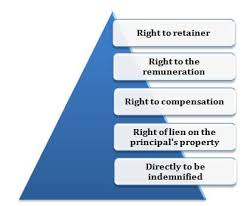
Right to Receive Remuneration: According to Section 219 of the Indian Contract Act, an agent is entitle to his remuneration. But Section 220 of the said act says that, an agent who is guilty of misconduct in the business of an agency is not entitled to any remuneration in respect of that part of the business which he has misconducted.
Right of Lien (Section 221): Agent’s lien on principal’s property- In the absence of any contract to the contrary, an agent is entitled to retain goods, papers and other property, whether movable or immovable, of the principal received by him, until the amount due to himself for commission, disbursements and services in respect of the same has been paid or accounted for to him.
Right to Indemnity: Agent to be indemnified against consequences of lawful acts. Indemnity means promise make good the loss. According to Section 222 of the Indian Contract Act, 1872 “The employer of an agent is bound to indemnify him against the consequences of all lawful acts done by such agent in exercise of the authority conferred upon him. Illustrations: B, at Singapore, under instructions from A of Calcutta, contracts with C to deliver certain goods to him. A does not send the goods to B, and C sues B for breach of contract. B informs A of the suit, and A authorities him to defend the suit. B defends the suit and is compelled to pay damages and costs and incurs expenses. A is liable to B for such damages, costs and expenses.
Right to Compensation: According to Section 225 of the said act, an agent is entitled to claim compensation for the injuries suffered as a consequence or want of skill of the principal. Section 225 reads as follows- “The principal must make compensation to his agent in respect of injury caused to such agent by the principal’s neglect or want of skill. Illustration: A employs B as a bricklayer in building a house, and puts up the scaffholding himself. The scaffholding is unskillfully put up, and B is in consequence hurt. A must make compensation to B.
Right to Retain Sums (Section 217 and 218): The agent has a duty to pay to his principal all sums received on principal’s account. But he also has a right to retain, out of any sums received on account of principal in the business of agency, all money due to himself in respect of advances made or expenses properly incurred by him in conducting such business and also such remuneration as may be payable to him for acting as agent. Similarly, when an agent sells his principal’s goods, he may detain the money received, for his remuneration on account of the goods sold by him. Such right can be exercised by an advocate also but lien must be confined to the costs incurred in that particular case.
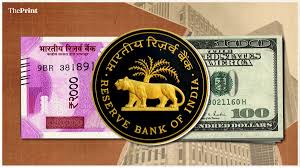
The Reserve Bank of India (RBI) is India’s central bank, also known as the banker’s bank. The RBI controls the monetary and other banking policies of the Indian government. The Reserve Bank of India (RBI) was established on April 1, 1935, in accordance with the Reserve Bank of India Act, 1934. The Reserve Bank is permanently situated in Mumbai since 1937.
Establishment of Reserve Bank of India
The Reserve Bank is fully owned and operated by the Government of India. The Preamble of the Reserve Bank of India describes the basic functions of the Reserve Bank as;
1)Regulating the issue of Banknotes
2)Securing monetary stability in India
3)Modernising the monetary policy framework to meet economic challenges
The Reserve Bank’s operations are governed by a central board of directors, RBI is on the whole operated with a 21-member central board of directors appointed by the Government of India in accordance with the Reserve Bank of India Act.
The Central board of directors comprise of: Official Directors – The governor who is appointed/nominated for a period of four years along with four Deputy Governors. Non-Official Directors – Ten Directors from various fields and two government officials.
Functions of RBI
The Issuer of the Currency: It has the sole authority to produce the currency. It also takes action to stop regulating the passage of fake money.
Banker to the Government: It acts as a financer both to state and central government. It delivers short-term credit. It governs all new matters of government lands, maintaining the government debt unsettled, and taking care of the market for the government securities. It counsels the government on banking and monetary subjects.
Banker’s Bank: It is the bank of all banks in the country as it delivers the loan to banks, rediscounts the invoice of banks and receives the payment of banks.
Lender of Last Resort: All the other banks can borrow from the RBI by keeping qualified securities as a deposit at the time of crisis.
Money Supply and Regulator of Credit: To manage demand and supply of cash in economy by Open Market Actions, Credit Ceiling and much more. It has to meet the credit necessities of the remaining banking system. It requires sustaining price stability and an elevated rate of economic growth.
Self-reliant India is the vision of the Prime Minister of India Narendra Modi of making India a self-reliant nation. The first mention of this came in the form of the ‘Self-Reliant India Mission’ during the announcement of the coronavirus pandemic related economic package on 12 May 2020. This self-reliant policy does not aim to be protectionist on nature and as the Finance Minister clarified, ” Self-reliant India does not mean cutting off from rest of the world”. The largest fund in the country worth Rs. 21,000 crore was setup by the IIT Alumni Council with the aim of supporting the mission towards self-reliance.
Everybody knows, that the youth are the future of any country. But India can take lead over many other nations because about 65 percent of the country’s population is below 35 years and 50 percent is below 25 years. With huge, educated young population, India is very uniquely poised to realise the demographic potential amd reap the advantage of this vast powerhouse of human resource talent. The need of the hour is to upgrade the skill or upskill the youth to meet the emloyment needs of technology driven 21st century and accelerate the pace of self-reliance.
The uncertainity created by the pandemic is being seen by many as an opportunity to upgrade knowledge and acquire new skills that will cater to the post-corona virus job scenario. The skills required for tomorrow’s jobs will be completely different from the skill-sets youth possess today.
So, its high time now, we have to make India self-reliant and youth plays the most important role in this mission.
Labour Day or International Workers Day is celebrated annually on 1 May to celebrate the working class and labourers across the world. Socialist and labour unions celebrate this day by organising programmes to improve wages and working conditions of the workforce. In more than 80 countries Labour Day is a national holiday.
Before a formal Labour Day came into place, deaths, injuries and dangerous working conditions were very common among the working class globally. During the rise of industrialisation, the U.S. exploited the working class during the nineteenth century and made them work upto 15 hours a day under rigorous conditions. The rising death of the workforce in industries forced the working class to raise their voices for their safety. After efforts made by the workers and socialists, eight hours was declared as the legal time for the workers in the late nineteenth century by the American Federation of Labour.
The origin of Labour Day goes back to an incident in Chicago on May 4, 1886 known as the Haymarket Affair. On this day workers assembled as part of a peaceful rally in a strike demanding an eight hour work day. An unknown person threw a dynamite bomb at the police as they acted to disperse the meeting, and the bomb blast and ensuing gunfire resulted in the deaths of seven police officers and atleast four civilians; dozens of others were wounded. The Chicago protests led to many countries and at last they got the proper labour rights.
So, they had a long repression from the society. So, now the time has come to live respectfully and safe. Without labour no country can prosper. They are the ones who make a way towards country’s development. Their hardwork, dedication cherishes the path of development of country. So, respect them and provide safe working conditions to them. The below mentioned lives are aptly quoted;” A worker is a creator and a great asset to every nation”.
Section 53 prescribes five types of punishments to be meted out to a person convicted of a crime under the Code, depending on the nature and gravity of the offence,viz .:
(i) Death; (ii) Imprisonment for life; (iii) Imprisonment, rigorous with hard labour, or simple; (iv) Forfeiture of property; and (v) Fine.
It is suggested to add five new forms of punishment to the existing ones in section 53, IPC with a view to deter particular types of criminals. Such punishments will have more psychological, social and moral impact on the criminals and will go a long way in curbing crimes. The proposed punishments are: (i) Externment, (ii) Compensation to victims of crime, (iii) Public Censure, (iv) Community service, and (v) Disqualification from holding public office.
(i) Externment: Externment or banishment is a form of punishment in which an accused is sent out of the place of his residence to another place for a specified period of time as mentioned in the order issued by the court. This is done to deprive the accused of the company of his family members, friends and associates so that he or she may not indulge in criminal activities. Externment is resorted to primarily in case of anti-social, hardened and habitual criminals.
(ii) Compensation to victims of crime: Unfortunately, the victims of crime in our country do not attract the attention of law makers. Of late, Civil Procedure Code, 1973 in section 357 has empowered the court to award compensation to the victims of crime in very limited cases at the time of passing the judgment. No doubt, the higher judiciary has on times provided compensation to the victims of crime of custodial violence, sexual assault, rape, illegal detention by invoking Article 21 of Constitution, but such instance will not serve the plight of helpless victims.
(iii) Public Censure: Public Censure or social censure is one of the methods of punishment prescribed in some of the countries, such as Russia, Columbia etc., in respect of certain offences of anti-social nature, such as white-collar crimes, tax crimes, food adulteration, etc. In ancient India, public censure was considered suitable punishment for certain class of criminals.
(iv) Community Service: Community service or corrective labour is a form of punishment in which the convict is not deprived of his liberty. Corrective labour is the standard penalty given in those cases where it is considered that the accused need not to be isolated from the society. The period ranges between one month to one year in such cases. This system is used in Soviet Russia with good results. An important feature of this type of punishment is that the accused is not deprived of his liberty and he may go home after the day’s work.
(v) Disqualification from holding public office and contest elections: Disqualification to hold public office and contest election of legislature and local bodies as a form of punishment will have the adequate and desired deterrent sanction, if sincerely implemented. Representation of the People Act, 1951 disqualifies a person convicted for a period of two years or more to contest election for a period of six years. But the provisions are very limited in scope and are being abused with impunity.
Punishment is the sanction imposed on an accused for the infringement of the established rules and norms of the society.
Objective
The object of punishment is to protect society from mischievous and undesirable elements by deterring potential offenders, by preventing the actual offenders from committing further offences and by reforming and turning them into law abiding citizens.
Types of Theories
Deterrent Theory
Preventive Theory
Retributive Theory
Reformative Theory
Multi Approach Theory
a) Deterrent Theory: According to this theory, the object of punishment is not only to prevent the wrong-doer from doing a wrong second time, but also to make him an example to others who have criminal tendencies. Salmond considers deterrent aspects of criminal justice to be most important for control of crime. Deterrent punishment is likely to harden the criminal instead of creating in his mind a fear of law. Hardened criminals are not afraid of imprisonment.
b) Preventive Theory: According to Paton:’The theory concentrates on the prisoner and seeks to prevent him from offending again in the future. The death penalty and exile serve the same purpose of disabling the offender’. Critics point out that preventive punishment has the undesirable effect of hardening first offenders, or juvenile offenders, when imprisonment is the punishment, by putting them in association of hardened criminals.
c) Retributive Theory: In primitive society punishment was mainly retributive. The person wronged was allowed to have revenge against the wrong-doer. The principle of ‘an eye for an eye’, ‘a tooth for tooth’, was the basis of criminal administration. According to Justice Holmes: ‘It is commonly known that the early forms of legal procedure were grounded in vengeance’. The advocates of this theory plead that the criminal deserves to suffer.
d) Reformative Theory: According to this theory, the object of punishment is reformation of criminals. The object of the punishment should be to reform the offender. The criminal must be educated and taught some art and craft or industry during his term of imprisonment, so that he may be able to lead a good life and become a responsible and respectable citizen after release from jail.
e) Multi Approach Theory: In fact, a perfect system of criminal justice could never be based on any single theory of justice. Every theory has its own merits and every effort should be made to extract the good points of each and integrate it so that best of all could be achieved. Punishment should be proportionate to the nature and gravity of the crime. The object of any concession given to an offender should be to convince him that normal and free life is better than life in jail.





















 Eduindex
You must be logged in to post a comment.