How Does an Engineer Create a Programming Language?

Besides being a software engineer, Marianne Bellotti is also a kind of technological anthropologist. Back in 2016 at the Systems We Love conference, Bellotti began her talk by saying she appreciated the systems most engineers hate —”messy, archaic, duct-tape-and-chewing-gum.” Then she added, “Fortunately, I work for the federal government.”

At the time, Bellotti was working for the U.S. Digital Service, where talented technology workers are matched to federal systems in need of some consultation. (While there, she’d encountered a web application drawing its JSON-formatted data from a half-century-old IBM 7074 mainframe.)

The rich experiences led her to write a book with the irresistible title “Kill It with Fire: Manage Aging Computer Systems (and Future Proof Modern Ones).” Its official web page at Random House promises it offers “a far more forgiving modernization framework” with “illuminating case studies and jaw-dropping anecdotes from her work in the field,” including “Critical considerations every organization should weigh before moving data to the cloud.”

Kill it With Fire by Marianne Bellotti - book cover

Bellotti is now working on products for defense and national security agencies as the principal engineer for system safety at Rebellion Defense (handling identity and access control).

But her latest project is a podcast chronicling what she’s learned while trying to write her own programming language.

“Marianne Writes a Programming Language” captures a kind of expedition of the mind, showing how the hunger to know can keep leading a software engineer down ever-more-fascinating rabbit holes. But it’s also an inspiring example of the do-it-yourself spirit, and a fresh new perspective on the parsers, lexers and evaluators that make our code run.

In short, it’s a deeply informative deconstruction of where a programmer’s tools really come from.

Going Deep

In one blog post, Bellotti invited listeners to “start this strange journey with me through parsers, grammars, data structures and the like.”

And it is a journey, filled with hope and ambition — and a lot of unexpected twists and turns. “Along the way, I’ll interview researchers and engineers who are active in this space and go deep on areas of programming not typically discussed,” the podcast host promised. “All in all,  I’m hoping to start a conversation around program language design that’s less intimidating and more accessible to beginners.”

But the “Marianne Writes a Programming Language” podcast also comes with a healthy dose of self-deprecation. “Let’s get one question out of the way,” her first episode began. “Does the world really need another programming language? Probably not, no.” But she described it as a passion project, driven by good old-fashioned curiosity. “I have always wanted to write a programming language. I figured I would learn so much from the challenge.”

“In an industry filled with opinions, where people will fight to the death over tabs -vs.- spaces, there isn’t much guidance for would-be program language designers.”

—Marianne Bellotti, software engineer and podcast host

Fifteen years into a sparkling technology career, “I feel like there are all these weird holes in my knowledge,” Bellotti told her audience. And even with the things she does know — like bytecode and logic gates — “I don’t have a clear sense of how all those things work together.”

In the podcast’s third episode, Bellotti pointed out that, “for me at least, the hardest part of learning something is figuring out how to learn it in the first place.” She discovered a surprising lack of best-practices documents, she wrote in an essay in Medium. “In an industry filled with opinions, where people will fight to the death over tabs -vs.- spaces, there isn’t much guidance for would-be program language designers.”

Still, her podcast’s first episode showed the arrival of those first glimmers of insight. “Even knowing very little upfront, I had a sense that in order for a programming language to work, there had to be some sense of cohesion in its design.”

Where to Begin?

Her Medium post cited a 2012 article titled “Programming Paradigms for Dummies: What Every Programmer Should Know,” which offers a taxonomy of language types based on how exactly they’re providing their abstractions. That article apparently got her thinking about how exactly a programming language helps communicate the connections that exist between its various data structures — which led to more insights. (In a later podcast, Bellotti even says “technology suggests to its user how it should be used.”)

“Eventually I came to my own conclusions,” she wrote in her Medium article. To be successful at creating her own language, she realized that she needed to think of  programming paradigms like object-oriented or functional programming “as logical groupings of abstractions and be as intentional about what is included and what isn’t.”

Bellotti is also trying to design a language that will work for her specific needs: to know how likely certain types of problems are in a given system, to achieve model resilience. But on her first podcast episode, Bellotti acknowledged that she still had to begin by typing, “How do you design a programming language” into Google —and was surprised by how little came up. (Although she did discover “there’s a whole world of obscure experimental languages that appear in research papers, rack up a host of citations, and never touch an actual computer other than their inventor’s.”)

“I feel like I’ve been struggling to hang pictures around my home and one day someone knocks on my door and introduces me to the hammer,”

—Marianne Bellotti, software engineer and podcast host

So where to begin? Avoiding the standard dry collegiate textbooks like “Compilers: Principles, Techniques, and Tools,” she instead found her way to the book Writing an Interpreter in Go, a book which by necessity also created its own programming language (a modified version of Scheme called Monkey) for its interpreter.

That book’s author, Thorsten Ball, became her podcast’s first guest, explaining that his language was not so much designed as experimented into existence. (Later, other people suggested something similar — that Bellotti “pick something you like in another language and copy the implementation to start, because figuring out all the edge cases from scratch is really hard.”)

In that first podcast episode, Bellotti explained her concern that “tiny little design decisions I don’t even realize I’m making could have dramatic impacts… it does seem to be the case that programmers create languages without being able to fully anticipate exactly how they will be used or how technology will change around them.”

Things Get Complicated

There are moments where it all sounds so simple. (“What you’re doing when you write a programming language is actually writing a series of applications that take string input and translate it into something the machine can execute.”)

But things get complicated pretty quickly, and by episode three Bellotti started to see a pattern: “Confronting what feels like a tidal wave of information is becoming an all too familiar feeling on this project.” Yet, while considering a need for her language’s source code-interpreting parser, she realized that parsers can be auto-generated — as long as she can supply that tool with the necessary grammar rules.

“I feel like I’ve been struggling to hang pictures around my home and one day someone knocks on my door and introduces me to the hammer,” she told her podcast audience.

She ends up talking to a linguist who studied under Noam Chomsky, who refers her to another linguistics professor, who begins by discussing whether language can be learned through the brute-force assimilation of machine learning, and ends up explaining why Chomsky’s “context-free grammar” ultimately became the basis for programming languages and compilers.

But there are resources to discover. Along the way, Bellotti found a Reddit forum about programming language design. (“This subreddit is full of great stories and people will give detailed explanations and encouragement, which is rare on the internet these days.”) She’s also found a forum for people building Domain Specific Languages.

By December, she’d received a comment from a grateful listener who was also writing their own programming language, and was glad to find a relevant podcast. And Bellotti acknowledged in a response that her whole journey “has been so much fun so far.”

Progress is clearly being made. By episode 12, Bellotti considered how hard it would be to add modules to her language. (“From my vantage point, being able to split a system specification into smaller parts means you get to reuse those parts and build progressively more complex systems that are in easily digestible chunks.”) And there’s also already an empty repository on GitHub that’s waiting expectantly for the code to arrive.

Then, in mid-April Bellotti announced that episode 12 would be the last one “for a while. I’ve made some design decisions that I feel really good about, but it’s clear that the only way to validate them is to write code and try things out.”

She’s also spending some time researching how to optimize her compiler, “But really, I just need to just be heads-down, hands-on-a-keyboard for a while on this.”

And so, the podcast has entered a productive hiatus, leaving listeners with this tantalizing promise.

“I’ll be back in a couple of months to let you know how that went.”

Writs and its types

INTRODUCTION

When we got independence, our forefathers gave us some rights and provided us with some rules and regulations with common consensus in the name of the constitution. The objective was to create a superstructure that could govern the nation by installing the rights in the hands of people and whenever there is a threat to human rights, the constitution will safeguard the innocent.

In our Constitution, fundamental rights hold extraordinary significance as they guarantee basic civic liberties for the citizens. Notwithstanding, note that these rights will lose all their importance if a wronged individual doesn’t have any component to move toward the court for infringement of his basic rights. Subsequently, keeping in see this need, the forefathers of our Constitution give us the “right to constitutional remedy” under Article 32 and 226 of the constitution. We can move toward the court for the issuance of a specific writ for the insurance of our privileges. In this article, we will investigate the importance of Article 32 and 226. We will likewise dive profound into the significance and sort of writs that can be given by our hon’ble courts.

Presently the inquiry emerges that what is a writ? The significance of the word ‘Writs’ signifies order recorded as a hard copy for the sake of the Court. It is an authoritative record given by the court that arranges an individual or element to play out a particular demonstration or to stop playing out a particular activity or deed. Orders, warrants, bearings, summons and so forth are all writs. A writ appeal is an application recorded under the watchful eye of the skilled Court mentioning it to give a particular writ.

There are five kinds of writ – habeas corpus, mandamus, quo-warranto, prohibition and certiorari.

Who can file a writ petition? A writ request can be documented by any individual whose Fundamental Rights have been encroached by the State. Under a Public Interest Litigation, any open energetic individual may document a writ request in light of a legitimate concern for the overall population regardless of whether his Fundamental Right has not encroached.

Where can a writ petition be filed? Under Article 32, a writ appeal can be documented in the Supreme Court. The Supreme Court can give a writ in particular if the candidate can demonstrate that his Fundamental Right has encroached. Under Article 226, a writ appeal can be documented under the steady gaze of any High Court inside whose purview the reason for activity emerges, either entirely or to some extent.

TYPES OF WRIT:

1. HABEAS CORPUS.

It signifies to have a body of”. This writ is utilized to deliver an individual who has been unlawfully confined or detained. By ideals of this writ, the Court coordinates the individual so confined to be brought before it to analyze the legitimateness of his detainment. Assuming the Court reasons that the detainment was unlawful, it guides the individual to be delivered right away.

Conditions of unlawful detention are: The confinement was not done as per the method set down. For example, the individual was not created before a Magistrate within 24 hours of his arrest. The individual was captured when he didn’t abuse any law. A capture was made under a law that is illegal.

This writ guarantees a quick legal audit of the supposed unlawful detainment of the detainee and prompt assurance of his entitlement to opportunity. Nonetheless, Habeas corpus can’t be allowed where an individual has been captured under a request from a skilled court and when at first sight the request doesn’t give off an impression of being completely unlawful or without locale. This writ can be recorded by the kept individual himself or his family members or companions for his benefit. It very well may be given against both public specialists and people.

2. MANDAMUS

A writ of mandamus, which in Latin signifies “we order, or once in a while “we command”, is the name of this right writ in the common law. It is given by a better court than force a lower court or an administration official to perform obligatory or ecclesiastical obligations accurately.

Mandamus is an order by the Supreme Court or High Courts to any open power to do or not to accomplish something in the idea of public obligation. It is given against the people or specialists who neglect to play out their compulsory obligations. For the motivation behind giving writ of mandamus, the official should have a pubic obligation and should neglect to perform such obligation. The applicant of this writ should likewise have an option to constrain the presence of some obligation cast upon the power.

3. QUO-WARRANTO

It signifies ‘what is your authority?’ It is an Order scrutinizing the authority of an individual holding a public office. It is given against the holder of a public office calling upon him to show with what authority he holds such office. The object of this writ is to control the leader activity in making arrangements to the public workplaces furthermore to shield general society from usurpers of public workplaces.

The Writ of Quo Warranto isn’t given when the workplace is a private office. At the point when the holder of the workplace is able to hold that office. At the point when the holder accordingly gets equipped for the workplace. At the point when the issue of writ gets useless. It implies if the writ doesn’t fill any need.

4. PROHIBITION

It signifies ‘to prevent’. Each Court is relied upon to act inside the restrictions of their purview. A writ of preclusion is given to keep a substandard Court or Tribunal from surpassing its locale, which isn’t legitimately vested, or acting without a ward or acting contrary to the standards of common equity. The writ of Prohibition can be given against the Courts as well as against the specialists practising legal or semi-legal capacities.

When can a Writ of Prohibition be granted? When the inferior Court or quasi-judicial authority exceeds its jurisdiction. When the inferior Court acts without lawful jurisdiction.  When the inferior Court or quasi-judicial authority acts against the rule of natural justice. When there is an apparent error on the face of the judicial record.

When the Writ of Prohibition not issued? At the point when the Court acts inside its legitimate ward. At the point when the Court notices standards of normal equity.

5. CERTIORARI

It intends ‘to certify’. Certiorari is a curative writ. It is an Order by the Supreme Court or the High Courts to a substandard Court to eliminate a suit from such second rate Court and mediate upon the legitimacy of the procedures or to suppress the Orders of the sub-par Court. Writ of Certiorari can be given against any second rate Courts as well as against a body practising legal or semi-legal capacities. This writ is given under the administrative or unique ward and not under the redrafting purview. Any individual whose central right is abused can apply for the writ of Certiorari.

When a writ of Certiorari can’t be allowed? To eliminate pastoral demonstrations. To eliminate or drop leader acts. To pronounce an Act as unlawful or void.

CONCLUSION

The privilege to protected cure is a piece of our fundamental construction and it can never be repealed. Our Constitution has conceded the preeminent ability to give the writ to the Supreme Court and the High court according to Article 32 and 226 individually.

There are predominantly 5 kinds of writs in which the extent of mandamus is the greatest one while other writs are issued in specific conditions only. These writs play an important role in the enforcement of justice.

Independence Day of India: History, Significance, Facts and Celebration!

Happy Independence Day 2021: Wishes, Messages, Quotes, Images, Facebook &  Whatsapp status

It is the 75th Indian Independence Day this year which means India has achieved 74 years of freedom from the britishers. We as Indians pay respect to all the leaders who fought bravely for our nation’s freedom in the past. The Prime Minister of India hoisted our tricolour flag at the Red Fort, Old Delhi. He also delivered a speech to the nation as well. However, all cultural programs and school celebrations didn’t took place this year due to the COVID-19 pandemic. Independence day i.e. the 15th of August is declared as a national holiday which means every government office, post offices, banks and stores will remain shut.

History:-

India was ruled by the Britishers for many years. The East India Company ruled India for about 100 years. It was in 1757 when the East India Company won the battle of Plassey. It was after the win went the Company started exerting power over India. Our nation had its rebellion against the foreign rule for the first time in 1957. The entire country united against British power. It was an unfortunate event as India was defeated back then but after that time. Indian rule was then passed to the British who ruled our country till India got its independence.

Our nation faced a long campaign to gain independence. Britain then began to weaken after two world wars and India was finally free. India’s freedom struggle has always been an inspiration to the work as it was the most non-violent campaign in the world.

Significance of this Day:-

This day reminds us of all the sacrifices that were made by our freedom fighters in order to set India free from British rule. 15th August is a national holiday and the day is then celebrated with flag hoisting, parades and cultural events.

India’s Independence Day is significant as it stands as a reminder of the sacrifices that many freedom fighters made to get independence from the British rule. It is a national holiday and it is usually observed throughout the nation with the hoisting of the tricolour, parades and cultural events. India’s first prime minister Jawaharlal Nehru raised the Indian national flag above the Lahori Gate of Red Fort in Delhi on August 15, 1947. It is a tradition that has since been followed by the incumbent Prime Minister, followed by an address to the country.

Some Rare and Unique Facts:-

  1. The song ‘Bharoto Bhagyo Bidhata’ composed in 1911 by Nobel laureate Rabindranath Tagore was renamed as ‘Jana Gana Mana’ and adopted by the Constituent Assembly of India as the national anthem on January 24, 1950.
  2. The Indian national flag with three horizontal stripes of red, yellow and green was hoisted on August 7, 1906, at Parsee Bagan Square in Kolkata. The first variant of India’s current national flag was designed by freedom fighter Pingali Venkayya in 1921. The current flag with saffron, white and green colours and the Ashok Chakra in the middle was officially adopted on July 22, 1947, and hoisted on August 15, 1947.
  3.  Five other countries celebrate their independence on August 15 along with India. They are Bahrain, North Korea, South Korea and Liechtenstein.
  4. The Indian flag is manufactured and supplied from only one place in the nation. The Karnataka Khadi Gramodyoga Samyukta Sangha (KKGSS), located in Dharwad in Karnataka, has the authority to manufacture and supply the Indian national flag. According to the Bureau of Indian Standards (BIS), the flag is manufactured only with hand-spun and handwoven cotton khadi wafting.
  5.  Even after India’s independence, Goa was still a Portuguese colony. It was annexed to India by the Indian Army only in 1961. Thus, Goa was the last state to join the Indian territory.

Celebrations Throughout the Whole Country:

The national anthem is sung on this day, flag-rising ceremonies and drills are also conducted in every corner of the country. Indians make an effort to dress in a specific way to celebrate their nation and culture. Kite flying is another tradition that is followed on Independence Day with people of all age groups as participants. It represents the freedom that we achieved on this day.

The Prime Minister of our country hoists our flag at the Red Fort in Old Delhi. A parade with members of the army and police also takes place. A speech to the nation is delivered by the PM where he speaks on the country’s accomplishments in all these years. He even speaks about the goals for future developments to be taken place in the coming years.

JAI HIND JAI BHARAT!

4 reasons to learn multiple programming languages

ARTICLE


4 Reasons To Learn Multiple Programming Languages

Learning your first programming language is a huge step in your journey to becoming a developer, but if the learning stops there it can dramatically impact your career prospects and income potential.

Technology is emerging at an unprecedented pace, with new coding languages created every year to keep up with this rapid innovation. Believe it or not, there are currently more than 500 programming languages, and that number continues to rise!

Companies like Shutterstock that used to be dedicated to only one language (Perl) are now multi-lingual with a developer team that programs in Node.js, Ruby, Java, Python, PHP, and Objective-C. A company using multiple programming languages isn’t the exception, it’s the norm.

So, here’s the million dollar question: Can someone really become a successful developer only knowing a single programming language? While there are specialized roles in single languages, including JavaScript, the majority of companies and jobs do, in fact, require knowledge of multiple programming languages.

Whether you already have one programming language under your belt, or are deciding where to start, here are a 4 reasons to learn multiple programming languages.

1. More Tools To Get The Job Done

As a developer, the end goal isn’t learning as many languages as you can, or even learning how to code. Instead, it’s about being able to look at a problem and figure out what tools (read: programming languages), you can bring in to get the job done. Naturally, the more tools you have under your belt the more ways you’ll be able to tackle different problems.

Just as there are hammers, screwdrivers, sanders, and an array of other tools for different tasks, there are countless programming languages, with each serving a unique purpose.

2. Pick and Choose the Jobs You Love

Knowing a variety of programming languages, especially in this day and age, helps open up the job market tremendously.

Let’s say you recently graduated from a coding bootcamp and are ready to dive headfirst into the field of programming. There are dozens of companies looking for junior developers, although you find only a fraction of them are hiring for the language you learned while attending a coding bootcamp. By default, only knowing one programming language automatically limits you to fewer roles.

Take a look at the market demand for each of these 9 programming languages:

programming-languages-ranked-by-number-of-jobs-graph-infographic

Having a solid grasp of multiple programming languages, on the other hand, means you have an edge in the job market and qualify for a wider range of job opportunities. You can pick the role and company you love, rather than settle with the limited options you’re dealt with after graduation.

3. Increase Your Salary Potential

More languages equals more money. Don’t believe me? Here’s a recent blog post that highlights the increasing number of companies looking for developers who can work across a number of different functions (and what they’re willing to dish out in return):

And while companies are often [cross-functional developers] to keep costs down, they’re also prepared to pay more to get someone who can switch between projects and has three or four programming languages at their fingertips. In fact, they’re prepared to pay up to a year more for developers who can work in multiple languages.

Facebook is another example of a company that uses a mashup of languages. Facebook.com’s front-end is built on JavaScript, back-end built on Hack, PHP, C++, Java, Python, Erlang, D, Xhp and Haskell, and its database on MySQL, HBase and Cassandra.

Additionally, there are several contributing factors when it comes to determining a developer’s salary. One being whether or not someone is a front-end, back-end or full-stack developer. Full-stack developers know all aspects of the development process, and can use both front-end and back-end technologies, making them more valuable to a company. Because of this, companies are willing to pay an average salary that tops out at roughly $20,000 higher than that of a front-end or back-end developer.

4. Don’t Get Left Behind: Become A More Versatile Developer

Learning a programming language isn’t all that different from learning a foreign language. Once you learn your first foreign language, it becomes progressively easier to learn your second,  third or even forth. The reason for this is because while learning your first foreign language you were essentially “learning how to learn.” You can also start recognizing similarities across languages, which accelerates the learning process. The same principle goes for learning additional programming languages.  

One of Coding Dojo’s lead instructors has been in the industry for 25 years. During that time, he’s learned more than 20 different programming languages! Throughout his career he applied for jobs not knowing any of the languages they used, but was still hired because he showed that he was able to quickly learn, and run with, new languages and technologies.

Being a versatile developer and knowing multiple programming languages means your skills will never become outdated, and you can quickly adapt to industry trends. You can use your vast knowledge of software and web development to keep your job opportunities varied and fresh. Even if you get hired on to work as a programmer for a specific programming language, it’s not unusual for companies to switch course and decide to move to or bring in new technologies. In this day and age, you really can’t afford not to know more than one programming language!

Comparison between software engineers and developers

Photo by Christina Morillo on Pexels.com

Many people have used software engineers and software developers as interchangeable terms. At a certain level, they are similar but there are many differences between both job roles as per the priorities and goals of professionals.

Software developer terms have been in the market since 1980 and till the time it reached the 1990s, it was at the peak of its popularity. But after that, software engineer became a much more popular term than a software developer. With this said, here are the basic differences between software developers and software engineers.

The major difference between software engineers and developers is the salary aspect. The salary of the software engineer is much higher than software developers since the engineers are responsible for compiling the developer’s code. However, both the job roles need a computer science degree along with the skill sets.

Software developers and engineers both must be familiar with application architectures, programming languages, DevOps concepts, etc.

Software engineering is held in higher esteem as compared to software development.

How To Become A YouTuber

Photo by Terje Sollie on Pexels.com

YouTube’s popularity continues to grow, the reputation of its content creators grows with it. In August 2018, the status of its top stars reached a new high when KSI and Logan Paul faced off in a boxing match that generated around $13 million in pay-per-view revenue. Starting your own channel from scratch and growing it into something special isn’t just a pipe dream. Many YouTubers have done it and more will do it again in the future. One of those YouTubers could be you.

Make A Plan: How often do I want to upload videos? This is also very important because the more videos you want to upload, the harder it will be to create fresh content and keep up with your schedule. As a kid, you probably have school to take into consideration and other after school activities.]

Follow your passion: It is almost impossible to create a really engaging video without having a genuine passion for what you’re doing. If you pretend to be interested, it won’t be long before you get called out in the comments section! Passion is infectious. That’s why even potentially boring topics can prove to be extremely successful on YouTube.

Make Your Content: Once you’ve decided what you want to create videos about, start thinking of how you can develop personal branding around that. Look for a unique selling point that’s related to the niche you’ve chosen and start owning it.

Choose your target audience: Just like you would if you were running an ad campaign, consider which demographic group your content would be most suited to. Think about factors like age, gender, and occupation when making your decision. It’s often best to target an audience that’s the same age and gender as you, as it’s easier to relate to them. Ask your friends what they’d be interested in watching and their answers could give you an insight into what your peers would like.

A ‘YouTube Influencer’ makes their money through sponsorships and ad revenue from other companies and brands as well as YouTube itself (if you become a ‘big’ YouTube influencer).

To monetize off of your YouTube channel you have to have at least 1,000 genuine (not bought or spam) subscribers and 4,000 watch hours in a year.

SEO: SEO is something that not everyone on YouTube will be doing, so it could be the secret weapon in your quest to become a top YouTuber. If you’re not familiar with it, it stands for search engine optimization and refers to the methods by which content is optimized to rank higher when someone searches for it. If you optimize your channels, videos, and playlists correctly, you’ll have a much better chance of being found on YouTube. The search ranking algorithm on YouTube will take into account how well your content, titles and video description matches the search intent of a viewer. If your content isn’t relevant, it won’t rank.

Once you’ve made it in, you can start making money from ads. The types of ads are: display ads, overlay ads, sponsored cards, skippable video ads and non-skippable video ads. Display ads appear to the right of your video, above suggestions, while overlay ads are semi-transparent and appear on the lower part of your video. The other ads appear at various points before, during, and after your video.

Top 6 Websites to Find Data Science Freelance Jobs

Freelancing is a great choice, especially today

Photo by Bram Naus on Unsplash

As professional or aspiring data scientists today, we face so many challenges: Learning new skills, improving existing skills, building a strong professional network, job hunting, and landing a role. Data science is one of the glamorous tech fields at the moment, from being an analyst to deep learning professional. The resources to learn are many, the interested candidates are there, but the job availability is not always a match.

To move on in your career, especially in data science, you need to build more projects, hone your skillset, and prove your value as a data scientist. But, how are you going to do that if you can’t find a job or if you weren’t given a chance to put your knowledge to use and prove you can use it correctly?

One of the great options to improve your skills, gain experience, strengthen your portfolio, and have an income is freelancing. Personally, I am a big fan of freelancing; although I am fully aware that succeeding as a freelancer is not easy, it’s very doable. As a freelance data scientist, you can choose the projects that you find interesting and really want to work on. You can also set your hourly pay, and most importantly, you get to be your own boss.

Perhaps my favorite thing about being a freelancer is the freedom of time. You get to choose when to work and when to take some time off, which is not always an option in regular 9-to-5 jobs. So now, you probably have a few questions, like, how do I get started with freelancing? Where do I find a freelance role (a gig)? What kinds of gigs exist out there?

I answered the latter question in another article, and I will write one answering the first question later this month. But today, let’s focus on the middle question, “where can I find and browse available data science freelance gigs?” So I will focus today on the top 6 websites you can use to find freelance data science roles.

№1: LinkedIn Job Finder

I will start with a great website that is often ignored, especially when looking for LinkedIn freelance gigs. Of course, we all know the professional networking website, and some of us have found our full-time job on LinkedIn. But, LinkedIn won’t probably come to mind if you’re looking for a freelance project.

LinkedIn can be used to look for freelance jobs; the trick is to filter the role type to “contract” or “temporary” only to see the freelance roles. Another good thing about using LinkedIn to find freelance roles is that you can set your experience level only to see jobs that match your skillset.

№2: AngelList

Next up on the list is a website very popular with startups, AngelList. AngelList is one of the top websites to find freelance tech roles in general and data science ones in particular. So, all you need to do is build a potent profile and start browsing available roles.

On AngelList, you can find roles for every experience level. Whether you are a fresh graduate, a self-learner, or a professional, you find well-paying roles for your experience. The website has many roles, both remote and in specific locations, with the possibility of being remote.9 Free Quality Resources to Learn and Expand Your Python SkillsLearn Python regardless of your technical background.towardsdatascience.com

№3: Lemon.io

My next website is not your typical freelance website; it’s a community of developers and startups, Lemon.io. We all understand the importance of community, of belonging especially in the freelance world. However, being a freelancer may feel lonely; Lemon tries to overcome that by building an exclusive community.

In Lemon, you can find different freelance roles for all tech specialties, from pure Python to web dev to data science, with hourly pay anywhere from $35~ to $55. To ensure quality, you will need to pass a simple English test and technical interview with one of Lemon’s developers to join Lemon.

№4: Toptal

When you ask an experienced freelance data scientist to recommend you a website to find roles, one of the websites that you will hear often is Toptal. Toptal is a remote talent company that aims to match skilled people with projects that match their skillset.

Toptal is more than a hiring website; it offers many resources and events to improve your skills and learn more about the future of work. Once you pass the initial screening and based on your experience and skill level, you can have an hourly rate ranging from $20 to $100+.6 Lesser-Known Data Science Blogs That Are Worth Followingtowardsdatascience.com

№5: Upwork

Next on today’s list is a website famous for being the freelance holy grail, not just tech freelance, but any freelance out there, Upwork. Create a profile, pass the screening, start browsing available roles, or just wait for clients to contact you.

In Upwork, you can mainly find two types of jobs based on payment: fixed payment and flexible roles. The fixed price has a fixed price to a specific amount of hours, while the flexible ones have average hourly pay starting from $20 and up.

№6: Kolabtree

Last but not least is a freelance platform with over 20,000 scientists and experts on board, Kolabtree. Kolabtree connects freelancers of all levels of experiance to businesses of all sizes from all over the world, with hundreds of projects are posted every month, and you can filter it by the exact topic you want to work on, like data science or a more specific subject areas.

Kolabtree is free to signup for and starts applying for projects with an hourly rate starting from $30 on data analysis, machine learning, and statistical analysis projects.

Final thoughts

As a data scientist myself and a computer science instructor, I fully understand the frustration of applying to tens of jobs and sometimes not hearing back from any. I know what it is like to feel unworthy and not enough, skilled enough, smart enough, and good enough. Unfortunately, the current way job hunting work tends to strengthen this feeling of unworthiness and leave the applicant mentally tired.

But, one of the ways I was able to overcome that feeling of being unemployable is freelancing. So, I decided to get out of the job-hunting world and make my own path to prove myself, to myself first, and to employers out there. I made a profile and started doing freelance projects. I started small, and the size of my projects and my skills grew with time.5 Python Books to Transfer Your Code to The Next Leveltowardsdatascience.com

So, if you reached a good point in your learning journey or got tired of your company and looking for something new, something challenging and rewarding, I suggest you give freelancing a try. Check the websites I proposed in this article out, and maybe you will find a gig that matches your skills and that you will feel excited about.

After all, you build your own path to success.

How to become A Leader

Photo by Rebrand Cities on Pexels.com

Transformational leaders are positive, empowering, and inspiring. They value followers and inspire them to perform better. So what can you do to embrace these valued leadership qualities and become a stronger and more effective leader?

Understand Your Leadership Style: Understanding your current leadership style is essential. What are your strengths? Which areas need some improvement? One way to start assessing your skills is to take this leadership style quiz to get a general idea of how you lead.

Once you have completed the quiz, read about the major characteristics of your dominant style. Are these qualities helping or hindering your leadership? Once you’ve determined which areas need some work, you can begin looking for ways to improve your leadership abilities.

Encourage Creativity: One way to foster creativity is to offer challenges to group members, making sure that the goals are within the grasp of their abilities. The purpose of this type of exercise is to get people to stretch their limits but not become discouraged by barriers to success.

Show Passion: You can develop this leadership quality by thinking of different ways that you can express your zeal. Let people know that you care about their progress. When one person shares something with the rest of the group, be sure to tell them how much you appreciate such contributions.

Communicate Effectively: Another important quality of transformational leadership involves a focus on providing one-on-one communication with group members. Transformational leadership is effective when leaders are able to communicate their vision to followers, who then feel inspired and motivated by this vision.

Part of the trust-building process is creating an environment where it’s safe to take risks and allows you and your employees to comfortably exchange candid, honest and direct feedback without the fear of being punished.

It’s important you provide ample channels for two-way communication between employees and managers, and also solicit and reward them for their ideas and contributions. This facilitates progress toward reaching organizational goals. As a leader, you should foster trust and cooperation. Leaders can paint a vision of the future that inspires the team to do whatever it takes to get there.

And as a coach, you have to inspire action that will help execute that goal. Reinforce an honest and candid environment without taking information personally. Equally treat everyone like you would want to be treated.

Give credit where credit is due. Say “thank you,” be encouraging, and try to put yourself in their shoes to better understand their everyday challenges.

You have to support and assist your team. Give them the confidence to take risks and speak up without being punished.

When the mistake is yours, take ownership. Don’t try to blame someone else, the situation or a circumstance.

Be credible – people want to follow an honest leader. Be candid about why things didn’t work out, learn from the mistake and move on. People will trust someone who actively displays honesty. As you work toward developing some of these leadership qualities, don’t forget to look to your followers for feedback and inspiration. Pay attention to the things that have been effective in the past and always be on the lookout for new ways to inspire, motivate, and reward group members.

3 Must-learn programming languages for developers in 2021

Photo by Kevin Ku on Pexels.com

Amidst the pandemic, it is essential to understand the major skills and a quick peep into the most in demand tech jobs that may help professionals to grow and explore various career prospects.

Especially with the evolving technology, which is offering innumerable job opportunities, for fresh graduates and even experienced programmers who are willing to learn the innovative trends that are emerging into the world of programming.

For a few the chances might be minimum in the growing tech market due to skills being mismatched. Therefore, to supersede this obstacle, we tailored 3 top programming skills which have high demand in the tech world today:

1. C++
The post-pandemic work that has forced people to work from home has seen an enormous rise in demand for cloud adoption. Various problems of data breaches have forced companies to come up with a greater budget for security purposes. The day-to-day cybersecurity threat is getting worse. So, if one wants to prosper in the said field, should be highly fascinated with IT not just that, sometimes it is even required more than that. Having command over various programming languages like C++ will make it easier. The demand for cybersecurity professionals with C++ skills has been rising especially with the rising cybersecurity cases globally.

2. Python
AI and ML are rising unexpectedly, mostly during pandemic times as businesses have been stuck in the digital world having no other way out than opting for AI and ML. For an AI engineer, it requires both the knowledge of technical and non-technical skills. A fastest-growing industry like this needs an ample amount of people with proper skills and knowledge. Well, Python is considered by experts the most suitable programming language for Machine Learning, Artificial Intelligence, and Natural Language Processing.

3. Rust
If one is starting a career in the world of programming they should be highly equipped with the knowledge of Python and JavaScript which forms the very base of it the reason being as they have a wide number of applications and have been used for many years. However, 2021, which is full of different things has something new to offer for people who aspire to be a programmer. In a survey, it was found that Rust was the most loved programming language which has been gaining prominence for the past few years.

Acting as an alternative for C++. Useful mostly for people who are looking for problem-solving techniques when they are working on large-scale applications. Offering a new atmosphere to programmers is highly functional helping developers remove bugs caused by C++.

Various courses are available with projects for hands-on experience.

Programming Languages: Choose Wisely?

languages cybersecurity

We’ve got decades of experience in programming and language adoption under our belt at this point, and there are a few things we can say definitively that developers in general (and DevOps engineers specifically) should be aware of.

First, it doesn’t matter as much as you think. It really doesn’t. Most developers don’t choose programming languages based on important things like optimization or general applicability. They choose a language based on ease of use, availability of third-party libraries and simplification of things like UI. Open source version availability helps, but only insofar as it spawns more third-party libraries. So, use the language that works best for the project, and don’t get too hung up on whether or not it’s the newest shiny one.

Second, the changes in use and adoption that matter–the top five to 10 languages that make up the vast majority of all professional programming activity–don’t happen overnight. Both JavaScript and Python are considered “rapid ascent” in terms of uptake when they took off … but both were around for years before that spike in adoption occurred. So, learning any of the top few languages is a far better long-term investment than learning the hottest new language.

Third, those top languages actually don’t change much. They were written to fulfill a need, and that doesn’t change much over time. Indeed, the only language I can think of that has fundamentally changed in its lifetime is C++, which seems to want to keep up with the times rather than keep serving its original niche. Python? Java? Still pretty much the same as when they became popular back in the day. And that’s a good thing. But that means if you want to try something new and engaging, you need to look to up-and-coming languages. At the time of this writing, specialist languages like R and Kafka are having their day, and that’s a good thing. After all, we know that different applications have different needs and different platforms have different needs–and have been trying to address that second one forever, currently with languages like Flutter. All of these will offer new ways of doing things, which is good exposure.

Fourth, (though we briefly toyed with eliminating this one) organizations do determine the pool of available languages. Frankly, allowing each team to build a separate architecture was never a good idea from a long-term maintenance point of view … but a fairly large number of organizations played with the idea and learned the lessons about technical debt all over again. Now we’re back to “We use these languages, pick one,” which is better than “We’re an X shop,” and offers maintainability over time without burning a ton of man-hours.

And finally, you can do anything with those languages your organization makes available. I’ve seen object-oriented assembler, I’ve seen entire websites served in C; the list goes on. The language you choose makes certain things easier or harder, but if you need to get it done, you’ll either get an exception to the language list, or you’ll figure out how to get it done with what’s available. But you can … But as my father used to love to say, “Just because you can, doesn’t mean you should.” He had nothing to do with programming and as little as possible to do with computers, but his logic still applies perfectly.

So, grab an approved language, and crank out solutions. Just keep driving it home; you’re rocking it. Don’t stop, and don’t worry too much about which language you’re using, just focus on the language and do what needs doing–like you’ve done all along.  And spin us up even more cool apps.

Challenges Faced : Mobile Banking

Challenges Faced 

  • Customer awareness: because of lack of data and awareness regarding mobile banking is  a reason for less trust in mobile banking services and it’s conjointly one more reason for risk and security issue in mobile banking which is a result of this can be new technology in banking and financial set-up therefore all banking client aren’t aware of it and feel risk to adopt it therefore it’s conjointly a big challenge before of mobile banking services in India.
  • Security problems & privacy: there’s security of mobile banking services is massive issue and challenges. In mobile banking for the safety purpose PIN or countersign is employed which can be steal by the offender or unauthorized user if mobile device has loss or steal therefore user got to aware about it. Customers are use sensitive information and data in mobile therefore here risk with pass of a legitimate application as a result of application service are provided by third party it’s going to steal our info and send it to a different third party therefore we’ve to aware of applications used for WAP mobile banking services and transfer a legitimate and authorize application for group action with mobile banking services.                                                                                                                                                                                                                                                                                           
  • Virus & malware attack: there’s conjointly risk with virus and malware attack it’s going to access your account info equivalent to username, countersign and alternative info like in computing system there’s conjointly risk on virus and malware attacks on mobile banking services some  codes are written to default mobile banking like Zeus has used for attacks on SMS banking and Zeus used for steal mobile group action authentication equivalent to password and pin number. therefore it’s a conjointly massive security issue and challenge in mobile banking services.
  • Wireless network: All method of mobile banking service is finished in wireless mode therefore there’s conjointly a security risk in mobile banking services mobile device element contact with cell website and dedicated circuit and microwave for the communication services therefore if there’s any weakness in any a part of this network then risk of attacks is will increase therefore we’ve to secure of these network and network devices for an honest security services.
  • Risk in SMS mobile banking: Format of SMS is in plain text. presently end to finish secret writing isn’t available. The sole encryption is out there in the base station at transceiver and at the SMS server during transmission time. Because of this there’s a risk in SMS banking equivalent to SMS spoofing attack where the offender will send a message on the network by manipulating the user’s number.
  • Authentication issue: In mobile banking there’s authentication risk at the login time or once we access our account through the mobile system as a result of in mobile banking for the authentication PINS numbers are used however PINS authentication technique is associate degree recent method and lots of security problems such as countersign and id thievery were by stealing the password and id unauthorized access is also potential by obtaining the countersign offender might access our account. Another risk regarding authentication in mobile banking as if the mobile has been stolen then the offender may get the countersign through the mobile and might access the account by exploiting your id and password.

Top 5 Freelancing platforms to know about (Part 2)

https://wordpress.com/post/eduindex.org/63783

Be it any field, any job, or any work we are about to do. Always be cautious and be careful of frauds. This information is purely based on providing you dome platforms to know about.

Trivium Education (Services Subject Matter Expert)

Trivium is a process outsourcing company focused on the Education Vertical. Trivium was founded in 2010 by the Master franchisee of The Princeton Review In India. Trivium offers services in assessment development, eTutoring, hand grading and content support to education companies globally. Our key markets currently are the US,UK and India.

People have had good experiences with them and the salary is said to be good compared to other SME jobs. You do have learn everything about jobs on your own. Like every first job, you will have dedicate yourself completely and work hard.

WorkNhire

About them: WorknHire.com, a product of WorknHire Technologies Pvt Ltd,  has been created to bridge the gap between Freelancers and Client in India by bringing them under one roof. The idea of WorknHire came to us seeing the demand generated by the numerous start-ups and small business to find freelancers/contractors for their work and hence a customized solution for the Indian market.

Projects can be posted and found on various categories like IT & Programming, Graphic Design, Content Writing, Data Entry, Finance and Sales & Marketing. Creating an account, finding work or posting a project is free of cost on WorknHire.

It is mainly based in India. It’s free for clients to register on Worknhire.com. There are fees to post jobslike 200(INR) fee to post a job and few more for it to be featured. Worknhire charges a 5.6% service fee on all invoices.

Guru

Guru.com is an expression of our beliefs that we hold close to our hearts. It’s one thing to simply provide a platform where Employers and Freelancers can work together. It’s another to do it in our own unique way. We strive to be the premier platform where professionals go to connect, collaborate, and get work done.

We strive to be the premier platform where professionals go to connect, collaborate, and get work done. We believe that the best work is done in a flexible and secure environment. With transparency comes trust, and with a community that’s built on meritocracy, people are eager to set aside differences in geography, politics and religion to share and profit from economic opportunities.

Since 1998, we have been working tirelessly out of our offices in Pittsburgh, PA and Noida, India to turn these aspirations into reality. We have developed a close bond with our users. As their needs have changed, we have evolved our platform to provide the tools and support they want. Our users teach us, we learn and we grow. We invite you to become a part of our expanding community!

  – Guru

They do charge fees, you will be charged 8.95% on your earnings. People have found jobs with adequate pay. It can be confusing but there’s flexibilty.

Youth4Work

Founder: Rachit Jain Founded: 2012

About: We at Youth4work, help the youth to improve their talents and use them for professional achievements, through self-assessment. We strive to use the connected human needs, enabling the transparent flow of hiring demands and talents supply. By helping the companies into insights of the young talent, Youth4work enables the seamless engagement and interaction of the users, through an online assessment program

It is a platform are aiding the youth right from their education and preparation, and eventually in their career journey and professional growth.

Areas: India, Argentina, Mexico, Chile, Columbia, and Peru.

It is a good platform which provides means to study, clear their doubts regarding various topics, self study time, exam tips, find jobs as a student. People have cracked their entrance exams through this and applied for various jobs as well.

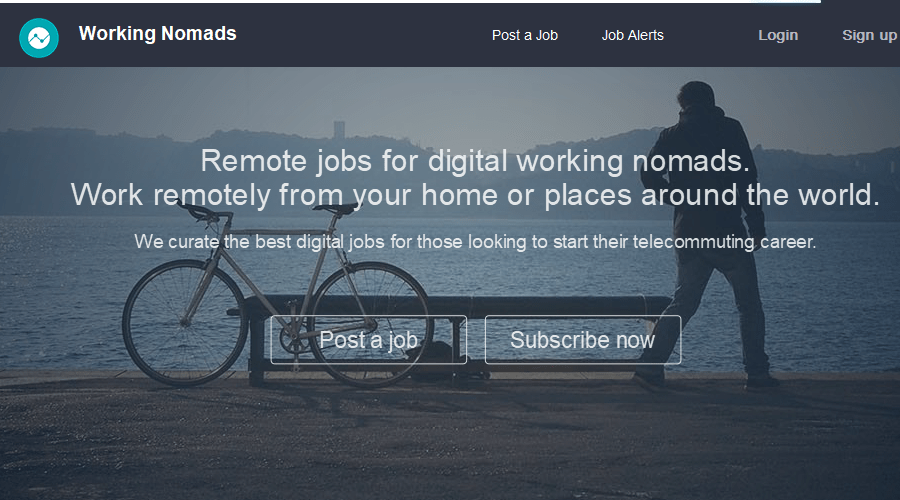
Working Nomads

WorkingNomads.co curates lists of the most interesting remote job offers in many professional career areas. We connect professionals who want to work remotely with innovative companies offering independent positions. Working nomads is a remote job board with a curated list of reliable remote positions from around the world. 

Working Nomad has several fields of jobs. You can find new updated job postings every day in many different areas such as development, management, marketing, design, sales and so on. You have choice of temporary projects or regular employment. A remote career is flexible kind of work and most of their job postings are fully remote with availability to work from anywhere in the world. For recruiters, one job posting costs $149 and a free service for job seekers.

The reviews have been positive till now. Yet, always remain cautious about the information you give, clear every suspicion without fear, and be within safe limits by keeping in touch with HR.

How much salary does Cognizant pay to software engineers?

Photo by Christina Morillo on Pexels.com

According to the JobBuzz data, here is the compensation of software engineers that Cognizant offers.

1. Software Developer/ Programmer
Software developers obtain compensation of Rs 2,73,617 per year on the minimum level and Rs 8,58,340 per year on the maximum level. The average salary of a software developer is Rs 4,84,968 annually.

2. Data Warehouse Developer
Annually, the minimum and maximum salary for a data warehouse developer are Rs 2,93,821 and Rs 9,47,472 respectively. The average compensation for the candidates is around Rs 5,30,472 per year.

3. Software Testing Engineer/ Test Automation Engineer
Software testing engineers obtain a salary of Rs 4,74,120 per year. The minimum and maximum compensations are Rs 2,43,227 and Rs 8,11,764 respectively depending on the experience of the candidates.

4. Tech Architect
On average, the salary of a tech architect is Rs 12,04,353 per year. The minimum and maximum compensation depending on the experience of the candidate are Rs 3,31,666 and Rs 23,38,366 annually.

5. Software Quality Assurance Analyst
Software quality assurance analyst compensation is around Rs 4,70,236 per year on average. The minimum compensation is Rs 2,52,693 per year and the maximum is Rs 8,02,490.

Developers dread these programming languages, but which one pays the most?

A portion of the report ranks programming languages by their correlating developer salary. If you’re looking to get paid well, it might be worth your time to learn Clojure and maybe not Dart

office.jpg
Image: GettyImages/RyanJLane

On Monday, Stack Overflow published the results of its 2021 Developer Survey. The findings highlight a range of sentiments and economic information such as developer attitudes toward specific “dreaded” languages and how much certain programming languages pay on average. So, which programming languages do developers love, and which one should you learn if you want to get paid top dollar?

Top programming languages: Loved, hated and wanted

Overall, the results are based on a global survey conducted in May and June of this year involving more than 83,000 software developers. Rust topped the list in terms of languages developers love versus the options they dreaded, with 86.98% of responses saying they loved Rust compared to the 13% of responses who dreaded it. Clojure ranked No. 2 in this regard with 81% of respondents saying they loved the language versus 18.88% who dreaded it.

Interestingly, there’s a marked drop-off between the top two and the rest of the field. TypeScript ranked third with 72.73% of respondents saying they loved the language versus 27.27% who dreaded it. In order, Elixir, Julia, and Python round out the top six.

On the other end of the spectrum, Cobol ranked at the least loved programming language, with 84.21% of respondents saying they dreaded it, versus 15.79% who loved it. In order, VBA, Matlab, Objective-C, Groovy and Assembly sat at the bottom of the list as the top six most dreaded programming languages.

A portion of the report identifies the programming languages developers wanted to have in their arsenal. Stack Overflow determined these languages based on the percentage of “developers who are not developing with the language or technology but have expressed interest in developing with it.” Python topped the list by a wide margin with 19.04% of respondents wanting the programming language, followed by runner-up TypeScript (15.29%). In order, JavaScript (14.59%), Go (14.54%), Rust (14.09%) and Node.js (11.9%) round out the top six most wanted programming languages.

“Rust is the “most loved” language for the sixth straight year, and Python was the “most wanted” for the fifth straight year. Though it’s not as “new” as Rust, Python is easy to learn and applicable across industries. It’s one of the most widely implemented languages, and programs tend to be clear and readable,” said Khalid El Khatib, SVP of marketing communications at Stack Overflow.

Top paying programming languages

A section of the report ranks programming languages by their correlating developer salary. To determine this figure, the survey asked respondents to list their total compensation. Clojure topped the list at $95,000 nearly $14,000 higher than runner-up F# ($81,037). Elixir and Erlang both garnered the same pay ($80,077) followed by Perl and Ruby, with both also earning the same pay ($80,000). On the economic flip side, Dart sat at the bottom of the list at $32,986, just a few grand below PHP ($38,916).

GREEDINESS – A HEART ISSUE!!!

Greediness is the path of destruction of people. When people are greedy, they are blinded by the wrong actions and never be able to come of from that without a constant effort. To make you understand easier, I brought you a story written by C. Rajagopalachari who is was the last Governor-General of India.

Quotes about Being Greedy (39 quotes)

The protagonist of the story is Rammaya. He is a simple man living with his wife in a nice house made of tiled roof in a small town. Though he is not rich, he could take care of this family well. There lived two sparrows in the nice spot of the tiled roof of Rammaya’s house adn the mother bird has laid its eggs in the nest.

The male sparrow asked the female why Ramaya’s wife often quarrel with Rammaya. The female replied how could I know and told the male to mind its own business. Then the male sparrow said, you are always self-centered and also asked whether thy could help Rammaya. The female sparrow replied aggressively “don’t talk about the matter that does’nt concern us. It is enough for us if the cat doesn’t come to us”. Here comes the main twist.

The male sparrow picked a diamond nose-jewel somewhere from the land. As soon as picking it, went to its nest and asked the female bird ” Do you like it?” The female replied, what could I do with this diamond jewel. It scolded the male to bring food for the young ones. this male bird dropped the diamond jewel in the house and went to search food for the young ones.

Rammaya’s wife noticed the stud while sweeping the floor. She didn’t think of anything and with delight she wore it. Ramaya became angry and asked her how did she get that diamond stud. She replied causally that she found it and so she wore it. Rammaya insisted her to hand it over to the village magistrate. He also said, if police come and search for it, it will be a disgrace for us.

In the neighbourhood, the talk begun about the lost diamond-stud. The owner of the stud is Meenakshi Ammal’s daughter. She consoled the little girl and also said not to tell her father. If he knows he would in rage, said Meenakshi Ammal. But this talk was heard by the little girl’s father and it has to be admitted. The suspect was the maid-servant Kuppayi. The police searched her but could find nothing. After hearing this, Rammaya was very timid and his wife put the diamond ring in a safe place. Soon after that she had severe fever and was kept in the bed. So no one searched their house.

The male sparrow said, the lady of the house is scared and is down with fever. Replied the female sparrow, it is solely due to your doing. THe male answered bravely, “Did I ask her to steal it?” THis is because the humans are bound to be greedy. The female appreciated the male and said that we should never be greedy for what belongs to others.

The story came to an end by, Rammaya and his wife lived their whole life with the fear of being caught. THe diamond-stud may be with them but the fear of getting caught is more than that.

The thing I understand from the story is, We humans have six sense yet we don’t have conscience. We are greedy and not being truthful and helpful to others. We know birds have only five senses. Do think about the birds and humans. The birds aren’t greedy forwhat doesn’t belong to them. But the humans are greedy.

Even if you don’t help otherrs, try not to be greedy!!!