INTERNSHIPS

The internship is the main source for a college student to improve and prove his/her knowledge.

Every college student has composed placements and off compose placements.

At the time of placements in a different company, we have to submit our Resume. That resume gives our real appearance to interview. If we have done any internships and any skill development that will help for our desired company placements.

Lets more about internships

Internships is the training and real-time project to the confidence of our skills for real-world understanding

 The internship is an opportunity offered by an employer to potential employees, as an intern, to work at a firm for a fixed period of time. Interns are usually likes undergraduates or students, and most internships period last between a month and three months. … An internship can be either paid or voluntary.

Which internships we have done?

Internships are based on your desired knowledge, department and day by day improved courses

Things to consider when choosing an internship

  • Which sector are you interested? …
  • What will be your responsibilities? …
  • What will you will get ? …
  • Where you have to do? …
  • What’s the environment like is it comfortable ? …
  • Will you get the opportunity to more network? …
  • What are the skills will you learn? …
  • What are your qualifications for ?

Let specific directions for your internships

There are some websites for internships that may have offline and online internships :

  • Linkedin
  • Glassdoor
  • Google
  • Internshala
  • Internship.com
  • Internmatch.com
  • Youturn
  • Idealist
  • Global Experience
  • Coolworks

Go for these websites you will find “updated(your name) version.0”

The Spanish Inquisition: A Turbulent Time

What was the Spanish Inquisition?

The Spanish inquisition was a judicial institution that prevailed in Spain from 1478 to 1834. It was set up through the Catholic church to root out and punish any heresy (religious beliefs that differed from those prevailing at the time, in this instance Catholicism) being practiced in the country. In each region of Spain, tribunals comprising of Catholic officials were set up to perform the functions of the inquisition. This system was aimed at consolidating power and establishing control in the country, but today the reputation of the inquisition is that it was an extremely brutal and turbulent time in Spanish society.

What happened during this time?

The Spanish inquisition is a well-known historical event but for reasons that should not be praised. It marked a period of violence and intolerance. The people working for inquisitions were called inquisitors. They would arrive in a town, and announce their presence to all the townspeople. Any heretics present in the town would be given a chance to confess, and thereby receive punishment which ranged from whipping to pilgrimage and repentance. Any person who was accused of being a heretic was forced to admit to it, and in case they did not voluntarily confess, they would be subject to violent torture and even execution. More often than not, people were victims of false allegations of being a heretic, but there was no formal court procedure or trial and the mere suspicion of being a heretic was enough to enforce severe punishment. Once a person was accused, even if falsely, there was no escaping either torture, imprisonment, or death. So, many people would end up confessing early on, even if they weren’t actual heretics, to say themselves from any severe consequences later on. This shows how much fear and tyranny was present in society at that time.

This period also represented one of xenophobia and parochialism. When the inquisition began, Spain was a very diverse country, both ethically and religiously. Many different communities like the Jews, Muslims and Christians all lived in harmony in the same regions. The objective of the inquisition was to eradicate such people from Spain who did not identify with the Catholic church and its beliefs. For more than 350 years, people who were not Catholics were subject to torture and exile from Spain.

We can clearly draw a comparison here to Nazi Germany under Hitler’s dictatorship, where only white people of the Aryan race were allowed to live in the country while others were deported or killed in cold blood. In both cases the victims were subject to inhumane torture and suffering. Also, the Jewish people were the major victims in both situations. Under the inquisition, Spanish Jews were forced to either convert to Catholicism or leave Spain entirely. Even those who converted, called the ‘Conversos’ were not safe as they were constantly under suspicion of secretly practicing Judaism while using Catholicism as a disguise. Eventually focus shifted to Muslims converting to Christianity to save themselves, called the ‘Moriscos’. In 1609 they were all ordered to leave Spain entirely.

Any punishments to be given were done so in public for everyone to see, and they were called ‘acts of faith’. It was meant to show the public what it means to defy the Catholic church and their beliefs, and why they should not follow any other ideology. In the worst of cases, where there were unrepentant heretics, they would even burn them alive at the stake for all of the public to witness.

Conclusion

Eventually in 1834, the inquisition was put to an end and the Catholic church’s power diminished in Spain. However, we cannot disregard the damage that had been caused in the 350 odd years. Thousands of people were tortured, killed or exiled from their homes in Spain. They were stripped of their land and wealth, and left homeless and poor. Many religious minorities had to flee from Spain, leaving behind their home land and all that they knew, while those that remained faced discrimination and suffering at the hands of the inquisitors. Not only mainland Spain, but even the Spanish territories like those in America had their own smaller inquisitions that took their own tolls (Mexico, Peru). However, as time progressed, so did political thinking, and Spain realized its mistake in introducing such a violent system and removed it. Today, Spain is a tolerant and accepting country with diverse groups of people all living in harmony.

Human rights

The twentieth century has seen numerous changes in Indian society in each field. The world itself saw two World Wars, numerous other enormous and little show-downs, cold-war, and rise of fundamentalism and psychological warfare which has ended up a risk to respectful society. The improvement in science and innovation has made life more comfortable but expanded the damaging capacity of fighting to such tall extents that the world appears to be living on a load of explosives and may self-destroy it one day. Man appears to have misplaced himself in this fabric world.

Coming back to India, it saw the heightened of flexibility battle within the starting of the final century, picked up autonomy halfway through it and experienced quick socio-economic changes. It has been able to preserve its mainstream majority rule nature and structure. But at times our commitments to preserve human rights were tried to the total.

The unstable circumstances in Kashmir, Gujarat and a few other delicate regions and indeed regularly serene ranges at touchy times have raised certain questions that got to be replied. Questions like: Has India been able to ensure human rights? In the event that there have been laxities or disappointments, how can they be evacuated? Do the barefaced charges against the nation, of having fizzled to secure human rights hold water or they are fair a portion of political purposeful publicity? And at long last what steps have been taken by the government to ensure that these rights are not abused? These questions got to be replied within the right point of view some time recently coming to a agreement whether human rights are secure in our nation. And more critically, what ought to be done to preserve and reinforce them.

There are two conclusions on the matter that India incorporates a convention of maintaining human values and securing human rights. The Father of the Country, Mahatma Gandhi wandered as distant as South Africa to battle for the cause of the neighborhood dark individuals. The Indian people’s possess battle for flexibility was extraordinary in it and expected more noteworthy size when observed within the higher viewpoint of putting an conclusion to the abominations and persecutions allotted out by outside run the show to humankind living in a nation.

It was, in this manner, in right sincere that after accomplishing autonomy; India was made a Imperial Equitable Republic. The six Essential rights, i.e. (i) Right to Uniformity, (ii) Right to Opportunity, (iii) Right against Abuse, (iv) Right to Opportunity of Religion, (v) Social and Instruction Rights and (vi) Right to Protected Cures were revered within the Structure. Other than, there has been a authoritative gathering at the State and the Parliament at the Middle to sanction laws from time to time for social and financial equity and improvement.

There’s an free and effective legal framework for security of rights of the citizens. Consequently, right conditions and an satisfactory set-up were made for tranquil, legal and dynamic presence for everybody with small or no scope for infringement on human rights.

In this way, we have a solid convention and protected backing to guarantee upkeep of human rights. But this does not cruel that there have been no laxities within the framework. There’s no dissent of the truth that there have been outright infringement of human rights ‘n a few parts at a few period of time like Delhi in 1984, Godhead m 2001 and J&K in 1980’s and 1990’s. It is germane to say here that distinctive communities have been at the accepting conclusion of such infringement totally different times and regions, with each community announcing to be the most exceedingly bad sufferers. But we are able call these episodes laxities not disappointments for the basic reason that they have been intermittent occurrences not a State incited orders of genocide like those of the Jews in Nazi Germany. By and expansive individuals themselves have been mindful for making ruin on target bunches. State has continuously stood for casualties and fortification of law and arrange.

The government’s execution in this respect has gotten wide spread feedback from different quarters. But in all reasonableness, we must to begin with of all have a see at the steps taken to preserve human rights.

The National Human Rights Commission was made in October 1993 which is an expression of India’s concern for security and advancement of human rights. It has developed as a lasting body having crucial teacher interface with the Minorities Commission, the Women’s Commission and the SC’s and ST’s Commission. Its primary capacities are counted underneath:

The creation of an autonomous commission laying down a appropriate framework and strategy for its work and bringing all the related issues inside its scope and control talks volume approximately the government’s concern to set up equity and run the show of law.

The Commission has its claim staff for conducting examinations into complaints of human rights infringement. It can moreover use the administrations of experts or examining offices of Central or State Governments. The Commission has moreover related itself with Non-Governmental Associations (NGOs) in examination work. It fixes time limits for accepting data or report falling flat which it goes before on its claim and orders indictment or such other activity against the charged for which it can approach and include the State Tall Court or the Preeminent Court.

It may suggest to the concerned specialist or government the give of such prompt intervals alleviation to the casualty because it may think fundamental. The Commission too has the control to go before in movements or petitions of charges of human rights infringement by equipped powers.

That the government has made it official on itself to show its activity taken report on the suggestion of the Commission bears declaration to the truth that the government isn’t as it were sharp to ensure human rights but moreover genuine around making an independent body which might make an air of believe on it among the individuals of India. The government needs to appear that it is its obligation to preserve legitimate open arrange and peace.

The destinations and circles of the Commission moreover incorporate security of planned castes and tribes as these classes have endured colossally for numerous centuries in terms of barefaced segregation and abuse. The Commission knows the esteem of locks in Central and State Governments, NGOs, common teach and other components of respectful society in its campaign to battle separation.

Since its initiation in 1993, the National Human Rights Commission has fared surprisingly well in its targets. It has kept on get and change various person complaints from people strikingly Davits and Exhorts against the affirmed acts of segregation, untouchability, savagery against human creatures, outrages of different sorts and high-handedness of open hirelings, etc. The Commission is exceptionally much able of managing successfully the issues like Godhead carnage and other ethnic and devout issues.

The exterior universes as well as the depreciators at domestic are fast to criticize that the episodes of expansive scale departure of Kashmiri Pandits from the valley are clear signs of the destitute state of undertakings within the nation with respect to human rights.

We may say that the travel to conclusion human abominations in a world which is isolated by financial inlets and devout convictions is long and testing. In India as all over else within the world, history and society have seen carnage and genocide. As we walk towards civilization and advance, there’s more extensive condemnation of savagery executed by devout or political intensity. What is vital is to figure it out the encourage to regard human rights as a national obligation, a ethical basic and God’s decree of all inclusive brotherhood. Nothing else things more.

Bose-EinsteinCondensate The 5th Matter

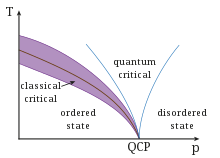
QuantumPhaseTransition.svg

In condensed matter physics, a Bose–Einstein condensate (BEC) is a state of matter (also called the fifth state of matter) which is typically formed when a gas of bosons at low densities is cooled to temperatures very close to absolute zero (−273.15 °C or −459.67 °F). Under such conditions, a large fraction of bosons occupy the lowest quantum state, at which point microscopic quantum mechanical phenomena, particularly wavefunction interference, become apparent macroscopically. A BEC is formed by cooling a gas of extremely low density (about one-hundred-thousandth (1/100,000) the density of normal air) to ultra-low temperatures.

This state was first predicted, generally, in 1924–1925 by Albert Einstein following and crediting a pioneering paper by Satyendra Nath Bose on the new field now known as quantum statistics.

This transition to BEC occurs below a critical temperature, which for a uniform three-dimensional gas consisting of non-interacting particles with no apparent internal degrees of freedom is given by:{\displaystyle T_{\rm {c}}=\left({\frac {n}{\zeta (3/2)}}\right)^{2/3}{\frac {2\pi \hbar ^{2}}{mk_{\rm {B}}}}\approx 3.3125\ {\frac {\hbar ^{2}n^{2/3}}{mk_{\rm {B}}}}}{\displaystyle T_{\rm {c}}=\left({\frac {n}{\zeta (3/2)}}\right)^{2/3}{\frac {2\pi \hbar ^{2}}{mk_{\rm {B}}}}\approx 3.3125\ {\frac {\hbar ^{2}n^{2/3}}{mk_{\rm {B}}}}}

where:

{\displaystyle \,T_{\rm {c}}}is the critical temperature,
\,nthe particle density,
\,mthe mass per boson,
\hbar the reduced Planck constant,
{\displaystyle \,k_{\rm {B}}}the Boltzmann constant and
\,\zeta the Riemann zeta function; {\displaystyle \,\zeta (3/2)\approx 2.6124.}\,\zeta(3/2)\approx 2.6124. 

Interactions shift the value and the corrections can be calculated by mean-field theory. This formula is derived from finding the gas degeneracy in the Bose gas using Bose–Einstein statistics.

Superfluidity of BEC and Landau criterion

The phenomena of superfluidity of a Bose gas and superconductivity of a strongly-correlated Fermi gas (a gas of Cooper pairs) are tightly connected to Bose–Einstein condensation. Under corresponding conditions, below the temperature of phase transition, these phenomena were observed in helium-4 and different classes of superconductors. In this sense, the superconductivity is often called the superfluidity of Fermi gas. In the simplest form, the origin of superfluidity can be seen from the weakly interacting bosons model.

TACHYON A PARTICLE THAT HELPS US TO TIME TRAVEL…

Tachyonhypothetical subatomic particle whose velocity always exceeds that of light. The existence of the tachyon, though not experimentally established, appears consistent with the theory of relativity, which was originally thought to apply only to particles traveling at or less than the speed of light. Just as an ordinary particle such as an electron can exist only at speeds less than that of light, so a tachyon could exist only at speeds above that of light, at which point its mass would be real and positive. Upon losing energy, a tachyon would accelerate; the faster it traveled, the less energy it would have.

The name ‘tachyon’ (from the Greek ‘tachys,’ meaning swift) was coined by the late Gerald Feinberg of Columbia University. Tachyons have never been found in experiments as real particles traveling through the vacuum, but we predict theoretically that tachyon-like objects exist as faster-than-light ‘quasiparticles’ moving through laser-like media. (That is, they exist as particle-like excitations, similar to other quasiparticles called phonons and polaritons that are found in solids. ‘Laser-like media’ is a technical term referring to those media that have inverted atomic populations, the conditions prevailing inside a laser.)

an experiment at Berkeley to detect tachyon-like quasiparticles. There are strong scientific reasons to believe that such quasiparticles really exist, because Maxwell’s equations, when coupled to inverted atomic media, lead inexorably to tachyon-like solutions.

“Quantum optical effects can produce a different kind of ‘faster than light’ effect (see “Faster than light?” by R. Y. Chiao, P. G. Kwiat, and A. M. Steinberg in Scientific American, August 1993). There are actually two different kinds of ‘faster-than-light’ effects that we have found in quantum optics experiments. (The tachyon-like quasiparticle in inverted media described above is yet a third kind of faster-than-light effect.)

“First, we have discovered that photons which tunnel through a quantum barrier can apparently travel faster than light (see “Measurement of the Single-Photon Tunneling Time” by A. M. Steinberg, P. G. Kwiat, and R. Y. Chiao, Physical Review Letters, Vol. 71, page 708; 1993). Because of the uncertainty principle, the photon has a small but very real chance of appearing suddenly on the far side of the barrier, through a quantum effect (the ‘tunnel effect’) which would seem impossible according to classical physics. The tunnel effect is so fast that it seems to occur faster than light.

“Second, we have found an effect related to the famous Einstein-Podolsky-Rosen phenomenon, in which two distantly separated photons can apparently influence one anothers’ behaviors at two distantly separated detectors (see “High-Visibility Interference in a Bell-Inequality Experiment for Energy and Time,” by P. G. Kwiat, A. M. Steinberg, and R. Y. Chiao, Physical Review A, Vol. 47, page R2472; 1993). This effect was first predicted theoretically by Prof. J. D. Franson of Johns Hopkins University. We have found experimentally that twin photons emitted from a common source (a down-conversion crystal) behave in a correlated fashion when they arrive at two distant interferometers. This phenomenon can be described as a ‘faster-than-light influence’ of one photon upon its twin. Because of the intrinsic randomness of quantum phenomena, however, one cannot control whether a given photon tunnels or not, nor can one control whether a given photon is transmitted or not at the final beam splitter. Hence it is impossible to send true signals in faster-than-light communications.

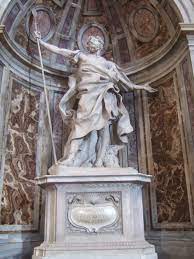
Pin on The Laws of Relativity

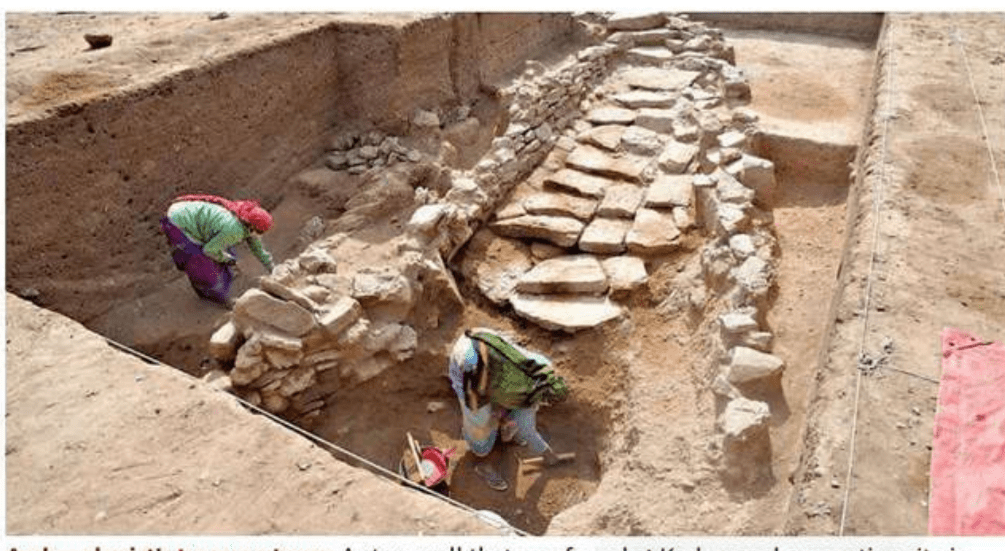
2300 year old step well found near Erode

Kodumanal Excavation site

• Located – Erode, a district in Tamil Nadu.

• Northern bank of the Noyyal river – Tributary of River Cauvery.

• Excavation – Megalithic period; Early historic period. • Habitation-cum-industrial site.

• Excavations since 1981.

• Industrial complex – beads and semi- precious stones were manufactured.

• Iron smelting units – forged steel at the site.
• Trade centre – 5th – 1st BCE. • Village – Chera capital of Karur with the Chera port of Muciri in Pattnam in Kerala.

Excavations

• Circle-shaped step-well – found for the first time. • Scientific dating – 2,300 years old.

• 2020 – Rubble masonry wall of 3.5 metres – waterway.

• Current excavation – trench was dug near the
last year’s trench • Result – Discovery of the well.
• Well – 2.65 metres wide; Depth – deposits were
removed.

• Steps – weathered rocks, slopes down from the
ground to the well that served the habitation.

• Two rubble masonry walls existed on either
side of the steps.

• Site – habitation come industrial site
 Water – Used both for household needs as
well as for polishing beads and other industrial activities.
Other Findings:
 Pottery – Black and red ware, black slipped
ware, russet coated ware and red slipped ware.
 Beads – Quartz and clay.
 Potsherds
 Megalithic cairn circle
 Iron sword
 Double edged axe
 Small daggers

DIGNITY OF LABOUR

“No work is insignificant. All labor that uplifts humanity has dignity.” Martin Luther King, Jr.

EVERY WORK MUST BE GIVEN HONOUR

The word ‘dignity’ means the ‘quality of being worthy of honour or respect So the expression ‘dignity of labour’ means honour or respect’ received through or for hard work. That is why it is said that ‘work is worship’. Every type of work need labour, physical or intellectual. But the word labour’ is generally used in the sense of physical labour which is as important as intellectual labour. The production of cereals, construction of buildings and the other constructive work require physical labour. Man cannot do without hard labour. So, he should do all types of work.

WRONG NOTION ABOUT MANUAL LABOUR

But the attitude of the educated and the gentlemen towards manual labour is wrong. They are of the opinion that manual work is fit for the illiterate men only. But they are mistaken. All intellectual work involves some sort of physical labour. Even a student has to labour hard to pass the examination. All artists, scientists and writers whose work is intellectual have to spend hours with patience. The manual work too needs the exercise of intellect. A carpenter, an ironsmith, a goldsmith, a barber, etc. whose work is physical have to exercise intellect to improve the quality of their work.

MANUAL LABOUR: THE ROOT OF ALL PROGRESS

And it is the manual labour which is at the root of all progress. It is rightly said that true labour never goes in vain. Labour has its own importance. Nothing can be achieved in the world without labour. The prosperity of a country depends on its agricultural products. So, there is no humiliation in the cultivation of land. The people of the West do their work themselves. They look upon labour as something honourable and sacred. Such is the importance of labour that its dignity is recognised by all. It is the source of health and happiness.

Aristotle’s view on the Tragic Hero [Part B]

Along the same lines of how a tragic hero need to be an enabler for not just a good plot but to reach for the desired set of emotions equally is 5) Hamartia a tragic hero with imperfections; the specific being his/her “tragic flaw” not the best adaptation of Hamartia, but is far more commonly used for a characteristic moral failing in an otherwise predominantly good man. The Hamartia of the hero is closely and inseparably connected with 6) “Peripety” the several of fortune from the point-of-view of the character involved and for a spectator or a reader the plot of the play as a whole is a reversal of the direction of the action. The analogy is thus that Peripety is contained in the idea of the boomerang effect of one’s own action. 7) Discovery – “A change from ignorance to knowledge.” The discovery of the truth of the matter is the costly beginning from the state of ignorance which is the very essence of “hamartia”. Hamartia, Peripety and Discovery all together in their ideal schematisation of the tragic plot.
Furthermore, tragedy, is presupposed as purging out of emotions of Pity and Fear i.e. Catharsis; exhilaration, a pleasurable sense of relief and the Tragic hero is given the title of the enabler of the purgation of these emotions. Relation of emotional catharsis which tragedy helps generate is the tragic pleasure. Therefore the continuous insistence towards Pity and Fear is because pity is generated under the pretence of a tragedy towards the character whose punishment for the audience is exceeding his crime; the punishment is more that what he deserves, and similarly Fear is when the hero; who being “not pre-eminently just and virtuous” is still better than ourselves and yet failed, then what hope do we have left?
Therefore the catharsis that Aristotle mentioned just once in Poetics is of emotions that occurs accidentally but surely in a tragedy is something he elaborates on, this accident is to be experienced to everyone in the audience or to anyone reading a work of art; no 

matter of high intellect does experience this form of proper pleasure which happens through proper tools and albeit perceived to be an “accident” is a sure shot guaranteed by the tragic hero.
Thus the tragic hero of Aristotle accounts to the whole of the Tragedy to be brought up to its potential and serve its purpose.

Aristotle’s view on the Tragic Hero [Part A]

Make sure you also read the second part of this post.

When Aristotle is talking about the tragic hero, it’s important to pan out where the tragic hero is being placed at and accordingly the significance of the ‘tragic hero’ needs to be questioned. This is furthered by the interpretation of the plot and the use of tragedy in the said plot that would give the idea of what Aristotle is describing as the tragic hero. So it’s important to understand tragedy; before anything, and so Poetics seems to be a plausible guide alongside plenty of other definitions within a dictionary which although correct; doesn’t fully help apply the idea of Aristotle. No-one in any absolute sense could define what Poetics denote as words have been genuinely lost in translation and what we could scavenge are a sense of one’s own point-of-view or interpretation to pacify their intellect; one could contest it to be inconsistent and probably is right in doing so, but the fact of the matter is the idea of lost in translation remains undeterred. 

Additionally, discussing on the characteristics of the tragic hero is an extremely elaborated idea of what Tragedy is and while, Aristotle’s Tragic Hero is someone who is primary agent in his Tragedy; which is an essential element in the notion of arousing Pity and Fear – the catharsis of Pity and Fear for Tragic Pleasure is also an important characteristic feature for the Tragic Hero. 

Humphrey house affirm seven points directed towards the dramatic character or the tragic hero 1) The tragic hero or the character in a tragedy must be Good. Tragedy is a limitation of personages better than the ordinary man. Hence goodness of character is a prerequisite for Aristotle as it is the foundation of initial sympathy in a spectator without which tragic emotions cannot be roused, that is tragic pleasure is ultimately conveyed through sympathy or Pity, a very basic of the whole tragic pleasure. All characters in a tragedy for Aristotle should be equivocally good. Although Aristotle’s good man is not good unless he is desiring specific, positive, good ends and working towards the attainment; therefore its necessary for the execution of a tragic plot that the hero has to be “not prominently virtuous or just”; adding here Immanuel Kant who talks action to be morally worthy, something that should be executed to do the right thing for the right reason and is said to hold that to do the right thing for personal reason isn’t morally right and that the motive of duty should be autonomous and not altruistic. Scholars have questioned on what does Aristotle mean by “good”, and it’s later when reading Poetics is established on the Ethical Goodness of a character. 2) Appropriateness of Character – a fitting character, the Plot should attempt to guarantee the individuality of Character in compliance to its status which is fundamental. 3) “Likeness” of Character – the literary portrait produced by the poet should be ‘like the original’, i.e. like what the personage in question is in history of legend; depriving the poet of his creative freedom and ties him to a quiet indefinable exemplar, because history and legends are largely the creation of other writers. Likeness — Aristotle differentiating Tragedy and Comedy by the consideration of type of characters shown acting in each — characters are either better or worse than ourselves, or just like ourselves: although Comedy makes its personages “worse” and Tragedy makes its personages “better than the men of the present day.” 4) Consistency – Aristotle describes a formula “consistently inconsistent” it is not concerned with momentary conflicting passions but with “the basis or foundation of a character “, — habit, bent or tendency. 

Longinus on ‘the Sublime’

In terms of its influence in modern literary criticism, aesthetics and philosophy of art, Longinus’s Theory of Sublime is a very critical piece of work. He is placed second to Aristotle’s Poetics by many scholars. Peri Hypsous is simply a rhetorical treatise offering an especially strong inclination of the awe-inspiring or high style of quality writing siding with the glories of written literature. 

The ownership of the treatise is a debate since its emergence during the Italian Renaissance with several manuscripts around until the initial publication by Italian humanist and philologist Francesco Robortello shaping the pre-existing dominant ideas in the world of literary criticism by Horace and Aristotle. The Theory of Sublimity is considered to be subjective as well as intersubjective on account of literary practice. The entirety of Longinus’s work is constructed over the notion of expressing greatness in one’s language and that being an important precursor for a writer, it also adds to what his predecessors helped shape the art of writing and diction. Longinus’s approach is characterised as distinctive and original on its precisely subjective drift: its focus on the creative and receptive facet of verbal arts, on the wit of the writer and affect on the audience is a crucial role of the text.
In western thought, the theory of Hysous is seen at length from its production contesting that the theory doubles itself as a theory of Genius. Longinus has also successfully inclined towards sublime being considered as a dual experience of simultaneously being overwhelming and elevating, dominating and exalting.
We are acquainted with the five forces of Sublimity; 1) Grandeur of thought and ability to form grand conception & 2) Powerful and inspired emotions – These are related to writers innate or natural capacity. 3) The effective use of stylistic & rhetorical figures as a means of increasing emotional impact of literature, 4) Noble diction & phrasing — the skilful use of metaphors and other figures of speech & 5) Dignified & elevated composition, most effective arrangements of words – is an artificially gained tool for achieving sublimity. The nurtured virtue in an author who must skilfully cultivate into the feeling in what he/she writes is proposed as; Sublimity as the echo of noble mind, could be a viable thought. “Sublimity is” for Longinus, “a kind of eminence or excellence of discourse. It is the source of distinction of the very greatest poets and prose writers and the means by which they have given eternal of their own fame.” It’s a discussed that the hypsous is intrinsically related to logos — translated as discourse; that the thought and diction — is inherently linked to the nobility of supreme and that a piece of art containing flashes of Sublimity — for a text need not be dripping in Sublimity but its position could be elevated with just these flashes — is universal and transhistorical.
The Sublimity of a text is acknowledged by its affect; its feeling and emotion, and so the most consequential way of defining sublimity of a text is by describing its affect on the audience.

Ideology defined by Louis Althusser

Figuring out what Ideology is, when understanding these Marxist terminology, it’s important to look at these ideas not as obsolete reality but an ever evolving pervasive concept. Karl Marx, has his own definition of Ideology as ideas and beliefs set out by the dominant class of a society for everyone to obey and thus justify the actions of the dominant class in any society. Here, Louis Althusser sets out with his own interpretation and has worked in “On The Reproduction Of Capitalism: Ideology And Ideological State Apparatuses”, that;  i) Ideology has no history, it is eternal; ii) Ideology represents the imaginary relationship of individuals to their real conditions of existence; iii) Ideology has a material (or spiritual) existence; iv) Ideology interpellates individuals as subjects. The four of these points become a pinnacle to what Althusser insists in the nature of Ideology.

These 4 parameters help us understand its nature, to what Ideology represents, for when man entered the state of nature, by subscribing to ideas and beliefs, we subscribed to this ideology, which though speaks of, no history  in itself, it’s still is an  implicit force that drives the Capitalistic existence, although  omnipresent. And leading on  to the second point, that “men represent their real conditions of existence to themselves in an imaginary form”. Who one is, is just another fragmented idea of you, which Lacan also states in the Mirror Stage and this is crucial in the understanding of this idea as well, that ideology works within multiplicity of narratives, conscious or unconscious, that shapes or has the ability to shape one’s identity. When the material existence of ideology is brought up, it is the material practices, ritual, and action that works under Ideology, unsuspecting and yet controlling one within their grasp. And lastly, Althusser believes, ideology interpellates individuals as subjects – their subjection to the category of subjects. There is no ideology except by the subject and for subjects, which by working seamlessly and weaving thoroughly over the three previous paradigms to concreticise the concept of ideology. 

One could say, Althusser’s insight about the “social unconscious” when it comes to assessing the concrete political realities and struggles, is thus become not just another crucial point to define and understand Ideology, but in itself a very significant negotiation of the concept of ideology in itself. 

Getting New Tempo of Life from Nanak Singh

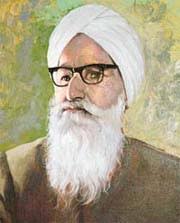
Nanak Singh 1998 stamp of India.jpg
Nanak Singh (Source: Wikipedia)

Looking Back to inmost salient lion from North-west corner of India:

The milieu where we are going through, reminds us of such a beacon whose life was out of the world of ceramic painting. In the prevailing situation in where myriad of youths are gloomy and distracted, all the deluge of depression and ‘break-up’ with our soul & courage, that poet-cum-author pillages our interest towards his escapade in the worrit situation he passed through, not lying on fortune’s lap.

“It seems to imply that in the lifeblood of our society, red corpuscles have disappeared.”

From Novel Chitta Lahu (White Blood), by Nanak Singh

Yes, we are talking about that very Panjabi author — Nanak Singh. This Indian poet, songwriter & novelist of Panjabi language made a royal entry to this world on the 4th July, 1897 through a poor Punjabi Hindu family. His literature produced crackles in the period of India’s Independence movement. If we take a magnificent lens on the pages of Modern Indian History, Nanak Singh was more prominent of them who wanted to eliminate the dual mentality of that ‘babu’ who went soft on the fierce deeds of the British.

The revolutionary identity got influenced and involved in the Jallianwala Bagh Massacre. On that auspicious day (April 13, 1919), of Punjabi New Year, Singh saw a lot of kin shot to death by the British troops, even two of his friends drooped on his lap for their last time. Then the author entity of Singh’s inner mind erupted in anger — invented an epic poem, mocking colonial rule — “Khomeini Visayans” (Bloody Baisakhi) from native heart. While conducting ‘Akali Movement’, in charge of the editor of ‘Akali’ papers, he became the subject of crimson eyes of the British — that resulted in the imprisonment of that new leader. In the meanwhile, he converted himself into Sikh. Hence, he portrayed the savagery and ‘legal violence’ of the British on peaceful Sikhs — and published his second anthology called “Zakhmi Dil ” (1923), which got banned within a fortnight of its publication, as expected.

Implementation of Singh’s Views in Present time:

This legend’s natural inclination towards protest against coercion, unjust & inequitable feud, as well as bluffing at every step, pulled him to pick-up ink as well as the flag of Mother India. Under Singh’s tenure, both the fallacy of British & dogmatism of Literature (specially in regional languages) got curtained. Yes, we agree delightfully that the British are no longer in power in India. But the orthodoxy, bigotry & undesired fanaticism has prepared a lot of arrest warrants for Indians. This situation reminds us of that nonesuch person:

Who escaped the boundary of patriarchy — implemented the quote of Lalan Fakir in reality —

“Everyone Sees Male & Female/ But, I see Only Humans” 

“সবাই দেখে নারী পুরুষ, আমি দেখি শুধুই মানুষ”

Lalan Fakir

We get a lot of views in his novels.

Nanak Singh (Source: ‘The Watchmaker‘ book written by Singh & translated by Navdeep Suri)

He’s Nanak Singh, whose voice was full of courage & pluck that successfully punctured British’s confidence, gives a message to us to belabor the deception of socio-political hand-cuffs. In his writing, always one thing got itself highlighted — the search for celestial happiness through fraternity, integrity & Liberty. 

However, all Indians, not only Panjabis draw inspiration from this icon who gives birth to every Indian from the previous fluffy life of usual inertia — that erects pillars to build a Happier nation for Future.


So, don’t delay to come forward to blow the conch of Humanity with the previously chanted hymns of Nanak Singh.

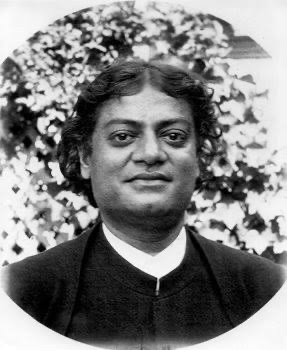
Swami Vivekananda: A Tribute to the Godly Figure.

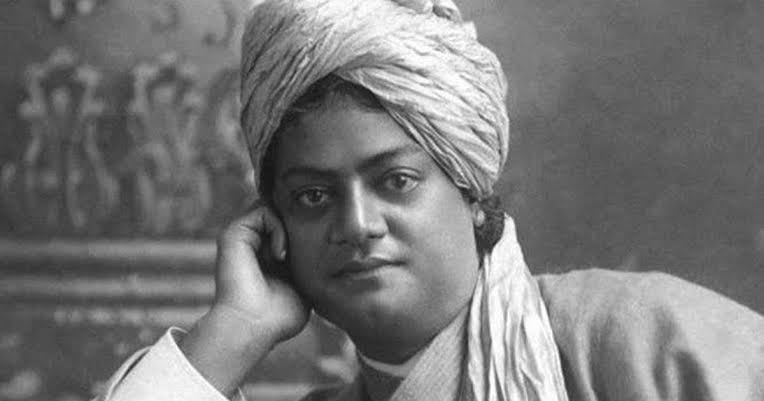
Swami Vivekananda as we all know was born on January 12, 1863 in Calcutta (present day Kolkata). Swami Vivekananda was never religious in his early life but was always interested in spirituality and meditation from young age.

Swami Vivekananda got educated from Calcutta University and had keen interest in subjects like history, religion, social science, philosophy and like. Today, July 4 is his death anniversary and us know five important incidents from his life.

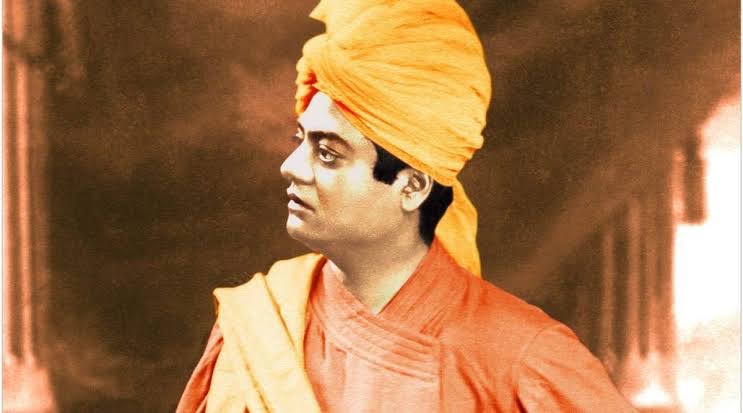
1) Swami Vivekananda at Parliament of World Religions, 1893.

Photo Credits: India TV

Swami Vivekananda became extremely popular when he went to Chicago in 1893 for Parliament of World Religions where he represented India and Hinduism. He addressed Americans as “Sisters and Brothers of America” in his speech which led to widespread appreciation. In this event, he spoke about how the land of Vedas, Yoga and Saints has taught tolerance and universal acceptance to the world.

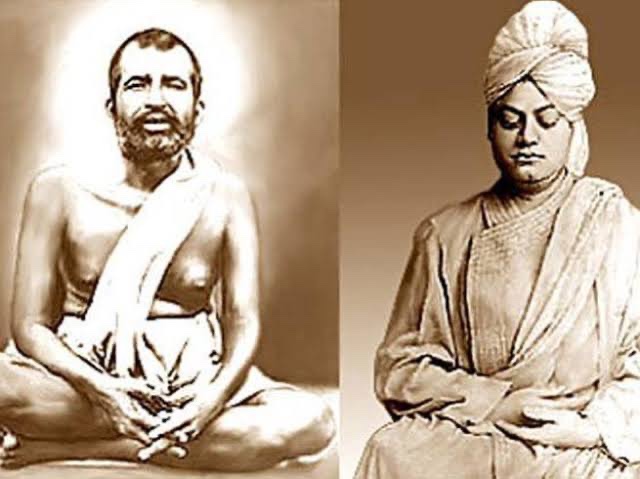
2) First meet of Swami Vivekananda and Ramkrishna Dev.

Photo Credits: Navbharat Times.

Swami Vivekananda met his mentor Ramkrishna Dev first in Dakshineswar Temple in Kolkata where Ramkrishna Dev used to reside but their relationship began when they met at the house of Surendra Nath Mitra. Ramkrishna Dev asked Swami Vivekananda to sing and impressed by his singing talent Ramkrishna Dev invited Swami Vivekananda to Dakshineswar.

3) Life in Dakshineswar, Kolkata.

Photo Credits: Scroll.

Swami Vivekananda’s constant meetings with Ramkrishna Dev became important and life changing moments for him. Initially, Swami Vivekananda was amused and nervous when he first interacted with Ramkrishna Dev. After giving many tests, Swami Vivekananda finally accepted Ramkrishna Dev as his spiritual teacher in 1882. He remained there until Ramkrishna Dev’s death in 1886.

4) Enlightenment of Swami Vivekananda.

Photo Credits: The Indian Express

Swami Vivekananda once asked Ramkrishna Dev whether there’s any God or not (as Ramkrishna used to keep telling him about God ), to which Ramkrishna Dev replied “I am the proof that God exists”. After three days, Swami Vivekananda retuned to him and asked whether Ramkrishna Dev can show him God or not. Ramkrishna Dev asked a counter question that whether Swami Vivekananda has the courage to see God or not to which Swami Vivekananda replied “Yes”. After this, Ramkrishna Dev placed his foot on Swami Vivekananda’s chest and Swami Vivekananda lost his consciousness after that. He restored his consciousness after twelve hours but he was totally changed by then.

5) Establishment of Ramkrishna Mission and relationship with Sharada Devi.

Photo Credits: Old Indian Photos.

Swami Vivekananda founded The Ramkrishna Mission on May 1, 1897 to honour and recognise the efforts and teachings of Ramkrishna Dev. Swami Vivekananda also had a very respectful and loving approach with Sarada Devi as he went to Chicago in 1893 only after taking her blessings.

At the end let’s apply Swami Vivekananda’s words in real life and as Indians, we should always move towards social equality and individual freedom which were his primary teachings.

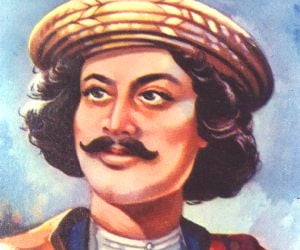
RAJA RAM MOHAN ROY

Raja Ram Mohan Roy, a great reformer, thinker, so much ahead of his times, one of the makers of modern India, a versatile personality and the founder of the Brahma-Samaj was born on 22nd May, 1772 in Radhanagar, a village in West Bengal.

When this so remarkable man was born there was an all-round decline in all walks of life. The law and order was in shambles, moral values, social concerns and religious institutions were at their lowest and the economy in a chaos. It was a time when the whole country was drowned in many superstitions, dead and useless rituals and caste, creed, and religious narrowness reigned supreme. It was a time when women were looked upon as helpless creatures worthy only to be confined to homes and hearths.

Ram Mohan Roy came with his scientific temper, broad outlook, championship of freedom, liberal and fundamental reforms and harbinger of equality and humanism. He thought differently and much ahead of his times. His ideas, ideals and practices helped a lot in the reawakening and renaissance in the country.

His dynamism and personal charismatic charm made people in thousand to rally behind him for fundamental reforms in religion, society, politics, education and personal life. He virtually caused to dawn a new era of enlightenment and reawakening.

Ram Mohan Roy’s father, Rama Kant Roy was a wealthy landlord. He sent his son Ram Mohan to the village school for his elementary education where the young boy learnt Arabic and Persian besides his mother tongue Bengali.

Colourism in India

Colourism entered the Indian society through British rule. The British people would often prefer light skin Indians as candidates for important roles. Even the European or the Mughals were relatively light-skinned people. This made Indians start looking at light skin as a sign of superiority.

Even today the obsession with white skin tone continues. A lot of girls from a young age have to go through things like:

“you should apply turmeric and saffron paste to make your skin fair”

“you should do a particular type of wax which removes tan”

“he married her despite her being dark”

“you should use light skin makeup to look fair”

Well, these are a few of the thousands of sentences that a person with dark skin goes through. Growing up sentences like these make the person feel insecure about their colour. Nobody is born with insecurities; a child will never differentiate between a skin tone. It’s the people around us that make us like a particular skin tone.

The media never fails to make money out of the beliefs of people. People consider white skin good, so they decided to bring products like fair & lovely. There are so many more products and creams which say things like natural fairness, or natural white to attract consumers. Many young men and women use these products daily. What they don’t realise is that these products contain bleach, steroids, and other harmful ingredients that lead to skin cancer and liver damage in the long term.

After #blacklivesmatter, products like fair and lovely were trolled so they decided to change the name into glow & lovely. But it is still the same product that was built to support light skin.

A lot of other brands also did initiatives like Johnson & Johnson stopped their line of skin lightening products. They also told how they will include all shades of skin colour in their band-aids.

 Changing the name of the product doesn’t mean that people won’t buy it and use it as a fairness cream. But, let’s still appreciate the little changes the multinational companies made. But, there is still a long way to go.

 Another thing you must have noticed is the matrimonial ads in your newspaper. If I got money every time I saw the word “fair” I would be a billionaire.  

What people fail to understand is that our skin tone depends on the geographic conditions, that is how exposed we are to direct sunlight. In places that are sun-soaked people have a dark skin tone. This is because their skin is rich in the pigment melanin. Melanin creates a shield from the radiation of the sun.

This is why when light-skinned people visit places with a lot of sunlight they experience sunburn because they don’t have enough melanin to protect them from the sun.

Our skin colour solely depends on how far we are from the equator. So, I don’t really understand why light-skinned people are given superiority when clearly this isn’t something we can control. Our skins are built of a certain tone to protect us from the environment we live in.

Next time if someone around you shames you or anyone for their skin colour make sure to correct them scientifically and also tell them how much money white people spend on tanning regularly. White people tan for hours, buy lotions, get spray tans to get the colour that we have. I am not stating this to hate on them, I just want to point out how they spend money on tanning while we bleach out our tan.