As we know that every person is related to each other in some way or the other. Whether it is a relationship of friendship, parents, siblings, and many more.
But there are some relations which have no name. Yet,they connected,they communicated.
He may remains anonymous throughout his life. But still they exist forever and become so important. When we are in any nameless relationship.They live every moment with wholeheartedly, but at the same time there is also the fear of losing . Our heart is in dilemma of the scariest thing of distance whether this diversion would erase all beautiful memories or will they be alive in the core of their hearts.
No one knows their limits in this relationship. We just keep on flowing like a stream of water. This is all life and fate so we have to breathe, belief, hold on and let go off the things with their own pace just to see what happens next.
Even though relationship is unnamed and we don’t know what we are for each other? But we still inside know the name of this unnamed relationship and know what she is for you and you are for her.
“What was the motive?” is one of first questions law enforcement authorities ask after a crime is committed. Crime scene investigators collaborate with detectives and law enforcement to put the pieces of the puzzle together, but comprehending the psychology of crime demands a different set of skills. Psychology encompasses the study of the mind, behavior, and attitudes, among other things. Individual traits including personality, reasoning, thought perceptions, intelligence, imagination, memory creativity, and so on are studied. Crime, according to psychologists, is a learned behavior that a criminal develops via his interactions with various individuals. And this even affects how the law is implemented on a certain crime. Psychology has been useful in the legal field since it helps in evaluating the mens rea of a criminal while committing the crime, the reliability of witnesses, and the appropriate punishment for a person committing an offense by taking into account the person’s psychological state of mind. With the help of psychology it is possible to obtain a better understanding of some of the most important explanations for criminal behavior, as well as establish crucial variables in determining what motivates people to commit specific sorts of crimes.
In today’s world, psychology has become a vital aspect of the legal system. Psychology is important in law because it encapsulates theories about human behavior. A combination of biological, psychological, and social factors often impact people who engage in criminal activity. There are mainly two important psychological theories that explore this possibility. Behavioral theory, which holds that committing a crime is a developed response to events, is an important psychological theory. Cognitive theory, which looks at how people solve problems through moral growth and information processing, is another important theory. When it comes to criminal behavior, psychological theories look at personality factors including extroversion, neuroticism, agreeableness, openness, and conscientiousness. They also look at the concept of the psychopathic personality, in which a person engages in illegal adrenaline rush activity to make up for low arousal levels. Hostility, narcissism, and impulsivity are personality qualities that have been linked to criminal and violent conduct. The hypothesis is that, like all other forms of behavior, criminality is learned through direct interaction with other criminals, rather than being invented by each criminal individually. Personal interactions with other people are used to teach behavioral skills. According to psychological studies on teenage aggression, there are two basic paths that violent careers take. Before they reach adolescence, some children begin to act violently. They have a higher chance of becoming repeat violent offenders. Children who turn to violence in adolescence are more likely to correct their ways sooner or later. Birth issues, poverty, anti-social parents, bad parenting, hostility, educational failure, psychiatric disorders, alienation from family, school, and other factors can all contribute to violence.
It is clear that the impact of psychology on crime is substantial. It is a step forward in refining the legal system; its position in the legal system contributes in the modification of our legal system as well as the maintenance of justice, equity, and good conscience. Psychology will play a vital role not only in assisting the criminal justice system and political systems, but also by helping the general public to understand the elements that lead to crime and influence criminal behavior.
A data shadow is a slang term that refers to the sum of all small traces of information that an individual leaves behind through everyday activities. It is a minute piece of data created when an individual sends an email, updates a social media profile, swipes a credit card, uses an ATM and so on.
Surveillance-related data is a particular driver for storage capacity requirements. This data is often recorded and stored long-term, providing a persistent record of activities online and in the physical world. The data presents a privacy concern for individuals and a burden on IT shoulders as it pushes storage demands and potentially exposes sensitive data.
Individuals are recorded on higher resolution video for significant portions of their days in many places. The number of these data files and their size are expected to increase as the number of devices, their resolution and other data detail increases. This massive volume of data calls for consideration into privacy policies, data ownership, retention and disposal. Administrators that are not adequately aware of the problem or keeping up on policy stand to be found responsible for leaks, should data be retained that should have been disposed of or, alternately, responsible for compliance failure should data be found missing that should have been saved.
We all thought this was a temporary thing. But here we are. People are already calling this the “COVID era” as if they are reading about it in a history book. But we’re still going through it.
For most of my friends and family, the social distancing and handwashing aren’t that bad. We got used to that stuff quickly. The tough part about this era is that life has changed permanently for many folks.
Rifts are created between people with different beliefs on wearing a mask. Complete industries are swept away and will probably never be the same. The world has truly changed.
In this article, I’m sharing 19 lessons I’ve learned from observing all these changes. Hopefully, these short reminders will make life during this era easier for you. These things surely have helped me a lot.
It’s hard on everybody I know your life is hard. But so is the life of your neighbor. That puts us all in the same boat. So go easy on yourself and others.
Nothing is forever It seems like this will last forever. But everything dies. And so will pandemics.
Accept it as if you chose this This is the only form of useful lying in the world. Trick yourself into believing you wanted a more tranquil and solitary life. This is a classic Stoic exercise. Simply accept everything that’s outside of your control as something you wanted. Life will be a lot rosier.
Take a breather Literally. Take a moment for yourself and breeeeath…. Aaaah. Yes, that’s the feeling.
Exercise every day Stay in shape. If you’re not injured or ill, it’s your duty to take care of your body. Never take this lightly.
Get off social media It’s a waste of your time. “Always?” Pretty much.
Read books This is a better use of your time. We all have reading lists with hundreds of books on them. And we’re not going to live 200 years. That means you need to make some tough choices. Which books will you read before you die?
Learn new skills Technology is improving and changing so fast that we’re not aware what’s going on. We just learn it after the fact. But that’s too late. So stay on top of your field and keep learning new skills you need to do good work.
Keep a daily journal This will probably be one of the weirdest times of our lives. Don’t you want to document this? Even if you never read it again, it’s still worth writing because it makes you a better thinker.
Inspiration comes from within “I need to go to Paris for inspiration.” Replace Paris with any city or place in the world. Why do we think inspiration comes from the outside? Look inside!
Good food improves your mood One of the few pleasures that you never get used to. Research new recipes, be creative, and cook food that makes you go, “Hmmmmnn.”
Objects will not make you happy STOP BUYING CRAP ONLINE! I had to tell myself that after a few too many useless purchases.
More money is not the answer Look, I’m not going to lie. Having a little bit of money will lighten the load. So start that online business or side-gig you’ve been thinking about. But don’t expect that money will make you happy. It just solves your money problems. Nothing else.
Do work you enjoy Just because you need to survive, don’t say yes to the first available job you encounter. And also don’t start some kind of soulless online business so you can make a few bucks. Find something you enjoy and pays the bills.
Appreciate what you have The grass is always greener. We tend to forget. So here’s a reminder: If you’re reading this on your smartphone in the comfort of your house, your life isn’t so bad.
Give back Do something altruistic. It’s fine to give money to charity. But I’m not talking about that. Talk to your elderly neighbors, hold the door for someone, share your hard-earned lessons with others. Small things that have a positive impact on people.
Change is good This is a difficult period if your industry got swept away. But remember, change is a part of life. And in the long-term, it’s good. We just don’t see the sunshine when we’re going through a storm.
Stop consuming—Start creating
The world never changed for the better by doing nothing. Right now, our biggest challenge is paralysis by consumption. We’re over-consuming everything: News, food, clothes, entertainment, you name it.
To get through this era, we need more action. So stop sitting there and go create something. Without creation, there’s no progress.
Since, this pandemic known as Covid 19 commenced, it made a huge impact to the whole world and everything went digital. And the necessity for using windows and its best features became more important. We’ll talk about Windows 10 and some of its best apps to ease up your work from home or many other experiences. There’s a wide range of apps available and it might be difficult to choose. So, whether you’re in need for a better work from home experience or beneficial productivity or some entertainment, we got you covered with some of the best apps for Windows 10 for 2021.
Spotify Music
Microsoft store on Windows 10 makes it easier for you to download this app. All the music and podcasts lovers can discover a lot here. The sync feature of this app is amazing as it can easily switch from your mobile to desktop and vice versa. Moreover, it provides a clean user interface and it has a “made for you“ playlist for your every mood. A little mood enlightenment from work requiressome good music and Spotify got it all covered.
2. Netflix
Who refuses to Netflix and chill? A break from work is necessary. And Netflix brings all your favorite shows and movies in one place. It got a huge range of your favorites with the genre of your choice. Moreover, you can choose from 3 subscription plans, skip the intros and all the videos are streaming. So, what’ s stopping you?
3. Audible Love reading books but can’t make out time to read? This app solves it all.
Audio book app is accessible anytime, anywhere. Just plug-in your earphones and explore the world of your favorite books. It’ll also improve your fluency, vocabulary, attention span and memory. And the biggest benefit, time management. So from now, listen your books.
4. Duolingo If you love languages, then this is the best place for you.
You can download this app from Microsoft store easily. Moreover, this app asks for no fee and is ad-free. It’s small lessons will help you to achieve your goals smoothly as it picks up the course from the basic level. Learn languages from the highest rated platform from the comfort of your home.
5. Google Meet Whether it’s a business meeting or online schooling, Google meet became one of the most important educational tool for workspace. More than 100 million users access this app and it’s easily available on Microsoft store. This app is secure and virus free. Moreover, it’s features like live captioning, speech to text, easy messaging, layout and screen setting and compatibility makes it beneficial and easy to use.
6. WhatsApp Desktop
Messaging has become an important feature and WhatsApp became a huge success during this pandemic.
WhatsApp desktop is easily available on Microsoft store. If you have less disc space then WhatsApp web is best for you. This app brings keyboard shortcuts for a better productivity. You can use a type in keyboard, drag, drop, copy or paste files from the sites and ease your work load. Bigger screen experience without any problem is good, isn’t it?
7. Pinterest
Need some inspiration or ideas for life? Don’t worry! This platform is for everyone- your hobbies, interests, etcetera, everything is available here. It has a five star rating on the store for a good reason, you get to the source directly and moreover it’s free of cost, you just need to sign in. So, pinning your interests or pinning interests of your choice is up to you.
We believe that we always have to say yes to opportunities. We fear that saying no leads us to miss out on money, fun, and other experiences. But by always saying yes, we don’t value our time.
Blindly we say yes to everything that comes our way. We often don’t look at saying “no” as a skill. If we are at work and our manager asks you to hand in a report before the end of the day, we say, “sure thing.” It interrupts our work, and we often have to push other things aside.
There was never any fear for me, no fear of failure. If I miss a shot, so what? – Michael Jordan
We say yes in our personal lives all the time. When friends ask us to go out while we have other things to do, we say yes. We friends or acquaintances a favor, without thinking about it. We even say yes to bigger things that we don’t want. We take jobs we don’t like. We start relationships with people who we are not in love with.
Why do we do this? We are afraid to say no, to let people down, to avoid confrontation. The stress of saying no often makes us say yes automatically. And then we complain or blame ourselves, “why couldn’t I just say no.” And with relationships, we are afraid that if we turn down an opportunity to settle down, another one maybe won’t show up.
I see this often with relationships at work. You spend time with a person at work so often and if you feel physically attracted to each other it easy to start a relationship. If you start a relationship, you cannot ‘kind of’ want it. No, you should be in love. Saying yes doesn’t always make you happy.
Other People’s Expectations
Learning to say no can save us a lot of time and stress. While we are afraid that we have to let people down, the opposite is true. People will start respecting you more when you start saying no. People perceive that as a strong character trait.
It’s time to stop doing things to live up to other people’s expectations. You don’t have to do things you don’t like. If you don’t start saying no, and keep doing things you don’t want to do, you begin to dislike the person you are trying to please. Saying no is not only for your benefit but actually by saying no, you are thinking about other people as well.
If you say yes to a night out with your spouse and you don’t feel like it, you probably won’t be in a great mood. It’s not fair for your spouse if you are not present mentally. If you rather go out the next day because you are tired tonight, say so. Your partner will respect you for that. If she doesn’t, we have to explain why we say no. And encourage them to say no when they don’t want to do something as well.
Conforming to other people expectations can impact your life’s outcome. When you say yes to one night out, when you don’t feel like it, doesn’t have huge life consequences. But sometimes it is about choices that will influence our life outcome. When parents expect their children to go to university, the children often give into that.
We are all unique and have things we want from life, asking people to do something they don’t like is not fair. If you don’t wish to go to university because of a good reason, then don’t. We have to follow our passion and make our own path.
Say No To Noise
We should say no to everything that is noise. Greg Mckeown, writes in his book Essentialism about how the ‘disciplined pursuit of less’ allows us to regain control over our choices. Mckeown says that many successful people in history were ‘essentialist’, people who can separate the essential from the non-essential in life. Saying no is a way of showing what you consider ‘essential’ by saying no to everything that is noise.
About the importance of saying no, Mckeown says, “ yet as hard as it can be to say no to someone, failing to do so can cause us to miss out on something far more important.” When we have a purpose in life, everything that doesn’t contribute to our purpose, becomes noise.
When we want to live a stress-free life, we have to choose “no”. Saying blindly yes to invitations from our colleagues, friends or family causes us stress. We often regret saying yes for days. We worry about damaging our relationships. We worry that we burn bridges. We worry about what people would think if we say no. We live in an abundant world. By saying no you don’t miss anything. The world is filled with opportunity and beauty.
We think we are not good friends or colleagues when we say no. You’re not a bad person when you say no. Once we start saying no, we lose the fear of disappointing people and find out that it wasn’t that hard. We find that we replace the noise with silence and clarity. We enjoy the things we do say yes to more. We become more present and happy.
Have you ever met an idiot and thought “What an idiot?” Well, don’t be so quick to judge — idiots can teach you a lot about life.
A few years ago I went to Shangai. When I boarded the plane in Amsterdam, I met a first class idiot as soon as I stepped foot on the aircraft.
When I got to my seat, the overhead bin was already full, so I had to store my bag on the other side. But when I tried to do that, an idiot came from nowhere and started screaming at me. I didn’t understand him, but I got his message: “That’s my seat, and I want to store my bag there.”
I grabbed my bag, walked two rows down, asked the person who was sitting there if it was ok I placed my bag in his overhead bin; he said yes, I stored my bag, walked down to my seat, and sat down.
Was that difficult? No. Could the idiot have done that? Yes. He didn’t have to make a scene.
“People are surprised to find out that an awful lot of people think that they’re idiots.” – Eric Schmidt
In my life, I’ve had many other encounters with people that had bad behavior — let’s call them idiots.
You know what I’m talking about, right? Idiot bosses, coworkers, strangers, friends. Idiots do things that are not cool. It’s not bad to be an idiot — I sometimes do idiotic things, everyone does.
Dealing With Idiots
Is it cool to call people idiots? Yes, I call myself an idiot sometimes. People think they should only learn from successful people — billionaires, entrepreneurs, athletes.
But that’s not the only way to learn. How many billionaires and athletes do you know? We all know idiots. From them, we can learn how we should not behave.
Maybe someone at work stabs you in the back. Maybe your girlfriend cheats on you with your best friend. Maybe someone wants to start a fight with you. Maybe someone bullies you.
Without a doubt, people in your life have, or will, let you down. There’s no escaping that. What’s more important is your response. Do you become bitter about people? Do you think that all people are bad?
If someone does something bad to you, don’t see it as a reason to justify that behavior. For example, when I first started working for a major corporation, I noticed quickly that people accept backstabbing. You screw someone over on one day, and get promoted the next day.
Is that good? Is that bad? It’s neither, as Shakespeare put it: “There is nothing either good or bad but thinking makes it so.”
However, it’s also not a ‘get out of jail free card’. We have to watch ourselves that we do not become what we despise. No one on this planet is born an idiot — we become one. So choose not to.
When people behave like idiots, don’t be offended, don’t take it personally, study them instead.
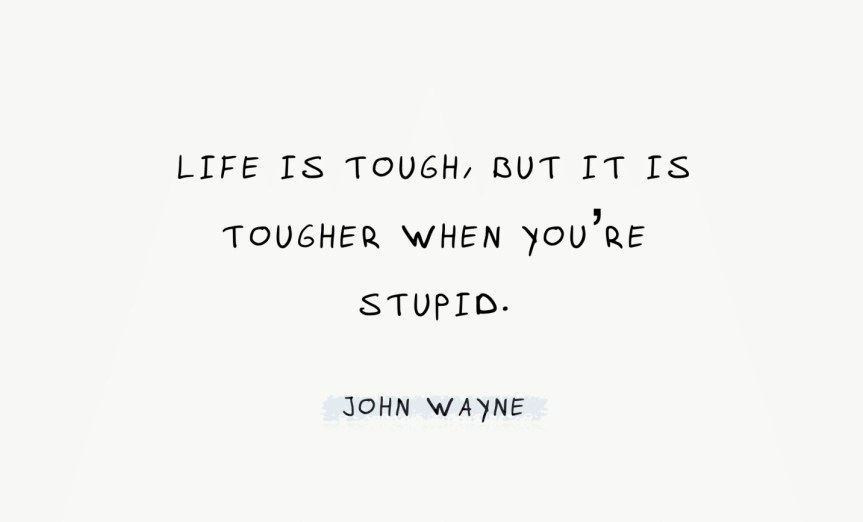
“Life is tough, but it’s tougher when you’re stupid.” – John Wayne
I observe idiots doing bad stuff like cheat, lie, be aggressive, rude or anything else that is not ok to me. Then, I consciously decide to not be like them.
By observing behavior that you don’t want to associate yourself with, you will become clear on the type of person you do want to be.
Just answer to yourself: What is ok, and what isn’t? For example, stabbing people in the back for a promotion — not ok.
In the end, do whatever you think is right. Always make sure you do the right thing — but please, don’t be an idiot.
Many people have a job they don’t like. Many take jobs they don’t like. The reason we take jobs we don’t like is because we need money. I can’t think of any other reason people would waste their time doing something that is not passionate about. I challenge you to find your dream job—a job that you love doing 7 days a week. Work that doesn’t feel like work. In that way, you are not only living for the weekend.
Many of us only live on the weekend and after 5 pm on weekdays. ‘The American Time Use Survey’ shows that we spend almost 40% of our time at work. Would you waste 40% of your money? I’ve never heard an average person saying, “I have $10.000 in savings, I’ll just throw $4.000 away.”
Time is more valuable than money. So why would you give away your time? By doing what you love to do, you are doing something of meaning. Stop the busy work and find your dream job! Here are 9 steps that you can use as a guideline.
Decide exactly what kind of job you want. If the job doesn’t exist, create it.
Choose the company or person you want to work for.
Study your potential future employer
Find out what kind of competencies you need to be successful
Do a strengths/weaknesses analysis of yourself. You have to be clear about what kind of value you can offer.
Create a plan of how you’re going to develop your competencies you need further.
Now, apply. Forget about job openings or vacancies. If you can add value to a company, they would be idiots not hiring you.
Once you know what job you want, what the company needs, what competencies you have, and what value you can add, put it on paper. Hire a copywriter or who can help you with his. Or have someone who is in sales look at it. You have to be persuasive.
Find out who has the ‘power’ to hire you. Browse LinkedIn for the senior manager of the department you want to work for. If it is a smaller company, contact the CEO.
This method may take you longer and more analysis of your skills. But it’s worth it to find your dream job. Financially and mentally. By doing something you love you will save yourself many headaches in the long run. You’ll probably earn more money as well. If you follow the standard hierarchy and climb the ladder like everybody else, you will earn exactly the same as everybody else.
Learn More About Finding Your Dream Job
If you’re interested in learning more about finding your dream job, feel free to check out my course.
We live in a uniquely safe, risk-free, and good time.
Mortality rate is at an all-time low. Poverty is decreasing year over year. Diseases are treatable. You get to live longer. And technology makes life easier and safer.
Evolution is a beautiful thing (if you only look at the facts).
However, that’s not the full story. People are still miserable. Suicide rates increase. People have more depressions and burnouts. More and more people are on meds. I’m not going to flush you with all the hard statistics. It’s not pretty.
Because to me, that’s what I think everybody is doing: Dancing around all the time and saying, “I’m alive! I’m alive.” I can’t be more wrong than that.
The reality is that we, humans, are ungrateful idiots. Always have been.
The Greek Stoic philosopher Epictetus, who lived between AD 50–135, put it best:
“Do not spoil what you have by desiring what you have not; remember that what you now have was once among the things you only hoped for.”
Why do we always desire what we don’t have? Desiring things you don’t have is not necessarily a bad thing. That same trait is also the reason the world developed the way it did. If we didn’t desire unattainable stuff, the world probably wouldn’t advance one bit.
But when I read about historical figures such as Christopher Columbus, the Wright Brothers, or Nikola Tesla, they used that desire for good things. They didn’t complain and had an innate desire to achieve things.
Can you image Columbus saying: “Fuck this stupid boat. Let’s sail back home, I want to chill out.”
And that the Wright Brothers said to each other: “Man, screw this flying thing. Let’s play checkers and drink beer.”
Or that Tesla would say: “Who cares about current? Let Edison and his stupid DC current win. I’m going for a swim in the lake.”
Of course not.
Just Be Thankful For Goodness Sake.
Two words. That’s all.
Say it. Believe it.
Thank you.
Easy.
Or you can go with a casual “thanks.” You can say it to people, but more importantly, you can also say it to random things.
When I wake up, I just say: “Thanks.”
I don’t even know who I’m thanking. God? The universe? Life? I’m just happy to be alive. And that mindset changes everything in your life. When you say thank you, and you truly believe it, you become a grateful person.
Gratitude changes the way you:
Think
Behave
Talk
Walk
Eat
Love
You can also say it to people. When your mother, father, brother, sister, spouse, boyfriend, girlfriend, friend, colleague, manager, does something for you (no matter how small), say: “Thank you.”
What you will find is that people appreciate you too. Gratitude goes both ways.
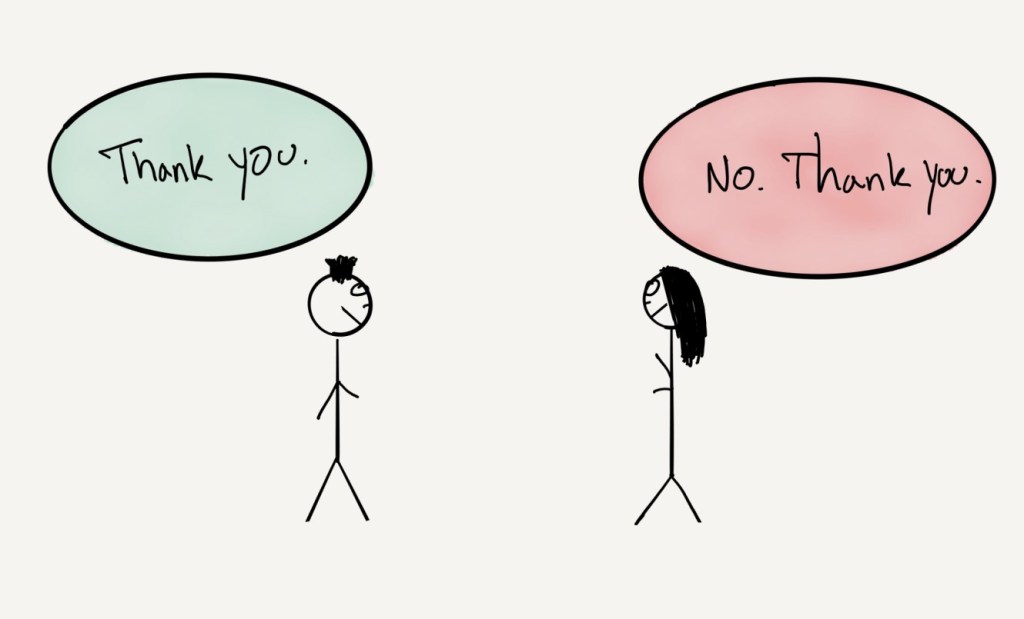
“Thank you.”
“No. Thank you.”
Saying thank you is a habit. It shows that you appreciate everything. Big things and little things. And appreciation is an important aspect of a happy life.
The French philosopher Voltaire put it well:
“Appreciation is a wonderful thing. It makes what is excellent in others belong to us as well.”
If you want to enjoy life, start by appreciating it.
Do you ever get upset about the nasty behavior of your co-workers, friends, or even family? Well, if you let others upset you, it’s not their fault.
“It’s not me, it’s him!” is what most of us say. We’re always quick to blame others for how we feel.
We say that others make us feel that way. But that’s false. You decide how you feel about the things that happen in your life.
Events can’t harm us. Our perception of an event harms us. That’s one of the most important ideas of Stoic philosophy.
In other words, you decide what meaning you give to the things that happen in your life. If your friend tells lies about you behind your back, and you get upset, that’s because you decided to get upset.
After all, you don’t control others. That’s why who you spend your time with is a matter of life and death.
The great Stoic philosopher, Epictetus, said this in his Manual For Living:
“Avoid fraternizing with people who don’t share your values. Prolonged association with those with false ideas can only tarnish your thinking.”
It’s something I truly live by. I’ve seen others destroy people’s lives too often to take this idea carelessly.
And I bet that you’ve had your share of, for lack of a better term, “toxic” people in your life.
There Are Two Kinds Of People
People with values
People without values
I think that less than 1% of the population has values. Values entail nothing more than answers to questions like:
How do you treat people?
How do you treat yourself?
What’s right and what’s wrong?
Here’s an easy way to detect people without values: When you see that someone becomes an entirely different person in a heartbeat — that’s when you know someone has no values.
For example, at our company, we recently hired a toxic intern. The intern turned out to be a different person from the person we thought we hired.
Of course, that’s our mistake. Even though we talked extensively about values during the interview process, we didn’t detect any warning signals.
And everything was fine during the first week. But as soon as the intern found a partner in one of our other interns, things started to change.
All of a sudden, with this new-found support, the intern started gossiping, trying to manipulate others, and causing mayhem. Fortunately, we identified it quickly and communicated that we have a zero-tolerance policy for toxic behavior.
When you lack values, you automatically gravitate towards natural human behavior. And that’s very dark. I recently read 12 Rules For Life by Dr. Jordan Peterson, a clinical psychologist, and a professor at the University of Toronto.
His fundamental proposition is that people are malevolent and that life is suffering. To prove that statement, Peterson shares compelling examples of human history with us.
He’s right. People have always lied, killed, and deceived their way through life.
But There’s An Alternative
Look, you can easily go down the rabbit hole of nasty behavior. Just spend enough time with bad people — eventually, you will become one of them.
You can also fill your days with gossiping, lying, and manipulating others. And you’ll probably also feel good when you do it. A sense of power, no matter how it’s achieved, gives people satisfaction. That’s how our minds work.
So when you recognize someone who doesn’t have principles, shows nasty behavior, and has multiple personalities — step away.
Instead, surround yourself with people who want the best for you.
Not with people who are jealous, can’t see your success, and thrive off negativity. I think this is important to realize for anyone who wants to live a good life.
A few years ago, when I started to live a conscious life, I had to say goodbye to people who only wanted to live a life of pleasure.
And I’ve also seen other friends that started to change their life for the better but were dragged back into the bottomless pit of darkness by others.
But as you and I both know, life is also full of warm and caring people. It’s not all bad.
Be Stingy With Your Time
“You’re the average of the five people you spend your time with.” It has become such a cliché. But I don’t think that we truly understand the impact that other people can have on us.
Like Epictetus said, others can tarnish your thinking. Is that worth it?
Look at it this way. Would you give $1000 to the people in your life if they asked for it? If the answer is no, stop giving the people who don’t share the same values as you, your time.
I’ve narrowed down the list of people I spend 90% of my time with to my direct family and my two best friends. Other than that, I spend my time working and exercising. That’s what I mostly do. And I’ve never enjoyed my life this much.
So if you have a job you love, and a few people in your life who you love, you don’t even have more time to spend.
Nothing else gives more satisfaction than having a meaningful career and a strong family.
“But what if my family is toxic?”
Inspire them to change for the better. I don’t give up on my family. Even if it takes 10 years, I will still try to help them.
Create Your Values, And Stick To Them
To live a virtuous life, you need principles. Without principles (or values), we have no character. And without character, we’re nothing.
“Who cares!”
Well, you should care. You’re the one who looks in the mirror every day. Are you happy with what you see?
That’s the only measure I have for my life. I must like the person I see in the mirror. If I don’t like that guy, I’ll change. That’s what I’ve always done. And that’s what I still do every day.
Improve Yourself
What’s the alternative? Like Peterson concludes in his 12 Rules For Life, there’s no other viable option for life.
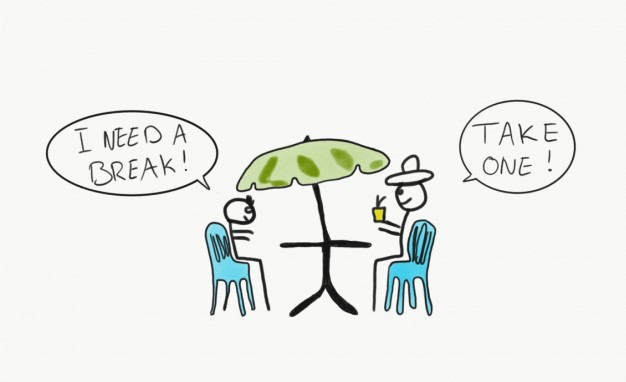
You recharge your phone when it runs out of juice. You refill your gas tank when you’re running on empty. But sometimes, you forget to take a break and recharge your most precious possession: Your body (and the brain that’s inside of it).
Whether you love what you do, are in between jobs, or have a job you hate: You’re working. Living is also a job. A pretty tough one, actually. Just the act of getting up in the morning can be a daunting task. And I’m not even talking about all the responsibilities we have.
So why do you make your life even more challenging by not taking a vacation to recharge? I’m not talking about your weekends that are packed with activities, or holidays where you do more work than relax.
No, that type of “free time” only costs energy. I’m talking about resting with a very specific reason: To recharge your battery so you can get back to living a productive life.
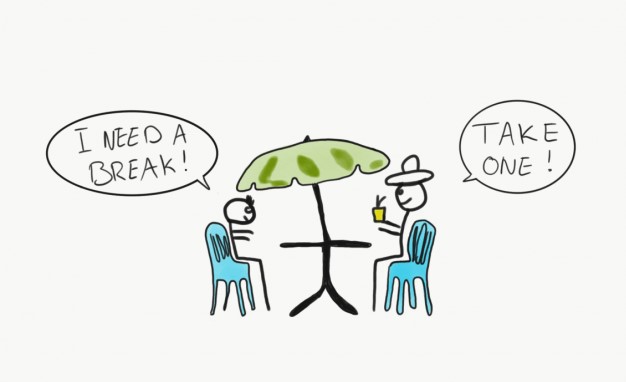
A break reduces stress and improves productivity.
Scientific research shows that a vacation decreases perceived job stress and burnout. Now, that’s a pretty solid benefit of taking a few days off. But there’s more.
As you may know, I’m always interested in productivity. In the case of resting or a vacation, my question is:
Will I get more things done when I get back?
The answer is yes, but there’s one major thing to keep in mind. But let’s back up a bit: What does it mean to get more done? Getting things done has nothing to do with time—if you work more hours, you don’t necessarily get more done.
In fact, research shows that working more hours general means less productivity.
Why? Well, we often waste time if we have a lot of it. It’s simple: If I say to you, you have a year to write an article. What would you do? Put it off until tomorrow, right?
But what if I tell you that you only have 2 hours? You’ll probably get started right away. So in a way, having more days off, and fewer days to work, forces you to be more effective with your time.
Research shows that a vacation in itself won’t make you more productive, but when you have more days off, you have a strong desire to get more things done in less time.
And that’s a win-win situation for everybody: You, your business, or your job. You take off a few days, recharge, spend time with your family or friends, and when you come back, you’re more productive.
Sounds great. But wait, there’s a caveat.
When your vacation is stressful, the positive benefits go away. So keep the stress at a minimum on your holiday. Otherwise, you’ve wasted a perfect opportunity to relax and boost your overall productivity.
I recently felt I needed a break for several reasons. I had a few injuries that didn’t seem to go away and had less energy. I could have powered through, but instead, I decided to go on a vacation with my family. For a week, I did absolutely no work. And when I came back, I was full of energy.
Here are a few tips that might help you to take a break that fully recharges you.
1. Do What You Want
There are no rules for taking vacations and everybody relaxes in a different way. If you like to plan your holiday, just do it. If you want to go with the flow, then do that.
Want to wake up early? Do it. Don’t like waking up early? Sleep in. Even if you go on a vacation with your partner, friends, or family, you don’t have to be together 24/7. You can also sometimes do things that you enjoy.
The key is to not have expectations on your vacation. Let go of everything. I also don’t like to post vacation pictures on social media. Otherwise, I’m constantly thinking about taking a cool picture so I can impress others.
You’ll probably even do things you wouldn’t do just to take a picture. “I really need to rent a jet ski so I can take a picture with it.” No, you don’t.
Who cares? Focus on enjoying the moments you experience. Whatever those moments may be.
2. Read
Bill Gates is famous for his voracious reading habit. He is also known for his ‘Think Week’ where does nothing else but read and think.
You don’t have to be Bill Gates to think about your life and career. We all have our daily, weekly, and monthly routines. Usually, routines and habits work very well. However, you can also get stuck inside a loop.
That’s why I recommend you to step back from your daily life and career. If you do that, two things can happen: When you step away, you miss your daily life and can’t wait to pick up where you left off.
Or, the opposite will happen. You don’t want to go back. See that as a sign that you need to make a change. Either way, a break always serves a purpose. It doesn’t only help you to recharge, it will also make you think.
That’s why I like to read for hours on my vacation.
3. Get Bored
One of my favorite strategies for finding new ideas is to get bored out of my mind. It sounds easier than it is because of distractions.
In the past, I would do everything to NOT get bored: Watch TV, go out, browse Facebook, etc. But did you know that you can use boredom to your advantage?
Instead of giving into distractions, just give into the boredom and see it leads your mind to. In fact, one of my favorite artists of all time, Andy Warhol, embraced boredom. You can tell by the boring films he made or the references he made in The Philosophy Of Andy Warhol about getting bored.
Whenever I hit a creative wall, I just do nothing. Literally, nothing. Try it sometime. It’s a great strategy; maybe you come up with the next best thing in your industry.
It’s never a good time to take a break.
“I just need to finish this project.”
“My boss will never accept it.”
“People will think I’m lazy.”
“I don’t have time.”
“My family needs me.”
Yeah, yeah, I’ve been there too. But what would you rather: Continue to work without resting and burn out? Or take some rest before you’re tired?
So before you use all those valid reasons to not take a break, think about what all the people in your life have to do if you’re not here anymore. Yes, you’re important. So take care of yourself. Take a break and come back with more energy.
When the lock down was announced our whole educational system came to an abrupt stop. Now we had to depend on online apps and webinars to learn.
Until the lock down period was announced most of us were not even aware of the existence of such apps. By the time lock down was announced the fame for an app like Zoom, had won over the millions of people across the world. It was one of the popular apps used around the world to conduct meetings. It accommodated more than about 100 participants.
First times in online classes are always a headache because half of the people forget to turn on the audio and camera. Not only us but teachers also have hard time in finding different functions. Online classes are always an advantage in situations where classroom learning cannot take place but in many strong opinions it can never take over the idea classroom learning.
To the other side of online classes, it opens us to a world of disparities between the elite and the middle class and the poor. An online class eliminates the human connection that a face-to-face, in-house teaching environment provides. An online instructor cannot gauge the mood, involvement and engagement level of her students the way she can in a traditional lecture-based classroom.
There are a lot of problems with online learning. Most of the students will face difficulty in connecting with the teacher. Without a proper connection at home for internet, students will find difficulty in attending the classes. Proper 4G connection is need for the smooth conduct of meeting in Zoom. This creates a digital divide between the students. Not all students can afford a phone or not all will have a proper connection. This creates a differentiate between the haves and have nots.
Such a simple issue as this can really draw us attention over the issue of network and internet connections, but what most of us forget is in some states of India, internet connections have been cut off which makes it very hard for students in that are to attend class.
Zoom classes does not allow you to enhance your learning capacity. It doesn’t provide for any kind of learning other than the academics. Sometimes the app would crash and there would be a lag.
Most of the times when classes go on, the system gets lagged and create network problems due to which students wont be able to focus. Students are forced to sit in front of their phones for hours listening to lectures which can have a lot of effect on their eyes as well as their thinking capacity.
Sometimes classes are taken without giving any breaks in between, this can cut off the span of concentration of a student. One person can normally concentrate to max to max half an hour without any other thoughts barging in, with proper breaks in between it becomes easier to learn.
Taking all these facts into consideration we can come to the conclusion that online learning may not always be an alternative for classroom education. Being in touch with human beings and socializing with people is what develops a persons character.
Most of us learn from school, from what we see and hear we develop into better versions of ourselves. Being outside in the sun, playing in the mud, reading a book to bed etc adds up to the character of a child. In all places learning by experience matters.
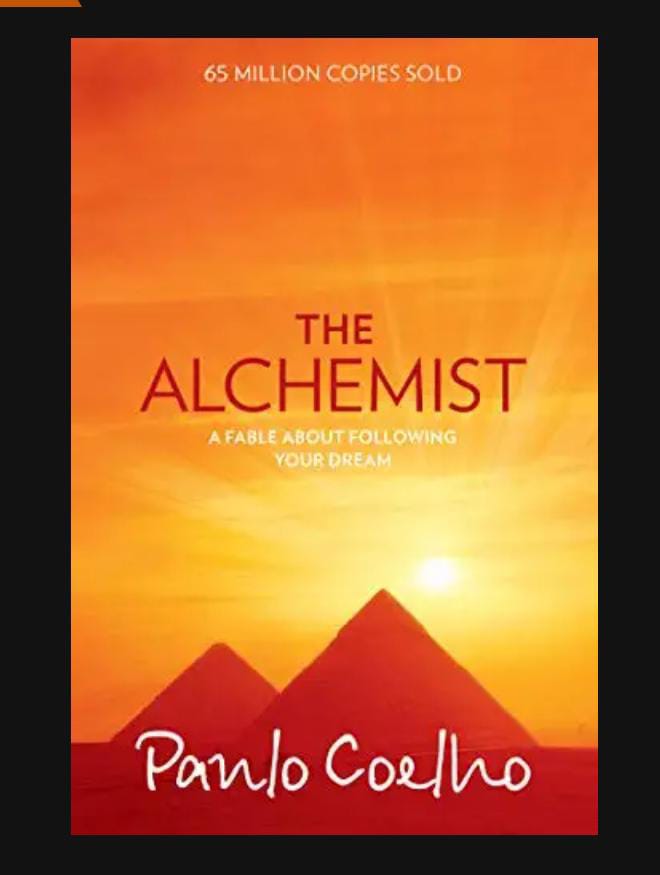
English Title :- The Alchemist Original Title :- O Alquimista Author :- Paul Coehlo, Brazilian author. Genre :- Quest , Adventure , fantasy. Language:- Portuguese English translation by :- Margaret Jull Costa Publisher ( English Translation ) :- Harper Torch , 1993. Pages:- 208 pages ( 1st English translation )
Book Cover :- The cover has a very enchanting and beautifully designed which attracts reader on the first basis.
“When you want something all the universe conspires in helping you to achieve it “
About author :-
Paul Coehlo is a Brazilian lyricist and novelist .He belongs to a middle-class family in Rio de Janeiro, Brazil.
He is best known for his novel The Alchemist, which holds the GuinnessWorld Record for most translated book by an author, and selling more than 65 millions copies in more than 150 countries as one of the best-selling books in history.
Paul Coehlo is considered as the world’s most popular spiritual writer. His books including -, The Alchemist, The Devils and Miss Prym , The fifth mountain, Manual of Warrior of light , Veronica Decides to Die , , covers various serious topic such as love , magic , dreams , spirit , suicide , real meaning of life etc.
He wrote The Alchemist only in 2 weeks . He explained that he was able to write at this pace because ” the story was already written within his soul “. He described the book as a film that takes place in the mind of the reader , an allegorical novel about a young shepherd’s journey of finding his dreams .
Summary :-
The Alchemist is about the journey of a boy Santiago of Andalusia who is a shepherd . His parents have continually struggled for basic necessities of life and have smothered their own ambition accordingly . Santiago on the other hand can read and wants to travel . One day Santiago retires for the night in an abandoned church with his flock of sheep. An enormous sycamore tree has grown in the place where the sacristy used to be. This is where Santiago falls asleep and dreams a recurring dream of a child who tells him that he will find a hidden treasure if he travels to the Egyptian pyramids.
Santiago visits the village of Tarifa. There he meets an old woman who interprets dreams, which she says are the language of God. The old woman tells Santiago that this dream is prophetic , in what she calls “the language of the world,” and that Santiago needs to travel to the pyramids, where he will find a treasure that will make him rich. Santiago is uncertain, however, since he enjoys the life of a shepherd.
Santiago meets a mysterious old man who introduces himself as Melchizedek, or the King of Salem. He tells Santiago about good and bad omens . Santiago started traveling after selling his flock and purchasing a ticket to Tangier in Northern Africa . He was unfortunately robbed which made him look for a way to make enough money to return home. He finds work in the shop of a crystal merchant.
After eleven months of working in the shop,he meets an Englishman who wants to learn the secret of alchemy, or turning any metal into gold, from a famous alchemist who lives at an oasis on the way to the pyramid.
While traveling, Santiago begins listening to the desert and discovering ” TheSoul ofthe World “. The caravan eventually reaches the oasis, and there Santiago meets an Arab girl named Fatima and falls in love with her instantly but had to leave eventually with a promise to return again , in search of his treasure
Santiago wanders from the oasis into the desert and, seeing two hawks fighting in the sky, has a vision of an army entering the oasis and gets into trouble because of the tribal wear .
He meets an Alchemist who offers to cross the desert with Santiago. Soon the two men enter into an area of intense tribal warfare. Warriors hold the two men captive, but eventually allow them to continue their journey
. The alchemist tells Santiago that he needs to return to the oasis, and that the rest of the trip is Santiago’s to make alone so that he can claim his treasure whom he referred as “Personal Legend”.
Santiago arrives at the Egyptian pyramids and begins to dig. He finds nothing buried in the ground. Thieves beat Santiago and rob him of his money. After he tells them of his dream, though, one of the thieves recounts his own dream about a buried treasure in the sacristy of an abandoned church.
Returning to Andalusia, Santiago goes back to the church where he dreamed of the treasure near the pyramids. He digs where he slept, beneath a sycamore tree, and there he finds his treasure Santiago’s treasure.
Analysis of the book :-
The Alchemist is a fable about following your dreams .
“My heart is afraid that it will have to suffer , the boy said ‘
“Tell your heart that the fear of suffering is worse than suffering itself and that no heart has ever suffered when it goes in search of its dream , because every second the search is a seconds encounter with God and with eternity .”
The Alchemist is a diversified allegorical story about a shepherd who cross boundaries just to follow his recurring dream which was entitled as “thelanguage of the heart “ by the gypsy woman and a man whose encounter made him ” follow his omens “
Paul Coehlo in his interview stated that “omens are individual languages in which God talks to you . They are this strange ,but very individual language that guides you towards your own destiny . They are not logical ,but talk to your heart directly .”
The writing style in the book is simple yet contains powerful emotions, interesting and deep characters, plots twists and inspiring wisdom.
Santiago journey is a spiritual quest ,where he travels through the desert ,speaks to the wind and ‘Soul ofthe world’ which is connected by everyone’s heart desires or as the Alchemist said ” Personal Legend “
The novel is figurative and metaphorical in style . The omens , Personal Legend , Soul of the world , the talk with the wind , holds symbolic meaning which may seem as fantasies fantasized by us somewhere some day .
The story not only aids one to follow his dream but connects it with the Soul of the world ,the universe where everyone is bonded with an invisible wire and makes us one .
The story is like living in a magical realism , getting enchanted by the omens , talking with winds being a part of the universe that we all are but tend to forget and finally following our dream despite the hurdles because following our heart desire means encountering eternity .
“when you really want something, the whole universe conspires in helping you to achieve it”
The book explains the major purpose of people living , that’s finding one’s treasure i.e Personal Legend and traveling to find it because following the personal legend is like connecting to something deeper of the universe ,to the threat that connects universe and our hearts , something that makes us follow our heart and reach our dreams which fear paralyse for us .
The fear of suffering is the mammoth hurdle one faces while taking the first step towards their dream . The Alchemist , mystically addresses the fear of suffering as worse than fear itself .
Paul Coehlo in his interview said ” the only way that you can learn the language of the soul is by making mistakes . I made my mistakes but then I started to connect with the signs that guide me “
Making mistakes is the key to finding one’s Personal Legend . But fear of taking risks only lets one suffer with regret of not trying to reach out for their dreams .
“ The world is conspiring for us ” , it symbolizes the determination one has for his dreams. Without hope and determination one can never know about the universe doing it all to make the dream come true .
Conclusion :-
Santiago struggles with what he is told versus what is real , between reality and the spiritual. He moves from hopeless to hopeful .
The book , with the magical realism genre leaves the reader with many questions. The questions are left to the reader’s imagination .
But Paul Coehlo said “there are some questions in life that we don’t know . We can’t have answers for everything . But we try to find good questions and not good answers “
Santiago represents the transforming power of our dreams, whether real or imagined and the importance of listening to our hearts.
The book is for one’s who want not only to escape reality but also to understand reality . The Alchemist can offer the best of both worlds. Each person has a destiny that exists independently of others. Only through devotion to the dream is the ‘soul of the world’ revealed to us, the knowledge that destroys fear of suffering and gives power. The Alchemist tells us that dreams have a price but, as Coelho has said in interviews, not living your dreams also has a price.
The book shares the Magic with the world , and affects so many lives. The Alchemist is an unforgettable story about the wisdom of listening to our heart and following our dreams .
” Dreams are made to be followed Life is meant to be loved Some books are meant to be read , Loved and passed on The Alchemist is one of those books “
We have often heard that teaching is the noblest of all jobs. Being able to carve out beautiful young minds brings its own kind of satisfaction. The impact of a teacher’s lesson extends far beyond the four walls of a classroom. They not only teach us how to face the exams at school but also how to excel at the challenges and tests life throws at us. Needless to say, teaching is the most thankless job of all.
Although teaching offers a great deal of contentment, it surely does not come easy. Being a teacher, a mentor requires a certain level of dedication and commitment that is hard to attain for most people. There was a time when anyone could be a teacher because the practice was standardized. There was a set curriculum to be followed and the teachers would stick to it. But now the time has changed. Educational institutions are looking for teachers who are experts in their fields. Someone who is capable of designing their own curriculum, someone who can challenge the students to flourish in all aspects. A job that was easier to find has now become one of the most challenging jobs out there.
There are a number of reasons for the job being so demanding and rewarding at the same time. With a growth in the field of research, new topics are coming to light every day. For becoming a teacher/professor, it is necessary for the candidate to have expertise in a particular field that can be gained only through carrying out thorough research in the said field. The research programs are long and intense and thus fail to attract people’s attention. Moreover, many institutions do not provide the teachers with the autonomy to carry out things their way. In addition to this, they are supposed to frame standardized tests which do not really challenge the intellectual capabilities of a student. The Indian education system and its emphasis on theoretical knowledge and its poor grading structure do no good either. The level of stress involved in planning a lecture is enormous. A teacher has to take into consideration the aptitude level of each and every student in the class while preparing a lesson. This could build up the pressure and lead to burnout. Some other challenges of being in this profession involve constant arguments with the management, lots of paperwork, lack of sufficient funding, having to handle too many students and tasks at the same time, etc.
It goes without saying that every great profession comes with certain challenges that might make it look unappealing but the sense of achievement one feels at the end of the day cannot be matched. One must choose to do something that challenges them and bring out their intellectual and creative side. So, if teaching is what you desire you have to get ready for the never ending research, having complex schedules, managing students from different backgrounds, keeping up with the recent rends in education and doing all this while staying focused and calm. However, we all can agree that being someone’s mentor, a confidant and a friend will bring a great amount of joy and delight into our own lives.
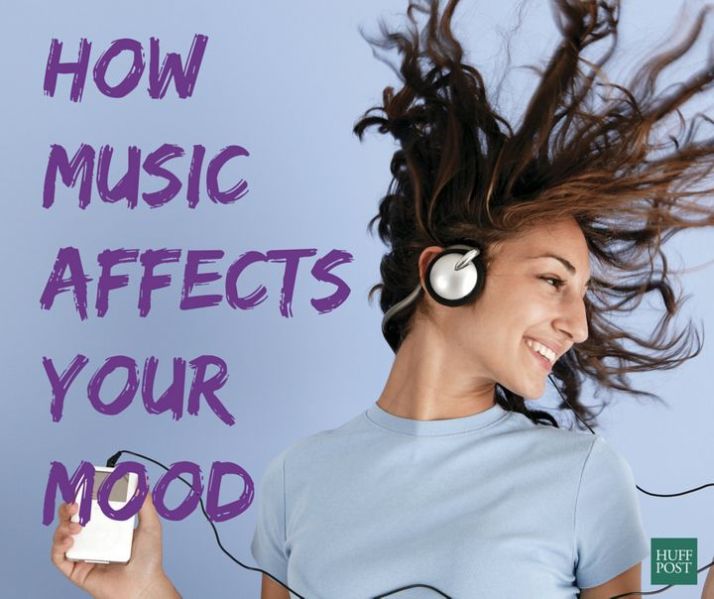
Music stimulates the part of the brain that produces the dopamine hormone. This hormone affects emotional behavior and mood. The influence of music is both behavioral and neural. That is, this means that music not only affects the mood but also affects what we cannot control ourselves.Music is not only able to affect your mood — listening to particularly happy or sad music can even change the way we perceive the world, according to researchers from the University of Groningen.
Music and mood are closely interrelated — listening to a sad or happy song on the radio can make you feel more sad or happy. However, such mood changes not only affect how you feel, they also change your perception. For example, people will recognize happy faces if they are feeling happy themselves.
A new study by researcher Jacob Jolij and student Maaike Meurs of the Psychology Department of the University of Groningen shows that music has an even more dramatic effect on perception: even if there is nothing to see, people sometimes still see happy faces when they are listening to happy music and sad faces when they are listening to sad music.
Research has found that when a subject listens to music that gives them the chills, it triggers a release of dopamine to the brain. And if you don’t know, dopamine is a kind of naturally occurring happy chemical we receive as part of a reward system. Now here’s the really interesting part: Dopamine is not only released during peak musical moments but also when we anticipate those moments. It’s like our brain is rewarding us for knowing a really great chorus is just about to hit!
Hearing a song from our adolescence brings back a flood of feelings and memories. By why do those songs have such a strong hold on our emotional core? Our brains develop rapidly between ages 12 and 22 (there’s a reason they call it our “formative” years), so when we make a connection to a song during that time, it’s a strong neurological connection. The massive rush of hormones associated with our pubescent years tells our brains that everything is super important, and that includes whatever music we’re listening to at the time. That’s why when we hear a true throwback to our high school days, it’s a powerful thing.
The impact of positive thinking has been a subject of focus for psychologists and self-help gurus for ages now, but what about positive listening? Is there such a thing as intentionally listening to positive-sounding music to boost your mood? We already know music that gives us the chills helps to release dopamine, but a separate study found that people who intentionally listened to upbeat music improved their moods and happiness in just two weeks. When a separate group was instructed to listen to different music that wasn’t deemed positive sounding, they didn’t experience the same mood-boosting effect. So the next time you’re blue, maybe put on a song that will make you smile.











 Eduindex
You must be logged in to post a comment.