Covid vaccine will be provided by linking Aadhaar.

Corona vaccine is being tested in the country and the world. Because cases of corona in the world are constantly increasing. However, it is a challenge to the government not only to corona but to whom to give corona vaccine first ? and how to distribute it?

In India, the corona vaccine may come early next year. According to Healthy Minister Dr. Harsh Vardhan 25-30 crore people will be given corona vaccine by June – July of next year. The person will be linked to the Aadhaar card while giving veccine. For which there will be no Aadhar card, the government has not given any kind of information.Simultaneously, the government will use schools, panchayats, and anganwadis to distribute the vaccine and the state government will identify the places from where the vaccine will be given.

How will the covid app work?

While moving the veccine from one place to another, there is no change in the environment of the veccine so the covid app will be taken.

After giving the covid vaccine the person will be given a certificate. in which who, when, and where the vaccine is given will be given information which can be severely reduced in digi locker.

All The Land Deals Under The Roshni Act Are Now Void

It goes without saying that most of us had seen how Roshni scam which is Rs 25,000 crore scam was highlighted extensively some time back in Zee News channel. They termed it as “Mission Zameen Jihad”. All this happened when Farooq Abdullah was the Chief Minister of Jammu and Kashmir. 

                   Truth be told, it was highlighted in Zee News that the chief objective of “Mission Zameen Jihad” was to change the demographic population of Jammu in favour of Muslims. It was told that the land was allotted mainly to influential people mostly Muslims who never hailed from Jammu. It was also disclosed that advertisements announcing 100% plots for Muslims in colonies were made so that no person of any other religion could ever buy the plot. 

                          Needless to say, we all now also know that the Jammu and Kashmir government has decided to annul all land dealings made under the Roshni Act after 3 weeks of the Jammu and Kashmir High Court declaring it unconstitutional and unsustainable. The Principal Secretary of Revenue was asked to retrieve all such land and remove encroachments within six months. An official spokesman said in the statement issued to the press that, “The Principal Secretary, Revenue, shall work out a plan to retrieve large tracts of state land in a time-bound manner and work out modalities to evict encroachers from such state land within six months besides planning the handling of money received for these lands after annulment.”    

                                       Going forward, the spokesman then said that the Principal Secretary, Revenue shall ensure information regarding district-wise state land as on January 1, 2001 are complied and posted on the official website and the NIC website with details of the state land that was in illegal and unauthorized occupation of person(s) entities with full identity of encroachers and particulars of the land. He said that complete identities of all influential ministers, legislators, bureaucrats, government officials, police officers, businessmen, their relatives or persons holding benami for them, who have derived benefit under the Roshni Act, 2001, or Roshni, 2007, will be revealed. The action shall be completed within a month.” 

                                       To be sure, the scheme initially envisaged conferment of proprietary rights of about 20.55 lakh kanals to the occupants of which only 15.85% land was approved for vesting of ownership rights. Against the anticipated revenue from such occupants, the revenue actually generated was meagre! Influential persons benefited the most from this!

                                          We also now know how in a latest, landmark, learned and extremely laudable judgment titled Prof. S.K. Bhalla v/s State of J & K and others in IA No. 48/2014 & CM Nos 4036, 4065 of 2020 in PIL No. 19/2011 delivered on October 9, 2020 through video conferencing from Srinagar, the Jammu and Kashmir High Court has held the ‘Roshni Act’ to be unconstitutional. It minced no words to hold that the Jammu and Kashmir State Land (Vesting of Ownership to the Occupants) Act, 2001 which is popularly known as the ‘Roshni Act’ is completely unconstitutional and all acts done under it or amendments thereunder are also unconstitutional and void ab initio. The Bench comprising the Chief Justice Gita Mittal and Justice Rajesh Bindal directed CBI investigation into allegations against Ministers, legislators, bureaucrats, high ranking Government and police officials for having encroached upon public lands and having caused orders passed under the Roshni Act in their favour. Very rightly so!  

                              In a sharp rebuff to the “Make hay while sun shines” culture, the Bench then holds in para 2 that, “It could perhaps be said that acquisition of property is a natural aspiration of every human being but certainly not dishonest acquisition premised in the criminal offence of trespass committed on State lands held in public trust by the Government. In fact, the implementation of this adage, as is manifested in the present case, tantamount to implementation of a “loot to own” policy. That these looters could motivate a legislation to facilitate their nefarious design, by itself speaks about their insidious and deep penetration into the corridors of power and authority; about the level and scale of their influence at all levels and suggests involvement of all those who mattered including in propounding and implementation of the policy.”

                  In a rare and candid admission, the Bench then concedes in para 3 that, “We have not come across any such legislative state action legitimizing criminal activity at the cost of national and public interest with incalculable loss and damage to the public exchequer and the environment, without any financial (or other) impact assessment.”

                     More damningly, the Bench then elucidates in para 4 holding that, “What is even more shocking is that despite a citizen of the erstwhile State of Jammu and Kashmir raising this issue by virtue of public interest litigation filed nine years ago in 2011 by way of the present PIL no. 19/2011 and another in the year 2014, their pleas for justice to the people of Jammu and Kashmir have fallen completely on the deaf ears of the official respondents. The bureaucracy and Government officials are enjoying huge salaries and benefits for their acts of omission and commission each of which tantamount to a penal offence and have thus actively encouraged usurpations of public lands. Those in power, authority and the respondents have completely failed to discharge their constitutional functions, their statutory duties and public law obligations towards the public to whom they owe their very existence.” 

                                  While elaborating on the facts of the present case, it is then envisaged in para 5 that, “In this writ petition filed in public interest nine years ago in 2011, the present application was filed by the petitioner five and a half years ago as back as on 13th March 2014 submitting that a multi crore Roshni land scam unearthed by the report of the Comptroller and Auditor General of India (CAG) for the ending year 31st March 2013, was required to be handed over to the CBI so that the matter could be thoroughly investigated and appropriate prosecutions be effected under the Jammu and Kashmir Prevention of Corruption Act and under Section 17 of the Jammu and Kashmir State Land (Vesting of Ownership to the Occupants) Act 2001 to be undertaken.”    

                                  Delving deeper, the Bench then lays down in para 7 that, “On 9th of November, 2001, the Jammu and Kashmir State Land (Vesting of Ownership to the Occupants) Act 2001 received the assent of the Governor which was published in the Government Gazette on 13th November, 2001. The Statement of Objects and Reasons for the enactment shocks the conscience of this Court and, therefore, is reproduction in extenso as under:

           “Whereas most of the State land stands encroached upon and is the purpose for which it was reserved at the time of regular settlement. These lands have either come under various types of construction or plantations including orchards. The eviction of these lands is very difficult if not impossible because of the procedure established under law whereunder an encroacher has to be given an opportunity of being heard before he is evicted. Moreover, the encroachers are entitled to file an appeal, review, revision and thereby the State will be involved in protracted litigation and ultimately no substantial achievement shall be made in removing the encroachments. The removal of encroachment en-block will also lead to mass unrest.

          In view of the above, the Hon’ble Finance Minister proposed the scheme called ‘Roshni’ in his Budget Speech 2000 whereunder it was suggested that the Proprietary Rights be given to the persons holding unauthorisedly till 1990 on payment of the cost equivalent to the prevailing market rate of the year 1990.””

                                           No wonder, it is then held in para 8 that, “As a result of the above, the said enactment is referred to in common parlance as the ‘Roshni Act’. We shall also so refer to this enactment hereafter.”

                                               Be it noted, the Bench then minces no words in stating in para 17 that, “It appears that the Revenue Department made J & K State Land (Vesting of Ownership to the Occupants) Rules, 2007 in purported exercise of power under Section 18 of the Roshni Act which came to be published in the Official Gazette as SRO 64 dated 5th May, 2007. It seems that no approval of these Rules was sought from the legislature and they were unauthorizedly published in Government Gazette. Again in a shocking illegality, these rules were in excess of the powers conferred by the Statute and in contradiction with the prohibitions contained therein.”

                                            What is worse is as stated in para 18 that, “This is done despite the mandate of the Constitution and the law laid down by the Supreme Court. Government officials had the gumption and absolute arrogance to publish rules which did not have the clearance of the legislature speaks volumes about the influence of the beneficiaries thereof.”  

                                               To put things in perspective, the key point of what is then stated in para 42 is that, “Before dealing with this application, few background facts are necessary. A writ petition in public interest which was registered as PIL No. 19/201, was filed by Prof. S.K. Bhalla on 17th August 2011, an academician and then a Principal of the Government Degree College, Mendhar pointing out to allegations of land grabbing leveled against influential people including police officers, politicians and bureaucrats occupying responsible positions in the Erstwhile J & K State in connivance with land mafia, making the prayer for constitution of an SIT and seeking appropriate criminal, disciplinary and other actions against those guilty.” It is also stated that the writ petitioner referred to specific instances of land grabbing in Paras 18 to 20 of the writ petition but due to paucity of space it is not possible to elaborate them in detail here.

                                        Finally and far most importantly, the Bench then concludes in the final para 119 by observing that, “In view of the above, we direct as follows:

(I)                         The Commissioner/Secretary to Government Revenue Department, shall ensure that following information regarding district wise State lands as on 1st January, 2001, are compiled and posted on the official website as well as the NIC website:

(i)                         The details of the State land which was in illegal and unauthorized occupation of person(s)/entities with full identity of encroachers and particulars of the land.

(ii)                      The details of:

(a)          the applications received under the Roshni Act, 2001;

(b)         the valuation of the land;

(c)           the amounts paid by the beneficiary;

(d)         the orders passed under the Roshni Act; and

(e)          the persons in whose favour the vesting was done and also further transfers, if any, recognized and accepted by the authorities.

(iii)                   Complete identities of all influential persons (including ministers, legislators, bureaucrats, government officials, police officers, businessmen etc.) their relatives or persons holding benami for them, who have derived benefit under the Roshni Act, 2001/Roshni Rules 2007 and/or occupy State lands.

(II)                     The Divisional Commissioners, Jammu as well as Kashmir, shall place on record district-wise full details of the encroached State land not covered by the Roshni Act, Rules, Scheme(s), order(s) which continues to be under illegal occupation; the full identity and particulars of the land and person(s)/entities encroaching the same. The Revenue Secretary shall ensure that this information is also posted on the website of the respondents within four weeks.

(III)                  The Secretary Revenue, Govt. of the Union Territory of Jammu and Kashmir shall furnish the above information with copies of the supporting records to the CBI in the digitized format, and, if requested, hard copies thereof be also provided, within four weeks. The same shall be filed on court record as well.   

(IV)                 Translation of records, wheresoever required, shall be expeditiously ensured by the concerned Deputy Commissioner from the Tehsildars and provided to CBI within one week of the need being noticed/informed.

(V)                     In case, the above directions are not complied with, the Secretary Revenue and the Divisional Commissioners of Jammu and Kashmir shall be held liable and proceeded against for Contempt of Court.

(VI)                 The present order be placed before the Director, CBI, who shall appoint teams of officers not below the ranks of Superintendents of Police assisted by other officers to conduct an in depth inquiry in the matters which are the subject matter of this order. On conclusion of the inquiry, the CBI shall register case(s) in accordance with law against the person(s) found culpable, proceed with the investigation(s) as well as prosecution(s) thereof.

(VII)              The Anti Corruption Bureau shall place before the Director, CBI, the closure report in FIR 6/2019 filed on 4th July, 2019 before the Special Judge (Anti-Corruption Judge, Jammu) as well as a copy of the order dated 4th December, 2019 passed thereon by the Special Judge, Jammu.

(VIII)          The Anti Corruption Bureau of the Union Territory of J & K shall place complete records of all matters regarding land encroachment/Roshni Act or Rules being enquired into or cases investigated into by it, before the CBI which shall proceed with the further inquiries and investigations therein in accordance with law.

(IX)                  In all cases in which charge sheets stand filed by the Anti Corruption Bureau in the Courts, the CBI shall conduct further and thorough investigation, and, if necessary file additional charge sheets in those cases.

(X)                     In cases pending for accord of sanction for prosecution before the Anti Corruption Bureau or the Competent Authority, the records thereof shall be placed before the CBI for examination. These cases shall be thoroughly further examined, investigated by the CBI and the matter for accord of sanction of prosecution against all persons found by the CBI as involved in the offences, shall be proceeded with, in accordance with law.

(XI)                  The CBI shall immediately inquire into the three instances at Serial Nos. A, B, C above (paragraph nos. 54 to 82); the matters pointed out in CMs 4036/2020, CM 4065/2020 and all instances of vesting under the Roshni Act and encroachment of State lands by influential persons as above in the details provided by the authorities and proceed further in these cases in accordance with law.

(XII)               The CBI shall also inquire into the continued encroachments on state lands; illegal change of ownership/use; grant of licences on encroached State lands; misuse of the land in violation of the permitted user; raising of illegal constructions; failure of the authorities to take action for these illegalities; fix the responsibility and culpability of the persons who were at the helm of affairs, who were duty bound to and responsible for taking action; their failure to proceed in accordance with law against the illegalities and instead have permitted/compounded the same, as also any other illegality which is revealed during the course of the enquiry wheresoever.

(XIII)           The CBI shall specifically inquire into the matter of publication of the Roshni Rules, 2007 without the assent of the Legislature. If this is found true, the CBI shall identify the persons responsible who have illegally and dishonestly published the same and proceed in the matter for their criminal liability.

(XIV)          The Principal Secretary, Revenue, Vice Chairman JDA and all other authorities from whom information is required by the CBI shall efficiently and expeditiously furnish all records and information to the CBI. Failure on the part of any Government authority to do so shall render them liable for appropriate departmental action apart from inviting criminal prosecution.

(XV)              We grant liberty to the petitioner in PIL No. 19/2011 and Ankur Sharma, the petitioner in PIL No. 41/2014; the applicants in CM 4036/2020 and CM 4065/2020 to place all material in their power and possession before the Central Bureau of Investigation. If called upon to do so, they shall render full assistance to the CBI.

(XVI)          The CBI shall file action taken reports every eight weeks in sealed cover before this court in this case.

(XVII)       The Chief Secretary of the Government of the Union Territory of Jammu & Kashmir shall monitor the matter and ensure that the inquiry by CBI is not hampered in any manner on account of concealment of documents, records, requisite assistance or cooperation on the part of the official machinery.

(XVIII)   Any effort to delay the enquiry by the CBI in any manner should be construed as active connivance by such person(s) with those whose culpability is being investigated.

(XIX)           In view of the above directions, the presence of the applicants in IA Nos. 4036/2020 and 4065/2020 in the present proceedings is completely unnecessary and these applications are disposed of.

These applications are disposed of in the above terms.”

                                 No doubt, the most significant impact of this latest, landmark and extremely laudable judgment which has been well-drafted, well-worded, well-reasoned, well-analysed and well-justified is that the Jammu and Kashmir State Land (Vesting of Ownership to the Occupants) Act, 2001 which is popularly known as the ‘Roshni Act’ is completely unconstitutional and all acts done under it or amendments thereunder are also unconstitutional and void ab initio. It merits no reiteration that CBI investigation has been very rightly directed by the two Judge Bench of Jammu and Kashmir High Court comprising of Chief Justice Gita Mittal and Justice Rajesh Bindal. This clearly manifests that the Jammu and Kashmir High Court is very serious about this whole issue and wants to get to the bottom of it as there are very serious allegations against ministers, legislators, bureaucrats, high ranking government and police officials for having encroached upon public lands and having caused orders passed under the Roshni Act in their favour. The language used by the Jammu and Kashmir High Court in this judgment is very harsh because there is systematic loot as pointed out in this notable judgment. All those who are involved must be first identified and then investigated properly and all those who are found involved in corrupt misdeeds must be booked and strictly punished in accordance with law at the earliest!

                                       To conclude, it goes without saying that the Jammu and Kashmir government has very rightly decided to annul all lands dealings under the Roshni Act as void. Truth must come out and it must be ensured what the Jammu and Kashmir High Court has stated about the systematic loot that those involved in it are not spared under any circumstances no matter how high they may be in power because as the time tested old adage goes that, “Be you ever sop high, the law is above you!” There can certainly be no ever denying or disputing it! 

Sanjeev Sirohi, Advcoate,

s/o Col BPS Sirohi,

A 82, Defence Enclave,

Sardhana Road, Kankerkhera,

Meerut – 250001, Uttar Pradesh.

Fatehpur Sikri – World Heritage Site

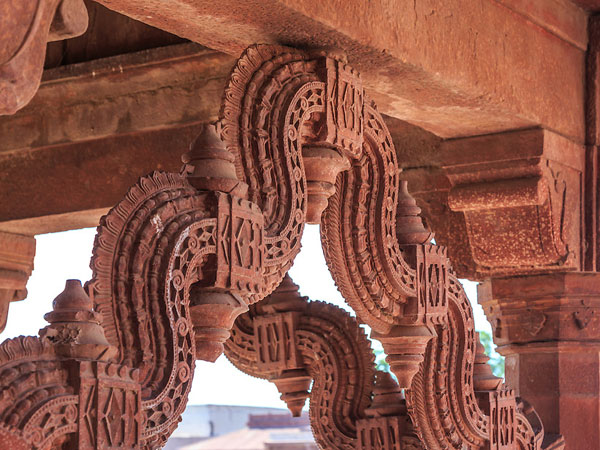
Fatehpur Sikri, , a city predominantly in red sand-stone, situated at a distance of 37 kms from Agra, was built by the Mughal Emperor Jalal-ud-din Mohammad Akbar, in honour of the great Sufi saint Sheikh Salim Chisti ; its magnificence and uniqueness offers a fine example of the emperor’s architectural finesse. Akbar’s tolerant religious views and interest in literature, architecture and fine arts gave the buildings at Fatehpur Sikri a charismatic blend of Islamic and Hindu elements in their style and design.

At Fatehpur Sikri during sunset and sunrise, the turrets and domes create shadows and silhouette against the copper red sky; which truly is an inspirational scene for a painter’s canvas or the visitor’s eyes.

Fatehpur Sikri is enclosed by a 11 kms long fortification wall interspersed with numerous gateways. The remains of the great city; the Imperial Palace Complex, the intricately built marble tomb of the great Sufi saint, Sheikh Salim Chisti and the grand mosque are second only to The Taj Mahal, a benchmark of architectural beauty.A rich imagination is all it takes to transport any visitor to the era of gold tapestry, drapes, rich plush carpets and the royalty of the Mughal courts.

Fatehpur Sikri

37 kms from Agra is built a city predominantly in Red Sandstone and is called Fatehpur Sikri. This town was built by the Mughal Emperor, Akbar. He had planned this city as his capital but shortage of water compelled him to abandon the city. After this within 20 years, the capital of Mughals was shifted to Lahore. Fatehpur Sikri was built during 1571 and 1585. Today this ghost city has a population of about 30,000. This deserted city has retained many of the old structures, because of the efforts of the Archaeological department .Fatehpur Sikri is one of the finest examples of Mughal architectural splendour at its height. Though the city is in ruins, it is a place to visit if one comes to Agra.But in real terms Fatehpur Sikri is a place where one should spend some time. The sunset over the ruins is sight to cherish.Fatehpur Sikri is the best example of the culmination of Hindu and Muslim architecture. Fatehpur Sikri Mosque is said to be a copy of the mosque in Mecca and has designs, derived from the Persian & Hindu architecture.


Diwan-I-Am

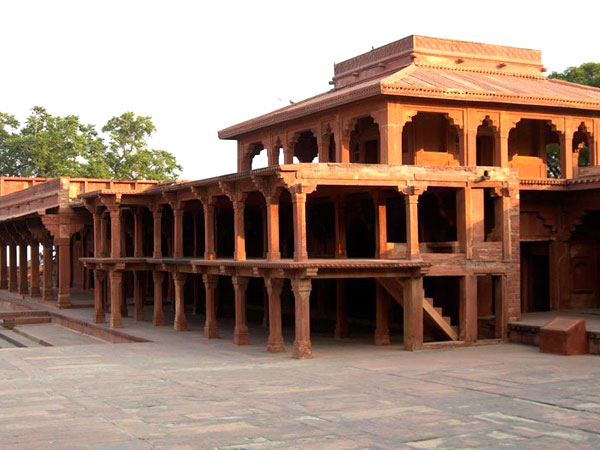
The journey to the royal palace begins with Diwan-I-Am or the Hall Of Public Audience. This hall was also used for celebrations and public prayers. It has cloisters on three sides of a rectangular courtyard. To the west is a pavilion with the Emperor’s throne. Beautiful jali screen on either sides separated the ladies attending the court.


Diwan-khana-I-khaas

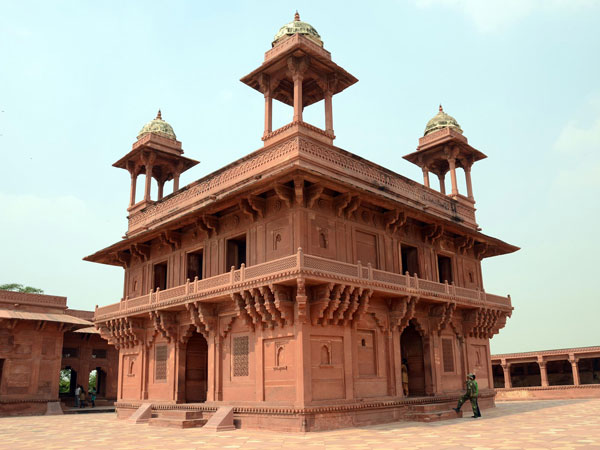
To the right is an apparently looking two storeyed building, with corner kiosks, known as diwan-khana-I-khaas or Hall Of Private Audience. On entering it, one finds only a single vaulted chamber. In the centre stands a profusely carved column supporting a collosal-bracketed capital. Four narrow causeways project from the centre and run to each corner of the chamber. It is believed that Akbar’s throne occupied the circular space over the capital and the corners were assigned to the four ministers.


Turkish Sultana’s House

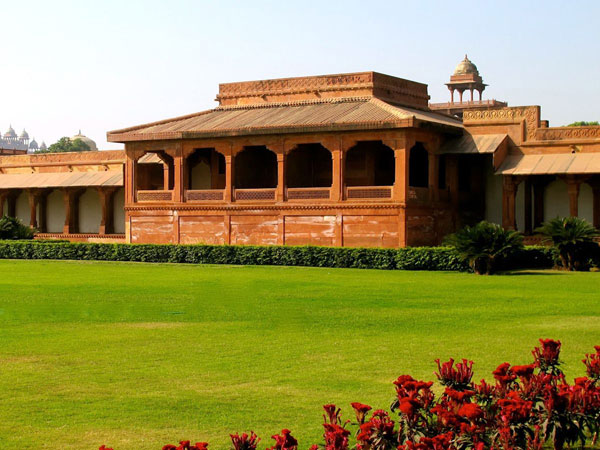
To the left of the Pachisi Board is the Turkish Sultana’s house. The house, as its location at the corner of Anup Talao shows, was a pavilion for repose, attached to the pool. The geometrical pattern on the ceiling is reminiscent of Central Asian carvings in wood.


The Treasury

To the left of the Diwan-I-Khaas is the Treasury or Ankh Michauli, once believed to have been used for playing the game, comprising three rooms each protected by a narrow corridor which were manned by guards.


Daulat khana-I-khas

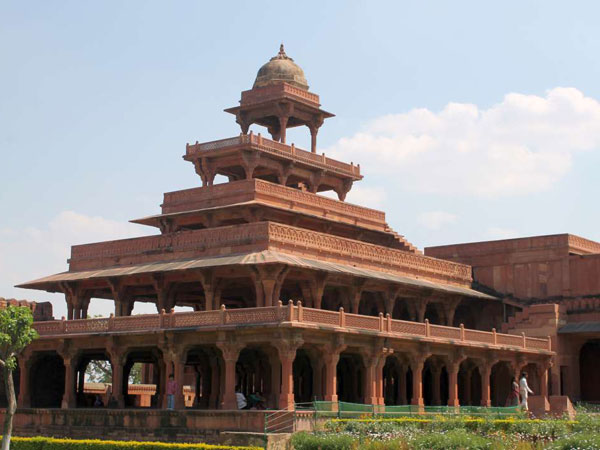
Located in the corner to the left is the emperor’s private chamber. It has two main rooms on the ground floor. One housed Akbar’s library while the larger room was his resting area. On the first floor is the Khwabgah or the bed-chamber. It was connected with the Turkish Sultana’s house, the Panch Mahal, Mariam’s House and the Jodha Bai’s palace by corridors.


Palace of Jodha Bai

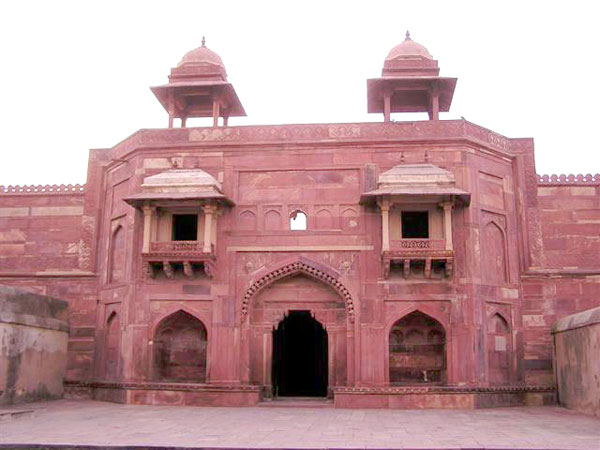
To the left of the Sunehra Makan is the largest and the most important building in the royal palace, named after Akbar’s Rajput wife, Jodha Bai. This spacious palace was assured of privacy and security by high walls and a 9 metre guarded gate to the east. The architecture is a blend of styles with Hindu columns and Muslim cupolas.


Hawa Mahal And Nagina Masjid

To the right of Jodha Bai’s palace is Hawa Mahal, the Palace of Winds. This small-screened wind tower faces the garden and is attached to the palace. The garden is laid out in the Char Bagh style with straight walls intersecting at right angles and divided by shallow channels.


The Jami Masjid

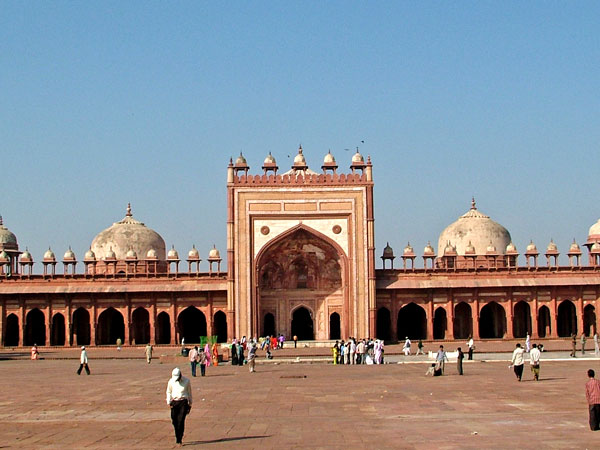
One of the largest mosques in India, Jami Masjid was built in 1571 AD. Inside, there is a vast congregational coutyard. To the right, at the corner, is the Jammat Khana Hall and next ot this is the tomb of the royal ladies. To the left of the Jami Masjid is the Stone Cutters’ mosque, the oldest place of worship at Fateh Pur Sikri. It is entered through the eastern entrance known as the Buland Darwaza.


Buland Darwaza

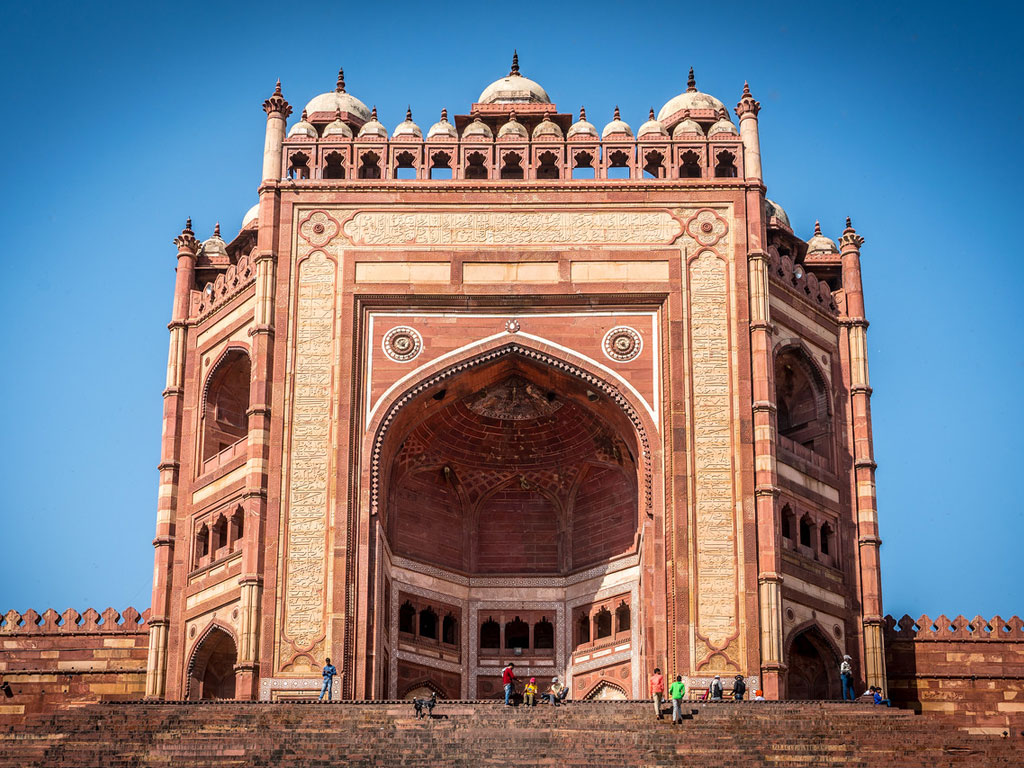
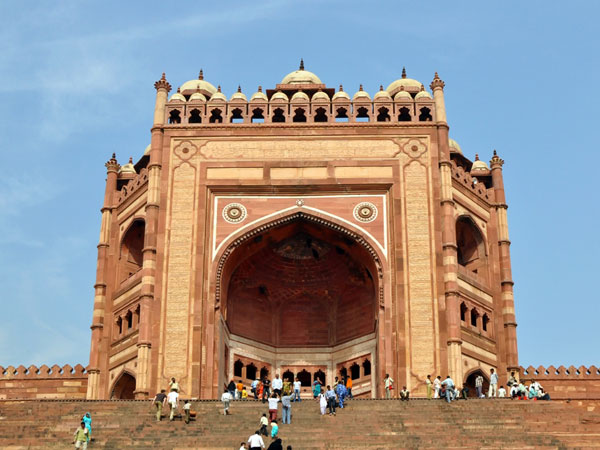
This gate can be approached from the outside by a 13-metre flight of steps which adds to its grandeur. The gate erected in 1602 AD to commemorate Akbar’s victory over Deccan is the highest and grandest gateway in India and ranks among the biggest in the world.

Getting to Fatehpur Sikri

Agra is the most easily accessible tourist destination in India. The city has excellent air, rail and road links. While in Agra, the best way to visit Fatehpur Sikri is by a taxi. The Imperial fort of Fatehpur Sikri is approachable from Agra, 37 kilometers away or 18 kilometers from Bharatpur. Most visitors prefer to make a day trip to the fort en route from Agra or from Bharatpur, as it requires at least half a day to explore.

AIR : Nearest airport is Agra which is 7 km from the city center and 3 km from Idgah bus stand. It only takes 40 minutes from Delhi to Agra.

RAIL : The main railway station is the Agra Cantonment station. It is well connected to all major cities of India. 

ROAD : Idgah bus stand is the main bus stand of Agra, from where one can catch buses for Delhi, Jaipur, Mathura, Fatehpur-Sikri, etc.

Childhood Redefined: 90’s Cartoon

 Memories are an integral part of the upbringing of a child. This leads to shaping up one’s personality based upon knowledge & past experiences. Memories are of different kinds. They vary by nature, like saying positive or negative or they can differ in periods depending upon very old or recent times. 

  These memories lend one experiences that lead one to learn one life lesson. This experience causes one to get off through tough days with ease & make good days better. Now discussing childhood memories, they leave each one of us with a different imprint. The reason for our smiles or tears occasionally. 

   To each one of us, our childhood holds a jar of memories. Savouring over our favourite delicacies, playing for hours under the sun with friends, sharing tiffins at school & are some of the common memories that each one of us holds. But something common to all of us is the animated series of the late ’90s or early ’20s. I bet they are still a part of you, embedded deep in your heart, probably forgotten. 

 From being a couch potato watching cartoons all day long to binging Netflix on weekends we all grew up. So let’s turn the clock back as we go down the lane to revisit childhood, with these top 12 cartoons hand-picked just for you :

1] Tom & Jerry: This American animated series was created in 1940. It is named after its two main characters; a blue-grey cat named Tom who gets into comedic fights or chases the brown homed mouse called Jerry. Each episode shows the two characters which they often get hurt ridiculously. 

 2] Flinstones: This show is set in the pre-historic times in the town of Bedrock. Living beings of the past, dinosaurs, and other long-extinct animals co-exist with cavemen, saber-toothed cats, and woolly mammoths. Also, these characters use Stone Age technologies, & their lives resemble the lives of 20th century urban America.

3] Richie Rich: A rich kid named Richie who used to deal with threats to the Rich family, more specifically Richie. Some segments for humor with Dollar and Cadbury. Also, his friends fighting master criminals, aliens, and other threats to the world.

https://images-na.ssl-images-amazon.com/images/I/91wO9DHpp5L._RI_.jpg

 4] Baby Looney Toons: Baby versions of Looney tunes characters Bugs, Daffy, Lola, Taz, Sylvester, Tweety, Petunia & Melissa living with granny.

5] Popeye The Sailorman: Guess the intro song’s still embedded in our head. As everyone has heard of Popeye, the sailor who eats spinach and gets stronger. There exists a love triangle among Popeye, Olive, and Bluto. And Bluto’s endless schemes to claim Olive at Popeye’s expense. Popeye holds his near-saintly perseverance in overcoming any obstacle to please Olive, who often renounces Popeye for Bluto.

6] Scooby Doo: Scooby and gang use their intelligence other detective instincts to uncover mysteries that appear to be supernatural initially but later reveal having a person behind all these things thus lending a logic to the situations.

7] The Powerpuff Girls: Probably the first and one of the only TV shows of the time that begun teaching us about feminism. Bubbles, Buttercup, and Blossom were cute little girls who were fierce warriors.

8] The Jungle Book: Movies like ‘The Jungle Book’ & ‘Lion King’ are an extension of this series. Based on the Rudyard Kipling book, here you see how a boy called Mogli grows up in a jungle fighting through the hardships. Despite not being an animal, he grows up with a pack of wolves while doing ridiculous things with Baloo and training with Bagheera.

9] Dragon tales: It is impossible to forget this sentence, those bunch of dragons called always managed to make us smile. Emmy & Max find a magical place called Dragonland where they are transported using magical crystals where they face challenges with dragon Ord, Cassie, Zak, Wheezie & Quetzal.

10] Pokemon: As Ash Ketchum turns 10, he desires to start his journey as a Pokemon trainer with the dream of being a Pokemon master in the long run. But having overslept, he rushes to Professor Oak to realize that the only Pokemon left for him to have is a Pikachu, an electric pokemon. Finally, Ash & Pikachu, embark on their journey together while befriending two travel mates Misty & Brock. Along the journey, they make a lot many both human and pokemon friends. 

https://in.pinterest.com/

National Integration

National integration is one of the most burning questions & problems of modern India. It has posed a tremendous threat & challenge to the very existence of India. History tells us that from long past India has never been a United country in the strict sense of the term. There was a temporary attempt of this unity in some parts of India Or a greater portion of the country during the reign of Chandragupta Maurya, Samudragupta, Chandragupta II Or Vikramaditya, Kanishka & emperor Ashok. A greater unity was felt during the Muslim rule in India, especially at the time of Alauddin Khilji & Ghiasuddin Balban. During the Mughal period, except some areas in the north-east, south & west, most parts of the country were brought under a unified administration. The British succeeded in building a united, far more unified Indian empire than ever before. But this so-called unity in India during the Muslim & the British rule was a forced or artificial one. There was no popular government then. There was no scope of people’s say in the administration. As India was divided into many small & large kingdoms, mostly at enmity with one another, they fell easy prey to the foreign Muslim & British invaders.

The seed of succession was first sown in Indian soil when the Muslim league wanted an independent, separate homeland for the Muslims in India at the Lahore conference in 1940. After this, at the instigation of the British Government, the Muslim league succeeded in carving out a separate Muslim state, named Pakistan after a process of prolonged communal riots which claimed millions of innocent lives & many thousands crores worth of property. After partition & independence from the British rule on 15th August 1947. India turned into a multinational country with a heterogeneous ethnic group with different cultures, languages, religions & faiths. Despite all these, there was at least some kind of unity in diversity still coexisting. Also, there was at least some sort of unity in diversity still in existence. But unfortunately direct or indirect, covert or overt instigation of some insurgents within the country or from without having posed a serious challenge to this integration.

The scene of this disintegration started of this disintegration begun with the Khalistan movement in Punjab. Gradually this movement brought in its wake many terrorist activities. Pakistan helped these terrorist activities. Pakistan helped these terrorists directly & indirectly with arms to destabilize the integrity of India. The movement soon took the character of separatists & secessionist struggle. By dint of strict military step other measures, the Indian government succeeded in curbing the movement within a decade. Next came the terrorist & secessionist movement in Kashmir & Nagaland. The former one was directly backed by Pakistan. It resulted in the merciless killing of masses of innocent people, eviction of Kashmiri Hindu Pandits from their hearths, homes & property & destruction of many crores worth of Government and private property, buildings, bridges & some other means of communication.

 Thus all these clearly show the problem of integration in free India now. The Indians who fought & struggled irrespective of caste, creed & linguistic varieties to free India from British domination in the past have forgotten their pledge & sacred duty, so to say, for national integration. The Central Government must face such a challenge with high-handed means & enough foresight at the same time. The linguistic & economic problems of the backward class tribals and some other ethnic groups must be taken into account. Autonomous rights must be granted to the provinces as far as possible. 

Cottage Industries

Cottage industries are small scale industries run by a handful of men in or near their homes with small capital. Such cottage industries are very useful to a poor & populous country like India. They don’t have enough wealth to inaugurate & establish a large no. of big industries. A handful of large industries prevalent in the country can’t employ a vast population of India.

Moreover one must utilize the immense manpower we possess. This is almost impossible in the existing mills, factories & large industries here, & leading to unemployment of a large number of people ultimately. This isn’t a healthy sign for society & the country. A planned approach to proper development & establishment of sufficient cottage industries can help solve the matter of fast-rising unemployment problems in India.

Before the arrival of the British Government in India, the cottage industry was very flourishing in our country. The products of cottage industries, particularly the famous ‘Muslin’ sarees of Bengal charmed the European ladies. The British Government destroyed the Muslin industry & many other cottage industries of India fir their selfish commercial & colonial interests.

https://www.pexels.com/

Gandhiji realized the importance of cottage industries amidst the poverty of the country. So he advised people to use ‘Charkha’ in every house to weave cloth & thus to attain self-sufficiency in the production of cloth. This thing came out to be advantageous for people as it didn’t require large capital to introduce the cottage industry. Fact, the members of a family can run it too. Semi-literate or illiterate people & craftsmen can run it easily. It doesn’t need much technical knowhow.

In our country, the people on the rural side suffer the most & many urban people also face periodic unemployment a lot. The laborers of a mill or factory are often at risk of becoming unemployed at any moment for the lock-out or sudden closure of the mill. So the cottage industry can supply them a golden opportunity to have self-employment throughout the year. So they will not have to rush to a town for an uncertain living. Moreover, these big industries of the cities are connected with antisocial activities.

India is noted for some small scale industry products. India has a worldwide reputation for some products of small scale & cottage industries. These are the silk of Murshidabad & Mysore, the shawls of Kashmir & the silverwares of South India.

The Sentinel Island (Indian) which is left isolated and prohibited for visit

On the 2nd of August 1981, Primrose named one cargo ship which was travelling between Bangladesh and Australia had crashed on a coral reef in the Bay of Bengal. That ship was in the Andaman (group of islands) archipelago around an island termed as “North Sentinel Island”. Ship was in unmovable condition and ships crew was not able to use their lifeboats because the sea was having high tides and waves. So, they were forced to wait for some days at same area so that they or someone can contact them anyhow. After residing there for few days, one young sailor noticed few peoples approaching near their ship. On the contrary as history tells, they were not coming to help them in any manner. Additionally, they were carrying weapons like spears, bows and arrows. Those peoples were “The Sentinelese” the public of that secret island.

Then the captain of the ship sent out an emergency message quoting “Wild men, estimate more than 50, carrying various homemade weapons are making two or three wooden boats,”. “worrying they will board us at sunset. All crew member’s lives not guaranteed”.  They somehow survived as they were inside the ship and unknown in quantity to peoples of Sentinelese.

A week later, the Indian Navy sent a helicopter to rescue the crew of ship. Surprisingly, this ship named Primrose is still lying at coast and can be found near the North Sentinel Island. And here starts the story and facts behind this island prohibited to visit.

This was an unintentional yet accidental interaction with the Sentinelese. Few more such contacts between those peoples and new age humans had happened until now. Earlier few was peaceful as to understand and grow. However, it has turned in not so peaceful meet and greet in coming of ages.

In November 2018, John Allen chau, an American missionary landed in Port Blair and desired to visit the North Sentinel Island and travel and search around there to know more. But he was dedicated to mission of introducing Christianity to the Peoples of Sentinel Islands. It was a fully planned trip and he had written and learned all the details carefully in his diary.

With the help of some local fisherman, he reached the North Sentinel Island with few gifts like scissors and fishhooks. In the first attempts, the Sentinelese reacted very aggressively, and he had to return back somehow saving himself. He left the island In a hurry and ran like a sprint. Also, at the second attempt, peoples of sentinel island were not in the mood of meeting and reacted violently to the john. Sadly, in the third attempt, John Allen Chau was killed by those peoples. And all the chances and attempts were shattered and also costed a life of human.

 Andaman and Nicobar Islands as a whole region in sea includes more than 300+ small and medium size islands. North, Middle & south Andaman are together called Great Andaman. These are also known as main island of Andaman. This place is crowded with most of the indigenous (native) peoples count. The original inhabitants (citizens) of the Andaman island were called “Andamanese”, who were supposedly first among the groups of peoples migrating outside from Africa Continent.

A research paper on claims that usually, the Andamanese were Hunter-gathers. They are the pre-evolution categories of human’s who does not depend no Agriculture. Instead, they rely on the Fruits, Fish, Honey & turtle eggs. The first ever known and recorded contact with these peoples was back in 1771. When John Ritchie was sent by Britishers to survey and collect info regarding these Islands. There were as many as 5 groups with around 9+ tribes in 1800’s, which has reduced to much extent as one or two are known to be in fruiting state. Rest are extinct or mixed with these tribes.

 The Sentinelese is an isolated tribe of Andaman who are completely isolated and separated from Andamanese and rest of world. The Sentinelese is one of the last tribes in the world which has had very low interaction with the modern Humans and Civilization. The exact figure is impossible to predict but as guesses goes, they would be around 100 to 600 in head counts. We have very little info about them that to from the few interactions we had.

The mention of this specific island was in 1771, when a vessel of the East India Company passed this island and they had noticed few light and sound around the island. All the interactions with these specific tribe we had, one thing we are sure is that they are not very fond of us and they don’t even want to interact with us. Somewhat like they want to be in their place yet undiscoverable to all of us

In 1867, an Indian merchant ship containing 100 passengers and crew were attacked by some peoples. This happened on the 3rd day after they met an accident near the island. These peoples were naked, had short hair, had red painted noses & were making strange sounds. Peoples were saved from there with the help of British India’s Royal Navy.

After this incident, the island remains untouched and not disturbed for almost another 80 years. However, this changed as a film crew wanted to shoot a documentary about the indigenous population of Andaman and Nicobar Islands. They were using tactics of presenting the gifts like food items, fish and pigs. The crew would drop these gifts at the entrance of these islands and then they would move back & observe if the local peoples invite them. This technique worked with the ONGE & JARAWA tribes.

But the same technique did not work out for Sentinelese peoples. It was believed that they follow isolation and one crew member was injured with the bows attacked by Sentinelese. The arrow was 2.5 metre in approx. However, it is still unknown that why Sentinelese are so aggressive and isolation followers against modern humans.

But there is one theory that claims and blames one person for all these bad interactions and perception about us. The person is reportedly MAURICE VIDAL PORTMAN. Portman was a British officer-in-charge of the Andaman Islands. He was sexually obsessed and attracted towards the Andamanese locals, including the “Sentinelese”. It is said that once he had kidnapped a Sentinelese couple and 4 children, in order to study them. But the couple died because they might not have genetic immunity against some diseases. Portman mentions these details in his own publication “A History of Our Relations with The Andamanese”.

All these interactions might have urged them to not meet and greet the modern human civilization for more than 100+ years. After 1974, Indian Government made many attempts to establish communication with the Sentinelese. Two Anthropologist played a key role in this, TN Pandit & Madhumala Chattopadhyay. Since 1981, TN pandit went towards the North Sentinel Islands several times, carrying gifts. But for almost 10 years he was unable to contact or visualize any presence. Things changed in 1991, when an Indian Govt. expedition project crew spent nearly 30 minutes with the Sentinelese.

 A few week later, TN Pandit who missed the first trip went back to the North Sentinel Island again. But this time luck favoured, and he was successful this time and it gave us the first video footage of the Sentinelese. This depicted that they were using metals and weapons made by metals which may have been made by cracking and moulding the part of primrose ship.

After the 1997, the Indian Govt. refused to carry out more such expeditions and created an imaginary yet geographical defined perimeter around the Island. For now, we have separated us from all connection with Sentinelese. But at the same time, it questions our thinking as why we are not able to greet them. The answer lies in ourselves as still few cases comes where peoples with illegal transportation uses and take benefits of tribal peoples in all the group of Island in the exchange of mere things like basic facilities. This exchange includes Alcohol and food items and such things. We have progressed but some people still are same as pre-evolution period which affects the relation among us badly.

This information is collectively not present but still it has internet source for distinct proofs. More info and deep discussion can be found on the YouTube channel “soch by mohak mangal”, in which he elaborates the tribal connection and interaction of humans with different tribes of Andamanese.

Indian Art Style

• Rajasthani miniature art

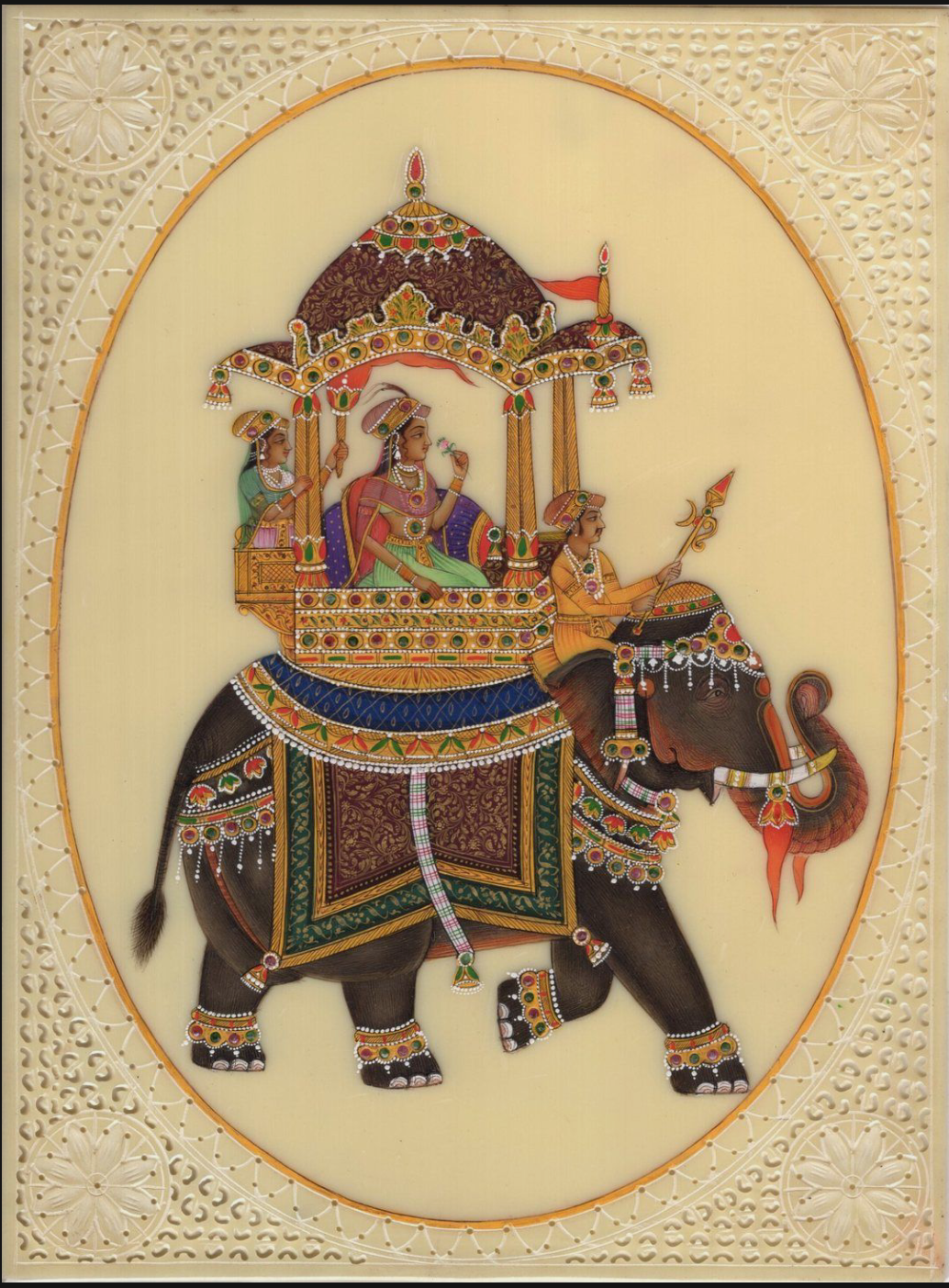
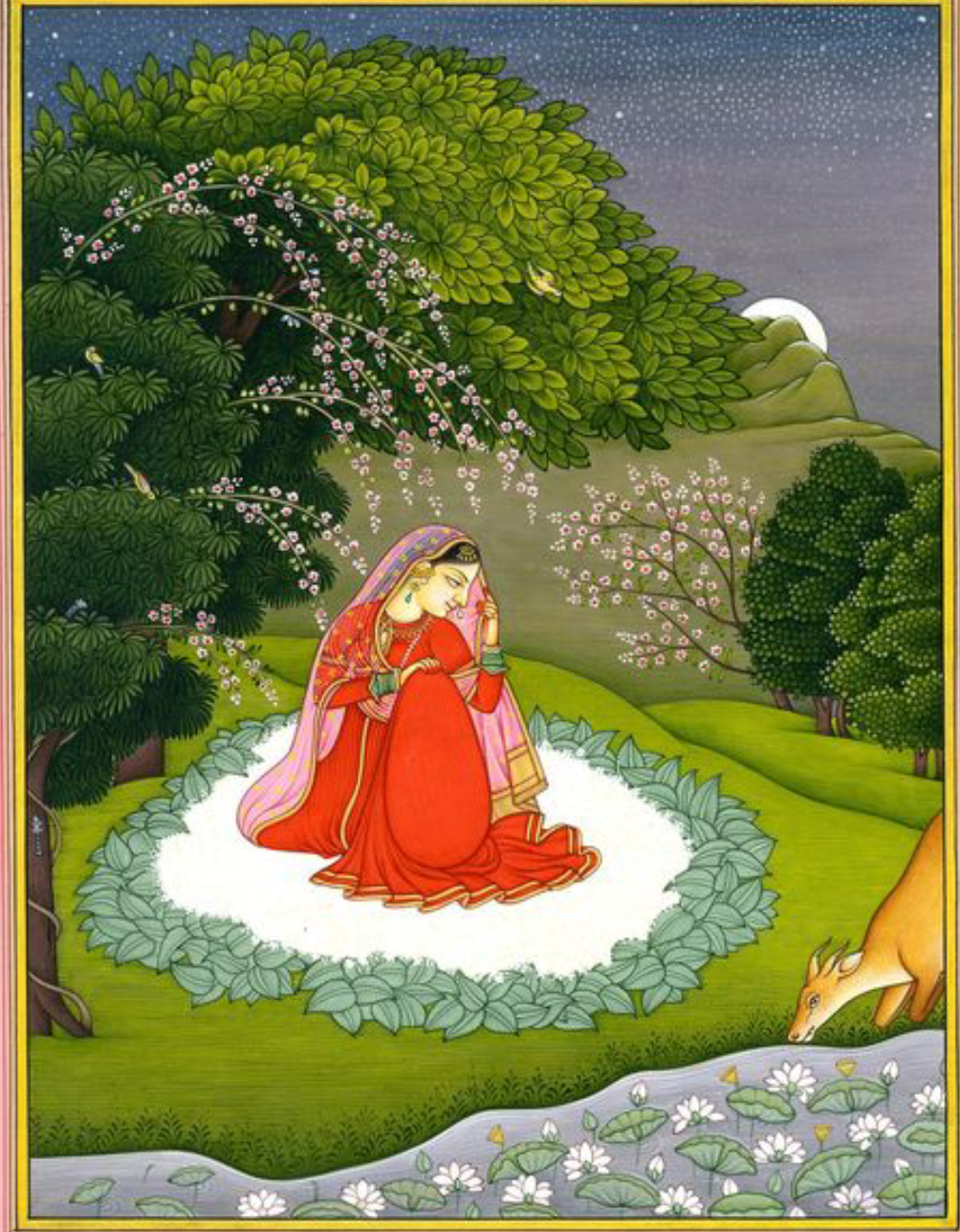
Rajasthan is one of the pioneer seats of miniature painting in India. Rajput painting, also known as Rajasthani painting, is a style of Indian painting evolved and flourished in the royal courts of Rajputana, India. Each Rajput kingdom evolved a distinct style but with certain common features. Rajput paintings depict a number of themes, events of epics like the Ramayana and the Mahabharata, Krishna’s life, beautiful landscapes and humans.

Miniatures in manuscripts or single sheets to be kept in albums were the preferred medium of Rajput painting but many paintings were done on the walls of palaces, inner chambers of the forts, havelis, particularly the havelis of Shekhawati, the forts and palaces built by Shekhawat Rajputs. The colours were extracted from certain minerals, plant sources and conch shells and were even derived by processing precious stones. Gold and silver were also used. The preparation of desired colours was a lengthy process, sometimes taking weeks. The brushes used were very fine.

• Pattachitra

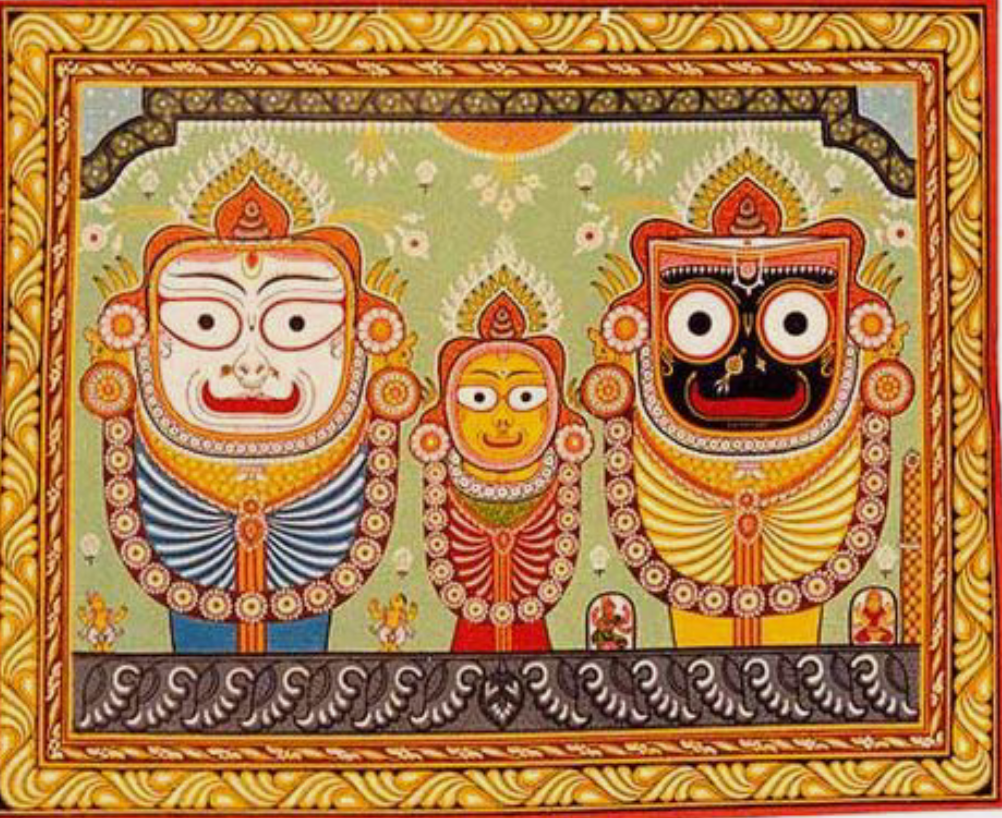
‘Pattachitra’ is a general term for traditional, cloth based scroll painting based in the eastern Indian state of Odisha. In the Sanskrit language, ‘patta’ literally means ‘cloth’ and ‘chitra’ means ‘ picture’. The pattachitra style of painting is one of the oldest and most popular art forms of Odisha.

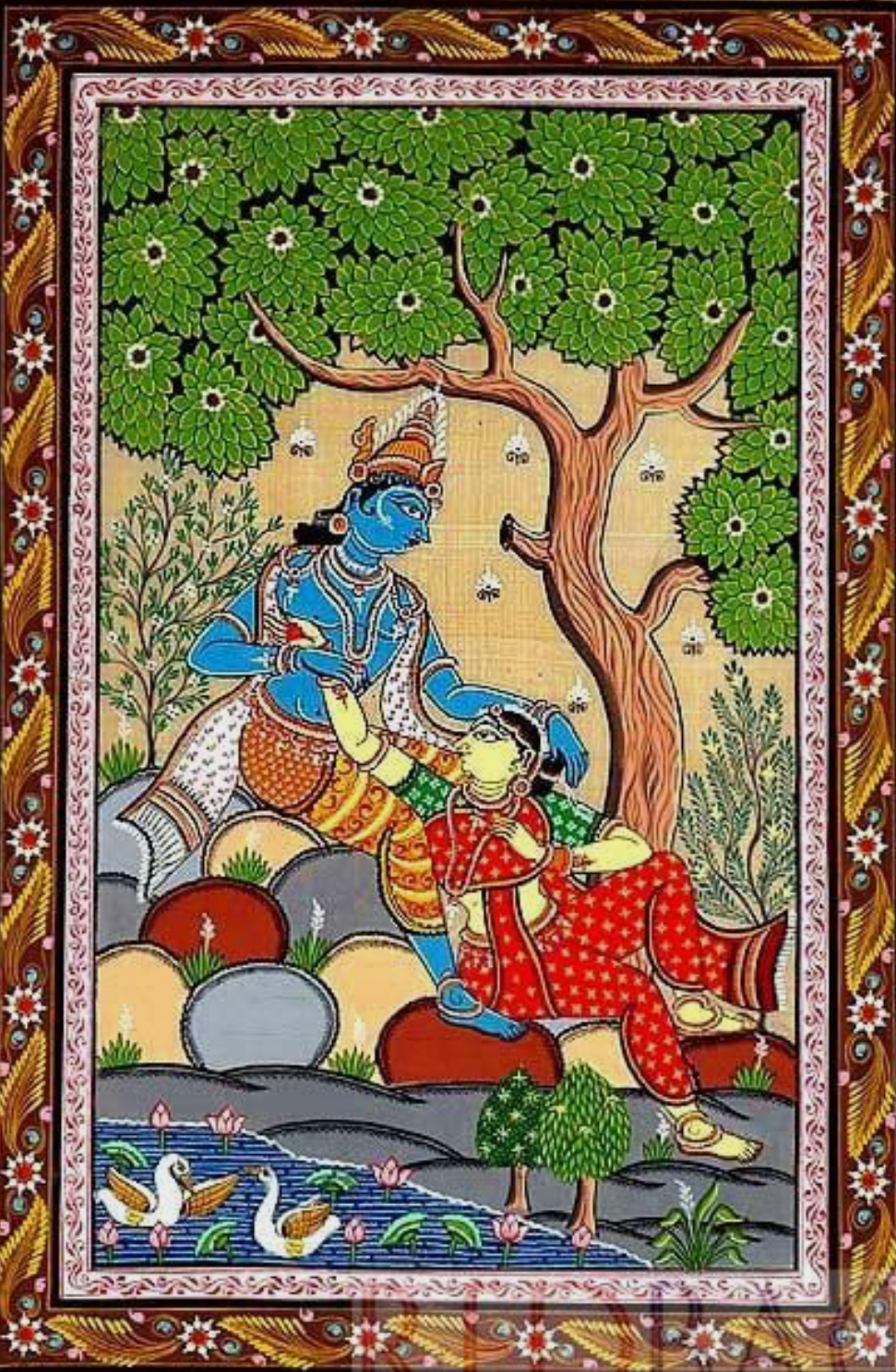
All colours used in the paintings are natural and the paintings are made fully in the old traditional way by chitrakaras who are Oriya painters. Pattachitra is manifested by a rich colourful application, creative motifs and designs and portrayal of simple themes mostly mythological in depiction. The traditions of pattachitra paintings are more than a 1000 years old. Pattachitra paintings resemble the old murals of Odisha, especially those from the religious centres of Puri, Konark and Bhubaneswar regions, dating back to the 5th century BC. The best works are found in and around Puri, especially in the village of Raghurajpur. The theme of Oriya painting centers round the Jagannath cult and the Vaishnava cult. Since the beginning of pattachitra culture, Lord Jagannath, who is an incarnation of Lord Krishna, has been the major source of inspiration. In the 16th century, with the emergence of the Bhakti movement, the paintings of Radha and Krishna were painted in vibrant shades of orange, red and yellow. There are typical scenes and figures like Krishna, Gopi’s, elephants, trees and other creatures portrayed in these paintings. Krishna is always painted in blue and Gopis in light pink, purple or brown.

Thank you for reading. Have a nice day!🌼

Indian Folk Art

• Warli paintings

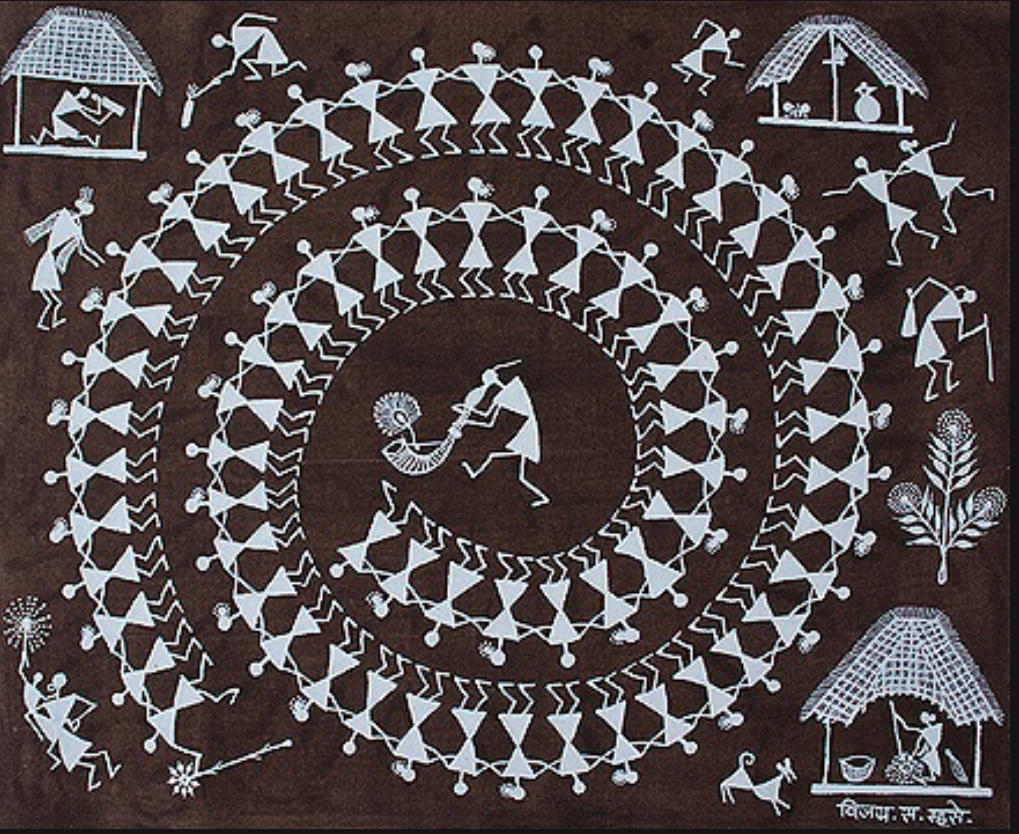
Warlis or Varlis are an indigenous tribes or adivasis living in the mountainous as well as coastal areas on the Maharastra-Gujarat border and surrounding areas. They have their own animistic beliefs, life, customs and traditions. As a result of acculturation, they have adopted many Hindu beliefs. Their extremely rudimentary Wall paintings use a very basic graphic vocabulary a circle, or triangle and a square. Their paintings were monosyllabic. The circle and the triangle come from the observation of nature, the circle representing the sun and the moon, the triangle derived from mountains and pointed trees. Only the square seems to be a different logic and seems to be a human invention, indicating a sacred enclosure or a piece of land.

The ritual paintings are usually done inside their huts. The walls are made of a mixture of branches, earth and cow dung making a red ochre background for wall paintings. Warlis use only white in their paintings. The white pigment used by them is a mixture of rice paste and water with gum as a binding. As the brush, they use a bamboo stick chewed at the end to make it as supple as a paintbrush. The wall paintings are done only on special occasions such as weddings or harvests. Warli art is the cultural intellectual property of the tribal community. Today, there is an urgent need for preserving this traditional knowledge in tribal communities across the globe. Now, Warli painting is registered with a geographical indication under the intellectual property rights act. With the use of technology and the concept of social entrepreneurship, tribals established the Warli Art Foundation, a non-profit company dedicated to Warli art and related activities.

• Cave paintings in India

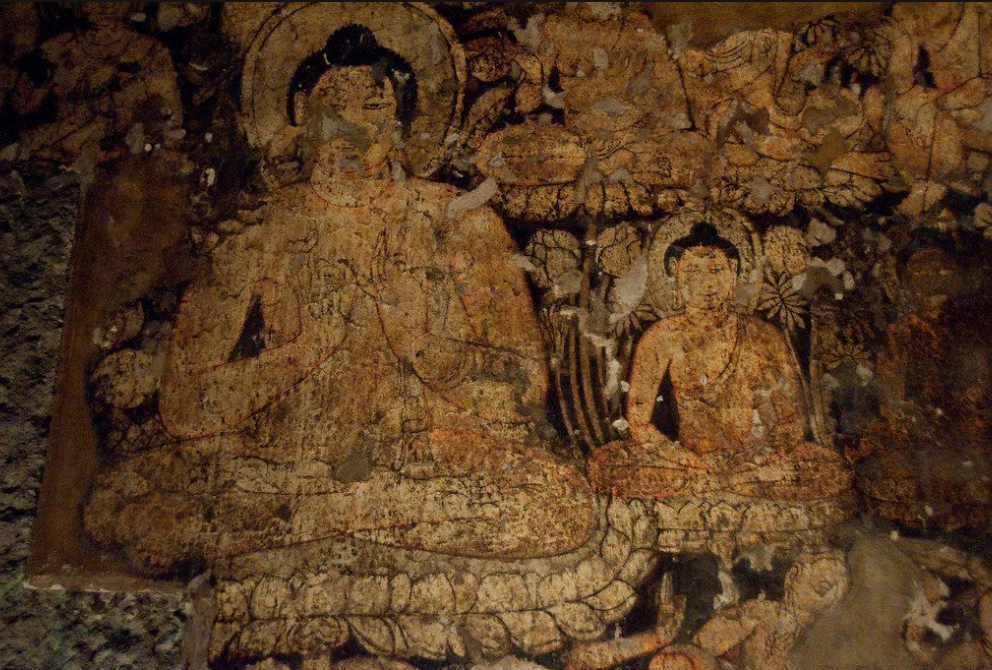
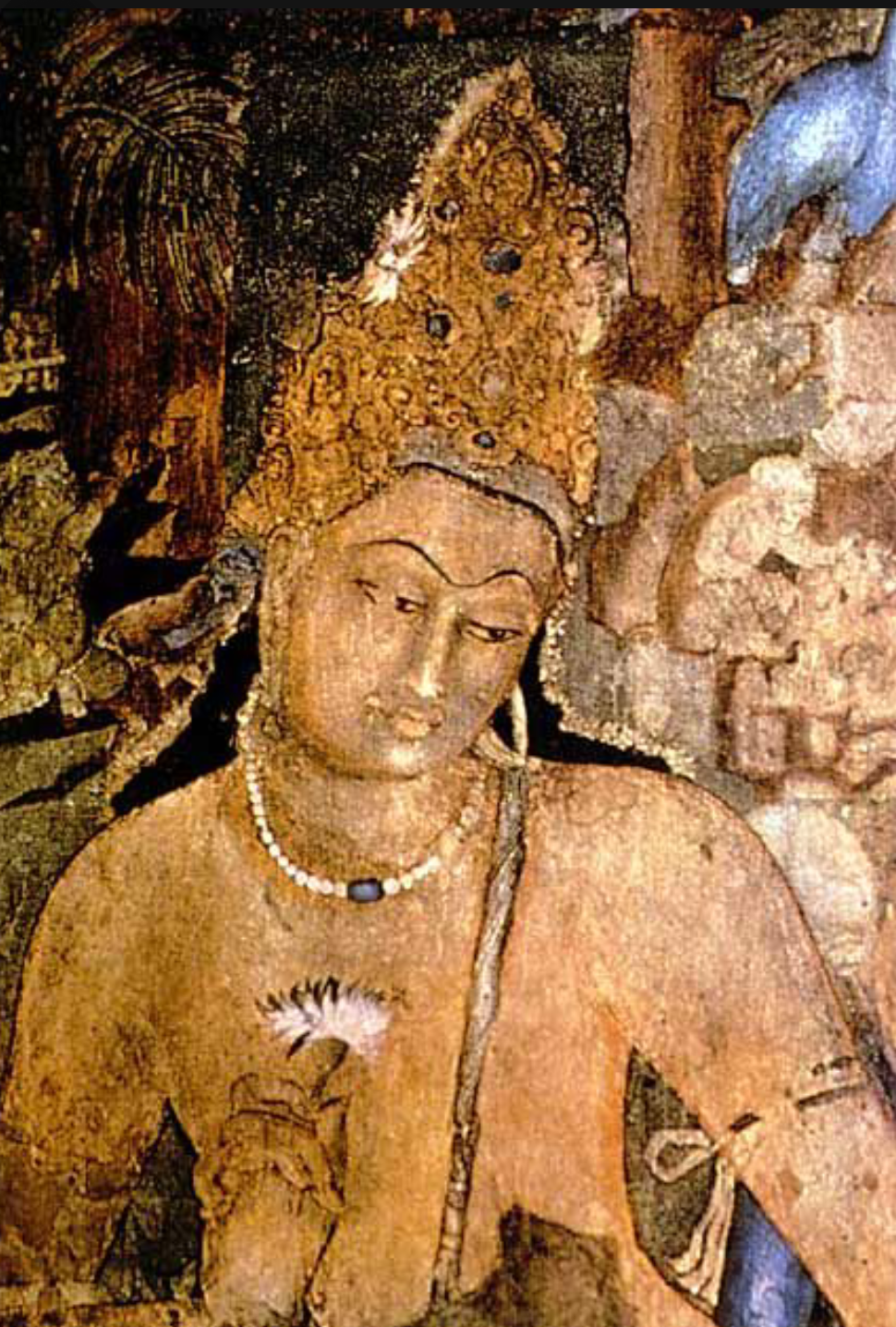
Almost all early painting in India survives in caves, as very few buildings from ancient India survive. The history of cave paintings in India or rock art range from drawings and paintings from prehistoric times – beginning around 30000 BCE in the caves of Central India, typified by those at the Bhimbetka rock shelters – to elaborate frescoes at sites such as the rock cut artificial caves at Ajanta and Ellora, prevalent as late as the 8th – 10th century CE. The frescoes of Ajanta are paintings in the Ajanta caves, which are situated near Aurangabad in Maharashtra. The caves are carved out of large rocks. Inside many of the caves are frescoes. Frescoes are paintings which are done on wet plaster in which colours become fixed on the walls and ceilings at Ajanta.

The paintings reflect different phases of Indian culture from Jain tirthankar Mahaveer’s birth to his Nirvana in the 8th century AD. The frescoes have degraded slightly due to the effect of flash photography. Photography here is not banned. The paintings depict themes of court life, feasting, processions, men and women at work, festivals and various natural scenes including animals and birds and flowers. The artists used shading to give a three-dimensional effect.

Similarly, beautiful frescoes have been found at the Bagh caves, 150 km away to the North of Ajanta. Though the themes in these paintings are both secular and religious, they do depict some aspects of Buddhist life and rituals. One of the most famous paintings show a procession of elephants. Another depicts a dancer and women musicians. These have been influenced by the Ajanta style of painting. These frescoes show a strong resemblance to the frescoes of Sigriya in Sri Lanka.

Thank you for reading. Have a nice day!🌼

Earthquake

The earthquake is one of the most dreadful natural calamities mankind has ever seen, while other being cyclones, tsunami & floods. The most recurring of all-natural calamities over the world. It is far more destructive than flood & storm. In the past, people believed that the earthquake happened when Vasuki shifted the earth from one good to another.

A better-fabricated story states that a huge giant, carried the earth on his shoulder shifted the earth to another shoulder out of exhaustion & it resulted in an earthquake. But Science doesn’t believe in such ideas. The scientific version of the cause of the earthquake is a sudden contraction, as the result of cooling of hot matters inside the earth. As a result of this sudden contraction, the upper part of the soil of the affected part gets loose & is torn apart. It results in deep cracks and landslides. The bases of houses, whether they are concrete buildings or any other type of houses are badly affected. Sometimes these houses collapse. There are some earthquake-prone areas on earth. Japan, China, the Himalayan range of India, Kutch, Assam, Iran & Turkey are some of them. Japan is highly earthquake-prone country. So most of the houses here are made of light wood.

The intensity of an earthquake is measured with an instrument named with am instrument named Seismograph. Its units of measurement are indicated by the Richter Scale. A quake measuring above life and properties. The source of the tremor is known as the epicenter of the earthquake. There are three types of tremors called minor, major & very major.

In different countries, researches are being carried on in order to predict and prevent the occasion of an earthquake. In India, the National Geographical Research Institute is carrying on such work. In some cases, scientists have succeeded in earthquakes. So it can prevent a huge loss of lives and properties. Like most other natural calamities, an earthquake can not be prevented. It can be predicted. This suitable measures should be taken individually during the calamity hit. Like avoid staying indoors, rather rush to the open grounds for preventing mishaps. Also it is the need of the hour that students in schools need to be taught about disaster management for inculcating skills & knowledge during such disasters in these budding minds.

Queen of Jhansi

Lakshmi Bai, also spelled Laxmi Bai, (born c. November 19, 1835, Kashi, India—died June 17, 1858, Kotah-ki-Serai, near Gwalior), rani (queen) of Jhansi and a leader of the Indian Mutiny of 1857–58.

Brought up in the household of the peshwa (ruler) Baji Rao II, Lakshmi Bai had an unusual upbringing for a Brahman girl. Growing up with the boys in the peshwa’s court, she was trained in martial arts and became proficient in sword fighting and riding. She married the maharaja of Jhansi, Gangadhar Rao, but was widowed without bearing a surviving heir to the throne. Following established Hindu tradition, just before his death the maharaja adopted a boy as his heir. Lord Dalhousie, the British governor-general of India, refused to recognize the adopted heir and annexed Jhansi in accordance with the doctrine of lapse. An agent of the East India Company was posted in the small kingdom to look after administrative matters.

The 22-year-old queen refused to cede Jhansi to the British. Shortly after the beginning of the mutiny in 1857, which broke out in Meerut, Lakshmi Bai was proclaimed the regent of Jhansi, and she ruled on behalf of the minor heir. Joining the uprising against the British, she rapidly organized her troops and assumed charge of the rebels in the Bundelkhand region. Mutineers in the neighbouring areas headed toward Jhansi to offer her support.

Under Gen. Hugh Rose, the East India Company’s forces had begun their counteroffensive in Bundelkhand by January 1858. Advancing from Mhow, Rose captured Saugor (now Sagar) in February and then turned toward Jhansi in March. The company’s forces surrounded the fort of Jhansi, and a fierce battle raged. Offering stiff resistance to the invading forces, Lakshmi Bai did not surrender even after her troops were overwhelmed and the rescuing army of Tantia Tope, another rebel leader, was defeated at the Battle ozzf Betwa. Lakshmi Bai managed to escape from the fort with a small force of palace guards and headed eastward, where other rebels joined her.

Tantia Tope and Lakshmi Bai then mounted a successful assault on the city-fortress of Gwalior. The treasury and the arsenal were seized, and Nana Sahib, a prominent leader, was proclaimed as the peshwa (ruler). After taking Gwalior, Lakshmi Bai marched east to Morar to confront a British counterattack led by Rose. Dressed as a man, she fought a fierce battle and was killed in combat.

Jhansi Rani even after her death remained as an idol of bravery and intelligence for Indian women. Enacting as the ruler on behalf of her heir showed her will power and women empowering attitude.

Development & Displacement

Development is the slogan of the day not only in developed countries but also for the developing countries of the world now. All governmental & state organizations are now rushing for introducing & installing industries, better roads, long fly-overs & many other civilized requisites.
But proper lands are required to execute & materialize these means & ways of development. These cannot be grown in the sky. So lands are acquired to start industries, erect stalls, or make high roads & flyovers.
On many occasions, this development is executed by acquiring fertile lands of the poor farmer or the lands where many houses & homelands had been built & human habitations are displaced from their age-old shelters & professions with penury and starvation staring at them.
Thoughtless destruction of forests in Kalahandi in Orrisa & plundering them for the sake of development displaced the local inhabitants, deprived them of their livelihood, and put them to starvation, hunger & ultimate migration. The construction of the Narmada dam to provide irrigation to dry areas of Gujrat, Madhya Pradesh & Maharashtra has rendered many thousands of the local people homeless without their consent and proper compensation.  

https://in.pinterest.com/

Displacement in the name of development may sometimes be needed. Displacement is worse and undesirable. The former is the narrow way to progress, but the latter is certainly a broad road to death. There must be a balance between development and its resulting displacement. It may be done by proper preplanning and proper rehabilitation of the displacement. The potential risks of displacement involve landlessness, joblessness, homelessness, marginalization, food insecurity, increased morbidity and mortality, loss of access to common property
   This is a social problem affecting multiple levels of human organization, from tribal and village communities to well-developed urban areas. The main potential risks of displacement, landlessness, joblessness, homelessness, marginalization, food insecurity, increased morbidity and mortality & loss of access to common property. 

Earthquake Escapade: Changing Across The Geography of India

2020 has been marked in almost all the usual natural disasters that mankind knows about. Forest fires, floods, earthquakes, you name it. Speaking of earthquakes, India is a hotspot for the earthquake occurrence due to the dynamic interaction between the Indian and the Asian plate. So, how prone is India to earthquakes? Or should I state, which areas in India are more prone to earthquakes? Let’s see…

What’s What

Earthquakes can be described as the movement of the land surfaces due to release of seismic waves from within the Earth’s lithosphere. Earthquakes all by itself can be pretty destructive. Higher magnitude earthquakes can cause violent shaking of the ground, thus destroying structures, and sometimes disturbing the local topographic scene too. The triggered effects in Nature due to earthquake include tsunami (in case of offshore source of origin), landslide, and in some rare cases, volcanic activity.

The term earthquake, in the general scientific respect, is associated with seismic activity. The source of the seismic activity though, can be either natural, or manmade. Some of the common causes of occurence are: faulting, mine blasts, landslide, nuclear testing or volcanic activity. The original point of disturbance within the lithosphere is known as the hypocentre, and the extrapolation of the point on the ground level is known as the epicentre.

The magnitude, or the strength of an earthquake, can be measured in various scales. But the most commonly known is the Richter magnitude scale. Nowadays, moment magnitude scales have a preference within the seismological authorities, but it is still reported as the Richter scale. The Richter scale is based on the logarithm values detected from the amplitude of seismic waves. It gives the measure of the energy given out by the earthquake. The Richter scale starts off from 1.0 and theoretically has no upper limit. But on the basis of historic records, the limit has been set for 8.9 as of now. Another scale, the Mercalli Damage Risk scale, measures the earthquake on the basis of its effect on the surface. Measured from the minimum of ‘not felt’, the scale goes up to the higher end category ‘extreme’. In terms of sumericals, the scale goes from 1-12. An important point to note is that the energy and effect of the earthquake are always not in relation, as for they depend on various factors.

Trends Within India

With India being a very large country in terms of territorial area, the areas are divided into various zones in accordance to the past seismological activity and the natural factors of the area. At present, the map produced by Bureau of Indian Standards dividends the whole country into four zones (Zones 2, 3, 4, 5). Zone 5 experiences highest Damage Risk of seismic activity and Zone 2 the lowest.

  • Zone 5 (Very Severe Damage Risk Zone) are the areas most susceptible to the risk of earthquakes of Damage Risk 9 or more. This zone includes the entire North Eastern region, Andaman Nicobar island groups, some parts of Jammu & Kashmir and Uttarakhand, Ladakh, Himachal Pradesh, northern regions of West Bengal, Rann of Kutch, North and Central Bihar and Uttarakhand.
  • Zone 4 (Severe Damage Risk Zone) are areas which are prone to experience the earthquakes of Damage Risk 8. Regions like North Punjab, Chandigarh, Western Uttar Pradesh, Sunderbans, Terai, the NCR, Sikkim, and the remaining parts of Jammu & Kashmir and Uttarakhand. The Patan area in Maharashtra also comes under this zone.
  • Zone 3 (Moderate Damage Risk Zone) usually has the probability to have earthquakes of Damage Risk 7. Goa, Lakshadweep Islands, Rajasthan, Jharkhand, Madhya Pradesh, Chattisgarh, Kerala, Tamil Nadu, Andhra Pradesh, Karnataka, Maharashtra, and the remaining parts of Bihar, West Bengal and Uttar Pradesh,
  • Zone 2 (Low Damage Risk Zone) accounts for regions that tend to experience earthquakes of intensity 6 and less. All the remaining areas of India fall under this category.

The Bureau of Indian Standards has provided some guidelines for construction of buildings, with certain parameters being assigned on the basis of the seismic zones. With a large part of the country, and by virtue of that, a large part of the population being susceptible to strong earthquakes, construction of legal and anti earthquake structures are a necessity of the present time. 

Website Reference:

https://en.wikipedia.org/wiki/Earthquake_zones_of_India

https://en.wikipedia.org/wiki/Earthquake

https://en.wikipedia.org/wiki/Richter_magnitude_scale

https://en.wikipedia.org/wiki/Modified_Mercalli_intensity_scale

https://www.jagranjosh.com/general-knowledge/list-of-earthquake-seismic-zones-in-india-1591274253-1

Subramaniya Siva-Tamil freedom fighter

Subramaniya Siva was an Indian freedom fighter. He was a revolutionary and had to spend many years in prison. He was also a versatile writer and has written many books. He was born on 4th October 1884 in Vathlagundu town of Dindigul district of the then Madras Presidency. His father was Rajam Iyer and he was his eldest son.

He followed the traits of Bala Ganghadhara Tilak. V. O. Chidambaram and Subramanya Bharathi are his contemporaries. He disagreed with Gandhiji and his non-violence attitude. He believed that only violence could counteract violence and so he adapted revolutionary methods of showing protest.

He was married and was survived by his son Sabhapathi Sharma. He was arrested in 1908 and 1922 for his anti-political activities. He wrote a book named Jail Life which gives an account of his life in prison. He was the author of the journal Gnana Bhanu which contains the collection of poetry.

He was a devotee of Swami Vivekananda and Sri Ramakrishna Paramahamsa. He wrote the books Ramanuja Vijayam and Madhya Vijayam. He wanted to create enlightenment among people through his dramas and bhajans.

He chose Papparapatti village in Pennagaram taluk for his activities. In 1921 he came to Papparapatti and tried to establish Bharatashram there which was not successful. He was suffering from leprosy when he was in prison. In those days leprosy was considered to be a contagious disease and many restrictions were imposed on him by the British Government. He was not allowed to travel in trains. In spite of these difficulties he walked on foot to many places and continued his struggle for Indian independence.In 1908, he was arrested by the British and was the first political prisoner in Madras jail. While serving a prison term, he was afflicted by leprosy and was shifted to Salem jail. Since leprosy was regarded as a contagious disease, the British authorities forbade him to travel by rail after his release and hence he was forced to travel on foot. He continued to fight for independence and was incarcerated many times until 1922. He was the author of the journal Jnanabhanu and books Ramanuja Vijayam and Madhva Vijayam.

He was the first political prisoner in the Madras jail. He died on 23rd July 1925 and his Samadhi is situated in Papparapatti. Dindugul district collector office and Vathlagundu Bus Stand were named after him. In 2010 it was announced by the Government of Tamil Nadu that a memorial would be established for him in Papparapatti

WATSON HOTEL

Watson’s Hotel, currently acknowledged as the Esplanade Mansion, is India’s oldest sustaining cast-iron building. It is located in the Kala Ghoda area of Mumbai (Bombay). Named after its original owner, John Watson, the building was fabricated in England and built on-site between 1867 and 1869.

The hotel closed in the 1960s and the building was sold to a private owner. It was later divided and partitioned into smaller cubicles that were let out on rent as homes and offices. Negligence of the building has resulted in corrosion and, despite its listing as a Grade II–A heritage structure, the building is now in a rundown state.

Design:

Watson’s hotel was planned by the civil engineer Rowland Mason Ordish, who was also linked with the St Pancras Station in London. The structure was fabricated in England from cast iron components and was congregated and constructed on-site. The external cast-iron frame closely resembles other high-profile 19th century buildings such as London’s Crystal Palace. The main façade of the hotel is characterized by building-wide open balconies on each floor that connected the guest rooms, which were constructed around the atrium in a courtyard arrangement.

History:

John Watson opened the hotel as an exclusive whites-only hotel, and it was the most expensive hotel in the city in those days. The five-storied building housed 130 guest rooms, as well as a lobby, restaurant, and a bar at the ground level. The hotel also had a 30 by 9 meters (98 ft × 30 ft) atrium, basically used as a ballroom, with a glass skylight. At its peak, Watson’s hotel employed English hostesses in its restaurant and ballroom, sparking a common joke at the time: “If only Watson had imported the English weather as well.”

After Watson’s death, the hotel lost its fame to the rival Taj Hotel. In the 1960s the hotel was closed and sold to a private owner. Sometime after this, it was subdivided and partitioned into small cubicles with independent access and let out on rent. Over the years, indifference toward the building by the residents has resulted in the structure decaying, and it is now in a neglected state. The atrium was consequently used as a dumping area and has various unauthorized constructions. In 2005, the building had 53 families and 97 commercial establishments. Most of the business enterprises are chambers of advocates attached to the nearby Bombay Civil & Session Courts and the nearby Bombay High Court.

  • Notable guests:

Among the hotel’s notable guests was Mark Twain who wrote about the city’s crows he saw outside his balcony in Following the Equator. It was also the first place in India to screen the Lumière Brothers’ Cinematograph invention in 1896. However, this was witnessed only by Europeans.

A popular myth surrounds the hotel was that the staff at Watson’s Hotel denied Indian industrialist Jamsetji Tata access to the hotel. In retaliation, he opened the Taj Hotel, a hotel that stands near the Gateway of India, in 1903. However, author and historian Sharada Dwivedi debunks this legend. She points out a lack of evidence to prove that Tata was a man of vengeance.

  • Current state:

The building’s poor state of affairs has been commonly remarked, and efforts by heritage activists to persuade its present owner to invest in restoration have been unsuccessful. One of the possible reasons proffered for apathy is the fact that the rent collected is low as it has been frozen by government legislation. The condition of the building was publicized by Italian architect Renzo Piano, and as a result of his efforts, the building was listed in June 2005 on the list of “100 World Endangered Monuments” by the World Monuments Fund, a New York-based NGO. Just a few days after its proposal, part of the building’s western façade, originally galleries evolved into small offices, collapsed, killing one person and crushing several cars and motorcycles parked in the street below. The building is currently listed as a Grade II–A heritage structure.