RBI Had Not Printed Rs 2000 Notes In 2019-20, Currency is Still Valid

Rs. 2000 notes were introduced by the Government of India after the announcement of the demonetisation of 500 and 1000 rupees notes in November, 2016. Currently, it is the highest denomination currency note of the country. According to the annual report of the RBI, the Rs 2000 denomination note was not printed at all during 2019-2020. These notes were introduced after the government announced demonetisation of old Rs 500 and Rs 1,000 notes 4 years back. At that time, those two denominations had accounted for 86% of the then total currency in circulation.

The number of Rs 2,000 denomination notes had peaked at 3.36 billion units in 2017-18. This number had dropped to 3.29 billion in the years 2018-19. It has again fallen to 2.73 billion in 2019-20. The currency note presses of the Reserve Bank of India (RBI) did not print even one Rs 2,000 note in the last year. This happened because the presses did not receive any order for printing those. This seems to indicate a conscious decision for starting the trend of decreasing the number of notes which are circulated. The 2000 notes under circulation was 50% in 2016-17 and it has come down to almost 22% in 2019-20. These figures are based on RBI’s Annual Report for 2019-20, which was released on August 25 2020.

It is also known that RBI has also disposed a disproportionate share of Rs 2,000 notes in the soiled category. This has raised many questions on the government’s plan about the 2000 denomination note. In January, 2019 the was an indication that the Rs. 2000 notes were not being printed any further because there was adequate supply.

A total of 176.8 million pieces, which is quite a high number, of Rs 2,000 notes under the category of soiled notes were disposed of in 2019-20 by the RBI. While in 2018-19, just 1 million Rs 2,000 notes were disposed of and in 2016-17 or 2017-18, no Rs 2,000 notes were disposed of. Both the 2000 and 500 denomination notes were introduced after demonetization. In 2019-20, the share of Rs 2000 notes which were disposed of was 6.5% while that of Rs.500 notes was 0.6%. Out of the 22 billion currency notes printed in 2019-20, more than 50% of those were of the Rs 500 denomination. Due to these changes in currency composition, the Rs 500 notes has reached a very high share in the total currency under circulation.

The Minister of State for Finance Anurag Singh Thakur had told the Lok Sabha on March 16 2020 that, “Printing of bank notes of particular denomination is decided by the government in consultation with RBI to maintain the desired denomination mix for facilitating transactional demand of public. No indent was placed with the presses for printing of Rs 2,000 denomination notes for 2019-20. However, there is no decision to discontinue the printing of Rs 2,000 bank notes.”

A government official said that, “The Rs 2,000 notes were introduced in 2016 to quickly fill the gap created by demonetization of Rs 500 and Rs 1,000 notes. It was the need of the hour. Gradually, with increased supply of smaller notes, including new notes of Rs 100 and Rs 200, and with growing popularity of digital transactions, the urgency to issue new Rs 2,000 notes is no longer there. But this does not mean that there is any move to discontinue Rs 2,000 notes. Increasingly, commercial banks are also using more and more smaller notes because their customers often find difficulties in getting change for Rs 2,000 notes.”

ONLINE SHOPPING IN PANDEMIC

THE COVID-19 HAS LET US DO WHAT WE NEVER USED TO DO AND STILL WE ARE NOT ABLE TO IT COMPLETELY AND THAT IS NOTHING BUT SOCIAL DISTANCING . SOME OF US HAVE NEVER MET OUR FAMILY MEMBERS , OUR CLOSE FRIENDS AND WE ARE DYING TO MEET THEM , MUTUAL FEELING IT IS !.

WE ARE GOING THROUGH ECONOMIC DOWNTURN AND ALL THE BUSINESSES ARE URGING TOWARDS LOSSES . MARKETRES ARE SAD DUE TO LESS PROFIT AND HAPPY DUE TO MORE CONSUMPTION DEMAND .

AS THERE IS A NEED OF SOCIAL DISTANCING , EVERYONE IS FEARING TO SHOP THROUGH OFFLINE MODE , THOUGH , MAKING PURCHASES THROUGH ONLINE MODE IS TOO DANGEROUS , YOU DON’T KNOW HOW MANY HANDS HAVE TOUCHED IT BUT THEY TAKE CARE OF EVERY PRECAUTIONS THEY ARE TAKING AND WE ALL SHOULD ALSO SANITISE THE GIFTS DELVERED.

MARKETERS AND THE SERVICE INDUSTRIES ARE THE HAPPIEST , ONLINE STORES CATERING BASIC NECESSITIES ARE ON TOP AS IT IS HELPING IN SOCIAL DISTANCING .

BOOMERS , THE GENERATION FROM 1946 TO 1964 ARE PREFERING TO SHOP THE PRODUCTS ONLINE FROM THE ONLIINE STORES AND HAS RAISED THE CONSUMPTION DEMAND , FUND’S ROLLING HAS INCREASED IN THE ECONOMY .

THE GIANTS LIKE ZOMATO FOR FOOD , AMAZON FOR ALL THE COSUMERS PRODUCTS , FLIPKART , MYNTRA FOR YOUR WEARS , WHY I HAVE CALLED THEM AS GAINTS BECAUSE THEY ARE DELIVERING BEST SERVICES TO THE PEOPLE . SURVEY HAS SHOWED THAT THE SALES HAS INCREASED THROUGH ONLINE MODE COMPARING PRE LOCKDOWN . AMAZON IS THE BIGGEST GIANT AMONG ALL . I THINK NOW MARKETERS SHOULD FOCUS MORE ON SOCIAL MEDIA MARKETING TO GAHTER MORE CUSTOMERS , THEY WERE DOING IT , BUT NOW IT HAS BECOME NECESSITY. MORE FOCUS SHOULD BE ON WEB DESIGNING , THEIR WEBSITE SHOULD BE DESIGNED IN SUCH A WAY THAT CUSTOMER’S FIRST GAZE AT IT MAKE THEM KNOW WHAT WE ARE CATERING . CATCHY LINES SHOULD BE USED TO MAKE THE CUSTOMERS MORE RELATABLE AND REDUCE THEIR STRESS.

LASTLY , BEFORE DEVOLOPING THE PRODUCT , A MARKETER SHOULD UNDERSTAND THE NEEDS OF THE CUSTOMERS AND WHAT THEY DEMAND , THEN DEVOLOP THE PRODUCT .IT WILL HYPE THE CUSTOMERS , THE SALES AND THE SERVICES , A TREAT FOR OUR ECONOMY RECOVERY .

A CHOCOLATE FOR OUR ECONOMY ! !

Books on Indian History which You Must Read

Indian History has been the theme for many books. Whether its fiction or non-fiction, there are plenty of books which deserve to be on the list of must-read books written on the topic of history. These books give one a detailed understanding of India’s history.

Be it comprehensive historical books or fictional accounts of a historical incident, there are many options for you to choose from. If you are a person who loves both reading and history then the following 5 books are just the right choice for you.

The Argumentative Indian by Amartya Sen

Amartya Sen is an Indian Economist and writer who had won the Nobel Prize in 1998. This book is a collection of essays and it will help one understand the Indian polity. It focusses on the importance of public debate, argument and intellectual diversity in the Indian civilization of the past. Sen writes about his view on how and what will lead to the success of democracy in India.

India After Gandhi by Ramachandra Guha

Ramachandra Guha is an Indian writer and researcher whose areas of interest include society, politics and history. India After Gandhi is a book describing the journey of modern India, from post-independence from the British in 1947 until the 1990s. The book will provide one with a thorough understanding of India’s social and economic spheres. It covers the country’s political history over the later part of the 20th century.

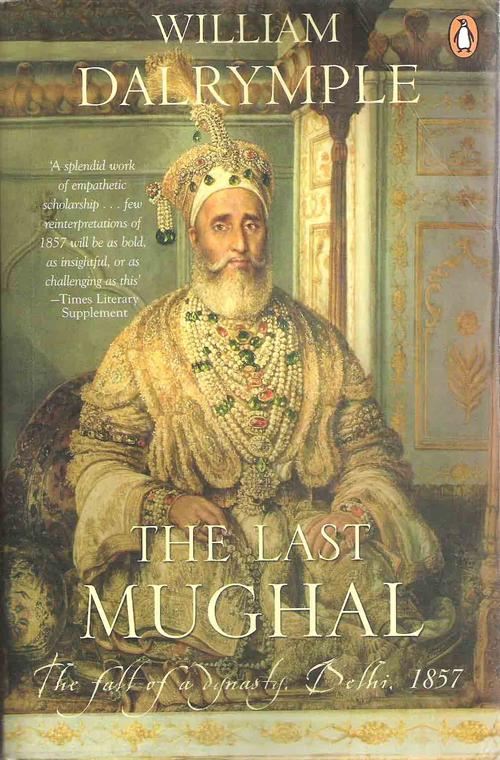
The Last Mughal by William Dalrymple

William Dalrymple is a Scottish historian, writer, critic, art historian and curator. He has won several awards and prizes for his writings. The book is a comprehensive description of the time period when the Mughal empire started declining in India. It will be a treat for people who love reading history. It is about the last Mughal ruler, Bahadur Shah Zafar II, and it provides an account of 19th century India with the tale of the emergence of the British Raj. Another famous book by him is White Mughals which is his fifth major book, it tells the story of the love affair between James Achilles Kirkpatrick and Khair-un-Nissa Begum at the backdrop of nineteenth century Hyderabad.

The Discovery of India by Jawaharlal Nehru

Jawaharlal Nehru was India’s first prime minister and he wrote this from 1942 – 1946. This book was written by Nehru when he was imprisoned by the British. It is a tribute to the rich cultural heritage and legacy of the country. It provides an account of all major developments in the subcontinent from the period of Indus Valley Civilization to the last years of the British rule.

The Palace of Illusions by Chitra Banerjee Divakaruni

Chitra Banerjee Divakaruni is an award-winning writer, novelist and poet. The book is about the tale of the epic Mahabharata, written from the perspective of Draupadi (Panchaali). It tells the story of the woman who fights, endures a lot living in a patriarchal world. It is a historical fiction which traces the historical tale and the life of Panchaali.

RECOVERY RATE OF INDIA

COVID-19 had made a period in each one’s life. The increase in cases could be seen in each state, this not only lead to scatter of hopes but also an internal danger is present in everyone’s mind. A quantum jump of cases from some thousands to lakhs make us realize that situation is not easy to handle for the staff working day and night in betterment of patients. The coronavirus pandemic has killed over 8.08 lakhs people globally since it emerged in China late last year. Over 2.34 crore people have been infected with the novel coronavirus.

But this is not the only side of the picture, according to a report in The Indian Express, India’s COVID-19 recoveries have crossed 23 lakh and are more than three times the number of active cases of the infection in the country, while the case fatality rate, maintaining a steady downward trajectory, has further dropped to 1.85 per cent, the Union health ministry said on Monday. With 61,408 new infections reported in the country, the tally has now risen to 31.06 lakh. Of these, 23,38,036 patients have already recovered, while 7,10,771 are still active. 

If we look closer in this regard, we will able to find that things are serious but there is nothing much to get afraid about. The strength and confidence seen in patients fighting against this virus is remarkable, said a doctor. They are the hardest hitten population as they even do not get a chance to stay at their home with their families. The recovery rate in terms of health is risen at a great level. People had become more health conscious and are spreading awareness about the same.

To accelerate the process of developing and manufacturing safe and effective COVID-19 vaccines in the country that can be easily accessible and affordable for the public, a ‘Mission COVID Suraksha’ has been proposed to be set up with a corpus of nearly Rs 3,000 crore, sources said, according to a PTI report. Piloted by the Department of Biotechnology, the proposed mission will focus on end-to-end vaccine development from clinical trial stage to regulatory facilitation to manufacturing, sources added. The aim of the mission is to accelerate the development of at least six vaccine candidates and ensure that they are licensed and introduced in market for emergency use at the earliest, they said. While there is no official word on the proposed mission as yet, multiple officials confirmed that a proposal has been made. A senior official said this is still in “a proposal stage”.

This shows that although we are moving slow to fight with this virus completely but the way is not impossible. Never lose hope just stay positive and keep moving forward!

SCHEMES IN CHATTISGARH ON RAJIV GANDHI’s BIRTHDAY

RAJIV GANDHI KISAN NYAY YOJANA

  • SECOND INSTALLMENT OF RS.1500 CRORES THROUGH DBT IN TO THE ACCOUNTS OF FARMERS .
  • 19 LAKH FARMERS OF CHATTISGARH TO BE BENIFITTED FROM PADDY , MAIZE AND SUGARCANE.
  • SUM OF 5750 CRORES TO BE TRANSFERRED IN TO THEIR ACCOUNTS .
  • ON 21st MAY 2020 , THE FIRST INSTALLMENT OF RS1500 CRORES TRANSFERRED IN TO THE ACCOUNTS .

GODHAN NYAY YOJANA

  • IN THE SECOND INSTALLMENT , PAYMENT OF RS 4.5 CRORES
  • THERE IS PURCHASE OF COW DUNG FROM 4341 GOTHANS , STATE HAS REGISTERED 101919 CATTLE REARERS AND 76426 BENIFICIARIES .
  • FROM 20th JULY TO 15th AUGUST , 3 LAKH QUINTALS DUNG WAS PURCHASED
  • CHATTISGARH IS THE ONLY STATE IN THE COUNTRY WHO IS MONETIZING COW DUNG .
  • THE SALE OF VERMICPOST TO THE FARMERS FOR THE GOOD QUALITY MANURE TO THE FARMERS AT RS 8/KG.
  • THE MAIN FOCUS IS ON GENERATING EMPLOYMENT OPPORTUNITIES AND BOOSTING THE RURAL ECONOMY .

INCENTIVE REMUNERATION FOR TENDUPATTA COLLECTORS

  • THIS SCHEME INVOLVES DISBURSEMENT OF 233 CRORES TO 1146626 TENDUPATTA COLLECTORS .
  • THE COLLECTION HAS INCREASED IN STANDARD BAG OF THIS SCHEME FROM RS 2500 TO RS 4000 PER STANDARD BAG .
  • MOREOVER , IT IS GOOD TO SEE THAT THE NUMBER OF ” MINORFOREST PRODUCE ” PURCHASED AT THE SUPPORT PRICE WHUCH HAS INCREASED FROM RS 7 TO RS 31 .

THEESE SCHEMES ARE RIPENING THE AGRICULTURAL SECTOR INCREASING THE YEILD WHICH IS CONTRIBUTING IN GROWTH AND DEVOLOPMENT IN OUR COUNTRY . THE NEW POLICIES ARE COMING WITH ORGANIC METHODS WHICH IS MAKING IT SELF RELIANT .

ONLINE CLASSES : ONLY CONS

Those were the days when we all used to go to the college or schools through metro and bus , tasting every corner of the life . That happiness of chasing the bus just because we are getting late for the classes , still get late in the class . The adventure of travelling with sudden jolts in the bus has another important role in our journey . we used to go to college , meet and greet with our friends , enjoy and work on ourselves by participating in diffrent societies , physically . A wonderfull journey , it is . But , this covid -19 has ruined all the plans and everything has transformed from offline mode to online mode . At first , we all were excited to study through online classes as we are relieved from our hectic schedule and can do work just by sitting at home . But , it is not like that , rather it has increased more stress and anxiety in us , which is not good for our health.

The online mode is making us sit in front of our phone and laptop early in the morning as everything is work from home. Anxiety has increased among the people of every age and we have become lazy , a bad news it is . It is impacting on our eyes and causing us headache . We have to bow down in front of this situation as its about our life . It is giving us back aches . In my opinion , yes it is a smart move in this time but a reliable move .

The work is easy for teachers as they teach us using PPT’s and our doubts remained uncleared . Earlier , teachers were not used to put efforts and take the classes regularly , but , now classes are also happening regularly as it is really easy for them , not much efforts required for them to put in . The classes are not fruitful for us , as it is creating blur in our minds for most of the topics . On the other hand , the situation demands this kind of studying , at least we are studying.

I pray for the situation to get normal as soon as possible so that we can study they way we used to , with much more clarity.

Was the Environment Healing During the Pandemic?

While the outbreak of the Covid 19 pandemic prompted lockdowns in many countries all over the world, the resultant decrease in emissions may have improved the health of our planet. Incidents where endangered animals have been spotted in certain areas were all around social media.

Photo by Anna Shvets on Pexels.com

The worldwide disruption caused by this has resulted in great impacts on the environment and the climate. Also, the considerable decline in travel has caused many regions to experience a large drop in air pollution. Carbon emission rates have reduced across countries significantly. There have been many instances where considerable changes in environmental conditions were observed. In China, lockdowns and similar measures have resulted in a 25 percent reduction in carbon emissions and 50 per cent reduction in nitrogen oxides emissions. One scientist estimated that this may have saved at least 77,000 lives over the course of two months. When compared with indexes of last year, pollution levels in New York have decreased almost by 50% this year. Satellite images have shown that Nitrogen dioxide emissions have started to decrease in Northern Italy, Spain and United Kingdom.

As most people had to stay at home due to lockdown and travel restrictions, many animals have been spotted in several cities. Sea turtles were spotted laying eggs on beaches they once avoided. This was found in coasts of the Bay of Bengal due to the lowered levels of pollution and human intervention. In the United States, dangerous vehicle collisions with animals such as deer, elk, moose, bears, mountain lions were very common. These incidents have reduced greatly and the rates fell by 58% during March and April. Endangered animals were visible in urban cities. A group of Nilgai deers were spotted on the roads of Noida near New Delhi. Dolphins which were seen in the Ganges many years ago, were also spotted in the river during the lockdowns. Several migratory birds were spotted across cities.

Gabon, an African country, had decided to ban the human consumption of certain animals like, bats and pangolins. This was done to reduce the spread of zoonotic diseases because the novel coronavirus is thought to have transmitted to humans through these animals.

According to a study published in May 2020, it was found that the rate of daily global carbon emissions during the lockdown in early April fell by 17%. This could possibly lead to an annual carbon emissions decline of up to 7%, which would be the biggest drop in emissions since World War II according to the study. Researchers suggest that these decreases are mainly due to the reduction of transportation usage and industrial activities. It is true that rebounding and returning to our previous routine and lives could diminish these reductions due to the more limited industrial activities. Due to the reduction in flights, air pollution levels have also dropped significantly.

Temporary changes have affected the environmental conditions. However, whether this pandemic will have a lasting impact on the environment is yet to be known. None of us would have wanted to lower emissions in this way, but it has shown us what we can do together in times of need. Covid-19 has shown us the importance of lives, health services, jobs and mental health. It has also shown us the difference that people and communities can make when they work together – this has given us hope that we can show the same zeal while dealing with climate change and saving our planet.

Floods in India: Urban planning

Grey Infrastructure

It includes drains, pumps and outfalls. They frequently overflow by heavy rainfall or high levels of storm-water runoff from roads and streets. Indian cities like Bengaluru, Bihar, Delhi, Mumbai and Hyderabad are flooding frequently. There are multiple, recurring failures of grey infrastructure in India and other developing countries, for which alternatives are now being sought.

Blue-Green Infrastructure

Natural ecosystems such as lakes, parks, floodplains, forests are nature-based solutions called blue-green infrastructure and offer low-cost and flexible solutions for flood mitigation and management. They offer many other co-benefits.

Urban flood management in India continues to focus only on improving grey infrastructure, rescue and relief, instead of creating sustainable solutions. Cities continue to expand storm-water networks, clean channels and separate the sewage and storm-water drains. These are all important actions and urban areas bear high expenses to build grey infrastructure; but repeated floods mean that these actions are not sufficient.

Major reasons for frequent urban flooding across India

1. Construction on flood pathways.

During the monsoon, urban development and infrastructure such as roads, airports, bus depots, metro rail, etc. which are built on low-lying areas such as floodplains and lake beds, face higher risk of floods.

2. Making way for the floodwater.

Water penetrates into the ground, flows as surface runoff, evaporates and transpirate into the atmosphere. Urban regions with impenetrable surfaces, avoid water to go underground, decrease evaporation and transpiration. This highly increases surface runoff. Urban India is constantly building structures, streets, flyovers for urban citizens, frequently with inadequate storm-water infrastructure. Enormous volumes of storm-water deteriorate on these impenetrable surfaces, causing continued flooding.

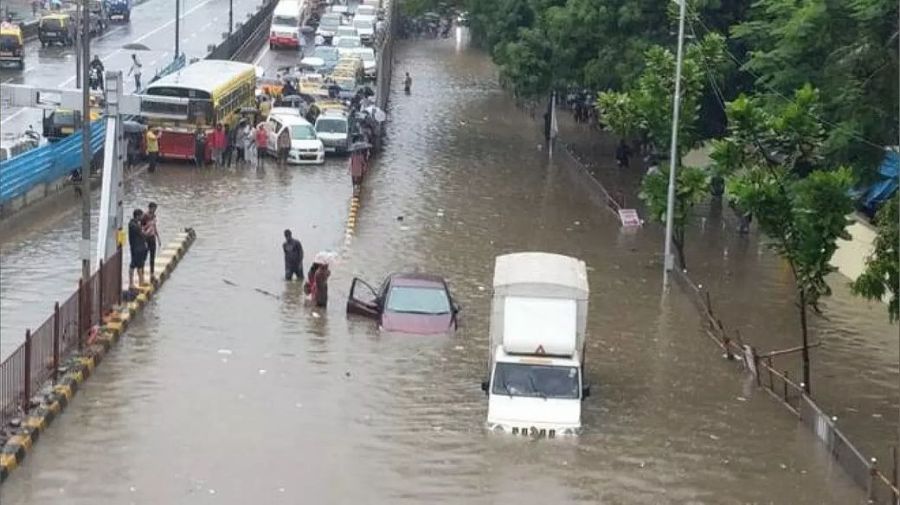
Source: Sentinel Assam MUMBAI FLOODS, 2020

3. Climate change and uncertainty.

The adverse climate change is creating uncertainty in many environmental phenomena. Rainfall variability is increasing because of climate change. Average monthly rainfall is now falling within days. Floods have high economic and social damage. This year (2020) Mumbai had 80% of its average rainfall in eight days.

Forecast, response and resilience.

  • Both grey and blue-green infrastructure expansion and upgrade is needed.
  • Official response to floods needs high-tech rainfall and flood warning systems like in Chennai and Mumbai.
  • Cities are building interactive maps of flood-prone zones (Bengaluru).
  • These measures enable evacuation and support effective deployment of rescue and relief measures, but do not prevent floods and mitigate against loss to life, property and infrastructure.
  • A reassessment of storm-water and cloudburst management is urgently needed in India. Depending solely on last century’s inflexible, expensive grey infrastructure does not manage current and future extreme natural events. Studies prove that the green infrastructure for storm-water management are cheaper and have more co-benefits than upgrading or expanding grey infrastructure.
  • Along with flood planning, we need major steps towards climate change and environmental protection. Much of the adverse natural and man-made events are happening because of collective ignorance towards climate and environment.

Coronavirus: Pandals go online in Ganesh festival.

Due to the coronovirus and the the lockdown this year the most popular festival of Maharashtra has lost its charm. Pandals which were seen in every street were now went missing. The Ganesh sculpture industry go through a huge loss. The excitement and thrill of the festival had gone down. Many families had lost the chance to visit in special aartis and dancing in welcome song of lord Ganesha. The silence this time had made many vendors and shopkeepers suffer the hardest.

The GSB Ganpati Mandal at Kings Circle in Mumbai went live on various social media platforms to avoid crowding of devotees at the pandal. “Since the immersion in lakes will not be possible during Covid, the municipal corporation has sanctioned the construction of 250 to 300 artificial water tanks this year,” said Dahibawkar. Most of the tanks will be built at the level of individual neighbourhoods. “I have appealed to many civic corporators to get tanks built in their own areas, but in many places, individual pandals themselves have offered to make their own tanks.”

The enthusiasm of making modaks to distributing them in public is not seen this time. Many hoseholds had done the establishment and havan of lord Ganesha via online astrologers speech. People claims idol-makers have also been struggling to get space to set up their temporary workshops. Normally the city authorities give us space in a maidan or ground to set up our workshop, but this year they still haven’t allowed us such space.

Many bollywood celebs had not broken their ritual of celebrating the festival and this time too had done every arrangements to meet ‘BABPA’. May be this year was not as good as previous one but the devotion and love of people towards our God is unbeatable and appreciative. We all could just hope and pray for better days in near future.

College and University Admissions 2020

Students are very worried about their careers as all admission procedures have been delayed due to the Coronavirus pandemic. Many have expressed concerns over the delay and cancellation of exams for they might lose an academic year. Final year students are suffering the worst. Many students of intermediate years in have started their classes in online mode for now.  

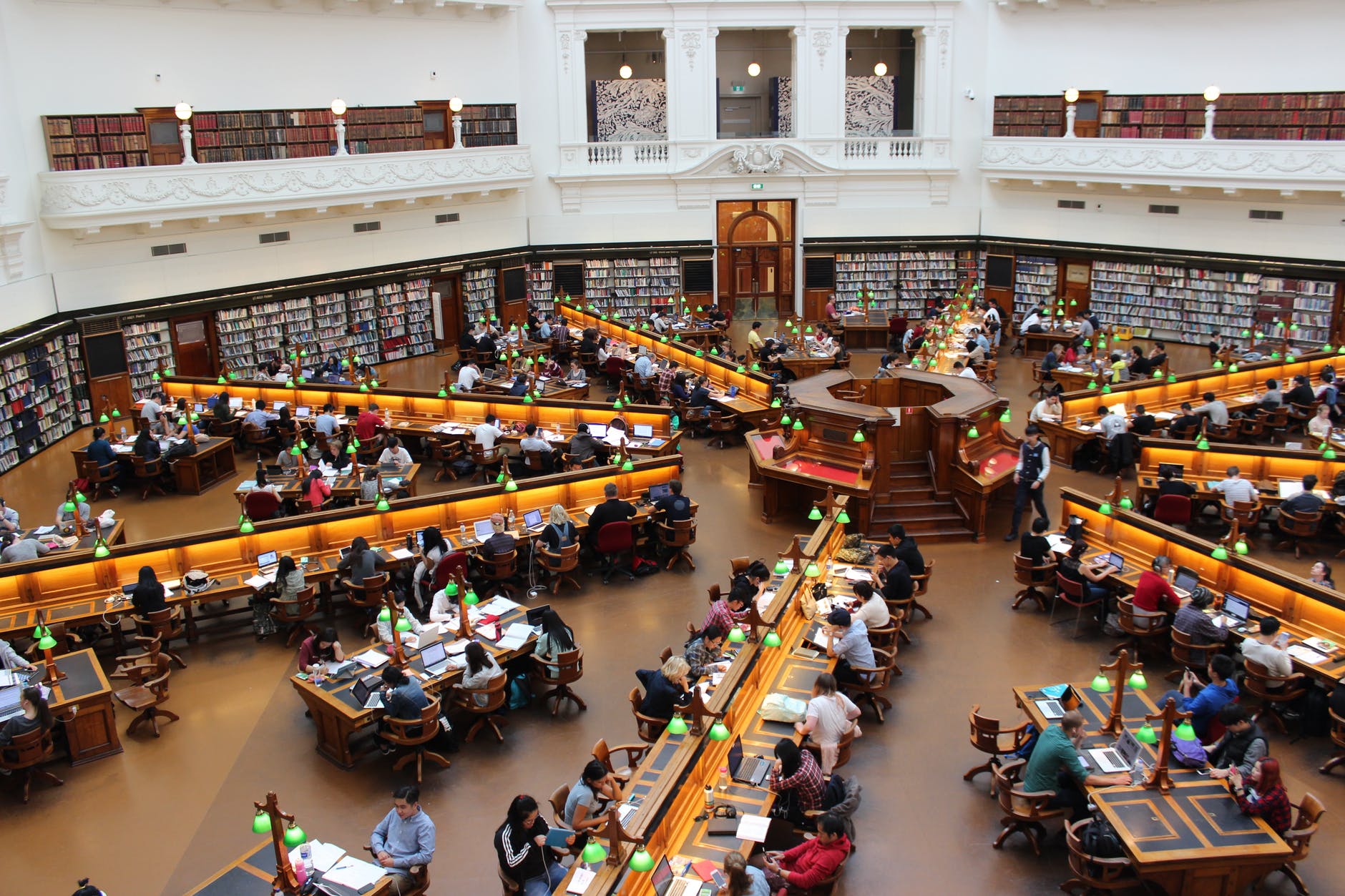
Photo by Pixabay on Pexels.com

Delhi University has scheduled its entrance tests for admission to 10 undergraduate and 86 masters and MPhil/PhD programmes from the 6th of September. The exams will be computer based and will be conducted by the National Testing Agency. They will take place from September 6th to 11th in three slots from 8 am. There will be 24 centers across the country. 1.47 lakh students have applied to the masters courses, and 21,699 students have applied for MPhil and PhD programmes. The undergraduate course entrance tests will be held for 3 management courses, journalism, education and a few specialised disciplines. 

Students are also worried about sitting for exams in this condition. There is the issue of social distancing and also wearing a mask, gloves and shield the entire time while appearing for an exam is quite taxing. The centres are located in specific cities so there is also an issue about travel restrictions and hotel accomodation. Some exam dates have also coincided with others as DU’s joint admission test for management courses and Common Law Admission Test (CLAT) is supposed to take place on the same day that is September 7. There is another problem about the masters aspirants as most of them have still not finished with their final year exams and yet to receive the degree. Students are waiting for the University to make an announcement and provide some clarification regarding the issue. JNUSU president Aishee Ghosh has expressed concern over the issue of students who are badly affected by floods and the pandemic. Many of them might not be in a position to appear for these exams in a specific centre.  

Jamia Milia Islamia has extended the dates of application for admission. The last date to fill the online application form has been extended to September 14. Students seeking admissions in any undergraduate course at the university can apply at the official website of the university. The applications for admissions under the sports category will end on September 16. This is applicable for students who play sports at the national, state, regional or university levels. Under the sports quota, students will be enrolled in both undergraduate and postgraduate courses. Sports including boxing, badminton, athletics, cricket, hockey, shooting, football, tennis, table tennis, volleyball, and wrestling will be accepted for the courses. 

The Jamia Milia Islamia University has been ranked first among the top central universities across India. Over 21,000 students are enrolled across 270 programmes in Jamia. This year, it has introduced several new courses including two MTech programmes, two MSc, and one MLib course. Among the undergraduate courses there are – BSc aeronautics, four BVov courses, diploma in hospitality management, and three postgraduate diploma courses including entrepreneurship, innovation and design thinking.  

New sessions across colleges and universities have all been postponed due to the Covid 19 pandemic. The application deadline has been extended for almost all courses including free UPSC tutoring classes that are conducted to support candidates belonging to minorities, SC, ST community, and women as well as NRI admissions.  

8 Amazing Places to Visit in India

India – a land of diverse landscape, language and culture, offers a variety of destinations for travellers to add to their bucket list. Whether its heavenly mountains, historical forts or peaceful beaches, every nook and corner has something beautiful to offer. These exotic places will surely take your breath away.

DAL LAKE, KASHMIR

Being one of the most prominent lakes in India, Dal Lake is also known as Srinagar’s Jewel. Pristine clear water with the backdrop of heavenly hills and mountains is sure to take your breath away. A Shikara ride in the Dal Lake is a must to explore in Kashmir. Shikaras are beautiful houseboats which are used to travel across the lake. The lake also has a travelling market. With an old world charm, the lake gives you a breathtaking experience.

THE RANN OF KUTCH, GUJARAT

The Rann of Kutch is a salt marsh in the Thar desert located in the border between India and Pakistan. It is one of the largest salt deserts in the world. It is a really popular exotic travel location. The Rann festival is the best time to visit when the region celebrates with crafts, handwork, cultural and musical performances. It is famous for its colourful and intricate crafts. On a full moon night, the sparkling salt desert looks spectacular and is a treat to the eyes.

ANDAMAN & NICOBAR ISLANDS

The Andaman Islands is an Indian archipelago of about 300 islands scattered in the Bay of Bengal. Its palm lined beaches and coral reefs is sure to give you a wonderful experience. The islands are known for its popular tourist sights like Havelock Island, Neill Island, and Wilson Island. You can also enjoy exotic sports like Parasailing, Snorkeling, and Scuba Diving.

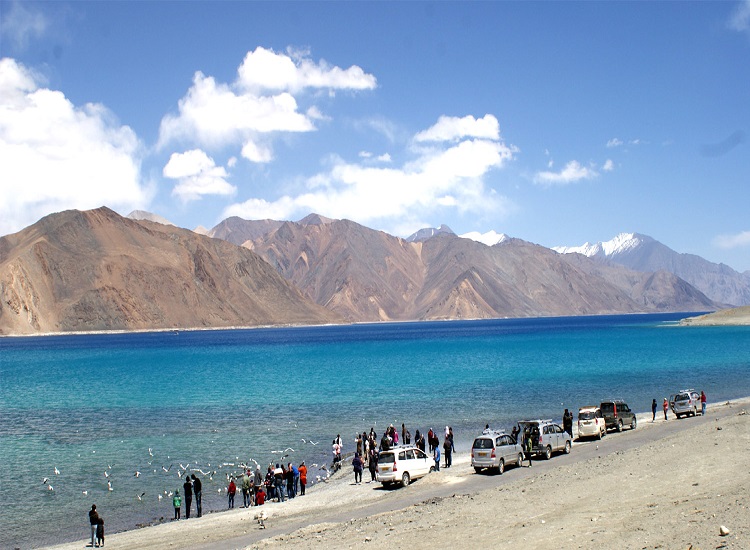
PANGONG LAKE, LADAKH

Also known as Pangong Tso, it is a beautiful lake situated in the Himalayas. The beautiful lake situated on a height of 4350 m, attracts tourists from all over the world. The alluring blue waters is a sight to soothe sore eyes. The best time to visit the lake is summer because in winter the whole lake freezes into ice. It is also a great place for bird lovers as it is home to different birds like cranes, seagulls and rodents.

BACKWATERS, KERALA

The Kerala backwaters are a network of lagoons and lakes on the Arabian sea coast. With its rivers and inlets it is connected with almost 900 kilometres of waterways. The picturesque site with its lush green landscapes and diverse wildlife is a popular tourist attraction of South India. You can visit the backwaters by boat or shikara from Alleppey. Watching the sunset from a shikara in the midst of green landscapes and serene waters will give an experience of a lifetime.

VALLEY OF FLOWERS, UTTARAKHAND

Valley of Flowers is an Indian national park, located in North Chamoli and Pithoragarh in Uttarakhand. With rare and exotic Himalayan flora it is located in the dense forests close to the Pushpawati river. The beautiful meadows with blossoms of Alpine flowers is a treat to any nature lover. The best time to go on a trek to the Valley of Flowers is March to October as during this time the valley is also known to change colours due to its colourful blossoms.

LOKTAK LAKE, MANIPUR

Loktak is the largest freshwater lake in Northeastern India. It is mostly known for the unique sight of floating phumdis which are heterogeneous mass of soil and organic matter at various stages of decomposition. It is the most popular tourist attraction around Imphal. Being almost like a miniature inland sea, the lake mesmerises all visitors.

LIVING ROOT BRIDGE, MEGHALAYA

Located in the Khasi and Jaintia hills, the suspended root bridge is made up of a species of the Indian Rubber tree with a very strong root system. These are estimated to be around 500 years old and attract tourists all around the year. There are dozens of these root bridges near Cherrapunji. Since they are located in very remote places you may need a guide to reach there. The spectacular bridges in the Meghalayan villages will be a treat to any traveller.

Registry Is Part And Parcel of The System: SC

In a fresh, welcome and interesting development, the Supreme Court has just recently on July 6, 2020 in a latest, landmark and extremely laudable judgment titled Reepak Kansal vs. Secretary-General, Supreme Court Of India & Ors. in Writ Petition (Civil) No. 541 of 2020 has taken a stern view of the increasing tendency to blame the Registry for listing some cases more swiftly as compared to others. Justice Arun Mishra who authored this notable judgment for himself and Justice S Abdul Nazeer observed that the Registry which is part and parcel of the judicial system, is blamed unnecessarily for no good reasons. Very rightly so!

                                    To start with, the ball is set rolling in para 1 of this noteworthy judgment wherein it is observed that, “The petitioner, who is an Advocate practicing in this Court, has filed the writ petition under Article 32 of the Constitution of India against various officers of the Registry of this Court and the Union of India. Prayer has been made to issue an appropriate Writ, Order or Direction in the nature of Mandamus directing the respondents not to give preference to the cases filed by influential lawyers/petitioners, law firms, etc. Prayer has been made to direct the respondents to give equal treatment to the cases filed by ordinary lawyers/petitioners and not to point out unnecessary defects, refund the excess court fee and other charges, and not to tag the cases without order or direction of the Court with other cases. A prayer has also been made to direct the Secretary General of this Court to take action against the erring officers for their involvement in the listing, clearing and bench hunting.”

                                      While mentioning the chief grouse of the petitioner, the Bench notes in para 2 that, “It is averred in the petition that equal treatment has not been given to the ordinary lawyers/litigants. They favour some law firms or Advocates for reasons best known to them.”

                                 While mentioning of the first instance, it is then unfolded in para 3 that, “The petitioner’s first instance is that a Writ Petition (Civil) D. No. 10951 of 2020 was filed by him on 16.4.2020. The Registry pointed out three defects, i.e. (1) Court Fee of Rs 530 was not paid, (2) Documents to be placed as per index, and (3) Details given in index were incomplete and annexures were not filed, matter to be rechecked. The petitioner had clarified vide email dated 18.4.2020 that he had paid the court fee of Rs. 730/- and there was no annexure with the petition. However, the petitioner was forced to pay more court fees to get the matter listed. Despite the letter of urgency, the Registry failed to register and list the writ petition. The petitioner requested the Secretary, Supreme Court Bar Association, about not listing the writ petition. On 27.4.2020, the writ petition was listed before the Court.”

                                         While mentioning of the second instance, it is then narrated in para 4 that, “The second instance given by the petitioner is that a Writ Petition (Civil) D. No. 11236 of 2020 was filed on 12.5.2020, which has not been listed by the Registry till today. He was informed that there were no defects in the writ petition, but a copy of the writ petition was missing. After that, no update was given by the Registry.”

                                                 Now coming to the third instance, it is then mentioned in para 5 that, “The third instance given is about Writ Petition (Civil) No. 522 of 2020 (Diary No. 522 of 2020) filed by the petitioner on 20.05.2020. The Dealing Assistant pointed out defects on 26.5.2020. The defects were pointed out by the Dealing Assistant after six days of filing, though the application for urgency was filed in the petition. The following note was made by the Registry:

            “MATTER NEEDS TO BE RECHECK AS WHOLE INDEX IS BLANK, PETITION, AFFIDAVIT, VAKALATNAMA, MEMO OF APPEARANCE AND APPLICATION ALL ARE UNSIGNED AND DEFICIT COURT FEE ETC.”

       The petitioner clarified that the signed documents were already uploaded. The matter was urgent, and he had uploaded them again along with signed documents on 26.5.2020. Again the defects were pointed out on 29.5.2020 by the Dealing Assistant to the following effect:

             “APPLICATION IS NOT PROPER AS HEADING NOT TALLY WITH INDEX AND BE SPECIFIC ABOUT THE SUBJECT AND PRAYER OF APPLICATION.”

       The petitioner cured the defects on 29.5.2020. After that, the Dealing Assistant did not recheck the matter. On 2.6.2020, the petitioner made a call and requested the Branch Officer concerned to direct the Dealing Assistant to recheck the matter. On 2.6.2020, the matter was rechecked and numbered as Diary No. 11552 of 2020. The case was verified on 6.6.2020 and listed for 6.7.2020 (computer-generated) which would make the case infructuous. The application for urgency was not considered. The petitioner was informed that the case was likely to be listed on 6.7.2020. He sent an email about the urgency. The Registry was not willing to list the Diary No. 11552 of 2020 despite the application for urgency. Hence, the writ petition has been filed.”

                                      Truth be told, para 6 then states that, “It is averred that on 23.4.2020, W.P. Diary No. 11006 of 2020 titled as Arnab Ranjan Goswami v. UOI was filed at 8.07 p.m. without annexure. The Registry had chosen not to point out any defects, and a special supplementary list was uploaded on the same day. The category was not specified in the notification to be heard during a nationwide lockdown. No procedure was followed by the Registry for urgent hearing during the lockdown. The petitioner made a complaint to Secretary-General against illegal activities of the Registry but the same is without response.”

                                            To put things in perspective, it is then illustrated in para 9 stating that, “Although defects were noted, Writ Petition (C) Diary No. 10951 of 2020 was listed, heard and finally decided on 27.4.2020. It was filed on 17.4.2020. 18th and 19th April 2020 were the holidays. There were only five working days, and during the nationwide lockdown, the court functioning was minimal. The case was mentioned in the cause list on 26.4.2020 to be listed on 27.4.2020. Thus, it could not be said that there was delay much less inordinate one by the officials of the Registry in listing the matter mentioned above.”      

                                        While continuing in the same vein, it is then revealed in para 10 that, “Concerning the second instance, i.e., Diary No. 11236 of 2020, which was filed by petitioner on 9.5.2020, the Registry has noted several defects on 14.5.2020. The petitioner is still lying with defects.”

                                      Not stopping here, it is then further revealed in para 11 that, “Concerning the third instance i.e., Writ Petition No. 522 of 2020 (D. No. 11552 of 2020), the same was filed on 20.5.2020. Again, a defective petition and defects were pointed out by the Registry on 26.5.2020 that the whole index was blank. Petition, Affidavit, Vakalatnama, Memo of Appearance, and Application were all unsigned with a deficit court fee, etc. The petitioner removed the defects. However, other defects were caused, such as the application filed was not proper as heading did not tally with the index, and specific subjects and prayers were not mentioned. The defects were re-cured, and the petition was re-filed on 3.6.2020. The matter was processed and listed on 9.6.2020 and was heard and dismissed on 12.6.2020 as other matters on the similar issues were pending as such the matter was not considered to be necessary. The petitioner has not disclosed about listing of the case for 12.6.2020, and its decision and averred that the computer-generated date was 6.7.2020. The Registry did not follow the computer-generated date, and the case was listed for 12.6.2020 on which it was dismissed. The petitioner himself was responsible for 12-13 days of delay in removing the defects.”

                                      While dwelling on the out of turn hearing given to eminent journalist Arnab Goswami, it is then pointed out in para 12 that, “As to case of Arnab Goswami, it was listed urgently in view of order of competent authority. It pertained to liberty and freedom of media.”

                                        Of course, it is then also very rightly pointed out in para 13 that, “In the aforesaid circumstances, considering the ongoing pandemic caused by COVID-19, the Registry of this Court is working with less strength, and because of the facts described above and circumstances, we find that there was no justification for the petitioner to allege discrimination vis-à-vis to him and to favour any particular individual. The defects were there in all the three cases filed by the petitioner.”

                                        Furthermore, it is then envisaged in para 14 that, “The petitioner has filed this writ application in a hurry. When it was listed, he circulated a letter to the effect that, as per procedure, he expected that he would be called for interaction by Registrar of this Court to find out his fitness whether he could argue a case in person. The petitioner ought to know that he is an Advocate of this Court and argues the matter in this Court. As such, it was not necessary to summon him for adjudging his capability as to whether he could argue the case. Be that as it may circulating such a letter was not appropriate at his stance and why he doubted his ability to argue. There was no justification to entertain this kind of apprehension in mind. He ought to have been careful in circulating such a letter seeking a wholly unjustified adjournment.”

                                          As if this was not enough, it is then further stated in para 15 that, “In the letter circulated by him, it was further stated that he wanted to collect the evidence and to file it, and for that purpose, he prayed for six weeks time. The conduct indicates that the petitioner was careless and not serious while he made the allegations. He filed writ application without due inquiries, and without collecting the requisite material. Such conduct was least expected of an officer of this Court. Petitioner ought to have been careful before cast of unnecessary aspersions on the Registry and staff of this Court.”

                                     Making matters worse, it is then also brought out in para 16 that, “The petition as filed could not be said to be maintainable. The petitioner has impleaded the Secretary General, various Registrars, and officers of the Registry, SCBA, and Union of India in his writ application. In contrast, Writ is filed against this Court itself. He ought to have impleaded the Supreme Court of India in the Writ Application through Secretary General. The omission indicates careless conduct on the part of the petitioner. The petition was filed in undue haste.”

                                            More significantly, it is then underscored in para 17 that, “We take judicial notice of the fact that a large number of petitions are filed which are defective; still, the insistence is made to list them and mention is made that they should be listed urgently. It happens in a large number of matters, and unnecessary pressure is put upon the Assistants dealing with the cases. We find due to mistakes/carelessness when petitions with defects are filed, it should not be expected that they should be listed instantly. To err is human and there can be an error on the part of the Dealing Assistants also. This is too much to expect perfection from them, particularly when they are working to their maximum capacity even during the pandemic. The cases are being listed. It could not be said that there was an inordinate delay in listing the matters in view of the defects. The Court functioned during the lockdown, the cases were scanned and listed by the Registry. The staff of this Court is working despite danger to their life and safety caused due to pandemic, and several of the Dealing Staff, as well as Officers, have suffered due to Covid-19. During such a hard time, it was not expected of the petitioner who is an officer of this Court to file such a petition to demoralize the Registry of this Court instead of recognizing the task undertaken by them even during pandemic and lockdown period.”   

                                             Let us discuss now in brief the salient points of para 18 wherein the Bench holds that, “We see, in general, it has become a widespread practice to blame the Registry for no good reasons. To err is human, as many petitions are field with defects, and defects are not cured for years together. A large number of such cases were listed in the recent past before the Court for removal of defects which were pending for years. In such situation, when the pandemic is going on, baseless and reckless allegations are made against the Registry of this Court, which is part and parcel of the judicial system. We take judicial notice of the fact that such evil is also spreading in the various High Courts, and Registry is blamed unnecessarily for no good reasons. It is to be remembered by worthy lawyers that they are the part of the judicial system; they are officers of the Court and are a class apart in the society.” Some relevant case laws discussed in detail in this para about the expectations from lawyers include R. Muthukrishnan v. The Registrar General of the High Court of Judicature at Madras, Writ Petition (C) No. 612 of 2016 and Kamini Jaiswal v. Union of India & Anr. (2018) 1 SCC 156.

                                           Most significantly, the Bench then minces no words in para 20 to hold that, “We expect members of the noble fraternity to respect themselves first. They are an intellectual class of the society. What may be proper for others may still be improper for them, the expectations from them is to be exemplary to the entire society, then only the dignity of noble profession and judicial system can be protected. The Registry is nothing but an arm of this Court and an extension of its dignity. Bar is equally respected and responsible part of the integral system. Registry is part and parcel of the system, and the system has to work in tandem and mutual reverence. We also expect from the Registry to work efficiently and effectively. At the same time, it is expected of the lawyers also to remove the defects effectively and not to unnecessarily cast aspersions on the system.”

                                 Be it noted, it is then held in para 21 that, “Thus, we find no ground to entertain the petition. We expect the petitioner to be more careful and live up to the dignity of the profession which it enjoys.”

                                             Finally, it is then held in para 22 that, “We dismiss the petition and impose cost of Rs. 100/- (Rupees One Hundred only) on the petitioner as a token to remind his responsibility towards noble profession and that he ought not to have preferred such a petition.”

                                         In essence, the long and short of this extremely laudable judgment is that lawyers must appreciate and admit that registry is part and parcel of the system and just like Bar is an arm of the Court. Lawyers must refrain from casting aspersions on Registry at the drop of a hat. For the system to operate smoothly, it is imperative that the Bar and the Registry work in tandem and mutual reverence as very rightly pointed out in para 20 that was discussed earlier! There can be no denying or disputing it!

Sanjeev Sirohi, Advocate,

s/o Col BPS Sirohi,

A 82, Defence Enclave,

Sardhana Road, Kankerkhera,

Meerut – 250001, Uttar Pradesh

Victim Under SC/ST Act Includes Parents & Family Members Of Persons

In a recent, remarkable and righteous decision delivered just recently on July 21, 2020, the Kalaburagi Bench of the Karnataka High Court in Marenna @ Mareppa v. State in Crl. Petition No. 200315/2020 has very rightly held that a victim under the SC/ST Atrocities Act includes not only the person who sustains injuries arising out of the crime but also his parents and family members. It is a very significant observation and ensures that the rights of the parents and family members are adequately protected. The case pertained to a deadly attack carried out on a 14-year-old boy whose head was allegedly hit by an axe by the petitioners-accused. They were also accused of abusing the boy in filthy language by mentioning the name of his caste.

                                                 To start with, Justice Hanchate Sanjeev Kumar who delivered this latest, landmark and extremely laudable judgment through ‘Virtual Court’ sets the ball rolling by first and foremost pointing out that, “Crl. P. No. 200315/2020 is filed by the petitioner/accused No. 2 under Section 439 of Cr.P.C and Crl.P. No. 200318/2020 is filed by the petitioner/accused No. 1 under Section 439 of Cr.P.C., seeking to enlarge them on bail.” This Criminal Petition is filed under Section 439 of CrPC, 1973 praying to release the petitioner on bail in Crime No. 72/2020 of Shahapur Police Station for the offences punishable under Sections 143, 147, 148, 323, 307, 504 and 506 read with Section 149 of IPC and Sections 3(1)(r), 3(1)(s) of SC/ST Act, 1989 pending on the file of District and Sessions Judge, Yadagiri. These petitions have been heard and reserved for orders on July 14, 2020. It is then pointed in para 2 that, “Since both the petitions arising out of same Crime i.e., in Crime No. 72/2020 of Shahapur P.S., they are taken up together, heard and disposed of by this common order.”

                                         While dwelling on the definition of victim, it is envisaged in para 16 that, “Therefore, the definition “victim” as enumerated in the Act is wide enough, which include any individuals who falls within the definition of the SC/ST Act who has suffered or experienced physically, mentally, psychologically, emotionally or monetary harm or suffered harm to his or her property. If a person sustains injuries arising out of crime then, he himself, his parents, family members are also to be considered as victim as per the above definition. It is not only stipulated a physical harm is to be caused but if there is a harm mentally, psychologically, emotionally or monetarily or if there is any harm in respect of the property then such person is also coming within the definition of the victim.”

                                                While continuing in the same vein, it is then further added in para 17 that, “In the present case, the first informant is the mother of the injured person. Therefore, definitely the first informant is victim in the present case. It is not only the mother alone is becoming the victim but father and other blood relative are also coming within the definition of victim to consider the present case. The first informant is the mother of the minor boy, the minor boy who had sustained injuries due to the assault  stated to have been committed by the petitioners and other accused. Therefore, certain rights are conferred to the victim and witnesses under the SC/ST Act.”  

                                           It would be instructive to now have a cursory glance at what para 18 states that, “Sub-section (5) of Section 15-A of the SC/ST Act guarantees a right to a victim or dependents to participate in any proceedings thus right of ‘Audi Alteram Partem’ is conferred. For ready reference, Sub-section (5) of Section 15-A of the SC/ST Act is extracted as under:

         “A victim or his dependent shall be entitled to be heard at any proceeding under this Act in respect of bail, discharge, release, parole, conviction or sentence of an accused or any connected proceedings or arguments and file written submission on conviction, acquittal or sentencing.””

                                       More significantly, it is then very rightly stated in simple and straight language in para 19 that, “Therefore, when a right of Audi Alteram Partem is conferred on the victim or his dependents, then the court has to give an opportunity/right of audience to the victim or his/her dependent to hear them as to enable them to participate in the proceedings including bail proceedings also. Therefore, a victim or dependent has a right to be heard by the Court enabling the victim or dependents to participate in any proceedings in respect of not only bail proceedings but also in the proceedings of discharge, release, parole, conviction or sentence of an accused or any connected proceedings or arguments and file written submission or conviction, acquittal or sentencing of a case. The court is able to hear the victim or respondent in respect of a proceedings as enumerated in Sub-section (5) of Section 15-A of the SC/ST Act only when the victim or dependent are made as parties in the proceedings, otherwise it cannot be possible for the court to hear the victim/dependents and to receive any written submission as stated in the said provision. The victim or dependent may participate either personally or through an Advocate or through Public Prosecutor or Special Public Prosecutor or appear himself/herself. As per Section 15 of the SC/ST Act, the Special Public Prosecutor are assigned the duties to represent the State in genre but in specie on behalf of the victim or dependent/complainant/first informant to prosecute the case. But the Parliament in its wisdom by inserting Chapter IV-A and Section 15-A of the SC/ST Act confers right of victims and witnesses and more expressly provided the victim or dependent to participate in any proceedings. Therefore, Sub-section (3) of Section 15-A of the SC/ST Act only enumerates giving such information to the victim or dependents through Special Public Prosecutor or State Government about any proceedings pending in the court. But Sub-section (5) of Section 15-A of the SC/ST Act confers a right on the victim or dependents to make them to participate in a proceedings and to hear their submissions and also to file written submissions in this regard in the proceedings pending before the court. Therefore, unless the victim or dependent as enumerated in Section 2(ec) of the SC/ST Act is made a party in the proceedings in the case pending before any court, it is not possible for the court to hear whatever submission to be put forth by the victim or dependents in the proceedings before the court. Therefore, under these circumstances, making the victim or dependent as party in the proceedings pending before any court is necessary and mandatory.”   

                                                Most significantly, it is then finally held in para 27 that, “Therefore, under these circumstances, the following guidelines are issued:

i)                 A right is conferred on the victim or his/her dependents to participate in the proceedings initiated under the Scheduled Castes and the Scheduled Tribes (Prevention of Atrocities) Act, 1989 as enumerated in Section 15-A as discussed above. Therefore, the first informant/complainant/victim or dependents shall be made as a party in the proceedings and issue necessary notice to the victim or dependents/first informant/complainant/victim or dependents and to hear them in any proceedings as envisaged under Sub-section (5) of Section 15-A of the SC/ST Act.

ii)              The Special Courts trying with the offence/s under the Scheduled Castes and the Scheduled Tribes (Prevention of Atrocities) Act, 1989 shall direct the District Legal Services Authority to provide an advocate on behalf of the victim or his/her dependents/first informant/complainant from the Panel Advocates of District Legal Services Authority.  

                 The Registrar General is hereby requested to circulate this order to all the concerned Special Courts trying/dealing the offences under the Scheduled Castes and the Scheduled Tribes (Prevention of Atrocities) Act, 1989 and to the Member Secretary, Karnataka State Legal Services Authority (KSLSA), who in turn shall inform all the District Legal Services Authority and Secretary, High Court Legal Services Committee (HCLSC) to provide legal services to the victim or dependents in any proceedings pending before the Special Court or High Court, as the case may be, as stated above.”

                                   In a nutshell, the long and short of this notable judgment is that the victim under SC/ST Act includes not just the victim who suffered injuries of the crime but also includes the parents and family members of the person suffering injuries of the crime! There can be no denying or disputing it! It would be pertinent in this regard to recollect here what para 15 states that, “Section 2 (ec) of the SC/ST Act defines ‘victim’, as under:

“ “victim” means any individual who falls within the definition of the “Scheduled Castes and Scheduled Tribes” under clause (c) of sub-section (1) of section 2, and who has suffered or experienced physical, mental, psychological, emotional or monetary harm or harm to his property as a result of the commission of any offence under this Act and includes his relatives, legal guardian and legal heirs.””

Sanjeev Sirohi, Advocate,

s/o Col BPS Sirohi,

A 82, Defence Enclave,

Sardhana Road, Kankerkhera,

Meerut – 250001, Uttar Pradesh

Burden Is On The Prosecution To Negate It

n a recent, remarkable and righteous decision delivered on July 28, 2020, the Apex Court in Parminder Kaur @ P.P. Kaur @ Soni vs State of Punjab in Criminal Appeal No. 283 of 2011 has made it abundantly clear that once a plausible version has been put forth by the defence at the examination stage of Section 313 of the Cr. PC, then it is for the prosecution to negate such a defence plea. It was further reiterated by the top court that failure of the trial court to fairly apply its mind and consider the defence could endanger the conviction itself. Very rightly so!

                                           To start with, this notable judgment authored by Justice Surya Kant for himself, Justice NV Ramana and Justice Krishna Murari sets the ball rolling in para 1 by first and foremost observing that, “The present Criminal Appeal has been preferred by Parminder Kaur, impugning the judgment dated 30.11.2009 of the High Court of Punjab and Haryana through which her challenge to a judgment dated 27.02.1999 passed by the Additional Sessions Judge, Barnala was turned down, thereby confirming her conviction of three years rigorous imprisonment and fine of Rs 2000 under Sections 366A and 506 of the Indian Penal Code, 1860 (“IPC”).”

                                      While dwelling on the facts and case history, it is then elaborated in para 2 that, “The prosecution story, as recorded in the FIR at around noon on 24.02.1996, was that the appellant was a single lady living with her child, mother and a young boy as her tenant in the neighbourhood of the prosecutrix’s house.[The name of the prosecutrix/victim has been withheld, in compliance with the ratio in Bhupinder Sharma v. State of Himachal Pradesh, (2003) 8 SCC 551]. About a week prior to registration of the police complaint, the appellant called the prosecutrix to her house and tried to entice her to indulge in illicit intercourse with the rich tenant boy in return for clothes and trips from him. The appellant at about 6.00 A.M. on 19.02.1996 allegedly pushed the visiting prosecutrix into the room occupied by the tenant boy and bolted it from the outside. It was only on hearing the prosecutrix’s screams that after five minutes the door was unlocked, with her father (Hari Singh, PW-2), Bhan Singh and Karnail Singh standing outside. Swiftly, the boy ran out of the room and successfully escaped. Upon the prosecutrix emerging from the room, her father protested and expressed his dismay to the by-standing appellant. Scared for their reputation, the prosecutrix and her father returned to their home without reporting the matter to anyone, except the prosecutrix’s mother. However, on 24.02.1996 at 7.00 A.M., the appellant caught hold of the prosecutrix outside her house and threatened to kill her brother if anyone was informed of the matter. The prosecutrix was able to escape the appellant’s clutches and worried at this high-handedness, proceeded with her father towards the police station to report these two incidents and lodged a complaint.”  

                                              As it turned out, para 6 then holds that, “Accordingly, the trial Court held that the appellant had intentionally induced the prosecutrix to perform illicit intercourse with her male tenant, and that she had also criminally intimidated the prosecutrix by threatening her family member. Noting the large number of dependents that the appellant had to support as a single lady, and considering the lack of commission of any assault or rape against the prosecutrix, the appellant was concurrently sentenced to three years rigorous imprisonment and fine of Rs. 2,000 (or further six months rigorous imprisonment in lieu thereof) under Section 366A, and one year rigorous imprisonment and fine of Rs. 1,000 (or further three months rigorous imprisonment in lieu thereof) under Section 506 of IPC.”

                                                 As a consequence, what then followed is stated in para 7 that, “The aggrieved appellant approached the High Court which too refused to interfere with the order of contention. While dismissing the appeal, the High Court observed that the statement of the accused under Section 313 CrPC appeared to be an after-thought, and that in the absence of any evidence proving enmity between the parties it was impossible that anyone would falsely implicate a woman in such like offence. The minority of the prosecutrix was noted as having been proved, and the testimonies of PW1 and PW2 were held to be impeccable and corroborating each other completely. Similar to the trial Court, the High Court also explained away the delay in registration of FIR as a result of family reputation put at stake in matter of sexual offence cases. Other omissions in the form of non-examination of Bhan Singh and Hari Singh and failure to catch or trace the identity of the male tenant were deemed insignificant and immaterial.”              

                         Analysis

I.                 Sweeping generalisations and superficial analysis

                     Without sparing any punches, the Bench then minces no words to point out in para 10 that, “Having heard learned counsel for the parties at considerable length through video conferencing, we find from the impugned orders that the Courts below failed in making the desired attempt to delve deep into the factual matrix of this case. Many aspects, as discussed hereunder, have completely been ignored or only dealt with hastily. Further, the reasoning is generic and is premised upon generalisations which may not be necessarily true always. It is indisputable that parents would not ordinarily endanger the reputation of their minor daughter merely to falsely implicate their opponents, but such clichés ought not to be the sole basis of dismissing reasonable doubts created and/or defences set out by the accused.”    

                                        While continuing in the same vein, the Bench then notes in para 11 that, “Similarly, the five-day delay in registration of the FIR, in the facts and circumstances of this case, gains importance as the father of the victim is an eye-witness to a part of the occurrence. It is difficult to appreciate that a father would await a second incident to happen before moving the law into motion. Sweeping assumptions concerning delays in registration of FIRs for sexual offences, send a problematic signal to society and create opportunities for abuse by miscreants. Instead, the facts of each individual case and the behaviour of the parties involved ought to be analysed by courts before reaching a conclusion on the reason and effect of delay in registration of FIR. In the facts of the present case, neither is Section 366A by itself a sexual offence in the strict sense nor do the inactions of the prosecutrix or her father inspire confidence on genuineness of the prosecution story. No steps were taken to avail of medical examination of the victim, nor was the Panchayat or any social forum approached for any form of redress till the occurrence of the second alleged incident.”  

                                               What’s more, the Bench then goes on to elaborate in para 12 that, “Further, it is beyond comprehension that the prosecutrix’s father and his two male associates failed to stop the tenant boy who was allegedly about to commit a sexual offence with the minor victim and neither did they later make any attempt to even register a complaint against him. Strangely, the prosecution has acquiesced to such disappearance of the boy from the scene. Still further, the father of the prosecutrix merely registered his protest to the appellant on the scene, instead of reacting instinctively and approaching police authorities when faced with possible trafficking of his daughter. This conduct of belatedly proceeding against only the prosecutrix creates a lurking suspicion against the prosecution case and it may not be totally improbable to infer that it was a malicious attempt at the behest of Bhola Singh to falsely implicate a weak rape victim and stifle her ability to seek justice.”

II. Shoddy investigation and prosecution

                                 In a damning indictment of the police, it is then pointed out in para 13 while also highlighting the shoddy investigation and prosecution that, “The original record elucidates the lack of serious effort on part of either the investigation agency or the prosecutor to bring home the appellant’s guilt. Save for the initiative of the prosecutrix and her father to register the complaint, no substantive evidence has been gathered by the police. Despite the male tenant having been residing with the appellant allegedly for many months, the police were unable to even discover his name, let alone his antecedents or location. Further, DW-1 casts an impressionable doubt on the existence of the boy in the first place. This is further buttressed by the fact that PW-1 and PW-2 differed in their physical description of the boy’s age, clothing and his whereabouts. If the boy was indeed a tenant and if he did live there for months, it is highly mootable that he couldn’t have been traced.”

                                          To be sure, it is then put forth in para 15 that, “Non-examination of Bhan Singh and Karnail Singh is also a noticeable lapse, given the gaps in the prosecution story. It appears that no serious attempt was made to get them examined to resolve the contradictions in the testimonies of PW-1 and PW-2. Such lack of examination of material independent witnesses, adversely affects the case of the prosecution.”

                                            Furthermore, it is then pointed out in para 14 that, “The spot map prepared by PW-3 also has glaring omissions. The location of Bhan Singh’s house and the place where the appellant allegedly threatened the prosecutrix on 24.02.1996 are not even marked. Letters which the prosecutrix alleged in her examination-in-chief and police complaint that the appellant got written from her, have not been produced during trial. These could have shed light on the relationship between the accused, prosecutrix and the male tenant prior to the incident. It is the duty of the prosecution to lead the best evidence in its possession, and failure to do so ought to lead to an adverse inference.(Musauddin Ahmed v. State of Assam, (2009) 14 SCC 541).”

III. Gross Mis-appreciation of conflicting testimonies

                                 To put things in perspective, it is then envisaged in para 16 that, “Ordinarily, the Supreme Court ought not to re-appreciate evidence. However, where the courts below have dealt with the material-on-record in a cavalier or mechanical manner which is likely to cause gross injustice, then this Court in such exceptional circumstances may justifiably re-appraise the evidence to advance the cause of justice. There is no gainsaying that such re-assessment ought not to take place routinely and ought not to become substitution of an otherwise plausible view taken by the Courts below.”

                                            Needless to say, it is then held in para 17 that, “The trial Court has summarily disregarded the contradictions highlighted by the defence side, on the premise that such contradictions had no material bearing and that there was no reason to disbelieve the prosecutrix. The High Court too has opined that PW-1 and PW-2 have completely corroborated each other and their testimonies were impeccable. These reasons, in our considered opinion, are not only contrary to the record but they also lead to an impermissible reversal of the burden of proof imposed in criminal trials. There are numerous clear contradictions between the testimonies of these two star-witnesses, which we find fatal to the prosecution case.”

IV. Failure to refute Section 313 CrPC statement

                                 Most significantly, it is then rightly underscored in para 21 that, “Under the Code of Criminal Procedure, 1973 after the prosecution closes its evidence and examines all its witnesses, the accused is given an opportunity of explanation through Section 313(1)(b). Any alternate version of events or interpretation proffered by the accused must be carefully analysed and considered by the trial Court in compliance with the mandate of Section 313(4). Such opportunity is a valuable right of the accused to seek justice and defend oneself. Failure of the trial Court to fairly apply its mind and consider the defence, could endanger the conviction itself (Reena Hazarika v. State of Assam, (2019) 13 SCC 289). Unlike the prosecution which needs to prove its case beyond reasonable doubt, the accused merely needs to create reasonable doubt or prove their alternate version by mere preponderance of probabilities. (M. Abbas v. State of Kerala, (2001) 10 SCC 103). Thus, once a plausible version has been put forth in defence at the Section 313 CrPC examination stage, then it is for the prosecution to negate such defense plea.”

V. Charge of criminal intimidation

                                  In short, the key point of para 25 is that, “Given the facts of this case where the common testimony of PW-1 on both charges has been doubted, it would be unwise to rely upon it as the sole piece of evidence to convict the appellant for criminal intimidation without any other corroboration.”

                                        Truth be told, it is then held in para 22 that, “In the case at hand, the alternate version given by the appellant could not be lightly brushed aside. Her two-part defence, put succinctly, was that first there was no male tenant at all and no one except for her child and mother lived with her, and second, that she was being falsely implicated as vengeance for filing a rape complaint against Bhola Singh with whom the prosecutrix’s father used to work.”

                                Conclusion

                                       Finally, it is then held in the last para 26 that, “We are thus of the considered view that the prosecution has failed to discharge its burden of proving the guilt of the appellant under Section 366A and 506 of the IPC beyond reasonable doubt. Thus, for the reasons aforesaid, the appeal is allowed and the conviction and sentence awarded by the Courts below are set aside. The appellant is acquitted and consequently set free.”

                                      No doubt, it is a well balanced, well worded and well reasoned order by a three Judge Bench of the Apex Court. It rightly espoused that once an accused makes a plausible defence in his Section 313 CrPC statement, the burden is on the prosecution to negate it. If prosecution fails then the benefit of doubt will go to the defence as we see here. Very rightly so!

Sanjeev Sirohi, Advocate,

s/o Col BPS Sirohi,

A 82, Defence Enclave,

Sardhana Road, Kankerkhera,

Meerut – 250001, Uttar Pradesh

Give Highest Priority To Pregnant Women, Then To Senior Citizens

In a well-balanced, well-reasoned, well-analysed and well-worded judgment, a two Judge Bench of the Principal Bench at Jabalpur of Madhya Pradesh High Court comprising of Justice Sanjay Yadav and Justice Atul Sreedharan in its judgment titled In Reference v. Union of India in Writ Petition No. 25097/2019 delivered just recently on July 27, 2020 asked Indian Railways to consider re-prioritising the lower berth allotment by giving the highest priority to pregnant women, then to senior citizens and thereafter to the VVIPs. It must be mentioned here that the said suggestion that was put forth by this two Judge Bench came in the PIL that was registered suo-motu by the MP High Court “to consider certain measures regarding railway journeys in the interest of the public at large”! This makes it all the more special and must be commended in no uncertain terms!

                               To start with, this notable judgment authored by Justice Atul Sreedharan for himself and Justice Sanjay Yadav sets the ball rolling by first and foremost observing in the opening para that, “This Public Interest Litigation (PIL) has been registered suo-motu by this Court to consider certain measures regarding railway journeys in the interest of the public at large. The PIL owes its genesis to a train journey undertaken by a Judge of this Court while he was travelling from Gwalior to Jabalpur on an official visit. When the train reached the Katni-Murwara station, the Judge got off the train for a cup of tea and suddenly, the train started pulling out from the platform without blowing its horn. The Judge was put to great inconvenience and the accompanying hazard of boarding the running train. The incident made the brother Judge put forth three suggestions to the Indian Railways which if implemented would go a long way to ensure passenger comfort during the journey.”

                                             Be it noted, it is then envisaged in para 2 that, “The Indian Railways is the largest State-owned railways in the world. It is the single largest employer and has more than 1.4 million (fourteen lakh) employees working for it (larger than the Indian Army which has 1.2 million personnel). It plies 7421 freight trains daily, moving three million tons of freight. It also runs 12617 passenger trains transporting about 23 million people every day over a 66000 Kms rail network.

The three-suggestions put forth by the Judge of this Court are as follows:

(1)         “It would be in the interest of the public at large that some light signal/sound be fixed on each bogie enabling the passengers outside the train to be alert prior to departure of train with a view to avoid mishappening/accident.

(2)         If the website/app is updated by displaying the position of the seats/berths to be allotted at the time of making reservation, that would be more convenient and suitable for the public in general.

(3)         The size/number of doors of the bogies should be increased or in the alternative, duration of stoppage of the trains should be increased from two minute to at least five minute, to make the people smooth and easy while boarding or getting off the train.””

                                        While lambasting the nonchalant approach of the railways, the Bench then holds in para 3 that, “The reply filed by the Respondent Indian Railways is most apologetic and regretful for the inconvenience caused to the Judge. As regards the first suggestion the Respondent has replied that the train does not move without at least two whistles and without a display of the green/amber signal on the platform in front of each train. It is further stated that perhaps the Judge may not have heard the whistle/horn of the engine on account of the loud ambient sound on the platform. The Respondent says that further instructions have been issued to the staff concerned that greater caution and care should be taken to ensure that the horn of the engine is loud and audible and that the same is accompanied by repeated announcements on the platform through the public address system and also the video displays regarding the departure of the train.”

                                     To say the least, it is then made clear in para 4 that, “As regards the suggestion that light signals or hooters being fixed on the coaches is concerned, the Respondent in the reply has stated that modification of the coach requires a policy decision and design approval of affecting thousands of trains all over the country and that it would not be possible to switch over to a new system of signaling overnight or even over months. Respondent further says that the system has been developed by a highly specialized body of experts. However, the Respondents undertake to ensure greater display of the green/yellow signals and efficient, loud and repeated blowing of the horn before the train departs from the station.”

                                    Now coming to the second suggestion, it is stipulated in para 5 that, “As regards the second suggestion put forth by the Judge with regard to information relating to vacant position of seats/berths, similar to what is shown on the websites and mobile applications of the airline services operating in the country, the Respondent state that though berths which are vacant for allotment are not displayed on the official website of the railways, a comparison with the airlines would not be an accurate assessment of the problem. The Respondent has stated that there can be no effective comparison between the airlines and the Indian Railways as the number of passenger trains running on an average day in India are over 12,000. It is further submitted by the Respondent that lakhs of passengers travel each day and so it is not physically possible to demonstrate which seats are vacant with the present IT infrastructure. The IT experts associated with the railways have stated that providing information relating to vacant berths and their position in the coach is presently not possible. Under the circumstances, the Respondent states that updating the website and the mobile application for displaying the position of seats/berths to be allotted at the time of drawing reservation is again a policy decision and involves major changes and hence has huge financial implications and therefore unviable.”     

                                          Furthermore, it is then stated in para 6 that, “The Respondent while answering the issue of granting lower berths to senior citizens has stated that in the priority list of the railways, the VVIPs like ministers, Supreme Court/High Court judges etc., fall very high and they have to be allotted the lower berths. After the VVIPs are accommodated, priorities are given to pregnant women and senior citizens. The Respondent has expressed their inability to manage to the extent that each and every person should be given the lower berth. However, they state that the best efforts are being made to ensure that senior citizens do get the lower berth. The Respondent also states that design of the railway coaches are being made in such a manner that in future it shall be convenient for every person to climb up to the upper berth also however, some inconvenience while travelling is inevitable and therefore regretted.”    

                                          Coming to the third suggestion, it is stated in para 7 that, “As regards the third suggestion relating to widening the doors or increasing the stoppage time of the trains at the stations, the Respondent states that it will not be possible to widen the size of the doors because it will decrease the passenger carrying capacity of the coach and will also compromise the safety of the passenger. It further says that any modification in the passenger coaches contains lot of public expenditure, trials and experiments. As regards the stoppage of a train at a particular station, the Respondent submits that the stop of the train at each station is widely published through railway timetables, announcements, notice board and display board etc. Increasing the stoppage of a train, according to the Respondent, would further delay the train in reaching its destination and that the fixing of the halting time at the stations is based upon an assessment by the Respondent with regard to the number of passengers alighting and boarding a particular train at the station. In other words, an indiscriminate extension of time would be counterproductive to the running of trains as it would cause delays and disrupt the time schedule of the trains in reaching their destinations.”

                                      More significantly, it is then stated in para 8 that, “Having heard the submissions of the learned Amicus Curiae and the learned counsel for the Respondent, we are satisfied with the reply given by the Respondent. The suggestions that were put forth to the Respondent have been considered by the Respondent and they have expressed their inability for the reasons stated hereinabove. This Court cannot force the Respondent to incur expenses which the Respondent does not consider as economically viable and also on account of the large number of trains on which the said measures would have to be implemented which makes the proposals difficult, almost impossible to implement. The suggestions put forth are aspects relating to policy decisions of the Respondent and entailing huge expenditure. This court cannot pass a judicial order in matters which would interfere with aspects of policy relating to the Respondent Indian Railways for which this court lacks the technical expertise to appreciate the difficulties that would be faced by the railways in giving effect to the suggestions.”

                                           Finally and perhaps most significantly, the Bench then minces no words to make it clear in para 9 that, “However, as regards the prioritisation of berth allotment is concerned, the Respondent Indian Railways is requested to consider re-prioritising the berth allotment by giving the highest priority to pregnant women, then to senior citizens and thereafter to the VVIPs. As far as VVIP’s/Officials being given a priority in reservation of seat/berth is concerned, the rationale of officials being given a priority is understandable as they are required to travel at short notice for their official duties. However, as regards the priority of allocation of the lower berth is concerned, the same as it exists on date is unpragmatic. Pregnant women are most vulnerable on account of their medical condition and it would cause them great inconvenience in occupying the middle or upper berth. Thus, the dictates of reason and the fulfillment of a welfare state demands that they be given the highest priority along with passengers suffering from terminal illness or life threatening ailments like cancer and those who are physically or mentally challenged, be considered as priority No. 1 for allotment of the lower berth. The senior citizen who on account of their advanced age and attendant medical issues should be considered as priority No. 2 and lastly, the VVIP’s who are usually serving state functionaries are invariably those blessed with better health and so be considered at priority No. 3. With the above direction to seriously re-consider the prioritisation of allotment of the lower berth in trains, the petition is finally disposed of.”  

                                         No doubt, the long and short of this latest, landmark and laudable judgment is stated in para 9 stated above. Indian Railways must now implement the directions given by the two Judge Bench of the Madhya Pradesh High Court at Jabalpur. It brooks no delay anymore!

Sanjeev Sirohi, Advocate,

s/o Col BPS Sirohi,

A 82, Defence Enclave,

Sardhana Road, Kankerkhera,

Meerut – 250001, Uttar Pradesh