Literature broadly is any collection of written work, but it is also used more narrowly for writings specifically considered to be an art form, especially prose fiction, drama, and poetry. In recent centuries, the definition has expanded to include oral literature, much of which has been transcribed.
Looking Back to inmost salient lion from North-west corner of India:
The milieu where we are going through, reminds us of such a beacon whose life was out of the world of ceramic painting. In the prevailing situation in where myriad of youths are gloomy and distracted, all the deluge of depression and ‘break-up’ with our soul & courage, that poet-cum-author pillages our interest towards his escapade in the worrit situation he passed through, not lying on fortune’s lap.
“It seems to imply that in the lifeblood of our society, red corpuscles have disappeared.”
From Novel Chitta Lahu (White Blood), by Nanak Singh
Yes, we are talking about that very Panjabi author — Nanak Singh. This Indian poet, songwriter & novelist of Panjabi language made a royal entry to this world on the 4th July, 1897 through a poor Punjabi Hindu family. His literature produced crackles in the period of India’s Independence movement. If we take a magnificent lens on the pages of Modern Indian History, Nanak Singh was more prominent of them who wanted to eliminate the dual mentality of that ‘babu’ who went soft on the fierce deeds of the British.
The revolutionary identity got influenced and involved in the Jallianwala Bagh Massacre. On that auspicious day (April 13, 1919), of Punjabi New Year, Singh saw a lot of kin shot to death by the British troops, even two of his friends drooped on his lap for their last time. Then the author entity of Singh’s inner mind erupted in anger — invented an epic poem, mocking colonial rule — “Khomeini Visayans” (Bloody Baisakhi) from native heart. While conducting ‘Akali Movement’, in charge of the editor of ‘Akali’ papers, he became the subject of crimson eyes of the British — that resulted in the imprisonment of that new leader. In the meanwhile, he converted himself into Sikh. Hence, he portrayed the savagery and ‘legal violence’ of the British on peaceful Sikhs — and published his second anthology called “Zakhmi Dil ” (1923), which got banned within a fortnight of its publication, as expected.
Implementation of Singh’s Views in Present time:
This legend’s natural inclination towards protest against coercion, unjust & inequitable feud, as well as bluffing at every step, pulled him to pick-up ink as well as the flag of Mother India. Under Singh’s tenure, both the fallacy of British & dogmatism of Literature (specially in regional languages) got curtained. Yes, we agree delightfully that the British are no longer in power in India. But the orthodoxy, bigotry & undesired fanaticism has prepared a lot of arrest warrants for Indians. This situation reminds us of that nonesuch person:
Who escaped the boundary of patriarchy — implemented the quote of Lalan Fakir in reality —
“Everyone Sees Male & Female/ But, I see Only Humans”
“সবাই দেখে নারী পুরুষ, আমি দেখি শুধুই মানুষ”
Lalan Fakir
We get a lot of views in his novels.
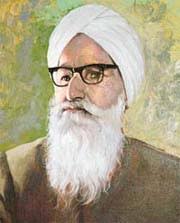
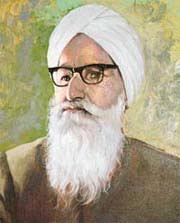
Nanak Singh (Source: ‘The Watchmaker‘ book written by Singh & translated by Navdeep Suri)
He’s Nanak Singh, whose voice was full of courage & pluck that successfully punctured British’s confidence, gives a message to us to belabor the deception of socio-political hand-cuffs. In his writing, always one thing got itself highlighted — the search for celestial happiness through fraternity, integrity & Liberty.
However, all Indians, not only Panjabis draw inspiration from this icon who gives birth to every Indian from the previous fluffy life of usual inertia — that erects pillars to build a Happier nation for Future.
So, don’t delay to come forward to blow the conch of Humanity with the previously chanted hymns of Nanak Singh.
“Why don’t we have a little game? Let’s pretend that we’re human beings, and that we’re actually alive.”
John Osborne
Look Back in Anger is a realist play written by John Osborne and Published in the year 1956. Set in an economy that has been diminished by the war, it follows the story of a young couple Jimmy and Alison Porter. Being from two different social classes, Jimmy being a working- class man and Alison being an upper-class, the two have trouble navigating through the class conflict present between themselves. The play focuses largely on Jimmy’s anger against the upper-class and particularly the upper-class women.
During the time of the play’s production, The Women’s Movement had already started taking shape in Britain and hence can be read as a reaction against the growing feminist movement of the time. It is evident from the play that Jimmy hates women and has strong misogynistic views. He blames women for his lack of power and impotence even though there is no coherent logic behind that argument. His wife Alison is the main victim of his hatred. Through her, he takes out all his anger against the establishments, the upper-class, Alison’s family and all women in general. His marriage to her was in itself a statement of rebellion against the bourgeoise and he himself states that ‘he took her hostage’. His motive for the marriage was never love and it was simply his need to assert his working-class masculinity over her.
“A refined sort of butcher, a woman is.”
-John Osborne
Where Alison is an aristocrat in terms of her class status, Jimmy is an aristocrat in terms of his gender identity and the only way he can get his anger and frustration against the bourgeoise out is by sexually mastering the upper-class women. He exploits his aristocracy as a male to compensate for his lack of status in terms of class, and he translates his class hatred into a sexual hatred. Here, Femininity is associated with the upper class and masculinity to that of the lower class and this act of attributing characteristics of gender to the classes is seen throughout the play. Despite being immensely flawed himself, Jimmy’s standards for women are highly unrealistic and he needs women only for his own selfish reasons. While Alison suffers to make their relationship work, Jimmy simply complains and puts a strain on them. He contradicts himself when he lashes out against Alison for being too silent but at the same time, he complains that she is like a python that is out to devour him whole with reference to her sexual aggression. The only two women that Jimmy seems to respect are Madeline (His ex-lover) and Mrs. Tanner (A working-class woman who helped him set up his sweet shop). He holds her as an ideal working-class woman as opposed to his own and Alison’s mother who are upper-class.
Although the driving force of the story is Jimmy’s anger, both Helena and Alison have made choices of their own to leave him. Even Alison who acts like a passive pushover has had her own choices and decisions in life. It was her choice to rebel against her parents and to marry Jimmy and leave her upper-class status, it was her choice to leave him and it was also her choice to come back to him in the final scene. Even when Jimmy calls her ‘Lady Pusillanimous’, she chooses to be silent so as to not give him the satisfaction of eliciting a reaction from her. Being silent is actually her way of retaliating against his dominance. On the other hand, Helena is one of the characters who is more expressively strong and feministic. She is unfazed by his threats and slaps him which shatters his façade and brings out his vulnerability. • Even when Alison chose to come back to Jimmy, Helena is unwilling to confirm to his demanding views on what a woman should be and boldly walks out on him because she is determined that she doesn’t want to go through pain and suffering just to be with him.
Look Back in Anger is thus riddled with undaunting and scathing misogyny and sexism. Although Osborne denied any anti-feministic overtones, we see that there’s an erasure of women I the male dominated dynamic in the play.
The Google every knows about Google, it gives us access to almost all information by typing what you want to know into the search bar. There are some interesting secrets you can have enjoy.
Then why are u waitimg just go with my steps ,
Go with,you have type the phrase “Do a barrel roll” into the search bar of Google and press enter, the entire page spin around once.
Second is a fun trick if you like Chuck Norris jokes. If you type in ‘Find Chuck Norris’ and click ‘I’m feeling lucky’, you will get a little message from Google about being careful what you search for.
Next, and this is one of my favourites, try typing ‘Google Gravity’ into the search bar on Google and pressing search. It will cause the entire page to fall into pieces. Although sometimes this doesn’t work, if you search it and click the first result on the page, it will take you back to the homepage which will then fall. The best part is that you can still search for things even after it has taken effect. It will, however, cause all of the results to fall from the sky and crash down on top of the already fallen homepage.
Finally, my favourite. Type ‘Zerg Rush’ into the search bar and hit enter. This will cause many ‘o’s to appear from all directions! But beware, they are not your friends. You must hover over each of the ‘o’s with your cursor and click like crazy. Soon they will vanish. Attempt this at your own peril, you have been warned.
So there you have it, a few cool things to do with Google when you’re bored. Of course, there are far more tricks to do with Google, but you can always find them by, you know, googling it. A little extra for reading this far: if you leave the search bar blank and click ‘I’m Feeling Lucky’, you’ll be shown all of the Google doodles that have ever been used on special dates.
Here are way more tricks you can do on google.
Do a Barrel Roll. Search for “do a barrel roll” without the quotes, and hold onto your desk for dear life. …
“As I rained blows upon him, I realized there had to be another way!” It’s a Festivus MIIIRACLE! …
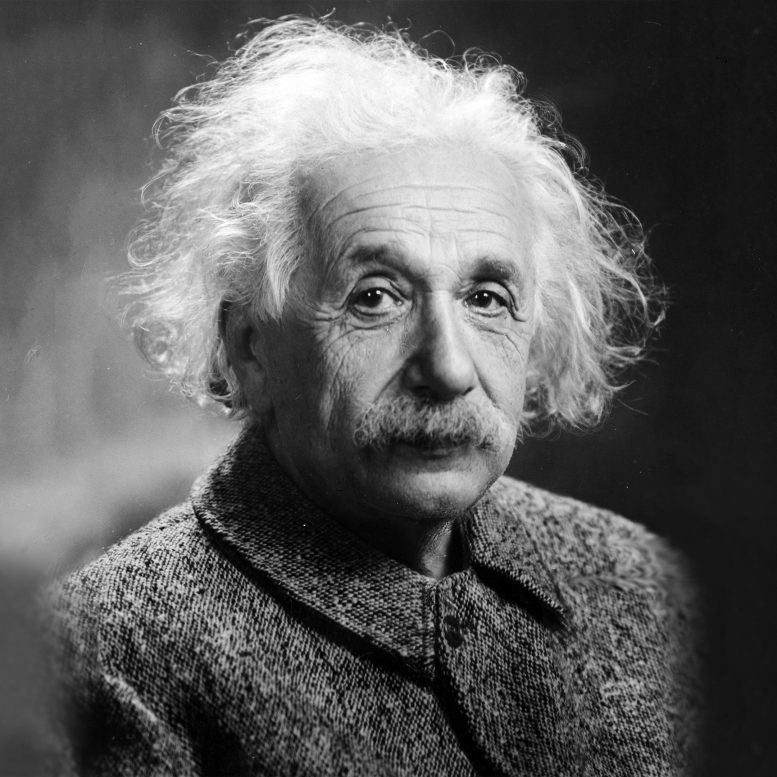
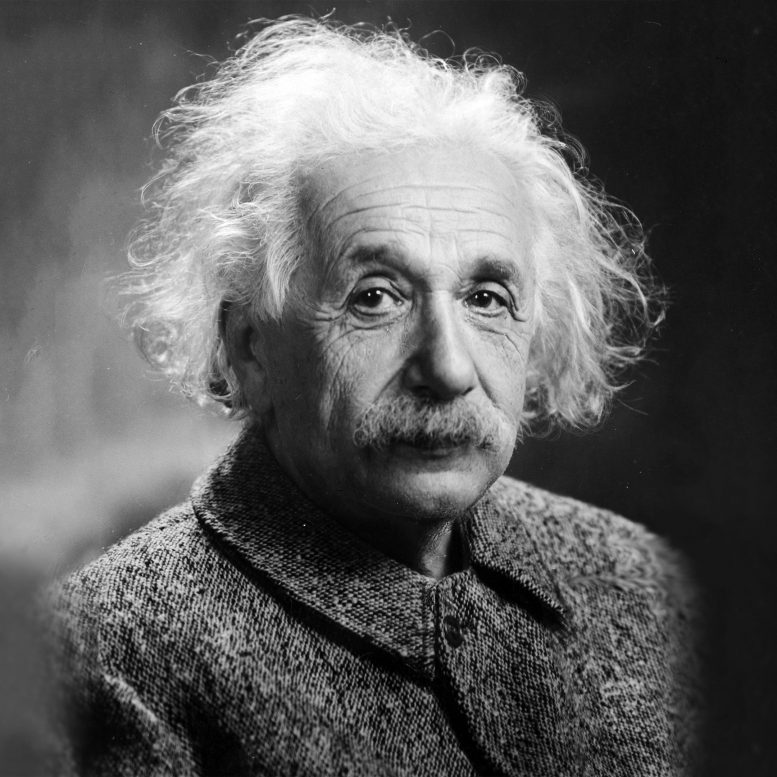
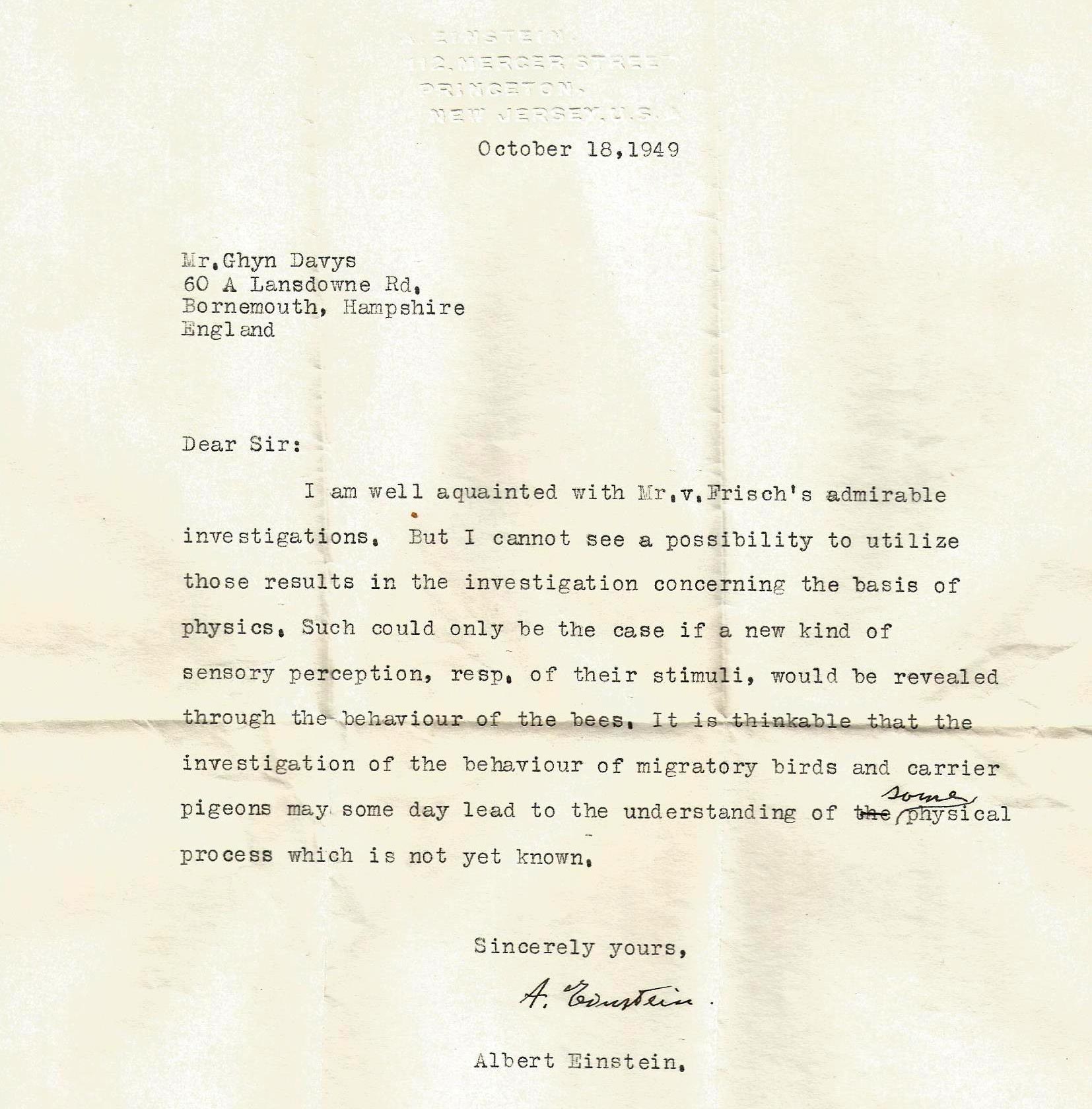
Previously Unknown Letter Reveals Einstein’s Thinking on Bees, Birds and Physics
The 1949 letter by the physicist and Nobel laureate discusses bees, birds, and whether new physics principles could come from studying animal senses.
It’s a position still being realized within physics to this day, with a growing body of research and understanding of how animals such as birds and bees find their way around.
Now a study led by RMIT University in Melbourne, Australia, discusses how recent discoveries in migratory birds back up Einstein’s thinking 72 years ago.
The previously unpublished letter was shared with researchers by Judith Davys — Einstein had addressed it to her late husband, radar researcher Glyn Davys.
RMIT’s Associate Professor Adrian Dyer has published significant studies into bees and is the lead author of the new paper on Einstein’s letter, published in the Journal of Comparative Physiology A.
Letter by Albert Einstein, validated by The Hebrew University of Jerusalem, where Einstein bequeathed his notes, letters and records. Credit: Dyer et al. 2021, J Comp Physiol A / The Hebrew University of Jerusalem
Dyer said the letter shows how Einstein envisaged new discoveries could come from studying animals.
“Seven decades after Einstein proposed new physics might come from animal sensory perception, we’re seeing discoveries that push our understanding about navigation and the fundamental principles of physics,” he said.
The letter also proves Einstein met with Nobel laureate Karl von Frisch, who was a leading bee and animal sensory researcher.
In April 1949, von Frisch presented his research on how honeybees navigate more effectively using the polarization patterns of light scattered from the sky.
The day after Einstein attended von Frisch’s lecture, the two researchers shared a private meeting.
Although this meeting wasn’t formally documented, the recently discovered letter from Einstein provides insight into what they might have talked about.
“It is thinkable that the investigation of the behavior of migratory birds and carrier pigeons may someday lead to the understanding of some physical process which is not yet known,” Einstein wrote.
Professor Andrew Greentree, a theoretical physicist at RMIT, said Einstein also suggested that for bees to extend our knowledge of physics, new types of behavior would need to be observed.
“Remarkably, it is clear through his writing that Einstein envisaged new discoveries could come from studying animals’ behaviors,” Greentree said.
More than 70 years since Einstein sent his letter, research is revealing the secrets of how migratory birds navigate while flying thousands of kilometers to arrive at a precise destination.
In 2008, research on thrushes fitted with radio transmitters showed, for the first time, that these birds use a form of magnetic compass as their primary orientation guide during flight.
One theory for the origin of magnetic sense in birds is the use of quantum randomness and entanglement. Both of these physics concepts were first proposed by Einstein.
Reference: “Einstein, von Frisch and the honeybee: a historical letter comes to light” by Adrian G. Dyer, Andrew D. Greentree, Jair E. Garcia, Elinya L. Dyer, Scarlett R. Howard and Friedrich G. Barth, 10 May 2021, Journal of Comparative Physiology A. DOI: 10.1007/s00359-021-01490-6
The letter to Glyn Davys shows the openness of Einstein’s mind to novel possibilities observed in nature and the evidence that he took an interest in von Frish and his bee research.
Something which can never be defined in words ,filled with so many emotions.It is as simple as it can be and as complex as it could be .life is god’s most amazing and artistic creation . So ,love it ‘as it is’ cause you are the luckiest one who can atleast feel those emotions . Enjoy your life and remember bloom where you are planted.
There is no perfect person in the world, but the most holy and supreme person has his shortcomings, but I believe that everyone is born innocent, because of course you can’t make mistakes in your childhood. But I think people are not really good or bad or both.
Not all people are good people. No matter how hard you try, everyone has their own shortcomings. I also feel bad about people.
The mistakes they make will anger God; therefore human beings are both. People are bad because someone has to do some naughty or bad things in their lives. No one can be so good, because I believe that if you think you are a good person, you should not do anything at all. Lock yourself in the room. people are bad mainly because of temptation. We have all done some non-model things, sometimes without even realizing it.At some point we are all bad people, but most people are not bad, just like everyone goes to jail, so we keep our balance. So we have good and bad. We have holy days and bad days.
We are not perfect people. When we start to think for ourselves and know what is happening, we will do this to ourselves. Our environment, except when we were young, they told us what to do, and now we can control our lives. Our daily decisions make us who we are today.
Sometimes we can be good, sometimes we can be bad. He mentioned in his sermon that God loves everyone, no matter what. Whether you are good or bad, as long as you are willing to give, God will always find in his heart to forgive your sins.
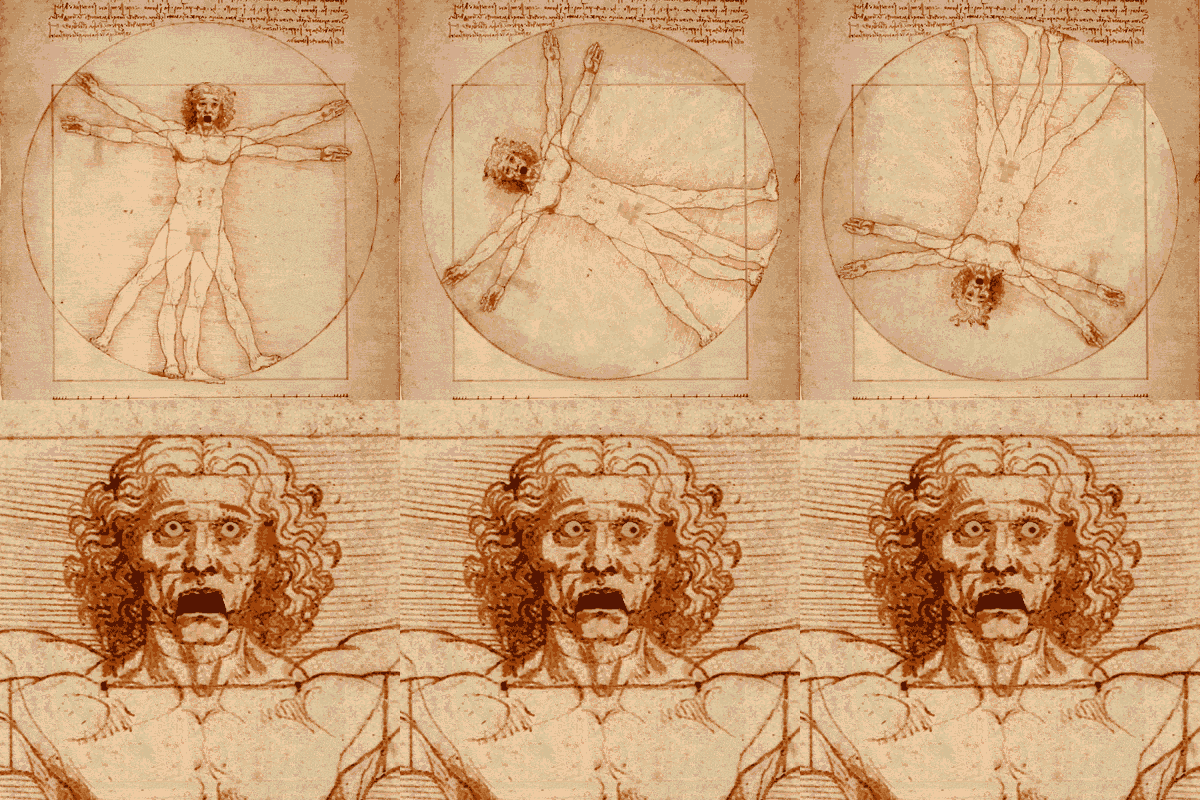
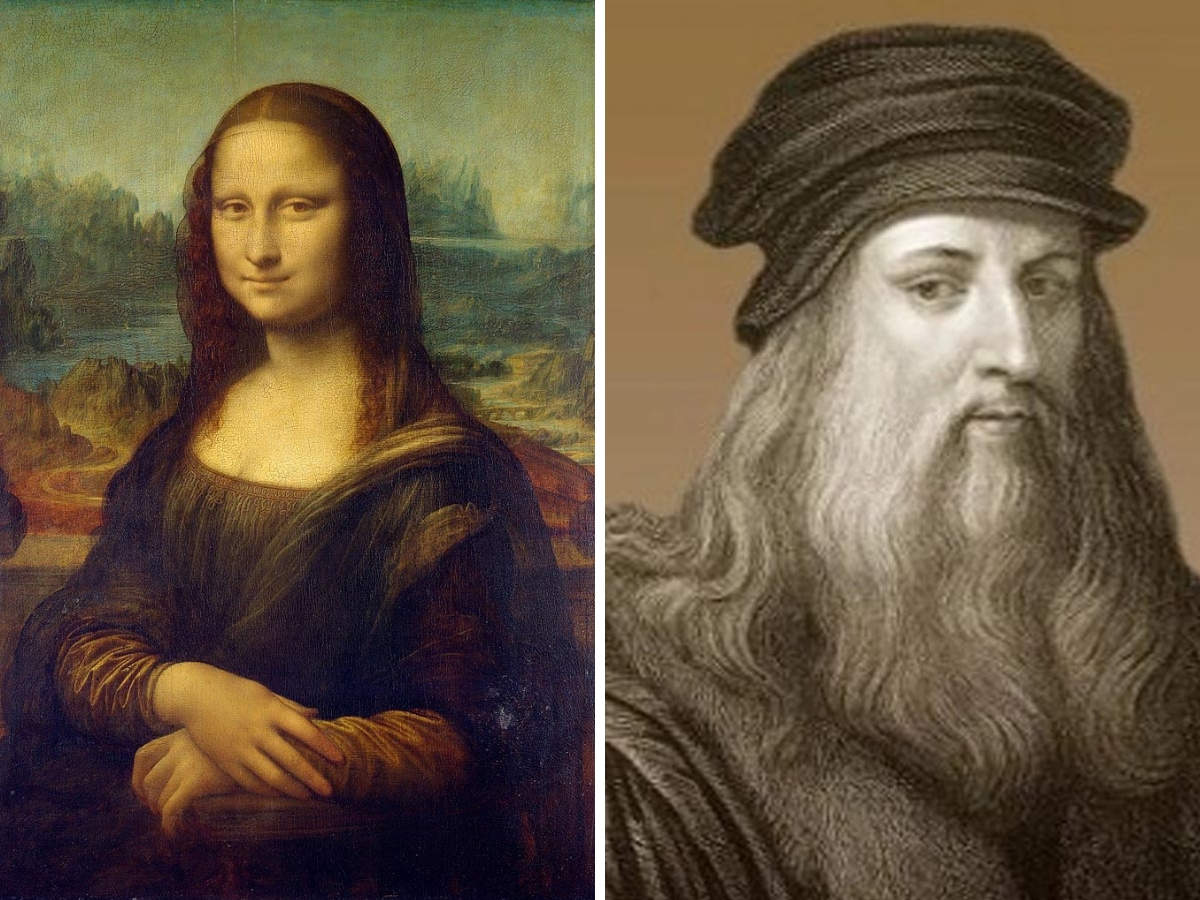
Leonardo da Vinci (1452-1519) was a painter, architect, inventor, and student of all things scientific. His natural genius crossed so many disciplines that he epitomized the term “Renaissance man.” Today he remains best known for his art, including two paintings that remain among the world’s most famous and admired, Mona Lisa and The Last Supper. Art, da Vinci believed, was indisputably connected with science and nature. Largely self-educated, he filled dozens of secret notebooks with inventions, observations and theories about pursuits from aeronautics to anatomy. But the rest of the world was just beginning to share knowledge in books made with moveable type, and the concepts expressed in his notebooks were often difficult to interpret. As a result, though he was lauded in his time as a great artist, his contemporaries often did not fully appreciate his genius—the combination of intellect and imagination that allowed him to create, at least on paper, such inventions as the bicycle, the helicopter and an airplane based on the physiology and flying capability of a bat.
Leonardo da Vinci: Early Life and Training
Leonardo da Vinci (1452-1519) was born in Anchiano, Tuscany (now Italy), close to the town of Vinci that provided the surname we associate with him today. In his own time he was known just as Leonardo or as “Il Florentine,” since he lived near Florence—and was famed as an artist, inventor and thinker.
Did you know? Leonardo da Vinci’s father, an attorney and notary, and his peasant mother were never married to one another, and Leonardo was the only child they had together. With other partners, they had a total of 17 other children, da Vinci’s half-siblings.
Da Vinci’s parents weren’t married, and his mother, Caterina, a peasant, wed another man while da Vinci was very young and began a new family. Beginning around age 5, he lived on the estate in Vinci that belonged to the family of his father, Ser Peiro, an attorney and notary. Da Vinci’s uncle, who had a particular appreciation for nature that da Vinci grew to share, also helped raise him.
Leonardo da Vinci: Early Career
Da Vinci received no formal education beyond basic reading, writing and math, but his father appreciated his artistic talent and apprenticed him at around age 15 to the noted sculptor and painter Andrea del Verrocchio, of Florence. For about a decade, da Vinci refined his painting and sculpting techniques and trained in mechanical arts. When he was 20, in 1472, the painters’ guild of Florence offered da Vinci membership, but he remained with Verrocchio until he became an independent master in 1478. Around 1482, he began to paint his first commissioned work, The Adoration of the Magi, for Florence’s San Donato, a Scopeto monastery.
However, da Vinci never completed that piece, because shortly thereafter he relocated to Milan to work for the ruling Sforza clan, serving as an engineer, painter, architect, designer of court festivals and, most notably, a sculptor. The family asked da Vinci to create a magnificent 16-foot-tall equestrian statue, in bronze, to honor dynasty founder Francesco Sforza. Da Vinci worked on the project on and off for 12 years, and in 1493 a clay model was ready to display. Imminent war, however, meant repurposing the bronze earmarked for the sculpture into cannons, and the clay model was destroyed in the conflict after the ruling Sforza duke fell from power in 1499.
Leonardo da Vinci: ‘The Last Supper’ and ‘Mona Lisa’
Although relatively few of da Vinci’s paintings and sculptures survive—in part because his total output was quite small—two of his extant works are among the world’s most well-known and admired paintings.
The first is da Vinci’s “The Last Supper,” painted during his time in Milan, from about 1495 to 1498. A tempera and oil mural on plaster, “The Last Supper” was created for the refectory of the city’s Monastery of Santa Maria delle Grazie. Also known as “The Cenacle,” this work measures about 15 by 29 feet and is the artist’s only surviving fresco. It depicts the Passover dinner during which Jesus Christ addresses the Apostles and says, “One of you shall betray me.” One of the painting’s stellar features is each Apostle’s distinct emotive expression and body language. Its composition, in which Jesus is centered among yet isolated from the Apostles, has influenced generations of painters.
When Milan was invaded by the French in 1499 and the Sforza family fled, da Vinci escaped as well, possibly first to Venice and then to Florence. There, he painted a series of portraits that included “La Gioconda,” a 21-by-31-inch work that’s best known today as “Mona Lisa.” Painted between approximately 1503 and 1506, the woman depicted—especially because of her mysterious slight smile—has been the subject of speculation for centuries. In the past she was often thought to be Mona Lisa Gherardini, a courtesan, but current scholarship indicates that she was Lisa del Giocondo, wife of Florentine merchant Francisco del Giocondo. Today, the portrait—the only da Vinci portrait from this period that survives—is housed at the Louvre Museum in Paris, France, where it attracts millions of visitors each year.
Around 1506, da Vinci returned to Milan, along with a group of his students and disciples, including young aristocrat Francesco Melzi, who would be Leonardo’s closest companion until the artist’s death. Ironically, the victor over the Duke Ludovico Sforza, Gian Giacomo Trivulzio, commissioned da Vinci to sculpt his grand equestrian-statue tomb. It, too, was never completed (this time because Trivulzio scaled back his plan). Da Vinci spent seven years in Milan, followed by three more in Rome after Milan once again became inhospitable because of political strife.
Leonardo da Vinci: Philosophy of Interconnectedness
Da Vinci’s interests ranged far beyond fine art. He studied nature, mechanics, anatomy, physics, architecture, weaponry and more, often creating accurate, workable designs for machines like the bicycle, helicopter, submarine and military tank that would not come to fruition for centuries. He was, wrote Sigmund Freud, “like a man who awoke too early in the darkness, while the others were all still asleep.”
Several themes could be said to unite da Vinci’s eclectic interests. Most notably, he believed that sight was mankind’s most important sense and that “saper vedere”(“knowing how to see”) was crucial to living all aspects of life fully. He saw science and art as complementary rather than distinct disciplines, and thought that ideas formulated in one realm could—and should—inform the other.
Probably because of his abundance of diverse interests, da Vinci failed to complete a significant number of his paintings and projects. He spent a great deal of time immersing himself in nature, testing scientific laws, dissecting bodies (human and animal) and thinking and writing about his observations. At some point in the early 1490s, da Vinci began filling notebooks related to four broad themes—painting, architecture, mechanics and human anatomy—creating thousands of pages of neatly drawn illustrations and densely penned commentary, some of which (thanks to left-handed “mirror script”) was indecipherable to others.
The notebooks—often referred to as da Vinci’s manuscripts and “codices”—are housed today in museum collections after having been scattered after his death. The Codex Atlanticus, for instance, includes a plan for a 65-foot mechanical bat, essentially a flying machine based on the physiology of the bat and on the principles of aeronautics and physics. Other notebooks contained da Vinci’s anatomical studies of the human skeleton, muscles, brain, and digestive and reproductive systems, which brought new understanding of the human body to a wider audience. However, because they weren’t published in the 1500s, da Vinci’s notebooks had little influence on scientific advancement in the Renaissance period.
Leonardo da Vinci: Later Years
Da Vinci left Italy for good in 1516, when French ruler Francis I generously offered him the title of “Premier Painter and Engineer and Architect to the King,” which afforded him the opportunity to paint and draw at his leisure while living in a country manor house, the Château of Cloux, near Amboise in France. Although accompanied by Melzi, to whom he would leave his estate, the bitter tone in drafts of some of his correspondence from this period indicate that da Vinci’s final years may not have been very happy ones. (Melzi would go on to marry and have a son, whose heirs, upon his death, sold da Vinci’s estate.)
Da Vinci died at Cloux (now Clos-Lucé) in 1519 at age 67. He was buried nearby in the palace church of Saint-Florentin. The French Revolution nearly obliterated the church, and its remains were completely demolished in the early 1800s, making it impossible to identify da Vinci’s exact gravesite.
Artists who create the magnificent form of artwork usually portray their inner personality in there all forms of art. They represent who they are, and how their psyche is. The creators of extraordinary art live a life of incompleteness, dullness, and hollowness within themselves.
Their creativity glorifies their inner self and how miserable their life is. All legendary wizards of art contribute incredible work despite having and living a horrible life. Whether it is Shakespeare who lost her 8yr old daughter, or whether it is Franz Kafka who had a fractured/failed relationship with his own father, or whether it is J.K. Rowling who had lived a miserable life striving between her failed career and failed family life while being a single mother, these all examples are basically the real lives of these great writers who imprinted their skills and printed their hands in the history of literature forever.
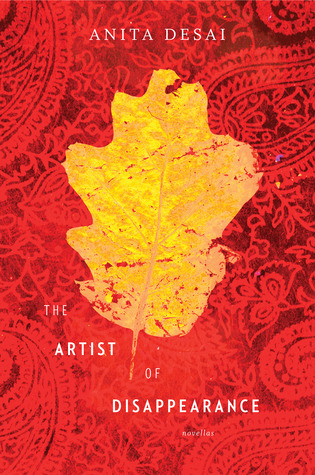
There are serval times when artists fail living in a complicated society when they are being judged and due to several cultural mishaps, which affect their lives. Likewise, The Novella “Artists of Disappearance” is one among them.
Artists of Disappearance – A Novella about unsuccessful Artists
This is a Novella, which is only one of its kind in its own way because this novel which has 3 novellas within it talks about what happens when the artists fail to satisfy their piece of art? How can an artist fail in his forte? For a writer/ or an artist the art is the reason why they survive in this uncanny world where there is a bridge between the writer and the injustices held against them, which ultimately oppose a writer to create their art! Readers will experience some kind of queries in their heads if they read these stories written by Anita Desai.
The writer had beautifully written these stories especially for the contemporary readers who are bustling their life and don’t have much time to read. But this Novella is amazing as all the 3 stories are somewhere relatable to readers of all ages.
“The Museum of Final Journey” –
This is the first novella of this book which is narrated by an unnamed Government bureaucrat who wanted to be a writer but unfortunately had to suppress his long writing career due to his father’s dream and expectation of his son to follow his footsteps and become a govt bureaucrat. As the story moves forward, we see that in the later years of the life of the narrator when he was a junior official and was posted into one of the remote areas, he describes his past experience as a flashback to the readers.
His experience was something which brought him in a state of apathy when one day an old man who was the caretaker of the “Mukherjee estates” came to the office for a favor to rescue the treasures of the states as some people were stealing it and disrespecting those precious things by exporting it to other countries. The Museum, which was now an abandoned museum for the residents living there, still had authentic elements present in it.
As the narrator quotes that: “While others dreamt dreams and lived lives of imagination and adventure, my role was only to take care of the mess left by them.” When the official comes in counter with the museum, he realizes the art and his life, his life is rusty and mundane like the dust-covered on the treasure’s museum, even if he tries to save the estate the art will be auctioned by other greedy people. When the artist dies, the art is never protected rather it becomes a means for greedy people to fulfill their needs.
The narrator finds himself and the Museum similar and ended his story by having this grief that he should have followed his dream, yet he was a failed writer whose life was hollowed and gloomy.
“Translator, Translated”–
Another story of a journey of a Failed writer, who is the protagonist of the story, named “Prema”, whose life was miserable and uncertain. She lived a mundane life as an English professor in a girl’s school where her own students mocked her and criticized her due to her appearance and her age. She didn’t have any goal and she always compared and envied her life with others, especially with one of her school acquaintances “Tara” who was now an editor head in a feminist publishing company.
When these 2 characters collide in one of the school programs, Tara allowed her to do a translating job. Initially, Prema’s journey as a translator was like a “Carousel”, but things fall apart when she tried to translate an Oriya book written by Suvarna Devi into English which later on ended her writer career ultimately.
Translating is a form of art that depends on how the translator deals with the language and brings the best piece of all. It becomes a sentimental concern if the translated work is not satisfied by the readers. This is what happened in the end, as her translated book didn’t receive much appreciation and in the end, Prema lost her dream to become an eminent writer and went back to her mundane life of being an English professor.
Her failure proves to us that, as the art fairs, the artists die! As the artist in Prema was dead when the art didn’t flourish. Her ability to write was dead when she drained by her own skills and failed with her own existence as an artist.
“The Artist of Disappearance” –
This is the title story of the novella with a protagonist named “Ravi” who had an unfortunate life who had been adopted at a very young age by a very wealthy couple. Even living in a mansion which was located at the foothills of the Himalayas, he never loved his life as his life was not peaceful like the other kids of his age. He had neglected parents who used to beat him up and used to leave him and traveled to Europe without having any concern for their son.
He was always caged in the house and what he always wanted is “Freedom”. This is what every artist wants to be free from the clutches of society, to think freely and exploring themselves.
In a fire accident when he lost his parents, he became to be with himself away from the social life and created much great artwork in his own house. His artwork was so much amazing that people who were filming near the village wanted to expose his work but he denied it and wanted to live an isolated life with his art.
The last story of Ravi proves that an artist is always attached to his work and never wants to leave it. Whether they fail or flourish, art is the reason which keeps them alive.
Though unnamed official, Prema and Ravi failed, their failures in there art form kept them alive from this undeserving world where they are not accepted for their art and yet these artists choose a life living in uncertainty with a certainty of hope hidden in their hearts and that surely one day they will reach their destination.
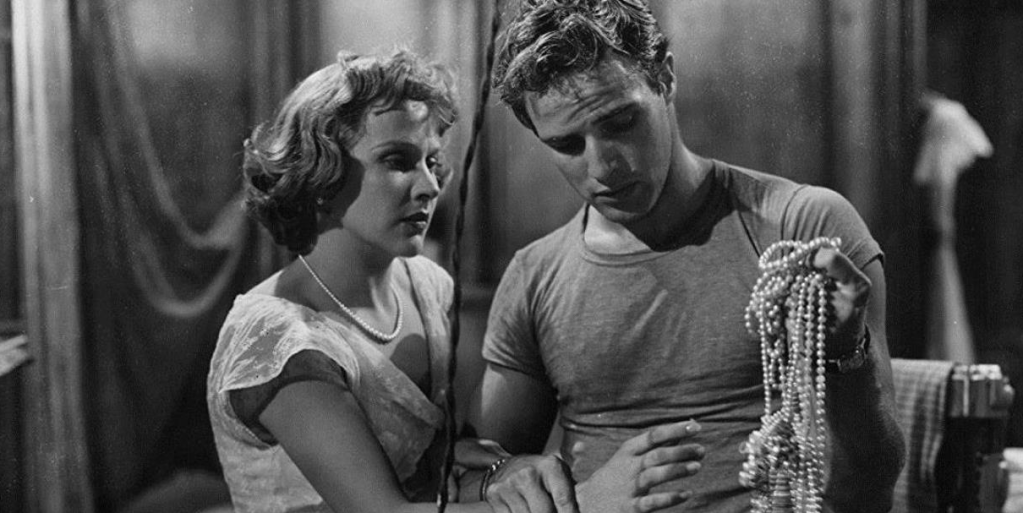
A still from A Streetcar Named Desire (1951) ft. Marlon Brando and Vivien Leigh
A Streetcar Named Desire is a 1947 play by the American playwright Tennessee Williams. It is regarded as one of Williams’ best plays and has received several awards including the Pulitzer Prize. It was also later adapted into a film in the year 1951 starring Marlon Brando and Vivien Leigh, and is still considered to be a classic. Through its eleven scenes, the play delivers a raw reality of the middle class in conflict with the fallen bourgeoise of the American South.
The story is set in motion when Blanche Dubois, a schoolteacher from Mississippi visits her younger sister Stella in New Orleans. Stella has been newly married to Stanley Kowalski, a Polish descent working class man. The Kowalskis live in a tiny apartment located in the shabbier side of New Orleans where jazz music constantly plays right around the corner. Blanche is sophisticated and looks down upon the living condition of Stella. She takes long baths, only wears fancy clothes and jewelleries and still lives a lifestyle that disagrees with her income. She informs her sister that she lost their ancestral plantation called Belle Reve and intends to stay with the Kowalskis for a while. During her stay, she gets close to one of Stanley’s friend Mitch.
Stella, despite having previously led the same luxurious life as Blanche has surprisingly adjusted quite well to her surroundings. She is head-over-heels for her husband and fears the thought of Blanche looking down on him. Stanley is the working-class hero who is unapologetic of his social status. He values his friends and is passionate about Stella. He lives in the practical world which is in stark contrast to the illusionary world of Blanche. He is strong and opinionated and has his way with everything whereas Blanche is soft spoken and is the embodiment of a chaste shy woman.
“I don’t want realism. I want magic! Yes, yes, magic! I try to give that to people. I misrepresent things to them. I don’t tell the truth, I tell what ought to be the truth. And it that’s sinful, then let me be damned for it!”
-Tennessee Williams
As the play unravels, we see the true colours of the characters. Despite trying her best fit the southern ideals of a naïve young woman, Blanche is revealed to be the exact opposite. She is obsessed with her beauty, is promiscuous with young men and has a severe drinking problem. She has no money left but is too proud to accept that and pretends to be an aristocrat who still expects everyone to be at her command. When she meets Mitch, she tries desperately to hide her promiscuous past from him. She refuses to see him in the day or under a light because she’s afraid that he’ll find her old. Her drinking problem starts soon after the suicide of her previous young husband. Stanley sees right through her and is adamant is calling her out. Through her, he takes out all his pent-up anger against the bourgeoise. He despises Blanche for looking down on him and makes up his mind to bring her to reality. He isn’t swayed by her flirting and succeeds in showing her true colours that she desperately wanted to hide. He even goes as far as to assault her. Despite knowing his true nature, Stella chooses to defend him over her sister.
A Streetcar NamedDesire is thus a raw reminder of the fall of the Southern Aristocracy. Williams reminds his audience that inequality of power never prevails and that those who still cling onto the old ideals are bound to perish with it. He also shows that truth eventually finds its way and that its impossible to live in an imaginary world. The play thus brings us to reality and reminds us of its harshness.
Tamil Chair Inc. is a non-profit organization registered in the state of Maryland (USA) that is currently working on fund raising for Harvard Tamil Chair
6m $ is required to establish it
Tamil is one of the very few languages of the world with a classical past and a robust literary tradition that has continued to this day. Despite many foreign occupations of the Tamil country and other outside influences, this noble language has always shined, producing vibrant literature for over 2 thousand years.
In addition to the literature, there have been numerous grammar books, commentaries, religious works, didactic books, secular literature and works from many other genres.
This is what the Tamil chair of Harvard university states about tamil
What is the need for a Tamil Chair?
Tamil language has one of the oldest written traditions in all of Asia and boasts a rich body of literary work dating back 2,500 years. Tamil has been accorded with a prestigious recognition as one of the seven classic languages (Greek, Sanskrit, Latin, Hebrew, Persian, Tamil and Chinese), and it is one of the very few that has survived all the way through to the modern world since its beginning.
Currently, Tamil is the 20th most commonly-spoken language (by 80 million people) in the world, with vibrant literatures for over 2 thousand years. Literature represents the culture and tradition of a language or people, and it provides a kind of blueprint of human civilization.
Thus far the global reach of Tamil literature is so limited, and for its ancient and Classic standing, Tamil literature deserves to be critically looked from new and diverse perspectives and the resulting knowledge needs to be shared across other cultures for mutual benefits.
So the purpose of this chair is multifold. First, it is a matter of great prestige for Tamils to have our language taught at the world’s most prestigious university which attracts brilliant students from all over the world.
There is also a need for research in ancient classical Tamil literature. Harvard will produce Tamil scholars who will be trained in research methodologies.
IMPORTANCE OF TAMIL CHAIR IN HARVARD UNIVERSITY AND THE WAY IT ENRICHES THE LANGUAGE
Helps building History
History can be written on the basis of outputs from researching a language.
Research about a language is a step to build a history.
Ex: In recent, historians of India use vedic texts of sanskrit to build the own history.
They build Indian history with vedas as base.
If more outputs from researching tamil comes out it will help build Indian History which may be seen from view of tamil literature.
2. Helps developing the language
In India Hindi and sanskrit are given importance by central government for promoting and developing them. These types of actions from Indian government limits Tamil as a regional language and major funding is deprieved.
Promoting through a reputed university will ensure good amount of funding for research.
It will help explore the Tamil studies on a much deeper level through a rigorous approach executing formal academic research processes to bring out the traditions, the cultural, intellectual, and social practices of the Sangam period that are barely explored as of now. This will elicit Tamil’s long tenured literary tradition to the peer academic communities and establish it’s much deserved recognition as a Classic language.
3. Competition with Sanskrit and other classical languages
Indian goverment in name of Hindu Nationalism promotes only sanskrit.
For all other Classic and widely spoken languages like Sanskrit, Greek etc , there is so much research and progressive work that is done at various international academic centers. It is quite urgent and highly imperative that the same world class effort is put forth for Tamil to expand its stature and reach. It will enhance not only the chances for continual use but also the newly embraced recognition from the global populace.
4. Intensive Research and development
Any developments on language of Tamil is stopped by Indian government . Without funds researchers are suffering. Even if someone come out with good research it is deemed valued by Hindutuvas/Hindi Nationalist Indian government
Independent research in a foreign country will only enrich it for good without influence by Indian Government.
5. Gets world wide interest and new learners
Developing the language in a well known University will gather world wide interest for the language and gather new learners.
May revoke intersets in researchers to resume archaelogical excavations a, Keezhadi, Poombukar, Adhichanallur which were currently banned by Indian government for excavating. Because they provide excessive proofs to Independent tamil culture in Sangam period, so that it will affect sanskrit’s claim on Tamil.
Assures Tamil language’s legacy to survive and grow.
This endeavour will cerainly increase the horizon of Tamil
The sun is also a star Author —- Nicola Yoon Stars -5 stars
This story is about Natasha and Daniel who meet each other in such a way that Daniel believes is destiny and Natasha believes coincidence. Natasha and her family are going to be deported to Jamaica as they are illegal immigrants . Daniel convinces Natasha to give him an our and he will make fall in love with him. This is how both of their lives turn around in just a day
I really loved the book . @nicolayoon has written this book beautifully and I fell in love with characters . I especially liked the part that the author told the backstory of each character . This book really made me believe in destiny as well as reality both at the same time . This one of the book that I would want to read again . This love story is the best love novel I have read so far
I would recommend this book to all the readers you won’t regret picking this book for a read . I am definitely adding this my favourite book of all times.
By Ishita Pillay Email- ishitapillay2004@gmail.com
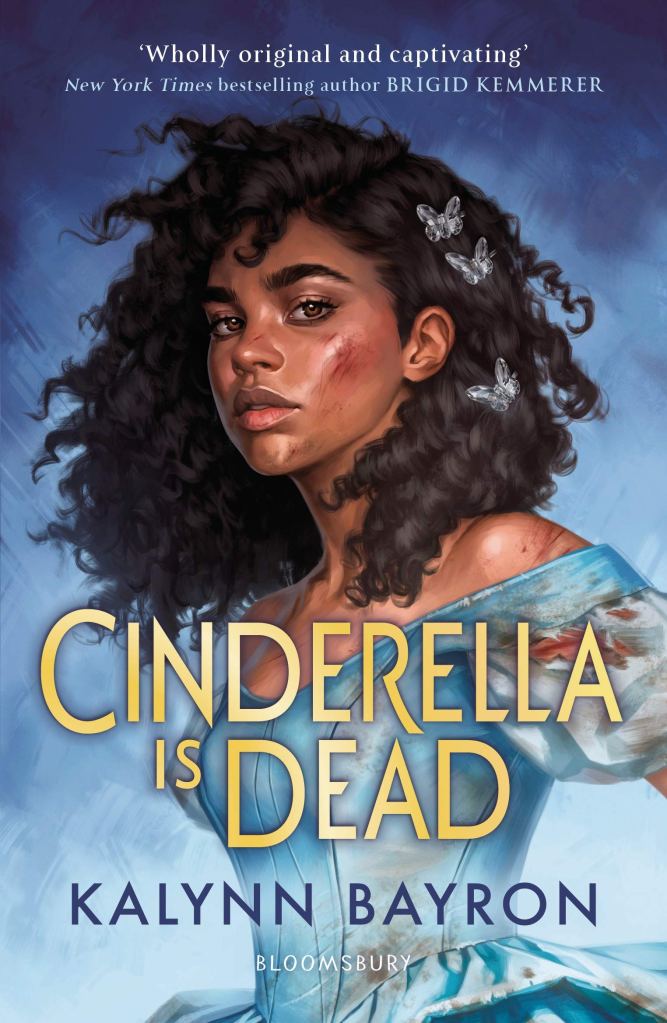
The story takes place 200 yrs after Cinderella story took place . It’s revolves around Sophia who is a lesbian and tries to rebel against the cruel king . The king has made rules that each year a ball will be held and the men will choose the women they want to marry through the ball , even if the women disagres she has to get married no matter what . Sophia doesn’t want to attend by the ball as she likes someone else. The story continues as Sophia tries to reveal the real story of Cinderella and Stop the reign of the king
I first thought this book was about Cinderella but it turned out different . I was disappointed with the way the book was written because I thought it became boring at points but it was a very different story and I liked it’s uniqueness. Even though the nature of Prince Charming’s characters was shown cruel which I don’t like. I really had q nice time reading it but definitely could have a lot more better
Spoiler alert
The fact that Fairy godmother was Charming’s mother was something I really do dint like along with the weird ending . The killing scene of king manford could have been more interesting .I liked the part that the stepsisters were shown as good characters
I would not completely recommend this book but if you are willing to try a new kind of story then this is a good read
China and Japan India and Byzantium traveling culture and history vector geisha and samurai men and women Taj Mahal and torii gate capitol building and Great wall landmarks and heritage nationalities.
Culture and history is the main building block of our lifes
The Culture is the characteristics and knowledge of a particular group of people, encompassing language, religion, cuisine, social habits, music and arts.
The word “culture” derives from a French term, which in turn derives from the Latin “colere,” which means to tend to the earth and grow, or cultivation and nurture
History is the study of life in society in the past, in all its aspect, in relation to present developments and future hopes. It is the story of man in time, an inquiry into the past based on evidence.
As with any scholarly approach that boasts of being “new” when it bursts onto the scene, new cultural history was fairly well established as one among many ways of thinking about history by the twenty-first century. This is not to say that new cultural historians enjoyed the unanimous esteem of their more traditional colleagues, for the field still managed to draw the fire of critics from the left and the right who believed that after twenty years this approach still represented a mere “trend.” One could agree with Peter Novick that this attests to the fragmentation of the historical profession into a plethora of specializations that no longer cohered around shared principles and whose denizens had little common ground for discussion. Yet much has changed in cultural history since its heyday in the 1980s.
When new cultural history was actually “new” it provided innovations both in terms of the topics considered worthy of historical attention and in terms of the ways of theorizing such topics within their respective contexts. It is nevertheless apparent that a good portion of what was marketed in 2000 as “cultural history” reflected more of the topical rather than theoretical innovations entailed by this approach. In fact, some of these works even read more like conventional social histories with a few obligatory nods to one of many privileged theorists.
To some extent this state of affairs reflects the success of this approach in the academy and the willingness of historians to combine methodologies in a creative and eclectic manner. On the other hand, though, one might argue that cultural history lost much of its edge by becoming subsumed into a more or less nonreflective historical establishment. Some historians see less fragmentation than the cooptation of erstwhile radical approaches back into a surprisingly resilient mainstream.
“Whatever possibilities become evident,” notes Patrick Joyce, “something is needed to shake the hold of a history which continually reproduces itself, in the process sucking the erstwhile heterodox into its consensus, in much the way that ‘cultural history’ is slowly but surely becoming routinized as more methodology, yet one more subdiscipline in the house of history.” Joyce’s observation is astute, yet one wonders whether a historical approach that could successfully resist such cooptation is possible and, even if it were, whether it would still merit the name “history.” It seems evident that what makes history “history” has little to do with methodologies and innovations that are unique to it, and perhaps a more thoroughgoing interdisciplinarity would discourage the domestication of future innovations into mere additions to the mansion of conventional history.
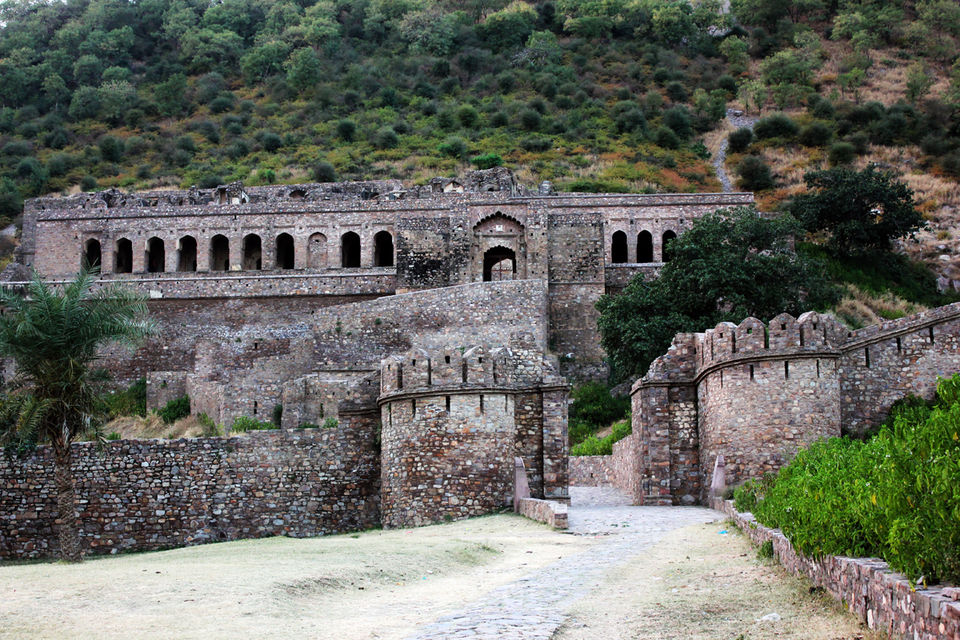
Bhangarh Fort is known as the most haunted place in India, and perhaps the greatest unsolved mystery. There is no doubting the fact that anything associated with the supernatural attracts a huge amount of attention and the deserted city of Bhangarh cashes in on that very idea. The many haunted stories of Bhangarh Fort have transformed it into a bucket list destination of sorts.
Curious travellers come in order to experience cheap thrills and while some go back disappointed, others simply cannot have enough of the suspense associated with the story of the Bhangarh Fort. If you happen to be one of those inquisitive travellers, it is imperative for you to visit this place and find out for yourself.
Is the Bhangarh Fort haunted? Here is the story of Bhangarh:
Most people are of the belief that Bhangarh Fort is haunted and there is no dearth of tales that help in amplifying the mystery that is Bhangarh. Venturing into the fort after sunset is nothing short of an act of bravery as it is supposed to be a centre for paranormal activity and the Archaelogical Survey of India therefore has prohibited people from visiting the Bhangarh Fort at night.
Of the many Bhangarh stories that the locals like to indulge in, the most popular is that of Emperor Madho Singh who built the city after attaining the approval of Guru Balu Nath, an ascetic who used to meditate there. The saint gave his approval on the condition that the shadow of the Emperor’s palace should never fall on his retreat.
If in case it did, the city would crumble into ruins. Once the construction was completed, the retreat of Guru Balu was unfortunately shadowed by the palace. Having incurred the saint’s wrath, Bhangarh immediately transformed into a cursed city and could never be rebuilt as no structures ever managed to survive in it. It is interesting to note that the tomb of Guru Balu Nath can still be found among the ruins.
mysterious!
Another Legend of Haunted Bhangarh Fort:
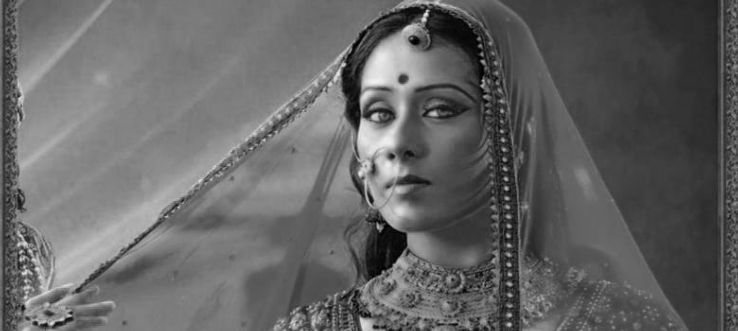
Another Bhangarh Fort story pertains to Princess Ratnavati. According to legends, her beauty was nonpareil and stories of her surpassing physical attractiveness even transcended kingdoms and borders. When she turned eighteen, suitors from several states asked for her hand in marriage. Of all these suitors was a sorcerer named Singhia who was aware of the fact that he was no match for the princess. However, he decided to entice her with the magical powers he possessed.
He was lucky enough to see Princess Ratnavati’s mistress in the market and enchanted the oil she was purchasing with black magic. He was of the hope that the princess would surrender herself to him upon touching the oil. However, his attempt was futile as Ratnavati witnessed his trick and poured the oil on the ground which then morphed into a rock, rolled towards the magician and crushed him.
Rani Ratnavati
Before dying, Singhia cursed the city of Bhangarh to death and as a result, it never witnessed any rebirths. Moreover, in the battle between Ajabgarh and Bhangarh, princess Ratnavati was killed, thus adding more weight to his malediction. Hopes, however, never die as several locals are of the belief that she has returned in a different form and will ultimately come back to end the unfortunate spell on Bhangarh.
While Bhangarh fort story has been rubbished by scientists, nothing stops the villagers from believing that it is a sanctuary for ghosts. People have supposedly often heard noises that are unaccounted for. The locals claim to have heard women screaming and crying, bangles breaking and strange music emerging from the fort. There have been instances where a special perfume was emanating from the Bhangarh Fort along with ghostly shadows and inexplicable lights. Some people have felt the strange sensation of being followed and even slapped by an invisible entity. It is believed that if a person enters the fort after sunset, he/she will never ever come out of it. The doors are therefore always locked after dusk and entry into the Bhangarh Fort at night is absolutely forbidden. Are all of the Bhangarh Fort stories factual or just strange pieces of fiction? Is the Bhangarh Fort really haunted? Nobody can say. Ghost hunters perhaps can.
A job is something you simply do for the money. Usually, jobs have a small impact on future resumes because they aren’t typically related to what your career is or will be. Also, jobs usually offer less networking opportunities because your coworkers often won’t be continuing on to the same field as you in your future career.
Most jobs consist of hourly wages, are more short-term, and focus on getting a task done.
What is a career ?
A career is all about building up skills through various employment opportunities, giving you the ability to move on to higher paying and more prestigious ones. Careers provide a foundation of experiences that help fuel your professional life for many years.
Careers are more long-term and are about learning, gaining experience, building connections, and putting yourself in the right position for promotions and raises. Also, careers tend to be more salary based, as opposed to hourly based like jobs, and often include benefits such as paid time off and healthcare.
While more education is often required for a career, you don’t need to spend the rest of your life in school just to get ahead. South College offers many associate degree programs that can be completed in just two years, getting you started on your new career before you know it.
If you’re interested in finding out what your future career should be or in getting the right education to put you there, contact us today!
That’s not to say that jobs aren’t valuable. Jobs show your work ethic, which is important to future employers, and money pays the bills! Jobs can help prepare you for a career by providing you with valuable skills like time management and communication.
DIFFERENCE
A job is more short-term oriented and tends to focus purely on earning money. On the other hand, a career is a series of related employment in one field that provides experience for your future and helps you earn a better paycheck and living status
7 Strategies to Build A Successful Career
Identify with Your Goals. Before even considering following a career route, you must get to know yourself. …
















 Eduindex
You must be logged in to post a comment.