National Science & Technology Management Information System

NSTMIS, DST is responsible for collection, collation, analysis and dissemination of information on resources devoted to S&T activities in the country.

The Scientific and Technological (S&T) activities play a vital role in the economic, social and physical development of a country. Scientific and technological research needs huge investments and calls for a judicious utilization of scarce resources like finance, trained manpower, raw materials etc. Data collection and analysis pertaining to resources, devoted to S&T, therefore, assumes significant importance. The growth of S&T, its performance and impact on society and economy are indicators to assess the effectiveness of planning and policy formulation.

The National Science and Technology Management Information System (NSTMIS), a division of Department of Science and Technology (DST) has been entrusted with the task of building the information base on a continuous basis on resources devoted to scientific and technological activities for policy planning in the country.

Activities

NSTMIS undertakes broadly two types of research activities:

  • In-house Research
  • Sponsored Research

In-house Research

  • National Survey on resources devoted to S&T activities in the country.
  • National Level database on Extramural (sponsored) R&D projects.

As an outcome of above in-house research, NSTMIS brings out the following publications

  • Research and Development Statistics
  • Research and Development in Industry
  • S&T Data Book
  • Directory of R&D Institutions
  • Directory of Extramural R&D Projects

Sponsored Research

While some of the valuable basic data on input resources into S&T activities were processed in -house, it was felt necessary to involve other interested individuals/organisations to take up studies in the sponsored project mode in order to convert this activity into a very comprehensive and cohesive plan programme to make available Science and Technology indicators. Keeping this in view, the divisional activities were further strengthened during Seventh Five Year Plan (1985-90) by enlarging the scope and including the following :

  • Creation, Updation and Dissemination of databases on R&D resources, projects, institutions, experts, equipments, other infrastructure facilities.
  • Development of S&T indicators.
  • Studying aspects related to R&D management and policy issues.
  • Estimation of short term and long term requirement of different categories of scientific manpower particularly in new emerging areas of S&T.
  • Studying the mismatch between employment and output of S&T personnel.
  • Supporting R&D projects on various S&T dimensions.

So far, more than 125 projects on the various facets of S&T have been sponsored to various organisations/ establishments and the results of 85 completed projects have already been published in the form of reports and disseminated to various researchers/users.

Call for Proposals (2017-18) – Centre for Human and Organisational Resource Development (CHORD Division)

New Initiatives

Innovation plays a vital role in nation’s prosperity. Recognizing the importance, the Indian Government has mounted a new initiative the Science, Technology, Innovation and Creation of Knowledge framework (STICK). The National Innovation Survey framework, evolved upon in-depth discussion with the national and international experts shall be used in the implementation of the STICK Programme.

For more information on STICK Programme National Innovation Survey

Linkages

NSTMIS division maintains a close liaison with UNESCO, NSF, OECD, etc. for matters relating to S&T statistics and indicators. NSTMIS officers are taken as resource persons by UNESCO for the various workshops conducted by them on standardisation of concepts and terminologies used in S&T statistics. NSTMIS expertise has also been shared with other developing nations like China and Trinidad and Tobago. Apart from this, NSTMIS continually interacts with various national organisations like Planning Commission, Institute of Applied Manpower Research, University Grants Commission, Confederation of Indian Industries and other scientific organisations for exchange of information and expertise related to Science Statistics and Indicators.

Project List Year Wise –


2004-05[PDF]10.96 KB 2005-06[PDF]9.75 KB 2006-07[PDF]15.43 KB 2007-08[PDF]20.99 KB 2008-09[PDF]21.5 KB
2009-10[PDF]9.01 KB 2010-11[PDF]9.65 KB 2011-12[PDF]10.13 KB 2012-13[PDF]7.93 KB 2013-14[PDF]14.79 KB
2014-15[PDF]137.39 KB 2015-16[PDF]15.09 KB 2016-17[PDF]233.86 KB 2017-18[PDF]247.83 KB 2018-19[PDF]240.6 KB

Swarnajayanti Fellowships Scheme

Govt. of India had instituted a scheme “The Swarnajayanti Fellowships” to commemorate India’s fiftieth year of Independence. Under this scheme a selected number of young scientists, with proven track record, are provided special assistance and support to enable them to pursue basic research in frontier areas of science and technology. The fellowships are scientist specific and not institution specific, very selective and have close academic monitoring..

Nature of Support:

The award consists of a Fellowship of Rs 25000/- per month in addition to the salary drawn from the parent Institute along with a Research Grant of Rs 5 lakh per annum by Department of Science and Technology for a period of 5 years, while the project submitted by the selected Fellows will be considered for funding by the Science & Engineering Research Board (SERB) as per SERB norms, for recurring and non-recurring heads. Scientists selected for the award will be allowed to pursue unfettered research with a freedom and flexibility in terms of expenditure as approved in the research plan. The project should contain innovative research idea and it should have a potential of making impact on R&D in the discipline.

Duration:

The duration of the fellowship will be for a period not exceeding five years.

The advertisement for  “Swarnajayanti Fellowships Scheme” for each year will appear on the DST website with all details.

Swarnajayanti Fellowships Awards

Project List Year Wise
1997-05 2005-06[PDF]28.02 KB 2006-07[PDF]26.44 KB 2007-08[PDF]16.86 KB 2008-09[PDF]22.37 KB 2009-10[PDF]14.59 KB 2010-11[PDF]46.39 KB 2011-12[PDF]82.02 KB 2012-13[PDF]102.55 KB 2013-2014[PDF]160.97 KB 2014-2015[PDF]29.24 KB 2015-2016[PDF]49.78 KB 2016-2017[PDF]65.09 KB 2017-2018[PDF]294.97 KB 2018-2019[PDF]255.81 KB

Advertisement

Advertisement for the “SwarnaJayanti Fellowships Scheme 2019-20”[PDF]0 bytes

Science Olympiad Programme

A National Science Olympiad Program covering Mathematics and Sciences including Astronomy is operational in the country.  These programs aim at promoting excellence in Science and Mathematics among pre-university students. While HomiBhaba Centre for Science Education (HBCSE), Mumbai is the nodal organization for selection, training of students through Indian Association of Physics Teachers (IAPT) for participation of students at various International Olympiads meet. The program is financially supported by Government of India, in particular Department of Science and Technology, Board of Nuclear Sciences (Department of Atomic Energy), Department of Space, Ministry of Human Resource Development and Ministry of Earth Sciences.

Except Mathematics Olympiad, HBCSE administered and coordinates various other Olympiads such as Astronomy (Junior & Senior), Biology, Chemistry, Earth Science, Physics and Junior Science through National Steering Committee (NSC) and the Department of Science and Technology (DST) is the member of NSC for implementation.

For more details please visit www.olympiads.hbcse.tifr.res.in

Kishore Vaigyanik Protsahan Yojana (KVPY)

Kishore VaigyanikProtsahanYojana (KVPY) is an on-going National Programme to provide Mentorship and Scholarship support to pursue study in Basic Sciences. While KVPY program is initiated and funded by the Department of Science and Technology, Government of India, it is administered and implemented by the Indian Institute of Science (IISc) Bangalore to attract exceptionally motivated students to study science and pursue careers in research.

The objectives of the program are to identify students with talent and aptitude for research, help them realize their potential in their studies, encourage them to take up research careers in science and ensure the growth of the best scientific minds for research and development in the country.

The KVPY Program enrolls students starting from Class XI standards (science subjects) and operates in 3 streams i.e. stream SA, Stream SX and Stream SB. Initiating with mentorship in initial 1-2 years through exposure in VIJOSHI Science Camp, it provides scholarship to KVPY students who joins in Science Courses (out 18 subjects) at the undergraduate (BSc, BS-MS or Integrated MS) level and continued upto post-graduate level.

The KVPY Programme announces every year sometime in May/June to conduct its selection process which is carried out in two stages: i) Aptitude Test (in November or so) and ii) Personal Interview. Each year nearly 2000 students are selected in 3 streams and approximately 1000 students received KVPY Scholarship every year.

For more information please visit website: www.kvpy.iisc.ernet.in

Science and Technology of Yoga and Meditation (SATYAM)

Department of Science and Technology (DST), in 2015, conceptualized a new research program- ‘Science and Technology of Yoga and Meditation’ (SATYAM)- under its Cognitive Science Research Initiative (CSRI). As Yoga and Meditation are interdisciplinary endeavors that interface with Neuroscience, Medicine, Psychology, Philosophy, and so on, therefore an interdisciplinary approach is needed to converge different & diverse disciplines as well as approaches & methods in the study of yoga and meditation. Thus comprehensive research on yoga and meditation is expected to address various challenges confronting physical and mental health. This new programme is aimed to foster scientific research on the effects of yoga and meditation on physical & mental health and on cognitive functioning in healthy people as well as in patients with disorders.

Themes: Basic themes being covered under SATYAM include, among others, (1) investigations on the effect of Yoga and Meditation on physical and mental health and well being, and (2) investigations on the effect of Yoga and Meditation on the body, brain, and mind in terms of basic processes and mechanisms.

Who can apply: Scientists/academicians with research background in ‘Yoga and Meditation’ and having regular position are invited to participate in this initiative. Practitioners actively involved in yoga and meditation practices are also encouraged to apply in collaboration with academic and research institutions of repute. Interested researchers are required to submit research proposals in their area of expertise along with Endorsement Certificate from the Head of the Institution and detailed bio-data of PI and Co-PIs.

Project duration: The project is tenable for a maximum period of three (3) years.


Last date for proposal submission under Science and Technology of Yoga and Meditation (SATYAM) and COVID-19 related SATYAM ‘Special Call’ has been extended till 31 May 2020)

Special Call under SATYAM to fight against COVID 19[PDF]0 bytes

Concept Note Format[PDF]517.48 KB

Advertisement for Science and Technology of Yoga and Meditation (SATYAM)- 2019-20[PDF]0 bytes

Format for Submission of Research Proposal Under Science and Technology of Yoga and Meditation (SATYAM)[PDF]580.33 KB 

Sanctioned Projects  – 2015-16[PDF]97.59 KB

Sanctioned Projects  – 2016-17[PDF]86.04 KB

Innovation in Science Pursuit for Inspired Research Programme

Innovation of Science Pursuit for Inspire Research (INSPIRE) is one such innovative scheme proposed by the Department of Science & Technology for attraction of talent to science. The basic objective of INSPIRE would be to communicate to the youth population of the country the excitements of creative pursuit of science and attract talent to the study of science at an early stage and build the required critical human resource pool for strengthening and expanding the Science & Technology system and R&D base.

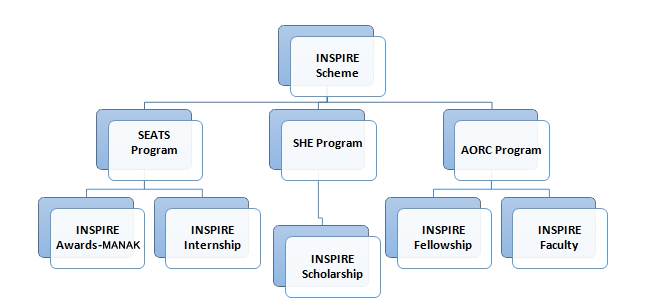
INSPIRE Scheme has included three programs and five components. They are i) Scheme for Early Attraction of Talents for Science (SEATS), b) Scholarship for Higher Education (SHE) and c) Assured Opportunity for Research Careers (AORC).The schematic diagram of the programme is shown below

Government of India approved this Scheme in November 2008 at a total cost of Rs 1979.25 crores in the 11th Plan Period and Hon’ble Prime Minister launched the Program on 13th December 2008. The Scheme with all the components is continuing in 12th Plan (2012-2017) at a total allocation of Rs.2200 crores. The Scheme has achieved the desired targets of enrolment of students in all 5 components by FY 2013-14.

For details on i) INSPIRE-Awards-MANAK ,click here:

For ii) INSPIRE Programme (4 other Components) ,click here:

1. Results of Level-2 Evaluation in 9th Advertisement (Provisional to Final) of INSPIRE Fellowship have been declared. Out of total 370 Declared Results, Selected for Final Offer: 256, Rejected-114.This results is compiled of applications received with documents uploaded up to 8th December 2017.

2. Partial Results of Results of Level-2 Evaluation in 10th Advertisement of INSPIRE Fellowship have been declared. Out of total 397 applications accepted for Level-2 Evaluation, now released results for 254 applications (158 accepted for Final Offers and 96 rejected), the remaining applications results will be announced shortly.

Results – 9th & 10th advertisement of INSPIRE- Candidate Click Here to View Result

Announcement for INSPIRE Faculty Fellowship Scheme for 2019[PDF]0 bytes

Fellowship Opportunities for Researchers

1. Extra Mural Research Funding (Individual Centric)

Individual centric competitive mode of funding will be provided under the EMR funding schemes. SERB supports potential scientists for undertaking research in frontier areas of S&T in Life Sciences, Physical Sciences, Chemical Sciences, Engineering Sciences, Earth & Atmospheric Sciences & Mathematical Sciences.

Read More

2.Scheme for funding High Risk -High Reward Research

The Scheme for funding High Risk – High Reward Research aims at supporting proposals that are conceptually new and risky, and if successful, expected to have a paradigm shifting influence on the S&T. This may be in terms of formulating new hypothesis, or scientific breakthroughs which aid in emergence of new technologies.

Read More

3.Empowerment and Equity Opportunities for Excellence in Science

The scheme, Empowerment and Equity Opportunities for Excellence in Science (EMEQ) is aimed at providing research support to scientists belonging to the Scheduled Caste and Scheduled Tribe in undertaking research in newly emerging and frontier areas of science and engineering and thus to involve them in the National Science and Technology development process.

Read More

4.Start-Up Research Grant (Young Scientists)

Start-up grant for Young Scientists is restructured w.e.f. 1st September, 2015 into two new schemes:    Early Career Research Award (ECRA), National Post-Doctoral Fellowship (NPDF)

Read More

5. J C Bose National Fellowship

Nominations are invited for the J C Bose National Fellowships. The fellowship is meant to recognize active scientists and engineers for their outstanding performance and contributions. The fellowships are scientist-specific and very selective.

Read More

6. Ramanujan Fellowship

The fellowship is meant for brilliant scientists and engineers from all over the world to take up scientific research positions in India, i.e. for those scientists who want to return to India from abroad. The fellowships are scientist-specific and very selective. The Ramanujan Fellows could work in any of the scientific institutions and universities in the country and they would be eligible for receiving regular research grants through the extramural funding schemes of various S&T agencies of the Government of India.

Read More

7.National Post Doctoral Fellowship

The SERB-National Post Doctoral Fellowship ( N-PDF) is aimed to identify motivated young researchers and provide them support for doing research in frontier areas of science and engineering. The fellows will work under a mentor, and it is hoped that this training will provide them a platform to develop as an independent researcher

Read More

8.Early Career Research Award

Early Career Research Award scheme aims to provide quick research support to the young researchers who are in their early career for pursuing exciting and innovative research in frontier areas of science and engineering.

Read More

9.SERB Overseas Postdoctoral Fellowship

SERB Overseas Postdoctoral fellowship (SERB-OPDF) aims to build national capacity in frontier areas of Science and Engineering, which are of interest to India by providing postdoctoral fellowship for a period of one year extendable to one more year subject to good performance. The applicant should have completed PhD degree in science and engineering not earlier than the preceding two years from recognized institutions in India. For researchers who are in regular employment, the 2 years� period may be relaxed. The Program admits candidates in *identified areas and sends them to top institutions around the globe, other than USA and also to institutions where internationally acclaimed scientists are working. The applicant should himself/herself correspond with the proposed host institution abroad for their postdoctoral work. He/she is required to produce evidence, in the form of a letter of acceptance from the host institution along with merits/uniqueness of the host institute in the proposed area.

Read More

10.CSIR Young Scientists Awards

11. Scheme for Young Scientists & Technologist (SYST)

12. IYBA Innovative Young Biotechnologist Award

13. Sponsored Research (RESPOND)

The Indian Space Research Organisation (ISRO) has evolved a programme through which financial support is provided for conducting research and development activities related to Space Science, Space Technology and Space Application to academia in India. This programme of Research Sponsored by ISRO is called RESPOND. In special cases research and development projects proposed by non-academic R & D laboratories can also be supported through this programme. The aim of RESPOND is to encourage quality research in areas of relevance to the Indian space programme.

Read More

14. Research Programmes and Projects –  Ministry of Earth Sciences

Read More

15. Indo-U.S. Fellowship for Women in STEMM

Indo-U.S. Fellowship for Women in STEMM (Science, Technology, Engineering, Mathematics and Medicine) is aimed to provide opportunities to Indian Women Scientists, Engineers & Technologists to undertake international collaborative research in premier institutions in U.S.A, to enhance their research capacities and capabilities in global perspective. DST has launched the fellowship (WISTEMM)” jointly with Indo-U.S. Science and Technology Forum (IUSSTF).

Read more
16. 2019-2020 Fulbright-Kalam Climate Fellowship (Announcement[PDF]47.8 KB)

In a September 2014 Joint Statement, the President of the United States of America and the Prime Minister of the Republic of India launched U.S.-India Climate Fellowship Program to build long-term capacity to address climate change related issues in both countries.

In pursuance of the Joint Statement, the Government of the United States of America and the Government of the Republic of India – desiring to promote further mutual understanding between the two peoples by a wider exchange of knowledge and professional talents – intend to partner to build long-term capacity in the United States and India by engaging scientific and technical research scholars from both countries related to climate research and education through the Fulbright-Kalam Climate Fellowship.

The United States-India Educational Foundation (USIEF) administers the Fulbright-Kalam Climate Fellowship on behalf of both the governments.

Read more

Research Awards to promising “Young Scientist” by various Organisation Public and Private

The Scheme provides Opportunities to Young Scientists for pursuing exciting and innovative research in frontier areas. The scheme is focused on young scientists & technologist who have adequate background and training in fields of science and technology and show inclination to undertake socially relevant action research projects. This is also to encourage academic institutions, national labs and other S&T institutions.

Department of Science & Technology (DST)

Department of Science & Technology (DST) was established in May 1971, with the objective of promoting new areas of Science & Technology and to play the role of a nodal department for organising, coordinating and promoting S&T activities in the country. The Department has major responsibilities for specific projects and programmes as listed below:

  1. Formulation of policies relating to Science and Technology.
  2. Matters relating to the Scientific Advisory Committee of the Cabinet (SACC).
  3. Promotion of new areas of Science and Technology with special emphasis on emerging areas.
    1. Research and Development through its research institutions or laboratories for development of indigenous technologies concerning bio-fuel production, processing, standardization and applications, in co-ordination with the concerned Ministry or Department;
    2. Research and Development activities to promote utilization of by-products to development value added chemicals.
  4. Futurology.
  5. Coordination and integration of areas of Science & Technology having cross-sectoral linkages in which a number of institutions and departments have interest and capabilities.
  6. Undertaking or financially sponsoring scientific and technological surveys, research design and development, where necessary.
  7. Support and Grants-in-aid to Scientific Research Institutions, Scientific Associations and Bodies.
  8. All matters concerning:
    1. Science and Engineering Research Council;
    2. Technology Development Board and related Acts such as the Research and Development Cess Act,1986 (32 of 1986) and the Technology Development Board Act,1995 (44 of 1995);
    3. National Council for Science and Technology Communication;
    4. National Science and Technology Entrepreneurship Development Board;
    5. International Science and Technology Cooperation including appointment of scientific attaches abroad (These functions shall be exercised in close cooperation with the Ministry of External Affairs);
    6. Autonomous Science and Technology Institutions relating to the subject under the Department of Science and Technology including Institute of Astro-physics, and Institute of Geo-magnetism;
    7. Professional Science Academies promoted and funded by Department of Science and Technology;
    8. The Survey of India, and National Atlas and Thematic Mapping Organisation;
    9. National Spatial Data Infrastructure and promotion of G.I.S;
    10. The National Innovation Foundation, Ahmedabad.
  9. Matters commonly affecting Scientific and technological departments/organisations/ institutions e.g. financial, personnel, purchase and import policies and practices.
  10. Management Information Systems for Science and Technology and coordination thereof.
  11. Matters regarding Inter-Agency/Inter-Departmental coordination for evolving science and  technology missions.
  12. Matters concerning domestic technology particularly the promotion of ventures involving  the commercialization of such technology other than those under the Department of  Scientific and Industrial Research.
  13. All other measures needed for the promotion of science and technology and their  application to the development and security of the nation.
  14. Matters relating to institutional Science and Technology capacity building including setting  up of new institutions and institutional infrastructure.
  15. Promotion of Science and Technology at the State, District, and Village levels for grass- roots development through State Science and Technology Councils and other mechanisms.
  16. Application of Science and Technology for weaker sections, women and other disadvantaged sections of Society.

Modernisation of infrastructure for airfields of Air Force, Navy, Coast Guard

Ministry of Defence signed contract for Modernisation of Air Field Infrastructure (MAFI) of 37 airfields for Indian Air Force(IAF), Indian Navy (IN) and Indian Coast Guard (ICG) with M/s Tata Power SED (TPSED) at a cost of nearly Rs 1,200 crore here today. The proposal has been duly approved by Raksha Mantri Shri Rajnath Singh.

The MAFI Phase-II is a follow-on programme based on MAFI Phase-I that included upgradation of 30 airfields of IAF. The airfields modernised under MAFI Phase-I have been of immense benefit to both military and civil users.

The project is a turnkey project that includes installation and commissioning of modern airfield equipment like Cat-II Instrument Landing System (ILS) and Cat II Air Field Lightning System (AFLS), etc. The modern equipment around the airfield will also be directly connected to Air Traffic Control (ATC), thereby providing excellent control of the airfield systems to the air traffic controllers. The upgradation of navigational aids and infrastructure under this project would enhance the operational capability by facilitating air operations of military and civil aircrafts even in poor visibility and adverse weather condition while enhancing aerospace safety.

The contract will provide impetus to the domestic industry in the prevailing situation. The project will give a boost to over 250 Micro, Small and Medium Enterprises which will be directly benefited from being involved in execution of various activities of this project. This contract would aid in infusing the much needed capital in the market and boost employment generation in such fields as communications, avionics, information technology, apart from civil and electrical equipment and construction.

Flowering Plant Endemism of Northern Western Ghats

Scientists at the Agharkar Research Institute (ARI), Pune, an autonomous institute of the Department of Science and Technology have come up with plant data of the Northern Western Ghats which indicates that plateaus, in addition to the forests, should be prioritized for conservation of the Northern Western Ghats.

It is the plateaus and the cliffs that harbour most of the endemic species, thus increasing their importance in conservation plans.

ARI team led by Dr. Mandar Datar and Dr. Ritesh Kumar Choudhary has published a paper in the international journal Phytotaxa after thoroughly investigating the Northern Western Ghats to produce an updated checklist of 181 local endemic plant species, including four monospecific genera.

They have found that a majority of the endemic species are therophytes, which complete their life cycle in a short period during monsoon.

The Western Ghats of India

The Western Ghats of India is one of the global biodiversity hotspots owing to the endemism that is sheltered by a chain of mountains. The northern part of this biodiversity hotspot, along with the Konkan region, is considerably different from its southern and central counterparts on account of lesser precipitation and extended dry season.

A notable geographical feature of the Northern Western Ghats is the presence of plateaus and cliffs that display maximum endemic species, unlike forests. Forests of the Northern Western Ghats harbour many species which are not endemic.

Figure 1: Abutilon ranadei, a Critically Endangered endemic species from the northern Western Ghats

Although the Northern Western Ghats region has been floristically surveyed well, the local endemism of the flowering plants in the area is not much explored. Scientists have various estimates about the species that are endemic to the region, and the understanding of habitats, seasons, and plant distribution is limited.

The study conducted by the ARI team suggested that the Northern Western Ghats is the region of rapid diversification of specific herbaceous endemic genera like Ceropegia, Glyphochloa, Dipcadi, and Eriocaulon.

Dr. Mandar Datar stated, “To project the Northern Western Ghats prominently on the world vegetation map, it is absolutely necessary to complete the IUCN threat status assessment on priority, which is underrepresented for the region.”

The team firmly believes that the published data can be used as a proxy for conservation planning and effective protection measures of the Northern Western Ghats.

[For further details, Dr. Mandar Datar (mndatar@aripune.org, 020-25325057), Scientist, Biodiversity and Palaeobiology Group, and Dr. PK Dhakephalkar, Director (Officiating), ARI, Pune, (director@aripune.org, pkdhakephalkar@aripune.org, 020-25325002) can be contacted.

Publication:

Bhushan K. Shigwan, Aboli Kulkarni, Smrithy Vijayan, Ritesh Kumar Choudhary & Mandar N. Datar. 2020. An assessment of the local endemism of flowering plants in the Northern Western Ghats and Konkan regions of India: checklist, habitat characteristics, distribution, and conservation. Phytotaxa, 440 (1): 025–054

DOI: http://dx.doi.org/10.11646/phytotaxa.440.1.2]

Integrated Cold Chain Network

The Cold Chain Infrastructure provides backbone support by storing the perishables and ensuring the availability of fruits and vegetables throughout the year, said Union FPI Minister Smt. Harsimrat Kaur Badal. During a video conference with promoters of MoFPI supported cold chain projects today, Union Minister emphasized the importance of Food processing enterprises, especially the Integrated Cold Chain Network, in the present uncertain and evolving circumstances in view of COVID pandemic. It saves the farmers from uncertain circumstances and also facilitates stabilization of market prices. The Food Processing Industry has the potential to absorb the excess farm produce thereby benefiting the farmers and at the same time, convert the harvest into a value added processed product that can meet the domestic as well as the global demand.

Sh. Rameswar Teli, MoS, MoFPI was also present in the video conference with the promoters of completed Integrated Cold Chain Projects supported by the Ministry of Food Processing Industries in the States of Haryana, Punjab, Himachal Pradesh, Jammu and Kashmir and Rajasthan. This was the second such interaction (in a series of web meetings) of Union FPI Minister, with the promoters of MoFPI supported projects to facilitate seamless operations of FPIs.

The promoters of 38 cold chain projects, across 5 states, participated in the Video Conference.  The promoters interacted with the Union Minister and shared their experience gained/ problems faced in completing the projects. Further, the promoters also shared the hardships and problems faced in running the cold chain projects during the lockdown period.

The promoters expressed their concerns on the decision of the local Government authorities to limit the hours of operations of Mandis to avoid overcrowding. They said that the limited hours of operations have slowed down the procurement process – leading to large waiting queues for farmers who wait to bring their produce to Mandis. They further shared that  delay affects the quality of perishable food products and significantly reduces their price while leading to wastage in certain cases.  They pitched for 24*7 operations of the Mandis to ensure seamless supply of recently harvested fruits and vegetables.

The promoters involved in export of processed food items expressed their concerns on the rising prices of (sea/air) freight which is rendering their product less competitive in the global arena. They said that the freight charges have gone up by 30 %. They requested the authorities to provide in-land as well as destination freight subsidies in order to support domestic industries to compete globally.

Citing the low domestic demand amidst the COVID Pandemic, the industry representatives from the Cold Chain sector, unanimously pitched for subsidy in the power tariffs. They urged that a Cold store needs to function 24*7 and the plant compressors cannot be shut at any point of time. They said that movement of perishables to and from cold stores has reduced in the past few days. The promoters further shared that they are experiencing a liquidity crunch due to obligation for the wages and salaries of employees and labourers, and urged for subsidy on power tariffs along with interest subvention on loans.

Apart from the above, following issues were discussed by Union Minister in the Video Conference:

1. Raw material availability and its high cost

2. Impact of Lockdown on operations

3. Labour and Logistics issues

4. High inventory costs

5. Liquidity crisis as payments have to be made to farmers

Make paper airplanes that fly far, really far

Atria University offers free online workshop with Guinness World Record holder, John Collins

Bengaluru May 3, 2020:  Give flight to your learning capability, while in COVID-19 lockdown.  Atria University is offering students various free online opportunities to learn, explore, and interact with experts to help them with academic and career decisions.

Atria University will host a free online Paper Plane Workshop with John Collins, Guinness World Record Holder on Sunday, 5 April at 7 PM.

Paper plane making workshop

Collins holds the World Record for designing and folding the world’s farthest flying paper airplane. He will be hosting the online workshop with high-school students where they learn how to make the farthest flying paper airplane.

Collins has spent decades mastering the art of origami and aerodynamics. He has also published books on how to make paper airplanes and sees paper airplanes as an educational tool that helps one study aerodynamics and geometry. He has spent many years creating and improving flying wonders made of paper.

Speaking about the workshop, Collins said, “The series of online engagement efforts for students by Atria University is a great way to keep the learning going especially in such fearful times when most students worry about what the future holds. It is a great initiative. These online workshops and events give students a chance to learn, discover, and explore various facets of their personalities.”

“The online workshop will help students learn how to make my world record paper airplane. We’ll also adjust the airplane to do something a bit crazy, so students can experiment in real-time and get feedback,” he added.

Shaheem Rahiman, Chief Executive Officer of Atria University said “Learning should not be confined in the four walls of a classroom. At Atria University, the closest form of a classroom is a workshop. We believe project based learning is the most effective way of learning, I am glad to see COVID-19 lockdown is helping a lot of people realize effective learning can happen in the comfort of one’s home. We have lined up several free online student engagement activities for students, such as the paper plane workshop with John Collins. I personally am amazed how John is able to help me appreciate complex science and math concepts while making paper planes. I want students to understand learning can be a lot of fun, when taught like the way John does.  We are certain our series of online workshops will help students make more well-informed undergrad choices.”

Those interested in learning how to make a paper airplane can register for the workshop here:  https://bit.ly/2JypIc4

Viral Challenges: Fun At Home

by: Manisha Chandwani

All the Social Media sites are bombarded with so many fun challenges while everyone is staying home during the quarantine.

The first week of Lockdown was quite challenging for everyone and especially for students. The day to day activities was stopped all of sudden due to the Pandemic situation across the globe. Coronavirus has affected everyone’s daily life schedule but as we know staying at home is essential for each one of us to stay healthy and corona free.

Viral Challenges
Viral Challenges

So to utilize this quarantine time people brought the best challenges on every social media site be it Instagram, TikTok, Facebook, etc. Users are going crazy with the trends and enjoying the challenges. #Challengeaccepted!!

These challenges include the most followed Dalgona Coffee challenge. This challenge has been highly participatory almost every person has loved this challenge and done it. This challenge is been extremely shared because no matter how bored you are at the end you will fetch yourself a mouth-watering coffee after all who say no to the coffee.

Another extremely shared challenge is Bingo. People are utilizing their time in creating beautiful and exciting Bingo which is basically what you have/ haven’t done in your city, college, school and this challenge are been mostly accepted by the youth.

Other Challenges are also been overrun on social media like physical challenge- Pushups and Squats challenge, Drawing anything on your story challenge and tagging others to do the same, For food bloggers Cook at home #Quarantinecookingchallenge, Dance challenges on TikTok and so many more.

These challenges were started by people when they began to stay home. All the challenges have come out as a positive impact on people during quarantine and it seems like no matter for how long we have to stay home such challenges will surely keep us engaged, entertained and connected to the World.

Area 51

By- Deep Dargan

The beginning of Area 51 is directly related to the development of the U-2 reconnaissance aircraft. After World War II, the Soviet Union lowered the Iron Curtain around themselves and the rest of the Eastern bloc, creating a near intelligence blackout to the rest of the world. When the Soviets backed North Korea’s invasion of South Korea in June 1950, it became increasingly clear that the Kremlin would aggressively expand its influence. America worried about the USSR’s technology, intentions, and ability to launch a surprise attack—only a decade removed from the Japanese attack on Pearl Harbor.

area 51
area 51

Making a Myth

U-2 testing began in July 1955, and immediately reports came flooding in about unidentified flying object sightings. If you read the details in a 1992 CIA report that was declassified with redactions in 1998 (and subsequently released nearly in full in 2013), it’s easy to see why.

Many of these sightings were observed by commercial airline pilots who had never seen an aircraft fly at such high altitudes as the U-2. Whereas today’s airliners can soar as high as 45,000 feet, in the mid-1950s airlines flew at altitudes between 10,000 and 20,000 feet. Known military aircraft could get to 40,000 feet, and some believed manned flight couldn’t go any higher than that. The U-2, flying at altitudes in excess of 60,000 feet, would’ve looked completely alien.

The truth is out there

Today, Area 51 is still very much in use. According to Google Earth, new construction and expansions are continuously happening. On most early mornings, eagle-eyed visitors can spot strange lights in the sky moving up and down. No, it’s not a UFO. It’s actually the  semi-secret contact commuter airlines using the call-sign “Janet”,that transports workers from Las Vegas’s McCarran Airport to the base.

As for what’s happening these days in America’s most secretive military base, few know for sure. Merlin has some educated guesses, including improved stealth technology, advanced weapons, electronic warfare systems and, in particular, unmanned aerial vehicles. Chris Pocock, noted U-2 historian and author of several books about the matter, told Popular Mechanics he thinks classified aircraft, more exotic forms of radio communication, directed energy weapons, and lasers are currently under development at the base.


The spread of newly-discovered strain of Coronavirus is causing concern: VP

The Vice President of India, Shri M Venkaiah Naidu today underscored the need for global cooperation for early detection of new viruses and to contain any serious fallout from outbreak of epidemics.

Addressing scientists and researchers of CSIR-Centre for Cellular and Molecular Biology (CCMB) in Hyderabad, the Vice President while referring to the newly-discovered strain of Coronavirus, said that it was spreading across the nations and causing a major concern to health authorities.

He pointed out that period outbreak of epidemics and new viruses highlighted our vulnerability to diseases.

Referring to the vital role of the Indian Science and Technology Innovation (STI) System in achieving national goals as India aspires for sustainable and inclusive growth, he appealed to the private sector to create a fund for financing innovative scientific projects that will address societal concerns.

Observing that investment in STI plays a major role in promoting research and developing cutting edge technologies, Shri Naidu said the funding for basic research also has to be stepped up.

Stressing that the outcome of every scientific endeavour must improve the lives of people, he called upon scientists of CCMB and other scientific labs to find answers to the many challenges the world was facing today like poverty, effects of climate change, pollution, lack of clean drinking water, sanitation, increasing urbanization and growing drug resistance, among others.

Lauding CCMB for developing bacterial blight-resistant Sambah Mahsuri rice variety in collaboration with Indian Institute of Rice Research (IIRR), Shri Naidu urged scientists to find ways to develop more disease and pest-resistant crops and aid in increasing productivity to make agriculture viable and sustainable. He stressed the need to protect farmers from the vagaries of nature.

Touching upon the problem of growing anti-microbial resistance, Shri Naidu said that modern medicine was facing a serious threat on account of it and expressed the fear that many antibiotics might eventually become ineffective if the trend continued unchecked.

Calling for developing new antibiotics, apart from preventing drug resistance, he expressed his happiness that CCMB was working in that direction.

.The Vice President also urged CCMB to develop Rapid DNA Testing Kits for detection of some of the rare diseases and many other genetic disorders. “It is important to predict and prevent genetic diseases as more than 70 million Indians are estimated to be suffering from genetic disorders, according to the Organization for Rare Diseases India (ORDI)”, Shri Naidu added.

He also advised institutions like CCMB to take up campaigns on a massive scale to create awareness among the people about the health risks associated with consanguineous marriages, particularly those relating to congenital disorders.

While expressing his delight that India was now at 3rd position globally in the number of peer-reviewed Science and Engineering Publications and moved to 52ndposition in the Global Innovation Index, he said there was no room for complacency. “We need to improve further and aim to be among the top nations in scientific discoveries and inventions”, Shri Naidu stressed.

The Vice President said that young scientists should be allowed to take up challenging research assignments and come up with innovative and out-of-box ideas.

Earlier, he went around the exhibits which highlighted the research activities undertaken by CCMB.

CCMB Director, Dr. Rakesh Mishra, Directors of various CSIR labs, senior scientists and researchers were present on the occasion.


The following is the full text of the speech:

I am extremely delighted to visit CCMB, one of India’s premier scientific institutions and interact with all of you.

I was just now shown around some of the facilities and was briefed on the work being done here. My compliments to the Director and all the senior scientists, researchers and others for the excellent work being done in these labs!

From DNA fingerprinting technology to population genetics, CCMB has made impressive strides in various domains of biology.

I was particularly impressed with some of your research outcomes like the bacterial blight-resistant improved Samba Mahsuri variety developed in collaboration with the Directorate of Rice Research. I am happy to note that the improved variety is being grown ineight states in about 3 lakh hectares with a turnover of about Rs. 2880 crore. I am told that trait specific benefit to the farmers is about Rs. 550 crore.

I am a farmer myself and I understand the suffering and pain of the farmers when their crops get blighted by disease.

I am also aware that the DNA fingerprinting technology developed at CCMB made India the third country ever to have its indigenous probe for DNA fingerprinting.

Over the years, thanks to the untiring efforts of our scientists, India has achieved remarkable progress in various areas from achieving self-sufficiency in food production because of green revolution to making spectacular strides in space exploration.

I am quite delighted to know that India now stands at 3rd position globally, in the number of peer-reviewed Science and Engineering Publications. Equally appreciable is that India improved its ranking by five places in the Global Innovation Index and moved to 52nd position in 2019.


It also pleasing to note that the total number of patent applications filed by scientists and inventors in India increased to 61,788 in FY19 (up to Dec 18) from 47,857 in FY18. Thus, India stood in 10th position for patents which included only resident applications.


While these figures indicate the steady progress we are making in science and technology, there is no room for complacency or to rest on our past laurels. We need to improve further and aim to be among the top nations in scientific discoveries and inventions.


I am sure that we can achieve higher goals if we create the right ecosystem for innovation and creativity to thrive. Our scientific labs like CCMB should become global hubs in their respective scientific fields. Our country has highly talented and hardworking scientists and the need of the hour is to provide them with the wherewithal and encouragement to carry on with their scientific pursuits, unhindered by any kind of red tape. The youngsters in particular should be allowed to take up challenging research assignments and come up with innovative and out-of-box ideas.


As new technologies emerge, new challenges will also arise. But ultimately, the outcome of every scientific endeavour has to be to improve the lives of people in all aspects.


Scientists like you must find answers to the many challenges the world is facing today like poverty, effects of climate change, pollution, lack of clean drinking water, sanitation, increasing urbanization and growing drug resistance, among others.


Issues like growing anti-microbial resistance need concerted efforts at the global level. A study in 2016 has attributed 7,00,000 deaths each year globally to anti-microbial resistance. Modern medicine is facing a serious threat on account of this problem as many antibiotics might eventually become ineffective if this trend continues unchecked. Imagine what will happen even if a common infection turns into a health threat. Apart from preventing drug resistance, there is a need to develop new antibiotics.

I am happy to know that CCMB is working in this area with focus on understanding microbial physiology.

Also the periodic outbreak of epidemics and new viruses not only highlight our vulnerability to diseases but also underscore the need for early detection and cooperation on a global scale to contain any serious fallout. As you all aware, the newly-discovered strain of Coronavirus is spreading across nations and causing a major concern to health authorities.

Please remember that that the real wealth of a nation is determined by the health of its populace.

As India aspires for faster, sustainable and inclusive growth, the Indian Science and Technology Innovation (STI) System has a vital role to play in realising the demographic dividend and in achieving the national goals. Further India has declared 2010-20 as the “Decade of Innovation”. The Government has stressed the need to enunciate a policy to synergize science, technology and innovation and has put in place the National Innovation Council.

Since investment in STI plays a major role in promoting research and developing cutting edge technologies, I appeal to the private sector to create a fund for financing innovative scientific projects that address societal concerns. Also the funding for basic research needs to be stepped up.

I am glad that CCMB is conducting research in frontier and multi-disciplinary areas of modern biology and has trained a huge number of scientists, especially through its PhD program. I am told that of the nearly 400 PhD scholars produced from CSIR-CCMB, more than 120 are now in leadership positions in highly placed institutions in the country as well as their own biotech industry activities.


I am also happy to know that CCMB is analyzing India’s biodiversity as well as human origins and ancestry through genomics and genetic studies.

I am told that CCMB’s genetic studies have provided evidence that the enigmatic tribal populations of Andaman and Nicobar islands are the first modern humans, who migrated out of Africa about 70,000 years ago. Interestingly, the migration of these people was through the coastal routes, along the eastern coast and then following the southern tip of the continent.

As regards migration patterns and genetic relatedness within the Indian population that consists of more than 5000 distinct ethnic groups, I was informed that CCMB study revealed shared ancestry for the South and North Indian populations unlike the theory of “Aryan invasion”.

I am also glad to know that this institute is running a Genetic Diagnostic and Counselling Centre and is providing rapid and quality genetic diagnostic tests for 35 genetic disorders. It is important to predict and prevent genetic diseases as more than 70 million Indians are estimated to be suffering from genetic disorders, according to the Organization for Rare Diseases India (ORDI).

I feel that the time has come for CCMB to develop Rapid DNA Testing Kits for detection of some of the rare diseases and many other genetic disorders.  Institutions like yours must also take up campaigns on a massive scale to create awareness among the people about the health risks associated with consanguineous marriages, particularly those relating to congenital disorders.

I am sure that the recently established state of the art Next Generation Sequencing (NGS) facility will be crucial in tackling the huge genetic disease burden of India.

I must also compliment CCMB for its efforts in wildlife conservation by establishing LaCONES (Laboratory for Conservation of Endangered Species).  I am happy to note that Scientists at LaCONES have demonstrated successful artificial insemination in spotted deer as a model for conservation of critically endangered deer species of India. The near-extinct mouse deer was also rescued by a selective breeding program and re-introduced in their native habitat.

I am also happy to know that CCMB is extending support to life science entrepreneurs and incubating through its Common Research and Technology Development Hub (CRTDH) and Atal Incubation Centre (AIC-CCMB). I am told that currently more than 20 life science companies ranging from diagnostics, vaccines, drug discovery and repurposing, food and health are based here.

I am also happy to learn that In the 1990s CCMB incubated the first biotech company in India – ShanthaBiotechnics. This company was instrumental in making Hepatitis B vaccine affordable to Indians by bringing down the price of the vaccine.

I strongly believe that technology, innovation, science and research must improve the lives of the common man and benefit crucial sectors like agriculture. I am sure that CCMB with its dedicated team of scientists will come out with path-breaking results to address many of the societal concerns and improve the lives of the common.


My best wishes for your future endeavors.

JAI HIND!


*********