Electricity is the Future of India; Plan to Leverage Electricity for Cooking in Big Way to Help Poor: Power Minister Shri R.K. Singh

Shri R.K. Singh , the Union Minister of State (Independent Charge) for Power, New and Renewable Energy and Minister of State for Skill Development and Entrepreneurship, Government of India, today said that the government is aiming to push electricity for cooking in a big way as it will provide the poor strata of the society a cheaper option for their day to day requirement, move the nation towards self-reliance and make it independent from imports.

“Electricity is the future of India and most of its infrastructure will be powered by electricity. The Government has envisaged Power Foundation to be formed at the Ministry’s level and objectives include cooking to completely run on electricity, which will allow our economy to be self-reliant and give us independence from imports. This government is for the poor and this move will help the poor strata of the society by giving them access to cheaper medium of cooking,” Shri Singh said. 

The power minister rolled out the vision for the government while inaugurating a Service Building at NPGCL, Nabinagar, a Shopping Complex developed by NTPC for the people of Barh and the Main Plant Canteen inside NTPC Barauni for convenience of NTPC employees and associates from New Delhi. The minister added that the delivery of various other pro poor measures like PM Awas Yojna and Har Ghar Bijlee, were accelerated during the lockdown by PM Shri Narendra Modi.

Shri Singh also praised the various initiatives of NTPC that show the power producer’s unflinching commitment to the nation and its economic growth.

“In the past years, work done by NTPC has been acknowledged across the country. NTPC Family is recognised for its professionalism and efficiency and have set an example for not just the state of Bihar but also for the country. Questions have always been raised on the performance of PSUs, but looking at the performance of NTPC and other Power PSUs, it is clear that they are even better than the private players and have consistently made progress and profit. I thank NTPC for being a partner in the progress for the state of Bihar as well as other states towards nation building.”

Shri R.K. Singh further said, “The expansion of NTPC will continue and it will keep setting benchmarks in professionalism, efficiency and being an ideal employer, professionalism and efficiency.”

He lauded the work done by NTPC for ensuring round the clock power supply during the lockdown. He added that fixed charges for DISCOMs were deferred and a rebate on cost was also given to states by India’s largest power producer during the lockdown period. He pointed out that that it is because of NTPC’s professional conduct and commitment to the nation that the ‘cream of the country’ from the IITs and the NITs want to work for such an ideal company.

Speaking during the inauguration function, Shri Gurdeep Singh, CMD, NTPC said, “Under the guidance of Shri R K Singh, NTPC is taking every possible step to shift towards electricity based cooking and we are confident of replicating it across the nation.” He further said, “During the lockdown phase, NTPC ensured that not just the employees, but even the contract labourers were paid on time through the professionally managed system of the company along with food, shelter and medical facilities. We also ensured that the country received uninterrupted power supply during the lockdown phase.” He also added that, “NTPC has 3800 MW of project under construction in Bihar and will keep on contributing to the progress of the state.”

The construction of new facilities and infrastructure is aimed at providing necessary services to the workers and associates of NTPC and improve the living standard for the people around plant area in the state of Bihar.

The inauguration ceremony was graced by senior officials from Ministry of Power, Bihar Administration, Directors and Officials of NTPC, Eastern Region Headquarters, Barh, Nabinagar and Barauni.

During the inauguration ceremony, films on Service Building at NPGCL Nabinagar, Shopping Complex in Barh and Main Plant Canteen at NTPC Barauni was shown to stakeholders present on the occasion.

With a total installed capacity of 62.9 GW, NTPC Group has 70 Power stations comprising of 24 Coal, 7 combined cycle Gas/Liquid Fuel, 1 Hydro, 13 Renewables along with 25 Subsidiary & JV Power Stations. The group has over 20 GW of capacity under construction, of which 5GW comprises of renewable energy.

From Touchless Soap & Water Dispenser, Mechanical Ventilator to Pioneering E-classroom Software or Low-cost Rapid Diagnostic Device and Innovating Air Providing Virus Destroying Mask, Covid 19 has forced Scientists to Seek for Fastest Innovations to Survive, Opine Researchers

Miss Digantika Bose studies in Class XII at Memari V M Institution Unit II, Burdwan. But in her tender age she is very much influenced by the principle of Thomas Alva Edison that ‘To invent, you need a good imagination and a pile of junk’. And as the proverb goes, Necessity is the mother of invention, Digantika has felt the utter helpless- ness of common people in the wake of Covid 19 pandemic to survive and has come up with Air Providing and Virus Destroying Mask which has received the acclaim from Science and Technology Ministry, Government of India. Likewise, the IIT Kharagpur has deviced e-classroom low bandwidth software Deekshak for educational institutions, by which a teacher could concentrate on the screen with the teaching materials while being able to view queries on a live chat box where each student can send in their queries. Students also have access to a doubt box where they can click to “raise their hands” and wait for the teacher to address it, as is done in a physical classroom. Teachers can also share documents with the students through the platform and even update notes on the documents in real-time. All these were discussed today in a webinar organised jointly by the Press Information Bureau and Regional Outreach Bureau, Chuchura as a part of Prime Minister, Shri Narendra modi’s vision of Atmanirbhar Bharat. The panellists included Professor V K Tewari, Director, IIT kharagpur, Professor (Dr) Harish Hirani, Director, CSIR-CMERI, Durgapur, Shri V S Ramachandran, Director, Birla Industrial & Technological Museum, Dr Biswarup neogi, Associate Professor and Head, ECE Department, JIS College of Engineering, Kalyani and last but not the least, Miss Digantika Bose.

Professor Tewari also delineated the institution’s invention of a novel portable rapid diagnostic device to detect Covid-19 infection at an affordable cost for the marginal people of this country.

According to Professor Dr Hirani, CSIR-CMERI Durgapur has not only come up with low-cost but high efficiency three-layered facemask, but also road sanitising tractor, mechanical ventilator, soap, sanitizer and dispenser, hospital assistive robot, solar-based IntelliMAST, 360 degree car flusher and dry fogging shoe disinfector, but of late it has developed mechanised sewage cleaning system for mechanical scavenging instead of the manual one to maintain the optimum high standards as well as to help contain the contamination chain through waste water.

Shri Ramachandran presented their technological interventions and contributions relating to the online ticketing and entry system, alcohol-free and Ayurvedic entry tunnel, touchfree operation of exhibits, UV based product sanitizer, virtual tour and classes, image processing for crowd control, human motion-based sanitizer dispenser and the like.

Miss Bose, apart from face mask-cum virus destroyer, showcased her innovations like homemade transparent faceshields, distance arrester for police, ear pressure reduction tool due to the use of masks and many others.

Dr Neogi, made his presentation relating to dew of his innovations developed by his team to deal with the pandemic like Corona evading gloves capable of automatic sanitization with alcohol, currency and coin disinfector, raincoat turned PPE kit and his idea on waste to mask.

The Additional Director General (M & C), Ministry of Information and Broadcasting, Miss Jane Namchu was also present in the webinar. The webinar was moderated by Smt Srijata Saha Sahoo, Media & Communication Officer, Press Information Bureau, Kolkata and Shri Sandipan Dasgupta, Field Publicity Officer, Field Outreach Bureau, Chuchura.

Union Power Minister lays foundation stone for construction of LILO of Kishenganj-Darbhanga 400kV Transmission Line at Saharsa in Bihar

Shri R. K. Singh, the Union Minister of State(I/C) for Power and New & Renewable Energy, laid foundation stone for construction of LILO of Kishenganj-Darbhanga 400kV Transmission Line at Saharsa in Bihar through a virtual event. The  execution agency for the ₹ 100 crore worth project is POWERGRID Ltd., a central PSU under Ministry of Power.

While praising the Powergrid for its efforts Shri Singh said that the Maharatna has played important role in connecting every state and region with national grid, especially in Bihar. The inter-regional transmission systems have helped Bihar in accessingpower supply from other states at cheaper rates. He further said that on completion of the Kishenganj-Darbhanga 400kV Transmission Lineproject, Power scenario of the Saharsa district including Supaul, Khagaria and Begusarai districts shall improve. Low voltage problem of North Bihar will be considerably solved and above districts shall be benefited by reliable Power.

Enhanced rainfall activity over Peninsular India till 17th September, 2020

According to the National Weather Forecasting Centre/Regional Meteorological Centre, New Delhi of the India Meteorological Department (IMD):

  • A low pressure area lies over westcentral Bay of Bengal off north Andhra Pradesh coast. Likely to move west-northwestwards towards central India across Telangana during next 2-3days.
  • The monsoon trough lies south of its normalposition.
  • An off-shore trough lies off south Gujarat coast to north Karnatakacoast.
  • Under the influence of the above low pressure area, widespread rainfall with isolated heavy to very heavy falls occurred over Coastal Andhra Pradesh during past 24 hours. Chief amount of rainfall (in cm, 10cm and above) recorded at 0830 hrs of today; Tanuku-18; Tiruvuru-16; Amalapuram-14;Chintalapudi-10

              Due to above favourable meteorologicalconditions:

Fairly widespread to widespread rainfall with Isolated heavy to very heavy falls are very likely over Coastal Andhra Pradesh &Yanam and Telangana on 13 & 14 September; over Rayalaseema on 13 September, over Vidarbha on 15 September and over Marathwada on 16 September.

Isolated extremely heavy falls is also very likely over Coastal Andhra Pradesh on 13 September and over Telanganaon 14 September, 2020 (Detail Color code based Warning and likely impact are given in pages 2- 4)

India- Unity In Diversity

             
  The phrase is an expression of harmony & unity between dissimilar individuals or groups. It means “unity without uniformity and diversity without fragmentation.” The idea and related phrase is very old and dates back to ancient times in both Western and Eastern Old World cultures. 

The country located in South Asia is the second-most populous country in the world. It is bounded by the Indian Ocean on the South, the Arabian Sea on the Southwest & Bay of Bengal on the southeast. Pakistan, China, Bangladesh, Myanmar, Nepal & Bhutan being the countries around it. 

  The country is an absolute example to portray the concept of unity in diversity. Housing all the geographical varieties like sea, oceans, mountains, forest, desert, hills & plateaus. People of different caste, creed, religion reside here. A variety of dialects are spoken & so are the residing communities like The Hindus, The Buddhists, The Sikhs, The Jains, The Muslims & The Christians & tribals like the Garo, the Khasi, the Koles, the Nagas & the Bheels. 

  The sense of unity struck people’s minds, in the period of crisis. Thus, during the British colonial system, the Indians established a sort of unity to fight against their persecution & begin a struggle for freedom. The National anthem ‘Vande Mataram’ & the non-obedient civil disobedience act ‘Dandi March’ are some instances that instilled a sense of patriotism among the citizens thus had a wide influence over the freedom fighters then. A type of unity was also cited during the reign of Chandragupta, Ashok, the Mughals & the Pathans. 

 Thus the concept should be maintained at any cost. The Central Government must face the secessionists with an iron hand. The Government should do away with the laws that create discrimination & differences among different religious groups & linguistic communities. In this connection, a uniform code of rule & conduct should be encouraged. 

 A range of selection of dressing sense & food habits can be observed as one moves from one place to the other. For instance, the traditional dhoti worn by males in Northern India is draped in some way while in South India, especially in Tamil Nadu & Karnataka is worn as a “Lungi.” Similarly, women drape sarees in different styles varying with the states. Like, Mekhela Chador from Assam, Nauvari from Maharashtra, Kappullu from Andhra Pradesh & Athepourey from West Bengal. On the other hand, the Tribal community possesses their peculiar forms of dress & customs. 

“Online Education: The Good, The Bad ; The Ugly”

“Necessity is the mother of invention”. This proverb is quite common and used by almost all of us. But today, when the whole world is facing the situation of Covid-19 pandemic, we are actually experiencing it. How drastically things have changed from being normal to abnormal and then finally quoted as the “New normal”. The effects of this pandemic on almost each and every sector of the economy has been drastic and Education sector has been the part of the same. Schools, colleges, coaching classes, home tutions everything came to a halt. Both the teachers and the students could not go to school because of which the studies were getting affected. With everything getting digital, education also found it’s way. The blackboard was now not something on the walls of the classroom but turned into screen sharing on your mobile phones. The bench you shared with your friend soon turned into your bed with no friend around. The questions and answers and the debates held in the classroom turned into a chaos because everybody unmuted themselves, and oh! Nothing was audible. The teachers who were too confident about their subjects had to work under a lot of pressure because their kids were no longer the faces they could see in the classrooms, they had turned into icons on their mobile screens with videos off .

Online Education has brought a 360 degree turn in the whole system of education. Online education was indeed the need of the hour. Failing which, students could lose a whole year and things would be more difficult then. As the topic suggests, Online education actually has three aspects : The good ,the bad and the ugly.

Good things first. Online Education has its own advantages.

Flexibility- Online education can be done anywhere and anytime.The hours have become flexible and even the place doesen’t matter. You can be sitting in your balcony having fresh air with earphones plugged in,listening to the lecture.

Safety- In the covid times, this is the best way to protect students, teachers  and their families.

Cost effective- Online education has saved monthly transportation costs of the students. Also, with the help of the availaibility of E-books, the cost for buying books have also reduced.

Access to Expertise- An online college education might give students access to specialized degree courses that may not be available in an easily accessible or local institution of learning. It has gained acceptance over time and is proving to be really beneficial for students.

One can learn whatever they want- With so many courses online,you can learn anything from anywhere. I can sit in Delhi and learn from University of Virgina through various online platforms.

A self paced learning – When we choose an online course we can do it by according to our choices. If I feel it is too much for the day I can simply close it and do it the next day.

Provides weightage to Resumes/CVs- The online courses and degree hold a good position and is effective if the certifications are attached to your Cvs.

BUT, “ALL  THAT GLITTERS IS NOT GOLD” . Just like there are two sides to each coin. Online education comes with it’s set of disadvantages. Few of them are :

Not enough interaction- When a student is in a class with 40 or 50 other students,he gets to interact, to keep his point to talk more. In online education this can not happen to that extent. It starts a chaos altogether.

The atmosphere- A traditional classroom has no comparison with a digital one. Atmosphere plays a vital role in one’s life. It helps you concentrate on your work.

Distractions- The online education comes with a lot of distractions .You are listening to a lecture but chatting on your whatsapp or facebook and nobody knows about it. Thus,leading to a reduced concentration level.

The side effects on the eyes and ears – Because of continuously looking at their mobile or laptop screens the cases of students facing eyesight problems has increased rapidly. Similarily with continuous plugged in earphones the ears are getting affected.

Not all teachers are tech savvy- The online education has created a lot of problems for teachers who are not techagile. They lose their confidence and get conscious.

Lack of accreditation & quality assurance in online education- If online education is to be considered as effective and authentic as traditional learning, it must be ensured that all online schools are qualified and accredited. Unfortunately, at the current point in time, there are still a vast number of online learning platforms which are unaccredited and where all the materials are quality checked by no one besides the instructors themselves.

Losing on network- The aspirants of MBA are losing their contact with seniors and allunus that is really important due to lack of human interaction.

Practical learning is getting affected- Although one is getting oppurtunities of learning in the online platform still the practical learning is far from reachable.

“ THE UGLY” – UGLY comes  in the picture when there are things that are pathetic and out of tolerance or control.

The major drawback is the Cyber crimes and the leak out of certain important documents .The privacy gets affected.

Then there are also times when the students behave in a manner that is just not acceptable .The links get shared and somebody enters the room and does pathetic things like abusing or talking nonsense.

The online education has also caused a lot to the vulnerable groups of the society. The poor people who can not afford to buy a smartphone for their kids to attend the online classes. Their kids have been denied to online learning and they can do nothing about it.

Finally, everything has it’s advantages and disadvantages. Nobody and nothing is perfect. With everything changing ,everybody needs to change, to adopt and adapt in the environment. We need to find solutions rather than crying about the problem, and maybe,Online Education is the solution for the times ahead or the times now.

How Bollywood still not progressed on Racism and colour discrimination

Despite being such big industry and following, Bollywood in 2020 has still not progressed from its dated, racist and regressive ideology. Commercial Bollywood has still the same problem which has been born since the beginning of the Cinema. Same mentality has been perpetuated through all its films throughout the century. The cliché part is that it is not just about the glorifying of fair complexion but also to dark skin to be thought and followed as inferior. There have been shots that showed the not acceptability of dark skin tone in the life. There is much of lifestyle that depicts that they don’t believe and follow ancient rules like Gender discrimination, Hypocrisy and Racism but It is mere tragedy that still follows the Bollywood in the work upfront. And we know that how much we may scream about our ideology it will create impact only when it will come from our work and industry has quite a mile distant to achieving this.

Even though that was earlier in 20th century, the show of this century is still not so great in that terms. There have been times where this has been portrayed that fair ones belonged to richer and known families while other complexion must belong to lower and poor families. Also, it was determined that fair complexion would grow in professional and educative manner whereas other would become a wage illiterate worker or would be doing some low downsizing jobs.

There is still scenario where such characters are showed as craving to get attention and affection from a fair one while that fair one is the most corrupt and full of toxicity. Old times still can be ignored due to the regulations that were followed but time has changed for sure and now a sector of public has raced ahead of such discriminative cinema scripts in our country. It was showed like living around not so fair skin peoples gives you the license to do anything for yourself and anything to them despite it is legal or not. Everything is still being justified like extra affair and other activities just because they haven’t got their choice of skin in particular.

Quite a few of songs has been made like recent one in past decades that left us with nothing except the cringe worthy essence and false impact on young ones who seek their ideology from such movies and their stars. ‘Hum gore nahi, kale hi sahi’ and ‘Hum kale hai toh kya hua dilwale hain’ forces one another to realise that we maybe dark in skin, but we are also human and have heart like you all do. How caricaturist it makes human to such extent that they had to tell them of being human too. Few people may argue over it to not take literal but as they said meaning is still same you are just molding it. There is proper type ‘where we say in funny manner but we actually mean the right hidden truth‘, that is called sarcasm but that’s not looks like case here. Also, there is scenes that shows our thinking that peoples from other planet or too distant places will be black only and that too with no potential perception of them being human. Songs like “saat samundar” actually showcases that.

You can’t stop criticizing such mentality when you simply pass through. It is still same as fair complexion is restricted to good and justifying roles while mostly the funny and side roles. This has been stereotyped in such manner that most of the audience are addicted to it and they simply don’t understand the flaw and point in such things. Let’s take a moment from now on to tell our surrounding that how we all are being actually lied in terms of real modernisation and where we are bursting all the stereotypes. And this one is not different from anything. Its not that black colour peoples are also desirable but instead this that colour must not be criteria for anything cause it really does not matters. 

Controversy arises on a song from khali-peeli, over “Racism” allegations

Some days back a song from Ishan khattar-Ananya Pandey starrer got released. Song was quoted with name “Beyonce Sharma jayegi”. Looking at name will not make any difference as there is nothing inappropriate, but catch is on its lyrics. The more we feel nothing bad about the song, but after listening to its lyrics you will equally feel disgusting about it.

Kumar and Raj Shankar for the lyrics, Vishal-Shekhar for their composition, and Ananya and Ishaan for accepting the song and dancing on the same, is seeing a lot of hatred, disapprovals and disappointments.

Controversy

The film Khaali Peeli, released, it has snowballed into controversy. Lyrics goes like ‘Ho tujhe dekh ke goriya, Beyonce sharma jaayegi’. With the trending hashtag of #BlackLivesMatter, here is what Bollywood learns from it and produces songs like this one. The 412K dislikes have surpassed the extremely low, 52K likes on the official video posted by Zee Music Company.

Ananya Panday’s Instagram post promoting Beyonce Sharma Jayegi was also met with backlash, as fans pointed out the racist undertones of the song. it is the lyrics — Chamkeeli lachkeeli tu jo kamar yeh hilayegi, tujhe dekh ke goriya Beyonce sharma jayegi  (which translates to “after looking at you fair woman, Beyonce will feel shy”) that triggered an outrage among netizens, with many calling out the song for its racist implications.

“The term ‘goriya‘ has been so often and traditionally used in Indian songs to address a girl, that it didn’t occur to any of us to interpret it in the literal manner,” said the director. During an interaction with Hindustan Times, the filmmaker apologised and said, “First, without any hesitation or excuses we want to apologise to anyone offended. We assure you that the lyric in question was never intended racially.” Defending his stance on the choice of the word, Mr Khan added, “In fact, the term ‘goriya‘ has been so often and traditionally used in Indian songs to address a girl, that it didn’t occur to any of us to interpret it in the literal manner.”

Speaking of the comparison with Beyonce facet, Maqbool Khan said the song wasn’t meant to disrespect the icon. “The comparison with Beyonce is simply meant to be a street-smart guy flattering a girl who is trying to impress that her dancing/performance is worth comparing to even Beyonce who we all see as the final word, the epitome of talent, beauty, performance, style and attitude.

According to a report in Mid-day, Beyonce has trademarked her name to avoid commercial use. The report also stated that the makers are likely to rework on the lyrics of the song to avoid a legal battle. “In a pre-emptive move, the makers are now planning to rewrite the song to avoid legal repercussions. A final call will be taken this week. With the dance number being called out for racism, it will be an unwise move to take on an international star like Beyoncé, especially at a time when the Black Lives Matter movement has set the stage for equality,” a source was quoted saying by the publication.

Over 85% attendance in NEET 2020

Photo credit: The Hindu

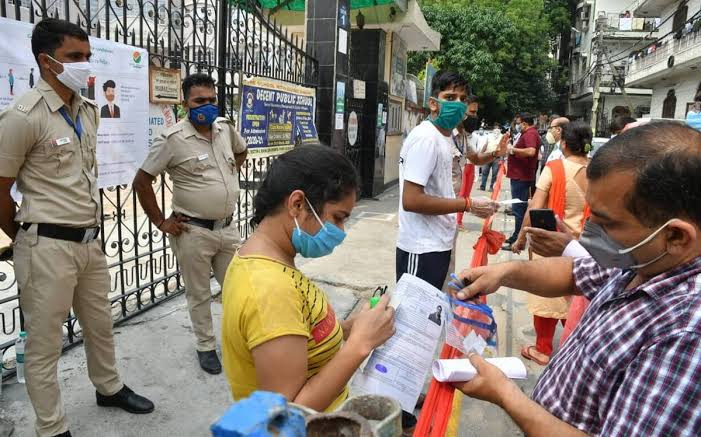
the National Testing Agency, based on random sampling, said that the attendance for the National Eligibility cum Entrance Test-Undergraduate (NEET-UG) stands between 85% to 90% on Sunday. Those candidates who missed the exams after being tested positive for COVID-19 will get another opportunity to sit for the test, the date for which will be announced later.

From this year the admissions to MBBS course in the 13 All India Institute of Medical Sciences (AIIMS), Jawaharlal Institute of Postgraduate Medical Education and Research (JIPMER), Puducherry will also be made through NEET following the amendment in National Medical Commission Act, 2019 passed by the Parliament last year.

In many places NTA also arranged buses and private vehicles to transfer candidates who arrived at the centres assigned to them earlier instead of the changed one.

A total of 15.97 lakh candidates registered for the test this year as against 15.13 lakh in 2019. The attendance in 2019 was 92.9%. Unlike JEE (main), NEET-UG is a pen-paper exam and NTA officials said that it will be able to compile the data on Monday after the centres send feedback after the dispatch of the OMR sheets.

“Based on random sampling the attendance is found to be between 85% to 90%, which is marginally lower than that of last year. The tests have been completed successfully,” said a senior official at the NTA headquarters in Noida.

Union minister of education Ramesh Pokhriyal Nishank while disclosing the figures also thanked states as many of them had arranged transport for the candidates keeping in view the difficulties due to the Covid-19 pandemic.

“NTA informed me that around 85-90% of students appeared in the #NEET exam today. I sincerely thank all Chief Ministers and @DG_NTA for proper arrangements made to facilitate student participation. #NEET participation reflects the tenacity and grit of young #AtmaNirbharBharat, ” Pokhriyal said in a tweet.

He thanked all chief ministers and Director General of National Testing Agency (NTA) Vineet Joshi for proper arrangements made to facilitate student participation.

“NEET participation reflects the tenacity and grit of young,” the Union education minister said.

The NEET attendance figures are higher than the JEE (Main) attendance figure of around 74%. NTA officials have attributed this to the fact that JEE (Main) is held twice every year.

Many students who had already taken the exam in January may have decided to skip the test in September in view of the Covid-19 related concerns.

5 Ways to not lose hope

Do you often feel hopeless and see no light at the end of the tunnel? Well, everybody feels that, at some point of their life. None’s life is perfect, but we should keep thriving to make one. Everybody gets hit by adversity at times, when it becomes difficult to search for the light, but it is only after the storm passes that we become a stronger version of ourselves than ever. Each storm teaches us a lesson to remember and helps us grow as a person. Now, let us explore the five ways through which we can keep our hope alive at the face of adversity.
1) Find support- whenever you feel hopeless and gloomy thinking about your life, or about the things that went wrong, try to talk it out with someone you trust, people who have always supported you and been there through thick and thin. Talking to such people at the time of adversity would help you stay on the right track and their words would give you the much needed strength to fight your fears.They might even help you get your life together.
2) Practice gratitude- Be grateful for what you have achieved so far. Be thankful for the things you have now, which you didn’t had, about a few years back. I am pretty sure you would find ample of things to feel good about yourself and would find a hope to hold on.
3) See the bright side- try to see the bright side of every negative event that might have happened in your life. Consider it as a great life lesson. Learn from your worst experiences and make it a point to never repeat your mistakes twice. The ability to learn from your mistakes would help build your life better and keep your hope alive.
4) Revisit your past- when you feel hopeless just calm your mind, sit with yourself at a quiet place and revisit your past. Try to get back to your past and recall the memories of the difficulties you had faced so far and how you have overcome it, every damn time. This revisiting would thus help you stay strong and would not let you lose hope. Now, your brain would get a positive boost and would try to think about the best possible ways to get you out of your current situation.
5) Everything is temporary- the sooner you realise that nothing is permanent in life, the better you would heal from all the hurt and the bad events that made you feel hopeless. Moreover, just like every night has it’s dawn, similarly every dark days in one’s life brings in bright sunny days later.
So my dear readers, if you have one reason to cry for, today, you would have several other reasons to smile tomorrow. What’s important is never to give up on life and always holding onto hope. Hope is what gets one going right? So no matter what happens, you are strong and brave enough to fight any adversity and most importantly, life donot always go as we plan so all we need to do during such hard circumstances is to keep our eye at the light shimmering at the end of the tunnel. Keep going, have faith in the Almighty and never ever lose hope!

Anushka Sharma on her pregnancy

Bollywood actor Anushka Sharma and Indian cricket team’s captain Virat Kohli are expecting their first child together. Anushka on Sunday took to Instagram to share a photo of herself looking lovingly at her baby bump.Sharing the photo, the actor wrote, “Nothing is more real and humbling than experiencing creation of life in you. When this is not in your control then really what is?

”Virat Kohli and Anushka Sharma are currently in Dubai. While Virat, who is also the captain of IPL team Royal Challengers Bangalore (RCB), is busy with the preparation for IPL, Anushka is enjoying some time off.In a recent interview, Virat spoke about becoming a father. He said, “It is an incredible feeling. It puts things into perspective for you. It is difficult to describe how you feel, but when we found it, we were over the moon. The kind of love that was showered on us when we announced it was amazing. People were genuinely so emotional and happy for us. We are looking forward to the third member joining the clan.

”Actor Anushka Sharma has shared a stunning new picture of herself as she cradles her baby bump. Anushka and her cricketer husband Virat Kohli are expecting their first child together.

The photo shows Anushka at a beach, smiling while caressing her baby bump. “Nothing is more real & humbling than experiencing creation of life in you . When this is not in your control then really what is,” she captioned her post. Commenting on the post, Virat wrote, “My whole world in one frame.”

Durga Puja: Through The Eyes of A Bengali

Durga Puja is a festival of Hindu origin, which is celebrated predominantly in West Bengal, Tripura, Orissa and Assam, within India. Bangladesh also has their fair share of Pujas. It is annual in occurrence and is an integral part of Shaktism tradition, a branch of Hinduism. It is conducted in accordance to the Indian calendar, in the month of Ashwin (begins at sixth day of Ashwin shukla paksha tithi and ends on the tenth of the same) . Ashwin usually corresponds to September or October in the Gregorian calendar. This is a ten day long festival, and the last five days are of greater significance. Durga Puja also coincides with festivals like Navratri and Dussehra, which are of other traditional significance. 

Nostalgia

Mahalaya marks the start of the journey of homecoming or ‘Agomoni’ of Durga Maa to her natal home. On the day of Mahalaya, Bengalis wake up early in the morning and go to see skits or watch Mahalaya special programs on TV or listen to radios. These mediums, on Mahalaya, present acts or songs, which capture the essence of Puja. Infact, some songs can only be equated to the nostalgia of Durga Puja and nothing else. Or, they narrate the story that is associated with the origin of this tradition. This story can be traced back to the Devi Mahatmya, a text which is recited during the Durga Pujas. It is believed that this text was written back in 400-600 CE and was written in Sanskrit. The popular story that goes down from generation to generation says that, ‘There was a demon Mahishasur, whom the Gods or Devatas were unable to defeat. Finally, they sought the advice of the Trinity, Brahma, Vishnu and Shiva. They created and manifested a superpower, whose soul rose from the holy waters of Ganga, and who was crafted by all the Devas together. That manifestation was Devi Durga. She had ten arms, each hand holding a weapon, given to her by different Gods. Armed with all these weapons, she waged a fierce war against Mahishasur and finally killed him on Maha Dashami.’

Get, Set, Puja

The main Puja starts from Maha Shashti. The idols are placed in the selected place and elaborate rituals are done to religiously establish the idols and this marks the beginning of Durga Puja. Pujas can be arranged by a single family or by a community. The community Pujas are done in PAndals, constructed specifically for the Puja. Along with Devi Durga, Laxmi, Saraswati, Ganesh and Kartikeya are also worshipped, as according to Bengali culture, they are Devi Durga’s children. Hence she brings them with her, when she visits her paternal home. Maha Dashami marks the end of her visit and the start of the journey back to Kailash,her husband Lord Shiva’s abode. The idols,which are made of biodegradable substances, are submerged in the water bodies.

For Bengalis, Durga Puja is a very big deal. The preparation and shopping starts from months prior to  the actual festival. Pandals start springing up almost a month before the Puja. Nowadays, pandals and Pratimas (the idols) competitions are a rage. So, all the communities strive to make their ones more innovative and crowd attracting. During Puja, anyone might feel like the whole city has descended on the streets. In the big cities and metropolis, you would be lucky if you get to walk on your own feet. The crowd, usually, does a good job pushing you forward. Various pandals are used to address various social issues. Pendal hoping is a favourite activity of the bengalis during the puja and it can only be seconded by the joy of eating street side food. This is actually a notable difference from the rest of India which celebrates different festivals at the same time, as for most of the food consumed during Durga Puja is non-veg. Many people, infact, eat out on all the Puja days.

Also, youngsters really like to tally how many Pujas they have finished visiting with their friends 

Puja gives everyone just the right environment to flaunt their favourite looks and outfits. No one is too over the top during this festival. Infact, try going out in old clothes, you will surely meet a family resistance. People get materials for their social media posts for a long time with all the pictures taken during puja. Also, going out with friends is met with no resistance during Puja. Another aspect of pandal hopping is that many young ones aspire to find their one true love in these Puja crowds. And if you already have someone, then Puja literally gives a free pass to go out with them, without the usual dose of hide and seek from people. 

That is true for the night life. But during the day, Pandals are filled with people, mostly from the neighbouring areas, who come to take Pushpanjali (offering flowers to Gods). The chants and hymns read during the Pushpanjali gives the true experience of the puja. Saptami, Ashtami and Navami are spent more or less in the same fashion. Bengalis basically don’t sleep on the Navami night.

Dashami Day starts with people, especially students offering prayers and possession to be blessed by all the deities. After that, married women partake in ‘Shidurkhela’, an important ritual of Dashami. Arati and Dhunuchi dance accompanied by Dhak is performed before finally moving the idolout for bishorjon (submerging in water). The processions accompanying the idols to Bishorjon are a sight in itself. Bengalis enjoy these final moments and cherish them forever. And see Durga Maa off, with misty eyes and a promise, 

“Asche bochor abar hobe”

Translation: Next year, this will happen again.

Mutual understanding key to sustaining a marriage

The key to sustaining a marriage is mutual understanding, cooperation and adjustment. For a marriage to succeed, both the husband and wife must be committed to its success. It will not develop on its own accord, but through the concerted effort of the couple.As husband and wife, we should learn to compromise and share, make sacrifices for each other, and always show concern for each other’s needs. We should also hold on to noble values like patience and forbearance. If all these happen, then you could say marriage is like a heaven.

Many relationships have broken up and many marriages have been torn apart, not because they don’t love each other, but because they don’t understand each other.Understanding means being more aware, sensitive and intuitive with the people we love. But understanding isn’t knowledge alone. Knowledge doesn’t always lead to understanding and without understanding, you won’t be able to love someone indefinitely.Understanding is knowing and being able to relate — it’s being able to comprehend the logic behind someone’s actions. It’s more than “getting” someone though.

A marriage based on love and respect doesn’t just happen. Both spouses have to do their part.Talking with your spouse is one of the best ways to keep your marriage healthy and successful. Be honest about what you’re feeling, but be kind and respectful when you communicate. Part of good communication is being a good listener and taking the time to understand what it is your spouse wants and needs from you. Keep the lines of communication open by talking often, and not just about things like bills and the kids. Share your thoughts and feelings.Appreciate each other, your relationship, your family, and your lives together. Show gratitude when your partner cooks dinner, helps the kids with their homework, or does the grocery shopping. It may help to take a few minutes each evening to tell each other at least one thing you appreciated that day.With work and family responsibilities, it can be easy to lose the romance factor. Plan special dates, either to go out or just stay at home. If you have children, send them on a play date while you relax, talk, and enjoy each other’s company.Alone time is just as important as couple time. Everyone needs time to recharge, think, and enjoy personal interests. That time is often lost when you’re married, especially if you have kids. Go out with friends, take a class, or do volunteer work, whatever you find enriching. When you’re back together with your spouse, you’ll appreciate each other even more.Everyone makes mistakes. Your spouse may hurt your feelings or do something that upsets you, and that may make you angry, even furious. But it’s important to deal with your feelings, let them go, and move on. don’t keep bringing up the past.

Remember to remain committed to your spouse, your family, and the life that you have built together. Support each other emotionally and in everyday ways. You, your spouse, and your relationship may grow and change with time, but these ideas can help your marriage stay successful over the years.

The painful reality is love is just not enough. I work ever day at better understanding the people whom I love. The willingness to understand is very important. It is not always easy, but healthy love is strengthened by the willingness to understand. “Love without understanding will wilt like flowers without water”.

So,please live a happy marriage life ,understand your partner problems ,issues and worries .Because without doing this you don’t have a successful marriage .

THANK U

Jallianwala Bagh Massacre

On the 13th April 1919, Acting Brigadier-General Reginald Dyer ordered troops from the British Indian Army to aim their weapons at the croweds of unwieldy Indian civilians at Jallianwala Bagh, Amritsar, Punjab and kill 379 individuals and harm more than 1,200 others, the Jallianwala massacre was also known as the Amritsar massacre.

Dyer, who was encouraged to have a major revolt, banned all meetings on Sunday 13 April 1919. The notice wasn’t widely disseminated and many villagers in Satyapal and Saifuddin Kitchlew gathered in Bagh to hold the important Indian Baisakhi Festival and to protest peacefully the arrest and deportation of two national leaders. Dyer and his soldiers entered the garden and locked their main entry, stood on a raised bank and fired at the crowd for about ten minutes without notice, aiming their bullets mostly to the few open doors, through which people tried to escape until the supply of ammunition was nearly depleted. On the next day Dyer proclaimed in a paper “I heard about the killing of between 200 and 300 people”.

In the following year the government of India released the Hunter Committee report condemning both Dyer and the Punjab administration for not having collected an accurate count of casualties and quoted 379 dead and approximately 1,200 wounded, including 192 serious wounded, provided by Sewa Samati. The statistics were reported by the Commission. More than 1,500 casualties, nearly 1,000 of them dead, were estimated by the Indian National Congress.

He was commended by some in Britain for his exploits and became a hero of many people, including Members of the House of Lords, who directly benefited from the British Raj. However, in the House of Commons, which was censured by its investigating committee in July 1920 he was strongly condemned and attacked. He couldn’t be charged for killing because he was a soldier working on orders. The military agreed not to send him to court, and his only penalty was to be suspended from his current appointment, refused the promotion of him, and forbidden further jobs in India. Dyer then withdrew from the army and moved back to England, where he died.

Both British and Indian populations were divided by responses. Rudyard Kipling, the eminent author of the novel, proclaimed that Dyer “went as far as he saw it.” This shocked him so much that he surrendered his knighthood and proclaimed “these mass-murderers do not deserve any title.” This was the first Indian and Asian Nobel laureate Rabindranath Tagore.

Although British intervention in the Mau Mau rebels in Kenya later led historian Huw Bennett to note that the new strategy has not always been carried out, this massacre has resulted in reassessment of its military position against civilians to a minimum. The army was retrained and less aggressive crowd control tactics developed.

The degree of casual violence and lack of responsibility shocked the whole country, causing the general Indian people’s loss of confidence in UK intentions. This unsuccessful investigation, together with Dyer ‘s initial recognition, fostered widespread outrage among the Indian population towards the British, leading to the 1920–22 Non-cooperation Movement. Some historians regard the episode as an significant step towards the end of British Indian rule.

The UK never officially apologised but expressed “regrets” in 2019 for the shooting.

Kappalotiya tamizhan-The tamil Helmsman

Vallinayagan Ulaganathan Chidambaram (5 September 1872 – 18 November 1936), popularly known by his initials, V.O.C. (spelled வ.உ.சி in Tamil), also known as Kappalottiya Tamizhan “The Tamil Helmsman”, was an Indian freedom fighter and leader of Indian National Congress. Founder of Swadeshi Steam Navigation Company in 1906 to compete against the monopoly of the British India Steam Navigation Company (BISNC) He launched the first indigenous Indian shipping service between Tuticorin and Colombo with the Swadeshi Steam Navigation Company, competing against British ships. Tuticorin Port Trust, one of India’s thirteen major ports, is named after him. At one time a member of the Indian National Congress, he was later charged with sedition by the British government and sentenced to life imprisonment, and his barrister license was revoked.

V. O. Chidambaram Pillai was born on 5 September 1872 in a vellalar family in Ottapidaram, Tuticorin District to Ulaganathan Pillai and Paramayee Ammal. When Chidambaram was six years old, he learned Tamil from teacher Veeraperumal Annavi. He heard stories about Shiva from his grandmother and stories from the Ramayana from his grandfather. He heard stories from Mahabharatha told by Allikulam Subramanya Pillai. As a child, he played goli (mkarbles), kabaddi, horse riding, swimming, stilt walking, archery, wrestling, silambattam and chess.

He learned English from a Taluk officer named Krishnan in the evenings. When Krishnan was transferred, Chidambaram’s father built a school with the help of villagers and appointed Aramvalarthanatha Pillai from Ettayapuram as the English teacher. The school was run by a priest at Pudhiamuthur. At fourteen, Chidambaram went to Thoothukudi to continue his studies. He studied at CEOA High School and Caldwell High School and in Thoothukudi at the Hindu College High School, Tirunelveli.

Chidambaram worked as Taluk office clerk for some time before his father sent him to Tiruchirappalli to study law. He passed his pleadership exam in 1894, returning to Ottapidaram to become a pleader in 1895.

In Chennai, Chidambaram met Swami Ramakrishnananda, a saint who belonged to Swami Vivekananda Ashram (monastery), who advised him to “do something for the nation”. Here he met the Tamil poet Bharathiyaar who shared his political ideology. The two men became close friends.In the 1890s and 1900s India’s independence movement and the Swadeshi movement, which confirms the politic parcel initiated by Bal Gangadhar Tilak and Lala Lajpat Rai of the Indian National Congress (INC), were at their peak. From 1892 Chidambaram was influenced by Tilak Maharaj and became his disciple. Along with Subramanya Siva and Subramanya Bharathi, he became a prominent spokesperson for the cause in the Madras Presidency. Following the partition of Bengal in 1905, Chidambaram entered politics, joining the Indian National Congress and taking a hardliner stance. He also presided at the Salem District Congress session.

Chidambaram moved to Kovilpatti and practiced as a lawyer. He rejoined the Congress party in 1927 and presided over the third political conference held at Salem. He said that he wanted to join Congress again because he noticed a remarkable change in the policies of Congress and was happy to note that the policies of which he did not approve were withdrawn one by one. However, after the Salem conference Chidambaram again severed his contact with Congress.

In 1929 he moved to Thoothukudi, where he spent his time writing and publishing Tamil books. By 1935, he had written commentary on the first book of the Tirukkural (Book of Virtue) and was published under a different title. However, it was only in 2008 that the complete work of his commentary on the Kural was published.

If you are interested check out the part two here.