PM to dedicate to the nation three key projects related to the Petroleum sector in Bihar on 13th September

Prime Minister Shri Narendra Modi will dedicate to the nation three key projects related to the Petroleum sector in Bihar on 13th September, via video conferencing. The projects include the Durgapur-Banka section of the Paradip-Haldia-Durgapur Pipeline Augmentation Project and two LPG Bottling Plants. They have been commissioned by IndianOil and HPCL, PSUs under the aegis of the Ministry of Petroleum and Natural Gas.

Chief Minister of Bihar will also be present on the occasion.

Durgapur-Banka section of the Pipeline Project

The 193 km long Durgapur-Banka pipeline section, built by IndianOil, is a part of the Paradip-Haldia-Durgapur Pipeline Augmentation Project, for which the foundation stone was laid by the Prime Minister on 17th February 2019. Durgapur-Banka section is the extension of the existing 679 Km long Paradip-Haldia-Durgapur LPG pipeline to the new LPG bottling plant at Banka in Bihar. The pipeline of 14” diameter passes through three states viz. West Bengal (60 km), Jharkhand (98 km), and Bihar (35 km). Presently, LPG injection can be made in the pipeline system from Paradip Refinery, Haldia Refinery, and IPPL Haldia. On completion of the whole project, the LPG injection facility will also be available from the Paradip Import terminal and Barauni refinery.

Laying of the pipeline under Durgapur-Banka Section required crossing several natural and manmade hurdles. A total of 154 crossings were bridged including 13 rivers (one of them being the Ajay river of 1077 m length), 5 national highways, and 3 railway crossings. The pipeline was laid under the riverbeds through state-of-the-art Horizontal Directional Drilling technique without disturbing the water flow.

LPG Bottling Plant at Banka, Bihar

IndianOil’s LPG Bottling Plant at Banka will increase the ‘AtmaNirbharta’ of Bihar by meeting the rising demand for LPG in the state. This Bottling Plant has been built at an investment of around Rs 131.75 crore to serve the districts of Bhagalpur, Banka, Jamui, Araria, Kishanganj & Katihar in Bihar, along with the districts of Godda, Deoghar, Dumka, Sahibganj, and Pakur in Jharkhand. With the LPG storage capacity of 1800 MTs and bottling capacity of 40,000 cylinders per day, this plant would generate direct and indirect employment opportunities in the state of Bihar.

LPG Plant at Champaran(Harsidhi), Bihar

HPCL’s 120 TMTPA LPG Bottling Plant has been constructed at Harsidhi in East Champaran district for Rs. 136.4 crores. This plant has been constructed on 29 acres of land and its Foundation stone was laid by the Prime Minister on 10th April 2018. The bottling plant will cater to the LPG requirement of East Champaran, West Champaran, Muzaffarpur, Siwan, Gopalganj & Sitamarhi districts in Bihar.

The event will be telecast Live on DD News.

JEE Main 2020 Results: 24 applicants scores 100 percentile

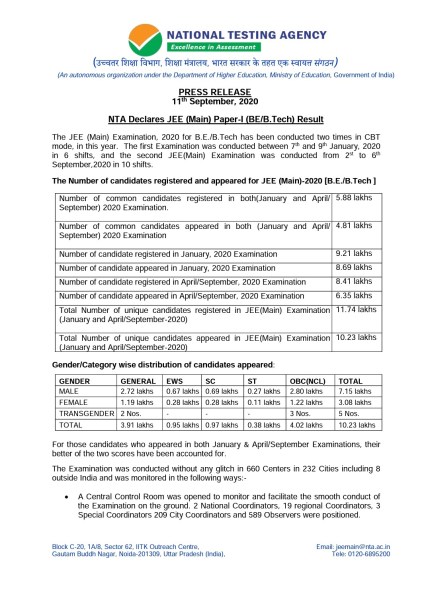
National Testing Agency (NTA) has declared the NTA JEE Main result 2020 at jeemain.nta.nic.in. The JEE Main 2020 result latest news shows 24 candidates have scored 100 percentile in JEE Main 2020 result.

The website may have gone down due to heavy traffic, students may wait for a while and then check their JEE Main 2020 results.

The Union Education minister Ramesh Pokhriyal on Wednesday said that out of the 8.58 lakh candidates who had registered for the JEE (Main) exam, 6.35 lakh candidates appeared in the examination. Over 8 lakh students had appeared in the JEE Main 2020 examination amid the COVID-19 pandemic.

 Students, parents and Opposition leaders had protested strongly demanding the postponement of the exam. But the government did not pay heed to their requests. Instead it issued strict guidelines for the appearing students and invigilators at the exam centre and conducted the entrance tests.

At the time of going to print, the National Testing Agency, which conducts the examination, had not yet released the full all-India rank list or the cut-off score for eligibility to attempt the JEE Advanced to be held on September 27. Students can check their scores and the final answer keys at jeemain.nta.nic.in.

For September, the number of students who have scored 100 is 15. State wise break up for the numbers is Telangana with 8 followed by Delhi with 5 students. 2 students from Haryana and 1 student each from Gujarat and Maharashtra scored 100 percentile. Rajasthan has 4 toppers and Andhra Pradesh has 3 students who scored 100 percentile. Along with the 100 percentilers, NTA would also be releasing the state wise list of toppers.

 The complete list of toppers would be provided shortly along with the JEE Main 2020 Rank list on the official site as well. In January, 9 students had scored 100 percentile. The complete list of toppers would be provided shortly along with the JEE Main 2020 Rank list on the official site as well. The score card of the candidates would be released online on jeemain.nta.nic.in. As many as 2.5 lakh students would qualify to appear for JEE Advanced 2020 or IIT JEE examination, scheduled for September 27. 

1. Landa Jitendra – Andhra Pradesh

2. Thadavarthi Vishnu Sri Sai Sankar – Andhra Pradesh

3. Y S S Narasimha Naidu – Andhra Pradesh

4. Chirag Falor- Delhi

5. Gurkirat Singh -Delhi

6. Laksh Gupta -Delhi

7. Nishant Agarwal- Delhi

8. Tushar Sethi – Delhi

9. Nisarg Chadha – Gujarat

10. Divyanshu Agarwal - Haryana

11. Harshvardhan Agarwal – Haryana

12. Swayam Shashank Chube- Maharashtra

13. Akhil Agrawal- Rajasthan

14. Akhil Jain — Rajasthan

15. Parth Dwivedi — Rajasthan

16. R Muhender Raj- Rajasthan

17. Chagari Koushal Kumar Reddy – Telangana

18. Deeti Yeshash Chandra – Telangana

19. Chukka Tanuja — Telangana

20. Morreddigari Likhith Reddy — Telangana

21. Rachapalle Shashank Anirudh – Telangana

22. Rongala Arun Siddardha – Telangana

23. Shiva Krishna Sagi — Telangana

24. Vadapalli Arvind Narasimha — Telangana

Steps to check Results

  • Visit the official website at jeemain.nta.nic.in
  • click on the link that reads, “JEE Mains 2020 results”
  • A new window page will display in screen
  • Login by entering your details
  • The JEE Mains 2020 will be displayed on the screen
  • And now you can download the results and take its print out too.

Optimism – The need of the hour

https://depositphotos.com/

   Optimism is defined as “a mental attitude reflecting a belief or hope that the outcome of some specific endeavor, or outcomes in general, will be positive, favorable, and desirable” by Wikipedia. I bet not many of us lead a smooth comfortable life, this is when one is put into test. Maintaining mental stability, putting a pause to all overthinking & most of all, thinking for the brighter side of things, is what optimism basically means. So a ray of hope Or even imagining the better times or opportunities is also an optimum drive to cheer one up in the faces of troubles. 

    A true optimist is believed to never give way easily to despair or psychological pain. On the contrary, a pessimist is defined as someone who looks at the negative & gloomy side of life or things. Thus a pessimist may lose interest from humane values and rather indulge in immoral & cruel acts. This may eventually lead to overpowering one’s mind to inculcate all negative qualities than the positives. 

   Also, lack of optimism or upon completely losing faith from it may compel one to be cynical & disinterested in life. And a severe form of pessimism may cause one to overload the brain with mental depression. This is often a key reason why people commit suicide. To most of us, the Sushant Singh Rajput suicide case clings at the back of our mind. True, the country did lose an exceptionally talented, young & bright actor. Watta pity! 

   Most of us are quite aware of this widely known idiom, “When life hands you lemons, make lemonade.” Mostly it’s used to encourage optimism in the face of adversity or misfortune. The literal meaning relates to when life hands you lemons that are sour in taste, signifying difficulties in life; rather make lemonade out of it that depicts positivity in life. 

https://depositphotos.com/

  One may also deduce it as, when life hands you lemons, rather than cribbing about the situation or fate, look out for ways & means to turn it to your advantage. As it is rightly said, “When one door shuts, another opens.” It isn’t always necessary that solutions shall be readily available served right on your plate. So one just needs to scavenge for ways at times & do the needful. 

    Not all optimists are of the same type. So let’s explore the different kinds of optimists here :

 ‌Dispositional optimism: Also known as the “big optimism”, is an expectation that more good shall happen than bad in the future. 

 ‌Strategic optimism: This involves one denying risks because he believes to have control over the situation. 

 ‌Unrealistic optimism: Can also be termed as “impractical optimism”, is when the positive expectations don’t match with the actual evidence. 

 ‌Comparative optimism: It’s expecting good things for oneself compared to others. 

 ‌Realistic optimism: Also known as “practical optimism”, is when one keeps a positive outlook even in the constraints of the world.

 ‌Situational optimism: This refers to the expectation of a positive outcome in a specific situation. 

    The most common theory used to illustrate the concept of pessimism vs optimism is a glass half filled with water. An optimist will observe the glass as half full, while a pessimist shall see it as half empty. It is simply the difference of perspective of a person that a situation is viewed differently. 

India – China to “Disengage” mutually on Border issues

India and China have agreed to “quickly disengage” from a standoff that has seen gunfire at a disputed border and accusations of kidnapping. Their foreign ministers met on Thursday and said they would ease tensions.

In a joint statement, the neighbours said the “current situation is not in the interest of either side”.

“They agreed, therefore, that the border troops of both sides should continue their dialogue, quickly disengage, maintain proper distance and ease tensions,” said the statement, released by Indian Foreign Minister S Jaishankar and his Chinese counterpart Wang Yi.

Both sides have accused each other of straying into their territory, and the clashes have sometimes turned deadly. Soldiers from both countries have periodically skirmished along the poorly demarcated border, called the Line of Actual Control. It is understood that the military commanders’ meeting in the next few days will chalk out steps of disengagement more clearly, which the Foreign Ministers will review before deciding on the course ahead. 

The five points agreed to are a template for the “principles of disengagement”, said a senior official privy to the meeting, but large divergences still remain in the positions taken by both sides. Both Ministers had a frank and constructive discussion on the developments in the India-China border areas as well as on India-China relations and agreed as follows:

1. The two Ministers agreed that both sides should take guidance from the series of consensus of the leaders on developing India-China relations, including not allowing differences to become disputes.

2. The two Foreign Ministers agreed that the current situation in the border areas is not in the interest of either side. They agreed therefore that the border troops of both sides should continue their dialogue, quickly disengage, maintain proper distance and ease tensions.

3. The two Ministers agreed that both sides shall abide by all the existing agreements and protocol on China-India boundary affairs, maintain peace and tranquillity in the border areas and avoid any action that could escalate matters.

4. The two sides also agreed to continue to have dialogue and communication through the Special Representative mechanism on the India-China boundary question. They also agreed in this context that the Working Mechanism for Consultation and Coordination on India-China border affairs (WMCC), should also continue its meetings.


5. The Ministers agreed that as the situation eases, the two sides should expedite work to conclude new Confidence Building Measures to maintain and enhance peace and tranquillity in the border areas

According to the Chinese press release, state councillor Wang said that bilateral relations between the two Asian neighbours “have once again come to a crossroads”. “But (he added) as long as the two sides keep moving the relationship in the right direction, there will be no difficulty or challenge that can’t be overcome.”
Jaishankar told his Chinese counterpart that India remained concerned at the massing of Chinese troops at the LAC, which was not in accordance with the 1993 and 1996 agreements. There has been “no credible explanation for this deployment”, which the minister said has created flash points along the LAC.

The Indian side said that the Chinese front line troops’ “provocative behaviour” at the various stand-off points showed disregard for border pacts and protocols.

10th September- World Suicide Prevention Day!

\

How difficult it is for a family who loses a loved one to bear the loss ? How painful it is for a friend to lose another? How devastating it is for a parent to cry over a child loss? UNIMAGINABLE. You can never know how much it aches to lose a piece of life and that to when you know that it was a “suicide”. When you come to know that someone close to you was tired of his life and you could just not predict that. You would crave to go back to them and ask them WHY did they do so . WHY this step? BUT,it would be too LATE till then. You would have to live with a regret then, that had you questioned this before you could save A LIFE.

Every day and evry year we come across news of suicides happening. From a CEO to a farmer, we had heard it all. Because when the mind is upset,no status matters. The pain and the frustration one feels is identical. But,since the topic suggests “PREVENTION” how can we contribute in the same ? How can we stop ourselves from regrets? How can we stop somebody from commiting a suicide ? Or how can we make someone feel lively again?

There are a lot of things we can do. We just need to get serious and committed about it. We need to stop taking things and people as a joke. Especially,what they speak. Because nobody speaks anything without a reason.If you are talking to somebody and they talk to you seriously about them getting tired of their life or how they can not just handle what is happening to them. STOP THERE,AND LISTEN. Listen to what one is saying maybe you can help them cope maybe you can help them heal . DO NOT JOKE AND IGNORE THE SAME. Maybe you will never be able to forgive yourself later.

There has to be an awareness about the serious effects one can have on their mental health.Aware people around you.Aware people who do not know about the seriousness about the matter.

Never discourage or talk pessimistic to a person who is already talking sad things. Always encourage them and tell them everything will be fine. Tell them about positives of life. Distract them from taking wrong decisions.

Do every part you can. Spread smiles everywhere you can 🙂

Leading the Way: K.K. Shailaja, Torchbearer of COVID-19 Containment in India

COVID-19 is on a roll across the whole country. With an alarming increase in the number of cases per day, Central and State governments are employing all possible measures so as to curb the spread of this virus, and parallely, to restore normalcy in the life of the general public. Amongst all the people fighting against COVID, directly or other-wise, one name stands out, K.K. Shailaja, Health and Social Welfare Minister of Kerala. With her critical thinking, timely actions and reasonable yet effective techniques to identify and contain the spread of the virus, K.K.Shailaja had flattened Kerala’s case growth curve at the time where there was an exponential increase in the number of cases across the country. 

Life At A Glance

K.K. Shailaja, also known as Shailaja Teacher hails from Kannur district of Kerala and was born on 20th November, 1956. She completed her Bachelor in Science (B.Sc.) from Pazhassi Raja N.S.S College, Mattanur and achieved a degree in Bachelors in Education (B.Ed) from Visvesvarayya College in 1980. Then, she was in service for seven years as a Science teacher at Shivapuram High School, Kannur. She retired in 2004 to pursue a full fledged political career.

Students Federation of India (SFI) paved the entry of K.K. Shailaja in the politics. She represented Koothuparamba and Peravoor constituencies in Kerala Legislative Assembly in the years 1996 and 2006 respectively. She is a CPI (M) Central Committee Member and also the Janadhipathya Mahila Association State Secretary and also its Joint Secretary in the Central Committee. In Pinarayi Vijayan government, she is serving as minister of Health and Social Welfare. 

Apart from all these, she is the secretary of All India Mahila Association. She had graced the Chief Editor’s post of ‘Sthree Sabdam’ and  also has authored two books, ‘Indian Varthamanam Sthreesamoohavum’ and ‘China- Rashtram, Rashteeyam,Kazhchakal’.

Tackling The Crisis

K.K. Shailaja has established a model structure for COVID containment by stringently implementing and following guidelines regarding testing and treatment. These included a strict contact-and-trace program, rapidly equipping for the patients by setting aside 2 hospitals and 500 beds in medical colleges per district, and planned diagnosis on the basis of symptoms and vulnerability. She kept a transparent process by having daily press briefings to inform the masses about the prevailing situations and the measures taken. She also had taken care of the appropriate arrangements for the migrants, those who were stuck in Kerala during the lock-down. Widespread rapid testing has also been done by the Kerala government. In an interview, she had revealed that being vigilant and proactive had helped to hold down the number of cases in the initial phase. 

The surge in number of the cases due to the influx of migrant citizens returning in the state is being taken care of. On the same page, measures are being taken so that medical professionals can be provided with some rest. Psychological and emotional counselling is also being provided by the government, over phone, for the elder people,individuals under home quarantine and those who are in need of it.

She has also tackled the 2018 Nipah virus outbreak in Kerala with fast diagnosis and equipped medical response. She was widely lauded for her extremely efficient manner and management. 

Applauds and Accolades

K.K Shailaja has been widely recognized, nationally and internationally, for her contribution in handling the COVID crisis in Kerala. Most recently, she has won the title of ‘Top Thinker’, which has been bestowed by the British Magazine ‘Prospect’. She has achieved this title by defeating Jacinda Ardern, Prime Minister of New Zealand. Apart from that, she had also been invited by the UN to take part in a panel discussion on June 23rd, 2020.BBC news has featured her in the list of Asian women Corona fighters, The Guardian and Vogue had also featured and mentioned  her in their print media.  

Website referred

https://en.wikipedia.org/wiki/K._K._Shailaja

https://minister-health.kerala.gov.in/about/

TRAVELLING: A MEDICINE FOR SOUL.

As you travel you’re revealed to more new spirits, arts, and lifestyles than you are living in your hometown all the time. Amidst all the uniqueness in your lifetime, means of comprehending nature, and sustenance, which provides people a new purpose for their lives. If you feel like you are puzzled about what your goal is, what you aspire to do with your life, the profession, or the collegiate path you want to proceed, go explore! You might just be bewildered regarding what you learn as an innovative thought of life meaning and objective.

Travelling will surely make you extra self-sufficient and bold. You will recognize your skills in tackling unexpected situations. You will apprehend that you can sustain without any help. You will realize that you are much tougher and more courageous than you have expected. Traveling more will have great importance on your mental health, particularly if you’re not used to moving out of the comfort zone if you travel, you can encounter things that you could never endure at home. You may see magnificent sites and sceneries that you may not have seen where you live. You can try activities that you have never undertaken previously.

You may learn a lot of useful things. Tasting local cuisine in a different country is a new experience. All the flavors are diverse. By traveling solo you can easily make friends. Every destination you go to, every person you meet, and every sight seen creates exceptional memories. It’s the encounters you go through which enables you to skip everyday life and enfold nature, the capitals, or the people around you. But there are certain disadvantages too like there are fund issues to travel and not everybody requires to be a moneybag to see the world but at times commuting prices can sum up suddenly. This is very precise if you visit during peak season or an extravagant destination, such as France or New York.

Countries all over the earth have languages and dialects which their people are accustomed to. So no matter wherever you visit, unless you’re a language wizard, you’re going to run into a people and undergo a language restriction. Everybody will at a point miss their home. Be it a trip or a tried distraction from your everyday life, there will be a time where an awful feeling takes over and will make you desire to go home. Now in the pandemic were people are just waiting for the situation to get better are yearning for getting out of the house. So hopefully when the condition gets better, go and travel because we all deserve it.

A two-day Conclave on ‘School Education in 21st Century’ concludes with a commitment to take New Education Policy 2020 forward

A two-day Conclave on “School Education in 21st Century” organised by Ministry of Education as part of Shikshak Parv 2020 concludes today with a commitment to take New Education Policy 2020 forward.  Prime Minister Shri Narendra Modi addressed the Conclave under the National Education Policy- 2020 (NEP-2020) at 11 AM today through video conferencing. Union Minister for Education Shri Ramesh Pokhriyal; Union Minister of State for Education, Shri Sanjay Dhotre; Secretary, Department of Higher Education, Shri Amit Khare, Secretary, Department of School Education and Literacy Smt Anita Karwal also participated in the event. After the Prime Minister’s address to the participants, Smt Anita Karwal gave a detailed presentation on implementation of New Education Policy 2020 relating to School Education.

Later in the day, the discussions were held in four technical sessions on various subjects of New Education Policy 2020 by the experts.

The first technical session started with a discussion on the subject of ‘Promotion of Indian Languages’ held from 1215 hrs today. The Session was coordinated by Dr. Shakeela T. Shamsu, OSD (New Education Policy draft Commitee), Department of Higher Education. The two speakers were Dr. Dhir Jhingran, Founder Director of Language & Learning Foundation and Prof. D.G. Rao, Director (in-charge), CIIL Mysore.

The speakers made the following points:

  • The New National Education Policy provides for promotion of Indian languages through regular use, preparation of pedagogical material, training of teachers, adoption of mother tongue as medium of instructions, etc. It particularly stresses on home languages. NEP also focuses on the promotion of all languages and mother tongue.
  • Implementation of Foundational Literacy and Numeracy requires language comprehensions.  It must include children’s language.
  • 25% of students suffers learning disadvantage because of gap in the home language and the school language. Most sufferers are from Tribal Areas, boarder areas, children of migrant labourers and children who study through English medium but have no exposer to English at home or otherwise.
  • Mapping of languages is necessary.
  • Create multilingual awareness
  • Begin including children’s home language in teacher and learning in oral domain
  • Create children’s material in local languages
  • Teacher recruitment or deployment of teachers to a particular area may be linked to the local language of that area. Teacher Education Courses should emphasize on language skills.

The discussion on the subject ‘Holistic Progress Card’ was held from 1400 hrs today. Dr. Shakeela T. Shamsu chaired the session and Dr. Anju Kauwr Chazot and Dr. Ameeta M. Wattal, Principal, Springdales School, Pusa Road, New Delhi were the speaker for the session.

Dr. Shakeela T. Shamsu welcomed all the participants and mentioned first principle of the New Education Policy to develop good human beings capable of rational thought and action, possessing compassion and empathy, courage and resilience, scientific temper and creative imagination, with sound ethical moorings and values. Recognizing, identifying, and fostering the unique capabilities of each student and mapping appropriately is key to holistic development. She told that Holistic Progress card is basically emanating from the principle combined with the principle of the integrated curriculum, experiential learning pedagogy and assessment which needs to move away from formative assessment.

Dr.Anju Kauwr Chazot made a presentation on Holistic Report Card and started with idea of Ahimsa in assessment and mentions need of paradigm changes in Holistic Report Card. She described interdisciplinary assessment which includes Humanities, Design Technology, Arts & Language and also mentioned about inter-disciplinary tasks comprising of Sciences and Physical Education (Sports). She explained that learners should be evaluated by self, their peers, parents and initiators (i.e. teachers). To bring the learners voice into the assessment, the colonial model of education which is based on control supervision and subjugation of a population needs to be change. She told that children have to learn two things- how to give feedback to another child and also how to receive feedback in a constructive manner. This will prepare students for ethical and value based learning.

Dr. Ameeta M. Wattal made a presentation on Holistic Report Card. She explained on aspects of holistic report card which includes equitable, inclusive, joyful, holistic and diverse knowledge. She told that National Education Policy is not about reforming but about transforming. She mentioned attributes of a progress card and the 4D framework for the whole child, which includes knowledge, skills and character. She also described the experiential learning and the core concepts which includes literacy, numeracy, ICT, capability, critical & creative thinking, ethical understanding and indigenous understanding. At last she explained indicators of Holistic Report Card which contains research, thinking, initiator, exploration, experimenting, curiosity, adaptability and balance.

The discussion on the subject ‘Early Childhood Care and Education’ was held at1500 hrs today. The session was moderated by Prof. M. K. Sridhar, Member of Drafting Committee of NEP. During the session two speakers –Dr. Venita Kaul, Ambedkar University and Prof. Suniti Sanwal, NCERT spoke about the subject based on their research and profound experiences.

Speakers highlighted that the impact of early learning, socialisation and school readiness experiences in preschool settings on educational and behavioural outcomes along the primary stages was explained. Based on research experiences, emphasis was given on developing all dimensions of school readiness among children and a strong linkage was highlighted between ECCE and foundational years of education in the life of an individual. In a comprehensive manner, presenters talked about the role of activity, joyful, playful and discovery based pedagogy to be used in the set-up of pre-school education. Quoting the New Education Policy 2020, importance of strong communication between all stakeholders was also elaborated.

The stages of all round development of children in early years and set of skills for development stages were also spoken about. NCERT informed that Pre-school Education Guidelines and Curriculum have been developed by them. To provide an effective and quality based ECCE to children importance of strong convergence between all stakeholders was emphasis.

The discussion on the subject ‘No Hard Separation’ was held at1600 hrs today. The Session was coordinated by Shri Manoj Ahuja, Chairperson, CBSE. The two speakers were Prof Manjul Bhargava, Member, Draft NEP Committee and Dr. Chand Kiran Saluja, Retd. Prof. CIE, Delhi University.

The speakers made the following points:

  • NEP provides for multidisciplinary, holistic development of children without any barriers and boundaries of streams, subjects, choices, etc. There is no hard separation in subject study, curricular, co-curricular, extra-curricular, vocational and academic streams, etc.
  • The holistic development or education prepares us for facing the different challenges throughout the life.
  • Creativity and technical knowhow needed together to excel in life.
  • Multidisciplinary and holistic education is the need of the hour.
  • Flexibility is the fundamental principle of the NEP 2020 and every chapter of the NEP attempts to eliminate or remove separation.
  • Integration and coordination is the basis of the holistic development.
  • Ensures the unity and integrity of all knowledge and eliminates harmful hierarchies among different areas of learning.
  • Integrates pre-schools (Aganwadies) to Higher Education.
  • Promotes creativity and critical thinking, multilingualism and power of language, life skills, etc.
  • NEP is based on full equity and inclusion. It encourages innovation and out of the box ideas through autonomy, good governance and empowerment.
  • NEP empowers students through flexibility in choice of subjects. It advocates identification of hidden talent in every child.


Centre exhorts the North Eastern States to actively break the Chain of Transmission

Union Health Secretary held a video conference (VC) today to review the COVID management strategies and actions taken in the eight North Eastern States. The VC was attended by the Principal Secretaries, Health Secretaries and other State representatives from Arunachal Pradesh, Assam, Manipur, Mizoram, Meghalaya, Nagaland, Tripura and Sikkim. These 8 North Eastern States together account for less than 5% of the total active cases in the country.

With active cases numbering 29,690 (as on date), Assam is presently constituting 68% share in the total active caseload of these eight North Eastern States. Tripura has 7,383 active cases and occupies the second place with 17% of the total active caseload of these States.

A snapshot of the total confirmed cases and the active caseload in these States is tabulated below:

Things To Keep You Going When You Are Stressed At Work

‘Life is 10% what happens to you and 90% how you react to it.’- Charles Swindoll.

I remember working during the online classes now-days-days. Working from home has because a stress factor for me during these days. You have send four to five hours of your day in zoom meetings and submit a tons of assignment within a particular time.  Half of day is spent online due to classes. You get the picture, right?

But unfortunately, after the tiresome day, I do not get time to find time for myself or neither I can spend the weekends or weekdays.

It has become impossible for me to give my undivided attention online and I feel stressed all the time. No forms of refreshment are there during these days. Sitting in front of laptop and mobile phones have become a daily part of our life. Many problems are occurring due this, sleeplessness, eye-itching etc.

A nonstop busyness surrounded me and I was losing myself in this digital world. So I decided to take out some time for me because I need fresh air and oxygen to live. My emotions were almost gone and I am becoming stone-hearted person. Emotions are melting too.

Let us scroll down to look at the 4 factors that kept me going during this stressed period:

  1. Control your thoughts: We can control our thoughts. When we are surrounded by negativity, we must try to do positive things and bring positive thoughts in our mind. From ‘what I am doing’ to ‘what can I do’ must be the mind set during these times. It will help to gear our positive thoughts and absorb the negative thoughts.
  2. Meditation for the peace of mind: We must spend time in doing meditation for the peace of mind. It is very helpful because it helps to reduce the stress factor and it prepares the mind for the day. It helps us to cope up with the rest of the day and work.
  3.  Get charged up: Before stepping into any work get yourself charged up. You can listen to your favourite songs. This keeps your mind fresh. This can also be the song that you can play in your laptop or desk to keep you charge. Two of my songs that keeps me charged are ‘Give me some sunshine’ and ‘My heart will go on’.
  4. Accept what it is:  You have to accept the things that you cannot control. It will save your energy. It will help you to concentrate on the things that is in your own hand. You will end your day with happiness.

When you find yourself in a situation, where you are not able to work properly or just cannot accept the stress, it is better for you to leave the job and find another possible job where you can work on your own choice and your stress level will be at controlled. It is the time for change. Your response to these kinds of tough situations can also motivate others and help others.

Horrible Job I Hate Might Just Change My Life

‘What you do today can improve all your tomorrows.’- Ralph Marston.

Before coming to university, I worked as social worker in the Presidency Correctional Home in Kolkata.  I hated that thing. Working with the criminals? Am I really made for that? These are questions that came into my mind.

Seriously I have to work with criminals. My life was at stake. I was terribly upset with this. It totally sucked.

First day when I went there, I saw prisoners in a terrible condition. They were like searching for a moment of peace and light. Spending a lot of my time, I gained with conclusion, criminals are not born but they are made due to certain shortage of their life. I was empathising with themselves. A feeling was gratitude was coming from within.

Let’s be honest. What do we really understand by criminals? We only know that they are bound by law due to their criminal activities. They are put behind the bars just because law has proved them to be guilt. A stigma gets attached to these people. I really got the opportunity to know them.

That day, I realized that God has a bigger plan for me and that very moment I thanked God, and said Oh My God that is why you have chosen me.

It taught me how to be compassionate towards the people, work with criminals, even in their difficult times. They become lonely, angry, disturbed and how I have to control them to bring peace in their mind, it had taught me. This work taught me that there will be haters, there will be naysayers, there will be disbelievers, and then there will be YOU, proving them wrong. Truly, God’s plans are bigger than your plans for yourself.

I never thought that the job or the work that I hated too much will one day become my main priority. It changed my life completely. The definition of life has changed in my dictionary. 

If you think that your life is hard and you are giving up on that because you think your life is unfair, THINK AGAIN.  We have this amazing fantasy about life, this is how things should work, this is my plan it should go as per my plans. If that does not happen, we give up. I never wanted to be a social worker in a correctional home or never thought of being there.

This life is test and a trail, tests and trails are never supposed to be easy. So when you are expecting ease from life, and life gives you lemons, then you make the lemonade and then do not blame life for that because you were expecting ease from a trail. There are many people  in the world who are dreaming to live a life that you are living right now. You have no idea.

Embrace each and every breathe that you are taking. Celebrate your life, live it. Do not die before your death. Live your life fully. Real happiness lies in gratitude. Live every moment of your life.

So do make a change. Do what you love. When people say that she had worked with inmates of correctional, I repeat to them, ‘These are my scars and I wear them with pride’.  You know what connects me with this correctional home, my imperfections. I am really glad that god has chosen me for serving in correctional home. The things you do today can change everything, even if you cannot see it yet.  You might not love the horrible job at first, but who knows that it might become your main concern and might change your life fully.

Hope you all enjoyed reading. Stay connected for more updates. Till then goodbye and have a nice day.

India

Indian Culture and traditions are something which has now become renowned all across the world. We all refer to India and its culture as something very diverse and unique. But seldom do we give a thought to why things are done in certain specific ways. Indian Culture is full of several unique customs and traditions, which outsiders might find really intriguing. Majority of the population following Hinduism, around 29%-40% of the people are vegetarians,meaning vegetarian travelers are never far delicious dal (lentil), sabzi (vegetable), or paneer (cheese)-based dishes. (Vegans will have more trouble, as dairy products are used in abundance. The country is the world’s biggest producer and consumer of mangoes, accounting for more than 40% of the world’s supply. In fact, Indians love mangoes so much they made it their national fruit. 

Although around 80% of Indians are Hindus, the country is home to large, well-established communities of all the major world religions, as well as some smaller ones. Christian communities and churches are visible throughout Kerala and Goa, the latter housing the remains of Catholic Saint Francis Xavier at the Basilica of Bom Jesus. The long history of Judaism in India can be seen in the Jewtown area of Fort Kochi in Kerala. Parsi Fire Temples and Towers of Silence are spread throughout Mumbai.
The number of English speakers in India is second only to that of the USA. English is one of the 22 official languages of India, and the joint official language (along with Hindi) of the Central Government. Only around 10% of Indians know English, and just a minority know it as a first language, but in a country with such a huge population, English-speaking travelers can count on being able to communicate almost everywhere they go.Indians are used to hearing a variety of accents and language capabilities, so no one will be perplexed if you don’t pronounce words perfectly or mix up your verb endings and postpositions. Chances are, the person you’re testing your faltering Hindi on speaks Bengali at home and English at work, and is used to bending their ear to the different sounds.

Uttar Pradesh has a population of more than 200 million — that’s more people than in Japan, Mexico…even Russia. UP is home to the Taj Mahal and Varanasi, but it’s so large (at almost 94,000 square miles, it’s about the size of Michigan) and densely populated that so much more can be enjoyed here: There’s the old Mughal city of Fatehpur Sikri, wildlife sanctuaries, the imambara complexes of Lucknow, the Buddhist sites at Sarnath…

India has the largest postal network in the world with over 1, 55,015 post offices. A single post office on an average serves a population of 7,175 people. The floating post office in Dal Lake, Srinagar, was inaugurated in August 2011.At an altitude of 2,444 meters, the Chail Cricket Ground in Chail, Himachal Pradesh, is the highest in the world. It was built in 1893 and is a part of the Chail Military School.

The namaste is one of the most popular Indian customs and isn’t really just restricted to the Indian territory anymore. You have Barack Obama, who has been seen doing it on various occasions, or you had Ban Ki-moon, the UN Secretary-General, greeting everyone with a namaste at the Times’ Square in New York on the first International Yoga Day. But, what’s the significance? The Namaste, or ‘namaskar’, or ‘namaskaara’ is one of the five forms of traditional greetings mentioned in the ancient Hindu scriptures, the Vedas. It literally translates to “I bow to you”, and greeting one another with it is a way of saying “May our minds meet”, indicated by the folded palms placed before the chest. The word ‘namaha’ can also be translated as ‘na ma’ (not mine), to signify the reductions of one’s ego in the presence of the other.

India also sees a large number of festivals, mainly because of the prevalence of diverse religions and groups. The Muslims celebrate Eid, the Christians have Christmas, good Friday and so on, the Sikhs have Baisakhi (harvesting of crop), and the birthdays of their Gurus and the Hindus have Diwali, Holi, Makar Sakranti, the Jains have Mahavir Jayanti, the Buddhists celebrate the Buddha’s birthday on Buddha Poornima, and quite honestly, the number is endless. All of these translate to holidays in our book, of course.

India used to be an island more than 100 million years ago? About 50 million years ago, it collided with the Asian continent and thus was born the Himalayas. Fascinating, isn’t it? With over a billion people from all kinds of religions and ethniciti

Compile-time and Run-time Errors

Programmers, while executing their code of any language will come across two terms, compile-time and Run time errors. Let us briefly know what they are.

Compilation Errors

Every code must be syntactically correct to pass compilation. The compilation is the process that compiler checks for syntaxes in the user-written code. Syntaxes are not just special characters but they do have some meaning. For example, semicolon (;) in C means the end of the statement, the opening and closing curly braces ({,}) defines the opening and closing of a block or scope respectively. So, syntaxes should not be missed to avoid compilation errors.

Let us see some examples to demonstrate more clearly.

#include<stdio.h>
int main()
{
int a=10 // semicolon missed
printf(“%d”,a);
return 0;
}

In the above code, we have missed a semicolon at the end of the declaration of ‘a’ variable. This is syntactically incorrect. So, the compiler results in an error, error: expected ‘,’ or ‘;’ before ‘printf’

#include<stdio.h>
int main()
{
int a=10,b=5;
if(a>b)
    {
       printf(“%d”,a);
    }
else
   {
      printf(“%d”,b);
   //closing brace for else part is missed
return 0;
}  

Here, the closing scope brace is missed for else part. So, there will be a compilation error saying error: expected declaration or statement at end of input

Run time Errors

after the successful compilation of our program, we’ll take the next step. We will run our program. This is where after the success of which, you will get your output. The errors that occurred during this run-time are called Run-time errors. Let us see some of the run time errors.

A run time error means that the program is compiled successfully, but it failed due to run time error or crashed. There are different types of run time errors. Let us learn them properly.

  1. SIGSEGV

This error means ‘Segmentation Fault’. Some of the causes of this error are, by an out-of-scope array index causing a buffer overflow, an incorrectly initialized pointer, etc. this error occurs when the program trying to access the outside the memory allocated for it.

2. SIGXFSZ

This error says “output limit exceeded”. Your program has expected too much data as output.

3. SIGFPE

This indicates a “floating point error”. This is the most famous error. Usually demonstrating run time errors start with this error. This error usually occurs when you are trying to divide a number by zero, or trying to take a square root of a negative number.

4. NZEC

This means “non-zero exit code”. This error means that the program exited returning a value other than 0. This may simply mean that we have forgotten the ‘return 0’ statement in c/c++ languages.

In interpreted languages like python, this error usually means that our program either crashed or raised an uncaught exception.

5. SIGABRT

This error occurs when the program is aborted in the middle of the execution. This error is raised by the program itself.

6. OTHER

This error is generated when we use too much of memory. For example, a very large sized array.

7. MLE

This indicates “Memory Limit Exceeded”. This error is generated when you try to allocate memory beyond the memory limit indicated. This can occur if you declare a very large array or some other data structures.

Online Shopping vs Offline Shopping

With online shopping, you have the luxury of being able to shop the world from the comfort of your home (or wherever you are) with internet connection. Furthermore, your purchases aren’t limited, and you can switch between different websites within a click.In terms of offline shopping, it takes more effort than just waking up and logging onto your laptop. With this method, you put in more effort which takes up money (petrol costs/public transport) and time (getting ready/travel time).Due to the increasing noise of technology and online shopping, we at times forget to appreciate the fun offline shopping offers! Right from groceries to accessories, we find everything online.Online shopping is on the rise, which is leaving brick and mortar stores struggling to keep up with the loss of salesWhen comparing two different ways of shopping most people do not even think about the difference, they do both and not even realize it.

In today’s society people shop while at work, after work and on the weekends, whenever time permits. Stop and think how can I get more time in the day for family or just myself? The best way to figure that out with all the recourses we have is to go into a store and spend time looking through racks and waiting in endless lines to just purchase something. I compared going into a store verses online shopping; to see which one will save you time and money. There are many reasons for choosing to go into a store to purchase items needed.For instance, having someone assist you in finding what you need.
For the draw backing for in-store shopping is; you do spend hours looking for the right product or in the lines trying to just purchase it. Or listening to all the people around you and all the additional noises you hear in stores. Not to mention stores have set hours on when you can shop and when you can not, this is something which can change with a sign on the door. Online shopping has been growing since businesses put the first online store on the web, now you can shop from anywhere around the world and have it shipped to you directly.

Comparing the product against other online store competitors; making it easier to find the best price on the web. You can research the product and make sure this is what you need before buying it. The internet is a twenty-four hour shopping center, you can shop at whatever time you want and wherever you have time for it, making it more convenient to use online shopping. Using it can create more time for the things you would like to do. The negative side of online shopping is you have to wait until the product is shipped to you. The shipping and handling charge is increased for more expedited shipping.

Here are a couple of reasons why we think offline shopping is incomparable:

1. The happiness of offline shopping and spending time with loved once
Wasn’t shopping supposed to be a ‘feel good’ activity? Do you remember the satisfaction you felt while shopping from a brick and mortar store? That feeling has no match. Online shopping is overshadowing the tiny perks of traditional shopping. Instead of trying on the dresses, clicking a selfie, and taking your best friend’s suggestion, we check the products on the internet and imagine how it would look on us. Where is the delight in it?

2. No need to wait for the delivery
In offline shopping, you look around for dresses, pick the ones you like, try them on, buy the best ones and leave feeling content with the purchases made. Whereas when shopping online, you browse through the dresses, add the ones you like to the cart, contemplate if they would look good on you, purchase it and wait for it to be delivered home. Basically you do not get the pleasure of walking home with shopping bags in online shopping.

3. You can actually experience the product
People who shop online will agree that sometimes the product they received was either too big or too small for them. Sometimes the colour of the dress in the product image is slightly different from the one that’s been delivered. When you purchase products from an offline store, you can be sure of the size, color, defects, etc. Online shopping can at times be disappointing, but not offline shopping.

4. Personalized recommendation from sales staff
Don’t you love it when a sales representative picks a few dresses or tops saying how they would look fabulous on you? And we cannot forget the times when we really needed a suggestion from sales representatives and they have been kind enough to ensure you have a comfortable shopping experience. Right from the size of the dress to understanding your fashion preferences, you need a human to suggest the right outfit, shoe, or accessory.

5. No need to keep looking for discounts
While purchasing online, we often feel the need of waiting for a day or two more… because just in case the prices drop. Due to the changing prices, we never know the real cost of the fabric. Thank God, there is no sudden fall in the cost at an offline store. You can be assured that you have received the best and sensible deal!

6. Can’t rely on online for immediate purchase needs
Your school friends have planned a reunion tomorrow and you are eager to attend it. But, you do not have the right outfit for the get-together! Of course, you are meeting these guys after years and you want to look your best. So, can you rely on an online shopping website during such a time? No! But, you can go to a store and purchase a beautiful dress.