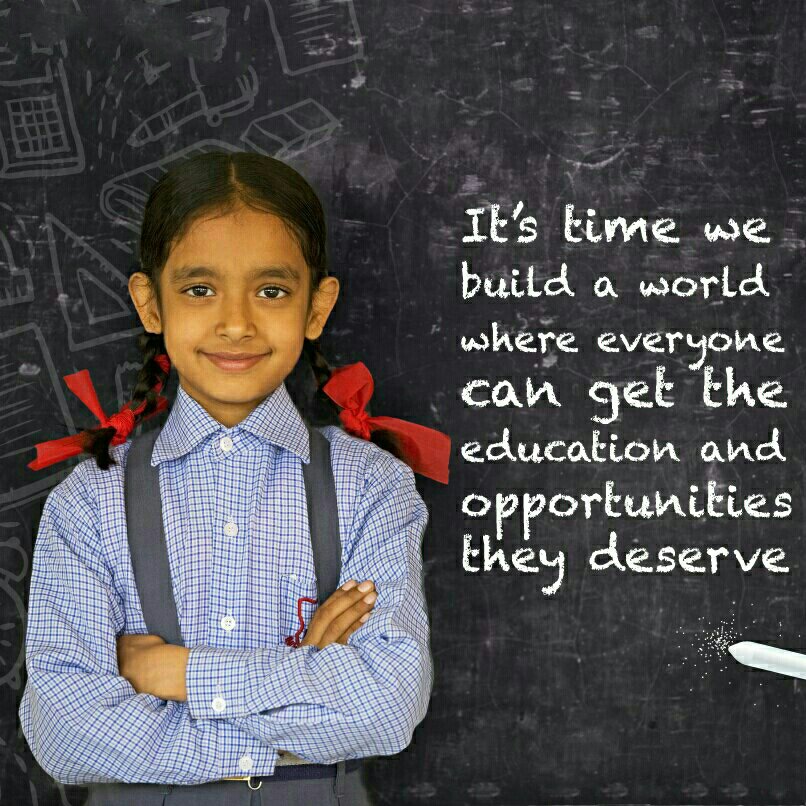
“Education begins the moment we see children as innately wise and capable beings. Only then can we play along in their world.” But unfortunately, there are many children in our country who are yet far away from education. Yes, I am talking about those little buds that must be withering somewhere today. There are still 72 million children in India who are far away from education which is the most important and basic right of a child. And the main reason for which they are deprived of education is their economic circumstances. Because of which they have come so far from education. For this reason, they have to do work like begging, stealing, and what we do later is that we badly abuse them. Friends, we all must have seen the children spreading their hands on the road for the sake of some money. But have you ever thought that why they want to do this or they have some compulsions?
So let me tell you today what their compulsion is – society today stands at a level where education is called a mirror. And this thing is a great example in itself to explain the importance of education. A survey by Child Welfare found that most of the children are deprived of education because the condition or situation in their houses are not good due to which their parents send them to earn wages for living. Their father’s one-day earnings could not even complete the ration. In a poor family, a girl child is assigned household chores and the boy child is sent to work outside. Government’s Sarva Shiksha Abhiyan runs but may not reach the children who need it. “A human becomes a demon without education” and in today’s era, we are well aware of this. Those little hands simply dry up in someone’s house washing dishes and cleaning the dirt.
There are many noble people who are giving free education to poor children by spreading and sharing their knowledge to serve society. There are many great people who are sharing knowledge with poor children and giving free education to them so that those children can grow up and serve for the welfare of the country. So, why can’t we take a step from our side to promote the education of poor children, to motivate them and to make them aware of their rights? so that the lives of those innocent children can be improved and filled with happiness. Even if you start with one child then he or she can improve many lives.
Since then the rural unemployment rate has been on the rise to stand at 8.37% for the week ended August 9 and further to 8.86% in the week ended August 16.Compared with a week earlier, the employment rate and labour participating rate (LPR) also increased to 38.4% and 42.2% from 37.09% and 40.62%, respectively, the Centre for Monitoring Indian Economy (CMIE) said.“There is a big increase in rural India in both employment and unemployment rates. This reflects increased agricultural activities,” CMIE’s managing director and CEO Mahesh Vyas said.Buoyed by hectic sowing activity and jobs offered under rural employment guarantee scheme, MG-NREGS, the unemployment rate in rural India steadily plummeted to 6.34% for the week ended July 12 from 17.92% for the week ended May 31, but it again headed north to 7.10% for the week ended July 19 and further to 7.66% in the very next week; but fell to 6.47% in the week ended August 2.In urban India, the unemployment rate has been steadily decelerating from 25.14% for the week ended May 31 to 8.73% for the week ended August 2; but since then the graph is on the rise to 9.31% for the week ended August 9 and further to 9.61% for the week ended August 16.India’s unemployment rate was a tad higher at 24.3% for the week ended May 24 compared to 24% in the preceding week or the average unemployment rate of 24.2% in the past eight weeks of the lockdown. The unemployment rate stood at 8.8% in March.“A combined factor of demand and supply, lack of opportunities in rural India, crop seasons coming to an end will increase the unemployment scenario in the short to medium term. The micro-lockdowns imposed by stated to curb the spread of covid-19 are having their impact as well,” said K.R. Shyam Sundar, a labour economist and professor at XLRI Jamshedpur.“The economic adjustments via scheme jobs like national employment guarantee scheme will not be able to solve employment problems. Because works provided through those schemes has a wage and skill mismatch for many workers who had returned,” explained Sundar.
Artificial intelligence has became the word of mouth these days everyone is wishing that their job should not get affected by Artificial intelligence. No doubt artificial intelligence is changing the equations in the business world and cutting down the manpower in various businesses. But what is Artificial intelligence ? what is it’s use? Basically Artificial Intelligence is a Method In Computer science where it is taught to understand and mimic human conversation and human behaviour.
USES OF AI IN DIGITAL MARKETING
UNDERSTANDING CONSUMERS BEHAVIOUR- The whole marketing revolves around the the consumer behaviour it is the pivot of the complete marketing plan. Researching and analysing the consumer behaviour is a tough and time taking process still the accuracy is not guaranteed but AI has made it very simple and least time consuming. It provides accurate data about buying patterns and latest trends of the market which are very important to lay down the marketing strategy.
MORE EFFECTIVE- AI has increased the effectiveness of marketing. Digital marketing has become more laser focused targeting only the potential buyers and neglecting the others. AI helps the marketers in scrutinising the audience base.
RISE IN ROI- Increasing ROI is the prime duty of any marketer the amount spent in marketing should give maximum return in the form of sales and conversions.
APPLICATIONS OF AI IN DIGITAL MARKETING
CONTENT CREATION- Content lies at the center in the Web of digital marketing you need content to promote your business on which ever platform. Making a high quality content is a time taking process but with the help of text AI it can be done in a very less span of time for example contentcal.
PRODUCT RECOMMENDATION– Many emails commerce sites like Amazon uses AI for recommending products to its visitors. The AI tracks the interest and behaviour and recommend products according to it.
CHATBOTS- Many business use chatbots to handle customer enquiry it is a very good way of providing a high level of customer service The AI itself reads the query and give reply according to it. Customer get enquiry settlement 24×7 which increase the prestige of the company.
DESIGN AND DEVELOPMENT- You can save yourself from hiring expensive designers and developers if you have good access to AI. AI can do Web design and development in comparatively less time and expenses.
PREDICTION- Like a human mind have tendency to make predictions the AI also have the characteristics of making predictions on the basis of past record and current circumstances it is used in weather forecasts and aviation industry to know about atmospheric conditions. It is also used in digital marketing to predict the upcoming trends in the field.
CONCLUSION-AI is the 8th wonder on this planet it is bringing a new revolution not only in business but in almost every field Digital marketing is going to have a great impact of it marketers will be able to make more effective and efficient marketing plans AI will reduce the time and cost and will definitely speed up the process.
“The only way to change the world is to quit thinking it’s a job for Superman. Real power lies in your own hands.”
― Richelle E. Goodrich,
VOLUNTEERING- A skill not everybody possess. And as the name suggests it has to be voluntary that is it should come from within to take a responsibility ,to manage a work, to guide someone through. Many do not do it because they feel that it is an unnecessary burden,it will consume their time and energy but they forget that in order to grow yourself and your personality it is very important to be an “Initiator” and also to take up activities that will add to your personality. Once, you are in a crowd you need to make your space, you need to stand out. And, if you possess a skill of volunteering it helps you in the process. It is the first step of turning into a leader. The application of soft skills you have, the showcase of your motivation and persuasion skills , all apply here.
Just as the quote you read in the start of this article : That, The only way to change the world is to quit thinking it’s a job for Superman. Real power lies in your own hands. One needs to stop thinking that there would be somebody who would come and help you or others .One needs to stop being dependent ,you need to take your own responsibilities and also encourage others to take theirs. One needs to help those in needs. Everybody wants to take, but the happiness lies when you give. When somebody smiles because of you that is the most priceless moment you can feel.
Let me also state some benefits you will get whn you start to volunteer. First and the foremost, is you start inculcating leadership qualities or may be a manager’s . When you start brain storming,when you start convincing others,when you motivate people, when you communicate, when you start building relationships , it all helps you grow as a leader.
Secondly, you build relationships. Suppose you have taken up a task of volunteering a very big project coming up. You team up and meet a lot of people you have never seen or met before . But,with time you gel up with them you are comfortable and communicating and expressing your thoughts with them .And,it all becomes easier !
You come out of your comfort zone. Nobody wants to leave their space. But,if you really want to male space for you in the real world the forst thing you have to do is step out of your comfort zone. And, volunteering helps you there.
Volunteering can help you advance your career. Everybody is very ambitious now, and wants to reach heights in their respective fields. Through volunteering you can advance your skills and grow in your career domain.
Volunteering is good for your mind and body . Volunteering teaches you stress management.You start counteratting anxiety and tension you would get all the time you take up a task. It turns you into a more patient person. It boosts your self confidence,you feel accomplished.
You build your own network. In the times like today,building your network is very necessary so that in any contingencies you can ask through your network and find jobs or help in which ever way you need.
You become empathetic,you start keeping yourself in the shoes of others and think about them and then take your decision.And oh! it also helps you build your decision making skills.
So, there are so many advantages of volunteering and taking up a responsibilty. So stop asking “WHY and saying “I WILL”
The idea of models that provide a discourse of analysis came into use in the 1970s and 1980s. They were thought as modes of organizing problems and giving them a form and coherence. A model essentially involves the notion of constructing a boundary around reality which is held common and while studying public policy, it is important to note how these models clash and shift around and solve problems.
SYSTEMS MODEL FOR POLICY ANALYSIS
The systems model is associated with David Easton, who defines the political system as that part of the society which is engaged in authoritative allocation of resources. He regards the policy process as a black box and thus this model is also called ‘the Estonian black box model’. The political system for Easton consists of inputs, environments, policy making process, output and feedback.
INSTITUTIONAL APPROACH
This approach focuses on the relationship between public policy and government institutions as policy making majorly depends on the interactions of institutions created by the government. One such institution is the state which is a web of government structures and institutions. It performs various functions like adjudicating between conflicting social and economic interests, guarding the interests of all the sections of the society by accommodating and reconciling them. It also includes the legislatures, executive, bureaucracy, etc.
RATIONAL POLICY MAKING MODEL
Rationality is considered to be the ‘yardstick’ in policy making and this approach emphasizes that policy making is making a choice among policy alternatives on rational ground. In other words, rational policy making means to ‘choose the best option’. A rational policy is designed to maximize net value achievement. This model is associated with Herbert Simon.
LINDBLOM’S INCREMENTAL APPROACH
This model is associated with Charles Lindblom who proposed it as an alternative to the rational model of policy making. His incremental approach, majorly focused upon in his ‘science of muddling through’ involves a process of continually building out from the current situation, step by step and in small degrees. This is the branch approach which is the basis of his approach and is in contrast to the root approach of the rational model wherein the policy makers start anew each time, building on the past experiences. Lindblom rejected the root approach because he believed that constraints on time, intelligence, and cost prevent policy makers from identifying all the alternatives and consequences. Rather, he suggested that successive limited comparison is both more relevant and more realistic in a condition of ‘bounded rationality’.
DROR’S NORMATIVE OPTIMUM MODEL
Dror’s model was an alternative to incrementalism for he believed that incrementalism increased the gap between those who had more power and those who had less power which made it difficult for the latter to bring about change. Thus, as an alternative to this, he proposed a model which seeks to accept the need for rationality, management techniques for enhancing rationality of decision making at low levels, policy science approach for dealing with complex problems and the need to take account of values and irrational elements in decision making.
These models as discussed above, emphasize public policy as an important area of politics and public management and can be understood in terms of policy analysis and through political public policy. Therefore, policy making is a mixture of all these models combined to form a crucial aspect of the political system.
The observance of the Independence Day in 1930 was followed by the launching of the Civil Disobedience Movement under the leadership of Gandhi. It started with the well-known Gandhi Dandi March. In Ahmadabad on the west shores of India, Gandhi left the Sabarmati Ashram at a walking distance of around 385 km from Ahmadabad, with 78 additional Ashram members for Dandi, a town. On 6 April 1930 they arrived in Dandi. The Salt Law was broken by Gandhi. Everyone produced salt illegally as it was a monopoly of the government. By collecting some salt which had formed from the evaporation of the sea, Gandhi challenged the government. In defiance of the salt law, the Civil Disobedience Movement spread across the country. In the first step of the civil disobedience movement, salt distributed across the world became a sign of popular government resistance.
C. Rajgopalchari led the march from Trichinopoly to Vedaranyam in Tamil Nadu, which was close to the Dandi. In Dharsana in Gujarat, in the march to the government’s salt depots Sarojini Naidu, the well-known poet, a leader of the congress and chair of the congress, led nonviolent satyagrahis. More than 300 satyagrahis have been critically wounded and two have been killed by police in a violent case. Demonstrations were held, hartals were held and international goods were boycotted, and taxes subsequently denied. The movement involved lakhs of people, many of them women.
At the first round-table meeting in London in November 1930 the British Government summoned the legislation suggested by the Simon Commission to discuss the change. It was boycotted by the congress, which struggled for the country’s freedom. The Indian kings, Muslim League, Hindu Mahasabha, and others attended. But the members were there. Yet it came out of nowhere. The British government understood that no decision on constitutional amendments would be appropriate to the people of India without the approval of the Congress.
Viceroy Irwin tried to convince the congress to attend the second roundtable conference at the beginning of 1931. There is consensus on the release of all political prisoners for whom no violence is claimed, between Gandhi and Irwin, according to which the government agreed. The convention was intended to postpone the campaign of civil disobedience. This agreement was frustrating for many nationalist leaders. The Congress agreed to accept the agreement and to participate in the second round table conference at its karachi meeting held in March 1931 under Vallabhbhai Patel.
No one was interested in India’s independence, either by princes or by the community leaders. Consequently, no agreement was reached and the second round table conference was broken. The Civil Disobedience Movement resumed. Gandhi returned to India. Also as the conference began, and now it is strengthened, government repression persisted. Arrested were Gandhi and other leaders. The actions of the government to counter the movement can be seen from 120000 individuals sent to gaol in approximately one year. In 1934, the campaign was suspended. A new resolution was adopted by the Congress in 1934. It requested that an adult franchise constituent assembly should be called by the people. He said that for India only a constitution would be drawn up for such an assembly. It therefore confirmed that only the people had the right to decide on their own form of government. The Congress failed to achieve its goal, however, but in the second great mass struggle in the country it managed to mobilise large segments of the people. It also had ambitious aims to change the Indian community.
Niccolò Machiavelli was the first thinker to take an unequivocal stand in regard to the relationship between religion, morality and virtue on the one hand, and politics, on the other. A brief introduction is necessary to acquaint us with this highly debated person in all of political thinking.
Machiavelli was born in Florence in 1468 in a family that was traditionally seen as belonging to middle aristocracy. Machiavelli’s life became more relevant after the year 1498, when he, although barely 29, managed to secure an important job of chief of the second chancellery. He was one of the top policy-makers of the state. His famous work- The Prince was published in 1532. It explored the causes of the rise and fall of states and the factors for political success. It became a constant reference point and inspired different avenues in political research.
To comprehend the full importance of Machiavelli’s writings and their context, it is important to understand the series of political, social, cultural changes that began in the fourteenth century called the Renaissance. It signified a rebirth of the human spirit in the attainment of liberty, self-confidence and optimism. At the centre of the Renaissance was the emergence of the new human who was ambitious and relentless, he motivated by self-interest, and his aim was to seek glory and fame. Alongside the development of the modern individual was also the beginning of the modern state.
Machiavelli saw stable political authority and order as a basic criterion for social cohesion and moral regeneration. It was for this reason that he stressed the need for a unified polity. According to him, the individual was wicked, selfish and egoistic. He was fundamentally weak, ungrateful, fake, anxious to avoid danger and always greedy for gains. Thus, since the individual was lacking in honesty and justice, he was ready to act in a manner that was detrimental to the community.
Machiavelli’s state was a secular entity, with no relation to the church. It was independent and isolated, with no obligation to anything outside itself. A state was necessary, as it existed to fulfil the desire for security of person and property. His ideal was a republic.
Machiavelli’s attitude towards religion was thoroughly utilitarian. It was seen as a social force and did not have any spiritual connotation. As a social force, it played a pivotal role by inducing a kind of behaviour and conduct that was deemed necessary for the well-being of a society. Religion determined the social and ethical norms and values that governed human conduct and actions.
Machiavelli did not condone the use of immoral ways. To him, the end was important, which could be attained by any means. He contended that a ruler need not always adhere to conventional morality. He was convinced that the use of violence although could be controlled, it cannot not be altogether eliminated. However, he recommended the cautious and judicious exercise of such violence, because otherwise it would create widespread distrust and hostility towards the government, which would result in instability.
Reference- A HISTORY OF POLITICAL THOUGHT: PLATO TO MARX. By SUBRATA MUKHERJEE & SUSHILA RAMASWAMY
Environmental issues arose across the world after the Industrial Revolution, during the 19th CE, there was a wide need for a change and development at that time. People desired for a speedy process of production and because of this, it set into motion changes which were unexpected.
Smoke was released across Europe and North America. Plains had turned into deserts, and various other issues had cropped up in USA and Canada too. It was only by the half of the 20th CE, there arose a concern for air and water pollution. The same cannot be said for land pollution, it only came into limelight after the introduction of pesticides. People were overjoyed with the agricultural revolution that they forgot to notice its defects, it was Rachel Carson who brought in the negative impacts of the usage of pesticides in her book ‘Silent Spring’. This gave the environmental movement a boost too. It paved way for a great number of researches across the world.
This made the people the need to have a world wide conference to discuss about the environmental issues and a need to change them. And thus the first global conference was held, it is named as Stockholm Conference. This conference was a pivotal event in the growth of the global concern for environment. This was the first time, countries of the world came to discuss the problems and make up good measures to correct them.
These were the following outcomes of the Stockholm conference
Firstly, people were of the perception that humanity and environment were different and had no connections. This was not the case. After the conference it was made sure that such a thinking has to be shifted off people’s mind in order to save our environment.
Stockholm created a comparison between the developed and developing countries. There were arguments from both sides but it was considered and decisions were made too. The least developed and developing countries were given priority in determining the international policy.
The importance and role played by NGO’s gave more importance to governmental and intergovernmental organizations.
The introduction of United Nations Environmental Program. This program was the best possible solution to the problems of the global world.
After the 1980’s there was a second wave of the environmental movement. This movement focused more on the complex issues and highlighted unresolved ones. Immediate action was taken for this, and this time it was more suitable and better understood than the previous times. Examples are World commission on Environment and Development(1986), Rio Conference(1992), Kyoto Protocol(1997) and the Johannesburg summit (2002).
The World Commission on Environment and Development is popularly known as Brundtland Commission. The commission focused on Sustainable development. The commission wanted to put forward new ideas that could create growth and sustainable development across the country. This promoted the Earth Summit of 1992 Rio de Janerio.
Major outcomes of Rio Summit are
The Framework Convention on Climate Change
The Convention on Biological Diversity
Agenda 21
The Rio Declaration on Environment and Development
Forest Principle
The Rio conference gave birth to the Kyoto Protocol, which was signed in 1997. 160 countries, especially the developed ones came together and promised to cut off their level of emission of greenhouse gases. But this wasn’t the case for every countries, the United States of America withdrew due to its pressure. The next Summit was held in Johannesburg, its main focus was also on sustainable development, many new policies and timetables were made but nothing was quite effective as they had calculated it to be.
Nation states wanted a plan which would help their self- interest rather than the interests as a whole. If we look closely we can see that the globe is divided into two, one set of countries are developed and they add to most of the greenhouse emissions, while the other set of countries are struggling to feed their citizens. And so when policies are to be made, it is to be ensured that it is accordingly to their interests.These were the recent changes brought in by the international systems
Intern at Hariyali Foundation In collaboration with Educational News.
In this fast evolving world, advancements are there along with crimes increasing at a double speed. In the age when puberty arrives into the life of a youngster, there are various changes happening in the body. There are bodily (physical changes) and a lot of mental changes too. It’s a time for evolving of a kid into a well developed individual with good presence of mind and the sense of what is wrong or what is right.
Particularly talking about India, such topics are never discussed seriously and openly neither in family nor at schools. But still growth of an individual will not wait for the society to have a discussion on it; it will take place at the right time with the right person. Many youngsters just can’t handle that what is going on in their body and eventually curse and start hating their selves. It is considered that it’s not all good to talk about such topics openly. Everyone gets so uncomfortable when one has to talk about it or to give some information regarding the same.
Though, it is such a natural process that happens with everyone, discussions on such topics in India are always considered as a taboo.
According to SIECUS, the Sexuality Information and Education Council of the United States, 93% of adults they surveyed support sexuality education in high school and 84% support it in junior high school. In fact, 88% of the parents of junior high school students and 80% of parents of secondary school students believe that sex education in school makes it easier for them to talk to their adolescents about sex. Also, 92% of adolescents report that they want both to talk to their parents about sex and to have comprehensive in-school sex education.
There was lot of expectations from the new education policy that has been introduced recently. Students and psychologists wanted the New Education policy to get included into the course curriculum in schools all across the Nation. But sad it is that there was no such inclusion of education for the students.
Adolescents are always curious to know about what is sex, what is their sexuality and similar topics about which they are never told. After the arrival of social media and its reach to a large group of young children, there are high chances of a child landing into problems like online bullying, indulging into forced sex, addiction to pornography and masturbation, mental disorders because of an uneducated mind, problems like depression and self regret, etc.
Even after regulations by the government there are still a lot of sites filled with dirty videos of pornography that are eating up the future of a productive individual and ultimately a very big loss to the nation and to the person himself. Many crimes against the teenagers take place daily. And also at the same time, many incidents of rapes by teenagers are heard in news and in newspapers too. In most of the cases the convicts and the victims say about a watching inappropriate content on the internet or being forcefully exposed to such content. In this all process, an individual kills himself or herself. They ruin their own future and time because of lack of awareness and knowledge about sex education.
Now, one can estimate how important it is to involve sex education into the course curriculum. There is need of support both from the side of school and from parents too.
The objectives of sex education are to help children understand the body structures of men and women and acquire the knowledge about birth. Teaching children to establish and accept the role and responsibility of their own gender by acquiring the knowledge of sex. Understanding the differences and similarities between two genders in terms of body and mind will set up a foundation for the future development in their acquaintance with friends and lovers and their interpersonal relationship. Sex education is a kind of holistic education. It teaches an individual about self-acceptance and the attitude and skills of interpersonal relationship.
It also helps an individual to cultivate a sense of responsibility for him and the acts what he or she are doing. Its role is similar to like that of power booster; as it gives more power to the jogger to jog long without any difficulty. Similarly, after the bookish knowledge, when an individual knows about his sexuality, healthy sex, sex at the right age, good and bad touch, hormonal changes, the individuals gets completed in himself / herself and becomes into a productive work personnel with proper balance of mind and the sense of responsibility towards his nation, his economy.
Hence, inclusion of sex education into a person’s life will bring stability, peace of mind and the sense of responsibility and help in the wholesome development of an individual.
We see millions of dazzling flowers in our life. We recognise them by their colour, their fragrance and their appearance. But do we know the deep meaning behind them? Do we know what exactly the flower symbolises..?
Hindu Mythology
Mythologies make us see the world from a different perspective. From a different point of view. A rather interesting one . Mythologies make us see a simple flying bird from a different frame of reference. Similarly, in the Hindu mythology many flowers and many objects which we see in our daily lives have a greater meaning to it. One of them is the Parijata flower.
The Story
Once upon a time, there lived a princess named Parijaat. She was exquisitely beautiful and delicate. It is believed that she saw the Sun God( Surya Dev) riding in his chariot from east to west and immediately fell in love with him. Many warned her that the relationship of a God and a materialistic person is not possible, but she was blinded and completely devoted to the Sun God. Even the Sun God was swayed by her devotion and had to descend on the earth to stay with Parijaat for a while. Soon, the summer season arrived. With time, the Sun God’ s energy intensified due to staying on earth and yearned to go back to the heaven. When he stood up in his chariot, to return to heaven, Parijaat tried to follow him. The Sun God’s energy was excessive to its most at that time, and Parijaat being a human, burned due to such a force of energy. The Sun God stood helpless and asked help from the other gods. The Gods, seeing the love of Surya and Parijaat, gave princess Parijaat another life. Hence, she embodiments as a tree of Parijata
In her next life. The Parijata flower was of the purest shade of white,with the bright orange delicate stem like structure. The Parijata flower embellished the love of Parijaat and Surya. But even as a plant,it was affected by the Sunrays. It cannot even stand the first stroke of the Sun and therefore sheds, symbolising the story of Princess Parijaat and Surya. The shedding releases a heavenly scent of the flowers. It has the sweetest scent, because it was believed to be kissed by the Sun God himself.
By Rajatkanti Bera from Shutterstock
Parijata became one of the purest flowers.One of the five divine flowers in heaven. Later, during the time of Samudra Manthana,the gods found a Parijata flower, deep in the milk ocean. Indra declared to have it for himself in his own empire, the gods finally agreed after a lot of thinking. According to them, if Indra did not get the flower, either he would bring droughts in every land or flood every region heavily. Indra’s wife Indrani(Sachi) cherished the flower like her own child with love and affection.
After many years, Narada once visited Krsna and offered him a Parijata flower. He wanted to see who would Krsna give the flower , amongst his wives. Krsna gave the Parijata flower to his first wife, Rukmini. Narada immediately goes to Satyabhama, the second wife of Krsna with a grieved face. Upon Satyabhama asking what the problem was, Narada said about the Parijata flower. Now, Satyabhama ,being a human became furious with jealousy. When Krsna arrived and asked the reason about her anger, she demanded Krsna to give her not the flower but the whole tree of Parijata.
Hence, Lord Krsna set out to the empire of Indra, who was believed to be residing in Amravati. As Lord Krsna worked to root up the tree,the king of Gods, Indra arrived at the place. In some scriptures, it is said that , Indra being intoxicated, challenged Krsna for a combat and was defeated in the most humiliating way,whereas in some scriptures, Indra, understanding that it was Lord Krsna who came to take the tree, allowed him to take the the Parijata. In this way, the Parijata flower descends to the earth. Hence,it is still believed to be the flower which incarnated from heaven.
Not only this, but Parijata leaves also have many medicinal properties! According to indiagardening.com, the Parijata leaves have the properties like,
The leaves having an anti aging property and is often used by people
Helps in the curing of fever, with being anti- malarial.
Usually considered beneficial for dry cough.
The leaves are meant to be good for diseases like Arthritis.
It is also a natural laxative
Source: Pinterest
Parijata leaves have so many more medicinal properties in the branch of Ayurveda.The flowers? Well, as the flowers taste a bit bitter, it is used for ophthalmic disease. It is also said to be very useful for constipation in children. And also for the various treatments like snakebites, antidotes, etc.
Many flowers have deep and philosophical meaning behind them. Which is why mythologies are read. So that we know we should not repeat what happened in the Deut Sabha in Mahabharata. And what happens in the Trojan War.
Fact: Parijata flower is the only flower which can still be offered to the gods after falling to the ground.
There was a guy named Peter. He was good in studies since childhood. He couldn’t see anything but studies. He used to be a school topper every year. He completed his schooling securing the 1st rank. He got the admission in one of the best colleges in the city. He studied hard, attended all the lectures and scored very good marks in his 12th grade. But then he couldn’t make it again in the entrance examination. So he couldn’t secure a good rank in the entrance test. He always had a dream to work for society. He felt engineering could be the bridge to take him there. So he got admitted to an engineering college. He tried to keep on performing well there as well. But he was struggling a bit. Even the failed in some subjects in 3rd year. But he didn’t give up. He took his time and completed his degree with good grades. Now he wanted to join one of the government agencies which serve the people. So he kept on preparing for exams to join those agencies. He gave two precious years of his life to crack the exams, but couldn’t make it. He always kept a dream in front of his eyes since childhood. But now he could see his dream falling apart. He never thought of anything but this in his life. He never had a plan B. Now every day he could hear people around saying he’s just wasting time, he’s doing nothing, he must be earning now. These things got him more into depression. Now he lost all the faith he had on himself. He felt like a loser. A scholar guy from school now was struggling and falling into the valley of depression. He now had the fear of exams. He began to underperform in exams thinking he’s not good enough. He couldn’t even express his feelings to anyone. All he used to do is to cry at night, hiding his tears from the world. An engineer guy was now feeling his value wasn’t even labour. He never knew life would be so harsh to him. At times he felt like giving up but some dead hope made him hold on. One fine day, destiny turned its bad page. He got an opportunity to work as an assistant of the CEO of a laser cutting startup. It was related to his engineering field but as had lost self-belief, he felt like an illiterate. The startup CEO was a kind man. He saw the potential in Peter. He kept on boosting him and trying to make him realise what he really is. It took so much time but now Peter was feeling a bit confident. Now he felt that he isn’t garbage. Soon he regained the knowledge he forgot. Now he was using his ideas for the company and the owner was promoting it. After 2 years, he moulded himself back to his original avatar, which made him manager of the company. He started off when each of his friends had 1-2 years of experience but now just within two years of work, he was earning double than any of his friends. He kept working hard and reached the topmost position. He was now working with his boss as a partner and equal shareholder of the company. The thing we should take from here is good things take time. You might be late as per the world but remember god must be planning something good in future. All you need to do is to keep faith in yourself and keep on trying.
Despite the fact that heterosexual men have worn makeup since 3000 B.C., the journey to normalize beauty and grooming in the 21st century has not been easy.
As with many things our society has deemed solely feminine, like wearing high heels or caring about personal grooming, men thousands of years ago actually took part. Even in the past fifty years, there have been men who embrace makeup, from actors like Johnny Depp to drag queens like RuPaul.
Makeup was documented in ancient Egypt. We see examples of this on many artifacts from the time, with both men and women wearing copious amounts of makeup, with particular attention paid to expressive eyeliner.
According to history, people in ancient Egypt, a civilization that’s known to have started around 3,000 B.C., thought wearing makeup gave them protection from the gods Horus and Ra.
Kohl eyeliner, which they made from grinding minerals like malachite and galena, served as much of a practical purpose as a spiritual one — some believed it warded of flies, infection and the harsh rays of the sun. Turns out, they weren’t exactly wrong about that, with research proving that their eyeliner mixture actually had the ability to prevent eye infections.
One of the men who was most famously a fan of this exaggerated eyeliner look was King Tutankhamen, who was regularly depicted wearing the black or green eyeliner, especially before large dinners and gatherings as a sign of power.
And if you consider nail polish to be makeup like we do, then men have actually been wearing it since 3,200 B.C., with men wearing nail polish to signify class in Babylonia during this time. Men in China and and Egypt also continued this practice as well, using colors to signify a kind of social hierarchy. Beyond Egypt, men in ancient Rome were also known to dabble in makeup, often using powder and rouge and nail polish to add a bit of flair.
Talking about how men wearing makeup started going downhill, it is said that Queen Victoria, who ruled during the late 19th century, who deemed wearing excessive makeup as impolite, associating it with and shaming sex workers. So men (as well as women) backed off a bit longer until the makeup industry modernized, and by “modernized,” it means removed all the lead in the late 19th and early 20th century.
Masculinity is a different definition for everyone, yet it is traditionally associated with men needing to be strong and aggressive, which excludes the act of pampering. With time, instead of men trying to fit this stereotype, they are beginning to advance past it and realize makeup has no boundaries.Society is taking small steps in the right direction to make this industry gender-neutral.
Societal norms of manhood accept anything “rugged,” “natural,” and “tough” while rejecting anything remotely “feminine,” which is considered emasculating for men and damaging to masculinity as a whole. Plus, what is wrong with having feminine features? Men with feminine features can totally rock their features ; makeup, grooming habits for men & having feminine features should be normalized.
The coronavirus has pushed schools all over the world to go online as new waves of infections keep emerging. In India, a country where the gaps in access to education and the Internet were already vast, poor families are struggling to stay the course.Every student needs adequate access to instructional resources and support services in order to achieve academically. Nowhere is this truer than in the area of instructional technology. Students who do not have access to computers and the Internet (among other technologies) will get further and further behind their peers who do. They will miss the instant links to information, entertainment, and communication with others that luckier students have. Their school reports will lack the latest data and the professional look of high resolution graphics and desktop publishing. Socio-economic status to have a major influence on who has access. Computers, modems and Internet service providers (ISPs) are expensive. But the data also suggest that location and race and ethnicity are important factors in the equation. When income is held constant, those who live in rural settings have less access, especially to the Internet, than those who live in metropolitan areas. The majority of users use dial-up modems that rely on phone lines to connect to the Internet. Rural users often cannot afford the long distance charges of connecting to a far away ISP. Faster connection methods such as cable modems and DSL are also only offered in major cities, and wireless and satellite technologies are not yet available in most places. Schools should periodically assess their programs regarding infrastructure, student usage of technology, and the provision of training and technical support to teachers. Several excellent formal ways to do so have been developed by a variety of universities and assistance centers
As feminism has wedged itself between the mainstream and counterculture, we see a new brand arising; it dons ‘The Future is Female’ tee-shirts and says it identifies as feminist, but makes rape jokes and engages in locker-room talk. It’ll use all the right hashtags, share all your Tumblr posts but at the end of the day, it’ll undress, letting go of the feminism it has wrapped around it. I’m talking about ‘fake feminism’, and we’ve all encountered it – whether in the media, a party, or in your Instagram DMs as a ‘nice guy’.
Fake feminism makes false equivalences: in a discussion about rape and abuse, you’ll hear it speak up, “But what about fake accusations?” The problem is that the discussion about false accusations takes precedence over the one about rape, ignoring the rarity of false accusations and the sheer abundance of reports about rape. Furthermore, it’s infuriating when you consider what’s classified as a false accusation could be a true event that’s never lent belief to. What you never hear said by those who talk about false accusations is that men have a higher probability of getting sexually assaulted than being falsely accused, but we almost never seem to talk about men getting raped.
Fake feminism isn’t intersectional, and it brings other women down to maintain the status quo. Feminism that’s meant for the ruling class can’t and shouldn’t be called feminism, and although it’s predominantly practiced by white women, those with significant power and clout wield it too. Beyonce preaches, singing, “Who run the world? Girls,” but abuses her female workers for Ivy Park, her clothing line that ironically aligns itself with women empowerment. As she spouts feminist lyrics, half a world away, she pays her workers 54 cents an hour and prevents them from unionising.
Fake feminism practices irony, a lot. It makes dishwasher jokes and humour that calls women the inferior sex. Natalie Wynn, or Contrapoints on YouTube (as she’s better known) says, “Sometimes irony can be a safe way to explore ideas you’re not quite ready to own.” It’s safe to make these jokes because when someone calls you out on it, you can flip it on them and say they’re not in on the joke, or that they just don’t ‘get it’. It’s not that everyone who makes these jokes hate women, but when you engage in humour with sexist undertones, it might be that misogyny has gotten to you too. It’s no secret that sexist jokes normalise sexism, and they come at the cost of devaluing women and validating sexist mentalities. Speaking of humour, good comedy punches up. Your jokes shouldn’t have to devalue women to be funny.
Fake feminism is constantly clarifying that you’re not ‘that type of feminist.’ It dissociates itself from third wave feminism, saying it stays true to the first and second waves, but the third is too extreme. It cherry-picks and chooses certain extremities of the third wave and uses it as a scapegoat – bra-burning and dyeing armpit hair. It even cites staged events to tell itself why third wave is cancer (like the viral, staged video of the woman pouring bleach on manspreaders). As the third wave does not have a defining piece of legislation, it can be easy to distort it, but to limit to its few inconsequential events ignores the overwhelmingly positive change it has brought us: the fight against workplace sexual harassment, putting women in positions of power, the notion of intersectionality, defeating stereotypes and the #MeToo movement.
In an age of information, it’s an act of ignorance to remain a fake feminist. Take a moment to reevaluate, and spoil yourself with the world of feminist media open to you. To feminists, root out the fakes from within; while it’s not your job to educate them, do them a favour and show them where they’ve gone wrong. As for me, I’ll wait – there’s so much change around me waiting to happen, and I can’t help but try and be a part of it.
There is a lot of news about privatization from Bharat Petroleum Corporation Limited to Air India, but in response to an RTI, it has been revealed that the government is in the process of privatizing a total of 26 companies. These companies range from Pawan Hans Limited to Hindustan Aeronautics Limited. Finance Minister Nirmala Sitharaman had also announced the privatization of 23 PSUs in the past, but the privatization of 26 companies has been revealed in RTI. Among the companies that the government is going to privatize, there are many such companies in which the government’s stake has now reduced drastically.
Among the companies that the government is going to privatize are Air India, Central Electronics Limited, Engineering Projects India Limited, Pawan Hans, B&R, Project and Development India Limited, Cement Corporation India Limited, Indian Medicine and Pharmaceuticals, Salem India Plant, Ferro Scrap Corporation Includes companies like Limited. Not only this, but the government is also going to privatize the Nagannar Steel Plant in Chhattisgarh. Explain that recently, Chhattisgarh CM Bhupesh Baghel wrote a letter to PM Narendra Modi against the privatization of this plant. He said that the tribal society has high hopes from it and privatization of it will give a boost.
Apart from these, Bharat Earthmovers Limited, HLL Lifecare, Bharat Petroleum, Shipping Corporation, Container Corporation of India, Nilanchal Ispat Limited, Hindustan Prefab Limited are also in the privatization list. Not only this, Bharat Pumps and Compressor Limited, Scooters India, Hindustan Newsprint, Karnataka Entrybiotics, Hindustan Antibiotics, India Tourism Development Corporation, and Hindustan Fluorocarbon Limited.
In this RTI, it was also asked about the selling stake of the privatized companies and privatization of UCO Bank. On this, the government has responded that the decision of how much stake of these companies will be sold will be according to the market. The government did not respond to UCO Bank. Let us tell you that the target of disinvestment has been set by the Central Government in the budget this year is Rs 2.1 lakh crore. Apart from selling stake in LIC, the government has started the privatization process in BPCL and Air India.







 Eduindex
You must be logged in to post a comment.